

- Industry Size (2026)
- USD 2.6 Bn
- Forecast (2036)
- USD 4.3 Bn
- CAGR (2026 to 2036)
- 5.2%
High-Performance Descaling and Deliming Chemicals Market Forecast and Outlook 2026 to 2036
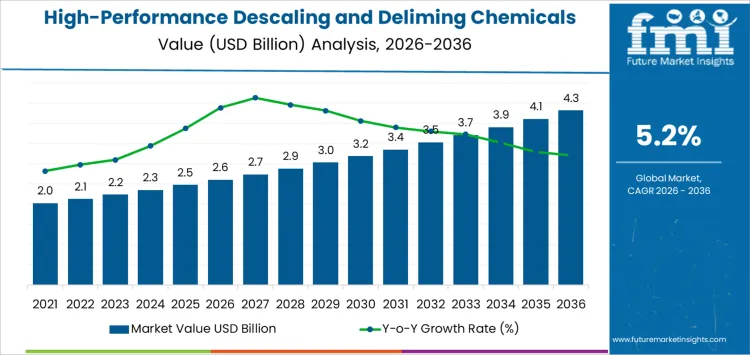
In 2026, the high performance descaling and deliming chemicals market is valued at USD 2.6 billion and is expected to reach USD 4.3 billion by 2036, reflecting a CAGR of 5.2%. Expansion from USD 2.0 billion in 2020 is supported by regular use across foodservice equipment, industrial boilers, and heat exchangers where scale buildup affects efficiency. Acid based descalers remain the primary chemistry due to effectiveness in mineral removal, while liquid concentrates dominate delivery formats for controlled dosing in professional maintenance programs.
From 2027 to 2031, market value increases from USD 2.8 billion to USD 3.4 billion, then progresses steadily toward USD 4.3 billion by 2036. Industrial utilities and hospitality operations anchor demand as descaling cycles remain routine and equipment uptime requirements persist. Commercial buildings and healthcare facilities contribute stable secondary volumes. Organic acid and chelation enhanced formulations gain incremental adoption where material compatibility is critical. Long term growth reflects maintenance driven consumption, predictable replacement demand, and gradual penetration into existing equipment service schedules rather than expansion of treated asset bases.
Quick Stats of the High-Performance Descaling and Deliming Chemicals Market
- High-Performance Descaling and Deliming Chemicals Market Value (2026): USD 2.6 billion
- High-Performance Descaling and Deliming Chemicals Market Forecast Value (2036): USD 4.3 billion
- High-Performance Descaling and Deliming Chemicals Market Forecast CAGR (2026-2036): 5.2%
- Leading Chemistry in the Market: Acid Descalers (Phosphoric/Sulfamic) (44%)
- Key Growth Regions: China, Brazil, USA, U.K., Germany
- Top Players: Ecolab, Diversey, Zep, Spartan Chemical, Betco, 3M, Clorox, Reckitt, Solenis, Kemira
What is the Growth Forecast for the High-Performance Descaling and Deliming Chemicals Market through 2036?
Between 2026 and 2031, the high-performance descaling and deliming chemicals market grows from USD 2.6 billion to around USD 3.2 billion, reflecting steady demand tied to routine maintenance rather than episodic spikes. Consumption in this phase is driven by regular scale removal in food processing equipment, boilers, heat exchangers, and industrial cleaning operations where mineral buildup directly affects efficiency. Growth is supported by predictable service schedules and replacement cycles across manufacturing plants and commercial facilities. Value expansion during this period comes primarily from broader use within existing applications and gradual preference for higher-strength formulations that reduce downtime.
From 2031 to 2036, the market expands from approximately USD 3.2 billion to USD 4.3 billion, showing a clearer acceleration in spending. This phase reflects higher chemical intensity per cleaning cycle, wider deployment across water-intensive industries, and increased reliance on specialized descaling solutions for complex systems. Demand strengthens as operators seek faster turnaround and more reliable performance in hard-water environments. Earlier growth was anchored in routine upkeep, while later expansion is shaped by deeper penetration in industrial maintenance programs, increased service frequency, and tighter operational tolerances across energy, processing, and commercial infrastructure.
High Performance Descaling and Deliming Chemicals Market Key Takeaways
| Metric | Value |
|---|---|
| Market Value (2026) | USD 2.6 billion |
| Forecast Value (2036) | USD 4.3 billion |
| Forecast CAGR (2026-2036) | 5.20% |
How Is Equipment Protection Shaping Demand in the High-Performance Descaling and Deliming Chemicals Market from 2026 to 2036?
Industrial operators increased use of advanced descaling and deliming chemicals to protect capital equipment exposed to mineral rich water. Breweries, laundries, commercial kitchens, and manufacturing plants faced rising maintenance costs when scale accumulated inside pipes, spray arms, and heating elements. Historical demand emerged from reactive maintenance cycles where performance loss triggered chemical cleaning. Facilities relied on strong acidic formulations capable of dissolving hardened deposits without dismantling equipment. Purchasing decisions emphasised compatibility with stainless steel, copper alloys, and seals. Usage patterns aligned with shutdown windows, sanitation cycles, and compliance audits tied to equipment performance and hygiene standards.
Between 2026 and 2036 demand is expected to reflect preventive maintenance strategies rather than corrective cleaning. Facilities adopt scheduled descaling to avoid energy losses and production interruptions. Growth appears in sectors operating continuous systems such as food processing, pharmaceuticals, and thermal utilities. Suppliers develop formulations that balance cleaning strength with lower corrosion risk and shorter neutralisation steps. Buyers examine cleaning frequency reduction, wastewater impact, and ease of on site handling. Demand depends on monitoring of heat efficiency, equipment lifecycle planning, and rising operational scrutiny across regulated industrial and commercial environments.
What Is the Demand for the High-Performance Descaling and Deliming Chemicals Market by Chemistry and Application for 2026 to 2036?
Between 2026 and 2036, the high-performance descaling and deliming chemicals market develops as scale control becomes central to equipment efficiency, energy management, and asset longevity. Acid descalers based on phosphoric and sulfamic chemistries account for 44% due to their rapid reaction with mineral deposits. Industrial heat exchangers and boilers represent the largest application share at 34% as operators manage continuous exposure to hard water, elevated temperatures, and mineral concentration across production and utility systems.
Why do acid descalers based on phosphoric and sulfamic chemistry account for 44% of demand in the high-performance descaling and deliming chemicals market from 2026 to 2036?
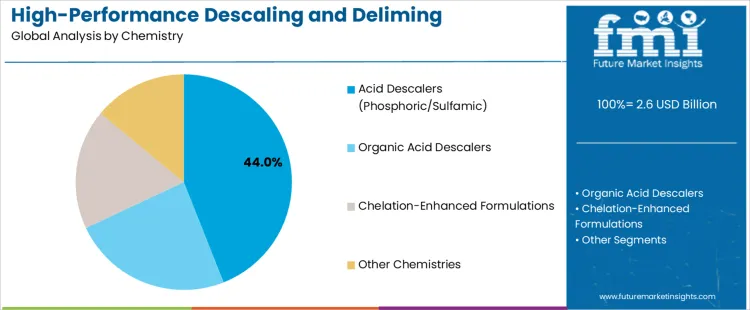
Acid descalers based on phosphoric and sulfamic chemistry account for 44% of demand because these formulations dissolve calcium carbonate, magnesium scale, and mixed mineral deposits with predictable reaction rates. Consumption intensity is high across foodservice operations, light manufacturing, and industrial utilities where equipment uptime depends on efficient heat transfer surfaces. Usage remains consistent as these acids provide controlled corrosion profiles when used with inhibitors, supporting repeated maintenance cycles. Procurement decisions emphasize reaction speed, metal compatibility, and ease of neutralization following treatment. Buyers prioritize chemistries that perform effectively at moderate concentrations, limiting chemical handling volume and downtime. Price sensitivity remains moderate as rapid scale removal reduces energy loss and unplanned maintenance costs. Specification control focuses on acid strength stability, inhibitor effectiveness, and residue management after flushing. Demand continues from 2026 to 2036 as aging infrastructure, higher operating temperatures, and stricter efficiency targets increase reliance on proven mineral-dissolving chemistries. Repeat purchasing patterns remain stable because descaling schedules are planned around operating hours, water hardness, and thermal load. Competitive substitution from weaker acids remains limited where fast turnaround and reliable scale removal are required across mixed-metal systems.
Why do industrial heat exchangers and boilers represent 34% of demand in the high-performance descaling and deliming chemicals market by application from 2026 to 2036?
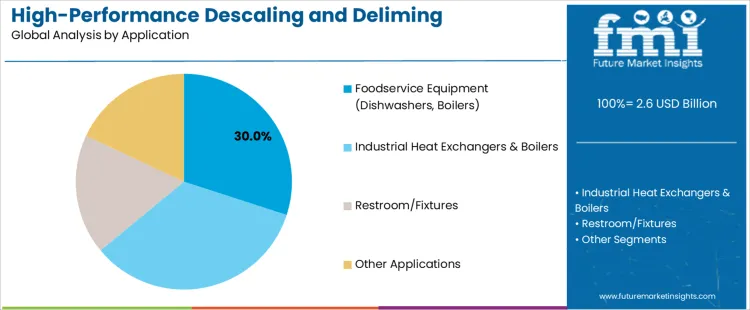
Industrial heat exchangers and boilers represent 34% of demand because scale accumulation directly reduces thermal efficiency and increases fuel consumption. Consumption is concentrated in power generation, chemical processing, food manufacturing, and district heating systems where continuous water circulation promotes mineral precipitation. Usage remains steady as operators follow preventive maintenance schedules tied to pressure drop, temperature deviation, and flow restriction indicators. Procurement favors descaling products compatible with carbon steel, stainless steel, copper alloys, and mixed metallurgy commonly found in heat transfer systems. Buyers value formulations that remove deposits without requiring mechanical disassembly, supporting shorter maintenance windows. Price sensitivity remains moderate since efficiency recovery and extended equipment life deliver measurable cost benefits. Specification control emphasizes penetration capability, gas release control during reaction, and safe disposal after neutralization. Demand persists from 2026 to 2036 as industrial operators manage higher utilization rates and tighter energy performance benchmarks. Repeat utilization remains predictable because water chemistry conditions remain constant within operating regions. Substitution pressure from physical cleaning remains constrained where chemical descaling offers lower labor input and reduced equipment stress.
How Is Demand for High Performance Descaling and Deliming Chemicals Being Defined by Equipment Intensive Operations?
Demand develops through facilities where mineral buildup directly affects uptime, heat transfer, and energy use. Beverage bottling plants rely on descaling agents to keep heat exchangers operating within tolerance during continuous runs. Commercial kitchens apply deliming chemicals to maintain steamers and dishwashers exposed to hard water. Hospitals schedule routine descaling of sterilizers to avoid cycle disruption. District heating operators use these chemicals during planned shutdowns to restore pipe efficiency. These uses arise from maintenance requirements tied to equipment reliability rather than routine surface cleaning, grounding demand in operational continuity.
What Site Specific Maintenance Pressures Are Driving Demand for High Performance Descaling and Deliming Chemicals?
Drivers originate from localized water conditions and asset protection practices. Facilities in hard water regions select stronger formulations to reduce cleaning frequency. Food processing plants adopt high performance descalers to shorten maintenance windows between production shifts. Healthcare facilities rely on precise deliming to protect sensitive instruments from residue damage. Hospitality operators use them to extend appliance life where replacement costs are high. These pressures reflect practical decisions linked to water chemistry, asset lifespan, and maintenance scheduling within specific operating environments.
What Operational Constraints Are Limiting Wider Adoption of High Performance Descaling and Deliming Chemicals?
Barriers relate to handling requirements, material compatibility, and training needs. Some facilities limit use due to concerns over corrosion on older equipment. Strong formulations often require controlled application, which increases labor oversight. Smaller operators hesitate because of higher unit costs compared with mild cleaners. Inconsistent maintenance schedules reduce effectiveness, leading to underuse. Storage and labeling rules also affect procurement in compact facilities. These constraints slow adoption where risk management, cost sensitivity, or limited technical oversight outweigh performance benefits.
What is the Growth Outlook for High Performance Descaling and Deliming Chemicals Across Key Countries?
| Country | CAGR (%) |
|---|---|
| China | 6.2% |
| Brazil | 6.0% |
| USA | 4.9% |
| U.K. | 4.9% |
| Germany | 4.8% |
The high performance descaling and deliming chemicals segment is expanding at a steady pace across industrial, commercial, and institutional cleaning applications. China leads growth at 6.2%, driven by heavy industrial activity, expanding manufacturing facilities, and high demand for scale control in boilers, heat exchangers, and process equipment. Brazil follows at 6.0%, supported by food processing, hospitality, and industrial maintenance requirements. The USA and U.K. each record 4.9%, reflecting stable demand from water systems maintenance, commercial kitchens, and HVAC equipment servicing. Germany at 4.8% shows consistent uptake linked to industrial compliance standards and preventive maintenance practices. Overall growth is shaped by equipment longevity needs, routine maintenance cycles, and continued reliance on chemical based scale removal solutions.
How Are Equipment Maintenance Needs Supporting High Performance Descaling and Deliming Chemicals Demand in the United States?
High performance descaling and deliming chemicals demand in the United States is growing at a CAGR of 4.9% from 2026 to 2036 as industrial facilities, foodservice operations, and commercial buildings maintain equipment efficiency. Facility operators use descaling chemicals to remove mineral buildup from boilers, heat exchangers, and piping systems. Foodservice operators rely on deliming products to maintain performance of dishwashers and beverage equipment. Commercial buildings integrate these chemicals into preventive maintenance schedules. Growth reflects consistent attention to equipment longevity and operational reliability across service and industrial environments.
- Facility operators use descaling chemicals to manage mineral buildup in equipment.
- Foodservice operations rely on deliming products to maintain appliance performance.
- Commercial buildings integrate descaling routines into preventive maintenance programs.
What Is Driving High Performance Descaling and Deliming Chemicals Adoption in Germany?
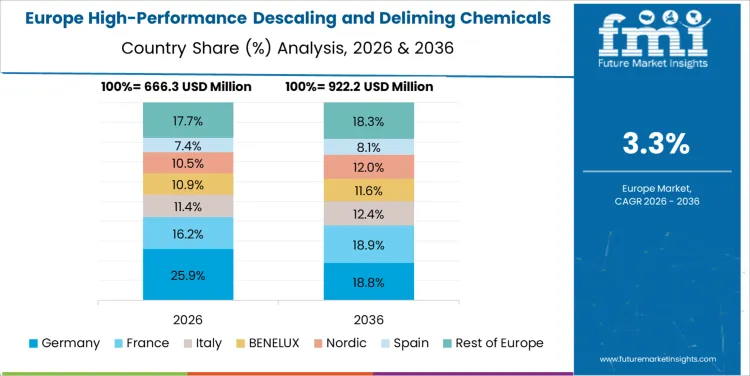
High performance descaling and deliming chemicals demand in Germany is expanding at a CAGR of 4.8% from 2026 to 2036 as industrial plants, public facilities, and commercial users follow structured equipment maintenance practices. Industrial plants apply descaling solutions to maintain thermal efficiency in process systems. Public facilities rely on deliming chemicals to support long term operation of water based equipment. Commercial users integrate these products into scheduled servicing routines. Growth reflects disciplined maintenance cultures aligned with operational precision and equipment protection.
- Industrial plants apply descaling solutions to maintain thermal efficiency.
- Public facilities rely on deliming chemicals for long term equipment operation.
- Commercial users integrate descaling products into scheduled maintenance routines.
Why Is China Recording Faster Growth in High Performance Descaling and Deliming Chemicals Demand?
High performance descaling and deliming chemicals demand in China is increasing at a CAGR of 6.2% from 2026 to 2036 as manufacturing facilities, commercial complexes, and infrastructure projects expand equipment maintenance activity. Manufacturing facilities use descaling chemicals to manage mineral deposits in high use systems. Commercial complexes apply deliming products to support continuous operation of water handling equipment. Infrastructure operators specify descaling chemicals within maintenance contracts. Growth reflects broad scale equipment deployment and rising focus on operational efficiency.
- Manufacturing facilities use descaling chemicals to manage mineral deposits.
- Commercial complexes apply deliming products to support continuous equipment operation.
- Infrastructure operators specify descaling chemicals within maintenance programs.
How Are Operational Practices Influencing Demand in the United Kingdom?
High performance descaling and deliming chemicals demand in the United Kingdom is growing at a CAGR of 4.9% from 2026 to 2036 as offices, hospitality venues, and industrial sites manage mineral buildup across equipment. Office facilities apply descaling products to maintain heating and water systems. Hospitality venues rely on deliming chemicals for kitchen and beverage equipment. Industrial sites integrate descaling routines into maintenance workflows. Growth reflects steady adoption across service and industrial settings focused on equipment care.
- Office facilities apply descaling products to maintain water systems.
- Hospitality venues rely on deliming chemicals for kitchen equipment.
- Industrial sites integrate descaling routines into maintenance workflows.
What Factors Are Supporting Strong Growth in Brazil?
High performance descaling and deliming chemicals demand in Brazil is expanding at a CAGR of 6.0% from 2026 to 2036 as industrial facilities, commercial buildings, and service operators address mineral buildup under challenging water conditions. Industrial facilities apply descaling solutions to maintain equipment efficiency. Commercial buildings rely on deliming products to support heating and cooling systems. Service operators integrate descaling chemicals into routine maintenance. Growth reflects rising attention to equipment performance across industrial and commercial infrastructure.
- Industrial facilities apply descaling solutions to maintain equipment efficiency.
- Commercial buildings rely on deliming products for system upkeep.
- Service operators integrate descaling chemicals into routine maintenance programs.
What Is Driving the Demand for High Performance Descaling and Deliming Chemicals and Which Companies Shape Industrial and Commercial Use
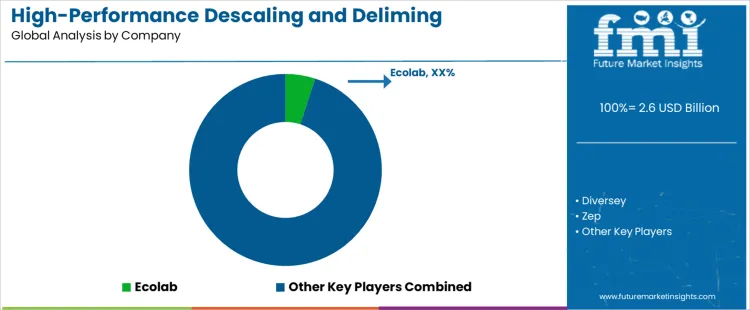
Use of high performance descaling and deliming chemicals is rising as facilities address mineral buildup that affects equipment efficiency, hygiene, and energy consumption. Food processing plants, commercial kitchens, healthcare facilities, and industrial boilers require regular removal of calcium and magnesium deposits to maintain uptime. Ecolab and Diversey support structured maintenance programs through acid based and low corrosion formulations used in heat exchangers, dishwashers, and sanitation systems. Solenis and Kemira serve industrial users through process specific chemistries applied in water systems, cooling towers, and membrane cleaning. Zep, Spartan Chemical, and Betco supply contractors and facility teams managing routine scale control across multi-site operations.
Product selection is governed by scale removal speed, material compatibility, vapor control, and ease of rinsing. 3M participates through specialty cleaners used on equipment surfaces and hard water exposed components. Clorox and Reckitt influence light commercial and institutional use through accessible formulations for restroom and kitchen descaling. Buyers emphasize predictable performance without excessive metal attack or downtime. Usage spans coffee machines, boilers, sterilizers, piping, and wash systems. Demand visibility tracks hard water exposure in urban infrastructure, preventive maintenance adoption, expansion of foodservice chains, and increased focus on extending equipment life through regular chemical cleaning programs.
Key Players in the High Performance Descaling and Deliming Chemicals Market
- Ecolab
- Diversey
- Zep
- Spartan Chemical
- Betco
- 3M
- Clorox
- Reckitt
- Solenis
- Kemira
Scope of the Report
| Items | Values |
|---|---|
| Quantitative Units (2026) | USD billion |
| Chemistry | Acid Descalers based on Phosphoric and Sulfamic Acids; Organic Acid Descalers; Chelation Enhanced Formulations; Other Chemistries |
| Application | Foodservice Equipment including Dishwashers and Boilers; Industrial Heat Exchangers and Boilers; Restroom Fixtures; Other Applications |
| End Use Sector | Industrial and Utilities; Hospitality and Foodservice; Commercial Buildings; Healthcare and Institutions |
| Delivery Format | Liquid Concentrates; Ready to Use Liquids; Powders; Other Formats |
| Regions Covered | Asia Pacific; Europe; North America; Latin America; Middle East and Africa |
| Countries Covered | China; Japan; South Korea; India; Australia and New Zealand; ASEAN; Germany; United Kingdom; France; Italy; Spain; Nordic; BENELUX; United States; Canada; Mexico; Brazil; Chile; Kingdom of Saudi Arabia; Turkey; South Africa; plus 40+ additional countries across Asia Pacific, Europe, Latin America, and Middle East and Africa |
| Key Companies Profiled | Ecolab; Diversey; Zep; Spartan Chemical; Betco; 3M; Clorox; Reckitt; Solenis; Kemira |
| Additional Attributes | Dollar by sales across chemistries, applications, end use sectors, and delivery formats; preventive versus corrective descaling usage patterns; maintenance cycle frequency in hard water regions; material compatibility requirements for mixed metal systems; inhibitor use and corrosion control considerations; wastewater neutralization and disposal practices; role of service contractors in scheduled descaling programs; integration with industrial maintenance and asset management routines |
High Performance Descaling and Deliming Chemicals Market Segmentation
Chemistry:
- Acid Descalers (Phosphoric/Sulfamic)
- Organic Acid Descalers
- Chelation-Enhanced Formulations
- Other Chemistries
Application:
- Foodservice Equipment (Dishwashers, Boilers)
- Industrial Heat Exchangers & Boilers
- Restroom/Fixtures
- Other Applications
End-Use Sector:
- Industrial & Utilities
- Hospitality & Foodservice
- Commercial Buildings
- Healthcare & Institutions
Delivery Format:
- Liquid Concentrates
- RTU Liquids
- Powders
- Other Formats
Region:
- Asia Pacific
- China
- Japan
- South Korea
- India
- Australia & New Zealand
- ASEAN
- Rest of Asia Pacific
- Europe
- Germany
- United Kingdom
- France
- Italy
- Spain
- Nordic
- BENELUX
- Rest of Europe
- North America
- United States
- Canada
- Mexico
- Latin America
- Brazil
- Chile
- Rest of Latin America
- Middle East & Africa
- Kingdom of Saudi Arabia
- Other GCC Countries
- Turkey
- South Africa
- Other African Union
- Rest of Middle East & Africa
Frequently Asked Questions
How big is the high-performance descaling and deliming chemicals market in 2026?
The global high-performance descaling and deliming chemicals market is estimated to be valued at USD 2.6 billion in 2026.
What will be the size of high-performance descaling and deliming chemicals market in 2036?
The market size for the high-performance descaling and deliming chemicals market is projected to reach USD 4.3 billion by 2036.
How much will be the high-performance descaling and deliming chemicals market growth between 2026 and 2036?
The high-performance descaling and deliming chemicals market is expected to grow at a 5.2% CAGR between 2026 and 2036.
What are the key product types in the high-performance descaling and deliming chemicals market?
The key product types in high-performance descaling and deliming chemicals market are acid descalers (phosphoric/sulfamic), organic acid descalers, chelation-enhanced formulations and other chemistries.
Which application segment to contribute significant share in the high-performance descaling and deliming chemicals market in 2026?
In terms of application, foodservice equipment (dishwashers, boilers) segment to command 30.0% share in the high-performance descaling and deliming chemicals market in 2026.
Preview the report firsthand - request a free sample
Get SampleGet the brochure for pricing and purchase details.
Get PDFTable of Content
- Executive Summary
- Global Market Outlook
- Demand-side Trends
- Supply-side Trends
- Technology Roadmap Analysis
- Analysis and Recommendations
- Market Overview
- Market Coverage / Taxonomy
- Market Definition / Scope / Limitations
- Market Background
- Market Dynamics
- Drivers
- Restraints
- Opportunity
- Trends
- Scenario Forecast
- Demand in Optimistic Scenario
- Demand in Likely Scenario
- Demand in Conservative Scenario
- Opportunity Map Analysis
- Product Life Cycle Analysis
- Supply Chain Analysis
- Investment Feasibility Matrix
- Value Chain Analysis
- PESTLE and Porter’s Analysis
- Regulatory Landscape
- Regional Parent Market Outlook
- Production and Consumption Statistics
- Import and Export Statistics
- Market Dynamics
- Global Market Analysis 2021 to 2025 and Forecast, 2026 to 2036
- Historical Market Size Value (USD Million) Analysis, 2021 to 2025
- Current and Future Market Size Value (USD Million) Projections, 2026 to 2036
- Y-o-Y Growth Trend Analysis
- Absolute $ Opportunity Analysis
- Global Market Pricing Analysis 2021 to 2025 and Forecast 2026 to 2036
- Global Market Analysis 2021 to 2025 and Forecast 2026 to 2036, By Chemistry
- Introduction / Key Findings
- Historical Market Size Value (USD Million) Analysis By Chemistry , 2021 to 2025
- Current and Future Market Size Value (USD Million) Analysis and Forecast By Chemistry , 2026 to 2036
- Acid Descalers (Phosphoric/Sulfamic)
- Organic Acid Descalers
- Chelation-Enhanced Formulations
- Other Chemistries
- Y-o-Y Growth Trend Analysis By Chemistry , 2021 to 2025
- Absolute $ Opportunity Analysis By Chemistry , 2026 to 2036
- Global Market Analysis 2021 to 2025 and Forecast 2026 to 2036, By Application
- Introduction / Key Findings
- Historical Market Size Value (USD Million) Analysis By Application, 2021 to 2025
- Current and Future Market Size Value (USD Million) Analysis and Forecast By Application, 2026 to 2036
- Foodservice Equipment (Dishwashers, Boilers)
- Industrial Heat Exchangers & Boilers
- Restroom/Fixtures
- Other Applications
- Y-o-Y Growth Trend Analysis By Application, 2021 to 2025
- Absolute $ Opportunity Analysis By Application, 2026 to 2036
- Global Market Analysis 2021 to 2025 and Forecast 2026 to 2036, By End-Use Sector
- Introduction / Key Findings
- Historical Market Size Value (USD Million) Analysis By End-Use Sector, 2021 to 2025
- Current and Future Market Size Value (USD Million) Analysis and Forecast By End-Use Sector, 2026 to 2036
- Industrial & Utilities
- Hospitality & Foodservice
- Commercial Buildings
- Healthcare & Institutions
- Y-o-Y Growth Trend Analysis By End-Use Sector, 2021 to 2025
- Absolute $ Opportunity Analysis By End-Use Sector, 2026 to 2036
- Global Market Analysis 2021 to 2025 and Forecast 2026 to 2036, By Delivery Format
- Introduction / Key Findings
- Historical Market Size Value (USD Million) Analysis By Delivery Format, 2021 to 2025
- Current and Future Market Size Value (USD Million) Analysis and Forecast By Delivery Format, 2026 to 2036
- Liquid Concentrates
- RTU Liquids
- Powders
- Other Formats
- Y-o-Y Growth Trend Analysis By Delivery Format, 2021 to 2025
- Absolute $ Opportunity Analysis By Delivery Format, 2026 to 2036
- Global Market Analysis 2021 to 2025 and Forecast 2026 to 2036, By Region
- Introduction
- Historical Market Size Value (USD Million) Analysis By Region, 2021 to 2025
- Current Market Size Value (USD Million) Analysis and Forecast By Region, 2026 to 2036
- North America
- Latin America
- Western Europe
- Eastern Europe
- East Asia
- South Asia and Pacific
- Middle East & Africa
- Market Attractiveness Analysis By Region
- North America Market Analysis 2021 to 2025 and Forecast 2026 to 2036, By Country
- Historical Market Size Value (USD Million) Trend Analysis By Market Taxonomy, 2021 to 2025
- Market Size Value (USD Million) Forecast By Market Taxonomy, 2026 to 2036
- By Country
- USA
- Canada
- Mexico
- By Chemistry
- By Application
- By End-Use Sector
- By Delivery Format
- By Country
- Market Attractiveness Analysis
- By Country
- By Chemistry
- By Application
- By End-Use Sector
- By Delivery Format
- Key Takeaways
- Latin America Market Analysis 2021 to 2025 and Forecast 2026 to 2036, By Country
- Historical Market Size Value (USD Million) Trend Analysis By Market Taxonomy, 2021 to 2025
- Market Size Value (USD Million) Forecast By Market Taxonomy, 2026 to 2036
- By Country
- Brazil
- Chile
- Rest of Latin America
- By Chemistry
- By Application
- By End-Use Sector
- By Delivery Format
- By Country
- Market Attractiveness Analysis
- By Country
- By Chemistry
- By Application
- By End-Use Sector
- By Delivery Format
- Key Takeaways
- Western Europe Market Analysis 2021 to 2025 and Forecast 2026 to 2036, By Country
- Historical Market Size Value (USD Million) Trend Analysis By Market Taxonomy, 2021 to 2025
- Market Size Value (USD Million) Forecast By Market Taxonomy, 2026 to 2036
- By Country
- Germany
- UK
- Italy
- Spain
- France
- Nordic
- BENELUX
- Rest of Western Europe
- By Chemistry
- By Application
- By End-Use Sector
- By Delivery Format
- By Country
- Market Attractiveness Analysis
- By Country
- By Chemistry
- By Application
- By End-Use Sector
- By Delivery Format
- Key Takeaways
- Eastern Europe Market Analysis 2021 to 2025 and Forecast 2026 to 2036, By Country
- Historical Market Size Value (USD Million) Trend Analysis By Market Taxonomy, 2021 to 2025
- Market Size Value (USD Million) Forecast By Market Taxonomy, 2026 to 2036
- By Country
- Russia
- Poland
- Hungary
- Balkan & Baltic
- Rest of Eastern Europe
- By Chemistry
- By Application
- By End-Use Sector
- By Delivery Format
- By Country
- Market Attractiveness Analysis
- By Country
- By Chemistry
- By Application
- By End-Use Sector
- By Delivery Format
- Key Takeaways
- East Asia Market Analysis 2021 to 2025 and Forecast 2026 to 2036, By Country
- Historical Market Size Value (USD Million) Trend Analysis By Market Taxonomy, 2021 to 2025
- Market Size Value (USD Million) Forecast By Market Taxonomy, 2026 to 2036
- By Country
- China
- Japan
- South Korea
- By Chemistry
- By Application
- By End-Use Sector
- By Delivery Format
- By Country
- Market Attractiveness Analysis
- By Country
- By Chemistry
- By Application
- By End-Use Sector
- By Delivery Format
- Key Takeaways
- South Asia and Pacific Market Analysis 2021 to 2025 and Forecast 2026 to 2036, By Country
- Historical Market Size Value (USD Million) Trend Analysis By Market Taxonomy, 2021 to 2025
- Market Size Value (USD Million) Forecast By Market Taxonomy, 2026 to 2036
- By Country
- India
- ASEAN
- Australia & New Zealand
- Rest of South Asia and Pacific
- By Chemistry
- By Application
- By End-Use Sector
- By Delivery Format
- By Country
- Market Attractiveness Analysis
- By Country
- By Chemistry
- By Application
- By End-Use Sector
- By Delivery Format
- Key Takeaways
- Middle East & Africa Market Analysis 2021 to 2025 and Forecast 2026 to 2036, By Country
- Historical Market Size Value (USD Million) Trend Analysis By Market Taxonomy, 2021 to 2025
- Market Size Value (USD Million) Forecast By Market Taxonomy, 2026 to 2036
- By Country
- Kingdom of Saudi Arabia
- Other GCC Countries
- Turkiye
- South Africa
- Other African Union
- Rest of Middle East & Africa
- By Chemistry
- By Application
- By End-Use Sector
- By Delivery Format
- By Country
- Market Attractiveness Analysis
- By Country
- By Chemistry
- By Application
- By End-Use Sector
- By Delivery Format
- Key Takeaways
- Key Countries Market Analysis
- USA
- Pricing Analysis
- Market Share Analysis, 2025
- By Chemistry
- By Application
- By End-Use Sector
- By Delivery Format
- Canada
- Pricing Analysis
- Market Share Analysis, 2025
- By Chemistry
- By Application
- By End-Use Sector
- By Delivery Format
- Mexico
- Pricing Analysis
- Market Share Analysis, 2025
- By Chemistry
- By Application
- By End-Use Sector
- By Delivery Format
- Brazil
- Pricing Analysis
- Market Share Analysis, 2025
- By Chemistry
- By Application
- By End-Use Sector
- By Delivery Format
- Chile
- Pricing Analysis
- Market Share Analysis, 2025
- By Chemistry
- By Application
- By End-Use Sector
- By Delivery Format
- Germany
- Pricing Analysis
- Market Share Analysis, 2025
- By Chemistry
- By Application
- By End-Use Sector
- By Delivery Format
- UK
- Pricing Analysis
- Market Share Analysis, 2025
- By Chemistry
- By Application
- By End-Use Sector
- By Delivery Format
- Italy
- Pricing Analysis
- Market Share Analysis, 2025
- By Chemistry
- By Application
- By End-Use Sector
- By Delivery Format
- Spain
- Pricing Analysis
- Market Share Analysis, 2025
- By Chemistry
- By Application
- By End-Use Sector
- By Delivery Format
- France
- Pricing Analysis
- Market Share Analysis, 2025
- By Chemistry
- By Application
- By End-Use Sector
- By Delivery Format
- India
- Pricing Analysis
- Market Share Analysis, 2025
- By Chemistry
- By Application
- By End-Use Sector
- By Delivery Format
- ASEAN
- Pricing Analysis
- Market Share Analysis, 2025
- By Chemistry
- By Application
- By End-Use Sector
- By Delivery Format
- Australia & New Zealand
- Pricing Analysis
- Market Share Analysis, 2025
- By Chemistry
- By Application
- By End-Use Sector
- By Delivery Format
- China
- Pricing Analysis
- Market Share Analysis, 2025
- By Chemistry
- By Application
- By End-Use Sector
- By Delivery Format
- Japan
- Pricing Analysis
- Market Share Analysis, 2025
- By Chemistry
- By Application
- By End-Use Sector
- By Delivery Format
- South Korea
- Pricing Analysis
- Market Share Analysis, 2025
- By Chemistry
- By Application
- By End-Use Sector
- By Delivery Format
- Russia
- Pricing Analysis
- Market Share Analysis, 2025
- By Chemistry
- By Application
- By End-Use Sector
- By Delivery Format
- Poland
- Pricing Analysis
- Market Share Analysis, 2025
- By Chemistry
- By Application
- By End-Use Sector
- By Delivery Format
- Hungary
- Pricing Analysis
- Market Share Analysis, 2025
- By Chemistry
- By Application
- By End-Use Sector
- By Delivery Format
- Kingdom of Saudi Arabia
- Pricing Analysis
- Market Share Analysis, 2025
- By Chemistry
- By Application
- By End-Use Sector
- By Delivery Format
- Turkiye
- Pricing Analysis
- Market Share Analysis, 2025
- By Chemistry
- By Application
- By End-Use Sector
- By Delivery Format
- South Africa
- Pricing Analysis
- Market Share Analysis, 2025
- By Chemistry
- By Application
- By End-Use Sector
- By Delivery Format
- USA
- Market Structure Analysis
- Competition Dashboard
- Competition Benchmarking
- Market Share Analysis of Top Players
- By Regional
- By Chemistry
- By Application
- By End-Use Sector
- By Delivery Format
- Competition Analysis
- Competition Deep Dive
- Ecolab
- Overview
- Product Portfolio
- Profitability by Market Segments (Product/Age /Sales Channel/Region)
- Sales Footprint
- Strategy Overview
- Marketing Strategy
- Product Strategy
- Channel Strategy
- Diversey
- Zep
- Spartan Chemical
- Betco
- 3M
- Clorox
- Reckitt
- Solenis
- Kemira
- Ecolab
- Competition Deep Dive
- Assumptions & Acronyms Used
- Research Methodology


