

- Market Size (2026)
- USD 9.4 Bn
- Forecast (2036)
- USD 38.7 Bn
- CAGR (2026 to 2036)
- 15.2%
AI Performance Marketing Market Size, Market Forecast and Outlook By FMI
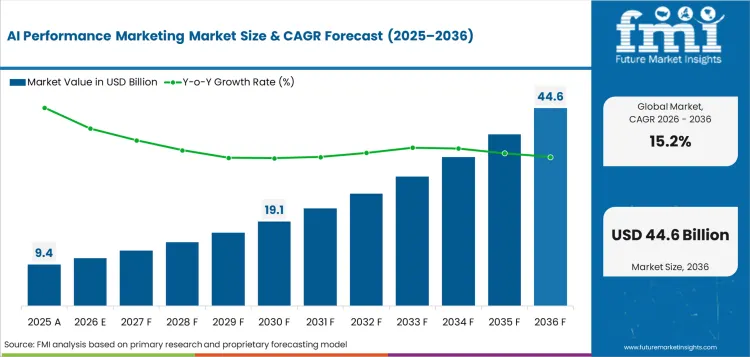
The AI performance marketing market is projected to grow from USD 9.4 billion in 2026 to USD 38.7 billion by 2036, at a CAGR of 15.2%. Software platforms are expected to account for 58.0% of market revenue in 2026, while paid search optimization remains the leading application with a 24.0% share.
Summary of the AI Performance Marketing Market
- Demand and Growth Drivers
- Advertisers are under pressure to improve return on ad spend without scaling headcount at the same pace.
- AI is moving beyond isolated bidding tools into broader workflow control across setup and budget allocation, with creative generation increasingly folded in.
- Performance teams are adopting AI faster where data feedback loops are strong and campaign decisions need to happen daily.
- Product and Segment View
- Software platforms hold the largest share as marketers prefer embedded AI inside ad-buying and measurement workflows.
- Paid search and paid social remain the most active application areas as they offer fast feedback and clear conversion signals.
- Creative optimization tools are gaining more attention as performance teams need more ad variations across channels and audience segments.
- Geography and Competitive Outlook
- North America leads the market through platform concentration and early enterprise adoption.
- Europe is scaling through privacy-aware measurement and agency-led optimization.
- Asia Pacific is becoming more important as mobile-led commerce and ad automation keep expanding across large user bases.
- Analyst Opinion
- "AI performance marketing is no longer limited to bidding automation. The category is shifting toward full-cycle execution where targeting and budget moves increasingly happen inside connected AI systems, with measurement tied more tightly to those decisions," says Anurag Sharma, Principal Consultant.
- The strongest vendors are linking campaign execution with measurement instead of selling AI as a narrow add-on.
- Buyers are placing more weight on workflow speed and signal quality than on headline AI claims.
- The market still has room to grow, though trust will depend on transparency and measurable lift.
Key Takeaways
- The AI performance marketing market is expected to be valued at USD 9.4 billion in 2026.
- By 2036, the AI performance marketing market is forecast to reach USD 38.7 billion.
- From 2026 to 2036, the market is projected to expand at a CAGR of 15.2%.
- The market is expected to create an incremental opportunity of USD 29.3 billion over the forecast period.
- Software platforms remain the largest component segment as buyers keep shifting optimization work into embedded AI workflows.
- Paid search optimization leads application demand in 2026 as advertisers keep using AI to widen reach and improve conversion efficiency.
- The United States remains the largest value market, while the United Kingdom, Germany, Japan, and India continue to shape agency adoption and automation practices.
The sharper opportunity sits in workflow compression rather than in headline ad-tech automation alone. First-hand signals from Adobe's GenStudio for Performance Marketing release, Google's AI Max for Search campaigns, Microsoft's Copilot and Performance Max expansion, and Meta's advertiser usage update show that AI is moving into day-to-day campaign execution, not just experimental tooling. That shifts the market toward vendors that can connect targeting, creative refresh, and measurement in one operating layer. Suppliers that stay limited to narrow optimization tools risk losing relevance as enterprise buyers prefer systems that improve launch speed and explainable performance at the same time.
AI Performance Marketing Market Definition
The AI performance marketing market includes software, services, and optimization tools that use artificial intelligence to improve measurable digital advertising outcomes such as conversions, leads, revenue, return on ad spend, and customer acquisition efficiency. It covers systems used across paid search, paid social, display, video, programmatic advertising, retail media, and cross-channel performance campaigns.
AI Performance Marketing Market Inclusions
Market scope covers AI-enabled campaign management platforms, bidding and budget optimization engines, creative generation and testing tools, audience intelligence systems, measurement and attribution tools, and related managed services sold across enterprise and mid-market performance marketing environments. The study includes segmentation by component, application, deployment mode, organization size, end user, channel focus, and region for the period 2026 to 2036.
Key stakeholder scope includes AI software platform vendors, ad-tech companies, measurement and attribution providers, creative-optimization tool suppliers, agencies, enterprise advertisers, retail-media networks, data partners, managed-service providers, and channel specialists. Platform vendors benefit by embedding automation into daily campaign workflows, agencies benefit by improving output per strategist, and advertisers benefit through faster testing, budget control, and clearer return-on-ad-spend decisions across search, social, retail media, and programmatic channels.
AI Performance Marketing Market Exclusions
The scope does not include general-purpose content generation tools with no performance marketing workflow, pure brand advertising platforms with no measurable optimization layer, or standalone analytics products that do not actively support campaign decisions.
Market Research Methodology
- Primary Research: Review of demand behavior across advertisers, agencies, ad-tech vendors, and channel specialists in major markets.
- Desk Research: Assessment of public company announcements, ad-platform product launches, and digital campaign automation trends.
- Market sizing and forecasting: Revenue modeling based on software and service adoption, campaign automation penetration, and regional performance marketing maturity.
- Data validation: Cross-checking against visible vendor launches, workflow expansion patterns, and enterprise marketing-tech budgets.
Why is the AI Performance Marketing Market Growing?
- Performance teams want more output from fixed budgets and smaller execution teams.
- AI is becoming easier to buy through ad-platform defaults and embedded software features.
- Cross-channel advertising is harder to manage manually as retail media and search automation keep expanding.
Search, social, retail media, and programmatic channels now generate more variables than most teams can handle through spreadsheet-heavy optimization. AI tools help compress that workload into faster targeting and automated budget moves.
Platform-led product launches are reinforcing that shift. Adobe launched GenStudio for Performance Marketing in October 2024 to help teams create and activate ad variations faster. Google introduced AI Max for Search campaigns in May 2025, while Microsoft expanded AI-led campaign execution through Performance Max and Copilot in Microsoft Advertising. These launches show that AI is becoming part of default campaign execution rather than an experimental layer on top.
The market is also benefiting from measurable-use-case clarity. Performance buyers care about whether a tool can improve conversion rates and shorten launch cycles. That makes performance marketing one of the easier enterprise AI categories to commercialize.
The market still faces constraints. Data access is tightening under privacy rules and platform signal loss, attribution remains contested across channels. Some vendors overstate automation quality before the measurement layer is mature. Even so, demand remains strong as advertisers keep moving spend toward systems that can improve efficiency under daily performance pressure.
Market Segmentation Analysis
- Software platforms account for 58.0% of market revenue in 2026 as buyers prefer embedded AI across campaign workflows.
- Paid search optimization holds a 24.0% share in 2026, keeping it the leading application segment.
- Large enterprises remain the biggest buyers, though mid-market adoption is rising as AI tools become easier to deploy through managed interfaces and platform-native workflows.
The AI performance marketing market is segmented by component, application, deployment mode, organization size, end user, channel focus, and region. That structure reflects where value is forming: in software-centered execution, measurable campaign workflows, and channel environments with strong conversion signals.
Insights into the Software Platforms Segment
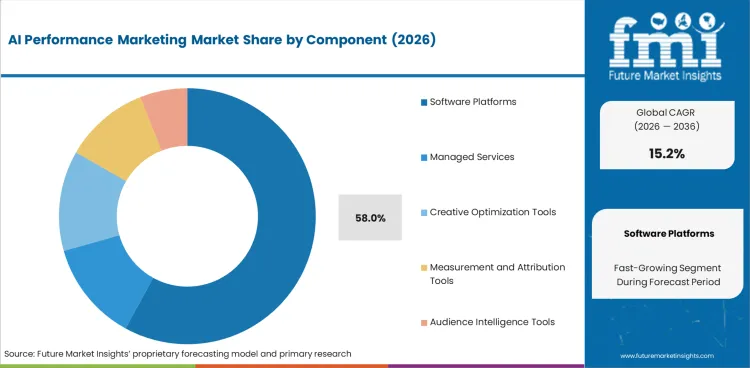
Software platforms are expected to account for 58.0% of the AI performance marketing market in 2026, making them the leading component segment. Buyers prefer platforms that combine audience logic, bidding, asset management, measurement inputs, and workflow controls in one environment. That reduces operational drag and keeps performance teams inside fewer systems.
The segment also benefits from platform-native adoption. Many advertisers first encounter AI through existing ad-buying interfaces rather than through standalone purchases, which supports faster commercialization for embedded software suppliers.
Insights into the Paid Search Optimization Segment
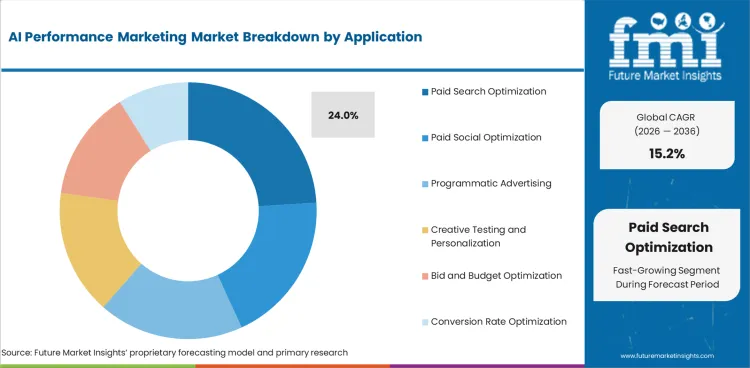
Paid search optimization is expected to hold 24% of the AI performance marketing market in 2026, making it the leading application segment. Search continues to offer strong intent signals, fast testing cycles, and clear performance metrics, which makes it a natural home for automation and AI-led recommendation systems.
This segment is also moving beyond bid management alone. Vendors are adding landing-page analysis, query expansion, asset generation, and budget reallocation features that turn search optimization into a broader AI execution layer.
Insights into the Large Enterprises Segment
Large enterprises are estimated to hold 63.0% revenue share in 2026, supported by higher campaign volume, broader channel mixes, and more complex measurement needs. They manage higher campaign volume, broader channel mixes, and more complex measurement requirements, which gives them a stronger reason to invest in AI-led optimization systems.
Their role remains important in early market scaling. Large brands and agencies often set workflow standards that later move into the mid-market through platform templates, managed services, and lighter software packages.
AI Performance Marketing Market Drivers, Restraints, and Opportunities
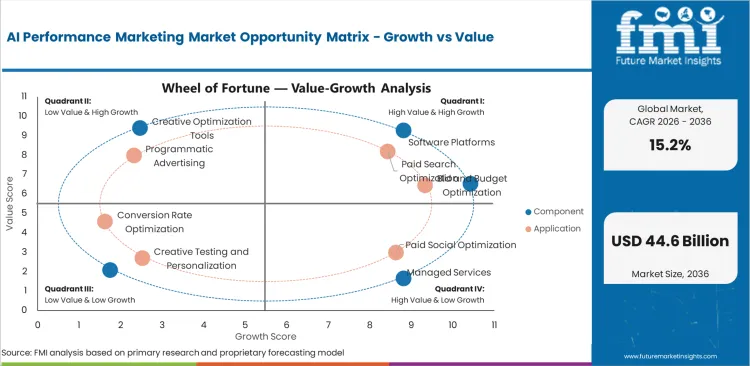
- Budget efficiency pressure remains the main demand driver.
- Privacy-driven signal loss and measurement opacity continue to restrain adoption quality.
- The strongest opportunities are opening in retail media and creative automation, especially where cross-channel campaign orchestration is weak.
The market is expanding quickly, though execution quality still varies. Advertisers are not only looking for automation. They want systems that can make campaign work more productive without making performance harder to explain.
Efficiency Pressure Is Accelerating AI Adoption
Marketing teams are expected to deliver more revenue from the same or smaller media budgets. That pushes buyers toward AI systems that can speed up testing, allocate spend faster, and identify wasted impressions earlier.
Measurement Friction and Trust Gaps Limit Full Automation
The main restraint is not interest. It is confidence. If a buyer cannot see why an AI system changed spend levels or audience mix, trust weakens. Privacy rules, signal fragmentation, and inconsistent attribution models make that problem harder to solve.
Upside Is Strongest in Retail Media and Creative Throughput
The clearest opportunity sits in channels and tasks that generate too much optimization work for human teams alone. Retail media expansion, asset variation at scale, and cross-channel budget coordination are creating practical openings for AI-first performance tools.
Regional Market Analysis
.webp "Top Country Growth Comparison Ai Performance Marketing Market Cagr (2026 2036)")
- The United States is projected to grow at 16.0% CAGR from 2026 to 2036 and remain the largest market in value terms.
- The United Kingdom and Germany are expected to expand at 14.5% and 13.9%, supported by agency digitization and privacy-aware measurement demand.
- Japan and India are forecast to post 13.2% and 16.8% growth as digital commerce and automation-led campaign management expand.
The AI performance marketing market is likely to scale first in countries where digital ad spend and measurement sophistication intersect. North America leads the first commercial wave, while Europe and Asia Pacific are shaping the next phase of privacy-aware optimization and mobile-led scale.
How is the United States Shaping the AI Performance Marketing Market?
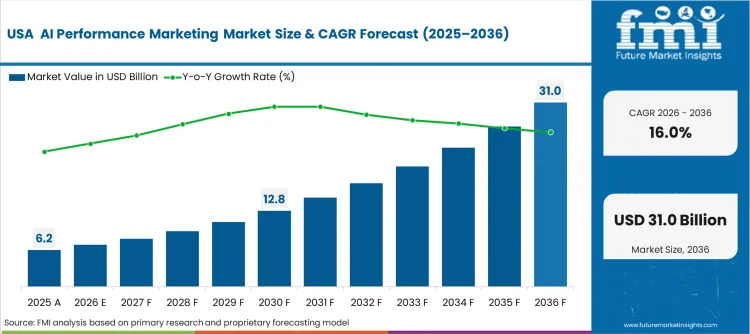
The United States remains the anchor market for AI performance marketing. It has the strongest mix of platform concentration and measurable digital ad spend.
- Large platform vendors are rolling out AI campaign controls first in the U.S.
- Retail media and paid social adoption keep adding optimization complexity.
- Buyers are more willing to test AI-led creative and measurement workflows at scale.
What is the Outlook on United Kingdom AI Performance Marketing Market?
The United Kingdom has advanced agency ecosystems and a mature e-commerce market. Buyers in the UK are more likely to evaluate AI tools through efficiency and governance during the forecast period.
- Agency influence helps new software categories move faster into active campaign use.
- Cross-channel performance management is already a core requirement in many accounts.
- Measurement transparency matters more as buyers scrutinize platform claims closely.
What Is Driving Demand in Germany?
Germany remains important as a market where performance buyers tend to reward workflow discipline and compliance-aware technology choices. AI adoption is likely to move through enterprise martech modernization and measurable productivity gains.
- Advertisers are more cautious with opaque automation layers.
- Privacy-aware measurement approaches matter more in purchase decisions.
- Enterprise software integration is a stronger selling point than aggressive AI positioning.
How Are Japan and India Expanding the Market?
Japan and India are expanding the market through different routes. Japan supports quality-led automation in mature digital environments, while India adds growth through mobile commerce and high campaign volume.
- Japan rewards stable workflow automation and high-precision optimization.
- India benefits from large advertiser bases moving into platform-native AI tools.
- Both markets support stronger demand for scalable creative and audience automation.
Competitive Landscape and Strategic Positioning
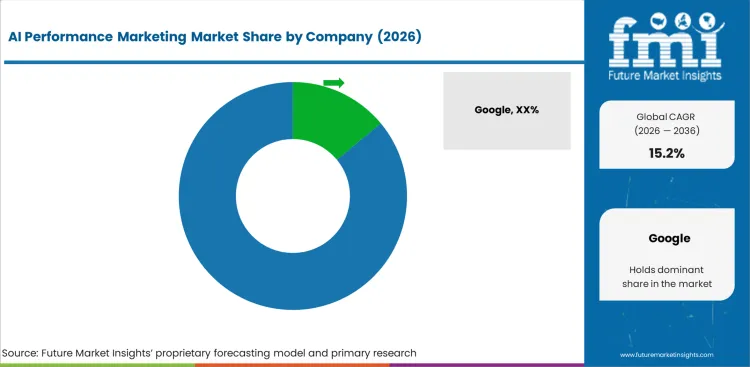
- Competition spans major ad platforms, enterprise software vendors, ad-tech specialists, and managed-service providers.
- Competitive strength depends on signal access and performance gains remain measurable.
- The strongest vendors are tying AI outputs directly to campaign action instead of offering disconnected analytics alone.
Competition is intensifying as AI becomes embedded across campaign setup and measurement. Large platforms still control the most direct signals, though software vendors are gaining ground by connecting planning and performance review in one workflow.
Platform owners can automate at execution depth, while software vendors offer broader orchestration across channels. Agencies and service providers still retain a role where advertisers need governance or mixed-platform execution.
Trust will remain the main commercial filter. Buyers want proof that AI improves performance without turning campaign logic into a black box. Vendors that can link automation with explainable measurement are in the strongest position.
Key Companies in the AI Performance Marketing Market
Key companies active in the market include Google, Meta, Adobe, Microsoft, TikTok, and AppLovin.
Competitive Benchmarking: AI Performance Marketing Market
| Company | Core Strength | Primary AI Performance Marketing Exposure | Strategic Positioning | Geographic Footprint |
|---|---|---|---|---|
| Search advertising scale and campaign automation | AI Max for Search campaigns and AI-led ad asset optimization | Platform-native performance automation | Global | |
| Meta | Paid social reach and conversion optimization | Advantage+ and generative AI ad tools for campaign efficiency | AI-led social performance engine | Global |
| Adobe | Enterprise creative and marketing workflow stack | GenStudio for Performance Marketing | Creative-to-activation workflow platform | Global |
| Microsoft | Search, audience, and workflow productivity layer | Performance Max and Copilot in Microsoft Advertising | Cross-surface AI campaign automation | Global |
| TikTok | Short-form video ad demand and automation tools | Smart campaign automation and generative ad enhancements | Performance-led video advertising platform | Global |
| AppLovin | Mobile performance advertising and ad-tech optimization | AI-supported performance ad creative and app-growth workflows | Mobile-first performance marketing engine | Global |
Key Developments in AI Performance Marketing Market
- Adobe announced the general availability of GenStudio for Performance Marketing in October 2024, giving brands a generative AI-first application for paid media and marketing content workflows.
- Microsoft made Performance Max globally available in March 2024 and expanded Copilot in Microsoft Advertising in June 2024, strengthening AI-led campaign execution across its ad network.
- Meta said in September 2024 that more than one million advertisers were using its generative AI ad tools, with 15 million ads created in the prior month.
- Google introduced AI Max for Search campaigns in May 2025, expanding AI-led targeting and creative controls in search advertising.
- TikTok announced new automation updates for advertisers in November 2025, adding GenAI-driven creative enhancements and more automation controls for campaign performance.
Key Players in the AI Performance Marketing Market
Major Global Players
- Meta
- Adobe
- Microsoft
- TikTok
- AppLovin
Emerging and Specialist Growth Providers
- Independent ad-tech vendors, measurement startups, creative testing software providers, and retail media optimization specialists are likely to widen the field over the next few years. Their role will be most visible where buyers need cross-platform orchestration or more transparent optimization logic than closed platforms provide.
Research Scope and Coverage
| Attribute | Details |
|---|---|
| Estimated market size (2026) | USD 9.4 billion |
| Projected market size (2036) | USD 38.7 billion |
| CAGR (2026 to 2036) | 15.2% |
| Quantitative units | USD billion |
| Key segment coverage | Component , Application , Deployment Mode , Organization Size , End User , Channel Focus , and Region |
| Regions covered | North America, Europe, Asia Pacific, Latin America, Middle East and Africa |
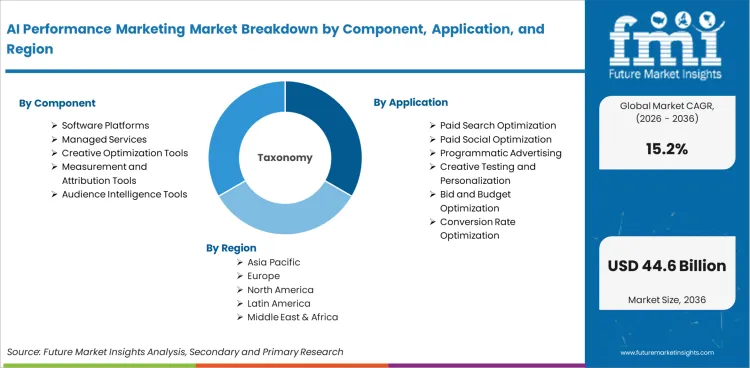
Segment Analysis by Component, Application, Deployment Mode, Organization Size, End User, Channel Focus, and Region
By Component:
- Software Platforms
- Managed Services
- Creative Optimization Tools
- Measurement and Attribution Tools
- Audience Intelligence Tools
By Application:
- Paid Search Optimization
- Paid Social Optimization
- Programmatic Advertising
- Creative Testing and Personalization
- Bid and Budget Optimization
- Conversion Rate Optimization
By Deployment Mode:
- Cloud-based
- Hybrid
By Organization Size:
- Large Enterprises
- Small and Mid-sized Businesses
By End User:
- Retail and E-commerce
- Media and Entertainment
- Travel and Hospitality
- Financial Services
- Consumer Goods
- Technology and SaaS
- Healthcare
- Other Services
By Channel Focus:
- Search
- Social
- Display
- Video
- Retail Media
- Cross-channel
By Region:
- North America
- Latin America
- Europe
- East Asia
- South Asia and Pacific
- Middle East and Africa
Research Sources and Bibliography
- 1. FMI analysis, 2026.
- 2. Official company announcements and product launch disclosures referenced in the competitive landscape and key developments sections.
- 3. Company product pages, investor communications, and technology or portfolio documentation referenced for market context.
- 4. Public industry documentation, platform updates, and regulatory or standards-related materials used for category framing where relevant.
This Report Answers
- What is the projected value of the AI Performance Marketing Market in 2026 and 2036?
- What is the expected CAGR from 2026 to 2036?
- Which segment currently contributes the largest share in the market structure?
- Which countries are expected to expand faster than the global average through 2036?
- Which companies hold the strongest visible positions in the current competitive landscape?
- What commercial factors are supporting current market adoption?
- Which product, application, or end-use areas are expected to create the strongest opportunity?
Frequently Asked Questions
What is the global market demand for AI Performance Marketing Market in 2026?
In 2026, the global market for AI Performance Marketing Market is estimated at USD 9.4 billion.
What is the forecast market value by 2036?
By 2036, the market is projected to reach USD 38.7 billion under the base-case forecast model.
What is the forecast CAGR from 2026 to 2036?
The market is expected to expand at a 15.2% CAGR during the forecast period.
Which segment leads the market?
The leading segment is identified in the market segmentation analysis based on FMI estimates for 2026.
Which countries are expected to expand faster than the global average?
The regional market analysis highlights the faster-growing country markets under the FMI forecast model.
Why is AI Performance Marketing Market gaining market traction?
Adoption is rising as suppliers and buyers respond to measurable operational, commercial, and performance needs in the category.
Preview the report firsthand - request a free sample
Get SampleGet the brochure for pricing and purchase details.
Get PDFTable of Content
- Executive Summary
- Global Market Outlook
- Demand-side Trends
- Supply-side Trends
- Technology Roadmap Analysis
- Analysis and Recommendations
- Market Overview
- Market Coverage / Taxonomy
- Market Definition / Scope / Limitations
- Research Methodology
- Chapter Orientation
- Analytical Lens and Working Hypotheses
- Market Structure, Signals, and Trend Drivers
- Benchmarking and Cross-market Comparability
- Market Sizing, Forecasting, and Opportunity Mapping
- Research Design and Evidence Framework
- Desk Research Programme (Secondary Evidence)
- Company Annual and Sustainability Reports
- Peer-reviewed Journals and Academic Literature
- Corporate Websites, Product Literature, and Technical Notes
- Earnings Decks and Investor Briefings
- Statutory Filings and Regulatory Disclosures
- Technical White Papers and Standards Notes
- Trade Journals, Industry Magazines, and Analyst Briefs
- Conference Proceedings, Webinars, and Seminar Materials
- Government Statistics Portals and Public Data Releases
- Press Releases and Reputable Media Coverage
- Specialist Newsletters and Curated Briefings
- Sector Databases and Reference Repositories
- FMI Internal Proprietary Databases and Historical Market Datasets
- Subscription Datasets and Paid Sources
- Social Channels, Communities, and Digital Listening Inputs
- Additional Desk Sources
- Expert Input and Fieldwork (Primary Evidence)
- Primary Modes
- Qualitative Interviews and Expert Elicitation
- Quantitative Surveys and Structured Data Capture
- Blended Approach
- Why Primary Evidence is Used
- Field Techniques
- Interviews
- Surveys
- Focus Groups
- Observational and In-context Research
- Social and Community Interactions
- Stakeholder Universe Engaged
- C-suite Leaders
- Board Members
- Presidents and Vice Presidents
- R&D and Innovation Heads
- Technical Specialists
- Domain Subject-matter Experts
- Scientists
- Physicians and Other Healthcare Professionals
- Governance, Ethics, and Data Stewardship
- Research Ethics
- Data Integrity and Handling
- Primary Modes
- Tooling, Models, and Reference Databases
- Desk Research Programme (Secondary Evidence)
- Data Engineering and Model Build
- Data Acquisition and Ingestion
- Cleaning, Normalisation, and Verification
- Synthesis, Triangulation, and Analysis
- Quality Assurance and Audit Trail
- Market Background
- Market Dynamics
- Drivers
- Restraints
- Opportunity
- Trends
- Scenario Forecast
- Demand in Optimistic Scenario
- Demand in Likely Scenario
- Demand in Conservative Scenario
- Opportunity Map Analysis
- Product Life Cycle Analysis
- Supply Chain Analysis
- Investment Feasibility Matrix
- Value Chain Analysis
- PESTLE and Porter’s Analysis
- Regulatory Landscape
- Regional Parent Market Outlook
- Production and Consumption Statistics
- Import and Export Statistics
- Market Dynamics
- Global Market Analysis 2021 to 2025 and Forecast, 2026 to 2036
- Historical Market Size Value (USD Million) Analysis, 2021 to 2025
- Current and Future Market Size Value (USD Million) Projections, 2026 to 2036
- Y-o-Y Growth Trend Analysis
- Absolute $ Opportunity Analysis
- Global Market Pricing Analysis 2021 to 2025 and Forecast 2026 to 2036
- Global Market Analysis 2021 to 2025 and Forecast 2026 to 2036, By Component
- Introduction / Key Findings
- Historical Market Size Value (USD Million) Analysis By Component , 2021 to 2025
- Current and Future Market Size Value (USD Million) Analysis and Forecast By Component , 2026 to 2036
- Software Platforms
- Managed Services
- Creative Optimization Tools
- Measurement and Attribution Tools
- Audience Intelligence Tools
- Software Platforms
- Y-o-Y Growth Trend Analysis By Component , 2021 to 2025
- Absolute $ Opportunity Analysis By Component , 2026 to 2036
- Global Market Analysis 2021 to 2025 and Forecast 2026 to 2036, By Application
- Introduction / Key Findings
- Historical Market Size Value (USD Million) Analysis By Application, 2021 to 2025
- Current and Future Market Size Value (USD Million) Analysis and Forecast By Application, 2026 to 2036
- Paid Search Optimization
- Paid Social Optimization
- Programmatic Advertising
- Creative Testing and Personalization
- Bid and Budget Optimization
- Conversion Rate Optimization
- Paid Search Optimization
- Y-o-Y Growth Trend Analysis By Application, 2021 to 2025
- Absolute $ Opportunity Analysis By Application, 2026 to 2036
- Global Market Analysis 2021 to 2025 and Forecast 2026 to 2036, By Region
- Introduction
- Historical Market Size Value (USD Million) Analysis By Region, 2021 to 2025
- Current Market Size Value (USD Million) Analysis and Forecast By Region, 2026 to 2036
- North America
- Latin America
- Western Europe
- Eastern Europe
- East Asia
- South Asia and Pacific
- Middle East & Africa
- Market Attractiveness Analysis By Region
- North America Market Analysis 2021 to 2025 and Forecast 2026 to 2036, By Country
- Historical Market Size Value (USD Million) Trend Analysis By Market Taxonomy, 2021 to 2025
- Market Size Value (USD Million) Forecast By Market Taxonomy, 2026 to 2036
- By Country
- USA
- Canada
- Mexico
- By Component
- By Application
- By Country
- Market Attractiveness Analysis
- By Country
- By Component
- By Application
- Key Takeaways
- Latin America Market Analysis 2021 to 2025 and Forecast 2026 to 2036, By Country
- Historical Market Size Value (USD Million) Trend Analysis By Market Taxonomy, 2021 to 2025
- Market Size Value (USD Million) Forecast By Market Taxonomy, 2026 to 2036
- By Country
- Brazil
- Chile
- Rest of Latin America
- By Component
- By Application
- By Country
- Market Attractiveness Analysis
- By Country
- By Component
- By Application
- Key Takeaways
- Western Europe Market Analysis 2021 to 2025 and Forecast 2026 to 2036, By Country
- Historical Market Size Value (USD Million) Trend Analysis By Market Taxonomy, 2021 to 2025
- Market Size Value (USD Million) Forecast By Market Taxonomy, 2026 to 2036
- By Country
- Germany
- UK
- Italy
- Spain
- France
- Nordic
- BENELUX
- Rest of Western Europe
- By Component
- By Application
- By Country
- Market Attractiveness Analysis
- By Country
- By Component
- By Application
- Key Takeaways
- Eastern Europe Market Analysis 2021 to 2025 and Forecast 2026 to 2036, By Country
- Historical Market Size Value (USD Million) Trend Analysis By Market Taxonomy, 2021 to 2025
- Market Size Value (USD Million) Forecast By Market Taxonomy, 2026 to 2036
- By Country
- Russia
- Poland
- Hungary
- Balkan & Baltic
- Rest of Eastern Europe
- By Component
- By Application
- By Country
- Market Attractiveness Analysis
- By Country
- By Component
- By Application
- Key Takeaways
- East Asia Market Analysis 2021 to 2025 and Forecast 2026 to 2036, By Country
- Historical Market Size Value (USD Million) Trend Analysis By Market Taxonomy, 2021 to 2025
- Market Size Value (USD Million) Forecast By Market Taxonomy, 2026 to 2036
- By Country
- China
- Japan
- South Korea
- By Component
- By Application
- By Country
- Market Attractiveness Analysis
- By Country
- By Component
- By Application
- Key Takeaways
- South Asia and Pacific Market Analysis 2021 to 2025 and Forecast 2026 to 2036, By Country
- Historical Market Size Value (USD Million) Trend Analysis By Market Taxonomy, 2021 to 2025
- Market Size Value (USD Million) Forecast By Market Taxonomy, 2026 to 2036
- By Country
- India
- ASEAN
- Australia & New Zealand
- Rest of South Asia and Pacific
- By Component
- By Application
- By Country
- Market Attractiveness Analysis
- By Country
- By Component
- By Application
- Key Takeaways
- Middle East & Africa Market Analysis 2021 to 2025 and Forecast 2026 to 2036, By Country
- Historical Market Size Value (USD Million) Trend Analysis By Market Taxonomy, 2021 to 2025
- Market Size Value (USD Million) Forecast By Market Taxonomy, 2026 to 2036
- By Country
- Kingdom of Saudi Arabia
- Other GCC Countries
- Turkiye
- South Africa
- Other African Union
- Rest of Middle East & Africa
- By Component
- By Application
- By Country
- Market Attractiveness Analysis
- By Country
- By Component
- By Application
- Key Takeaways
- Key Countries Market Analysis
- USA
- Pricing Analysis
- Market Share Analysis, 2025
- By Component
- By Application
- Canada
- Pricing Analysis
- Market Share Analysis, 2025
- By Component
- By Application
- Mexico
- Pricing Analysis
- Market Share Analysis, 2025
- By Component
- By Application
- Brazil
- Pricing Analysis
- Market Share Analysis, 2025
- By Component
- By Application
- Chile
- Pricing Analysis
- Market Share Analysis, 2025
- By Component
- By Application
- Germany
- Pricing Analysis
- Market Share Analysis, 2025
- By Component
- By Application
- UK
- Pricing Analysis
- Market Share Analysis, 2025
- By Component
- By Application
- Italy
- Pricing Analysis
- Market Share Analysis, 2025
- By Component
- By Application
- Spain
- Pricing Analysis
- Market Share Analysis, 2025
- By Component
- By Application
- France
- Pricing Analysis
- Market Share Analysis, 2025
- By Component
- By Application
- India
- Pricing Analysis
- Market Share Analysis, 2025
- By Component
- By Application
- ASEAN
- Pricing Analysis
- Market Share Analysis, 2025
- By Component
- By Application
- Australia & New Zealand
- Pricing Analysis
- Market Share Analysis, 2025
- By Component
- By Application
- China
- Pricing Analysis
- Market Share Analysis, 2025
- By Component
- By Application
- Japan
- Pricing Analysis
- Market Share Analysis, 2025
- By Component
- By Application
- South Korea
- Pricing Analysis
- Market Share Analysis, 2025
- By Component
- By Application
- Russia
- Pricing Analysis
- Market Share Analysis, 2025
- By Component
- By Application
- Poland
- Pricing Analysis
- Market Share Analysis, 2025
- By Component
- By Application
- Hungary
- Pricing Analysis
- Market Share Analysis, 2025
- By Component
- By Application
- Kingdom of Saudi Arabia
- Pricing Analysis
- Market Share Analysis, 2025
- By Component
- By Application
- Turkiye
- Pricing Analysis
- Market Share Analysis, 2025
- By Component
- By Application
- South Africa
- Pricing Analysis
- Market Share Analysis, 2025
- By Component
- By Application
- USA
- Market Structure Analysis
- Competition Dashboard
- Competition Benchmarking
- Market Share Analysis of Top Players
- By Regional
- By Component
- By Application
- Competition Analysis
- Competition Deep Dive
- Google
- Overview
- Product Portfolio
- Profitability by Market Segments (Product/Age /Sales Channel/Region)
- Sales Footprint
- Strategy Overview
- Marketing Strategy
- Product Strategy
- Channel Strategy
- Meta
- Adobe
- Microsoft
- TikTok
- AppLovin
- Google
- Competition Deep Dive
- Assumptions & Acronyms Used


