

- Market Size (2026)
- USD 6.2 Bn
- Forecast (2036)
- USD 20.04 Bn
- CAGR (2026 to 2036)
- 12.6%
AI Marketing Tool Market Size, Market Forecast and Outlook By FMI
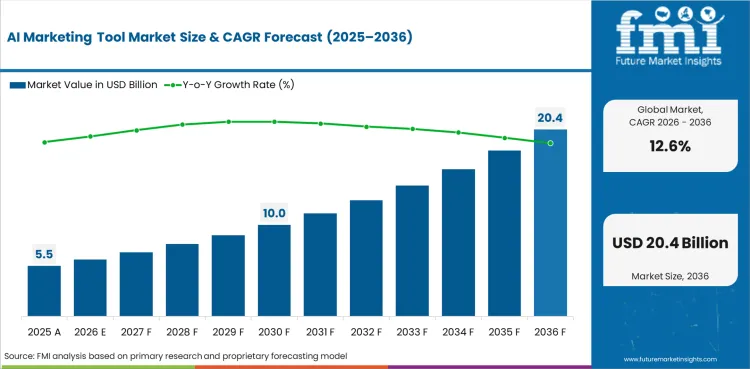
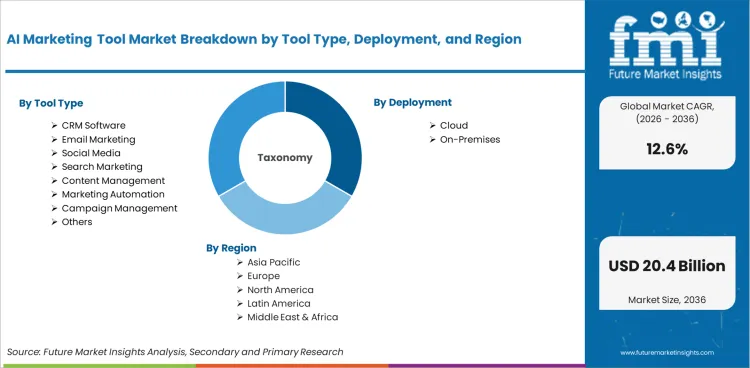
The AI marketing tool market was valued at USD 5.5 billion in 2025. The market is set to reach USD 6.2 billion by 2026-end and grow at a CAGR of 12.6% between 2026-2036 to reach USD 20.4 billion by 2036. CRM Software will dominate with a 28.8% share, while Cloud will lead with a 60.3%% share.
Summary of AI Marketing Tool Market Size, Market Forecast and Outlook By FMI
- Demand and Growth Drivers
- Content production demands across digital channels are exceeding marketing team capacity, creating demand for AI tools that generate, optimize, and personalize marketing content at scale.
- Customer data complexity is increasing as multi-channel engagement creates fragmented customer profiles, driving investment in AI-powered CRM and analytics platforms that unify customer intelligence.
- Marketing performance accountability is intensifying, with AI attribution models and predictive analytics enabling marketers to optimize spend allocation across channels with measurable ROI.
- Product and Segment View
- CRM Software holds 28.8% of the tool type segment in 2026, supported by enterprise demand for AI-powered customer data platforms that unify sales, marketing, and service interactions.
- Cloud accounts for 60.3% of the deployment segment, reflecting marketer preference for scalable SaaS-based AI tools that integrate with existing marketing technology stacks.
- Marketing automation represents a growing tool category, with AI optimizing lead scoring, nurture sequencing, and conversion attribution across multi-channel campaigns.
- Geography and Competitive Outlook
- ANZ leads country-level growth at 16.1% CAGR, driven by rapid digital marketing adoption, strong e-commerce growth, and marketing technology investment across enterprise and SMB segments.
- China follows at 13.1% CAGR, supported by the scale of its digital advertising ecosystem, e-commerce platform competition, and enterprise investment in AI-powered customer engagement.
- Competition spans established marketing technology platforms adding AI capabilities, AI-native content generation tools, and specialized marketing analytics companies offering AI-powered optimization.
- Analyst Opinion
- AI marketing tools are evolving from point solutions for individual tasks to integrated platforms that optimize the full marketing lifecycle from audience identification through conversion and retention. Marketers are moving beyond AI-generated content toward AI-optimized campaign orchestration that coordinates messaging, timing, and channel selection. Companies that combine content generation with performance analytics and attribution modeling will capture the most significant share of marketing AI spending during the forecast period.
- Privacy regulation, including GDPR and state-level data protection laws, is shaping AI marketing tool capabilities around consent management and first-party data optimization.
- B2B marketing AI adoption is accelerating as account-based marketing platforms incorporate AI for intent signal detection and buying committee identification.
- Marketing AI tool consolidation is underway as enterprises seek to reduce tool proliferation and integrate AI capabilities within unified marketing technology platforms.
Key Takeaways, Market Size, and Forecast
- The AI Marketing Tool Market was valued at USD 5.52 billion in 2025.
- By 2036, the AI Marketing Tool Market is expected to be worth USD 20.35 billion.
- From 2026 to 2036, the market is projected to expand at a CAGR of 12.6%.
- The market is projected to create an incremental opportunity of USD 14.14 billion between 2026 and 2036.
- In 2026, crm software is expected to account for 28.8% of the tool type segment, supported by enterprise demand for AI-powered customer data platforms that unify sales, marketing, and service interactions.
- ANZ (16.1%) and China (13.1%) are two of the fastest growing markets in the world.
AI Marketing Tool Market Definition
The AI marketing tool market includes software platforms and SaaS solutions that apply artificial intelligence to marketing operations, covering content generation, customer relationship management, campaign optimization, social media management, search marketing, email marketing, and marketing analytics.
AI Marketing Tool Market Inclusions
Market scope covers AI solutions segmented by tool type (CRM software, email marketing, social media, search marketing, content management, marketing automation, campaign management, others) and deployment (cloud, on-premises). The revenue range extends from 2026 to 2036.
AI Marketing Tool Market Exclusions
The scope does not include traditional marketing software without AI capabilities, basic email service providers without AI optimization, generic social media platforms, and manual marketing consulting services.
AI Marketing Tool Market Research Methodology
- Primary Research: FMI analysts conducted interviews with technology vendors, industry practitioners, and domain specialists across key markets.
- Desk Research: Integrated data from industry publications, regulatory databases, and technology vendor disclosures.
- Market Sizing and Forecasting: Bottom-up aggregation across segments and regional adoption curves with cross-validation against industry spending data.
- Data Validation: Cross-checked quarterly against vendor revenue disclosures, industry surveys, and regulatory filings.
Why is the AI Marketing Tool Market Growing?
- AI content generation is transforming marketing operations by producing text, images, and video assets at scale, reducing content creation bottlenecks that limit campaign velocity and channel coverage.
- Predictive analytics AI is improving marketing ROI by optimizing audience targeting, bid management, and budget allocation across paid media channels in real time.
- Customer data platform AI is unifying fragmented customer information across touchpoints, enabling personalized marketing at scale across email, social, search, and direct channels.
The AI marketing tool market reflects the structural challenge facing marketing organizations: delivering personalized, multi-channel customer engagement at scale with constrained team resources and increasing performance accountability. AI addresses this challenge across the marketing lifecycle, from content creation through campaign optimization and attribution measurement.
CRM software holds 28.8% of the tool type segment, reflecting the central role of customer data management in AI-powered marketing. AI-enhanced CRM platforms analyze customer behavior patterns, predict purchase intent, and trigger personalized engagement sequences that improve conversion rates and customer lifetime value.
Cloud deployment at 60.3% leads the deployment segment, as marketers adopt SaaS-based AI tools that integrate with existing marketing technology stacks through APIs and pre-built connectors. Cloud deployment reduces implementation complexity and enables rapid experimentation with AI capabilities.
Market Segmentation Analysis
- CRM Software holds 28.8% of the tool type segment, supported by enterprise demand for AI-powered customer data platforms that unify sales, marketing, and service interactions.
- Cloud at 60.3% leads the deployment segment, reflecting marketer preference for scalable SaaS-based AI tools that integrate with existing marketing technology stacks.
- Additional segments contribute to market diversification and growth across applications.
The ai marketing tool market is segmented by tool type (CRM software, email marketing, social media, search marketing, content management, marketing automation, campaign management, others) and deployment (cloud, on-premises).
Insights into the CRM Software Tool Type
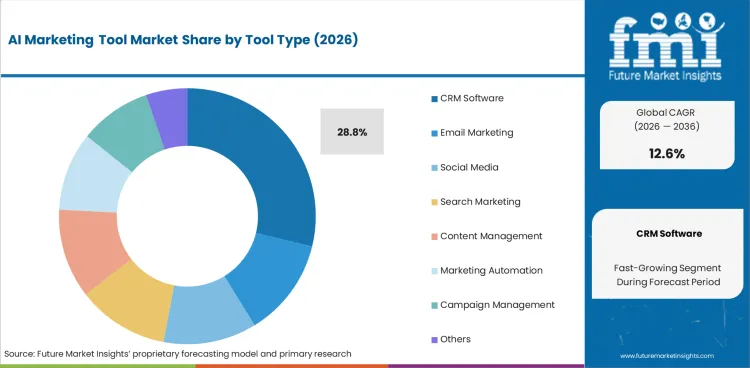
CRM software holds 28.8% of the tool type segment in 2026. AI-enhanced CRM platforms combine customer data unification with predictive analytics, automated engagement sequencing, and revenue attribution to provide marketers with actionable intelligence from customer interaction data.
AI CRM capabilities are expanding beyond sales forecasting into marketing-specific applications including lead scoring, customer lifetime value prediction, churn propensity modeling, and next-best-action recommendations that optimize marketing resource allocation.
Insights into the Cloud Deployment Segment
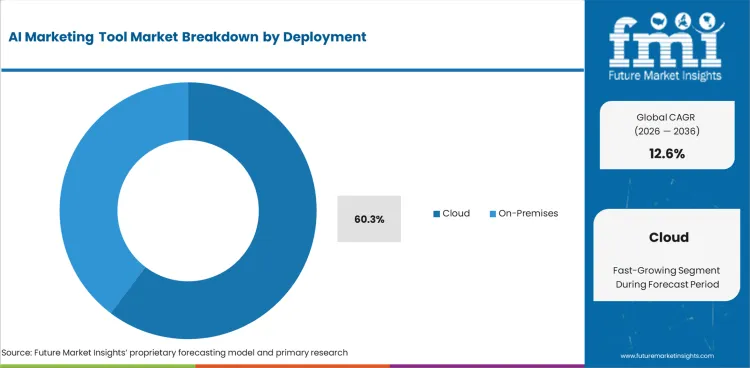
Cloud deployment accounts for 60.3% of the deployment segment in 2026, reflecting the marketing industry preference for SaaS-based tools that provide rapid deployment, automatic updates, and scalable computing for campaign processing workloads.
API-based integration capabilities enable cloud AI marketing tools to connect with existing marketing technology stacks, including advertising platforms, content management systems, and analytics tools, reducing the implementation friction that previously limited AI adoption among marketing teams.
AI Marketing Tool Market Drivers, Restraints, and Opportunities
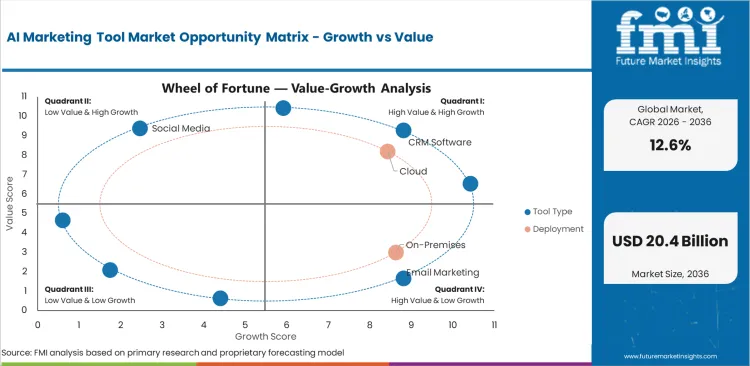
- Content production demands and performance accountability requirements are the primary structural drivers, creating direct efficiency and ROI justification for AI marketing tool investment.
- Privacy regulation and third-party data deprecation constrain certain AI marketing capabilities, requiring tools to adapt toward first-party data strategies and consent-based personalization.
- B2B marketing automation and account-based marketing AI represent growth opportunities as enterprise marketing teams adopt AI for complex buyer journey orchestration.
The AI marketing tool market is shaped by the convergence of content production demands, data privacy evolution, and the increasing expectation that marketing spending delivers measurable, attributable returns.
Content and Performance Pressure as Structural Drivers
Marketing teams face simultaneous demands for more content, more channels, and more personalization while demonstrating measurable performance against revenue targets. AI tools that automate content creation and optimize campaign performance directly address both capacity and accountability challenges.
Privacy Regulation and Data Strategy Shift
GDPR, CCPA, and the deprecation of third-party cookies are reshaping AI marketing tool capabilities. Platforms that optimize performance using first-party data and consent-based personalization maintain effectiveness while meeting compliance requirements.
B2B and Account-Based Marketing Expansion
Enterprise B2B marketing is adopting AI for account identification, buying intent signal detection, and multi-stakeholder engagement orchestration. These applications create demand for specialized AI marketing tools beyond consumer-focused platforms.
Analysis of AI Marketing Tool Market by Key Countries
.webp "Top Country Growth Comparison Ai Marketing Tool Market Cagr (2026 2036)")
| Country | CAGR |
|---|---|
| ANZ | 16.1% |
| China | 13.1% |
| USA | 9.5% |
| Japan | 5.4% |
| Germany | 4.1% |
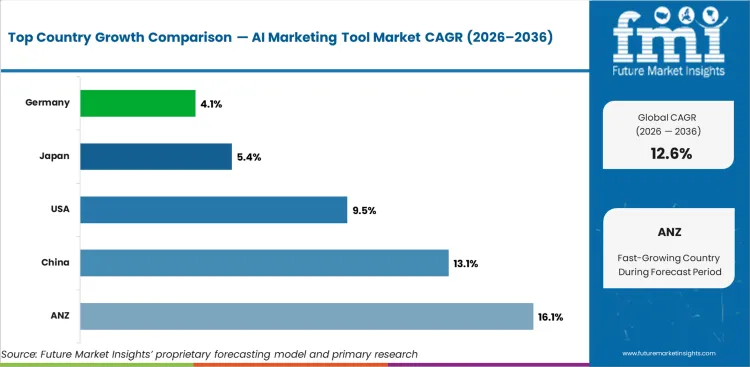
- ANZ leads at 16.1% CAGR through 2036, anz (australia and new zealand) is growing at 16.
- China at 13.1% CAGR is expanding, supported by the scale of its digital advertising ecosystem, e-commerce platform competition, and enterprise investment in AI-powered customer engagement.
- USA (9.5%) and Japan (5.4%) maintain growth supported by regional demand and regulatory frameworks.
The ai marketing tool market is projected to expand at 12.6% CAGR globally from 2026 to 2036. The analysis covers more than 30 countries, with the leading markets detailed below.
Demand Outlook for AI Marketing Tool Market in ANZ
ANZ (Australia and New Zealand) is growing at 16.1% CAGR through 2036, leading country-level growth. Rapid digital marketing adoption, strong e-commerce growth, and marketing technology investment across enterprise and SMB segments are driving AI marketing tool adoption.
- Digital advertising growth drives AI-powered campaign optimization and audience targeting tool adoption.
- E-commerce expansion creates demand for AI-powered personalization and conversion optimization.
- SMB marketing technology adoption is accelerating through accessible cloud-based AI tool platforms.
Future Outlook for AI Marketing Tool Market in China
China is expanding at 13.1% CAGR through 2036, supported by the scale of its digital advertising ecosystem, e-commerce platform competition, and enterprise investment in AI-powered customer engagement.
- E-commerce platform competition drives AI marketing tool investment for customer acquisition and retention.
- Social commerce and short-video marketing create demand for AI content generation and optimization tools.
- Enterprise CRM AI adoption is growing across B2B and B2C marketing operations.
Opportunity Analysis of AI Marketing Tool Market in the USA
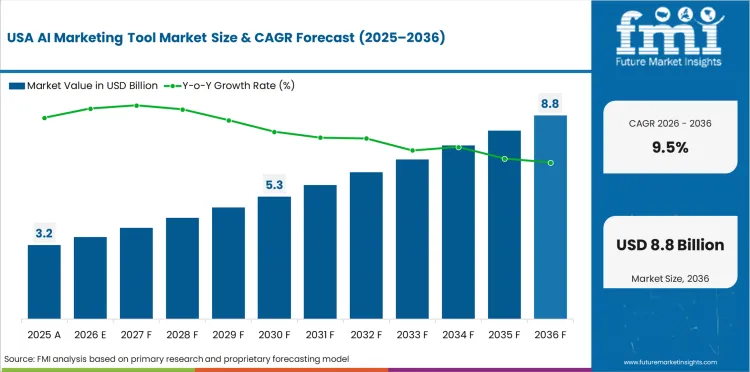
The USA is growing at 9.5% CAGR through 2036, maintaining the largest digital advertising market globally. Enterprise AI marketing tool adoption spans Fortune 500 and mid-market companies across all major industry verticals.
- Enterprise marketing technology stack investment drives AI tool procurement across large organizations.
- Performance marketing AI adoption is accelerating for paid media optimization and attribution modeling.
- B2B marketing automation platforms are integrating AI for account-based marketing and demand generation.
In-depth Analysis of AI Marketing Tool Market in Japan
Japan is growing at 5.4% CAGR through 2036, driven by digital advertising growth, enterprise CRM modernization, and increasing marketing technology adoption across Japanese corporations.
- Digital advertising growth drives AI-powered ad optimization and audience analytics tool adoption.
- Enterprise CRM modernization programs integrate AI for customer analytics and engagement automation.
- E-commerce marketing AI supports the growing online retail sector with personalization and recommendation tools.
Sales Analysis of AI Marketing Tool Market in Germany
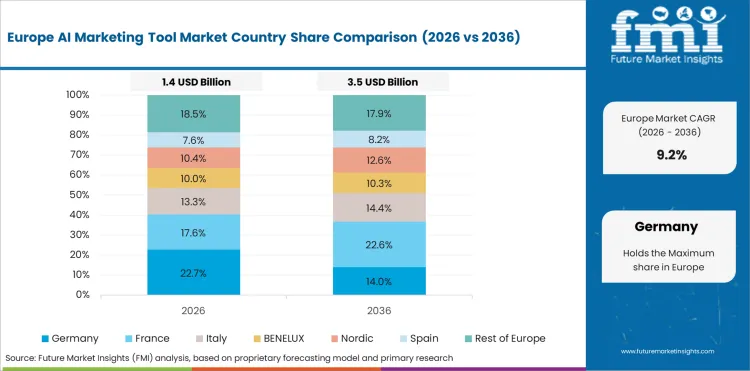
Germany is growing at 4.1% CAGR through 2036, reflecting GDPR compliance requirements shaping AI marketing tool capabilities and enterprise adoption of privacy-compliant marketing automation platforms.
- GDPR compliance requirements drive demand for AI marketing tools with built-in privacy and consent management.
- B2B industrial marketing is adopting AI for account-based marketing and lead qualification across manufacturing sectors.
- Enterprise marketing automation investment integrates AI for campaign optimization and customer journey orchestration.
Competitive Landscape and Strategic Positioning
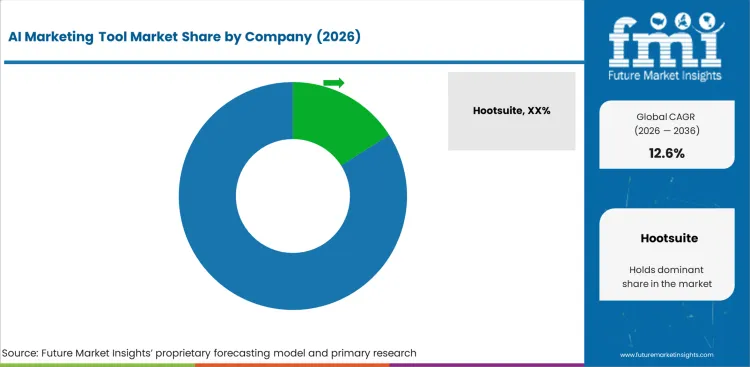
- Hootsuite leads in AI-powered social media management, combining scheduling, analytics, and AI-generated content recommendations for enterprise and SMB marketers.
- JasperAI and Copy.ai compete in AI content generation, providing text and creative asset production tools that address the content velocity demands of modern marketing operations.
- Specialized platforms including Albert.ai and Skai focus on AI-powered campaign optimization and performance marketing analytics.
Hootsuite maintains leadership in social media marketing AI, providing enterprise and SMB marketers with AI-powered content scheduling, social listening, and engagement analytics across platforms. JasperAI and Copy.ai compete in AI content generation for marketing teams.
Albert.ai offers AI-powered autonomous campaign optimization that manages paid media bidding, audience targeting, and budget allocation across channels. Wordstream provides AI-powered search marketing optimization for SMB advertisers.
Midjourney and DeepBrain AI Studios represent the emerging visual content generation category, providing AI-powered image and video creation tools that reduce production costs for marketing asset development.
Key Companies in the AI Marketing Tool Market
Key global companies leading the ai marketing tool market include:
- Hootsuite, JasperAI, Copy.ai, Albert.ai maintain leading positions through comprehensive product portfolios and established industry relationships.
- Wordstream compete through specialized capabilities and regional market expertise.
- Midjourney, Podcastle, Quillbot, Magic Studio represent emerging players developing focused solutions for specific market applications.
Competitive Benchmarking: AI Marketing Tool Market
| Company | Product Breadth | AI Capability | Market Access | Geographic Reach |
|---|---|---|---|---|
| Hootsuite | Social Media | Moderate | Strong | Global |
| JasperAI | Content Gen | Advanced | Moderate | Global |
| Copy.ai | Content Gen | Advanced | Moderate | Global |
| Albert.ai | Campaign AI | Advanced | Niche | N. America |
| Wordstream | Search Mktg | Moderate | Moderate | N. America |
| Midjourney | Image Gen | Advanced | Broad | Global |
| Skai | Performance | Advanced | Moderate | Global |
| DeepBrain AI | Video Gen | Advanced | Emerging | Asia, Global |
Source: Future Market Insights competitive analysis, 2026.
Key Players in the AI Marketing Tool Market
Major Global Players
- Hootsuite
- JasperAI
- Copy.ai
- Albert.ai
- Wordstream
Emerging Players/Startups
- Midjourney
- Podcastle
- Quillbot
- Magic Studio
- DeepBrain AI Studios
- Skai
Report Scope and Coverage
| Parameter | Details |
|---|---|
| Quantitative Units | USD 6.21 billion to USD 20.35 billion, at a CAGR of 12.6% |
| Market Definition | The AI marketing tool market includes software platforms and SaaS solutions that apply artificial intelligence to marketing operations, covering content generation, customer relationship management, campaign optimization, social media management, search marketing, email marketing, and marketing analytics. |
| Regions Covered | North America, Latin America, Europe, East Asia, South Asia and Pacific, Middle East and Africa |
| Countries Covered | ANZ, China, USA, Japan, Germany, 30 plus countries |
| Key Companies Profiled | Hootsuite, JasperAI, Copy.ai, Albert.ai, Wordstream, Midjourney, Podcastle, Quillbot |
| Forecast Period | 2026 to 2036 |
| Approach | Hybrid bottom-up and top-down methodology starting with verified industry data, projecting adoption velocity across segments and regions. |
Market Segmentation Analysis
AI Marketing Tool Market Segmented by Tool Type:
- CRM Software
- Email Marketing
- Social Media
- Search Marketing
- Content Management
- Marketing Automation
- Campaign Management
- Others
AI Marketing Tool Market Segmented by Deployment:
- Cloud
- On-Premises
AI Marketing Tool Market by Region:
- North America
- USA
- Canada
- Mexico
- Latin America
- Brazil
- Chile
- Rest of Latin America
- Western Europe
- Germany
- UK
- Italy
- Spain
- France
- Nordic
- BENELUX
- Rest of Western Europe
- Eastern Europe
- Russia
- Poland
- Hungary
- Balkan & Baltic
- Rest of Eastern Europe
- East Asia
- China
- Japan
- South Korea
- South Asia and Pacific
- India
- ASEAN
- Australia & New Zealand
- Rest of South Asia and Pacific
- Middle East & Africa
- Kingdom of Saudi Arabia
- Other GCC Countries
- Turkiye
- South Africa
- Other African Union
- Rest of Middle East & Africa
Research Sources and Bibliography
- Interactive Advertising Bureau. (2025). AI in Digital Marketing: Technology and Measurement Standards. IAB.
- European Commission. (2024). EU Digital Services Act: AI in Marketing Compliance Requirements. EC.
- USA Federal Trade Commission. (2025). AI-Powered Marketing: Consumer Protection Guidelines. FTC.
- World Federation of Advertisers. (2024). AI Adoption in Global Marketing Operations. WFA.
- OECD. (2025). AI and Digital Marketing: Economic Impact Assessment. OECD.
This bibliography is provided for reader reference.
This Report Answers
- Estimating the size of the ai marketing tool market and revenue projections from 2026 to 2036.
- Segmentation by tool type (CRM software, email marketing, social media.
- Insights about more than 30 markets in the region.
- Analysis of key technology, application, and deployment segments.
- Assessment of the competitive landscape.
- Finding investment opportunities across key segments and regions.
- Tracking regulatory frameworks and industry standards.
Frequently Asked Questions
What is the global market demand for aiing tool market in 2026?
In 2026, the global ai marketing tool market is expected to be worth USD 6.21 billion.
How big will the ai marketing tool market be in 2036?
By 2036, the market is expected to be worth USD 20.35 billion.
How much is demand expected to grow between 2026 and 2036?
Between 2026 and 2036, the market is expected to grow at a CAGR of 12.6%.
Which tool type segment is likely to lead globally in 2026?
CRM Software is expected to hold 28.8% of the tool type segment in 2026, supported by enterprise demand for AI-powered customer data platforms that unify sales, marketing, and service interactions.
What is causing demand to rise in ANZ?
ANZ is growing at 16.1% CAGR through 2036, driven by rapid digital marketing adoption, strong e-commerce growth, and marketing technology investment across enterprise and SMB segments.
What is causing demand to rise in China?
China is expanding at 13.1% CAGR through 2036, supported by the scale of its digital advertising ecosystem, e-commerce platform competition, and enterprise investment in AI-powered customer engagement.
What does this report mean by ai marketing tool market definition?
The AI marketing tool market includes software platforms and SaaS solutions that apply artificial intelligence to marketing operations, covering content generation, customer relationship management, campaign optimization, social media management, search marketing, email marketing, and marketing analytics.
How does FMI make this forecast and validate it?
Forecasting uses a hybrid bottom-up and top-down approach, starting with verified industry data and cross-checking against vendor disclosures and industry spending surveys.
Preview the report firsthand - request a free sample
Get SampleGet the brochure for pricing and purchase details.
Get PDFTable of Content
- Executive Summary
- Global Market Outlook
- Demand-side Trends
- Supply-side Trends
- Technology Roadmap Analysis
- Analysis and Recommendations
- Market Overview
- Market Coverage / Taxonomy
- Market Definition / Scope / Limitations
- Research Methodology
- Chapter Orientation
- Analytical Lens and Working Hypotheses
- Market Structure, Signals, and Trend Drivers
- Benchmarking and Cross-market Comparability
- Market Sizing, Forecasting, and Opportunity Mapping
- Research Design and Evidence Framework
- Desk Research Programme (Secondary Evidence)
- Company Annual and Sustainability Reports
- Peer-reviewed Journals and Academic Literature
- Corporate Websites, Product Literature, and Technical Notes
- Earnings Decks and Investor Briefings
- Statutory Filings and Regulatory Disclosures
- Technical White Papers and Standards Notes
- Trade Journals, Industry Magazines, and Analyst Briefs
- Conference Proceedings, Webinars, and Seminar Materials
- Government Statistics Portals and Public Data Releases
- Press Releases and Reputable Media Coverage
- Specialist Newsletters and Curated Briefings
- Sector Databases and Reference Repositories
- FMI Internal Proprietary Databases and Historical Market Datasets
- Subscription Datasets and Paid Sources
- Social Channels, Communities, and Digital Listening Inputs
- Additional Desk Sources
- Expert Input and Fieldwork (Primary Evidence)
- Primary Modes
- Qualitative Interviews and Expert Elicitation
- Quantitative Surveys and Structured Data Capture
- Blended Approach
- Why Primary Evidence is Used
- Field Techniques
- Interviews
- Surveys
- Focus Groups
- Observational and In-context Research
- Social and Community Interactions
- Stakeholder Universe Engaged
- C-suite Leaders
- Board Members
- Presidents and Vice Presidents
- R&D and Innovation Heads
- Technical Specialists
- Domain Subject-matter Experts
- Scientists
- Physicians and Other Healthcare Professionals
- Governance, Ethics, and Data Stewardship
- Research Ethics
- Data Integrity and Handling
- Primary Modes
- Tooling, Models, and Reference Databases
- Desk Research Programme (Secondary Evidence)
- Data Engineering and Model Build
- Data Acquisition and Ingestion
- Cleaning, Normalisation, and Verification
- Synthesis, Triangulation, and Analysis
- Quality Assurance and Audit Trail
- Market Background
- Market Dynamics
- Drivers
- Restraints
- Opportunity
- Trends
- Scenario Forecast
- Demand in Optimistic Scenario
- Demand in Likely Scenario
- Demand in Conservative Scenario
- Opportunity Map Analysis
- Product Life Cycle Analysis
- Supply Chain Analysis
- Investment Feasibility Matrix
- Value Chain Analysis
- PESTLE and Porter’s Analysis
- Regulatory Landscape
- Regional Parent Market Outlook
- Production and Consumption Statistics
- Import and Export Statistics
- Market Dynamics
- Global Market Analysis 2021 to 2025 and Forecast, 2026 to 2036
- Historical Market Size Value (USD Million) Analysis, 2021 to 2025
- Current and Future Market Size Value (USD Million) Projections, 2026 to 2036
- Y-o-Y Growth Trend Analysis
- Absolute $ Opportunity Analysis
- Global Market Pricing Analysis 2021 to 2025 and Forecast 2026 to 2036
- Global Market Analysis 2021 to 2025 and Forecast 2026 to 2036, By Tool Type
- Introduction / Key Findings
- Historical Market Size Value (USD Million) Analysis By Tool Type , 2021 to 2025
- Current and Future Market Size Value (USD Million) Analysis and Forecast By Tool Type , 2026 to 2036
- CRM Software
- Email Marketing
- Social Media
- Search Marketing
- Content Management
- Marketing Automation
- Campaign Management
- Others
- CRM Software
- Y-o-Y Growth Trend Analysis By Tool Type , 2021 to 2025
- Absolute $ Opportunity Analysis By Tool Type , 2026 to 2036
- Global Market Analysis 2021 to 2025 and Forecast 2026 to 2036, By Deployment
- Introduction / Key Findings
- Historical Market Size Value (USD Million) Analysis By Deployment, 2021 to 2025
- Current and Future Market Size Value (USD Million) Analysis and Forecast By Deployment, 2026 to 2036
- Cloud
- On-Premises
- Cloud
- Y-o-Y Growth Trend Analysis By Deployment, 2021 to 2025
- Absolute $ Opportunity Analysis By Deployment, 2026 to 2036
- Global Market Analysis 2021 to 2025 and Forecast 2026 to 2036, By Region
- Introduction
- Historical Market Size Value (USD Million) Analysis By Region, 2021 to 2025
- Current Market Size Value (USD Million) Analysis and Forecast By Region, 2026 to 2036
- North America
- Latin America
- Western Europe
- Eastern Europe
- East Asia
- South Asia and Pacific
- Middle East & Africa
- Market Attractiveness Analysis By Region
- North America Market Analysis 2021 to 2025 and Forecast 2026 to 2036, By Country
- Historical Market Size Value (USD Million) Trend Analysis By Market Taxonomy, 2021 to 2025
- Market Size Value (USD Million) Forecast By Market Taxonomy, 2026 to 2036
- By Country
- USA
- Canada
- Mexico
- By Tool Type
- By Deployment
- By Country
- Market Attractiveness Analysis
- By Country
- By Tool Type
- By Deployment
- Key Takeaways
- Latin America Market Analysis 2021 to 2025 and Forecast 2026 to 2036, By Country
- Historical Market Size Value (USD Million) Trend Analysis By Market Taxonomy, 2021 to 2025
- Market Size Value (USD Million) Forecast By Market Taxonomy, 2026 to 2036
- By Country
- Brazil
- Chile
- Rest of Latin America
- By Tool Type
- By Deployment
- By Country
- Market Attractiveness Analysis
- By Country
- By Tool Type
- By Deployment
- Key Takeaways
- Western Europe Market Analysis 2021 to 2025 and Forecast 2026 to 2036, By Country
- Historical Market Size Value (USD Million) Trend Analysis By Market Taxonomy, 2021 to 2025
- Market Size Value (USD Million) Forecast By Market Taxonomy, 2026 to 2036
- By Country
- Germany
- UK
- Italy
- Spain
- France
- Nordic
- BENELUX
- Rest of Western Europe
- By Tool Type
- By Deployment
- By Country
- Market Attractiveness Analysis
- By Country
- By Tool Type
- By Deployment
- Key Takeaways
- Eastern Europe Market Analysis 2021 to 2025 and Forecast 2026 to 2036, By Country
- Historical Market Size Value (USD Million) Trend Analysis By Market Taxonomy, 2021 to 2025
- Market Size Value (USD Million) Forecast By Market Taxonomy, 2026 to 2036
- By Country
- Russia
- Poland
- Hungary
- Balkan & Baltic
- Rest of Eastern Europe
- By Tool Type
- By Deployment
- By Country
- Market Attractiveness Analysis
- By Country
- By Tool Type
- By Deployment
- Key Takeaways
- East Asia Market Analysis 2021 to 2025 and Forecast 2026 to 2036, By Country
- Historical Market Size Value (USD Million) Trend Analysis By Market Taxonomy, 2021 to 2025
- Market Size Value (USD Million) Forecast By Market Taxonomy, 2026 to 2036
- By Country
- China
- Japan
- South Korea
- By Tool Type
- By Deployment
- By Country
- Market Attractiveness Analysis
- By Country
- By Tool Type
- By Deployment
- Key Takeaways
- South Asia and Pacific Market Analysis 2021 to 2025 and Forecast 2026 to 2036, By Country
- Historical Market Size Value (USD Million) Trend Analysis By Market Taxonomy, 2021 to 2025
- Market Size Value (USD Million) Forecast By Market Taxonomy, 2026 to 2036
- By Country
- India
- ASEAN
- Australia & New Zealand
- Rest of South Asia and Pacific
- By Tool Type
- By Deployment
- By Country
- Market Attractiveness Analysis
- By Country
- By Tool Type
- By Deployment
- Key Takeaways
- Middle East & Africa Market Analysis 2021 to 2025 and Forecast 2026 to 2036, By Country
- Historical Market Size Value (USD Million) Trend Analysis By Market Taxonomy, 2021 to 2025
- Market Size Value (USD Million) Forecast By Market Taxonomy, 2026 to 2036
- By Country
- Kingdom of Saudi Arabia
- Other GCC Countries
- Turkiye
- South Africa
- Other African Union
- Rest of Middle East & Africa
- By Tool Type
- By Deployment
- By Country
- Market Attractiveness Analysis
- By Country
- By Tool Type
- By Deployment
- Key Takeaways
- Key Countries Market Analysis
- USA
- Pricing Analysis
- Market Share Analysis, 2025
- By Tool Type
- By Deployment
- Canada
- Pricing Analysis
- Market Share Analysis, 2025
- By Tool Type
- By Deployment
- Mexico
- Pricing Analysis
- Market Share Analysis, 2025
- By Tool Type
- By Deployment
- Brazil
- Pricing Analysis
- Market Share Analysis, 2025
- By Tool Type
- By Deployment
- Chile
- Pricing Analysis
- Market Share Analysis, 2025
- By Tool Type
- By Deployment
- Germany
- Pricing Analysis
- Market Share Analysis, 2025
- By Tool Type
- By Deployment
- UK
- Pricing Analysis
- Market Share Analysis, 2025
- By Tool Type
- By Deployment
- Italy
- Pricing Analysis
- Market Share Analysis, 2025
- By Tool Type
- By Deployment
- Spain
- Pricing Analysis
- Market Share Analysis, 2025
- By Tool Type
- By Deployment
- France
- Pricing Analysis
- Market Share Analysis, 2025
- By Tool Type
- By Deployment
- India
- Pricing Analysis
- Market Share Analysis, 2025
- By Tool Type
- By Deployment
- ASEAN
- Pricing Analysis
- Market Share Analysis, 2025
- By Tool Type
- By Deployment
- Australia & New Zealand
- Pricing Analysis
- Market Share Analysis, 2025
- By Tool Type
- By Deployment
- China
- Pricing Analysis
- Market Share Analysis, 2025
- By Tool Type
- By Deployment
- Japan
- Pricing Analysis
- Market Share Analysis, 2025
- By Tool Type
- By Deployment
- South Korea
- Pricing Analysis
- Market Share Analysis, 2025
- By Tool Type
- By Deployment
- Russia
- Pricing Analysis
- Market Share Analysis, 2025
- By Tool Type
- By Deployment
- Poland
- Pricing Analysis
- Market Share Analysis, 2025
- By Tool Type
- By Deployment
- Hungary
- Pricing Analysis
- Market Share Analysis, 2025
- By Tool Type
- By Deployment
- Kingdom of Saudi Arabia
- Pricing Analysis
- Market Share Analysis, 2025
- By Tool Type
- By Deployment
- Turkiye
- Pricing Analysis
- Market Share Analysis, 2025
- By Tool Type
- By Deployment
- South Africa
- Pricing Analysis
- Market Share Analysis, 2025
- By Tool Type
- By Deployment
- USA
- Market Structure Analysis
- Competition Dashboard
- Competition Benchmarking
- Market Share Analysis of Top Players
- By Regional
- By Tool Type
- By Deployment
- Competition Analysis
- Competition Deep Dive
- Hootsuite
- Overview
- Product Portfolio
- Profitability by Market Segments (Product/Age /Sales Channel/Region)
- Sales Footprint
- Strategy Overview
- Marketing Strategy
- Product Strategy
- Channel Strategy
- Copy.ai
- JasperAI
- Midjourney
- Podcastle
- Quillbot
- Magic Studio
- DeepBrain AI Studios
- Albert.ai
- Wordstream
- Skai
- Hootsuite
- Competition Deep Dive
- Assumptions & Acronyms Used


