

- Industry Size (2026)
- USD 32.1 Bn
- Forecast (2036)
- USD 262.8 Bn
- CAGR (2026 to 2036)
- 23.4%
Natural Language Processing Market Size and Share Forecast Outlook 2026 to 2036
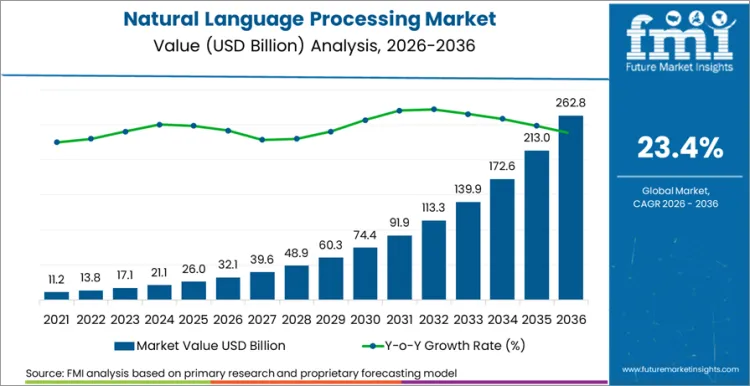
The global natural language processing sector is on track to achieve a valuation of USD 262.8 billion by 2036, accelerating from USD 32.1 billion in 2026 at a CAGR of 23.4%. As per Future Market Insights, expansion is structurally underpinned by the enterprise adoption of LLM-powered agents for process automation, the proliferation of multilingual foundation models serving non-English markets, and the hardware cost reductions that enable on-premise and edge NLP deployment. The Stanford Institute for Human-Centred AI (HAI) reported in its 2024 AI Index that private investment in generative AI reached USD 25.2 billion in 2023, more than doubling year-on-year, validating the capital allocation trend that sustains NLP platform development and commercialisation. This investment velocity compels both hyperscale AI companies and enterprise software vendors to integrate NLP capabilities into their product portfolios. Simultaneously the regulatory landscape is advancing as the EU AI Act enters enforcement, mandating transparency and risk assessment for high-risk AI applications including NLP-powered clinical and financial decision support systems.
In September 2025, Mistral AI raised EUR 1.7 billion in Series C funding led by ASML to accelerate research and industrial AI solutions. FMI analysts are of the opinion that the European NLP ecosystem will achieve parity with US and Chinese competitors in enterprise-grade multilingual models by 2029, driven by EU AI Act compliance expertise and sovereign AI investment programmes.
The competitive landscape in 2025 and 2026 is defined by foundation model launches and enterprise software integration. Sarvam AI launched Sarvam Vision in February 2026, an OCR model achieving 84.3% accuracy on benchmarks, outperforming frontier models like Gemini 3 Pro on Indian language document processing. The Technology Innovation Institute (TII) in Abu Dhabi launched Falcon-H1 Arabic in January 2026, a hybrid Mamba-Transformer model establishing the highest performance on the Open Arabic LLM Leaderboard. Baidu unveiled ERNIE 5.0 in November 2025, a natively omni-modal foundation model jointly modelling text, images, audio, and video. SAP and Anthropic finalised a strategic partnership in January 2026 to embed Claude 3's reasoning capabilities into SAP's ERP suite for automated financial reporting and supply chain analysis. Workday acquired the AI-native platform Sana for USD 1.1 billion in September 2025, integrating NLP-powered agents into HR and finance software. As per FMI, this convergence of multilingual model development, enterprise ERP integration, and record-breaking private investment confirms that NLP is transitioning from an AI research category into the default intelligence layer of global enterprise operations.
Summary of Natural Language Processing Market
What Is Growth Outlook for Natural Language Processing Market as per Future Market Insights Projection?
Future Market Insights projects the natural language processing industry to expand at a CAGR of 23.4% from 2026 to 2036, increasing from USD 32.1 Billion in 2026 to USD 262.8 Billion by 2036.
FMI Research Approach: FMI proprietary forecasting model based on enterprise AI CAPEX budgets, LLM API consumption data, and generative AI private investment tracking.
How Do FMI Analysts Perceive Natural Language Processing Market to Evolve?
FMI analysts perceive the market evolving toward embedded enterprise NLP where LLM-powered agents are integrated directly into ERP, CRM, and HR platforms, shifting revenue from standalone API consumption to process automation within operational software.
FMI Research Approach: Stanford HAI AI Index 2024 and SAP-Anthropic partnership analysis.
Which Country Holds Largest Share in Global Natural Language Processing Market?
The United States holds a significant share of the global natural language processing market by value which is supported by the concentration of LLM developers (OpenAI, Anthropic, Google), enterprise software vendors (SAP, Workday, Salesforce), and private AI investment.
FMI Research Approach: FMI country-level revenue modeling by generative AI investment data and enterprise AI adoption surveys.
How Large Will Natural Language Processing Market Be by 2036?
The global natural language processing market is projected to reach USD 262.8 Billion by 2036.
FMI Research Approach: FMI long-term revenue forecast derived from enterprise AI adoption S-curves and multilingual LLM deployment projections.
What Is Definition of Natural Language Processing Market?
The natural language processing market includes foundation models, LLM platforms, text analytics software, speech recognition and synthesis engines, machine translation systems, conversational AI platforms, and NLP-embedded enterprise software used across industries for document processing, customer interaction, and operational automation.
FMI Research Approach: FMI market taxonomy aligned with Stanford HAI AI Index classification and EU AI Act risk categorisation.
What Are Globally Unique Trends Shaping Natural Language Processing Market?
Globally unique trends include the emergence of sovereign multilingual LLMs (Sarvam AI for India, Falcon-H1 Arabic for MENA), the embedding of LLM agents into enterprise ERP platforms (SAP-Anthropic), and the record EUR 1.7 billion Series C funding for European AI champion Mistral AI.
FMI Research Approach: Stanford HAI AI Index private investment data and TII Falcon-H1 Arabic launch analysis.
Natural Language Processing Market Key Takeaways
| Metric | Details |
|---|---|
| Industry Size (2026) | USD 32.1 Billion |
| Industry Value (2036) | USD 262.8 Billion |
| CAGR (2026 to 2036) | 23.4% |
Source: Future Market Insights (FMI) analysis, based on proprietary forecasting model and primary research
Segment-wise analysis
By Technology
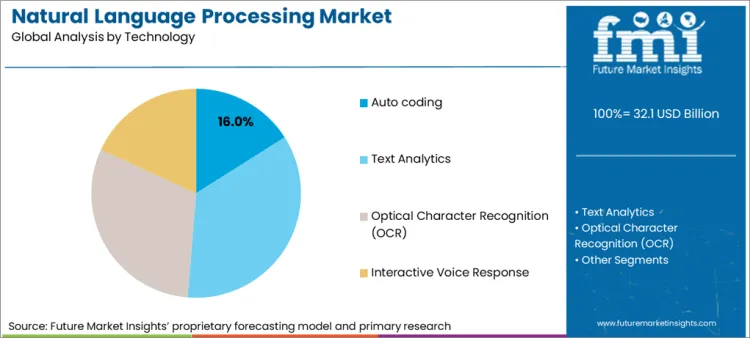
It is expected that Auto coding will have 16.0% of the share in 2026, driven by the increasing adoption of these AI-powered automation tools for text categorization, data annotation, medical coding, and more. The increase of unstructured data across various industries, including healthcare, finance, and legal services, is driving the demand for efficient solutions for auto coding.
The most recognized arena of auto-coding usage is in the healthcare sector, where it is successfully applied to improve clinical documentation improvement (CDI), accelerate medical billing as well as regulatory adherence (ICD-10, CPT codes, etc.). Companies such as 3M, Optum, and Nuance Communications have already adopted AI-driven auto-coding software to solve various internal challenges by increasing accuracy and reducing administrative effort.
Enterprises are also embedding auto coding into their customer service and content management platforms for tagging, classification, and retrieval of large text datasets. The ability of AI models to improve contextual understanding and accuracy will encourage the continued growth of auto-coding adoption across different domains, ensuring efficiency and scalability.
Text analytics is forecast to account for 31.8% of the share by 2025, in part driven by the growing prominence of big data, sentiment analysis, and AI and deep learning-accelerated insights in business intelligence. Organizations across industries, from retail to finance to marketing, are pursuing text analytics to improve customer sentiment, detect fraud, and optimize content strategy.
With enterprises increasingly interested in harnessing actionable insights from an array of structured and unstructured data sources, from emails and social media to chatbot interactions, the demand for natural language processing (NLP) and machine learning-based text analytics continues to rise.
The leading players like IBM Watson, SAS, and Microsoft Azure Cognitive Services, are upgrading their Natural Language Processing models to develop better contextual understanding, Entity Recognition, and intent analysis.
By Type
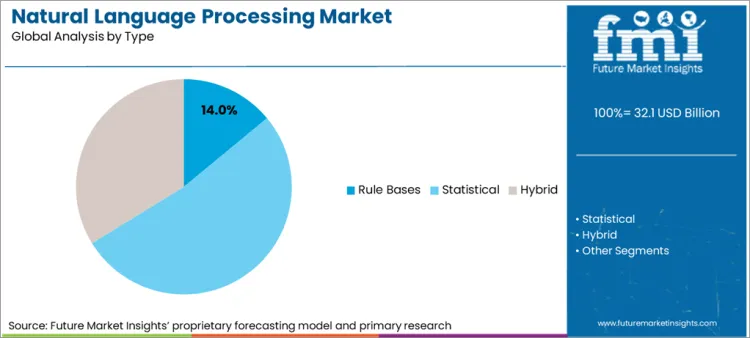
In 2026, the rule-based segment will account for 14.0% of the share, as it is more structured in its approach to text processing and classification. In a review of such frameworks, the understanding is that strict rule-based systems are best suited for certain fundamental roles like healthcare coding, legal document review, and compliance reporting, where regulatory compliance and accuracy are critical. They achieve this by parsing text based on pre-established language rules, lexicons, and pattern-matching algorithms.
They will still use rule-based text analysis widely across government, healthcare, finance, and many other sectors (e.g., for automated documentation, fraud detection, and compliance monitoring). Same for a chatbots and virtual assistants as well which are primarily built with a decision making approach for clearing a limited range of queries. However, these systems are limited and scaling while handling vague or unstructured text formats and therefore restrict themselves to advanced structural languages.
Other organizations like SAS, IBM Watson, and Oracle are enhancing rule-based systems with hybrid AI-based developments to improve speed and agility.
In fact, by 2025, the statistical segment would represent the majority of the industry, with enterprises slated to adopt ML and AI-enabled NLP solutions in 40.3% of cases. Statistical techniques, with their use of probabilistic modeling, deep learning algorithms, and big data, are able to detect trends, sense sentiment, and learn which are the most effective ways to make decisions.
Major players in the statistical NLP industry include Google AI, Amazon Web Services (AWS), and Microsoft Azure Cognitive Services, which offer AI-powered text analytics solutions for e-commerce, social media, and customer service automation.
Trend Analysis and Purchasing Criteria across Different End-Use Segments
The Natural Language Processing (NLP) Market is undergoing a fast expansion phase that is largely propelled by the widespread acceptance of AI-based chatbots, virtual assistants, sentiment analysis, and voice recognition technologies.
In the healthcare sector, NLP plays a significant role in clinical documentation, medical transcription, and patient data analysis, which requires great accuracy and the fulfillment of obligations concerning data privacy regulations. Retail & e-commerce make use of NLP for tailor-made suggestions, chatbots, and customer sentiment analysis problems that are focused on real-time processing and scalability.
The finance and banking industry features fraud detection, risk assessment, and compliance automation, which are the primary reasons why it demands high security, precise information, and integration capabilities. IT & telecom are the industry areas of the economy that apply NLP to enable automatic customer care, real-time analysis, and text mining, which is the current trend with cost-effectiveness and scalability.
Government & defense applications are the ones that are based on NLP for threat analysis, automated language, and secure communication, with an emphasis on privacy, accuracy, and compliance of information.
Contract & Deals Analysis - Natural Language Processing Market
| Company | Contract Value (USD Million) |
|---|---|
| Google Cloud | Approximately USD 80 - 90 |
| Microsoft | Approximately USD 70 - 80 |
| IBM Watson | Approximately USD 60 - 70 |
| OpenAI | Approximately USD 90 - 100 |
| Nuance Communications | Approximately USD 50 - 60 |
In 2024 and early 2025, the Natural Language Processing Market witnessed significant momentum as organizations across various sectors increasingly adopt AI-driven language solutions to enhance customer engagement, streamline operations, and extract actionable insights from vast data sets.
Leading companies such as Google Cloud, Microsoft, IBM Watson, OpenAI, and Nuance Communications have secured pivotal contracts and strategic partnerships, underscoring the industry's commitment to driving innovation and integrating cutting-edge NLP technologies into core business processes.
Shifts in the Market from 2021 to 2025 and Future Trends 2026 to 2036
From 2021 to 2025, the NLP market developed rapidly due to AI advancements, chatbots, and content creation through automation. Organizations applied NLP to customer service, business process automation, and language translation in real-time across healthcare, banking, and e-commerce.
Human-like natural language conversations and emotional sentiment analysis became achievable through conversational AI tools such as GPT and BERT. Medical and legal professionals use NLP to process documents and transcribe them. From 2025 onward, efforts focused on reducing bias, improving explainability, and making models more efficient.
2026 to 2036, NLP will advance using explainable AI, multimodal learning, and domain-specific models. Neurosymbolic AI will improve contextual comprehension and reasonableness. Multimodal AI will process text, voice, and vision and energize AR/VR and autonomous machines.
AI assistants will anticipate user intent and perform sophisticated tasks. Federated learning will protect user data and allow for personalization. Quantum computing will speed up training and allow for improved contextual embeddings, transforming advanced language processing and multi-turn conversation.
A Comparative Market Shift Analysis (2021 to 2025 vs. 2026 to 2036)
| 2021 to 2025 | 2026 to 2036 |
|---|---|
| Tighter data protection regulations (GDPR, CCPA, AI Ethics Guidelines) necessitated NLP models to incorporate improved data protection, bias elimination, and transparency capabilities. | Decentralized, AI-powered NLP platforms utilize blockchain-based privacy protection, explainable AI (XAI), and regulation-compliant language models to provide ethical, bias-free communication. |
| Transformer architectures (BART, GPT, T5) transformed NLP potential to enable human-like text generation, sentiment analysis, and context knowledge. | Neuromorphic, artificially intelligent NLP technology allows ultra-contextual real-time natural language understanding, self-training, and multimodal intelligence for human-like conversation. |
| Companies use AI-driven chatbots and virtual assistants to enable customer support, workflow automation, and real-time analysis. | AI-powered, intent-based NLP technologies offer hyper-personalized, emotion-sensitive interactions, dynamically changing conversations based on user tone, context, and predictive behavior. |
| Firms used NLP-based low-code/no-code platforms to automate content creation, analytics, and app development. | Self-improving, AI-driven NLP platforms self-generate and optimize low-code processes, providing real-time, natural-language programming and decision-making capabilities. |
| AI-fueled NLP technologies advanced real-time spoken-to-written word translation, defying language obstacles in international communications. | Universal NLP systems powered by AI facilitate hyper-realistic cross-language dialogue, gesture-to-speech translation in real time, and frictionless human-AI communication across cultures. |
| NLP technology for health care enhanced health care documentation, AI conversationalists, and automated diagnosis. | Real-time AI-generations NLP applications scan patient data, predict conditions, and provide context-sensitive clinical decision support for tailored medicine. |
| Smaller, high-speed networks fueled real-time NLP capability for voice interfaces, video conferences, and smart IoT devices. | AI-driven, 6G-based NLP systems offer real-time, context-aware voice AI, facilitating ultra-low-latency, immersive human-AI interaction in the metaverse and digital workplaces. |
| AI-driven NLP models detected phishing attempts, analyzed threats in digital communication, and enhanced cybersecurity automation. | AI-powered, quantum-resistant NLP cybersecurity tools autonomously analyze linguistic patterns, detect deception, and counteract sophisticated AI-generated cyber threats in real-time. |
| Enterprises optimized NLP model training and inference to reduce computational costs and lower environmental impact. | Carbon-conscious, AI-powered NLP models employ energy-frugal algorithms, distributed computing, and intelligent workload optimization for green AI language processing. |
| NLP technologies developed in virtual assistants, autocomplete, and sentiment-guided AI responses. | Self-improving NLP agents deliver live emotional intelligence, adaptive decision-making, and AI-human co-authoring, revolutionizing creative content creation, automation, and user interaction. |
Risk Assessment
The industry is at risk due to several factors, such as data privacy issues, ethical AI problems, dynamic regulatory frameworks, and expensive computational requirements. With more and more companies turning to artificial intelligence (AI) apps driven by these risks, they have to be solved properly for the sake of scalability, compliance, and responsible AI mutual adoption.
Data security and privacy are the two major concerns. The inability to protect the privacy of customers is a major reason why many businesses found it so hard to trust NLP models grasping external data from sources like customer interactions, medical records, and financial documents. Besides, improper encryption and access control are the main things that businesses need to address to avoid data breaches and noncompliance with rules concerning data privacy like that of GDPR, CCPA, and HIPAA.
Another problem with cyberspace prejudices and moral artificial intelligence has also been raised. For example, NLP programs sorted through nasty or unfiltered data can produce discriminatory, misleading, or even insulting sentences.
This is particularly important in fields like healthcare, hiring, and customer service, on which unbiased decision-making is heavily reliant. Despite this, companies are to take steps such as budget realignment in favor of mitigation strategies, fairness audits, and imposing rigorous governance on AI so that they realize fewer reputational and legal risks.
The exorbitant computational expenses of executing NLP models are yet another hurdle. Training and fine-tuning massive language models are not cheap, involving the use of costly hardware, cloud storage, and power-consuming resources. Lack of cost-effective AI infrastructure, inefficient model designs, and not having scalable cloud systems in place are some of the key issues businesses are struggling with in addressing these costs effectively.
Country-Wise Analysis
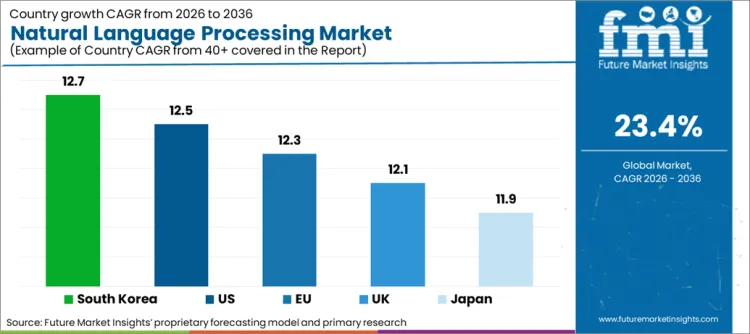
| Country | CAGR (2026 to 2036) |
|---|---|
| The USA | 12.5% |
| The UK | 12.1% |
| European Union (EU) | 12.3% |
| Japan | 11.9% |
| South Korea | 12.7% |
The USA
The Natural Language Processing (NLP) market in the USA is expanding at a rapid rate with the increasing adoption of AI, the rising need for automated customer service, and improvements in deep learning models. Organizations deploy NLP-based chatbots, AI-based sentiment analysis, and real-time speech recognition to enhance user interaction and productivity.
The National Science Foundation (NSF) and tech leaders invest in big data language models, document processing using artificial intelligence, and real-time translation of languages in order to drive automation and access.
Voice command assistant innovations, fraud detection based on artificial intelligence, and smart transcription services enhance growth even more. Google, Microsoft, and OpenAI develop text analytics using artificial intelligence, multilingual NLP solutions, and real-time conversational AI to enable business communication and decision-making.
FMI is of the opinion that the USA market is slated to grow at 12.5% CAGR during the study period.
Growth Factors in the USA
| Key Drivers | Details |
|---|---|
| AI Adoption | Companies in chatbots, sentiment analysis, and voice recognition use NLP. |
| Government & Private Investments | NSF and tech leaders invest in big-data AI models and document processing. |
| Business Applications | Smart transcription, fraud detection with AI, and multilingual NLP services drive growth. |
The UK
The UK NLP industry is growing monstrously on the shoulders of increasing funds for AI research, intelligent automation implementation, and an increase in the expansion of NLP in financial services and healthcare. AI-enabled virtual assistants, intelligent data analysis, and customer sentiment analysis in real-time help firms improve business effectiveness. Responsible usage of NLP is encouraged in the UK via the AI Strategy and policy interventions.
Live voice processing via AI and conversational AI supporting multiple languages are increasing their use across industries. Such firms spend money on AI-driven chatbots, NLP-driven legal document examination, and AI-driven knowledge management systems to optimize enterprise automation.
FMI is of the opinion that the UK is slated to grow at 12.1% CAGR during the study period.
Growth Drivers in the UK
| Key Drivers | Details |
|---|---|
| AI Research Spending | Government and private entities fund AI research and NLP solutions. |
| Adoption of Automation | NLP enhances customer service, finance, and healthcare processes. |
| Support of Regulations | AI policies ensure the safe and ethical use of NLP. |
European Union (EU)
NLP in the EU market is growing rapidly with EU-level AI investment strategies, increased adoption of machine learning-based NLP models, and rising demand for automation of text analytics.
The EU Digital Strategy and GDPR govern secure and ethical NLP deployments. Germany, France, and the Netherlands are at the forefront of multilingual AI translation, AI-driven knowledge discovery, and real-time voice analysis.
AI-powered automated customer services, NLP-driven fraud detection, and compliance management software are fueling growth. SAP, Siemens, and Orange invest in intelligent text processing, AI-driven knowledge extraction, and real-time speech recognition for business automation and decision-making.
FMI is of the opinion that the EU is slated to grow at 12.3% CAGR during the study period.
Growth Drivers in the EU
| Key Drivers | Details |
|---|---|
| AI Investment Policies | European countries are emphasizing AI investments and research. |
| Data Security Regulations | GDPR impacting ethical NLP implementations. |
| Industry-Specific NLP Applications | Finance, health, and compliance monitoring growth. |
Japan
NLP in Japan is developing rapidly with government-sponsored AI projects, booming uses of AI-powered voice assistants, and expansion of NLP robotics and healthcare solutions. Intelligent automation, multilingual AI models, and deep learning are Japan's focal points that create new horizons for NLP solutions.
Investment by the Ministry of Internal Affairs and Communications (MIC) is made in real-time AI-transcription services, sentiment analysis using NLP, and language learning platforms powered by AI. Voice recognition for autonomous systems, AI document summarization, and AI compliance monitoring go mainstream.
Fujitsu, Sony, and NTT Communications of Japan lead in AI-driven text analysis, deep learning-based NLP, and voice-enabling AI to deliver best-in-class business intelligence and automation.
FMI is of the opinion that Japan is slated to grow at 11.9% CAGR during the study period.
Drivers of Growth in Japan
| Key Drivers | Details |
|---|---|
| Government-Backed AI Initiatives | MIC invests in sentiment analysis and AI-powered transcription. |
| Healthcare & Robotics Industry | NLP enables automation in the healthcare and robotics industry. |
| Speech-Enabling AI | Speech recognition powered by AI fuels business and consumer use. |
South Korea
South Korea's NLP industry growth is gaining traction on the strength of nationwide AI research spending, surging demand for AI-powered customer service automation, and changing NLP-powered content moderation. South Korea's focus on AI-powered translation services and smart voice recognition fuels adoption. The Ministry of Science and ICT (MSIT) promotes AI-powered language processing, real-time speech-to-text analysis, and NLP-powered sentiment analysis.
AI-driven legal document processing, voice-secured security authentication, and intelligent contract automation redefine business. Samsung Electronics, LG AI Research, and Naver, some of South Korea's leading companies, are investing in deep learning-driven NLP, AI-driven content generation, and multi-language voice recognition to drive innovation in automated communication and data insights.
FMI is of the opinion that South Korea is slated to grow at 12.7% CAGR during the study period.
Growth Drivers in South Korea
| Key Drivers | Details |
|---|---|
| AI Research Expenditure | Government and private investment fund AI-driven NLP innovation. |
| Content Moderation & Security | AI facilitates fraud detection and document processing. |
| Multilingual AI Growth | Speech recognition and translation are driven by AI-supported expansion. |
Competitive Outlook
The natural language processing (NLP) market is growing as businesses adopt customer service solutions fueled by AI in automation technology and content analysis. The increasing proliferation of chatbots, virtual assistants, speech recognition, and text analytics in industries such as healthcare, finance, e-commerce, and media are further propelling the growth of NLP markets.
Market giants like Google, Microsoft, IBM, OpenAI, and Amazon use large-scale language models, cloud-based NLP solutions, and AI-powered analytics platforms to capture a larger market share. Meanwhile, startups and niche providers are increasing their competitive intensity because of their application-specific and real-time sentiment analysis and domain-trained AI models.
The rapid evolution of the market is driven by advances in deep learning, transformer-based architectures (of which the most well-known examples include GPT and BERT), and multimodal AI, developing language understanding and contextual awareness. The increasing popularity of multilingual NLP and ethical AI is shaping the industry's future direction.
Increased AI automation, impending regulations about data privacy, and the development of bias-free language models are the major strategic factors affecting the industry. Companies are building differentiation through AI-driven personalization and scalable cloud NLP applications and including them in enterprise software ecosystems, and this will continue to provide innovation and dynamic competition.
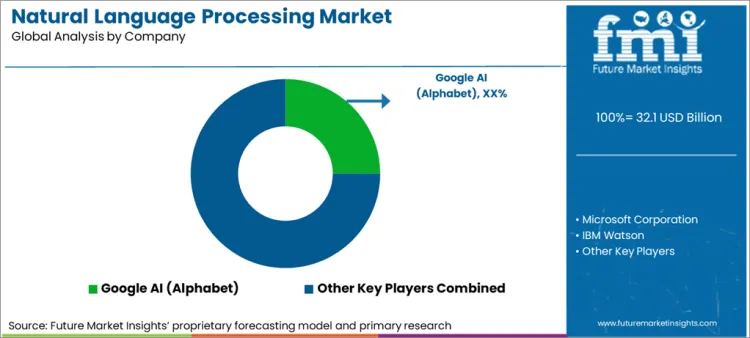
Market Share Analysis by Company
| Company Name | Estimated Market Share (%) |
|---|---|
| Google AI (Alphabet) | 20-25% |
| Microsoft Corporation | 15-20% |
| IBM Watson | 12-16% |
| Amazon Web Services (AWS) | 10-14% |
| OpenAI | 6-10% |
| Other Companies (combined) | 20-30% |
Recent Developments
- In January 2026, SAP and Anthropic finalised a strategic partnership to embed Claude 3's advanced reasoning into SAP's ERP suite, enabling automated financial reporting and supply chain analysis directly within enterprise operational software.
- In September 2025, Mistral AI raised EUR 1.7 billion in Series C funding led by ASML to accelerate research and industrial AI solutions, representing the largest European AI funding round.
- In February 2026, Sarvam AI launched Sarvam Vision, an OCR model achieving 84.3% accuracy on benchmarks, outperforming frontier models on Indian language document processing.
Key Players
- Google AI (Alphabet)
- Microsoft Corporation
- IBM Watson
- Amazon Web Services (AWS)
- OpenAI
- Meta AI
- SAP SE
- Nuance Communications
- Hugging Face
- Cohere
Market Definition
The natural language processing market represents revenue generated from the development, licensing, and deployment of software and platforms that enable machines to understand, interpret, generate, and respond to human language. The market measures the value of LLM platforms, text analytics tools, speech engines, machine translation systems, conversational AI, and NLP-embedded enterprise applications.
Inclusions cover large language models and foundation model APIs, text classification and sentiment analysis tools, named entity recognition (NER) systems, machine translation platforms, speech-to-text and text-to-speech engines, conversational AI and chatbot platforms, document intelligence and OCR systems, and NLP capabilities embedded in ERP, CRM, and ITSM software. Training compute infrastructure costs directly tied to NLP model development are also included.
Exclusions include general-purpose cloud computing infrastructure not specific to NLP workloads, computer vision models without NLP components, robotic process automation (RPA) software without language understanding capability, and consumer social media platforms where NLP is an internal tool rather than a sold product.
Scope of Report
| Items | Values |
|---|---|
| Quantitative Units (2026) | USD 32.1 Billion |
| Product Type | LLM Platforms, Text Analytics, Speech Engines, Machine Translation, Conversational AI, Document Intelligence, NLP-Embedded Enterprise Software |
| Deployment | Cloud API, On-Premise, Edge, Hybrid |
| End User | Enterprises (BFSI, Healthcare, Retail, Manufacturing), Government, Technology Companies |
| Regions Covered | North America, Europe, Asia Pacific, Middle East and Africa, Latin America |
| Countries Covered | USA, China, India, UK, Germany, UAE, France, Japan, and 40+ countries |
| Key Companies Profiled | OpenAI, Anthropic, Google, Microsoft, Mistral AI, Baidu, Sarvam AI, SAP, Workday |
Natural Language Processing Market Segment
By Technology:
The market is segmented into Auto Coding, Text Analytics, Optical Character Recognition (OCR), Interactive Voice Response, Pattern & Image Recognition, and Speech Analytics.
By Type:
The market includes rule-based, statistical, and hybrid models.
By Service:
The market is categorized into Integration Services, Consulting Services, and Maintenance Services.
By Deployment Model:
The market comprises on-premises and on-demand deployment models.
By Application:
The market covers sentiment analysis, data extraction, risk and threat detection, automatic summarization, content management, language scoring, and others (portfolio monitoring, HR and Recruiting, and Branding and Advertising).
By Vertical:
The market spans the healthcare sector, public sector, retail sector, media & entertainment, manufacturing, and other sectors.
By Region:
The market is distributed across North America, Latin America, Western Europe, Eastern Europe, Asia Pacific excluding Japan (APEJ), Japan, and the Middle East & Africa.
Bibliography
- Stanford Institute for Human-Centred AI. (2024). AI Index 2024: Generative AI Private Investment Data. Stanford HAI.
- Mistral AI. (2025, September). Mistral AI raises EUR 1.7 billion Series C to accelerate technological progress with AI. Mistral AI Newsroom.
- Technology Innovation Institute. (2026, January). TII launches Falcon-H1 Arabic: World's leading Arabic AI model. TII Abu Dhabi.
- SAP SE. (2026, January). SAP and Anthropic partnership: Claude 3 integration into SAP ERP. SAP Newsroom.
Frequently Asked Questions
What is the current global market size for Natural Language Processing?
The global market is valued at USD 32.1 Billion in 2026, driven by enterprise LLM adoption, multilingual foundation model development, and the embedding of NLP agents into ERP and CRM platforms.
What is the projected Compound Annual Growth Rate (CAGR) for the market over the next 10 years?
The market is projected to grow at a CAGR of 23.4% from 2026 to 2036.
Which regions are experiencing the fastest expansion?
Asia Pacific and the Middle East are the fastest-growing regions driven by sovereign multilingual LLM development (Sarvam AI, Falcon-H1 Arabic), while North America leads by value through enterprise AI investment concentration.
What are the primary market drivers?
Enterprise LLM-powered agent integration into operational software, record private AI investment exceeding USD 25 billion annually, and EU AI Act compliance requirements are the primary growth catalysts.
Who are the leading suppliers in the industry?
OpenAI, Anthropic, Google, Microsoft, and Mistral AI are key players, differentiating through foundation model capability, enterprise software integration depth, and multilingual coverage.
Preview the report firsthand - request a free sample
Get SampleGet the brochure for pricing and purchase details.
Get PDFTable of Content
- Executive Summary
- Global Market Outlook
- Demand-side Trends
- Supply-side Trends
- Technology Roadmap Analysis
- Analysis and Recommendations
- Market Overview
- Market Coverage / Taxonomy
- Market Definition / Scope / Limitations
- Research Methodology
- Chapter Orientation
- Analytical Lens and Working Hypotheses
- Market Structure, Signals, and Trend Drivers
- Benchmarking and Cross-market Comparability
- Market Sizing, Forecasting, and Opportunity Mapping
- Research Design and Evidence Framework
- Desk Research Programme (Secondary Evidence)
- Company Annual and Sustainability Reports
- Peer-reviewed Journals and Academic Literature
- Corporate Websites, Product Literature, and Technical Notes
- Earnings Decks and Investor Briefings
- Statutory Filings and Regulatory Disclosures
- Technical White Papers and Standards Notes
- Trade Journals, Industry Magazines, and Analyst Briefs
- Conference Proceedings, Webinars, and Seminar Materials
- Government Statistics Portals and Public Data Releases
- Press Releases and Reputable Media Coverage
- Specialist Newsletters and Curated Briefings
- Sector Databases and Reference Repositories
- FMI Internal Proprietary Databases and Historical Market Datasets
- Subscription Datasets and Paid Sources
- Social Channels, Communities, and Digital Listening Inputs
- Additional Desk Sources
- Expert Input and Fieldwork (Primary Evidence)
- Primary Modes
- Qualitative Interviews and Expert Elicitation
- Quantitative Surveys and Structured Data Capture
- Blended Approach
- Why Primary Evidence is Used
- Field Techniques
- Interviews
- Surveys
- Focus Groups
- Observational and In-context Research
- Social and Community Interactions
- Stakeholder Universe Engaged
- C-suite Leaders
- Board Members
- Presidents and Vice Presidents
- R&D and Innovation Heads
- Technical Specialists
- Domain Subject-matter Experts
- Scientists
- Physicians and Other Healthcare Professionals
- Governance, Ethics, and Data Stewardship
- Research Ethics
- Data Integrity and Handling
- Primary Modes
- Tooling, Models, and Reference Databases
- Desk Research Programme (Secondary Evidence)
- Data Engineering and Model Build
- Data Acquisition and Ingestion
- Cleaning, Normalisation, and Verification
- Synthesis, Triangulation, and Analysis
- Quality Assurance and Audit Trail
- Market Background
- Market Dynamics
- Drivers
- Restraints
- Opportunity
- Trends
- Scenario Forecast
- Demand in Optimistic Scenario
- Demand in Likely Scenario
- Demand in Conservative Scenario
- Opportunity Map Analysis
- Product Life Cycle Analysis
- Supply Chain Analysis
- Investment Feasibility Matrix
- Value Chain Analysis
- PESTLE and Porter’s Analysis
- Regulatory Landscape
- Regional Parent Market Outlook
- Production and Consumption Statistics
- Import and Export Statistics
- Market Dynamics
- Global Market Analysis 2021 to 2025 and Forecast, 2026 to 2036
- Historical Market Size Value (USD Million) Analysis, 2021 to 2025
- Current and Future Market Size Value (USD Million) Projections, 2026 to 2036
- Y-o-Y Growth Trend Analysis
- Absolute $ Opportunity Analysis
- Global Market Pricing Analysis 2021 to 2025 and Forecast 2026 to 2036
- Global Market Analysis 2021 to 2025 and Forecast 2026 to 2036, By Technology
- Introduction / Key Findings
- Historical Market Size Value (USD Million) Analysis By Technology , 2021 to 2025
- Current and Future Market Size Value (USD Million) Analysis and Forecast By Technology , 2026 to 2036
- Auto coding
- Text Analytics
- Optical Character Recognition (OCR)
- Interactive Voice Response
- Auto coding
- Y-o-Y Growth Trend Analysis By Technology , 2021 to 2025
- Absolute $ Opportunity Analysis By Technology , 2026 to 2036
- Global Market Analysis 2021 to 2025 and Forecast 2026 to 2036, By Type
- Introduction / Key Findings
- Historical Market Size Value (USD Million) Analysis By Type, 2021 to 2025
- Current and Future Market Size Value (USD Million) Analysis and Forecast By Type, 2026 to 2036
- Rule Bases
- Statistical
- Hybrid
- Rule Bases
- Y-o-Y Growth Trend Analysis By Type, 2021 to 2025
- Absolute $ Opportunity Analysis By Type, 2026 to 2036
- Global Market Analysis 2021 to 2025 and Forecast 2026 to 2036, By Region
- Introduction
- Historical Market Size Value (USD Million) Analysis By Region, 2021 to 2025
- Current Market Size Value (USD Million) Analysis and Forecast By Region, 2026 to 2036
- North America
- Latin America
- Western Europe
- Eastern Europe
- East Asia
- South Asia and Pacific
- Middle East & Africa
- Market Attractiveness Analysis By Region
- North America Market Analysis 2021 to 2025 and Forecast 2026 to 2036, By Country
- Historical Market Size Value (USD Million) Trend Analysis By Market Taxonomy, 2021 to 2025
- Market Size Value (USD Million) Forecast By Market Taxonomy, 2026 to 2036
- By Country
- USA
- Canada
- Mexico
- By Technology
- By Type
- By Country
- Market Attractiveness Analysis
- By Country
- By Technology
- By Type
- Key Takeaways
- Latin America Market Analysis 2021 to 2025 and Forecast 2026 to 2036, By Country
- Historical Market Size Value (USD Million) Trend Analysis By Market Taxonomy, 2021 to 2025
- Market Size Value (USD Million) Forecast By Market Taxonomy, 2026 to 2036
- By Country
- Brazil
- Chile
- Rest of Latin America
- By Technology
- By Type
- By Country
- Market Attractiveness Analysis
- By Country
- By Technology
- By Type
- Key Takeaways
- Western Europe Market Analysis 2021 to 2025 and Forecast 2026 to 2036, By Country
- Historical Market Size Value (USD Million) Trend Analysis By Market Taxonomy, 2021 to 2025
- Market Size Value (USD Million) Forecast By Market Taxonomy, 2026 to 2036
- By Country
- Germany
- UK
- Italy
- Spain
- France
- Nordic
- BENELUX
- Rest of Western Europe
- By Technology
- By Type
- By Country
- Market Attractiveness Analysis
- By Country
- By Technology
- By Type
- Key Takeaways
- Eastern Europe Market Analysis 2021 to 2025 and Forecast 2026 to 2036, By Country
- Historical Market Size Value (USD Million) Trend Analysis By Market Taxonomy, 2021 to 2025
- Market Size Value (USD Million) Forecast By Market Taxonomy, 2026 to 2036
- By Country
- Russia
- Poland
- Hungary
- Balkan & Baltic
- Rest of Eastern Europe
- By Technology
- By Type
- By Country
- Market Attractiveness Analysis
- By Country
- By Technology
- By Type
- Key Takeaways
- East Asia Market Analysis 2021 to 2025 and Forecast 2026 to 2036, By Country
- Historical Market Size Value (USD Million) Trend Analysis By Market Taxonomy, 2021 to 2025
- Market Size Value (USD Million) Forecast By Market Taxonomy, 2026 to 2036
- By Country
- China
- Japan
- South Korea
- By Technology
- By Type
- By Country
- Market Attractiveness Analysis
- By Country
- By Technology
- By Type
- Key Takeaways
- South Asia and Pacific Market Analysis 2021 to 2025 and Forecast 2026 to 2036, By Country
- Historical Market Size Value (USD Million) Trend Analysis By Market Taxonomy, 2021 to 2025
- Market Size Value (USD Million) Forecast By Market Taxonomy, 2026 to 2036
- By Country
- India
- ASEAN
- Australia & New Zealand
- Rest of South Asia and Pacific
- By Technology
- By Type
- By Country
- Market Attractiveness Analysis
- By Country
- By Technology
- By Type
- Key Takeaways
- Middle East & Africa Market Analysis 2021 to 2025 and Forecast 2026 to 2036, By Country
- Historical Market Size Value (USD Million) Trend Analysis By Market Taxonomy, 2021 to 2025
- Market Size Value (USD Million) Forecast By Market Taxonomy, 2026 to 2036
- By Country
- Kingdom of Saudi Arabia
- Other GCC Countries
- Turkiye
- South Africa
- Other African Union
- Rest of Middle East & Africa
- By Technology
- By Type
- By Country
- Market Attractiveness Analysis
- By Country
- By Technology
- By Type
- Key Takeaways
- Key Countries Market Analysis
- USA
- Pricing Analysis
- Market Share Analysis, 2025
- By Technology
- By Type
- Canada
- Pricing Analysis
- Market Share Analysis, 2025
- By Technology
- By Type
- Mexico
- Pricing Analysis
- Market Share Analysis, 2025
- By Technology
- By Type
- Brazil
- Pricing Analysis
- Market Share Analysis, 2025
- By Technology
- By Type
- Chile
- Pricing Analysis
- Market Share Analysis, 2025
- By Technology
- By Type
- Germany
- Pricing Analysis
- Market Share Analysis, 2025
- By Technology
- By Type
- UK
- Pricing Analysis
- Market Share Analysis, 2025
- By Technology
- By Type
- Italy
- Pricing Analysis
- Market Share Analysis, 2025
- By Technology
- By Type
- Spain
- Pricing Analysis
- Market Share Analysis, 2025
- By Technology
- By Type
- France
- Pricing Analysis
- Market Share Analysis, 2025
- By Technology
- By Type
- India
- Pricing Analysis
- Market Share Analysis, 2025
- By Technology
- By Type
- ASEAN
- Pricing Analysis
- Market Share Analysis, 2025
- By Technology
- By Type
- Australia & New Zealand
- Pricing Analysis
- Market Share Analysis, 2025
- By Technology
- By Type
- China
- Pricing Analysis
- Market Share Analysis, 2025
- By Technology
- By Type
- Japan
- Pricing Analysis
- Market Share Analysis, 2025
- By Technology
- By Type
- South Korea
- Pricing Analysis
- Market Share Analysis, 2025
- By Technology
- By Type
- Russia
- Pricing Analysis
- Market Share Analysis, 2025
- By Technology
- By Type
- Poland
- Pricing Analysis
- Market Share Analysis, 2025
- By Technology
- By Type
- Hungary
- Pricing Analysis
- Market Share Analysis, 2025
- By Technology
- By Type
- Kingdom of Saudi Arabia
- Pricing Analysis
- Market Share Analysis, 2025
- By Technology
- By Type
- Turkiye
- Pricing Analysis
- Market Share Analysis, 2025
- By Technology
- By Type
- South Africa
- Pricing Analysis
- Market Share Analysis, 2025
- By Technology
- By Type
- USA
- Market Structure Analysis
- Competition Dashboard
- Competition Benchmarking
- Market Share Analysis of Top Players
- By Regional
- By Technology
- By Type
- Competition Analysis
- Competition Deep Dive
- Google AI (Alphabet)
- Overview
- Product Portfolio
- Profitability by Market Segments (Product/Age /Sales Channel/Region)
- Sales Footprint
- Strategy Overview
- Marketing Strategy
- Product Strategy
- Channel Strategy
- Microsoft Corporation
- IBM Watson
- Amazon Web Services (AWS)
- Google AI (Alphabet)
- Competition Deep Dive
- Assumptions & Acronyms Used


