

- Market Size (2026)
- USD 6.1 Bn
- Forecast (2036)
- USD 12.7 Bn
- CAGR (2026 to 2036)
- 7.5%
Natural Tea Extract Market Size, Market Forecast and Outlook By FMI
Summary of the Natural Tea Extract Market
- Demand and Growth Drivers
- Functional beverage adoption is shaping demand. Manufacturers are adding tea extracts to ready-to-drink drinks, energy drinks, and wellness formulations to give them antioxidant and functional health benefits.
- The demand for nutraceutical supplements is driving growth. More and more, extracts high in EGCG and catechin are being used in formulas that aim to improve heart health, metabolism, and weight management.
- Organic certification trends are helping growth by making certified tea extracts more valuable in specialty retail and ingredient supply chains.
- Product and Segment View
- Green Tea Extract has the biggest share of the product segment at 45.0%. This is because it has a lot of antioxidants and is well-known among health and wellness consumers.
- Functional Beverages make up 50.0% of the application segment, which shows that they are widely used in ready-to-drink and fortified beverage categories.
- The food and beverage industry has the biggest share of the end-use segment at 55.0%. This is because they buy a lot of ingredients and use them in their products.
- Geography and Competitive Outlook
- China is likely to continue to be an important growth market because it has a strong base for tea production and demand for functional ingredients is growing in many industries.
- India is expected to keep growing because more people are becoming aware of health issues and more tea extracts are being used in nutraceuticals and drinks.
- Companies that can guarantee consistent extract quality, optimize catechin concentration, and keep production scalable for global supply chains define competitive positioning.
- Analyst Opinion
- Nandini Roy Choudhury, Principal Consultant at FMI says, "Companies that can standardize extract quality while aligning with functional health positioning are likely to strengthen their presence in the natural tea extract market."
- The natural tea extract market is evolving from a traditional ingredient category into a core component of functional nutrition systems.
- Adoption is being driven by increasing demand for antioxidant rich ingredients across beverages and supplements.
- The market is also benefiting from expansion in wellness focused product development across global food and nutraceutical sectors.
- Demand is further supported by the growing role of plant based functional ingredients in health oriented consumption patterns.
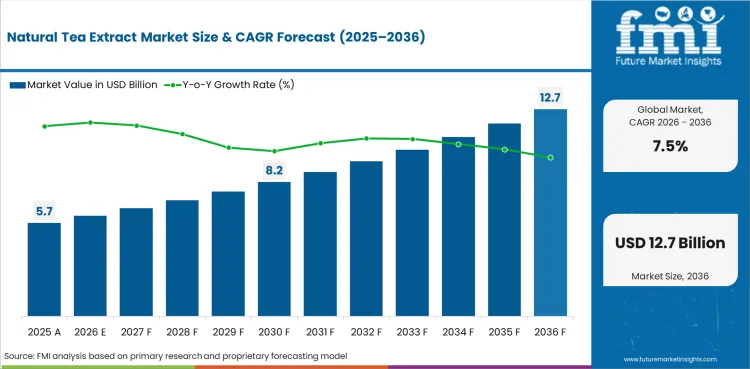
Key Takeaways, Market Size, and Forecast
- The natural tea extract market was valued at USD 5.7 billion in 2025.
- The market is set to reach USD 6.1 billion by the end of 2026.
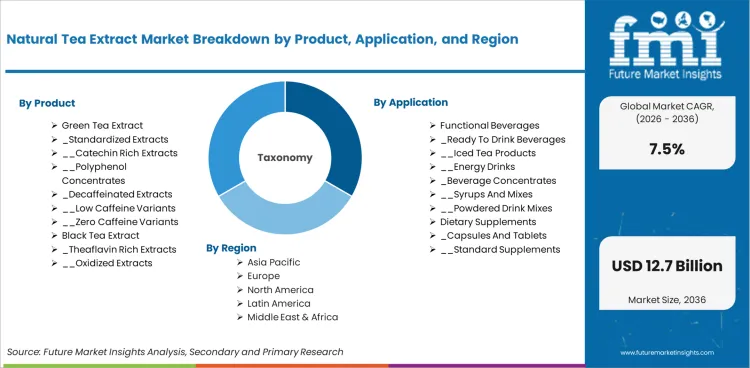
- The market is projected to grow at a CAGR of 7.5% between 2026 and 2036, reaching USD 12.7 billion by 2036.
- The natural tea extract market was valued at USD 5.71 billion in 2025.
- By 2036, the natural tea extract market is expected to be worth USD 12.65 billion.
- From 2026 to 2036, the market is projected to expand at a CAGR of 7.5%.
- The market is projected to create an incremental opportunity of USD 6.51 billion between 2026 and 2036.
- In 2026, green tea extract is expected to account for 45.0% of the product segment, driven by strong demand in functional beverage and supplement formulations.
- China (10.13%) and India (9.38%) are the two of the fastest growing markets in the world.
Natural Tea Extract Market Definition
The natural tea extract market encompasses concentrated extracts derived from Camellia sinensis including green tea, black tea, white tea, oolong tea, and related botanical tea varieties. Product scope covers powder extracts, liquid concentrates, spray-dried extracts, and standardized extract formulations containing defined EGCG, catechin, polyphenol, and caffeine content, sold to food and beverage manufacturers, nutraceutical formulators, and personal care product companies.
Natural Tea Extract Market Inclusions
Market scope includes all commercially traded natural tea extract covering the product, application, end-use, and distribution-channel segments detailed in Section 4, spanning the 2026 to 2036 forecast period across North America, Latin America, Europe, East Asia, South Asia and Pacific, and Middle East and Africa regions.
Natural Tea Extract Market Exclusions
The scope excludes dried tea leaves for direct brewing, tea bags, ready-to-drink tea beverages, herbal non-tea infusions (such as rooibos, chamomile, and hibiscus), and isolated pure compounds such as synthetic EGCG or caffeine extracted from non-tea sources.
Natural Tea Extract Market Research Methodology
- Primary Research: FMI analysts talked to procurement leaders, technical experts, and commercial managers along the natural tea extract value chain in North America, Europe, and Asia-Pacific.
- Desk Research: To set verifiable baseline parameters, data collection included statistics from industry associations, regulatory filings, company annual reports, and trade publications.
- Market Sizing and Forecasting: We get baseline values by adding up transaction volumes from the bottom up and using growth rates and substitution curves that are specific to each region to predict demand through 2036.
- Data validation and update cycle: Every three months, projections are checked against industry sales data, regulatory disclosures, and shipment statistics from manufacturers.
Why is the Natural Tea Extract Market Growing?
- The growth of the functional beverage category, which includes ready-to-drink tea, energy drinks, and wellness drinks, drives standardized green tea extract procurement at a rate of more than 12% per year.
- Nutraceutical EGCG and catechin supplement formulations support premium pricing tiers that are 40% to 60% higher than regular green tea extract grades.
- The share of organic tea extract has grown from less than 15% in 2020 to more than 25% in 2025 at Alnatura, Whole Foods, and Tmall specialty channels.
The growth of the functional beverage category is driving demand. Manufacturers of ready-to-drink tea, energy drinks, and wellness drinks are buying standardized green tea extract to prove its catechin content and caffeine content. Coca-Cola Honest Tea, PepsiCo Pure Leaf, Ito En, and Suntory BOSS all buy a lot of tea extracts, which is causing functional beverage ingredient supply to grow by more than 12% every year.
The fastest-growing premium sub-segment is nutraceutical EGCG and catechin supplement formulations. Cardiovascular, metabolic, and weight management positioning backed by clinical trial evidence results in a 40% to 60% price premium compared to regular green tea extract. Naturex, Indena, and Kerry provide standardized EGCG extracts to supplement makers like NOW Foods, Jarrow Formulas, and Life Extension.
The growth of organic certification premiums changes the way specialty stores and online stores are positioned. The share of organic green tea extract has grown from less than 15% in 2020 to more than 25% in 2025. Alnatura, Whole Foods 365, and Tmall specialty channels are helping to position the premium category. Naturex, Indena, and Zhejiang Yinfeng's investments in extraction capacity make it possible to supply organic certification-capable products on a large scale.
Market Segmentation Analysis
- In 2026, green tea extract will make up 45% of the market. The fastest-growing sub-segment is EGCG-standardized formulations, which are in high demand as nutraceuticals.
- Functional drinks are the most common type of application, making up 50% of all applications. Dietary supplements are the next most common type.
- 65% of the channel share is for business-to-business distribution. This shows that food and beverage manufacturers are the biggest buyers of bulk goods.
There are different types of natural tea extracts based on their product, use, end use, distribution channel, formulation, source, and price range. Product segmentation separates extracts of green tea, black tea, white tea, and oolong tea. Functional drinks, dietary supplements, personal care products, and specialty food manufacturing are all areas where this technology can be used.
Insights into the Green Tea Extract Segment
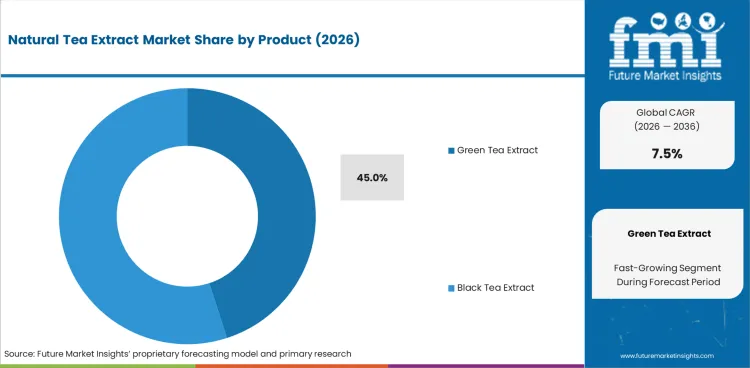
By 2026, green tea extract is expected to have the largest share of the market, with 45% of all products. This leadership is due to the demand for functional beverages, the growth of the nutraceutical supplement category, and the fact that people still think green tea catechin and EGCG are good for their health.
EGCG-standardized formulations with a set 50% to 95% EGCG content are the fastest-growing premium sub-segment of green tea extracts. Naturex, Indena, and Kerry sell standardized EGCG extracts to supplement makers for 40% to 60% more than regular green tea extract grades.
Green tea extract is likely to keep most of its market share until 2036. Black tea extract is the second biggest product group. Theaflavin and thearubigin compounds are what make it useful in specialty functional beverages and personal care products. White tea and oolong tea extracts are still high-end specialty categories, but they don't have as many sales.
Insights into the Functional Beverages Segment
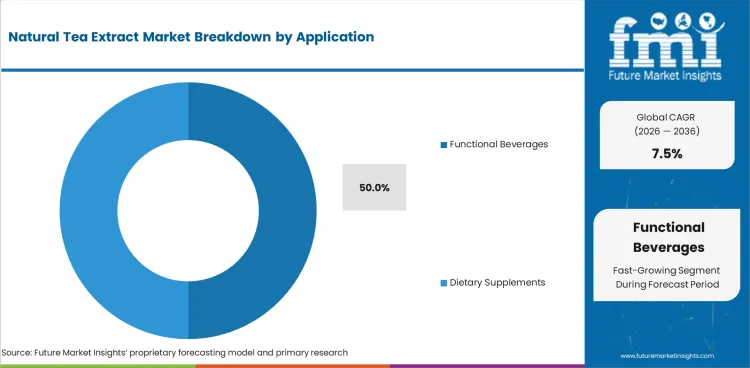
By 2026, functional drinks are expected to make up half of the application segment. The three biggest sub-applications by procurement volume are ready-to-drink tea, energy drinks, and wellness drinks.
Coca-Cola Honest Tea, PepsiCo Pure Leaf, Ito En, and Suntory BOSS all get tea extracts in large quantities to make sure they have the same amount of caffeine and catechins. Companies that make energy drinks, like Red Bull, Monster, and Celsius, a wellness brand, push for premium green tea extract that meets caffeine and catechin content standards.
Natural Tea Extract Market Drivers, Restraints, and Opportunities
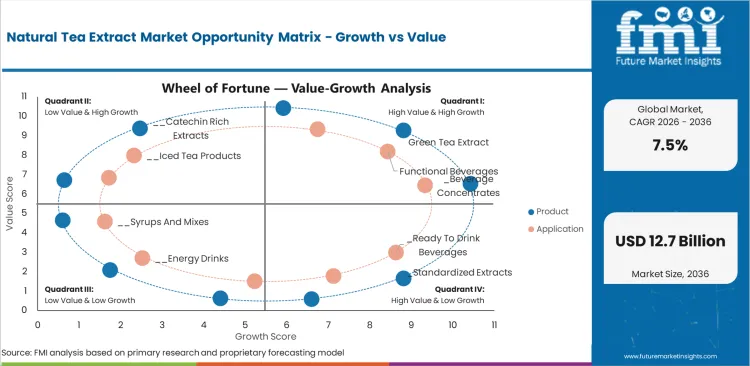
- Functional beverage formulation growth drives 12% annual demand growth at scale beverage manufacturers.
- Nutraceutical EGCG standardized extracts support 40% to 60% price premiums versus commodity grades.
- Organic certification expansion at specialty retail and e-commerce channels drives premium positioning.
The natural tea extract segment is shaped by functional beverage formulation growth, nutraceutical EGCG demand, and organic certification premium expansion. Constraints include agricultural tea leaf supply volatility, extraction capacity concentration in Asia, and ongoing competition from synthetic caffeine sources in some beverage applications.
Functional Beverage Category Growth
Demand is shaped by ready-to-drink tea, energy drink, and wellness beverage manufacturer procurement at Coca-Cola Honest Tea, PepsiCo Pure Leaf, Ito En, Suntory BOSS, Red Bull, Monster, and Celsius. Standardized green tea extract specification drives predictable bulk procurement volumes at over 12% annual growth. Extract suppliers with scale extraction capacity including Naturex, Indena, and Kerry capture the majority of functional beverage ingredient supply.
Nutraceutical EGCG and Catechin Supplement Demand
Growth reflects nutraceutical supplement formulation demand for standardized EGCG extracts at 50% to 95% EGCG concentrations. NOW Foods, Jarrow Formulas, Life Extension, and Nature's Bounty source standardized green tea extracts for cardiovascular, metabolic, and weight management formulations. Premium standardized grades command 40% to 60% price premiums over commodity green tea extract.
Organic Certification and Specialty Retail Expansion
Adoption is increasing due to organic certification premium positioning at Alnatura, Whole Foods 365, Tmall specialty, and Holland and Barrett. Organic green tea extract share has grown from under 15% in 2020 to over 25% in 2025. Extraction capacity investment at Naturex, Indena, and Zhejiang Yinfeng supports organic certification-capable supply meeting USDA NOP, EU 2018/848, and China organic standards.
Agricultural Supply Volatility and Extraction Capacity Concentration
Growth is being shaped by tea leaf supply concentration in China, India, Kenya, and Sri Lanka, exposing extract manufacturers to harvest yield volatility and currency exposure. Extraction capacity concentration at facilities in China and India creates geographic supply risk for Western manufacturers. Multi-origin sourcing and extraction partnership diversification are strategic responses, with Kerry and Naturex operating facilities across multiple geographies.
Analysis of Natural Tea Extract Market By Key Countries
.webp "Top Country Growth Comparison Natural Tea Extract Market Cagr (2026 2036)")
| Country | CAGR |
|---|---|
| China | 10.13% |
| India | 9.38% |
| Germany | 8.63% |
| Brazil | 7.88% |
| United States | 7.13% |
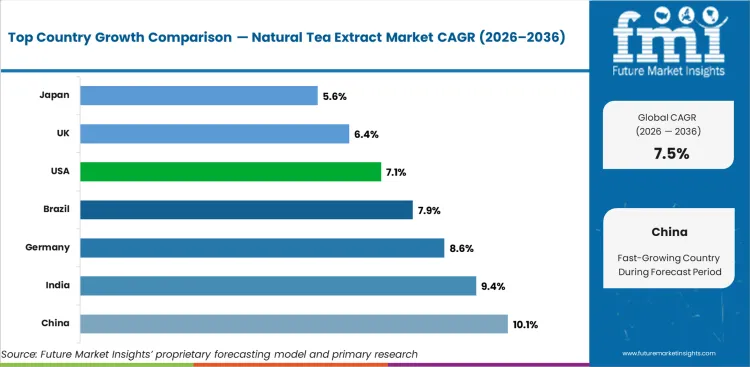
- China and India dominate absolute tea extract production volume given scale agricultural base, while North America and Western Europe lead premium functional beverage and nutraceutical formulation demand.
- China leads growth at 10.1% CAGR, propelled by functional beverage manufacturer expansion and premium supplement category development.
- India grows at 9.4% CAGR, supported by both domestic consumption growth and export production capacity at Zhejiang Yinfeng-adjacent tea extract manufacturers.
- Mature markets including the USA and UK grow at 6% to 7% CAGR through functional beverage and supplement category momentum.
The natural tea extract market is projected to grow globally at a CAGR of 7.5% from 2026 to 2036. The analysis spans over 30 countries, with the leading markets detailed below.
Demand Outlook for Natural Tea Extract Market in the United States
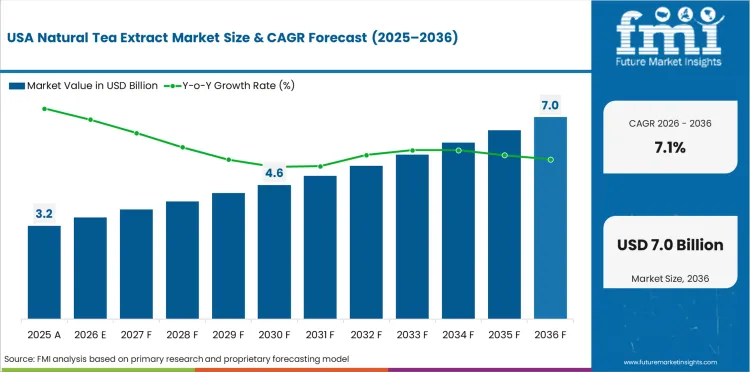
The United States is projected to grow at 7.1% CAGR through 2036, shaped by Coca-Cola Honest Tea, PepsiCo Pure Leaf, and Celsius wellness beverage procurement, NOW Foods, Jarrow Formulas, and Life Extension nutraceutical supplement formulation, and specialty retail expansion at Whole Foods and Sprouts. Naturex, Indena US, and Kerry lead premium extraction supply.
- Coca-Cola Honest Tea, PepsiCo Pure Leaf, and Celsius drive functional beverage ingredient demand.
- NOW Foods, Jarrow Formulas, and Life Extension source standardized EGCG extracts.
- Naturex US, Indena, and Kerry lead premium extraction supply partnerships.
Future Outlook for Natural Tea Extract Market in the United Kingdom
The United Kingdom is projected to grow at 6.4% CAGR through 2036, supported by functional beverage category growth, nutraceutical supplement demand at Holland and Barrett, and specialty retail organic category expansion. Domestic beverage brands including Tetley, PG Tips parent Unilever, and specialty functional beverage brands source green tea extracts. Indena UK and Kerry lead premium extraction supply.
- Holland and Barrett drives nutraceutical supplement channel demand.
- Unilever (Tetley, PG Tips) and specialty functional brands source scale green tea extracts.
- Indena UK and Kerry lead premium extract supply partnerships.
Opportunity Analysis of Natural Tea Extract Market in Germany
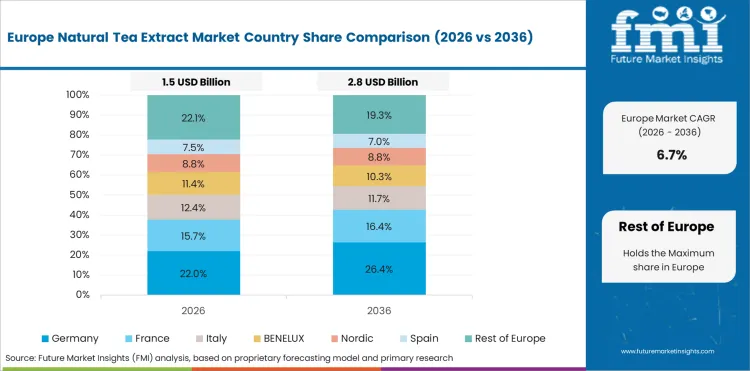
Germany is projected to grow at 8.6% CAGR through 2036, propelled by functional beverage category growth, Bio-Siegel organic certification premium positioning, and specialty nutraceutical demand at Alnatura, dm-drogerie, and Reformhaus. Domestic brands including Teekanne and specialty extract suppliers compete alongside imports from Naturex, Indena, and Kerry. EU regulation on botanical extract claim substantiation shapes formulation specifications.
- Alnatura, dm-drogerie, and Reformhaus drive specialty nutraceutical retail expansion.
- Bio-Siegel organic certification premium supports 30% to 50% pricing differential.
- EU botanical extract claim regulation shapes supplement formulation specifications.
In-depth Analysis of Natural Tea Extract Market in Japan
Japan is projected to grow at 5.6% CAGR through 2036, reflecting Ito En, Suntory, and Kirin ready-to-drink tea manufacturer procurement at scale, Fancl, DHC, and Asahi supplement formulation demand, and specialty retail premium positioning. Taiyo International, Ito En's extract subsidiary, and Mitsui Norin lead domestic extract supply. Matcha premium positioning supports additional premium sub-segments.
- Ito En, Suntory, and Kirin ready-to-drink tea manufacturers drive scale procurement.
- Fancl, DHC, and Asahi nutraceutical formulations source standardized tea extracts.
- Taiyo International and Mitsui Norin lead domestic tea extract supply.
Sales Analysis of Natural Tea Extract Market in China
China is projected to grow at 10.1% CAGR through 2036, propelled by functional beverage manufacturer expansion at Nongfu Spring, Genki Forest, and Tea Top, nutraceutical category development, and e-commerce specialty retail growth at Tmall and JD.com. Zhejiang Yinfeng Natural Products, Hunan Changlong Biotech, and Taiyo International China lead domestic extract supply.
- Nongfu Spring, Genki Forest, and Tea Top functional beverage procurement drives scale demand.
- Zhejiang Yinfeng, Hunan Changlong Biotech lead domestic extraction capacity.
- Tmall and JD.com drive e-commerce specialty nutraceutical category expansion.
In-depth Analysis of Natural Tea Extract Market in India
India grows at 9.4% CAGR through 2036, supported by both domestic extract production capacity in Assam, Darjeeling, and Nilgiri tea regions, functional beverage category growth, and nutraceutical formulation demand. Domestic extract suppliers including Sami Labs, Arjuna Natural, and Amrutanjan Health Care compete with multinational entrants. FSSAI regulations on botanical extract claim substantiation shape formulation practices.
- Assam, Darjeeling, and Nilgiri tea regions support scale domestic extract production.
- Sami Labs, Arjuna Natural, and Amrutanjan lead domestic nutraceutical extract supply.
- FSSAI botanical extract regulations shape claim substantiation requirements.
Competitive Landscape and Strategic Positioning
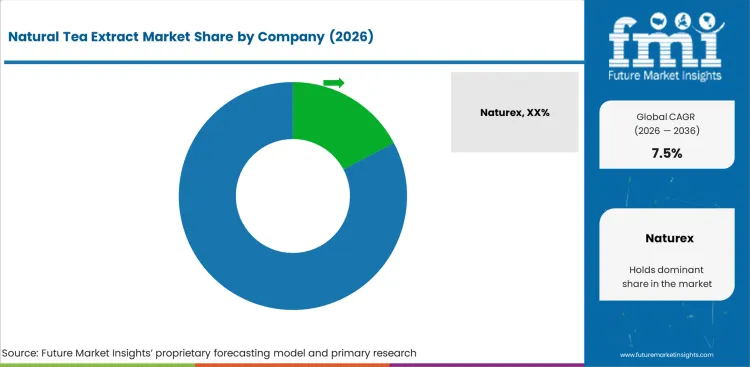
- Naturex (Givaudan), Indena, and Kerry Group collectively hold over 40% of global premium tea extract supply share, built on extraction technology investment and multi-origin sourcing.
- Regional specialists including Taiyo International (Japan), Zhejiang Yinfeng (China), and Sami Labs (India) hold meaningful branded positions in respective geographies.
- Startups focused on specialty extraction technology and organic certification are carving niche positions in premium nutraceutical and specialty beverage segments.
The natural tea extract market is shaped by global ingredient suppliers and regional extraction specialists. Naturex, now part of Givaudan, leads global premium extract supply through extraction technology investment, multi-origin sourcing, and standardized EGCG and catechin formulation capability.
Indena holds meaningful premium extract share through standardized botanical extract supply including green tea extracts with defined EGCG concentrations. Kerry Group supplies scale functional beverage and supplement manufacturers with tea extract platforms including standardized green tea, black tea, and matcha-grade extracts.
Taiyo International leads Japanese premium extract supply with functional beverage and nutraceutical formulator relationships. Zhejiang Yinfeng Natural Products operates scale Chinese extraction capacity serving both domestic and export demand.
Barriers to entry include extraction technology investment of USD 10 to 50 million per facility, multi-origin sourcing relationship development, food safety and quality certification requirements including FSSC 22000 and USP, and established relationships with functional beverage and supplement manufacturers. Strategic priorities include organic certification expansion, extraction technology refinement for standardized EGCG content, and multi-origin sourcing diversification.
Key Companies in the Natural Tea Extract Market
Key global companies leading the natural tea extract market include:
- Naturex (France, part of Givaudan), Indena S.p.A (Italy), Kerry Group Plc (Ireland), and Taiyo International Inc. (Japan) were identified as some of the star players in the natural tea extract market, given their global extraction capacity, standardized formulation capability, and multi-origin sourcing networks spanning primary tea-producing geographies.
- Zhejiang Yinfeng Natural Products Co. Ltd. (China), Hunan Changlong Biotech Co. Ltd. (China), and Mitsui Norin Co. Ltd. (Japan) have established strong regional positions by specializing in scale extraction capacity, organic certification expansion, and specialty matcha and catechin extract formulations across Asian and export markets.
- Sami Labs (India), Arjuna Natural Extracts (India), and Amrutanjan Health Care (India), among others, have distinguished themselves among emerging extraction specialists by securing strong footholds in standardized nutraceutical botanical extract supply, with growing multinational supplement manufacturer relationships underscoring their expanding export positioning.
Competitive Benchmarking: Natural Tea Extract Market
| Company | Extraction Capacity | EGCG Standardization | Organic Certification | Geographic Footprint |
|---|---|---|---|---|
| Naturex (Givaudan) | High | High | High | Global |
| Indena S.p.A | High | High | High | Europe, Global |
| Kerry Group Plc | High | High | Medium | Global |
| Taiyo International | Medium | High | High | Japan, Asia |
| Zhejiang Yinfeng | High | Medium | Medium | China, Global |
| Hunan Changlong Biotech | Medium | Medium | Medium | China, Asia |
| Mitsui Norin | Medium | High | Medium | Japan, Asia |
| Sami Labs | Medium | Medium | Low | India, Global |
| Arjuna Natural Extracts | Medium | Medium | Medium | India, Global |
| Amrutanjan Health Care | Low | Low | Low | India |
Source: Future Market Insights competitive analysis, 2026.
Key Developments in Natural Tea Extract Market
- In 2025, Kerry Group continued supplying tea extract ingredients sourced from multiple global regions, supporting demand from beverage and nutraceutical manufacturers.
- In 2025, Taiyo International maintained its portfolio of standardized green tea extracts, including EGCG-rich formulations, used in dietary supplements targeting cardiovascular and metabolic health applications.
Key Players in the Natural Tea Extract Market
Major Global Players:
- Naturex (Givaudan)
- Indena S.p.A
- Kerry Group Plc
- Taiyo International
- Zhejiang Yinfeng Natural Products
- Hunan Changlong Biotech
- Mitsui Norin
Emerging Players/Startups
- Sami Labs
- Arjuna Natural Extracts
- Amrutanjan Health Care
Report Scope and Coverage
| Metric | Value |
|---|---|
| Quantitative Units | USD 6.14 billion to USD 12.65 billion, at a CAGR of 7.5% |
| Market Definition | The natural tea extract market encompasses concentrated extracts derived from Camellia sinensis including green tea, black tea, white tea, oolong tea, and related botanical tea varieties. Product scope covers powder extracts, liquid concentrates, spray-dried extracts, and standardized extract formulations containing defined EGCG, catechin, polyphenol, and caffeine content, sold to food and beverage manufacturers, nutraceutical formulators, and personal care product companies. |
| Regions Covered | North America, Latin America, Europe, East Asia, South Asia and Pacific, Middle East and Africa |
| Countries Covered | India, China, USA, UK, Germany, Japan, South Korea, Brazil, 30 plus countries |
| Key Companies Profiled | Naturex (Givaudan), Indena S.p.A, Kerry Group Plc, Taiyo International, Zhejiang Yinfeng Natural Products, Hunan Changlong Biotech, Mitsui Norin, Sami Labs, Arjuna Natural Extracts, Amrutanjan Health Care |
| Forecast Period | 2026 to 2036 |
| Approach | Hybrid bottom-up and top-down methodology starting with verified natural tea extract transaction data, projecting adoption velocity across segments and regions. |
Market Segmentation Analysis
Natural Tea Extract Market Market Segmented by Product:
- Green Tea Extract
- Standardized Extracts
- Catechin Rich Extracts
- Polyphenol Concentrates
- Decaffeinated Extracts
- Low Caffeine Variants
- Zero Caffeine Variants
- Standardized Extracts
- Black Tea Extract
- Theaflavin Rich Extracts
- Oxidized Extracts
- High Antioxidant Variants
- Instant Extracts
- Spray Dried Extracts
- Agglomerated Powders
- Theaflavin Rich Extracts
- Oolong Tea Extract
- Semi Fermented Extracts
- Balanced Polyphenol Content
- Moderate Caffeine Variants
- Semi Fermented Extracts
- White Tea Extract
- Minimal Process Extracts
- High Purity Extracts
- Premium Grade Extracts
- Minimal Process Extracts
Natural Tea Extract Market Market Segmented by Application:
- Functional Beverages
- Ready To Drink Beverages
- Iced Tea Products
- Energy Drinks
- Beverage Concentrates
- Syrups And Mixes
- Powdered Drink Mixes
- Ready To Drink Beverages
- Dietary Supplements
- Capsules And Tablets
- Standard Supplements
- High Potency Supplements
- Powder Supplements
- Bulk Powders
- Stick Packs
- Capsules And Tablets
- Food Products
- Bakery And Confectionery
- Functional Snacks
- Fortified Bakery Items
- Dairy And Frozen Desserts
- Flavored Dairy Products
- Ice Cream Applications
- Bakery And Confectionery
- Personal Care And Cosmetics
- Skin Care Products
- Anti Aging Formulations
- Antioxidant Creams
- Hair Care Products
- Scalp Treatment
- Hair Strengthening
- Skin Care Products
Natural Tea Extract Market Market Segmented by End Use:
- Food And Beverage Industry
- Beverage Manufacturers
- Ready To Drink Brands
- Functional Beverage Producers
- Food Manufacturers
- Snack Producers
- Dairy Product Manufacturers
- Beverage Manufacturers
- Nutraceutical Companies
- Supplement Manufacturers
- Capsule Producers
- Powder Supplement Brands
- Supplement Manufacturers
- Personal Care Industry
- Cosmetic Manufacturers
- Skin Care Brands
- Hair Care Brands
- Cosmetic Manufacturers
Natural Tea Extract Market Market Segmented by Distribution Channel:
- Business To Business
- Direct Sales
- Bulk Ingredient Supply
- Contract Supply Agreements
- Distributors And Wholesalers
- Ingredient Distributors
- Specialty Chemical Distributors
- Direct Sales
- Business To Consumer
- Online Retail
- E Commerce Platforms
- Brand Owned Websites
- Offline Retail
- Health Stores
- Pharmacy Retail
- Online Retail
Natural Tea Extract Market Market Segmented by Formulation:
- Powder Extracts
- Spray Dried Powder
- Fine Powder
- Agglomerated Powder
- Freeze Dried Powder
- High Nutrient Retention
- Premium Extracts
- Spray Dried Powder
- Liquid Extracts
- Concentrated Liquids
- High Strength Extracts
- Flavor Concentrates
- Tinctures
- Alcohol Based Extracts
- Water Based Extracts
- Concentrated Liquids
Natural Tea Extract Market Market Segmented by Source:
- Organic
- Certified Organic Tea Leaves
- Sustainably Sourced
- Pesticide Free Cultivation
- Certified Organic Tea Leaves
- Conventional
- Standard Cultivation
- High Yield Production
- Cost Efficient Sourcing
- Standard Cultivation
Natural Tea Extract Market Market Segmented by Pricing Tier:
- Mid Range
- Standard Extract Grades
- Balanced Quality And Price
- Standard Extract Grades
- Economy
- Bulk Commodity Extracts
- Low Cost Variants
- Bulk Commodity Extracts
- Premium
- High Purity Extracts
- Clinical Grade Extracts
- Specialty Formulations
- High Purity Extracts
Natural Tea Extract Market Market by Region:
- North America
- USA
- Canada
- Mexico
- Latin America
- Brazil
- Chile
- Rest of Latin America
- Western Europe
- Germany
- UK
- Italy
- Spain
- France
- Nordic
- BENELUX
- Rest of Western Europe
- Eastern Europe
- Russia
- Poland
- Hungary
- Balkan & Baltic
- Rest of Eastern Europe
- East Asia
- China
- Japan
- South Korea
- South Asia and Pacific
- India
- ASEAN
- Australia & New Zealand
- Rest of South Asia and Pacific
- Middle East & Africa
- Kingdom of Saudi Arabia
- Other GCC Countries
- Turkiye
- South Africa
- Other African Union
- Rest of Middle East & Africa
Research Sources and Bibliography
- 1. USA Pharmacopeia. (2025). USP Green Tea Extract Monograph and Specifications. USP.
- 2. European Food Safety Authority. (2024). EFSA Scientific Opinion on Green Tea Extract Safety. EFSA.
- 3. USA Food and Drug Administration. (2024). FDA Dietary Supplement Health and Education Guidance. FDA.
- 4. Food and Agriculture Organization. (2025). FAO Global Tea Production and Trade Statistics. FAO.
- 5. Food Safety and Standards Authority of India. (2025). FSSAI Botanical Extracts and Nutraceutical Regulations. FSSAI.
This bibliography is provided for reader reference.
This Report Answers
- Market sizing and revenue forecasting for natural tea extract products from 2026 to 2036.
- Segmentation analysis across all product, application, end-use, and distribution-channel axes covered in Section 4.
- Regional and country-level insights covering over 30 markets with comparative growth analysis.
- Regulatory analysis covering the key frameworks shaping product specifications and procurement priorities in major markets.
- Competitive landscape assessment covering market structure, vendor positioning, and recent developments.
- Investment opportunity mapping across supplier, brand-owner, and channel verticals.
- Supply chain tracking from raw material sourcing to finished product distribution.
- Data delivery in PDF and Excel formats with quarterly refresh access.
Frequently Asked Questions
How large is the demand for Natural Tea Extract Market in the global market in 2026?
Demand for natural tea extract market in the global market is estimated to be valued at USD 6.14 billion in 2026.
What will be the market size of Natural Tea Extract Market by 2036?
Market size for natural tea extract market is projected to reach USD 12.65 billion by 2036.
What is the expected demand growth for Natural Tea Extract Market between 2026 and 2036?
Demand for natural tea extract market is expected to grow at a CAGR of 7.5% between 2026 and 2036.
Which Product is poised to lead global sales by 2026?
Green Tea Extract accounts for 45.0% in 2026, reflecting established manufacturing infrastructure and proven performance advantages.
How is Business To Business driving Natural Tea Extract Market adoption?
Business To Business represents 65.0% of distribution channel demand as dominant operators and procurement organizations drive volume.
What is driving demand in the top-growth country?
China registers a 10.13% CAGR through 2036, propelled by policy mandates, category adoption, and procurement-scale investment.
What does Natural Tea Extract Market definition mean in this report?
The natural tea extract market ral tea extract market encompasses concentrated extracts derived from Camellia sinensis including green tea, black tea, white tea, oolong tea, and related botanical tea varieties. Product scope covers powder extracts, liquid concentrates, spray-dried extracts, and standardized extract formulations containing defined EGCG, catechin, polyphenol, and caffeine content, sold to food and beverage manufacturers, nutraceutical formulators, and personal care product companies.
How does FMI build and validate the Natural Tea Extract Market forecast?
Forecasting models apply a hybrid bottom-up methodology starting with verified transaction data, cross-validated against industry sales statistics and manufacturer financial disclosures.
Preview the report firsthand - request a free sample
Get SampleGet the brochure for pricing and purchase details.
Get PDFTable of Content
- Executive Summary
- Global Market Outlook
- Demand-side Trends
- Supply-side Trends
- Technology Roadmap Analysis
- Analysis and Recommendations
- Market Overview
- Market Coverage / Taxonomy
- Market Definition / Scope / Limitations
- Research Methodology
- Chapter Orientation
- Analytical Lens and Working Hypotheses
- Market Structure, Signals, and Trend Drivers
- Benchmarking and Cross-market Comparability
- Market Sizing, Forecasting, and Opportunity Mapping
- Research Design and Evidence Framework
- Desk Research Programme (Secondary Evidence)
- Company Annual and Sustainability Reports
- Peer-reviewed Journals and Academic Literature
- Corporate Websites, Product Literature, and Technical Notes
- Earnings Decks and Investor Briefings
- Statutory Filings and Regulatory Disclosures
- Technical White Papers and Standards Notes
- Trade Journals, Industry Magazines, and Analyst Briefs
- Conference Proceedings, Webinars, and Seminar Materials
- Government Statistics Portals and Public Data Releases
- Press Releases and Reputable Media Coverage
- Specialist Newsletters and Curated Briefings
- Sector Databases and Reference Repositories
- FMI Internal Proprietary Databases and Historical Market Datasets
- Subscription Datasets and Paid Sources
- Social Channels, Communities, and Digital Listening Inputs
- Additional Desk Sources
- Expert Input and Fieldwork (Primary Evidence)
- Primary Modes
- Qualitative Interviews and Expert Elicitation
- Quantitative Surveys and Structured Data Capture
- Blended Approach
- Why Primary Evidence is Used
- Field Techniques
- Interviews
- Surveys
- Focus Groups
- Observational and In-context Research
- Social and Community Interactions
- Stakeholder Universe Engaged
- C-suite Leaders
- Board Members
- Presidents and Vice Presidents
- R&D and Innovation Heads
- Technical Specialists
- Domain Subject-matter Experts
- Scientists
- Physicians and Other Healthcare Professionals
- Governance, Ethics, and Data Stewardship
- Research Ethics
- Data Integrity and Handling
- Primary Modes
- Tooling, Models, and Reference Databases
- Desk Research Programme (Secondary Evidence)
- Data Engineering and Model Build
- Data Acquisition and Ingestion
- Cleaning, Normalisation, and Verification
- Synthesis, Triangulation, and Analysis
- Quality Assurance and Audit Trail
- Market Background
- Market Dynamics
- Drivers
- Restraints
- Opportunity
- Trends
- Scenario Forecast
- Demand in Optimistic Scenario
- Demand in Likely Scenario
- Demand in Conservative Scenario
- Opportunity Map Analysis
- Product Life Cycle Analysis
- Supply Chain Analysis
- Investment Feasibility Matrix
- Value Chain Analysis
- PESTLE and Porter’s Analysis
- Regulatory Landscape
- Regional Parent Market Outlook
- Production and Consumption Statistics
- Import and Export Statistics
- Market Dynamics
- Global Market Analysis 2021 to 2025 and Forecast, 2026 to 2036
- Historical Market Size Value (USD Million) Analysis, 2021 to 2025
- Current and Future Market Size Value (USD Million) Projections, 2026 to 2036
- Y-o-Y Growth Trend Analysis
- Absolute $ Opportunity Analysis
- Global Market Pricing Analysis 2021 to 2025 and Forecast 2026 to 2036
- Global Market Analysis 2021 to 2025 and Forecast 2026 to 2036, By Product
- Introduction / Key Findings
- Historical Market Size Value (USD Million) Analysis By Product , 2021 to 2025
- Current and Future Market Size Value (USD Million) Analysis and Forecast By Product , 2026 to 2036
- Green Tea Extract
- Standardized Extracts
- Catechin Rich Extracts
- Polyphenol Concentrates
- Decaffeinated Extracts
- Low Caffeine Variants
- Zero Caffeine Variants
- Black Tea Extract
- Theaflavin Rich Extracts
- Oxidized Extracts
- High Antioxidant Variants
- Instant Extracts
- Spray Dried Extracts
- Oolong Tea Extract
- Semi Fermented Extracts
- Balanced Polyphenol Content
- Moderate Caffeine Variants
- White Tea Extract
- Minimal Process Extracts
- High Purity Extracts
- Premium Grade Extracts
- Green Tea Extract
- Y-o-Y Growth Trend Analysis By Product , 2021 to 2025
- Absolute $ Opportunity Analysis By Product , 2026 to 2036
- Global Market Analysis 2021 to 2025 and Forecast 2026 to 2036, By Application
- Introduction / Key Findings
- Historical Market Size Value (USD Million) Analysis By Application, 2021 to 2025
- Current and Future Market Size Value (USD Million) Analysis and Forecast By Application, 2026 to 2036
- Functional Beverages
- Ready To Drink Beverages
- Iced Tea Products
- Energy Drinks
- Beverage Concentrates
- Syrups And Mixes
- Powdered Drink Mixes
- Dietary Supplements
- Capsules And Tablets
- Standard Supplements
- High Potency Supplements
- Powder Supplements
- Bulk Powders
- Food Products
- Bakery And Confectionery
- Functional Snacks
- Fortified Bakery Items
- Dairy And Frozen Desserts
- Flavored Dairy Products
- Personal Care And Cosmetics
- Skin Care Products
- Anti Aging Formulations
- Antioxidant Creams
- Hair Care Products
- Scalp Treatment
- Functional Beverages
- Y-o-Y Growth Trend Analysis By Application, 2021 to 2025
- Absolute $ Opportunity Analysis By Application, 2026 to 2036
- Global Market Analysis 2021 to 2025 and Forecast 2026 to 2036, By End Use
- Introduction / Key Findings
- Historical Market Size Value (USD Million) Analysis By End Use, 2021 to 2025
- Current and Future Market Size Value (USD Million) Analysis and Forecast By End Use, 2026 to 2036
- Food And Beverage Industry
- Beverage Manufacturers
- Ready To Drink Brands
- Functional Beverage Producers
- Food Manufacturers
- Snack Producers
- Dairy Product Manufacturers
- Nutraceutical Companies
- Supplement Manufacturers
- Capsule Producers
- Powder Supplement Brands
- Personal Care Industry
- Cosmetic Manufacturers
- Skin Care Brands
- Hair Care Brands
- Food And Beverage Industry
- Y-o-Y Growth Trend Analysis By End Use, 2021 to 2025
- Absolute $ Opportunity Analysis By End Use, 2026 to 2036
- Global Market Analysis 2021 to 2025 and Forecast 2026 to 2036, By Distribution Channel
- Introduction / Key Findings
- Historical Market Size Value (USD Million) Analysis By Distribution Channel, 2021 to 2025
- Current and Future Market Size Value (USD Million) Analysis and Forecast By Distribution Channel, 2026 to 2036
- Business To Business
- Direct Sales
- Bulk Ingredient Supply
- Contract Supply Agreements
- Distributors And Wholesalers
- Ingredient Distributors
- Specialty Chemical Distributors
- Business To Consumer
- Online Retail
- E Commerce Platforms
- Brand Owned Websites
- Offline Retail
- Health Stores
- Business To Business
- Y-o-Y Growth Trend Analysis By Distribution Channel, 2021 to 2025
- Absolute $ Opportunity Analysis By Distribution Channel, 2026 to 2036
- Global Market Analysis 2021 to 2025 and Forecast 2026 to 2036, By Formulation
- Introduction / Key Findings
- Historical Market Size Value (USD Million) Analysis By Formulation, 2021 to 2025
- Current and Future Market Size Value (USD Million) Analysis and Forecast By Formulation, 2026 to 2036
- Powder Extracts
- Spray Dried Powder
- Fine Powder
- Agglomerated Powder
- Freeze Dried Powder
- High Nutrient Retention
- Premium Extracts
- Liquid Extracts
- Concentrated Liquids
- High Strength Extracts
- Flavor Concentrates
- Tinctures
- Alcohol Based Extracts
- Powder Extracts
- Y-o-Y Growth Trend Analysis By Formulation, 2021 to 2025
- Absolute $ Opportunity Analysis By Formulation, 2026 to 2036
- Global Market Analysis 2021 to 2025 and Forecast 2026 to 2036, By Source
- Introduction / Key Findings
- Historical Market Size Value (USD Million) Analysis By Source, 2021 to 2025
- Current and Future Market Size Value (USD Million) Analysis and Forecast By Source, 2026 to 2036
- Organic
- Certified Organic Tea Leaves
- Sustainably Sourced
- Pesticide Free Cultivation
- Conventional
- Standard Cultivation
- High Yield Production
- Cost Efficient Sourcing
- Organic
- Y-o-Y Growth Trend Analysis By Source, 2021 to 2025
- Absolute $ Opportunity Analysis By Source, 2026 to 2036
- Global Market Analysis 2021 to 2025 and Forecast 2026 to 2036, By Pricing Tier
- Introduction / Key Findings
- Historical Market Size Value (USD Million) Analysis By Pricing Tier, 2021 to 2025
- Current and Future Market Size Value (USD Million) Analysis and Forecast By Pricing Tier, 2026 to 2036
- Mid Range
- Standard Extract Grades
- Balanced Quality And Price
- Economy
- Bulk Commodity Extracts
- Low Cost Variants
- Premium
- High Purity Extracts
- Clinical Grade Extracts
- Specialty Formulations
- Mid Range
- Y-o-Y Growth Trend Analysis By Pricing Tier, 2021 to 2025
- Absolute $ Opportunity Analysis By Pricing Tier, 2026 to 2036
- Global Market Analysis 2021 to 2025 and Forecast 2026 to 2036, By Region
- Introduction
- Historical Market Size Value (USD Million) Analysis By Region, 2021 to 2025
- Current Market Size Value (USD Million) Analysis and Forecast By Region, 2026 to 2036
- North America
- Latin America
- Western Europe
- Eastern Europe
- East Asia
- South Asia and Pacific
- Middle East & Africa
- Market Attractiveness Analysis By Region
- North America Market Analysis 2021 to 2025 and Forecast 2026 to 2036, By Country
- Historical Market Size Value (USD Million) Trend Analysis By Market Taxonomy, 2021 to 2025
- Market Size Value (USD Million) Forecast By Market Taxonomy, 2026 to 2036
- By Country
- USA
- Canada
- Mexico
- By Product
- By Application
- By End Use
- By Distribution Channel
- By Formulation
- By Source
- By Pricing Tier
- By Country
- Market Attractiveness Analysis
- By Country
- By Product
- By Application
- By End Use
- By Distribution Channel
- By Formulation
- By Source
- By Pricing Tier
- Key Takeaways
- Latin America Market Analysis 2021 to 2025 and Forecast 2026 to 2036, By Country
- Historical Market Size Value (USD Million) Trend Analysis By Market Taxonomy, 2021 to 2025
- Market Size Value (USD Million) Forecast By Market Taxonomy, 2026 to 2036
- By Country
- Brazil
- Chile
- Rest of Latin America
- By Product
- By Application
- By End Use
- By Distribution Channel
- By Formulation
- By Source
- By Pricing Tier
- By Country
- Market Attractiveness Analysis
- By Country
- By Product
- By Application
- By End Use
- By Distribution Channel
- By Formulation
- By Source
- By Pricing Tier
- Key Takeaways
- Western Europe Market Analysis 2021 to 2025 and Forecast 2026 to 2036, By Country
- Historical Market Size Value (USD Million) Trend Analysis By Market Taxonomy, 2021 to 2025
- Market Size Value (USD Million) Forecast By Market Taxonomy, 2026 to 2036
- By Country
- Germany
- UK
- Italy
- Spain
- France
- Nordic
- BENELUX
- Rest of Western Europe
- By Product
- By Application
- By End Use
- By Distribution Channel
- By Formulation
- By Source
- By Pricing Tier
- By Country
- Market Attractiveness Analysis
- By Country
- By Product
- By Application
- By End Use
- By Distribution Channel
- By Formulation
- By Source
- By Pricing Tier
- Key Takeaways
- Eastern Europe Market Analysis 2021 to 2025 and Forecast 2026 to 2036, By Country
- Historical Market Size Value (USD Million) Trend Analysis By Market Taxonomy, 2021 to 2025
- Market Size Value (USD Million) Forecast By Market Taxonomy, 2026 to 2036
- By Country
- Russia
- Poland
- Hungary
- Balkan & Baltic
- Rest of Eastern Europe
- By Product
- By Application
- By End Use
- By Distribution Channel
- By Formulation
- By Source
- By Pricing Tier
- By Country
- Market Attractiveness Analysis
- By Country
- By Product
- By Application
- By End Use
- By Distribution Channel
- By Formulation
- By Source
- By Pricing Tier
- Key Takeaways
- East Asia Market Analysis 2021 to 2025 and Forecast 2026 to 2036, By Country
- Historical Market Size Value (USD Million) Trend Analysis By Market Taxonomy, 2021 to 2025
- Market Size Value (USD Million) Forecast By Market Taxonomy, 2026 to 2036
- By Country
- China
- Japan
- South Korea
- By Product
- By Application
- By End Use
- By Distribution Channel
- By Formulation
- By Source
- By Pricing Tier
- By Country
- Market Attractiveness Analysis
- By Country
- By Product
- By Application
- By End Use
- By Distribution Channel
- By Formulation
- By Source
- By Pricing Tier
- Key Takeaways
- South Asia and Pacific Market Analysis 2021 to 2025 and Forecast 2026 to 2036, By Country
- Historical Market Size Value (USD Million) Trend Analysis By Market Taxonomy, 2021 to 2025
- Market Size Value (USD Million) Forecast By Market Taxonomy, 2026 to 2036
- By Country
- India
- ASEAN
- Australia & New Zealand
- Rest of South Asia and Pacific
- By Product
- By Application
- By End Use
- By Distribution Channel
- By Formulation
- By Source
- By Pricing Tier
- By Country
- Market Attractiveness Analysis
- By Country
- By Product
- By Application
- By End Use
- By Distribution Channel
- By Formulation
- By Source
- By Pricing Tier
- Key Takeaways
- Middle East & Africa Market Analysis 2021 to 2025 and Forecast 2026 to 2036, By Country
- Historical Market Size Value (USD Million) Trend Analysis By Market Taxonomy, 2021 to 2025
- Market Size Value (USD Million) Forecast By Market Taxonomy, 2026 to 2036
- By Country
- Kingdom of Saudi Arabia
- Other GCC Countries
- Turkiye
- South Africa
- Other African Union
- Rest of Middle East & Africa
- By Product
- By Application
- By End Use
- By Distribution Channel
- By Formulation
- By Source
- By Pricing Tier
- By Country
- Market Attractiveness Analysis
- By Country
- By Product
- By Application
- By End Use
- By Distribution Channel
- By Formulation
- By Source
- By Pricing Tier
- Key Takeaways
- Key Countries Market Analysis
- USA
- Pricing Analysis
- Market Share Analysis, 2025
- By Product
- By Application
- By End Use
- By Distribution Channel
- By Formulation
- By Source
- By Pricing Tier
- Canada
- Pricing Analysis
- Market Share Analysis, 2025
- By Product
- By Application
- By End Use
- By Distribution Channel
- By Formulation
- By Source
- By Pricing Tier
- Mexico
- Pricing Analysis
- Market Share Analysis, 2025
- By Product
- By Application
- By End Use
- By Distribution Channel
- By Formulation
- By Source
- By Pricing Tier
- Brazil
- Pricing Analysis
- Market Share Analysis, 2025
- By Product
- By Application
- By End Use
- By Distribution Channel
- By Formulation
- By Source
- By Pricing Tier
- Chile
- Pricing Analysis
- Market Share Analysis, 2025
- By Product
- By Application
- By End Use
- By Distribution Channel
- By Formulation
- By Source
- By Pricing Tier
- Germany
- Pricing Analysis
- Market Share Analysis, 2025
- By Product
- By Application
- By End Use
- By Distribution Channel
- By Formulation
- By Source
- By Pricing Tier
- UK
- Pricing Analysis
- Market Share Analysis, 2025
- By Product
- By Application
- By End Use
- By Distribution Channel
- By Formulation
- By Source
- By Pricing Tier
- Italy
- Pricing Analysis
- Market Share Analysis, 2025
- By Product
- By Application
- By End Use
- By Distribution Channel
- By Formulation
- By Source
- By Pricing Tier
- Spain
- Pricing Analysis
- Market Share Analysis, 2025
- By Product
- By Application
- By End Use
- By Distribution Channel
- By Formulation
- By Source
- By Pricing Tier
- France
- Pricing Analysis
- Market Share Analysis, 2025
- By Product
- By Application
- By End Use
- By Distribution Channel
- By Formulation
- By Source
- By Pricing Tier
- India
- Pricing Analysis
- Market Share Analysis, 2025
- By Product
- By Application
- By End Use
- By Distribution Channel
- By Formulation
- By Source
- By Pricing Tier
- ASEAN
- Pricing Analysis
- Market Share Analysis, 2025
- By Product
- By Application
- By End Use
- By Distribution Channel
- By Formulation
- By Source
- By Pricing Tier
- Australia & New Zealand
- Pricing Analysis
- Market Share Analysis, 2025
- By Product
- By Application
- By End Use
- By Distribution Channel
- By Formulation
- By Source
- By Pricing Tier
- China
- Pricing Analysis
- Market Share Analysis, 2025
- By Product
- By Application
- By End Use
- By Distribution Channel
- By Formulation
- By Source
- By Pricing Tier
- Japan
- Pricing Analysis
- Market Share Analysis, 2025
- By Product
- By Application
- By End Use
- By Distribution Channel
- By Formulation
- By Source
- By Pricing Tier
- South Korea
- Pricing Analysis
- Market Share Analysis, 2025
- By Product
- By Application
- By End Use
- By Distribution Channel
- By Formulation
- By Source
- By Pricing Tier
- Russia
- Pricing Analysis
- Market Share Analysis, 2025
- By Product
- By Application
- By End Use
- By Distribution Channel
- By Formulation
- By Source
- By Pricing Tier
- Poland
- Pricing Analysis
- Market Share Analysis, 2025
- By Product
- By Application
- By End Use
- By Distribution Channel
- By Formulation
- By Source
- By Pricing Tier
- Hungary
- Pricing Analysis
- Market Share Analysis, 2025
- By Product
- By Application
- By End Use
- By Distribution Channel
- By Formulation
- By Source
- By Pricing Tier
- Kingdom of Saudi Arabia
- Pricing Analysis
- Market Share Analysis, 2025
- By Product
- By Application
- By End Use
- By Distribution Channel
- By Formulation
- By Source
- By Pricing Tier
- Turkiye
- Pricing Analysis
- Market Share Analysis, 2025
- By Product
- By Application
- By End Use
- By Distribution Channel
- By Formulation
- By Source
- By Pricing Tier
- South Africa
- Pricing Analysis
- Market Share Analysis, 2025
- By Product
- By Application
- By End Use
- By Distribution Channel
- By Formulation
- By Source
- By Pricing Tier
- USA
- Market Structure Analysis
- Competition Dashboard
- Competition Benchmarking
- Market Share Analysis of Top Players
- By Regional
- By Product
- By Application
- By End Use
- By Distribution Channel
- By Formulation
- By Source
- By Pricing Tier
- Competition Analysis
- Competition Deep Dive
- Naturex
- Overview
- Product Portfolio
- Profitability by Market Segments (Product/Age /Sales Channel/Region)
- Sales Footprint
- Strategy Overview
- Marketing Strategy
- Product Strategy
- Channel Strategy
- Indena S.p.A
- Kerry Group Plc
- Taiyo International Inc.
- Zhejiang Yinfeng Natural Products Co., Ltd.
- Shaanxi Huike Botanical Development Co., Ltd.
- Xi’an Sost Biotech Co., Ltd.
- NutriScience Innovations LLC
- Evolva Holding SA
- Natures Aid Ltd.
- Naturex
- Competition Deep Dive
- Assumptions & Acronyms Used


