

- Market Size (2026)
- USD 1.6 Bn
- Forecast (2036)
- USD 7.4 Bn
- CAGR (2026 to 2036)
- 16.5%
Retail Media Creative Optimization Market Size, Market Forecast and Outlook By FMI
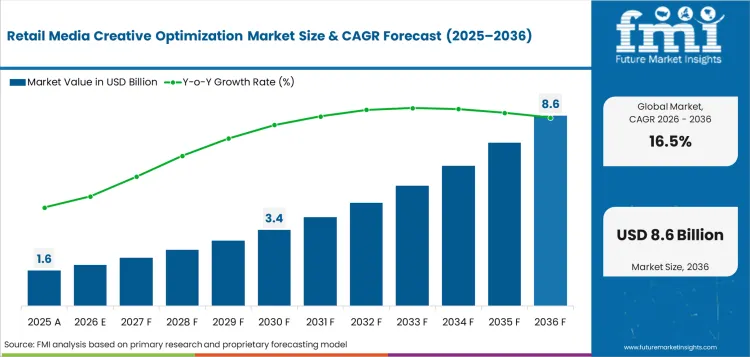
The retail media creative optimization market is projected to grow from USD 1.6 billion in 2026 to USD 7.4 billion by 2036, at a CAGR of 16.5%. Software platforms are expected to account for 55.0% of market revenue in 2026, while sponsored product and onsite display creatives remain the leading ad-format group with a 29.0% share. Source: FMI analysis, 2026.
Summary of the Retail Media Creative Optimization Market
- Demand and Growth Drivers
- Retail media networks are scaling faster than most creative workflows built to support them.
- Brands now want creative testing that responds to retail transaction data rather than generic media KPIs alone.
- Platform vendors are turning retail media optimization into a workflow category rather than a narrow ad-serving feature.
- Product and Segment View
- Software platforms hold the largest share as retailers and brands prefer embedded systems over manual creative handoffs.
- Sponsored products and onsite display remain the most active format areas as they tie closely to purchase-intent environments.
- Dynamic creative personalization is gaining more attention as retail media budgets spread across more placements and audiences.
- Geography and Competitive Outlook
- North America leads through large retail media budgets, strong platform concentration, and early advertiser experimentation.
- Europe is scaling through agency coordination, privacy-aware targeting, and retailer demand for measurable creative value.
- Asia Pacific is becoming more important as marketplaces, commerce apps, and performance-led retail media keep expanding.
- Analyst Opinion
- "Retail media creative optimization is becoming a control layer for commerce advertising rather than a design-side support function. The vendors that win will be the ones that tie creative decisions directly to retail signals, placement logic, and closed-loop performance outcomes," says Anurag Sharma, Principal Consultant.
- The strongest suppliers are linking asset generation, experimentation, and measurement inside one workflow.
- Buyers are placing more weight on testing speed and incrementality proof than on generic automation claims.
- The market remains early, though platform standardization is accelerating.
Key Takeaways
- The retail media creative optimization market is expected to be valued at USD 1.6 billion in 2026.
- By 2036, the retail media creative optimization market is forecast to reach USD 7.4 billion.
- From 2026 to 2036, the market is projected to expand at a CAGR of 16.5%.
- The market is expected to create an incremental opportunity of USD 5.8 billion over the forecast period.
- Software platforms remain the largest component segment as buyers want creative and measurement inside one workflow layer.
- Sponsored product and onsite display creatives lead current demand in 2026 as retailers and brands still anchor performance around search-adjacent and onsite conversion moments.
- The United States remains the largest value market, while the United Kingdom, Germany, Japan, and India continue to shape agency adoption and retail media workflow maturity.
The real opportunity sits in turning closed-loop retail media data into faster creative decisions, not in adding more ad inventory alone. First-hand signals from Amazon Ads’ October 2024 optimization and measurement launches, Walmart Connect’s expanded creative capabilities and Luminate activation push in 2024, Sam’s Club MAP’s AI-powered Omni-Impact and Retail Experience Network updates in 2025-2026, and Criteo’s 2025 retail media platform moves into onsite video and auction-based display show that retailers and commerce-media platforms are competing on creative relevance, testing speed, and measurable sales lift. That shifts the market toward platforms that can connect asset generation, placement logic, and retail transaction feedback in one operating loop. Suppliers that stay limited to static ad serving will lose ground as brands push for creative systems tied directly to conversion and incrementality outcomes.
Retail Media Creative Optimization Market Definition
The retail media creative optimization market includes software, services, and workflow tools used to create, test, personalize, and refresh ad creatives across retail media environments based on retailer data, campaign feedback, and conversion outcomes. It covers onsite, offsite, and in-store retail media creative workflows tied to sales-driven advertising and closed-loop measurement.
Retail Media Creative Optimization Market Inclusions
Market scope covers creative automation platforms, testing and measurement tools, asset-management systems, optimization modules, and related managed services sold across retailer, brand, agency, and marketplace-seller workflows. The study includes segmentation by component, ad format, optimization function, deployment mode, end user, campaign objective, and region for the period 2026 to 2036.
Retail Media Creative Optimization Market Exclusions
The scope does not include general digital creative tools with no retail media linkage, broad social ad-creation platforms without retail transaction feedback, or pure media buying systems that do not directly support creative decisions.
Market Research Methodology
- Primary Research: Review of demand behavior across retail media networks, consumer brands, agencies, marketplace sellers, and commerce-tech vendors in major markets.
- Desk Research: Assessment of public platform launches, retail media product updates, measurement tools, and creative workflow announcements.
- Market sizing and forecasting: Revenue modeling based on retail media spend expansion, software adoption, format complexity, and workflow automation penetration.
- Data validation: Cross-checking against visible product launches, retailer platform moves, agency workflow changes, and commerce-media ecosystem signals.
Why is the Retail Media Creative Optimization Market Growing?
- Retail media budgets are growing faster than manual creative teams can scale.
- Retailers and brands want creative decisions that respond to commerce data, not only media engagement metrics.
- Onsite, offsite, and in-store retail media formats are multiplying, which increases the need for faster asset adaptation.
The market is growing as retail media becomes harder to manage with static creative workflows. Brands are now running across more retailer networks, more formats, and more audience segments, while still being asked to prove sales lift and incrementality. That makes creative optimization a performance and workflow problem, not just a design problem.
Platform launches are reinforcing that shift. Amazon Ads announced new optimization and measurement capabilities in October 2024 to simplify product launch and full-funnel retail advertising. Walmart Connect expanded creative and closed-loop activation pathways during 2024, while Sam’s Club MAP introduced AI-powered Omni-Impact in June 2025 and extended its Retail Experience Network logic in April 2026. Criteo also expanded onsite video and auction-based display in 2025, showing that retail media creative is becoming more dynamic and placement-sensitive.
The category also benefits from clearer procurement logic. Retailers want higher monetization from existing inventory, and brands want better performance from closed-loop commerce media. Creative optimization tools help both sides without requiring a new ad category to be invented.
The market still faces constraints. Retailer interfaces remain fragmented, measurement logic differs by network, and not every brand has the creative bandwidth to exploit automation fully. Even so, demand remains strong as commerce media becomes a larger share of digital performance budgets.
Market Segmentation Analysis
- Software platforms account for 55.0% of market revenue in 2026 as buyers prefer embedded optimization across creative workflows. Source: FMI analysis, 2026.
- Sponsored product and onsite display creatives hold a 29.0% share in 2026, keeping them the leading ad-format group. Source: FMI analysis, 2026.
- Retailers and retail media networks remain the strongest current buyers, though agencies and consumer brands are increasing software adoption quickly.
The retail media creative optimization market is segmented by component, ad format, optimization function, deployment mode, end user, campaign objective, and region. That structure reflects where value is forming: in software-centered workflow control, test-and-refresh speed, and creative systems tied to measurable commerce outcomes.
Insights into the Software Platforms Segment
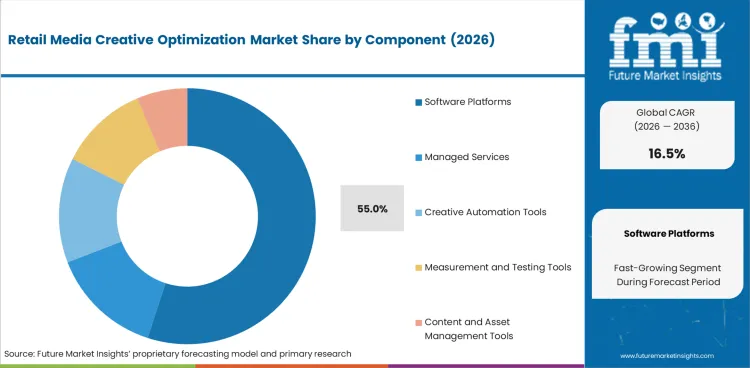
Software platforms remain the leading component segment in the retail media creative optimization market. Buyers prefer platforms that connect creative generation, placement logic, testing, and performance review in one environment. That reduces workflow drag and speeds iteration across retailer networks.
The segment also benefits from platform-native adoption. Many brands first encounter retail media optimization through retailer or commerce-platform tooling rather than through standalone creative purchases.
Insights into the Sponsored Product and Onsite Display Segment
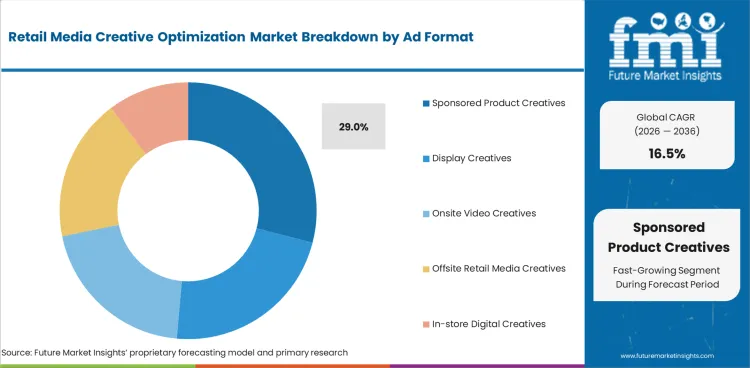
Sponsored products and onsite display remain the largest ad-format group in 2026. These formats sit closest to the purchase moment, which makes them the clearest commercial proving ground for creative testing and optimization.
This segment is also moving beyond static merchandising. Vendors are adding more dynamic assets, placement-aware logic, and format-sensitive refresh tools that increase the value of optimization software.
Insights into the Retailers and Retail Media Networks Segment
Retailers and retail media networks are expected to account for the largest end-user share in 2026. They control inventory, first-party commerce signals, and ad-serving logic, which gives them the strongest reason to invest in creative systems that improve monetization and brand performance simultaneously.
Their role remains central in early market scaling. Retailer-side workflow standards often shape how agencies, brands, and software vendors prioritize creative integration.
Retail Media Creative Optimization Market Drivers, Restraints, and Opportunities
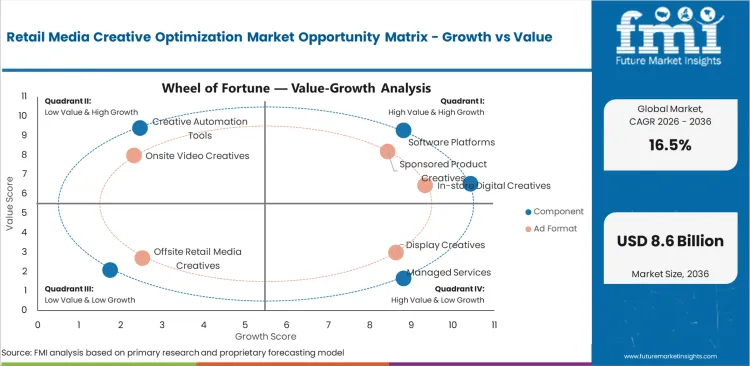
- Format fragmentation remains the main market driver.
- Retailer-specific workflow complexity and inconsistent measurement continue to restrain efficiency.
- The strongest opportunities are opening in dynamic onsite creative, cross-retailer testing layers, and closed-loop creative measurement.
The market is expanding quickly, though execution quality still varies. Buyers are not simply looking for more ad formats. They want systems that make retail media creative easier to adapt, easier to test, and easier to justify commercially.
Retail Media Format Growth Is Accelerating Workflow Demand
Retailers are adding onsite video, display, creator-led content, and more advanced offsite commerce formats. That creates a strong opening for software that can refresh and align creative faster than manual teams can.
Fragmentation and Different Measurement Rules Slow Scale
The main restraint is operational complexity. Each retail media network has its own reporting logic, placement rules, and asset requirements. That makes cross-network optimization harder than most brands initially expect.
Upside Is Strongest in Closed-loop and Cross-network Optimization
The clearest opportunity sits in systems that connect creative decisions to verified sales outcomes. Tools that help brands test across multiple retail media environments while keeping transaction feedback visible should see the strongest demand.
Regional Market Analysis
.webp "Top Country Growth Comparison Retail Media Creative Optimization Market Cagr (2026 2036)")
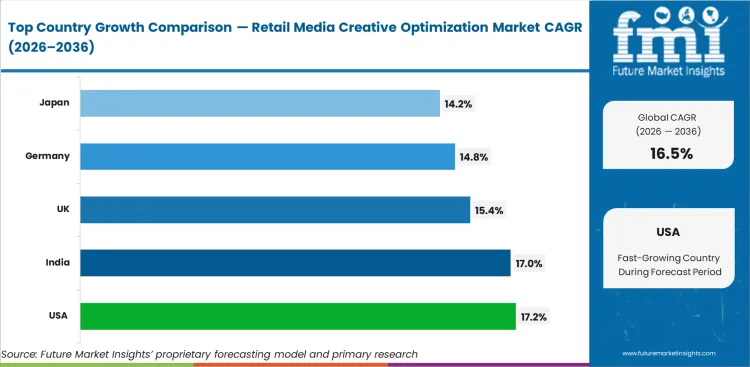
- The United States is projected to grow at 17.2% CAGR from 2026 to 2036 and remain the largest market in value terms.
- The United Kingdom and Germany are expected to expand at 15.4% and 14.8%, supported by agency digitization and maturing retail media network ecosystems.
- Japan and India are forecast to post 14.2% and 17.0% growth as marketplace-led media and performance commerce continue to expand. Country growth rates are FMI estimates, 2026.
The retail media creative optimization market is likely to scale first in countries where retail media budgets, ecommerce maturity, and measurement sophistication intersect. North America leads the first commercial wave, while Europe and Asia Pacific are shaping the next phase of cross-network workflow maturity.
How Is the United States Shaping the Retail Media Creative Optimization Market?
The United States remains the anchor market for retail media creative optimization. It has the strongest mix of retailer network scale, commerce-media budgets, and visible platform innovation.
- Major retailer networks are launching more advanced optimization and measurement workflows.
- Brands are more willing to test dynamic formats in purchase-intent environments.
- Agencies are building dedicated retail media creative practices around USA-led demand.
What is the Outlook on United Kingdom Retail Media Creative Optimization Market?
The United Kingdom has strong agency ecosystems and a mature ecommerce market. Buyers in the UK are more likely to evaluate optimization tools through efficiency, governance, and multi-retailer workflow control.
- Agency influence helps new software categories move faster into active use.
- Cross-network media management is already a core requirement in many accounts.
- Measurement transparency matters more as buyers compare retailer platform claims.
What Is Driving Demand in Germany?
Germany remains important as a market where buyers tend to reward workflow discipline, privacy-aware execution, and practical software integration. Retail media creative optimization is likely to move through enterprise martech modernization and measurable productivity gains.
- Advertisers are more cautious with black-box workflow layers.
- Platform integration matters more in purchase decisions.
- Privacy-aware measurement approaches have stronger weight in procurement.
How Are Japan and India Expanding the Market?
Japan and India are expanding the market through different routes. Japan supports quality-led workflow automation in mature commerce environments, while India adds growth through marketplace expansion and high campaign volume.
- Japan rewards stable workflow automation and more disciplined execution layers.
- India benefits from large advertiser and seller bases moving into marketplace-led media.
- Both markets support stronger demand for scalable creative and testing systems.
Competitive Landscape and Strategic Positioning
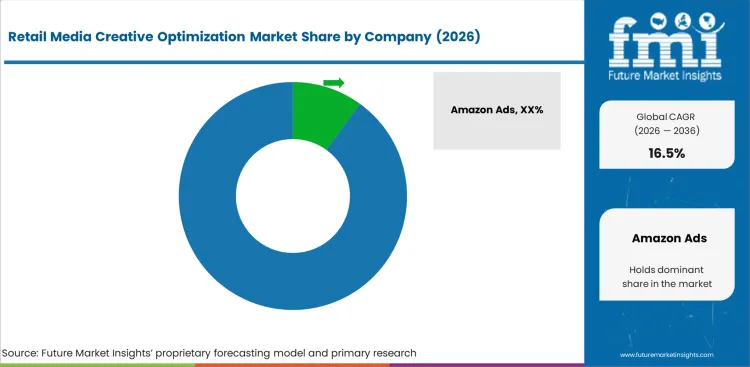
- Competition spans retailer media platforms, ad-tech software vendors, commerce-media networks, and agency workflow providers.
- Competitive strength depends on closed-loop signal access, testing speed, and measurable sales impact.
- The strongest vendors are tying creative outputs directly to retail action instead of offering disconnected asset-management alone.
Competition is intensifying as retail media becomes more format-rich and performance-sensitive. Large retailer platforms still control the most direct transaction signals, though software vendors are gaining ground by connecting planning, creative iteration, and performance review in one workflow.
That split matters. Retailer-owned platforms can optimize deeper inside their own inventory, while software vendors can offer broader orchestration across networks. Agencies and service providers still retain a role where brands need governance, experimentation support, or mixed-platform execution.
Trust will remain the main commercial filter. Buyers want proof that creative optimization improves sales without making retail media logic harder to understand. Vendors that can link automation with explainable performance outcomes are in the strongest position.
Key Companies in the Retail Media Creative Optimization Market
Key companies active in the market include Amazon Ads, Walmart Connect, Sam’s Club MAP, Criteo, CitrusAd, and Epsilon.
Competitive Benchmarking: Retail Media Creative Optimization Market
| Company | Core Strength | Primary Retail Media Creative Optimization Exposure | Strategic Positioning | Geographic Footprint |
|---|---|---|---|---|
| Amazon Ads | Closed-loop retail data and full-funnel ad stack | Optimization and measurement tools tied to product launch and retail ad workflows | Retail-plus-media performance platform | Global |
| Walmart Connect | Omnichannel retailer media network and first-party data | Expanded creative capabilities and closed-loop activation via Walmart ecosystem | Retailer-owned commerce media optimization | North America |
| Sam’s Club MAP | Member-based retail media measurement and AI workflow | Omni-Impact and Retail Experience Network logic tied to campaign optimization | AI-led retail experience and measurement platform | North America |
| Criteo | Commerce media technology and retail media network scale | AI-driven optimization, onsite video, auction-based display, and retail creative orchestration | Open commerce-media workflow platform | Global |
| CitrusAd | Retail media platform infrastructure | Onsite sponsored products and retail ad activation workflows | Retail network enablement platform | Global |
| Epsilon | Identity, personalization, and retail data activation | Measurement-linked personalization and retail media activation support | Identity-led commerce optimization | Global |
Key Developments in Retail Media Creative Optimization Market
- Amazon Ads announced new optimization and measurement capabilities in October 2024 to simplify product launch and full-funnel advertising workflows.
- Walmart Connect said in April 2024 that it was expanding creative capabilities and helping suppliers combine Walmart Luminate insights with Walmart Connect activation.
- Sam’s Club MAP launched Omni-Impact in June 2025 and expanded its Retail Experience Network positioning in April 2026, reinforcing AI-powered measurement and optimization logic.
- Criteo introduced onsite video to its retail media mix in April 2025 and launched auction-based display ads in June 2025, expanding creative and placement-level optimization capability.
Key Players in the Retail Media Creative Optimization Market
Major Global Players
- Amazon Ads
- Walmart Connect
- Sam’s Club MAP
- Criteo
- CitrusAd
- Epsilon
Emerging and Specialist Growth Providers
- Independent retail media workflow vendors, creative testing startups, commerce analytics specialists, and agency-side automation providers are likely to widen the field over the next few years. Their role will be most visible where buyers need cross-network orchestration or more transparent optimization logic than closed retailer systems provide.
Research Scope and Coverage
| Attribute | Details |
|---|---|
| Estimated market size (2026) | USD 1.6 billion |
| Projected market size (2036) | USD 7.4 billion |
| CAGR (2026 to 2036) | 16.5% |
| Quantitative units | USD billion |
| Key segment coverage | Component, Ad Format, Optimization Function, Deployment Mode, End User, Campaign Objective, Region |
| Regions covered | North America, Europe, Asia Pacific, Latin America, Middle East and Africa |
Segment Analysis by Component, Ad Format, Optimization Function, Deployment Mode, End User, Campaign Objective, and Region
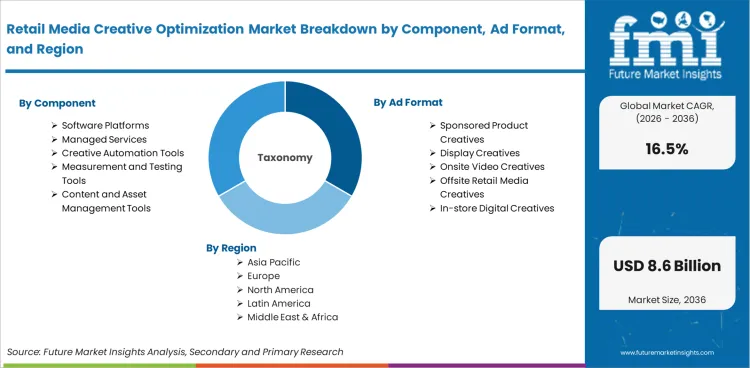
By Component:
- Software Platforms
- Managed Services
- Creative Automation Tools
- Measurement and Testing Tools
- Content and Asset Management Tools
By Ad Format:
- Sponsored Product Creatives
- Display Creatives
- Onsite Video Creatives
- Offsite Retail Media Creatives
- In-store Digital Creatives
By Optimization Function:
- Creative Testing
- Dynamic Creative Personalization
- Placement-level Optimization
- Budget-linked Creative Refresh
- Audience and Context Alignment
By Deployment Mode:
- Cloud-based
- Hybrid
By End User:
- Retailers and Retail Media Networks
- Consumer Brands
- Agencies
- Marketplace Sellers
- Commerce Enablers
By Campaign Objective:
- Sales Conversion
- New Product Launches
- Basket Expansion
- Brand Discovery
- Cross-sell and Upsell
By Region:
- North America
- Latin America
- Europe
- Asia Pacific
- Middle East and Africa
Research Sources and Bibliography
- 1. Amazon Ads. (2024, October 15). Announces new optimization and measurement capabilities at unBoxed 2024.
- 2. Walmart Connect / Walmart Corporate. (2024, April 1). Expanded creative capabilities for advertisers.
- 3. Walmart Corporate. (2024, April 17). Walmart Luminate insights activation for Walmart Connect.
- 4. Sam’s Club MAP. (2025, June 26). Launches Omni-Impact.
- 5. Sam’s Club MAP. (2026, April 16). Advances Retail Experience Network with AI-enhanced targeting and optimization.
- 6. Criteo. (2025, April 23). Introduces onsite video to retail media mix.
- 7. Criteo. (2025, June 17). Debuts auction-based display ads for retail media.
This Report Answers
- What is the projected value of the Retail Media Creative Optimization Market in 2026 and 2036?
- What is the expected CAGR from 2026 to 2036?
- Which component segment contributes the largest 2026 share?
- Which ad-format group currently leads demand in the market?
- Which countries are expected to expand faster than the global average through 2036?
- Which companies hold the strongest visible positions in current retail media creative optimization workflows?
- Why are software platforms and onsite commerce formats leading current adoption?
Frequently Asked Questions
What is the global market demand for Retail Media Creative Optimization Market in 2026?
In 2026, the global market for Retail Media Creative Optimization Market is estimated at USD 1.6 billion.
What is the forecast market value by 2036?
By 2036, the market is projected to reach USD 7.4 billion under the base-case forecast model.
What is the forecast CAGR from 2026 to 2036?
The market is expected to expand at a 16.5% CAGR during the forecast period.
Which component segment leads the market?
Software Platforms lead the component structure with an estimated 55.0% share in 2026.
Which ad-format group leads the market?
Sponsored Product Creatives and Onsite Display-linked formats lead the format structure with an estimated 29.0% share in 2026.
Which country market shows the fastest forecast pace?
Among the highlighted markets, India is projected to post the fastest pace at 17.0% CAGR through 2036.
Why is retail media creative optimization gaining faster adoption?
Adoption is rising as brands and retailer networks need faster creative testing, better closed-loop measurement, and more efficient workflows across increasingly fragmented retail media environments.
Preview the report firsthand - request a free sample
Get SampleGet the brochure for pricing and purchase details.
Get PDFTable of Content
- Executive Summary
- Global Market Outlook
- Supply-side Trends
- Technology Roadmap Analysis
- Analysis and Recommendations
- Market Overview
- Market Coverage / Taxonomy
- Market Definition / Scope / Limitations
- Research Methodology
- Chapter Orientation
- Analytical Lens and Working Hypotheses
- Market Structure, Signals, and Trend Drivers
- Benchmarking and Cross-market Comparability
- Market Sizing, Forecasting, and Opportunity Mapping
- Research Design and Evidence Framework
- Desk Research Programme (Secondary Evidence)
- Company Annual and Sustainability Reports
- Peer-reviewed Journals and Academic Literature
- Corporate Websites, Product Literature, and Technical Notes
- Earnings Decks and Investor Briefings
- Statutory Filings and Regulatory Disclosures
- Technical White Papers and Standards Notes
- Additional Desk Sources
- Expert Input and Fieldwork (Primary Evidence)
- Primary Modes
- Qualitative Interviews and Expert Elicitation
- Quantitative Surveys and Structured Data Capture
- Blended Approach
- Why Primary Evidence is Used
- Field Techniques
- Interviews
- Surveys
- Focus Groups
- Observational and In-context Research
- Social and Community Interactions
- Stakeholder Universe Engaged
- C-suite Leaders
- Board Members
- Presidents and Vice Presidents
- R&D and Innovation Heads
- Technical Specialists
- Domain Subject-matter Experts
- Scientists
- Physicians and Other Healthcare Professionals
- Governance, Ethics, and Data Stewardship
- Research Ethics
- Data Integrity and Handling
- Primary Modes
- Tooling, Models, and Reference Databases
- Desk Research Programme (Secondary Evidence)
- Data Engineering and Model Build
- Data Acquisition and Ingestion
- Cleaning, Normalisation, and Verification
- Synthesis, Triangulation, and Analysis
- Quality Assurance and Audit Trail
- Market Background
- Market Dynamics
- Drivers
- Restraints
- Opportunity
- Trends
- Scenario Forecast
- Demand in Optimistic Scenario
- Demand in Likely Scenario
- Demand in Conservative Scenario
- Opportunity Map Analysis
- Product Life Cycle Analysis
- Supply Chain Analysis
- Investment Feasibility Matrix
- Value Chain Analysis
- PESTLE and Porter’s Analysis
- Regulatory Landscape
- Regional Parent Market Outlook
- Production and Consumption Statistics
- Import and Export Statistics
- Market Dynamics
- Global Market Analysis 2021 to 2025 and Forecast, 2026 to 2036
- Historical Market Size Value (USD Million) Analysis, 2021 to 2025
- Current and Future Market Size Value (USD Million) Projections, 2026 to 2036
- Y-o-Y Growth Trend Analysis
- Absolute $ Opportunity Analysis
- Global Market Pricing Analysis 2021 to 2025 and Forecast 2026 to 2036
- Global Market Analysis 2021 to 2025 and Forecast 2026 to 2036, By Component
- Introduction / Key Findings
- Historical Market Size Value (USD Million) Analysis By Component , 2021 to 2025
- Current and Future Market Size Value (USD Million) Analysis and Forecast By Component , 2026 to 2036
- Software Platforms
- Managed Services
- Creative Automation Tools
- Measurement and Testing Tools
- Content and Asset Management Tools
- Software Platforms
- Y-o-Y Growth Trend Analysis By Component , 2021 to 2025
- Absolute $ Opportunity Analysis By Component , 2026 to 2036
- Global Market Analysis 2021 to 2025 and Forecast 2026 to 2036, By Ad Format
- Introduction / Key Findings
- Historical Market Size Value (USD Million) Analysis By Ad Format, 2021 to 2025
- Current and Future Market Size Value (USD Million) Analysis and Forecast By Ad Format, 2026 to 2036
- Sponsored Product Creatives
- Display Creatives
- Onsite Video Creatives
- Offsite Retail Media Creatives
- In-store Digital Creatives
- Sponsored Product Creatives
- Y-o-Y Growth Trend Analysis By Ad Format, 2021 to 2025
- Absolute $ Opportunity Analysis By Ad Format, 2026 to 2036
- Global Market Analysis 2021 to 2025 and Forecast 2026 to 2036, By Region
- Introduction
- Historical Market Size Value (USD Million) Analysis By Region, 2021 to 2025
- Current Market Size Value (USD Million) Analysis and Forecast By Region, 2026 to 2036
- North America
- Latin America
- Western Europe
- Eastern Europe
- East Asia
- South Asia and Pacific
- Middle East & Africa
- Market Attractiveness Analysis By Region
- North America Market Analysis 2021 to 2025 and Forecast 2026 to 2036, By Country
- Historical Market Size Value (USD Million) Trend Analysis By Market Taxonomy, 2021 to 2025
- Market Size Value (USD Million) Forecast By Market Taxonomy, 2026 to 2036
- By Country
- USA
- Canada
- Mexico
- By Component
- By Ad Format
- By Country
- Market Attractiveness Analysis
- By Country
- By Component
- By Ad Format
- Key Takeaways
- Latin America Market Analysis 2021 to 2025 and Forecast 2026 to 2036, By Country
- Historical Market Size Value (USD Million) Trend Analysis By Market Taxonomy, 2021 to 2025
- Market Size Value (USD Million) Forecast By Market Taxonomy, 2026 to 2036
- By Country
- Brazil
- Chile
- Rest of Latin America
- By Component
- By Ad Format
- By Country
- Market Attractiveness Analysis
- By Country
- By Component
- By Ad Format
- Key Takeaways
- Western Europe Market Analysis 2021 to 2025 and Forecast 2026 to 2036, By Country
- Historical Market Size Value (USD Million) Trend Analysis By Market Taxonomy, 2021 to 2025
- Market Size Value (USD Million) Forecast By Market Taxonomy, 2026 to 2036
- By Country
- Germany
- UK
- Italy
- Spain
- France
- Nordic
- BENELUX
- Rest of Western Europe
- By Component
- By Ad Format
- By Country
- Market Attractiveness Analysis
- By Country
- By Component
- By Ad Format
- Key Takeaways
- Eastern Europe Market Analysis 2021 to 2025 and Forecast 2026 to 2036, By Country
- Historical Market Size Value (USD Million) Trend Analysis By Market Taxonomy, 2021 to 2025
- Market Size Value (USD Million) Forecast By Market Taxonomy, 2026 to 2036
- By Country
- Russia
- Poland
- Hungary
- Balkan & Baltic
- Rest of Eastern Europe
- By Component
- By Ad Format
- By Country
- Market Attractiveness Analysis
- By Country
- By Component
- By Ad Format
- Key Takeaways
- East Asia Market Analysis 2021 to 2025 and Forecast 2026 to 2036, By Country
- Historical Market Size Value (USD Million) Trend Analysis By Market Taxonomy, 2021 to 2025
- Market Size Value (USD Million) Forecast By Market Taxonomy, 2026 to 2036
- By Country
- China
- Japan
- South Korea
- By Component
- By Ad Format
- By Country
- Market Attractiveness Analysis
- By Country
- By Component
- By Ad Format
- Key Takeaways
- South Asia and Pacific Market Analysis 2021 to 2025 and Forecast 2026 to 2036, By Country
- Historical Market Size Value (USD Million) Trend Analysis By Market Taxonomy, 2021 to 2025
- Market Size Value (USD Million) Forecast By Market Taxonomy, 2026 to 2036
- By Country
- India
- ASEAN
- Australia & New Zealand
- Rest of South Asia and Pacific
- By Component
- By Ad Format
- By Country
- Market Attractiveness Analysis
- By Country
- By Component
- By Ad Format
- Key Takeaways
- Middle East & Africa Market Analysis 2021 to 2025 and Forecast 2026 to 2036, By Country
- Historical Market Size Value (USD Million) Trend Analysis By Market Taxonomy, 2021 to 2025
- Market Size Value (USD Million) Forecast By Market Taxonomy, 2026 to 2036
- By Country
- Kingdom of Saudi Arabia
- Other GCC Countries
- Turkiye
- South Africa
- Other African Union
- Rest of Middle East & Africa
- By Component
- By Ad Format
- By Country
- Market Attractiveness Analysis
- By Country
- By Component
- By Ad Format
- Key Takeaways
- Key Countries Market Analysis
- USA
- Pricing Analysis
- Market Share Analysis, 2025
- By Component
- By Ad Format
- Canada
- Pricing Analysis
- Market Share Analysis, 2025
- By Component
- By Ad Format
- Mexico
- Pricing Analysis
- Market Share Analysis, 2025
- By Component
- By Ad Format
- Brazil
- Pricing Analysis
- Market Share Analysis, 2025
- By Component
- By Ad Format
- Chile
- Pricing Analysis
- Market Share Analysis, 2025
- By Component
- By Ad Format
- Germany
- Pricing Analysis
- Market Share Analysis, 2025
- By Component
- By Ad Format
- UK
- Pricing Analysis
- Market Share Analysis, 2025
- By Component
- By Ad Format
- Italy
- Pricing Analysis
- Market Share Analysis, 2025
- By Component
- By Ad Format
- Spain
- Pricing Analysis
- Market Share Analysis, 2025
- By Component
- By Ad Format
- France
- Pricing Analysis
- Market Share Analysis, 2025
- By Component
- By Ad Format
- India
- Pricing Analysis
- Market Share Analysis, 2025
- By Component
- By Ad Format
- ASEAN
- Pricing Analysis
- Market Share Analysis, 2025
- By Component
- By Ad Format
- Australia & New Zealand
- Pricing Analysis
- Market Share Analysis, 2025
- By Component
- By Ad Format
- China
- Pricing Analysis
- Market Share Analysis, 2025
- By Component
- By Ad Format
- Japan
- Pricing Analysis
- Market Share Analysis, 2025
- By Component
- By Ad Format
- South Korea
- Pricing Analysis
- Market Share Analysis, 2025
- By Component
- By Ad Format
- Russia
- Pricing Analysis
- Market Share Analysis, 2025
- By Component
- By Ad Format
- Poland
- Pricing Analysis
- Market Share Analysis, 2025
- By Component
- By Ad Format
- Hungary
- Pricing Analysis
- Market Share Analysis, 2025
- By Component
- By Ad Format
- Kingdom of Saudi Arabia
- Pricing Analysis
- Market Share Analysis, 2025
- By Component
- By Ad Format
- Turkiye
- Pricing Analysis
- Market Share Analysis, 2025
- By Component
- By Ad Format
- South Africa
- Pricing Analysis
- Market Share Analysis, 2025
- By Component
- By Ad Format
- USA
- Market Structure Analysis
- Competition Dashboard
- Competition Benchmarking
- Market Share Analysis of Top Players
- By Regional
- By Component
- By Ad Format
- Competition Analysis
- Competition Deep Dive
- Amazon Ads
- Overview
- Product Portfolio
- Profitability by Market Segments (Product/Age /Sales Channel/Region)
- Sales Footprint
- Strategy Overview
- Marketing Strategy
- Product Strategy
- Channel Strategy
- Walmart Connect
- Sam’s Club MAP
- Criteo
- CitrusAd
- Epsilon
- Amazon Ads
- Competition Deep Dive
- Assumptions & Acronyms Used


