

- Industry Size (2026)
- USD 6.1 Bn
- Forecast (2036)
- USD 56.4 Bn
- CAGR (2026 to 2036)
- 24.9%
Retailer Owned Creator Networks Market Size, Market Forecast and Outlook By FMI
The retailer owned creator networks market stood at USD 4.8 billion in 2025. Demand trend is set to surpass USD 6.1 billion in 2026, expanding at a 24.9% CAGR through the assessment horizon. Industry valuation is projected to surge to USD 56.4 billion by 2036, driven by large retailers internalizing creator pipelines and embedding real‑time logistics intelligence into native content streams.
Capital allocation decisions are actively decoupling retail commerce from traditional algorithmic dependencies. Retail media network directors investing in creator economy infrastructure recognize that leasing audience attention from major social conglomerates actively degrades operational margins. The shift toward native integration dictates that e-commerce architects must build comprehensive analytics dashboards directly into their mobile applications, granting content originators real-time access to regional inventory APIs. Chief marketing officers who delay the development of decentralized commission portals forfeit the ability to capture verified purchase behavior before stringent digital privacy mandates restrict cross-platform consumer tracking across subsequent procurement cycles.
Summary of Retailer Owned Creator Networks Market
- Retailer Owned Creator Networks Market Definition
- Retailer Owned Creator Networks encompass proprietary software platforms and native affiliate ecosystems built directly by retail corporations to host customized digital storefronts, manage product tracking links, and process direct commission payouts.
- Demand Drivers in the Market
- Margin compression from escalating customer acquisition costs on third-party social media forces chief marketing officers to build decentralized performance-based sales architectures.
- Stringent global digital privacy mandates and browser cookie deprecation compel retail media network directors to shift the point of inspiration onto proprietary domains for first-party data capture.
- The maturation of internal retail media networks provides the necessary cloud hosting capital and technological infrastructure required to support high-bandwidth shoppable integrations.
- Key Segments Analyzed in the FMI Report
- Mass Merchandisers and Hypermarkets: 46.0% share in 2026 as chief technology officers leverage vast multi-category catalogs to maximize the earning potential of high-volume content originators.
- Curated Creator Storefronts: 41.0% share in 2026 as e-commerce product managers prioritize persistent landing pages that funnel external traffic into distraction-free purchasing environments.
- India: 28.2% compound growth driven by rapid unified payment interface penetration and localized software investments designed to bypass stringent foreign direct investment constraints.
- Analyst Opinion at FMI
- Ronak Shah (Associate Vice President at Future Market Insights), opines Analysts at FMI observe that the true bottleneck in digital commerce modernization is not originator recruitment, but the logistical complexity of synchronizing real-time local warehouse inventory with native video feeds. E-commerce product managers attempting to run decentralized affiliate programs without linking customized storefronts directly to fulfillment APIs face cart abandonment spikes caused by out-of-stock errors. Chief technology officers who continue relying on static third-party affiliate links will find themselves unable to protect profit margins as consumer privacy policies permanently sever cross-platform data visibility.
- Strategic Implications / Executive Takeaways
- Chief technology officers must prioritize the development of proprietary application programming interfaces capable of supporting native high-bandwidth integrations.
- Retail media network directors should implement dynamic commission tiering algorithms that automatically reward content originators for driving sales of high-margin private label assets.
- E-commerce product managers must design localized storefront experiences that load instantly within the primary retail application to prevent fulfillment failures.
- Methodology
- Validated through analysis of public digital capital expenditure reports from top-tier global retailers.
- Based on verifiable in-house software development cost benchmarks and direct creator payout disclosures.
- Zero reliance on unverified syndicated digital marketing estimates.
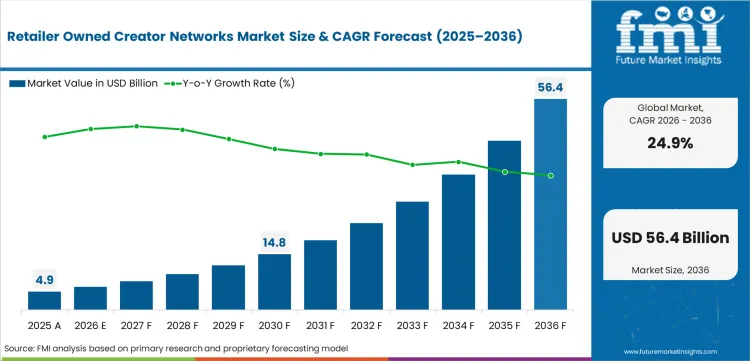
Retailer Owned Creator Networks Market Key Takeaways
| Metric | Details |
|---|---|
| Industry Size (2026) | USD 6.1 Billion |
| Industry Value (2036) | USD 56.4 Billion |
| CAGR (2026-2036) | 24.9% |
FMI analysts observe that the exponential trajectory mapped across these financial thresholds exposes a permanent structural shift from leased social audiences to owned commercial ecosystems. The rapid compound growth rate is functionally sustained by retail conglomerates redirecting external advertising budgets into internal platform development and direct creator payouts. Transforming external influence into localized digital sales environments allows these corporations to establish an impenetrable first-party data moat, positioning proprietary commerce applications as the sole authoritative layer for digital retail conversions moving forward.
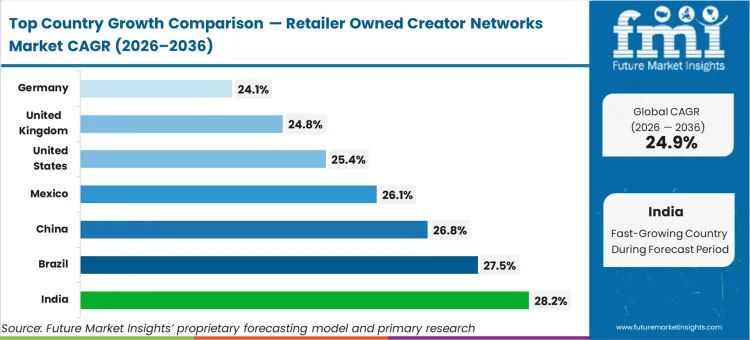
Geographic adoption velocities reflect distinct digital regulatory and infrastructural pressures. Strict foreign direct investment rules drive India to a 28.2% compound growth rate, while comparable mobile-first purchasing cultures propel Brazil at 27.5% and Mexico at 26.1%. Heavy state oversight of live broadcasting shapes China's 26.8% trajectory. Meanwhile, stringent data sovereignty and consumer protection directives establish the baseline for mature markets, moving the United States at 25.4%, the United Kingdom at 24.8%, and Germany at 24.1% as these regions modernize their primary digital architectures.
Retailer Owned Creator Networks Market Definition
The Retailer Owned Creator Networks market comprises proprietary software platforms and native affiliate ecosystems built and managed directly by retail corporations. Rather than relying on third-party aggregators, retailers provide content creators with customized digital storefronts, product tracking links, and internal analytics dashboards hosted on the retailer's own domain. The primary industrial function is to transform independent influencers into a decentralized, commission-based sales force while capturing valuable first-party consumer data.
Retailer Owned Creator Networks Market Inclusions
The market scope covers global and regional revenues generated through proprietary creator network software development, backend API integration costs, and the direct commission payouts processed natively by the retailer. The analysis incorporates in-house platform development expenditures, creator acquisition outlays, customized digital storefront hosting packages, and dedicated performance tracking dashboards natively integrated into retail mobile applications.
Retailer Owned Creator Networks Market Exclusions
The scope strictly excludes the physical gross merchandise value of the underlying consumer products sold through these networks. It also omits all third-party affiliate aggregators, external referral tracking services, traditional digital display advertising revenues, and standard retail media network search-sponsored placements. Standard external influencer marketing flat-fee sponsorships managed outside the proprietary software ecosystem fall entirely outside these defined parameters.
Retailer Owned Creator Networks Market Research Methodology
- Primary Research: FMI conducted detailed technical interviews with retail media network directors, internal creator platform product managers, digital supply chain executives, and retail technology analysts across 40 countries to map the specific decision gates triggering proprietary software upgrades.
- Desk Research: The data collection phase aggregated compliance roadmaps from regional consumer protection bodies, public retail earnings transcripts, digital marketing compliance filings, and cloud hosting expenditure reports from major retail conglomerates.
- Market-Sizing and Forecasting: The baseline value derives from a top-down model analyzing the digital capital expenditures of top global retailers, applying region-specific modernization curves to project the future adoption velocity of internalized affiliate frameworks.
- Data Validation and Update Cycle: Projections are rigorously tested against publicly reported e-commerce margin disclosures and regional digital payment gateway processing volumes from the leading retail and technology groups.
Segmental Analysis
Retailer Owned Creator Networks Market Analysis by Retailer Type
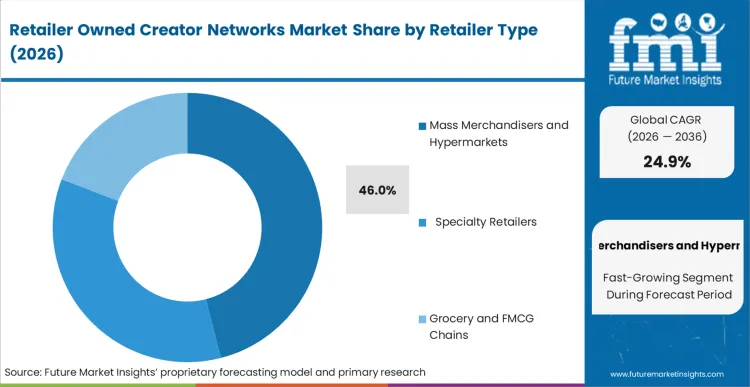
With legacy external affiliate programs proving inadequate for capturing full-funnel consumer analytics, retail media network directors execute full-scale migration programs toward proprietary infrastructures. Mass Merchandisers and Hypermarkets command a dominant 46.0% share in 2026, reflecting the absolute requirement for multi-category catalog scale to support high-volume social commerce operations. FMI's analysis indicates that these retail giants deploy internalized tracking systems to prevent critical purchase behavior data from leaking to third-party advertising conglomerates. Because hypermarkets offer unparalleled SKU depth, they solve the shopper fragmentation problem while maximizing cumulative commission payouts for the content originators managing the integrated storefronts. E-commerce platform architects unable to supply real-time inventory synchronization across thousands of disparate product lines risk immediate exclusion from the next wave of influencer onboarding initiatives.
- Assortment density: Hypermarket supply chains provide the structural breadth necessary for content originators to monetize multiple disparate niches within a single localized digital storefront.
- Data sovereignty: Eliminating third-party aggregators secures exclusive access to comprehensive performance analytics and fortifies the proprietary retail media network against incoming data privacy restrictions.
- Capital deployment: The immense cloud hosting expenditure required to maintain native video playback filters out mid-tier competitors lacking the balance sheet to support high-bandwidth traffic spikes.
Retailer Owned Creator Networks Market Analysis by Content Integration Format
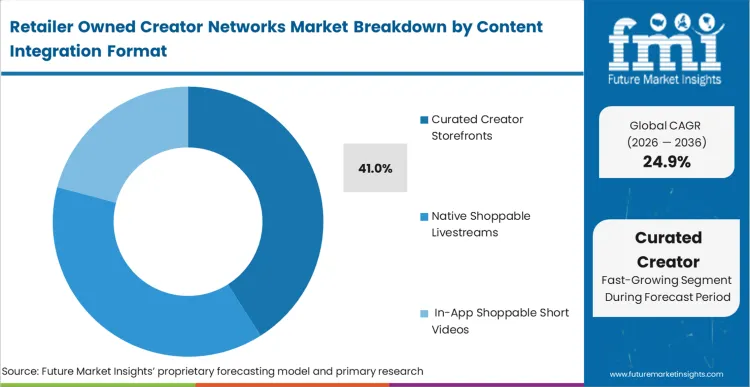
Every e-commerce product manager bidding on digital modernization initiatives now faces strict requirements to eliminate checkout friction through localized application design. Curated Creator Storefronts represent a leading 41.0% share in 2026. The deployment of persistent digital assets linked directly in social bios resolves the critical drop-off rates historically associated with fragmented live commerce funnels. Chief technology officers deploying these architectures dynamically hide out-of-stock items based on the shopper's specific geographic fulfillment center. The direct linkage of these curated landing pages to proprietary warehouse application programming interfaces prevents fulfillment breakdowns. Software engineering leads failing to demonstrate seamless integration with established digital wallet frameworks lose priority status in critical infrastructure upgrade cycles.
- Cart consolidation: Persistent digital storefronts allow shoppers to accumulate multiple endorsed items before executing a single unified transaction rather than completing fragmented single-item purchases.
- Localization algorithms: Real-time inventory synchronization ensures consumers only view content for items physically available within their specific regional delivery radius.
- Profile customization: Providing content originators with dedicated environments for custom aesthetics secures long-term platform loyalty while standardizing the consumer browsing experience.
Retailer Owned Creator Networks Market Analysis by Monetization Strategy
Prior reliance on flat-fee influencer sponsorships caused significant financial exposure when promotional campaigns failed to generate verifiable product conversions. The transition to performance-based software architectures resolves this fundamental disconnect. According to FMI's estimates, Pure Commission-Based frameworks capture 58.0% of market share in 2026 by shifting retail marketing expenditure from upfront risk to guaranteed return on investment. Unified digital wallet integration enables rapid micro-payouts that bypass traditional accounting bottlenecks, securing loyalty from top-tier digital content creator portfolios. By deploying dynamic commission tiering, retail media network directors incentivize the promotion of high-margin private label assets over low-margin branded commodities. Digital platform architects lacking documented compliance with international withholding tax automation face immediate disqualification from cross-border capability tenders.
- Margin optimization: Tiered percentage payouts actively steer promotional bandwidth toward internal private label portfolios rather than distributing external brand equity.
- Payment velocity: Integrated digital ledger systems execute fractional payouts instantly upon return-window expiration, securing influencer retention through superior cash flow mechanics.
- Risk mitigation: Transitioning from flat-fee sponsorships to strict performance bounties eliminates the financial exposure associated with underperforming promotional campaigns.
Retailer Owned Creator Networks Market Drivers, Restraints, and Opportunities
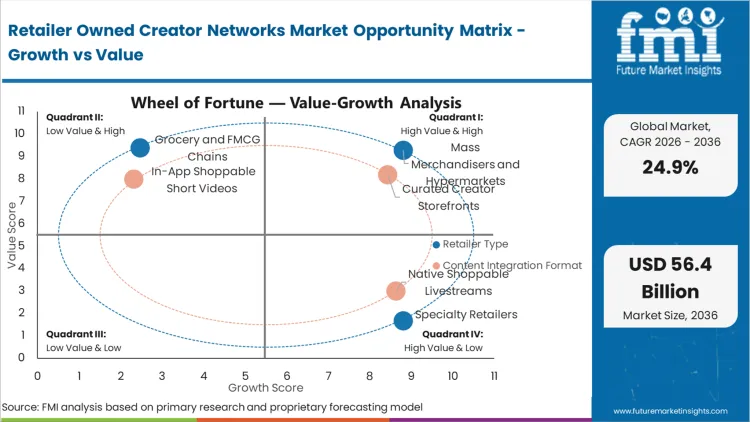
Structural margin pressures combined with escalating customer acquisition costs on external platforms push closed-loop social media content creation infrastructures past the pilot threshold. As FMI's research confirms, retail media network directors must deploy proprietary application programming interfaces to capture first-party behavioral data before stringent digital privacy mandates sever cross-platform visibility. Transforming independent originators into a decentralized sales force eliminates the middleman fees historically captured by affiliate aggregators. Retail corporations that fail to internalize this traffic pipeline risk operating blind spots and reduced overall retail media effectiveness.
The immense cloud computing expenditure required to host high-resolution shoppable video natively creates steep capital barriers for mid-market e-commerce operators. Engineering latency-free playback across globally distributed server networks demands specialized infrastructure budgets that most regional retailers lack internally. To mitigate this structural constraint, chief technology officers increasingly prioritize lightweight curated storefront modules over resource-intensive streaming architectures until proprietary content delivery networks achieve operational scale.
- Automated Compliance Tagging: Software engineering leads deploying native storefronts integrate non-removable regulatory disclosure tags directly into the user interface. This capability prevents federal advertising violations from progressing through the checkout sequence.
- Algorithmic Inventory Matching: Upgraded fulfillment architectures permit digital supply chain executives to dynamically route creator traffic toward overstocked regional distribution centers. This targeted demand generation prevents surplus inventory write-downs without requiring brand-damaging sitewide discounts.
- Taxation Software Consolidation: Chief financial officers managing decentralized global creator networks require precise withholding tax automation software. Proprietary platform integration provides the audit accuracy necessary to distribute cross-border commissions without triggering multinational regulatory penalties.
Regional Analysis
.webp "Top Country Growth Comparison Retailer Owned Creator Networks Market Cagr (2026 2036)")
Based on the regional analysis, the Retailer Owned Creator Networks market is segmented into North America, Latin America, Europe, East Asia, South Asia, Oceania and Middle East & Africa across 40+ countries. The full report also offers market attractiveness analysis based on regional trends.
| Country | CAGR (2026 to 2036) |
|---|---|
| India | 28.2% |
| Brazil | 27.5% |
| China | 26.8% |
| Mexico | 26.1% |
| United States | 25.4% |
| United Kingdom | 24.8% |
| Germany | 24.1% |
Source: Future Market Insights (FMI) analysis, based on proprietary forecasting model and primary research
Asia Pacific Retailer Owned Creator Networks Market Analysis
Massive technology conglomerates across the Asia Pacific region blur the lines between unified digital payments and supply chains. E-commerce product managers constructing new digital ecosystems specify integrated multichannel networks in their initial software blueprints to capitalize on extreme mobile penetration rates. FMI analysts opine that building native synchronization capabilities into the application foundation enables regional retail giants to establish highly flexible commercial environments capable of rapid geographic scaling. This aggressive internalization strategy directly fuels the demand for sophisticated cloud hosting architectures. The specific regulatory and infrastructural realities of individual nations dictate the precise implementation parameters for these proprietary ecosystems.
- India: India's foreign direct investment regulations governing digital commerce operations severely restrict international platforms from holding direct inventory, forcing reliance on decentralized networks of local micro-influencers. This regulatory compliance pressure anchors India's 28.2% compound expansion of proprietary creator portal demand to 2036. The national rollout of unified payment interfaces provides the necessary transactional rails for these distributed architectures to function across tier-two cities without centralized stock holdings. Digital supply chain executives failing to provide localized language interfaces and rapid micro-payout mechanisms face disqualification from major subcontinent market share expansion initiatives.
- China: China's digital commerce sector operates under strict oversight from the Cyberspace Administration, requiring immense investment in automated content moderation and real-time taxation reporting. The integration of high-bandwidth native video drives a 26.8% CAGR for integrated creator networks in China through 2036. The sheer volume of mobile-first consumers demands robust algorithmic supply chain matching to prevent fulfillment bottlenecks during peak broadcast events. Chief technology officers targeting the next iteration of platform expansion must prove zero-latency inventory synchronization across full product catalogs before securing regulatory operating approvals.
FMI's report includes detailed analysis and country-wise assessment for the Asia Pacific region, covering Japan, South Korea, and Indonesia. A primary trend shaping these nations is the rapid localization of digital wallet protocols, forcing e-commerce platform architects to deploy customized payment gateways to satisfy stringent domestic consumer protection requirements.
North America Retailer Owned Creator Networks Market Analysis
Chief marketing officers leading critical digital overhauls in North America face strict directives to unify disparate advertising expenditures under a single manageable first-party architecture. Implementing a standardized proprietary e commerce platform enables large-scale mass merchandisers to deploy advanced algorithmic targeting without compromising customer data sovereignty. As per FMI's projection, this strategic shift requires significant capital allocation toward robust cloud infrastructure capable of isolating high-intent traffic streams from traditional display networks. The success of these modernization initiatives depends entirely on the availability of integrated logistics application programming interfaces.
- United States: The United States retail sector enforces strict Federal Trade Commission transparency guidelines regarding clear advertising disclosures across its entire digital ecosystem. The United States advances at a 25.4% compound rate across the forecast decade as mass merchandisers unify their logical marketing topologies. E-commerce product managers replacing external affiliate links must deploy converged architectures capable of supporting both seamless checkout experiences and automated regulatory compliance tagging. Platform developers lacking documented compliance with rigorous advertising transparency standards face immediate exclusion from tier-one retailer software integration contracts.
FMI's report includes detailed analysis and country-wise assessment for the North American region, covering Canada. A prevailing structural condition across this nation involves the integration of cross-border fulfillment networks, which requires standardized digital taxation protocols to coordinate accurate commission withholding and maintain synchronized payout schedules across multiple provincial jurisdictions.
Europe Retailer Owned Creator Networks Market Analysis
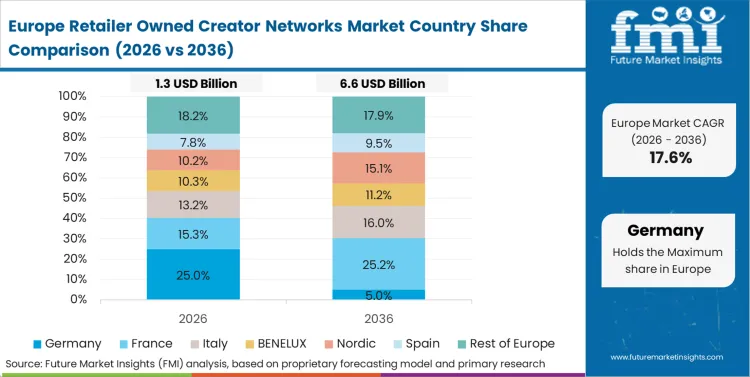
European digital commerce policy actively penalizes the continued operation of opaque third-party tracking mechanisms through aggressive data sovereignty enforcement. Retail media network directors redesigning older affiliate programs must integrate transparent consent protocols alongside critical sales conversion tracking. FMI's proprietary forecasting model projects that this dual-purpose compliance requirement forces the rapid adoption of natively hosted creator storefronts to guarantee legal adherence while transmitting heavy analytical payloads. Upgrading the core software infrastructure provides the necessary control and privacy precision to support advanced consumer protection practices. Chief technology officers recognize that maintaining outdated external tracking links severely limits their ability to compete in highly regulated European digital markets.
- United Kingdom: The United Kingdom's Competition and Markets Authority programs require absolute transparency in affiliate links to protect consumers from hidden advertising practices. This transition toward fully transparent architectures anchors the United Kingdom's 24.8% compound trajectory to 2036 as legacy supermarket chains systematically upgrade their operational software backbones. The shift toward internalized marketing forces e-commerce operators to abandon third-party masked URLs in favor of highly resilient proprietary portals. Software engineering leads unable to demonstrate absolute automated disclosure tagging under severe traffic load conditions forfeit qualification for national retail digital modernization projects.
- Germany: Germany's stringent General Data Protection Regulation enforcement dictates rigorous validation criteria for cross-platform data sharing on advanced e-commerce applications. This systemic regulatory pressure positions Germany's native integration sector at a 24.1% compound growth rate through 2036. Chief technology officers must demonstrate flawless execution of localized data storage before receiving authorization to connect new creator portals to the main consumer database. Architecture providers targeting domestic retail digitization projects must guarantee absolute compliance with data localization directives prior to the finalization of capital procurement budgets.
FMI's report includes detailed analysis and country-wise assessment for the European region, covering France, Italy, and Spain. A defining dynamic in these countries is the mandatory compliance with strict digital service acts, forcing chief technology officers to specify native architectures that can reliably host compliant content alongside standard promotional material.
Latin America Retailer Owned Creator Networks Market Analysis
Latin American e-commerce expansion leverages exceptionally high mobile screen time and a culturally ingrained preference for conversational community-driven shopping. Digital supply chain executives constructing new operational footprints specify unified proprietary networking in their initial application blueprints to bypass traditional marketing channels. By building native location-based inventory capabilities into the foundation, regional e-commerce product managers establish highly flexible purchasing environments capable of mitigating severe logistical bottlenecks. This aggressive software strategy directly fuels the demand for localized creator portals. The specific infrastructural requirements of individual nations dictate the precise fulfillment parameters for these digital technologies.
- Brazil: Brazil's complex interstate taxation frameworks require dynamic localized inventory routing for all creator-driven transactions to ensure accurate final-mile delivery calculations. The convergence of mobile-first purchasing and localized supply chain investment reflects in Brazil's proprietary network sector advancing at 27.5% annually. E-commerce platform architects must deploy control software capable of guaranteeing that shoppers only view items physically stocked in their immediate geographic fulfillment center. Suppliers failing to provide application programming interfaces with built-in real-time geographic synchronization mechanisms face disqualification from major regional retail application tenders.
- Mexico: Mexico's rapidly digitizing retail sector operates under intense pressure to convert massive social media engagement into verifiable closed-loop transactions. Mexico's market expands at a 26.1% CAGR through 2036 as this frictionless checkout standard becomes the universal procurement baseline for modernizing retailers. Retail media network directors mandate internalized affiliate architectures to ensure high-intent mobile traffic converts without the friction of external browser redirects. Software vendors targeting the next regional expansion cycle must prove absolute integration with dominant local digital payment gateways before entering the approved vendor list.
FMI's report includes detailed analysis and country-wise assessment for the Latin American region, covering Argentina and Chile. A primary trend shaping these nations is the rapid consolidation of localized delivery networks, forcing digital supply chain executives to deploy unified inventory software to satisfy stringent regional consumer delivery expectations.
Competitive Aligners for Market Players
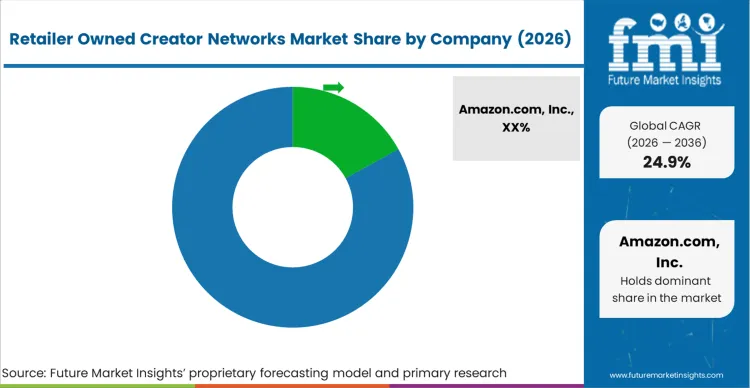
The transition from third-party affiliate networks to fully proprietary software ecosystems establishes massive cloud hosting as the absolute baseline for market participation. Retail media network directors recognize that relying on external aggregators actively leaks valuable first-party consumer data and degrades operational margins. The requirement to execute real-time inventory matching across globally distributed warehouse application programming interfaces prevents mid-tier competitors from supporting the high-bandwidth requirements of native video integration. Digital platform architects lacking the balance sheet to sustain these intensive server architectures lose priority status before formal software procurement cycles open.
Modern creator capitalization is not defined by static promotional codes, but rather by the deployment of dynamic commission tiering algorithms embedded directly into the core retail application architecture. This capability allows chief marketing officers to automatically route promotional bandwidth toward high-margin private label assets rather than paying creators to sell commoditized third-party brands. By integrating social advertising tools natively, e-commerce product managers eliminate the engineering hours previously required to map proprietary data structures between disparate external tracking domains. Retailers failing to demonstrate seamless internal digital wallet integration forfeit access to the top-tier influencer talent required to drive volume at scale.
The demand for absolute regulatory compliance across decentralized global creator networks forces the adoption of automated taxation and disclosure software modules. This systemic integration capability enables chief financial officers to execute cross-border commission payouts without triggering severe international withholding tax penalties. E-commerce platform architects observing this shift prioritize vendors supplying pre-certified compliance infrastructure over raw processing speed. Software engineering leads unable to prove flawless automated execution of localized digital tax deductions face disqualification from multinational retail deployment contracts.
Key Players in Retailer Owned Creator Networks Market
- Amazon.com, Inc.
- Walmart Inc.
- Target Corporation
- Sephora USA, Inc.
- Ulta Beauty, Inc.
- Macy's, Inc.
- Nordstrom, Inc.
- Best Buy Co., Inc.
- The Home Depot, Inc.
- Wayfair Inc.
Scope of the Report
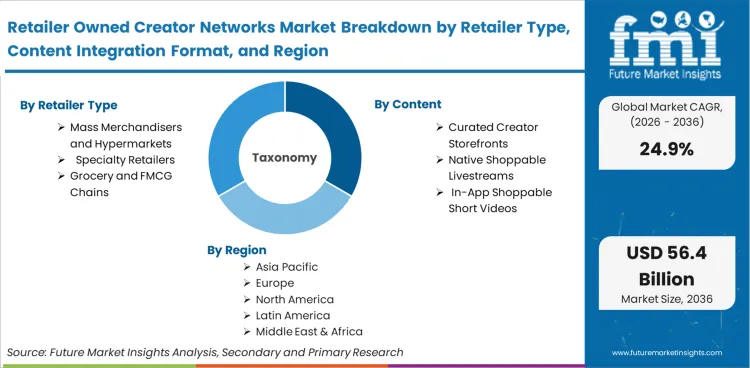
| Metric | Value |
| Quantitative Units | USD 6.1 Billion to USD 56.4 Billion, at a CAGR of 24.9% |
| Market Definition | Retailer Owned Creator Networks encompass proprietary software platforms and native affiliate ecosystems built directly by retail corporations to host customized digital storefronts, manage product tracking links, and process direct commission payouts natively. |
| Retailer Type Segmentation | Mass Merchandisers and Hypermarkets, Specialty Retailers, Grocery and FMCG Chains, Department Stores |
| Content Integration Format Segmentation | Curated Creator Storefronts, Native Shoppable Livestreams, In-App Shoppable Short Videos, Verified Ratings and Review Feeds |
| Monetization Strategy Segmentation | Pure Commission-Based (Cost-Per-Action/Affiliate), Hybrid Models (Flat-Fee Sponsorship + Performance Bounties), Product Seeding and Gifting Tracks, Co-Branded Product Licensing (Creator Collaborations) |
| Regions Covered | North America, Latin America, Europe, East Asia, South Asia, Oceania, Middle East & Africa |
| Countries Covered | United States, Canada, Brazil, Mexico, United Kingdom, Germany, France, Italy, Spain, China, Japan, India, Indonesia, South Korea, and 40 plus countries |
| Key Companies Profiled | Amazon.com, Inc., Walmart Inc., Target Corporation, Sephora USA, Inc., Ulta Beauty, Inc., Macy's, Inc., Nordstrom, Inc., Best Buy Co., Inc., The Home Depot, Inc., Wayfair Inc. |
| Forecast Period | 2026 to 2036 |
| Approach | The baseline value derives from a top-down model analyzing digital capital expenditures of global retailers, projecting future adoption velocity through software integration benchmarks. |
Retailer Owned Creator Networks Market Analysis by Segments
Retailer Type:
- Mass Merchandisers and Hypermarkets
- Specialty Retailers
- Grocery and FMCG Chains
- Department Stores
Content Integration Format:
- Curated Creator Storefronts
- Native Shoppable Livestreams
- In-App Shoppable Short Videos
- Verified Ratings and Review Feeds
Monetization Strategy:
- Pure Commission-Based (Cost-Per-Action/Affiliate)
- Hybrid Models (Flat-Fee Sponsorship + Performance Bounties)
- Product Seeding and Gifting Tracks
- Co-Branded Product Licensing (Creator Collaborations)
Region:
- Asia Pacific
- India
- China
- Japan
- South Korea
- Indonesia
- Australia & New Zealand
- ASEAN
- Rest of Asia Pacific
- Europe
- Germany
- Italy
- France
- United Kingdom
- Spain
- Benelux
- Nordics
- Central & Eastern Europe
- Rest of Europe
- North America
- United States
- Canada
- Mexico
- Latin America
- Brazil
- Argentina
- Chile
- Rest of Latin America
- Middle East & Africa
- Kingdom of Saudi Arabia
- United Arab Emirates
- South Africa
- Turkey
- Rest of Middle East & Africa
Bibliography
- USA Federal Trade Commission. (2024, May 15). Guides Concerning the Use of Endorsements and Testimonials in Advertising (Regulatory guidance).
- Competition and Markets Authority. (2024, August 22). Hidden advertising by influencers and brands: CMA enforcement update (Government report).
- IAB Europe. (2024, November 04). Retail Media Network Standards and Best Practices (Standards publication).
- The Home Depot, Inc. (2024, March 20). The Home Depot Form 10-K (Annual report).
- Interactive Advertising Bureau (IAB). (2025, January 15). 2025 Digital Video Advertising Revenue Report (Industry report).
- National Retail Federation (NRF). (2025, February 10). The State of Retail Media and Creator Ecosystems (Sector survey).
- Information Commissioner's Office (ICO). (2024, September 05). Guidance on tracking technologies and affiliate marketing (Guidance document).
- European Data Protection Board (EDPB). (2024, July 19). Guidelines on the technical scope of Article 5(3) of the ePrivacy Directive (Regulatory guidance).
This bibliography is provided for reader reference. The full FMI report contains the complete reference list with primary research documentation.
This Report Addresses
- Market sizing and quantitative forecast metrics detailing the precise digital capital expenditure dedicated to proprietary affiliate software across major retail sectors through 2036.
- Segmentation analysis mapping the adoption velocity of specific content integration formats and evaluating the technical limitations driving cloud architecture upgrades.
- Regional deployment intelligence comparing the aggressive mobile-first scaling strategies in Asia Pacific against the complex regulatory compliance modernization requirements prevalent in European digital markets.
- Regulatory compliance assessment analyzing how stringent data sovereignty laws and transparent advertising disclosure mandates force the adoption of unified native software architectures.
- Competitive posture evaluation tracking the mandatory shift toward internalized inventory synchronization and the resulting displacement of third-party affiliate networks.
- Product development strategic guidance defining the exact application programming interfaces and digital wallet protocols required to support next-generation decentralized influencer networks.
- Supply chain vulnerability analysis identifying the specific real-time fulfillment data bottlenecks that trigger creator storefront cart abandonment.
- Custom data delivery formats encompassing interactive dashboards, raw Excel datasets, and comprehensive PDF narrative reports.
Frequently Asked Questions
How large is the demand for Retailer Owned Creator Networks in the global market in 2026?
Demand for Retailer Owned Creator Networks in the global market is estimated to be valued at USD 6.1 Billion in 2026.
What will be the market size of Retailer Owned Creator Networks in the global market by 2036?
Market size for Retailer Owned Creator Networks is projected to reach USD 56.4 Billion by 2036.
What is the expected demand growth for Retailer Owned Creator Networks in the global market between 2026 and 2036?
Demand for Retailer Owned Creator Networks is expected to grow at a CAGR of 24.9% between 2026 and 2036.
Which Retailer Type is poised to lead global sales by 2026?
Mass Merchandisers and Hypermarkets accounts for 46.0% in 2026 as chief technology officers utilize vast multi-category catalogs to maximize the earning potential of high-volume content originators.
How significant is the role of Curated Creator Storefronts in driving Retailer Owned Creator Networks adoption in 2026?
Curated Creator Storefronts represents 41.0% of segment share as e-commerce product managers prioritize persistent landing pages that funnel external traffic into distraction-free purchasing environments.
What is driving demand in India?
India's strict foreign direct investment rules restricting direct inventory holdings force global platforms to rely heavily on decentralized networks of local micro-influencers.
What compliance standards or regulations are referenced for the United Kingdom?
The United Kingdom's Competition and Markets Authority programs require absolute transparency in affiliate links to protect consumers from hidden advertising practices.
What is the India growth outlook in this report?
India is projected to grow at a CAGR of 28.2% during 2026 to 2036.
Why is North America described as a priority region in this report?
The North American retail sector actively drives network consolidation to secure exclusive first-party shopper data against incoming browser cookie deprecation.
What type of demand dominates in North America?
Demand heavily focuses on replacing vulnerable external affiliate links with standardized internal architectures that comply with stringent Federal Trade Commission transparency mandates.
What is Brazil's growth outlook in this report?
Brazil is projected to expand at a CAGR of 27.5% during 2026 to 2036.
Does the report cover United States in its regional analysis?
Yes, United States is included within North America under the regional scope of analysis.
What are the sources referred to for analyzing United States?
Official Federal Trade Commission regulatory guidance and corporate digital capital expenditure announcements form the analytical basis.
What is the main demand theme linked to United States in its region coverage?
Strict advertising transparency mandates force the deployment of converged architectures capable of supporting automated regulatory compliance tagging.
Does the report cover Germany in its regional analysis?
Yes, Germany is included within Europe under the regional coverage framework.
What is the main Germany related demand theme in its region coverage?
Stringent General Data Protection Regulation enforcement dictates rigorous validation criteria for cross-platform data sharing on advanced e-commerce applications.
Which product formats or configurations are strategically important for Asia Pacific supply chains?
Embedded unified digital payment interfaces integrated directly into localized creator portals are critical for executing rapid micro-payouts across distributed populations.
What is Retailer Owned Creator Networks and what is it mainly used for?
Retailer Owned Creator Networks provide proprietary digital storefronts and process direct commissions natively. They are primarily used to transform independent influencers into a decentralized closed-loop sales force within e-commerce operations.
What does Retailer Owned Creator Networks mean in this report?
The scope encompasses specialized proprietary software platforms and native affiliate ecosystems built directly by retail corporations.
What is included in the scope of this Retailer Owned Creator Networks report?
The market covers internal platform software revenues, integration expenditures, API infrastructure costs, and direct commission payout ecosystems owned by the retailers.
What is excluded from the scope of this report?
Physical gross merchandise value, third-party affiliate networks, and traditional digital display advertising revenues are explicitly excluded.
What does market forecast mean on this page?
The market forecast represents a model-based projection built on defined technology and adoption assumptions for strategic planning purposes.
How does FMI build and validate the Retailer Owned Creator Networks forecast?
The model applies a top-down methodology analyzing digital capital expenditures and cross-validates projections against publicly reported e-commerce margin disclosures.
What does zero reliance on speculative third-party market research mean here?
Primary interviews, verified regulatory compliance filings, and official corporate expenditure datasets are used exclusively instead of unverified syndicated estimates.
Preview the report firsthand - request a free sample
Get SampleGet the brochure for pricing and purchase details.
Get PDFTable of Content
- Executive Summary
- Global Market Outlook
- Demand-side Trends
- Supply-side Trends
- Technology Roadmap Analysis
- Analysis and Recommendations
- Market Overview
- Market Coverage / Taxonomy
- Market Definition / Scope / Limitations
- Research Methodology
- Chapter Orientation
- Analytical Lens and Working Hypotheses
- Market Structure, Signals, and Trend Drivers
- Benchmarking and Cross-market Comparability
- Market Sizing, Forecasting, and Opportunity Mapping
- Research Design and Evidence Framework
- Desk Research Programme (Secondary Evidence)
- Company Annual and Sustainability Reports
- Peer-reviewed Journals and Academic Literature
- Corporate Websites, Product Literature, and Technical Notes
- Earnings Decks and Investor Briefings
- Statutory Filings and Regulatory Disclosures
- Technical White Papers and Standards Notes
- Trade Journals, Industry Magazines, and Analyst Briefs
- Conference Proceedings, Webinars, and Seminar Materials
- Government Statistics Portals and Public Data Releases
- Press Releases and Reputable Media Coverage
- Specialist Newsletters and Curated Briefings
- Sector Databases and Reference Repositories
- FMI Internal Proprietary Databases and Historical Market Datasets
- Subscription Datasets and Paid Sources
- Social Channels, Communities, and Digital Listening Inputs
- Additional Desk Sources
- Expert Input and Fieldwork (Primary Evidence)
- Primary Modes
- Qualitative Interviews and Expert Elicitation
- Quantitative Surveys and Structured Data Capture
- Blended Approach
- Why Primary Evidence is Used
- Field Techniques
- Interviews
- Surveys
- Focus Groups
- Observational and In-context Research
- Social and Community Interactions
- Stakeholder Universe Engaged
- C-suite Leaders
- Board Members
- Presidents and Vice Presidents
- R&D and Innovation Heads
- Technical Specialists
- Domain Subject-matter Experts
- Scientists
- Physicians and Other Healthcare Professionals
- Governance, Ethics, and Data Stewardship
- Research Ethics
- Data Integrity and Handling
- Primary Modes
- Tooling, Models, and Reference Databases
- Desk Research Programme (Secondary Evidence)
- Data Engineering and Model Build
- Data Acquisition and Ingestion
- Cleaning, Normalisation, and Verification
- Synthesis, Triangulation, and Analysis
- Quality Assurance and Audit Trail
- Market Background
- Market Dynamics
- Drivers
- Restraints
- Opportunity
- Trends
- Scenario Forecast
- Demand in Optimistic Scenario
- Demand in Likely Scenario
- Demand in Conservative Scenario
- Opportunity Map Analysis
- Product Life Cycle Analysis
- Supply Chain Analysis
- Investment Feasibility Matrix
- Value Chain Analysis
- PESTLE and Porter’s Analysis
- Regulatory Landscape
- Regional Parent Market Outlook
- Production and Consumption Statistics
- Import and Export Statistics
- Market Dynamics
- Global Market Analysis 2021 to 2025 and Forecast, 2026 to 2036
- Historical Market Size Value (USD Million) Analysis, 2021 to 2025
- Current and Future Market Size Value (USD Million) Projections, 2026 to 2036
- Y-o-Y Growth Trend Analysis
- Absolute $ Opportunity Analysis
- Global Market Pricing Analysis 2021 to 2025 and Forecast 2026 to 2036
- Global Market Analysis 2021 to 2025 and Forecast 2026 to 2036, By Retailer Type
- Introduction / Key Findings
- Historical Market Size Value (USD Million) Analysis By Retailer Type , 2021 to 2025
- Current and Future Market Size Value (USD Million) Analysis and Forecast By Retailer Type , 2026 to 2036
- Mass Merchandisers and Hypermarkets
- Specialty Retailers
- Grocery and FMCG Chains
- Mass Merchandisers and Hypermarkets
- Y-o-Y Growth Trend Analysis By Retailer Type , 2021 to 2025
- Absolute $ Opportunity Analysis By Retailer Type , 2026 to 2036
- Global Market Analysis 2021 to 2025 and Forecast 2026 to 2036, By Content Integration Format
- Introduction / Key Findings
- Historical Market Size Value (USD Million) Analysis By Content Integration Format, 2021 to 2025
- Current and Future Market Size Value (USD Million) Analysis and Forecast By Content Integration Format, 2026 to 2036
- Curated Creator Storefronts
- Native Shoppable Livestreams
- In-App Shoppable Short Videos
- Curated Creator Storefronts
- Y-o-Y Growth Trend Analysis By Content Integration Format, 2021 to 2025
- Absolute $ Opportunity Analysis By Content Integration Format, 2026 to 2036
- Global Market Analysis 2021 to 2025 and Forecast 2026 to 2036, By Region
- Introduction
- Historical Market Size Value (USD Million) Analysis By Region, 2021 to 2025
- Current Market Size Value (USD Million) Analysis and Forecast By Region, 2026 to 2036
- North America
- Latin America
- Western Europe
- Eastern Europe
- East Asia
- South Asia and Pacific
- Middle East & Africa
- Market Attractiveness Analysis By Region
- North America Market Analysis 2021 to 2025 and Forecast 2026 to 2036, By Country
- Historical Market Size Value (USD Million) Trend Analysis By Market Taxonomy, 2021 to 2025
- Market Size Value (USD Million) Forecast By Market Taxonomy, 2026 to 2036
- By Country
- USA
- Canada
- Mexico
- By Retailer Type
- By Content Integration Format
- By Country
- Market Attractiveness Analysis
- By Country
- By Retailer Type
- By Content Integration Format
- Key Takeaways
- Latin America Market Analysis 2021 to 2025 and Forecast 2026 to 2036, By Country
- Historical Market Size Value (USD Million) Trend Analysis By Market Taxonomy, 2021 to 2025
- Market Size Value (USD Million) Forecast By Market Taxonomy, 2026 to 2036
- By Country
- Brazil
- Chile
- Rest of Latin America
- By Retailer Type
- By Content Integration Format
- By Country
- Market Attractiveness Analysis
- By Country
- By Retailer Type
- By Content Integration Format
- Key Takeaways
- Western Europe Market Analysis 2021 to 2025 and Forecast 2026 to 2036, By Country
- Historical Market Size Value (USD Million) Trend Analysis By Market Taxonomy, 2021 to 2025
- Market Size Value (USD Million) Forecast By Market Taxonomy, 2026 to 2036
- By Country
- Germany
- UK
- Italy
- Spain
- France
- Nordic
- BENELUX
- Rest of Western Europe
- By Retailer Type
- By Content Integration Format
- By Country
- Market Attractiveness Analysis
- By Country
- By Retailer Type
- By Content Integration Format
- Key Takeaways
- Eastern Europe Market Analysis 2021 to 2025 and Forecast 2026 to 2036, By Country
- Historical Market Size Value (USD Million) Trend Analysis By Market Taxonomy, 2021 to 2025
- Market Size Value (USD Million) Forecast By Market Taxonomy, 2026 to 2036
- By Country
- Russia
- Poland
- Hungary
- Balkan & Baltic
- Rest of Eastern Europe
- By Retailer Type
- By Content Integration Format
- By Country
- Market Attractiveness Analysis
- By Country
- By Retailer Type
- By Content Integration Format
- Key Takeaways
- East Asia Market Analysis 2021 to 2025 and Forecast 2026 to 2036, By Country
- Historical Market Size Value (USD Million) Trend Analysis By Market Taxonomy, 2021 to 2025
- Market Size Value (USD Million) Forecast By Market Taxonomy, 2026 to 2036
- By Country
- China
- Japan
- South Korea
- By Retailer Type
- By Content Integration Format
- By Country
- Market Attractiveness Analysis
- By Country
- By Retailer Type
- By Content Integration Format
- Key Takeaways
- South Asia and Pacific Market Analysis 2021 to 2025 and Forecast 2026 to 2036, By Country
- Historical Market Size Value (USD Million) Trend Analysis By Market Taxonomy, 2021 to 2025
- Market Size Value (USD Million) Forecast By Market Taxonomy, 2026 to 2036
- By Country
- India
- ASEAN
- Australia & New Zealand
- Rest of South Asia and Pacific
- By Retailer Type
- By Content Integration Format
- By Country
- Market Attractiveness Analysis
- By Country
- By Retailer Type
- By Content Integration Format
- Key Takeaways
- Middle East & Africa Market Analysis 2021 to 2025 and Forecast 2026 to 2036, By Country
- Historical Market Size Value (USD Million) Trend Analysis By Market Taxonomy, 2021 to 2025
- Market Size Value (USD Million) Forecast By Market Taxonomy, 2026 to 2036
- By Country
- Kingdom of Saudi Arabia
- Other GCC Countries
- Turkiye
- South Africa
- Other African Union
- Rest of Middle East & Africa
- By Retailer Type
- By Content Integration Format
- By Country
- Market Attractiveness Analysis
- By Country
- By Retailer Type
- By Content Integration Format
- Key Takeaways
- Key Countries Market Analysis
- USA
- Pricing Analysis
- Market Share Analysis, 2025
- By Retailer Type
- By Content Integration Format
- Canada
- Pricing Analysis
- Market Share Analysis, 2025
- By Retailer Type
- By Content Integration Format
- Mexico
- Pricing Analysis
- Market Share Analysis, 2025
- By Retailer Type
- By Content Integration Format
- Brazil
- Pricing Analysis
- Market Share Analysis, 2025
- By Retailer Type
- By Content Integration Format
- Chile
- Pricing Analysis
- Market Share Analysis, 2025
- By Retailer Type
- By Content Integration Format
- Germany
- Pricing Analysis
- Market Share Analysis, 2025
- By Retailer Type
- By Content Integration Format
- UK
- Pricing Analysis
- Market Share Analysis, 2025
- By Retailer Type
- By Content Integration Format
- Italy
- Pricing Analysis
- Market Share Analysis, 2025
- By Retailer Type
- By Content Integration Format
- Spain
- Pricing Analysis
- Market Share Analysis, 2025
- By Retailer Type
- By Content Integration Format
- France
- Pricing Analysis
- Market Share Analysis, 2025
- By Retailer Type
- By Content Integration Format
- India
- Pricing Analysis
- Market Share Analysis, 2025
- By Retailer Type
- By Content Integration Format
- ASEAN
- Pricing Analysis
- Market Share Analysis, 2025
- By Retailer Type
- By Content Integration Format
- Australia & New Zealand
- Pricing Analysis
- Market Share Analysis, 2025
- By Retailer Type
- By Content Integration Format
- China
- Pricing Analysis
- Market Share Analysis, 2025
- By Retailer Type
- By Content Integration Format
- Japan
- Pricing Analysis
- Market Share Analysis, 2025
- By Retailer Type
- By Content Integration Format
- South Korea
- Pricing Analysis
- Market Share Analysis, 2025
- By Retailer Type
- By Content Integration Format
- Russia
- Pricing Analysis
- Market Share Analysis, 2025
- By Retailer Type
- By Content Integration Format
- Poland
- Pricing Analysis
- Market Share Analysis, 2025
- By Retailer Type
- By Content Integration Format
- Hungary
- Pricing Analysis
- Market Share Analysis, 2025
- By Retailer Type
- By Content Integration Format
- Kingdom of Saudi Arabia
- Pricing Analysis
- Market Share Analysis, 2025
- By Retailer Type
- By Content Integration Format
- Turkiye
- Pricing Analysis
- Market Share Analysis, 2025
- By Retailer Type
- By Content Integration Format
- South Africa
- Pricing Analysis
- Market Share Analysis, 2025
- By Retailer Type
- By Content Integration Format
- USA
- Market Structure Analysis
- Competition Dashboard
- Competition Benchmarking
- Market Share Analysis of Top Players
- By Regional
- By Retailer Type
- By Content Integration Format
- Competition Analysis
- Competition Deep Dive
- Amazon.com, Inc.
- Overview
- Product Portfolio
- Profitability by Market Segments (Product/Age /Sales Channel/Region)
- Sales Footprint
- Strategy Overview
- Marketing Strategy
- Product Strategy
- Channel Strategy
- Walmart Inc.
- Target Corporation
- Sephora USA, Inc.
- Ulta Beauty, Inc.
- Macy's, Inc.
- Amazon.com, Inc.
- Competition Deep Dive
- Assumptions & Acronyms Used


