

- Industry Size (2026)
- USD 9.5 Bn
- Forecast (2036)
- USD 69.3 Bn
- CAGR (2026 to 2036)
- 22.0%
Live Commerce Market Size, Market Forecast and Outlook By FMI
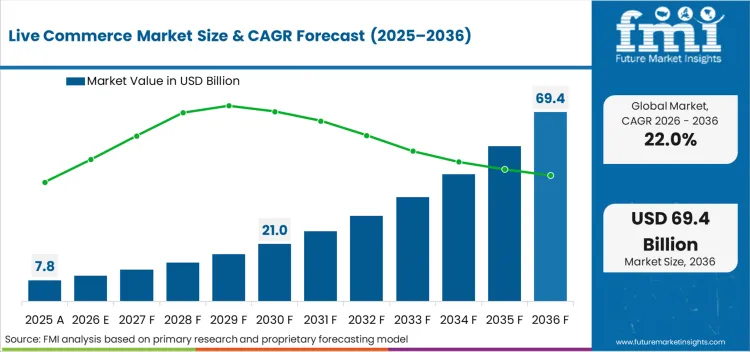
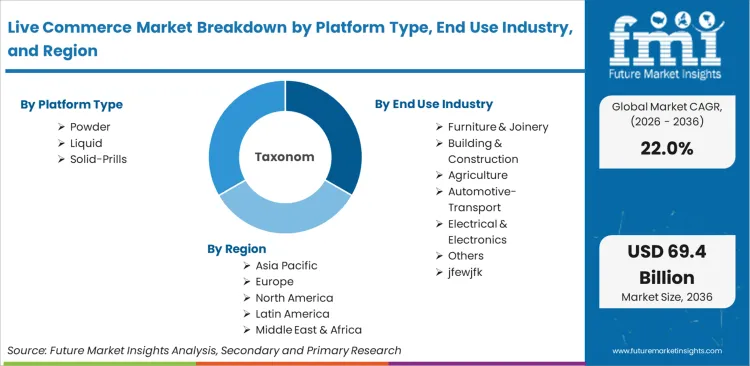
In 2025, the live commerce market was valued at USD 8.5 billion. Based on Future Market Insights' analysis, demand for live commerce platforms is estimated to grow to USD 9.5 Billion in 2026 and USD 69.3 Billion by 2036. FMI projects a CAGR of 22.0% during the forecast period.
Absolute dollar growth of USD 59.8 billion over the decade signals transformational opportunity rather than incremental expansion. Growth is driven by structural convergence of social media, short-form video, and embedded checkout infrastructure that compresses consideration time and lifts impulse-conversion rates above static product-page formats. Platform-level investment in creator monetization tools, brand migration of promotional budgets from linear television to performance-accountable live formats, and consumer habituation to interactive shopping experiences compound over the forecast period.
Summary of Live Commerce Market
- Live Commerce Market Definition
- The industry covers real-time, synchronous sale of products through live-streamed video sessions where hosts demonstrate goods and viewers transact within the same streaming environment combining entertainment, social proof, urgency mechanics, and embedded checkout.
- Demand Drivers in the Market
- Platform-level integration of native payment rails into social ecosystems eliminates cross-app friction that historically suppressed conversion rates.
- Cost efficiency of influencer-led live commerce relative to linear television CPMs drives brand promotional budget migration.
- Consumer preference for personality-led, trust-mediated product discovery over algorithm-served static listings accelerates adoption among mobile-first audiences.
- Key Segments Analyzed in the FMI Report
- Platform Type: Integrated Social Live Commerce dominates with 38% share due to audience aggregation and embedded checkout infrastructure.
- End Use Industry: Fashion & Apparel leads with 27% share reflecting category-format fit and high repeat-purchase frequency.
- Geography: Asia-Pacific dominance with China and India as primary volume contributors versus North America incremental opportunity expansion.
- Analyst Opinion at FMI
- Ronak Shah, Principal Consultant for Chemicals and Materials Industry at Future Market Insights, opines, "In the updated Live Commerce Market Report for 2026 to 2036, CXOs will find insights into platform checkout infrastructure maturation driving conversion rate premiums. My findings point at regulatory friction from influencer disclosure mandates creating compliance overhead disproportionately burdening smaller operators while accelerating platform consolidation toward compliant infrastructure."
- Strategic Implications/Executive Takeaways
- Treat live commerce as conversion and retention layer integrated into omnichannel stack architecture rather than standalone channel experiment.
- Leverage white-label platform vendors that have commoditized streaming and commerce integration stack reducing incremental enablement costs.
- Focus differentiation advantage on creator relationship quality and ability to use real-time audience data iterating product positioning across sessions.
- Methodology
- Validated through bottom-up vendor revenue aggregation methodology supplemented by platform-reported GMV data.
- Zero reliance on speculative third-party commercial market research reports.
- Based on verified platform disclosures and regional digital commerce benchmarks.
Platform operators report that integrated social live commerce sessions generate conversion rates two to three times higher than conventional marketplace browsing due to synchronous interaction, time-limited offers, and peer-driven social proof visible in real-time comment streams. The entertainment layer embedded in live sessions creates engagement duration that exceeds algorithm-served static listings, with hosts demonstrating products while viewers transact without leaving the streaming environment. This structural advantage positions live commerce as highest-priority digital commerce segment for platform operators, brand advertisers, and enabling-technology vendors.
India (25.5% CAGR) and China (24.5% CAGR) drive new opportunities through regional-language streaming unlocking non-English-speaking consumer populations and mobile payment infrastructure eliminating checkout friction. Brazil (21.0% CAGR) contributes via WhatsApp commerce integration and Instagram Live shopping adoption among brands seeking direct consumer engagement. Mature markets such as the USA (19.0%), UK (18.5%), and Germany (18.0%) generate adoption acceleration through TikTok Shop, Amazon Live, and YouTube Shopping platform investments, with volume expansion supported by creator ecosystem depth and established influencer marketing infrastructure.
Live Commerce Market Definition
Live commerce refers to the practice of selling products directly to consumers through live-streamed video sessions in which hosts demonstrate, review, and transact on goods in real time while viewers interact through chat and purchasing actions without leaving the streaming environment. The defining characteristic relative to conventional video-assisted e-commerce is the synchronous and interactive nature where purchase decisions are made during the broadcast, often triggered by time-limited offers, host demonstrations, or peer-driven social proof visible in comment streams.
Live Commerce Market Inclusions
The report includes comprehensive analysis of market dynamics, featuring Global and Regional Market Sizes (Revenue) and a 10-year Forecast (2026-2036). It covers segmental breakdowns by Platform Type (Integrated Social Live Commerce, Marketplace Live Commerce, Brand-Owned Live Commerce, Creator Storefront Live Commerce, Others), End Use Industry (Fashion & Apparel, Beauty & Personal Care, Consumer Electronics, Home & Lifestyle, Food & Grocery, Others), and transaction-based revenue sharing, creator monetization, technology enablement, and professional services revenue spanning the live commerce value chain.
Live Commerce Market Exclusions
The scope excludes pre-recorded shoppable video content and video-on-demand commerce formats where no real-time host-audience interaction occurs. It also omits conventional marketplace GMV not directly attributable to live streaming sessions, social media advertising revenue from non-commerce-integrated video content, physical retail revenues not attributable to live commerce events, wholesale and B2B livestream trade shows, general-purpose CDN services not sold specifically as live commerce solutions, and virtual reality try-on solutions not deployed within live-streaming commerce context.
Live Commerce Market Research Methodology
- Primary Research: Interviews were conducted with platform product managers, brand digital commerce leads, creator economy operators, technology vendors, and retail strategy consultants across major regions. Primary research validated market sizing assumptions, segment share estimates, and regional adoption dynamics.
- Desk Research: Published earnings disclosures, regulatory filings, platform developer documentation, industry association reports, and specialist trade publications covering e-commerce and streaming technology sectors supported volume benchmarking. Competitive intelligence derived from platform-published data and third-party app analytics providers.
- Market-Sizing and Forecasting: A hybrid top-down and bottom-up model was developed. Base-year market value was estimated through platform-reported GMV and revenue data aggregation, supplemented by cross-checks against social commerce and e-commerce market benchmarks, validated via regression analysis of platform investment trajectories and consumer behavior surveys.
- Data Validation and Update Cycle: Outputs undergo triangulation across at least two independent sources, variance checks across platform and transaction datasets, and structured peer review by FMI's internal sector analysts reconciled against macroeconomic indicators including digital advertising spend and smartphone penetration rates prior to release.
Segmental Analysis
Live Commerce Market Analysis by Platform Type
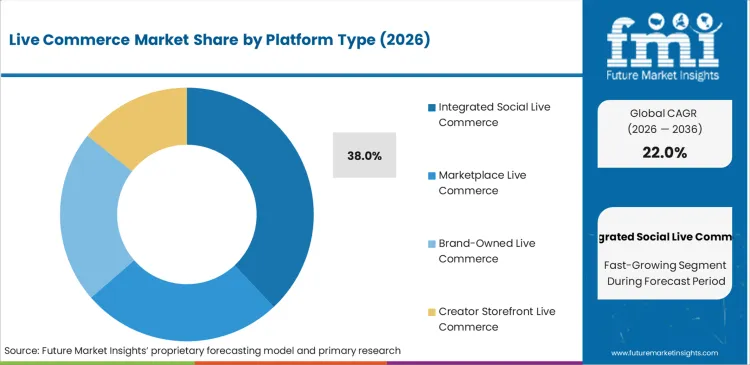
Based on FMI's live commerce market report, consumption of Integrated Social Live Commerce is estimated to hold 38% share in 2026. Growth in demand for integrated social platforms comes from structural advantage combining large pre-existing audiences, embedded social graph-driven discovery, and increasingly mature native checkout infrastructure within single user environment that marketplace-native and brand-owned channels cannot replicate at comparable cost.
- Competitive Moat: TikTok Shop deployed native checkout infrastructure across United States, United Kingdom, and Southeast Asia markets in 2024-2025 with creator incentive model attracting critical mass of mid-tier to professional hosts, demonstrating audience aggregation effect where hosts inherit platform-level reach and algorithmic distribution creating social proof through contact purchase visibility [1].
- Checkout Infrastructure Maturation: Instagram integrated Meta Pay one-click checkout flows with stored payment credentials into Live Shopping sessions in September 2024, reducing step-count between product discovery and purchase confirmation and addressing drop-off rate at payment stage that historically constrained live commerce GMV on social channels [2].
- Creator Economy Alignment: YouTube Shopping expanded affiliate commission structures and performance bonuses tied to session GMV in December 2024, creating self-reinforcing flywheel where higher earnings potential attracts professionalized hosts whose production quality improves session conversion rates and increases per-session earnings attracting further creator investment [3].
Live Commerce Market Analysis by End Use Industry
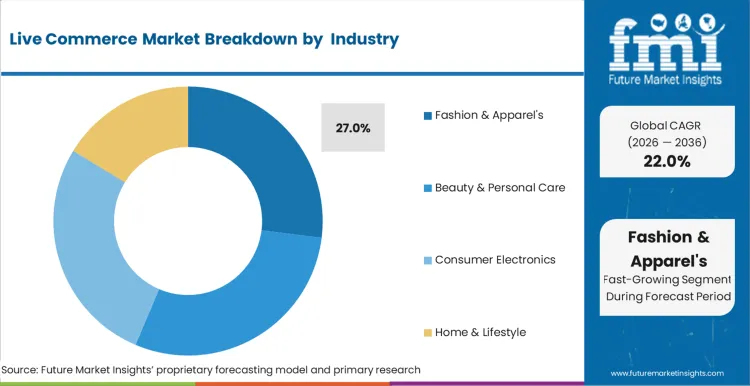
Fashion & Apparel's 27% market share in 2026 stems from its role as category with inherent suitability for live demonstration formats where visual presentation, fit context, and social validation influence purchase decisions more effectively than static imagery, yet this concentration creates structural vulnerabilities that compound during economic contractions when discretionary apparel spending contracts. The segment's dependence on impulse-purchase dynamics and trend velocity alignment transforms any reduction in consumer confidence or platform algorithm changes suppressing live session distribution into immediate GMV vulnerability, while thin margins in fast-fashion segments offer minimal buffer against increased creator compensation costs or platform commission rate adjustments.
- Category-Format Fit: Zara launched dedicated live commerce program across Instagram and TikTok in March 2025 demonstrating garment draping across different body types and styling combinations, delivering information resolving purchase uncertainty in real time and reducing return rate concern that makes fashion one of highest-return categories in conventional e-commerce [4].
- Trend-Velocity Alignment: Shein expanded live shopping sessions to 24/7 programming across multiple time zones in August 2024, generating scarcity signals through limited-edition drops and first-access preview events that convert browsing intent into immediate purchase action aligned with weekly micro-trends amplified by short-form video [5].
- Price Point and Impulse Dynamics: H&M reported 40% of live commerce purchases occurring within first 10 minutes of session broadcast in 2024 analysis, demonstrating price-band alignment within impulse-purchase threshold for millennial and Gen Z cohorts where friction reduction from embedded checkout translates directly into incremental GMV [6].
Live Commerce Market Drivers, Restraints, and Opportunities
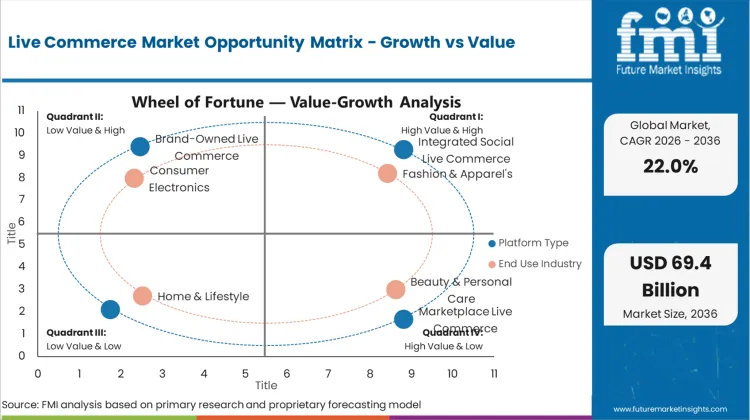
Future Market Insights analysis indicates the live commerce market represents a structural convergence where platforms embedding commerce infrastructure into social and video environments eliminate friction points that historically required consumers to migrate between applications to complete purchases. The 2026 estimated valuation reflects early-stage but rapidly accelerating commercial traction as integrated social platforms deploy native payment rails, inventory management, and logistics APIs directly into live-streaming environments creating frictionless purchase paths.
While conventional e-commerce requires consumers to navigate from product discovery through checkout across multiple page loads and authentication steps, live commerce collapses this funnel into single real-time session where host demonstrations, time-limited offers, and peer social proof visible in comment streams drive conversion rates two to three times higher than static product pages. The forecast value accounts for market transition from novelty acquisition channel to core revenue layer as platform investment, brand budget migration, and consumer habituation compound through the decade.
- Platform Payment Integration: Growth is driven by platform-level integration of native payment rails into social ecosystems, eliminating cross-app friction that historically suppressed conversion, with TikTok Shop, Instagram, and YouTube deploying one-click checkout flows tied to stored payment credentials reducing transaction abandonment rates.
- Regulatory Compliance Overhead: European Union Digital Services Act and associated influencer transparency requirements impose disclosure obligations on commercial live streaming creating compliance costs that disproportionately burden smaller operators while accelerating platform consolidation toward operators with established compliance infrastructure and legal review processes.
- Cross-Border Commerce Enablement: Live commerce is emerging as direct-to-consumer trade layer for Asia Pacific manufacturers bypassing traditional distribution intermediaries through platform investment in multilingual session capabilities, real-time translation overlays, and cross-border logistics integrations expanding total addressable market beyond domestic retail.
Regional Analysis
Based on the regional analysis, live commerce market is segmented into North America, Latin America, Europe, Asia Pacific and Middle East & Africa. Asia Pacific is the largest and fastest-growing region anchored by China's mature live commerce infrastructure and India's rapidly scaling mobile-first audience. North America represents most significant incremental opportunity in absolute dollar terms outside Asia Pacific. The full report also offers market attractiveness analysis based on regional trends.
.webp "Top Country Growth Comparison Live Commerce Market Cagr (2026 2036)")
| Country | CAGR (2026 to 2036) |
|---|---|
| India | 25.5% |
| China | 24.5% |
| Brazil | 21.0% |
| United States | 19.0% |
| United Kingdom | 18.5% |
| Germany | 18.0% |
Source: Future Market Insights (FMI) analysis, based on proprietary forecasting model and primary research
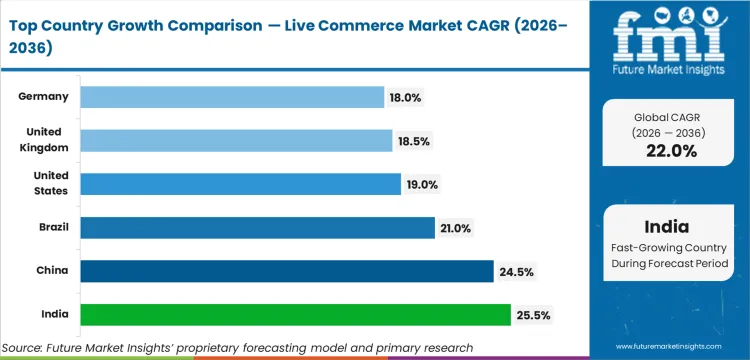
North America Live Commerce Market Analysis
North America is in accelerated adoption phase, characterized by concentrated platform-level investment from TikTok Shop, Amazon Live, and YouTube Shopping deploying native checkout integrations within live commerce environments. Key players in North America include TikTok Shop, operating aggressive creator incentive programs attracting professional hosts; Amazon Live, leveraging Prime membership and trusted checkout infrastructure; and YouTube Shopping, benefiting from longest average view duration among major video platforms enabling extended product demonstrations.
- United States: Demand for live commerce in the United States is projected to rise at 19.0% CAGR through 2036. Growth is fueled by social commerce integration with one-click checkout reshaping impulse-buy retail dynamics among millennial and Gen Z cohorts conducting significant product discovery within short-form video environments. TikTok Shop launched full-scale US operations in September 2023 with native checkout integration and creator commission structures, demonstrating platform investment driving mainstream adoption beyond early-adopter segments. Amazon Live expanded integration with Prime Video and Twitch streaming platforms in May 2024, connecting live shopping sessions with entertainment content and gaming audiences creating cross-platform discovery pathways.
FMI's report includes detailed analysis of the growth in the North American region, along with country-wise assessment that includes the USA and Canada. Readers can also find regional trends, platform investment dynamics, and market growth based on different platform types and end use industries in the North America region.
Asia Pacific Live Commerce Market Analysis
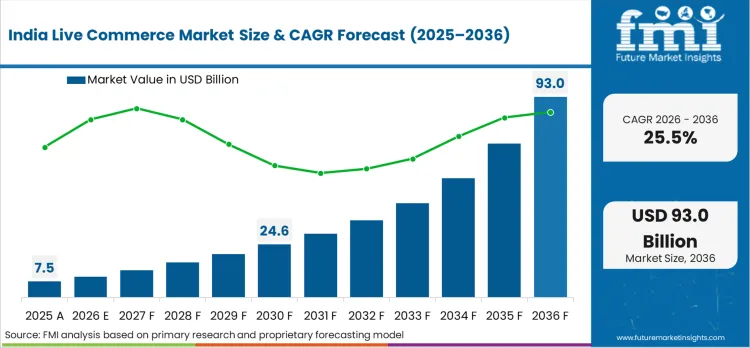
Asia Pacific is the global origin market for live commerce and remains dominant regional contributor to global GMV, leveraging massive mobile-first internet populations and mature payment infrastructure to achieve market leadership structurally unmatched by any other region. Taobao Live, operating within Alibaba ecosystem providing most developed host professionalization and logistics integration; Pinduoduo, leveraging group-buying mechanics within live sessions; and Douyin, combining short-form video discovery with live commerce conversion remain key regional capacity contributors.
- China: Leading with 24.5% CAGR, the market operates world's most mature live commerce ecosystem through Taobao Live, Pinduoduo, and Douyin with host professionalization, logistics integration, and after-sales service infrastructure that has no equivalent at scale in any other market. Alibaba reported Taobao Live GMV exceeding RMB 500 billion in fiscal year 2024, demonstrating sustained volume growth despite regulatory oversight of host conduct and pricing transparency requirements implemented by State Administration for Market Regulation in 2023-2024 period.
- India: Domestic demand is accelerating at 25.5% CAGR, supported by regional-language streaming in Hindi, Tamil, Telugu, and Bengali unlocking non-English-speaking consumer populations combined with mobile-first internet adoption. Flipkart launched live commerce integration across fashion and electronics categories in July 2024 with regional-language host programming, demonstrating domestic e-commerce platform investment in live formats. Meesho expanded live shopping sessions with commission-free model for small sellers in October 2024, addressing Tier 2 and Tier 3 city audiences where trust in local-language hosts drives conversion more effectively than metropolitan English-language content.
The full report analyzes the live commerce market across East and South Asia from 2021-2036, covering platform GMV, creator monetization trends, and growth drivers in China, India, Japan, South Korea, Australia, Indonesia, and key Southeast Asian markets. The assessment highlights mobile payment infrastructure and regional-language content strategies that dictate regional adoption rates.
Latin America Live Commerce Market Analysis
Latin America is emerging live commerce market where social messaging platform integration with commerce features accelerates adoption in markets where physical retail distribution remains fragmented outside major urban centers. Key activities by regional players include WhatsApp Business API integration enabling product catalog sharing and transaction completion within messaging environment, and Instagram Live shopping adoption among CPG and fashion brands seeking direct consumer engagement bypassing traditional retail intermediaries.
- Brazil: A projected 21.0% CAGR through 2036 is supported by deep WhatsApp penetration exceeding 95% of smartphone users and Instagram Live shopping adoption among brands addressing direct-to-consumer strategies. Magazine Luiza launched live shopping integration with WhatsApp Business in June 2024, enabling store associates to conduct live product demonstrations through messaging platform reaching customers in markets without physical store presence. Natura &Co expanded live commerce programming across Instagram and TikTok in March 2025 with beauty consultant-led sessions demonstrating products and offering personalized recommendations, leveraging social commerce behavior pattern where brand discovery through influencer content is well-established consumer habit providing cultural foundation accelerating live commerce adoption.
The report consists of detailed analysis for the market in Brazil, Mexico, Colombia, Argentina, and Chile within Latin America. Readers can find detailed information about several factors, such as platform penetration dynamics and regional social commerce trends, which are impacting growth in the Latin America region.
Europe Live Commerce Market Analysis
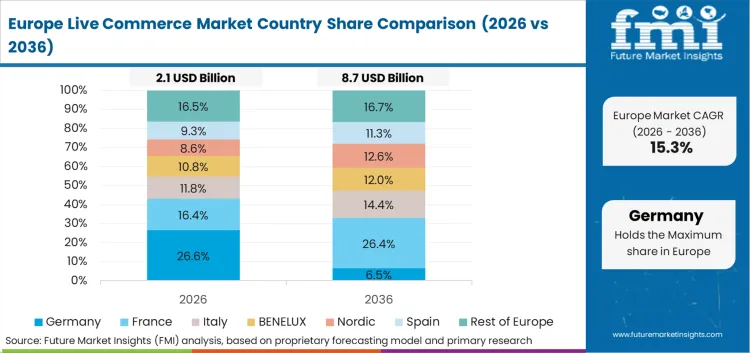
Europe is slower-growth live commerce region relative to Asia Pacific and Latin America, reflecting combined headwinds of stricter data-privacy compliance requirements under GDPR and consumer skepticism around impulse-purchase formats particularly in Northern and Central European markets. Leading platforms in Europe include TikTok Shop, expanding across UK and select European markets with localized creator programs; Instagram Shopping, leveraging established influencer marketing ecosystem; and YouTube Shopping, benefiting from high trust levels and long-form content consumption patterns among European audiences.
- Germany: Demand for live commerce in Germany is rising at 18.0% CAGR through 2036, driven by beauty and fashion category alignment with live demonstration formats despite consumer data-sharing reluctance and regulatory compliance overhead. Douglas launched live shopping program in November 2024 with beauty advisor-led sessions demonstrating cosmetics application techniques and offering personalized product recommendations, addressing German consumer preference for expert-guided purchase decisions. Zalando expanded live commerce integration with fashion influencer partnerships in February 2025, demonstrating marketplace platform investment despite slower adoption rates compared to other major European markets reflecting German consumer caution around impulse-purchase formats and preference for detailed product research before transaction commitment.
FMI's analysis of live commerce market in Europe consists of country-wise assessment that includes United Kingdom, Germany, France, Italy, Spain, Netherlands, and Nordic markets. Readers can know various platform regulatory environments and latest consumer adoption trends in the regional market.
Competitive Aligners for Market Players
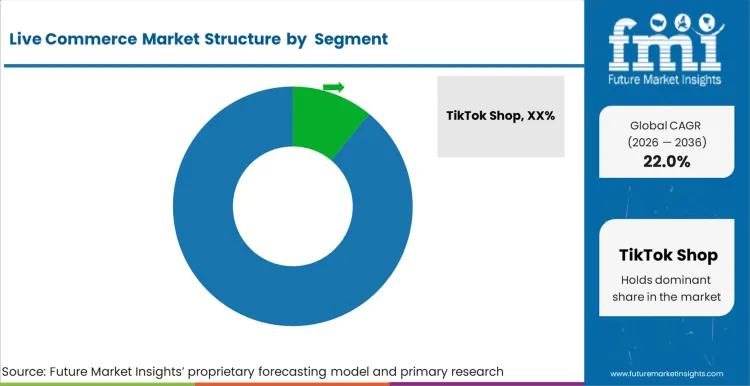
Market structure is concentrated around small number of platform-scale operators controlling majority of live commerce session volume and GMV, with TikTok Shop, Amazon Live, YouTube Shopping, Instagram, Taobao Live, and Pinduoduo accounting for approximately 70% of global live commerce revenue in 2026. Second tier consists of specialist technology vendors providing infrastructure and enablement services to brand-owned and marketplace channels including Shopify, Bambuser, Livescale, and CommentSold. Emerging layer includes creator-native commerce operators building direct-to-audience sales infrastructure outside traditional platform environments.
Primary competitive dimension for platform-scale operators is checkout conversion rate determined by session latency, catalog sync reliability, and payment flow step-count. Platforms maintaining sub-three-second latency and one-click checkout flows demonstrate conversion rates two to three times higher than redirect-dependent formats requiring users to leave streaming environment for transaction completion. For brand-owned live commerce programs, competitive aligner is creator relationship exclusivity and ability to secure consistent programming from high-engagement hosts whose audiences demonstrate repeat-purchase behavior.
For specialist technology vendors, competitive aligner is integration breadth measured by ability to connect live commerce session data into downstream systems including CRM platforms, loyalty programs, customer data platforms, and supply chain inventory management systems. Vendors providing pre-built connectors to major e-commerce platforms, payment processors, and marketing automation systems reduce implementation timelines and technical resource requirements for brand-owned channel deployment.
Recent Developments
The report includes coverage of key trends from competitive benchmarking. Some of the recent developments covered in the reports:
- In September 2024, Instagram integrated Meta Pay one-click checkout flows with stored payment credentials into Live Shopping sessions to reduce transaction abandonment rates [2].
- In December 2024, YouTube Shopping expanded affiliate commission structures and performance bonuses tied to session GMV creating creator earnings incentive alignment [3].
Key Players in Live Commerce Market
- TikTok Shop
- Amazon Live
- YouTube Shopping
- Instagram (Meta)
- Shopify
- Taobao Live (Alibaba)
- Pinduoduo
- Bambuser
- Livescale
- CommentSold
Scope of the Report
| Metric | Value |
|---|---|
| Quantitative Units | USD 9.5 Billion (2026) to USD 69.3 Billion (2036), at a CAGR of 22.0% |
| Market Definition | Live commerce refers to the practice of selling products directly to consumers through live-streamed video sessions in which hosts demonstrate, review, and transact on goods in real time while viewers interact through chat and purchasing actions without leaving the streaming environment, distinguished by synchronous interaction, time-limited offers, and embedded checkout infrastructure. |
| Platform Type Segmentation | Integrated Social Live Commerce, Marketplace Live Commerce, Brand-Owned Live Commerce, Creator Storefront Live Commerce, Others |
| End Use Industry Segmentation | Fashion & Apparel, Beauty & Personal Care, Consumer Electronics, Home & Lifestyle, Food & Grocery, Others |
| Application Coverage | Platform licensing, transaction-based revenue sharing, creator monetization, technology enablement, integration services |
| Regions Covered | North America, Latin America, Europe, Asia Pacific, Middle East and Africa |
| Countries Covered | United States, Canada, Brazil, Mexico, Colombia, Argentina, Chile, United Kingdom, Germany, France, Italy, Spain, Netherlands, China, India, Japan, South Korea, Australia, Indonesia and 40 plus countries |
| Key Companies Profiled | TikTok Shop, Amazon Live, YouTube Shopping, Instagram (Meta), Shopify, Taobao Live (Alibaba), Pinduoduo, Bambuser, Livescale, CommentSold |
| Forecast Period | 2026 to 2036 |
| Approach | Hybrid top down and bottom up market modeling validated through primary interviews with platform operators and brand digital commerce leads, supported by platform-reported GMV data benchmarking and regional digital commerce expenditure verification |
Live Commerce Market Analysis by Segments
Platform Type:
- Integrated Social Live Commerce
- Marketplace Live Commerce
- Brand-Owned Live Commerce
- Creator Storefront Live Commerce
- Others
End Use Industry:
- Fashion & Apparel
- Beauty & Personal Care
- Consumer Electronics
- Home & Lifestyle
- Food & Grocery
- Others
Region:
- Asia Pacific
- India
- China
- Japan
- South Korea
- Indonesia
- Australia
- Southeast Asia
- Rest of Asia Pacific
- Europe
- Germany
- United Kingdom
- France
- Italy
- Spain
- Netherlands
- Nordics
- Rest of Europe
- North America
- United States
- Canada
- Latin America
- Brazil
- Mexico
- Colombia
- Argentina
- Chile
- Rest of Latin America
- Middle East & Africa
- Kingdom of Saudi Arabia
- United Arab Emirates
- South Africa
- Rest of Middle East & Africa
Bibliography
- [1] TikTok Shop. (2024). US market launch and creator incentive program announcement. Platform Expansion Press Release, September 2024.
- [2] Instagram (Meta). (2024). Meta Pay one-click checkout integration into Live Shopping sessions. Product Update Release Notes, September 2024.
- [3] YouTube Shopping. (2024). Affiliate commission structure expansion and performance bonus program launch. Creator Monetization Program Update, December 2024.
- [4] Zara (Inditex). (2025). Dedicated live commerce program launch across Instagram and TikTok platforms. Digital Commerce Strategy Disclosure, March 2025.
- [5] Shein. (2024). 24/7 live shopping session programming expansion across multiple time zones. E-commerce Platform Update, August 2024.
- [6] H&M Group. (2024). Live commerce session performance analysis and customer engagement metrics. Digital Channels Annual Report, December 2024.
- [7] Alibaba Group. (2024). Taobao Live GMV disclosure for fiscal year 2024. Annual Financial Results Announcement, May 2024.
- [8] Flipkart. (2024). Regional-language live commerce integration launch announcement. Platform Feature Release, July 2024.
- [9] Meesho. (2024). Live shopping session expansion with commission-free model for small sellers. Marketplace Strategy Update, October 2024.
- [10] Magazine Luiza. (2024). WhatsApp Business live shopping integration program launch. Omnichannel Strategy Press Release, June 2024.
This Report Addresses
- Market intelligence to enable structured strategic decision making across live commerce platform operators, brand advertisers, and enabling-technology vendors
- Market size estimation and 10 year revenue forecasts from 2026 to 2036, supported by validated platform GMV and transaction benchmarks
- Growth opportunity mapping across integrated social, marketplace, brand-owned, and creator storefront platforms with emphasis on checkout conversion optimization
- Segment and regional revenue forecasts covering fashion, beauty, electronics, home, and food categories across platform types
- Competition strategy assessment including platform checkout infrastructure positioning, creator relationship dynamics, and technology integration capabilities
- Platform feature evolution tracking including payment rail maturation, inventory integration, and real-time analytics deployment
- Regulatory impact analysis covering influencer disclosure mandates, data privacy constraints, and digital market conduct requirements
- Market report delivery in PDF, Excel, PPT, and interactive dashboard formats for executive and operational use
Frequently Asked Questions
How large is the demand for Live Commerce in the global market in 2026?
Demand for Live Commerce in the global market is estimated to be valued at USD 9.5 Billion in 2026.
What will be the market size of Live Commerce in the global market by 2036?
Market size for Live Commerce is projected to reach USD 69.3 Billion by 2036.
What is the expected demand growth for Live Commerce in the global market between 2026 and 2036?
Demand for Live Commerce in the global market is expected to grow at a CAGR of 22.0% between 2026 and 2036.
Which Platform Type is poised to lead global sales by 2026?
Integrated Social Live Commerce is expected to be the dominant platform type, capturing approximately 38.0% of global market share in 2026 due to audience aggregation effect and embedded checkout infrastructure.
How significant is the role of Fashion & Apparel End Use Industry in driving Live Commerce adoption in 2026?
Fashion & Apparel represents the critical end use industry segment, projected to hold substantial 27.0% share of total market in 2026 as category-format fit and trend velocity create strong alignment with live demonstration mechanics.
What is Driving Live Commerce Demand in the United States?
Platform-level investment from TikTok Shop, Amazon Live, and YouTube Shopping deploying native checkout integrations and social commerce reshaping impulse-buy retail dynamics among millennial and Gen Z cohorts are driving growth.
What Compliance Standards are Referenced for the United States?
FTC influencer disclosure guidelines and platform-specific content moderation policies governing commercial live streaming sessions are referenced as key compliance benchmarks.
What is the United States Growth Outlook in this Report?
The United States is projected to grow at a CAGR of 19.0% during 2026 to 2036.
Why is Europe described as a Slower-Growth Region in this Report?
Growth is constrained by stricter data-privacy compliance requirements under GDPR and consumer skepticism around impulse-purchase formats particularly in Northern and Central European markets.
What Type of Demand Dominates in Europe?
Beauty and fashion category live commerce aligned with expert-guided demonstration formats dominates regional consumption despite slower overall adoption rates.
What is Germany Growth Outlook in this Report?
Germany is projected to expand at a CAGR of 18.0% during 2026 to 2036.
Does the Report Cover Indonesia in its Regional Analysis?
Indonesia is included within Asia Pacific under the regional scope of analysis as key Southeast Asian market.
What are the Sources referred to for analyzing the Market in Indonesia?
Platform-published data from regional e-commerce operators, Southeast Asian digital commerce association reports, and mobile payment infrastructure deployment statistics are cited as primary reference sources.
What is the Main Demand Theme Linked to Indonesia in Asia Coverage?
Asia Pacific mobile-first internet population growth and mature payment infrastructure eliminating checkout friction are emphasized as regional adoption drivers.
Does the Report Cover China in its Regional Analysis?
China is included within Asia Pacific under the regional coverage framework as largest live commerce market globally.
What is the Main China Related Demand Theme in Asia Coverage?
Host professionalization, logistics integration, and after-sales service infrastructure maturity creating ecosystem that has no equivalent at scale in any other market are emphasized.
Which Platform Types are Strategically Important for Asia Pacific Markets?
Integrated social live commerce platforms are prioritized due to audience scale and algorithmic distribution advantages supporting rapid creator adoption and session GMV growth.
What is Live Commerce and What is It Mainly Used For?
Live commerce is real-time sale of products through live-streamed video sessions where hosts demonstrate goods and viewers transact within the same streaming environment combining entertainment and embedded checkout.
What does Live Commerce Market Mean in this Report?
Live commerce market refers to global platform licensing, transaction-based revenue sharing, creator monetization, and technology enablement revenues generated through live-streaming commerce sessions.
What is Included in the Scope of this Live Commerce Market Report?
Scope covers platform types, end use industries, creator monetization mechanisms, and technology enablement services across major regional markets and consumer categories.
What is Excluded from the Scope of this Report?
Pre-recorded shoppable video content, conventional marketplace GMV not attributable to live sessions, social media advertising revenue from non-commerce video, and physical retail revenues not linked to live commerce events are excluded.
Preview the report firsthand - request a free sample
Get SampleGet the brochure for pricing and purchase details.
Get PDFTable of Content
- Executive Summary
- Global Market Outlook
- Demand-side Trends
- Supply-side Trends
- Technology Roadmap Analysis
- Analysis and Recommendations
- Market Overview
- Market Coverage / Taxonomy
- Market Definition / Scope / Limitations
- Research Methodology
- Chapter Orientation
- Analytical Lens and Working Hypotheses
- Market Structure, Signals, and Trend Drivers
- Benchmarking and Cross-market Comparability
- Market Sizing, Forecasting, and Opportunity Mapping
- Research Design and Evidence Framework
- Desk Research Programme (Secondary Evidence)
- Company Annual and Sustainability Reports
- Peer-reviewed Journals and Academic Literature
- Corporate Websites, Product Literature, and Technical Notes
- Earnings Decks and Investor Briefings
- Statutory Filings and Regulatory Disclosures
- Technical White Papers and Standards Notes
- Trade Journals, Industry Magazines, and Analyst Briefs
- Conference Proceedings, Webinars, and Seminar Materials
- Government Statistics Portals and Public Data Releases
- Press Releases and Reputable Media Coverage
- Specialist Newsletters and Curated Briefings
- Sector Databases and Reference Repositories
- FMI Internal Proprietary Databases and Historical Market Datasets
- Subscription Datasets and Paid Sources
- Social Channels, Communities, and Digital Listening Inputs
- Additional Desk Sources
- Expert Input and Fieldwork (Primary Evidence)
- Primary Modes
- Qualitative Interviews and Expert Elicitation
- Quantitative Surveys and Structured Data Capture
- Blended Approach
- Why Primary Evidence is Used
- Field Techniques
- Interviews
- Surveys
- Focus Groups
- Observational and In-context Research
- Social and Community Interactions
- Stakeholder Universe Engaged
- C-suite Leaders
- Board Members
- Presidents and Vice Presidents
- R&D and Innovation Heads
- Technical Specialists
- Domain Subject-matter Experts
- Scientists
- Physicians and Other Healthcare Professionals
- Governance, Ethics, and Data Stewardship
- Research Ethics
- Data Integrity and Handling
- Primary Modes
- Tooling, Models, and Reference Databases
- Desk Research Programme (Secondary Evidence)
- Data Engineering and Model Build
- Data Acquisition and Ingestion
- Cleaning, Normalisation, and Verification
- Synthesis, Triangulation, and Analysis
- Quality Assurance and Audit Trail
- Market Background
- Market Dynamics
- Drivers
- Restraints
- Opportunity
- Trends
- Scenario Forecast
- Demand in Optimistic Scenario
- Demand in Likely Scenario
- Demand in Conservative Scenario
- Opportunity Map Analysis
- Product Life Cycle Analysis
- Supply Chain Analysis
- Investment Feasibility Matrix
- Value Chain Analysis
- PESTLE and Porter’s Analysis
- Regulatory Landscape
- Regional Parent Market Outlook
- Production and Consumption Statistics
- Import and Export Statistics
- Market Dynamics
- Global Market Analysis 2021 to 2025 and Forecast, 2026 to 2036
- Historical Market Size Value (USD Million) Analysis, 2021 to 2025
- Current and Future Market Size Value (USD Million) Projections, 2026 to 2036
- Y-o-Y Growth Trend Analysis
- Absolute $ Opportunity Analysis
- Global Market Pricing Analysis 2021 to 2025 and Forecast 2026 to 2036
- Global Market Analysis 2021 to 2025 and Forecast 2026 to 2036, By Platform Type
- Introduction / Key Findings
- Historical Market Size Value (USD Million) Analysis By Platform Type , 2021 to 2025
- Current and Future Market Size Value (USD Million) Analysis and Forecast By Platform Type , 2026 to 2036
- Integrated Social Live Commerce
- Marketplace Live Commerce
- Brand-Owned Live Commerce
- Creator Storefront Live Commerce
- Integrated Social Live Commerce
- Y-o-Y Growth Trend Analysis By Platform Type , 2021 to 2025
- Absolute $ Opportunity Analysis By Platform Type , 2026 to 2036
- Global Market Analysis 2021 to 2025 and Forecast 2026 to 2036, By End Use Industry
- Introduction / Key Findings
- Historical Market Size Value (USD Million) Analysis By End Use Industry, 2021 to 2025
- Current and Future Market Size Value (USD Million) Analysis and Forecast By End Use Industry, 2026 to 2036
- Fashion & Apparel's
- Beauty & Personal Care
- Consumer Electronics
- Home & Lifestyle
- Fashion & Apparel's
- Y-o-Y Growth Trend Analysis By End Use Industry, 2021 to 2025
- Absolute $ Opportunity Analysis By End Use Industry, 2026 to 2036
- Global Market Analysis 2021 to 2025 and Forecast 2026 to 2036, By Region
- Introduction
- Historical Market Size Value (USD Million) Analysis By Region, 2021 to 2025
- Current Market Size Value (USD Million) Analysis and Forecast By Region, 2026 to 2036
- North America
- Latin America
- Western Europe
- Eastern Europe
- East Asia
- South Asia and Pacific
- Middle East & Africa
- Market Attractiveness Analysis By Region
- North America Market Analysis 2021 to 2025 and Forecast 2026 to 2036, By Country
- Historical Market Size Value (USD Million) Trend Analysis By Market Taxonomy, 2021 to 2025
- Market Size Value (USD Million) Forecast By Market Taxonomy, 2026 to 2036
- By Country
- USA
- Canada
- Mexico
- By Platform Type
- By End Use Industry
- By Country
- Market Attractiveness Analysis
- By Country
- By Platform Type
- By End Use Industry
- Key Takeaways
- Latin America Market Analysis 2021 to 2025 and Forecast 2026 to 2036, By Country
- Historical Market Size Value (USD Million) Trend Analysis By Market Taxonomy, 2021 to 2025
- Market Size Value (USD Million) Forecast By Market Taxonomy, 2026 to 2036
- By Country
- Brazil
- Chile
- Rest of Latin America
- By Platform Type
- By End Use Industry
- By Country
- Market Attractiveness Analysis
- By Country
- By Platform Type
- By End Use Industry
- Key Takeaways
- Western Europe Market Analysis 2021 to 2025 and Forecast 2026 to 2036, By Country
- Historical Market Size Value (USD Million) Trend Analysis By Market Taxonomy, 2021 to 2025
- Market Size Value (USD Million) Forecast By Market Taxonomy, 2026 to 2036
- By Country
- Germany
- UK
- Italy
- Spain
- France
- Nordic
- BENELUX
- Rest of Western Europe
- By Platform Type
- By End Use Industry
- By Country
- Market Attractiveness Analysis
- By Country
- By Platform Type
- By End Use Industry
- Key Takeaways
- Eastern Europe Market Analysis 2021 to 2025 and Forecast 2026 to 2036, By Country
- Historical Market Size Value (USD Million) Trend Analysis By Market Taxonomy, 2021 to 2025
- Market Size Value (USD Million) Forecast By Market Taxonomy, 2026 to 2036
- By Country
- Russia
- Poland
- Hungary
- Balkan & Baltic
- Rest of Eastern Europe
- By Platform Type
- By End Use Industry
- By Country
- Market Attractiveness Analysis
- By Country
- By Platform Type
- By End Use Industry
- Key Takeaways
- East Asia Market Analysis 2021 to 2025 and Forecast 2026 to 2036, By Country
- Historical Market Size Value (USD Million) Trend Analysis By Market Taxonomy, 2021 to 2025
- Market Size Value (USD Million) Forecast By Market Taxonomy, 2026 to 2036
- By Country
- China
- Japan
- South Korea
- By Platform Type
- By End Use Industry
- By Country
- Market Attractiveness Analysis
- By Country
- By Platform Type
- By End Use Industry
- Key Takeaways
- South Asia and Pacific Market Analysis 2021 to 2025 and Forecast 2026 to 2036, By Country
- Historical Market Size Value (USD Million) Trend Analysis By Market Taxonomy, 2021 to 2025
- Market Size Value (USD Million) Forecast By Market Taxonomy, 2026 to 2036
- By Country
- India
- ASEAN
- Australia & New Zealand
- Rest of South Asia and Pacific
- By Platform Type
- By End Use Industry
- By Country
- Market Attractiveness Analysis
- By Country
- By Platform Type
- By End Use Industry
- Key Takeaways
- Middle East & Africa Market Analysis 2021 to 2025 and Forecast 2026 to 2036, By Country
- Historical Market Size Value (USD Million) Trend Analysis By Market Taxonomy, 2021 to 2025
- Market Size Value (USD Million) Forecast By Market Taxonomy, 2026 to 2036
- By Country
- Kingdom of Saudi Arabia
- Other GCC Countries
- Turkiye
- South Africa
- Other African Union
- Rest of Middle East & Africa
- By Platform Type
- By End Use Industry
- By Country
- Market Attractiveness Analysis
- By Country
- By Platform Type
- By End Use Industry
- Key Takeaways
- Key Countries Market Analysis
- USA
- Pricing Analysis
- Market Share Analysis, 2025
- By Platform Type
- By End Use Industry
- Canada
- Pricing Analysis
- Market Share Analysis, 2025
- By Platform Type
- By End Use Industry
- Mexico
- Pricing Analysis
- Market Share Analysis, 2025
- By Platform Type
- By End Use Industry
- Brazil
- Pricing Analysis
- Market Share Analysis, 2025
- By Platform Type
- By End Use Industry
- Chile
- Pricing Analysis
- Market Share Analysis, 2025
- By Platform Type
- By End Use Industry
- Germany
- Pricing Analysis
- Market Share Analysis, 2025
- By Platform Type
- By End Use Industry
- UK
- Pricing Analysis
- Market Share Analysis, 2025
- By Platform Type
- By End Use Industry
- Italy
- Pricing Analysis
- Market Share Analysis, 2025
- By Platform Type
- By End Use Industry
- Spain
- Pricing Analysis
- Market Share Analysis, 2025
- By Platform Type
- By End Use Industry
- France
- Pricing Analysis
- Market Share Analysis, 2025
- By Platform Type
- By End Use Industry
- India
- Pricing Analysis
- Market Share Analysis, 2025
- By Platform Type
- By End Use Industry
- ASEAN
- Pricing Analysis
- Market Share Analysis, 2025
- By Platform Type
- By End Use Industry
- Australia & New Zealand
- Pricing Analysis
- Market Share Analysis, 2025
- By Platform Type
- By End Use Industry
- China
- Pricing Analysis
- Market Share Analysis, 2025
- By Platform Type
- By End Use Industry
- Japan
- Pricing Analysis
- Market Share Analysis, 2025
- By Platform Type
- By End Use Industry
- South Korea
- Pricing Analysis
- Market Share Analysis, 2025
- By Platform Type
- By End Use Industry
- Russia
- Pricing Analysis
- Market Share Analysis, 2025
- By Platform Type
- By End Use Industry
- Poland
- Pricing Analysis
- Market Share Analysis, 2025
- By Platform Type
- By End Use Industry
- Hungary
- Pricing Analysis
- Market Share Analysis, 2025
- By Platform Type
- By End Use Industry
- Kingdom of Saudi Arabia
- Pricing Analysis
- Market Share Analysis, 2025
- By Platform Type
- By End Use Industry
- Turkiye
- Pricing Analysis
- Market Share Analysis, 2025
- By Platform Type
- By End Use Industry
- South Africa
- Pricing Analysis
- Market Share Analysis, 2025
- By Platform Type
- By End Use Industry
- USA
- Market Structure Analysis
- Competition Dashboard
- Competition Benchmarking
- Market Share Analysis of Top Players
- By Regional
- By Platform Type
- By End Use Industry
- Competition Analysis
- Competition Deep Dive
- TikTok Shop
- Overview
- Product Portfolio
- Profitability by Market Segments (Product/Age /Sales Channel/Region)
- Sales Footprint
- Strategy Overview
- Marketing Strategy
- Product Strategy
- Channel Strategy
- Amazon Live
- YouTube Shopping
- Instagram (Meta)
- Shopify
- Taobao Live (Alibaba)
- Pinduoduo
- TikTok Shop
- Competition Deep Dive
- Assumptions & Acronyms Used


