

- Industry Size (2026)
- USD 82.4 Bn
- Forecast (2036)
- USD 379.5 Bn
- CAGR (2026 to 2036)
- 16.5%
Shoppable Short Video Products Market Forecast and Outlook By FMI
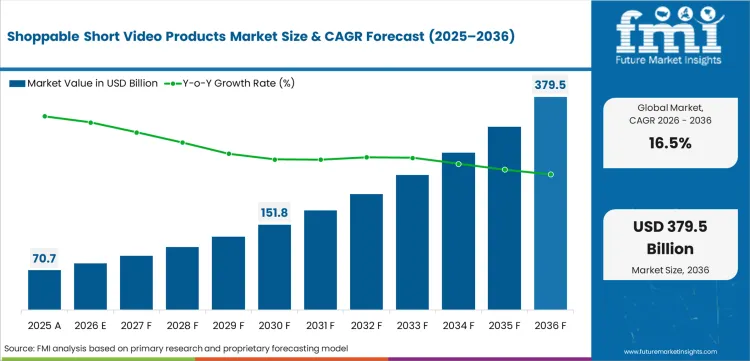
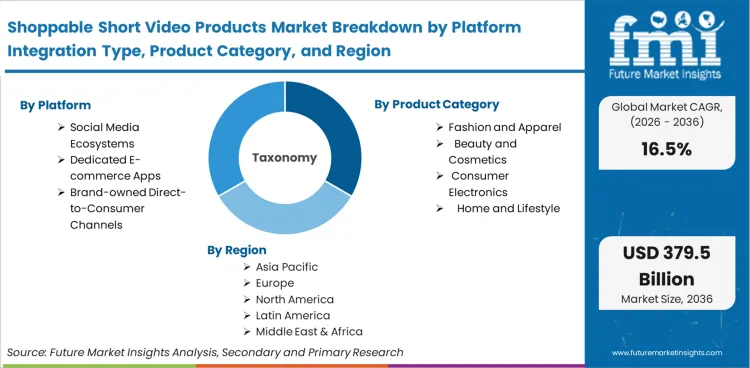
In 2025, the shoppable short video products market stood at USD 65.2 billion. It is poised to surpass USD 82.4 billion in 2026, supported by a 16.5% CAGR through 2036. Market valuation is projected to reach USD 379.5 billion by 2036, driven by mobile-first consumer behavior and fully integrated video-based checkout. Algorithmic targeting and integrated payment gateways sustain transformational shifts in digital retail rather than mere incremental channel expansion. Major platform operators maintain aggressive gross merchandise value targets by lowering merchant commission rates during initial rollout phases.
Subsidized transaction environments accelerate merchant onboarding while temporarily suppressing profit margins for network operators. Retail brand digital directors capitalizing on the creator economy must optimize product catalogs for vertical video formats before legacy text-search traffic declines permanently. FMI analysts observe that massive technical moats protect current valuations, as building behavioral algorithms capable of predicting purchasing intent requires vast computational resources. Transitioning from subsidized growth to sustainable monetization forces platform architects to extract higher commission rates on short video sales to offset rising logistical costs. Widespread adoption of native checkout frameworks establishes a new baseline for retail conversion metrics, rendering external landing pages obsolete.
Summary of Shoppable Short Video Products Market
- Shoppable Short Video Products Market Definition
- Shoppable short video products comprise the global digital infrastructure, software interfaces, and physical gross merchandise value generated when consumers purchase retail goods directly through short-form video content.
- Demand Drivers in the Market
- Mobile-first consumer demographics actively transition product discovery from static digital storefronts to algorithm-driven video feeds.
- Closed-loop payment integrations eliminate friction by allowing users to complete purchases without navigating to external browser windows.
- Network operators aggressively subsidize shipping and creator affiliate commissions to secure market share from traditional retail incumbents.
- Key Segments Analyzed in the FMI Report
- Social Media Ecosystems: 68% share in 2026, leading the market because established networks possess billions of daily active users, eliminating the customer acquisition costs that standalone applications face.
- Fashion and Apparel: 37% share in 2026, dominating due to a highly visual nature that translates perfectly to dynamic video demonstrations and low-ticket impulse purchasing.
- Asia Pacific: Drives massive transaction volumes as regional populations bypass traditional banking infrastructure using integrated digital wallets natively embedded in entertainment platforms.
- Analyst Opinion at FMI
- Rahul Pandita, Principal Consultant for Technology at FMI, opines: Mastering creator affiliate networks and navigating localized data privacy laws separate successful native commerce operations from failed integrations. Algorithmic impulse generation requires network operators to balance user retention with transaction friction. Retail brand digital directors who delay integrating closed-loop payment gateways within their content strategies forfeit impulse purchase revenue. Within the next sourcing cycle, standalone mobile storefronts will lose market share to native social feeds that convert passive viewing into immediate capital transfer.
- Strategic Implications / Executive Takeaways
- Shift capital from traditional static digital advertising toward dynamic creator affiliate funds.
- Build agile supply chains capable of responding to sudden algorithmic demand spikes for low-ticket items.
- Prioritize localized compliance teams to manage rapidly changing regulations regarding foreign-owned application transaction data.
- Methodology
- Interviews conducted with platform monetization directors, digital supply chain managers, and regional retail compliance officers verified adoption timelines.
- Public tech earnings transcripts, digital payment gateway volume reports, and international telecommunication usage statistics supported baseline estimations.
- Bottom-up aggregation models validated regional gross merchandise value targets against application download metrics and digital wallet penetration rates.
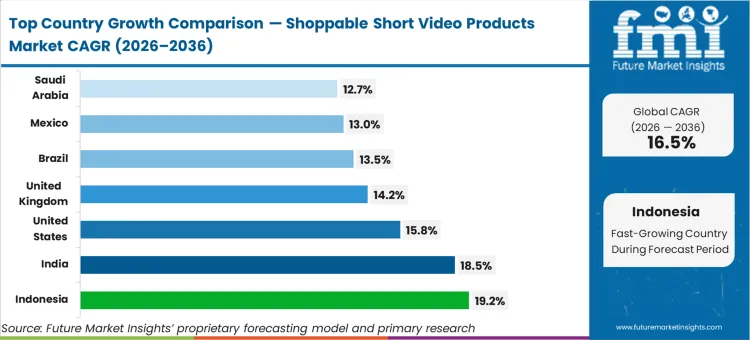
Indonesia (19.2% CAGR) and India (18.5% CAGR) drive rapid expansion through mobile-first consumer bases rapidly adopting integrated digital wallets. Brazil (17.4% CAGR) contributes significantly via high daily screen time metrics and localized creator networks. Mature markets such as the United States (15.8% CAGR) and the United Kingdom (14.2% CAGR) generate replacement demand away from traditional search-based e-commerce, with volume growth constrained by strict data privacy compliance and user saturation
Shoppable short video products encompass the digital tools, secure checkout gateways, and resulting transaction volumes generated when physical retail goods are sold directly through embedded systems in short-form mobile feeds. Proprietary behavioral algorithms serve highly targeted product clips to users already engaged in extended viewing sessions, converting passive content consumption into immediate transactional action. Direct-to-consumer retail represents the primary industrial function, allowing users to buy physical consumer goods without leaving the host application environment.
Shoppable Short Video Products Market Key Takeaways
| Metric | Details |
|---|---|
| Industry Size (2026) | USD 82.4 billion |
| Industry Value (2036) | USD 379.5 billion |
| CAGR (2026-2036) | 16.5% |
Shoppable Short Video Products Market Definition
Shoppable short video products encompass the digital tools, secure checkout gateways, and resulting transaction volumes generated when physical retail goods are sold directly through embedded systems in short-form mobile feeds. Proprietary behavioral algorithms serve highly targeted product clips to users already engaged in extended viewing sessions, converting passive content consumption into immediate transactional action. Direct-to-consumer retail represents the primary industrial function, allowing users to buy physical consumer goods without leaving the host application environment.
Shoppable Short Video Products Market Inclusions
Global and regional market sizes for short video commerce transactions fall squarely within the scope, including segment breakdowns by platform architecture and product category. Platform commission rate trends, regional affiliate fee structures, and the trade flow of cross-border goods fulfilling these digital orders are fully incorporated. Software interfaces enabling secure checkout gateways within mobile applications are evaluated as critical infrastructure.
Shoppable Short Video Products Market Exclusions
Traditional long-form live shopping broadcasts lacking discrete short video clip repurposing fall outside the defined parameters. Standard display advertising revenues, subscription services, and digital virtual goods are explicitly omitted from the valuation. Standalone retail websites without integrated short-form video discovery engines are excluded.
Shoppable Short Video Products Market Research Methodology
- Primary Research: Analysts engaged with platform monetization directors, digital supply chain managers, creator agency executives, and regional retail compliance officers to map transaction capabilities.
- Desk Research: Data collection aggregated national trade ministry disclosures, public tech earnings transcripts, and digital payment gateway volume reports to establish baseline estimations.
- Market-Sizing and Forecasting: Regional gross merchandise value targets from leading networks formed a bottom-up aggregation model, applying specific adoption curves to project future transaction velocity.
- Data Validation and Update Cycle: Projections undergo rigorous variance checks against regional e-commerce trade datasets and verifiable payment processing benchmarks.
Segmental Analysis
Shoppable Short Video Products Market Analysis by Platform Integration Type
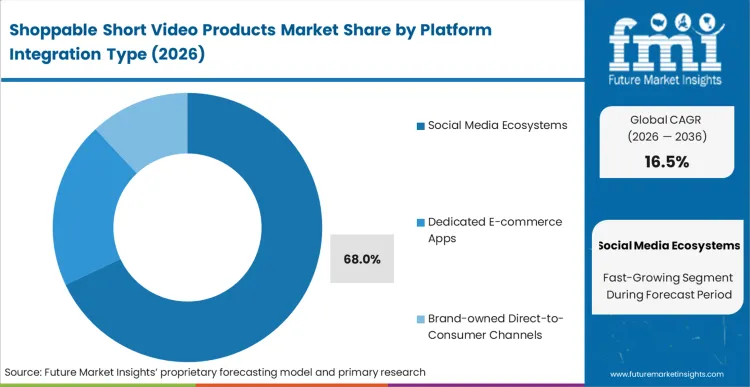
With social media ecosystems capturing a 68% share in 2026, standalone shopping applications face insurmountable customer acquisition costs. Established networks possess billions of daily active users, eliminating the friction required to build separate commercial audiences. According to FMI's estimates, proprietary behavioral algorithms serve highly targeted product clips to users already engaged in extended viewing sessions. Minimizing the steps between discovery and checkout maximizes impulse purchase probabilities for low-ticket consumer goods. Platform architects refining native social commerce integrations must implement localized closed-loop payment structures or surrender transaction fees to third-party providers. Ecosystem operators unable to supply frictionless checkout components risk permanent exclusion from the next wave of creator-led merchandising campaigns.
- Application stickiness: Fully embedded shopping catalogs keep consumers within the host application environment, directly increasing daily active user retention metrics.
- Algorithmic targeting: Machine learning models analyze watch time variables to serve physical products at the exact moment of highest purchase probability.
- Conversion friction: Removing mandatory browser redirects dramatically lowers cart abandonment rates across all mobile operating systems.
Shoppable Short Video Products Market Analysis by Product Category
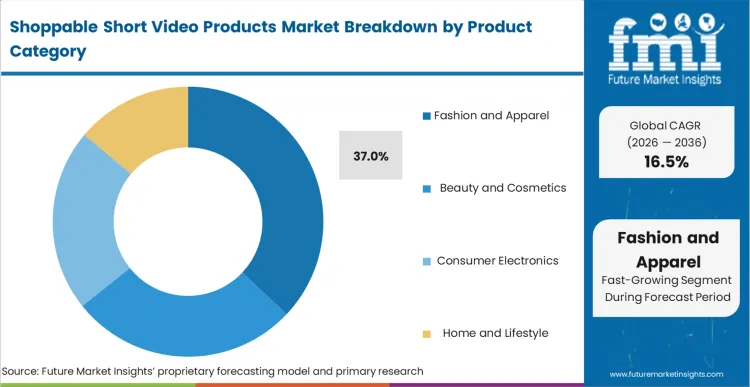
Highly visual physical goods translate perfectly to dynamic video demonstrations, positioning fashion and apparel to hold 37% of total market share in 2026. Low-ticket clothing items require minimal consideration time, aligning directly with the rapid interaction cycles inherent to short video scrolling. FMI analysts opine that independent creators relying on fast fashion try-on hauls generate an endless cycle of user-generated product discovery. Platform operators continuously update merchant tools to automatically synchronize warehouse inventory levels with dynamic video tags. Apparel sellers implementing advanced virtual try on platform technology achieve measurable reductions in product return rates. Retail merchandisers who fail to integrate real-time inventory tracking with video discovery feeds face severe stockout penalties during viral demand spikes.
- Impulse threshold: Clothing and cosmetic items priced below standard psychological resistance barriers trigger immediate purchases without extended comparative research.
- Styling demonstrations: Dynamic fit and texture representations convey more actionable purchasing data than static catalog imagery.
- Trend acceleration: Algorithmic viral velocity compresses traditional seasonal fashion cycles into hyper-accelerated micro-trends.
Shoppable Short Video Products Market Analysis by Content Generation Model
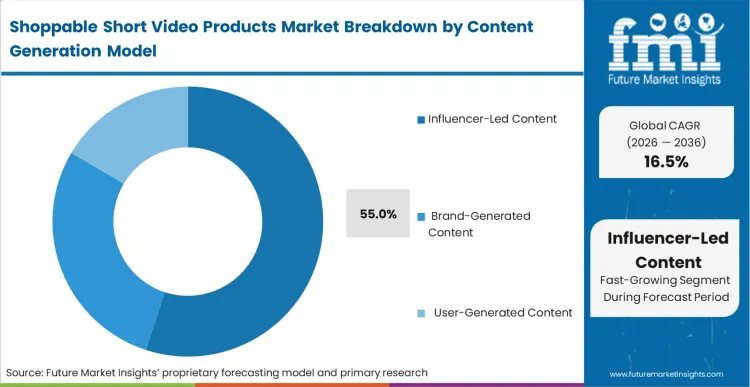
Trust and parasocial relationships serve as the primary conversion mechanism, driving influencer-led content to capture a leading 55% segment share in 2026. Consumers exhibit significantly lower resistance to product recommendations presented by familiar personalities compared to highly produced corporate advertisements. As per FMI's projection, network operators adjusting affiliate algorithms reward creators who generate high conversion rates rather than just high view counts. Corporate joint ventures specifically aim to equip vast networks of local influencers with compliant transaction tools. Independent broadcasters utilizing dedicated affiliate marketing software maximize the lifespan and transactional value of content across disparate platforms. Creator agency leads unable to verify direct sales attribution metrics lose priority status during brand sponsorship negotiations.
- Direct sales transition: Commission structures fundamentally shift the creator economy from brand awareness campaigns to strict performance marketing.
- Parasocial conversion: Familiar personalities bypass traditional consumer skepticism, drastically lowering customer acquisition costs for emerging brands.
- Content syndication: Automated infrastructure cuts extended creator broadcasts into discrete, shoppable short clips to capture secondary audiences.
Shoppable Short Video Products Market Drivers, Restraints, and Opportunities
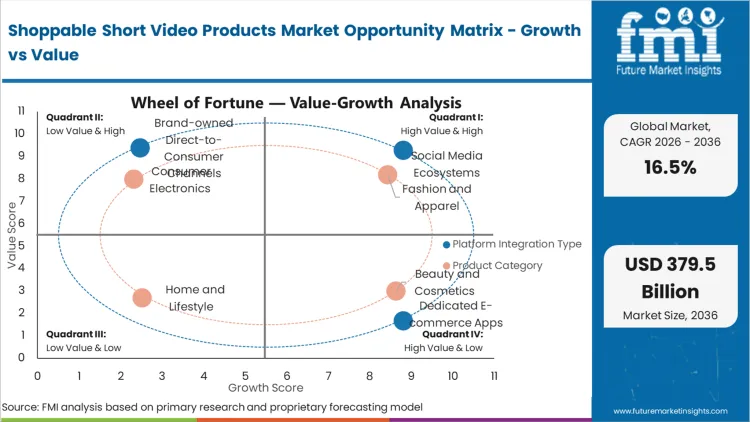
Digital retail architecture relies entirely on capturing human attention and monetizing it instantaneously before the user swipes away. Platform operators successfully integrated secure payment gateways directly into entertainment feeds, removing the friction that previously defined digital advertising. FMI's analysis indicates that demanding measurable creator affiliate programs forces merchant budgets away from traditional static display ads. Algorithmic impulse generation requires network operators to balance user retention with transaction functionality. Social commerce architects deploying integrated video content management solutions capture unprecedented gross merchandise value. Platform monetization leads failing to optimize native checkout modules forfeit transaction fee revenue to external payment processors.
Data privacy regulations and cross-border taxation policies strictly limit unfettered application expansion in mature retail environments. Government digitalization ministries actively mandate the separation of social media data from direct financial transactions to protect domestic merchants. High logistics costs associated with fulfilling single-item impulse purchases compress operating margins for both sellers and network operators. Retailers offset acquisition costs by shifting fulfillment burdens onto platform-subsidized shipping networks. Merchandising directors relying on cross-border supply chains must implement localized warehousing solutions to guarantee next-day delivery on viral products.
- Frictionless Payment Rollouts: Growth accelerates as network operators partner with regional unified payment interfaces, allowing consumers in developing nations to execute micro-transactions using digital wallets.
- Corporate Joint Ventures: Integrating video discovery with compliant local transaction infrastructure protects foreign operators from abrupt regulatory shutdowns.
- Live-to-Short Conversion: Internal infrastructure automatically cuts extended creator broadcasts into discrete clips, maximizing the transactional value of influencer content.
Regional Analysis
Based on the regional analysis, the shoppable short video products market is segmented into North America, Latin America, Europe, East Asia, South Asia, Oceania and Middle East & Africa across 40+ countries. The full report also offers market attractiveness analysis based on regional trends.
.webp "Top Country Growth Comparison Shoppable Short Video Products Market Cagr (2026 2036)")
| Country | CAGR (2026 to 2036) |
|---|---|
| Indonesia | 19.2% |
| India | 18.5% |
| United States | 15.8% |
| United Kingdom | 14.2% |
| Brazil | 13.5% |
| Mexico | 13.0% |
| Saudi Arabia | 12.7% |
Source: Future Market Insights (FMI) analysis, based on proprietary forecasting model and primary research
Asia Pacific Shoppable Short Video Products Market Analysis
Asia Pacific serves as the production epicenter and primary testing ground for advanced video commerce models. Platform operators dominate this region by leveraging massive mobile-first populations and integrating deeply with local digital wallet providers to bypass traditional banking infrastructure. As FMI's research confirms, government digitalization programs push regional operators to heavily promote integrated video services to rural consumer bases. Subsidizing affiliate programs incentivizes local creators to drive high-volume fashion and beauty sales. Strict national commerce policies and aggressive corporate joint ventures create a highly controlled but rapidly expanding transactional ecosystem across the continent.
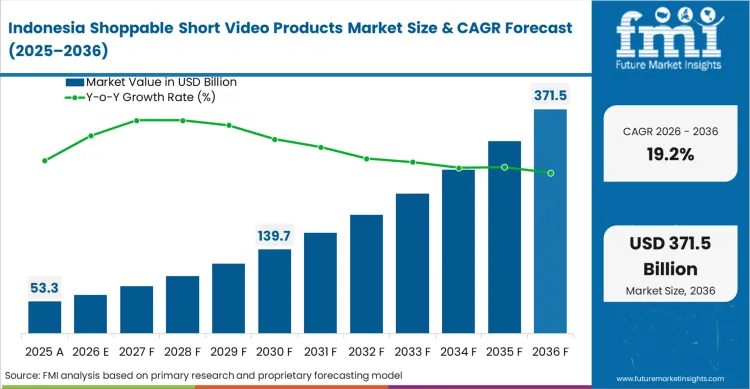
- Indonesia: Ministry of Trade Regulation No. 31 of 2023 mandates the separation of social media from direct e-commerce transactions, forcing market operators to restructure domestic operations rapidly. Integrating video discovery with compliant transaction infrastructure drives a 19.2% CAGR for native digital retail in Indonesia through 2036. Joint ventures between foreign social networks and domestic logistics providers establish the legal framework this legislative action requires. Platform monetization leads who fail to secure local joint venture partnerships face permanent expulsion from the Indonesian digital economy before the next audit cycle.
- India: Unified payment interfaces penetrate tier-two and tier-three cities, enabling frictionless micro-transactions directly from mobile entertainment feeds. This structural payment architecture positions India's short video commerce segment at an 18.5% compound growth rate through 2036. Domestic e-commerce giants building captive video ecosystems blur the lines between streaming entertainment and immediate product discovery. Network operators not fully integrated with national open india digital commerce initiatives forfeit access to the next generation of rural consumers entering the digital economy.
FMI's report includes detailed analysis and country-wise assessment for Asia Pacific. Readers can find precise data on creator commission rate benchmarks and regional data sovereignty regulations for China, Japan, and South Korea. Rapid penetration of unified payment interfaces forces platform architects to redesign checkout flows specifically for mobile-wallet micro-transactions.
North America Shoppable Short Video Products Market Analysis
North America represents a high-value, highly regulated ecosystem where mature platforms struggle to balance aggressive commerce integration with stringent user privacy expectations. Incumbent tech giants leverage existing advertising relationships to onboard large-scale retail brands into short video formats. Based on FMI's assessment, expansion is carefully managed against a backdrop of increasing federal scrutiny regarding cross-border data flows. Legislators debating the security implications of foreign-owned social infrastructure force operators to localize data storage. Regulators actively mandate partnerships with domestic fulfillment providers to guarantee transaction security.
- United States: Intense competition between incumbent tech giants protecting advertising revenues and specialized platforms introducing native commerce loops dictates the domestic landscape. The rollout of closed-loop checkout systems anchors the United States' 15.8% compound expansion of digital transaction volume to 2036. Aggressive seller subsidies and fulfillment network partnerships challenge traditional search-based retail infrastructures. Retail brand digital directors utilizing external usa digital commerce websites rather than native checkout modules suffer severe algorithmic penalty rates during product discovery phases.
FMI's report includes detailed analysis and country-wise assessment for North America. Precision data regarding digital privacy legislation impacts and average order value metrics across different platform architectures covers Canada and the United States. Federal data privacy regulations force network operators to build automated compliance screening tools, raising entry barriers for emerging standalone applications.
Europe Shoppable Short Video Products Market Analysis
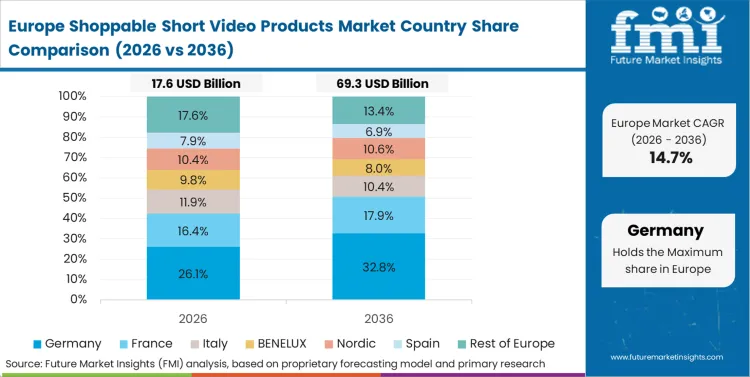
Europe operates as the global regulatory laboratory for digital retail, where transaction volumes are heavily gated by strict consumer protection and digital markets legislation. Companies navigate complex consent frameworks to operate compliant affiliate programs across diverse national borders. FMI's proprietary forecasting model projects that regional markets expand as consumers increasingly rely on creator recommendations to navigate cost-of-living pressures. Establishing localized physical supply chains ensures rapid delivery times that match traditional e-commerce standards. Regulators mandating clear disclosures on all creator-led product videos foster a higher trust environment for consumers making digital impulse purchases.
- United Kingdom: Strict regulatory oversight from local advertising standards authorities mandates clear disclosures on all creator-led product videos. Building automated compliance screening tools sustains a 14.2% compound rate for short video commerce in the United Kingdom. Platforms investing in domestic fulfillment centers allow approved merchants to store inventory directly within network-controlled warehouses. Digital merchandising directors failing to verify explicit paid-partnership disclosures face immediate algorithmic suppression and potential regulatory fines from local advertising authorities.
FMI's report includes detailed analysis and country-wise assessment for Europe. Comprehensive assessments of digital markets act compliance and local creator monetization trends cover Germany, France, Italy, and Spain. Strict enforcement of data localization directives forces digital commerce platform providers to host European consumer transaction records exclusively within regional server clusters.
Competitive Aligners for Market Players
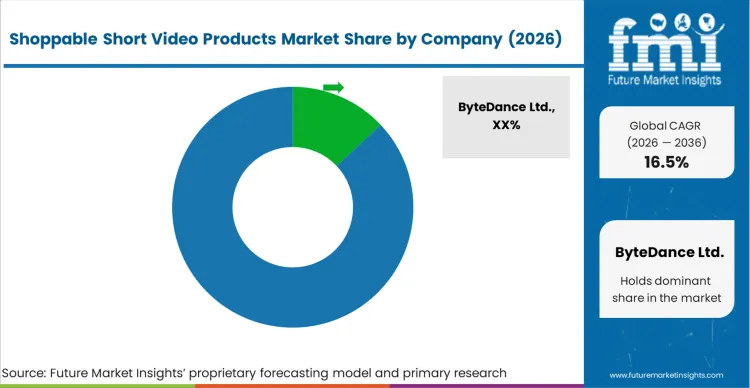
Widespread adoption of localized compliance frameworks establishes a new baseline requirement that digital platforms must satisfy before operating affiliate networks. Regional trade ministries mandating the strict separation of social user data from financial transaction processing force global operators into complex domestic joint ventures. Network operators must integrate robust streaming media services with certified local payment gateways to capture transaction share legally. Platform architects failing to secure domestic regulatory approval before the 2027 enforcement deadlines risk complete disqualification from high-growth emerging economies.
Subsidized shipping and zero-commission onboarding events represent massive capital investments that permanently change merchant acquisition fundamentals. Ecosystem operators deploying billions in creator affiliate funds actively purchase market share from incumbent search-based retail platforms. Massive server infrastructure capable of rendering thousands of concurrent content creation streams provides an insurmountable technological moat. Standalone application developers lacking the capital reserves to subsidize regional fulfillment networks face immediate marginalization during vendor shortlisting processes.
Multi-homing strategies employed by large retail conglomerates mandate cross-platform interoperability for product catalog synchronization. API documentation supporting automated inventory updates across diverse social networks determines which platforms capture top-tier brand partnerships. Agnostic digital infrastructure empowers facility owners to optimize networks for performance and reliability instead of being constrained by vendor lock-in. Social commerce architects unable to verify real-time inventory synchronization across disparate video feeds face severe stockout penalties during viral demand spikes.
Key Players in Shoppable Short Video Products Market
- ByteDance Ltd.
- Meta Platforms, Inc.
- Alphabet Inc.
- Alibaba Group Holding Limited
- Sea Limited
- Kuaishou Technology
- Amazon.com, Inc.
- Tencent Holdings Ltd.
- PDD Holdings Inc.
- Loop Now Technologies, Inc.
Scope of the Report
| Metric | Value |
|---|---|
| Quantitative Units | USD 82.4 billion to USD 379.5 billion, at a CAGR of 16.5% |
| Market Definition | Shoppable short video products comprise the digital infrastructure and gross merchandise value generated when consumers purchase retail goods directly through embedded checkout systems in short-form mobile feeds. |
| Platform Integration Type Segmentation | Social Media Ecosystems, Dedicated E-commerce Apps, Brand-owned Direct-to-Consumer Channels |
| Product Category Segmentation | Fashion and Apparel, Beauty and Cosmetics, Consumer Electronics, Home and Lifestyle, Food and Beverage |
| Content Generation Model Segmentation | Influencer-Led Content, Brand-Generated Content, User-Generated Content |
| Regions Covered | North America, Latin America, Europe, East Asia, South Asia, Oceania, Middle East and Africa |
| Countries Covered | United States, Canada, Brazil, United Kingdom, Germany, France, Italy, Spain, China, Japan, India, Indonesia, South Korea, and 40 plus countries |
| Key Companies Profiled | ByteDance Ltd., Meta Platforms, Inc., Alphabet Inc., Alibaba Group Holding Limited, Sea Limited, Kuaishou Technology, Amazon.com, Inc., Tencent Holdings Ltd., PDD Holdings Inc., Loop Now Technologies, Inc. |
| Forecast Period | 2026 to 2036 |
| Approach | Bottom-up market modeling validated through primary interviews with platform directors, supported by payment gateway data and digital wallet adoption statistics. |
Shoppable Short Video Products Market Analysis by Segments
Platform Integration Type:
- Social Media Ecosystems
- Dedicated E-commerce Apps
- Brand-owned Direct-to-Consumer Channels
Product Category:
- Fashion and Apparel
- Beauty and Cosmetics
- Consumer Electronics
- Home and Lifestyle
- Food and Beverage
Content Generation Model:
- Influencer-Led Content
- Brand-Generated Content
- User-Generated Content
Region:
- North America
- United States
- Canada
- Latin America
- Brazil
- Rest of Latin America
- Europe
- United Kingdom
- Germany
- France
- Italy
- Spain
- Rest of Europe
- East Asia
- China
- Japan
- South Korea
- South Asia
- India
- Rest of South Asia
- Oceania
- Australia
- New Zealand
- Middle East and Africa
Bibliography
- International Telecommunication Union. (2024). Measuring digital development: Facts and Figures 2024.
- Asian Development Bank. (2024). Leveraging lessons learned from India’s Unified Payments Interface for digital transformation in Asia and the Pacific (ADB Brief No. 299).
- APEC. (2026). Digital Economy Steering Group Chair’s Report.
- European Court of Auditors. (2025). Special report 01/2025: Digital payments in the EU.
- Australian Competition and Consumer Commission. (2024). 2024-25 compliance and enforcement policy and priorities.
- European Data Protection Board. (2024). Opinion 08/2024 on valid consent in the context of consent or pay models implemented by large online platforms.
- National Payments Corporation of India. (2025). Retail payments statistics.
This bibliography is provided for reader reference. The full FMI report contains the complete reference list with primary research documentation.
This Report Addresses
- Market sizing estimation and 10-year revenue forecasts detailing precise capital expenditure dedicated to short video retail channels across major geographic sectors through 2036.
- Segmentation analysis mapping the adoption velocity of specific content generation models and evaluating the technical limitations driving platform integration upgrades.
- Regional deployment intelligence comparing aggressive digital wallet adoption strategies in Asia Pacific against complex data privacy modernization requirements prevalent in European hubs.
- Regulatory compliance assessment analyzing how stringent digital markets legislation and cross-border taxation standards force the adoption of localized network architectures.
- Competitive posture evaluation tracking the mandatory shift toward third-party interoperability certification and the resulting commoditization of physical fulfillment layers.
- Capital project strategic guidance defining exact procurement specifications and inventory synchronization tolerances required to support next-generation closed-loop digital storefronts.
- Supply chain vulnerability analysis identifying specific native checkout integration bottlenecks that extend regional application commissioning timelines.
- Custom data delivery formats encompassing interactive dashboards, raw Excel datasets, and comprehensive PDF narrative reports.
Frequently Asked Questions
How large is the demand for Shoppable Short Video Products in the global market in 2026?
Demand for Shoppable Short Video Products in the global market is estimated to be valued at USD 82.4 billion in 2026.
What will be the market size of Shoppable Short Video Products in the global market by 2036?
Market size for Shoppable Short Video Products is projected to reach USD 379.5 billion by 2036.
What is the expected demand growth for Shoppable Short Video Products in the global market between 2026 and 2036?
Demand for Shoppable Short Video Products is expected to grow at a CAGR of 16.5% between 2026 and 2036.
Which Platform Integration Type is poised to lead global sales by 2026?
Social media ecosystems accounts for 68% in 2026 as established networks leverage massive embedded daily active user bases to eliminate customer acquisition costs.
How significant is the role of Fashion and Apparel in driving Shoppable Short Video Products adoption in 2026?
Fashion and apparel represents 37% of segment share as visually driven impulse purchases dominate early adoption cycles on mobile interfaces.
What is driving demand in Indonesia?
Ministry of Trade Regulation No. 31 of 2023 forces market operators to rapidly restructure domestic operations, driving massive joint venture investments into compliant transaction infrastructure.
What compliance standards or regulations are referenced for Indonesia?
Ministry of Trade Regulation No. 31 of 2023, which mandates the separation of social media from direct e-commerce transactions.
What is the Indonesia growth outlook in this report?
Indonesia is projected to grow at a CAGR of 19.2% during 2026 to 2036.
Why is North America described as a priority region in this report?
Incumbent tech giants protecting their advertising revenues struggle to balance aggressive commerce integration with stringent user privacy expectations regarding cross-border data flows.
What type of demand dominates in North America?
Demand heavily focuses on rolling out closed-loop checkout systems to keep consumers within the application during the entire purchasing journey.
What is India's growth outlook in this report?
India is projected to expand at a CAGR of 18.5% during 2026 to 2036.
Does the report cover the United States in its regional analysis?
Yes, the United States is included within North America under the regional scope of analysis.
What are the sources referred to for analyzing the United States?
Federal data privacy regulations and cross-border data flow restrictions form the analytical basis.
What is the main demand theme linked to the United States in its region coverage?
Intense competition between incumbent tech giants and specialized platforms introducing native commerce loops drives the rollout of closed-loop checkout systems.
Does the report cover the United Kingdom in its regional analysis?
Yes, the United Kingdom is included within Europe under the regional coverage framework.
What is the main United Kingdom related demand theme in its region coverage?
Strict regulatory oversight from local advertising standards authorities mandates clear disclosures on all creator-led product videos, necessitating automated compliance screening tools.
Which product formats or configurations are strategically important for Asia Pacific supply chains?
Frictionless micro-transactions enabled by deeply integrated regional unified payment interfaces are critical for rural consumer penetration.
What is Shoppable Short Video Products and what is it mainly used for?
Shoppable short video products refer to digital infrastructure enabling immediate transactions during content consumption. They are primarily used to convert passive social media scrolling into immediate physical retail purchases.
What does Shoppable Short Video Products mean in this report?
The scope encompasses the digital tools, secure checkout gateways, and resulting transaction volumes generated when retail goods are sold directly through mobile video feeds.
What is included in the scope of this Shoppable Short Video Products report?
The market covers transaction values by platform integration type, product category, content generation model, and region, alongside associated software interface modules.
What is excluded from the scope of this report?
Traditional long-form live shopping broadcasts, display advertising revenues, and digital virtual goods are explicitly excluded.
What does market forecast mean on this page?
The market forecast represents a model-based projection built on defined digital infrastructure and consumer adoption assumptions for strategic planning purposes.
How does FMI build and validate the Shoppable Short Video Products forecast?
The model applies a bottom-up methodology starting with regional gross merchandise value targets and cross-validates projections against application download metrics and digital wallet adoption statistics.
What does zero reliance on speculative third-party market research mean here?
Primary interviews, verified digital payment gateway volume reports, and official telecommunication usage statistics are used exclusively instead of unverified syndicated estimates.
Preview the report firsthand - request a free sample
Get SampleGet the brochure for pricing and purchase details.
Get PDFTable of Content
- Executive Summary
- Global Market Outlook
- Demand-side Trends
- Supply-side Trends
- Technology Roadmap Analysis
- Analysis and Recommendations
- Market Overview
- Market Coverage / Taxonomy
- Market Definition / Scope / Limitations
- Research Methodology
- Chapter Orientation
- Analytical Lens and Working Hypotheses
- Market Structure, Signals, and Trend Drivers
- Desk Research Programme (Secondary Evidence)
- Company Annual and Sustainability Reports
- Peer-reviewed Journals and Academic Literature
- Corporate Websites, Product Literature, and Technical Notes
- Earnings Decks and Investor Briefings
- Statutory Filings and Regulatory Disclosures
- Technical White Papers and Standards Notes
- Trade Journals, Industry Magazines, and Analyst Briefs
- Conference Proceedings, Webinars, and Seminar Materials
- Government Statistics Portals and Public Data Releases
- Press Releases and Reputable Media Coverage
- Specialist Newsletters and Curated Briefings
- Sector Databases and Reference Repositories
- FMI Internal Proprietary Databases and Historical Market Datasets
- Subscription Datasets and Paid Sources
- Social Channels, Communities, and Digital Listening Inputs
- Additional Desk Sources
- Expert Input and Fieldwork (Primary Evidence)
- Primary Modes
- Qualitative Interviews and Expert Elicitation
- Quantitative Surveys and Structured Data Capture
- Blended Approach
- Why Primary Evidence is Used
- Field Techniques
- Interviews
- Surveys
- Focus Groups
- Observational and In-context Research
- Social and Community Interactions
- Stakeholder Universe Engaged
- C-suite Leaders
- Board Members
- Presidents and Vice Presidents
- R&D and Innovation Heads
- Technical Specialists
- Domain Subject-matter Experts
- Scientists
- Physicians and Other Healthcare Professionals
- Governance, Ethics, and Data Stewardship
- Research Ethics
- Data Integrity and Handling
- Primary Modes
- Tooling, Models, and Reference Databases
- Data Engineering and Model Build
- Data Acquisition and Ingestion
- Cleaning, Normalisation, and Verification
- Synthesis, Triangulation, and Analysis
- Quality Assurance and Audit Trail
- Market Background
- Market Dynamics
- Drivers
- Restraints
- Opportunity
- Trends
- Scenario Forecast
- Demand in Optimistic Scenario
- Demand in Likely Scenario
- Demand in Conservative Scenario
- Opportunity Map Analysis
- Product Life Cycle Analysis
- Supply Chain Analysis
- Investment Feasibility Matrix
- Value Chain Analysis
- PESTLE and Porter’s Analysis
- Regulatory Landscape
- Regional Parent Market Outlook
- Production and Consumption Statistics
- Import and Export Statistics
- Market Dynamics
- Global Market Analysis 2021 to 2025 and Forecast, 2026 to 2036
- Historical Market Size Value (USD Million) Analysis, 2021 to 2025
- Current and Future Market Size Value (USD Million) Projections, 2026 to 2036
- Y-o-Y Growth Trend Analysis
- Absolute $ Opportunity Analysis
- Global Market Pricing Analysis 2021 to 2025 and Forecast 2026 to 2036
- Global Market Analysis 2021 to 2025 and Forecast 2026 to 2036, By Platform Integration Type
- Introduction / Key Findings
- Historical Market Size Value (USD Million) Analysis By Platform Integration Type , 2021 to 2025
- Current and Future Market Size Value (USD Million) Analysis and Forecast By Platform Integration Type , 2026 to 2036
- Social Media Ecosystems
- Dedicated E-commerce Apps
- Brand-owned Direct-to-Consumer Channels
- Social Media Ecosystems
- Y-o-Y Growth Trend Analysis By Platform Integration Type , 2021 to 2025
- Absolute $ Opportunity Analysis By Platform Integration Type , 2026 to 2036
- Global Market Analysis 2021 to 2025 and Forecast 2026 to 2036, By Product Category
- Introduction / Key Findings
- Historical Market Size Value (USD Million) Analysis By Product Category, 2021 to 2025
- Current and Future Market Size Value (USD Million) Analysis and Forecast By Product Category, 2026 to 2036
- Fashion and Apparel
- Beauty and Cosmetics
- Consumer Electronics
- Home and Lifestyle
- Food and Beverage
- Fashion and Apparel
- Y-o-Y Growth Trend Analysis By Product Category, 2021 to 2025
- Absolute $ Opportunity Analysis By Product Category, 2026 to 2036
- Global Market Analysis 2021 to 2025 and Forecast 2026 to 2036, By Region
- Introduction
- Historical Market Size Value (USD Million) Analysis By Region, 2021 to 2025
- Current Market Size Value (USD Million) Analysis and Forecast By Region, 2026 to 2036
- North America
- Latin America
- Western Europe
- Eastern Europe
- East Asia
- South Asia and Pacific
- Middle East & Africa
- Market Attractiveness Analysis By Region
- North America Market Analysis 2021 to 2025 and Forecast 2026 to 2036, By Country
- Historical Market Size Value (USD Million) Trend Analysis By Market Taxonomy, 2021 to 2025
- Market Size Value (USD Million) Forecast By Market Taxonomy, 2026 to 2036
- By Country
- USA
- Canada
- Mexico
- By Platform Integration Type
- By Product Category
- By Country
- Market Attractiveness Analysis
- By Country
- By Platform Integration Type
- By Product Category
- Key Takeaways
- Latin America Market Analysis 2021 to 2025 and Forecast 2026 to 2036, By Country
- Historical Market Size Value (USD Million) Trend Analysis By Market Taxonomy, 2021 to 2025
- Market Size Value (USD Million) Forecast By Market Taxonomy, 2026 to 2036
- By Country
- Brazil
- Chile
- Rest of Latin America
- By Platform Integration Type
- By Product Category
- By Country
- Market Attractiveness Analysis
- By Country
- By Platform Integration Type
- By Product Category
- Key Takeaways
- Western Europe Market Analysis 2021 to 2025 and Forecast 2026 to 2036, By Country
- Historical Market Size Value (USD Million) Trend Analysis By Market Taxonomy, 2021 to 2025
- Market Size Value (USD Million) Forecast By Market Taxonomy, 2026 to 2036
- By Country
- Germany
- UK
- Italy
- Spain
- France
- Nordic
- BENELUX
- Rest of Western Europe
- By Platform Integration Type
- By Product Category
- By Country
- Market Attractiveness Analysis
- By Country
- By Platform Integration Type
- By Product Category
- Key Takeaways
- Eastern Europe Market Analysis 2021 to 2025 and Forecast 2026 to 2036, By Country
- Historical Market Size Value (USD Million) Trend Analysis By Market Taxonomy, 2021 to 2025
- Market Size Value (USD Million) Forecast By Market Taxonomy, 2026 to 2036
- By Country
- Russia
- Poland
- Hungary
- Balkan & Baltic
- Rest of Eastern Europe
- By Platform Integration Type
- By Product Category
- By Country
- Market Attractiveness Analysis
- By Country
- By Platform Integration Type
- By Product Category
- Key Takeaways
- East Asia Market Analysis 2021 to 2025 and Forecast 2026 to 2036, By Country
- Historical Market Size Value (USD Million) Trend Analysis By Market Taxonomy, 2021 to 2025
- Market Size Value (USD Million) Forecast By Market Taxonomy, 2026 to 2036
- By Country
- China
- Japan
- South Korea
- By Platform Integration Type
- By Product Category
- By Country
- Market Attractiveness Analysis
- By Country
- By Platform Integration Type
- By Product Category
- Key Takeaways
- South Asia and Pacific Market Analysis 2021 to 2025 and Forecast 2026 to 2036, By Country
- Historical Market Size Value (USD Million) Trend Analysis By Market Taxonomy, 2021 to 2025
- Market Size Value (USD Million) Forecast By Market Taxonomy, 2026 to 2036
- By Country
- India
- ASEAN
- Australia & New Zealand
- Rest of South Asia and Pacific
- By Platform Integration Type
- By Product Category
- By Country
- Market Attractiveness Analysis
- By Country
- By Platform Integration Type
- By Product Category
- Key Takeaways
- Middle East & Africa Market Analysis 2021 to 2025 and Forecast 2026 to 2036, By Country
- Historical Market Size Value (USD Million) Trend Analysis By Market Taxonomy, 2021 to 2025
- Market Size Value (USD Million) Forecast By Market Taxonomy, 2026 to 2036
- By Country
- Kingdom of Saudi Arabia
- Other GCC Countries
- Turkiye
- South Africa
- Other African Union
- Rest of Middle East & Africa
- By Platform Integration Type
- By Product Category
- By Country
- Market Attractiveness Analysis
- By Country
- By Platform Integration Type
- By Product Category
- Key Takeaways
- Key Countries Market Analysis
- USA
- Pricing Analysis
- Market Share Analysis, 2025
- By Platform Integration Type
- By Product Category
- Canada
- Pricing Analysis
- Market Share Analysis, 2025
- By Platform Integration Type
- By Product Category
- Mexico
- Pricing Analysis
- Market Share Analysis, 2025
- By Platform Integration Type
- By Product Category
- Brazil
- Pricing Analysis
- Market Share Analysis, 2025
- By Platform Integration Type
- By Product Category
- Chile
- Pricing Analysis
- Market Share Analysis, 2025
- By Platform Integration Type
- By Product Category
- Germany
- Pricing Analysis
- Market Share Analysis, 2025
- By Platform Integration Type
- By Product Category
- UK
- Pricing Analysis
- Market Share Analysis, 2025
- By Platform Integration Type
- By Product Category
- Italy
- Pricing Analysis
- Market Share Analysis, 2025
- By Platform Integration Type
- By Product Category
- Spain
- Pricing Analysis
- Market Share Analysis, 2025
- By Platform Integration Type
- By Product Category
- France
- Pricing Analysis
- Market Share Analysis, 2025
- By Platform Integration Type
- By Product Category
- India
- Pricing Analysis
- Market Share Analysis, 2025
- By Platform Integration Type
- By Product Category
- ASEAN
- Pricing Analysis
- Market Share Analysis, 2025
- By Platform Integration Type
- By Product Category
- Australia & New Zealand
- Pricing Analysis
- Market Share Analysis, 2025
- By Platform Integration Type
- By Product Category
- China
- Pricing Analysis
- Market Share Analysis, 2025
- By Platform Integration Type
- By Product Category
- Japan
- Pricing Analysis
- Market Share Analysis, 2025
- By Platform Integration Type
- By Product Category
- South Korea
- Pricing Analysis
- Market Share Analysis, 2025
- By Platform Integration Type
- By Product Category
- Russia
- Pricing Analysis
- Market Share Analysis, 2025
- By Platform Integration Type
- By Product Category
- Poland
- Pricing Analysis
- Market Share Analysis, 2025
- By Platform Integration Type
- By Product Category
- Hungary
- Pricing Analysis
- Market Share Analysis, 2025
- By Platform Integration Type
- By Product Category
- Kingdom of Saudi Arabia
- Pricing Analysis
- Market Share Analysis, 2025
- By Platform Integration Type
- By Product Category
- Turkiye
- Pricing Analysis
- Market Share Analysis, 2025
- By Platform Integration Type
- By Product Category
- South Africa
- Pricing Analysis
- Market Share Analysis, 2025
- By Platform Integration Type
- By Product Category
- USA
- Market Structure Analysis
- Competition Dashboard
- Competition Benchmarking
- Market Share Analysis of Top Players
- By Regional
- By Platform Integration Type
- By Product Category
- Competition Analysis
- Competition Deep Dive
- ByteDance Ltd.
- Overview
- Product Portfolio
- Profitability by Market Segments (Product/Age /Sales Channel/Region)
- Sales Footprint
- Strategy Overview
- Marketing Strategy
- Product Strategy
- Channel Strategy
- Meta Platforms, Inc.
- Alphabet Inc.
- Alibaba Group Holding Limited
- Sea Limited
- Kuaishou Technology
- Amazon.com, Inc.
- Tencent Holdings Ltd.
- PDD Holdings Inc.
- Loop Now Technologies, Inc.
- ByteDance Ltd.
- Competition Deep Dive
- Assumptions & Acronyms Used


