

- Industry Size (2026)
- USD 12.9 Bn
- Forecast (2036)
- USD 61.1 Bn
- CAGR (2026 to 2036)
- 16.8%
Streaming Media Services Market Size and Share Forecast Outlook 2026 to 2036
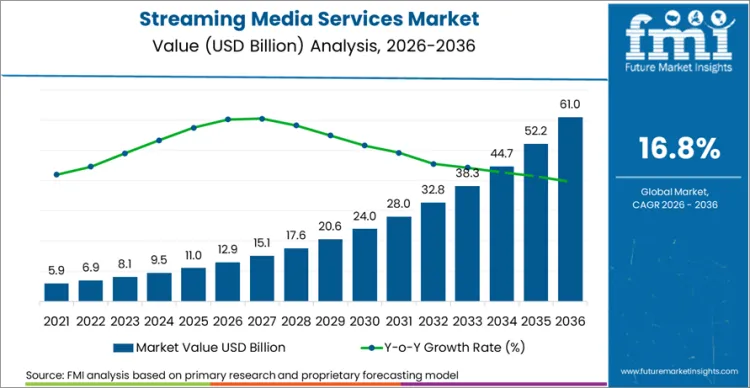
The global streaming media services sector is on track to achieve a valuation of USD 61.1 billion by 2036, accelerating from USD 12.9 billion in 2026 at a CAGR of 16.8%. As per Future Market Insights, expansion is structurally underpinned by the rapid adoption of ad-supported streaming tiers and the consolidation of content portfolios through mega-mergers. The International Telecommunication Union (ITU) reported in 2024 that global internet users surpassed 5.5 billion, providing the connectivity infrastructure necessary for streaming to reach previously unserved markets. This expanding addressable audience compels platforms to localize content libraries and pricing structures for emerging regions. Simultaneously, the industry is shifting from a subscriber-count growth model to a revenue-per-user optimization model, which forces platforms to invest in advertising technology, content bundling, and hybrid monetization frameworks.
The most significant structural event in the sector was the August 2025 completion of the Skydance Media and Paramount Global merger, an USD 8 billion deal that formed Paramount, a Skydance Corporation. The combined entity announced a shift to a unified technology stack for Paramount+ and Pluto TV to improve efficiency and reduce technical overhead. In May 2025, Netflix announced the full rollout of its proprietary in-house advertising technology platform, moving away from its initial reliance on third-party systems. Andy Jassy, CEO of Amazon, noted that Amazon's streaming platform maintained an average ad-supported audience of 315 million viewers globally, up from 200 million disclosed in April 2024. FMI is of the opinion that the buildout of first-party advertising technology is the defining competitive differentiator for the next phase of streaming economics, as it allows platforms to capture a larger share of advertiser budgets without intermediary fees.
The operational reality for streaming media suppliers is defined by the need to balance content investment with path-to-profitability timelines in an increasingly crowded market. Maxime Saada, CEO of Canal+, stated: 'It's clear that Showmax has not been commercially successful. We made significant investments in marketing, content, and technology.' As per FMI, this candid assessment of Showmax's performance in the African streaming market illustrates the risks of geographic expansion without sufficient local content density and distribution partnerships. The contrast between Netflix's advertising technology self-sufficiency and the challenges faced by smaller regional platforms highlights a growing bifurcation in the industry between scale players who can monetize through multiple revenue streams and niche operators who remain dependent on subscription revenue alone.
Summary of Streaming Media Services Market
What Is Growth Outlook for Streaming Media Services Market as per Future Market Insights Projection?
Future Market Insights projects the streaming media services market to expand at a CAGR of 16.8% from 2026 to 2036, increasing from USD 12.9 Billion in 2026 to USD 61.1 Billion by 2036.
FMI Research Approach: FMI proprietary forecasting model based on global internet penetration, ad-supported tier adoption rates, and ARPU trends.
How Do FMI Analysts Perceive Streaming Media Services Market to Evolve?
FMI analysts perceive the market evolving toward a consolidated landscape dominated by 4-5 global platforms with proprietary ad-tech stacks, while regional players face viability pressures without sufficient content density.
FMI Research Approach: Skydance-Paramount merger (August 2025) and Netflix ad-tech platform rollout (May 2025).
Which Country Holds Largest Share in Global Streaming Media Services Market?
The United States holds a significant share of the global streaming media services market by value, which is supported by the highest streaming household penetration, mature digital advertising infrastructure, and the headquarters of all major global platforms.
FMI Research Approach: FMI country-level revenue modeling by streaming household penetration and digital ad spend allocation.
How Large Will Streaming Media Services Market Be by 2036?
The global streaming media services market is projected to reach USD 61.1 Billion by 2036.
FMI Research Approach: FMI long-term revenue forecast derived from ITU internet user projections and ARPU growth modeling.
What Is Definition of Streaming Media Services Market?
The streaming media services market includes revenue from subscription video-on-demand (SVOD), ad-supported video-on-demand (AVOD), and transactional video-on-demand (TVOD) platforms delivering entertainment content over the internet to connected devices.
FMI Research Approach: FMI market taxonomy and inclusion-exclusion framework.
What Are Globally Unique Trends Shaping Streaming Media Services Market?
Globally unique trends include the mega-consolidation of content libraries through billion-dollar mergers, the buildout of proprietary first-party advertising technology platforms, and the shift from subscriber-count growth to revenue-per-user optimization.
FMI Research Approach: Skydance-Paramount USD 8 billion merger (August 2025) and Netflix in-house ad-tech rollout (May 2025).
Streaming Media Services Market Key Takeaways
| Metric | Details |
|---|---|
| Industry Size (2026) | USD 12.9 Billion |
| Industry Value (2036) | USD 61.1 Billion |
| CAGR (2026 to 2036) | 16.8% |
Source: Future Market Insights (FMI) analysis, based on proprietary forecasting model and primary research
Semi-Annual Market Update
The below table presents the expected CAGR for the global streaming media services market over several semi-annual periods spanning from 2026 to 2036. This assessment outlines changes in the memory interconnect industry and identify revenue trends, offering key decision makers an understanding about market performance throughout the year. H1 represents first half of the year from January to June, H2 spans from July to December, which is the second half.
In the first half (H1) of the year from 2025 to 2035, the business is predicted to surge at a CAGR of 4.8%, followed by a higher growth rate of 5.3% in the second half (H2) of the same decade.
| Particular | Value CAGR |
|---|---|
| H1 | 4.8% (2025 to 2035) |
| H2 | 5.3% (2025 to 2035) |
| H1 | 5.1% (2026 to 2036) |
| H2 | 5.7% (2026 to 2036) |
Moving into the subsequent period, from H1 2026 to H2 2026, the CAGR is projected to increase slightly to 5.1% in the first half and remain higher at 5.7% in the second half. In the first half (H1) the market witnessed an increase of 30 BPS and in the second half (H2), the market witnessed an increase of 40 BPS.
Category-wise Insights
The section provides detailed insights into key segments of the streaming media services market. This section analyzes the growth and market share in the market among key segments.
Mobile Apps Segment to Grow at Rapid Rate
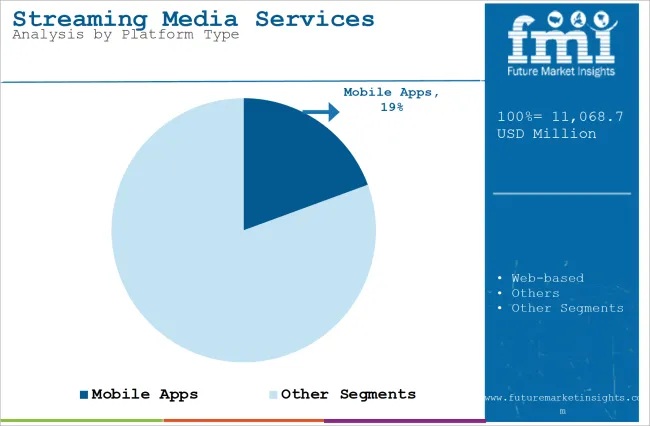
The adoption of smartphones has been on the rise globally, as an increasing number of users are shifting toward using their mobile devices to consume media. This fact has directly contributed to the rise in the consumption of mobile apps for streaming services. Besides, the continuous deployment of 5G networks has enhanced mobile streaming experiences-faster and quality-assured video streaming, thus becoming ever so appealing to the user.
This is further accelerating growth in the segment of mobile apps, as the streaming services have started adopting more mobile-first strategies, particularly within large developing markets like India and Southeast Asia dominated by mobile internet.
| Segment | Mobile Apps (Platform Type) |
|---|---|
| CAGR (2026 to 2036) | 54.0% |
Video Streaming Leads the Streaming Media Services Market in terms of Share
Large-scale investments by major players are facilitating market growth. For instance, Disney acquired 75% of the interest in BAMTech for USD 1.58 billion, helping it to launch its online streaming services like Disney+. The combination of Disney's Hulu + Live TV and FuboTV created North America's second-biggest online pay-TV operator, which could generate USD 6 billion in revenue and boast 6.2 million subscribers.
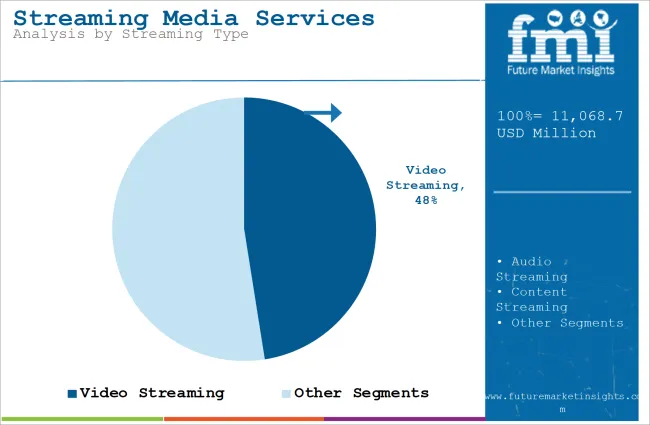
These rich investments have enabled large content libraries and advanced streaming technologies, which has further attracted a big subscriber base. The increasing demand by consumers for on-demand video content and its access over a multitude of devices is driving the dominance of video streaming service in the market.
| Segment | Video Streaming (Streaming Type) |
|---|---|
| Value Share (2026) | 47.5% |
Key Industry Highlights
Increased Internet Penetration and Bandwidth Improvements
High-speed internet expansion has proved responsible for profound penetration of the internet, especially in the poorer countries and this way more people joined streaming sites, thereby allowing them to access on-demand content.
While in some countries where the internet infrastructure is quite an issue, 4G and 5G upgrades are available in addition to fiber-optic cables and other available technological upgrading methods, it therefore assists to boost the bandwidth for inexplicable watching of high-quality video and audio content. And further, with those developments, it is possible to watch streaming content in higher resolution formats such as 4K and HDR, hence improving the experience and hence increasing subs in premium content.
Additionally, increased accessibility to relatively affordable smartphones and other devices with high-speed internet contributes to the growth of streaming services. More viewers, especially younger audiences, forego traditional TV broadcasting in favor of streaming on-the-go with their mobile devices, further driving the market. For as long as the internet continues to grow globally, so too will be the case with the streaming media market, since a greater audience will have access to reliable high-speed internet.
Shift from Traditional Media to On-Demand Streaming
Consumer behavior is rapidly chainging toward Internet-based streaming. People like this new mode as it doesn't bind them to showing up on broadcast schedules. Instead, it lets them watch whenever they feel like doing so and from any particular location. Furthermore, there are features that just make it so nice: personal-content recommendation, multi-device offerings, abilities of pause and recovery of viewing across devices.
The leadership is seen at the front end drawn to "non-linear TV" usage by millennial and Gen Z targets, who tend to be demanding when it comes to on-demand streaming. It has been noted that the growth in cord-cutting has been consistent with the trend mentioned above. Cord-cutting means abandoning a paid TV subscription in favor of alternatives like YouTube or other streaming services.
Thus, a majority of the traditional media industries have spent a lot of money on OTT platforms for hosting more content and temporarily taken success ratings as an indicator of a disappearing headcount. The old way of broadcasting was going away as a tremendous rise in on-demand services such as Netflix and Hulu, Disney, and Amazon Prime Video was becoming more popular, leading to a tremendous increase in streaming media.
Rising Content Costs and Licensing Issues May Serve as Market Barrier
The growing costs of content creation and licensing are a big concern for streaming platforms, which continue to invest heavily in original content and exclusive licenses. High demand for quality content and the competition among the big players drive up prices. Major franchises, such as sports or blockbuster films, can only be acquired with substantial financial investments.
Furthermore, the licensing agreements for third-party content are generally short-term and must be renegotiated constantly. This may lead to situations whereby popular shows or films are taken off the platform, frustrating subscribers and leading to probable churn. The cost of original content production is also increasing due to factors like inflation, labor costs, and specialized talent and technology.
The more minor streaming services will find it increasingly unaffordable to buy exclusive rights to the most in-demand content, meaning their range of content could be limited, weakening their competitive position.
For the larger platforms, the challenge is how to balance the cost of creating and acquiring content with the need for subscription-based revenue, which can be hard when competition is driving up prices. This dynamic creates financial pressure across the entire industry and may impact the long-term sustainability of some streaming services.
2021 to 2025 Global Streaming Media Services Sales Outlook Compared to Demand Forecasts from 2026 to 2036
The industry showcased a CAGR of 16.0% during the period between 2021 and 2025. The industry reached a value of USD 9,537.5 million in 2025 from USD 5,263.6 million in 2021.
From 2021 to 2025, the streaming media services market went through a rapid growth due to the high demand for on-demand content during the COVID-19 pandemic. Owing to the lockdown and restrictions all over the world, people shifted from traditional cable TV to streaming platforms for entertainment, educational content, and more.
On the other hand, the market is estimated to grow at a CAGR of 16.8% during the forecasted period between 2026 and 2036. The market is expected to grow swiftly as it has a potential to reach a value of USD 61.1 Billion in 2036 from USD 12.9 Billion in 2026.
Looking ahead to the period from 2025 to 2035, the streaming media services market will be further developed and is expected to take a leading position in a number of key trends. Among the biggest drivers, further growth in high-speed internet access, including 5G network expansion, is creating more seamless streaming opportunities for ultra-high-definition content such as 4K and 8K video.
It can be said that consumers are increasingly looking forward to experiences immersed in content interactivity, Virtual and Augmented Reality, thus pressuring streamers into continued innovation beyond mere video and audio.
Market Concentration
Tier-1 companies in the streaming media services market have gained huge, leading positions based on their wide library, huge global presence, and highly lucrative balance sheet resources. These players have an already well-established subscriber base and strong brand presence.
It includes Netflix, Amazon Prime Video, Disney+, and YouTube with the financial muscle to invest intensively in building up a vast content library-licensed or created; in-house productions and strategic licensing of properties. These vendors capture around 35%-40% share in the market.
Tier-2 companies often target specific regional markets or niche segments and offer competitive content at attractive pricing to attract subscribers. Examples of such Tier-2 players include Hulu, Peacock, and Discovery+, coupled with regional players like Hotstar in India or Paramount+ from ViacomCBS. As such, Tier 2 would constitute about 15%-20% concerning the capture of market size.
Tier-3 companies usually operate in very niche markets or often smaller-sized geographic markets with focused content offering against a consumer's needs. Smaller or specialist services like Shudder-mely focused on horror titles, Criterion Channel/classic film, and smaller services include Sling TV, which focuses on streaming Live TV. Regional players and their regional services who have less than international reach make up Tier 3. About 25% - 30% would be the share of Tier 3 vendors in the total market size.
Country-wise Insights
The section highlights the CAGRs of countries experiencing growth in the streaming media services market, along with the latest advancements contributing to overall market development. Based on current estimates USA, India and China are expected to see steady growth during the forecast period.
| Countries | CAGR from 2026 to 2036 |
|---|---|
| India | 20.9% |
| China | 18.8% |
| Germany | 16.4% |
| KSA | 15.3% |
| United States | 15.8% |
Rapid Growth in India in the Streaming Media Services Market Fueled by Increasing Internet Penetration
Growth in the streaming media services market of India is based on increasing smartphone usage, growing internet penetration, and consumer preference for digital content. In 2024, there will be over 600 million internet users in India, adding directly to the growth of the OTT platforms. The leading players, Disney+ Hotstar, Amazon Prime Video, and Netflix, have been investing aggressively in the country.
If reports are to be believed, Disney+ Hotstar alone has invested over USD 1 billion in original Indian content. Meanwhile, homegrown services such as Zee5 and JioCinema are leveraging regional content to drive consumption. Central to this market's growth is the launch of affordable data plans and proliferation of 4G/5G connectivity.
Streaming Media Services Market Grows in USA with Significant Investments
USA continues to lead in the market with a tech-savvy consumer base, high disposable income, and substantial preference for on-demand content. A few players in the market, like Netflix, Amazon Prime Video, and Hulu, have been able to capture this market due to huge investments in both technology and original content.
In fact, Netflix alone committed USD 17 billion for content creation in 2020, which has further consolidated its position in the USA market. With a massive investment in place, the active subscriber base is likely to reach 130 million by 2025, with exclusive content drawn from Disney, Pixar, Marvel, and Star Wars franchises. High investments are further supported by high access to advanced broadband infrastructure and high-speed internet in the country.
Expanding OTT Landscape in China Driven by Strong Local Demand and Investment in Content
The rapid growth of streaming media services in china demand due to a greater inclination towards online video content has promoted the rapid rise of local OTT platforms. In 2020, iQIYI alone invested over USD 1.5 billion in content creation. Government policies that support the move toward digital transformation and the consumption of entertainment further encourage growth.
With over 900 million Internet users and fast-developing 5G networks, the streaming platforms are expanding their contents from films and TV series to live-streaming and game services. Investments in content and technology ensure continued market growth.
Competition Outlook
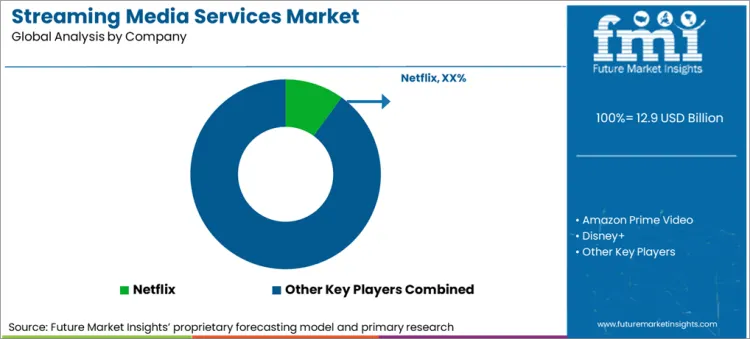
Competition within the streaming media services market is fierce, with players coming up with innovations in all ways to acquire a share in the market. Competition will revolve around content acquisition, as platforms are investing heavily in original programming and buying exclusive rights for subscribers. Besides, pricing models have an important role in that services are offering different subscription tiers for a range of consumer preferences.
Moreover, the development of technologies like the adoption of 4K, 5G, and AI-driven content recommendations are improving user experience. Though big players rule the global market, regional services are also gaining momentum owing to more localized content and flexible pricing, thereby increasing competition.
Recent Developments
- In August 2025, Skydance Media and Paramount Global completed their USD 8 billion merger, forming Paramount, a Skydance Corporation, and announced a unified technology stack for Paramount+ and Pluto TV.
- In May 2025, Netflix announced the full rollout of its proprietary in-house advertising technology platform, replacing its initial reliance on third-party ad-tech systems.
- Canal+ assessed the commercial performance of Showmax in the African streaming market, acknowledging that significant investments in marketing, content, and technology had not achieved the expected returns.
Key players in the Streaming Media Services Industry
- Netflix
- Amazon Prime Video
- Disney+
- Youtube
- Apple TV+
- Peacock
- Hulu
- Tencent Video
- Claro Video
- Movistar Play
Market Definition
The streaming media services market represents revenue generated from platforms that deliver video entertainment content over the internet on a subscription, advertising-supported, or transactional basis. The market measures the value of SVOD, AVOD, and TVOD services provided by dedicated streaming platforms to consumers via connected TVs, mobile devices, and web browsers.
Inclusions cover subscription video-on-demand (SVOD) services, advertising-supported video-on-demand (AVOD) services, free ad-supported streaming television (FAST) channels, and transactional video-on-demand (TVOD) platforms. It includes platform licensing fees, advertising revenue generated on streaming platforms, and content delivery network costs allocated to streaming operations.
Exclusions include traditional linear broadcast television, pay-TV cable and satellite subscription revenue, live sports broadcasting rights not delivered via streaming platforms, and user-generated content platforms such as YouTube creator revenue. Standalone music streaming services are outside the scope.
Scope of Report
| Items | Values |
|---|---|
| Quantitative Units (2026) | USD 12.9 Billion |
| Product Type | SVOD, AVOD, FAST Channels, TVOD |
| Revenue Model | Subscription, Advertising, Hybrid, Transactional |
| End User | Residential Consumers, Hospitality, Institutional |
| Regions Covered | North America, Europe, Asia Pacific, Latin America, Middle East and Africa |
| Key Companies Profiled | Netflix, Amazon Prime Video, Disney+, Paramount/Skydance, Warner Bros Discovery, Apple TV+ |
Streaming Media Services Market Segmentation
By Streaming Type:
In terms of streaming type, the segment is divided into Video Streaming, Audio Streaming, Content Streaming and Live Streaming.
By Platform Type:
In terms of platform type, the segment is segregated into Web-based, Mobile Apps and Others.
By End User:
In terms of end user, the segment is segregated into Individuals and Enterprises.
By Region:
A regional analysis has been carried out in key countries of North America, Latin America, East Asia, South Asia & Pacific, Western Europe, Eastern Europe and Middle East and Africa (MEA).
Bibliography
- Paramount Global. (2025, August). Skydance-Paramount merger completion. Paramount Press Releases.
- Netflix, Inc. (2025, May). In-house advertising technology platform rollout. Netflix Investor Relations.
- International Telecommunication Union. (2024). Global internet user statistics. ITU.
- Canal+ Group. (2025). Showmax performance assessment. Canal+ Investor Relations.
Frequently Asked Questions
What is the current global market size for Streaming Media Services?
The global market is valued at USD 12.9 Billion in 2026, driven by the rapid adoption of ad-supported tiers and content portfolio consolidation through mega-mergers.
What is the projected CAGR for the market over the next 10 years?
The market is projected to grow at a CAGR of 16.8% from 2026 to 2036.
Which regions are experiencing the fastest expansion?
Asia Pacific leads due to rapidly growing internet penetration and affordable mobile streaming tiers, followed by North America driven by ad-supported revenue optimization.
What are the primary market drivers?
The buildout of first-party advertising technology platforms and mega-mergers consolidating content libraries are the primary growth catalysts.
Who are the leading suppliers in the industry?
Netflix, Amazon Prime Video, Disney+, and Paramount/Skydance are key players, differentiating through proprietary ad-tech stacks, content library scale, and hybrid monetization models.
Preview the report firsthand - request a free sample
Get SampleGet the brochure for pricing and purchase details.
Get PDFTable of Content
- Executive Summary
- Global Market Outlook
- Demand-side Trends
- Supply-side Trends
- Technology Roadmap Analysis
- Analysis and Recommendations
- Market Overview
- Market Coverage / Taxonomy
- Market Definition / Scope / Limitations
- Research Methodology
- Chapter Orientation
- Analytical Lens and Working Hypotheses
- Market Structure, Signals, and Trend Drivers
- Benchmarking and Cross-market Comparability
- Market Sizing, Forecasting, and Opportunity Mapping
- Research Design and Evidence Framework
- Desk Research Programme (Secondary Evidence)
- Company Annual and Sustainability Reports
- Peer-reviewed Journals and Academic Literature
- Corporate Websites, Product Literature, and Technical Notes
- Earnings Decks and Investor Briefings
- Statutory Filings and Regulatory Disclosures
- Technical White Papers and Standards Notes
- Trade Journals, Industry Magazines, and Analyst Briefs
- Conference Proceedings, Webinars, and Seminar Materials
- Government Statistics Portals and Public Data Releases
- Press Releases and Reputable Media Coverage
- Specialist Newsletters and Curated Briefings
- Sector Databases and Reference Repositories
- FMI Internal Proprietary Databases and Historical Market Datasets
- Subscription Datasets and Paid Sources
- Social Channels, Communities, and Digital Listening Inputs
- Additional Desk Sources
- Expert Input and Fieldwork (Primary Evidence)
- Primary Modes
- Qualitative Interviews and Expert Elicitation
- Quantitative Surveys and Structured Data Capture
- Blended Approach
- Why Primary Evidence is Used
- Field Techniques
- Interviews
- Surveys
- Focus Groups
- Observational and In-context Research
- Social and Community Interactions
- Stakeholder Universe Engaged
- C-suite Leaders
- Board Members
- Presidents and Vice Presidents
- R&D and Innovation Heads
- Technical Specialists
- Domain Subject-matter Experts
- Scientists
- Physicians and Other Healthcare Professionals
- Governance, Ethics, and Data Stewardship
- Research Ethics
- Data Integrity and Handling
- Primary Modes
- Tooling, Models, and Reference Databases
- Desk Research Programme (Secondary Evidence)
- Data Engineering and Model Build
- Data Acquisition and Ingestion
- Cleaning, Normalisation, and Verification
- Synthesis, Triangulation, and Analysis
- Quality Assurance and Audit Trail
- Market Background
- Market Dynamics
- Drivers
- Restraints
- Opportunity
- Trends
- Scenario Forecast
- Demand in Optimistic Scenario
- Demand in Likely Scenario
- Demand in Conservative Scenario
- Opportunity Map Analysis
- Product Life Cycle Analysis
- Supply Chain Analysis
- Investment Feasibility Matrix
- Value Chain Analysis
- PESTLE and Porter’s Analysis
- Regulatory Landscape
- Regional Parent Market Outlook
- Production and Consumption Statistics
- Import and Export Statistics
- Market Dynamics
- Global Market Analysis 2021 to 2025 and Forecast, 2026 to 2036
- Historical Market Size Value (USD Million) Analysis, 2021 to 2025
- Current and Future Market Size Value (USD Million) Projections, 2026 to 2036
- Y-o-Y Growth Trend Analysis
- Absolute $ Opportunity Analysis
- Global Market Pricing Analysis 2021 to 2025 and Forecast 2026 to 2036
- Global Market Analysis 2021 to 2025 and Forecast 2026 to 2036, By Platform Type
- Introduction / Key Findings
- Historical Market Size Value (USD Million) Analysis By Platform Type , 2021 to 2025
- Current and Future Market Size Value (USD Million) Analysis and Forecast By Platform Type , 2026 to 2036
- Mobile Apps
- Web-based
- Mobile Apps
- Y-o-Y Growth Trend Analysis By Platform Type , 2021 to 2025
- Absolute $ Opportunity Analysis By Platform Type , 2026 to 2036
- Global Market Analysis 2021 to 2025 and Forecast 2026 to 2036, By Streaming Type
- Introduction / Key Findings
- Historical Market Size Value (USD Million) Analysis By Streaming Type, 2021 to 2025
- Current and Future Market Size Value (USD Million) Analysis and Forecast By Streaming Type, 2026 to 2036
- Video Streaming
- Audio Streaming
- Content Streaming
- Video Streaming
- Y-o-Y Growth Trend Analysis By Streaming Type, 2021 to 2025
- Absolute $ Opportunity Analysis By Streaming Type, 2026 to 2036
- Global Market Analysis 2021 to 2025 and Forecast 2026 to 2036, By Region
- Introduction
- Historical Market Size Value (USD Million) Analysis By Region, 2021 to 2025
- Current Market Size Value (USD Million) Analysis and Forecast By Region, 2026 to 2036
- North America
- Latin America
- Western Europe
- Eastern Europe
- East Asia
- South Asia and Pacific
- Middle East & Africa
- Market Attractiveness Analysis By Region
- North America Market Analysis 2021 to 2025 and Forecast 2026 to 2036, By Country
- Historical Market Size Value (USD Million) Trend Analysis By Market Taxonomy, 2021 to 2025
- Market Size Value (USD Million) Forecast By Market Taxonomy, 2026 to 2036
- By Country
- USA
- Canada
- Mexico
- By Platform Type
- By Streaming Type
- By Country
- Market Attractiveness Analysis
- By Country
- By Platform Type
- By Streaming Type
- Key Takeaways
- Latin America Market Analysis 2021 to 2025 and Forecast 2026 to 2036, By Country
- Historical Market Size Value (USD Million) Trend Analysis By Market Taxonomy, 2021 to 2025
- Market Size Value (USD Million) Forecast By Market Taxonomy, 2026 to 2036
- By Country
- Brazil
- Chile
- Rest of Latin America
- By Platform Type
- By Streaming Type
- By Country
- Market Attractiveness Analysis
- By Country
- By Platform Type
- By Streaming Type
- Key Takeaways
- Western Europe Market Analysis 2021 to 2025 and Forecast 2026 to 2036, By Country
- Historical Market Size Value (USD Million) Trend Analysis By Market Taxonomy, 2021 to 2025
- Market Size Value (USD Million) Forecast By Market Taxonomy, 2026 to 2036
- By Country
- Germany
- UK
- Italy
- Spain
- France
- Nordic
- BENELUX
- Rest of Western Europe
- By Platform Type
- By Streaming Type
- By Country
- Market Attractiveness Analysis
- By Country
- By Platform Type
- By Streaming Type
- Key Takeaways
- Eastern Europe Market Analysis 2021 to 2025 and Forecast 2026 to 2036, By Country
- Historical Market Size Value (USD Million) Trend Analysis By Market Taxonomy, 2021 to 2025
- Market Size Value (USD Million) Forecast By Market Taxonomy, 2026 to 2036
- By Country
- Russia
- Poland
- Hungary
- Balkan & Baltic
- Rest of Eastern Europe
- By Platform Type
- By Streaming Type
- By Country
- Market Attractiveness Analysis
- By Country
- By Platform Type
- By Streaming Type
- Key Takeaways
- East Asia Market Analysis 2021 to 2025 and Forecast 2026 to 2036, By Country
- Historical Market Size Value (USD Million) Trend Analysis By Market Taxonomy, 2021 to 2025
- Market Size Value (USD Million) Forecast By Market Taxonomy, 2026 to 2036
- By Country
- China
- Japan
- South Korea
- By Platform Type
- By Streaming Type
- By Country
- Market Attractiveness Analysis
- By Country
- By Platform Type
- By Streaming Type
- Key Takeaways
- South Asia and Pacific Market Analysis 2021 to 2025 and Forecast 2026 to 2036, By Country
- Historical Market Size Value (USD Million) Trend Analysis By Market Taxonomy, 2021 to 2025
- Market Size Value (USD Million) Forecast By Market Taxonomy, 2026 to 2036
- By Country
- India
- ASEAN
- Australia & New Zealand
- Rest of South Asia and Pacific
- By Platform Type
- By Streaming Type
- By Country
- Market Attractiveness Analysis
- By Country
- By Platform Type
- By Streaming Type
- Key Takeaways
- Middle East & Africa Market Analysis 2021 to 2025 and Forecast 2026 to 2036, By Country
- Historical Market Size Value (USD Million) Trend Analysis By Market Taxonomy, 2021 to 2025
- Market Size Value (USD Million) Forecast By Market Taxonomy, 2026 to 2036
- By Country
- Kingdom of Saudi Arabia
- Other GCC Countries
- Turkiye
- South Africa
- Other African Union
- Rest of Middle East & Africa
- By Platform Type
- By Streaming Type
- By Country
- Market Attractiveness Analysis
- By Country
- By Platform Type
- By Streaming Type
- Key Takeaways
- Key Countries Market Analysis
- USA
- Pricing Analysis
- Market Share Analysis, 2025
- By Platform Type
- By Streaming Type
- Canada
- Pricing Analysis
- Market Share Analysis, 2025
- By Platform Type
- By Streaming Type
- Mexico
- Pricing Analysis
- Market Share Analysis, 2025
- By Platform Type
- By Streaming Type
- Brazil
- Pricing Analysis
- Market Share Analysis, 2025
- By Platform Type
- By Streaming Type
- Chile
- Pricing Analysis
- Market Share Analysis, 2025
- By Platform Type
- By Streaming Type
- Germany
- Pricing Analysis
- Market Share Analysis, 2025
- By Platform Type
- By Streaming Type
- UK
- Pricing Analysis
- Market Share Analysis, 2025
- By Platform Type
- By Streaming Type
- Italy
- Pricing Analysis
- Market Share Analysis, 2025
- By Platform Type
- By Streaming Type
- Spain
- Pricing Analysis
- Market Share Analysis, 2025
- By Platform Type
- By Streaming Type
- France
- Pricing Analysis
- Market Share Analysis, 2025
- By Platform Type
- By Streaming Type
- India
- Pricing Analysis
- Market Share Analysis, 2025
- By Platform Type
- By Streaming Type
- ASEAN
- Pricing Analysis
- Market Share Analysis, 2025
- By Platform Type
- By Streaming Type
- Australia & New Zealand
- Pricing Analysis
- Market Share Analysis, 2025
- By Platform Type
- By Streaming Type
- China
- Pricing Analysis
- Market Share Analysis, 2025
- By Platform Type
- By Streaming Type
- Japan
- Pricing Analysis
- Market Share Analysis, 2025
- By Platform Type
- By Streaming Type
- South Korea
- Pricing Analysis
- Market Share Analysis, 2025
- By Platform Type
- By Streaming Type
- Russia
- Pricing Analysis
- Market Share Analysis, 2025
- By Platform Type
- By Streaming Type
- Poland
- Pricing Analysis
- Market Share Analysis, 2025
- By Platform Type
- By Streaming Type
- Hungary
- Pricing Analysis
- Market Share Analysis, 2025
- By Platform Type
- By Streaming Type
- Kingdom of Saudi Arabia
- Pricing Analysis
- Market Share Analysis, 2025
- By Platform Type
- By Streaming Type
- Turkiye
- Pricing Analysis
- Market Share Analysis, 2025
- By Platform Type
- By Streaming Type
- South Africa
- Pricing Analysis
- Market Share Analysis, 2025
- By Platform Type
- By Streaming Type
- USA
- Market Structure Analysis
- Competition Dashboard
- Competition Benchmarking
- Market Share Analysis of Top Players
- By Regional
- By Platform Type
- By Streaming Type
- Competition Analysis
- Competition Deep Dive
- Netflix
- Overview
- Product Portfolio
- Profitability by Market Segments (Product/Age /Sales Channel/Region)
- Sales Footprint
- Strategy Overview
- Marketing Strategy
- Product Strategy
- Channel Strategy
- Amazon Prime Video
- Disney+
- Youtube
- Apple TV+
- Peacock
- Netflix
- Competition Deep Dive
- Assumptions & Acronyms Used


