

- Industry Size (2026)
- USD 185.1 Bn
- Forecast (2036)
- USD 185.1 Bn
- CAGR (2026 to 2036)
- 15.7%
India Digital Commerce Market Size and Share Forecast Outlook 2026 to 2036
The India digital commerce sector is on track to achieve a valuation of USD 740.5 billion by 2036, accelerating from USD 185.1 billion in 2026 at a CAGR of 15.7%. As per Future Market Insights, expansion is structurally underpinned by India's unique combination of massive smartphone penetration growth, UPI-based digital payment infrastructure, government-backed digitization programs, and the rapid expansion of quick commerce delivery models that are compressing delivery windows from days to minutes. The National Payments Corporation of India (NPCI) reported that UPI processed 16.6 billion transactions worth INR 23.5 lakh crore in December 2024 alone, confirming the payment infrastructure's ability to support the velocity of digital commerce at national scale. This transactional density compels e-commerce platforms to invest in last-mile logistics, warehouse automation, and merchant digitization to convert India's 60 million+ retail outlets into digital commerce participants. Simultaneously, regulatory developments including the Open Network for Digital Commerce (ONDC) are creating an interoperable protocol layer that challenges the platform lock-in model of incumbent marketplaces.
Kalyan Krishnamurthy, CEO of Flipkart, stated: 'Flipkart is experiencing a 20 per cent to 25 per cent year-on-year growth in orders across its businesses in the current month.' This confirms that India's largest domestic e-commerce platform continues to achieve growth rates that substantially exceed global e-commerce averages, validating India's position as the world's fastest-growing major digital commerce market. FMI is of the opinion that the India digital commerce market will be defined by a three-way competitive dynamic between Amazon (global technology and logistics), Flipkart-Walmart (domestic market knowledge and tier-2/3 reach), and Reliance-JioMart (physical retail network plus digital overlay), with ONDC acting as a potential structural disruptor.
The competitive landscape in 2025 and 2026 has been defined by massive capital commitments and format innovation. Amazon announced an additional USD 35 billion investment in India through 2030 at the 2025 Smbhav Summit, targeting AI-driven digitization, export growth, and 15 million small business onboarding. Reliance Retail entered quick commerce in October 2024 via JioMart, leveraging its 18,000+ store network for 10 to 15 minute deliveries across 1,150 cities. Tata Digital launched Tata Neu's unified commerce strategy in August 2025, integrating Bigbasket, 1mg, and Croma into a single super-app ecosystem. Meesho expanded its zero-commission marketplace model across tier-3 and tier-4 cities through 2025, reaching over 160 million annual transacting users. As per FMI, this combination of multi-billion-dollar platform investments, quick commerce infrastructure buildout, and tier-2/3 penetration confirms that India's digital commerce market is entering a phase of infrastructure-led growth where logistics capability and merchant network density will determine market share.
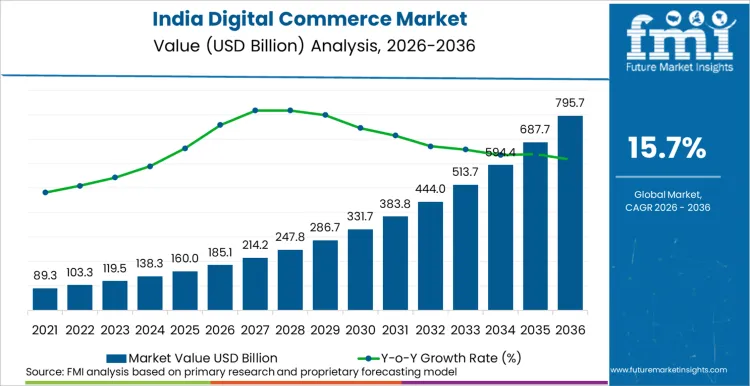
Key Takeaways
The India digital commerce market is controlled by a concentrated platform oligopoly where Amazon India, Flipkart (Walmart), JioMart (Reliance), and Tata Neu collectively account for the majority of organized digital commerce GMV. FMI analysts observe that Reliance's entry into quick commerce leveraging 18,000+ physical stores creates a hybrid model that neither pure-play e-commerce (Amazon, Flipkart) nor pure-play quick commerce (Blinkit, Zepto) can replicate.
Pricing asymmetry in India's digital commerce market exists between platform-mediated transactions (where platforms extract 15 to 30% commission) and ONDC-mediated transactions (where commission structures are negotiated per transaction). As per FMI, ONDC's open protocol threatens the margin structure of incumbent platforms, but adoption remains limited by merchant awareness and buyer habit inertia.
Sourcing fragility is concentrated in last-mile logistics infrastructure. India's fragmented urban geography, inconsistent address systems, and varying road quality create delivery cost structures that are 3 to 5 times higher per package in tier-3/4 cities compared to metro areas. Amazon's USD 35 billion investment specifically targets logistics and AI infrastructure to address this constraint. FMI opines that platforms that achieve cost-efficient tier-2/3/4 delivery will unlock the majority of India's untapped digital commerce demand.
Brand and compliance risks center on data localization mandates, FDI restrictions on marketplace models (preventing inventory ownership by foreign platforms), and the tightening of Consumer Protection (E-Commerce) Rules. Flipkart and Amazon must navigate complex FDI compliance structures, while Reliance and Tata benefit from domestic ownership status. FMI is of the opinion that regulatory asymmetry between foreign and domestic platforms will continue to shape competitive dynamics.
Geographic leverage within India is shifting from metro-centric to pan-India distribution. Meesho's 160 million users across tier-3/4 cities demonstrate the scale of non-metro demand, while Reliance's 1,150-city quick commerce network addresses the logistics gap. FMI analysts note that southern and western India (Karnataka, Maharashtra, Tamil Nadu) lead in e-commerce penetration, while northern India is growing fastest in quick commerce adoption.
The executive reframing for India's digital commerce market is that the competitive battleground has shifted from customer acquisition to logistics infrastructure and merchant digitization at national scale. FMI analysts emphasize that platform executives must invest in warehousing, last-mile delivery, and AI-driven demand forecasting as the primary competitive levers, as customer acquisition costs converge across platforms while logistics efficiency determines profitability.
Summary of India Digital Commerce Market
What Is Growth Outlook for India Digital Commerce Market as per Future Market Insights Projection?
Future Market Insights projects the India digital commerce market to expand at a CAGR of 15.7% from 2026 to 2036, increasing from USD 185.1 Billion in 2026 to USD 740.5 Billion by 2036.
FMI Research Approach: FMI proprietary forecasting model based on UPI transaction volume growth, smartphone penetration, and e-commerce GMV tracking.
How Do FMI Analysts Perceive India Digital Commerce Market to Evolve?
FMI analysts perceive the market evolving toward a quick commerce-dominated, ONDC-disrupted ecosystem where sub-15-minute delivery, AI-driven merchant digitization, and platform interoperability redefine competitive positioning.
FMI Research Approach: NPCI UPI transaction data and ONDC protocol adoption tracking.
Which Country Holds Largest Share in Global India Digital Commerce Market?
India is the sole country in this market scope, with Maharashtra, Karnataka, Delhi-NCR, and Tamil Nadu leading by digital commerce GMV.
FMI Research Approach: FMI state-level revenue modeling by e-commerce penetration and UPI transaction density.
How Large Will India Digital Commerce Market Be by 2036?
The India digital commerce market is projected to reach USD 740.5 Billion by 2036.
FMI Research Approach: FMI long-term revenue forecast derived from internet user growth projections and digital payment adoption curves.
What Is Definition of India Digital Commerce Market?
The India digital commerce market includes revenue from online retail (marketplace and inventory models), quick commerce, social commerce, B2B digital trade, and ONDC-mediated transactions conducted within India.
FMI Research Approach: FMI market taxonomy and inclusion-exclusion framework.
What Are Globally Unique Trends Shaping India Digital Commerce Market?
Globally unique trends include ONDC open protocol disrupting platform lock-in, Reliance Retail's physical-to-digital quick commerce model leveraging 18,000+ stores, and Amazon's USD 35 billion India investment targeting 15 million small business digitization.
FMI Research Approach: Amazon Smbhav Summit 2025 announcements and Reliance Retail quarterly disclosures.
India Digital Commerce Market Key Takeaways
| Metric | Details |
|---|---|
| Industry Size (2026) | USD 185.1 Billion |
| Industry Value (2036) | USD 740.5 Billion |
| CAGR (2026 to 2036) | 15.7% |
Source: Future Market Insights (FMI) analysis, based on proprietary forecasting model and primary research
Key Industry Highlights in India’s E-Retail and Marketplace Landscape
Mobile Commerce Drives Growth
Growth in India's mobile commerce sector witnesses a rampant growth due to increasingly affordable smartphones and ridiculously cheap data plans that make online shopping increasingly accessible.
UPI Revolutionizes Payments
This includes the Unified Payment Interface of India, at over 10 billion transactions this month in 2024. Seamless, secure UPI is confidence for people to shop online, just as they would be in stores.
Tier 2 and Tier 3 Cities Lead Growth
Other ecommerce sites, like Meesho and Snapdeal, are targeting smaller cities in India, which reflect more growth compared to metropolitan cities. Affordable products, interfaces in local languages, and options for cash-on-delivery raise adoptions.
B2B Commerce Expands with ONDC
Open Network for Digital Commerce democratizes e-commerce, thus letting SMEs and local businesses in the digital marketplace. By 2030, India's B2B commerce market is likely to cross about USD 360 billion.
Focus on Sustainability
Indian e-commerce companies are becoming environmentally friendly through lesser packaging, electric vehicles to deliver the goods, and selling green products on their portal.
Category-Wise Insights Across B2C, B2B, and D2C Channels
Retail E-Commerce Leads the Market
The retail e-commerce is one of the dominant forms of digital commerce in India, with major drivers in fashion, electronics, and groceries.
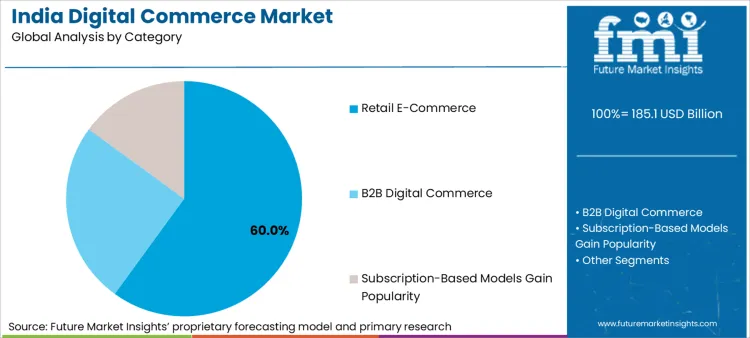
| Segment | Retail E-Commerce |
|---|---|
| Value Share (2026) | 60% |
| Growth Driver | Convenience and competitive pricing |
B2B Digital Commerce Grows with ONDC
The B2B sector in India modernizes supply chains and builds cross-border trade on platforms such as Udaan and an initiative called ONDC.
| Segment | B2B Digital Commerce |
|---|---|
| CAGR (2026 to 2036) | 18% |
| Growth Driver | SME participation and real-time inventory management |
Subscription-Based Models Gain Popularity
India’s subscription economy grows with platforms like Tata Play Binge, Zomato Gold, and Grofers Plus offering recurring benefits.
| Segment | Subscription Services |
|---|---|
| Value Share (2026) | 15.7% |
| Growth Driver | Convenience and recurring savings |
Competition Outlook Among E-Commerce Giants and Retail Tech Innovators
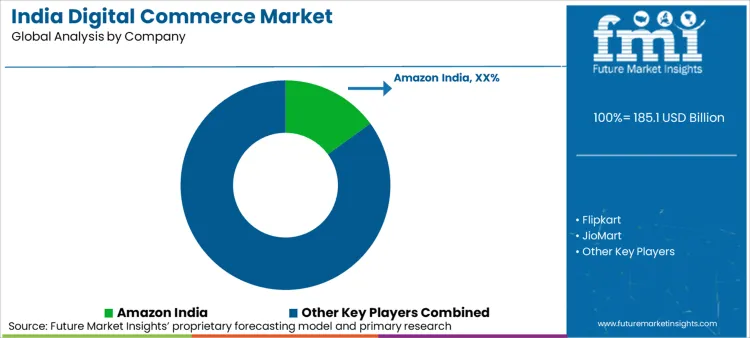
Global giants compete with domestic leaders and regional disruptors for market share in the Indian digital commerce market.
Recent Developments
- At the 2025 Amazon Smbhav Summit, Amazon announced an additional USD 35 billion investment in India through 2030, targeting AI-driven digitization of 15 million small businesses and USD 80 billion in cumulative e-commerce exports.
- In October 2024, Reliance Retail entered the quick commerce sector via JioMart, leveraging its 18,000+ store network for 10 to 15 minute deliveries across 1,150 cities across India.
- In August 2025, Tata Digital launched its unified commerce strategy through Tata Neu, integrating Bigbasket, 1mg, and Croma into a single super-app ecosystem.
Emerging Startups Disrupting India’s Digital Commerce Ecosystem
- Meesho: Targets Tier 2 and Tier 3 cities with affordable goods and a reseller model.
- Udaan: Pioneers B2B e-commerce with a focus on SMEs and wholesalers.
- Zomato: Expands into subscription-based models like Zomato Gold and Zomato Everyday for hyperlocal food delivery.
Regional Specialists Catering to Tier 2 and Tier 3 Consumer Bases
- Meesho: selling low-priced commodities to Tier 2 and Tier 3 cities and utilizing reseller model to sell goods
- Udaan: pioneers B2B e-commerce with SMEs, wholesaler-focused operation
- Zomato: subscription-based businesses like Zomato Gold and Zomato Everyday for hyper-local food delivery
Market Definition
The India digital commerce market represents revenue generated from online buying and selling of goods and services within India, including marketplace transactions, direct-to-consumer e-commerce, quick commerce, social commerce, and ONDC-mediated digital trade. The market measures the gross merchandise value (GMV) of transactions processed through digital commerce platforms.
Inclusions cover horizontal marketplaces (Amazon, Flipkart), quick commerce platforms (Blinkit, Zepto, JioMart), vertical e-commerce (Nykaa, 1mg, Croma), social commerce (Meesho), B2B digital trade platforms, ONDC-mediated transactions, and direct-to-consumer brand websites. Digital payment processing revenue attributable to e-commerce transactions is also included.
Exclusions include offline retail revenue even if digitally influenced, ride-hailing and mobility services, food delivery services (Swiggy, Zomato restaurant delivery), digital entertainment and OTT subscriptions, and pure fintech and lending platform revenue. Physical store POS transactions not processed through digital commerce platforms are outside the scope.
Scope of Report
| Items | Values |
|---|---|
| Quantitative Units (2026) | USD 185.1 Billion |
| Product Type | Horizontal Marketplaces, Quick Commerce, Vertical E-Commerce, Social Commerce, B2B Digital Trade, ONDC-Mediated Transactions |
| Material Type | Marketplace Model, Inventory Model, Quick Commerce (Dark Store), Hybrid Physical-Digital, Social Commerce (Reseller) |
| End-Use / Channel | Amazon India, Flipkart, JioMart, Meesho, Tata Neu, Myntra, Nykaa, ONDC Network |
| Regions Covered | North India, South India, West India, East India, Northeast India |
| Countries Covered | India (Maharashtra, Karnataka, Delhi-NCR, Tamil Nadu, Uttar Pradesh, and 28+ states) |
| Key Companies Profiled | Amazon India, Flipkart (Walmart), JioMart (Reliance), Tata Neu (Tata Digital), Meesho, Nykaa, Blinkit (Zomato), Zepto |
| Additional Attributes | Revenue analysis by platform and product category, UPI transaction correlation, ONDC adoption tracking, quick commerce penetration, tier-2/3/4 city expansion, and logistics cost per delivery analysis |
Top Segments Studied in the India Digital Commerce Market Report
By Product Type:
- Horizontal Marketplaces (Amazon, Flipkart)
- Quick Commerce (Sub-30 Minute Delivery)
- Vertical E-Commerce (Beauty, Health, Electronics)
- Social Commerce (Reseller Model)
- B2B Digital Trade
- ONDC-Mediated Transactions
By Material Type:
- Marketplace Model
- Inventory Model
- Quick Commerce (Dark Store)
- Hybrid Physical-Digital Model
- Social Commerce (Reseller)
By Region:
- North India
- South India
- West India
- East India
- Northeast India
Bibliography
- Amazon.com Inc. (2025, May). Smbhav Summit USD 35 billion India investment announcement. Amazon India.
- Reliance Retail Ventures Ltd. (2024, October). JioMart quick commerce launch announcement. Reliance Industries.
- National Payments Corporation of India. (2025, January). UPI December 2024 transaction statistics. NPCI.
- Tata Digital Ltd. (2025, August). Tata Neu unified commerce strategy launch. Tata Group.
Frequently Asked Questions
What is the current market size for India Digital Commerce?
The market is valued at USD 185.1 Billion in 2026, driven by UPI payment infrastructure, quick commerce expansion, and Amazon's USD 35 billion investment commitment.
What is the projected CAGR for the market over the next 10 years?
The market is projected to grow at a CAGR of 15.7% from 2026 to 2036.
Which states lead digital commerce in India?
Maharashtra, Karnataka, Delhi-NCR, and Tamil Nadu lead by GMV, while tier-3/4 cities in Uttar Pradesh and Bihar are the fastest-growing segments.
What are the primary market drivers?
UPI payment infrastructure, quick commerce sub-15-minute delivery models, and platform-led merchant digitization programs are the primary drivers.
Who are the leading platforms in the industry?
Amazon India, Flipkart, JioMart, and Meesho are key players, differentiating through logistics infrastructure, quick commerce networks, and tier-2/3/4 city penetration.
Preview the report firsthand - request a free sample
Get SampleGet the brochure for pricing and purchase details.
Get PDFTable of Content
- Executive Summary
- Global Market Outlook
- Demand-side Trends
- Supply-side Trends
- Technology Roadmap Analysis
- Analysis and Recommendations
- Market Overview
- Market Coverage / Taxonomy
- Market Definition / Scope / Limitations
- Research Methodology
- Chapter Orientation
- Analytical Lens and Working Hypotheses
- Market Structure, Signals, and Trend Drivers
- Benchmarking and Cross-market Comparability
- Market Sizing, Forecasting, and Opportunity Mapping
- Research Design and Evidence Framework
- Desk Research Programme (Secondary Evidence)
- Company Annual and Sustainability Reports
- Peer-reviewed Journals and Academic Literature
- Corporate Websites, Product Literature, and Technical Notes
- Earnings Decks and Investor Briefings
- Statutory Filings and Regulatory Disclosures
- Technical White Papers and Standards Notes
- Trade Journals, Industry Magazines, and Analyst Briefs
- Conference Proceedings, Webinars, and Seminar Materials
- Government Statistics Portals and Public Data Releases
- Press Releases and Reputable Media Coverage
- Specialist Newsletters and Curated Briefings
- Sector Databases and Reference Repositories
- FMI Internal Proprietary Databases and Historical Market Datasets
- Subscription Datasets and Paid Sources
- Social Channels, Communities, and Digital Listening Inputs
- Additional Desk Sources
- Expert Input and Fieldwork (Primary Evidence)
- Primary Modes
- Qualitative Interviews and Expert Elicitation
- Quantitative Surveys and Structured Data Capture
- Blended Approach
- Why Primary Evidence is Used
- Field Techniques
- Interviews
- Surveys
- Focus Groups
- Observational and In-context Research
- Social and Community Interactions
- Stakeholder Universe Engaged
- C-suite Leaders
- Board Members
- Presidents and Vice Presidents
- R&D and Innovation Heads
- Technical Specialists
- Domain Subject-matter Experts
- Scientists
- Physicians and Other Healthcare Professionals
- Governance, Ethics, and Data Stewardship
- Research Ethics
- Data Integrity and Handling
- Primary Modes
- Tooling, Models, and Reference Databases
- Desk Research Programme (Secondary Evidence)
- Data Engineering and Model Build
- Data Acquisition and Ingestion
- Cleaning, Normalisation, and Verification
- Synthesis, Triangulation, and Analysis
- Quality Assurance and Audit Trail
- Market Background
- Market Dynamics
- Drivers
- Restraints
- Opportunity
- Trends
- Scenario Forecast
- Demand in Optimistic Scenario
- Demand in Likely Scenario
- Demand in Conservative Scenario
- Opportunity Map Analysis
- Product Life Cycle Analysis
- Supply Chain Analysis
- Investment Feasibility Matrix
- Value Chain Analysis
- PESTLE and Porter’s Analysis
- Regulatory Landscape
- Regional Parent Market Outlook
- Production and Consumption Statistics
- Import and Export Statistics
- Market Dynamics
- Global Market Analysis 2021 to 2025 and Forecast, 2026 to 2036
- Historical Market Size Value (USD Million) Analysis, 2021 to 2025
- Current and Future Market Size Value (USD Million) Projections, 2026 to 2036
- Y-o-Y Growth Trend Analysis
- Absolute $ Opportunity Analysis
- Global Market Pricing Analysis 2021 to 2025 and Forecast 2026 to 2036
- Global Market Analysis 2021 to 2025 and Forecast 2026 to 2036, By Category
- Introduction / Key Findings
- Historical Market Size Value (USD Million) Analysis By Category , 2021 to 2025
- Current and Future Market Size Value (USD Million) Analysis and Forecast By Category , 2026 to 2036
- Retail E-Commerce
- B2B Digital Commerce
- Subscription-Based Models Gain Popularity
- Retail E-Commerce
- Y-o-Y Growth Trend Analysis By Category , 2021 to 2025
- Absolute $ Opportunity Analysis By Category , 2026 to 2036
- Global Market Analysis 2021 to 2025 and Forecast 2026 to 2036, By Region
- Introduction
- Historical Market Size Value (USD Million) Analysis By Region, 2021 to 2025
- Current Market Size Value (USD Million) Analysis and Forecast By Region, 2026 to 2036
- North America
- Latin America
- Western Europe
- Eastern Europe
- East Asia
- South Asia and Pacific
- Middle East & Africa
- Market Attractiveness Analysis By Region
- North America Market Analysis 2021 to 2025 and Forecast 2026 to 2036, By Country
- Historical Market Size Value (USD Million) Trend Analysis By Market Taxonomy, 2021 to 2025
- Market Size Value (USD Million) Forecast By Market Taxonomy, 2026 to 2036
- By Country
- USA
- Canada
- Mexico
- By Category
- By Country
- Market Attractiveness Analysis
- By Country
- By Category
- Key Takeaways
- Latin America Market Analysis 2021 to 2025 and Forecast 2026 to 2036, By Country
- Historical Market Size Value (USD Million) Trend Analysis By Market Taxonomy, 2021 to 2025
- Market Size Value (USD Million) Forecast By Market Taxonomy, 2026 to 2036
- By Country
- Brazil
- Chile
- Rest of Latin America
- By Category
- By Country
- Market Attractiveness Analysis
- By Country
- By Category
- Key Takeaways
- Western Europe Market Analysis 2021 to 2025 and Forecast 2026 to 2036, By Country
- Historical Market Size Value (USD Million) Trend Analysis By Market Taxonomy, 2021 to 2025
- Market Size Value (USD Million) Forecast By Market Taxonomy, 2026 to 2036
- By Country
- Germany
- UK
- Italy
- Spain
- France
- Nordic
- BENELUX
- Rest of Western Europe
- By Category
- By Country
- Market Attractiveness Analysis
- By Country
- By Category
- Key Takeaways
- Eastern Europe Market Analysis 2021 to 2025 and Forecast 2026 to 2036, By Country
- Historical Market Size Value (USD Million) Trend Analysis By Market Taxonomy, 2021 to 2025
- Market Size Value (USD Million) Forecast By Market Taxonomy, 2026 to 2036
- By Country
- Russia
- Poland
- Hungary
- Balkan & Baltic
- Rest of Eastern Europe
- By Category
- By Country
- Market Attractiveness Analysis
- By Country
- By Category
- Key Takeaways
- East Asia Market Analysis 2021 to 2025 and Forecast 2026 to 2036, By Country
- Historical Market Size Value (USD Million) Trend Analysis By Market Taxonomy, 2021 to 2025
- Market Size Value (USD Million) Forecast By Market Taxonomy, 2026 to 2036
- By Country
- China
- Japan
- South Korea
- By Category
- By Country
- Market Attractiveness Analysis
- By Country
- By Category
- Key Takeaways
- South Asia and Pacific Market Analysis 2021 to 2025 and Forecast 2026 to 2036, By Country
- Historical Market Size Value (USD Million) Trend Analysis By Market Taxonomy, 2021 to 2025
- Market Size Value (USD Million) Forecast By Market Taxonomy, 2026 to 2036
- By Country
- India
- ASEAN
- Australia & New Zealand
- Rest of South Asia and Pacific
- By Category
- By Country
- Market Attractiveness Analysis
- By Country
- By Category
- Key Takeaways
- Middle East & Africa Market Analysis 2021 to 2025 and Forecast 2026 to 2036, By Country
- Historical Market Size Value (USD Million) Trend Analysis By Market Taxonomy, 2021 to 2025
- Market Size Value (USD Million) Forecast By Market Taxonomy, 2026 to 2036
- By Country
- Kingdom of Saudi Arabia
- Other GCC Countries
- Turkiye
- South Africa
- Other African Union
- Rest of Middle East & Africa
- By Category
- By Country
- Market Attractiveness Analysis
- By Country
- By Category
- Key Takeaways
- Key Countries Market Analysis
- USA
- Pricing Analysis
- Market Share Analysis, 2025
- By Category
- Canada
- Pricing Analysis
- Market Share Analysis, 2025
- By Category
- Mexico
- Pricing Analysis
- Market Share Analysis, 2025
- By Category
- Brazil
- Pricing Analysis
- Market Share Analysis, 2025
- By Category
- Chile
- Pricing Analysis
- Market Share Analysis, 2025
- By Category
- Germany
- Pricing Analysis
- Market Share Analysis, 2025
- By Category
- UK
- Pricing Analysis
- Market Share Analysis, 2025
- By Category
- Italy
- Pricing Analysis
- Market Share Analysis, 2025
- By Category
- Spain
- Pricing Analysis
- Market Share Analysis, 2025
- By Category
- France
- Pricing Analysis
- Market Share Analysis, 2025
- By Category
- India
- Pricing Analysis
- Market Share Analysis, 2025
- By Category
- ASEAN
- Pricing Analysis
- Market Share Analysis, 2025
- By Category
- Australia & New Zealand
- Pricing Analysis
- Market Share Analysis, 2025
- By Category
- China
- Pricing Analysis
- Market Share Analysis, 2025
- By Category
- Japan
- Pricing Analysis
- Market Share Analysis, 2025
- By Category
- South Korea
- Pricing Analysis
- Market Share Analysis, 2025
- By Category
- Russia
- Pricing Analysis
- Market Share Analysis, 2025
- By Category
- Poland
- Pricing Analysis
- Market Share Analysis, 2025
- By Category
- Hungary
- Pricing Analysis
- Market Share Analysis, 2025
- By Category
- Kingdom of Saudi Arabia
- Pricing Analysis
- Market Share Analysis, 2025
- By Category
- Turkiye
- Pricing Analysis
- Market Share Analysis, 2025
- By Category
- South Africa
- Pricing Analysis
- Market Share Analysis, 2025
- By Category
- USA
- Market Structure Analysis
- Competition Dashboard
- Competition Benchmarking
- Market Share Analysis of Top Players
- By Regional
- By Category
- Competition Analysis
- Competition Deep Dive
- Amazon India
- Overview
- Product Portfolio
- Profitability by Market Segments (Product/Age /Sales Channel/Region)
- Sales Footprint
- Strategy Overview
- Marketing Strategy
- Product Strategy
- Channel Strategy
- Flipkart
- JioMart
- Nykaa
- Amazon India
- Competition Deep Dive
- Assumptions & Acronyms Used


