

- Industry Size (2026)
- USD 23.4 Bn
- Forecast (2036)
- USD 68.8 Bn
- CAGR (2026 to 2036)
- 11.4%
India Outbound Tourism Market Size, Market Forecast and Outlook By FMI
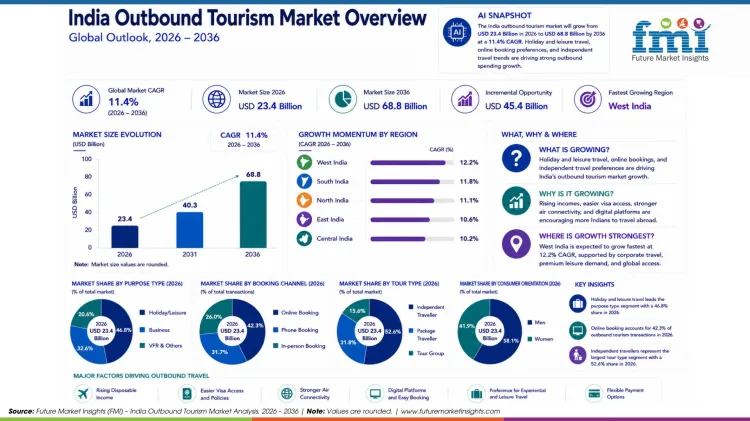
The India outbound tourism market is likely to expand from USD 23.4 billion in 2026 to USD 68.8 billion by 2036. The market is anticipated to register 11.4% CAGR during the forecast period. Holiday and leisure travel is likely to lead with 46.8% share, while online booking is forecast to account for 42.3% of outbound tourism transactions.
Key Takeaways, Market Size, and Forecast
- The India outbound tourism market is likely to be valued at USD 23.4 billion in 2026.
- By 2036, the market is forecast to advance to USD 68.8 billion.
- From 2026 to 2036, outbound tourism spending is anticipated to grow at 11.4% CAGR.
- Holiday and leisure travel is likely to hold 46.8% share by purpose type.
- Online booking is forecast to account for 42.3% of outbound tourism transactions.
- Independent travellers are likely to represent 52.6% share by tour type.
- West India is projected to lead regional growth at 12.2% CAGR through 2036.
Summary of the India Outbound Tourism Market
- Demand and Growth Drivers
- Rising income levels are making overseas trips more regular for Indian households.
- Short-haul destinations are gaining traction due to easier visa access.
- Digital booking platforms are reducing planning friction for first-time travellers.
- Flexible payment options are widening access to international holiday packages.
- Product and Segment View
- Holiday and leisure travel leads as overseas vacations become routine spending.
- Online booking remains the main channel due to price visibility and easy comparison.
- Independent travellers hold the strongest share as younger users plan customized trips.
- Cultural and heritage tourism benefits from curated city and landmark itineraries.
- Geography and Competitive Outlook
- West India leads regional growth due to strong corporate mobility and premium leisure demand.
- North India anchors long-haul travel through Delhi NCR’s strong global connectivity.
- South India is expanding through IT-linked travel and student mobility.
- Thomas Cook, SOTC, Akbar Travels, and MakeMyTrip remain important market participants.
- Analyst Opinion
- Ronak Shah, Principal Consultant for Consumer Product and Travel and Tourism at FMI, suggests, “India outbound tourism is moving into a repeat travel cycle. Travel companies that combine visa help, payment flexibility, and curated itineraries will gain stronger conversion. Short-haul leisure will bring volume, while premium long-haul trips will lift spending value.”
- India Outbound Tourism Market Value Analysis
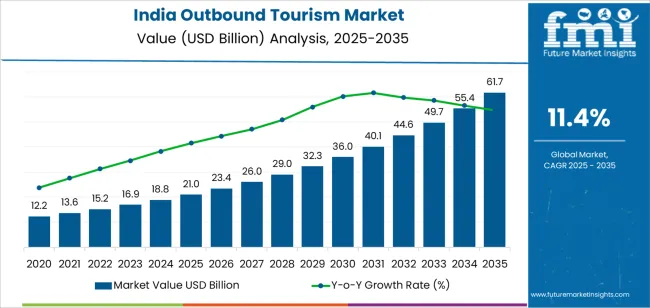
- The India outbound tourism market is shifting from rare overseas holidays into regular leisure spending.
- Demand is rising as middle-income households gain access to international routes.
- Short-haul travel creates volume through lower planning effort and shorter leave cycles.
- Online platforms are improving conversion through bundled services and transparent pricing.
- Growth is backed by aviation capacity, visa support, and wider participation from non-metro cities.
Summary of the India Outbound Tourism Market
What Is Growth Outlook for the India Outbound Tourism Market as per Future Market Insights Projection?
Future Market Insights projects the India outbound tourism market to grow at an 11.4% CAGR from 2026 to 2036, expanding from USD 23.4 billion in 2026 to USD 68.8 billion by 2036.
FMI Research Approach: FMI proprietary forecasting model based on bottom-up estimation of outbound travel spending, tracking international trip frequency among Indian travelers, and demand modeling linked to air connectivity expansion, visa facilitation, and rising discretionary travel budgets.
How Do FMI Analysts Perceive the India Outbound Tourism Market to Evolve?
FMI analysts perceive outbound tourism from India evolving from episodic, holiday-led international travel toward more frequent, experience-oriented overseas trips. Growth is supported by rising participation from middle-income households, expanding traveler bases across Tier 2 and Tier 3 cities, and increasing preference for curated itineraries covering leisure, wellness, weddings, and adventure travel.
FMI Research Approach: Assessment of traveler segmentation by income group and city tier, evaluation of evolving travel motivations, and analysis of itinerary complexity, trip duration, and per-trip spending patterns across outbound leisure segments.
Which Destination Region Accounts for the Largest Share of India Outbound Tourism Spend?
Southeast Asia and the Middle East account for the largest share of India outbound tourism spend, supported by short-haul connectivity, relatively liberal visa regimes, high flight frequency, and strong presence of bundled travel packages catering to Indian travelers.
FMI Research Approach: FMI destination-wise demand assessment based on outbound passenger flows, route-level air traffic analysis, visa access benchmarking, and tracking of package tour sales across key outbound corridors.
How Large Will the India Outbound Tourism Market Be by 2036?
The India outbound tourism market is projected to reach USD 68.8 billion by 2036.
FMI Research Approach: FMI long-term forecast by destination region, travel purpose, and booking channel, incorporating assumptions around aviation capacity additions, international tourism recovery cycles, and long-term growth in overseas leisure travel penetration among Indian consumers.
What Is Definition of the India Outbound Tourism Market?
The India outbound tourism market comprises international travel undertaken by Indian residents for leisure, visiting friends and relatives, business, education-linked travel, and experiential tourism, covering spending on air travel, accommodation, tour packages, and destination activities.
FMI Research Approach: FMI market taxonomy and inclusion-exclusion framework covering leisure travel, VFR, MICE, and education-related outbound travel, while excluding inbound tourism to India and domestic travel within national borders.
What Are Globally Unique Trends Shaping the India Outbound Tourism Market?
Globally unique trends shaping the market include rising adoption of experience-led international travel, growing preference for multi-country itineraries, increasing reliance on digital travel platforms, and rising influence of social commerce and content-led destination discovery.
FMI Research Approach: Analysis of travel purpose mix, booking channel contribution trends, destination-wise growth differentials, and evolving digital engagement patterns influencing international trip planning among Indian travelers.
India Outbound Tourism Market Key Takeaways
| Metric | Details |
|---|---|
| Industry Size (2026) | USD 23.4 Billion |
| Industry Value (2036) | USD 68.8 Billion |
| CAGR (2026-2036) | 11.4% |
Source: Future Market Insights (FMI) analysis, based on proprietary forecasting model and primary research.
Why Is the Demand for India Outbound Tourism Growing?
The way Indian consumers approach international travel is undergoing a noticeable shift, with overseas trips becoming a more regular part of leisure planning rather than limited to rare, milestone occasions. Future Market Insights observes that travelers are increasingly prioritizing simplified booking processes, shorter international getaways, and access to nearby overseas destinations that can be planned around limited vacation windows. In earlier years, outbound travel was largely confined to infrequent long vacations or special family trips, which kept overall participation levels relatively low. This pattern is changing as international mobility becomes more attainable for working professionals, young couples, and first-time overseas travelers.
Travel platform strategies reflect this evolution. EaseMyTrip has broadened its outbound travel offerings by promoting ready-made international holiday packages, price-led short-haul travel deals, and destination-focused promotions aimed at encouraging more frequent overseas trips. These offerings lower planning complexity and reduce cost uncertainty, allowing international travel to fit more easily into routine vacation planning cycles. FMI notes that travel platforms embedding outbound destinations into everyday trip search behavior, supported by bundled services and targeted promotions, are better positioned to expand repeat international travel demand as overseas tourism becomes a normalized part of Indian consumer travel habits.
How Is the India Outbound Tourism Market Segmented?
The India outbound tourism market is segmented by purpose type, booking channel, tourist type, tourism type, tour type, consumer orientation, and age group, reflecting outbound travel structure and participation patterns. By purpose type, the market includes business travel, holiday and leisure travel, and VFR and other travel, with holiday and leisure travel holding the largest share. By booking channel, online booking leads transactions, followed by in-person booking and phone booking. By tourist type, international travel accounts for the dominant share of outbound tourism activity. By tourism type, cultural and heritage tourism represents a major segment, alongside medical tourism, eco and sustainable tourism, sports tourism, and wellness tourism and others. By tour type, independent travellers account for a larger share, followed by package travellers and tour groups. By consumer orientation, men account for a larger share of outbound travel participation, while women represent a substantial portion of travelers. By age group, travelers aged 26 to 45 years hold the largest share, followed by 15 to 25 years, 46 to 65 years, and 66 to 75 years.
Why Does Holiday and Leisure Travel Dominate by Purpose Type?
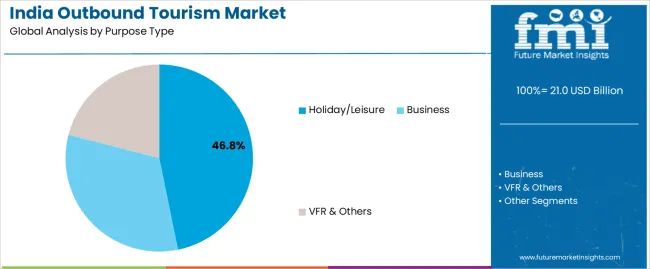
Holiday and leisure travel accounts for around 46.8% of India’s outbound tourism demand, reflecting the rising inclination toward international vacations as part of routine lifestyle spending. Indian travelers increasingly prioritize overseas leisure trips for short breaks, seasonal holidays, and family vacations, supported by improved air connectivity and accessible visa regimes across popular short-haul destinations. Leisure trips benefit from higher frequency compared with business or VFR travel, as consumers allocate discretionary income toward experiences such as shopping, theme parks, beaches, and city tourism. Travel brands actively promote leisure itineraries through bundled packages and curated experiences, reinforcing leisure travel as the primary driver of outbound tourism volumes.
Why Does Online Booking Lead the Booking Channel?
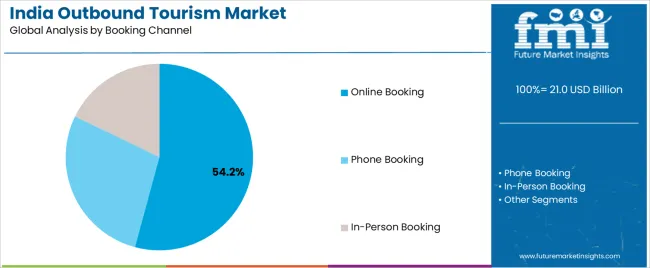
Online booking represents about 42.3% of outbound tourism transactions, reflecting strong alignment between digital platforms and international travel planning behavior. Indian travelers increasingly rely on mobile apps and web platforms for comparing fares, selecting hotels, and building multi-component itineraries within a single interface. Digital booking lowers planning friction by offering transparent pricing, real-time availability, and flexible payment options for overseas trips. Online channels also support repeat travel behavior through loyalty programs, alerts, and personalized offers. While phone and in-person bookings remain relevant for complex itineraries, online booking continues to dominate as travelers prioritize speed, convenience, and control over international travel planning.
Why Do International Trips Dominate by Tourist Type?

International travel accounts for over 90% of total spending within the outbound tourism market, as the category itself is anchored in overseas travel undertaken by Indian residents. International trips generate significantly higher per-trip expenditure compared with domestic travel, driven by airfare, accommodation, local transport, and activity spending in foreign destinations. Indian travelers increasingly allocate higher budgets toward international vacations, long-haul leisure trips, and premium travel experiences, which elevates the value contribution of this subsegment. Growth in passport penetration, rising comfort with overseas travel, and increasing exposure to global destinations through digital media continue to strengthen the dominance of international trips within outbound tourism demand.
Why Does Cultural and Heritage Tourism Lead by Tourism Type?
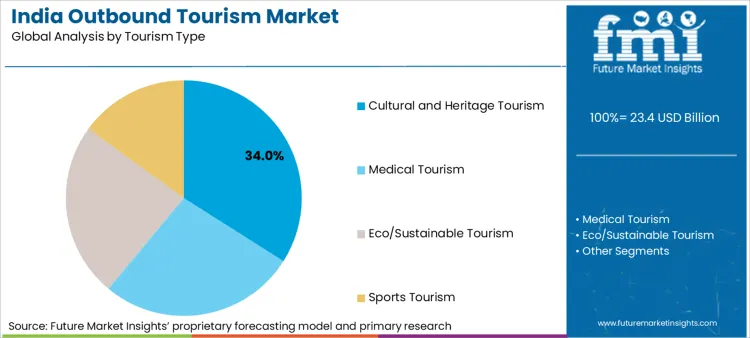
Cultural and heritage tourism accounts for nearly 34.0% of thematic outbound travel demand, supported by growing interest in experiential and destination-led international travel. Indian tourists increasingly seek cultural immersion, historical exploration, and local lifestyle experiences across Europe, East Asia, and the Middle East. This segment benefits from structured itineraries that combine museums, architectural landmarks, city tours, and cultural events, which appeal to family groups and mid-income travelers. Cultural tourism is often positioned as value-enhancing travel rather than purely leisure-driven consumption, supporting higher willingness to spend on guided experiences and curated itineraries. The appeal of cultural discovery continues to anchor demand within themed outbound tourism.
Why Do Independent Travellers Lead by Tour Type?
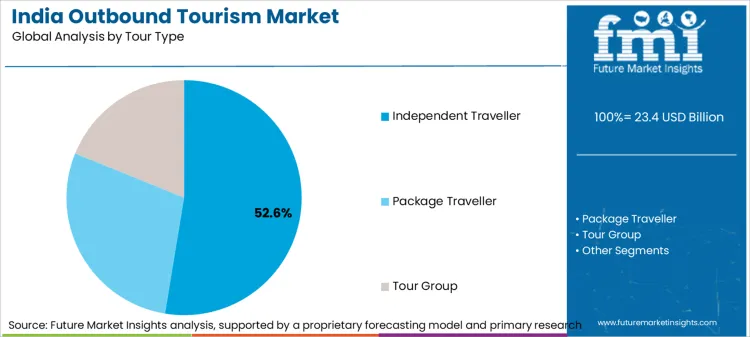
Independent travellers account for around 52.6% of outbound tourism demand, driven by growing confidence in self-planned international travel. Digital tools enable travelers to customize flights, accommodations, and local experiences without relying on pre-packaged tours. Independent travel supports flexible itineraries, varied trip durations, and multi-destination planning, which aligns with preferences of younger professionals and repeat international travelers. Travelers associate independent trips with greater autonomy and personalized experiences, particularly for city breaks and short-haul destinations. While package tours remain relevant for first-time travelers, the shift toward self-curated international travel continues to expand the share of independent travellers within outbound tourism.
Why Do Male Travelers Dominate by Consumer Orientation?
Male travelers account for approximately 56.2% of outbound tourism spending, reflecting higher participation in business-linked travel and long-haul leisure trips. Men continue to represent a larger share of corporate mobility, international trade travel, and professional travel, which contributes to higher frequency of overseas journeys. Leisure travel among male travelers also includes solo travel, sports tourism, and experience-driven international trips. This pattern is reflected in outbound booking trends observed by Yatra, where international corporate travel bookings and premium long-haul itineraries show stronger participation from male travelers, particularly across business corridors connecting India with North America, Europe, and the Middle East. While female participation in outbound travel continues to expand, male travelers currently contribute a higher share of total travel expenditure due to greater trip frequency, longer average stay duration, and higher per-trip spending on international travel.
Why Do 26 to 35-Year-Old Travelers Dominate by Age Group?
Travelers aged 26 to 35 years contribute nearly 38.4% of outbound tourism demand, reflecting peak earning years, higher travel propensity, and strong exposure to global travel culture. This age group actively pursues international leisure trips, short-haul vacations, and experiential travel such as adventure tourism and urban exploration. Digital-native behavior supports frequent use of online booking platforms, flexible travel planning, and shorter booking cycles. Younger professionals prioritize travel as part of lifestyle consumption, allocating discretionary income toward overseas experiences. Their willingness to experiment with destinations and travel formats reinforces the dominance of this age group within India’s outbound tourism market.
What Forces Are Reshaping the India Outbound Tourism Landscape?
Outbound tourism from India is evolving as travel planning becomes more experience-oriented and less centered on single annual holidays. Indian travelers are increasingly structuring overseas trips around shorter breaks, multi-country itineraries, and theme-based travel rather than long, infrequent vacations. This shift is changing how destinations, airlines, and travel platforms design routes, packages, and promotional calendars. Travel planning now blends leisure, shopping, culture, and lifestyle experiences into cohesive itineraries that fit tighter leave cycles. According to Future Market Insights, outbound travel from India is becoming more routine within discretionary spending baskets, with higher repeat travel frequency and greater willingness to experiment with new destinations. This evolution is gradually redefining outbound tourism from milestone-led travel into a recurring lifestyle activity.
How Is Route Expansion Supporting the Scale-Up of Outbound Travel?
Network expansion by international carriers and increased seat capacity on key corridors are supporting wider participation in outbound travel. Airlines are adding direct connections between Indian cities and short-haul as well as long-haul destinations, reducing transit times and improving travel convenience for first-time and repeat travelers. This capacity expansion is reshaping destination accessibility beyond traditional metro-to-metro routes. The impact of network development is reflected in route additions and frequency increases announced by Air India and Air India Express, which have expanded international services across Southeast Asia and the Middle East to capture rising outbound leisure and business demand from secondary Indian cities. FMI notes that improved connectivity lowers perceived barriers to overseas travel and supports sustained growth in outbound passenger volumes across multiple destination regions.
Why Are Packaging and Curation Becoming Central to Outbound Travel Offerings?
The growing complexity of international travel preferences is pushing travel providers to emphasize curated itineraries and bundled offerings that combine flights, accommodation, transfers, and experiences. Travelers increasingly seek structured travel products that simplify planning while still allowing personalization across destination choice, duration, and activities. Curated packages also help manage cost visibility and itinerary coherence for multi-stop international trips. FMI observes that as outbound tourism scales, packaging strategies are becoming central to how travel platforms differentiate offerings and improve conversion rates. This approach reduces planning friction for travelers and supports repeat bookings by aligning outbound travel with familiar domestic booking behavior. Over time, curated international travel formats are likely to anchor product design as Indian outbound tourism matures into a more standardized consumption category.
What Is the India Outbound Tourism Market Regional Outlook?
India’s outbound tourism demand is expanding rapidly as rising disposable incomes, wider passport penetration, and improved international air connectivity push overseas travel beyond a metro-only phenomenon. While the national market grows at an 11.4% CAGR from 2026 to 2036, outbound travel intensity varies significantly by region based on income concentration, airport infrastructure, and travel purpose mix. West and North India form the primary demand axis, driven by corporate travel, premium leisure, and VFR flows. South India follows with accelerating participation led by technology-sector mobility and education-linked travel. East India remains comparatively smaller but is steadily scaling as connectivity improves and middle-income households increasingly participate in international travel. FMI analysis indicates that future growth will come from deeper regional diffusion of outbound travel habits rather than reliance on a few legacy metros.
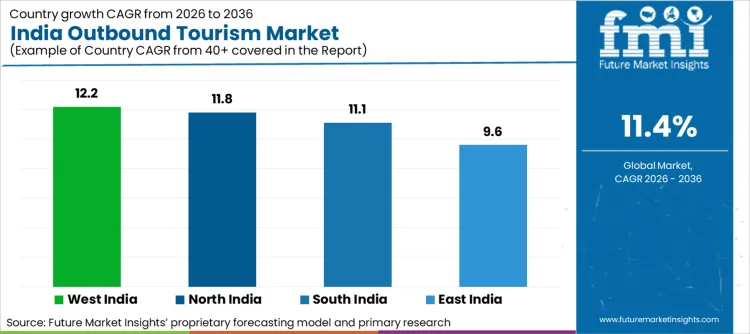
| Region | CAGR |
|---|---|
| West India | 12.2% |
| North India | 11.8% |
| South India | 11.1% |
| East India | 9.6% |
Source: FMI historical analysis and forecast data.
Why Does West India Lead Outbound Travel Generation?
At a 12.2% CAGR, West India leads outbound travel generation because it combines India’s highest concentration of internationally mobile households with unmatched aviation and distribution infrastructure. Mumbai functions as the region’s primary long-haul gateway, while Pune and Ahmedabad add strong regional demand driven by IT services, manufacturing, pharmaceuticals, and export-oriented SMEs. Corporate travel is structurally dense, feeding consistent business, MICE, and VFR flows rather than episodic leisure spikes. Household income levels support repeat international trips, not one-off vacations, which raises per-capita outbound frequency. The region also hosts India’s most mature outbound travel ecosystem, with strong penetration of OTAs, premium tour operators, corporate travel desks, and airline loyalty programs. FMI analysis indicates that West India’s dominance is sustained by repeat travel behaviour and institutional travel demand rather than first-time passport adoption alone.
How Is North India Shaping Premium and Long-Haul Demand?
Growing at an 11.8% CAGR, North India shapes the premium and long-haul segment of outbound tourism through Delhi NCR’s role as a political, corporate, and education hub. Outbound demand from the region is disproportionately weighted toward Europe, North America, and multi-country itineraries, reflecting higher per-trip budgets and longer average stays. Education-linked travel, business travel tied to multinational headquarters, and premium leisure tours form a structurally resilient demand base. Indira Gandhi International Airport’s connectivity supports dense intercontinental routes, reducing friction for long-haul planning. The region’s travel ecosystem is oriented toward higher-value services, including curated itineraries, international student consulting, visa facilitation, and corporate mobility management. FMI notes that North India’s outbound growth is less volume-driven and more value-led, reinforcing its role as the market’s premium demand anchor.
What Is Driving South India’s Expanding Outbound Base?
South India expands at an 11.1% CAGR, driven by the normalization of international mobility among technology professionals, students, and upper-middle-income households. Bengaluru, Hyderabad, Chennai, and Kochi collectively generate steady outbound flows linked to IT services, global capability centers, healthcare, and higher education. Unlike the family-led travel of West India, South India’s growth is supported by a high concentration of young working professionals and the country's highest passport penetration levels among first-generation international travelers. Student mobility to Europe, Australia, and Southeast Asia forms a durable pipeline, while business travel tied to offshore delivery and client-facing roles adds frequency. Improved international connectivity from southern airports reduces reliance on hub transfers, making outbound travel more accessible. FMI analysis highlights South India as a structurally expanding base where outbound travel is becoming a routine lifestyle expenditure rather than an aspirational milestone.
Why Is East India Growing at a Steadier Pace?
At a 9.6% CAGR, East India’s outbound tourism market is expanding steadily but from a smaller structural base. Kolkata remains the primary demand center, supported by emerging outbound participation from cities such as Bhubaneswar, Guwahati, and Patna. Growth is driven by gradual income uplift, rising passport ownership, and improving air connectivity rather than corporate travel density. Outbound demand is skewed toward short-haul destinations in Southeast Asia and the Middle East, reflecting price sensitivity and first-time international travel patterns. Travel agency penetration and organized outbound offerings are improving, but the ecosystem remains less mature than in West and North India. FMI analysis indicates that East India’s long-term upside lies in infrastructure-led accessibility and middle-class expansion, positioning it as a gradual but structurally improving contributor to national outbound growth.
What Is the Competitive Outlook for the India Outbound Tourism Market?
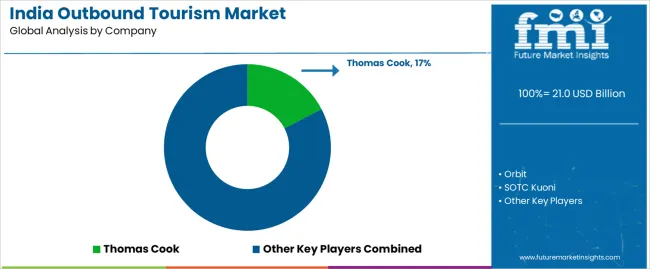
The competitive landscape for India outbound tourism is led by established travel management companies and tour operators that extend beyond ticketing into end-to-end international travel orchestration to maintain relevance across leisure, corporate, and group travel segments. Players such as Thomas Cook India, SOTC Travel, and Akbar Travels benefit from extensive branch networks, long-standing brand recall, and strong supplier relationships across airlines, hotels, and destination partners. Competitive positioning in this market is less about pure ticket volume and more about the ability to package international travel services, manage documentation workflows, and support complex itineraries across leisure and corporate travel categories.
Future Market Insights observes that competition is increasingly centered on itinerary reliability, service continuity, and the ability to manage cross-border travel complexity rather than rapid capacity expansion. Companies such as BCD Travel and FCM Travel Solutions emphasize corporate travel management, compliance workflows, and account-level service delivery, while leisure-focused operators including Kesari Tours and Veena World prioritize group tour curation and standardized international itineraries. At the same time, technology providers such as Amadeus shape competitive dynamics by enabling distribution access, inventory management, and booking workflow integration across agencies. FMI notes that long-term competitive advantage will depend on how effectively travel companies integrate international offerings into broader customer travel ecosystems, rather than treating outbound travel as a standalone service line.
Recent Developments
- In February 2026, MakeMyTrip partnered with Minor Hotels to add more than 560 properties, including brands such as Anantara and Tivoli, to its platform. The partnership expands access to premium and luxury accommodations across Europe, Asia, and the Middle East for Indian travelers, reflecting rising demand for high-value, experience-driven stays.
- In February 2026, IndiGo launched its direct service between Delhi and London Heathrow, marking its entry into the long-haul international market. Operating with wide-body aircraft, the new route challenges the dominance of full-service airlines while offering Indian travelers a more affordable direct connection to the UK and Europe.
- In February 2026, SOTC Travel introduced a No-Cost EMI payment option for its holiday packages, targeting Gen Z and Millennial travelers. The initiative addresses the rising cost of international travel by providing greater payment flexibility and reflects the growing adoption of "Travel Now, Pay Later" models across the travel industry.
- India recorded 30.89 million outbound departures in 2024, up 10.79% year over year, with the UAE, Saudi Arabia, the United States, Thailand, and Singapore emerging as the leading international destinations.
- Thailand introduced a 60-day visa exemption for Indian passport holders from December 1, 2025, and in July 2026 confirmed a permanent 30-day visa-free entry policy after a proposal to withdraw the exemption affected visitor arrivals. The Tourism Authority of Thailand aims to attract a record 2.7 million Indian visitors and projects Indian outbound travel to increase from 32.7 million trips in 2025 to approximately 50 million by 2030.
- India became Thailand's third-largest source market with a record 2.1 million visitors in 2024, representing 30% year-over-year growth and surpassing its pre-pandemic peak. In the first half of 2025, India also ranked as Moscow's second-largest source market for international visitors.
Key Players in Indian Outbound Travel Industry
- Orbit
- Thomas Cook
- SOTC Kuoni
- Raj Travels
- In Orbit Tours
- MakeMyTrip
- TCI
- Travelmart India
- Riya Travels
- Akbar Travels
- BTI Sita
- BCD Travels
- Mercury Travels
- Gold Chip
- Kesari Tours
- Amadeus
Market Definition
The India outbound tourism market captures revenue generated from international travel undertaken by Indian residents across leisure, business, visiting friends and relatives, education-linked travel, and other overseas trip purposes. In this assessment, the market covers commercially organized outbound travel services consumed by Indian travelers, including airfare, accommodation, tour packages, local transfers, and destination activities purchased for international trips. Market sizing reflects total outbound travel spending by Indian residents, analyzed by purpose type, booking channel, tour format, and destination region, and reported in USD billion.
Market Inclusion
The scope includes short-haul and long-haul international travel originating from India, covering holiday and leisure travel, corporate and MICE travel, VFR trips, medical and wellness travel, and themed tourism formats such as cultural, sports, and eco-focused tourism. Expenditure captured includes spending on international flights, overseas lodging, packaged holidays, visa facilitation services bundled with travel products, and pre-booked experiences arranged through online platforms, travel agencies, and tour operators. Geographic coverage spans outbound travel from India to destinations across Asia Pacific, Europe, North America, Latin America, and the Middle East & Africa.
Market Exclusion
The market excludes domestic tourism within India, inbound travel to India by foreign tourists, and non-travel expenditures such as remittances, overseas education tuition fees, long-term migration-related relocation costs, and standalone insurance or foreign exchange services not bundled with travel consumption. Revenues from airline fleet operations, airport services, aircraft leasing, and travel technology licensing are excluded from market valuation. Trips undertaken purely for long-term employment relocation or permanent migration without tourism consumption are outside the defined market scope.
Scope of Report
| Items | Values |
|---|---|
| Quantitative Units (2026) | USD 23.4 Billion |
| Purpose Type | Holiday & Leisure; Business Travel; VFR (Visiting Friends & Relatives); Education-Linked Travel; Others |
| Booking Channel | Online Booking; In-Person Booking (Travel Agencies); Phone Booking |
| Tourism Type | Cultural & Heritage Tourism; Medical Tourism; Eco & Sustainable Tourism; Sports Tourism; Wellness Tourism; Others |
| Tour Type | Independent Travellers; Package Travellers; Group Tours |
| Regions Covered | West India; South India; East India; North India |
| Countries Covered | India |
| Key Companies Profiled | Orbit; Thomas Cook; SOTC Kuoni; Raj Travels; In Orbit Tours; MakeMyTrip; TCI; Kesari Tours; Travelmart India; Riya Travels; Akbar Travels; BTI Sita; BCD Travels; Mercury Travels; Gold Chip; Amadeus |
| Additional Attributes | Dollar spending by purpose type, booking channel, and destination region; country-wise outbound travel growth analysis; short-haul versus long-haul destination mix; adoption trends for curated international packages and dynamic packaging models; traveler behavior patterns by age group and city tier; competitive positioning of OTAs, tour operators, and corporate travel management firms |
Source: FMI historical analysis and forecast data
Segmentation of India Outbound Tourism Market
By Purpose Type:
- Business
- Holiday/Leisure
- VFR & Others
By Booking Channel:
- Phone Booking
- Online Booking
- In-person Booking
By Tourist Type:
- Domestic
- International
By Tourism Type:
- Cultural and Heritage Tourism
- Medical Tourism
- Eco/Sustainable Tourism
- Sports Tourism
- Wellness Tourism and Others
By Tour Type:
- Independent Traveller
- Package Traveller
- Tour Group
By Consumer Orientation:
- Men
- Women
By Age Group:
- 15 to 25 Years
- 26 to 35 Years
- 36 to 45 Years
- 46 to 65 Years
- 66 to 75 Years
Bibliography
- Directorate General of Civil Aviation. (2025). Handbook on civil aviation statistics 2024-25. Government of India.
- Reserve Bank of India. (2025). Bulletin: Outbound remittances under the Liberalised Remittance Scheme (LRS) for travel.
- Federation of Indian Chambers of Commerce & Industry (FICCI) & Nangia Andersen. (2024). Unlocking the potential: Future of Indian outbound tourism.
Frequently Asked Questions
What is the current market size for the India Outbound Tourism Market?
The India outbound tourism market is valued at USD 23.4 billion in 2026, reflecting strong participation in international leisure and business travel.
What is the projected CAGR for the India Outbound Tourism Market?
The market is forecasted to grow at an 11.4% CAGR from 2026 to 2036, reaching USD 68.8 billion by 2036.
Which segment currently dominates the India Outbound Tourism Market?
Holiday and leisure travel leads the market with around a 46.8% share, driven by frequent international vacations and experience-led travel demand.
What are the primary risks or constraints affecting outbound tourism growth?
Key constraints include airfare volatility, visa processing timelines, currency fluctuations, and geopolitical uncertainties.
Who are the leading players in the India Outbound Tourism Market?
Key players include Thomas Cook India, SOTC Travel, Akbar Travels, Cox & Kings, BCD Travel, and Amadeus.
Preview the report firsthand - request a free sample
Get SampleGet the brochure for pricing and purchase details.
Get PDFTable of Content
- Key Takeaways
- Market Size and CAGR
- Top Growth Driver
- Fastest Growing Segment
- Leading Region
- Key Companies
- Emerging Opportunities
- Executive Summary
- India Market Outlook
- Demand-side Trends
- Supply-side Trends
- Technology Roadmap Analysis
- Analysis and Recommendations
- Analyst Perspective (What is happening? Why now? What should investors know?)
- Key Questions Answered
- How large is the market?
- What is the CAGR?
- What are key trends?
- Which region dominates?
- Who are the leaders?
- Market Overview
- Market Coverage / Taxonomy
- Market Definition / Scope / Limitations
- Research Methodology
- Chapter Orientation
- Analytical Lens and Working Hypotheses
- Market Structure, Signals, and Trend Drivers
- Benchmarking and Cross-market Comparability
- Market Sizing, Forecasting, and Opportunity Mapping
- Research Design and Evidence Framework
- Desk Research Programme (Secondary Evidence)
- Expert Input and Fieldwork (Primary Evidence)
- Tooling, Models, and Reference Databases
- Data Engineering and Model Build
- Quality Assurance and Audit Trail
- Market Background
- Market Dynamics (Drivers, Restraints, Opportunity, Trends)
- Scenario Forecast (Optimistic, Likely, Conservative)
- Impact Analysis
- AI Impact
- Sustainability Impact
- Regulatory Impact
- Technology Impact
- Consumer / Buyer Analysis
- Purchase Drivers
- Adoption Barriers
- Buyer Journey
- Opportunity Map Analysis
- Product Life Cycle Analysis
- Travel Distribution Chain Analysis
- Investment Feasibility Matrix
- Value Chain Analysis
- PESTLE and Porter's Analysis
- Regulatory Landscape
- Regional Parent Market Outlook
- Outbound Traveller Volume and Spending Statistics
- Inbound vs Outbound Travel Flow Statistics
- India Market Analysis and Forecast, 2021 to 2036
- Historical Market Size Value (USD Billion) Analysis, 2021 to 2025
- Current and Future Market Size Value (USD Billion) Projections, 2026 to 2036
- Y-o-Y Growth Trend Analysis
- Absolute $ Opportunity Analysis
- India Market Pricing Analysis, 2021 to 2036
- India Market Analysis and Forecast, By Purpose Type, 2021 to 2036
- Introduction / Key Findings
- Historical Market Size Value (USD Billion) Analysis By Purpose Type, 2021 to 2025
- Current and Future Market Size Value (USD Billion) Analysis and Forecast By Purpose Type, 2026 to 2036
- Holiday/Leisure
- Business
- VFR
- Y-o-Y Growth Trend Analysis By Purpose Type, 2021 to 2025
- Absolute $ Opportunity Analysis By Purpose Type, 2026 to 2036
- India Market Analysis and Forecast, By Booking Channel, 2021 to 2036
- Introduction / Key Findings
- Historical Market Size Value (USD Billion) Analysis By Booking Channel, 2021 to 2025
- Current and Future Market Size Value (USD Billion) Analysis and Forecast By Booking Channel, 2026 to 2036
- Online Booking
- Phone Booking
- In-person Booking
- Y-o-Y Growth Trend Analysis By Booking Channel, 2021 to 2025
- Absolute $ Opportunity Analysis By Booking Channel, 2026 to 2036
- India Market Analysis and Forecast, By Consumer Orientation, 2021 to 2036
- Introduction / Key Findings
- Historical Market Size Value (USD Billion) Analysis By Consumer Orientation, 2021 to 2025
- Current and Future Market Size Value (USD Billion) Analysis and Forecast By Consumer Orientation, 2026 to 2036
- Men
- Women
- Y-o-Y Growth Trend Analysis By Consumer Orientation, 2021 to 2025
- Absolute $ Opportunity Analysis By Consumer Orientation, 2026 to 2036
- India Market Analysis and Forecast, By Tourism Type, 2021 to 2036
- Introduction / Key Findings
- Historical Market Size Value (USD Billion) Analysis By Tourism Type, 2021 to 2025
- Current and Future Market Size Value (USD Billion) Analysis and Forecast By Tourism Type, 2026 to 2036
- Cultural and Heritage Tourism
- Medical Tourism
- Eco/Sustainable Tourism
- Sports Tourism
- Y-o-Y Growth Trend Analysis By Tourism Type, 2021 to 2025
- Absolute $ Opportunity Analysis By Tourism Type, 2026 to 2036
- India Market Analysis and Forecast, By Tour Type, 2021 to 2036
- Introduction / Key Findings
- Historical Market Size Value (USD Billion) Analysis By Tour Type, 2021 to 2025
- Current and Future Market Size Value (USD Billion) Analysis and Forecast By Tour Type, 2026 to 2036
- Independent Traveller
- Package Traveller
- Tour Group
- Y-o-Y Growth Trend Analysis By Tour Type, 2021 to 2025
- Absolute $ Opportunity Analysis By Tour Type, 2026 to 2036
- India Market Analysis and Forecast, By Tourist Type
- Introduction / Key Findings
- Historical Market Size Value (USD Billion) Analysis By Tourist Type, 2021 to 2025
- Current and Future Market Size Value (USD Billion) Analysis and Forecast By Tourist Type, 2026 to 2036
- Domestic
- International
- Y-o-Y Growth Trend Analysis By Tourist Type, 2021 to 2025
- Absolute $ Opportunity Analysis By Tourist Type, 2026 to 2036
- India Market Analysis and Forecast, By Sub-region, 2021 to 2036
- Introduction
- Historical Market Size Value (USD Billion) Analysis By Sub-region, 2021 to 2025
- Current Market Size Value (USD Billion) Analysis and Forecast By Sub-region, 2026 to 2036
- West India
- North India
- South India
- East India
- Market Attractiveness Analysis By Sub-region
- West India Market Analysis and Forecast, By Sub-region, 2021 to 2036
- Historical Market Size Value (USD Billion) Trend Analysis By Market Taxonomy, 2021 to 2025
- Market Size Value (USD Billion) Forecast By Market Taxonomy, 2026 to 2036
- By Purpose Type
- By Booking Channel
- By Consumer Orientation
- By Tourism Type
- By Tour Type
- By Tourist Type
- Market Attractiveness Analysis
- By Purpose Type
- By Booking Channel
- By Consumer Orientation
- By Tourism Type
- By Tour Type
- By Tourist Type
- Key Takeaways
- North India Market Analysis and Forecast, By Sub-region
- Historical Market Size Value (USD Billion) Trend Analysis By Market Taxonomy, 2021 to 2025
- Market Size Value (USD Billion) Forecast By Market Taxonomy, 2026 to 2036
- By Purpose Type
- By Booking Channel
- By Consumer Orientation
- By Tourism Type
- By Tour Type
- By Tourist Type
- Market Attractiveness Analysis
- By Purpose Type
- By Booking Channel
- By Consumer Orientation
- By Tourism Type
- By Tour Type
- By Tourist Type
- Key Takeaways
- South India Market Analysis and Forecast, By Sub-region
- Historical Market Size Value (USD Billion) Trend Analysis By Market Taxonomy, 2021 to 2025
- Market Size Value (USD Billion) Forecast By Market Taxonomy, 2026 to 2036
- By Purpose Type
- By Booking Channel
- By Consumer Orientation
- By Tourism Type
- By Tour Type
- By Tourist Type
- Market Attractiveness Analysis
- By Purpose Type
- By Booking Channel
- By Consumer Orientation
- By Tourism Type
- By Tour Type
- By Tourist Type
- Key Takeaways
- East India Market Analysis and Forecast, By Sub-region
- Historical Market Size Value (USD Billion) Trend Analysis By Market Taxonomy, 2021 to 2025
- Market Size Value (USD Billion) Forecast By Market Taxonomy, 2026 to 2036
- By Purpose Type
- By Booking Channel
- By Consumer Orientation
- By Tourism Type
- By Tour Type
- By Tourist Type
- Market Attractiveness Analysis
- By Purpose Type
- By Booking Channel
- By Consumer Orientation
- By Tourism Type
- By Tour Type
- By Tourist Type
- Key Takeaways
- Market Structure Analysis
- Competition Dashboard
- Competition Benchmarking
- Market Share Analysis of Top Players
- By Sub-regional
- By Purpose Type
- By Booking Channel
- By Consumer Orientation
- By Tourism Type
- By Tour Type
- By Tourist Type
- Emerging Startups
- Innovation Benchmarking
- Case Studies
- Success Stories
- Recent Developments
- Competition Analysis
- Competition Deep Dive
- Orbit
- Overview
- Product Portfolio
- Profitability by Market Segments
- Sales Footprint
- Strategy Overview
- Marketing Strategy
- Product Strategy
- Channel Strategy
- Thomas Cook
- SOTC Kuoni
- Raj Travels
- In Orbit Tours
- MakeMyTrip
- TCI
- Kesari Tours
- Travelmart India
- Orbit
- Competition Deep Dive
- Assumptions & Acronyms Used


