

- Industry Size (2025)
- USD 44.3 Mn
- Forecast (2035)
- USD 258.5 Mn
- CAGR (2025 to 2035)
- 19.3%
India Sustainable Tourism Market Size, Market Forecast and Outlook By FMI
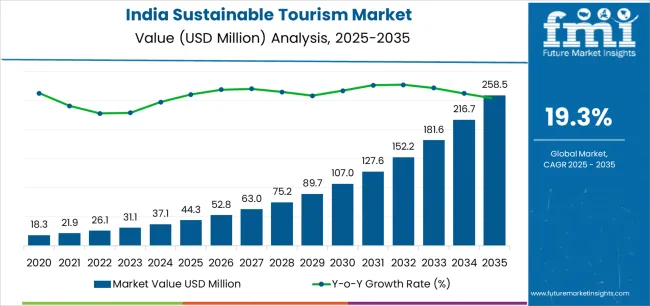
The India sustainable tourism market was valued at USD 44.3 million in 2025 and is projected to reach USD 258.5 million by 2035. The market is likely to register a 19.3% CAGR during the forecast period. Eco-tourism led tourism type demand with a 35.0% share in 2025, while online booking held 60.0% share of booking channel revenue.
Summary of the India Sustainable Tourism Market
- Demand and Growth Drivers
- Responsible travel preferences are expected to support demand for low-impact tourism experiences across India.
- Government programs are likely to improve eco-tourism infrastructure and community-based travel models.
- Rising domestic travel is anticipated to strengthen sustainable tourism in regional and nature-led destinations.
- Product and Segment View
- Eco-tourism is expected to remain the leading tourism type due to stronger interest in conservation-led travel.
- Online booking is likely to retain leadership as travelers prefer digital planning and transparent package comparison.
- Domestic tourists are anticipated to remain the main customer group as local destination discovery increases.
- Geography and Competitive Outlook
- India is expected to remain the core demand base due to rising awareness of ethical and nature-based travel.
- Sustainable destinations in rural and protected areas are likely to attract travelers seeking community-linked experiences.
- Operators with local partnerships and eco-certified packages are anticipated to improve their competitive position.
- Analyst Opinion
- Ronak Shah, Principal Consultant for Travel and Tourism at FMI, suggests, “The India sustainable tourism market is moving toward responsible travel formats that combine local culture with nature conservation. Operators with community partnerships and transparent digital booking models are likely to gain advantage as travelers seek credible low-impact experiences.”
- India Sustainable Tourism Market Value Analysis
- The India sustainable tourism market is moving from niche eco-travel toward organized responsible tourism packages.
- Demand is likely to rise as travelers choose nature-based stays and community-led activities.
- Online platforms are expected to improve access to sustainable travel operators across remote destinations.
- Spending is anticipated to strengthen as green accommodation and local experience packages expand through 2035.
Key Takeaways, Market Size, and Forecast
- The India sustainable tourism market was valued at USD 44.3 million in 2025.
- The India sustainable tourism market is projected to attain USD 258.5 million by 2035.
- From 2025 to 2035, the market is anticipated to expand at a 19.3% CAGR.
- Eco-tourism held 35.0% share of the tourism type segment in 2025.
- Online booking accounted for 60.0% share of the booking channel segment in 2025.
| Metric | Value |
|---|---|
| India Sustainable Tourism Market Estimated Value in (2025 E) | USD 44.3 million |
| India Sustainable Tourism Market Forecast Value in (2035 F) | USD 258.5 million |
| Forecast CAGR (2025 to 2035) | 19.3% |
Segmental Analysis
The market is segmented by Tourism Type, Booking Channel, Tourist Type, Traveller Type, Consumer Orientation, and Age Group and region. By Tourism Type, the market is divided into Eco-Tourism, Green Tourism, Soft Tourism, and Community Tourism. In terms of Booking Channel, the market is classified into Online Booking, Phone Booking, and In-Person Booking. Based on Tourist Type, the market is segmented into Domestic and International. By Traveller Type, the market is divided into Independent Traveller, Tour Group, and Package Traveller. By Consumer Orientation, the market is segmented into Women and Men. By Age Group, the market is segmented into 26-35 Years, 15-25 Years, 36-45 Years, 46-55 Years, 56-65 Years, and 66-75 Years. Regionally, the market is classified into North America, Latin America, Western Europe, Eastern Europe, Balkan & Baltic Countries, Russia & Belarus, Central Asia, East Asia, South Asia & Pacific, and the Middle East & Africa.
Insights into the Eco-Tourism Segment
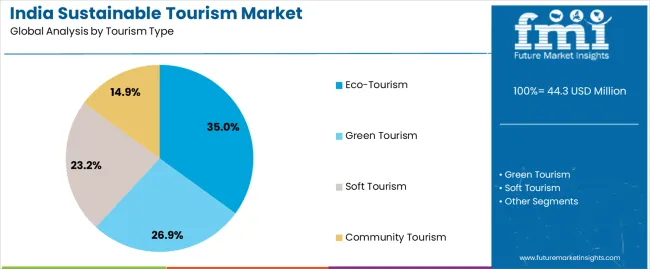
The eco-tourism segment is projected to hold 35.0% of the India Sustainable Tourism Market revenue share in 2025, making it a leading tourism type. This dominance is driven by the growing interest among travelers to explore nature-based destinations that emphasize environmental conservation and cultural preservation. Increased awareness regarding the ecological impact of mass tourism has encouraged travelers to choose eco-friendly alternatives.
Government programs promoting conservation zones, wildlife sanctuaries, and rural tourism have further contributed to this segment’s growth. The development of eco-lodges and low-impact accommodation options, combined with local community engagement, has enhanced the authenticity of travel experiences.
Furthermore, the integration of digital platforms has enabled travelers to access eco-tourism destinations more easily, encouraging participation from urban populations The rising focus on carbon neutrality and sustainability certifications within the tourism industry continues to strengthen this segment’s position, ensuring its steady contribution to India’s sustainable tourism growth.
Insights into the Online Booking Segment
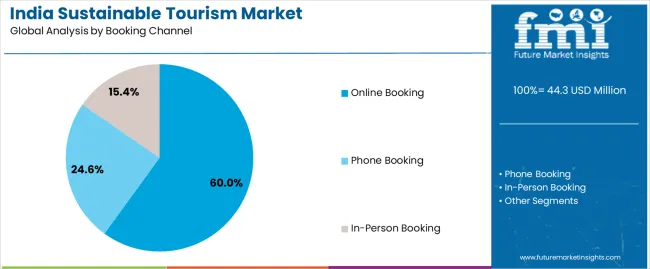
The online booking segment is anticipated to account for 60.0% of the India Sustainable Tourism Market revenue in 2025, establishing it as the leading booking channel. This segment’s growth is being propelled by the widespread adoption of smartphones, improved internet penetration, and the increasing preference for digital convenience among travelers. The integration of advanced technologies such as artificial intelligence and virtual tours has transformed how travelers plan and book sustainable experiences.
Online platforms offering transparent information about eco-friendly accommodations and sustainable packages have gained trust among consumers. The shift toward digital payment solutions and dynamic pricing options further supports the dominance of online booking.
Additionally, the rise of influencer-driven travel content and sustainability-focused travel portals has expanded awareness of responsible travel options The convenience of real-time booking, customer reviews, and customizable itineraries through digital channels has positioned online booking as the most efficient and accessible mode for travelers seeking sustainable tourism experiences in India.
Insights into the Domestic Tourist Segment
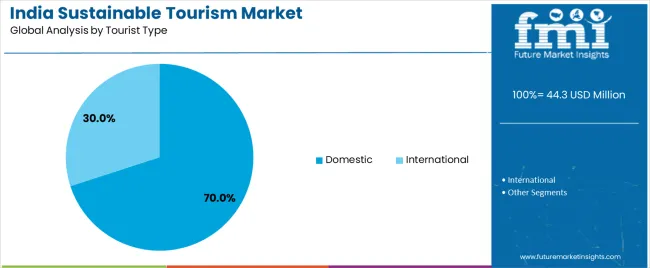
The domestic tourist segment is expected to hold 70.0% of the India Sustainable Tourism Market revenue in 2025, representing the leading tourist type. The segment’s strong position is supported by the growing interest of Indian travelers in exploring local destinations and contributing to regional economies. Increased affordability of travel, enhanced road and rail connectivity, and awareness campaigns promoting local tourism have significantly influenced this growth.
The post-pandemic preference for short-distance and culturally immersive travel experiences has further encouraged domestic tourism. Government initiatives such as Dekho Apna Desh and regional tourism circuits have played a key role in promoting sustainable domestic travel.
Additionally, the growing inclination toward eco-conscious travel among young professionals and families is driving participation in sustainable travel programs Domestic tourists are increasingly valuing authentic, community-based experiences that align with India’s cultural and environmental ethos, ensuring that this segment continues to be the cornerstone of the country’s sustainable tourism development.
Comparison of Historical vs Forecast Performance (2020 to 2035) in India Sustainable Tourism
The COVID-19 pandemic affected tourism profoundly, having a critical impact on the economy, and the environment. Travel restrictions, lockdowns, and health concerns impacted the global tourism sector negatively. Further, International tourist arrivals dropped by 72% in 2025, a major decline in the history of world tourism according to the United Nations World Tourism Organization (UNWTO).
In the future, opportunities for development and revolution for both businesses and governments to take advantage of emerging trends. The government of India has shifted its attention towards the development of tourism facilities, in addition to this, the Government is committed to ensuring the sustainable preservation of tourist sites and protected areas to also visited by succeeding generations, to maximize the tourism sector's potential.
The factors lead to an increase in the demand for sustainable tourism in India, and the market is expected to grow with a healthy CAGR growth of 19.3%.
Key India Sustainable Tourism Industry Trends
Key Trends Driving the India Sustainable Tourism Market
India is a popular tourist destination on a global scale due to its incredible variety of diversity. It is crucial to ensure the tourism sector's sustainability as most nations are recognizing the importance of sustainable tourism as a crucial worldwide trend for the development of the tourism industry.
The fact that India is a diverse country with attractive and serene landscapes that have cultural and historical value is one of the trends influencing the sustainable tourism business. Another contributing factor towards sustainable tourism in India is the increase in disposable income that raised people's urge to travel beautiful and eco-friendly destinations.
Local Activities Expected to Boost the Sustainable Tourism Industry in India
Sustainable tourism in India is on the rise due to several local initiatives and activities promoting responsible travel, protection of the environment, and empowering communities. The grassroots movements are instrumental in creating change towards a better future for the tourism industry in the country.
For instance, the City Walk program by Salaam Baalak Trust in Delhi involves young people in a walking tour of Delhi and not only provides a unique perspective of the city but also helps underprivileged youth gain valuable skills. The money raised from the program is used to provide scholarships, job opportunities, and shelters. More than 33 guides have been used, and many of the girls have used the experiences to further their education and get jobs in different fields.
Public Private Partnerships (PPP) for Sustainable Tourism
Public-private partnerships (PPPs) are of growing significance to sustainable tourism development in India. Cooperation between the authorities and businesses of both the public and private domains is beneficial in developing sustainable and eco-friendly tourism experiences.
For instance, a successful PPP for sustainable tourism in India is the development of eco-tourism facilities in the Andaman & Nicobar and Lakshadweep islands. The Ministry of Home Affairs, in association with NITI Aayog, initiated the bidding for developing sustainable and eco-tourism projects in seven islands through the PPP model. The initiative aims to promote the complete development of the islands while ensuring environmental sustainability.
Public private partnerships are strategic instruments in a growing economy as they facilitate the devolution of responsibility from the government and large organizations to manage and coordinate the delivery of services to the local community.
Public-Private Linkages and Investment Opportunities in Sustainable Tourism
Effective cross-institutional linkages are vital for attracting private sector investment in sustainable tourism in India as these linkages require cooperation between government agencies, private companies, communities, and NGOs that form a coherent system for sustainable tourism development.
For instance, the cooperative tourism model was implemented in Uttarakhand and West Bengal, where local communities are empowered to manage tourism projects. The model not only contributes to the development of local culture and heritage but also ensures the economic benefits are distributed among community members, to achieve the purpose of equal development.
Integrated approaches increase the sustainable tourism sector in India and make a positive contribution to the economy, without harming the environment and local culture.
Government Initiatives Expected to Boost the Sustainable Tourism Market in India
The regulations governing sustainable tourism are heavily influenced by the governments at all levels such as central, state, and local. Additionally, a lot of the laws and regulations about sustainable tourism fall under the category of governance, including those about waste management, labor laws, environmental restrictions, and land usage.
Raising an environment that permits or influences the private sector to operate more sustainably, as well as influencing patterns of visitor flows and behavior to maximize the impact of tourism, is one of the main roles of the government in promoting sustainable tourism. Therefore, government engagement that goes above and beyond just creating an enabling environment is required.
Recognizing its role in encouraging sustainable tourism, the Ministry of Tourism, Government of India, engaged in a thorough discussion with the sector and other stakeholders in 1998 to develop the comprehensive Ecotourism in India.
Category-wise Insights in the India Sustainable Tourism Market
What Type of Booking Channel Is the Most Prominent Channel?
Online Booking Is More Preferred by Tourists
In the India sustainable tourism market, online booking is identified as the most popular booking mode. The availability of smartphones and the accessibility of the internet, enable more people to use online platforms. Additionally, online booking offers advantages such as convenience, time-saving and the ability to compare prices and read reviews, which are highly valued by modern travellers.
The younger generation, particularly Gen Z and millennials, have adapted to using digital tools and prefer the seamless experience provided by online booking platforms. Consequently, online booking become the preferred choice for sustainable tourism in India, outpacing traditional phone and in-person booking methods.
Which Age Group Is More Likely to Travel?
Popularity of India Sustainable Tourism Among Middle-Aged People Will Remain High
In terms of age group, the 26 - 35 age demographic is more inclined towards travel and it is expected to increase in the forecast period as the age group is adventurous and eager to explore the world, making them more interested in sustainable travel experiences. Individuals in this age bracket often seek unique and immersive experiences such as eco-friendly accommodations, wildlife safaris, and cultural heritage tours.
Which Traveller Type is More Preferred?
Package Travel Is Mostly Preferred by The Tourists
In the context of sustainable tourism in India, packaged group travel is one of the most preferred modes among the travelling population due to the flexibility and affordability offered to the packaged tourist. Travellers benefit from pre-arranged itineraries, including accommodations, transportation, and sightseeing, often at discounted rates.
Simplifies the planning process and also ensures a hassle-free travel experience. Additionally, packaged group travel often includes guided tours, enhancing the overall experience by providing valuable insights into the destinations visited.
Competitive Landscape of the India Sustainable Tourism Market
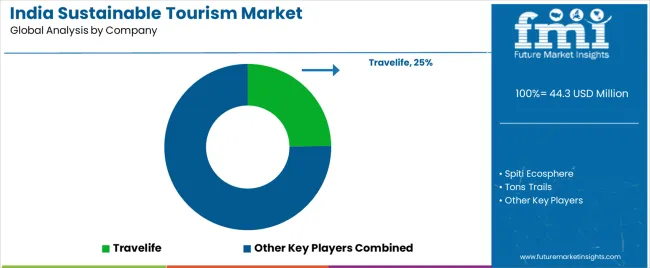
The competitive landscape of the sustainable tourism industry in India is rapidly evolving, driven by increasing consumer awareness and government initiatives aimed at promoting environmentally responsible travel.
The government’s initiative to mainstream sustainability in tourism through the National Strategy for Sustainable Tourism, emphasizes resource efficiency, carbon neutrality, and the protection of cultural and natural resources.
For Instances
- In 2025, Tons Trails expanded its operations to cover 37 villages in the Tons Valley, promoting sustainable tourism and economic empowerment for local communities. The company started its sustainable initiatives back in 2020.
- In 2025, Green People started working on sustainable tourism initiatives in rural India, focusing on community-based tourism and conservation.
Scope and Coverage of the India Sustainable Tourism Market Report
| Attribute | Details |
|---|---|
| Forecast Period | 2025 to 2035 |
| Historical Data Available for | 2020 to 2025 |
| Market Analysis | USD Million for Value |
| Key Region Covered | South Asia |
| Key Countries Covered | India |
| Key Segments Covered | Tourism Type, Booking Channel, Tourist Type, Traveller Type, Consumer Orientation, and Age Group. |
| Key Companies Profiled | Spiti Ecosphere; Tons Trails; Travelife; Asian adventures; Sky view by Empyrean; Green People; Evolve Back; Himalayan Ark; Kipepeo; Desia Ecotourism; Grassroutes Journeys; India Untravelled; Greaves India |
| Report Coverage | Market Forecast, Company Share Analysis, Competition Intelligence, DROT Analysis, Market Dynamics and Challenges, and Strategic Growth Initiatives |
Top Segments Studied in the India Sustainable Tourism Market by Category
By Tourism Type, India Sustainable Tourism Market is segmented as:
- Eco-Tourism
- Green Tourism
- Soft Tourism
- Community Tourism
By Booking Channel, India Sustainable Tourism Market is segmented as:
- Phone Booking
- Online Booking
- In-Person Booking
By Tourist Type, India Sustainable Tourism Market is segmented as:
- Domestic
- International
By Traveller Type, India Sustainable Tourism Market is segmented as:
- Independent Traveller
- Tour Group
- Package Traveller
By Consumer Orientation, India Sustainable Tourism Market is segmented as:
- Men
- Women
By Age Group, India Sustainable Tourism Market is segmented as:
- 15-25 Years
- 26-35 Years
- 36-45 Years
- 46-55 Years
- 56-65 Years
- 66-75 Years
Frequently Asked Questions
How big is the india sustainable tourism market in 2025?
The global india sustainable tourism market is estimated to be valued at USD 44.3 million in 2025.
What will be the size of india sustainable tourism market in 2035?
The market size for the india sustainable tourism market is projected to reach USD 258.5 million by 2035.
How much will be the india sustainable tourism market growth between 2025 and 2035?
The india sustainable tourism market is expected to grow at a 19.3% CAGR between 2025 and 2035.
What are the key product types in the india sustainable tourism market?
The key product types in india sustainable tourism market are eco-tourism, green tourism, soft tourism and community tourism.
Which booking channel segment to contribute significant share in the india sustainable tourism market in 2025?
In terms of booking channel, online booking segment to command 60.0% share in the india sustainable tourism market in 2025.
Preview the report firsthand - request a free sample
Get SampleGet the brochure for pricing and purchase details.
Get PDFTable of Content
- Executive Summary
- Global Market Outlook
- Demand-side Trends
- Supply-side Trends
- Technology Roadmap Analysis
- Analysis and Recommendations
- Market Overview
- Market Coverage / Taxonomy
- Market Definition / Scope / Limitations
- Market Background
- Market Dynamics
- Drivers
- Restraints
- Opportunity
- Trends
- Scenario Forecast
- Demand in Optimistic Scenario
- Demand in Likely Scenario
- Demand in Conservative Scenario
- Opportunity Map Analysis
- Product Life Cycle Analysis
- Supply Chain Analysis
- Investment Feasibility Matrix
- Value Chain Analysis
- PESTLE and Porter’s Analysis
- Regulatory Landscape
- Regional Parent Market Outlook
- Production and Consumption Statistics
- Import and Export Statistics
- Market Dynamics
- Global Market Analysis 2020 to 2025 and Forecast, 2025 to 2035
- Historical Market Size Value (USD Million) Analysis, 2020 to 2025
- Current and Future Market Size Value (USD Million) Projections, 2025 to 2035
- Y-o-Y Growth Trend Analysis
- Absolute $ Opportunity Analysis
- Global Market Pricing Analysis 2020 to 2025 and Forecast 2025 to 2035
- Global Market Analysis 2020 to 2025 and Forecast 2025 to 2035, By Tourism Type
- Introduction / Key Findings
- Historical Market Size Value (USD Million) Analysis By Tourism Type , 2020 to 2025
- Current and Future Market Size Value (USD Million) Analysis and Forecast By Tourism Type , 2025 to 2035
- Eco-Tourism
- Green Tourism
- Soft Tourism
- Community Tourism
- Y-o-Y Growth Trend Analysis By Tourism Type , 2020 to 2025
- Absolute $ Opportunity Analysis By Tourism Type , 2025 to 2035
- Global Market Analysis 2020 to 2025 and Forecast 2025 to 2035, By Booking Channel
- Introduction / Key Findings
- Historical Market Size Value (USD Million) Analysis By Booking Channel, 2020 to 2025
- Current and Future Market Size Value (USD Million) Analysis and Forecast By Booking Channel, 2025 to 2035
- Online Booking
- Phone Booking
- In-Person Booking
- Y-o-Y Growth Trend Analysis By Booking Channel, 2020 to 2025
- Absolute $ Opportunity Analysis By Booking Channel, 2025 to 2035
- Global Market Analysis 2020 to 2025 and Forecast 2025 to 2035, By Tourist Type
- Introduction / Key Findings
- Historical Market Size Value (USD Million) Analysis By Tourist Type, 2020 to 2025
- Current and Future Market Size Value (USD Million) Analysis and Forecast By Tourist Type, 2025 to 2035
- Domestic
- International
- Y-o-Y Growth Trend Analysis By Tourist Type, 2020 to 2025
- Absolute $ Opportunity Analysis By Tourist Type, 2025 to 2035
- Global Market Analysis 2020 to 2025 and Forecast 2025 to 2035, By Traveller Type
- Introduction / Key Findings
- Historical Market Size Value (USD Million) Analysis By Traveller Type, 2020 to 2025
- Current and Future Market Size Value (USD Million) Analysis and Forecast By Traveller Type, 2025 to 2035
- Independent Traveller
- Tour Group
- Package Traveller
- Y-o-Y Growth Trend Analysis By Traveller Type, 2020 to 2025
- Absolute $ Opportunity Analysis By Traveller Type, 2025 to 2035
- Global Market Analysis 2020 to 2025 and Forecast 2025 to 2035, By Consumer Orientation
- Introduction / Key Findings
- Historical Market Size Value (USD Million) Analysis By Consumer Orientation, 2020 to 2025
- Current and Future Market Size Value (USD Million) Analysis and Forecast By Consumer Orientation, 2025 to 2035
- Women
- Men
- Y-o-Y Growth Trend Analysis By Consumer Orientation, 2020 to 2025
- Absolute $ Opportunity Analysis By Consumer Orientation, 2025 to 2035
- Global Market Analysis 2020 to 2025 and Forecast 2025 to 2035, By Age Group
- Introduction / Key Findings
- Historical Market Size Value (USD Million) Analysis By Age Group, 2020 to 2025
- Current and Future Market Size Value (USD Million) Analysis and Forecast By Age Group, 2025 to 2035
- 26-35 Years
- 15-25 Years
- 36-45 Years
- 46-55 Years
- 56-65 Years
- 66-75 Years
- Y-o-Y Growth Trend Analysis By Age Group, 2020 to 2025
- Absolute $ Opportunity Analysis By Age Group, 2025 to 2035
- Global Market Analysis 2020 to 2025 and Forecast 2025 to 2035, By Region
- Introduction
- Historical Market Size Value (USD Million) Analysis By Region, 2020 to 2025
- Current Market Size Value (USD Million) Analysis and Forecast By Region, 2025 to 2035
- North America
- Latin America
- Western Europe
- Eastern Europe
- East Asia
- South Asia and Pacific
- Middle East & Africa
- Market Attractiveness Analysis By Region
- North America Market Analysis 2020 to 2025 and Forecast 2025 to 2035, By Country
- Historical Market Size Value (USD Million) Trend Analysis By Market Taxonomy, 2020 to 2025
- Market Size Value (USD Million) Forecast By Market Taxonomy, 2025 to 2035
- By Country
- USA
- Canada
- Mexico
- By Tourism Type
- By Booking Channel
- By Tourist Type
- By Traveller Type
- By Consumer Orientation
- By Age Group
- By Country
- Market Attractiveness Analysis
- By Country
- By Tourism Type
- By Booking Channel
- By Tourist Type
- By Traveller Type
- By Consumer Orientation
- By Age Group
- Key Takeaways
- Latin America Market Analysis 2020 to 2025 and Forecast 2025 to 2035, By Country
- Historical Market Size Value (USD Million) Trend Analysis By Market Taxonomy, 2020 to 2025
- Market Size Value (USD Million) Forecast By Market Taxonomy, 2025 to 2035
- By Country
- Brazil
- Chile
- Rest of Latin America
- By Tourism Type
- By Booking Channel
- By Tourist Type
- By Traveller Type
- By Consumer Orientation
- By Age Group
- By Country
- Market Attractiveness Analysis
- By Country
- By Tourism Type
- By Booking Channel
- By Tourist Type
- By Traveller Type
- By Consumer Orientation
- By Age Group
- Key Takeaways
- Western Europe Market Analysis 2020 to 2025 and Forecast 2025 to 2035, By Country
- Historical Market Size Value (USD Million) Trend Analysis By Market Taxonomy, 2020 to 2025
- Market Size Value (USD Million) Forecast By Market Taxonomy, 2025 to 2035
- By Country
- Germany
- UK
- Italy
- Spain
- France
- Nordic
- BENELUX
- Rest of Western Europe
- By Tourism Type
- By Booking Channel
- By Tourist Type
- By Traveller Type
- By Consumer Orientation
- By Age Group
- By Country
- Market Attractiveness Analysis
- By Country
- By Tourism Type
- By Booking Channel
- By Tourist Type
- By Traveller Type
- By Consumer Orientation
- By Age Group
- Key Takeaways
- Eastern Europe Market Analysis 2020 to 2025 and Forecast 2025 to 2035, By Country
- Historical Market Size Value (USD Million) Trend Analysis By Market Taxonomy, 2020 to 2025
- Market Size Value (USD Million) Forecast By Market Taxonomy, 2025 to 2035
- By Country
- Russia
- Poland
- Hungary
- Balkan & Baltic
- Rest of Eastern Europe
- By Tourism Type
- By Booking Channel
- By Tourist Type
- By Traveller Type
- By Consumer Orientation
- By Age Group
- By Country
- Market Attractiveness Analysis
- By Country
- By Tourism Type
- By Booking Channel
- By Tourist Type
- By Traveller Type
- By Consumer Orientation
- By Age Group
- Key Takeaways
- East Asia Market Analysis 2020 to 2025 and Forecast 2025 to 2035, By Country
- Historical Market Size Value (USD Million) Trend Analysis By Market Taxonomy, 2020 to 2025
- Market Size Value (USD Million) Forecast By Market Taxonomy, 2025 to 2035
- By Country
- China
- Japan
- South Korea
- By Tourism Type
- By Booking Channel
- By Tourist Type
- By Traveller Type
- By Consumer Orientation
- By Age Group
- By Country
- Market Attractiveness Analysis
- By Country
- By Tourism Type
- By Booking Channel
- By Tourist Type
- By Traveller Type
- By Consumer Orientation
- By Age Group
- Key Takeaways
- South Asia and Pacific Market Analysis 2020 to 2025 and Forecast 2025 to 2035, By Country
- Historical Market Size Value (USD Million) Trend Analysis By Market Taxonomy, 2020 to 2025
- Market Size Value (USD Million) Forecast By Market Taxonomy, 2025 to 2035
- By Country
- India
- ASEAN
- Australia & New Zealand
- Rest of South Asia and Pacific
- By Tourism Type
- By Booking Channel
- By Tourist Type
- By Traveller Type
- By Consumer Orientation
- By Age Group
- By Country
- Market Attractiveness Analysis
- By Country
- By Tourism Type
- By Booking Channel
- By Tourist Type
- By Traveller Type
- By Consumer Orientation
- By Age Group
- Key Takeaways
- Middle East & Africa Market Analysis 2020 to 2025 and Forecast 2025 to 2035, By Country
- Historical Market Size Value (USD Million) Trend Analysis By Market Taxonomy, 2020 to 2025
- Market Size Value (USD Million) Forecast By Market Taxonomy, 2025 to 2035
- By Country
- Kingdom of Saudi Arabia
- Other GCC Countries
- Turkiye
- South Africa
- Other African Union
- Rest of Middle East & Africa
- By Tourism Type
- By Booking Channel
- By Tourist Type
- By Traveller Type
- By Consumer Orientation
- By Age Group
- By Country
- Market Attractiveness Analysis
- By Country
- By Tourism Type
- By Booking Channel
- By Tourist Type
- By Traveller Type
- By Consumer Orientation
- By Age Group
- Key Takeaways
- Key Countries Market Analysis
- USA
- Pricing Analysis
- Market Share Analysis, 2025
- By Tourism Type
- By Booking Channel
- By Tourist Type
- By Traveller Type
- By Consumer Orientation
- By Age Group
- Canada
- Pricing Analysis
- Market Share Analysis, 2025
- By Tourism Type
- By Booking Channel
- By Tourist Type
- By Traveller Type
- By Consumer Orientation
- By Age Group
- Mexico
- Pricing Analysis
- Market Share Analysis, 2025
- By Tourism Type
- By Booking Channel
- By Tourist Type
- By Traveller Type
- By Consumer Orientation
- By Age Group
- Brazil
- Pricing Analysis
- Market Share Analysis, 2025
- By Tourism Type
- By Booking Channel
- By Tourist Type
- By Traveller Type
- By Consumer Orientation
- By Age Group
- Chile
- Pricing Analysis
- Market Share Analysis, 2025
- By Tourism Type
- By Booking Channel
- By Tourist Type
- By Traveller Type
- By Consumer Orientation
- By Age Group
- Germany
- Pricing Analysis
- Market Share Analysis, 2025
- By Tourism Type
- By Booking Channel
- By Tourist Type
- By Traveller Type
- By Consumer Orientation
- By Age Group
- UK
- Pricing Analysis
- Market Share Analysis, 2025
- By Tourism Type
- By Booking Channel
- By Tourist Type
- By Traveller Type
- By Consumer Orientation
- By Age Group
- Italy
- Pricing Analysis
- Market Share Analysis, 2025
- By Tourism Type
- By Booking Channel
- By Tourist Type
- By Traveller Type
- By Consumer Orientation
- By Age Group
- Spain
- Pricing Analysis
- Market Share Analysis, 2025
- By Tourism Type
- By Booking Channel
- By Tourist Type
- By Traveller Type
- By Consumer Orientation
- By Age Group
- France
- Pricing Analysis
- Market Share Analysis, 2025
- By Tourism Type
- By Booking Channel
- By Tourist Type
- By Traveller Type
- By Consumer Orientation
- By Age Group
- India
- Pricing Analysis
- Market Share Analysis, 2025
- By Tourism Type
- By Booking Channel
- By Tourist Type
- By Traveller Type
- By Consumer Orientation
- By Age Group
- ASEAN
- Pricing Analysis
- Market Share Analysis, 2025
- By Tourism Type
- By Booking Channel
- By Tourist Type
- By Traveller Type
- By Consumer Orientation
- By Age Group
- Australia & New Zealand
- Pricing Analysis
- Market Share Analysis, 2025
- By Tourism Type
- By Booking Channel
- By Tourist Type
- By Traveller Type
- By Consumer Orientation
- By Age Group
- China
- Pricing Analysis
- Market Share Analysis, 2025
- By Tourism Type
- By Booking Channel
- By Tourist Type
- By Traveller Type
- By Consumer Orientation
- By Age Group
- Japan
- Pricing Analysis
- Market Share Analysis, 2025
- By Tourism Type
- By Booking Channel
- By Tourist Type
- By Traveller Type
- By Consumer Orientation
- By Age Group
- South Korea
- Pricing Analysis
- Market Share Analysis, 2025
- By Tourism Type
- By Booking Channel
- By Tourist Type
- By Traveller Type
- By Consumer Orientation
- By Age Group
- Russia
- Pricing Analysis
- Market Share Analysis, 2025
- By Tourism Type
- By Booking Channel
- By Tourist Type
- By Traveller Type
- By Consumer Orientation
- By Age Group
- Poland
- Pricing Analysis
- Market Share Analysis, 2025
- By Tourism Type
- By Booking Channel
- By Tourist Type
- By Traveller Type
- By Consumer Orientation
- By Age Group
- Hungary
- Pricing Analysis
- Market Share Analysis, 2025
- By Tourism Type
- By Booking Channel
- By Tourist Type
- By Traveller Type
- By Consumer Orientation
- By Age Group
- Kingdom of Saudi Arabia
- Pricing Analysis
- Market Share Analysis, 2025
- By Tourism Type
- By Booking Channel
- By Tourist Type
- By Traveller Type
- By Consumer Orientation
- By Age Group
- Turkiye
- Pricing Analysis
- Market Share Analysis, 2025
- By Tourism Type
- By Booking Channel
- By Tourist Type
- By Traveller Type
- By Consumer Orientation
- By Age Group
- South Africa
- Pricing Analysis
- Market Share Analysis, 2025
- By Tourism Type
- By Booking Channel
- By Tourist Type
- By Traveller Type
- By Consumer Orientation
- By Age Group
- USA
- Market Structure Analysis
- Competition Dashboard
- Competition Benchmarking
- Market Share Analysis of Top Players
- By Regional
- By Tourism Type
- By Booking Channel
- By Tourist Type
- By Traveller Type
- By Consumer Orientation
- By Age Group
- Competition Analysis
- Competition Deep Dive
- Travelife
- Overview
- Product Portfolio
- Profitability by Market Segments (Product/Age /Sales Channel/Region)
- Sales Footprint
- Strategy Overview
- Marketing Strategy
- Product Strategy
- Channel Strategy
- Spiti Ecosphere
- Tons Trails
- Asian adventures
- Sky view by Empyrean
- Green People
- Evolve Back
- Himalayan Ark
- Kipepeo
- Desia Ecotourism
- Grassroutes Journeys
- India Untravelled
- Greaves India
- Travelife
- Competition Deep Dive
- Assumptions & Acronyms Used
- Research Methodology


