

- Industry Size (2026)
- USD 1.0 Bn
- Forecast (2036)
- USD 2.6 Bn
- CAGR (2026 to 2036)
- 10.2%
Short Wave Near Infrared Lens Market Forecast and Outlook 2026 to 2036
The short wave near infrared lens market expands from USD 1.0 billion in 2026 to USD 2.6 billion by 2036, representing a CAGR of 10.2%. Activity is concentrated in East Asia, North America, and Western Europe, where semiconductor inspection, machine vision, and defense imaging infrastructure is already in place. Adoption remains uneven because many regions lack calibrated imaging lines, controlled environments, and trained integration partners. Infrastructure maturity determines not only demand but also specification depth, since lens performance is tied to sensor choice, enclosure design, and optical alignment standards. Manufacturing scale advantages cluster around countries with precision glass processing, coating capacity, and metrology ecosystems.
Large operators account for a disproportionate share of purchasing because optical stacks are standardized across entire fleets of tools and inspection stations. Once a lens family is qualified, it is replicated across dozens or hundreds of systems to simplify calibration, spares, and validation work. Smaller users enter mainly through integrators, since standalone deployment requires alignment expertise and metrology capability. Cleanroom access, uptime targets, and service response times influence which regions adopt first. Market expansion therefore comes from scaling by infrastructure heavy operators, not from fragmented uptake across general purpose imaging users.
Quick Stats for Short Wave Near Infrared Lens Market
- Short Wave Near Infrared Lens Market Value (2026): USD 1.0 billion
- Short Wave Near Infrared Lens Market Forecast Value (2036): USD 2.6 billion
- Short Wave Near Infrared Lens Market Forecast CAGR 2026 to 2036: 10.2%
- Leading Type in Short Wave Near Infrared Lens Market: Fixed-focus NIR lenses
- Key Growth Regions in Short Wave Near Infrared Lens Market: Asia Pacific, North America, Europe
- Top Players in Short Wave Near Infrared Lens Market: Edmund Optics, SCHOTT AG, OptoSigma Corporation, Navitar (CVI Laser Optics), Kaiser Optical Systems, Jenoptik AG, Sill Optics GmbH
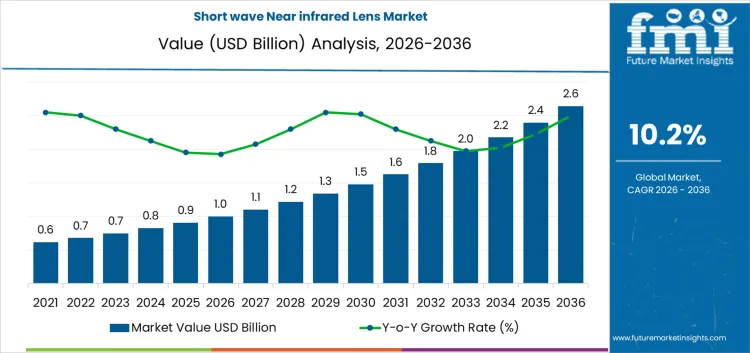
What is the Growth Forecast for Short Wave Near Infrared Lens Market through 2036?
The growth of the short wave near infrared lens market is being shaped by corridor-driven infrastructure buildouts rather than by uniform global adoption. Early demand concentrates in a limited number of industrial and logistics corridors where automated inspection, semiconductor fabrication, and high-throughput sorting systems are being deployed at scale. These corridors act as demand amplifiers because equipment platforms are standardized across multiple sites, which locks in specific optical specifications and multiplies lens volumes per project. Market expansion in this phase is therefore governed by hub dominance, not by country-level diffusion. Investment decisions are made at network and platform level, which means a small number of winning lens designs capture disproportionately large volumes. Growth intensity is uneven, but where it appears, it is structurally anchored and repeatable.
As these primary hubs mature, demand begins to propagate outward into secondary manufacturing zones and regional logistics nodes using the same inspection architectures. This spillover phase does not rely on new application discovery but on replication of proven system designs into lower-tier locations. The installed base broadens geographically while remaining technologically conservative. Volume growth accelerates because deployment friction is low and qualification cycles are already complete. The market reaches USD 2.6 billion by 2036 mainly through this replication effect, not through disruptive innovation. Competitive advantage rests on optical consistency, platform compatibility, and supply reliability, since buyers prioritize fast rollout and system standardization over incremental performance gains.
Short Wave Near Infrared Lens Market Key Takeaways
| Metric | Value |
|---|---|
| Market Value (2026) | USD 1.0 billion |
| Forecast Value (2036) | USD 2.6 billion |
| Forecast CAGR 2026 to 2036 | 10.2% |
How Are Short Wave Near Infrared Lenses Managing Failure Costs and Liability Exposure?
Short wave near infrared (SWNIR) lenses are increasingly adopted in industrial, medical, and defense imaging systems for precise light transmission and high-resolution sensing. Historically, optical systems relied on conventional lenses, which offered limited spectral control and were prone to misalignment, leading to operational errors and increased maintenance costs. Modern SWNIR lenses are engineered with specialized coatings, precise geometries, and robust materials to ensure consistent performance, minimize optical aberrations, and withstand environmental stress. Manufacturers, system integrators, and end-users prioritize optical accuracy, material reliability, and compliance with application-specific standards. Early adoption focused on scientific research and defense imaging, while current demand spans medical diagnostics, industrial inspection, and autonomous sensing applications, driven by high-stakes operational requirements and regulatory oversight. Optical precision, durability, and coating integrity influence supplier selection.
Failure of SWNIR lenses can lead to significant operational costs, including system downtime, calibration, and replacement, while liability exposure arises from inaccurate imaging, safety risks, or product defects. Compared with conventional lenses, modern SWNIR optics emphasize precise wavelength control, environmental resilience, and long-term stability to reduce failure probability. Cost structures depend on material quality, coating processes, and manufacturing tolerances, concentrating margins among suppliers capable of delivering certified, high-reliability lenses. System integrators adopt these lenses to minimize maintenance costs, ensure accurate measurements, and mitigate legal or operational liabilities. By 2036, high-precision SWNIR lenses are expected to become standard in industrial, medical, and defense imaging systems, supporting operational reliability, cost control, and reduced liability risk.
What Factors Are Shaping the Demand for Short Wave Near Infrared Lenses by Optical Design and End Use in 2026?
The short wave near infrared lens market in 2026 is segmented by optical type and by application. By optical design, demand is divided into fixed focus, zoom, telecentric, and wide angle NIR lenses, each serving different requirements for field of view, distortion control, and mechanical complexity. By application, demand is organized around machine vision systems, surveillance and security, biomedical imaging, and automotive sensing, which differ in scale of deployment, qualification cycles, and performance tolerances. These segments reflect how buyers balance existing system compatibility, image stability needs, and future expansion plans while selecting optics that must operate reliably in the 900 to 1700 nm range.
Why Do Fixed Focus NIR Lenses Dominate Through Installed Base Scale?
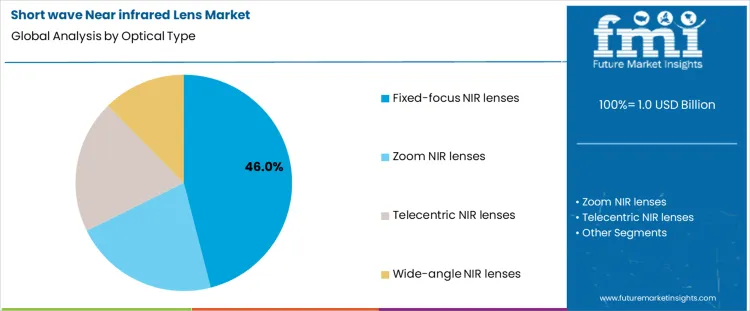
Fixed focus NIR lenses account for about 46% of demand in 2026, largely because of the size and inertia of the installed base in industrial vision and inspection systems. Thousands of production lines already rely on fixed geometry camera setups where the working distance and field of view rarely change. In such environments, stability and repeatability matter more than flexibility. Fixed focus lenses are simpler, more robust, and easier to qualify across large fleets of cameras. Once a configuration is validated, operators tend to replicate it across multiple lines and sites. Replacement demand also favors like for like components to avoid requalification. This accumulation of legacy systems and standardized layouts keeps fixed focus designs at the center of volume demand.
Zoom, telecentric, and wide angle lenses serve more specialized or evolving setups. Telecentric optics are essential where measurement accuracy is critical, yet they are expensive and used in narrower applications. Zoom lenses provide flexibility, but many production environments avoid moving optics because of drift and maintenance concerns. Wide angle lenses address coverage needs, yet they introduce distortion that must be corrected in software. These designs grow where new systems are built or where requirements change, but they do not displace the vast number of existing fixed focus installations. The weight of this installed base continues to anchor most unit shipments in the fixed focus category.
Why Is Machine Vision Driving Emerging Adoption Across Applications?
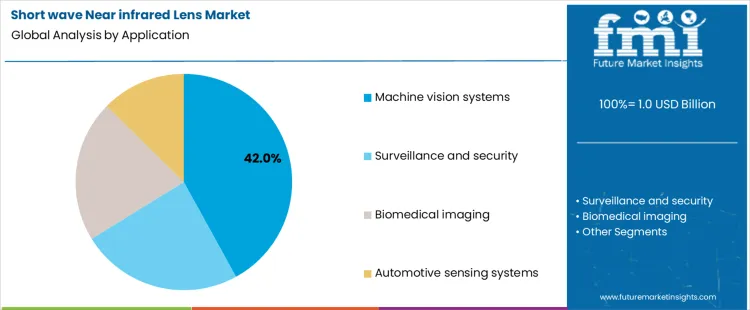
Machine vision systems represent about 42% of demand in 2026 and are also the main source of new adoption momentum for short wave NIR optics. New inspection tasks increasingly involve materials and features that are not visible in the standard spectrum, such as moisture content, coatings, or internal structures. This pushes system integrators to specify SWIR capable cameras and lenses in both new lines and upgrades. Unlike surveillance or medical imaging, which have longer qualification cycles and stricter regulatory paths, industrial vision projects can be deployed and scaled relatively quickly once a business case is proven. This makes machine vision the fastest moving application segment in terms of new system rollouts.
Surveillance, biomedical, and automotive uses follow slower or more selective adoption paths. Security systems adopt SWIR mainly for specific low light or obscured visibility scenarios rather than as a universal upgrade. Biomedical imaging requires long validation and clinical acceptance cycles, which limits the pace of deployment. Automotive sensing is still in a platform development phase, with optics specified years before volume production. These segments are strategically important, but their growth is staged. In contrast, machine vision continues to expand through incremental problem solving on factory floors, making it the primary driver of emerging demand for short wave near infrared lenses.
How Are Operating Model Shifts, Organizational Barriers, and Platform Scale Reshaping the Short Wave Near Infrared Lens Category through 2036?
The category is moving from project driven optics selection toward platform based deployment. Growth potential comes from large scale standardization of vision systems, while adoption speed is held back by conservative validation cultures and slow organizational change. Users increasingly buy inspection capability as a system, not as a collection of parts, which changes how lenses are specified, approved, and rolled out. This favors suppliers that can support documentation, consistency, and long term availability at scale. At the same time, many installations remain locked into legacy configurations because requalification cost and internal risk aversion outweigh incremental gains. The result is uneven adoption shaped more by operating models than by optical performance alone.
Why Is Process Standardization at Scale Becoming the Main Growth Lever for Short Wave Near Infrared Lenses through 2036?
Opportunity in this category is emerging from how vision systems are industrialized rather than from new use cases alone. Machine builders and integrators increasingly deploy identical inspection and sensing modules across multiple lines, plants, and regions. This favors lens platforms that can be produced, qualified, and supported in large, repeatable batches with predictable optical performance. Once a lens family is accepted into a standardized vision architecture, it benefits from volume pull across many projects without being re specified each time. This shifts growth from project by project selling to program based sourcing, where scale, consistency, and long term availability become the main drivers of unit demand.
Why Is Organizational Inertia Slowing Adoption Even When Technical Value Is Clear?
The main barrier is not optical performance but decision making structure. Many industrial and research users rely on long standing supplier relationships and proven configurations that are deeply embedded in validation procedures and documentation. Changing a lens triggers requalification of the entire imaging chain, including lighting, calibration, and software thresholds. This creates internal resistance even when newer options offer better performance or cost. Procurement and engineering often move at different speeds, further slowing change. In regulated or mission critical environments, the perceived risk of disruption outweighs incremental gains. As a result, replacement cycles are long and adoption depends more on organizational readiness than on technical merit.
How Is a Shift in Operating Models Changing How These Lenses Are Selected and Deployed?
The trend is moving away from bespoke optical selection toward system level sourcing. Vision systems are increasingly bought as integrated modules or platforms rather than as collections of individual components. This changes lens selection from an engineer level choice to a platform governance decision. Central teams define approved component lists that are reused across sites and projects. This favors suppliers that can support global programs, documentation, and lifecycle stability. It also means that once a lens family is selected, it can propagate quickly across many installations. The category is becoming driven by operating model design rather than by isolated optical optimization decisions.
What is the Demand for Short Wave Near-Infrared Lenses by Country?
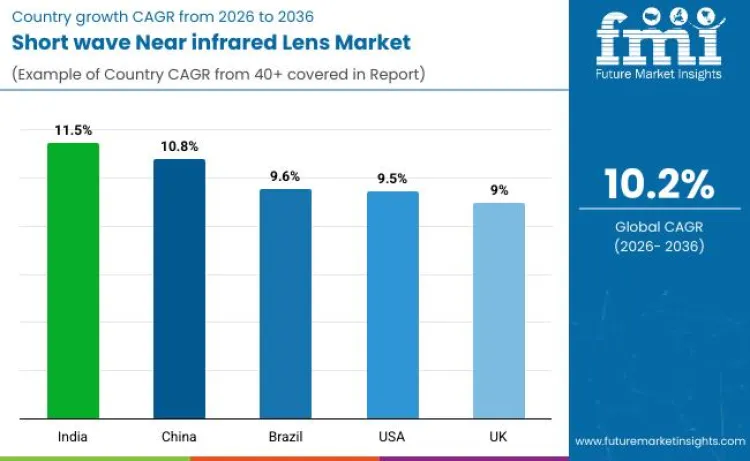
| Country | CAGR (%) |
|---|---|
| USA | 9.5% |
| UK | 9.0% |
| China | 10.8% |
| India | 11.5% |
| Brazil | 9.6% |
Demand for short wave near infrared lenses is rising as optical, imaging, and sensor manufacturers adopt advanced lenses for applications in medical imaging, industrial inspection, and security systems. India leads with an 11.5% CAGR, driven by growing adoption in healthcare diagnostics, industrial imaging solutions, and technological applications requiring precise infrared detection. China follows at 10.8%, supported by industrial automation, imaging device production, and sensor integration. Brazil records 9.6% growth, shaped by adoption in industrial and security applications. The USA grows at 9.5%, influenced by medical and defense applications. The UK shows 9.0% CAGR, reflecting steady demand for near-infrared lenses in scientific, industrial, and security systems.
How is the short wave near infrared lens market growing in the United States?
United States is experiencing growth at a CAGR of 9.5% underpinned by a large installed base of industrial and defense optical systems with predictable replacement cycles. High productivity pressure and relatively high labor cost structure push firms to adopt lenses that reduce maintenance and recalibration downtime. Industry concentration around defense contractors and advanced manufacturing clusters in California and the Northeast supports demand for premium optical components. Local production is strong but some high-precision subcomponents remain imported, keeping cost sensitivity moderate and price ceilings firm. Capital intensity in imaging and sensing systems leads to disciplined payback expectations, with procurement focused on long service life and integration with existing platforms rather than lowest upfront cost.
- Substantial installed optical systems base drives replacements.
- High labor costs increase preference for low-maintenance lenses.
- Defense and manufacturing clusters concentrate demand.
- Capital budgeting prioritizes durability and total cost of ownership.
How is the short wave near infrared lens market developing in the United Kingdom?
United Kingdom is experiencing growth at a CAGR of 9%, supported by a moderate installed base in industrial inspection, rail signaling, and security imaging that follows established replacement cycles. Productivity pressures in precision engineering and aerospace sectors encourage adoption of high-performance NIR lenses that minimize recalibration labor. Industry concentration in the Midlands and Scotland anchors stable demand for optical components, though smaller firms show higher cost sensitivity. Local manufacturing capacity exists but critical precision subcomponents remain imported, affecting payback expectations and price ceilings. Capital intensity in imaging platforms leads procurement to emphasize predictable lifecycle costs and integration ease. Growth reflects careful balancing of performance with cost constraints in UK industrial markets.
- Installed base in precision sectors sustains replacements.
- Labor productivity pressures favor reliable lens systems.
- Aerospace and security sectors concentrate demand.
- Cost sensitivity shapes payback expectations.
How is the short wave near infrared lens market evolving in China?
China is experiencing growth at a CAGR of 10.8%, driven by a rapidly expanding installed base of machine vision, industrial automation, and surveillance systems with brisk replacement cycles. Relatively lower labor costs reduce immediate productivity pressure but high throughput manufacturing heightens demand for robust NIR optics that support continuous operation. Industry concentration in Guangdong, Jiangsu, and Zhejiang provinces anchors demand, and local production of lenses and optical assemblies has strengthened, reducing import dependence. Cost sensitivity remains high in domestic supply chains, setting firm price ceilings and driving competitive pricing. Capital intensity in automated imaging platforms and tight payback expectations influence buyers to select lenses with proven reliability and integration support rather than experimental designs.
- Rapidly expanding installed base accelerates replacements.
- High-throughput manufacturing reduces tolerance for downtime.
- Regional industrial clusters concentrate demand.
- Local production mitigates import pressure and cost risk.
How is the short wave near infrared lens market expanding in India?
India is experiencing growth at a CAGR of 11.5%, supported by a growing installed base of imaging systems in automotive inspection, pharmaceuticals, and security screening with increasing replacement activity. Labor cost structure remains relatively low but productivity pressure in competitive manufacturing sectors makes durable, low-maintenance NIR lenses attractive. Industry concentration in Maharashtra, Tamil Nadu, and Karnataka anchors demand among domestic OEMs and system integrators. Local production capacity is emerging but many high-precision lenses and coatings are imported, elevating cost sensitivity and influencing price ceilings. Capital intensity and short payback expectations in cost-constrained projects lead decision-makers to prefer proven, modular lens solutions that minimize integration risk and offer predictable lifecycle performance.
- Growing installed base increases replacement demand.
- Productivity pressures in competitive sectors drive quality focus.
- Manufacturing hubs concentrate demand.
- Import dependence shapes cost and payback expectations.
How is the short wave near infrared lens market progressing in Brazil?
Brazil is experiencing growth at a CAGR of 9.6%, influenced by a modest installed base of industrial imaging and environmental monitoring systems with moderate replacement cycle rhythms. Labor cost structure is mixed, with relatively lower industrial wages but strong emphasis on productivity in export-linked industries. Industry concentration in São Paulo and Paraná supports demand for rugged NIR lenses in machine vision and process control applications. Local production of optical components is limited, making import dependence significant and heightening cost sensitivity among buyers. Capital intensity and payback expectations in projects with constrained budgets lead firms to balance upfront price against expected durability and service life. Growth reflects careful cost management in lens procurement and selective investment in high-performance imaging systems.
- Modest installed base shapes replacement timing.
- Mixed labor cost structure influences productivity pressures.
- Regional industrial clusters anchor demand.
- Import reliance drives cost sensitivity and payback focus.
Who Competes in the Short Wave Near Infrared Lens Market and How Is the Market Structured?
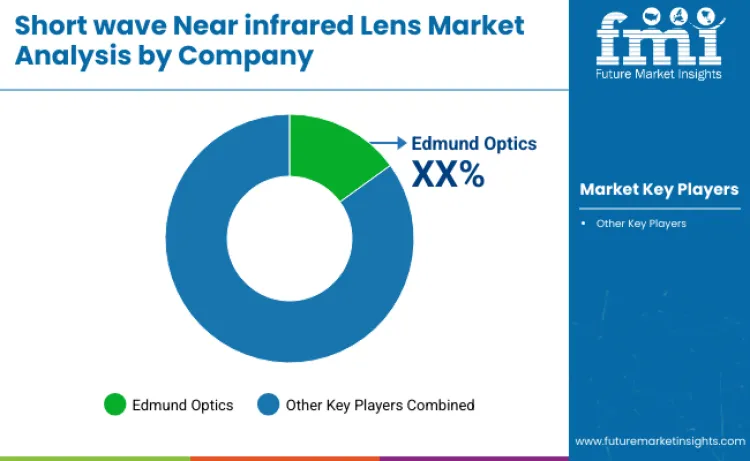
Competition in the short wave near infrared (SWIR) lens market is shaped by optical precision, material quality, and transmission efficiency. Edmund Optics supplies SWIR lenses optimized for imaging, sensing, and spectroscopy, emphasizing consistent transmission and low aberration. SCHOTT AG offers specialty optical glasses and lenses with high uniformity and durability for industrial, defense, and scientific applications. OptoSigma Corporation delivers custom lens solutions tailored for laboratory, machine vision, and industrial inspection systems. Navitar (CVI Laser Optics) develops precision SWIR optics with compact form factors for integration into imaging devices. Kaiser Optical Systems provides lenses engineered for high resolution and low distortion in scientific and military sensing applications. Jenoptik AG focuses on high-performance optics for machine vision, surveillance, and research applications. Sill Optics GmbH supplies specialized SWIR lenses optimized for thermal and spectral imaging.
The market exhibits moderate concentration, dominated by a few global players like Edmund Optics, SCHOTT AG, and Kaiser Optical Systems, who command a significant share of high-performance SWIR lens applications due to proprietary materials, precision manufacturing, and established service networks. Fragmentation exists among smaller regional and niche suppliers such as OptoSigma, Navitar, and Sill Optics, who provide custom or specialized lenses targeting laboratory, industrial, or localized defense applications. Competitive differentiation arises from optical quality, wavelength coverage, lens coatings, dimensional tolerances, and integration support. Market concentration is reinforced by high barriers to entry including precision glass manufacturing, cleanroom assembly, and quality validation, while fragmentation persists in lower-volume, highly specialized or custom SWIR lens solutions where agility and bespoke services are valued. Adoption across industrial, defense, scientific, and imaging applications reflects both the dominance of leading players and the continued opportunity for niche suppliers serving specific technical requirements.
Key Players in the Short Wave Near Infrared Lens Market
- Edmund Optics
- SCHOTT AG
- OptoSigma Corporation
- Navitar (CVI Laser Optics)
- Kaiser Optical Systems
- Jenoptik AG
- Sill Optics GmbH
Scope of the Report
| Items | Values |
|---|---|
| Quantitative Units (2026) | USD billion |
| Optical Type | Fixed-Focus NIR Lenses, Zoom NIR Lenses, Telecentric NIR Lenses, Wide-Angle NIR Lenses |
| Application | Machine Vision Systems, Surveillance and Security, Biomedical Imaging, Automotive Sensing Systems |
| Regions Covered | Asia Pacific, Europe, North America, Latin America, Middle East & Africa |
| Countries Covered | China, Japan, South Korea, India, Australia & New Zealand, ASEAN, Germany, United Kingdom, France, Italy, Spain, Nordic, BENELUX, United States, Canada, Mexico, Brazil, Chile, Saudi Arabia, Turkey, South Africa, and other regional markets |
| Key Companies Profiled | Edmund Optics, SCHOTT AG, OptoSigma Corporation, Navitar (CVI Laser Optics), Kaiser Optical Systems, Jenoptik AG, Sill Optics GmbH |
| Additional Attributes | Dollar sales by optical type and application; fixed-focus lenses as the largest segment; machine vision as the leading application; demand driven by standardized inspection platforms and semiconductor and industrial automation corridors; procurement shaped by qualification cycles, optical consistency, and supply reliability; adoption constrained by requalification cost, integration complexity, and organizational inertia. |
Short Wave Near Infrared Lens Market Segmentation
Optical Type:
- Fixed-focus NIR lenses
- Zoom NIR lenses
- Telecentric NIR lenses
- Wide-angle NIR lenses
Application:
- Machine vision systems
- Surveillance and security
- Biomedical imaging
- Automotive sensing systems
Region:
- Asia Pacific
- China
- Japan
- South Korea
- India
- Australia & New Zealand
- ASEAN
- Rest of Asia Pacific
- Europe
- Germany
- United Kingdom
- France
- Italy
- Spain
- Nordic
- BENELUX
- Rest of Europe
- North America
- United States
- Canada
- Mexico
- Latin America
- Brazil
- Chile
- Rest of Latin America
- Middle East & Africa
- Kingdom of Saudi Arabia
- Other GCC Countries
- Turkey
- South Africa
- Other African Union
- Rest of Middle East & Africa
Bibliography
- International Organization for Standardization. (2024). ISO 17319: Optics and photonics — Spectral responsivity measurements of detectors for imaging systems. ISO.
- European Committee for Standardization & European Committee for Electrotechnical Standardization. (2024). EN IEC 60825-1: Safety of laser products — Part 1: Equipment classification and requirements. CENELEC/CEN.
- Society of Motion Picture and Television Engineers. (2024). SMPTE ST 2084: High dynamic range electro-optical transfer function of mastering reference displays. SMPTE.
Frequently Asked Questions
How big is the short wave near infrared lens market in 2026?
The global short wave near infrared lens market is estimated to be valued at USD 1.0 billion in 2026.
What will be the size of short wave near infrared lens market in 2036?
The market size for the short wave near infrared lens market is projected to reach USD 2.6 billion by 2036.
How much will be the short wave near infrared lens market growth between 2026 and 2036?
The short wave near infrared lens market is expected to grow at a 10.2% CAGR between 2026 and 2036.
What are the key product types in the short wave near infrared lens market?
The key product types in short wave near infrared lens market are fixed‑focus nir lenses, zoom nir lenses, telecentric nir lenses and wide‑angle nir lenses.
Which application segment to contribute significant share in the short wave near infrared lens market in 2026?
In terms of application, machine vision systems segment to command 42.0% share in the short wave near infrared lens market in 2026.
Preview the report firsthand - request a free sample
Get SampleGet the brochure for pricing and purchase details.
Get PDFTable of Content
- Executive Summary
- Global Market Outlook
- Demand-side Trends
- Supply-side Trends
- Technology Roadmap Analysis
- Analysis and Recommendations
- Market Overview
- Market Coverage / Taxonomy
- Market Definition / Scope / Limitations
- Market Background
- Market Dynamics
- Drivers
- Restraints
- Opportunity
- Trends
- Scenario Forecast
- Demand in Optimistic Scenario
- Demand in Likely Scenario
- Demand in Conservative Scenario
- Opportunity Map Analysis
- Product Life Cycle Analysis
- Supply Chain Analysis
- Investment Feasibility Matrix
- Value Chain Analysis
- PESTLE and Porter’s Analysis
- Regulatory Landscape
- Regional Parent Market Outlook
- Production and Consumption Statistics
- Import and Export Statistics
- Market Dynamics
- Global Market Analysis 2021 to 2025 and Forecast, 2026 to 2036
- Historical Market Size Value (USD Million) Analysis, 2021 to 2025
- Current and Future Market Size Value (USD Million) Projections, 2026 to 2036
- Y-o-Y Growth Trend Analysis
- Absolute $ Opportunity Analysis
- Global Market Pricing Analysis 2021 to 2025 and Forecast 2026 to 2036
- Global Market Analysis 2021 to 2025 and Forecast 2026 to 2036, By Optical Type
- Introduction / Key Findings
- Historical Market Size Value (USD Million) Analysis By Optical Type, 2021 to 2025
- Current and Future Market Size Value (USD Million) Analysis and Forecast By Optical Type, 2026 to 2036
- Fixed‑focus NIR lenses
- Zoom NIR lenses
- Telecentric NIR lenses
- Wide‑angle NIR lenses
- Fixed‑focus NIR lenses
- Y-o-Y Growth Trend Analysis By Optical Type, 2021 to 2025
- Absolute $ Opportunity Analysis By Optical Type, 2026 to 2036
- Global Market Analysis 2021 to 2025 and Forecast 2026 to 2036, By Application
- Introduction / Key Findings
- Historical Market Size Value (USD Million) Analysis By Application, 2021 to 2025
- Current and Future Market Size Value (USD Million) Analysis and Forecast By Application, 2026 to 2036
- Machine vision systems
- Surveillance and security
- Biomedical imaging
- Automotive sensing systems
- Machine vision systems
- Y-o-Y Growth Trend Analysis By Application, 2021 to 2025
- Absolute $ Opportunity Analysis By Application, 2026 to 2036
- Global Market Analysis 2021 to 2025 and Forecast 2026 to 2036, By Region
- Introduction
- Historical Market Size Value (USD Million) Analysis By Region, 2021 to 2025
- Current Market Size Value (USD Million) Analysis and Forecast By Region, 2026 to 2036
- North America
- Latin America
- Western Europe
- Eastern Europe
- East Asia
- South Asia and Pacific
- Middle East & Africa
- Market Attractiveness Analysis By Region
- North America Market Analysis 2021 to 2025 and Forecast 2026 to 2036, By Country
- Historical Market Size Value (USD Million) Trend Analysis By Market Taxonomy, 2021 to 2025
- Market Size Value (USD Million) Forecast By Market Taxonomy, 2026 to 2036
- By Country
- USA
- Canada
- Mexico
- By Optical Type
- By Application
- By Country
- Market Attractiveness Analysis
- By Country
- By Optical Type
- By Application
- Key Takeaways
- Latin America Market Analysis 2021 to 2025 and Forecast 2026 to 2036, By Country
- Historical Market Size Value (USD Million) Trend Analysis By Market Taxonomy, 2021 to 2025
- Market Size Value (USD Million) Forecast By Market Taxonomy, 2026 to 2036
- By Country
- Brazil
- Chile
- Rest of Latin America
- By Optical Type
- By Application
- By Country
- Market Attractiveness Analysis
- By Country
- By Optical Type
- By Application
- Key Takeaways
- Western Europe Market Analysis 2021 to 2025 and Forecast 2026 to 2036, By Country
- Historical Market Size Value (USD Million) Trend Analysis By Market Taxonomy, 2021 to 2025
- Market Size Value (USD Million) Forecast By Market Taxonomy, 2026 to 2036
- By Country
- Germany
- UK
- Italy
- Spain
- France
- Nordic
- BENELUX
- Rest of Western Europe
- By Optical Type
- By Application
- By Country
- Market Attractiveness Analysis
- By Country
- By Optical Type
- By Application
- Key Takeaways
- Eastern Europe Market Analysis 2021 to 2025 and Forecast 2026 to 2036, By Country
- Historical Market Size Value (USD Million) Trend Analysis By Market Taxonomy, 2021 to 2025
- Market Size Value (USD Million) Forecast By Market Taxonomy, 2026 to 2036
- By Country
- Russia
- Poland
- Hungary
- Balkan & Baltic
- Rest of Eastern Europe
- By Optical Type
- By Application
- By Country
- Market Attractiveness Analysis
- By Country
- By Optical Type
- By Application
- Key Takeaways
- East Asia Market Analysis 2021 to 2025 and Forecast 2026 to 2036, By Country
- Historical Market Size Value (USD Million) Trend Analysis By Market Taxonomy, 2021 to 2025
- Market Size Value (USD Million) Forecast By Market Taxonomy, 2026 to 2036
- By Country
- China
- Japan
- South Korea
- By Optical Type
- By Application
- By Country
- Market Attractiveness Analysis
- By Country
- By Optical Type
- By Application
- Key Takeaways
- South Asia and Pacific Market Analysis 2021 to 2025 and Forecast 2026 to 2036, By Country
- Historical Market Size Value (USD Million) Trend Analysis By Market Taxonomy, 2021 to 2025
- Market Size Value (USD Million) Forecast By Market Taxonomy, 2026 to 2036
- By Country
- India
- ASEAN
- Australia & New Zealand
- Rest of South Asia and Pacific
- By Optical Type
- By Application
- By Country
- Market Attractiveness Analysis
- By Country
- By Optical Type
- By Application
- Key Takeaways
- Middle East & Africa Market Analysis 2021 to 2025 and Forecast 2026 to 2036, By Country
- Historical Market Size Value (USD Million) Trend Analysis By Market Taxonomy, 2021 to 2025
- Market Size Value (USD Million) Forecast By Market Taxonomy, 2026 to 2036
- By Country
- Kingdom of Saudi Arabia
- Other GCC Countries
- Turkiye
- South Africa
- Other African Union
- Rest of Middle East & Africa
- By Optical Type
- By Application
- By Country
- Market Attractiveness Analysis
- By Country
- By Optical Type
- By Application
- Key Takeaways
- Key Countries Market Analysis
- USA
- Pricing Analysis
- Market Share Analysis, 2025
- By Optical Type
- By Application
- Canada
- Pricing Analysis
- Market Share Analysis, 2025
- By Optical Type
- By Application
- Mexico
- Pricing Analysis
- Market Share Analysis, 2025
- By Optical Type
- By Application
- Brazil
- Pricing Analysis
- Market Share Analysis, 2025
- By Optical Type
- By Application
- Chile
- Pricing Analysis
- Market Share Analysis, 2025
- By Optical Type
- By Application
- Germany
- Pricing Analysis
- Market Share Analysis, 2025
- By Optical Type
- By Application
- UK
- Pricing Analysis
- Market Share Analysis, 2025
- By Optical Type
- By Application
- Italy
- Pricing Analysis
- Market Share Analysis, 2025
- By Optical Type
- By Application
- Spain
- Pricing Analysis
- Market Share Analysis, 2025
- By Optical Type
- By Application
- France
- Pricing Analysis
- Market Share Analysis, 2025
- By Optical Type
- By Application
- India
- Pricing Analysis
- Market Share Analysis, 2025
- By Optical Type
- By Application
- ASEAN
- Pricing Analysis
- Market Share Analysis, 2025
- By Optical Type
- By Application
- Australia & New Zealand
- Pricing Analysis
- Market Share Analysis, 2025
- By Optical Type
- By Application
- China
- Pricing Analysis
- Market Share Analysis, 2025
- By Optical Type
- By Application
- Japan
- Pricing Analysis
- Market Share Analysis, 2025
- By Optical Type
- By Application
- South Korea
- Pricing Analysis
- Market Share Analysis, 2025
- By Optical Type
- By Application
- Russia
- Pricing Analysis
- Market Share Analysis, 2025
- By Optical Type
- By Application
- Poland
- Pricing Analysis
- Market Share Analysis, 2025
- By Optical Type
- By Application
- Hungary
- Pricing Analysis
- Market Share Analysis, 2025
- By Optical Type
- By Application
- Kingdom of Saudi Arabia
- Pricing Analysis
- Market Share Analysis, 2025
- By Optical Type
- By Application
- Turkiye
- Pricing Analysis
- Market Share Analysis, 2025
- By Optical Type
- By Application
- South Africa
- Pricing Analysis
- Market Share Analysis, 2025
- By Optical Type
- By Application
- USA
- Market Structure Analysis
- Competition Dashboard
- Competition Benchmarking
- Market Share Analysis of Top Players
- By Regional
- By Optical Type
- By Application
- Competition Analysis
- Competition Deep Dive
- Competition Deep Dive
- Assumptions & Acronyms Used
- Research Methodology


