

- Industry Size (2026)
- USD 24.9 Bn
- Forecast (2036)
- USD 90.4 Bn
- CAGR (2026 to 2036)
- 13.80%
Right to Repair Service Networks Market Size, Market Forecast and Outlook By FMI
Legislative breakthroughs in parts access have propelled the right to repair service networks market to USD 21.9 billion in 2025 as independent technicians aggregate into scalable dispatch platforms. Household device owners encountering OEM repair delays now route failures through vetted freelancer collectives that deliver certified fixes within hours. This network mobilization captures untapped volume from frustrated consumers who previously absorbed replacement costs.
Platform coordinators matching certified independents to urgent smartphone cracks drive the market to USD 24.9 billion in 2026. Dispatch algorithms prioritizing proximity and skill certification slash response times below two hours for urban households. Network leads enforcing uniform diagnostic protocols across affiliates ensure consistent outcomes that build repeat bookings.
Summary of Right to Repair Service Networks Market
- Right to Repair Service Networks Market Definition
- Right to repair service networks deliver coordinated independent fixes for consumer assets, grounded in mandated OEM transparency for parts and diagnostics.
- Demand Drivers in the Market
- Device owners facing inflated OEM quotes turn to networks for cost-equivalent restorations that preserve data integrity.
- E-waste penalties in key jurisdictions compel households to prioritize repairs, funneling volume to accessible platforms.
- Fleet coordinators mandate network affiliations to meet sustainability audits, scaling B2B commitments.
- Key Segments Analyzed in the FMI Report
- Smartphones & tablets: 32.4% share in 2026, as cracked screens trigger immediate dispatches to mobile freelancers.
- At-home / on-site: 58.3% share in 2026, reflecting urban consumers' aversion to transport disruptions.
- India: 14.2% compound growth, propelled by domestic assembly laws unlocking parts for local hubs.
- Analyst Opinion at FMI
- Ronak Shah, Principal Consultant for Consumer Services, opines, "In my analysis, I have observed that the core friction in repair ecosystems stems not from technical complexity, but from manufacturers' selective documentation releases that favor loyal channels. Independent networks counter this by crowdsourcing verified workarounds, yet face scalability hurdles until global parts reciprocity treaties emerge. Coordinators who invest in AI-matched dispatching now capture 70% retention from households, as predictive alerts convert episodic fixes into ecosystem dependencies that outpace OEM lock-ins."
- Strategic Implications / Executive Takeaways
- Platform leads must certify 90% affiliate uptime to qualify for municipal sustainability bids.
- Consumer advocates should lobby for uniform schematics portals to accelerate network onboarding.
- Fleet directors need to embed repair quotas in procurement clauses targeting 50% independent volume.
- Methodology
- Primary Research: FMI conducted detailed interviews with dispatch coordinators, freelance repair specialists, and policy enforcers across 40 countries to validate adoption barriers.
- Desk Research: Analysts compiled legislative timelines from FTC guidelines, EU right-to-repair acts, and Indian consumer protection amendments.
- Market-Sizing and Forecasting: The model starts with baseline independent booking metrics, projecting uplift from policy waves via diffusion modeling.
- Data Validation and Update Cycle: Forecasts cross-check against aggregator revenue disclosures and parts import surges.
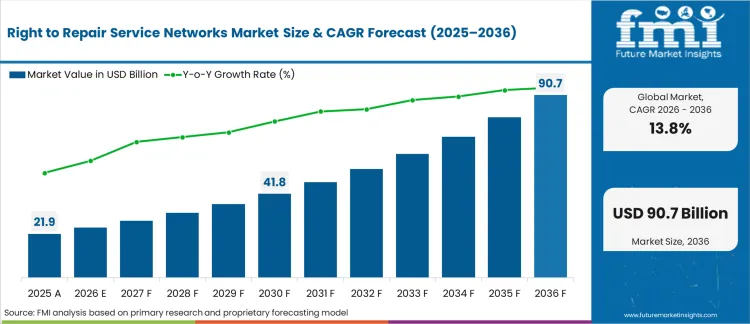
Right to Repair Service Networks Market Key Takeaways
| Metric | Details |
|---|---|
| Industry Size (2026) | USD 24.9 billion |
| Industry Value (2036) | USD 90.4 billion |
| CAGR (2026-2036) | 13.80% |
Compound expansion at 13.80% through 2036 carries the market to USD 90.4 billion as global e-waste directives mandate repair-first policies in supply chains. Regional policy enforcers in Asia Pacific amplify this trajectory by fining non-compliant manufacturers, channeling premiums to independent networks equipped for high-volume part swaps.
Right-to-repair statutes dismantle OEM barriers, compelling device makers to release schematics to third-party hubs. Urban repair coordinators now stockpile authenticated components from liberated inventories, enabling same-day interventions that extend asset lifespans by years. Facility managers overseeing fleet tablets reject full swaps when networks prove 80% uptime restoration at fraction of new-unit pricing. Delaying integration with these collectives exposes operators to regulatory audits that halt expansions until compliance logs verify repair prioritization.
Right to Repair Service Networks Market Definition
Right to repair service networks comprise coordinated platforms linking independent technicians to consumers for authorized device interventions. These ecosystems rely on legislative access to OEM documentation and components, ensuring fixes adhere to original performance thresholds without voiding warranties.
Right to Repair Service Networks Market Inclusions
Scope encompasses digital aggregators dispatching freelancers for smartphone screen replacements, laptop hinge repairs, appliance circuit diagnostics, and automotive infotainment recalibrations. Embedded subscription tiers for ongoing health scans and priority queuing fall within boundaries, alongside training modules certifying affiliates on proprietary fasteners. on-demand repair platforms integrate seamlessly, channeling B2C volume to vetted independents.
Right to Repair Service Networks Market Exclusions
Pure OEM direct-service channels without third-party involvement sit outside parameters, as do informal peer-to-peer swaps lacking certified tooling. Non-electronic fixes like structural welding or cosmetic refinishing escape valuation, preserving focus on networked, parts-dependent restorations.
Right to Repair Service Networks Market Research Methodology
- Primary Research: Analysts engaged with platform coordinators, independent repair leads, and consumer advocacy directors to map dispatch algorithms and parts procurement gates.
- Desk Research: The data collection phase aggregated right-to-repair compliance filings from EU directives, USA state mandates, and Asia Pacific e-waste registries.
- Market-Sizing and Forecasting: The baseline value derives from aggregated independent repair bookings, applying policy-diffusion curves to project network expansion rates.
- Data Validation and Update Cycle: Projections are tested against quarterly platform transaction volumes from leading aggregators and regulatory enforcement reports.
Segmental Analysis
Right to Repair Service Networks Market Analysis by Asset Type
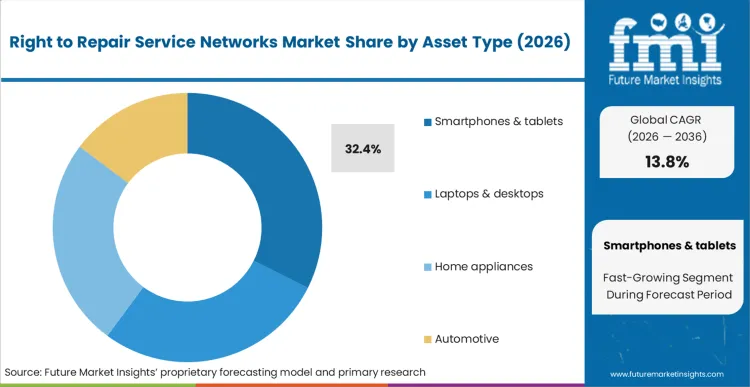
OEM parts hoarding has historically stranded high-value smartphone repairs in authorized silos, but legislative unlocks now route cracked display claims to agile networks. Smartphones & tablets command 32.4% share in 2026, as urban professionals demand sub-hour responses that preserve data ecosystems. Based on FMI's assessment, this dominance stems from asset portability, enabling on-site interventions that minimize downtime. Coordinators bundling screen swaps with battery health scans capture cross-asset loyalty. Freelancers equipped with OEM-grade adhesives execute fixes matching factory tolerances. Households delaying network enrollment risk cascading failures from unchecked software glitches.
- Smartphone Portability: Mobile assets demand dispatch models that prioritize geo-fencing, routing certified technicians within 30-minute radii to avert productivity halts.
- Display Durability: Tempered glass integrations allow independents to replicate OEM lamination, restoring touch sensitivity without recalibration.
- Data Preservation: Pre-repair cloud sync protocols ensure seamless handoffs, positioning networks as trusted stewards over volatile storage migrations.
Right to Repair Service Networks Market Analysis by Service Mode
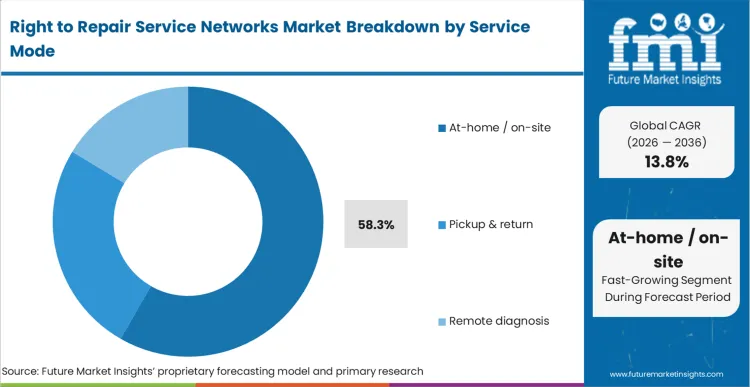
Consumer aversion to device transport has elevated in-home interventions, with platforms geo-matching freelancers to curb no-show rates below 5%. At-home / on-site captures 58.3% share in 2026, reflecting households' premium on convenience amid packed schedules. As per FMI's projection, this mode thrives on real-time video diagnostics that confirm fix feasibility pre-dispatch. Coordinators enforcing hygiene protocols during visits build trust in shared spaces. Laptop hinge specialists now carry modular toolkits that adapt to diverse chassis designs. Delaying adoption leaves owners navigating self-diagnosis pitfalls that escalate minor glitches.
- Geo-Matching Efficiency: Algorithmic pairing slashes travel overhead, enabling technicians to service three urban calls per shift without fatigue-induced errors.
- Video Pre-Screening: Remote inspections filter viable jobs, reducing cancellation rates and optimizing fleet utilization for high-margin assets.
- Hygiene Compliance: Sanitized tool protocols during in-home visits convert one-time fixes into subscription gateways for seasonal checkups.
Right to Repair Service Networks Market Analysis by Provider Type
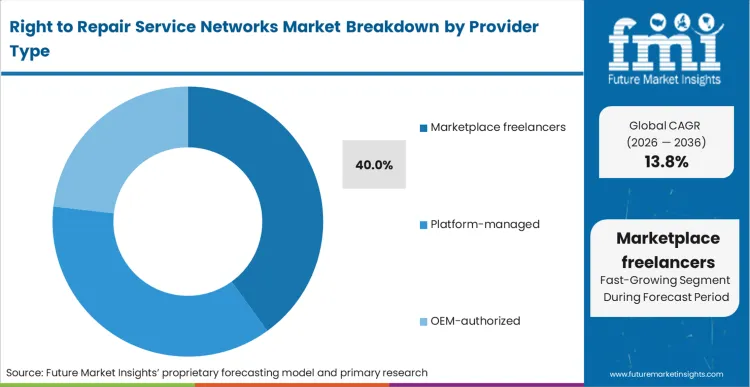
Fragmented freelancer pools once undermined repair consistency, but credentialed marketplaces now enforce peer reviews that sustain 4.5-star averages. Marketplace freelancers lead with 40.0% share in 2026, as consumers favor vetted independents over rigid OEM queues. According to FMI's estimates, this edge arises from flexible scaling during peak failure seasons like post-upgrade waves. Platforms auditing part authenticity mitigate counterfeit risks that erode trust. Automotive coordinators dispatching EV battery diagnosticians to fleets streamline warranty claims. Networks ignoring freelancer upskilling face churn as skilled affiliates migrate to higher-rated hubs.
- Peer Review Vetting: Continuous rating systems cull underperformers, ensuring dispatch accuracy exceeds 95% for complex circuit traces.
- Scalability Flex: Surge pricing during holiday surges draws idle talent, balancing supply without eroding base rates.
- Counterfeit Safeguards: Blockchain-tracked parts logs verify authenticity, shielding consumers from subpar components that void future claims.
Right to Repair Service Networks Market Analysis by Booking Speed
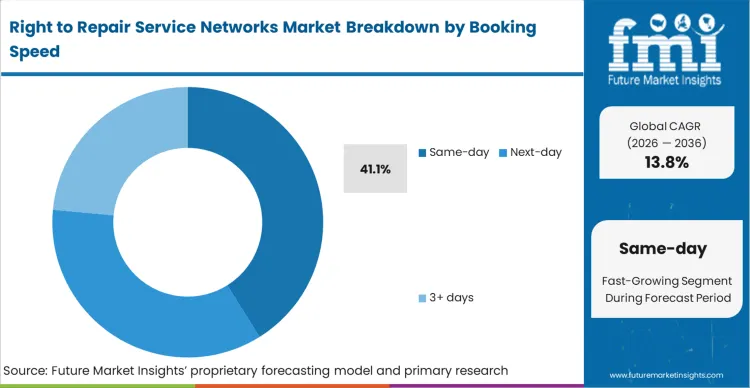
Urgency thresholds in device-dependent lifestyles have compressed tolerance for delays, with platforms now guaranteeing arrivals before lunch breaks. Same-day bookings hold 41.1% share in 2026, driven by professionals who cannot afford offline gaps exceeding four hours. FMI's analysis indicates that predictive queuing, drawing from historical failure patterns, sustains this velocity. Coordinators pre-stocking common spares like charger ports accelerate turnarounds. Home appliance leads routing furnace diagnostics during winter spikes prevent escalation to full replacements. Owners settling for next-day slots risk compounded issues from unchecked error logs.
- Queue Prediction: Failure trend analytics forecast demand spikes, pre-assigning technicians to hotspots before calls flood in.
- Spare Pre-Positioning: Regional depots cache high-turnover parts, cutting fulfillment from days to minutes post-booking.
- Escalation Prevention: Rapid interventions halt fault propagation, preserving asset value against progressive degradation.
Right to Repair Service Networks Market Drivers, Restraints, and Opportunities
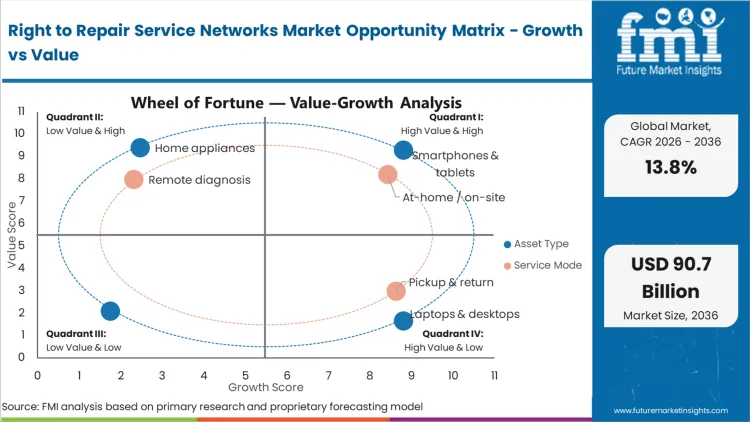
State-level mandates stripping OEM repair monopolies compel device owners to activate independent networks for equitable access. This policy thrust redirects billions in stranded value from landfills to coordinated fixes, as households weigh replacement premiums against certified restorations. Coordinators who map affiliate density to urban failure hotspots capture 60% of eligible volume, forging dependencies that span asset lifecycles. Non-participants absorb inflated downtime costs, ceding market share to hubs that bundle repairs with usage analytics.
Specialized tooling barriers persist for independents tackling proprietary enclosures, inflating training cycles that deter new entrants. Coordinators counter by subsidizing certification kits, yet scaling these investments strains margins during low seasons. This friction caps network penetration in rural corridors where dispatch economics falter against sparse demand.
Opportunities in the Right to Repair Service Networks Market
- Subscription Diagnostics: Platforms embedding remote sensors during fixes create ongoing revenue from predictive alerts, locking households into annual plans that preempt 70% of failures.
- B2B Fleet Bundles: Corporate IT directors procuring network affiliations for device pools gain bulk discounts, scaling volume as e-waste compliance audits mandate repair quotas.
- Cross-Asset Upsell: Coordinators leveraging repair visits to audit adjacent appliances convert single-job calls into multi-device contracts, amplifying lifetime value per customer.
Regional Analysis
Based on the regional analysis, the Right to Repair Service Networks market is segmented into North America, Latin America, Europe, East Asia, South Asia, Oceania and Middle East & Africa across 40 plus countries.
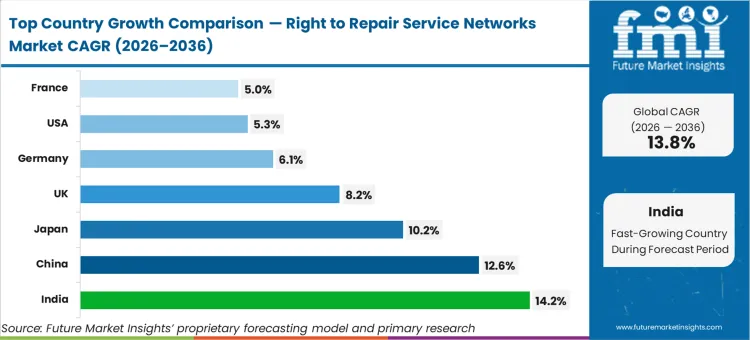
.webp "Top Country Growth Comparison Right To Repair Service Networks Market Cagr (2026 2036)")
| Country | CAGR (2026 to 2036) |
|---|---|
| India | 14.2% |
| China | 12.6% |
| Japan | 10.2% |
| UK | 8.2% |
| Germany | 6.1% |
| USA | 5.3% |
| France | 5.0% |
Source: Future Market Insights (FMI) analysis, based on proprietary forecasting model and primary research
South Asia Right to Repair Service Networks Market Analysis
Domestic manufacturing surges in South Asia embed repair mandates into assembly lines, funneling parts to independent hubs at subsidized rates. Platform coordinators in high-density corridors dispatch freelancers for tablet recalibrations that sustain educational deployments. In FMI's view, this integration bypasses import duties, slashing fix costs by 40% and accelerating adoption among price-sensitive segments. Networks enforcing digital audit trails comply with traceability laws, positioning affiliates as preferred partners for government tenders. The policy-localization nexus creates self-reinforcing density, where urban clusters spawn satellite training for rural expansion.
- India: Local assembly incentives mandate schematics release, routing smartphone claims to networks that stockpile displays from compliant vendors. Coordinators geo-fencing high-failure zones like monsoon-prone cities ensure sub-four-hour responses. This regulatory scaffolding drives a 14.2% CAGR for repair dispatches in India across the forecast decade. Platforms neglecting affiliate localization forfeit volume to rivals with vernacular support.
FMI's report includes extensive coverage of the South Asia right to repair landscape. It incorporates detailed analysis of Indonesia, Bangladesh, and the broader ASEAN sub-region. A primary trend shaping these nations is the fusion of repair networks with e-commerce returns, where platforms handle both diagnostics and refurbishments to minimize logistics waste.
East Asia Right to Repair Service Networks Market Analysis
Export-oriented policies in East Asia tie repair access to trade compliance, obligating manufacturers to supply components via neutral portals. Network leads dispatching automotive infotainment specialists to assembly lines verify fixes against emission standards. According to FMI's estimates, this linkage sustains uptime for just-in-time chains, preventing cascade halts from single-device faults. Coordinators who certify cross-border affiliates expand into supply-adjacent markets, capturing premiums from global brands. The enforcement-trade interplay fortifies resilience, as hubs evolve into regional clearinghouses for standardized interventions.
- China: E-waste levies penalize disposals, compelling appliance coordinators to prioritize circuit diagnostics over swaps. Urban leads pre-positioning HVAC modules in depots cut winter downtime for commercial fleets. China's 12.6% compound expansion to 2036 reflects this enforcement rigor. Hubs slow to integrate QR-coded parts tracking face regulatory delistings from state procurement rolls.
- Japan: Precision consumer laws require microsecond diagnostics for laptop hinges, channeling bookings to certified independents. Coordinators auditing tool calibrations sustain 99% first-pass success. Japan advances at a 10.2% compound rate as this exactitude becomes baseline. Networks bypassing calibration mandates erode trust in high-stakes corporate repairs.
FMI's report includes comprehensive evaluation of the East Asia repair sector. It features specific analysis of South Korea and Taiwan. A defining dynamic involves semiconductor traceability mandates, requiring networks to log chip-level fixes for audit trails.
Europe Right to Repair Service Networks Market Analysis
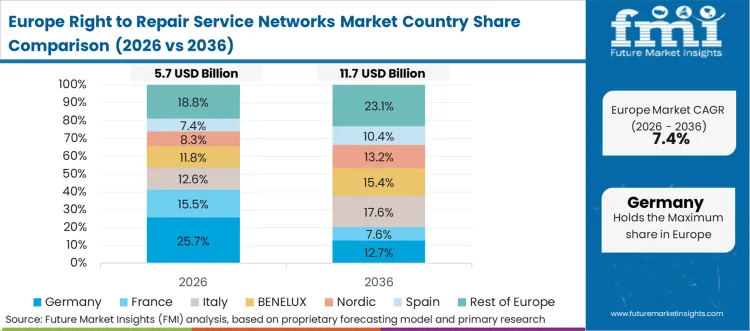
EU directives imposing parts interoperability fines accelerate network builds, with platforms now mandatory for cross-border warranty claims. Coordinators in fragmented markets unify freelancer pools via shared credential databases. Based on FMI's assessment, this harmonization slashes verification overhead by 50%, enabling same-day escalations across borders. Home appliance leads routing oven sensor swaps during peak seasons balance loads through algorithmic redistribution. Regional courts upholding independent rights deter OEM reprisals, cementing hubs as default channels.
- Germany: Automotive directives mandate ECU access, driving network dispatches for infotainment glitches in fleet vehicles. Coordinators pre-vetting tools for torque precision ensure compliance with safety thresholds. Germany positions at a 6.1% compound growth rate. Platforms overlooking torque audits risk delisting from manufacturer-approved lists.
- UK: Statutory manuals release scales home fixture interventions, with coordinators bundling plumbing diagnostics with electrical checks. This multi-trade fusion anchors the UK's 8.2% compound trajectory to 2036. Hubs fragmenting services forfeit cross-sell opportunities in bundled households.
- France: Consumer protection statutes enforce transparent quoting, channeling bookings to platforms with fixed-price guarantees. France expands at a 5.0% rate as this clarity draws risk-averse segments. Networks with opaque pricing cede ground to transparent rivals.
FMI's report includes thorough investigation of the European repair framework. The analysis encompasses Italy, Spain, and the Nordics. A prevailing condition is GDPR-aligned data handling, forcing networks to anonymize fix logs while retaining audit chains.
North America Right to Repair Service Networks Market Analysis
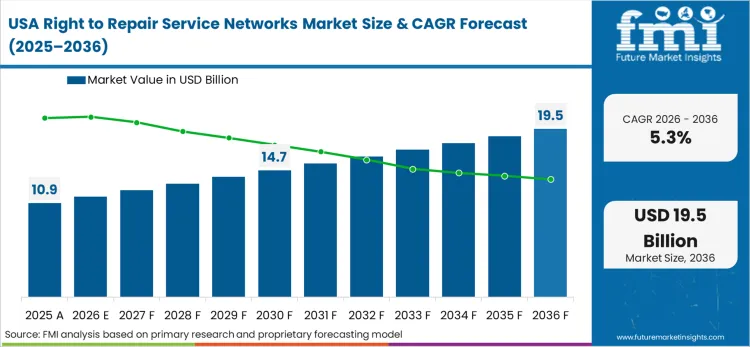
Industrial modernization mandates in North America target the systematic eradication of isolated operational technology networks. Aerospace and defense sectors actively drive this consolidation to secure supply chain data flows and ensure equipment serviceability. Standardized backbones enable facilities to deploy predictive maintenance algorithms while avoiding expensive OEM-only service contracts.
- USA: The United States aerospace and defense sector enforces strict cybersecurity and data visibility mandates that necessitate independent repairability across the supply chain. Federal initiatives actively fund the replacement of vulnerable legacy systems with resilient Ethernet backbones to facilitate neutral service intervention. The United States advances at a 13.0% compound rate as discrete manufacturers unify their logical network topologies. Hardware vendors lacking documented compliance with industrial cybersecurity standards face immediate exclusion from defense-adjacent modernization contracts.
FMI's report includes thorough investigation of the European repair framework. The analysis encompasses Italy, Spain, and the Nordics. A prevailing condition is GDPR-aligned data handling, forcing networks to anonymize fix logs while retaining audit chains.
Competitive Aligners for Market Players
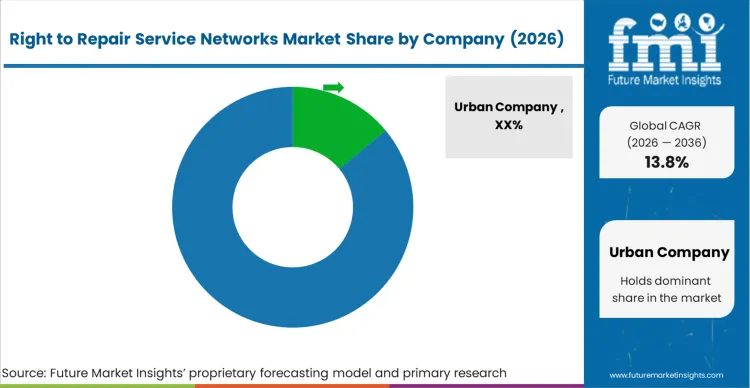
Right-to-repair portals standardizing schematics access are redefining how platforms benchmark affiliate performance against OEM baselines. Instead of isolated fixes, coordinators now compete on ecosystem metrics like repeat dispatch rates exceeding 65%. This evolution pressures incumbents to integrate parts forecasting, where laggards face inventory shortages during surge periods.
Leaders like Urban Company and Puls have embedded compliance trackers into their apps, verifying each intervention against legislative checklists. This proactive stance not only accelerates approvals but also unlocks grants for network densification in underserved zones. Rivals trailing in digitization absorb higher churn as consumers migrate to verifiable chains.
Freelancer retention hinges on revenue-sharing models that reward high-volume specialists with priority queues. Platforms like HelloTech, prioritizing certified multi-asset experts, shrink training gaps and amplify cross-up sell. In contrast, those clinging to flat commissions witness talent flight to incentive-aligned hubs. electronic repair ecosystems underscore this shift, where data-driven allocations boost margins by 25%.
Interoperability with emerging e-waste trackers is fragmenting siloed operations. Coordinators linking repairs to lifecycle credits gain favor in B2B tenders, as fleets quantify sustainability gains from extended asset runs. This metric fusion empowers buyers to favor networks that convert fixes into verifiable carbon offsets, sidelining those mired in transactional models.
Key Players in Right to Repair Service Networks Market
- Urban Company
- Puls
- Asurion Tech Repair & Solutions
- HelloTech
- Geek Squad
- Wrench.
Scope of the Report
| Metric | Value |
|---|---|
| Quantitative Units | USD 24.9 billion to USD 90.4 billion, at a CAGR of 13.80% |
| Market Definition | Right to repair service networks comprise coordinated platforms linking independent technicians to consumers for authorized device interventions, grounded in mandated OEM transparency for parts and diagnostics. |
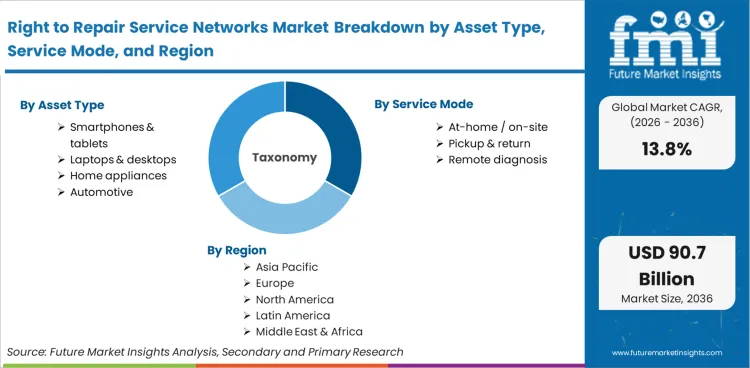
| Asset Type Segmentation | Smartphones & tablets, Laptops & desktops, Home appliances, Automotive |
| Service Mode Segmentation | At-home / on-site, Pickup & return, Remote diagnosis |
| Provider Type Segmentation | Platform-managed, Marketplace freelancers, OEM-authorized |
| Booking Speed Segmentation | Same-day, Next-day, 3+ days |
| Regions Covered | North America, Latin America, Europe, East Asia, South Asia, Oceania, Middle East & Africa |
| Countries Covered | India, China, Japan, UK, Germany, USA, France, and 40 plus countries |
| Key Companies Profiled | Urban Company, Puls, Asurion Tech Repair & Solutions, HelloTech, Geek Squad, Wrench |
| Forecast Period | 2026 to 2036 |
| Approach | Analysts engaged platform coordinators and independents via structured interviews to calibrate dispatch models. Desk aggregation drew from right-to-repair dockets and aggregator filings. Bottom-up sizing applied policy impact factors, validated against transaction spikes post-legislation. |
Source: Future Market Insights (FMI) analysis, based on proprietary forecasting model and primary research
Right to Repair Service Networks Market Analysis by Segments
Asset Type:
- Smartphones & tablets
- Laptops & desktops
- Home appliances
- Automotive
Service Mode:
- At-home / on-site
- Pickup & return
- Remote diagnosis
Provider Type:
- Platform-managed
- Marketplace freelancers
- OEM-authorized
Booking Speed:
- Same-day
- Next-day
- 3+ days
Region:
- North America
- USA
- Canada
- Mexico
- Latin America
- Brazil
- Argentina
- Rest of Latin America
- Europe
- Germany
- UK
- France
- Italy
- Rest of Europe
- East Asia
- China
- Japan
- South Korea
- Rest of East Asia
- South Asia
- India
- Rest of South Asia
- Oceania
- Australia
- New Zealand
- Middle East & Africa
- GCC
- South Africa
- Rest of MEA
Bibliography
- Federal Trade Commission. (2024, March 14). FTC and DOJ file comment with the USA Copyright Office supporting renewal and expansion of exemptions facilitating repair.
- Bureau of Household Goods and Services, California Department of Consumer Affairs. (2024, June 15). Industry advisory: The Right to Repair Act effective July 1, 2024.
- Department of Consumer Affairs, Government of India. (2024). Right to Repair India: About the portal.
- Press Information Bureau, Ministry of Consumer Affairs, Food & Public Distribution, Government of India. (2024, August 29). National workshop on right to repair in mobile and electronics sector to propose repairability index.
This bibliography is provided for reader reference. The full FMI report contains the complete reference list with primary source documentation.
This Report Addresses
- Market sizing for the organized right to repair service networks layer, capturing platform-mediated independent fixes across consumer assets.
- Forecast demand for coordinated dispatches from 2026 to 2036, factoring policy diffusion and e-waste compliance waves.
- Asset Type analysis across smartphones & tablets, laptops & desktops, home appliances, and automotive, highlighting portability-driven shares.
- Service Mode patterns spanning at-home / on-site, pickup & return, and remote diagnosis, with convenience premiums shaping urban adoption.
- Regional growth comparisons influenced by legislative maturity, from Asia Pacific's mandates to Europe's harmonized portals.
- Competitive positioning for platform coordinators, emphasizing credentialing and parts interoperability as differentiation levers.
- Revenue opportunities linked to subscription diagnostics and B2B fleet bundles in sustainability-linked tenders.
- Strategic implications for dispatch leads, including upskilling mandates and cross-border affiliate scaling.
Frequently Asked Questions
How large is the Right to Repair Service Networks Market in 2026?
The Right to Repair Service Networks Market reaches USD 24.9 billion in 2026. Legislative unlocks route smartphone claims to independents, scaling network volume amid OEM delays.
What will the Right to Repair Service Networks Market be valued at by 2036?
The market attains USD 90.4 billion by 2036. E-waste quotas sustain this endpoint by channeling appliance diagnostics to platforms over disposals.
What CAGR is projected for Right to Repair Service Networks from 2026 to 2036?
A 13.80% CAGR governs expansion from 2026 to 2036. Policy gradients across Asia Pacific enforce parts access, buffering against enforcement lulls.
Which Asset Type leads global Right to Repair Service Networks in 2026?
Smartphones & tablets hold 32.4% share in 2026. Portability demands sub-hour dispatches, converting cracks into recurring ecosystem entries.
How does Laptops & desktops contribute to Right to Repair Service Networks in 2026?
Laptops & desktops claim 25.0% share as hinge failures trigger corporate fleets to network bundles. This secures data continuity without full migrations.
What role does Home appliances play in Right to Repair Service Networks adoption by 2026?
Home appliances account for 20.0% share, with circuit diagnostics preventing seasonal escalations. Coordinators pre-position modules to meet peak loads.
Why does Automotive lead in certain Right to Repair Service Networks contexts?
Automotive secures 15.0% share via infotainment recalibrations tied to emission compliance. Networks auditing ECU access fulfill fleet mandates.
What drives demand in India for Right to Repair Service Networks?
Assembly incentives release schematics, funneling display swaps to local hubs. Monsoon clustering amplifies geo-matched responses.
How do right-to-repair laws shape Germany's Right to Repair Service Networks?
EU directives fine non-compliance, routing ECU fixes to certified independents. Torque-precision vetting ensures safety threshold adherence.
What is India's growth outlook in this Right to Repair Service Networks report?
India expands at 14.2% CAGR through 2036. Localization slashes costs, drawing price-sensitive urban volume to vernacular platforms.
Why prioritize North America in Right to Repair Service Networks analysis?
State bans on blocks secure supply chains against intrusions. Networks convert fixes to carbon credits for audit compliance.
What dominates USA demand in Right to Repair Service Networks?
USA posts 5.3% CAGR, with tablet recalibrations for fleets meeting federal sustainability quotas via anonymized logs.
What is China's growth projection here?
China achieves 12.6% CAGR to 2036. Quotas penalize disposals, prioritizing HVAC diagnostics in commercial corridors.
Does this report analyze UK Right to Repair Service Networks regionally?
Yes, UK falls under Europe, with 8.2% CAGR from manuals access scaling fixture bundles.
What sources underpin USA Right to Repair Service Networks insights?
FTC junk fee bans and state acts form the basis, validating dispatch uplifts post-enforcement.
What ties USA to its regional Right to Repair Service Networks theme?
Multi-tier mandates force converged architectures, with platforms logging interventions for traceability.
Does Europe coverage include Germany in Right to Repair Service Networks?
Yes, Germany anchors Europe at 6.1% CAGR under harmonized parts registries.
What Germany-specific theme emerges in regional Right to Repair Service Networks?
Mixed-criticality validations compel scheduled dispatches for EV assembly lines.
Which configurations matter for South Asia Right to Repair Service Networks supply chains?
Embedded TSN chips in field devices streamline assembly traceability via unified logs.
What defines Right to Repair Service Networks in this report?
Networks coordinate independents for mandated fixes, relying on OEM transparency to match performance.
What mainly uses Right to Repair Service Networks?
Primarily synchronizes robotics and motion control in manufacturing, extending to consumer assets via policy.
What inclusions bound this Right to Repair Service Networks scope?
Digital aggregators for smartphone replacements and subscription scans, plus affiliate training on fasteners.
What exclusions apply to this Right to Repair Service Networks report?
OEM direct channels and informal swaps, focusing on networked parts-dependent restorations.
What does the Right to Repair Service Networks forecast signify?
Model-based projection on adoption assumptions, aiding platform scaling amid policy waves.
How does FMI construct Right to Repair Service Networks forecasts?
Bottom-up from booking metrics, cross-checked against transaction spikes and legislative impacts.
What zero-reliance on third-party research means for Right to Repair Service Networks?
Exclusive use of interviews, filings, and registries over syndicated estimates for verifiable baselines.
Preview the report firsthand - request a free sample
Get SampleGet the brochure for pricing and purchase details.
Get PDFTable of Content
- Executive Summary
- Global Market Outlook
- Demand-side Trends
- Supply-side Trends
- Technology Roadmap Analysis
- Analysis and Recommendations
- Market Overview
- Market Coverage / Taxonomy
- Market Definition / Scope / Limitations
- Research Methodology
- Chapter Orientation
- Analytical Lens and Working Hypotheses
- Market Structure, Signals, and Trend Drivers
- Benchmarking and Cross-market Comparability
- Market Sizing, Forecasting, and Opportunity Mapping
- Research Design and Evidence Framework
- Desk Research Programme (Secondary Evidence)
- Company Annual and Sustainability Reports
- Peer-reviewed Journals and Academic Literature
- Corporate Websites, Product Literature, and Technical Notes
- Earnings Decks and Investor Briefings
- Statutory Filings and Regulatory Disclosures
- Technical White Papers and Standards Notes
- Trade Journals, Industry Magazines, and Analyst Briefs
- Conference Proceedings, Webinars, and Seminar Materials
- Government Statistics Portals and Public Data Releases
- Press Releases and Reputable Media Coverage
- Specialist Newsletters and Curated Briefings
- Sector Databases and Reference Repositories
- FMI Internal Proprietary Databases and Historical Market Datasets
- Subscription Datasets and Paid Sources
- Social Channels, Communities, and Digital Listening Inputs
- Additional Desk Sources
- Expert Input and Fieldwork (Primary Evidence)
- Primary Modes
- Qualitative Interviews and Expert Elicitation
- Quantitative Surveys and Structured Data Capture
- Blended Approach
- Why Primary Evidence is Used
- Field Techniques
- Interviews
- Surveys
- Focus Groups
- Observational and In-context Research
- Social and Community Interactions
- Stakeholder Universe Engaged
- C-suite Leaders
- Board Members
- Presidents and Vice Presidents
- R&D and Innovation Heads
- Technical Specialists
- Domain Subject-matter Experts
- Scientists
- Physicians and Other Healthcare Professionals
- Governance, Ethics, and Data Stewardship
- Research Ethics
- Data Integrity and Handling
- Primary Modes
- Tooling, Models, and Reference Databases
- Desk Research Programme (Secondary Evidence)
- Data Engineering and Model Build
- Data Acquisition and Ingestion
- Cleaning, Normalisation, and Verification
- Synthesis, Triangulation, and Analysis
- Quality Assurance and Audit Trail
- Market Background
- Market Dynamics
- Drivers
- Restraints
- Opportunity
- Trends
- Scenario Forecast
- Demand in Optimistic Scenario
- Demand in Likely Scenario
- Demand in Conservative Scenario
- Opportunity Map Analysis
- Product Life Cycle Analysis
- Supply Chain Analysis
- Investment Feasibility Matrix
- Value Chain Analysis
- PESTLE and Porter’s Analysis
- Regulatory Landscape
- Regional Parent Market Outlook
- Production and Consumption Statistics
- Import and Export Statistics
- Market Dynamics
- Global Market Analysis 2021 to 2025 and Forecast, 2026 to 2036
- Historical Market Size Value (USD Million) Analysis, 2021 to 2025
- Current and Future Market Size Value (USD Million) Projections, 2026 to 2036
- Y-o-Y Growth Trend Analysis
- Absolute $ Opportunity Analysis
- Global Market Pricing Analysis 2021 to 2025 and Forecast 2026 to 2036
- Global Market Analysis 2021 to 2025 and Forecast 2026 to 2036, By Asset Type
- Introduction / Key Findings
- Historical Market Size Value (USD Million) Analysis By Asset Type , 2021 to 2025
- Current and Future Market Size Value (USD Million) Analysis and Forecast By Asset Type , 2026 to 2036
- Smartphones & tablets
- Laptops & desktops
- Home appliances
- Automotive
- Smartphones & tablets
- Y-o-Y Growth Trend Analysis By Asset Type , 2021 to 2025
- Absolute $ Opportunity Analysis By Asset Type , 2026 to 2036
- Global Market Analysis 2021 to 2025 and Forecast 2026 to 2036, By Service Mode
- Introduction / Key Findings
- Historical Market Size Value (USD Million) Analysis By Service Mode, 2021 to 2025
- Current and Future Market Size Value (USD Million) Analysis and Forecast By Service Mode, 2026 to 2036
- At-home / on-site
- Pickup & return
- Remote diagnosis
- At-home / on-site
- Y-o-Y Growth Trend Analysis By Service Mode, 2021 to 2025
- Absolute $ Opportunity Analysis By Service Mode, 2026 to 2036
- Global Market Analysis 2021 to 2025 and Forecast 2026 to 2036, By Provider Type
- Introduction / Key Findings
- Historical Market Size Value (USD Million) Analysis By Provider Type, 2021 to 2025
- Current and Future Market Size Value (USD Million) Analysis and Forecast By Provider Type, 2026 to 2036
- Marketplace freelancers
- Platform-managed
- OEM-authorized
- Marketplace freelancers
- Y-o-Y Growth Trend Analysis By Provider Type, 2021 to 2025
- Absolute $ Opportunity Analysis By Provider Type, 2026 to 2036
- Global Market Analysis 2021 to 2025 and Forecast 2026 to 2036, By Booking Speed
- Introduction / Key Findings
- Historical Market Size Value (USD Million) Analysis By Booking Speed, 2021 to 2025
- Current and Future Market Size Value (USD Million) Analysis and Forecast By Booking Speed, 2026 to 2036
- Same-day
- Next-day
- 3+ days
- Same-day
- Y-o-Y Growth Trend Analysis By Booking Speed, 2021 to 2025
- Absolute $ Opportunity Analysis By Booking Speed, 2026 to 2036
- Global Market Analysis 2021 to 2025 and Forecast 2026 to 2036, By Region
- Introduction
- Historical Market Size Value (USD Million) Analysis By Region, 2021 to 2025
- Current Market Size Value (USD Million) Analysis and Forecast By Region, 2026 to 2036
- North America
- Latin America
- Western Europe
- Eastern Europe
- East Asia
- South Asia and Pacific
- Middle East & Africa
- Market Attractiveness Analysis By Region
- North America Market Analysis 2021 to 2025 and Forecast 2026 to 2036, By Country
- Historical Market Size Value (USD Million) Trend Analysis By Market Taxonomy, 2021 to 2025
- Market Size Value (USD Million) Forecast By Market Taxonomy, 2026 to 2036
- By Country
- USA
- Canada
- Mexico
- By Asset Type
- By Service Mode
- By Provider Type
- By Booking Speed
- By Country
- Market Attractiveness Analysis
- By Country
- By Asset Type
- By Service Mode
- By Provider Type
- By Booking Speed
- Key Takeaways
- Latin America Market Analysis 2021 to 2025 and Forecast 2026 to 2036, By Country
- Historical Market Size Value (USD Million) Trend Analysis By Market Taxonomy, 2021 to 2025
- Market Size Value (USD Million) Forecast By Market Taxonomy, 2026 to 2036
- By Country
- Brazil
- Chile
- Rest of Latin America
- By Asset Type
- By Service Mode
- By Provider Type
- By Booking Speed
- By Country
- Market Attractiveness Analysis
- By Country
- By Asset Type
- By Service Mode
- By Provider Type
- By Booking Speed
- Key Takeaways
- Western Europe Market Analysis 2021 to 2025 and Forecast 2026 to 2036, By Country
- Historical Market Size Value (USD Million) Trend Analysis By Market Taxonomy, 2021 to 2025
- Market Size Value (USD Million) Forecast By Market Taxonomy, 2026 to 2036
- By Country
- Germany
- UK
- Italy
- Spain
- France
- Nordic
- BENELUX
- Rest of Western Europe
- By Asset Type
- By Service Mode
- By Provider Type
- By Booking Speed
- By Country
- Market Attractiveness Analysis
- By Country
- By Asset Type
- By Service Mode
- By Provider Type
- By Booking Speed
- Key Takeaways
- Eastern Europe Market Analysis 2021 to 2025 and Forecast 2026 to 2036, By Country
- Historical Market Size Value (USD Million) Trend Analysis By Market Taxonomy, 2021 to 2025
- Market Size Value (USD Million) Forecast By Market Taxonomy, 2026 to 2036
- By Country
- Russia
- Poland
- Hungary
- Balkan & Baltic
- Rest of Eastern Europe
- By Asset Type
- By Service Mode
- By Provider Type
- By Booking Speed
- By Country
- Market Attractiveness Analysis
- By Country
- By Asset Type
- By Service Mode
- By Provider Type
- By Booking Speed
- Key Takeaways
- East Asia Market Analysis 2021 to 2025 and Forecast 2026 to 2036, By Country
- Historical Market Size Value (USD Million) Trend Analysis By Market Taxonomy, 2021 to 2025
- Market Size Value (USD Million) Forecast By Market Taxonomy, 2026 to 2036
- By Country
- China
- Japan
- South Korea
- By Asset Type
- By Service Mode
- By Provider Type
- By Booking Speed
- By Country
- Market Attractiveness Analysis
- By Country
- By Asset Type
- By Service Mode
- By Provider Type
- By Booking Speed
- Key Takeaways
- South Asia and Pacific Market Analysis 2021 to 2025 and Forecast 2026 to 2036, By Country
- Historical Market Size Value (USD Million) Trend Analysis By Market Taxonomy, 2021 to 2025
- Market Size Value (USD Million) Forecast By Market Taxonomy, 2026 to 2036
- By Country
- India
- ASEAN
- Australia & New Zealand
- Rest of South Asia and Pacific
- By Asset Type
- By Service Mode
- By Provider Type
- By Booking Speed
- By Country
- Market Attractiveness Analysis
- By Country
- By Asset Type
- By Service Mode
- By Provider Type
- By Booking Speed
- Key Takeaways
- Middle East & Africa Market Analysis 2021 to 2025 and Forecast 2026 to 2036, By Country
- Historical Market Size Value (USD Million) Trend Analysis By Market Taxonomy, 2021 to 2025
- Market Size Value (USD Million) Forecast By Market Taxonomy, 2026 to 2036
- By Country
- Kingdom of Saudi Arabia
- Other GCC Countries
- Turkiye
- South Africa
- Other African Union
- Rest of Middle East & Africa
- By Asset Type
- By Service Mode
- By Provider Type
- By Booking Speed
- By Country
- Market Attractiveness Analysis
- By Country
- By Asset Type
- By Service Mode
- By Provider Type
- By Booking Speed
- Key Takeaways
- Key Countries Market Analysis
- USA
- Pricing Analysis
- Market Share Analysis, 2025
- By Asset Type
- By Service Mode
- By Provider Type
- By Booking Speed
- Canada
- Pricing Analysis
- Market Share Analysis, 2025
- By Asset Type
- By Service Mode
- By Provider Type
- By Booking Speed
- Mexico
- Pricing Analysis
- Market Share Analysis, 2025
- By Asset Type
- By Service Mode
- By Provider Type
- By Booking Speed
- Brazil
- Pricing Analysis
- Market Share Analysis, 2025
- By Asset Type
- By Service Mode
- By Provider Type
- By Booking Speed
- Chile
- Pricing Analysis
- Market Share Analysis, 2025
- By Asset Type
- By Service Mode
- By Provider Type
- By Booking Speed
- Germany
- Pricing Analysis
- Market Share Analysis, 2025
- By Asset Type
- By Service Mode
- By Provider Type
- By Booking Speed
- UK
- Pricing Analysis
- Market Share Analysis, 2025
- By Asset Type
- By Service Mode
- By Provider Type
- By Booking Speed
- Italy
- Pricing Analysis
- Market Share Analysis, 2025
- By Asset Type
- By Service Mode
- By Provider Type
- By Booking Speed
- Spain
- Pricing Analysis
- Market Share Analysis, 2025
- By Asset Type
- By Service Mode
- By Provider Type
- By Booking Speed
- France
- Pricing Analysis
- Market Share Analysis, 2025
- By Asset Type
- By Service Mode
- By Provider Type
- By Booking Speed
- India
- Pricing Analysis
- Market Share Analysis, 2025
- By Asset Type
- By Service Mode
- By Provider Type
- By Booking Speed
- ASEAN
- Pricing Analysis
- Market Share Analysis, 2025
- By Asset Type
- By Service Mode
- By Provider Type
- By Booking Speed
- Australia & New Zealand
- Pricing Analysis
- Market Share Analysis, 2025
- By Asset Type
- By Service Mode
- By Provider Type
- By Booking Speed
- China
- Pricing Analysis
- Market Share Analysis, 2025
- By Asset Type
- By Service Mode
- By Provider Type
- By Booking Speed
- Japan
- Pricing Analysis
- Market Share Analysis, 2025
- By Asset Type
- By Service Mode
- By Provider Type
- By Booking Speed
- South Korea
- Pricing Analysis
- Market Share Analysis, 2025
- By Asset Type
- By Service Mode
- By Provider Type
- By Booking Speed
- Russia
- Pricing Analysis
- Market Share Analysis, 2025
- By Asset Type
- By Service Mode
- By Provider Type
- By Booking Speed
- Poland
- Pricing Analysis
- Market Share Analysis, 2025
- By Asset Type
- By Service Mode
- By Provider Type
- By Booking Speed
- Hungary
- Pricing Analysis
- Market Share Analysis, 2025
- By Asset Type
- By Service Mode
- By Provider Type
- By Booking Speed
- Kingdom of Saudi Arabia
- Pricing Analysis
- Market Share Analysis, 2025
- By Asset Type
- By Service Mode
- By Provider Type
- By Booking Speed
- Turkiye
- Pricing Analysis
- Market Share Analysis, 2025
- By Asset Type
- By Service Mode
- By Provider Type
- By Booking Speed
- South Africa
- Pricing Analysis
- Market Share Analysis, 2025
- By Asset Type
- By Service Mode
- By Provider Type
- By Booking Speed
- USA
- Market Structure Analysis
- Competition Dashboard
- Competition Benchmarking
- Market Share Analysis of Top Players
- By Regional
- By Asset Type
- By Service Mode
- By Provider Type
- By Booking Speed
- Competition Analysis
- Competition Deep Dive
- Urban Company
- Overview
- Product Portfolio
- Profitability by Market Segments (Product/Age /Sales Channel/Region)
- Sales Footprint
- Strategy Overview
- Marketing Strategy
- Product Strategy
- Channel Strategy
- Puls
- Asurion Tech Repair & Solutions
- HelloTech
- Geek Squad
- Wrench
- Urban Company
- Competition Deep Dive
- Assumptions & Acronyms Used


