

- Industry Size (2026)
- USD 3.08 Bn
- Forecast (2036)
- USD 16.45 Bn
- CAGR (2026 to 2036)
- 18.2%
Creator Led Brand Incubation Market Size, Market Forecast and Outlook By FMI
The creator‑led brand incubation market stood at USD 2.55 billion in 2025. It is poised to surpass USD 3.08 billion in 2026, expanding at a CAGR of 18.2% through the assessment horizon. Market momentum is projected to elevate the valuation to by 2036, supported by the shift from advertising‑dependent models to equity‑driven creator-venture studio partnerships.
Venture studio partners scaling independent product lines require sophisticated audience monetization strategies. Establishing dedicated corporate entities allows digital entrepreneurs to bypass saturated affiliate networks and capture direct customer relationships. According to FMI's estimates, successful creator economy transitions depend on securing manufacturing partners capable of handling unpredictable, algorithm-driven demand spikes without requiring massive upfront inventory commitments. Securing these agile fulfillment networks dictates which creative agencies can successfully elevate digital personalities into sustainable retail enterprises before audience fatigue sets in.
Summary of Creator Led Brand Incubation Market
- Creator Led Brand Incubation Market Definition
- The market provides the operational, financial, and strategic framework required to transition digital personalities into owners of sustainable, scalable physical and digital product enterprises.
- Demand Drivers in the Market
- Algorithmic volatility on major social networks forces digital entrepreneurs to seek independent, direct-to-consumer revenue channels.
- The maturation of modular, small-batch manufacturing infrastructure drastically lowers the capital requirements for launching professional-grade consumer goods.
- Tightening global regulations around paid endorsements compel high-profile influencers to prioritize fully owned, transparent corporate entities.
- Key Segments Analyzed in the FMI Report
- Individual Professional Creators: 58.7% share in 2026, reflecting the rise of the solo digital entrepreneur utilizing specialized back-office automation to scale operations.
- Venture-Led and Startup Studios: 41.0% share in 2026, driven by the demand for full-stack legal, financial, and manufacturing expertise that virtual platforms lack.
- Video and Live Streaming Channels: 45.0% share in 2026, as short-form content networks integrate instantaneous shoppable features directly into the viewer feed.
- Analyst Opinion at FMI
- Ronak Shah, Principal Consultant for Services & Utilities, opines: “The friction in digital audience monetization no longer resides in customer acquisition, but in the physical realities of supply chain continuity. Digital entrepreneurs consistently underestimate the operational strain of unpredictable, viral demand spikes on legacy manufacturing partners. Venture studios that control proprietary, modular fulfillment networks hold a definitive structural advantage. Agencies relying solely on outsourced logistics will find themselves unable to deliver inventory during peak engagement windows, permanently damaging customer trust and destroying the equity value of their incubated enterprises before the second production run."
- Strategic Implications / Executive Takeaways
- Talent management directors must prioritize equity-sharing incubation models over standard commission-based representation to secure long-term revenue.
- Venture studio partners should invest directly in agile contract manufacturing networks capable of scaling production within 72-hour viral windows.
- Creative agency leads must transition their metric focus from top-line follower counts to community purchasing depth to validate enterprise valuations.
- Methodology
- Primary Research: FMI conducted detailed technical interviews with venture studio partners, creative agency directors, and supply chain managers across North America, APAC, and Europe.
- Desk Research: Analysts aggregated public corporate filings from digital media agencies, manufacturing capability reports, and national e-commerce statistical databases.
- Market-Sizing and Forecasting: The hybrid top-down and bottom-up model reconstructs demand from creator earnings data and incubator funding rounds, validating against historical direct-to-consumer growth rates.
- Data Validation and Update Cycle: Projections undergo rigorous anomaly screening and cross-verification with proprietary FMI engagement-to-commerce conversion models.
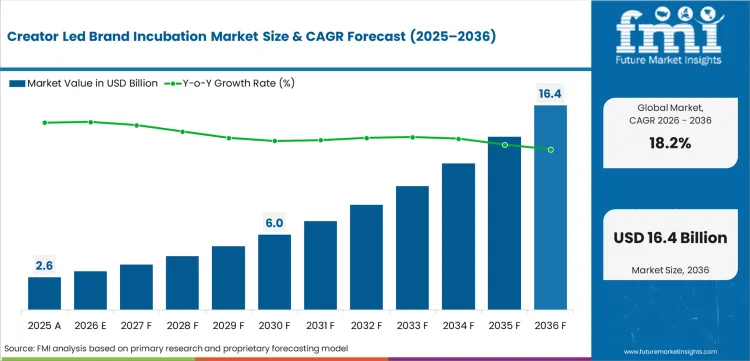
Creator Led Brand Incubation Market Key Takeaways
| Metric | Details |
|---|---|
| Industry Size (2026) | USD 3.08 Billion |
| Industry Value (2036) | USD 16.45 Billion |
| CAGR (2026-2036) | 18.2% |
FMI analysts observe that the financial scale detailed above signals a permanent departure from the rental economics of affiliate marketing. The acceleration of capital flowing into venture-backed incubation hubs confirms that institutional investors now view highly engaged digital audiences as de-risked customer acquisition channels for consumer packaged goods. This pivot from fleeting digital attention to tangible supply chain ownership establishes a new commercial baseline across global media markets.
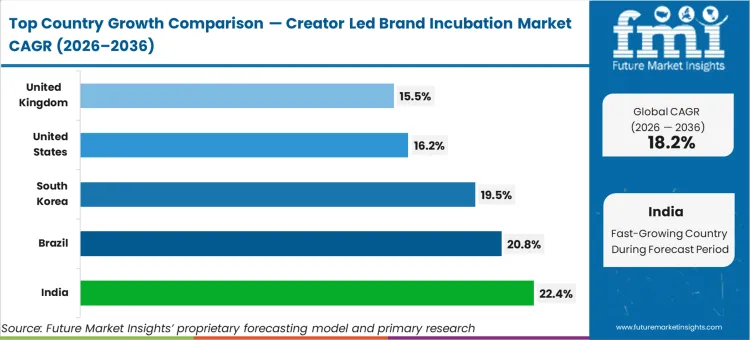
The global trajectory is characterized by distinct regional adoption velocities linked directly to localized e-commerce infrastructure. India (22.4%), Brazil (20.8%), and South Korea (19.5%) lead the expansion through rapid content-to-commerce integration and mobile-first consumer habits. The United States (16.2%) and the United Kingdom (15.5%) demonstrate measured growth as regulatory scrutiny over endorsement transparency accelerates the transition toward professionalized, equity-owned corporate structures.
Creator Led Brand Incubation Market Definition
The Creator Led Brand Incubation market encompasses the B2B ecosystem of services, platforms, and capital providers that assist digital talent in launching, scaling, and managing independent physical or digital product enterprises. The market includes venture studios offering equity-for-service models, corporate accelerator programs, and specialized digital platforms managing the backend logistics of consumer goods development. The defining characteristic is the focus on long-term enterprise building and supply chain execution rather than temporary promotional campaigns.
Creator Led Brand Incubation Market Inclusions
The market scope incorporates full-stack venture studios, customized supply chain logistics platforms catering to digital entrepreneurs, and financial technology services providing capital based on audience metrics. Revenue generated from equity stakes, monthly retainer fees for operational support, and specialized software-as-a-service platforms designed for creative collectives are fully evaluated. Services enabling the development of both physical consumer packaged goods and high-margin knowledge commerce products are included.
Creator Led Brand Incubation Market Exclusions
Traditional talent management agencies focusing solely on negotiating third-party advertising deals are explicitly omitted from the valuation. Standard, generalized e-commerce marketplaces and web hosting platforms lacking dedicated incubation features fall outside the defined parameters. The downstream retail revenue generated by the physical products themselves is excluded, isolating the analysis strictly on the B2B services and operational infrastructure supporting the enterprise creation phase.
Creator Led Brand Incubation Market Research Methodology
- Primary Research: FMI engaged with venture studio founders, supply chain directors at contract manufacturers, and audience monetization strategists to map the operational bottlenecks triggering specialized infrastructure investments.
- Desk Research: The data collection phase aggregated compliance roadmaps from the Federal Trade Commission, financial disclosures from publicly traded creative agencies, and regional direct-to-consumer expansion metrics.
- Market-Sizing and Forecasting: The baseline value derives from a bottom-up aggregation of incubation service fees and equity valuations, applying region-specific digital commerce penetration curves to project future adoption velocity.
- Data Validation and Update Cycle: Segment forecasts undergo cross-validation against quarterly venture capital flow into the digital media and specialized e-commerce infrastructure sectors.
Creator Led Brand Incubation Market Analysis by Segments
Creator Led Brand Incubation Market Analysis by Incubation Model
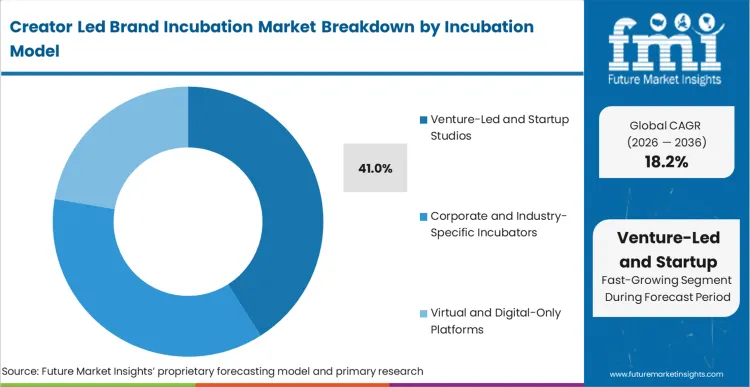
With generic affiliate marketing proving inadequate for sustained wealth generation, creative agency directors execute full-scale shifts toward specialized operational support models. FMI analysts opine that Venture-Led and Startup Studios command a dominant 41.0% share in 2026, reflecting the absolute requirement for institutional-grade manufacturing and legal expertise during the enterprise launch phase. By acting as co-founders, these specialized studios de-risk the product development cycle, allowing the digital digital content creator to focus entirely on community engagement while the studio manages complex industrial logistics. The integration of advanced inventory forecasting algorithms within these studios prevents catastrophic stockouts during highly concentrated, viral demand spikes. Venture studio partners who fail to secure proprietary contract manufacturing networks risk immediate exclusion from the next wave of top-tier talent acquisition cycles.
- Financial structuring: Equity-for-service agreements align the long-term incentives of the production hub with the digital personality, eliminating upfront capital barriers for product development.
- Logistical execution: Dedicated supply chain managers navigate the complexities of international freight and warehousing, shielding the creative entity from operational disruptions.
- Regulatory compliance: In-house legal teams secure intellectual property rights and ensure adherence to stringent regional consumer safety standards before market entry.
Creator Led Brand Incubation Market Analysis by End-User Category
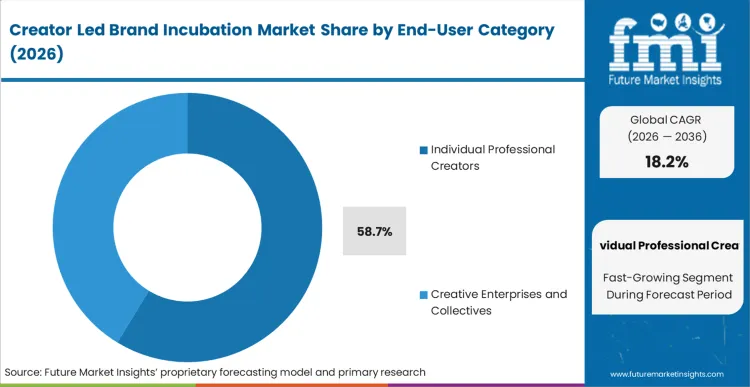
Individual Professional Creators emerge as the dominant end-user category, expected to represent 58.7% of total market share in 2026, driven by the profound effectiveness of the personal connection in modern commerce. The direct parasocial relationship these individuals cultivate yields conversion rates that frequently outpace heavily capitalized, faceless corporate entities. FMI's analysis indicates that the proliferation of specialized back-office automation tools empowers these solo digital entrepreneurs to manage complex multinational supply chains without requiring expansive internal teams. This democratization of enterprise infrastructure allows micro-audiences with intense loyalty to support highly profitable, niche product lines. Audience monetization strategists unable to deliver customized, low-minimum-order-quantity manufacturing solutions lose shortlist position for managing social media content creation ventures.
- Audience conversion: Hyper-specific community trust translates directly into reduced customer acquisition costs and elevated lifetime purchasing value.
- Capital efficiency: Lean operational structures enabled by specialized incubation software minimize overhead, accelerating the path to initial profitability.
- Product agility: Solo decision-makers bypass corporate approval bureaucracies, allowing rapid product iteration in response to real-time audience feedback.
Creator Led Brand Incubation Market Analysis by Platform Ecosystem
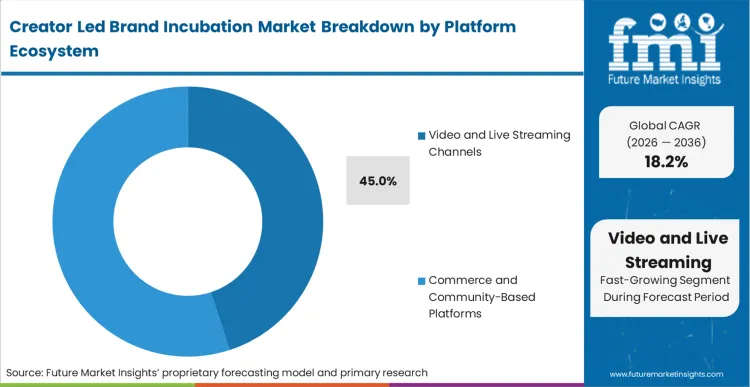
Every digital entrepreneur launching a physical product line now faces the strict necessity of collapsing the discovery-to-purchase funnel into a singular environment. Video and Live Streaming Channels represent a leading 45.0% share in 2026. As FMI's research confirms, the integration of native, frictionless checkout capabilities within short-form video feeds transforms passive viewership into instantaneous transaction volume. This architectural pivot forces backend logistics providers to construct application programming interfaces capable of processing thousands of concurrent orders during targeted broadcast events. The synchronized orchestration of live entertainment and inventory management defines the modern commercial launch sequence. Platform developers failing to integrate robust live commerce payment gateways forfeit critical transaction fee revenue to third-party processors.
- Transactional velocity: In-feed purchasing mechanisms eliminate the friction of redirecting consumers to external websites, capturing high-intent impulse buying.
- Demand synchronization: Real-time audience metrics allow manufacturing partners to adjust production schedules dynamically based on broadcast engagement levels.
- Interactive showcasing: Live demonstration capabilities provide immediate verification of product efficacy, establishing a critical baseline for consumer trust.
Creator Led Brand Incubation Market Drivers, Restraints, and Opportunities
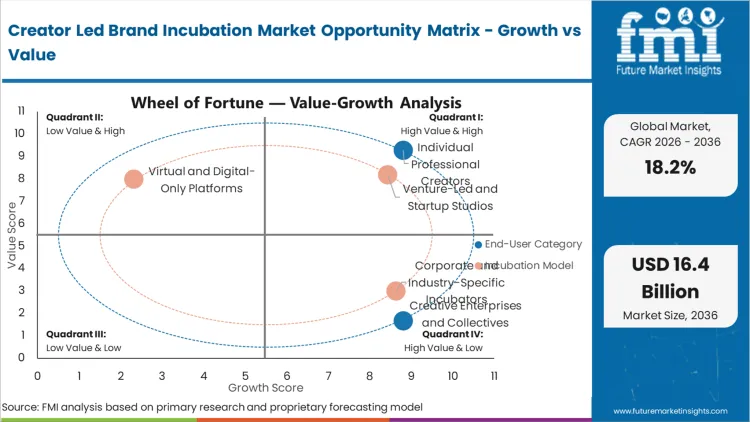
The structural shift from algorithm-dependent advertising revenue to owned equity forces digital talent managers to establish robust commercial infrastructure. This architectural requirement renders traditional, promotion-only agency representation obsolete. Creative agency directors upgrading their service portfolios face a strict binary choice between acquiring dedicated supply chain expertise or losing their most lucrative clients to specialized venture studios. Based on FMI's assessment, transitioning to an equity-based incubation model aligns the long-term financial incentives of the management firm with the sustained success of the digital personality's enterprise. Talent managers who fail to modernize their core service offerings risk permanent demotion to low-margin affiliate brokers.
The volatile nature of viral audience engagement creates severe inventory forecasting challenges for newly established product lines. Predicting the exact magnitude of demand generated by a single broadcast event requires specialized data analytics that most early-stage digital entrepreneurs lack internally. To mitigate this critical operational gap, venture studio partners increasingly deploy machine learning algorithms that cross-reference historical engagement metrics with live sentiment analysis to calibrate precise production volumes before committing capital to contract manufacturers.
- Niche Knowledge Commerce: Digital entrepreneurs leverage specialized educational platforms to launch high-margin, scalable digital courses directly targeting specialized professional communities. The absence of physical fulfillment bottlenecks allows for rapid global scaling of these informational assets.
- Modular Supply Chain Integration: Regional contract manufacturers offer specialized, low-minimum-order production lines tailored specifically for digital personalities testing initial product-market fit. This capability prevents devastating capital losses from unsold inventory during unproven launch sequences.
- Cross-Border Fulfillment Networks: International logistics providers develop optimized routing algorithms specifically designed for the dispersed audience geographies typical of global digital personalities. This synchronized delivery infrastructure ensures equitable shipping rates, unlocking previously inaccessible international consumer bases.
Regional Analysis
Based on the regional analysis, the Creator Led Brand Incubation market is segmented into North America, Latin America, Europe, East Asia, South Asia, Oceania and Middle East & Africa across 40+ countries. The full report also offers market attractiveness analysis based on regional trends.
.webp "Top Country Growth Comparison Creator Led Brand Incubation Market Cagr (2026 2036)")
| Country | CAGR (2026 to 2036) |
|---|---|
| India | 22.4% |
| Brazil | 20.8% |
| South Korea | 19.5% |
| United States | 16.2% |
| United Kingdom | 15.5% |
Source: Future Market Insights (FMI) analysis, based on proprietary forecasting model and primary research
Asia Pacific Creator Led Brand Incubation Market Analysis
Greenfield digital infrastructure development across the Asia Pacific region accelerates the bypass of legacy e-commerce constraints. Venture studio partners constructing new incubation hubs specify unified social commerce networking in their initial operational blueprints. This clean-slate approach entirely eliminates the costly retrofit phase that plagues older Western digital agencies attempting to bolt commerce onto content. As per FMI's projection, building native manufacturing integration into the foundation establishes highly flexible production environments capable of rapid retooling. This aggressive expansion strategy fuels the demand for high-performance supply chain software. The integration of robust logistics architecture forms the critical prerequisite for deploying advanced localized product lines.
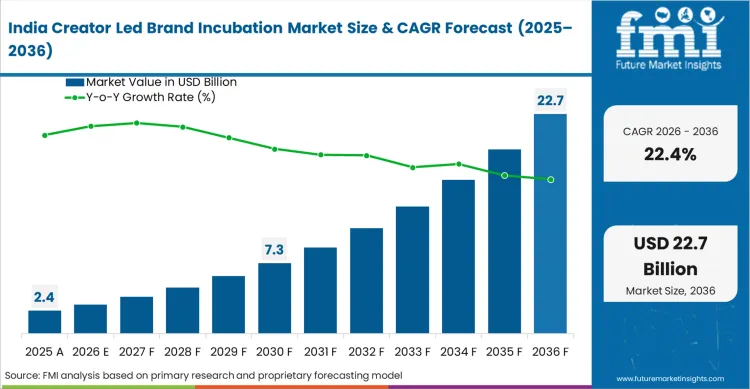
- India: India's digital commerce sector operates under newly enforced influencer advertising guidelines from the Advertising Standards Council, accelerating the shift from paid endorsements to owned equity ventures. This regulatory compliance pressure drives a 22.4% CAGR for creator-led enterprise infrastructure in India through 2036. The domestic direct-to-consumer manufacturing base has reorganized around small-batch cosmetics and apparel, allowing regional language influencers to bypass traditional retail gatekeepers entirely. Talent managers failing to secure dedicated white-label production agreements before the 2027 festival shopping season forfeit access to the highest-margin audience monetization pathways available in the subcontinent.
- South Korea: South Korea's entertainment complex demands synchronized global merchandising, rendering domestic-only fulfillment models obsolete for rising digital talent. The concentration of advanced cosmetic formulation labs within the Seoul metropolitan area enables rapid prototyping timelines that Western markets cannot match. South Korea advances at a 19.5% compound rate over the forecast period as digital talent agencies internalize supply chain operations. Virtual avatar integration into physical product launches sets a new baseline for audience engagement across the region. Venture studio partners who do not establish cross-border logistics capabilities before the next cultural export wave lose critical international market share to more agile local competitors.
FMI's report includes extensive coverage of the Asia Pacific incubation landscape. It incorporates detailed analysis of Japan, Indonesia, Australia, and the broader ASEAN region. A primary trend shaping these nations is the rapid localization of contract manufacturing, forcing digital entrepreneurs to deploy unified operational architectures to satisfy stringent global brand traceability requirements.
North America Creator Led Brand Incubation Market Analysis
Digital modernization mandates across North America target the systematic eradication of fragmented, third-party affiliate revenue streams. Creative agency directors leading talent overhauls face strict directives to unify disparate audience monetization domains under a single manageable corporate architecture. The rigorous venture capital environment actively drives this consolidation to secure stable, recurring product revenue against unpredictable algorithm changes. Implementing a standardized, equity-owned product backbone enables studios to deploy advanced predictive inventory algorithms without compromising creative independence. This strategic shift requires significant capital allocation toward robust logistical hardware capable of isolating direct-to-consumer fulfillment streams. The success of these initiatives depends entirely on the availability of agile manufacturing partners.
- United States: Venture capital allocation across the United States digital media sector now mandates recurring product revenue streams to secure series A funding, penalizing creators reliant solely on algorithmic advertising payouts. The maturation of domestic modular fulfillment networks provides the essential physical backbone for these digital-first enterprises. This structural capital shift positions the United States at a 16.2% compound growth rate across the 2026 to 2036 planning window. Specialized financial institutions increasingly underwrite inventory loans based on audience engagement metrics rather than traditional credit histories. Digital talent managers lacking integrated inventory forecasting systems face immediate exclusion from top-tier venture studio seed programs.
FMI's report includes comprehensive evaluation of the North American incubation sector. It features specific analysis of the Canadian and Mexican digital commerce markets. A defining dynamic in these countries involves the integration of cross-border fulfillment supply chains, which requires standardized software protocols to coordinate targeted delivery sequences and maintain synchronized product drops across multiple geographic facilities.
Europe Creator Led Brand Incubation Market Analysis
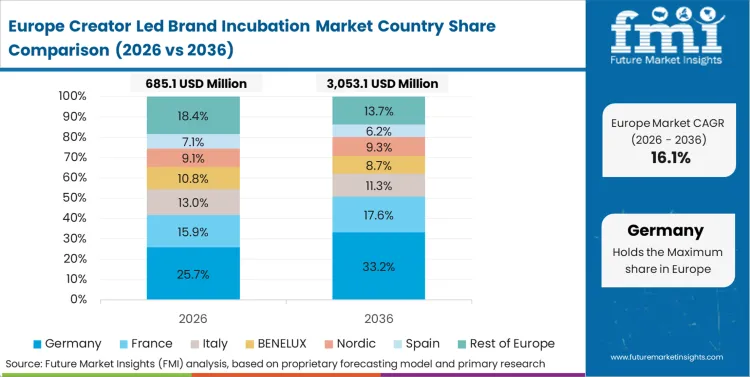
European consumer protection policy actively penalizes the continued operation of opaque affiliate marketing and undisclosed digital endorsements. Audience monetization strategists redesigning talent portfolios must integrate continuous compliance documentation alongside creative output. This dual-purpose operational requirement forces the rapid adoption of dedicated corporate entities to guarantee legal stability while managing complex cross-border logistics. The transition requires a complete overhaul of existing commercial topologies, shifting from casual promotional structures to highly regulated direct-to-consumer architectures. Upgrading the core venture studio infrastructure provides the necessary legal and logistical precision to support advanced sustainable product launches. Agency directors recognize that maintaining outdated endorsement models severely limits their ability to compete in highly regulated European markets.
- United Kingdom: The United Kingdom's strict enforcement of the Digital Markets, Competition and Consumers Bill forces high-profile digital personalities to distance themselves from third-party affiliate schemes in favor of fully transparent owned enterprises. This legislative environment sustains a 15.5% compound rate for incubation services in the United Kingdom to the 2036 horizon. London-based creative collectives are systematically acquiring specialized boutique manufacturing facilities to guarantee sustainable production credentials. Audience monetization strategists unable to provide audited supply chain transparency records risk regulatory penalties and permanent loss of consumer trust in the highly scrutinized European commercial zone.
FMI's report includes thorough investigation of the European digital commerce framework. The analysis encompasses Germany, France, Italy, the Nordics, and the Benelux region. A prevailing structural condition across these nations is the mandatory compliance with strict consumer data privacy directives, forcing venture studios to specify compliant first-party data capture architectures that can reliably manage customer information independent of major social networks.
Competitive Aligners for Market Players
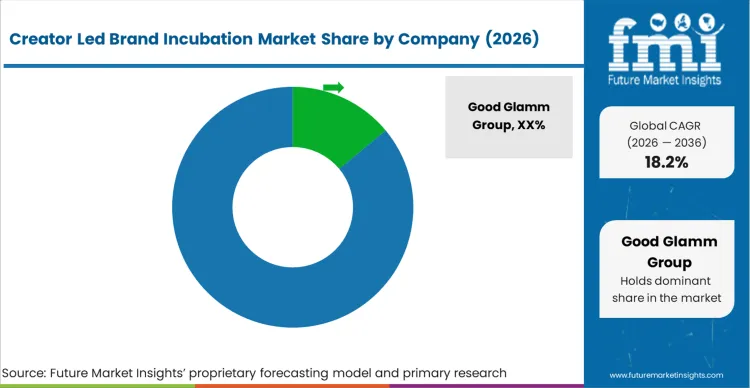
The enforcement of stringent digital disclosure regulations establishes fully owned corporate structures as the non-negotiable baseline for top-tier talent monetization. Creative agency directors moving away from simple affiliate models must construct comprehensive legal and operational entities to shield their clients from liability while capturing maximum margin. FMI's proprietary forecasting model projects that venture studios providing integrated legal, financial, and manufacturing frameworks immediately capture the most lucrative digital personalities. Agencies reliant on outsourced, fragmented service providers cannot offer the necessary speed to market, leaving them structurally unable to compete for high-value client rosters. Specialized talent managers failing to implement automated compliance documentation protocols face disqualification from institutional venture funding rounds.
Incubation success is not determined by initial audience size, but by the venture studio's capability to execute flawless fulfillment during compressed, viral demand windows. Independent digital entrepreneurs utilizing modular e commerce platform architecture connect directly with certified contract manufacturers, bypassing the slow, capital-intensive legacy supply chains. This direct integration ensures that production scales synchronously with real-time broadcast engagement metrics. Production hubs unable to guarantee 72-hour turnaround times for initial product runs lose priority vendor status in the fast-paced creator launch ecosystem.
The transition from solitary digital personalities to sophisticated creative collectives demands robust financial splitting and inventory management software. Establishing these multi-party digital workspaces allows venture studios to orchestrate complex collaborations between creators, designers, and manufacturers seamlessly. The implementation of specialized banking application programming interfaces ensures transparent, immediate revenue distribution among all stakeholders following a successful product drop. Software providers who cannot deliver instantaneous, multi-currency payment routing systems forfeit access to the rapidly expanding cross-border creative collective market.
Key Players in Creator Led Brand Incubation Market
- Good Glamm Group
- LTK
- ShopMy
- Wonnda
- Kajabi
- Stir
- Karat
- Passionfroot
- Genies
- BYAHT
Scope of the Report
| Metric | Value |
|---|---|
| Quantitative Units | USD 3.08 billion to USD 16.45 Billion, at a CAGR of 18.2% |
| Market Definition | The B2B ecosystem of services, platforms, and capital providers that assist digital talent in launching, scaling, and managing independent physical or digital product enterprises. |
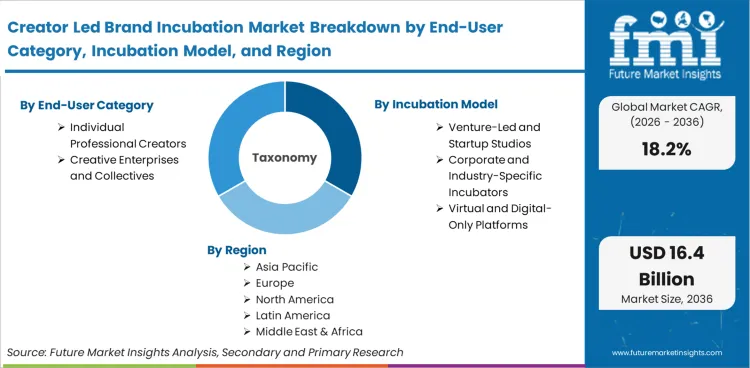
| Incubation Model Segmentation | Venture-Led and Startup Studios, Corporate and Industry-Specific Incubators, Virtual and Digital-Only Platforms |
| End-User Category Segmentation | Individual Professional Creators, Creative Enterprises and Collectives |
| Platform Ecosystem Segmentation | Video and Live Streaming Channels, Commerce and Community-Based Platforms |
| Regions Covered | North America, Latin America, Europe, East Asia, South Asia, Oceania, Middle East & Africa |
| Countries Covered | United States, India, South Korea, Brazil, United Kingdom, and 40 plus countries |
| Key Companies Profiled | Good Glamm Group, LTK, ShopMy, Wonnda, Kajabi, Stir, Karat, Passionfroot, Genies, BYAHT |
| Forecast Period | 2026 to 2036 |
| Approach | The hybrid top-down and bottom-up model reconstructs demand from creator earnings data and incubator funding rounds, validating against historical direct-to-consumer growth rates. |
Creator Led Brand Incubation Market Analysis by Segments
Incubation Model:
- Venture-Led and Startup Studios
- Corporate and Industry-Specific Incubators
- Virtual and Digital-Only Platforms
End-User Category:
- Individual Professional Creators
- Creative Enterprises and Collectives
Platform Ecosystem:
- Video and Live Streaming Channels
- Commerce and Community-Based Platforms
Region:
- Asia Pacific
- India
- China
- Japan
- South Korea
- Indonesia
- Australia & New Zealand
- ASEAN
- Rest of Asia Pacific
- Europe
- Germany
- Italy
- France
- United Kingdom
- Spain
- Benelux
- Nordics
- Central & Eastern Europe
- Rest of Europe
- North America
- United States
- Canada
- Mexico
- Latin America
- Brazil
- Argentina
- Chile
- Rest of Latin America
- Middle East & Africa
- Kingdom of Saudi Arabia
- United Arab Emirates
- South Africa
- Turkey
- Rest of Middle East & Africa
Bibliography
- HM Revenue & Customs. (2025). Understanding social media content creators.
- Competition and Markets Authority. (2025). Social media endorsements: Guidance for brands.
- Advertising Standards Council of India. (2025). ASCI influencer guidelines.
- European Union Intellectual Property Office. (2025). Influencers and IP.
- World Intellectual Property Organization. (2025, May 15). Music merchandise: The new key to branding for musicians.
- Organisation for Economic Co-operation and Development. (2024). OECD digital economy outlook 2024 (Volume 1): Embracing the technology frontier. OECD Publishing.
- Ad Standards. (2025, October 8). Influencer marketing disclosure guidelines.
- Federal Trade Commission. (2024, August 14). Federal Trade Commission announces final rule banning fake reviews and testimonials.
This bibliography is provided for reader reference. The full FMI report contains the complete reference list with primary research documentation.
This Report Addresses
- Market intelligence mapping the transition from affiliate marketing to equity-owned digital enterprises for venture studio partners and creative agency directors.
- Market sizing and 10-year quantitative forecasting detailing the specific capital allocation toward incubation infrastructure across major economic zones through 2036.
- Segmentation analysis evaluating the distinct adoption curves of venture-led studios versus virtual automation platforms.
- Regional deployment intelligence comparing the aggressive content-to-commerce greenfield strategies in Asia Pacific against strict regulatory compliance requirements in Europe.
- Regulatory compliance assessment analyzing how disclosure laws and consumer protection directives force the professionalization of digital talent management.
- Competitive posture evaluation tracking the mandatory shift toward modular contract manufacturing and automated back-office financial systems.
- Capability gap identification highlighting specific supply chain bottlenecks that prevent digital personalities from scaling physical product lines.
- Report delivery formats encompassing interactive digital dashboards, raw analytical datasets, and comprehensive PDF strategy briefings.
Frequently Asked Questions
How large is the demand for Creator Led Brand Incubation in the global market in 2026?
Demand for Creator Led Brand Incubation in the global market is estimated to be valued at USD 3.08 billion in 2026.
What will be the market size of Creator Led Brand Incubation in the global market by 2036?
Market size for Creator Led Brand Incubation is projected to reach USD 16.45 billion by 2036.
What is the expected demand growth for Creator Led Brand Incubation in the global market between 2026 and 2036?
Demand for Creator Led Brand Incubation is expected to grow at a CAGR of 18.2% between 2026 and 2036.
Which End-User Category is poised to lead global sales by 2026?
Individual Professional Creators commands 58.7% in 2026 as specialized back-office automation tools empower solo digital entrepreneurs to manage complex multinational supply chains.
How significant is the role of Venture-Led and Startup Studios in driving Creator Led Brand Incubation adoption in 2026?
Venture-Led and Startup Studios represents 41.0% of segment share as creative agency directors execute full-scale shifts toward specialized operational support models.
What is driving demand in India?
Newly enforced influencer advertising guidelines from the Advertising Standards Council accelerate the shift from paid endorsements to owned equity ventures.
What compliance standards or regulations are referenced for the United States?
The Federal Trade Commission's Endorsement Guides and tightening digital disclosure rules dictate platform integration protocols.
What is the India growth outlook in this report?
India is projected to grow at a CAGR of 22.4% during 2026 to 2036.
Why is North America described as a priority region in this report?
Venture capital allocation actively drives consolidation to secure stable, recurring product revenue against unpredictable algorithm changes.
What type of demand dominates in North America?
Demand heavily focuses on establishing standardized, equity-owned product backbones that enable advanced predictive inventory forecasting.
What is Brazil's growth outlook in this report?
Brazil is projected to expand at a CAGR of 20.8% during 2026 to 2036.
Does the report cover South Korea in its regional analysis?
Yes, South Korea is included within Asia Pacific under the regional scope of analysis.
What are the sources referred to for analyzing South Korea?
Corporate capacity reports from cosmetic formulation labs and digital media venture capital flow data form the analytical basis.
What is the main demand theme linked to South Korea in its region coverage?
The demand for synchronized global merchandising renders domestic-only fulfillment models obsolete for rising digital talent.
Does the report cover the United Kingdom in its regional analysis?
Yes, the United Kingdom is included within Europe under the regional coverage framework.
What is the main United Kingdom related demand theme in its region coverage?
Strict enforcement of the Digital Markets, Competition and Consumers Bill forces high-profile digital personalities into fully transparent owned enterprises.
Which product formats or configurations are strategically important for Asia Pacific supply chains?
Small-batch, modular direct-to-consumer manufacturing capabilities are critical for rapid prototyping and regional language influencer launches.
What is Creator Led Brand Incubation and what is it mainly used for?
The market provides operational, financial, and strategic infrastructure to transition digital personalities into owners of sustainable physical or digital enterprises.
What does Creator Led Brand Incubation mean in this report?
The scope encompasses the B2B ecosystem of venture studios, capital providers, and specialized digital platforms managing backend logistics for consumer goods development.
What is included in the scope of this Creator Led Brand Incubation report?
The market covers full-stack venture studios, customized supply chain logistics platforms, and financial technology services providing capital based on audience metrics.
What is excluded from the scope of this report?
Traditional talent management agencies focusing solely on third-party advertising deals and standard, generalized e-commerce marketplaces are explicitly excluded.
What does market forecast mean on this page?
The market forecast represents a model-based projection built on defined digital media and supply chain assumptions for strategic planning purposes.
How does FMI build and validate the Creator Led Brand Incubation forecast?
The model reconstructs demand from creator earnings data and incubator funding rounds, validating against historical direct-to-consumer growth rates.
What does zero reliance on speculative third-party market research mean here?
Primary interviews, verified corporate financial disclosures, and official regulatory compliance roadmaps are used exclusively instead of unverified syndicated estimates.
Preview the report firsthand - request a free sample
Get SampleGet the brochure for pricing and purchase details.
Get PDFTable of Content
- Executive Summary
- Global Market Outlook
- Demand-side Trends
- Supply-side Trends
- Technology Roadmap Analysis
- Analysis and Recommendations
- Market Overview
- Market Coverage / Taxonomy
- Market Definition / Scope / Limitations
- Research Methodology
- Chapter Orientation
- Analytical Lens and Working Hypotheses
- Market Structure, Signals, and Trend Drivers
- Benchmarking and Cross-market Comparability
- Market Sizing, Forecasting, and Opportunity Mapping
- Research Design and Evidence Framework
- Desk Research Programme (Secondary Evidence)
- Company Annual and Sustainability Reports
- Peer-reviewed Journals and Academic Literature
- Corporate Websites, Product Literature, and Technical Notes
- Earnings Decks and Investor Briefings
- Statutory Filings and Regulatory Disclosures
- Technical White Papers and Standards Notes
- Trade Journals, Industry Magazines, and Analyst Briefs
- Conference Proceedings, Webinars, and Seminar Materials
- Government Statistics Portals and Public Data Releases
- Press Releases and Reputable Media Coverage
- Specialist Newsletters and Curated Briefings
- Sector Databases and Reference Repositories
- FMI Internal Proprietary Databases and Historical Market Datasets
- Subscription Datasets and Paid Sources
- Social Channels, Communities, and Digital Listening Inputs
- Additional Desk Sources
- Expert Input and Fieldwork (Primary Evidence)
- Primary Modes
- Qualitative Interviews and Expert Elicitation
- Quantitative Surveys and Structured Data Capture
- Blended Approach
- Why Primary Evidence is Used
- Field Techniques
- Interviews
- Surveys
- Focus Groups
- Observational and In-context Research
- Social and Community Interactions
- Stakeholder Universe Engaged
- C-suite Leaders
- Board Members
- Presidents and Vice Presidents
- R&D and Innovation Heads
- Technical Specialists
- Domain Subject-matter Experts
- Scientists
- Physicians and Other Healthcare Professionals
- Governance, Ethics, and Data Stewardship
- Research Ethics
- Data Integrity and Handling
- Primary Modes
- Tooling, Models, and Reference Databases
- Desk Research Programme (Secondary Evidence)
- Data Engineering and Model Build
- Data Acquisition and Ingestion
- Cleaning, Normalisation, and Verification
- Synthesis, Triangulation, and Analysis
- Quality Assurance and Audit Trail
- Market Background
- Market Dynamics
- Drivers
- Restraints
- Opportunity
- Trends
- Scenario Forecast
- Demand in Optimistic Scenario
- Demand in Likely Scenario
- Demand in Conservative Scenario
- Opportunity Map Analysis
- Product Life Cycle Analysis
- Supply Chain Analysis
- Investment Feasibility Matrix
- Value Chain Analysis
- PESTLE and Porter’s Analysis
- Regulatory Landscape
- Regional Parent Market Outlook
- Production and Consumption Statistics
- Import and Export Statistics
- Market Dynamics
- Global Market Analysis 2021 to 2025 and Forecast, 2026 to 2036
- Historical Market Size Value (USD Million) Analysis, 2021 to 2025
- Current and Future Market Size Value (USD Million) Projections, 2026 to 2036
- Y-o-Y Growth Trend Analysis
- Absolute $ Opportunity Analysis
- Global Market Pricing Analysis 2021 to 2025 and Forecast 2026 to 2036
- Global Market Analysis 2021 to 2025 and Forecast 2026 to 2036, By End-User Category
- Introduction / Key Findings
- Historical Market Size Value (USD Million) Analysis By End-User Category , 2021 to 2025
- Current and Future Market Size Value (USD Million) Analysis and Forecast By End-User Category , 2026 to 2036
- Individual Professional Creators
- Creative Enterprises and Collectives
- Individual Professional Creators
- Y-o-Y Growth Trend Analysis By End-User Category , 2021 to 2025
- Absolute $ Opportunity Analysis By End-User Category , 2026 to 2036
- Global Market Analysis 2021 to 2025 and Forecast 2026 to 2036, By Incubation Model
- Introduction / Key Findings
- Historical Market Size Value (USD Million) Analysis By Incubation Model, 2021 to 2025
- Current and Future Market Size Value (USD Million) Analysis and Forecast By Incubation Model, 2026 to 2036
- Venture-Led and Startup Studios
- Corporate and Industry-Specific Incubators
- Virtual and Digital-Only Platforms
- Venture-Led and Startup Studios
- Y-o-Y Growth Trend Analysis By Incubation Model, 2021 to 2025
- Absolute $ Opportunity Analysis By Incubation Model, 2026 to 2036
- Global Market Analysis 2021 to 2025 and Forecast 2026 to 2036, By Platform Ecosystem
- Introduction / Key Findings
- Historical Market Size Value (USD Million) Analysis By Platform Ecosystem, 2021 to 2025
- Current and Future Market Size Value (USD Million) Analysis and Forecast By Platform Ecosystem, 2026 to 2036
- Video and Live Streaming Channels
- Commerce and Community-Based Platforms
- Video and Live Streaming Channels
- Y-o-Y Growth Trend Analysis By Platform Ecosystem, 2021 to 2025
- Absolute $ Opportunity Analysis By Platform Ecosystem, 2026 to 2036
- Global Market Analysis 2021 to 2025 and Forecast 2026 to 2036, By Region
- Introduction
- Historical Market Size Value (USD Million) Analysis By Region, 2021 to 2025
- Current Market Size Value (USD Million) Analysis and Forecast By Region, 2026 to 2036
- North America
- Latin America
- Western Europe
- Eastern Europe
- East Asia
- South Asia and Pacific
- Middle East & Africa
- Market Attractiveness Analysis By Region
- North America Market Analysis 2021 to 2025 and Forecast 2026 to 2036, By Country
- Historical Market Size Value (USD Million) Trend Analysis By Market Taxonomy, 2021 to 2025
- Market Size Value (USD Million) Forecast By Market Taxonomy, 2026 to 2036
- By Country
- USA
- Canada
- Mexico
- By End-User Category
- By Incubation Model
- By Platform Ecosystem
- By Country
- Market Attractiveness Analysis
- By Country
- By End-User Category
- By Incubation Model
- By Platform Ecosystem
- Key Takeaways
- Latin America Market Analysis 2021 to 2025 and Forecast 2026 to 2036, By Country
- Historical Market Size Value (USD Million) Trend Analysis By Market Taxonomy, 2021 to 2025
- Market Size Value (USD Million) Forecast By Market Taxonomy, 2026 to 2036
- By Country
- Brazil
- Chile
- Rest of Latin America
- By End-User Category
- By Incubation Model
- By Platform Ecosystem
- By Country
- Market Attractiveness Analysis
- By Country
- By End-User Category
- By Incubation Model
- By Platform Ecosystem
- Key Takeaways
- Western Europe Market Analysis 2021 to 2025 and Forecast 2026 to 2036, By Country
- Historical Market Size Value (USD Million) Trend Analysis By Market Taxonomy, 2021 to 2025
- Market Size Value (USD Million) Forecast By Market Taxonomy, 2026 to 2036
- By Country
- Germany
- UK
- Italy
- Spain
- France
- Nordic
- BENELUX
- Rest of Western Europe
- By End-User Category
- By Incubation Model
- By Platform Ecosystem
- By Country
- Market Attractiveness Analysis
- By Country
- By End-User Category
- By Incubation Model
- By Platform Ecosystem
- Key Takeaways
- Eastern Europe Market Analysis 2021 to 2025 and Forecast 2026 to 2036, By Country
- Historical Market Size Value (USD Million) Trend Analysis By Market Taxonomy, 2021 to 2025
- Market Size Value (USD Million) Forecast By Market Taxonomy, 2026 to 2036
- By Country
- Russia
- Poland
- Hungary
- Balkan & Baltic
- Rest of Eastern Europe
- By End-User Category
- By Incubation Model
- By Platform Ecosystem
- By Country
- Market Attractiveness Analysis
- By Country
- By End-User Category
- By Incubation Model
- By Platform Ecosystem
- Key Takeaways
- East Asia Market Analysis 2021 to 2025 and Forecast 2026 to 2036, By Country
- Historical Market Size Value (USD Million) Trend Analysis By Market Taxonomy, 2021 to 2025
- Market Size Value (USD Million) Forecast By Market Taxonomy, 2026 to 2036
- By Country
- China
- Japan
- South Korea
- By End-User Category
- By Incubation Model
- By Platform Ecosystem
- By Country
- Market Attractiveness Analysis
- By Country
- By End-User Category
- By Incubation Model
- By Platform Ecosystem
- Key Takeaways
- South Asia and Pacific Market Analysis 2021 to 2025 and Forecast 2026 to 2036, By Country
- Historical Market Size Value (USD Million) Trend Analysis By Market Taxonomy, 2021 to 2025
- Market Size Value (USD Million) Forecast By Market Taxonomy, 2026 to 2036
- By Country
- India
- ASEAN
- Australia & New Zealand
- Rest of South Asia and Pacific
- By End-User Category
- By Incubation Model
- By Platform Ecosystem
- By Country
- Market Attractiveness Analysis
- By Country
- By End-User Category
- By Incubation Model
- By Platform Ecosystem
- Key Takeaways
- Middle East & Africa Market Analysis 2021 to 2025 and Forecast 2026 to 2036, By Country
- Historical Market Size Value (USD Million) Trend Analysis By Market Taxonomy, 2021 to 2025
- Market Size Value (USD Million) Forecast By Market Taxonomy, 2026 to 2036
- By Country
- Kingdom of Saudi Arabia
- Other GCC Countries
- Turkiye
- South Africa
- Other African Union
- Rest of Middle East & Africa
- By End-User Category
- By Incubation Model
- By Platform Ecosystem
- By Country
- Market Attractiveness Analysis
- By Country
- By End-User Category
- By Incubation Model
- By Platform Ecosystem
- Key Takeaways
- Key Countries Market Analysis
- USA
- Pricing Analysis
- Market Share Analysis, 2025
- By End-User Category
- By Incubation Model
- By Platform Ecosystem
- Canada
- Pricing Analysis
- Market Share Analysis, 2025
- By End-User Category
- By Incubation Model
- By Platform Ecosystem
- Mexico
- Pricing Analysis
- Market Share Analysis, 2025
- By End-User Category
- By Incubation Model
- By Platform Ecosystem
- Brazil
- Pricing Analysis
- Market Share Analysis, 2025
- By End-User Category
- By Incubation Model
- By Platform Ecosystem
- Chile
- Pricing Analysis
- Market Share Analysis, 2025
- By End-User Category
- By Incubation Model
- By Platform Ecosystem
- Germany
- Pricing Analysis
- Market Share Analysis, 2025
- By End-User Category
- By Incubation Model
- By Platform Ecosystem
- UK
- Pricing Analysis
- Market Share Analysis, 2025
- By End-User Category
- By Incubation Model
- By Platform Ecosystem
- Italy
- Pricing Analysis
- Market Share Analysis, 2025
- By End-User Category
- By Incubation Model
- By Platform Ecosystem
- Spain
- Pricing Analysis
- Market Share Analysis, 2025
- By End-User Category
- By Incubation Model
- By Platform Ecosystem
- France
- Pricing Analysis
- Market Share Analysis, 2025
- By End-User Category
- By Incubation Model
- By Platform Ecosystem
- India
- Pricing Analysis
- Market Share Analysis, 2025
- By End-User Category
- By Incubation Model
- By Platform Ecosystem
- ASEAN
- Pricing Analysis
- Market Share Analysis, 2025
- By End-User Category
- By Incubation Model
- By Platform Ecosystem
- Australia & New Zealand
- Pricing Analysis
- Market Share Analysis, 2025
- By End-User Category
- By Incubation Model
- By Platform Ecosystem
- China
- Pricing Analysis
- Market Share Analysis, 2025
- By End-User Category
- By Incubation Model
- By Platform Ecosystem
- Japan
- Pricing Analysis
- Market Share Analysis, 2025
- By End-User Category
- By Incubation Model
- By Platform Ecosystem
- South Korea
- Pricing Analysis
- Market Share Analysis, 2025
- By End-User Category
- By Incubation Model
- By Platform Ecosystem
- Russia
- Pricing Analysis
- Market Share Analysis, 2025
- By End-User Category
- By Incubation Model
- By Platform Ecosystem
- Poland
- Pricing Analysis
- Market Share Analysis, 2025
- By End-User Category
- By Incubation Model
- By Platform Ecosystem
- Hungary
- Pricing Analysis
- Market Share Analysis, 2025
- By End-User Category
- By Incubation Model
- By Platform Ecosystem
- Kingdom of Saudi Arabia
- Pricing Analysis
- Market Share Analysis, 2025
- By End-User Category
- By Incubation Model
- By Platform Ecosystem
- Turkiye
- Pricing Analysis
- Market Share Analysis, 2025
- By End-User Category
- By Incubation Model
- By Platform Ecosystem
- South Africa
- Pricing Analysis
- Market Share Analysis, 2025
- By End-User Category
- By Incubation Model
- By Platform Ecosystem
- USA
- Market Structure Analysis
- Competition Dashboard
- Competition Benchmarking
- Market Share Analysis of Top Players
- By Regional
- By End-User Category
- By Incubation Model
- By Platform Ecosystem
- Competition Analysis
- Competition Deep Dive
- Good Glamm Group
- Overview
- Product Portfolio
- Profitability by Market Segments (Product/Age /Sales Channel/Region)
- Sales Footprint
- Strategy Overview
- Marketing Strategy
- Product Strategy
- Channel Strategy
- LTK
- ShopMy
- Wonnda
- Kajabi
- Stir
- Karat
- Passionfroot
- Good Glamm Group
- Competition Deep Dive
- Assumptions & Acronyms Used


