

- Industry Size (2026)
- USD 2.8 Bn
- Forecast (2036)
- USD 7.4 Bn
- CAGR (2026 to 2036)
- 10.2%
LED Drivers and Power Supplies for Horticulture Market Forecast and Outlook 2026 to 2036
The LED drivers and power supplies for horticulture market is likely to be valued at USD 2.8 billion in 2026 and is projected to reach USD 7.4 billion by 2036, reflecting a CAGR of 10.2%. Early demand is shaped by the financial structure of controlled environment farming rather than by lighting unit sales alone. Operators size power systems around crop cycles, load stability, and downtime risk. Driver specifications are fixed during facility design, which locks voltage ranges, dimming protocols, and redundancy levels before installation. Purchasing decisions focus on uptime records, thermal margins, and service access rather than on headline efficiency figures or fixture styling.
As the period advances, market behavior reflects the operating economics of large growing facilities. Expansion decisions depend on energy contracts, yield predictability, and maintenance staffing models. Replacement demand grows as early installations reach service limits, though upgrades follow planned shutdown windows. Supplier switching remains limited because power systems are integrated into control and monitoring layouts. Pricing pressure persists, yet reliability standards prevent aggressive cost cutting. Capacity planning tracks greenhouse and vertical farm build programs by region. Growth remains strong, supported by the steady professionalization of indoor agriculture and by disciplined capital investment cycles rather than by short term shifts in crop prices.
Quick Stats of the LED Drivers and Power Supplies for Horticulture Market
- LED Drivers and Power Supplies for Horticulture Market Value (2026): USD 2.8 billion
- LED Drivers and Power Supplies for Horticulture Forecast Value (2036): USD 7.4 billion
- LED Drivers and Power Supplies for Horticulture Forecast CAGR 2026 to 2036: 10.2%
- Leading Driver Type in LED Drivers and Power Supplies for Horticulture Market: Constant Current Drivers (52 % share)
- Leading Power Class in LED Drivers and Power Supplies for Horticulture Market: Up to 150 W (34 % share)
- Key Growth Regions in LED Drivers and Power Supplies for Horticulture Market: China, India, USA, South Korea, Germany
- Top Players in LED Drivers and Power Supplies for Horticulture Market: Inventronics, Mean Well, Delta Electronics, Tridonic, OSRAM, Signify, Moso Power, Lifud, TCI, Eaglerise
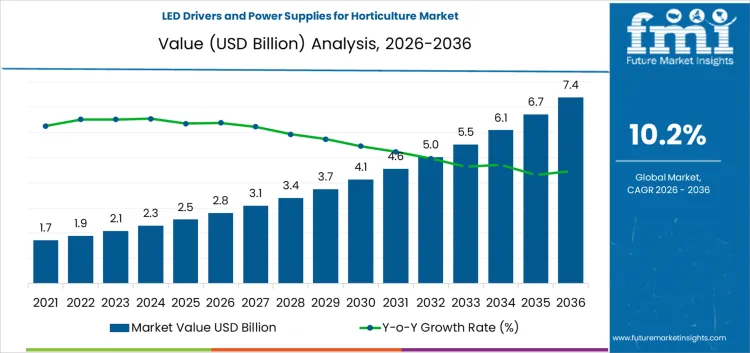
What is the Growth Forecast for LED Drivers and Power Supplies for Horticulture Market through 2036?
Between 2026 and 2031, the LED drivers and power supplies for horticulture market is expected to grow from USD 2.8 billion along a trajectory aligned with a 10.2% CAGR, reflecting the way controlled-environment agriculture is becoming an electrical infrastructure business as much as an agronomic one. In new vertical farms and high-intensity greenhouses, power electronics are specified early in the system design because they determine dimming behavior, load balancing, and thermal limits of the lighting grid. Constant current drivers dominate due to their compatibility with multi-channel luminaires and predictable output control. Project developers increasingly standardize power architectures across entire facilities, which shifts purchasing away from ad hoc replacement toward planned, large-batch electrical system deployments.
From 2031 to 2036, the market is projected to reach USD 7.4 billion, with expansion shaped by system scale and control complexity rather than by fixture counts alone. As farms adopt multi-zone recipes, adaptive spectra, and energy optimization strategies, drivers evolve from simple converters into managed nodes within the lighting network. Higher power ranges and digital interfaces raise the value per installation even when physical layouts remain similar. Sales continue to be anchored in lighting OEM supply relationships, where certification, efficiency curves, and failure-rate statistics influence platform selection. Competitive positioning favors suppliers with strong power electronics engineering depth and long qualification records, including Inventronics, Mean Well, Delta Electronics, Tridonic, OSRAM, Signify, Moso Power, Lifud, TCI, and Eaglerise.
LED Drivers and Power Supplies for Horticulture Market Key Takeaways
| Metric | Value |
|---|---|
| Market Value (2026) | USD 2.8 billion |
| Forecast Value (2036) | USD 7.4 billion |
| Forecast CAGR 2026 to 2036 | 10.2% |
How Are LED Drivers and Power Supplies Optimizing Horticulture Lighting?
LED drivers and power supplies for horticulture are increasingly adopted to ensure precise, reliable, and energy-efficient lighting for controlled environment agriculture. Historically, lighting systems relied on basic ballasts or power supplies that offered limited control over intensity, spectrum, or dimming, affecting crop growth and energy efficiency. Modern LED drivers integrate dimming capability, programmable spectral control, and protection against voltage fluctuations to optimize plant growth, reduce energy consumption, and extend fixture life. Greenhouse operators, vertical farm owners, and horticultural equipment manufacturers prioritize reliability, compatibility with LED fixtures, and regulatory compliance. Early adoption focused on high-value crops and research facilities, while current demand spans commercial greenhouses, vertical farms, and indoor agriculture operations, driven by yield optimization, energy cost reduction, and precision horticulture practices.
Rising adoption of indoor farming, energy efficiency standards, and precision cultivation requirements are shaping market growth. Compared with conventional power supplies, modern LED drivers emphasize programmable control, thermal protection, and high-efficiency operation for optimized plant lighting. Cost structures depend on driver design, component quality, and software integration, concentrating margins among suppliers capable of delivering reliable, high-performance solutions. Horticulture operators adopt these systems to maintain consistent light output, optimize crop growth cycles, and reduce operational costs. By 2036, advanced LED drivers and power supplies are expected to become standard in controlled-environment agriculture, supporting energy-efficient, high-yield, and precise lighting solutions.
What Factors Are Shaping the Demand for LED Drivers and Power Supplies for Horticulture by Control Method and Power Class in 2026?
The LED drivers and power supplies for horticulture market in 2026 is segmented by driver type and by power range. By control method, demand is divided into constant current, constant voltage, dimmable or smart, and other driver architectures, each linked to different fixture designs and control strategies. By power class, demand is organized around units up to 150 W, 150 to 600 W, above 600 W, and other ranges that reflect installation scale and electrical distribution planning. These segments reflect how growers and system integrators manage reliability, expandability, and operating risk while balancing capital cost, maintenance access, and the need for predictable light output across large cultivation facilities.
Why Do Constant Current Drivers Form the Backbone of Horticulture Lighting Systems?
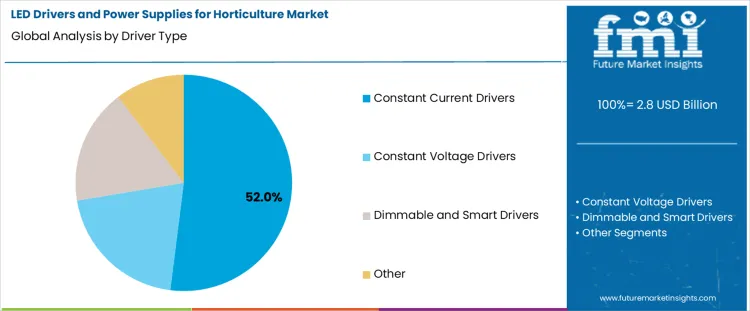
Constant current drivers account for about 52% of demand in 2026, reflecting their role in protecting LED modules from overcurrent stress and uneven loading. In multi fixture environments, maintaining stable current is critical for uniform light output and predictable aging behavior. These drivers simplify luminaire design because thermal and optical performance can be specified around a fixed electrical input. From an operational standpoint, they reduce the risk of premature LED degradation, which is costly in rack based or high bay installations where access is difficult. Their widespread use also supports standardization across projects, allowing integrators to reuse validated designs. This emphasis on stability, lifespan control, and predictable performance sustains their dominant position in horticulture lighting systems.
Constant voltage and smart or dimmable drivers serve different roles tied to system flexibility and control depth. Constant voltage units are common where luminaires integrate their own current regulation, which shifts complexity into the fixture and limits interchangeability. Smart drivers enable scheduling, remote monitoring, and dynamic dimming, yet they add software layers and commissioning steps that increase setup time and failure modes. These features appeal to operators running variable light recipes or energy optimization programs. Many large facilities still prioritize operational simplicity and hardware level reliability over control sophistication. As a result, advanced driver types grow in selected projects, while constant current designs remain the default across most production oriented installations.
Why Does the Up to 150 W Class Lead in Unit Volumes?
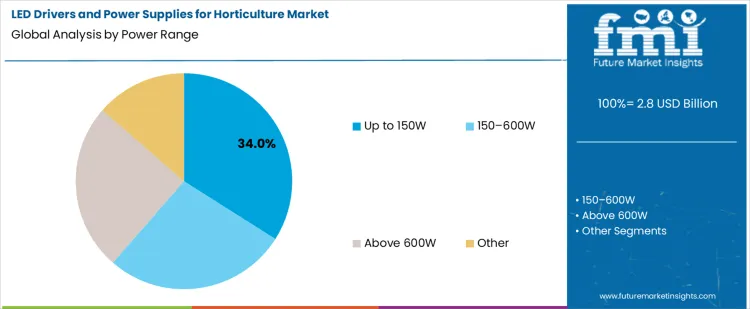
Drivers up to 150 W represent about 34% of demand in 2026 because they match the modular design approach used in many horticulture luminaires. Lower power units allow fixtures to be distributed across racks or benches with finer granularity, which improves coverage uniformity and limits the impact of single component failures. Electrical planning also benefits because circuits can be balanced more easily and replacement parts are lighter and easier to handle. These drivers fit well into linear bars and compact fixtures commonly used in multi tier systems. High unit counts in such installations naturally favor smaller power classes, which explains their leading share in total shipments even when larger drivers carry more power per unit.
The 150 to 600 W and above 600 W classes serve installations that prioritize fixture consolidation and higher output per mounting point. These drivers reduce part count and wiring complexity, yet they increase the consequences of individual failures and require more robust thermal management. They are common in high intensity top lighting or large area greenhouse fixtures rather than in dense rack systems. Their adoption depends on facility layout, maintenance strategy, and electrical infrastructure limits. While these higher power classes are important for certain applications, their unit volumes remain lower because many operators prefer distributed architectures that localize risk and simplify service in large, continuously operating growing environments.
Why Are Crop Production Economics and Lighting System Design Decisions Driving Demand for LED Drivers and Power Supplies in Horticulture through 2036?
Demand is shaped by operating cost control rather than by enthusiasm for new equipment. In controlled environment agriculture, electricity is a major expense, and lighting efficiency directly affects production margins. Growers design lighting layouts around uniformity, dimming capability, and reliability, which makes driver selection a system level decision rather than a component choice. Multi-tier farms and long photoperiod crops also push power supplies toward higher utilization rates, increasing the cost of failure. Once a lighting recipe is fixed, the electrical architecture becomes locked in for years. This ties driver demand to farm buildouts and retrofits, not to seasonal planting cycles.
What Reliability Risk, Capital Cost, and Upgrade Complexity Are Slowing Replacement and Specification Changes?
Restraints come from risk management inside farms. Lighting failures can disrupt crop schedules and cause yield loss, so operators avoid frequent changes to proven power systems. High quality drivers and power supplies represent a meaningful share of fixture cost, raising the barrier to large scale upgrades. Retrofitting often requires rewiring, recertification, and downtime in active growing areas. Many facilities also operate under tight capital budgets and prefer to sweat existing assets rather than chase incremental efficiency gains. These factors lengthen replacement cycles, favor conservative specification choices, and slow the pace at which new electrical architectures displace installed systems.
How Are Farm Scale, Control Strategies, and Procurement Models Restructuring This Category?
The structure of demand is shifting with farm organization. Large operators standardize lighting platforms across sites, which concentrates volume on a smaller set of approved driver and power supply designs. Integration with central control systems increases the importance of digital interfaces and remote monitoring functions. At the same time, contract growing and leased facilities encourage modular, easily redeployed lighting systems. Suppliers are being asked to support long production runs rather than many small custom variants. The category is moving toward fewer, more standardized electrical platforms aligned with multi-site expansion strategies and long term operating contracts.
What is the Demand for LED Drivers and Power Supplies for Horticulture by Country?
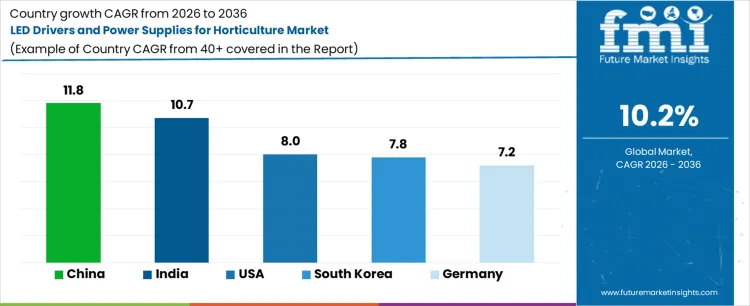
| Country | CAGR (%) |
|---|---|
| China | 11.8 |
| India | 10.7 |
| USA | 8.0 |
| Germany | 7.2 |
| South Korea | 7.8 |
Demand for LED drivers and power supplies for horticulture is rising as indoor and controlled-environment agriculture adopt efficient lighting systems to enhance crop growth, energy efficiency, and yield. China leads with an 11.8% CAGR, driven by rapid expansion of vertical farming, greenhouse installations, and adoption of advanced horticulture LED solutions. India follows at 10.7%, supported by increasing greenhouse cultivation, government initiatives, and investment in controlled-environment agriculture. The USA grows at 8.0%, shaped by modernization of greenhouse operations and adoption of energy-efficient horticulture lighting. South Korea records 7.8% growth, influenced by advanced horticultural research and high-value crop cultivation. Germany shows 7.2% CAGR, reflecting steady adoption of LED drivers and power supply solutions in commercial horticulture applications.
How is China experiencing growth in the LED drivers and power supplies for horticulture market?
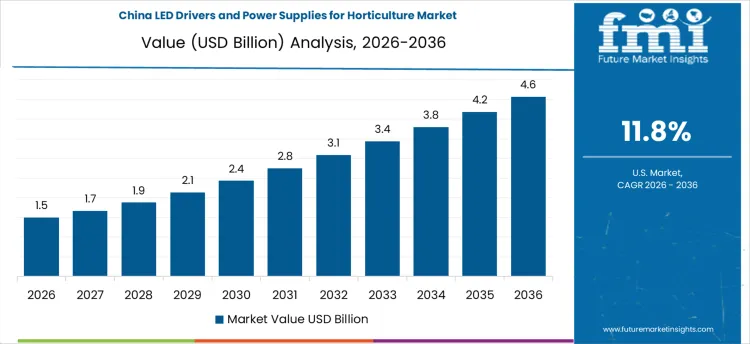
China is experiencing growth at a CAGR of 11.8%, supported by adoption of LED drivers and power supplies for horticulture market solutions to enhance controlled-environment agriculture, plant growth efficiency, and energy management. Manufacturers and suppliers are producing drivers and power supplies optimized for stable voltage output, durability, and compatibility with horticultural lighting systems. Demand is concentrated in greenhouse farms, vertical farming facilities, and controlled-environment agriculture R&D centers. Investments focus on material reliability, energy efficiency, and compliance with agricultural and electrical standards rather than large-scale deployment. Growth reflects rising adoption of modern horticultural techniques, industrial focus on energy-efficient lighting, and increasing demand for higher crop yields.
- Controlled-environment agriculture drives adoption.
- Drivers optimize voltage stability and durability.
- Greenhouses and vertical farms concentrate demand.
- Material reliability and energy compliance guide investment.
How is India witnessing growth in the LED drivers and power supplies for horticulture market?
India is witnessing growth at a CAGR of 10.7%, fueled by adoption of LED drivers and power supplies for horticulture market solutions to improve plant growth, operational efficiency, and energy management in controlled agricultural systems. Manufacturers and suppliers are deploying drivers optimized for high efficiency, durability, and compatibility with horticultural lighting setups. Demand is concentrated in greenhouse farms, vertical farming facilities, and agri-tech R&D centers. Investments prioritize material performance, energy efficiency, and adherence to agricultural and electrical standards rather than fleet-scale deployment. Growth reflects increasing adoption of modern horticulture, industrial use of energy-efficient lighting, and focus on crop productivity.
- Plant growth efficiency drives adoption.
- Drivers enhance energy efficiency and durability.
- Greenhouses and vertical farms concentrate demand.
- Material performance and standards compliance guide investment.
How is the United States experiencing growth in the LED drivers and power supplies for horticulture market?
United States is experiencing growth at a CAGR of 8%, supported by adoption of LED drivers and power supplies for horticulture market solutions to improve controlled-environment agriculture, plant yield, and energy efficiency. Manufacturers and suppliers are producing drivers and power supplies optimized for stable voltage output, durability, and integration with horticultural lighting systems. Demand is concentrated in greenhouse farms, indoor farming facilities, and agri-tech R&D centers. Investments focus on material quality, system reliability, and compliance with agricultural and electrical standards rather than large-scale deployment. Growth reflects industrial adoption of modern horticultural technologies and focus on energy-efficient lighting.
- Controlled-environment agriculture drives adoption.
- Drivers optimize voltage stability and system reliability.
- Greenhouses and indoor farms concentrate demand.
- Material quality and compliance guide investment.
How is Germany witnessing growth in the LED drivers and power supplies for horticulture market?
Germany is witnessing growth at a CAGR of 7.2%, fueled by adoption of LED drivers and power supplies for horticulture market solutions to improve greenhouse lighting efficiency, plant growth, and energy management. Manufacturers and suppliers are deploying drivers optimized for voltage stability, durability, and integration with horticultural lighting systems. Demand is concentrated in industrial greenhouses, indoor farms, and agricultural R&D centers. Investments prioritize material quality, energy efficiency, and compliance with agricultural and electrical standards rather than fleet-scale deployment. Growth reflects industrial adoption of modern horticultural lighting solutions and focus on energy-efficient farming practices.
- Greenhouse efficiency drives adoption.
- Drivers enhance voltage stability and durability.
- Industrial farms and R&D centers concentrate demand.
- Material quality and energy compliance guide investment.
How is South Korea experiencing growth in the LED drivers and power supplies for horticulture market?
South Korea is experiencing growth at a CAGR of 7.8%, supported by adoption of LED drivers and power supplies for horticulture market solutions to improve plant growth, energy management, and lighting system reliability. Manufacturers and suppliers are producing drivers optimized for stable voltage output, high durability, and compatibility with horticultural lighting setups. Demand is concentrated in greenhouse farms, vertical farming facilities, and controlled-environment agriculture R&D centers. Investments focus on material performance, energy efficiency, and compliance with agricultural and electrical standards rather than large-scale deployment. Growth reflects industrial adoption of modern horticultural techniques and focus on crop productivity.
- Plant growth efficiency drives adoption.
- Drivers optimize voltage stability and durability.
- Greenhouses and vertical farms concentrate demand.
- Material performance and compliance guide investment.
Who Competes in the LED Drivers and Power Supplies for Horticulture Market and What Defines Their Capabilities?
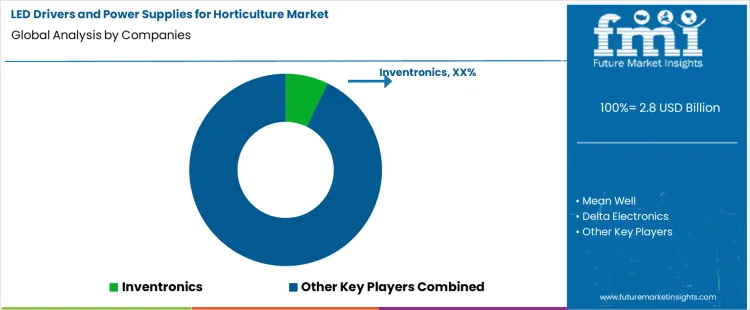
Competition in the LED drivers and power supplies for horticulture market is defined by output stability, energy efficiency, and integration with controlled-environment agriculture systems. Inventronics supplies drivers engineered for precise current regulation, high efficiency, and reliable operation under horticultural lighting conditions. Mean Well develops LED drivers optimized for dimming, thermal management, and compatibility with multi-tier LED arrays. Delta Electronics provides power supplies with high efficiency, surge protection, and integration capability for greenhouse and vertical farm lighting. Tridonic delivers drivers engineered for controllable output, energy efficiency, and multi-channel operation in horticultural environments. OSRAM supplies horticulture-specific power solutions with robust thermal tolerance and long-term reliability.
Signify develops integrated LED drivers with precise dimming, programmable schedules, and energy-efficient operation. Moso Power provides drivers designed for high stability and long service life in multi-tier horticultural setups. Lifud delivers power supplies optimized for controlled current and thermal management. TCI supplies modular drivers compatible with high-density LED configurations. Eaglerise focuses on energy-efficient, stable drivers for greenhouse and vertical farm applications. Other regional and specialty suppliers provide drivers emphasizing energy efficiency, thermal resilience, and integration with automation systems. Competitive differentiation arises from output precision, energy efficiency, thermal management, scalability, and compatibility with multi-tier horticultural lighting configurations.
Key Players in the LED Drivers and Power Supplies for Horticulture Market
- Inventronics
- Mean Well
- Delta Electronics
- Tridonic
- OSRAM
- Signify
- Moso Power
- Lifud
- TCI
- Eaglerise
Scope of the Report
| Items | Values |
|---|---|
| Quantitative Units (2026) | USD billion |
| Driver Type | Constant Current Drivers, Constant Voltage Drivers, Dimmable and Smart Drivers, Other |
| Power Range | Up to 150W, 150-600W, Above 600W, Other |
| Control Interface | 0-10V, DALI, Wireless/IoT, Other |
| Sales Channel | Lighting OEM Supply, Distributors, Direct Projects, Other |
| Regions Covered | Asia Pacific, Europe, North America, Latin America, Middle East & Africa |
| Countries Covered | China, Japan, South Korea, India, Australia & New Zealand, ASEAN, Germany, United Kingdom, France, Italy, Spain, Nordic, BENELUX, United States, Canada, Mexico, Brazil, Chile, Saudi Arabia, Turkey, South Africa, and other regional markets |
| Key Companies Profiled | Inventronics, Mean Well, Delta Electronics, Tridonic, OSRAM, Signify, Moso Power, Lifud, TCI, Eaglerise |
| Additional Attributes | Dollar sales by driver type, power range, control interface, and sales channel, demand driven by controlled environment agriculture buildouts rather than fixture replacement cycles, specification of power systems at facility design stage locking voltage ranges and dimming protocols, dominance of OEM lighting supply relationships over spot aftermarket sales, value growth linked to multi-zone control complexity and higher power classes, and regional deployment aligned with greenhouse and vertical farm expansion programs. |
LED Drivers and Power Supplies for Horticulture Market Segmentation
Driver Type:
- Constant Current Drivers
- Constant Voltage Drivers
- Dimmable and Smart Drivers
- Other
Power Range:
- Up to 150W
- 150-600W
- Above 600W
- Other
Control Interface:
- 0-10V
- DALI
- Wireless/IoT
- Other
Sales Channel:
- Lighting OEM Supply
- Distributors
- Direct Projects
- Other
Region
- Asia Pacific
- China
- Japan
- South Korea
- India
- Australia & New Zealand
- ASEAN
- Rest of Asia Pacific
- Europe
- Germany
- United Kingdom
- France
- Italy
- Spain
- Nordic
- BENELUX
- Rest of Europe
- North America
- United States
- Canada
- Mexico
- Latin America
- Brazil
- Chile
- Rest of Latin America
- Middle East & Africa
- Kingdom of Saudi Arabia
- Other GCC Countries
- Turkey
- South Africa
- Other African Union
- Rest of Middle East & Africa
Bibliography
- Food and Agriculture Organization of the United Nations. (2024). Controlled environment agriculture and indoor farming systems. FAO.
- International Energy Agency. (2024). Energy efficiency in lighting and electrical systems. International Energy Agency.
- European Commission. (2024). Ecodesign and energy labelling requirements for light sources and control gear. European Union.
- USA Department of Energy. (2024). Energy conservation standards for lighting systems and power supplies. USA Department of Energy.
- USA Department of Agriculture. (2023). Indoor agriculture and controlled environment production systems. USDA.
Frequently Asked Questions
How big is the led drivers and power supplies for horticulture market in 2026?
The global led drivers and power supplies for horticulture market is estimated to be valued at USD 2.8 billion in 2026.
What will be the size of led drivers and power supplies for horticulture market in 2036?
The market size for the led drivers and power supplies for horticulture market is projected to reach USD 7.4 billion by 2036.
How much will be the led drivers and power supplies for horticulture market growth between 2026 and 2036?
The led drivers and power supplies for horticulture market is expected to grow at a 10.2% CAGR between 2026 and 2036.
What are the key product types in the led drivers and power supplies for horticulture market?
The key product types in led drivers and power supplies for horticulture market are constant current drivers, constant voltage drivers, dimmable and smart drivers and other.
Which power range segment to contribute significant share in the led drivers and power supplies for horticulture market in 2026?
In terms of power range, up to 150w segment to command 34.0% share in the led drivers and power supplies for horticulture market in 2026.
Preview the report firsthand - request a free sample
Get SampleGet the brochure for pricing and purchase details.
Get PDFTable of Content
- Executive Summary
- Global Market Outlook
- Demand-side Trends
- Supply-side Trends
- Technology Roadmap Analysis
- Analysis and Recommendations
- Market Overview
- Market Coverage / Taxonomy
- Market Definition / Scope / Limitations
- Market Background
- Market Dynamics
- Drivers
- Restraints
- Opportunity
- Trends
- Scenario Forecast
- Demand in Optimistic Scenario
- Demand in Likely Scenario
- Demand in Conservative Scenario
- Opportunity Map Analysis
- Product Life Cycle Analysis
- Supply Chain Analysis
- Investment Feasibility Matrix
- Value Chain Analysis
- PESTLE and Porter’s Analysis
- Regulatory Landscape
- Regional Parent Market Outlook
- Production and Consumption Statistics
- Import and Export Statistics
- Market Dynamics
- Global Market Analysis 2021 to 2025 and Forecast, 2026 to 2036
- Historical Market Size Value (USD Million) Analysis, 2021 to 2025
- Current and Future Market Size Value (USD Million) Projections, 2026 to 2036
- Y-o-Y Growth Trend Analysis
- Absolute $ Opportunity Analysis
- Global Market Pricing Analysis 2021 to 2025 and Forecast 2026 to 2036
- Global Market Analysis 2021 to 2025 and Forecast 2026 to 2036, By Driver Type
- Introduction / Key Findings
- Historical Market Size Value (USD Million) Analysis By Driver Type , 2021 to 2025
- Current and Future Market Size Value (USD Million) Analysis and Forecast By Driver Type , 2026 to 2036
- Constant Current Drivers
- Constant Voltage Drivers
- Dimmable and Smart Drivers
- Other
- Constant Current Drivers
- Y-o-Y Growth Trend Analysis By Driver Type , 2021 to 2025
- Absolute $ Opportunity Analysis By Driver Type , 2026 to 2036
- Global Market Analysis 2021 to 2025 and Forecast 2026 to 2036, By Power Range
- Introduction / Key Findings
- Historical Market Size Value (USD Million) Analysis By Power Range, 2021 to 2025
- Current and Future Market Size Value (USD Million) Analysis and Forecast By Power Range, 2026 to 2036
- Up to 150W
- 150-600W
- Above 600W
- Other
- Up to 150W
- Y-o-Y Growth Trend Analysis By Power Range, 2021 to 2025
- Absolute $ Opportunity Analysis By Power Range, 2026 to 2036
- Global Market Analysis 2021 to 2025 and Forecast 2026 to 2036, By Control Interface
- Introduction / Key Findings
- Historical Market Size Value (USD Million) Analysis By Control Interface, 2021 to 2025
- Current and Future Market Size Value (USD Million) Analysis and Forecast By Control Interface, 2026 to 2036
- 0-10V
- DALI
- Wireless and IoT
- Other
- 0-10V
- Y-o-Y Growth Trend Analysis By Control Interface, 2021 to 2025
- Absolute $ Opportunity Analysis By Control Interface, 2026 to 2036
- Global Market Analysis 2021 to 2025 and Forecast 2026 to 2036, By Sales Channel
- Introduction / Key Findings
- Historical Market Size Value (USD Million) Analysis By Sales Channel, 2021 to 2025
- Current and Future Market Size Value (USD Million) Analysis and Forecast By Sales Channel, 2026 to 2036
- Lighting OEM Supply
- Distributors
- Direct Projects
- Other
- Lighting OEM Supply
- Y-o-Y Growth Trend Analysis By Sales Channel, 2021 to 2025
- Absolute $ Opportunity Analysis By Sales Channel, 2026 to 2036
- Global Market Analysis 2021 to 2025 and Forecast 2026 to 2036, By Region
- Introduction
- Historical Market Size Value (USD Million) Analysis By Region, 2021 to 2025
- Current Market Size Value (USD Million) Analysis and Forecast By Region, 2026 to 2036
- North America
- Latin America
- Western Europe
- Eastern Europe
- East Asia
- South Asia and Pacific
- Middle East & Africa
- Market Attractiveness Analysis By Region
- North America Market Analysis 2021 to 2025 and Forecast 2026 to 2036, By Country
- Historical Market Size Value (USD Million) Trend Analysis By Market Taxonomy, 2021 to 2025
- Market Size Value (USD Million) Forecast By Market Taxonomy, 2026 to 2036
- By Country
- USA
- Canada
- Mexico
- By Driver Type
- By Power Range
- By Control Interface
- By Sales Channel
- By Country
- Market Attractiveness Analysis
- By Country
- By Driver Type
- By Power Range
- By Control Interface
- By Sales Channel
- Key Takeaways
- Latin America Market Analysis 2021 to 2025 and Forecast 2026 to 2036, By Country
- Historical Market Size Value (USD Million) Trend Analysis By Market Taxonomy, 2021 to 2025
- Market Size Value (USD Million) Forecast By Market Taxonomy, 2026 to 2036
- By Country
- Brazil
- Chile
- Rest of Latin America
- By Driver Type
- By Power Range
- By Control Interface
- By Sales Channel
- By Country
- Market Attractiveness Analysis
- By Country
- By Driver Type
- By Power Range
- By Control Interface
- By Sales Channel
- Key Takeaways
- Western Europe Market Analysis 2021 to 2025 and Forecast 2026 to 2036, By Country
- Historical Market Size Value (USD Million) Trend Analysis By Market Taxonomy, 2021 to 2025
- Market Size Value (USD Million) Forecast By Market Taxonomy, 2026 to 2036
- By Country
- Germany
- UK
- Italy
- Spain
- France
- Nordic
- BENELUX
- Rest of Western Europe
- By Driver Type
- By Power Range
- By Control Interface
- By Sales Channel
- By Country
- Market Attractiveness Analysis
- By Country
- By Driver Type
- By Power Range
- By Control Interface
- By Sales Channel
- Key Takeaways
- Eastern Europe Market Analysis 2021 to 2025 and Forecast 2026 to 2036, By Country
- Historical Market Size Value (USD Million) Trend Analysis By Market Taxonomy, 2021 to 2025
- Market Size Value (USD Million) Forecast By Market Taxonomy, 2026 to 2036
- By Country
- Russia
- Poland
- Hungary
- Balkan & Baltic
- Rest of Eastern Europe
- By Driver Type
- By Power Range
- By Control Interface
- By Sales Channel
- By Country
- Market Attractiveness Analysis
- By Country
- By Driver Type
- By Power Range
- By Control Interface
- By Sales Channel
- Key Takeaways
- East Asia Market Analysis 2021 to 2025 and Forecast 2026 to 2036, By Country
- Historical Market Size Value (USD Million) Trend Analysis By Market Taxonomy, 2021 to 2025
- Market Size Value (USD Million) Forecast By Market Taxonomy, 2026 to 2036
- By Country
- China
- Japan
- South Korea
- By Driver Type
- By Power Range
- By Control Interface
- By Sales Channel
- By Country
- Market Attractiveness Analysis
- By Country
- By Driver Type
- By Power Range
- By Control Interface
- By Sales Channel
- Key Takeaways
- South Asia and Pacific Market Analysis 2021 to 2025 and Forecast 2026 to 2036, By Country
- Historical Market Size Value (USD Million) Trend Analysis By Market Taxonomy, 2021 to 2025
- Market Size Value (USD Million) Forecast By Market Taxonomy, 2026 to 2036
- By Country
- India
- ASEAN
- Australia & New Zealand
- Rest of South Asia and Pacific
- By Driver Type
- By Power Range
- By Control Interface
- By Sales Channel
- By Country
- Market Attractiveness Analysis
- By Country
- By Driver Type
- By Power Range
- By Control Interface
- By Sales Channel
- Key Takeaways
- Middle East & Africa Market Analysis 2021 to 2025 and Forecast 2026 to 2036, By Country
- Historical Market Size Value (USD Million) Trend Analysis By Market Taxonomy, 2021 to 2025
- Market Size Value (USD Million) Forecast By Market Taxonomy, 2026 to 2036
- By Country
- Kingdom of Saudi Arabia
- Other GCC Countries
- Turkiye
- South Africa
- Other African Union
- Rest of Middle East & Africa
- By Driver Type
- By Power Range
- By Control Interface
- By Sales Channel
- By Country
- Market Attractiveness Analysis
- By Country
- By Driver Type
- By Power Range
- By Control Interface
- By Sales Channel
- Key Takeaways
- Key Countries Market Analysis
- USA
- Pricing Analysis
- Market Share Analysis, 2025
- By Driver Type
- By Power Range
- By Control Interface
- By Sales Channel
- Canada
- Pricing Analysis
- Market Share Analysis, 2025
- By Driver Type
- By Power Range
- By Control Interface
- By Sales Channel
- Mexico
- Pricing Analysis
- Market Share Analysis, 2025
- By Driver Type
- By Power Range
- By Control Interface
- By Sales Channel
- Brazil
- Pricing Analysis
- Market Share Analysis, 2025
- By Driver Type
- By Power Range
- By Control Interface
- By Sales Channel
- Chile
- Pricing Analysis
- Market Share Analysis, 2025
- By Driver Type
- By Power Range
- By Control Interface
- By Sales Channel
- Germany
- Pricing Analysis
- Market Share Analysis, 2025
- By Driver Type
- By Power Range
- By Control Interface
- By Sales Channel
- UK
- Pricing Analysis
- Market Share Analysis, 2025
- By Driver Type
- By Power Range
- By Control Interface
- By Sales Channel
- Italy
- Pricing Analysis
- Market Share Analysis, 2025
- By Driver Type
- By Power Range
- By Control Interface
- By Sales Channel
- Spain
- Pricing Analysis
- Market Share Analysis, 2025
- By Driver Type
- By Power Range
- By Control Interface
- By Sales Channel
- France
- Pricing Analysis
- Market Share Analysis, 2025
- By Driver Type
- By Power Range
- By Control Interface
- By Sales Channel
- India
- Pricing Analysis
- Market Share Analysis, 2025
- By Driver Type
- By Power Range
- By Control Interface
- By Sales Channel
- ASEAN
- Pricing Analysis
- Market Share Analysis, 2025
- By Driver Type
- By Power Range
- By Control Interface
- By Sales Channel
- Australia & New Zealand
- Pricing Analysis
- Market Share Analysis, 2025
- By Driver Type
- By Power Range
- By Control Interface
- By Sales Channel
- China
- Pricing Analysis
- Market Share Analysis, 2025
- By Driver Type
- By Power Range
- By Control Interface
- By Sales Channel
- Japan
- Pricing Analysis
- Market Share Analysis, 2025
- By Driver Type
- By Power Range
- By Control Interface
- By Sales Channel
- South Korea
- Pricing Analysis
- Market Share Analysis, 2025
- By Driver Type
- By Power Range
- By Control Interface
- By Sales Channel
- Russia
- Pricing Analysis
- Market Share Analysis, 2025
- By Driver Type
- By Power Range
- By Control Interface
- By Sales Channel
- Poland
- Pricing Analysis
- Market Share Analysis, 2025
- By Driver Type
- By Power Range
- By Control Interface
- By Sales Channel
- Hungary
- Pricing Analysis
- Market Share Analysis, 2025
- By Driver Type
- By Power Range
- By Control Interface
- By Sales Channel
- Kingdom of Saudi Arabia
- Pricing Analysis
- Market Share Analysis, 2025
- By Driver Type
- By Power Range
- By Control Interface
- By Sales Channel
- Turkiye
- Pricing Analysis
- Market Share Analysis, 2025
- By Driver Type
- By Power Range
- By Control Interface
- By Sales Channel
- South Africa
- Pricing Analysis
- Market Share Analysis, 2025
- By Driver Type
- By Power Range
- By Control Interface
- By Sales Channel
- USA
- Market Structure Analysis
- Competition Dashboard
- Competition Benchmarking
- Market Share Analysis of Top Players
- By Regional
- By Driver Type
- By Power Range
- By Control Interface
- By Sales Channel
- Competition Analysis
- Competition Deep Dive
- Inventronics
- Overview
- Product Portfolio
- Profitability by Market Segments (Product/Age /Sales Channel/Region)
- Sales Footprint
- Strategy Overview
- Marketing Strategy
- Product Strategy
- Channel Strategy
- Mean Well
- Delta Electronics
- Tridonic
- OSRAM
- Signify
- Moso Power
- Lifud
- TCI
- Eaglerise
- Inventronics
- Competition Deep Dive
- Assumptions & Acronyms Used
- Research Methodology


