

- Industry Size (2026)
- USD 4.6 Bn
- Forecast (2036)
- USD 10.4 Bn
- CAGR: 8.5%
- (2026 to 2036)
E-Commerce Flexible Cartons Market Forecast and Outlook 2026 to 2036
The e-commerce flexible cartons market is valued at USD 4.6 billion in 2026 and is projected to reach USD 10.4 billion by 2036, reflecting a CAGR of 8.5%. Production concentration is observed among suppliers offering paperboard, corrugated laminates, barrier films, and biodegradable materials. Regional control over material sourcing and logistics affects supply reliability and lead times. Volume stability is influenced by e-commerce growth, seasonal demand fluctuations, and adoption in apparel, electronics, beauty, and food sectors. Suppliers delivering validated, high-quality cartons capture predictable revenue streams, whereas smaller operators face variability and limited bargaining leverage.
Revenue concentration is shaped by alignment with high-volume retailers and fulfillment centers, and by the ability to provide multi-format solutions such as stand-up pouches, flat cartons, bubble mailers, and cushion wraps. Adoption varies regionally according to e-commerce penetration, distribution infrastructure, and packaging regulations. Margin strength favors operators combining material performance, certified sustainability, and technical support. Fragmentation persists in regional and niche suppliers, while established players such as International Paper, WestRock Company, Smurfit Kappa Group, Amcor plc, and DS Smith secure concentrated value through portfolio breadth, production reliability, and integration with fulfillment networks rather than output volume alone.
Quick Stats of the E-Commerce Flexible Cartons Market
- E-Commerce Flexible Cartons Market Value (2026): USD 4.6 billion
- E-Commerce Flexible Cartons Forecast Value (2036): USD 10.4 billion
- E-Commerce Flexible Cartons Forecast CAGR 2026 to 2036: 8.5%
- Leading Material Type in E-Commerce Flexible Cartons Market: Paperboard Flexible Cartons (36.7% share)
- Leading End-Use Industry in E-Commerce Flexible Cartons Market: Apparel & Accessories (31.8% share)
- Key Growth Regions in E-Commerce Flexible Cartons Market: USA, China, India, Germany, Brazil
- Top Players in E-Commerce Flexible Cartons Market: International Paper, WestRock Company, Smurfit Kappa Group, Amcor plc, DS Smith
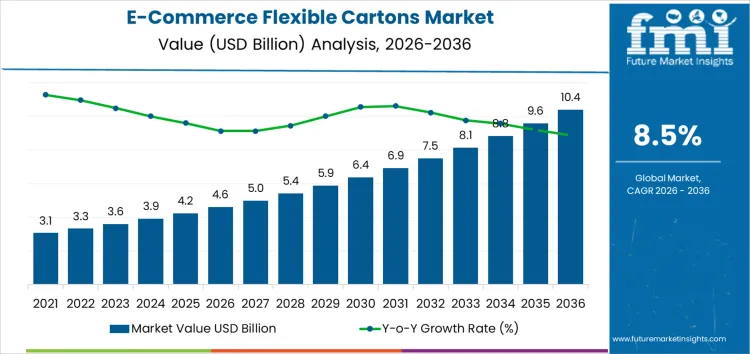
What is the Growth Forecast for E-Commerce Flexible Cartons Market through 2036?
Between 2026 and 2031, the e-commerce flexible cartons market is expected to experience significant expansion, driven by the rapid growth of online retail, increasing consumer demand for convenient and lightweight packaging, and the need for enhanced protective solutions during transit. Innovation in materials, such as recyclable and multi-layer laminates, supports product differentiation. Brands are prioritizing sustainable and visually appealing packaging to improve consumer experience. Adoption is also influenced by the expansion of last-mile delivery networks and increasing focus on cost-effective, high-performance packaging solutions for fragile and perishable goods.
From 2031 to 2036, the market is anticipated to continue robust growth. Key factors include continued growth in global e-commerce, rising preference for sustainable and tamper-evident packaging, and the development of advanced flexible carton designs for multi-product shipments. Manufacturers are investing in technology for improved structural integrity, print quality, and customization options. Consumer demand for convenience, combined with regulatory pressure for environmentally friendly packaging, will shape product innovation. Companies with capabilities in sustainable materials, design flexibility, and efficient production processes will secure competitive advantages in the evolving market landscape.
E Commerce Flexible Cartons Market Key Takeaways
| Metric | Value |
|---|---|
| Market Value (2026) | USD 4.6 billion |
| Forecast Value (2036) | USD 10.4 billion |
| Forecast CAGR 2026 to 2036 | 8.50% |
How Are E-Commerce Flexible Cartons Transforming Online Retail Packaging?
E-commerce flexible cartons are increasingly adopted to meet the packaging needs of online retail, including lightweight shipping, product protection, and unboxing experience. Historically, conventional rigid cartons were used, adding weight, shipping costs, and storage challenges. Modern flexible cartons use laminated films, paper-polymer composites, and recyclable materials to provide durability, tamper resistance, and sustainability. Retailers, e-commerce platforms, and packaging suppliers prioritize material strength, printability, and compatibility with automated packing lines. Early adoption focused on high-value or subscription products, while current demand spans apparel, food, electronics, and personal care segments driven by online shopping growth, fast delivery expectations, and eco-friendly packaging trends. Design flexibility, barrier properties, and supply chain integration influence selection.
Rising e-commerce penetration, consumer demand for convenience, and sustainability initiatives are shaping market growth. Compared with rigid cartons, flexible cartons emphasize lightweight construction, foldability, and recyclability while maintaining protective performance. Cost factors include material formulation, production technology, and logistics, concentrating margins among suppliers delivering consistent, high-quality products. Retailers adopt flexible cartons to reduce shipping costs, improve customer experience, and align with environmental goals. By 2036, e-commerce flexible cartons are expected to become a standard packaging solution across online retail sectors, supporting operational efficiency, product safety, and sustainable practices.
What Factors Are Shaping the Demand for E-Commerce Flexible Cartons in Terms of Material Type and End-Use Industry?
The demand for e-commerce flexible cartons is segmented by material type and end-use industry. Material types include paperboard flexible cartons, corrugated and kraft laminates, barrier films, biodegradable and compostable films, and other materials. End-use industries cover apparel and accessories, consumer electronics, beauty and personal care, food and beverages, and additional sectors. Adoption is influenced by packaging durability, protection, and sustainability standards. Uptake is driven by operational efficiency, product safety during transport, and environmental compliance. Material and industry selection depends on product fragility, shipping requirements, and cost considerations, ensuring secure delivery, reduced damage, and improved consumer satisfaction in online retail.
Why Are Paperboard Flexible Cartons Leading the Material Type Segment in E-Commerce Packaging?
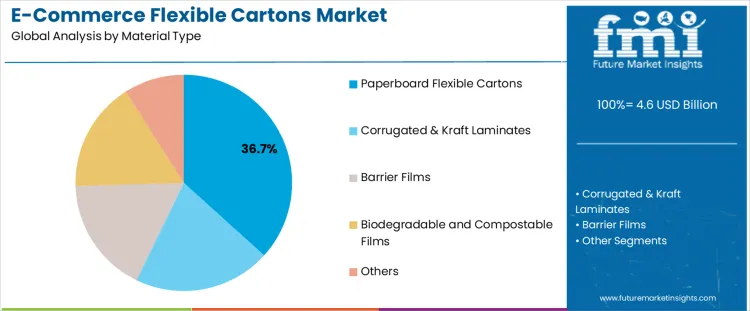
Paperboard flexible cartons account for 36.7% of total material type demand, making them the leading category. These cartons provide strength, lightweight design, and recyclability, suitable for a wide range of e-commerce products. Adoption is reinforced by compatibility with printing, branding, and protective inserts for fragile items. Retailers implement paperboard cartons for apparel, accessories, and personal care items to maintain product integrity while reducing shipping weight. Maintenance includes monitoring stacking performance, moisture resistance, and durability during transit. The segment leads because paperboard flexible cartons combine operational efficiency, sustainability, and protective performance, meeting e-commerce packaging needs.
Operational factors further support adoption. Cartons must withstand compression, handling, and environmental variations during logistics. Proper board thickness, lamination, and structural design ensure secure packaging and minimal product damage. The segment leads because paperboard cartons deliver reliable protection, sustainability benefits, and cost-efficient performance across diverse e-commerce applications.
Why Is Apparel and Accessories Representing the Largest End-Use Industry Segment in E-Commerce Flexible Cartons?
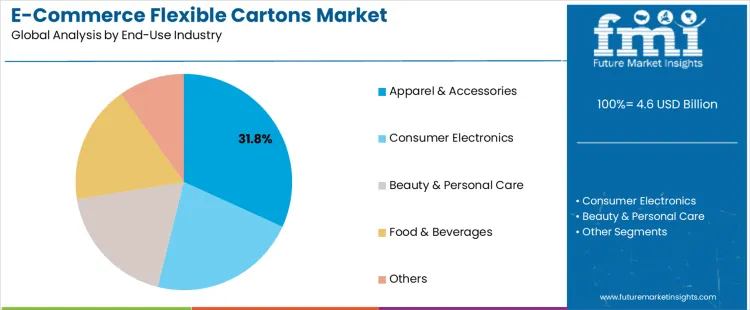
Apparel and accessories account for 31.8% of total end-use demand, making them the largest segment. Adoption is driven by the high volume of lightweight, non-fragile products shipped globally through online retail channels. Flexible cartons protect items from minor handling damage, allow branded packaging, and support sustainable material use. Retailers select carton materials, design, and closures to enhance customer experience and ensure compliance with shipping regulations. Operational monitoring includes evaluating package integrity, print durability, and ease of opening to maintain satisfaction and reduce returns.
Functional and design considerations influence adoption. Cartons must balance protective performance, sustainability, and cost efficiency while accommodating various product sizes. Stacking strength, moisture resistance, and foldability are optimized for efficient logistics. The segment leads because apparel and accessories represent the largest online retail category, requiring flexible cartons that combine protection, visual appeal, and operational reliability.
How Are Flexible Cartons Enhancing E-Commerce Packaging Efficiency?
E-commerce flexible cartons are increasingly adopted by retailers, logistics providers, and direct-to-consumer brands to protect products during shipping while optimizing material usage. Adoption is strongest in regions with high online retail penetration, stringent packaging standards, and growing demand for sustainable solutions. Cartons are selected for durability, print quality, and material flexibility. Growth is driven by operational efficiency, reduced shipping damage, and regulatory compliance. Investment focuses on material innovation, structural design, and compatibility with automated packing systems. Retailers prioritize cartons that maintain product safety, reduce environmental impact, and meet regional e-commerce and sustainability standards.
Why Are Regional E-Commerce Growth and Packaging Regulations Driving Adoption?
Demand is influenced by local consumer behavior, shipping requirements, and regulations on recyclable and recyclable-friendly packaging. Companies adopt flexible cartons to improve shipment protection, branding, and compliance with waste management standards. Materials that combine strength, lightweight properties, and recyclability gain preference. Adoption is concentrated in regions with high online sales volumes and regulatory oversight. Operational efficiency and compliance drive procurement rather than cost. Suppliers providing validated, environmentally friendly packaging solutions gain advantage among e-commerce companies, logistics providers, and retail brands.
What Factors Restrict Broader Deployment of Flexible Cartons?
High material costs, structural design complexity, and variability in production quality limit adoption. Carton performance may be affected by stacking pressure, handling, and environmental conditions during transit. Compatibility with automated packing lines and labeling systems requires technical adjustments. Certification and testing for regulatory compliance can delay deployment. Smaller e-commerce operators or regions with limited access to specialized packaging materials may face adoption challenges. Early deployment is concentrated among large retailers, logistics companies, and regions with developed e-commerce infrastructure.
How Are Technological Advancements and Collaboration Shaping Market Growth?
Developments include multi-layer laminates, recyclable materials, and customizable designs for brand differentiation and product protection. Collaboration between packaging manufacturers, e-commerce brands, and logistics providers ensures durability testing, compliance, and optimization for shipping efficiency. Pilot programs validate carton strength, material performance, and print quality before large-scale use. Quality monitoring, material certification, and process standardization maintain consistency. Focus is on operational reliability, environmental compliance, and customer experience rather than cost or volume. Collaborative efforts enable broader adoption of e-commerce flexible cartons while supporting sustainable, safe, and efficient product delivery.
What is the Demand for E-Commerce Flexible Cartons by Country?
| Country | CAGR (%) |
|---|---|
| USA | 9.1% |
| China | 10.3% |
| India | 11.0% |
| Germany | 8.4% |
| Brazil | 7.9% |
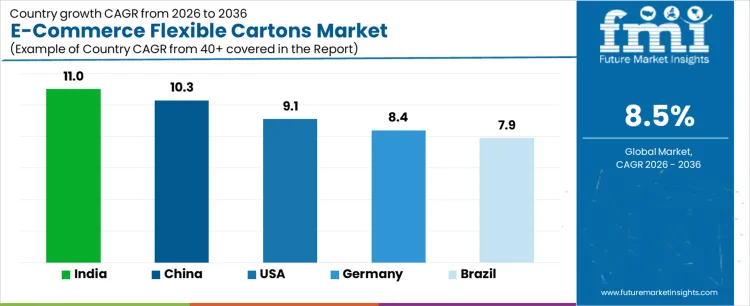
Demand for e-commerce flexible cartons is rising as online retail grows and brands seek lightweight, protective, and sustainable packaging solutions. India leads with an 11.0% CAGR, driven by rapid e-commerce adoption, rising consumer demand for safe and attractive packaging, and expansion of logistics infrastructure. China follows at 10.3%, supported by large-scale online retail operations and the need for cost-efficient, protective cartons. The USA grows at 9.1%, shaped by high e-commerce penetration and demand for customized, eco-friendly packaging. Germany records 8.4% growth, reflecting steady adoption in e-commerce packaging and logistics efficiency. Brazil shows 7.9% CAGR, driven by expanding online retail and growing focus on sustainable and protective carton solutions.
How Is the United States Experiencing Growth in the E-Commerce Flexible Cartons Market?
United States is experiencing growth at a CAGR of 9.1%, supported by adoption of flexible cartons in e-commerce packaging to improve efficiency, reduce material use, and enhance product protection during shipping. Packaging manufacturers and e-commerce companies are deploying cartons optimized for durability, lightweight design, and recyclability. Demand is concentrated in urban fulfillment centers, logistics hubs, and retail distribution networks. Investments focus on material innovation, structural integrity, and compliance with packaging regulations rather than broad-scale expansion. Growth reflects rising online retail activity, increasing demand for sustainable packaging solutions, and adoption of advanced carton design and manufacturing technologies.
- E-commerce growth drives adoption.
- Cartons are optimized for durability, lightweight design, and recyclability.
- Urban fulfillment centers and logistics hubs concentrate demand.
- Material innovation and regulatory compliance guide investment.
How Is China Witnessing Rapid Growth With Online Retail Expansion?
China is witnessing growth at a CAGR of 10.3%, fueled by adoption of flexible cartons in e-commerce packaging to meet increasing demand for durable, lightweight, and recyclable shipping solutions. Manufacturers and logistics companies are deploying cartons optimized for material efficiency, protective performance, and sustainability. Demand is concentrated in urban fulfillment centers, logistics hubs, and retail distribution networks. Investments prioritize material quality, structural integrity, and regulatory compliance rather than large-scale expansion. Growth reflects rapid growth in online retail, adoption of sustainable packaging practices, and use of advanced carton manufacturing technologies.
- Online retail expansion drives adoption.
- Cartons optimize durability, protection, and recyclability.
- Urban fulfillment centers and logistics hubs concentrate demand.
- Material quality and structural integrity guide investment.
How Is India Experiencing Rapid Growth With E-Commerce Logistics Development?
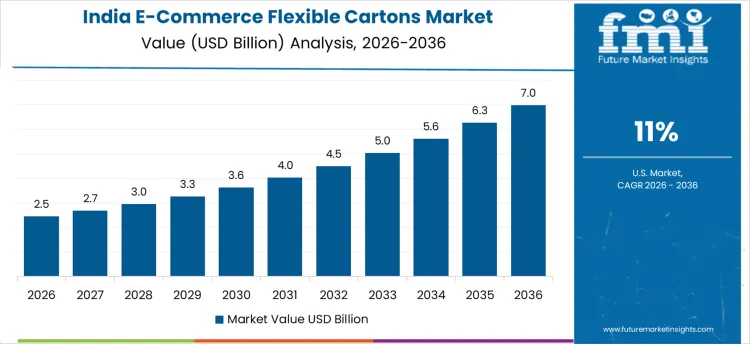
India is experiencing growth at a CAGR of 11%, supported by adoption of flexible cartons in e-commerce packaging to improve product protection, reduce shipping costs, and support sustainability. Packaging manufacturers and e-commerce operators are deploying cartons optimized for durability, lightweight design, and recyclability. Demand is concentrated in major fulfillment centers, logistics hubs, and distribution networks across urban regions. Investments focus on material innovation, carton design, and compliance with packaging standards rather than large-scale deployment. Growth reflects rapid expansion of e-commerce, increasing consumer demand for sustainable packaging, and adoption of advanced flexible carton technologies.
- E-commerce logistics drives adoption.
- Cartons are optimized for durability and sustainable performance.
- Fulfillment centers and distribution hubs concentrate demand.
- Material innovation and design efficiency guide investment.
How Is Germany Witnessing Growth With Sustainable Packaging Practices?
Germany is witnessing growth at a CAGR of 8.4%, supported by adoption of flexible cartons in e-commerce packaging to reduce environmental impact and enhance shipping efficiency. Manufacturers and e-commerce operators are implementing cartons designed for recyclability, durability, and lightweight performance. Demand is concentrated in urban fulfillment centers, logistics hubs, and industrial packaging facilities. Investments prioritize material quality, structural reliability, and regulatory compliance rather than market-wide expansion. Growth reflects increasing consumer preference for sustainable packaging, adoption of advanced e-commerce logistics solutions, and industrial focus on efficient carton design.
- Sustainable packaging practices drive adoption.
- Cartons provide durability, lightweight design, and recyclability.
- Fulfillment centers and logistics hubs concentrate demand.
- Material quality and structural reliability guide investment.
How Is Brazil Experiencing Moderate Growth With Online Retail Adoption?
Brazil is experiencing growth at a CAGR of 7.9%, fueled by adoption of flexible cartons in e-commerce packaging to protect products, optimize shipping, and support recyclable materials. Manufacturers and logistics operators are deploying cartons optimized for durability, lightweight design, and operational efficiency. Demand is concentrated in major fulfillment centers, urban logistics hubs, and retail distribution networks. Investments focus on material quality, carton design, and compliance with packaging regulations rather than large-scale rollout. Growth reflects steady expansion of online retail, adoption of sustainable packaging practices, and increasing focus on operational efficiency in e-commerce supply chains.
- Online retail adoption drives growth.
- Cartons are designed for durability and sustainability.
- Fulfillment centers and logistics hubs concentrate demand.
- Material quality and carton design guide investment.
Who Competes in the E-Commerce Flexible Cartons Market and What Defines Their Capabilities?
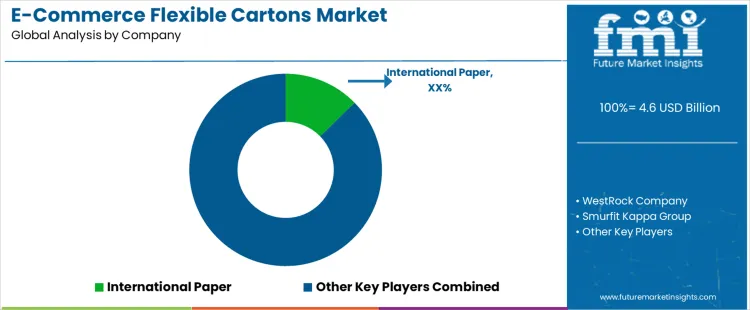
Competition in the e-commerce flexible cartons market is shaped by material innovation, structural strength, and compatibility with automated fulfillment processes. International Paper supplies flexible carton solutions designed for tear resistance and cushioning performance tailored to high-velocity distribution centers. WestRock Company delivers carton designs balancing lightweight construction with protective function for multiple product categories. Smurfit Kappa Group develops cartons integrating recycled content and strength ratings suitable for stacked transport. Amcor plc focuses on flexible carton materials optimized for print quality and branding impact. DS Smith provides modular carton formats compatible with automated handling systems. Other participants include regional converters and specialty producers catering to unique product profiles and delivery requirements. Adoption reflects the need for cartons that combine protection, sustainability attributes, and operational efficiency in fulfillment networks.
Market participants differentiate through substrate selection, protective performance, and integration with digital printing and handling workflows. International Paper emphasizes fiber quality and board integrity to withstand shipment stresses. WestRock Company engineers fluting and board combinations to improve stacking strength without increasing material weight. Smurfit Kappa Group leverages design platforms supporting sustainability targets and supply chain traceability. Amcor plc provides cartons with surface properties suited for high-resolution graphics. DS Smith focuses on system compatibilities for automated fulfillment. Regional and specialty suppliers contribute moisture-resistant and cushioning-enhanced cartons. Competitive differences emerge from quality consistency, customization support, and alignment with sustainability initiatives in e-commerce logistics.
Key Players in the E-Commerce Flexible Cartons Market
- International Paper
- WestRock Company
- Smurfit Kappa Group
- Amcor plc
- DS Smith
- Others
Scope of the Report
| Items | Values |
|---|---|
| Quantitative Units (2026) | USD billion |
| Material Type | Paperboard Flexible Cartons, Corrugated & Kraft Laminates, Barrier Films, Biodegradable and Compostable Films, Others |
| End Use Industry | Apparel & Accessories, Consumer Electronics, Beauty & Personal Care, Food & Beverages, Others |
| Format Type | Stand-up Pouches, Flat and Envelope Cartons, Bubble Mailers, Cushion Wraps & Laminates, Others |
| Region | Asia Pacific, Europe, North America, Latin America, Middle East & Africa |
| Key Countries Covered | China, Japan, South Korea, India, Australia & New Zealand, Germany, United Kingdom, France, Italy, Spain, Nordic, BENELUX, United States, Canada, Mexico, Brazil, Chile, Kingdom of Saudi Arabia, Other GCC Countries, Turkey, South Africa, Other African Union |
| Key Companies Profiled | International Paper, WestRock Company, Smurfit Kappa Group, Amcor plc, DS Smith, Others |
| Additional Attributes | Dollar sales by material type, end-use industry, and format type; regional CAGR, volume and value growth projections; adoption in apparel, electronics, beauty, and food e-commerce segments; material innovation, recyclability, barrier properties, and supply chain integration |
E-Commerce Flexible Cartons Market Segmentation
Material Type:
- Paperboard Flexible Cartons
- Corrugated & Kraft Laminates
- Barrier Films
- Biodegradable and Compostable Films
- Others
End-Use Industry:
- Apparel & Accessories
- Consumer Electronics
- Beauty & Personal Care
- Food & Beverages
- Others
Format Type:
- Stand-up Pouches
- Flat and Envelope Cartons
- Bubble Mailers
- Cushion Wraps & Laminates
- Others
Region
- Asia Pacific
- China
- Japan
- South Korea
- India
- Australia & New Zealand
- ASEAN
- Rest of Asia Pacific
- Europe
- Germany
- United Kingdom
- France
- Italy
- Spain
- Nordic
- BENELUX
- Rest of Europe
- North America
- United States
- Canada
- Mexico
- Latin America
- Brazil
- Chile
- Rest of Latin America
- Middle East & Africa
- Kingdom of Saudi Arabia
- Other GCC Countries
- Turkey
- South Africa
- Other African Union
- Rest of Middle East & Africa
Bibliography
- Food and Agriculture Organization of the United Nations (FAO). (2024). Sustainable packaging materials and paper‑based solutions for food and non‑food supply chains. FAO Packaging and Supply Chain Systems Division.
- United Nations Environment Programme (UNEP). (2024). Packaging sustainability, flexible materials, and environmental impacts in global e‑commerce. UNEP Sustainable Consumption and Production Branch.
- European Commission – Joint Research Centre (JRC). (2024). Flexible paper‑based and hybrid packaging systems for e‑commerce and retail distribution. Publications Office of the European Union.
- Organization for Economic Co‑operation and Development (OECD). (2024). Packaging materials, logistics efficiency, and sustainability frameworks for digital commerce. OECD Environment, Health and Safety Programme.
- International Organization for Standardization (ISO). (2024). Packaging — performance, recyclability, and material efficiency requirements for transport and e‑commerce. ISO Technical Committee on Packaging and the Environment.
Frequently Asked Questions
How big is the e-commerce flexible cartons market in 2026?
The global e-commerce flexible cartons market is estimated to be valued at USD 4.6 billion in 2026.
What will be the size of e-commerce flexible cartons market in 2036?
The market size for the e-commerce flexible cartons market is projected to reach USD 10.4 billion by 2036.
How much will be the e-commerce flexible cartons market growth between 2026 and 2036?
The e-commerce flexible cartons market is expected to grow at a 8.5% CAGR between 2026 and 2036.
What are the key product types in the e-commerce flexible cartons market?
The key product types in e-commerce flexible cartons market are paperboard flexible cartons, corrugated & kraft laminates, barrier films , biodegradable and compostable films and others.
Which end‑use industry segment to contribute significant share in the e-commerce flexible cartons market in 2026?
In terms of end‑use industry, apparel & accessories segment to command 31.8% share in the e-commerce flexible cartons market in 2026.
Preview the report firsthand - request a free sample
Get SampleGet the brochure for pricing and purchase details.
Get PDFTable of Content
- Executive Summary
- Global Market Outlook
- Demand-side Trends
- Supply-side Trends
- Technology Roadmap Analysis
- Analysis and Recommendations
- Market Overview
- Market Coverage / Taxonomy
- Market Definition / Scope / Limitations
- Market Background
- Market Dynamics
- Drivers
- Restraints
- Opportunity
- Trends
- Scenario Forecast
- Demand in Optimistic Scenario
- Demand in Likely Scenario
- Demand in Conservative Scenario
- Opportunity Map Analysis
- Product Life Cycle Analysis
- Supply Chain Analysis
- Investment Feasibility Matrix
- Value Chain Analysis
- PESTLE and Porter’s Analysis
- Regulatory Landscape
- Regional Parent Market Outlook
- Production and Consumption Statistics
- Import and Export Statistics
- Market Dynamics
- Global Market Analysis 2021 to 2025 and Forecast, 2026 to 2036
- Historical Market Size Value (USD Million) Analysis, 2021 to 2025
- Current and Future Market Size Value (USD Million) Projections, 2026 to 2036
- Y-o-Y Growth Trend Analysis
- Absolute $ Opportunity Analysis
- Global Market Pricing Analysis 2021 to 2025 and Forecast 2026 to 2036
- Global Market Analysis 2021 to 2025 and Forecast 2026 to 2036, By Material Type
- Introduction / Key Findings
- Historical Market Size Value (USD Million) Analysis By Material Type , 2021 to 2025
- Current and Future Market Size Value (USD Million) Analysis and Forecast By Material Type , 2026 to 2036
- Paperboard Flexible Cartons
- Corrugated & Kraft Laminates
- Barrier Films
- Biodegradable and Compostable Films
- Others
- Paperboard Flexible Cartons
- Y-o-Y Growth Trend Analysis By Material Type , 2021 to 2025
- Absolute $ Opportunity Analysis By Material Type , 2026 to 2036
- Global Market Analysis 2021 to 2025 and Forecast 2026 to 2036, By End‑Use Industry
- Introduction / Key Findings
- Historical Market Size Value (USD Million) Analysis By End‑Use Industry, 2021 to 2025
- Current and Future Market Size Value (USD Million) Analysis and Forecast By End‑Use Industry, 2026 to 2036
- Apparel & Accessories
- Consumer Electronics
- Beauty & Personal Care
- Food & Beverages
- Others
- Apparel & Accessories
- Y-o-Y Growth Trend Analysis By End‑Use Industry, 2021 to 2025
- Absolute $ Opportunity Analysis By End‑Use Industry, 2026 to 2036
- Global Market Analysis 2021 to 2025 and Forecast 2026 to 2036, By Format Type
- Introduction / Key Findings
- Historical Market Size Value (USD Million) Analysis By Format Type, 2021 to 2025
- Current and Future Market Size Value (USD Million) Analysis and Forecast By Format Type, 2026 to 2036
- Stand‑up Pouches
- Flat and Envelope Cartons
- Bubble Mailers
- Cushion Wraps & Laminates
- Others
- Stand‑up Pouches
- Y-o-Y Growth Trend Analysis By Format Type, 2021 to 2025
- Absolute $ Opportunity Analysis By Format Type, 2026 to 2036
- Global Market Analysis 2021 to 2025 and Forecast 2026 to 2036, By Region
- Introduction
- Historical Market Size Value (USD Million) Analysis By Region, 2021 to 2025
- Current Market Size Value (USD Million) Analysis and Forecast By Region, 2026 to 2036
- North America
- Latin America
- Western Europe
- Eastern Europe
- East Asia
- South Asia and Pacific
- Middle East & Africa
- Market Attractiveness Analysis By Region
- North America Market Analysis 2021 to 2025 and Forecast 2026 to 2036, By Country
- Historical Market Size Value (USD Million) Trend Analysis By Market Taxonomy, 2021 to 2025
- Market Size Value (USD Million) Forecast By Market Taxonomy, 2026 to 2036
- By Country
- USA
- Canada
- Mexico
- By Material Type
- By End‑Use Industry
- By Format Type
- By Country
- Market Attractiveness Analysis
- By Country
- By Material Type
- By End‑Use Industry
- By Format Type
- Key Takeaways
- Latin America Market Analysis 2021 to 2025 and Forecast 2026 to 2036, By Country
- Historical Market Size Value (USD Million) Trend Analysis By Market Taxonomy, 2021 to 2025
- Market Size Value (USD Million) Forecast By Market Taxonomy, 2026 to 2036
- By Country
- Brazil
- Chile
- Rest of Latin America
- By Material Type
- By End‑Use Industry
- By Format Type
- By Country
- Market Attractiveness Analysis
- By Country
- By Material Type
- By End‑Use Industry
- By Format Type
- Key Takeaways
- Western Europe Market Analysis 2021 to 2025 and Forecast 2026 to 2036, By Country
- Historical Market Size Value (USD Million) Trend Analysis By Market Taxonomy, 2021 to 2025
- Market Size Value (USD Million) Forecast By Market Taxonomy, 2026 to 2036
- By Country
- Germany
- UK
- Italy
- Spain
- France
- Nordic
- BENELUX
- Rest of Western Europe
- By Material Type
- By End‑Use Industry
- By Format Type
- By Country
- Market Attractiveness Analysis
- By Country
- By Material Type
- By End‑Use Industry
- By Format Type
- Key Takeaways
- Eastern Europe Market Analysis 2021 to 2025 and Forecast 2026 to 2036, By Country
- Historical Market Size Value (USD Million) Trend Analysis By Market Taxonomy, 2021 to 2025
- Market Size Value (USD Million) Forecast By Market Taxonomy, 2026 to 2036
- By Country
- Russia
- Poland
- Hungary
- Balkan & Baltic
- Rest of Eastern Europe
- By Material Type
- By End‑Use Industry
- By Format Type
- By Country
- Market Attractiveness Analysis
- By Country
- By Material Type
- By End‑Use Industry
- By Format Type
- Key Takeaways
- East Asia Market Analysis 2021 to 2025 and Forecast 2026 to 2036, By Country
- Historical Market Size Value (USD Million) Trend Analysis By Market Taxonomy, 2021 to 2025
- Market Size Value (USD Million) Forecast By Market Taxonomy, 2026 to 2036
- By Country
- China
- Japan
- South Korea
- By Material Type
- By End‑Use Industry
- By Format Type
- By Country
- Market Attractiveness Analysis
- By Country
- By Material Type
- By End‑Use Industry
- By Format Type
- Key Takeaways
- South Asia and Pacific Market Analysis 2021 to 2025 and Forecast 2026 to 2036, By Country
- Historical Market Size Value (USD Million) Trend Analysis By Market Taxonomy, 2021 to 2025
- Market Size Value (USD Million) Forecast By Market Taxonomy, 2026 to 2036
- By Country
- India
- ASEAN
- Australia & New Zealand
- Rest of South Asia and Pacific
- By Material Type
- By End‑Use Industry
- By Format Type
- By Country
- Market Attractiveness Analysis
- By Country
- By Material Type
- By End‑Use Industry
- By Format Type
- Key Takeaways
- Middle East & Africa Market Analysis 2021 to 2025 and Forecast 2026 to 2036, By Country
- Historical Market Size Value (USD Million) Trend Analysis By Market Taxonomy, 2021 to 2025
- Market Size Value (USD Million) Forecast By Market Taxonomy, 2026 to 2036
- By Country
- Kingdom of Saudi Arabia
- Other GCC Countries
- Turkiye
- South Africa
- Other African Union
- Rest of Middle East & Africa
- By Material Type
- By End‑Use Industry
- By Format Type
- By Country
- Market Attractiveness Analysis
- By Country
- By Material Type
- By End‑Use Industry
- By Format Type
- Key Takeaways
- Key Countries Market Analysis
- USA
- Pricing Analysis
- Market Share Analysis, 2025
- By Material Type
- By End‑Use Industry
- By Format Type
- Canada
- Pricing Analysis
- Market Share Analysis, 2025
- By Material Type
- By End‑Use Industry
- By Format Type
- Mexico
- Pricing Analysis
- Market Share Analysis, 2025
- By Material Type
- By End‑Use Industry
- By Format Type
- Brazil
- Pricing Analysis
- Market Share Analysis, 2025
- By Material Type
- By End‑Use Industry
- By Format Type
- Chile
- Pricing Analysis
- Market Share Analysis, 2025
- By Material Type
- By End‑Use Industry
- By Format Type
- Germany
- Pricing Analysis
- Market Share Analysis, 2025
- By Material Type
- By End‑Use Industry
- By Format Type
- UK
- Pricing Analysis
- Market Share Analysis, 2025
- By Material Type
- By End‑Use Industry
- By Format Type
- Italy
- Pricing Analysis
- Market Share Analysis, 2025
- By Material Type
- By End‑Use Industry
- By Format Type
- Spain
- Pricing Analysis
- Market Share Analysis, 2025
- By Material Type
- By End‑Use Industry
- By Format Type
- France
- Pricing Analysis
- Market Share Analysis, 2025
- By Material Type
- By End‑Use Industry
- By Format Type
- India
- Pricing Analysis
- Market Share Analysis, 2025
- By Material Type
- By End‑Use Industry
- By Format Type
- ASEAN
- Pricing Analysis
- Market Share Analysis, 2025
- By Material Type
- By End‑Use Industry
- By Format Type
- Australia & New Zealand
- Pricing Analysis
- Market Share Analysis, 2025
- By Material Type
- By End‑Use Industry
- By Format Type
- China
- Pricing Analysis
- Market Share Analysis, 2025
- By Material Type
- By End‑Use Industry
- By Format Type
- Japan
- Pricing Analysis
- Market Share Analysis, 2025
- By Material Type
- By End‑Use Industry
- By Format Type
- South Korea
- Pricing Analysis
- Market Share Analysis, 2025
- By Material Type
- By End‑Use Industry
- By Format Type
- Russia
- Pricing Analysis
- Market Share Analysis, 2025
- By Material Type
- By End‑Use Industry
- By Format Type
- Poland
- Pricing Analysis
- Market Share Analysis, 2025
- By Material Type
- By End‑Use Industry
- By Format Type
- Hungary
- Pricing Analysis
- Market Share Analysis, 2025
- By Material Type
- By End‑Use Industry
- By Format Type
- Kingdom of Saudi Arabia
- Pricing Analysis
- Market Share Analysis, 2025
- By Material Type
- By End‑Use Industry
- By Format Type
- Turkiye
- Pricing Analysis
- Market Share Analysis, 2025
- By Material Type
- By End‑Use Industry
- By Format Type
- South Africa
- Pricing Analysis
- Market Share Analysis, 2025
- By Material Type
- By End‑Use Industry
- By Format Type
- USA
- Market Structure Analysis
- Competition Dashboard
- Competition Benchmarking
- Market Share Analysis of Top Players
- By Regional
- By Material Type
- By End‑Use Industry
- By Format Type
- Competition Analysis
- Competition Deep Dive
- International Paper
- Overview
- Product Portfolio
- Profitability by Market Segments (Product/Age /Sales Channel/Region)
- Sales Footprint
- Strategy Overview
- Marketing Strategy
- Product Strategy
- Channel Strategy
- WestRock Company
- Smurfit Kappa Group
- Amcor plc
- DS Smith
- Others
- International Paper
- Competition Deep Dive
- Assumptions & Acronyms Used
- Research Methodology


