

- Industry Size (2026)
- USD 2.2 Bn
- Forecast (2036)
- USD 5.5 Bn
- CAGR (2026 to 2036)
- 9.6%
LED Lane Control Signs Market Forecast and Outlook 2026 to 2036
In 2026, the LED lane control signs market stands at USD 2.2 billion and is expected to reach USD 5.5 billion by 2036, implying a CAGR of 9.60%. These systems perform a safety critical role in managed highways, tunnels, and urban expressways, where incorrect lane status indication carries direct accident and liability exposure. Demand is therefore concentrated in regions with dense high speed road networks and centralized traffic control infrastructure, particularly Western Europe, North America, and parts of East Asia. Adoption remains uneven because many countries still rely on static signage and fragmented control systems, and upgrades depend on public investment cycles rather than routine maintenance budgets.
Procurement is governed by total cost of ownership and lifecycle reliability rather than by headline equipment price. Road authorities evaluate luminance decay, electronics failure rates, enclosure sealing, and access for maintenance when defining specifications. Long replacement cycles and multi-year performance guarantees favor suppliers that can support extended service obligations and parts availability. Installation is frequently bundled with corridor modernization and control center upgrades, which creates irregular ordering patterns. The market expands through targeted network upgrades and traffic management densification, not through uniform deployment across all road categories or jurisdictions.
Quick Stats for LED Lane Control Signs Market
- LED Lane Control Signs Market Value (2026): USD 2.2 billion
- LED Lane Control Signs Market Forecast Value (2036): USD 5.5 billion
- LED Lane Control Signs Market Forecast CAGR 2026 to 2036: 9.6%
- Leading Type in LED Lane Control Signs Market: Overhead LED lane control signs
- Key Growth Regions in LED Lane Control Signs Market: Asia Pacific, North America, Europe
- Top Players in LED Lane Control Signs Market: Eberle Design Inc., Daktronics, LITE ON Technology Corporation, Carmanah Technologies, Flash Technology Inc., Mobile Vision Inc., Vanguard LED Systems
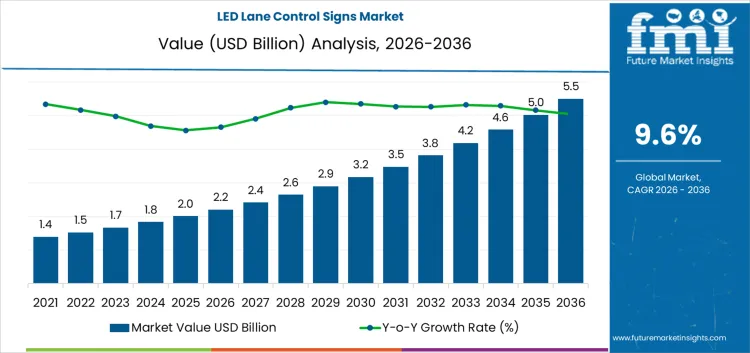
What is the Growth Forecast for LED Lane Control Signs Market through 2036?
The LED lane control signs market is being driven primarily by corridor and tunnel upgrade programs rather than by isolated traffic projects. High-traffic urban corridors, river crossings, and long tunnels concentrate a disproportionate share of incidents and congestion, which makes dynamic lane control one of the highest return-on-investment interventions for traffic authorities. In many countries, 20-30% of highway kilometers carry more than 50% of traffic volume, and these sections are now the first targets for digital lane management retrofits. This is why demand clusters around specific routes rather than spreading evenly across networks. Replacement and modernization cycles also play a central role, since a large installed base of early LED and electromechanical signs from the 2008-2015 wave is reaching end-of-life. The market expands not only through new kilometers equipped, but through systematic replacement of older units with higher-brightness, higher-contrast, and remotely diagnosable systems.
Economic logic around maintenance access and lane closures is now a decisive buying factor. On heavily trafficked tunnels and urban expressways, a single lane closure can impose social and economic costs far exceeding the price of the sign itself, which pushes operators toward longer-life, front-access, and modular designs that reduce intervention frequency. This shifts procurement from lowest-capex to lowest-lifecycle-disruption logic. At the same time, LED lane control signs are no longer treated as standalone devices but as field nodes inside traffic management systems, feeding and receiving data from incident detection, variable message signs, and central control rooms. As more corridors move to coordinated, software-driven traffic control, sign density per kilometer increases and unit value rises due to communication, redundancy, and diagnostics features.
LED Lane Control Signs Market Key Takeaways
| Metric | Value |
|---|---|
| Market Value (2026) | USD 2.2 billion |
| Forecast Value (2036) | USD 5.5 billion |
| Forecast CAGR 2026 to 2036 | 9.6% |
How Is the LED Lane Control Signs Market Managing Failure Costs and Safety Liability?
LED lane control signs are critical for guiding traffic flow, reducing congestion, and preventing accidents on highways and urban road networks. Historically, static or poorly maintained signaling systems led to driver confusion, increased accident risk, and operational downtime. Modern LED lane control signs integrate high-visibility displays, redundancy features, and real-time monitoring to maintain operational reliability and alert drivers effectively. Transportation authorities, highway operators, and traffic management companies prioritize system durability, compliance with traffic regulations, and rapid fault detection. Early adoption focused on high-traffic expressways, while current deployment spans urban arterial roads, tunnels, and bridges, driven by safety requirements, traffic efficiency, and regulatory oversight. Sign clarity, electrical reliability, and maintenance accessibility influence supplier selection.
Failures in lane control signage can result in severe operational, legal, and financial consequences. Accidents caused by malfunctioning or miscommunicated lane instructions expose operators to liability, legal claims, and reputational risk. Compared with conventional static systems, modern LED signs emphasize redundancy, remote monitoring, and fail-safe mechanisms to mitigate operational risks. Cost structures depend on display quality, monitoring infrastructure, and system integration, concentrating margins among suppliers capable of delivering reliable, high-performance solutions. Transportation agencies adopt these signs to maintain traffic safety, reduce accident likelihood, and minimize legal exposure. By 2036, LED lane control signs are expected to be standard across major road networks, supporting safer traffic flow, reduced incident risk, and accountable operational management.
What Factors Are Shaping the Demand for LED Lane Control Signs Segment wise Analysis by Sign Configuration and Deployment Environment in 2026?
The LED lane control signs market in 2026 is segmented by sign type and by application setting. By sign configuration, demand is divided into overhead LED lane control signs, side mounted LED lane signs, portable LED lane control units, and dynamic message lane control systems, each imposing different requirements on structures, cabling, and maintenance access. By application, demand is organized around highways and expressways, urban traffic management, toll plazas and ramps, and airport or transit lane control, which differ in traffic volume, uptime expectations, and approval processes. These segments reflect how agencies balance tooling and mounting compatibility against the cost and risk of redesign when upgrading existing corridors.
Why Do Overhead LED Lane Control Signs Lead When Tooling and Mounting Compatibility Matters?
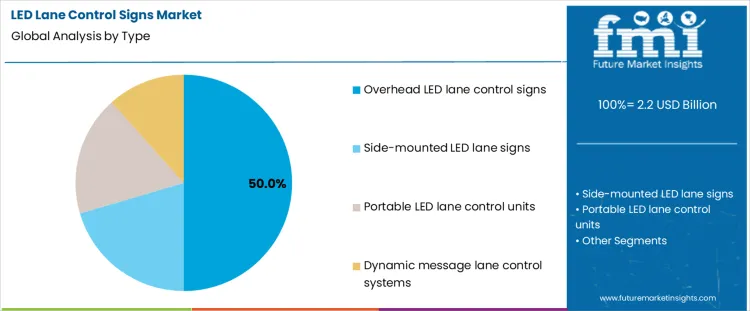
Overhead LED lane control signs account for about 50% of demand in 2026, largely because they align with the dominant gantry and portal structures already installed on controlled access roads. Many corridors were built with standardized mounting points, cable routes, and sight line geometry that favor like for like replacement. Using compatible overhead units allows operators to reuse brackets, foundations, and access equipment without changing civil works. This reduces installation time, traffic closures, and permitting effort. Procurement teams also prefer equipment that fits existing tooling because it simplifies spares, training, and inspection routines. The accumulated stock of gantries and portals therefore pulls demand toward overhead formats that can be swapped in with minimal physical change.
Side mounted, portable, and dynamic systems address different operational needs but often face compatibility limits. Side mounted units depend on barrier or pole spacing that varies by site, which increases custom work. Portable units avoid fixed mounting but are used mainly for temporary control. Dynamic message systems offer richer content, yet they often require different frames and power arrangements. These options are selected where function demands them, but they rarely replace overhead signs in bulk programs. The scale of the existing overhead infrastructure and the desire to avoid new tooling keep overhead formats as the primary volume category.
Why Do Highways and Expressways Dominate Where Redesign Requirements Are Minimized?
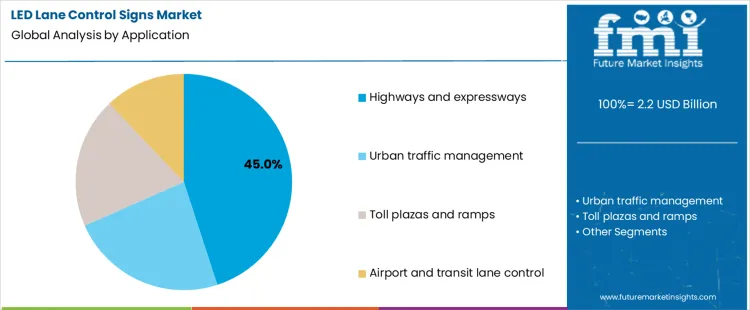
Highways and expressways represent about 45% of demand in 2026 because upgrades in these corridors prioritize continuity of layout and traffic management practice. Any physical redesign on high speed roads triggers long approval cycles, safety audits, and extended closures. As a result, agencies favor sign systems that can be installed within the existing geometric envelope. Lane control signs in these environments are often part of coordinated gantry sets, so changing one element without altering structure dimensions reduces engineering risk. This bias toward minimal redesign concentrates spending in highway networks where replacement programs focus on electronics and optics rather than on civil modifications.
Urban streets, toll plazas, and airports follow different constraints. Urban traffic management accepts more variation in mounting but faces space conflicts and stakeholder approvals. Toll and ramp areas use specialized structures tied to booths or canopies, which limits reuse. Airport and transit lanes require coordination with facility operators and safety authorities, which lengthens redesign timelines. These environments adopt new formats selectively. In contrast, the long, standardized runs of expressways allow large scale refresh cycles that avoid structural change, keeping them as the main application base for LED lane control sign demand.
How Are the Key Dynamics of Active Traffic Management, Public Procurement Friction, and Corridor Modernization Reshaping the LED Lane Control Signs Market through 2036?
The category is being redefined by how road authorities manage flow rather than by how they display rules. Agencies want lane control to respond to incidents, congestion, and weather in real time, which pushes signage from static instruction into operational control. This creates a strong case for network level upgrades, but delivery is slowed by long budget cycles and complex public tendering. At the same time, many corridors are being rebuilt or digitized, creating windows to embed smarter control layers. The result is a market driven by program scale investments and governance timing, where success depends as much on procurement alignment and funding cycles as on display performance.
Why Is the Shift from Passive Signage to Active Traffic Management Driving the LED Lane Control Signs Market through 2036?
Demand is being pulled by how traffic is operated, not by signage replacement needs. Congestion, incidents, and work zones require lane status to change by minute, not by season. Control rooms increasingly manage roads as dynamic systems, adjusting lane use, speed, and access in response to conditions. LED lane control signs become actuators in this system rather than information boards. Once integrated into traffic management platforms, they are specified as part of corridor control architecture. This ties volume to intelligent transport deployments and network operations strategies rather than to simple asset aging or compliance driven replacement programs.
Why Are Budget Cycles and Slow Public Procurement Holding Back Faster Rollout?
The main barrier is institutional timing, not technical readiness. Most road authorities fund projects in multiyear cycles, and intelligent infrastructure must compete with basic maintenance and expansion needs. Approval chains are long, and specifications often require multiple stakeholder sign offs. Tendering rules favor proven designs and lowest compliant bids, which discourages rapid platform shifts. Integration with existing control systems also raises project risk and review requirements. Even when operational benefits are clear, projects can sit in planning for years. These factors make adoption lumpy and corridor by corridor rather than continuous and network wide.
How Are Network Level Upgrades and Corridor Modernization Programs Changing the Structure of Demand?
The opportunity is becoming programmatic rather than project based. Many regions are upgrading entire corridors or urban networks with coordinated control, communications, and sensing. In these programs, lane control signs are bundled with detectors, cameras, and central software rather than procured as standalone assets. This favors suppliers that can participate in integrated packages and support long deployment schedules. Once a corridor standard is defined, the same equipment is rolled out across many sites. Over time, demand shifts from one off replacements to multiyear modernization programs tied to broader intelligent transport and road renewal strategies.
What is the Demand for LED Lane Control Signs by Country?
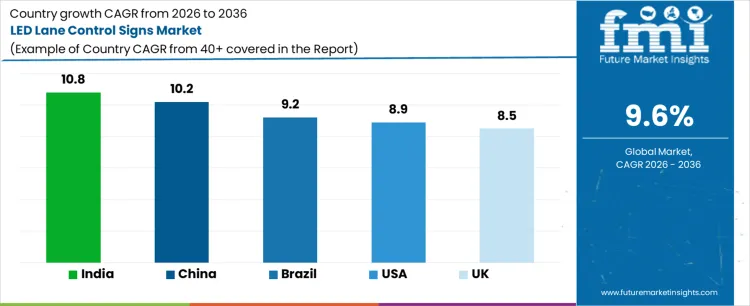
| Country | CAGR (%) |
|---|---|
| USA | 8.9% |
| UK | 8.5% |
| China | 10.2% |
| India | 10.8% |
| Brazil | 9.2% |
Demand for LED lane control signs is rising as transportation authority’s adopt intelligent traffic management solutions to improve road safety, traffic flow, and operational efficiency. India leads with a 10.8% CAGR, driven by growing highway networks, urban road expansions, and adoption of smart traffic control systems. China follows at 10.2%, supported by large-scale infrastructure projects and deployment of advanced LED signage. Brazil records 9.2% growth, shaped by highway modernization and urban traffic management initiatives. The USA grows at 8.9%, influenced by upgrades to existing traffic control systems. The UK shows 8.5% CAGR, reflecting steady adoption of LED lane control solutions across urban and highway networks.
How is the United States experiencing growth in the LED lane control signs market?
United States is experiencing growth at a CAGR of 8.9%, driven by highway and urban traffic management projects in California, Texas, and New York. Qualification barriers and inclusion on approved vendor lists restrict entry, favoring established manufacturers. Market concentration is high around major metropolitan traffic authorities, while regional fragmentation exists in smaller municipalities. Global suppliers compete with local traffic systems integrators, providing specialized maintenance and installation services. Service coverage and maintenance capability influence adoption, as switching costs and long contract cycles favor reliable partners. Scale advantages in manufacturing and installation allow established vendors to deliver cost-effective, high-quality LED lane control signs.
- Highway and urban traffic projects drive adoption.
- Approved vendor lists and qualification barriers shape the market.
- Service coverage and maintenance requirements concentrate demand.
- Scale advantages favor established manufacturers.
How is the United Kingdom witnessing growth in the LED lane control signs market?
United Kingdom is witnessing growth at a CAGR of 8.5%, supported by smart motorway projects and urban traffic control upgrades in London, Birmingham, and Manchester. Qualification barriers and strict supplier vetting favor experienced vendors. Market structure is moderately concentrated, with regional transport authorities contracting integrators for design, installation, and maintenance. Global suppliers compete alongside domestic traffic systems providers, with long contract cycles and switching costs influencing procurement decisions. Service coverage and ongoing maintenance capability are critical, and scale advantages in manufacturing and deployment improve cost efficiency for large projects.
- Smart motorway and urban traffic projects drive adoption.
- Supplier vetting and qualification barriers influence participation.
- Maintenance capability and long contracts anchor demand.
- Scale and deployment efficiency guide investment.
How is China experiencing growth in the LED lane control signs market?
China is experiencing growth at a CAGR of 10.2%, fueled by rapid expansion of expressway networks and urban traffic management systems in Shanghai, Beijing, and Guangzhou. Qualification barriers favor certified suppliers, while market concentration exists in provincial transport bureaus, and regional fragmentation is limited due to centralized planning. Global suppliers compete with strong domestic integrators that provide installation and maintenance services. Service coverage and technical support are critical, as switching costs and multi-year contract cycles encourage long-term engagements. Scale advantages in manufacturing and large-scale deployment support rapid project completion and cost optimization.
- Expressway and urban traffic expansion drives adoption.
- Certified supplier barriers concentrate qualified vendors.
- Maintenance and service coverage influence demand.
- Large-scale deployment provides cost and schedule advantages.
How is India witnessing growth in the LED lane control signs market?
India is witnessing growth at a CAGR of 10.8%, supported by national highway and urban smart city initiatives in Delhi, Mumbai, and Bengaluru. Qualification barriers and approved vendor lists restrict market participation, favoring experienced providers. Market is fragmented regionally, with local traffic system integrators complementing global suppliers. Service coverage and maintenance capability are key to adoption, given long contract cycles and high switching costs. Scale advantages in manufacturing and installation allow larger vendors to meet the needs of multi-city deployments efficiently. Growth reflects government investment in modern traffic infrastructure and high-reliability LED lane control systems.
- National highways and urban smart city projects drive adoption.
- Qualification barriers restrict vendor participation.
- Service coverage and contract length influence adoption.
- Scale and installation capacity provide advantages.
How is Brazil experiencing growth in the LED lane control signs market?
Brazil is experiencing growth at a CAGR of 9.2%, driven by urban roadway modernization and highway safety projects in São Paulo, Rio de Janeiro, and Paraná. Qualification barriers and approved vendor lists favor certified suppliers. Market concentration is moderate, with regional fragmentation across states. Global suppliers provide technology while domestic integrators manage installation and maintenance. Service coverage and ongoing support are critical due to long contract durations and high switching costs. Scale advantages in manufacturing and deployment allow suppliers to efficiently serve multiple urban and highway projects. Growth reflects investment in modern traffic management and reliable LED lane control infrastructure.
- Urban road and highway projects drive adoption.
- Certified vendor lists shape participation.
- Maintenance and service requirements concentrate demand.
- Scale and deployment capability guide investment.
Who Are the Key Competitors in the LED Lane Control Signs Market and How Do They Compete?
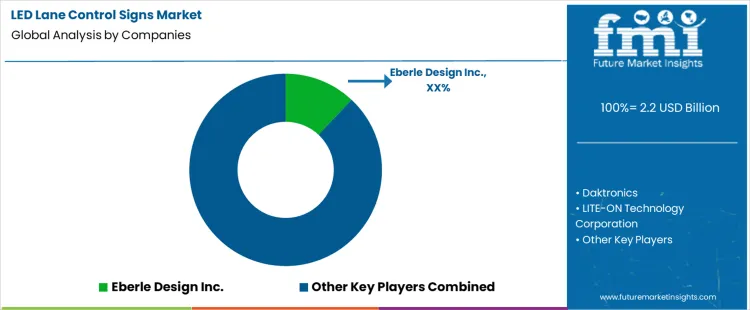
Competition in the LED lane control signs market is shaped by display clarity, reliability in varied weather conditions, and integration with traffic control systems. Eberle Design Inc. supplies lane control signs engineered for high visibility and durability, focusing on modular designs that support rapid field service. Daktronics offers LED sign platforms with strong brightness control and networked communication capabilities to interface with central traffic management systems. LITE-ON Technology Corporation provides LED modules and sign assemblies with emphasis on energy efficiency and long service life. Carmanah Technologies delivers robust, solar-compatible lane control signs aimed at jurisdictions with renewable power integration. Flash Technology Inc. supplies rugged LED signage solutions tailored to highway environments with vibration and temperature resilience.
Mobile Vision Inc. develops mobile and semi-permanent LED lane signs suited for work zones and temporary traffic patterns, with control systems that support remote updates. Vanguard LED Systems provides high-intensity LED signs with customizable messaging and color configurations for lane control and dynamic routing applications. Other regional and specialty providers offer LED sign solutions focused on local standards and installation practices. Competitive differentiation arises from sign brightness, control system interoperability, power management, ease of integration with traffic signal networks, and long-term reliability under highway conditions. Suppliers that combine proven optical performance, network connectivity, and field service support are positioned to meet the evolving needs of municipalities and transportation agencies managing lane designation, closures, and dynamic traffic flows.
Key Players in the LED lane control signs market
- Eberle Design Inc.
- Daktronics
- LITE ON Technology Corporation
- Carmanah Technologies
- Flash Technology Inc.
- Mobile Vision Inc.
- Vanguard LED Systems
Scope of the Report
| Items | Values |
|---|---|
| Quantitative Units (2026) | USD billion |
| Type | Overhead LED Lane Control Signs, Side-Mounted LED Lane Signs, Portable LED Lane Control Units, Dynamic Message Lane Control Systems |
| Application | Highways and Expressways, Urban Traffic Management, Toll Plazas and Ramps, Airport and Transit Lane Control |
| Regions Covered | Asia Pacific, Europe, North America, Latin America, Middle East & Africa |
| Countries Covered | China, Japan, South Korea, India, Australia & New Zealand, ASEAN, Germany, United Kingdom, France, Italy, Spain, Nordic, BENELUX, United States, Canada, Mexico, Brazil, Chile, Saudi Arabia, Turkey, South Africa, and other regional markets |
| Key Companies Profiled | Eberle Design Inc., Daktronics, LITE-ON Technology Corporation, Carmanah Technologies, Flash Technology Inc., Mobile Vision Inc., Vanguard LED Systems |
| Additional Attributes | Dollar sales by sign type and application; overhead signs as the dominant format; highways and expressways as the leading deployment segment; demand driven by corridor modernization and tunnel upgrades; procurement shaped by lifecycle reliability, maintenance access, and lane-closure economics; integration with traffic management systems increases unit value and deployment density. |
LED lane control signs market Segmentation
Type:
- Overhead LED lane control signs
- Side-mounted LED lane signs
- Portable LED lane control units
- Dynamic message lane control systems
Application:
- Highways and expressways
- Urban traffic management
- Toll plazas and ramps
- Airport and transit lane control
Region
- Asia Pacific
- China
- Japan
- South Korea
- India
- Australia & New Zealand
- ASEAN
- Rest of Asia Pacific
- Europe
- Germany
- United Kingdom
- France
- Italy
- Spain
- Nordic
- BENELUX
- Rest of Europe
- North America
- United States
- Canada
- Mexico
- Latin America
- Brazil
- Chile
- Rest of Latin America
- Middle East & Africa
- Kingdom of Saudi Arabia
- Other GCC Countries
- Turkey
- South Africa
- Other African Union
- Rest of Middle East & Africa
Bibliography
- European Union. (2024). Regulation (EU) 2024/1679 on Union guidelines for the development of the trans-European transport network. Official Journal of the European Union.
- International Organization for Standardization. (2024). Intelligent transport systems—Graphic data dictionary—Part 1: Specification (ISO 14823-1:2024). ISO.
- International Organization for Standardization. (2024). Intelligent transport systems—Roadside modules AP-DATEX data interface—Part 10: Variable message signs (ISO/TS 22741-10:2024). ISO.
Frequently Asked Questions
How big is the led lane control signs market in 2026?
The global led lane control signs market is estimated to be valued at USD 2.2 billion in 2026.
What will be the size of led lane control signs market in 2036?
The market size for the led lane control signs market is projected to reach USD 5.5 billion by 2036.
How much will be the led lane control signs market growth between 2026 and 2036?
The led lane control signs market is expected to grow at a 9.6% CAGR between 2026 and 2036.
What are the key product types in the led lane control signs market?
The key product types in led lane control signs market are overhead led lane control signs , side‑mounted led lane signs, portable led lane control units and dynamic message lane control systems.
Which application segment to contribute significant share in the led lane control signs market in 2026?
In terms of application, highways and expressways segment to command 45.0% share in the led lane control signs market in 2026.
Preview the report firsthand - request a free sample
Get SampleGet the brochure for pricing and purchase details.
Get PDFTable of Content
- Executive Summary
- Global Market Outlook
- Demand-side Trends
- Supply-side Trends
- Technology Roadmap Analysis
- Analysis and Recommendations
- Market Overview
- Market Coverage / Taxonomy
- Market Definition / Scope / Limitations
- Market Background
- Market Dynamics
- Drivers
- Restraints
- Opportunity
- Trends
- Scenario Forecast
- Demand in Optimistic Scenario
- Demand in Likely Scenario
- Demand in Conservative Scenario
- Opportunity Map Analysis
- Product Life Cycle Analysis
- Supply Chain Analysis
- Investment Feasibility Matrix
- Value Chain Analysis
- PESTLE and Porter’s Analysis
- Regulatory Landscape
- Regional Parent Market Outlook
- Production and Consumption Statistics
- Import and Export Statistics
- Market Dynamics
- Global Market Analysis 2021 to 2025 and Forecast, 2026 to 2036
- Historical Market Size Value (USD Million) Analysis, 2021 to 2025
- Current and Future Market Size Value (USD Million) Projections, 2026 to 2036
- Y-o-Y Growth Trend Analysis
- Absolute $ Opportunity Analysis
- Global Market Pricing Analysis 2021 to 2025 and Forecast 2026 to 2036
- Global Market Analysis 2021 to 2025 and Forecast 2026 to 2036, By Type
- Introduction / Key Findings
- Historical Market Size Value (USD Million) Analysis By Type, 2021 to 2025
- Current and Future Market Size Value (USD Million) Analysis and Forecast By Type, 2026 to 2036
- Overhead LED lane control signs
- Side‑mounted LED lane signs
- Portable LED lane control units
- Dynamic message lane control systems
- Overhead LED lane control signs
- Y-o-Y Growth Trend Analysis By Type, 2021 to 2025
- Absolute $ Opportunity Analysis By Type, 2026 to 2036
- Global Market Analysis 2021 to 2025 and Forecast 2026 to 2036, By Application
- Introduction / Key Findings
- Historical Market Size Value (USD Million) Analysis By Application, 2021 to 2025
- Current and Future Market Size Value (USD Million) Analysis and Forecast By Application, 2026 to 2036
- Highways and expressways
- Urban traffic management
- Toll plazas and ramps
- Airport and transit lane control
- Highways and expressways
- Y-o-Y Growth Trend Analysis By Application, 2021 to 2025
- Absolute $ Opportunity Analysis By Application, 2026 to 2036
- Global Market Analysis 2021 to 2025 and Forecast 2026 to 2036, By Region
- Introduction
- Historical Market Size Value (USD Million) Analysis By Region, 2021 to 2025
- Current Market Size Value (USD Million) Analysis and Forecast By Region, 2026 to 2036
- North America
- Latin America
- Western Europe
- Eastern Europe
- East Asia
- South Asia and Pacific
- Middle East & Africa
- Market Attractiveness Analysis By Region
- North America Market Analysis 2021 to 2025 and Forecast 2026 to 2036, By Country
- Historical Market Size Value (USD Million) Trend Analysis By Market Taxonomy, 2021 to 2025
- Market Size Value (USD Million) Forecast By Market Taxonomy, 2026 to 2036
- By Country
- USA
- Canada
- Mexico
- By Type
- By Application
- By Country
- Market Attractiveness Analysis
- By Country
- By Type
- By Application
- Key Takeaways
- Latin America Market Analysis 2021 to 2025 and Forecast 2026 to 2036, By Country
- Historical Market Size Value (USD Million) Trend Analysis By Market Taxonomy, 2021 to 2025
- Market Size Value (USD Million) Forecast By Market Taxonomy, 2026 to 2036
- By Country
- Brazil
- Chile
- Rest of Latin America
- By Type
- By Application
- By Country
- Market Attractiveness Analysis
- By Country
- By Type
- By Application
- Key Takeaways
- Western Europe Market Analysis 2021 to 2025 and Forecast 2026 to 2036, By Country
- Historical Market Size Value (USD Million) Trend Analysis By Market Taxonomy, 2021 to 2025
- Market Size Value (USD Million) Forecast By Market Taxonomy, 2026 to 2036
- By Country
- Germany
- UK
- Italy
- Spain
- France
- Nordic
- BENELUX
- Rest of Western Europe
- By Type
- By Application
- By Country
- Market Attractiveness Analysis
- By Country
- By Type
- By Application
- Key Takeaways
- Eastern Europe Market Analysis 2021 to 2025 and Forecast 2026 to 2036, By Country
- Historical Market Size Value (USD Million) Trend Analysis By Market Taxonomy, 2021 to 2025
- Market Size Value (USD Million) Forecast By Market Taxonomy, 2026 to 2036
- By Country
- Russia
- Poland
- Hungary
- Balkan & Baltic
- Rest of Eastern Europe
- By Type
- By Application
- By Country
- Market Attractiveness Analysis
- By Country
- By Type
- By Application
- Key Takeaways
- East Asia Market Analysis 2021 to 2025 and Forecast 2026 to 2036, By Country
- Historical Market Size Value (USD Million) Trend Analysis By Market Taxonomy, 2021 to 2025
- Market Size Value (USD Million) Forecast By Market Taxonomy, 2026 to 2036
- By Country
- China
- Japan
- South Korea
- By Type
- By Application
- By Country
- Market Attractiveness Analysis
- By Country
- By Type
- By Application
- Key Takeaways
- South Asia and Pacific Market Analysis 2021 to 2025 and Forecast 2026 to 2036, By Country
- Historical Market Size Value (USD Million) Trend Analysis By Market Taxonomy, 2021 to 2025
- Market Size Value (USD Million) Forecast By Market Taxonomy, 2026 to 2036
- By Country
- India
- ASEAN
- Australia & New Zealand
- Rest of South Asia and Pacific
- By Type
- By Application
- By Country
- Market Attractiveness Analysis
- By Country
- By Type
- By Application
- Key Takeaways
- Middle East & Africa Market Analysis 2021 to 2025 and Forecast 2026 to 2036, By Country
- Historical Market Size Value (USD Million) Trend Analysis By Market Taxonomy, 2021 to 2025
- Market Size Value (USD Million) Forecast By Market Taxonomy, 2026 to 2036
- By Country
- Kingdom of Saudi Arabia
- Other GCC Countries
- Turkiye
- South Africa
- Other African Union
- Rest of Middle East & Africa
- By Type
- By Application
- By Country
- Market Attractiveness Analysis
- By Country
- By Type
- By Application
- Key Takeaways
- Key Countries Market Analysis
- USA
- Pricing Analysis
- Market Share Analysis, 2025
- By Type
- By Application
- Canada
- Pricing Analysis
- Market Share Analysis, 2025
- By Type
- By Application
- Mexico
- Pricing Analysis
- Market Share Analysis, 2025
- By Type
- By Application
- Brazil
- Pricing Analysis
- Market Share Analysis, 2025
- By Type
- By Application
- Chile
- Pricing Analysis
- Market Share Analysis, 2025
- By Type
- By Application
- Germany
- Pricing Analysis
- Market Share Analysis, 2025
- By Type
- By Application
- UK
- Pricing Analysis
- Market Share Analysis, 2025
- By Type
- By Application
- Italy
- Pricing Analysis
- Market Share Analysis, 2025
- By Type
- By Application
- Spain
- Pricing Analysis
- Market Share Analysis, 2025
- By Type
- By Application
- France
- Pricing Analysis
- Market Share Analysis, 2025
- By Type
- By Application
- India
- Pricing Analysis
- Market Share Analysis, 2025
- By Type
- By Application
- ASEAN
- Pricing Analysis
- Market Share Analysis, 2025
- By Type
- By Application
- Australia & New Zealand
- Pricing Analysis
- Market Share Analysis, 2025
- By Type
- By Application
- China
- Pricing Analysis
- Market Share Analysis, 2025
- By Type
- By Application
- Japan
- Pricing Analysis
- Market Share Analysis, 2025
- By Type
- By Application
- South Korea
- Pricing Analysis
- Market Share Analysis, 2025
- By Type
- By Application
- Russia
- Pricing Analysis
- Market Share Analysis, 2025
- By Type
- By Application
- Poland
- Pricing Analysis
- Market Share Analysis, 2025
- By Type
- By Application
- Hungary
- Pricing Analysis
- Market Share Analysis, 2025
- By Type
- By Application
- Kingdom of Saudi Arabia
- Pricing Analysis
- Market Share Analysis, 2025
- By Type
- By Application
- Turkiye
- Pricing Analysis
- Market Share Analysis, 2025
- By Type
- By Application
- South Africa
- Pricing Analysis
- Market Share Analysis, 2025
- By Type
- By Application
- USA
- Market Structure Analysis
- Competition Dashboard
- Competition Benchmarking
- Market Share Analysis of Top Players
- By Regional
- By Type
- By Application
- Competition Analysis
- Competition Deep Dive
- Eberle Design Inc.
- Overview
- Product Portfolio
- Profitability by Market Segments (Product/Age /Sales Channel/Region)
- Sales Footprint
- Strategy Overview
- Marketing Strategy
- Product Strategy
- Channel Strategy
- Daktronics
- LITE‑ON Technology Corporation
- Carmanah Technologies
- Flash Technology Inc.
- Mobile Vision Inc.
- Vanguard LED Systems
- Eberle Design Inc.
- Competition Deep Dive
- Assumptions & Acronyms Used
- Research Methodology


