

- Industry Size (2026)
- USD 12.4 Bn
- Forecast (2036)
- USD 35.8 Bn
- CAGR (2026 to 2036)
- 11.20%
Temperature-Controlled Last-Mile Delivery Services Market Size, Market Forecast and Outlook By FMI
The temperature-controlled last-mile delivery services market reached USD 11.1 billion in 2025 and is expected to exceed USD 12.4 billion in 2026, reflecting a CAGR of 11.20% over the forecast period. Continued capital deployment is projected to drive industry value to USD 35.8 billion by 2036, as rising urban delivery density compels operators to shift from passive cooling methods toward active, multi-zone vehicle routing systems.
Summary of Temperature-Controlled Last-Mile Delivery Services Market
- Market Snapshot
- The market size of the Temperature-Controlled Last-Mile Delivery Services is projected to reach USD 11.1 billion in 2025 and USD 35.8 billion in 2036.
- The market is expected to increase at a CAGR of 11.2% in 2026-2036, which will mean an incremental revenue growth of USD 23.4 billion during the period.
- This category operates at the intersection of cold-chain logistics and urban last-mile execution, where performance is closely tied to maintaining temperature integrity, achieving route density, meeting compliance standards, and ensuring real-time proof-of-condition visibility.
- Pricing power in this market has been influenced by the fact that there are strict handling and delivery conditions on chilled and frozen foods and healthcare products that are sensitive to temperature like vaccines, biologic, diagnostics and pharmacy shipments that have to be delivered within very strict delivery windows.
- Demand and Growth Drivers
- The demand is growing with rising USA retail e-commerce sales, broadening the range of digitally ordered goods to a larger proportion of goods that require temperature regulation, such as grocery and other perishable items.
- Grocery platforms with temperature-regulated delivery still grow, and Instacart has already fulfilled over 1.6 billion lifetime orders, and DoorDash states that it is experiencing constant growth in the grocery, convenience, and alcohol categories.
- The pharmaceutical logistics is essential in accelerated value growth, with the standards of good distribution practice of the European Medicines Agency demanding that product quality and integrity must be ensured throughout the supply chain, which adds further complexity to last-mile delivery.
- Service providers are not only going beyond warehousing and line-haul transportation to last-mile execution but also enhancing the value of service bundling and bolstering the overall economics of healthcare and specialized shipments.
- India has the highest CAGR of 13.4, China comes at 12.6, and Brazil at 11.5, with the United States and United Kingdom having 10.8 and 10.1, respectively. The adoption is relatively slower in Germany and Japan, which is 9.7% and 9.1.
- High refrigeration operating costs, difficulty in controlling dry ice and coolant systems in ultra-cold supply lines, reduced delivery density to non-metro areas, and the growing regulatory and documentation demands to health care shipments limit expansion.
- Product and Segment View
- The sector encompasses chilled, frozen, and ultra-cold last-mile delivery services, typically executed through refrigerated vans, light trucks, insulated containers, and rapid-turn urban delivery fleets.
- Temperature-controlled delivery is applied across a broad set of end uses, including food retail, meal kits, pharmacy distribution, biologics, diagnostics, and direct-to-patient healthcare channels.
- Chilled services lead the temperature range segmentation, accounting for the largest share at 46.8%, driven by the high frequency of grocery orders, particularly across dairy, fresh produce, and routine pharmacy products.
- Food retail represents the leading end-use segment with a 41.2% share, supported by increasing adoption of digital grocery platforms and higher order frequency compared to specialized medical shipments.
- Scheduled delivery dominates the delivery mode segment with a 44.6% share, as planned time windows enable better route optimization, higher drop density, and lower spoilage risk compared to fully on-demand models.
- Refrigerated vans hold the largest share in the vehicle type segment at 49.3%, reflecting their suitability for urban operations, flexibility in handling varied load types, and efficiency in multi-stop delivery routes.
- Third-party logistics providers lead the service model segment with a 52.4% share, as retailers, pharmacies, and healthcare distributors continue to outsource route execution and temperature-sensitive compliance requirements.
- The industry scope covers last-mile operational services, including delivery execution, cold-hold handling, and temperature monitoring during transit, while excluding upstream elements such as cold storage infrastructure, packaging manufacturing, and long-haul refrigerated transport when considered independently.
- Geography and Competitive Outlook
- The growing sectors in India, China, and Brazil are emerging as the fastest, and the United States remains the most secure high-value demand base, with more penetrated platforms and a more organized pharmaceutical distribution environment.
- Competitive dynamics are being shaped by the expansion of delivery platforms, targeted acquisitions in healthcare cold-chain logistics, deployment of reusable temperature-controlled assets, and the rise of integrated fulfilment models that combine warehousing, transportation, and last-mile execution.
- Major market participants are Instacart, DoorDash, SF Express, JD Logistics, UPS Healthcare, DHL Supply Chain, and Lineage.
- Retailer-owned fleets, regional refrigerated transport specialists, pharmacy distributors and quick-commerce operators still have a large localized capacity despite the inclusion of large players, making the market fragmented, not consolidated.
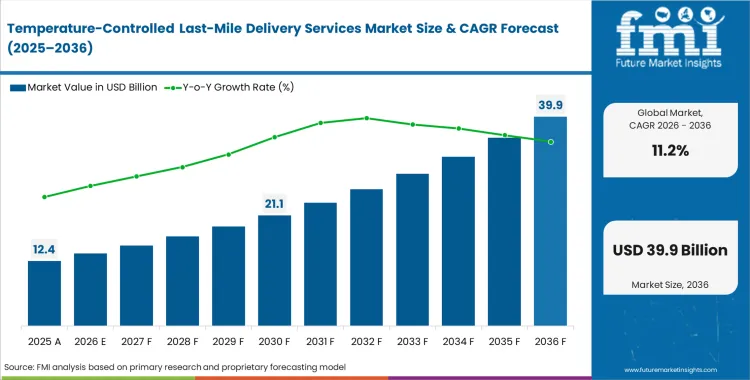
Grocery fulfillment leaders are dealing with a clear mismatch between controlled warehouse environments and inconsistent last-mile execution. Moving perishable goods through last mile delivery networks previously relied on styrofoam-based insulation has proven inadequate, particularly during peak summer conditions or when deliveries are delayed at the doorstep. Prolonging the shift to actively cooled fleet models increases the risk of spoilage and, in regulated categories such as pharmaceuticals, potential license disruptions. Industry analysis indicates that multi-temperature route batching has now reached a level of cost efficiency that supports scalable last-mile cold chain services, even within the tight margins of food retail.
The clinical needs are moving toward direct-to-patient delivery at an augmented rate; refrigeration transport infrastructure should guarantee that the temperature remains intact throughout delivery. Those providers who pass such validation criteria are in a position to capture high-margin pharmaceutical volumes, which in turn assists in offsetting the reduced returns of grocery distribution. Looking toward 2036, dispatch decisions will be increasingly governed by dynamic route optimization systems that continuously track and respond to in-vehicle temperature conditions.
India is leading the expansion with a projected growth rate of 13.4%, driven by the density and frequency of quick-commerce deliveries. China is expected to capture at 12.6%, followed by Brazil at 11.5 %, as its food distribution networks continue to become modern. It has been predicted that the United States and the United Kingdom will grow by 10.8% and 10.1, respectively, indicating the development of digital groceries. The next countries are Germany and Japan, with 9.7% and 9.1%, where the tight control of costs is slowing the upgrade of the fleet.
Segmental Analysis
Temperature-Controlled Last-Mile Delivery Services Market Analysis by Temperature Range
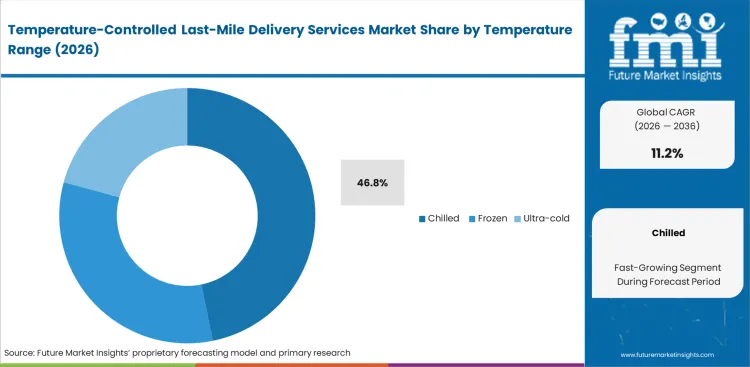
Consumer demand for fresh produce is essential in shaping delivery network design. Chilled segments are expected to account for 46.8% share of online grocery execution in 2026, reflecting the dominance of temperature-sensitive daily essentials. Grocery operators structure their routing systems around the 2°C to 8°C range, as even brief exposure to ambient conditions can immediately impact product quality and customer confidence. Analysis shows that fresh food turnover moves faster than frozen categories, requiring tighter control over transit times. This makes localized cold storage and staging critical to maintaining efficiency. Chilled fulfilment is often more operationally demanding than ultra-cold logistics. While sub-zero shipments rely on specialized passive packaging, chilled grocery delivery depends on direct product handling within actively cooled vehicles. Without timely investment in multi-zone fleets, operators face rising dry-ice costs and increased risk of spoilage that cannot be recovered.
- Urban density optimization: Dispatch teams prioritize high-density delivery zones when routing chilled shipments to maximize drop efficiency. Drivers operate under strict door-open time limits to minimize internal temperature variation during multi-stop routes.
- Thermal packaging limitations: Passive cooling solutions such as gel packs often fall short during extended delivery windows in warmer conditions. Quality control teams increasingly avoid standard courier models in favor of actively refrigerated transport.
- Compliance verification hurdles: Real-time temperature monitoring through automated data loggers feeds directly into retailer systems. Dispatch teams must intervene quickly when deviations occur, often rerouting or stopping deliveries before compromised goods reach the end customer.
Temperature-Controlled Last-Mile Delivery Services Market Analysis by End Use
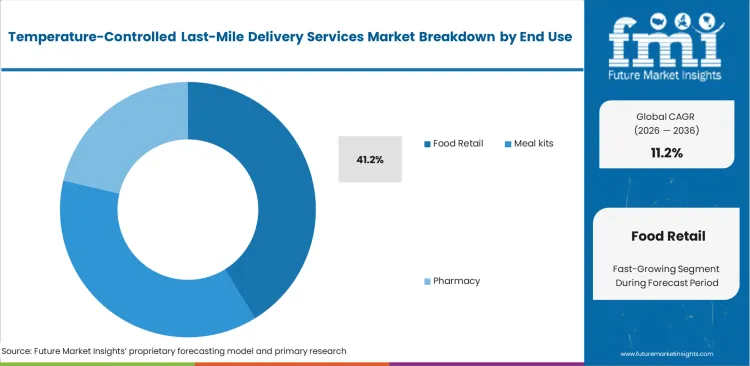
Margin pressure is pushing supermarket chains to rely more heavily on outsourced last-mile logistics rather than investing in in-house delivery capabilities. Food retail remains the primary volume driver for urban fleet operators. To manage cost and complexity, supply chain teams increasingly partner with specialized third-party carriers that can combine high-frequency pharmaceutical cold chain deliveries with bulk grocery distribution, which is expected to hold for a 41.2% share. This blended operating model allows operators to offset the high cost of healthcare cold chain logistics infrastructure with consistent grocery order volumes. This approach introduces significant operational risk around cross-contamination. Transporting raw food items alongside sensitive medical products within the same vehicle requires strict physical segregation. Any failure to maintain these standards can result in immediate regulatory action and loss of contracts with higher-margin pharmaceutical clients.
- Cross-category batching: Route optimization systems are designed to combine lower-margin grocery or meal kit deliveries with higher-value medical shipments. Medical deliveries are prioritized within the route, while grocery stops are sequenced to optimize return paths and vehicle utilization.
- Regulatory decertification risk: Mixing different product categories demands clearly separated cargo zones within vehicles. Compliance teams routinely audit shipment configurations, and any breach that risks contaminating sterile medical products can lead to contract termination.
- Asset utilization tracking: Fleet operators increasingly evaluate performance based on cubic capacity usage rather than the number of delivery stops. Underutilized return trips to distribution centers directly impact daily profitability targets.
Temperature-Controlled Last-Mile Delivery Services Market Analysis by Delivery Mode
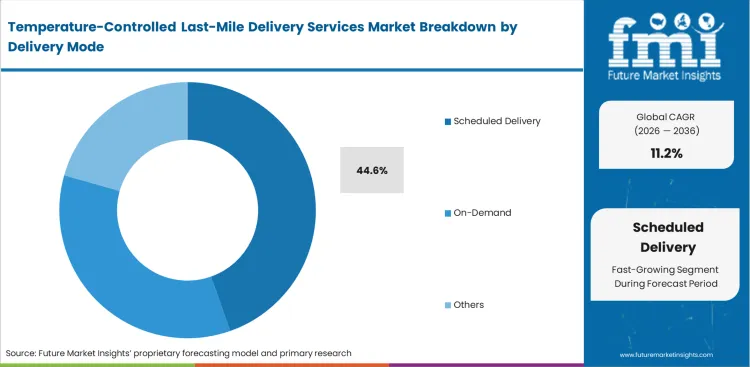
Route predictability is more critical to fleet profitability than payload value. Operators increasingly focus on consolidating deliveries within tightly defined local zones. Dispatch teams rely on structured routing through refrigerated vans to manage multiple stops within fixed time windows, ensuring higher vehicle utilization. Scheduled delivery models are expected to account for a 44.6% share in 2026. Disciplined scheduling reduces the frequency of door openings, helping maintain stable internal temperatures more effectively than unplanned, on-demand dispatching. While instant delivery continues to attract attention, logistics planners recognize that life sciences shipments depend on predefined receiving windows to ensure secure and compliant handovers. Attempts to operate without sufficient route density often lead to higher costs, driven by idle driver time and unnecessary refrigeration unit usage.
- Density accumulation: Route planning systems are designed to hold dispatches until a minimum delivery density is achieved within a zone. This approach prioritizes efficiency and cost control over immediate dispatch speed.
- Temperature recovery periods: Frequent stops require repeated opening of cargo doors, leading to temperature fluctuations. To manage this, vehicles are equipped with higher-capacity cooling systems that can quickly restore required conditions between closely spaced deliveries.
- Failed handoff protocols: Missed delivery windows trigger automatic return-to-base procedures, as sensitive shipments such as biologics cannot be left unattended. This results in additional delivery attempts and increased operational costs.
Temperature-Controlled Last-Mile Delivery Services Market Analysis by Vehicle Type
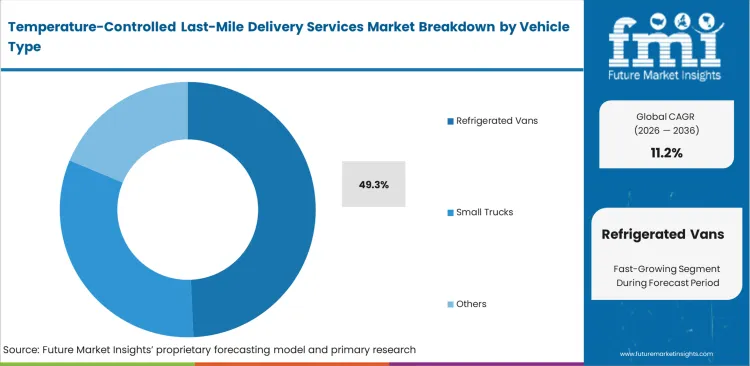
Urban access regulations place clear limits on the use of large commercial trucks, particularly within dense residential areas. Refrigerated vans account for a 49.3% share in 2026, as fleet operators increasingly rely on smaller vehicle formats that can navigate parking constraints while still carrying multi-zone temperature-controlled loads. Operations teams standardize these vehicle types to move efficiently through narrow city infrastructure without breaching municipal weight restrictions. Shifting from larger trucks to more agile vans removes the need for intermediate staging hubs, enabling direct deliveries from suburban distribution centers to urban customers. This transition brings additional considerations around energy use. Active cooling systems place a significant load on electric vehicle range, often requiring the integration of auxiliary power units. Purchasing pharmaceutical cold chain packaging alongside cold chain packaging ensures product integrity in case of mechanical failure.
- Chassis integration: Vehicle upfitters install modular insulation systems onto standard cargo bodies, allowing fleets to maintain consistency in design. This helps maintenance teams streamline servicing and reduce the need for diverse spare parts.
- Auxiliary power draw: Cooling systems place additional demand on electric vehicle batteries, reducing effective operating range. Route planners account for this by aligning delivery schedules with available charging infrastructure.
- Payload weight limits: Insulation materials add to the overall vehicle weight, reducing available capacity for goods. Engineering teams focus on minimizing packaging weight to preserve as much usable payload space as possible.
Temperature-Controlled Last-Mile Delivery Services Market Analysis by Service Model
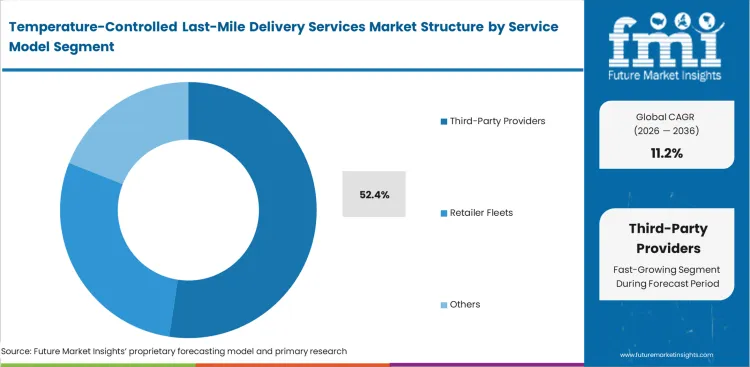
Retailers are increasingly reluctant to commit capital to dedicated active-cooling fleets, preferring more flexible operating models. This shift is driving greater reliance on outsourced third-party temperature-controlled delivery structures that align with variable demand across grocery and healthcare distribution. Sourcing teams negotiate stringent service level agreements that shift spoilage and compliance risk away from retailers and onto logistics partners. Industry assessments suggest that hyperlocal grocery delivery models are becoming increasingly dependent on established 3PL networks, avoiding the need to build parallel cold chain transport infrastructure, with third-party providers accounting for a 52.4% share in 2026. Outsourcing delivery operations can limit direct access to chain-of-custody data, and underlying service issues may only become visible once customer dissatisfaction begins to affect retention.
- Capital expenditure avoidance: Retail finance teams convert fixed fleet investments into variable, per-delivery operating costs. Third-party providers take on vehicle ownership, depreciation, and maintenance responsibilities.
- Liability transfer mechanisms: Service agreements are structured to hold logistics providers accountable for temperature deviations. Quality control teams monitor compliance closely and may withhold payments in cases of verified breaches.
- Capacity elasticity: Third-party networks offer the ability to scale driver capacity during peak demand periods, such as holiday-driven food distribution, while allowing retailers to avoid maintaining underutilized assets during slower periods.
Temperature-Controlled Last-Mile Delivery Services Market Drivers, Restraints, and Opportunities
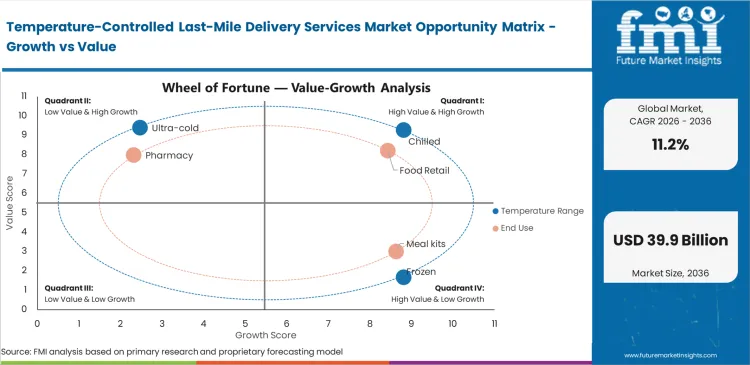
Clinical trial decentralization compels supply chain directors to guarantee unbroken thermal tracking from laboratory to patient living rooms. Spoilage liability during unmonitored residential handoffs presents unacceptable commercial risk for high-value biologic treatments. Operators capturing vaccine last-mile delivery services instantly subsidize adjacent low-margin grocery routes using high-yield medical delivery premiums. Delaying compliance with European Medicines Agency GDP standards locks regional couriers out of lucrative pharmaceutical partnerships permanently.
Asset utilization metrics restrict rapid active-fleet expansion across independent couriers. Dispatchers struggle to balance the high fixed costs of multi-zone refrigerated vehicles against unpredictable daily order volumes. While temporary reusable cold chain packaging offers passive stopgaps, managing reverse logistics for these insulated containers destroys margin gains. Independent operators must secure anchor retail contracts before authorizing capital fleet investments.
Opportunities in the Temperature-Controlled Last-Mile Delivery Services Market
- Dynamic routing optimization: Algorithmic platforms sequence drop-offs based on payload temperature sensitivity rather than strictly geographic proximity. Fleet managers increase drop density without risking thermal excursion limits.
- Electric fleet auxiliary cooling: Instant grocery delivery route optimization platforms mapping charging stations alongside delivery routes solve battery drain constraints. Operations directors deploy zero-emission refrigerated assets across ultra-low emission urban zones.
- Micro-fulfillment staging: Repurposing vacant retail real estate into localized cold-storage nodes eliminates long-haul stem mileage. Logistics planners decrease transit durations to extend the total orderable radius for sensitive perishables.
Regional Analysis
Based on regional analysis, temperature-controlled last-mile delivery services market is segmented into North America, Latin America, Europe, and Asia Pacific across 40 plus countries.
.webp "Top Country Growth Comparison Temperature Controlled Last Mile Delivery Services Market Cagr (2026 2036)")
| Country | CAGR (2026 to 2036) |
|---|---|
| India | 13.4% |
| China | 12.6% |
| Brazil | 11.5% |
| United States | 10.8% |
| United Kingdom | 10.1% |
| Germany | 9.7% |
| Japan | 9.1% |
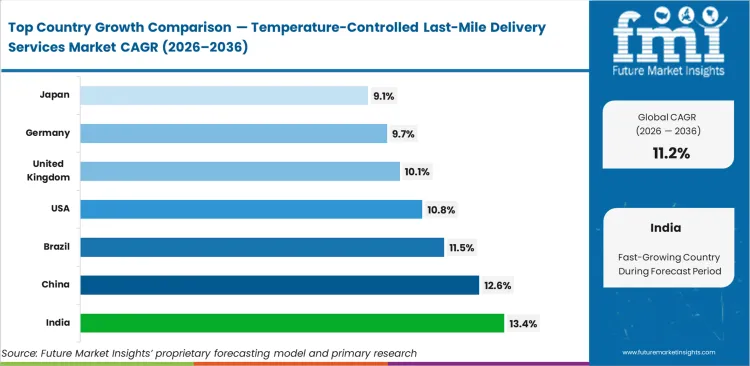
Source: Future Market Insights (FMI) analysis, based on proprietary forecasting model and primary research
Asia Pacific Temperature-Controlled Last-Mile Delivery Services Market Analysis
Quick-commerce expansion across major urban centers is reshaping fragmented courier networks into more structured temperature-controlled logistics systems. Grocery platform operators are focused on maintaining uninterrupted cold-chain conditions to support rapid delivery expectations for fresh produce. High ambient temperatures, particularly during summer, combined with dense urban populations, are pushing operators away from passive packaging toward actively managed cooling systems. Delivery models are evolving to include compartmentalized two-wheelers and compact electric vans that can move efficiently through congested city environments. Aggregating order volumes across fragmented neighborhood retail networks remains essential to achieving viable delivery density and cost efficiency.
- India: India’s temperature‑controlled last‑mile delivery sector is gaining momentum as quick‑commerce grocery platforms increase delivery density and cold‑chain investment deepens across urban centers. Supply‑chain teams are steadily moving away from dry‑ice solutions in favor of compact, actively cooled assets built for rapid, repeat delivery cycles. The sector is expected to hold a 13.4% CAGR; operators have an opportunity to refine networks and asset utilization before rural distribution introduces added cost and reliability pressures.
- China: Urban density and consumer expectations are compressing fulfillment timelines for fresh foods, prompting a fundamental shift in last‑mile cold‑chain execution. To meet tighter quality standards, logistics operators increasingly rely on electric trikes fitted with continuous temperature‑logging systems. This level of specialization carries meaningful competitive weight in a market expanding at a 12.6% CAGR, where providers serving China’s major cities are clearly separating themselves from conventional parcel couriers.
- Japan: Growth in Japan’s temperature‑controlled last‑mile sector is currently tracking a 9.1% CAGR and is being shaped by strict cost discipline and structural labor scarcity. Fleet renewal happens cautiously, while automation investments focus on robotic staging and selective autonomous delivery trials. Precision scheduling rather than brute expansion remains the core lever, helping operators limit temperature variance across tightly sequenced, multi‑drop routes.
FMI's report indicates that the broader Asia Pacific region prioritizes dense urban network consolidation. Operators scaling these urban refrigerated delivery networks secure massive volume advantages before suburban expansion begins. In Southeast Asia, Indonesia is highlighted for accelerating investment in temperature‑controlled logistics as modern grocery formats and food delivery platforms expand rapidly across Jakarta and secondary cities.
North America Temperature-Controlled Last-Mile Delivery Services Market Analysis
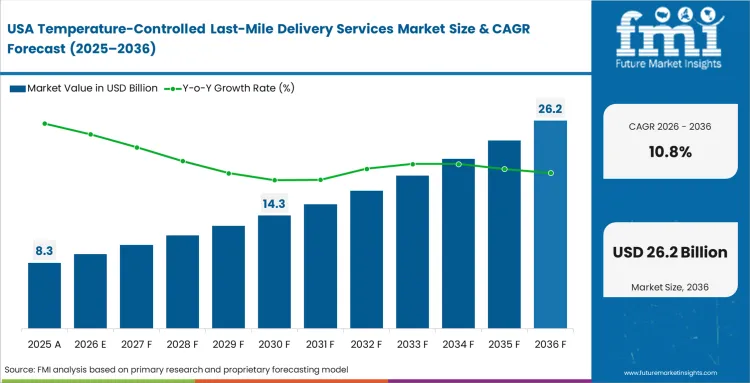
Established digital grocery habits are placing sustained pressure on supermarket chains to absorb the cost of last-mile delivery. Fulfillment operations increasingly combine online ordering with automated warehouse picking, requiring dependable carrier partnerships for residential delivery. Suburban sprawl reduces route density, making per-stop economics more challenging than in densely populated Asian cities. To manage this, operators often bundle pharmacy deliveries with higher-margin meal kits, using segregated cargo spaces to optimize route profitability.
- United States: The sector in the United States continues to benefit from digital grocery scale and entrenched pharmaceutical distribution standards, is anticipated to capture a 10.8% CAGR without dramatic shifts in operating models. Fleet managers favor large refrigerated vans with multiple thermal zones, enabling mixed payloads across suburban routes. Operators that successfully merge consumer convenience with clinical compliance standards continue to outperform.
FMI's report includes Canada and Mexico alongside core United States operations. Supply chain managers across this expanded geography increasingly prioritize cross‑border regulatory harmonization for pharmaceutical shipments over pure fleet asset expansion. Colombia as an emerging growth node, where improving cold‑chain standards and rising biologics imports are increasing demand for compliant last‑mile pharmaceutical delivery.
Latin America Temperature-Controlled Last-Mile Delivery Services Market Analysis
The modernization of food distribution systems is driving investment in more organized logistics infrastructure. Supply chain operators are moving away from informal courier networks toward standardized temperature-controlled delivery providers. The focus is on rapid deployment models that combine insulated containers with high-frequency two-wheeler delivery to meet growing urban demand efficiently.
- Brazil: Brazil offers rare expansion headroom in temperature‑controlled last‑mile delivery, with operators still addressing baseline infrastructure gaps. Early investments often target safety protocols and refrigeration reliability, sharply reducing spoilage across long, heat‑exposed routes. Expected to record a 11.5% CAGR, this market’s trajectory is now defined, and firms locking in anchor retail partners are rapidly establishing durable regional dominance.
FMI's report includes Argentina, Colombia, and Chile within its broader regional assessment. Urban planners across these emerging markets increasingly restrict heavy diesel commercial trucks from entering high‑density retail zones during peak daylight hours. Peru is also identified as a market with rising opportunity, where growth in modern food retail and healthcare imports is accelerating demand for smaller, compliant refrigerated delivery vehicles in central Lima.
Europe Temperature-Controlled Last-Mile Delivery Services Market Analysis
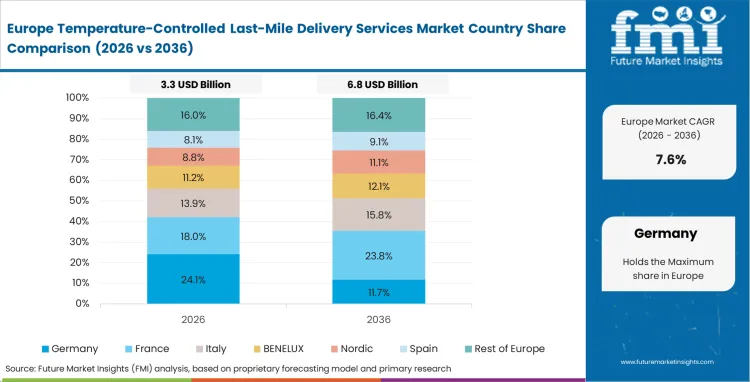
Tightening urban emissions regulations are accelerating the shift toward electrified delivery fleets. Logistics operators must balance battery limitations with the continuous energy demands of active refrigeration systems. Many are setting up localized cross-docking hubs at the edge of restricted emission zones, where goods are transferred from larger diesel vehicles to smaller zero-emission vans equipped for temperature-sensitive deliveries.
- United Kingdom: Driven by high online grocery penetration, the UK’s cold‑chain last‑mile landscape emphasizes operational refinement over brute capacity growth. Dispatch teams focus on door‑open time reduction and optimized sequencing at the neighborhood level. These execution details matter more as the industry is anticipated to record at around 10.1% CAGR, rewarding providers that maintain steady compliance and audit performance.
- Germany: Germany’s mature cold‑chain last‑mile market leaves little room for disruptive expansion, yet it continues to progress steadily, estimated to grow at a 9.7% CAGR. Fleet upgrades center on energy efficiency, with advanced insulation helping offset compressor load during seasonal extremes. Operators increasingly integrate automated temperature data directly into client systems, reinforcing transparency expectations typical of an established logistics environment.
FMI's report includes France, Italy, Spain, and the Nordic markets. Pharmacy compliance officers across these highly regulated territories actively decouple their physical delivery contracts from their data‑logging software procurement. Belgium is also referenced as a growing point of influence, where dense cross‑border pharmaceutical flows are encouraging wider adoption of standardized temperature‑monitoring platforms independent of transport providers.
Competitive Aligners for Market Players
Platform integrators such as Instacart and Door Dash is essential in shaping volume density across urban food retail networks, influencing how delivery flows are structured. These dynamic places pressure on traditional carriers to protect their higher-margin pharmaceutical routes. Independent cold storage equipment operators struggle to compete on grocery routing efficiency and instead focus on clinical trials and biologics distribution, where strict temperature control and validation take priority over delivery speed. Regional fleet operators are facing increasing pressure as companies like Lineage and DHL Supply Chain integrate mid-mile staging with localized last-mile capabilities.
Established logistics providers maintain a clear advantage through extensive regulatory compliance systems and proven refrigerated trailer network integration. This level of infrastructure cannot be replicated quickly by newer, software-led entrants. Companies such as JD Logistics and SF Express leverage these capabilities to strengthen their position in highly regulated segments like radiopharmaceutical logistics pathways. New entrants attempting to enter healthcare logistics often face setbacks, particularly in meeting European Medicines Agency GDP standards, where basic thermal packaging solutions fall short of required validation and monitoring expectations.
Procurement teams issuing RFQs for temperature-controlled delivery services often distribute volumes across multiple third-party providers to avoid overdependence on a single partner. Grocery operators are particularly cautious about concentrating delivery data on one platform, as it reduces visibility into customer interactions. Loss of control over chain-of-custody data can weaken direct customer relationships. Leading temperature-controlled last-mile delivery providers are adjusting their operating models to manage this trade-off, with cold chain last-mile logistics companies combining high-frequency grocery deliveries with tightly regulated medical shipments within the same routes to improve overall economics and maintain service differentiation.
Key Players in Temperature-Controlled Last-Mile Delivery Services Market
- Instacart
- DoorDash
- SF Express
- JD Logistics
- UPS Healthcare
- DHL Supply Chain
- Lineage
Scope of the Report
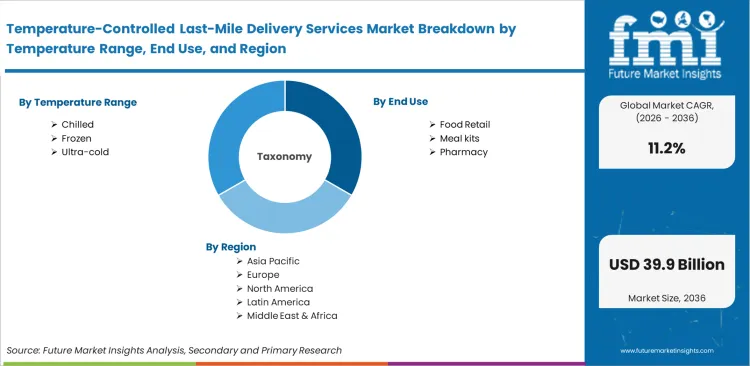
| Metric | Value |
|---|---|
| Quantitative Units | USD 12.40 Billion to USD 35.80 Billion, at a CAGR of 11.20% |
| Market Definition | Final-leg logistics operations maintaining precise thermal regulation from localized hubs to consumer endpoints, prioritizing temperature integrity and compliance across grocery and pharmaceutical supply chains. |
| Segmentation | Temperature Range, End Use, Delivery Mode, Vehicle Type, Service Model, and Region |
| Regions Covered | North America, Latin America, Europe, Asia Pacific, Middle East and Africa |
| Countries Covered | United States, United Kingdom, Germany, Japan, China, India, Brazil |
| Key Companies Profiled | Instacart, DoorDash, SF Express, JD Logistics, UPS Healthcare, DHL Supply Chain, Lineage |
| Forecast Period | 2026 to 2036 |
| Approach | Urban digital grocery penetration rates and clinical trial direct-to-patient protocols anchored baseline order frequency projections. |
Source: Future Market Insights (FMI) analysis, based on proprietary forecasting model and primary research
Temperature-Controlled Last-Mile Delivery Services Market Analysis by Segments
Temperature Range
- Chilled
- Frozen
- Ultra-cold
End Use
- Food retail
- Meal kits
- Pharmacy
- Biologics
- Diagnostics
Delivery Mode
- Scheduled
- On-demand
- Same-day
- Direct-to-patient
Vehicle Type
- Refrigerated vans
- Small trucks
- Insulated boxes
- Two-wheelers
Service Model
- Third-party logistics
- Platform fleets
- Retailer fleets
- Hybrid networks
Region
- North America
- Latin America
- Europe
- Asia Pacific
- Middle East and Africa
Bibliography
- European Medicines Agency. (2024, August 1). GDP inspection report - Union format.
- Instacart. (2026). Form 10-K for the fiscal year ended December 31, 2025. USA Securities and Exchange Commission.
- S.F. Holding Co., Ltd. (2024, November 27). 2024 annual report.
- United Parcel Service, Inc. (2026). 2025 annual report and 2026 proxy statement.
- USA Census Bureau. (2026, March 10). Quarterly retail e-commerce sales report: 4th quarter 2025.
- DoorDash, Inc. (2025, February 11). Letter to shareholders dated February 11, 2025. USA Securities and Exchange Commission.
This bibliography is provided for reader reference. The full FMI report contains the complete reference list with primary source documentation.
This Report Addresses
- Fleet operators balancing upfront vehicle acquisition costs against operational flexibility.
- Pharmacy directors validating third-party courier compliance with regulatory protocols.
- Grocery retailers maintaining margins while meeting thermal packaging requirements.
- Dispatch supervisors minimizing door-opening durations during urban multi-drop sequences.
- Supply chain planners tracking daily spoilage liability across decentralized networks.
- Procurement officers negotiating aggressive Service Level Agreements for thermal handling.
- Logistics engineers optimizing payload weight limits against heavy insulation materials.
- Quality assurance teams auditing multi-zone refrigerated vehicle cross-contamination risks.
Frequently Asked Questions
What is the temperature-controlled last-mile delivery services market?
This sector covers final-leg logistics operations maintaining active or passive thermal regulation from local distribution hubs to end-consumer destinations. Localized fulfillment networks prioritizing temperature integrity over standard parcel velocity define the core operational boundary.
How big is the temperature-controlled last-mile delivery services market?
Operations tracking temperature-sensitive final-mile deliveries represent USD 12.40 billion in baseline revenue for 2026. Overall revenue crosses USD 35.80 billion through 2036. This figure isolates specific fulfillment protocols mandated by grocery and pharmacy distributors.
What drives growth in cold chain last-mile delivery?
A compound annual growth rate of 11.20% reflects urgent compliance shifts. Distributors replace passive insulation boxes with active multi-zone vehicle routing to mitigate escalating spoilage liabilities and satisfy clinical trial decentralization requirements.
Compare chilled vs frozen vs ultra-cold last-mile delivery markets?
Chilled parameters account for 46.8% share because fresh produce moves at significantly higher velocities than frozen goods. Sub-zero and ultra-cold logistics utilize specialized passive shippers, whereas chilled grocery margins demand naked-item batching in actively cooled cargo bays.
Which companies lead the cold chain last-mile delivery market?
Incumbents like UPS Healthcare, DHL Supply Chain, and Lineage leverage massive regulatory compliance libraries and validated network integration. Platform integrators like Instacart and Door-Dash dictate volume density across urban food retail corridors.
How does food retail command the largest end-use footprint?
Food retail captures 41.2% share by generating consistent daily volume that subsidizes expensive refrigerated infrastructure. Operators blend these dense grocery drops with high-margin pharmacy deliveries to optimize overall unit economics.
Why do scheduled deliveries outperform on-demand models?
Scheduled routing commands 44.6% share because predictable dispatch allows consolidation software to maximize drop density. Rigid time windows minimize excessive door-opening events that compromise internal thermal stability.
What advantage secures the lead for refrigerated vans?
Refrigerated vans hold 49.3% share because their physical dimensions clear residential parking constraints while hauling sufficient multi-temperature payload. Planners deploy these assets to bypass intermediate staging hub transfers entirely.
How do third-party logistics providers dominate service models?
Third-party carriers secure 52.4% share by absorbing massive upfront vehicle capital expenditures. Retail CFOs utilize these external networks to convert fixed fleet depreciation into variable per-drop operational expenses.
Why does India present the fastest geographic expansion?
Tracking at a 13.4% compound rate, India benefits from aggressive quick-commerce network expansion. Operators transition from consumable dry-ice shippers to actively cooled assets to support hyper-frequent urban delivery drops.
What structural factor separates Chinese fleet deployment?
Advancing at 12.6%, early adopters deploy specialized electric trikes integrated with active thermal loggers. Extensive urban populations demand rapid fulfillment, establishing formidable competitive moats against traditional uninsulated couriers.
How does Brazilian modernization shape delivery architecture?
Growing at 11.5%, significant modernization whitespace allows new entrants to capture substantial distribution contracts. Operations managers upgrade baseline safety standards across tropical corridors to drastically reduce historical spoilage rates.
What restricts rapid electric fleet adoption in Europe?
Battery capacity limitations clash with continuous auxiliary power requirements for active cargo refrigeration. Engineers struggle balancing zero-emission municipal mandates against the massive energy draw of mobile cooling compressors.
How do European operators navigate ultra-low emission zones?
Logistics providers establish localized cross-docking micro-hubs just outside restricted boundaries. Planners transfer sensitive payloads from heavy diesel linehaul trucks into zero-emission thermal-compliant delivery vans.
What forces United States operators to bundle delivery categories?
Massive suburban sprawl dilutes route density, destroying per-stop economics. Couriers offset long stem mileage by mixing pharmacy prescriptions with premium meal kits inside partitioned multi-zone cargo bays.
How do clinical trials alter traditional courier requirements?
Direct-to-patient biologic administration requires zero-deviation thermal tracking from laboratory to residential endpoints. Couriers failing European Medicines Agency GDP audits face immediate decertification and contract termination.
What consequence awaits retailers relying solely on passive packaging?
Passive gel packs fail routinely during extended summer delivery windows or missed consumer handoffs. Brands face irreversible consumer churn and unacceptable replacement costs when relying on passive isolation.
Why do independent fleet operators struggle with multi-zone vehicles?
Multi-temperature compartmentalized vehicles require massive upfront capital investment. Independent dispatchers struggle balancing these fixed costs against unpredictable daily order volumes without securing anchor retail contracts first.
How does automated routing software improve unit economics?
Algorithmic platforms sequence drop-offs based on payload temperature sensitivity rather than strictly geographic proximity. Fleet managers increase delivery density without risking thermal excursion limits across complex neighborhood routes.
What role does vacant retail real estate play in distribution?
Logistics planners repurpose abandoned retail spaces into localized cold-storage staging nodes. This micro-fulfillment strategy eliminates long-haul stem mileage, extending the total orderable radius for sensitive perishable goods.
How do legacy logistics giants defend market share from platforms?
Incumbents utilize massive regulatory compliance libraries and validated network integration to monopolize radiopharmaceutical pathways. Platform aggregators struggle replicating these strict quality assurance frameworks overnight.
Why do supermarket chains resist carrier lock-in?
Grocery executives deliberately split regional volumes across multiple third-party fleets. Surrendering complete chain-of-custody data to a single aggregator blinds the retailer and destroys their direct consumer relationship.
What defines competitive advantage toward 2036?
Sustainable operations require successfully blending low-margin dense grocery drops with high-margin strict-compliance medical deliveries inside single vehicle dispatch cycles. Segmenting these payloads into isolated fleets artificially caps route density and burns capital.
Preview the report firsthand - request a free sample
Get SampleGet the brochure for pricing and purchase details.
Get PDFTable of Content
- Executive Summary
- Global Market Outlook
- Demand-side Trends
- Supply-side Trends
- Technology Roadmap Analysis
- Analysis and Recommendations
- Market Overview
- Market Coverage / Taxonomy
- Market Definition / Scope / Limitations
- Research Methodology
- Chapter Orientation
- Analytical Lens and Working Hypotheses
- Market Structure, Signals, and Trend Drivers
- Benchmarking and Cross-market Comparability
- Market Sizing, Forecasting, and Opportunity Mapping
- Research Design and Evidence Framework
- Desk Research Programme (Secondary Evidence)
- Company Annual and Sustainability Reports
- Peer-reviewed Journals and Academic Literature
- Corporate Websites, Product Literature, and Technical Notes
- Earnings Decks and Investor Briefings
- Statutory Filings and Regulatory Disclosures
- Technical White Papers and Standards Notes
- Trade Journals, Industry Magazines, and Analyst Briefs
- Conference Proceedings, Webinars, and Seminar Materials
- Government Statistics Portals and Public Data Releases
- Press Releases and Reputable Media Coverage
- Specialist Newsletters and Curated Briefings
- Sector Databases and Reference Repositories
- FMI Internal Proprietary Databases and Historical Market Datasets
- Subscription Datasets and Paid Sources
- Social Channels, Communities, and Digital Listening Inputs
- Additional Desk Sources
- Expert Input and Fieldwork (Primary Evidence)
- Primary Modes
- Qualitative Interviews and Expert Elicitation
- Quantitative Surveys and Structured Data Capture
- Blended Approach
- Why Primary Evidence is Used
- Field Techniques
- Interviews
- Surveys
- Focus Groups
- Observational and In-context Research
- Social and Community Interactions
- Stakeholder Universe Engaged
- C-suite Leaders
- Board Members
- Presidents and Vice Presidents
- R&D and Innovation Heads
- Technical Specialists
- Domain Subject-matter Experts
- Scientists
- Physicians and Other Healthcare Professionals
- Governance, Ethics, and Data Stewardship
- Research Ethics
- Data Integrity and Handling
- Primary Modes
- Tooling, Models, and Reference Databases
- Desk Research Programme (Secondary Evidence)
- Data Engineering and Model Build
- Data Acquisition and Ingestion
- Cleaning, Normalisation, and Verification
- Synthesis, Triangulation, and Analysis
- Quality Assurance and Audit Trail
- Market Background
- Market Dynamics
- Drivers
- Restraints
- Opportunity
- Trends
- Scenario Forecast
- Demand in Optimistic Scenario
- Demand in Likely Scenario
- Demand in Conservative Scenario
- Opportunity Map Analysis
- Product Life Cycle Analysis
- Supply Chain Analysis
- Investment Feasibility Matrix
- Value Chain Analysis
- PESTLE and Porter’s Analysis
- Regulatory Landscape
- Regional Parent Market Outlook
- Production and Consumption Statistics
- Import and Export Statistics
- Market Dynamics
- Global Market Analysis 2021 to 2025 and Forecast, 2026 to 2036
- Historical Market Size Value (USD Million) Analysis, 2021 to 2025
- Current and Future Market Size Value (USD Million) Projections, 2026 to 2036
- Y-o-Y Growth Trend Analysis
- Absolute $ Opportunity Analysis
- Global Market Pricing Analysis 2021 to 2025 and Forecast 2026 to 2036
- Global Market Analysis 2021 to 2025 and Forecast 2026 to 2036, By Temperature Range
- Introduction / Key Findings
- Historical Market Size Value (USD Million) Analysis By Temperature Range , 2021 to 2025
- Current and Future Market Size Value (USD Million) Analysis and Forecast By Temperature Range , 2026 to 2036
- Chilled
- Frozen
- Ultra-cold
- Chilled
- Y-o-Y Growth Trend Analysis By Temperature Range , 2021 to 2025
- Absolute $ Opportunity Analysis By Temperature Range , 2026 to 2036
- Global Market Analysis 2021 to 2025 and Forecast 2026 to 2036, By End Use
- Introduction / Key Findings
- Historical Market Size Value (USD Million) Analysis By End Use, 2021 to 2025
- Current and Future Market Size Value (USD Million) Analysis and Forecast By End Use, 2026 to 2036
- Food Retail
- Meal kits
- Pharmacy
- Food Retail
- Y-o-Y Growth Trend Analysis By End Use, 2021 to 2025
- Absolute $ Opportunity Analysis By End Use, 2026 to 2036
- Global Market Analysis 2021 to 2025 and Forecast 2026 to 2036, By Delivery Mode
- Introduction / Key Findings
- Historical Market Size Value (USD Million) Analysis By Delivery Mode, 2021 to 2025
- Current and Future Market Size Value (USD Million) Analysis and Forecast By Delivery Mode, 2026 to 2036
- Scheduled Delivery
- On-Demand
- Others
- Scheduled Delivery
- Y-o-Y Growth Trend Analysis By Delivery Mode, 2021 to 2025
- Absolute $ Opportunity Analysis By Delivery Mode, 2026 to 2036
- Global Market Analysis 2021 to 2025 and Forecast 2026 to 2036, By Vehicle Type
- Introduction / Key Findings
- Historical Market Size Value (USD Million) Analysis By Vehicle Type, 2021 to 2025
- Current and Future Market Size Value (USD Million) Analysis and Forecast By Vehicle Type, 2026 to 2036
- Refrigerated Vans
- Small Trucks
- Others
- Refrigerated Vans
- Y-o-Y Growth Trend Analysis By Vehicle Type, 2021 to 2025
- Absolute $ Opportunity Analysis By Vehicle Type, 2026 to 2036
- Global Market Analysis 2021 to 2025 and Forecast 2026 to 2036, By Service Model
- Introduction / Key Findings
- Historical Market Size Value (USD Million) Analysis By Service Model, 2021 to 2025
- Current and Future Market Size Value (USD Million) Analysis and Forecast By Service Model, 2026 to 2036
- Third-Party Providers
- Retailer Fleets
- Others
- Third-Party Providers
- Y-o-Y Growth Trend Analysis By Service Model, 2021 to 2025
- Absolute $ Opportunity Analysis By Service Model, 2026 to 2036
- Global Market Analysis 2021 to 2025 and Forecast 2026 to 2036, By Region
- Introduction
- Historical Market Size Value (USD Million) Analysis By Region, 2021 to 2025
- Current Market Size Value (USD Million) Analysis and Forecast By Region, 2026 to 2036
- North America
- Latin America
- Western Europe
- Eastern Europe
- East Asia
- South Asia and Pacific
- Middle East & Africa
- Market Attractiveness Analysis By Region
- North America Market Analysis 2021 to 2025 and Forecast 2026 to 2036, By Country
- Historical Market Size Value (USD Million) Trend Analysis By Market Taxonomy, 2021 to 2025
- Market Size Value (USD Million) Forecast By Market Taxonomy, 2026 to 2036
- By Country
- USA
- Canada
- Mexico
- By Temperature Range
- By End Use
- By Delivery Mode
- By Vehicle Type
- By Service Model
- By Country
- Market Attractiveness Analysis
- By Country
- By Temperature Range
- By End Use
- By Delivery Mode
- By Vehicle Type
- By Service Model
- Key Takeaways
- Latin America Market Analysis 2021 to 2025 and Forecast 2026 to 2036, By Country
- Historical Market Size Value (USD Million) Trend Analysis By Market Taxonomy, 2021 to 2025
- Market Size Value (USD Million) Forecast By Market Taxonomy, 2026 to 2036
- By Country
- Brazil
- Chile
- Rest of Latin America
- By Temperature Range
- By End Use
- By Delivery Mode
- By Vehicle Type
- By Service Model
- By Country
- Market Attractiveness Analysis
- By Country
- By Temperature Range
- By End Use
- By Delivery Mode
- By Vehicle Type
- By Service Model
- Key Takeaways
- Western Europe Market Analysis 2021 to 2025 and Forecast 2026 to 2036, By Country
- Historical Market Size Value (USD Million) Trend Analysis By Market Taxonomy, 2021 to 2025
- Market Size Value (USD Million) Forecast By Market Taxonomy, 2026 to 2036
- By Country
- Germany
- UK
- Italy
- Spain
- France
- Nordic
- BENELUX
- Rest of Western Europe
- By Temperature Range
- By End Use
- By Delivery Mode
- By Vehicle Type
- By Service Model
- By Country
- Market Attractiveness Analysis
- By Country
- By Temperature Range
- By End Use
- By Delivery Mode
- By Vehicle Type
- By Service Model
- Key Takeaways
- Eastern Europe Market Analysis 2021 to 2025 and Forecast 2026 to 2036, By Country
- Historical Market Size Value (USD Million) Trend Analysis By Market Taxonomy, 2021 to 2025
- Market Size Value (USD Million) Forecast By Market Taxonomy, 2026 to 2036
- By Country
- Russia
- Poland
- Hungary
- Balkan & Baltic
- Rest of Eastern Europe
- By Temperature Range
- By End Use
- By Delivery Mode
- By Vehicle Type
- By Service Model
- By Country
- Market Attractiveness Analysis
- By Country
- By Temperature Range
- By End Use
- By Delivery Mode
- By Vehicle Type
- By Service Model
- Key Takeaways
- East Asia Market Analysis 2021 to 2025 and Forecast 2026 to 2036, By Country
- Historical Market Size Value (USD Million) Trend Analysis By Market Taxonomy, 2021 to 2025
- Market Size Value (USD Million) Forecast By Market Taxonomy, 2026 to 2036
- By Country
- China
- Japan
- South Korea
- By Temperature Range
- By End Use
- By Delivery Mode
- By Vehicle Type
- By Service Model
- By Country
- Market Attractiveness Analysis
- By Country
- By Temperature Range
- By End Use
- By Delivery Mode
- By Vehicle Type
- By Service Model
- Key Takeaways
- South Asia and Pacific Market Analysis 2021 to 2025 and Forecast 2026 to 2036, By Country
- Historical Market Size Value (USD Million) Trend Analysis By Market Taxonomy, 2021 to 2025
- Market Size Value (USD Million) Forecast By Market Taxonomy, 2026 to 2036
- By Country
- India
- ASEAN
- Australia & New Zealand
- Rest of South Asia and Pacific
- By Temperature Range
- By End Use
- By Delivery Mode
- By Vehicle Type
- By Service Model
- By Country
- Market Attractiveness Analysis
- By Country
- By Temperature Range
- By End Use
- By Delivery Mode
- By Vehicle Type
- By Service Model
- Key Takeaways
- Middle East & Africa Market Analysis 2021 to 2025 and Forecast 2026 to 2036, By Country
- Historical Market Size Value (USD Million) Trend Analysis By Market Taxonomy, 2021 to 2025
- Market Size Value (USD Million) Forecast By Market Taxonomy, 2026 to 2036
- By Country
- Kingdom of Saudi Arabia
- Other GCC Countries
- Turkiye
- South Africa
- Other African Union
- Rest of Middle East & Africa
- By Temperature Range
- By End Use
- By Delivery Mode
- By Vehicle Type
- By Service Model
- By Country
- Market Attractiveness Analysis
- By Country
- By Temperature Range
- By End Use
- By Delivery Mode
- By Vehicle Type
- By Service Model
- Key Takeaways
- Key Countries Market Analysis
- USA
- Pricing Analysis
- Market Share Analysis, 2025
- By Temperature Range
- By End Use
- By Delivery Mode
- By Vehicle Type
- By Service Model
- Canada
- Pricing Analysis
- Market Share Analysis, 2025
- By Temperature Range
- By End Use
- By Delivery Mode
- By Vehicle Type
- By Service Model
- Mexico
- Pricing Analysis
- Market Share Analysis, 2025
- By Temperature Range
- By End Use
- By Delivery Mode
- By Vehicle Type
- By Service Model
- Brazil
- Pricing Analysis
- Market Share Analysis, 2025
- By Temperature Range
- By End Use
- By Delivery Mode
- By Vehicle Type
- By Service Model
- Chile
- Pricing Analysis
- Market Share Analysis, 2025
- By Temperature Range
- By End Use
- By Delivery Mode
- By Vehicle Type
- By Service Model
- Germany
- Pricing Analysis
- Market Share Analysis, 2025
- By Temperature Range
- By End Use
- By Delivery Mode
- By Vehicle Type
- By Service Model
- UK
- Pricing Analysis
- Market Share Analysis, 2025
- By Temperature Range
- By End Use
- By Delivery Mode
- By Vehicle Type
- By Service Model
- Italy
- Pricing Analysis
- Market Share Analysis, 2025
- By Temperature Range
- By End Use
- By Delivery Mode
- By Vehicle Type
- By Service Model
- Spain
- Pricing Analysis
- Market Share Analysis, 2025
- By Temperature Range
- By End Use
- By Delivery Mode
- By Vehicle Type
- By Service Model
- France
- Pricing Analysis
- Market Share Analysis, 2025
- By Temperature Range
- By End Use
- By Delivery Mode
- By Vehicle Type
- By Service Model
- India
- Pricing Analysis
- Market Share Analysis, 2025
- By Temperature Range
- By End Use
- By Delivery Mode
- By Vehicle Type
- By Service Model
- ASEAN
- Pricing Analysis
- Market Share Analysis, 2025
- By Temperature Range
- By End Use
- By Delivery Mode
- By Vehicle Type
- By Service Model
- Australia & New Zealand
- Pricing Analysis
- Market Share Analysis, 2025
- By Temperature Range
- By End Use
- By Delivery Mode
- By Vehicle Type
- By Service Model
- China
- Pricing Analysis
- Market Share Analysis, 2025
- By Temperature Range
- By End Use
- By Delivery Mode
- By Vehicle Type
- By Service Model
- Japan
- Pricing Analysis
- Market Share Analysis, 2025
- By Temperature Range
- By End Use
- By Delivery Mode
- By Vehicle Type
- By Service Model
- South Korea
- Pricing Analysis
- Market Share Analysis, 2025
- By Temperature Range
- By End Use
- By Delivery Mode
- By Vehicle Type
- By Service Model
- Russia
- Pricing Analysis
- Market Share Analysis, 2025
- By Temperature Range
- By End Use
- By Delivery Mode
- By Vehicle Type
- By Service Model
- Poland
- Pricing Analysis
- Market Share Analysis, 2025
- By Temperature Range
- By End Use
- By Delivery Mode
- By Vehicle Type
- By Service Model
- Hungary
- Pricing Analysis
- Market Share Analysis, 2025
- By Temperature Range
- By End Use
- By Delivery Mode
- By Vehicle Type
- By Service Model
- Kingdom of Saudi Arabia
- Pricing Analysis
- Market Share Analysis, 2025
- By Temperature Range
- By End Use
- By Delivery Mode
- By Vehicle Type
- By Service Model
- Turkiye
- Pricing Analysis
- Market Share Analysis, 2025
- By Temperature Range
- By End Use
- By Delivery Mode
- By Vehicle Type
- By Service Model
- South Africa
- Pricing Analysis
- Market Share Analysis, 2025
- By Temperature Range
- By End Use
- By Delivery Mode
- By Vehicle Type
- By Service Model
- USA
- Market Structure Analysis
- Competition Dashboard
- Competition Benchmarking
- Market Share Analysis of Top Players
- By Regional
- By Temperature Range
- By End Use
- By Delivery Mode
- By Vehicle Type
- By Service Model
- Competition Analysis
- Competition Deep Dive
- Instacart
- Overview
- Product Portfolio
- Profitability by Market Segments (Product/Age /Sales Channel/Region)
- Sales Footprint
- Strategy Overview
- Marketing Strategy
- Product Strategy
- Channel Strategy
- DoorDash
- SF Express
- JD Logistics
- UPS Healthcare
- DHL Supply Chain
- Instacart
- Competition Deep Dive
- Assumptions & Acronyms Used


