

- Industry Size (2026)
- USD 310 Bn
- Forecast (2036)
- USD 720.5 Bn
- CAGR (2026 to 2036)
- 8.8%
Cold Storage Market Forecast and Outlook 2026 to 2036
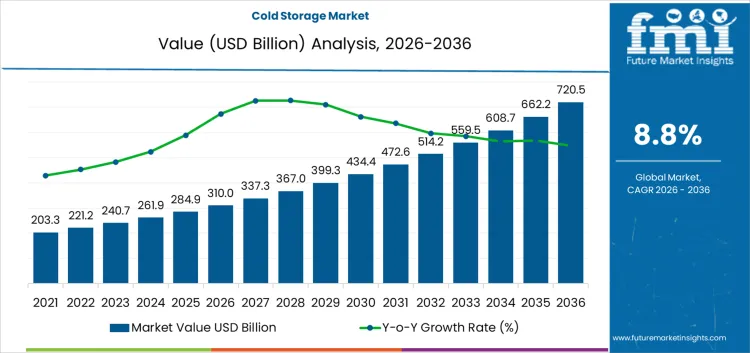
From USD 310 billion in 2026, the cold storage market is projected to reach USD 720.5 billion by 2036, implying a CAGR of 8.80%. Capacity remains heavily concentrated in East Asia, North America, and parts of Western Europe, where large scale food processing, pharmaceutical distribution, and port logistics support high utilization rates. Adoption patterns differ widely because many regions still rely on fragmented, small warehouse networks or direct delivery chains. Cost advantages cluster around coastal logistics corridors and manufacturing hubs with reliable power and transport access, which shapes where large automated facilities are built and expanded.
Across the period, growth remains uneven as investment follows trade flows, export oriented agriculture, and vaccine and biologics distribution routes. Southeast Asia, India, and parts of Latin America add capacity faster, driven by food exports and urban consumption, while mature regions focus on network densification and throughput efficiency. Land availability, electricity pricing, and grid stability influence site selection more than labor costs. Public policy and port infrastructure also shape expansion timing. The market grows through geographic redistribution of capacity and scale concentration, not through uniform upgrades of existing storage assets.
Quick Stats of the Cold Storage Market
- Cold Storage Market Value (2026): USD 310 billion
- Cold Storage Forecast Value (2036): USD 720.5 billion
- Cold Storage Forecast CAGR 2026 to 2036: 8.8%
- Leading Storage Format in Cold Storage Market: Frozen Storage (48 % share)
- Leading End-Use in Cold Storage Market: Food and Beverages (52 % share)
- Key Growth Regions in Cold Storage Market: India, China, Brazil, USA, UK
- Top Players in Cold Storage Market: Americold Logistics, Lineage Logistics, United States Cold Storage, AGRO Merchants Group, ColdEX, Kloosterboer, NewCold International
What is the Growth Forecast for Cold Storage Market through 2036?
Between 2026 and 2031, the cold storage market is projected to expand from USD 310 billion along a trajectory consistent with an 8.8% CAGR, shaped by logistics network reconfiguration rather than by warehouse construction alone. The growth of organized food distribution, centralized processing, and longer supply chains increases the strategic value of temperature-controlled nodes. Frozen and chilled storage capacity expands fastest because retailers and food service operators push inventory holding upstream to stabilize availability and reduce waste. Investment decisions in this phase are driven by location, throughput, and automation readiness rather than by cubic volume alone. Operators focus on facilities that integrate tightly with ports, processing plants, and urban distribution hubs, where utilization and turnaround speed matter more than headline capacity.
From 2031 to 2036, the market is expected to reach USD 720.5 billion, with growth increasingly tied to portfolio optimization and network density. Cold storage becomes infrastructure for both food and pharmaceutical supply chains, not a specialized logistics niche. More facilities are designed for multi-temperature operation, cross-docking, and high-frequency picking, which raises capital intensity and revenue per site. The business shifts toward long-term contracts with producers, retailers, and healthcare suppliers seeking resilience and traceability. Competitive positioning depends on site networks, operational reliability, and capital access, favoring large operators such as Americold Logistics, Lineage Logistics, United States Cold Storage, AGRO Merchants Group, ColdEX, Kloosterboer, and NewCold International.
Cold Storage Market Key Takeaways
| Metric | Value |
|---|---|
| Market Value (2026) | USD 310 billion |
| Forecast Value (2036) | USD 720.5 billion |
| Forecast CAGR 2026 to 2036 | 8.8% |
How Is the Cold Storage Market Supporting Global Food and Pharmaceutical Supply Chains?
The cold storage market is increasingly adopted to maintain temperature-sensitive products, including perishable foods, pharmaceuticals, and biologics, ensuring safety, quality, and regulatory compliance. Historically, storage relied on basic refrigeration or insulated facilities, which offered limited temperature control and posed risks of spoilage or reduced shelf life. Modern cold storage facilities integrate precision HVAC systems, IoT-based monitoring, and modular racking to maintain consistent temperatures, optimize energy use, and enable scalable storage solutions.
Food distributors, pharmaceutical companies, and logistics providers prioritize temperature accuracy, operational reliability, and compliance with cold chain regulations. Early adoption focused on high-value or temperature-sensitive products, while current demand spans fresh produce, vaccines, frozen foods, and biologics, driven by global supply chain expansion, e-commerce growth, and stringent regulatory standards. Temperature uniformity, monitoring capabilities, and energy efficiency influence facility design and supplier selection.
Rising demand for perishable goods, pharmaceuticals, and vaccines is shaping market growth. Compared with conventional storage, modern cold storage emphasizes precise climate control, real-time monitoring, and automated inventory management to reduce spoilage and operational costs. Cost structures depend on HVAC efficiency, insulation quality, and monitoring systems, concentrating margins among suppliers capable of delivering reliable, scalable, and compliant storage solutions. Food distributors and pharmaceutical companies adopt these facilities to maintain product integrity, comply with safety regulations, and enhance supply chain efficiency. By 2036, advanced cold storage facilities are expected to become standard across global logistics networks, supporting product safety, regulatory compliance, and operational optimization.
What Factors Are Shaping the Demand for Cold Storage by Storage Format and End Use in 2026?
The cold storage market in 2026 is segmented by storage type and by end use application. By storage format, demand is divided into frozen, chilled, controlled atmosphere, and blast freezing facilities, each designed around different temperature stability and handling requirements. By end use, demand is organized around food and beverages, pharmaceuticals and healthcare, agricultural products, and chemical or industrial goods, which differ in shelf life sensitivity, regulatory oversight, and inventory turnover patterns. These segments reflect how operators plan capacity, energy use, and throughput while balancing capital intensity, operating cost exposure, and service reliability across diverse temperature controlled supply chains.
Why Does Frozen Storage Represent the Largest Share of Total Capacity?
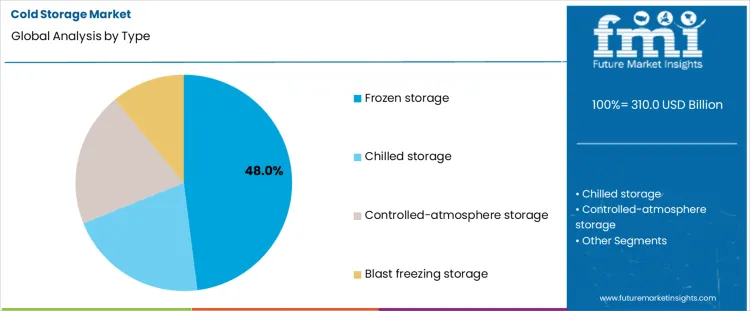
Frozen storage accounts for about 48% of demand in 2026, reflecting its role in preserving products over long distribution and inventory cycles. Freezing arrests biological and chemical activity more effectively than chilling, which allows goods to be stored for months without significant quality loss. This makes frozen facilities central to global trade in meat, seafood, prepared foods, and seasonal produce. These warehouses also operate as strategic buffers between production and consumption, smoothing supply fluctuations. Once built, they tend to run at high utilization because many supply chains depend on them continuously. The combination of long dwell times, high volume throughput, and structural dependence keeps frozen storage as the dominant format in total installed capacity.
Chilled, controlled atmosphere, and blast freezing storage serve more specific logistical roles. Chilled storage focuses on short to medium term holding of fresh goods, which turns inventory faster and reduces average space occupied. Controlled atmosphere facilities are designed for selected fruits and crops, where gas composition management extends shelf life, yet their application scope is narrow. Blast freezing is a process step rather than a long term storage solution, which limits its footprint. These formats are essential within certain chains, yet their use is episodic or specialized. This keeps their aggregate capacity lower than frozen storage, which functions as the backbone of many temperatures controlled distribution networks.
Why Does Food and Beverage Dominate Cold Storage Utilization?
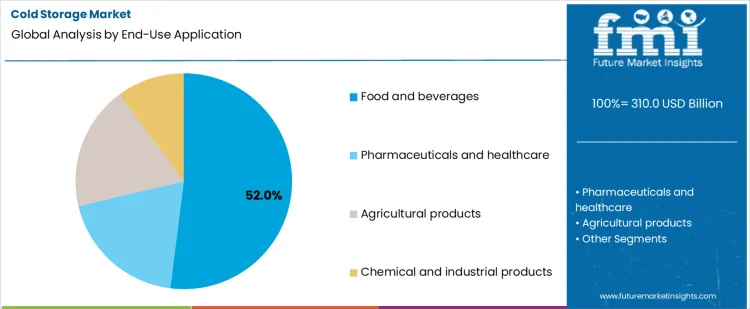
Food and beverage represents about 52% of demand in 2026 because this sector generates the largest and most continuous flow of temperature sensitive goods. Consumption is daily, volumes are high, and supply chains often span long distances, which increases the need for intermediate storage. Retail and foodservice distribution also require buffering to manage promotions, seasonality, and demand swings. Regulatory requirements for hygiene and traceability further concentrate these products in professional cold storage facilities rather than in ad hoc solutions. The breadth of product categories, from frozen meals to fresh produce, creates steady base load for warehouses, which explains why food and beverage remains the primary driver of overall cold storage utilization.
Pharmaceutical, agricultural, and industrial applications follow different demand patterns. Pharmaceuticals require strict temperature control and documentation, yet volumes are smaller and more centralized. Agricultural products use cold storage to manage harvest timing, though storage durations and capacity needs vary widely by crop. Chemical and industrial goods represent niche use cases tied to specific materials. These segments are important and often higher value per pallet, yet they do not match the sheer throughput and frequency of food distribution. As a result, their combined demand remains secondary to the food and beverage sector, which anchors coldest storage investment and daily operational activity.
Why Are Inventory Risk Management and Supply Chain Buffering, Not Jvust Food Consumption, Driving the Cold Storage Market through 2036?
Demand is being pulled by how companies manage olatility. Food processors, retailers, and pharmaceutical distributors are holding more safety stock to protect against harvest swings, shipping delays, and recall events. This shifts cold storage from a transit function to a strategic buffer. E commerce grocery and centralized distribution models also require large, well located temperature controlled hubs to support rapid order fulfillment. Export oriented producers need conditioning and holding space to time shipments to price windows. Once these logistics models are adopted, storage capacity becomes embedded in operations planning. Utilization follows inventory strategy changes more than population growth or simple consumption trends.
What Capital Intensity, Energy Exposure, and Site Constraints Are Slowing Capacity Expansion?
The main restraint is economic risk. Cold stores require high upfront investment in insulation, refrigeration systems, and power infrastructure, and payback depends on stable occupancy. Electricity cost volatility directly affects operating margins, making long term pricing commitments difficult. Suitable land near ports, cities, and production zones is scarce and expensive. Skilled maintenance and compliance with food and pharma standards add recurring cost. In some regions, grid connection limits delay new projects. These factors raise financing hurdles and lengthen development timelines, which prevents supply from responding quickly to short term demand spikes and keeps capacity additions cautious and phased.
How Are Network Design, Automation, and Customer Mix Reshaping the Structure of Cold Storage?
The category is being reorganized by logistics strategy. Customers want fewer, larger, more automated sites that can handle mixed temperature zones and high throughput. This pushes operators toward hub and spoke networks instead of many small warehouses. Automation is adopted to reduce labor exposure and improve pick accuracy in low temperature environments. At the same time, storage is increasingly bundled with value added services such as blast freezing, repacking, and labeling. Customer portfolios are also diversifying beyond food into life sciences. Cold storage is evolving from passive space rental into an integrated, process driven logistics platform.
What is the Demand for Cold Storage by Country?
| Country | CAGR (%) |
|---|---|
| USA | 8.0% |
| UK | 7.5% |
| China | 9.2% |
| India | 10.0% |
| Brazil | 8.3% |
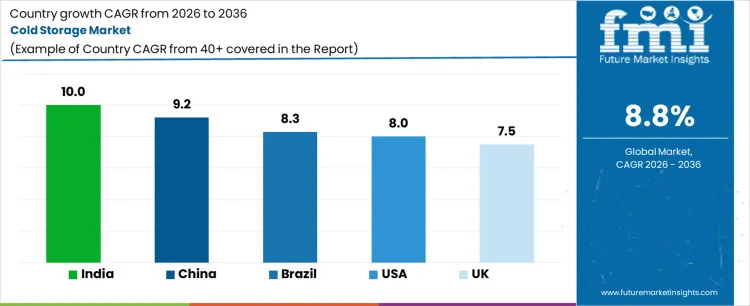
Demand for cold storage is rising as food, pharmaceutical, and logistics sectors expand temperature-controlled storage and distribution facilities to maintain product quality, safety, and shelf life. India leads with a 10.0% CAGR, driven by growing demand for frozen and perishable foods, increasing pharmaceutical production, and investment in modern cold-chain infrastructure. China follows at 9.2%, supported by urbanization, e-commerce growth, and expansion of logistics networks. Brazil records 8.3% growth, shaped by rising demand for temperature-sensitive products and cold storage modernization. The USA grows at 8.0%, influenced by established cold-chain infrastructure and rising demand for perishable food storage. The UK shows 7.5% CAGR, reflecting steady adoption in food, pharmaceutical, and logistics sectors.
How is the United States experiencing growth in the cold storage market?
United States is experiencing growth at a CAGR of 8%, driven by expansion in the food processing, pharmaceuticals, and logistics sectors. Cold storage facilities are essential for perishable goods, vaccines, and frozen foods, requiring systems optimized for temperature control, energy efficiency, and rapid access. Demand is concentrated in metropolitan distribution hubs such as Los Angeles, Chicago, and New York, where supply chain complexity and volume are high. Investments focus on refrigeration reliability, compliance with food safety standards, and energy-efficient technologies. Growth reflects rising demand for cold-chain solutions, increasing e-commerce in perishable goods, and modernization of logistics infrastructure.
- Perishable goods logistics drive adoption.
- Systems optimize temperature control and energy efficiency.
- Distribution hubs concentrate demand.
- Refrigeration reliability and regulatory compliance guide investment.
How is the United Kingdom witnessing growth in the cold storage market?
United Kingdom is witnessing growth at a CAGR of 7.5%, fueled by demand from food retail, pharmaceuticals, and logistics companies. Cold storage systems are used for frozen foods, medical supplies, and temperature-sensitive products, requiring high reliability and precise climate control. Demand is concentrated in London, Manchester, and Birmingham, where urban supply chains and e-commerce distribution require efficient cold-chain solutions. Investments prioritize energy efficiency, system durability, and adherence to food safety regulations. Growth reflects rising online grocery sales, pharmaceutical storage needs, and modernization of warehouse infrastructure.
- Food retail and pharmaceuticals drive adoption.
- Systems enhance temperature control and operational reliability.
- Urban supply chains concentrate demand.
- Energy efficiency and regulatory compliance guide investment.
How is China experiencing growth in the cold storage market?
China is experiencing growth at a CAGR of 9.2%, supported by rapid urbanization, rising e-commerce in frozen and fresh foods, and expansion of pharmaceutical supply chains. Cold storage facilities are critical for maintaining product quality in regions such as Beijing, Shanghai, and Guangdong. Manufacturers provide systems optimized for precise temperature control, energy efficiency, and integration with automated warehouse management. Demand is concentrated in large industrial and logistics hubs. Investments focus on reliability, refrigeration efficiency, and compliance with national food safety standards. Growth reflects industrial expansion, rising consumption of frozen foods, and modernization of the cold-chain infrastructure.
- E-commerce and urbanization drive adoption.
- Systems optimize temperature precision and energy efficiency.
- Industrial and logistics hubs concentrate demand.
- Reliability and regulatory compliance guide investment.
How is India witnessing growth in the cold storage market?
India is witnessing growth at a CAGR of 10%, fueled by increasing demand for cold-chain solutions in food retail, pharmaceuticals, and dairy sectors. Cold storage facilities are essential to prevent spoilage, maintain quality, and support logistics in urban and peri-urban centers. Manufacturers are producing systems optimized for energy efficiency, durability, and precise climate control under tropical conditions. Demand is concentrated in Mumbai, Bengaluru, and Delhi, where industrial clusters and distribution networks are expanding. Investments focus on system reliability, energy-efficient refrigeration, and adherence to national food safety regulations. Growth reflects rising perishable goods consumption, government support for cold-chain development, and modernization of warehouses.
- Food retail and pharmaceuticals drive adoption.
- Systems enhance energy efficiency and climate control.
- Industrial clusters and urban centers concentrate demand.
- System reliability and regulatory compliance guide investment.
How is Brazil experiencing growth in the cold storage market?
Brazil is experiencing growth at a CAGR of 8.3%, supported by expansion in food processing, meat exports, and pharmaceutical distribution. Cold storage systems are used to maintain product integrity in tropical climates, requiring energy-efficient, reliable refrigeration solutions. Demand is concentrated in São Paulo, Rio de Janeiro, and Paraná, where industrial production and export logistics are significant. Manufacturers supply systems optimized for temperature stability, durability, and operational efficiency. Investments prioritize energy efficiency, system reliability, and compliance with food safety and export regulations. Growth reflects rising perishable goods production, modernization of cold-chain infrastructure, and increased international trade.
- Food processing and exports drive adoption.
- Systems optimize temperature stability and energy efficiency.
- Industrial hubs concentrate demand.
- Reliability and regulatory compliance guide investment.
Who Competes in the Cold Storage Market and What Defines Their Capabilities?
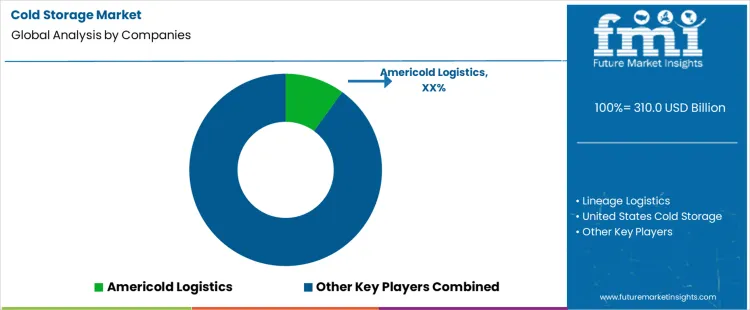
Competition in the cold storage market is defined by facility capacity, geographic coverage, logistics integration, and service reliability for temperature controlled warehousing. Americold Logistics provides extensive cold storage infrastructure and intermodal distribution services, focusing on food, pharmaceuticals, and frozen goods across North America. Lineage Logistics operates a global network of temperature controlled facilities designed to support supply chain continuity, rapid throughput, and value added services such as blast freezing and inventory management.
United States Cold Storage supplies multi temperature storage and handling solutions, with emphasis on USDA and FDA compliance for perishable products. AGRO Merchants Group delivers cold storage and logistics services with customized solutions for import/export flows, focusing on fresh and frozen supply chains. ColdEX offers refrigerated warehousing and distribution across strategic hubs, supporting retail and foodservice customers. Kloosterboer operates cold storage terminals in Europe with integrated transport services. NewCold International develops highly automated, high density facilities designed for scale and operational efficiency.
Market participants differentiate through facility size, automation level, network reach, and integration with transportation services. Americold Logistics emphasizes wide geographic reach and end to end cold chain solutions, including cross docking and inventory visibility. Lineage Logistics integrates advanced data systems with facility operations, enabling real time monitoring and supply chain analytics. United States Cold Storage focuses on compliance and service reliability in domestic temperature controlled warehousing.
AGRO Merchants Group supports multi modal logistics and global trade flows with flexible storage options. ColdEX positions through regional networks and customer service responsiveness. Kloosterboer leverages European logistics corridors and integrated transport services. NewCold International distinguishes with high throughput automation, robotics, and dense storage footprints designed to reduce handling time and increase energy efficiency. Other regional and specialty providers offer niche capacity and local logistics solutions.
Key Players in the Cold Storage Market
- Americold Logistics
- Lineage Logistics
- United States Cold Storage
- AGRO Merchants Group
- ColdEX
- Kloosterboer
- NewCold International
Scope of the Report
| Items | Values |
|---|---|
| Quantitative Units (2026) | USD billion |
| Type | Frozen Storage, Chilled Storage, Controlled-Atmosphere Storage, Blast Freezing Storage |
| End-Use Application | Food and Beverages, Pharmaceuticals and Healthcare, Agricultural Products, Chemical and Industrial Products |
| Regions Covered | Asia Pacific, Europe, North America, Latin America, Middle East & Africa |
| Countries Covered | China, Japan, South Korea, India, Australia & New Zealand, ASEAN, Germany, United Kingdom, France, Italy, Spain, Nordic, BENELUX, United States, Canada, Mexico, Brazil, Chile, Saudi Arabia, Turkey, South Africa, and other regional markets |
| Key Companies Profiled | Americold Logistics, Lineage Logistics, United States Cold Storage, AGRO Merchants Group, ColdEX, Kloosterboer, NewCold International |
| Additional Attributes | Dollar sales by storage type and end-use application, frozen storage representing the largest share of total capacity due to long dwell times and global trade dependence, food and beverages forming the largest utilization segment because of continuous high-volume throughput, growth driven by logistics network reconfiguration and inventory buffering rather than warehouse construction alone, increasing role of multi-temperature and cross-docking facilities, expansion shaped by port access, electricity pricing, and grid stability, rising adoption of automation and high-density storage, shift toward long-term contracts with food and pharmaceutical customers, and competitive positioning based on site networks, operational reliability, and capital access. |
Cold Storage Market Segmentation
Type:
- Frozen storage
- Chilled storage
- Controlled-atmosphere storage
- Blast freezing storage
End-Use Application:
- Food and beverages
- Pharmaceuticals and healthcare
- Agricultural products
- Chemical and industrial products
Region:
- Asia Pacific
- China
- Japan
- South Korea
- India
- Australia & New Zealand
- ASEAN
- Rest of Asia Pacific
- Europe
- Germany
- United Kingdom
- France
- Italy
- Spain
- Nordic
- BENELUX
- Rest of Europe
- North America
- United States
- Canada
- Mexico
- Latin America
- Brazil
- Chile
- Rest of Latin America
- Middle East & Africa
- Kingdom of Saudi Arabia
- Other GCC Countries
- Turkey
- South Africa
- Other African Union
- Rest of Middle East & Africa
Bibliography
- Food and Agriculture Organization of the United Nations. (2024). The state of food and agriculture: Cold chains and food loss reduction.
- World Health Organization. (2023). Technical guidance on the temperature-controlled supply chain for pharmaceuticals and vaccines.
- World Bank. (2024). Cold chain logistics and food systems modernization in developing economies.
- Organisation for Economic Co-operation and Development. (2025). Building resilient supply chains for food and pharmaceuticals.
- International Energy Agency. (2023). The future of cooling: Energy and infrastructure implications.
Frequently Asked Questions
How big is the cold storage market in 2026?
The global cold storage market is estimated to be valued at USD 310.0 billion in 2026.
What will be the size of cold storage market in 2036?
The market size for the cold storage market is projected to reach USD 720.5 billion by 2036.
How much will be the cold storage market growth between 2026 and 2036?
The cold storage market is expected to grow at a 8.8% CAGR between 2026 and 2036.
What are the key product types in the cold storage market?
The key product types in cold storage market are frozen storage, chilled storage, controlled-atmosphere storage and blast freezing storage.
Which end-use application segment to contribute significant share in the cold storage market in 2026?
In terms of end-use application, food and beverages segment to command 52.0% share in the cold storage market in 2026.
Preview the report firsthand - request a free sample
Get SampleGet the brochure for pricing and purchase details.
Get PDFTable of Content
- Executive Summary
- Global Market Outlook
- Demand-side Trends
- Supply-side Trends
- Technology Roadmap Analysis
- Analysis and Recommendations
- Market Overview
- Market Coverage / Taxonomy
- Market Definition / Scope / Limitations
- Market Background
- Market Dynamics
- Drivers
- Restraints
- Opportunity
- Trends
- Scenario Forecast
- Demand in Optimistic Scenario
- Demand in Likely Scenario
- Demand in Conservative Scenario
- Opportunity Map Analysis
- Product Life Cycle Analysis
- Supply Chain Analysis
- Investment Feasibility Matrix
- Value Chain Analysis
- PESTLE and Porter’s Analysis
- Regulatory Landscape
- Regional Parent Market Outlook
- Production and Consumption Statistics
- Import and Export Statistics
- Market Dynamics
- Global Market Analysis 2021 to 2025 and Forecast, 2026 to 2036
- Historical Market Size Value (USD Million) Analysis, 2021 to 2025
- Current and Future Market Size Value (USD Million) Projections, 2026 to 2036
- Y-o-Y Growth Trend Analysis
- Absolute $ Opportunity Analysis
- Global Market Pricing Analysis 2021 to 2025 and Forecast 2026 to 2036
- Global Market Analysis 2021 to 2025 and Forecast 2026 to 2036, By Type
- Introduction / Key Findings
- Historical Market Size Value (USD Million) Analysis By Type, 2021 to 2025
- Current and Future Market Size Value (USD Million) Analysis and Forecast By Type, 2026 to 2036
- Frozen storage
- Chilled storage
- Controlled-atmosphere storage
- Blast freezing storage
- Frozen storage
- Y-o-Y Growth Trend Analysis By Type, 2021 to 2025
- Absolute $ Opportunity Analysis By Type, 2026 to 2036
- Global Market Analysis 2021 to 2025 and Forecast 2026 to 2036, By End-Use Application
- Introduction / Key Findings
- Historical Market Size Value (USD Million) Analysis By End-Use Application, 2021 to 2025
- Current and Future Market Size Value (USD Million) Analysis and Forecast By End-Use Application, 2026 to 2036
- Food and beverages
- Pharmaceuticals and healthcare
- Agricultural products
- Chemical and industrial products
- Food and beverages
- Y-o-Y Growth Trend Analysis By End-Use Application, 2021 to 2025
- Absolute $ Opportunity Analysis By End-Use Application, 2026 to 2036
- Global Market Analysis 2021 to 2025 and Forecast 2026 to 2036, By Region
- Introduction
- Historical Market Size Value (USD Million) Analysis By Region, 2021 to 2025
- Current Market Size Value (USD Million) Analysis and Forecast By Region, 2026 to 2036
- North America
- Latin America
- Western Europe
- Eastern Europe
- East Asia
- South Asia and Pacific
- Middle East & Africa
- Market Attractiveness Analysis By Region
- North America Market Analysis 2021 to 2025 and Forecast 2026 to 2036, By Country
- Historical Market Size Value (USD Million) Trend Analysis By Market Taxonomy, 2021 to 2025
- Market Size Value (USD Million) Forecast By Market Taxonomy, 2026 to 2036
- By Country
- USA
- Canada
- Mexico
- By Type
- By End-Use Application
- By Country
- Market Attractiveness Analysis
- By Country
- By Type
- By End-Use Application
- Key Takeaways
- Latin America Market Analysis 2021 to 2025 and Forecast 2026 to 2036, By Country
- Historical Market Size Value (USD Million) Trend Analysis By Market Taxonomy, 2021 to 2025
- Market Size Value (USD Million) Forecast By Market Taxonomy, 2026 to 2036
- By Country
- Brazil
- Chile
- Rest of Latin America
- By Type
- By End-Use Application
- By Country
- Market Attractiveness Analysis
- By Country
- By Type
- By End-Use Application
- Key Takeaways
- Western Europe Market Analysis 2021 to 2025 and Forecast 2026 to 2036, By Country
- Historical Market Size Value (USD Million) Trend Analysis By Market Taxonomy, 2021 to 2025
- Market Size Value (USD Million) Forecast By Market Taxonomy, 2026 to 2036
- By Country
- Germany
- UK
- Italy
- Spain
- France
- Nordic
- BENELUX
- Rest of Western Europe
- By Type
- By End-Use Application
- By Country
- Market Attractiveness Analysis
- By Country
- By Type
- By End-Use Application
- Key Takeaways
- Eastern Europe Market Analysis 2021 to 2025 and Forecast 2026 to 2036, By Country
- Historical Market Size Value (USD Million) Trend Analysis By Market Taxonomy, 2021 to 2025
- Market Size Value (USD Million) Forecast By Market Taxonomy, 2026 to 2036
- By Country
- Russia
- Poland
- Hungary
- Balkan & Baltic
- Rest of Eastern Europe
- By Type
- By End-Use Application
- By Country
- Market Attractiveness Analysis
- By Country
- By Type
- By End-Use Application
- Key Takeaways
- East Asia Market Analysis 2021 to 2025 and Forecast 2026 to 2036, By Country
- Historical Market Size Value (USD Million) Trend Analysis By Market Taxonomy, 2021 to 2025
- Market Size Value (USD Million) Forecast By Market Taxonomy, 2026 to 2036
- By Country
- China
- Japan
- South Korea
- By Type
- By End-Use Application
- By Country
- Market Attractiveness Analysis
- By Country
- By Type
- By End-Use Application
- Key Takeaways
- South Asia and Pacific Market Analysis 2021 to 2025 and Forecast 2026 to 2036, By Country
- Historical Market Size Value (USD Million) Trend Analysis By Market Taxonomy, 2021 to 2025
- Market Size Value (USD Million) Forecast By Market Taxonomy, 2026 to 2036
- By Country
- India
- ASEAN
- Australia & New Zealand
- Rest of South Asia and Pacific
- By Type
- By End-Use Application
- By Country
- Market Attractiveness Analysis
- By Country
- By Type
- By End-Use Application
- Key Takeaways
- Middle East & Africa Market Analysis 2021 to 2025 and Forecast 2026 to 2036, By Country
- Historical Market Size Value (USD Million) Trend Analysis By Market Taxonomy, 2021 to 2025
- Market Size Value (USD Million) Forecast By Market Taxonomy, 2026 to 2036
- By Country
- Kingdom of Saudi Arabia
- Other GCC Countries
- Turkiye
- South Africa
- Other African Union
- Rest of Middle East & Africa
- By Type
- By End-Use Application
- By Country
- Market Attractiveness Analysis
- By Country
- By Type
- By End-Use Application
- Key Takeaways
- Key Countries Market Analysis
- USA
- Pricing Analysis
- Market Share Analysis, 2025
- By Type
- By End-Use Application
- Canada
- Pricing Analysis
- Market Share Analysis, 2025
- By Type
- By End-Use Application
- Mexico
- Pricing Analysis
- Market Share Analysis, 2025
- By Type
- By End-Use Application
- Brazil
- Pricing Analysis
- Market Share Analysis, 2025
- By Type
- By End-Use Application
- Chile
- Pricing Analysis
- Market Share Analysis, 2025
- By Type
- By End-Use Application
- Germany
- Pricing Analysis
- Market Share Analysis, 2025
- By Type
- By End-Use Application
- UK
- Pricing Analysis
- Market Share Analysis, 2025
- By Type
- By End-Use Application
- Italy
- Pricing Analysis
- Market Share Analysis, 2025
- By Type
- By End-Use Application
- Spain
- Pricing Analysis
- Market Share Analysis, 2025
- By Type
- By End-Use Application
- France
- Pricing Analysis
- Market Share Analysis, 2025
- By Type
- By End-Use Application
- India
- Pricing Analysis
- Market Share Analysis, 2025
- By Type
- By End-Use Application
- ASEAN
- Pricing Analysis
- Market Share Analysis, 2025
- By Type
- By End-Use Application
- Australia & New Zealand
- Pricing Analysis
- Market Share Analysis, 2025
- By Type
- By End-Use Application
- China
- Pricing Analysis
- Market Share Analysis, 2025
- By Type
- By End-Use Application
- Japan
- Pricing Analysis
- Market Share Analysis, 2025
- By Type
- By End-Use Application
- South Korea
- Pricing Analysis
- Market Share Analysis, 2025
- By Type
- By End-Use Application
- Russia
- Pricing Analysis
- Market Share Analysis, 2025
- By Type
- By End-Use Application
- Poland
- Pricing Analysis
- Market Share Analysis, 2025
- By Type
- By End-Use Application
- Hungary
- Pricing Analysis
- Market Share Analysis, 2025
- By Type
- By End-Use Application
- Kingdom of Saudi Arabia
- Pricing Analysis
- Market Share Analysis, 2025
- By Type
- By End-Use Application
- Turkiye
- Pricing Analysis
- Market Share Analysis, 2025
- By Type
- By End-Use Application
- South Africa
- Pricing Analysis
- Market Share Analysis, 2025
- By Type
- By End-Use Application
- USA
- Market Structure Analysis
- Competition Dashboard
- Competition Benchmarking
- Market Share Analysis of Top Players
- By Regional
- By Type
- By End-Use Application
- Competition Analysis
- Competition Deep Dive
- Americold Logistics
- Overview
- Product Portfolio
- Profitability by Market Segments (Product/Age /Sales Channel/Region)
- Sales Footprint
- Strategy Overview
- Marketing Strategy
- Product Strategy
- Channel Strategy
- Lineage Logistics
- Value (USD Million)ed States Cold Storage
- AGRO Merchants Group
- ColdEX
- Kloosterboer
- NewCold International
- Americold Logistics
- Competition Deep Dive
- Assumptions & Acronyms Used
- Research Methodology


