

- Industry Size (2026)
- USD 23.9 Bn
- Forecast (2036)
- USD 34.4 Bn
- CAGR (2026 to 2036)
- 3.7%
Storage Area Network (SAN) Market Forecast and Outlook 2026 to 2036
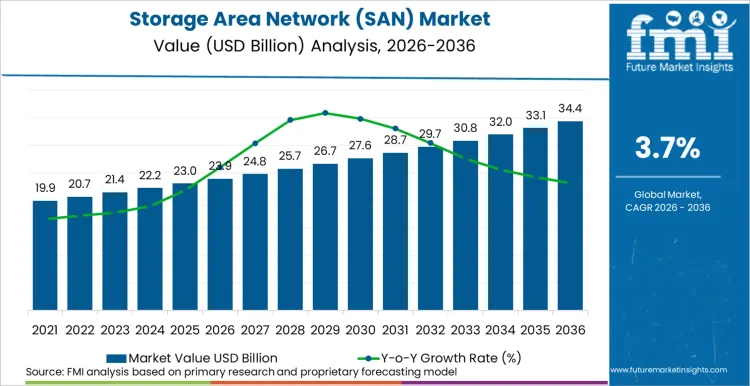
The global storage area network (SAN) sector is on track to achieve a valuation of USD 34.3 billion by 2036, expanding from USD 23.9 billion in 2026 at a CAGR of 3.7%. As per Future Market Insights, expansion is structurally underpinned by the rapid growth of AI inference and training workloads which require deterministic, low-latency data access that only dedicated SAN fabrics can deliver at enterprise scale. Broadcom confirmed in November 2025 the launch of the industry's first Gen 8 128G Fibre Channel SAN switch portfolio, featuring quantum-safe encryption and AI-embedded traffic optimization. This product cycle compels enterprise storage architects to initiate refresh programs rather than abandon Fibre Channel, which validates continued capital investment in SAN infrastructure. Simultaneously, the security landscape is shifting from perimeter-based protection to data-layer encryption mandates, which forces a fundamental upgrade of SAN fabric firmware and switch hardware across regulated industries.
Charles Giancarlo, CEO of Pure Storage, stated: 'Pure's Enterprise Data Cloud breaks data free from application silos, allowing enterprises to harness the power of AI, automation, and analytics.' This confirms that even vendors positioning around software-defined storage recognize the need for high-performance, dedicated storage connectivity. FMI analysts are of the opinion that the Gen 8 Fibre Channel upgrade cycle will sustain SAN capital expenditure through 2030, even as NVMe-over-Fabrics adoption accelerates in parallel.
The technology landscape in 2025 and 2026 has been reshaped by the integration of AI directly into storage management. Dell Technologies introduced PowerStore software enhancements featuring AI-driven Advanced Ransomware Detection in May 2025 to validate data integrity and reduce downtime from cyberattacks. HPE announced Alletra Storage MP X10000 Data Intelligence Nodes in December 2025, embedding Nvidia L40S GPUs directly on storage nodes to run AI pipelines without data movement. As per FMI, this convergence of compute and storage at the SAN layer represents a structural shift that will expand the addressable market beyond traditional block storage into AI-adjacent workloads.
Key Takeaways
- The storage area network (SAN) market is controlled by a concentrated vendor structure where Broadcom (Brocade), Cisco, Dell, NetApp, HPE, and Pure Storage collectively dominate the Fibre Channel switch, director, and all-flash array segments. FMI analysts note that Broadcom's control of the Fibre Channel standard through its Brocade division gives it structural pricing power over the SAN fabric layer.
- Pricing asymmetry favors vendors with integrated hardware-software platforms. Pure Storage, Dell, and HPE command premium margins through proprietary data services (deduplication, compression, encryption) embedded in their SAN arrays. Customers face high switching costs once committed to a vendor's data format and management plane. FMI opines that this lock-in dynamic sustains above-average operating margins for incumbent SAN vendors despite commoditization pressure from software-defined storage alternatives.
- Sourcing fragility in the SAN market is concentrated in semiconductor supply chains. Fibre Channel ASICs, NVMe controllers, and high-capacity NAND flash are sourced from a limited number of fabrication facilities. The extended maintenance turnaround at Broadcom facilities and supply constraints reported across the industry in 2025 highlight how concentrated component sourcing can disrupt enterprise storage refresh cycles.
- Brand and compliance risks are escalating as ransomware attacks on enterprise storage infrastructure intensify. Dell's integration of AI-driven ransomware detection into PowerStore and Broadcom's quantum-safe encryption in Gen 8 switches are direct responses to regulatory pressure and customer demand for data-layer security. FMI is of the opinion that compliance with data sovereignty and encryption mandates will drive mandatory SAN refresh cycles in financial services, healthcare, and government sectors.
- Geographic leverage is concentrated in North America, which accounts for the largest share of enterprise SAN spending driven by hyperscaler adjacency and financial services data center density. Europe follows with GDPR-driven data residency requirements that favor on-premise SAN deployments. Asia Pacific, particularly India and Singapore, is expanding through new data center construction. Emerson's expansion of its actuator manufacturing facility in Singapore and Cisco's planned Webex data centers in Mumbai and Chennai in 2026 confirm APAC infrastructure build-out.
- The executive reframing for the SAN market is that dedicated storage networking is not being replaced by cloud but is being repositioned as the performance and security layer underneath hybrid cloud architectures. As per FMI, C-suite leaders should view SAN modernization as a prerequisite for AI infrastructure readiness rather than a legacy maintenance expense.
Summary of Storage Area Network (SAN) Market
What Is Growth Outlook for Storage Area Network (SAN) Market as per Future Market Insights Projection?
Future Market Insights projects the storage area network (SAN) market to expand at a CAGR of 3.7% from 2026 to 2036, increasing from USD 23.9 Billion in 2026 to USD 34.3 Billion by 2036.
FMI Research Approach: FMI proprietary forecasting model based on enterprise data center capital expenditure cycles and Fibre Channel port shipment data.
How Do FMI Analysts Perceive Storage Area Network (SAN) Market to Evolve?
FMI analysts perceive the market evolving toward AI-integrated, quantum-safe SAN fabrics where storage infrastructure serves as both a performance layer and a security perimeter for enterprise data.
FMI Research Approach: Gen 7 to Gen 8 Fibre Channel migration tracking and AI workload density projections.
Which Country Holds Largest Share in Global Storage Area Network (SAN) Market?
The United States holds a significant share of the global storage area network (SAN) market by value which is supported by hyperscaler proximity, financial services data center density, and federal cybersecurity mandates.
FMI Research Approach: FMI country-level revenue modeling by enterprise data center investment and regulated industry SAN penetration.
How Large Will Storage Area Network (SAN) Market Be by 2036?
The global storage area network (SAN) market is projected to reach USD 34.3 Billion by 2036.
FMI Research Approach: FMI long-term revenue forecast derived from enterprise storage refresh cycle projections and AI infrastructure spending forecasts.
What Is Definition of Storage Area Network (SAN) Market?
The storage area network (SAN) market includes revenue from dedicated high-speed network infrastructure connecting servers to shared storage devices, including Fibre Channel switches, directors, host bus adapters, all-flash arrays, and SAN management software.
FMI Research Approach: FMI market taxonomy and inclusion-exclusion framework.
What Are Globally Unique Trends Shaping Storage Area Network (SAN) Market?
Globally unique trends include the deployment of quantum-safe Gen 8 128G Fibre Channel switches, the embedding of AI inference engines directly on storage nodes, and the convergence of NVMe-over-Fabrics with traditional SAN architectures.
FMI Research Approach: Broadcom Brocade product announcements and HPE Alletra platform specifications.
Storage Area Network (SAN) Market Key Takeaways
| Metric | Details |
|---|---|
| Industry Size (2026) | USD 23.9 Billion |
| Industry Value (2036) | USD 34.4 Billion |
| CAGR (2026 to 2036) | 3.7% |
Source: Future Market Insights (FMI) analysis, based on proprietary forecasting model and primary research
Segment-wise Analysis
By Component
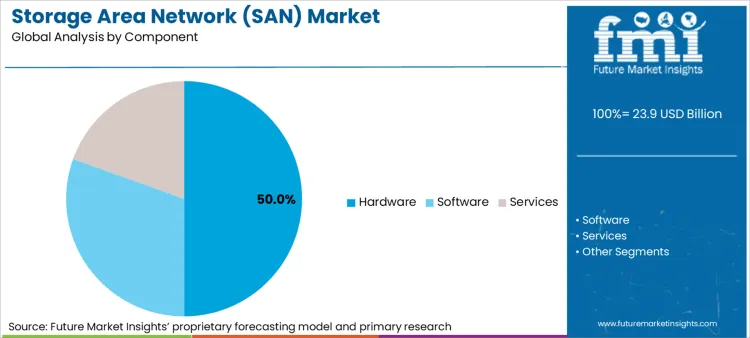
The hardware segment is projected to dominate the SAN industry with a 50.0% share in 2026, driven by the increasing adoption of high-performance storage solutions. Storage Area Network (SAN) hardware consists of disk arrays, host bus adapters (HBAs), Fiber Channel switches, and controllers, and they play an important role in managing large quantities of enterprise data.
The hardware segment is gaining traction due to the increasing need for high-speed, scalable storage infrastructure in sectors including BFSI, IT & telecom, and healthcare. For example, recent offerings by the likes of Dell Technologies, Hewlett Packard Enterprise (HPE), and NetApp have been driven by continued demand for high-throughput data applications capable of delivering fast backup and disaster recovery.
This transition to all-flash and hybrid storage arrays is also driving innovation by providing better performance and lower latencies. Meanwhile, the company's software segment leads with a 36.8% share and is forecast to experience considerable growth driven by increased investments in software-defined storage (SDS) and virtualization technologies.
These SAN software solutions improve data management, automation, and security features. The major SAN providers, including IBM, VMware, and Microsoft, have also been focused on SAN management and orchestration to improve storage utilization, reduce downtime, and enable cloud-based storage environments.
The rising need for SAN software solutions, however, only reflects the growing performance-based nature of the hardware infrastructure boom in the market as enterprises strap themselves to scale down their operational costs, enhance accessibility to data, and achieve added functionality.
By SAN Type
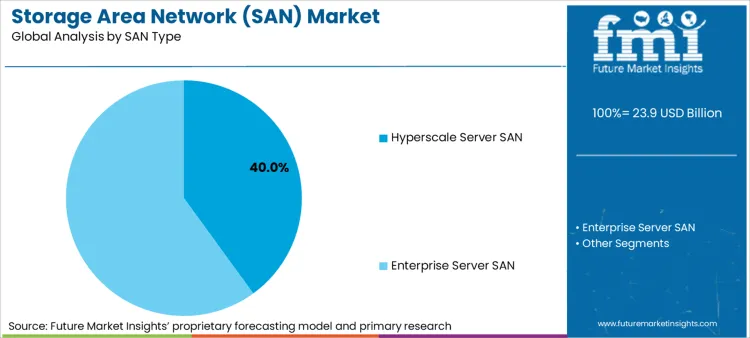
Out of all the different segments of the Enterprise Server San, the segment is anticipated to account for the largest share, recording 40.0% by 2026, due to rapid increase in enterprise data workloads, increase in trends such as cloud computing, and high demand for enterprise server SAN solution with high security.
Enterprise-grade SAN solutions are utilized in BFSI, healthcare, and IT & telecom industries for mission-critical applications, data redundancy, and storage optimization. Leaders in this space include Dell Technologies, Hewlett Packard Enterprise (HPE), and NetApp, who provide scalable, high-performance, and secure SAN architectures.
Enterprise Server SANs are specifically important for large-scale enterprises and data centers, offering key benefits, including low-latency data access, high availability, and seamless scalability. Enterprise Adopts New Storage Technologies: The multiplying power of NVMe-over-Fibre Channel (NVMe-oFC), all-flash is making enterprises more efficient and performant in storage networks.
Hyperscale Server SAN is expected to cover the largest share of 41.6% in 2026, and the market for hyperscale server SAN is driven by the increasing demand for cloud computing, big data analytics, and AI-driven applications. Hyperscale cloud providers like AWS, Google Cloud, and Azure will also invest in next-generation SANs to offer scalable, software-defined, distributed storage infrastructures.
As edge computing and hybrid cloud strategies expand, hyperscale SAN solutions are becoming ever more critical for organizations searching for economical, high-capacity data storage solutions.
Trend Analysis and Purchasing Criteria across Different End-Use Segments
The rapidly transforming Storage Area Network (SAN) Market is a result of the growing need for high-speed, secure, and scalable data storage solutions throughout the industries. The first preference of enterprise data centers and cloud service providers is performance, which is augmented with speed, scalability, and security.
The features are most critical to support a huge number of workloads and the cloud connectivity connection. Government and defense sectors require high-security aspects and encryption of data, whereas healthcare facilities emphasize secure and prompt recovery of electronic health records (EHRs).
Small and medium-sized businesses (SMEs) are mainly concerned about their affordability and ease of administration, thereby opting for the most affordable but scalable offerings. Coupled with the growth in data volume, AI-based analytics, and cloud computing adoption, there is a shift towards software-defined storage, hyper-converged infrastructure (HCI), and NVMe-based solutions offering stellar performance, security, and efficiency.
Contract & Deals Analysis
| Company | Contract Value (USD Billion) |
|---|---|
| Dell EMC | Approximately USD 80 - 90 |
| Hewlett Packard Enterprise (HPE) | Approximately USD 70 - 80 |
| NetApp | Approximately USD 60 - 70 |
| IBM | Approximately USD 90 - 100 |
| Hitachi Vantara | Approximately USD 75 - 85 |
In 2024 and early 2026, the Storage Area Network (SAN) Market experienced significant momentum, driven by the rising need for scalable, high-performance data storage solutions across diverse industries. Leading companies such as Dell EMC, HPE, NetApp, IBM, and Hitachi Vantara have secured strategic contracts and partnerships, underscoring their commitment to enhancing data management, ensuring business continuity, and enabling efficient IT operations in an increasingly digital landscape.
Shifts in the Market from 2021 to 2025 and Future Trends 2026 to 2036
Between 2020 and 2024, the storage area network (SAN) market grew rapidly as enterprises prioritized high-performance storage solutions to handle massive datasets, optimize workloads, and enhance security. The shift to hybrid and multi-cloud storage increased demand for scalable and flexible SAN architectures, with NVMe-over-Fabric (NVMe-oF) improving data transfer speeds.
AI and big data analytics drove the adoption of all-flash SAN systems, ensuring faster processing for real-time applications. Cybersecurity concerns also accelerated the deployment of encrypted SAN solutions and blockchain-backed data authentication. However, challenges such as high implementation costs and storage complexity led companies to adopt software-defined storage (SDS) and AI-powered automation for improved efficiency.
Between 2026 and 2036, there will be an evolution with AI-driven automation, quantum-ready storage, and sustainable data infrastructures. AI-powered predictive analytics will optimize storage allocation, automate performance tuning, and enhance anomaly detection.
Quantum computing will demand ultra-fast, post-quantum encrypted architectures, ensuring secure data processing. Edge computing and 6G networks will drive AI-optimized, low-latency storage for IoT and autonomous systems. Sustainability will be a key focus, with enterprises adopting energy-efficient storage, green data center solutions, and recyclable SSD technologies to align with global environmental goals.
A Comparative Market Shift Analysis 2021 to 2025 vs. 2026 to 2036
| 2021 to 2025 | 2026 to 2036 |
|---|---|
| Stricter data privacy regulations (GDPR, CCPA, HIPAA) required SAN solutions to implement enhanced encryption, access control, and compliance auditing. | AI-driven, quantum-secure SAN architectures autonomously ensure real-time data encryption, blockchain-based access verification, and regulatory-compliant storage automation. |
| AI-assisted storage management improved workload balancing, predictive maintenance, and automated data tiering for enterprise storage. | AI-native, self-optimizing SAN solutions dynamically allocate resources, autonomously detect anomalies, and self-heal storage inefficiencies in real-time. |
| Enterprises adopted hybrid SAN architectures to bridge on-premise storage with cloud environments for scalable and cost-effective data management. | AI-powered, decentralized SAN platforms enable seamless multi-cloud integration, intent-based storage orchestration, and adaptive data migration for real-time scalability. |
| NVMe-over-Fabrics accelerated data access, improving storage performance for AI, big data analytics, and real-time applications. | AI-enhanced NVMe-based SAN ecosystems enable ultra-low latency, self-adjusting data pipelines, and AI-driven workload acceleration for next-gen computing environments. |
| Enterprises integrated software-defined SAN solutions for greater flexibility, scalability, and automated resource provisioning. | AI-driven, intent-based SAN architectures provide autonomous resource scaling, self-optimizing storage allocation, and predictive performance tuning for hybrid IT ecosystems. |
| Distributed edge SANs optimized low-latency data processing for IoT, smart cities, and industrial automation. | AI-powered, edge-native SAN solutions autonomously manage real-time storage workloads, enabling ultra-fast AI inference, autonomous system operations, and edge intelligence. |
| AI-driven security tools monitored SAN traffic for anomalies, preventing ransomware attacks and unauthorized access. | AI-native, zero-trust SAN security frameworks autonomously detect cyber threats, implement real-time anomaly prevention, and ensure tamper-proof, quantum-resistant storage environments. |
| Faster network speeds improved SAN performance, enabling real-time storage access and AI-driven analytics. | AI-integrated, 6G-powered SAN solutions provide hyper-fast data synchronization, real-time workload replication, and distributed AI-driven storage optimization. |
| Enterprises optimized SAN power efficiency and adopted energy-efficient data centers to reduce operational carbon footprints. | AI-driven, carbon-neutral SAN infrastructures leverage renewable-powered storage, energy-aware data tiering, and self-regulating cooling technologies for sustainable high-performance computing. |
| Enterprises explored blockchain-based SAN models for enhanced data integrity, traceability, and immutable audit trails. | AI-enhanced, decentralized SAN ecosystems enable trustless data transactions, real-time consensus-based storage verification, and secure, distributed file-sharing architectures. |
Risk Assessment for the Storage Area Network (SAN) Market
The industry is susceptible to various risks, including technological obsolescence, cybersecurity attacks, infrastructure expenses, regulatory requirements, and supply chain interruption. The primary risk is the rapid rate of technological change. As cloud storage, hyper-converged infrastructure (HCI), and software-defined storage (SDS) develop, the conventional SAN can be subject to diminishing demand.
In order to stay competitive, companies must continually upgrade their storage infrastructure. The expense of deployment and maintenance is also very high. SAN infrastructure involves expensive components, manual management, and skilled personnel. Businesses need to balance between the two aspects by making investments in scalable, energy-efficient solutions.
Compliance and regulatory risks are most applicable to healthcare, finance, and government sectors where SANs are used. Therefore, companies must comply with data privacy laws (GDPR, HIPAA, CCPA) and adhere to safe data handling processes in a bid to avoid penalties and legal frustrations.
Ultimately, supply chain disruption can cause hardware shortage of SAN devices such as but not restricted to network switches, fiber channels, and storage arrays with high performance. By having diverse suppliers and turning to cloud-based solutions can help avoid these risks. By addressing these concerns, organizations will be able to advance in security solutions, storage performance, and overall competitiveness in the SAN marketplace.
Country Wise Analysis
| Countries/Region | CAGR (2026 to 2036) |
|---|---|
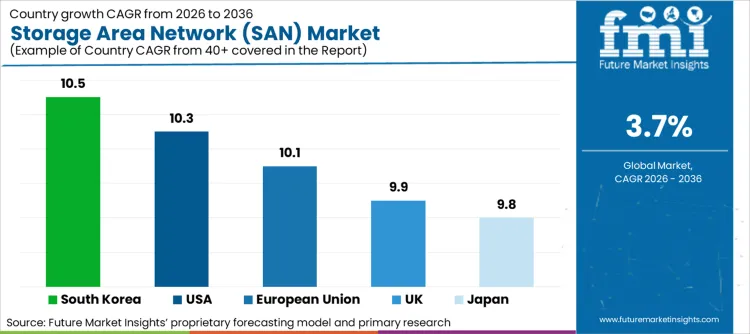
| USA | 10.3% |
| UK | 9.9% |
| European Union | 10.1% |
| Japan | 9.8% |
| South Korea | 10.5% |
USA
Increasing demand for scalable enterprise storage, hybrid cloud storage, and AI-powered storage management will drive the SAN industry in the USA SAN solutions let them centralize their data, fortify security, and boost real-time analytics.
Federal Government & large tech companies are just regulating future fiber channel nets, AI storage automation & NVMe-over-Fiber solutions that raise the workload of data. However, the growing deployment of multi-cloud storage, edge computing, and AI-based predictive analytics will propel the growth even further.
Industry giants like Dell Technologies, Hewlett Packard Enterprise (HPE), and NetApp are constantly innovating for SAN technology, creating automated data recovery mechanisms and AI-based SAN management solutions to help enterprises make better use of storage resources. The USA industry is expected to expand at a 10.3% CAGR during the forecast period, according to FMI.
Growth Factors in the USA
| Key Drivers | Details |
|---|---|
| Storage Optimization powered by AI | AI helps enterprises in managing storage workloads, setting storage performance, automating data lifecycle management and reducing downtime with predictive analytics. |
| Hybrid SAN Adoption | Data integration, data migration, and cloud storage use SAN with a cloud. Cloud storage solutions are often hybrids. |
UK
UK is growing due to increasing investment in digital transformation, rising number of data centers, and the increasing demand for AI-enabled storage solutions. The top data generation across businesses like Finance, Healthcare, and Manufacturing has led enterprises to focus on scalable SAN architectures.
Through DCMS, the UK government is working on securing cloud storage and data lifecycle management with AI and end-to-end SAN security solutions. The growing implementation of automated disaster recovery, combined with AI-based real-time analytics to improve visibility, is further driving the expansion.
Vendors such as IBM, Pure Storage, and Cisco Systems are at the forefront of new advances in SAN platforms integrated with the cloud, high-speed NVMe networks, and techniques for using AI to optimize data. The UK industry will grow at a 9.9% CAGR during the forecast period, according to FMI.
Growth Factors in the UK
| Key Drivers | Details |
|---|---|
| AI-Enhanced Data Management | AI powers analytics which makes data fetching, storage utilization and backup automation efficient. |
| Secure Enterprise Storage | Strong security with end-to-end encryption and cybersecurity measures |
European Union
Stringent data protection regulations, growing investments in artificial intelligence-backed storage solutions, and rising adoption of hybrid cloud storage are driving the SAN industry in the European Union. As a result of these initiatives, the EU’s GDPR and Digital Strategy have driven greater demand for SAN architectures that are both secure and high-performance.
Germany, France, and the Netherlands are paving the way for AI-driven storage automation, scalable SAN solutions, and software-defined storage networks. Trends like edge computing, AI-driven SAN analytics, and hybrid cloud SAN infrastructure are defining the landscape in the region.
Major players in the industry are Hitachi Vantara, Fujitsu, and Broadcom, which are investing in cloud-integrated fiber channel networks, intelligent SAN orchestration, and predictive maintenance for the enterprise. The European Union industry will grow at a 10.1% CAGR during the forecast period, according to FMI.
Growth Factors in the EU
| Key Drivers | Details |
|---|---|
| GDPR Compliance & Security | All over the EU, businesses are moving towards data storage and encryption that complies with European regulations. |
| AI-Powered Storage Automation | AI use cases in the Data Center space include using AI to optimize SAN performance and predictive maintenance. |
Japan
Japan’s SAN market is evolving rapidly, driven by government-backed smart infrastructure projects, AI-powered enterprise storage adoption, and high-speed data processing demands. Japan is focusing on AI-driven storage automation, robotics, and software-defined SAN solutions to modernize its data ecosystem.
The Ministry of Internal Affairs and Communications (MIC) is actively promoting secure enterprise storage, real-time predictive analytics, and cloud-integrated SAN platforms. With growing reliance on AI for data lifecycle management, businesses are integrating NVMe-based SAN architectures for ultra-fast storage access.
Technology leaders such as Toshiba, NEC, and NTT Data are pioneering AI-assisted SAN optimization, hybrid cloud storage management, and software-defined storage solutions to enhance enterprise efficiency. FMI anticipates Japan's industry to grow at a 9.8% CAGR during the study period.
Growth Factors in Japan
| Key Drivers | Details |
|---|---|
| AI-Integrated Data Management | Predictably, AI-driven SAN analytics optimizes storage utilization, reduces latency, predicts failures, etc. |
| NVMe-Based Storage Innovation | Enterprise computing and AI applications are driven by high-velocity data transfer |
South Korea
Growth in South Korea’s SAN market is being driven by the government’s Smart Infrastructure Initiative, the rise of AI in enterprise IT, and new 5G cloud storage capabilities. In South Korea, advanced AI-powered SAN monitoring, predictive storage analytics, and hybrid cloud solutions are converging with enterprise IT infrastructures.
Ministry of Science and ICT (MSIT) also focuses on real-time SAN analytics and AI aid storage automation services and fast data center interconnection. Samsung Electronics, SK Hynix, and LG CNS are making inroads in the realm of artificial intelligence-based storage intelligence, NVMe-over-TCP SAN solutions, and automated data recovery technologies. FMI anticipates South Korean industry to grow at a 10.5% CAGR during the study period.
| Key Drivers | Details |
|---|---|
| AI-Powered SAN Intelligence | Storage efficiency optimization and predictive failure analytics via AI-driven automation. |
| High-Speed 5G-Enabled Storage | 5G connectivity enhances cloud-integrated SAN performance and real-time data access. |
Competitive Outlook
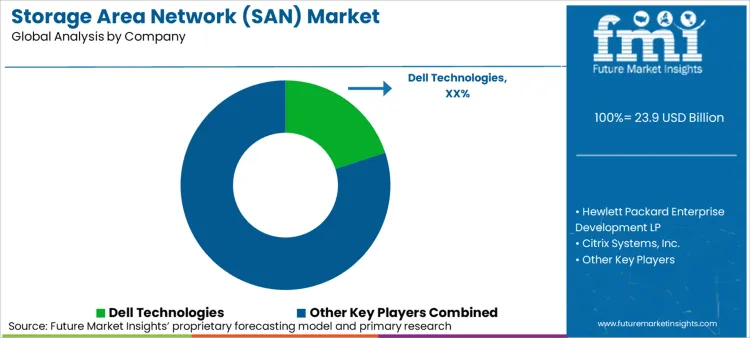
The SAN industry is witnessing rapid expansion as enterprises and data centers increasingly demand high-speed, scalable, and secure storage solutions. The growing need for real-time analytics, cloud integration, and AI-powered storage management is driving advancements in centralized storage infrastructure.
Companies are focusing on NVMe-over-Fabric (NVMe-oF), software-defined storage (SDS), and hyper-converged architectures to enhance performance, reduce latency, and improve cost efficiency. Market leaders such as Dell Technologies, Hewlett Packard Enterprise (HPE), and NetApp dominate with cutting-edge SAN solutions that integrate AI-driven automation, high-speed flash storage, and hybrid cloud compatibility. IBM and Cisco Systems further strengthen competition with enterprise-grade storage platforms and network-optimized SAN infrastructures.
The competitive landscape is evolving with the increased adoption of multi-cloud storage, AI-driven data tiering, and cybersecurity-enhanced storage frameworks. As enterprises prioritize low-latency, scalable, and cost-efficient storage solutions, companies that emphasize automation, hybrid cloud flexibility, and performance-driven SAN innovations will gain a strategic edge in the market.
Recent Developments
- In November 2025, Broadcom introduced the Brocade® Gen 8 Fibre Channel portfolio, featuring 128G SAN switches with quantum-safe security and AI-enabled SAN management to support mission-critical enterprise AI workloads.
- In January 2026, Broadcom released the Brocade G710, a 24-port 64G Fibre Channel switch with 460-nanosecond latency and the industry's first lifetime warranty for a SAN switch.
- In May 2026, Dell Technologies introduced PowerStore software enhancements with AI-driven Advanced Ransomware Detection to validate data integrity and reduce downtime.
Market Share Analysis by Company
| Company Name | Estimated Market Share (%) |
|---|---|
| Dell Technologies | 20-25% |
| Hewlett Packard Enterprise (HPE) | 15-20% |
| NetApp Inc. | 12-16% |
| IBM Corporation | 10-14% |
| Cisco Systems Inc. | 6-10% |
| Other Companies (combined) | 20-30% |
Key Company Offerings and Activities
| Company Name | Key Offerings/Activities |
|---|---|
| Dell Technologies | Specializes in scalable SAN solutions with PowerMax, NVMe, and AI-powered automation. |
| Hewlett Packard Enterprise (HPE) | Focuses on high-performance storage with HPE Alletra, 3PAR, and AI-driven analytics. |
| NetApp Inc. | Innovates in hybrid cloud SAN architectures, NVMe-based storage, and data management. |
| IBM Corporation | Provides enterprise-grade storage solutions with FlashSystem and AI-powered optimization. |
| Cisco Systems Inc. | Develops networking solutions for SAN infrastructure with Fibre Channel and NVMe-oF. |
Key Company Insights
Dell Technologies (20-25%)
Dell has the world's best SAN market with its cutting-edge storage infrastructure, which provides PowerMax and Unity XT solutions with AI-driven optimization and multi-cloud capabilities.
Hewlett-Packard Enterprise (HPE) - 15-20%
HPE is a leader in intelligent SAN storage. It has an HPE Primera and Alletra platform that provides scalable, high-speed, and AI-powered data management.
NetApp Inc. (12-16%)
NetApp is leading hybrid cloud SAN designs with cloud storage plus high-speed NVMe technology for enterprise use cases.
IBM Corporation (10-14%)
IBM is a high-performance storage leader, providing enterprise SAN solutions using FlashSystem and Spectrum Virtualize to improve data mobility and protection.
Cisco Systems Inc. (6-10%)
Cisco leads the networking solution market for SAN infrastructure, optimizing data center performance with fiber channel switching and NVMe-oF solutions.
Other Key Players (20-30% Combined)
- Pure Storage
- Hitachi Vantara
- Broadcom (Brocade)
- Western Digital (SanDisk & HGST)
- Fujitsu Ltd.
Key Players
- Dell Technologies
- Hewlett Packard Enterprise (HPE)
- NetApp Inc.
- IBM Corporation
- Cisco Systems Inc.
- Pure Storage
- Hitachi Vantara
- Broadcom (Brocade)
- Western Digital (SanDisk & HGST)
- Fujitsu Ltd.
Market Definition
The storage area network (SAN) market represents revenue generated from dedicated high-speed network infrastructure that connects server hosts to shared block-level storage devices. The market measures the value of Fibre Channel switches and directors, host bus adapters, all-flash and hybrid SAN arrays, and SAN management and orchestration software.
Inclusions cover Fibre Channel switches (16G, 32G, 64G, 128G), SAN directors, host bus adapters, all-flash arrays purpose-built for SAN connectivity, SAN fabric management software, and SAN-attached encryption and data protection appliances. NVMe-over-Fabrics (NVMe-oF) adapters designed for SAN integration are also included.
Exclusions include network-attached storage (NAS) appliances, object storage platforms, general-purpose Ethernet switches not configured for storage traffic, and public cloud storage-as-a-service billing. Software-defined storage platforms sold independently of SAN hardware are outside the scope.
Scope of Report
| Items | Values |
|---|---|
| Quantitative Units (2026) | USD 23.9 Billion |
| Product Type | Fibre Channel Switches and Directors, Host Bus Adapters, All-Flash SAN Arrays, SAN Management Software |
| Material Type | 16G FC, 32G FC, 64G FC, 128G FC, NVMe-oF |
| End-Use / Channel | Enterprise Data Centers, Hyperscaler Adjacent, Managed Service Providers, Government and Defense |
| Regions Covered | North America, Europe, Asia Pacific, Latin America, Middle East and Africa |
| Countries Covered | USA, Germany, China, Japan, India, Singapore, and 40+ countries |
| Key Companies Profiled | Broadcom (Brocade), Dell Technologies, NetApp, Pure Storage, HPE, Hitachi Vantara, IBM, Cisco |
| Additional Attributes | Revenue analysis by Fibre Channel speed tier, AI workload adjacency tracking, quantum-safe encryption adoption rates, competitive installed base analysis, and NVMe-oF migration impact assessment |
Key Segmentation
By Component:
The market includes hardware, software, and services (consulting, system integration, support & maintenance).
By SAN Type:
The market covers Hyperscale Server SAN and Enterprise Server SAN.
By Technology:
The market comprises Fibre Channel (FC), Fibre Channel Over Ethernet (FCoE), InfiniBand, and iSCSI Protocol.
By Vertical:
The market spans BFSI, IT & Telecom, Energy & Utility, Government, Military & Defense, Healthcare, Manufacturing, Retail & e-Commerce, and Others.
By Region:
The market covers North America, Latin America, Western Europe, Eastern Europe, and Asia Pacific, excluding Japan (APEJ), Japan, and the Middle East & Africa (MEA), including GCC countries.
Bibliography
- Broadcom Inc. (2025, November). Gen 8 128G Fibre Channel SAN switch portfolio launch announcement. Broadcom Investor Relations.
- Dell Technologies Inc. (2025, May). PowerStore software enhancements announcement. Dell Technologies Newsroom.
- Pure Storage Inc. (2025, December). Third quarter fiscal year 2026 financial results. Pure Storage Investor Relations.
- NetApp Inc. (2025, November). Second quarter fiscal year 2026 results and Flexera transaction. NetApp Investor Relations.
Frequently Asked Questions
How big is the storage area network (san) market in 2026?
The global storage area network (san) market is estimated to be valued at USD 23.9 billion in 2026.
What will be the size of storage area network (san) market in 2036?
The market size for the storage area network (san) market is projected to reach USD 34.4 billion by 2036.
How much will be the storage area network (san) market growth between 2026 and 2036?
The storage area network (san) market is expected to grow at a 3.7% CAGR between 2026 and 2036.
What are the key product types in the storage area network (san) market?
The key product types in storage area network (san) market are hardware, software and services.
Which san type segment is expected to contribute significant share in the storage area network (san) market in 2026?
In terms of san type, hyperscale server san segment is expected to command 40.0% share in the storage area network (san) market in 2026.
Preview the report firsthand - request a free sample
Get SampleGet the brochure for pricing and purchase details.
Get PDFTable of Content
- Executive Summary
- Global Market Outlook
- Demand-side Trends
- Supply-side Trends
- Technology Roadmap Analysis
- Analysis and Recommendations
- Market Overview
- Market Coverage / Taxonomy
- Market Definition / Scope / Limitations
- Research Methodology
- Chapter Orientation
- Analytical Lens and Working Hypotheses
- Market Structure, Signals, and Trend Drivers
- Benchmarking and Cross-market Comparability
- Market Sizing, Forecasting, and Opportunity Mapping
- Research Design and Evidence Framework
- Desk Research Programme (Secondary Evidence)
- Company Annual and Sustainability Reports
- Peer-reviewed Journals and Academic Literature
- Corporate Websites, Product Literature, and Technical Notes
- Earnings Decks and Investor Briefings
- Statutory Filings and Regulatory Disclosures
- Technical White Papers and Standards Notes
- Trade Journals, Industry Magazines, and Analyst Briefs
- Conference Proceedings, Webinars, and Seminar Materials
- Government Statistics Portals and Public Data Releases
- Press Releases and Reputable Media Coverage
- Specialist Newsletters and Curated Briefings
- Sector Databases and Reference Repositories
- FMI Internal Proprietary Databases and Historical Market Datasets
- Subscription Datasets and Paid Sources
- Social Channels, Communities, and Digital Listening Inputs
- Additional Desk Sources
- Expert Input and Fieldwork (Primary Evidence)
- Primary Modes
- Qualitative Interviews and Expert Elicitation
- Quantitative Surveys and Structured Data Capture
- Blended Approach
- Why Primary Evidence is Used
- Field Techniques
- Interviews
- Surveys
- Focus Groups
- Observational and In-context Research
- Social and Community Interactions
- Stakeholder Universe Engaged
- C-suite Leaders
- Board Members
- Presidents and Vice Presidents
- R&D and Innovation Heads
- Technical Specialists
- Domain Subject-matter Experts
- Scientists
- Physicians and Other Healthcare Professionals
- Governance, Ethics, and Data Stewardship
- Research Ethics
- Data Integrity and Handling
- Primary Modes
- Tooling, Models, and Reference Databases
- Desk Research Programme (Secondary Evidence)
- Data Engineering and Model Build
- Data Acquisition and Ingestion
- Cleaning, Normalisation, and Verification
- Synthesis, Triangulation, and Analysis
- Quality Assurance and Audit Trail
- Market Background
- Market Dynamics
- Drivers
- Restraints
- Opportunity
- Trends
- Scenario Forecast
- Demand in Optimistic Scenario
- Demand in Likely Scenario
- Demand in Conservative Scenario
- Opportunity Map Analysis
- Product Life Cycle Analysis
- Supply Chain Analysis
- Investment Feasibility Matrix
- Value Chain Analysis
- PESTLE and Porter’s Analysis
- Regulatory Landscape
- Regional Parent Market Outlook
- Production and Consumption Statistics
- Import and Export Statistics
- Market Dynamics
- Global Market Analysis 2021 to 2025 and Forecast, 2026 to 2036
- Historical Market Size Value (USD Billion) Analysis, 2021 to 2025
- Current and Future Market Size Value (USD Billion) Projections, 2026 to 2036
- Y-o-Y Growth Trend Analysis
- Absolute $ Opportunity Analysis
- Global Market Pricing Analysis 2021 to 2025 and Forecast 2026 to 2036
- Global Market Analysis 2021 to 2025 and Forecast 2026 to 2036, By Component
- Introduction / Key Findings
- Historical Market Size Value (USD Billion) Analysis By Component , 2021 to 2025
- Current and Future Market Size Value (USD Billion) Analysis and Forecast By Component , 2026 to 2036
- Hardware
- Software
- Services
- Hardware
- Y-o-Y Growth Trend Analysis By Component , 2021 to 2025
- Absolute $ Opportunity Analysis By Component , 2026 to 2036
- Global Market Analysis 2021 to 2025 and Forecast 2026 to 2036, By SAN Type
- Introduction / Key Findings
- Historical Market Size Value (USD Billion) Analysis By SAN Type, 2021 to 2025
- Current and Future Market Size Value (USD Billion) Analysis and Forecast By SAN Type, 2026 to 2036
- Hyperscale Server SAN
- Enterprise Server SAN
- Hyperscale Server SAN
- Y-o-Y Growth Trend Analysis By SAN Type, 2021 to 2025
- Absolute $ Opportunity Analysis By SAN Type, 2026 to 2036
- Global Market Analysis 2021 to 2025 and Forecast 2026 to 2036, By Region
- Introduction
- Historical Market Size Value (USD Billion) Analysis By Region, 2021 to 2025
- Current Market Size Value (USD Billion) Analysis and Forecast By Region, 2026 to 2036
- North America
- Latin America
- Western Europe
- Eastern Europe
- East Asia
- South Asia and Pacific
- Middle East & Africa
- Market Attractiveness Analysis By Region
- North America Market Analysis 2021 to 2025 and Forecast 2026 to 2036, By Country
- Historical Market Size Value (USD Billion) Trend Analysis By Market Taxonomy, 2021 to 2025
- Market Size Value (USD Billion) Forecast By Market Taxonomy, 2026 to 2036
- By Country
- USA
- Canada
- Mexico
- By Component
- By SAN Type
- By Country
- Market Attractiveness Analysis
- By Country
- By Component
- By SAN Type
- Key Takeaways
- Latin America Market Analysis 2021 to 2025 and Forecast 2026 to 2036, By Country
- Historical Market Size Value (USD Billion) Trend Analysis By Market Taxonomy, 2021 to 2025
- Market Size Value (USD Billion) Forecast By Market Taxonomy, 2026 to 2036
- By Country
- Brazil
- Chile
- Rest of Latin America
- By Component
- By SAN Type
- By Country
- Market Attractiveness Analysis
- By Country
- By Component
- By SAN Type
- Key Takeaways
- Western Europe Market Analysis 2021 to 2025 and Forecast 2026 to 2036, By Country
- Historical Market Size Value (USD Billion) Trend Analysis By Market Taxonomy, 2021 to 2025
- Market Size Value (USD Billion) Forecast By Market Taxonomy, 2026 to 2036
- By Country
- Germany
- UK
- Italy
- Spain
- France
- Nordic
- BENELUX
- Rest of Western Europe
- By Component
- By SAN Type
- By Country
- Market Attractiveness Analysis
- By Country
- By Component
- By SAN Type
- Key Takeaways
- Eastern Europe Market Analysis 2021 to 2025 and Forecast 2026 to 2036, By Country
- Historical Market Size Value (USD Billion) Trend Analysis By Market Taxonomy, 2021 to 2025
- Market Size Value (USD Billion) Forecast By Market Taxonomy, 2026 to 2036
- By Country
- Russia
- Poland
- Hungary
- Balkan & Baltic
- Rest of Eastern Europe
- By Component
- By SAN Type
- By Country
- Market Attractiveness Analysis
- By Country
- By Component
- By SAN Type
- Key Takeaways
- East Asia Market Analysis 2021 to 2025 and Forecast 2026 to 2036, By Country
- Historical Market Size Value (USD Billion) Trend Analysis By Market Taxonomy, 2021 to 2025
- Market Size Value (USD Billion) Forecast By Market Taxonomy, 2026 to 2036
- By Country
- China
- Japan
- South Korea
- By Component
- By SAN Type
- By Country
- Market Attractiveness Analysis
- By Country
- By Component
- By SAN Type
- Key Takeaways
- South Asia and Pacific Market Analysis 2021 to 2025 and Forecast 2026 to 2036, By Country
- Historical Market Size Value (USD Billion) Trend Analysis By Market Taxonomy, 2021 to 2025
- Market Size Value (USD Billion) Forecast By Market Taxonomy, 2026 to 2036
- By Country
- India
- ASEAN
- Australia & New Zealand
- Rest of South Asia and Pacific
- By Component
- By SAN Type
- By Country
- Market Attractiveness Analysis
- By Country
- By Component
- By SAN Type
- Key Takeaways
- Middle East & Africa Market Analysis 2021 to 2025 and Forecast 2026 to 2036, By Country
- Historical Market Size Value (USD Billion) Trend Analysis By Market Taxonomy, 2021 to 2025
- Market Size Value (USD Billion) Forecast By Market Taxonomy, 2026 to 2036
- By Country
- Kingdom of Saudi Arabia
- Other GCC Countries
- Turkiye
- South Africa
- Other African Union
- Rest of Middle East & Africa
- By Component
- By SAN Type
- By Country
- Market Attractiveness Analysis
- By Country
- By Component
- By SAN Type
- Key Takeaways
- Key Countries Market Analysis
- USA
- Pricing Analysis
- Market Share Analysis, 2025
- By Component
- By SAN Type
- Canada
- Pricing Analysis
- Market Share Analysis, 2025
- By Component
- By SAN Type
- Mexico
- Pricing Analysis
- Market Share Analysis, 2025
- By Component
- By SAN Type
- Brazil
- Pricing Analysis
- Market Share Analysis, 2025
- By Component
- By SAN Type
- Chile
- Pricing Analysis
- Market Share Analysis, 2025
- By Component
- By SAN Type
- Germany
- Pricing Analysis
- Market Share Analysis, 2025
- By Component
- By SAN Type
- UK
- Pricing Analysis
- Market Share Analysis, 2025
- By Component
- By SAN Type
- Italy
- Pricing Analysis
- Market Share Analysis, 2025
- By Component
- By SAN Type
- Spain
- Pricing Analysis
- Market Share Analysis, 2025
- By Component
- By SAN Type
- France
- Pricing Analysis
- Market Share Analysis, 2025
- By Component
- By SAN Type
- India
- Pricing Analysis
- Market Share Analysis, 2025
- By Component
- By SAN Type
- ASEAN
- Pricing Analysis
- Market Share Analysis, 2025
- By Component
- By SAN Type
- Australia & New Zealand
- Pricing Analysis
- Market Share Analysis, 2025
- By Component
- By SAN Type
- China
- Pricing Analysis
- Market Share Analysis, 2025
- By Component
- By SAN Type
- Japan
- Pricing Analysis
- Market Share Analysis, 2025
- By Component
- By SAN Type
- South Korea
- Pricing Analysis
- Market Share Analysis, 2025
- By Component
- By SAN Type
- Russia
- Pricing Analysis
- Market Share Analysis, 2025
- By Component
- By SAN Type
- Poland
- Pricing Analysis
- Market Share Analysis, 2025
- By Component
- By SAN Type
- Hungary
- Pricing Analysis
- Market Share Analysis, 2025
- By Component
- By SAN Type
- Kingdom of Saudi Arabia
- Pricing Analysis
- Market Share Analysis, 2025
- By Component
- By SAN Type
- Turkiye
- Pricing Analysis
- Market Share Analysis, 2025
- By Component
- By SAN Type
- South Africa
- Pricing Analysis
- Market Share Analysis, 2025
- By Component
- By SAN Type
- USA
- Market Structure Analysis
- Competition Dashboard
- Competition Benchmarking
- Market Share Analysis of Top Players
- By Regional
- By Component
- By SAN Type
- Competition Analysis
- Competition Deep Dive
- Dell Technologies
- Overview
- Product Portfolio
- Profitability by Market Segments (Product/Age /Sales Channel/Region)
- Sales Footprint
- Strategy Overview
- Marketing Strategy
- Product Strategy
- Channel Strategy
- Hewlett Packard Enterprise Development LP
- Citrix Systems, Inc.
- QLogic Corporation
- Hitachi Data Systems Corporation
- Nutanix, Inc.
- DataCore Software Corporation
- Dell Technologies
- Competition Deep Dive
- Assumptions & Acronyms Used


