

- Industry Size (2026):
- USD 240.4 Mn
- Forecast (2036):
- USD 391.6 Mn
- CAGR (2026 to 2036)
- 5.0%
Norma Cold Storage Board Market Forecast and Outlook 2026 to 2036
The norma cold storage board market is likely to be valued at USD 240.4 million in 2026 and reach USD 391.6 million by 2036,at a CAGR of 5.0%. This segment serves as a critical insulation substrate across pharmaceutical, food, and industrial cold environments. Its positioning is defined by functional integration into temperature-controlled infrastructure, not by differentiation in features or branding. Norma boards form a non-negotiable layer that upholds thermal continuity and compliance with regulatory thresholds. Decision-making is driven by lifecycle efficiency, thermal resistance, and compatibility with structural retrofits. Adoption is specification-based, often embedded into design documents for warehouses, processing units, and logistics hubs. In an environment where cold chain reliability is becoming quantifiable and benchmarked, norma boards operate at the intersection of energy cost control and perishables integrity. Procurement cycles align with long-term infrastructure planning, and replacement demand reflects wear cycles rather than preference, reinforcing the segment’s role as a performance-critical standard component..
Quick Stats for Norma Cold Storage Board Market
- Norma Cold Storage Board Market Value (2026): USD 240.4 Million
- Norma Cold Storage Board Market Forecast Value (2036): USD 391.6 Million
- Norma Cold Storage Board Market Forecast CAGR 2026 to 2036: 5.0%
- Leading Type in Norma Cold Storage Board Market: PU Boards (44.3% share)
- Key Growth Regions in Norma Cold Storage Board Market: Asia Pacific, North America, Europe, Latin America, Middle East & Africa
- Top Key Players in Norma Cold Storage Board Market: Kingspan, Ruukki, Teknopor EPS, Balex Metal, Mecalux, Nikkei Panel System, Square Technology Group, Hongbaoli
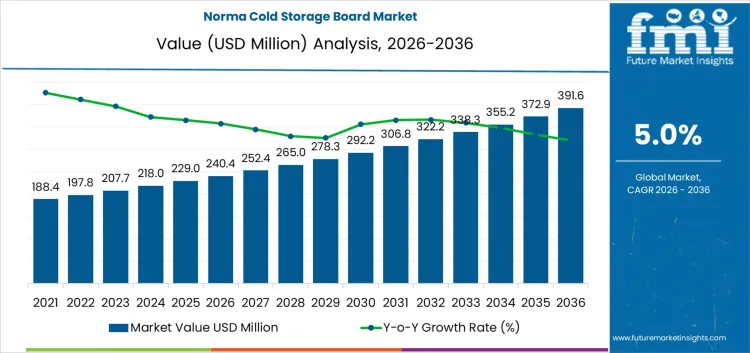
Norma Cold Storage Board Market Key Takeaways
| Metric | Value |
|---|---|
| Norma Cold Storage Board Market Value (2026) | USD 240.4 Million |
| Norma Cold Storage Board Market Forecast Value (2036) | USD 391.6 Million |
| Norma Cold Storage Board Market Forecast CAGR 2026 to 2036 | 5.0% |
Why Is the Norma Cold Storage Board Market Experiencing Steady Growth?
The norma cold storage board market is expanding due to increasing demand for insulated panels in cold storage facilities and temperature-sensitive supply chains. Growing requirements in the food, pharmaceutical, and logistics sectors are driving adoption, as cold storage boards provide thermal insulation, structural stability, and energy efficiency for warehouses, freezers, and refrigerated transport systems.
Technological improvements are supporting growth in the norma cold storage board market. Manufacturers are developing boards with enhanced thermal performance, fire resistance, and moisture control. Lightweight and easy-to-install panels reduce construction time and operational costs, improving overall facility efficiency. Compatibility with modular designs allows rapid expansion or retrofitting of storage units, increasing adoption across industrial and commercial applications.
Expansion of cold chain infrastructure and increasing focus on product quality preservation are reinforcing growth in the norma cold storage board market. Rising demand for perishable goods, pharmaceuticals, and frozen foods is encouraging investments in modern storage solutions. Regulatory compliance for food safety and energy efficiency further promotes adoption. Together, sectoral demand, product innovation, and infrastructural growth are sustaining steady market expansion over the forecast period.
What Does The Segment Overview Indicate About The Norma Cold Storage Board Market?
The Norma cold storage board market is segmented by board type and application area, showing material-specific suitability across insulated environments. PU boards lead the type segment with an estimated 44.30% share, driven by their low thermal conductivity and high insulation efficiency. XPS, EPS, and phenolic boards offer varied thermal resistance and cost profiles. Cold storage warehouses dominate the application segment with approximately 40% share, reflecting their large-scale demand for temperature-controlled insulation panels. Other key applications include refrigerated transport vehicles, food processing plants, and pharmaceutical storage, each with distinct performance, hygiene, and fire-resistance requirements.
Why Do PU Boards Hold The Leading Type Share In The Norma Cold Storage Board Market?
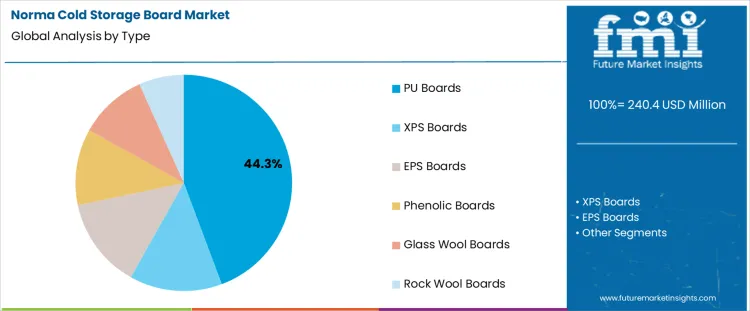
PU boards lead the Norma cold storage board market with a 44.30% share, owing to their superior thermal insulation properties and moisture resistance, making them ideal for long-term temperature control. Their high R-value per inch and dimensional stability support energy-efficient cold room construction in warehouses, processing facilities, and retail environments. These boards are lightweight, easy to install, and suitable for panelized construction. Demand also stems from regulatory compliance with thermal performance standards in commercial cold chains. Segment variation exists based on thickness, foam density, and facing materials, with specialized PU panels used in ultra-low temperature and hygienic applications. Their balance of insulation performance and material handling efficiency keeps them ahead of alternatives like XPS or EPS in core storage applications.
How Do Cold Storage Warehouses Drive Application Demand In The Norma Cold Storage Board Market?
Cold storage warehouses account for the leading 40% share in the Norma cold storage board market, due to their large surface area and critical insulation needs for preserving perishable goods. These facilities require consistent internal temperature regulation to store fruits, vegetables, meat, pharmaceuticals, and chemicals over extended periods. Norma boards, especially PU and XPS types, are used extensively in wall panels, ceilings, and flooring systems to minimize energy loss. Demand is reinforced by the expansion of food supply chains, organized retail, and e-commerce-driven fresh product distribution. Warehouse construction standards and safety codes influence material selection based on fire resistance, compressive strength, and thermal insulation values. Rapid growth in cold chain infrastructure across emerging markets continues to support warehouse demand for high-performance insulation boards.
What Is Driving Demand in the Norma Cold Storage Board Market?
The Norma cold storage board market is growing as temperature-controlled infrastructure expands across food, pharmaceutical, and logistics sectors. Norma boards, known for their structural rigidity and thermal insulation, are used in constructing wall panels, ceilings, and flooring in cold warehouses and refrigeration units. Rising demand for frozen and processed food storage, driven by supply chain decentralization and e-commerce grocery platforms, is fueling installations. Growth is also supported by temperature-sensitive pharma storage and distribution hubs, especially in vaccine and biologic handling. Norma boards offer dimensional stability, moisture resistance, and long service life, making them suitable for environments requiring hygienic and thermally regulated surfaces.
Why Are Cold Chain Operators Adopting Norma Boards Over Conventional Panels?
Adoption of Norma cold storage boards is increasing among cold chain operators due to their performance consistency in extreme conditions. Unlike conventional composite boards, Norma boards maintain structural strength and insulation efficiency even under continuous freezing cycles. These boards resist delamination, warping, and bacterial growth, which are key concerns in perishable storage environments. Their compatibility with modular construction systems supports faster installation and retrofitting in existing facilities. Low thermal conductivity and minimal vapor permeability improve energy efficiency. Industries such as seafood processing, dairy storage, and vaccine logistics are transitioning to Norma boards to meet stricter quality and safety compliance benchmarks.
What Constraints Are Slowing Wider Use of Norma Cold Storage Boards?
The Norma cold storage board market faces limitations in cost-sensitive regions where operators prefer low-cost PU or EPS panels. Upfront material and installation costs for Norma boards are higher due to proprietary resin formulations, thermal core technology, and specialized joint sealing systems. Limited manufacturer presence outside developed regions affects supply continuity and after-sales service. Heavy customization needs in large facilities may also delay procurement timelines. In retrofit projects, compatibility with legacy construction materials can require additional design adjustments. Awareness among smaller cold storage contractors remains low, especially where performance metrics are not specified in tender documentation or building codes.
What is the Country-Wise Growth Outlook for the Norma Cold Storage Board Market?
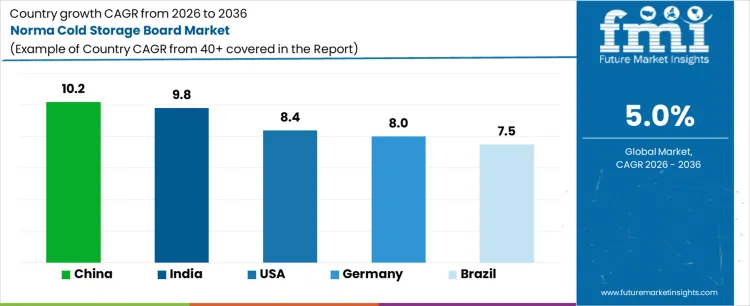
The norma cold storage board market is expanding in key regions due to rising demand for temperature-controlled infrastructure in food logistics, pharmaceutical storage, and industrial cold chains. China is leading with a CAGR of 10.2%, supported by domestic investments in integrated cold chain hubs and export-oriented storage systems. India follows at 9.8% CAGR, driven by government-backed cold chain modernization across perishables and vaccine logistics. The USA shows 8.4% CAGR as warehouse retrofitting and pharma-grade insulation standards gain traction. Germany grows at 8.0% CAGR with structural upgrades in agri-food storage and last-mile delivery cold rooms. Brazil records 7.5% CAGR with regional logistics zones expanding in urban peripheries.
| Country | CAGR |
|---|---|
| China | 10.2% |
| India | 9.8% |
| USA | 8.4% |
| Germany | 8.0% |
| Brazil | 7.5% |
Why Is China Leading in the Norma Cold Storage Board Market?
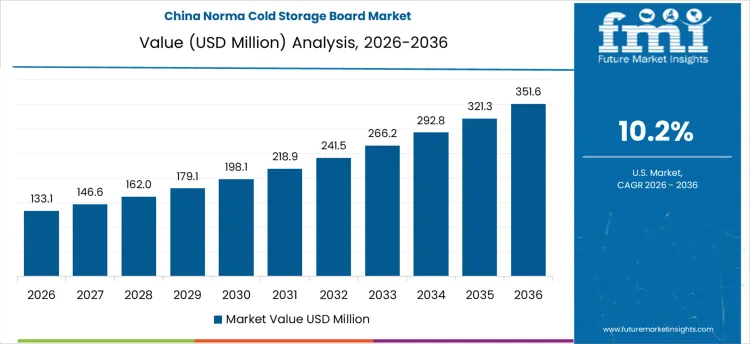
Demand for the norma cold storage board in China is growing at a CAGR of 10.2%, supported by rapid industrial-scale cold chain expansion and localized food logistics infrastructure. Chinese authorities are investing heavily in cold storage upgrades across inland cities and export hubs to reduce post-harvest losses and meet global compliance. The boards are used in wall panels, flooring, and ceiling sections across large warehouses and food processing centers. Local insulation panel manufacturers benefit from economies of scale and proximity to major food clusters, enhancing distribution efficiency. Increasing demand from pharmaceutical and dairy cold chains is pushing facility operators to standardize insulation performance, fire resistance, and microbial control properties. The rise of cross-border e-commerce in frozen foods and active temperature logistics drives demand for robust modular cold rooms. Cold storage board usage is also scaling in slaughterhouses, fisheries, and centralized kitchen infrastructures.
What Is Driving Growth in India's Norma Cold Storage Board Market?
Sales for the norma cold storage board in India are rising at a CAGR of 9.8%, primarily driven by national cold chain modernization programs in agriculture, seafood, and vaccine storage. Government subsidies and policy reforms targeting food security and post-harvest management have created a high-growth environment for cold storage expansion. Cold storage boards are widely used for thermal insulation in pack houses, reefer terminals, and pharmaceutical warehouses across multiple climate zones. Indian manufacturers are increasingly offering localized variants of polyurethane and PIR boards suited for varied humidity and thermal loads. Modular prefabricated cold rooms are replacing traditional brick-walled chambers due to better hygiene compliance and energy savings. Dairy cooperatives and fruit exporters are installing standardized walk-in cold storage units using these boards. Regional cold storage networks in Maharashtra, Gujarat, and Tamil Nadu are expanding rapidly under PPP and FPO-based infrastructure models. These patterns are accelerating adoption across both institutional and private-sector cold chain nodes in India.
Why Is the USA Expanding Its Norma Cold Storage Board Usage?
Demand for the norma cold storage board in the USA is expanding at a CAGR of 8.4%, as warehouse developers and logistics firms retrofit facilities with energy-efficient insulation systems. Cold storage boards are being adopted in both new construction and legacy facility upgrades across the frozen food, retail logistics, and vaccine distribution sectors. These boards are selected for their low thermal conductivity, moisture resistance, and fire-rated compliance, enabling LEED-certified designs and HACCP alignment. Distribution giants and regional food operators are increasing deployment of insulated wall panels for last-mile delivery hubs and fulfillment centers. Medical and biotech companies use these panels in ultra-low temperature environments for biologics and gene therapy storage. Climate-controlled warehousing demand is rising in suburban zones to reduce delivery latency, pushing panel-based modular cold rooms. Domestic manufacturers offer rigid board variants with FM approvals, tailored for North American operational codes. The combination of regulatory compliance and thermal performance is driving adoption across multiple verticals in the USA.
What Is Supporting Growth in Germany's Norma Cold Storage Board Market?
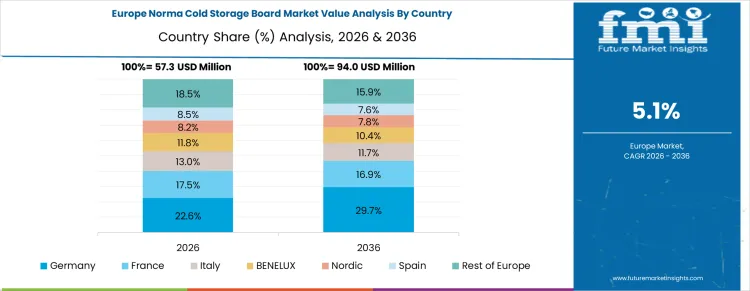
Sales for the norma cold storage board in Germany are growing at a CAGR of 8.0%, fueled by rising investment in energy-efficient infrastructure and structured food logistics. Cold storage boards are being installed across food-grade warehouses, bakery supply chains, and processed meat packaging units in urban and peri-urban areas. German builders favor PIR and mineral wool-based boards that meet local fire and moisture performance standards under DIN and EU norms. Demand is highest among logistics developers and food wholesalers optimizing cold chain distribution under green building regulations. Retrofit projects targeting energy savings have led to increased use of cold storage boards in older facilities. Dairy and pharmaceutical sectors continue to deploy modular cold rooms and clean environments with standardized board assemblies. Tier-1 cold chain providers offer bundled services with inbuilt insulated wall and roof systems to streamline compliance. The demand for compact, hygienic, and reusable cold room panels supports consistent growth in the German market.
Why Is Brazil a Growing Market for Norma Cold Storage Boards?
Demand for the norma cold storage board in Brazil is rising at a CAGR of 7.5%, supported by regional development in temperature-sensitive logistics and the formalization of agri-food supply chains. Urban peripheries in São Paulo, Minas Gerais, and Paraná are witnessing installation of cold storage clusters targeting meat exports, fresh produce, and processed foods. Modular insulated panel systems are replacing conventional structures due to faster assembly, lower maintenance, and better hygiene control. Public sector initiatives aimed at food security and export competitiveness provide incentives for upgrading rural and port-adjacent warehouses. Board suppliers focus on anti-fungal and moisture-resistant specifications suited for tropical climates. Cold storage boards are also used in refrigerated truck interiors, packhouses, and fisheries. The rise of food e-commerce and last-mile cold distribution further contributes to demand. While the segment remains cost-sensitive, operational savings and rapid deployment timelines are driving long-term interest in cold storage panels across logistics networks in Brazil.
How Are Leading Companies Competing And Differentiating In The Norma Cold Storage Board Market?
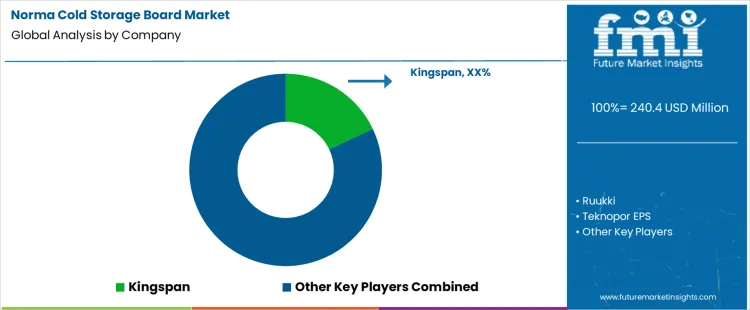
Competition in the Norma cold storage board market is being shaped by thermal insulation efficiency, structural strength, and ease of installation. Kingspan is being positioned around high-performance panels for industrial and commercial cold storage, with product brochures highlighting low thermal conductivity, fire resistance, and consistent dimensional stability. Ruukki is being differentiated through prefabricated modular panels, emphasizing rapid assembly, uniform thickness, and suitability for large-scale cold storage warehouses. Teknopor EPS focuses on lightweight, energy-efficient boards, promoting durability, ease of handling, and long-term thermal retention.
Customization and operational efficiency are being leveraged by Balex Metal, Mecalux, and Nikkei Panel System. Balex Metal markets steel-faced panels with robust insulation cores, emphasizing corrosion resistance and long service life. Mecalux integrates panels with racking and shelving solutions, positioning turnkey storage systems for optimized workflow. Nikkei Panel System promotes moisture-resistant cores and precision-engineered tolerances, highlighting installation accuracy and consistent quality across projects.
Square Technology Group and Hongbaoli follow a differentiated approach. Square Technology Group emphasizes engineered composite panels for extreme temperature applications, stressing structural stability and energy savings. Hongbaoli focuses on cost-effective solutions for regional facilities, highlighting ease of transport, installation, and low maintenance. Across the market, differentiation is being driven by insulation performance, structural reliability, and modular design, with product brochures translating technical specifications into operational efficiency and energy savings for cold storage operators.
Key Players in Norma Cold Storage Board Market
- Kingspan
- Ruukki
- Teknopor EPS
- Balex Metal
- Mecalux
- Nikkei Panel System
- Square Technology Group
- Hongbaoli
Scope of Reports
| Attributes | Description |
|---|---|
| Quantitative Unit | USD Million |
| Board Types | PU Boards, XPS Boards, EPS Boards, Phenolic Boards, Glass Wool Boards, Rock Wool Boards |
| Applications | Cold Storage Warehouses, Refrigerated Transport Vehicles, Food Processing Plants, Pharmaceutical Cold Storage, Retail Cold Storage Facilities, Industrial Cold Storage |
| Regions Covered | Asia Pacific, Europe, North America, Latin America, Middle East & Africa |
| Countries Covered | China, Japan, South Korea, India, Australia & New Zealand, ASEAN, Rest of Asia Pacific, Germany, United Kingdom, France, Italy, Spain, Nordic, BENELUX, Rest of Europe, United States, Canada, Mexico, Brazil, Chile, Rest of Latin America, Kingdom of Saudi Arabia, Other GCC Countries, Turkey, South Africa, Other African Union, Rest of Middle East & Africa |
| Key Companies Profiled | Kingspan, Ruukki, Teknopor EPS, Balex Metal, Mecalux, Nikkei Panel System, Square Technology Group, Hongbaoli |
| Additional Attributes | Market revenue breakdown by board type and application; regional adoption trends; growth in cold storage infrastructure and refrigerated transport; forecasted market size and CAGR for 2026-2036; supply chain insights and key players’ strategies; adoption patterns in food, pharmaceutical, and retail cold storage; emerging insulation trends and material innovations. |
Norma Cold Storage Board Market by Key Segments
Type:
- PU Boards
- XPS Boards
- EPS Boards
- Phenolic Boards
- Glass Wool Boards
- Rock Wool Boards
Application:
- Cold Storage Warehouses
- Refrigerated Transport Vehicles
- Food Processing Plants
- Pharmaceutical Cold Storage
- Retail Cold Storage Facilities
- Industrial Cold Storage
Region:
- Asia Pacific
- China
- Japan
- South Korea
- India
- Australia & New Zealand
- ASEAN
- Rest of Asia Pacific
- Europe
- Germany
- United Kingdom
- France
- Italy
- Spain
- Nordic
- BENELUX
- Rest of Europe
- North America
- United States
- Canada
- Mexico
- Latin America
- Brazil
- Chile
- Rest of Latin America
- Middle East & Africa
- Kingdom of Saudi Arabia
- Other GCC Countries
- Turkey
- South Africa
- Other African Union
- Rest of Middle East & Africa
Bibliography
- Ministry of Food Processing Industries (Government of India). (2025). Cold chain infrastructure guidelines. Government of India.
- Ministry of New and Renewable Energy (Government of India). (2025). Guidelines on design specifications, performance, and testing procedures for solar cold storage with thermal energy storage backup. Government of India.
- Food and Agriculture Organization of the United Nations. (2024). Cold storage and supply chain systems for perishable foods: Policy and technical guidance. FAO.
Frequently Asked Questions
How big is the norma cold storage board market in 2026?
The global norma cold storage board market is estimated to be valued at USD 240.4 million in 2026.
What will be the size of norma cold storage board market in 2036?
The market size for the norma cold storage board market is projected to reach USD 391.6 million by 2036.
How much will be the norma cold storage board market growth between 2026 and 2036?
The norma cold storage board market is expected to grow at a 5.0% CAGR between 2026 and 2036.
What are the key product types in the norma cold storage board market?
The key product types in norma cold storage board market are pu boards, xps boards, eps boards, phenolic boards, glass wool boards and rock wool boards.
Which application segment to contribute significant share in the norma cold storage board market in 2026?
In terms of application, cold storage warehouses segment to command 40.0% share in the norma cold storage board market in 2026.
Preview the report firsthand - request a free sample
Get SampleGet the brochure for pricing and purchase details.
Get PDFTable of Content
- Executive Summary
- Global Market Outlook
- Demand-side Trends
- Supply-side Trends
- Technology Roadmap Analysis
- Analysis and Recommendations
- Market Overview
- Market Coverage / Taxonomy
- Market Definition / Scope / Limitations
- Market Background
- Market Dynamics
- Drivers
- Restraints
- Opportunity
- Trends
- Scenario Forecast
- Demand in Optimistic Scenario
- Demand in Likely Scenario
- Demand in Conservative Scenario
- Opportunity Map Analysis
- Product Life Cycle Analysis
- Supply Chain Analysis
- Investment Feasibility Matrix
- Value Chain Analysis
- PESTLE and Porter’s Analysis
- Regulatory Landscape
- Regional Parent Market Outlook
- Production and Consumption Statistics
- Import and Export Statistics
- Market Dynamics
- Global Market Analysis 2021 to 2025 and Forecast, 2026 to 2036
- Historical Market Size Value (USD Million) Analysis, 2021 to 2025
- Current and Future Market Size Value (USD Million) Projections, 2026 to 2036
- Y-o-Y Growth Trend Analysis
- Absolute $ Opportunity Analysis
- Global Market Pricing Analysis 2021 to 2025 and Forecast 2026 to 2036
- Global Market Analysis 2021 to 2025 and Forecast 2026 to 2036, By Type
- Introduction / Key Findings
- Historical Market Size Value (USD Million) Analysis By Type, 2021 to 2025
- Current and Future Market Size Value (USD Million) Analysis and Forecast By Type, 2026 to 2036
- PU Boards
- XPS Boards
- EPS Boards
- Phenolic Boards
- Glass Wool Boards
- Rock Wool Boards
- PU Boards
- Y-o-Y Growth Trend Analysis By Type, 2021 to 2025
- Absolute $ Opportunity Analysis By Type, 2026 to 2036
- Global Market Analysis 2021 to 2025 and Forecast 2026 to 2036, By Application
- Introduction / Key Findings
- Historical Market Size Value (USD Million) Analysis By Application, 2021 to 2025
- Current and Future Market Size Value (USD Million) Analysis and Forecast By Application, 2026 to 2036
- Cold Storage Warehouses
- Refrigerated Transport Vehicles
- Food Processing Plants
- Pharmaceutical Cold Storage
- Retail Cold Storage Facilities
- Industrial Cold Storage
- Cold Storage Warehouses
- Y-o-Y Growth Trend Analysis By Application, 2021 to 2025
- Absolute $ Opportunity Analysis By Application, 2026 to 2036
- Global Market Analysis 2021 to 2025 and Forecast 2026 to 2036, By Region
- Introduction
- Historical Market Size Value (USD Million) Analysis By Region, 2021 to 2025
- Current Market Size Value (USD Million) Analysis and Forecast By Region, 2026 to 2036
- North America
- Latin America
- Western Europe
- Eastern Europe
- East Asia
- South Asia and Pacific
- Middle East & Africa
- Market Attractiveness Analysis By Region
- North America Market Analysis 2021 to 2025 and Forecast 2026 to 2036, By Country
- Historical Market Size Value (USD Million) Trend Analysis By Market Taxonomy, 2021 to 2025
- Market Size Value (USD Million) Forecast By Market Taxonomy, 2026 to 2036
- By Country
- USA
- Canada
- Mexico
- By Type
- By Application
- By Country
- Market Attractiveness Analysis
- By Country
- By Type
- By Application
- Key Takeaways
- Latin America Market Analysis 2021 to 2025 and Forecast 2026 to 2036, By Country
- Historical Market Size Value (USD Million) Trend Analysis By Market Taxonomy, 2021 to 2025
- Market Size Value (USD Million) Forecast By Market Taxonomy, 2026 to 2036
- By Country
- Brazil
- Chile
- Rest of Latin America
- By Type
- By Application
- By Country
- Market Attractiveness Analysis
- By Country
- By Type
- By Application
- Key Takeaways
- Western Europe Market Analysis 2021 to 2025 and Forecast 2026 to 2036, By Country
- Historical Market Size Value (USD Million) Trend Analysis By Market Taxonomy, 2021 to 2025
- Market Size Value (USD Million) Forecast By Market Taxonomy, 2026 to 2036
- By Country
- Germany
- UK
- Italy
- Spain
- France
- Nordic
- BENELUX
- Rest of Western Europe
- By Type
- By Application
- By Country
- Market Attractiveness Analysis
- By Country
- By Type
- By Application
- Key Takeaways
- Eastern Europe Market Analysis 2021 to 2025 and Forecast 2026 to 2036, By Country
- Historical Market Size Value (USD Million) Trend Analysis By Market Taxonomy, 2021 to 2025
- Market Size Value (USD Million) Forecast By Market Taxonomy, 2026 to 2036
- By Country
- Russia
- Poland
- Hungary
- Balkan & Baltic
- Rest of Eastern Europe
- By Type
- By Application
- By Country
- Market Attractiveness Analysis
- By Country
- By Type
- By Application
- Key Takeaways
- East Asia Market Analysis 2021 to 2025 and Forecast 2026 to 2036, By Country
- Historical Market Size Value (USD Million) Trend Analysis By Market Taxonomy, 2021 to 2025
- Market Size Value (USD Million) Forecast By Market Taxonomy, 2026 to 2036
- By Country
- China
- Japan
- South Korea
- By Type
- By Application
- By Country
- Market Attractiveness Analysis
- By Country
- By Type
- By Application
- Key Takeaways
- South Asia and Pacific Market Analysis 2021 to 2025 and Forecast 2026 to 2036, By Country
- Historical Market Size Value (USD Million) Trend Analysis By Market Taxonomy, 2021 to 2025
- Market Size Value (USD Million) Forecast By Market Taxonomy, 2026 to 2036
- By Country
- India
- ASEAN
- Australia & New Zealand
- Rest of South Asia and Pacific
- By Type
- By Application
- By Country
- Market Attractiveness Analysis
- By Country
- By Type
- By Application
- Key Takeaways
- Middle East & Africa Market Analysis 2021 to 2025 and Forecast 2026 to 2036, By Country
- Historical Market Size Value (USD Million) Trend Analysis By Market Taxonomy, 2021 to 2025
- Market Size Value (USD Million) Forecast By Market Taxonomy, 2026 to 2036
- By Country
- Kingdom of Saudi Arabia
- Other GCC Countries
- Turkiye
- South Africa
- Other African Union
- Rest of Middle East & Africa
- By Type
- By Application
- By Country
- Market Attractiveness Analysis
- By Country
- By Type
- By Application
- Key Takeaways
- Key Countries Market Analysis
- USA
- Pricing Analysis
- Market Share Analysis, 2025
- By Type
- By Application
- Canada
- Pricing Analysis
- Market Share Analysis, 2025
- By Type
- By Application
- Mexico
- Pricing Analysis
- Market Share Analysis, 2025
- By Type
- By Application
- Brazil
- Pricing Analysis
- Market Share Analysis, 2025
- By Type
- By Application
- Chile
- Pricing Analysis
- Market Share Analysis, 2025
- By Type
- By Application
- Germany
- Pricing Analysis
- Market Share Analysis, 2025
- By Type
- By Application
- UK
- Pricing Analysis
- Market Share Analysis, 2025
- By Type
- By Application
- Italy
- Pricing Analysis
- Market Share Analysis, 2025
- By Type
- By Application
- Spain
- Pricing Analysis
- Market Share Analysis, 2025
- By Type
- By Application
- France
- Pricing Analysis
- Market Share Analysis, 2025
- By Type
- By Application
- India
- Pricing Analysis
- Market Share Analysis, 2025
- By Type
- By Application
- ASEAN
- Pricing Analysis
- Market Share Analysis, 2025
- By Type
- By Application
- Australia & New Zealand
- Pricing Analysis
- Market Share Analysis, 2025
- By Type
- By Application
- China
- Pricing Analysis
- Market Share Analysis, 2025
- By Type
- By Application
- Japan
- Pricing Analysis
- Market Share Analysis, 2025
- By Type
- By Application
- South Korea
- Pricing Analysis
- Market Share Analysis, 2025
- By Type
- By Application
- Russia
- Pricing Analysis
- Market Share Analysis, 2025
- By Type
- By Application
- Poland
- Pricing Analysis
- Market Share Analysis, 2025
- By Type
- By Application
- Hungary
- Pricing Analysis
- Market Share Analysis, 2025
- By Type
- By Application
- Kingdom of Saudi Arabia
- Pricing Analysis
- Market Share Analysis, 2025
- By Type
- By Application
- Turkiye
- Pricing Analysis
- Market Share Analysis, 2025
- By Type
- By Application
- South Africa
- Pricing Analysis
- Market Share Analysis, 2025
- By Type
- By Application
- USA
- Market Structure Analysis
- Competition Dashboard
- Competition Benchmarking
- Market Share Analysis of Top Players
- By Regional
- By Type
- By Application
- Competition Analysis
- Competition Deep Dive
- Kingspan
- Overview
- Product Portfolio
- Profitability by Market Segments (Product/Age /Sales Channel/Region)
- Sales Footprint
- Strategy Overview
- Marketing Strategy
- Product Strategy
- Channel Strategy
- Ruukki
- Teknopor EPS
- Balex Metal
- Mecalux
- Nikkei Panel System
- Square Technology Group
- Hongbaoli
- Kingspan
- Competition Deep Dive
- Assumptions & Acronyms Used
- Research Methodology


