

- Industry Size (2026)
- USD 238.4 Mn
- Forecast (2036)
- USD 447.5 Mn
- CAGR (2026 to 2036)
- 6.5%
Cold-Pressed Citrus Seed Oil Ingredients Market Size, Market Forecast and Outlook By FMI
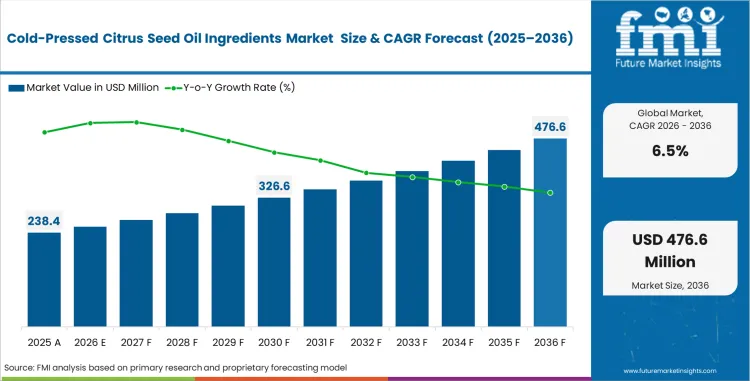
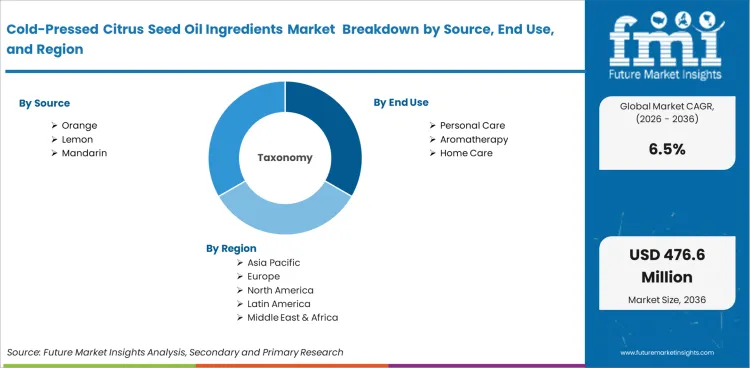
The cold-pressed citrus seed oil ingredients market reached a valuation of USD 223.8 million in 2025. Sales are projected to exceed USD 238.4 million in 2026, reflecting a citrus seed oil market CAGR of 6.5% over the forecast period. Total market value is projected to advance to USD 447.5 million by 2036 as cosmetic manufacturers increase use of mechanically recovered citrus seed oils in select formulations that prioritize traceability, upcycled sourcing, and milder processing narratives.
Summary of Cold-Pressed Citrus Seed Oil Ingredients Market
- Market Snapshot
- Cold-pressed citrus seed oil ingredients market stands at USD 223.8 million in 2025 and is projected to reach USD 447.5 million by 2036.
- Market is expected to expand at a 6.5% CAGR from 2026 to 2036, creating an incremental opportunity of USD 209.1 million across forecast years.
- Category includes ingredient-grade oils obtained through mechanical pressing from citrus seeds and sold mainly into personal care, cosmetics, nutraceuticals, functional food, and specialty formulation channels instead of bulk edible oil trade.
- Supply remains linked to citrus processing residues, making processor location, seed recovery rates, and post-press refining strength critical for competitive positioning.
- Demand and Growth Drivers
- Demand is rising as citrus processors and ingredient formulators increasingly treat seeds as revenue-generating by-products rather than waste, supported by growing research and commercial interest in oil recovery.
- Cold-pressed seed oils are gaining traction in formulation activity because citrus seeds often contain about 30% to 45% oil, giving mechanical extraction solid commercial relevance even at niche scale.
- Existing cosmetic ingredient familiarity for select citrus seed oils supports wider experimentation across topical products and carrier oil systems, though commercial uptake still depends on stability, sensory profile, and supplier consistency.
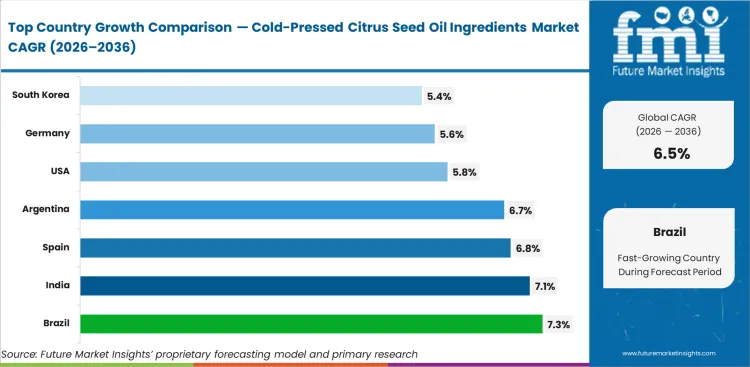
- Among key countries, Brazil leads at 7.3% CAGR, followed by India at 7.1%, Spain at 6.8%, Argentina at 6.7%, United States at 5.8%, Germany at 5.6%, and South Korea at 5.4%.
- Expansion faces moderation from uneven seed recovery logistics, variable feedstock composition across citrus species, and a limited pool of scaled specialist suppliers focused on seed-derived oils instead of peel-derived citrus oils.
- Product and Segment View
- Market covers citrus-seed-derived ingredients from orange, lemon, grapefruit, mandarin, and mixed citrus, with material sold as cosmetic grade, food grade, nutraceutical grade, and pharma grade in conventional and organic formats.
- Applications span personal care, nutraceuticals, functional food, aromatherapy, and home care, though current visible commercialization remains strongest in personal care and topical formulation.
- Orange leads source segment with an estimated 41.8% share, supported by a much larger orange-processing base than other citrus feedstocks.
- Personal care leads the end use segment with an estimated 49.2% share, reflecting current supplier activity and cosmetic-ingredient recognition for expressed citrus seed oils.
- Cosmetic grade leads the grade segment with an estimated 46.5% share, while conventional leads nature segment at 68.1% and refined leads processing segment at 54.7%.
- Scope includes cold-pressed citrus seed oils sold as ingredients, yet excludes peel essential oils, synthetic citrus aroma chemicals, bulk commodity vegetable oils, and non-oil citrus seed derivatives such as extracts or meals.
- Geography and Competitive Outlook
- Brazil, India, and Spain are among fastest-growing markets, while the United States remains a stable high-value formulation base because ingredient demand stays broader even without dominant local feedstock recovery.
- Competition depends more on niche assortment depth, batch traceability, and distribution reach than on large-scale corporate concentration, with O&3, Nature In Bottle, Natural Poland, Liven Cyprus, Aromaaz International, and Aarnav Global Exports among visible participants in the category.
- Market remains fragmented, with few leading suppliers holding a majority share of global value in this narrow niche.
Key Takeaways, Market Size, and Forecast
- Cold-Pressed Citrus Seed Oil Ingredients Market is projected to grow from USD 238.4 million in 2026 to USD 447.5 million by 2036, at a CAGR of 6.5%.
- The market was valued at USD 223.8 million in 2025.
- The market is projected to create an incremental opportunity of USD 209.1 million between 2026 and 2036.
- In 2026, Orange is expected to account for 41.8% of the source segment.
- Personal Care is projected to lead end use with 49.2% share in 2026.
- Cosmetic Grade is expected to dominate the grade segment with 46.5% share in 2026.
- Brazil (7.3%) and India (7.1%) are among the fastest growing markets.
Demand for cold-pressed citrus seed oil ingredients is rising across beauty, personal care, nutraceutical, and specialty formulation markets as brands place higher importance on upcycled inputs paired with strong source clarity. Citrus oils obtained through mechanical pressing present a cleaner processing route than solvent-based options, raising appeal in formulas built around natural claims, residue caution, and sustainability-driven brand value. Adoption is supported where citrus processing streams generate recoverable seed volumes that can be redirected from low-value waste handling into higher-value ingredient use. Companies also benefit from growing interest in ingredients backed by clear origin, practical recovery economics, and production methods that align with premium product positioning across multiple end-use categories.
Personal care continues as a major area of demand, spanning facial oils, body serums, scalp care, cleansing oils, and emulsion formats looking for lighter botanical lipid profiles. Buyers respond well to sourcing narratives linked to fruit origin, circular processing, and gentler extraction methods. Broader adoption depends on oxidation control, peroxide management, and lot-to-lot consistency, as poor seed storage, moisture variation, and delayed handling can reduce formulation reliability. Greater buyer confidence often comes from suppliers offering full batch traceability, aroma consistency, fatty acid profile clarity, shelf-life data, and documented handling practices that reduce formulation risk during product development, scale-up, and commercial launch.
Supply-side improvement is reinforcing market expansion. Better seed separation, washing, drying, and near-source pressing capacity are helping suppliers limit spoilage exposure and raise usable output. Growth is being supported by clean-label beauty demand, broader commercial use of citrus processing by-products, and rising preference for traceable plant-based ingredient systems. Premium wellness lines, indie cosmetic brands, spa treatment products, and hybrid ingestible-beauty concepts are also adding demand. Stronger quality systems, better storage procedure, and sharper raw material recovery economics are expected to keep commercial interest moving upward across ingredient supply chains.
Brazil benefits from a large citrus processing base, giving extractors broader access to seed feedstock and supporting an estimated CAGR of 7.3% over the forecast period. India follows with 7.1% CAGR, helped by rising personal care demand, expanding local formulation activity, and stronger interest in plant-based cosmetic ingredients. Spain is projected to post 6.8% CAGR, supported by established natural formulation channels and steady use of citrus-derived inputs across European beauty applications. Argentina is likely to record 6.7% CAGR, with lemon processing strength contributing to raw material availability. Market growth in the United States remains comparatively moderate at 5.8% CAGR, reflecting demand from premium cosmetic and specialty ingredient segments. Germany is set to see 5.6% CAGR, while South Korea is anticipated to achieve 5.4% CAGR, supported by continued use of differentiated botanical oils in advanced skin care and beauty formulations.
Cold-Pressed Citrus Seed Oil Ingredients Market Key Takeaways
| Metric | Details |
|---|---|
| Industry Size (2026) | USD 238.4 million |
| Industry Value (2036) | USD 447.5 million |
| CAGR (2026 to 2036) | 6.5% |
Source: Future Market Insights (FMI) analysis, based on proprietary forecasting model and primary research
Segmental Analysis
Cold-Pressed Citrus Seed Oil Ingredients Market Analysis by Source
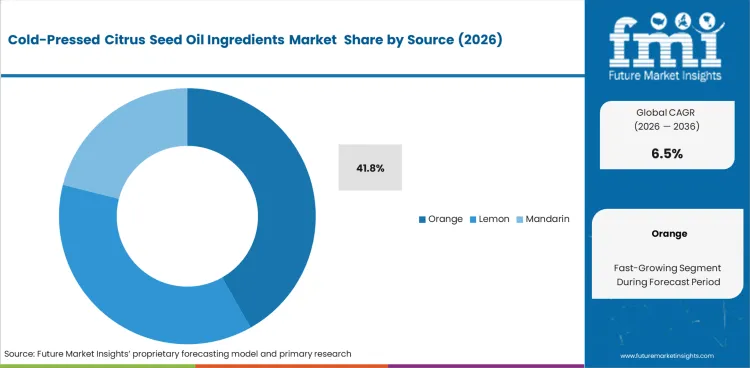
Commercial success in byproduct trade starts with reliable raw material flow, long before performance attributes enter evaluation. Orange processing gives suppliers a practical edge because large juice systems generate seed volumes at a scale minor citrus streams rarely match. Centralized extraction hubs reduce wet-seed movement, simplify aggregation, and support steadier planning across multi-batch production cycles. Buyer trust also improves because multiple suppliers participate in orange-linked recovery, reducing exposure linked with narrow sourcing pools or short seasonal runs. In 2026, orange segment is projected to secure 41.8% share in this market. This lead reflects supply continuity more than any major technical advantage, since orange seed oil typically benefits from better availability, easier production planning, and lower disruption risk rather than sharply differentiated functionality. Smaller formulation houses, especially across mid-volume cosmetic and wellness programs, often lean toward orange-derived input because stock planning remains easier and replacement sourcing stays more realistic during uneven harvest periods.
- Logistical consolidation: Orange processing clusters very large seed volumes inside single industrial sites. Stable collection patterns support smoother pricing discussions, simpler shipment planning, and lower aggregation cost than fragmented recovery models tied to smaller citrus varieties.
- Qualification security: Formulation teams gain greater sourcing flexibility with orange-derived material because more than one supplier can often meet baseline specifications. Backup sourcing improves contract stability and reduces exposure during quality disputes, freight delays, or seasonal raw material shortfalls.
- Seasonality pressure in minor citrus: Grapefruit, lemon, and tangerine oil recovery often follows narrower processing calendars. Extra storage, added warehousing, and longer inventory carry periods raise hidden operating expenses, weakening commercial attractiveness for year-round ingredient programs.
Cold-Pressed Citrus Seed Oil Ingredients Market Analysis by End Use
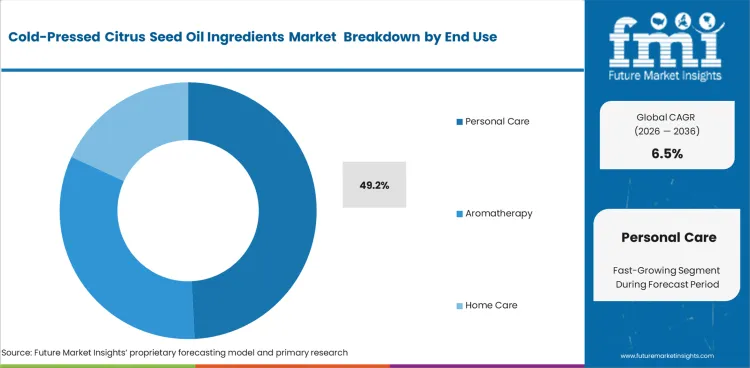
Topical applications account for the strongest commercial uptake because skin and body care categories are better able to absorb higher ingredient costs than lower-margin ingestible formats. Facial oils, scalp serums, cleansing blends, and emulsion systems all gain value from plant-origin positioning, solvent-free extraction language, and visually appealing citrus-linked sourcing narratives. Companies also favor such oils because label appeal can support premium placement without forcing a sharp increase in total formula complexity. Personal care segment is anticipated to emerge with 49.2% market share in 2026. This strong position is attributed to several factors including improved margin absorption, extensive compatibility with carrier-oil systems, and continuous high demand for botanical ingredients. These botanicals are often used as supporting components alongside more costly active ingredients in both prestige and masstige product ranges. Nutritional use remains possible, yet retail pricing power in topical categories gives processors and formulators a far clearer path toward acceptable returns, particularly across premium beauty shelves, spa-led treatment ranges, and smaller indie labels seeking a recognizable fruit-origin ingredient with clean-label appeal.
- Solvent-free appeal: Cosmetic applications benefit from mechanical extraction because residue-sensitive shoppers and retail gatekeepers favor cleaner processing language. Such positioning supports acceptance across Europe and North America beauty channels carrying tighter ingredient review standards.
- Margin support: Skincare and body care pricing often absorbs extraction premiums more comfortably than supplements or functional foods. Better unit economics encourage use in serums, treatment oils, and premium emulsions rather than in high-volume ingestible lines facing stronger price comparison pressure.
- Brand story value: Citrus-origin lipids offer a commercially useful label story. Marketing teams can highlight fruit-based sourcing, byproduct recovery, and milder processing while formulators rely on a practical carrier oil delivering texture support and blend flexibility inside finished products.
Cold-Pressed Citrus Seed Oil Ingredients Market Analysis by Grade
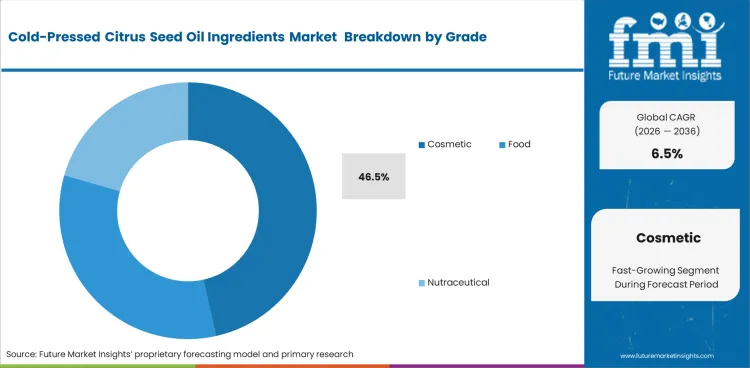
Regulatory usability often shapes immediate addressable demand for novel botanical ingredients, and cosmetic-grade supply generally enters commercial pathways more easily than ingestible material. Processors can focus on peroxide control, color behavior, odor refinement, and oxidative stability rather than on full food-compliance burdens that require deeper certification investment. For many agricultural byproduct handlers, that distinction carries major commercial importance because audit intensity, documentation load, and facility readiness differ sharply across grade categories. Cosmetic grade is set to represent 46.5% of market share in 2026. Broad preference stems from easier formulation entry, established cosmetic ingredient recognition, and stronger alignment with current supplier capabilities across topical oil applications. Material with potential food-related use often remains positioned within cosmetic channels because compliance pathways may be faster, capital requirements are often lower, and revenue realization is typically quicker in beauty and personal care. Demand from prestige skincare brands further strengthens early-season competition for better pressing lots, especially once oxidation performance and visual stability become deciding factors during qualification.
- Audit burden avoidance: Secondary byproduct processors often prefer cosmetic positioning because food-grade certification demands longer compliance cycles, more documentation, and heavier plant investment. Faster route-to-market improves cash realization and reduces administrative drag on smaller recovery businesses.
- Oxidative performance focus: Topical products need stable odor and low rancidity risk across long shelf periods. Cosmetic-grade tuning often prioritizes peroxide management and sensory stability, helping brands avoid complaint risk once finished products reach retail shelves or e-commerce storage channels.
- Lot allocation patterns: Better raw pressings frequently move first toward higher-value cosmetic programs. Food-focused buyers may encounter tighter access to premium lots, especially during early harvest windows or years marked by uneven raw material quality.
Cold-Pressed Citrus Seed Oil Ingredients Market Analysis by Nature
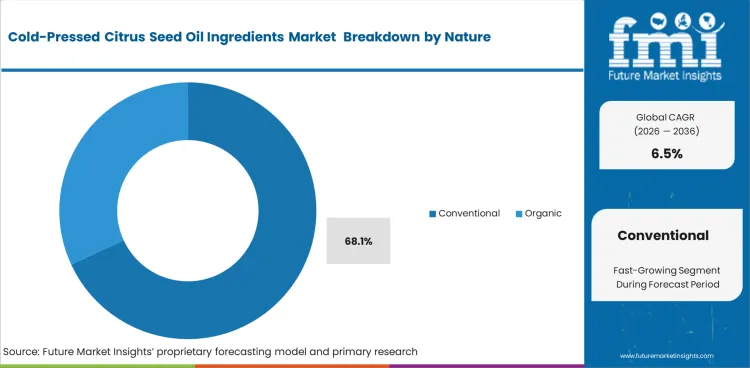
Organic supply remains constrained not only by demand-side factors, but also by the operational realities of large citrus processing systems built around throughput, mixed-farm intake, and limited segregation flexibility. Once fruit from many farms enters continuous juicing lines, segregation becomes expensive, especially for byproduct streams such as seeds that already represent a secondary recovery opportunity. Certified organic citrus processing also remains limited in global volume, leaving seed recovery from that subset too small for many scaled production plans. Conventional material is likely to account for 68.1% share in 2026. Such dominance reflects easier sourcing, better manufacturing continuity, and broader commercial practicality across ingredient buyers serving personal care, nutraceutical, and specialty formulation channels. Many premium beauty brands already accept mechanically pressed conventional material as sufficiently aligned with clean-beauty expectations, reducing pressure to insist on organic certification for every carrier-oil component. During weaker crop cycles, this preference becomes even more pronounced because supply assurance, batch availability, and continuity of production often outweigh premium label ambition.
- Facility segregation limits: Industrial juice plants handle enormous fruit volumes under continuous operating schedules. Running isolated organic seed batches can interrupt flow, complicate handling, and raise cost far beyond acceptable levels for many byproduct recovery models.
- Output economics: Organic citrus processing remains comparatively small, leaving only micro-batches of recoverable seed material in many regions. Limited output restricts dependable year-round supply and pushes buyers toward sporadic spot purchases at elevated prices.
- Clean-beauty alignment without organic status: Mechanical pressing already satisfies a large share of natural-positioning expectations in beauty and wellness channels. Reliable conventional supply therefore remains attractive for formulators seeking cleaner extraction language without risking severe sourcing gaps.
Cold-Pressed Citrus Seed Oil Ingredients Market Analysis by Processing
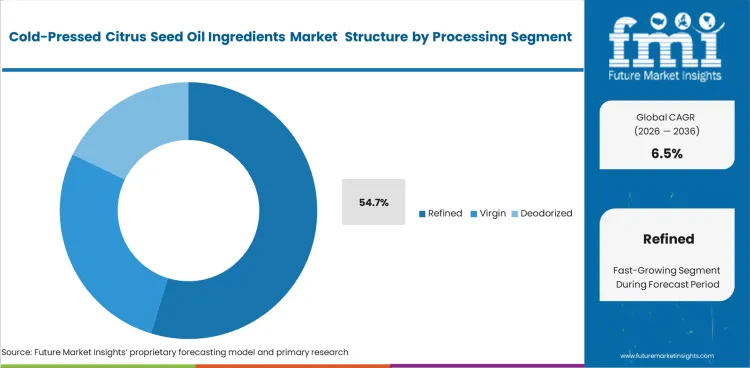
End-product stability depends on a carrier oil remaining visually quiet, odor controlled, and oxidation resistant across varied formulation systems. Virgin oils may carry appealing natural credentials, yet stronger aroma, darker color, and faster oxidative drift create added formulation work in premium creams, serums, and scent-sensitive emulsions. Refined material offers a more neutral starting point, making blending easier for brands aiming for pale textures, fragrance clarity, and longer retail resilience. In 2026, refined processing is expected to contribute 54.7% of total market share. Preference follows practical formulation logic: fewer color disruptions, less odor conflict, and improved shelf-life performance under retail lighting or warehouse exposure. Manufacturers first explore virgin material for story value, yet later move toward refined grades after pilot instability, pigment interference, or sensory inconsistency create avoidable redevelopment costs. Commercial success in high-value personal care rarely depends on rawness alone; repeatable stability, scent neutrality, and visual cleanliness often matter far more once a formula moves from concept stage into scaled manufacturing and shelf display.
- Pigment management: Unrefined flavoring oils can introduce yellow or green tones that alter visual identity in white creams or light emulsions. Physical refining helps preserve cleaner appearance and supports premium positioning linked with purity, softness, and clinical-style aesthetics.
- Oxidation control: Raw pressings often degrade faster under heat, air, and store lighting. Better stability from refined grades can reduce need for extra protective additives and lower risk linked with off-notes, discoloration, or shortened shelf life.
- Sensory neutrality: Strong natural seed odor may interfere with delicate fragrance systems. Refined variants provide a more neutral canvas, allowing perfumers and formulators to maintain the intended scent profile without interference from base-oil character.
Cold-Pressed Citrus Seed Oil Ingredients Market Drivers, Restraints, and Opportunities
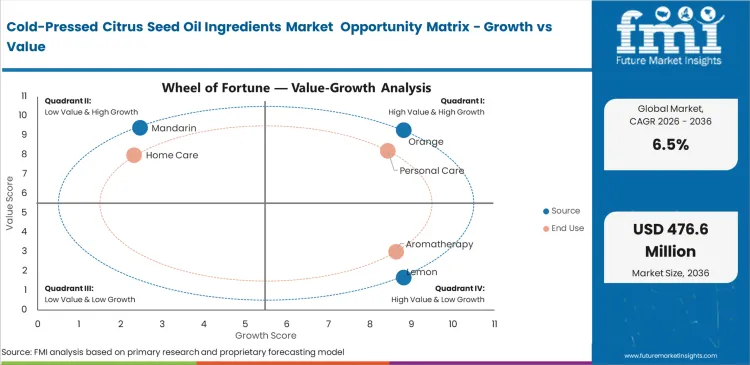
Clean-beauty retail requirements are accelerating reformulation cycles for mid-tier cosmetic brands still relying on synthetic emollients. Movement toward upcycled citrus seed oil ingredients supports mechanical extraction preferences while also adding a stronger byproduct recovery story for premium product positioning. Delayed adaptation can expose contract manufacturers to lost brand opportunities as clients shift toward cleaner carrier systems, particularly in Europe-facing beauty programs. Commercial pressure extends beyond consumer taste, since retail gatekeeping, ingredient review criteria, plus clean-label screening increasingly shape entry into topical product ranges. Growth drivers for citrus seed oil ingredients through 2036 therefore connect closely with carrier substitution needs, residue-sensitive formulation trends, sustainability-linked sourcing narratives, plus rising preference for traceable botanical lipids in premium beauty portfolios.
Rapid lipid degradation between fruit extraction plus seed pressing continues to weaken supply reliability across this niche. Wet citrus seeds can ferment or oxidize within only a few hours after juice extraction, pushing peroxide levels high before arrival at a drying unit. Plant operations personnel often face difficulty justifying large capital outlays needed for dedicated drying centrifuges placed directly beside juicing activity. Such friction leaves a meaningful portion of potential feedstock exposed to spoilage in holding bins, restricting ingredient availability despite very large agricultural volumes across citrus processing regions. Current mobile drying options still deliver inconsistent results, leaving buyers exposed to quality variation between harvest lots. Added strain also comes from moisture inconsistency, variable seed cleanliness, delayed separation practices, plus uneven post-extraction handling standards, all of this reducing stability across raw material supply programs intended for cosmetic, nutraceutical, or specialty formulation use.
Opportunities in Cold-Pressed Citrus Seed Oil Ingredients Market
- Colocated drying infrastructure: Continuous seed dryers installed beside juice extraction units can stop early fermentation, reduce peroxide escalation, preserve oil quality, and improve commercial recovery rates. Plants capturing cleaner feedstock can secure premium pricing from cosmetic buyers seeking tighter quality parameters plus stronger consistency across repeat orders.
- Micro-encapsulation technologies: Protective shell systems around virgin citrus seed lipids can extend shelf life, lower oxidation risk, support broader use in emulsions, serums, and ingestible wellness blends. Product developers gain access to fuller antioxidant rich fruit oils without creating avoidable instability inside finished retail formulations.
- Upcycled certification protocols: Third-party audit systems around byproduct recovery can strengthen sustainability claims, improve ingredient credibility, support premium branding across natural personal care aisles. Marketing teams can use clean-label oil ingredients derived from citrus waste to create stronger product distinction in crowded botanical formulation categories.
Regional Analysis
Based on regional analysis, the cold-pressed citrus seed oil ingredients market is segmented into North America, Europe, Asia Pacific, Latin America, and Middle East & Africa, across 40 plus countries.
.webp "Top Country Growth Comparison Cold Pressed Citrus Seed Oil Ingredients Market Cagr (2026 2036)")
| Country | CAGR (2026 to 2036) |
|---|---|
| Brazil | 7.3% |
| India | 7.1% |
| Spain | 6.8% |
| Argentina | 6.7% |
| United States | 5.8% |
| Germany | 5.6% |
| South Korea | 5.4% |
Source: Future Market Insights (FMI) analysis, based on proprietary forecasting model and primary research
Latin America Cold-Pressed Citrus Seed Oil Ingredients Market Analysis
Large-scale juice processing gives Latin America a strong commercial base in citrus pulp, since very high fruit throughput creates a dependable stream of recoverable seed material across major citrus belts. Seed extraction business in this region has moved beyond a small sustainability exercise and now serves as a practical revenue extension for processors facing rising farm-gate movement, handling, storage, and utility costs. Dense raw material concentration also supports investment in dedicated pressing systems, separation equipment, drying units, and quality control workflows that smaller producing areas often cannot justify at similar scale. Even though finished beauty, nutraceutical, and specialty formulation demand extends far beyond this region, early-stage extraction economics in Latin America continue to influence broader market pricing, supply consistency, and batch availability for downstream buyers operating in premium botanical oil applications.
- Brazil: Massive orange concentrate infrastructure in Brazil is a major commercial edge, since seed availability remains far more abundant than in most competing citrus markets. Large juice corridors support continuous separation, shorter transfer distances between extraction stages, and better utilization rates for installed pressing assets. Near-site placement of recovery systems beside major juice lines also improves throughput discipline and lowers spoilage risk during seed handling. Global buyers frequently look to Brazil for baseline supply security because material availability remains broader and more commercially workable than in many alternative sourcing locations. Sales of cold-pressed citrus seed oil ingredients in Brazil are expected to increase at a CAGR of 7.3% during the forecast period. Strong local economics, dependable orange throughput, and improving recovery systems keep Brazil well positioned for volume-oriented supply agreements serving cosmetic, personal care, and specialty ingredient programs across multiple export channels.
- India: Domestic beauty and personal care expansion continues to create stronger room for citrus-derived botanical lipids across lotions, scalp products, face oils, and treatment formats positioned around natural appeal. Contract manufacturing capability has improved steadily, and broader familiarity with plant-based carrier systems is raising acceptance for ingredients connected with fruit origin and cleaner processing language. Local demand also benefits from premium product positioning linked with Ayurvedic and botanical wellness concepts, giving citrus seed derivatives a more visible role in branded formulations. Imported supply still supports a meaningful share of market development while domestic processors continue upgrading byproduct recovery systems and post-harvest handling practices. The market for cold-pressed citrus seed oil ingredients in India is expected to grow at a CAGR of 7.1% during the study period. Rising product sophistication, broader ingredient awareness, and stronger premiumization across personal care portfolios are helping India move into a more important consumption position across this niche.
- Argentina: Argentina's focus on lemon processing sets it apart in the citrus market, appealing particularly to buyers seeking specialized citrus products rather than large quantities of orange-based supply. The regional extraction procedure is highly advantageous due to the dense supply of raw materials, existing infrastructure for handling citrus, and extensive experience with processing cycles that align with the lemon-centric harvest. Such concentration gives local suppliers meaningful influence in niche sourcing conversations, particularly across applications seeking differentiated fruit-origin oils for topical and specialty formulations. Short harvesting windows still require disciplined storage, separation, and pressing practices, yet regional expertise in lemon-linked processing supports more reliable commercial execution than many outside buyers can secure elsewhere. Cold-pressed citrus seed oil ingredients adoption in Argentina is likely to advance at a CAGR of 6.7% by 2036. Continued buyer interest in specialized citrus variants and more focused procurement across premium formulation channels are expected to support steady market expansion.
- South Korea: Fast product rotation across K-beauty keeps demand high for ingredients carrying a fresh botanical identity, clean sensory profile, and compatibility with layered formulation systems. Refined citrus seed lipids fit well into serum programs, treatment oils, and multi-step beauty routines requiring odor control, visual clarity, and stable performance inside premium textures. Fragrance sensitivity also remains important in this market, making deodorized and carefully refined grades more commercially useful than oils carrying strong native aroma. Agricultural scale does not define market success here to the same extent seen in extraction-heavy regions; formulation quality, sensory precision, and finished-product suitability matter far more for supplier acceptance. South Korea is likely to post a CAGR of 5.4% in the cold-pressed citrus seed oil ingredients industry by 2036. Buyers in this market continue to favor suppliers capable of offering consistency in refining, odor neutrality, oxidation control, and batch presentation suited to premium cosmetic development.
Europe Cold-Pressed Citrus Seed Oil Ingredients Market Analysis
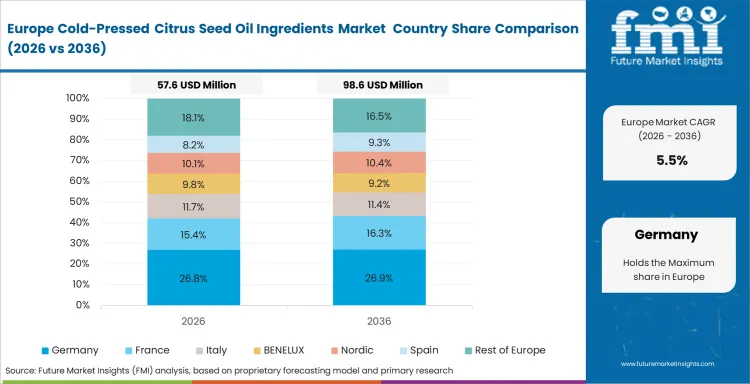
Demand for mechanically pressed botanical lipids in Europe continues to incline due to tighter scrutiny around formulation inputs, cleaner processing preferences, and stronger retail emphasis on traceable origin stories. Ingredient screening across beauty and personal care channels has compelled many formulators toward physically processed oils carrying a simpler compliance narrative than solvent-linked alternatives. Europe functions less as a dominant agricultural extractor and more as a higher-value refining, formulation, and specialty processing hub, supported by strong cosmetic development capability and high sensory expectations across finished products. Raw or semi-finished material often enters from outside producing regions, after which local operators refine, deodorize, standardize, and adapt oil profiles for skincare, personal care, and luxury formulation needs across advanced product lines.
- Spain: Citrus cultivation plus regional processing capability offer Spain a commercially useful bridge between Mediterranean agricultural supply and high-specification formulation demand across Europe. Local operators have added advantage from easy access to orchards, established ingredient handling experience, and comparatively short movement distances between recovery, pressing, and refining activity. Spain also has added relevance in fragrance-linked and premium topical applications, since sensory quality matters greatly in many downstream beauty industries served from this market. Supplier positioning gains additional support from geographic closeness to Europe formulators seeking shorter lead times, easier coordination, and reduced logistics complexity versus long-haul bulk imports. Demand for cold-pressed citrus seed oil ingredients in Spain is anticipated to rise at a CAGR of 6.8% through 2036. Such momentum reflects a mix of regional processing strength, premium application focus, and growing preference for plant-derived inputs aligned with refined cosmetic standards.
- Germany: High formulation standards, strong consumer interest in ingredient transparency, and a large prestige beauty manufacturing base continue to support steady demand in Germany. Product developers across this market place considerable value on mechanically extracted lipids carrying clear sourcing documentation, consistent technical performance, and low-risk sensory behavior across advanced skincare systems. Broad clean-label preferences also contribute to a gradual shift away from synthetic carrier oils in selected applications, especially in premium personal care lines positioned around mild processing and botanical authenticity. Germany-based brands retain good pricing power across Europe, allowing more room for specialized ingredient use in higher-value finished products. Cold-pressed citrus seed oil ingredients sales in Germany are poised to grow at a CAGR of 5.6% during the assessment period. Ongoing focus on purity, documentation quality, and formulation discipline keeps Germany influential in shaping supplier expectations across premium cosmetic-grade supply chains.
North America Cold-Pressed Citrus Seed Oil Ingredients Market Analysis
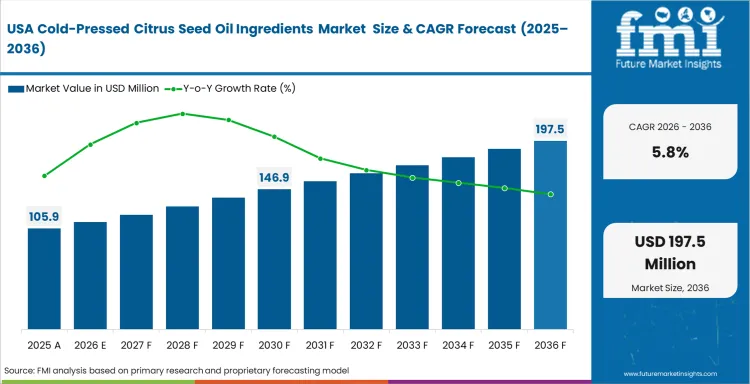
North America remains a major formulation and consumption hub for cold-pressed citrus seed oil ingredients, even though raw agricultural recovery does not match regional demand scale. Beauty and personal care manufacturing capacity in this region is extensive, and brand emphasis on traceability, clean-label language, oxidative stability, and batch consistency continues to drive supplier qualification standards. Imported semi-finished oils and refined inputs therefore play a major role in supply formation, especially for cosmetic and specialty botanical applications requiring reliable documentation plus predictable performance. The North American market, despite some local citrus processing capability, currently features limited domestic seed recovery volumes. This limited local recovery capacity remains insufficient relative to downstream formulation demand across personal care, specialty ingredients, and related applications. This critical supply-demand imbalance has a profound and sustained impact on the global trade landscape for citrus-derived products.
- United States: Large contract manufacturing networks, high beauty product turnover, and constant demand for recognizable botanical stories continue to support market expansion in the United States. Many formulators are shifting preference from synthetic carrier systems in selected premium categories and are placing greater value on plant-based lipids carrying traceable sourcing plus cleaner extraction language. Considerable capital in this market flows toward blending capability, emulsion performance, product aesthetics, and shelf stability rather than toward primary seed recovery itself. Imported virgin and refined oils therefore remain important in supporting finished-product development across skincare, scalp care, cleansing oil, and treatment formats. Cold-pressed citrus seed oil ingredient demand across the United States is set to rise at 5.8% CAGR through 2036. Strong consumption depth, advanced product development infrastructure, and demanding documentation expectations continue to keep this market central to premium cosmetic-grade commercialization.
Competitive Aligners for Market Players
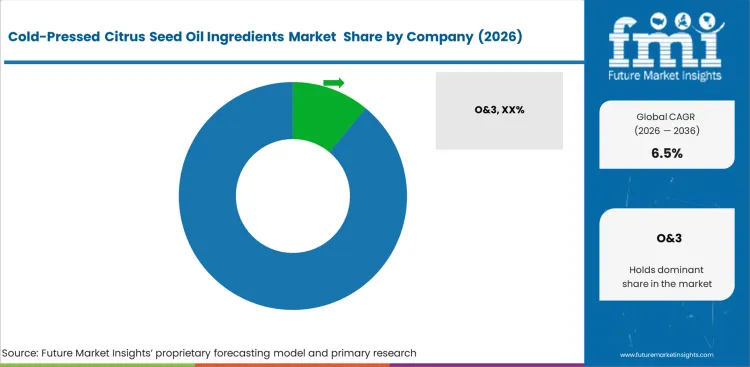
Identifying a reliable citrus seed oil supplier is a core competitive factor in a market where post-extraction handling speed materially affects seed quality and usable oil recovery. Suppliers such as O&3 and Nature In Bottle appear to compete through product availability, ingredient positioning, and sourcing access, while broader differentiation in this niche depends on recovery integration, handling speed, and batch consistency. Suppliers with tighter integration across seed recovery, drying, and pressing typically gain a meaningful cost and quality advantage over less integrated buyers relying on delayed third-party seed collection. Colocation with juice-processing infrastructure can improve feedstock freshness, reduce peroxide risk, and strengthen consistency, giving integrated suppliers a practical advantage over players dependent on delayed collection and transport.
Incumbents defend their market share through established refining infrastructure and deep regulatory documentation. Established suppliers may hold stronger stability documentation, ingredient registration familiarity, and customer qualification history than newer entrants, which can slow challenger entry into premium cosmetic programs. Quality teams at major cosmetic brands often prioritize suppliers with stronger batch history, repeat performance records, and documentation depth, even when lower-priced alternatives are available. Challengers may establish mechanical pressing capability but still struggle commercially when they cannot deliver the consistent, deodorized, and sensory-neutral profiles required by contract manufacturers serving premium emulsions.
Key Players in Cold-Pressed Citrus Seed Oil Ingredients Market
- O&3
- Nature In Bottle
- Natural Poland
- Liven Cyprus
- Aromaaz International
- Aarnav Global Exports
Scope of the Report
| Metric | Value |
|---|---|
| Quantitative Units | USD 238.4 million to USD 447.5 million, at a CAGR of 6.5% |
| Market Definition | The cold-pressed citrus seed oil ingredients market covers pure lipid fractions mechanically expressed from the seeds of citrus fruits without the use of chemical solvents. This category isolates the non-volatile fixed oils, primarily containing oleic, linoleic, and palmitic acids, serving functionally as carrier oils, active cosmetic ingredients, or specialty food lipids depending on subsequent refining steps. |
| Segmentation | Source, End Use, Grade, Nature, Processing, Region |
| Regions Covered | North America, Latin America, Europe, East Asia, South Asia, Oceania, Middle East and Africa |
| Countries Covered | Brazil, India, Spain, Argentina, United States, Germany, South Korea |
| Key Companies Profiled | O&3, Nature In Bottle, Natural Poland, Liven Cyprus, Aromaaz International, Aarnav Global Exports |
| Forecast Period | 2026 to 2036 |
| Approach | USDA baseline figures for oranges and grapefruits delivered to global processing facilities anchor the addressable feedstock volume, validated against independent trade records for specialty vegetable oil shipments out of primary citrus-producing regions. |
Source: Future Market Insights (FMI) analysis, based on proprietary forecasting model and primary research
Cold-Pressed Citrus Seed Oil Ingredients Market Analysis by Segments
Source
- Orange
- Lemon
- Grapefruit
- Mandarin
- Mixed citrus
End Use
- Personal care
- Nutraceuticals
- Functional food
- Aromatherapy
- Home care
Grade
- Cosmetic grade
- Food grade
- Nutraceutical grade
- Pharma grade
Nature
- Conventional
- Organic
Processing
- Refined
- Virgin
- Deodorized
Region
- North America
- United States
- Canada
- Europe
- Germany
- United Kingdom
- France
- Italy
- Spain
- Asia Pacific
- China
- Japan
- South Korea
- Taiwan
- Singapore
- Latin America
- Brazil
- Mexico
- Argentina
- Middle East & Africa
- GCC Countries
- South Africa
- Israel
- Rest of Middle East & Africa
Bibliography
- Yang, H., Lin, Y., Zhu, X., Mu, H., Li, Y., Chen, S., Li, J., & Cao, X. (2024). Comprehensive comparison of a new technology with traditional methods for extracting Ougan (Citrus reticulata cv. Suavissima) seed oils: Physicochemical properties, fatty acids, functional components, and antioxidant activities.
- Seyyedi-Mansour, S., Carpena, M., Donn, P., Barciela, P., Perez-Vazquez, A., Echave, J., Pereira, A. G., & Prieto, M. A. (2024). Citrus seed waste and circular bioeconomy: Insights on nutritional profile, health benefits, and application as food ingredient.
- Dikmetas, D. N., Devecioglu, D., Karbancioglu-Guler, F., & Kahveci, D. (2024). Sequential extraction and characterization of essential oil, flavonoids, and pectin from industrial orange waste.
- Sadeghi-Nik, M., Ebrahimi, S. N., Salehi, P., Espírito Santo, L., Ferreira, D. M., Alves, R. C., Oliveira, M. B. P. P., & Fathi, F. (2025). Comparative analysis of innovative and conventional oil extraction techniques on yield and phytochemical profiles of Citrus aurantium L. seed oil and seed nutritional value.
This bibliography is provided for reader reference. The full FMI report contains the complete reference list with primary source documentation.
This Report Addresses
- Colocation strategies for drying centrifuges at primary citrus extraction facilities.
- Peroxide value management during the critical transition from wet waste to dry seed.
- Formulation implications of replacing solvent-extracted carrier oils with mechanical pressings.
- Yield economics governing the viability of minor citrus seed lipid extraction.
- Regulatory bypass advantages inherent in cosmetic-grade versus food-grade byproduct classification.
- Citrus seed oil carrier oil applications scaling across premium beauty channels.
- Deodorization techniques required to achieve sensory neutrality for prestige white emulsions.
- Logistics networks connecting Latin America-based processing hubs with Europe-headquatered cosmetic refining centers.
Frequently Asked Questions
Give me the current market size for cold-pressed citrus seed oil ingredients?
The market reached USD 223.8 million in 2025. This figure indicates that citrus seed oil extraction has moved beyond early-stage experimentation and is gaining commercial relevance among specialty ingredient suppliers.
Explain the growth drivers for citrus seed oil ingredients through 2036?
Revenue is projected to reach USD 447.5 million by 2036. Growth through 2036 is expected to be supported by better drying, stabilization, and near-source recovery infrastructure, which can improve feedstock quality and commercial usability.
What is cold-pressed citrus seed oil used for in formulation?
Topical formulations absorb 49.2% of global volume because cosmetic chemists face intense retail pressure to demonstrate clean-label compliance. Mechanically pressed citrus seed oil serves as an inexpensive, recognizable botanical carrier lipid that effectively masks the underlying bulk cost of premium skin creams.
Is citrus seed oil a cosmetic ingredient?
Yes, cosmetic grades hold 46.5% share. Agricultural byproduct processors actively resist the heavy capital expenditures required to meet strict food-safety audit standards, so quality assurance managers intentionally downgrade technically viable oil to cosmetic status to expedite market access and reduce compliance friction.
How is citrus seed oil extracted commercially?
Extraction occurs via physical cold pressing. In premium beauty, retailer scrutiny and clean-label positioning increasingly favor mechanical extraction over solvent-based routes, particularly where brands want simpler processing narratives and lower residue concern.
Why does orange dominate the raw material feedstock?
Orange commands 41.8% share primarily due to industrial logistics rather than unique lipid performance. Global orange juice operations aggregate immense volumes of biological material in centralized hubs, allowing seed pressers to operate continuous extraction lines without suffering the severe seasonal disruptions typical of minor citrus variants.
What prevents the widespread adoption of organic citrus seed oils?
Industrial juice extractors mix conventional fruit continuously to maintain factory throughput. Plant managers refuse to halt operations to run tiny, isolated batches of organic material, effectively capping organic supply and cementing conventional material at 68.1% of global volume.
Why do many cosmetic applications prefer refined citrus seed oil grades?
Refined grades account for 54.7% of volume because virgin pressings impart dark pigments and strong odors. Many formulation teams prefer refined or deodorized grades when they need the carrier oil to remain low-odor, visually neutral, and compatible with fragrance-sensitive white emulsions.
How does Brazil maintain its structural advantage in extraction?
Brazil expands at 7.3% annually by leveraging its unparalleled orange concentrate infrastructure. Near-source recovery and pressing can improve raw material economics in Brazil by reducing spoilage exposure, shortening transfer time, and supporting higher usable yield from large juice-processing streams.
What forces Europe buyers to import pressings from Latin America?
European beauty markets place high value on traceability, ingredient transparency, and milder processing claims, which increases interest in mechanically pressed botanical oils relative to more heavily processed alternatives. European facilities import bulk virgin oils and apply advanced local deodorization tech to meet luxury brand standards, growing the regional market at a 5.6% rate in Germany.
Why does East Asia represent a premium formulation hub?
South Korea advances at 5.4% by deploying citrus seed lipids as high-value narrative ingredients rather than bulk emulsion bases. Many buyers in South Korea favor refined grades because they align better with sensory expectations, formulation precision, and premium skincare positioning in competitive K-beauty channels.
What specific risk do virgin citrus seed oils pose to formulators?
Unrefined pressings oxidize rapidly under normal warehouse conditions. Cosmetic chemists specifying virgin grades must incorporate expensive synthetic antioxidants to prevent sudden color shifts and rancidity, a hidden formulation cost that often erases the initial savings.
How do incumbent suppliers defend their market position?
Established distributors may hold stronger batch-history documentation, stability data, and ingredient registration familiarity than newer entrants. Major brands typically expect robust historical documentation and repeat batch performance, which can slow qualification for newer pressers lacking established stability records.
Who are the key suppliers in the citrus seed oil ingredients market?
Agricultural juice processors optimize for liquid extraction, largely viewing seed pressing as a distraction. Specialty lipid distributors like O&3 and Nature In Bottle capture margin by purchasing dried seeds, executing the complex mechanical pressing and physical refining steps that primary agricultural operators prefer to avoid entirely.
Why do buyers intentionally split contracts among multiple pressers?
Agricultural yields remain highly vulnerable to weather patterns. Manufacturers actively qualify multiple suppliers and cross-qualify orange and lemon seed derivatives, ensuring they can pivot formulations immediately if a regional freeze destroys a specific citrus harvest.
What physical constraint limits absolute ingredient supply?
Wet citrus seeds ferment within hours of extraction, generating massive peroxide spikes. Millions of tons of potential feedstock rot annually simply because plant operations lack the dedicated drying centrifuges required to stabilize the seeds before transportation to a pressing facility.
How does seed oil differ functionally from essential peel oil?
Seed oils are non-volatile fixed lipids composed of heavy fatty acids, functioning as emollients and carriers. Peel oils are highly volatile aromatic compounds used strictly for fragrance and flavoring, operating in entirely separate regulatory and formulation supply chains.
What happens when cosmetic brands demand exotic minor citrus lipids?
Mandarin and grapefruit extraction windows are exceptionally narrow. Supply chain planners must purchase and warehouse a full year of supply during a three-week processing window, creating severe inventory carrying costs that frequently ruin the commercial viability of the final product.
Why is solvent extraction explicitly excluded from this market?
Chemical extraction utilizing hexane violates the fundamental clean-label proposition that drives premium buyer demand. In premium beauty, contract manufacturers may favor cold-pressed extraction where brands want a simpler processing narrative, lower residue concern, and stronger alignment with clean-label positioning.
How do suppliers manage the odor profile of mechanically pressed oils?
Raw citrus seed oils carry strong, bitter aromas that clash with delicate cosmetic perfumes. Processing facilities utilize high-vacuum steam deodorization to strip the volatile aroma compounds without degrading the underlying fatty acid profile, rendering the lipid completely neutral.
Citrus seed oil in nutraceuticals faces what adoption barriers?
Ingestible products operate on razor-thin margins compared to luxury skincare. Adoption in food and nutraceutical matrices can be slower because lower-cost commodity oils often meet the required carrier function at a more attractive cost-in-use.
How do Argentine processors leverage their market position?
Argentina dominates global lemon processing, creating a structural chokepoint for lemon seed derivatives. Regional suppliers can hold stronger pricing influence in specialized lemon-seed-derived supply where industrial aggregation remains limited outside a few processing hubs.
What signals a successful transition from waste to valorized ingredient?
True commercialization occurs only when juice processors redesign their primary extraction lines specifically to isolate and dry seeds automatically. When plant managers treat the seed as a co-product requiring immediate stabilization rather than a waste stream requiring disposal, reliable ingredient supply begins.
Preview the report firsthand - request a free sample
Get SampleGet the brochure for pricing and purchase details.
Get PDFTable of Content
- Executive Summary
- Global Market Outlook
- Demand-side Trends
- Supply-side Trends
- Technology Roadmap Analysis
- Analysis and Recommendations
- Market Overview
- Market Coverage / Taxonomy
- Market Definition / Scope / Limitations
- Research Methodology
- Chapter Orientation
- Analytical Lens and Working Hypotheses
- Market Structure, Signals, and Trend Drivers
- Benchmarking and Cross-market Comparability
- Market Sizing, Forecasting, and Opportunity Mapping
- Research Design and Evidence Framework
- Desk Research Programme (Secondary Evidence)
- Company Annual and Sustainability Reports
- Peer-reviewed Journals and Academic Literature
- Corporate Websites, Product Literature, and Technical Notes
- Earnings Decks and Investor Briefings
- Statutory Filings and Regulatory Disclosures
- Technical White Papers and Standards Notes
- Trade Journals, Industry Magazines, and Analyst Briefs
- Conference Proceedings, Webinars, and Seminar Materials
- Government Statistics Portals and Public Data Releases
- Press Releases and Reputable Media Coverage
- Specialist Newsletters and Curated Briefings
- Sector Databases and Reference Repositories
- FMI Internal Proprietary Databases and Historical Market Datasets
- Subscription Datasets and Paid Sources
- Social Channels, Communities, and Digital Listening Inputs
- Additional Desk Sources
- Expert Input and Fieldwork (Primary Evidence)
- Primary Modes
- Qualitative Interviews and Expert Elicitation
- Quantitative Surveys and Structured Data Capture
- Blended Approach
- Why Primary Evidence is Used
- Field Techniques
- Interviews
- Surveys
- Focus Groups
- Observational and In-context Research
- Social and Community Interactions
- Stakeholder Universe Engaged
- C-suite Leaders
- Board Members
- Presidents and Vice Presidents
- R&D and Innovation Heads
- Technical Specialists
- Domain Subject-matter Experts
- Scientists
- Physicians and Other Healthcare Professionals
- Governance, Ethics, and Data Stewardship
- Research Ethics
- Data Integrity and Handling
- Primary Modes
- Tooling, Models, and Reference Databases
- Desk Research Programme (Secondary Evidence)
- Data Engineering and Model Build
- Data Acquisition and Ingestion
- Cleaning, Normalisation, and Verification
- Synthesis, Triangulation, and Analysis
- Quality Assurance and Audit Trail
- Market Background
- Market Dynamics
- Drivers
- Restraints
- Opportunity
- Trends
- Scenario Forecast
- Demand in Optimistic Scenario
- Demand in Likely Scenario
- Demand in Conservative Scenario
- Opportunity Map Analysis
- Product Life Cycle Analysis
- Supply Chain Analysis
- Investment Feasibility Matrix
- Value Chain Analysis
- PESTLE and Porter’s Analysis
- Regulatory Landscape
- Regional Parent Market Outlook
- Production and Consumption Statistics
- Import and Export Statistics
- Market Dynamics
- Global Market Analysis 2021 to 2025 and Forecast, 2026 to 2036
- Historical Market Size Value (USD Million) Analysis, 2021 to 2025
- Current and Future Market Size Value (USD Million) Projections, 2026 to 2036
- Y-o-Y Growth Trend Analysis
- Absolute $ Opportunity Analysis
- Global Market Pricing Analysis 2021 to 2025 and Forecast 2026 to 2036
- Global Market Analysis 2021 to 2025 and Forecast 2026 to 2036, By Source
- Introduction / Key Findings
- Historical Market Size Value (USD Million) Analysis By Source , 2021 to 2025
- Current and Future Market Size Value (USD Million) Analysis and Forecast By Source , 2026 to 2036
- Orange
- Lemon
- Mandarin
- Orange
- Y-o-Y Growth Trend Analysis By Source , 2021 to 2025
- Absolute $ Opportunity Analysis By Source , 2026 to 2036
- Global Market Analysis 2021 to 2025 and Forecast 2026 to 2036, By End Use
- Introduction / Key Findings
- Historical Market Size Value (USD Million) Analysis By End Use, 2021 to 2025
- Current and Future Market Size Value (USD Million) Analysis and Forecast By End Use, 2026 to 2036
- Personal Care
- Aromatherapy
- Home Care
- Personal Care
- Y-o-Y Growth Trend Analysis By End Use, 2021 to 2025
- Absolute $ Opportunity Analysis By End Use, 2026 to 2036
- Global Market Analysis 2021 to 2025 and Forecast 2026 to 2036, By Grade
- Introduction / Key Findings
- Historical Market Size Value (USD Million) Analysis By Grade, 2021 to 2025
- Current and Future Market Size Value (USD Million) Analysis and Forecast By Grade, 2026 to 2036
- Cosmetic
- Food
- Nutraceutical
- Cosmetic
- Y-o-Y Growth Trend Analysis By Grade, 2021 to 2025
- Absolute $ Opportunity Analysis By Grade, 2026 to 2036
- Global Market Analysis 2021 to 2025 and Forecast 2026 to 2036, By Nature
- Introduction / Key Findings
- Historical Market Size Value (USD Million) Analysis By Nature, 2021 to 2025
- Current and Future Market Size Value (USD Million) Analysis and Forecast By Nature, 2026 to 2036
- Conventional
- Organic
- Conventional
- Y-o-Y Growth Trend Analysis By Nature, 2021 to 2025
- Absolute $ Opportunity Analysis By Nature, 2026 to 2036
- Global Market Analysis 2021 to 2025 and Forecast 2026 to 2036, By Processing
- Introduction / Key Findings
- Historical Market Size Value (USD Million) Analysis By Processing, 2021 to 2025
- Current and Future Market Size Value (USD Million) Analysis and Forecast By Processing, 2026 to 2036
- Refined
- Virgin
- Deodorized
- Refined
- Y-o-Y Growth Trend Analysis By Processing, 2021 to 2025
- Absolute $ Opportunity Analysis By Processing, 2026 to 2036
- Global Market Analysis 2021 to 2025 and Forecast 2026 to 2036, By Region
- Introduction
- Historical Market Size Value (USD Million) Analysis By Region, 2021 to 2025
- Current Market Size Value (USD Million) Analysis and Forecast By Region, 2026 to 2036
- North America
- Latin America
- Western Europe
- Eastern Europe
- East Asia
- South Asia and Pacific
- Middle East & Africa
- Market Attractiveness Analysis By Region
- North America Market Analysis 2021 to 2025 and Forecast 2026 to 2036, By Country
- Historical Market Size Value (USD Million) Trend Analysis By Market Taxonomy, 2021 to 2025
- Market Size Value (USD Million) Forecast By Market Taxonomy, 2026 to 2036
- By Country
- USA
- Canada
- Mexico
- By Source
- By End Use
- By Grade
- By Nature
- By Processing
- By Country
- Market Attractiveness Analysis
- By Country
- By Source
- By End Use
- By Grade
- By Nature
- By Processing
- Key Takeaways
- Latin America Market Analysis 2021 to 2025 and Forecast 2026 to 2036, By Country
- Historical Market Size Value (USD Million) Trend Analysis By Market Taxonomy, 2021 to 2025
- Market Size Value (USD Million) Forecast By Market Taxonomy, 2026 to 2036
- By Country
- Brazil
- Chile
- Rest of Latin America
- By Source
- By End Use
- By Grade
- By Nature
- By Processing
- By Country
- Market Attractiveness Analysis
- By Country
- By Source
- By End Use
- By Grade
- By Nature
- By Processing
- Key Takeaways
- Western Europe Market Analysis 2021 to 2025 and Forecast 2026 to 2036, By Country
- Historical Market Size Value (USD Million) Trend Analysis By Market Taxonomy, 2021 to 2025
- Market Size Value (USD Million) Forecast By Market Taxonomy, 2026 to 2036
- By Country
- Germany
- UK
- Italy
- Spain
- France
- Nordic
- BENELUX
- Rest of Western Europe
- By Source
- By End Use
- By Grade
- By Nature
- By Processing
- By Country
- Market Attractiveness Analysis
- By Country
- By Source
- By End Use
- By Grade
- By Nature
- By Processing
- Key Takeaways
- Eastern Europe Market Analysis 2021 to 2025 and Forecast 2026 to 2036, By Country
- Historical Market Size Value (USD Million) Trend Analysis By Market Taxonomy, 2021 to 2025
- Market Size Value (USD Million) Forecast By Market Taxonomy, 2026 to 2036
- By Country
- Russia
- Poland
- Hungary
- Balkan & Baltic
- Rest of Eastern Europe
- By Source
- By End Use
- By Grade
- By Nature
- By Processing
- By Country
- Market Attractiveness Analysis
- By Country
- By Source
- By End Use
- By Grade
- By Nature
- By Processing
- Key Takeaways
- East Asia Market Analysis 2021 to 2025 and Forecast 2026 to 2036, By Country
- Historical Market Size Value (USD Million) Trend Analysis By Market Taxonomy, 2021 to 2025
- Market Size Value (USD Million) Forecast By Market Taxonomy, 2026 to 2036
- By Country
- China
- Japan
- South Korea
- By Source
- By End Use
- By Grade
- By Nature
- By Processing
- By Country
- Market Attractiveness Analysis
- By Country
- By Source
- By End Use
- By Grade
- By Nature
- By Processing
- Key Takeaways
- South Asia and Pacific Market Analysis 2021 to 2025 and Forecast 2026 to 2036, By Country
- Historical Market Size Value (USD Million) Trend Analysis By Market Taxonomy, 2021 to 2025
- Market Size Value (USD Million) Forecast By Market Taxonomy, 2026 to 2036
- By Country
- India
- ASEAN
- Australia & New Zealand
- Rest of South Asia and Pacific
- By Source
- By End Use
- By Grade
- By Nature
- By Processing
- By Country
- Market Attractiveness Analysis
- By Country
- By Source
- By End Use
- By Grade
- By Nature
- By Processing
- Key Takeaways
- Middle East & Africa Market Analysis 2021 to 2025 and Forecast 2026 to 2036, By Country
- Historical Market Size Value (USD Million) Trend Analysis By Market Taxonomy, 2021 to 2025
- Market Size Value (USD Million) Forecast By Market Taxonomy, 2026 to 2036
- By Country
- Kingdom of Saudi Arabia
- Other GCC Countries
- Turkiye
- South Africa
- Other African Union
- Rest of Middle East & Africa
- By Source
- By End Use
- By Grade
- By Nature
- By Processing
- By Country
- Market Attractiveness Analysis
- By Country
- By Source
- By End Use
- By Grade
- By Nature
- By Processing
- Key Takeaways
- Key Countries Market Analysis
- USA
- Pricing Analysis
- Market Share Analysis, 2025
- By Source
- By End Use
- By Grade
- By Nature
- By Processing
- Canada
- Pricing Analysis
- Market Share Analysis, 2025
- By Source
- By End Use
- By Grade
- By Nature
- By Processing
- Mexico
- Pricing Analysis
- Market Share Analysis, 2025
- By Source
- By End Use
- By Grade
- By Nature
- By Processing
- Brazil
- Pricing Analysis
- Market Share Analysis, 2025
- By Source
- By End Use
- By Grade
- By Nature
- By Processing
- Chile
- Pricing Analysis
- Market Share Analysis, 2025
- By Source
- By End Use
- By Grade
- By Nature
- By Processing
- Germany
- Pricing Analysis
- Market Share Analysis, 2025
- By Source
- By End Use
- By Grade
- By Nature
- By Processing
- UK
- Pricing Analysis
- Market Share Analysis, 2025
- By Source
- By End Use
- By Grade
- By Nature
- By Processing
- Italy
- Pricing Analysis
- Market Share Analysis, 2025
- By Source
- By End Use
- By Grade
- By Nature
- By Processing
- Spain
- Pricing Analysis
- Market Share Analysis, 2025
- By Source
- By End Use
- By Grade
- By Nature
- By Processing
- France
- Pricing Analysis
- Market Share Analysis, 2025
- By Source
- By End Use
- By Grade
- By Nature
- By Processing
- India
- Pricing Analysis
- Market Share Analysis, 2025
- By Source
- By End Use
- By Grade
- By Nature
- By Processing
- ASEAN
- Pricing Analysis
- Market Share Analysis, 2025
- By Source
- By End Use
- By Grade
- By Nature
- By Processing
- Australia & New Zealand
- Pricing Analysis
- Market Share Analysis, 2025
- By Source
- By End Use
- By Grade
- By Nature
- By Processing
- China
- Pricing Analysis
- Market Share Analysis, 2025
- By Source
- By End Use
- By Grade
- By Nature
- By Processing
- Japan
- Pricing Analysis
- Market Share Analysis, 2025
- By Source
- By End Use
- By Grade
- By Nature
- By Processing
- South Korea
- Pricing Analysis
- Market Share Analysis, 2025
- By Source
- By End Use
- By Grade
- By Nature
- By Processing
- Russia
- Pricing Analysis
- Market Share Analysis, 2025
- By Source
- By End Use
- By Grade
- By Nature
- By Processing
- Poland
- Pricing Analysis
- Market Share Analysis, 2025
- By Source
- By End Use
- By Grade
- By Nature
- By Processing
- Hungary
- Pricing Analysis
- Market Share Analysis, 2025
- By Source
- By End Use
- By Grade
- By Nature
- By Processing
- Kingdom of Saudi Arabia
- Pricing Analysis
- Market Share Analysis, 2025
- By Source
- By End Use
- By Grade
- By Nature
- By Processing
- Turkiye
- Pricing Analysis
- Market Share Analysis, 2025
- By Source
- By End Use
- By Grade
- By Nature
- By Processing
- South Africa
- Pricing Analysis
- Market Share Analysis, 2025
- By Source
- By End Use
- By Grade
- By Nature
- By Processing
- USA
- Market Structure Analysis
- Competition Dashboard
- Competition Benchmarking
- Market Share Analysis of Top Players
- By Regional
- By Source
- By End Use
- By Grade
- By Nature
- By Processing
- Competition Analysis
- Competition Deep Dive
- O&3
- Overview
- Product Portfolio
- Profitability by Market Segments (Product/Age /Sales Channel/Region)
- Sales Footprint
- Strategy Overview
- Marketing Strategy
- Product Strategy
- Channel Strategy
- Nature In Bottle
- Natural Poland
- Liven Cyprus
- Aromaaz International
- Aarnav Global Exports
- O&3
- Competition Deep Dive
- Assumptions & Acronyms Used


