

- Market Size (2026)
- USD 65.1 Bn
- Forecast (2036)
- USD 110.1 Bn
- CAGR (2026 to 2036)
- 5.4%
Prickly Pear Seed Oil Nutricosmetic Bases Market Size, Market Forecast and Outlook By FMI
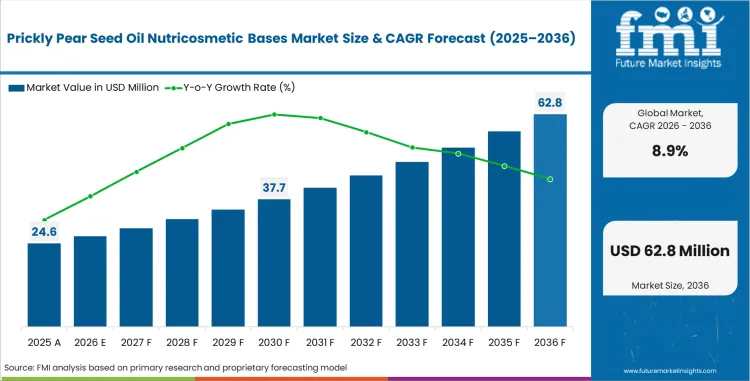
The prickly pear seed oil nutricosmetic bases market was valued at USD 22.6 million in 2025. Industry value is projected to reach USD 24.6 million in 2026 at a CAGR of 8.9% during the forecast period. Demand is expected to raise the valuation to USD 57.7 million by 2036.
Summary of Prickly Pear Seed Oil Nutricosmetic Bases Market
- The market is forecast to reach USD 57.7 million by 2036.
- The market is expected to grow at a rate of 8.9% from 2026 to 2036.
- The market was valued at USD 22.6 million in 2025.
- The forecast period represents an incremental opportunity of USD 33.1 million.
- Cold pressed oil is expected to remain the leading extraction method with 71.0% share in 2026.
- Organic certified material is projected to be the largest certification category with 64.0% share in 2026.
- Tunisia is estimated to remain the leading source origin with 29.0% share in 2026.
- Dual-use grade is expected to account for 44.0% share in 2026, reflecting stronger use across ingestible and premium beauty concepts.
- Skin nutrition is anticipated to remain the leading application segment with 40.0% share in 2026.
- Nopal Tunisie, Biovalley, Zine Glob, King of Cactus, Aromeya, and Nutraceites are among the companies in the market landscape.
Key Takeaways, Market Size, and Forecast
- Prickly Pear Seed Oil Nutricosmetic Bases Market is projected to grow from USD 24.6 million in 2026 to USD 57.7 million by 2036, at a CAGR of 8.9%.
- The prickly pear seed oil nutricosmetic bases market was valued at USD 22.6 million in 2025.
- By 2036, the Prickly Pear Seed Oil Nutricosmetic Bases Market is expected to be worth USD 57.7 million.
- Over the 2026 to 2036 period, the market is forecast to expand at a CAGR of 8.9%.
- The market is set to create an incremental opportunity of USD 33.1 million.
- In 2026, Cold pressed oil is expected to account for 71.0% of the extraction method segment.
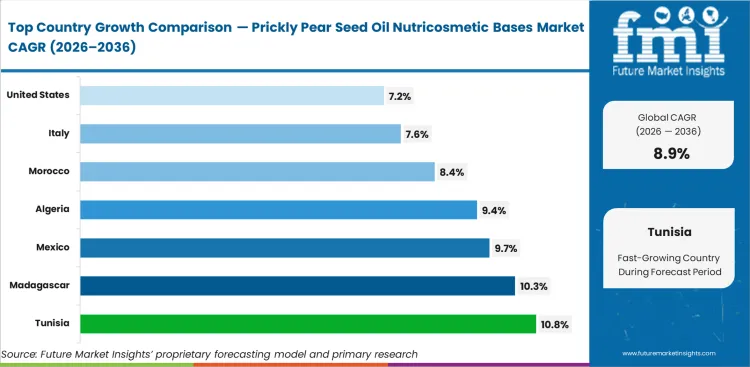
- Tunisia (10.8%) and Madagascar (10.3%) are two of the fastest growing markets.
Prickly Pear Seed Oil Nutricosmetic Bases Market Key Takeaways
| Parameter | Details |
|---|---|
| Market value (2026) | USD 24.6 million |
| Forecast value (2036) | USD 57.7 million |
| CAGR (2026 to 2036) | 8.9% |
| Estimated market value (2025) | USD 22.6 million |
| Incremental opportunity | USD 33.1 million |
| Leading extraction method segment | Cold Pressed |
| Leading formulation format | Neat Oil |
| Leading ingredient grade | Dual-Use Grade |
| Leading application | Skin Nutrition |
| Leading certification type | Organic Certified |
| Leading end-user segment | Contract Formulators |
| Leading distribution channel | Direct B2B |
| Key suppliers referenced in market landscape | Nopal Tunisie, Biovalley, Zine Glob, King of Cactus, Aromeya, Nutraceites |
Source: Future Market Insights (FMI) analysis, based on proprietary forecasting model and primary research
Buyers increasingly prioritize lots that shorten qualification time and reduce reformulation risk, which is why origin credibility, ingestible-use documentation, sensory consistency, and formulation usability matter more than rarity alone in early supplier selection. Beauty-from-within brands are expanding premium ingestible portfolios, but repeat demand forms only when the oil can move from sample-stage interest into a stable finished concept with acceptable sensory performance, defensible dosage economics, and documentation that supports internal approval. Dual-use material gains attention under that setting, supported by smoother product development and cleaner premium language. Suppliers are positioning more closely toward beauty supplements and skin-health formats because brands favor ingredients that can move from concept testing into repeat commercial placement without major reformulation.
Market expansion will depend on whether suppliers can deliver repeatable lots across neat oil and protected formats that support both pilot work and repeat commercialization. Neat oil remains important for early formulation work, but broader market adoption will depend on suppliers that can also support blends, softgel-fill systems, and protected formats without weakening premium positioning. That shift matters because easier handling, tighter oxidation control, and smoother scale-up from sampling to repeat orders are critical in a high-value oil category. Similar format logic is visible across botanical ingredients and botanical extracts, since buyers often prefer ingredients that move across more than one finished format.
Tunisia is set to record a CAGR of 10.8% during the forecast period, supported by stronger export familiarity and a more established premium oil image in global trade. Madagascar is anticipated to see growth at a CAGR of 10.3% over the forecast period, as a smaller supply base leaves room for faster premium-positioned expansion. Mexico is projected to witness 9.7% CAGR, while Algeria is likely to post a CAGR of 9.4% through 2036, reflecting steady scope for ingredient-grade development. Morocco is forecast to expand at a CAGR of 8.4%, Italy at 7.6%, and the United States at 7.2%, with value creation in these countries tied more closely to premium formulation use, certification comfort, and finished-format positioning.
Segmental Analysis
Key Facts About Segments
- Cold pressed oil is projected to account for 71.0% of market share by 2026.
- Preference for cold pressed oil remains strong due to cleaner premium positioning, simpler quality review, natural product appeal, and better fit with small-batch formulation programs.
- Dual-use grade is expected to capture 44.0% of total market share in 2026.
- Demand for dual-use grade remains firm due to broader concept-stage usability, lower restart risk, easier internal review, and smoother movement across adjacent beauty and ingestible formats.
- Skin nutrition is projected to contribute 40.0% share to the market by end of 2026.
- Skin-focused use continues to attract demand through easier consumer communication, stronger premium wellness appeal, better fit with beauty-from-within products, and simpler product-positioning logic.
Prickly Pear Seed Oil Nutricosmetic Bases Analysis by Extraction Method
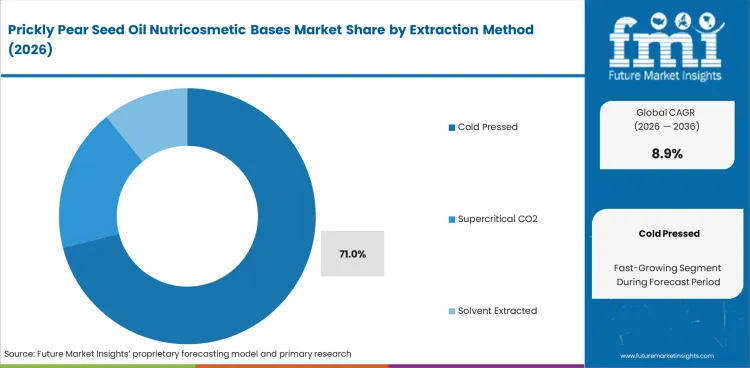
Cold pressed oil remains the preferred extraction route because buyers associate it with a more natural product image, simpler qualification, and stronger premium-market fit. Mechanical pressing supports a cleaner natural-positioning narrative and simplifies internal product review for brands evaluating premium botanical inputs. Cold pressed oil segment is anticipated to capture 71.0% of the market in 2026, driven by premium image and easier quality review during small-batch formulation programs. Supercritical CO2 extraction remains relevant where added stability justifies the cost, but adoption stays narrower because many commercial runs remain too small to absorb the processing premium. Solvent-extracted material stays more limited since premium ingestible concepts depend on perception, paperwork, and a cleaner route from origin into final format.
- Lead position: Cold pressed oil remains the first commercial choice for many premium buyers since it gives a more natural image and a simpler starting point for internal review, supplier comparison, and early dosage planning across small high-value projects.
- Buyer gain: Mechanical extraction supports cleaner storytelling, steadier sensory acceptance, and easier premium placement in beauty-from-within programs, especially across launches carrying botanical rarity, short ingredient lists, and a stronger link with botanical bioactives.
- Commercial limit: CO2 and solvent routes add flexibility for a few specialized uses, yet broader movement stays restrained by higher processing cost, tighter economic justification, and weaker fit for brands leaning on natural identity as a core selling point.
Prickly Pear Seed Oil Nutricosmetic Bases Analysis by Formulation Format
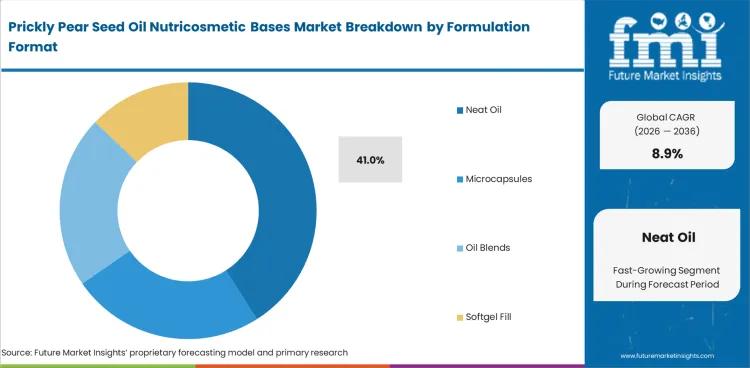
Neat oil leads early demand because brands prefer formulation control during concept development, including dosage setting, blend design, and finished-format selection. Plain oil gives more freedom for blend design, capsule fill planning, and pairing with adjacent botanical lipids across early trials. In 2026, neat oil is expected to contribute 41.0% to market share, supported by dosage flexibility and easier blend customization during pilot-stage development work. Microcapsules and softgel-fill systems still add value for repeat sales, especially across products needing easier handling or softer oxidation pressure. Brands typically begin with simpler oil formats during pilot work, then shift toward protected formats once repeat production requires easier handling, better stability, and lower formulation risk.
- Format lead: Neat oil stays ahead in terms of demand because direct oil purchase gives brands more control over strength, pairing logic, and finished-format direction, making the ingredient easier to fit into new product briefs without early supplier dependence.
- Operational edge: Straight oil works well across concept building, sensory review, and pilot runs, giving manufacturers a cleaner route into premium ingestible formats linked with anti-aging vitamins and edible beauty infusions.
- Next phase: Microcapsules, blends, and softgel-fill systems adoption can rise further once repeat demand asks for easier handling, cleaner production flow, and tighter control over stability during storage, transport, and daily use.
Prickly Pear Seed Oil Nutricosmetic Bases Analysis by Ingredient Grade
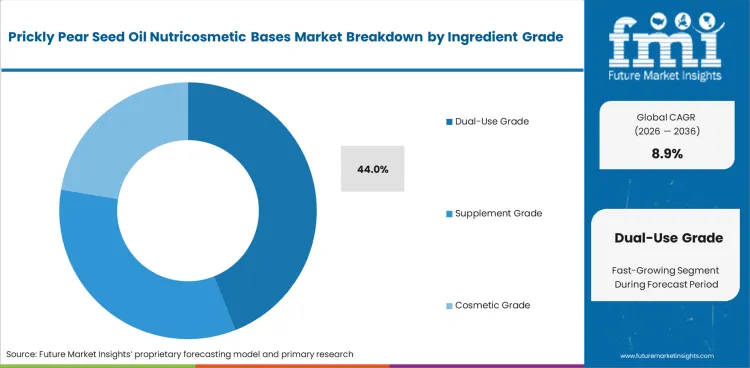
Dual-use grade carries strong value because early-stage product development often spans both ingestible evaluation and premium beauty positioning before a final route is chosen. Brands often assess an ingredient for ingestible use, topical positioning, and premium communication at the same stage of concept development. The dual-use grade category is likely to account for 44.0% share in 2026, owing to broader internal usability and lower restart risk during concept shifts. Supplement-only and cosmetic-only grades still remain relevant in later-stage programs, yet narrow grading can create extra work once a concept expands into related product ideas. Broader usability makes dual-use lots easier to present, easier to sample, and easier to keep under review for a longer period.
- Grade lead: Dual-use grade keeps a stronger commercial position since one documented lot can serve wider concept work and reduce extra sourcing activity during brand development across premium beauty and wellness programs.
- Planning value: A broader grade profile makes internal review easier, supports faster movement between adjacent finished concepts, and keeps buyer confidence steadier during early-stage testing linked with organic personal care.
- Qualification issue: Narrow grades still serve specific finished products, yet added separation between ingestible and topical routes can stretch review time and reduce flexibility for brands still refining final product direction.
Prickly Pear Seed Oil Nutricosmetic Bases Analysis by Application
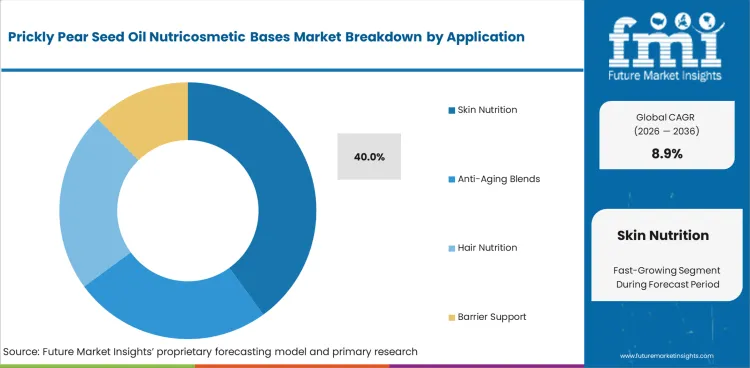
Prickly pear seed oil fits naturally into skin-focused products because buyers already associate botanical oils with hydration, softness, comfort, and anti-aging support. That makes the product message easier for brands to explain on packaging and easier for consumers to understand quickly. A skin-focused message also works well in premium wellness and beauty-from-within products, as brands want benefits that sound broad and attractive rather than too technical or limited. Skin nutrition is set to represent 40.0% of market share in 2026, driven by easier consumer language and broader premium wellness appeal in finished products. Hair-focused products and barrier-support products still have high demand and those uses usually need a more specific promise to justify using an expensive oil like prickly pear seed oil. Skin nutrition remains the leading application because it gives premium ingestible brands a simpler consumer proposition than narrower benefit territories such as barrier-support or hair-focused positioning.
- Application lead: Skin nutrition stays in front because premium beauty ingestibles sell more easily through familiar language around glow, comfort, and visible care rather than tightly framed niche benefit themes.
- Brand appeal: A skin-led route keeps the oil easier to place in capsules, powders, and beauty shots, while also matching the premium language already visible across anti-aging skincare and skincare.
- Growth path: Hair support and barrier-comfort concepts can still gain space, yet stronger movement usually depends on clearer product framing, higher buyer education, and a sharper reason for premium pricing.
Prickly Pear Seed Oil Nutricosmetic Bases Analysis by Certification
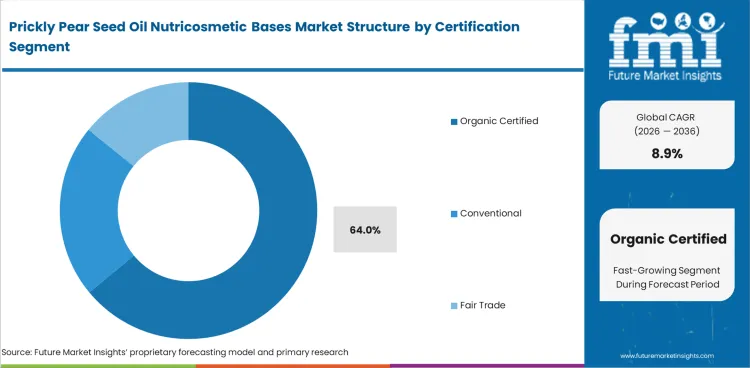
Certification functions as an early qualification filter in this high-value niche because buyers use it to reduce sourcing risk before deeper technical review begins. Since prickly pear seed oil is often sold in small quantities at a premium price, buyers usually look for a clear sign of high quality and credibility before spending time on deeper technical evaluation. Organic certification leads because it combines premium-positioning value with a visible proof point that simplifies early supplier screening. Organic certified material is projected to secure 64.0% share in 2026, as it gives buyers more comfort during early qualification and sourcing discussions. Conventional material can still find demand, especially in price-sensitive products or custom blend applications, though it usually has weaker appeal in premium programs. Fair-trade positioning may support selected products as well, yet organic certification remains the stronger and more immediate buying cue in premium ingestible beauty.
- Certification lead: Organic supply keeps a stronger lead because paperwork and premium identity arrive together, helping brands defend pricing and reduce hesitation across early supplier screening and brand positioning work.
- Trust value: Certified lots make the ingredient easier to place beside herbal beauty products and similar wellness-led premium concepts carrying short-ingredient-list positioning and a more transparent sourcing story.
- Commercial limit: Conventional material still has a place in some value-focused programs, yet broader traction stays lower unless the supplier adds a clearer price edge or a distinct formulation benefit.
Prickly Pear Seed Oil Nutricosmetic Bases Analysis by End User
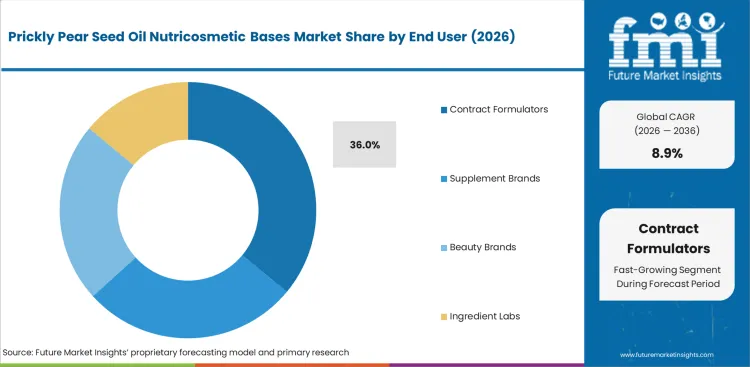
Contract formulators play a key role in helping the market grow during the early stage. Many premium beauty and supplement brands do not have all formulation capabilities internally, especially while working with a rare and expensive botanical oil like prickly pear seed oil. Outsourcing formulation partners makes product development easier because it reduces technical difficulty, lowers the risk linked with small-volume trials, and helps brands move faster from concept to pilot stage. Contract formulators are forecast to command 36.0% share in 2026, driven by lower entry barriers and faster pilot conversion for smaller brands. Beauty brands and supplement brands still determine the final product demand, though contract formulators often decide whether the oil can be turned into a practical product format or remains only at the sampling stage. Their expertise keeps contract formulators important in a category that is still finding the most workable path to scale.
- End-user lead: Contract formulators remain influential because outsourced technical work shortens the path from sample intake into a usable pilot concept across premium wellness and ingestible beauty programs.
- Operational benefit: Specialist partners add value through faster blend work, easier dosage planning, and better fit between a rare oil and finished-format reality, especially across brands carrying limited internal development capacity.
- Commercial effect: Early success in this category often starts with formulation support, since a premium ingredient needs a practical finished concept before repeat purchase volume begins to build.
Prickly Pear Seed Oil Nutricosmetic Bases Analysis by Distribution Channel
Direct B2B sales remain the most suitable channel in a premium oil market where orders are small, technical questions are common, and buyers want close contact with suppliers. Before placing an initial order, buyers often need direct discussion about batch identity, storage conditions, origin details, and supporting documents to reduce sourcing risk. Direct B2B is set to capture a 57.0% market share in 2026, driven by documentation needs and closer supplier communication during qualification stages. Distributors still play an important role once the supplier relationship becomes more established, though early-stage buying usually depends more on direct interaction than on wider channel access. Supplier visibility, document readiness, and fast response times remain important factors in commercial success across this industry.
- Channel lead: Direct B2B leads because premium buyers need a closer link with the source, giving more room for technical discussion, document review, storage guidance, and order planning.
- Commercial fit: High unit value and smaller order size make direct exchange more useful than broad distribution during early supplier evaluation, especially in categories tied with botanical supplements and specialist wellness formats.
- Secondary route: Distribution still adds reach in later-stage programs, though the best fit usually appears after direct trust is already built between buyer and original supplier.
Prickly Pear Seed Oil Nutricosmetic Bases Analysis by Source Origin
Source origin matters a great deal in the prickly pear seed oil market because buyers often judge the oil’s value even before product development begins. Origin is not seen only as a sourcing detail in this category. It often indicates product quality, supply discipline, and market familiarity during the first stage of supplier review. Tunisia category is estimated to represent 29.0% of the market in 2026, owing to export familiarity and stronger recognition in premium oil trade. Other origins such as Morocco, Madagascar, Mexico, Algeria, and Italy also remain important because these add supply depth and support long-term market stability. Buyers attention often starts with the most recognized source base. A stronger reputation at origin level makes suppliers easier to trust, makes sample requests easier to secure, and that early comfort can help create repeat demand in later buying stages.
- Origin lead: Tunisia keeps a stronger place in buyer thinking because commercial familiarity reduces hesitation and makes a premium oil feel easier to assess during early supplier comparison.
- Trade value: A recognized origin base helps support premium pricing, steadier sample activity, and cleaner communication across ingestible beauty projects connected with nutricosmetics share analysis and prestige wellness lines.
- Broader supply role: Other origins widen resilience and future depth, yet many still work from a smaller recognition base and need more time to reach similar premium credibility in export trade.
Prickly Pear Seed Oil Nutricosmetic Bases Market Drivers, Restraints, and Opportunities
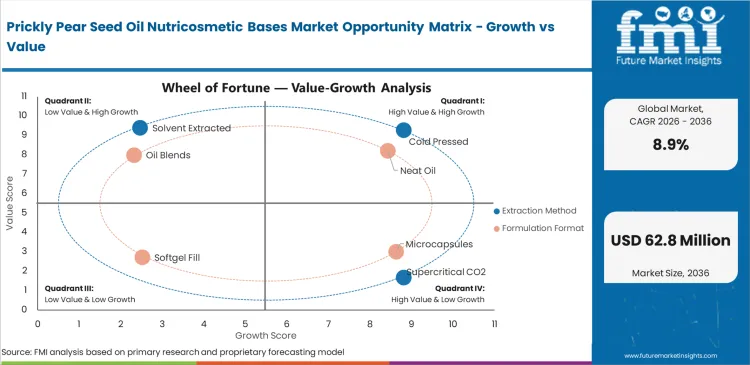
Premium beauty-from-within demand remains the main growth driving factor because prickly pear seed oil gives brands a rare botanical lipid with a strong story and a usable functional profile. The product is gaining attention because prickly pear seed oil gives premium ingestible brands a strong point of difference. Its rarity, botanical identity, and close fit with beauty-focused product messaging make it attractive in categories such as nutricosmetic ingredients and botanical extracts. Market also benefits from the way brands are building more flexible premium portfolios. Organic positioning, dual-use grading, and higher-value delivery formats make the oil easier to place across multiple product concepts instead of limiting it to one narrow use. The category remains appealing for premium capsules, beauty shots, concentrated powders, and blended lipid systems due to above mentioned factors.
Low yield keeps supply tight, and that makes the oil expensive and harder to use in larger-volume products, making it challenging for companies and limiting market growth. Cost pressure becomes more difficult once a brand tries to move beyond prestige positioning and reach a broader consumer base. Batch variation creates another challenge, especially in ingestible products demanding consistency, traceability, and technical documentation. Premium interest therefore does not always convert into repeat volume at the same pace. Long-term growth depends on suppliers being able to maintain origin credibility, careful handling, and reliable technical documentation across repeated batches.
Opportunities in the Prickly Pear Seed Oil Nutricosmetic Bases Market
- Format development: Microcapsules, softgel-fill systems, and protected blends carry strong room for expansion because premium brands increasingly look for easier handling, softer oxidation pressure, and cleaner movement from sample-stage interest into repeat production runs across ingestible beauty.
- Certification depth: More organic and dual-use lots can widen early buying comfort, support stronger premium language, and keep supplier review smoother across categories linked with organic cosmetics and organic personal care.
- Origin diversification: Broader origin participation can improve supply resilience, raise buyer choice, and reduce overreliance on one familiar source base without weakening premium identity, provided documentation, export discipline, and lot steadiness remain strong.
Regional Analysis
Key Facts About Country
- Tunisia is expected to be the fastest-growing market among the countries, with a CAGR of 10.8% through 2036.
- Madagascar is estimated to follow at 10.3%, placing it among the stronger-growth markets covered in the analysis.
- Mexico is predicted to record 9.7%, indicating a firm growth outlook supported by rising ingredient-grade development potential.
- Algeria is projected to garner at 9.4%, while Morocco registers 8.4%, reflecting comparatively moderate growth across North African source markets.
- Italy is set to incline at 7.6%, showing steady expansion tied to premium wellness and green-beauty product positioning.
- The United States is poised to rise at 7.2%, remaining below the growth rates projected for Tunisia, Madagascar, Mexico, Algeria, Morocco, and Italy.
Based on this analysis, the prickly pear seed oil nutricosmetic bases market is assessed across North America, Europe, and Middle East & Africa, with country-level coverage focused on Tunisia, Madagascar, Mexico, Algeria, Morocco, Italy, and the United States.
.webp "Top Country Growth Comparison Prickly Pear Seed Oil Nutricosmetic Bases Market Cagr (2026 2036)")
| Country | CAGR (2026 to 2036) |
|---|---|
| Tunisia | 10.8% |
| Madagascar | 10.3% |
| Mexico | 9.7% |
| Algeria | 9.4% |
| Morocco | 8.4% |
| Italy | 7.6% |
| United States | 7.2% |
Source: Future Market Insights (FMI) analysis, based on proprietary forecasting model and primary research
North America Prickly Pear Seed Oil Nutricosmetic Bases Market Analysis
North America companies are more involved in finished-format products than for raw oil. Premium wellness brands, supplement developers, and specialist formulators add relevance because a rare oil can gain shelf value faster in concept-led products than in broad commodity use. Commercial success in this region depends on disciplined positioning, strong paper trails, and a clear reason for higher end pricing. Mexico adds source-side relevance, while the United States adds premium demand and finished-format visibility.
- United States: Premium ingestible beauty remains the main support base in the United States because consumers already accept rare botanical ingredients in high-value wellness concepts. Product use is selective due to pricing pressure and a careful review culture around premium inputs. Sales of prickly pear seed oil nutricosmetic bases in the United States are expected to increase at a CAGR of 7.2% during the forecast period. Market is developing through premium product positioning rather than mass-market expansion. Brands are finding more value in presenting the ingredient through cleaner formulation claims, higher-end wellness messaging, and a stronger connection with healthy aging supplements. Growth is still expected to remain selective and controlled rather than spread quickly across all product types. The United States continues to hold importance because it supports premium product innovation, advanced format development, and stronger value realization in finished products.
- Mexico: Mexico has a natural advantage in this category because prickly pear is already familiar from an agricultural and raw material perspective. Strong crop presence alone does not create high commercial value. In premium ingredient markets, buyers place more weight on processing quality, consistency, and export readiness than on raw material visibility by itself. Prickly pear seed oil nutricosmetic base demand across Mexico is set to rise at 9.7% CAGR through 2036. That growth reflects room for improvement in processing standards, stronger premium positioning, and wider recognition in ingredient-grade trade.
Europe Prickly Pear Seed Oil Nutricosmetic Bases Market Analysis
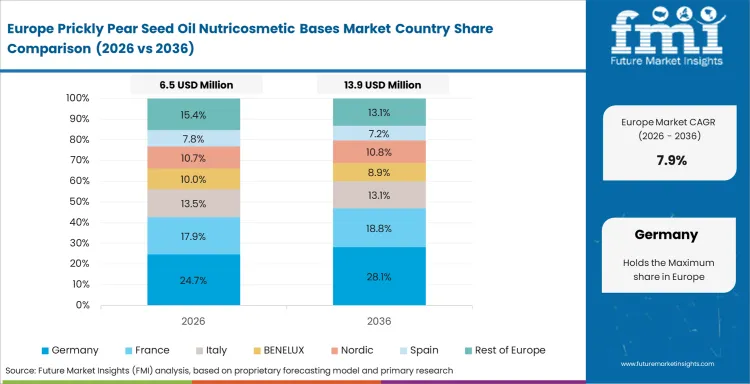
Europe is an important market because buyers there usually evaluate premium ingredients very carefully before making repeat purchases. In a category like prickly pear seed oil, buyers often pay close attention to product identity, certification status, and the way the ingredient fits with premium wellness or green beauty concepts. A rare oil can attract interest in these areas, though supplier credibility remains essential before business grows further. Europe creates value through careful premium positioning rather than through fast volume expansion.
- Italy: Italy is a relevant market for prickly pear seed oil because it has a strong culture around premium wellness and green beauty products. This creates a good opportunity for rare botanical oils to enter niche ingestible products and prestige product extensions. Demand still remains selective because brands usually need a clear and practical reason to use the oil in a finished product, rather than relying only on its exotic image. The prickly pear seed oil nutricosmetic bases market in Italy is poised to expand at a CAGR of 7.6% through 2036. Demand stays active in smaller high-value programs because buyers respond to supplier credibility, sustainability-focused positioning, and a clean premium product fit. Italy also matters beyond its own market because it reflects a wider buying pattern, as quality and product discipline carry more weight than novelty alone.
Middle East & Africa Prickly Pear Seed Oil Nutricosmetic Bases Market Analysis
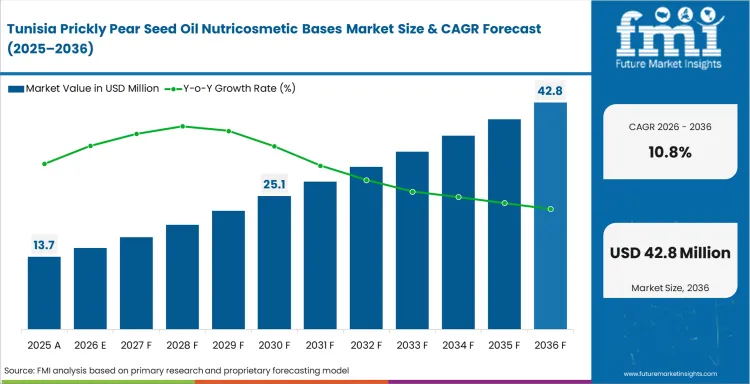
Middle East & Africa holds a main position in the prickly pear seed oil market because much of the competition begins at the source level. Since the product story starts with cultivation and origin, suppliers in this region determine early buyer perception around authenticity, quality, and premium value. Real market value grows only when suppliers can combine origin strength with export readiness, consistent lot quality, and reliable supply discipline.
- Tunisia: Tunisia holds the strongest commercial position because premium buyers already recognize it as a familiar and reliable export origin. That familiarity reduces buyer hesitation during the early stage of supplier review, especially if trust matters before technical evaluation goes deeper. Product image, organic credentials, and supplier readiness help keep sample demand active across smaller high-value programs. Tunisia is set to record a CAGR of 10.8% in prickly pear seed oil nutricosmetic bases market during the assessment period. Even with that growth outlook, future demand still depends on suppliers maintaining consistent batch quality and clear supporting documentation, since repeat orders in a premium oil category are built on trust before they scale through volume. Supplier advantage remains strongest if lots combine clear origin identity with practical usability in formulation work.
- Morocco: Morocco remains important in the long term because it has strong fruit availability and a product story that fits well with the premium oil market. Raw material availability alone is not enough to build stronger commercial success. Morocco is projected to witness 8.4% CAGR in the prickly pear seed oil nutricosmetic bases market through 2036. Morocco’s upside lies in moving beyond raw-material availability toward stronger processing discipline and better positioning in higher-value botanical systems.
- Algeria: Algeria has growth potential, though its market position is still less established than other countries. Buyers are more familiar with Tunisia as a premium source, so Algeria needs stronger supplier positioning to gain similar attention. Premium oil trade can expand as more Algerian lots meet ingestible-quality standards and present a clearer export-ready profile. The market for prickly pear seed oil nutricosmetic bases in Algeria is expected to grow at a CAGR of 9.4% during the study period. Market growth reflects room for improvement in premium ingredient positioning rather than a shift toward large-scale volume demand.
- Madagascar: Madagascar is attracting interest because it offers a different origin story in a market that has so far leaned on familiar source countries. Buyers often start exploring alternative origins once dependence on one well-known source becomes too strong in premium ingredient categories. Madagascar is anticipated to see prickly pear seed oil nutricosmetic bases grow at a CAGR of 10.3% over the forecast period. Growth is expected to be driven by advantage of starting from a smaller commercial base with more room to expand. Long-term progress may still depend on practical factors such as reliable handling, proper documentation, and consistent product quality across export lots. A smaller base can support faster growth, though repeat business still relies on strong commercial discipline and supplier credibility.
Competitive Aligners for Market Players
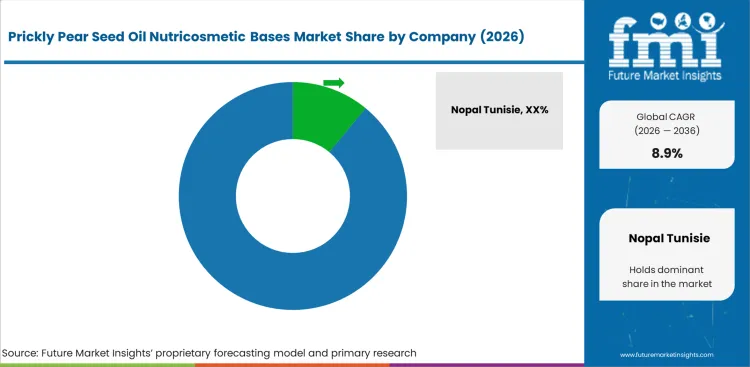
Competition in this market is driven more by credibility and execution than by company size alone. Since prickly pear seed oil is traded in small lots and sold at high value, buyers pay close attention to origin, documentation quality, and handling discipline before moving forward. Suppliers such as Nopal Tunisie, Biovalley, Zine Glob, King of Cactus, Aromeya, and Nutraceites operate in a market where premium image helps, though repeat business usually goes to companies that provide steadier paperwork and a clearer path into finished-product use. A similar pattern can be seen in beauty supplements and herbal beauty products, where buyers in niche premium segments often judge suppliers by how well they execute rather than by how large they appear.
Nopal Tunisie is presented as the closest to a leading position in this analysis. Biovalley and Zine Glob benefit from stronger North Africa familiarity, which makes early supplier review more comfortable for premium buyers. King of Cactus, Aromeya, and Nutraceites become more relevant when brands want alternative sourcing options that improve resilience without fully giving up premium positioning.
Key Players in Prickly Pear Seed Oil Nutricosmetic Bases Market
- Nopal Tunisie
- Biovalley
- Zine Glob
- King of Cactus
- Aromeya
- Nutraceites
Scope of the Report
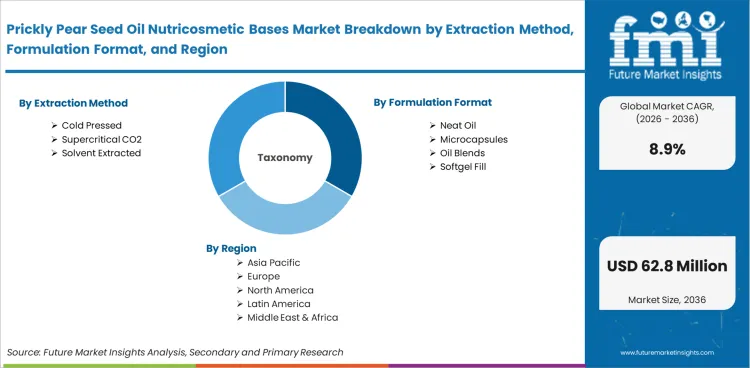
| Metric | Value |
|---|---|
| Quantitative Units | USD 24.6 million in 2026 to USD 57.7 million by 2036, at a CAGR of 8.9% |
| Market Definition | Prickly pear seed oil ingredient bases used in nutricosmetic and beauty-from-within products, including neat oils, blends, softgel-fill systems, and protected formats applied in premium ingestible beauty, skin nutrition, and adjacent wellness formulations. |
| Segmentation | Extraction Method, Formulation Format, Ingredient Grade, Application, Certification, End User, Distribution Channel, Source Origin, Region |
| Regions Covered | North America, Europe, Middle East & Africa |
| Countries Covered | Tunisia, Madagascar, Mexico, Algeria, Morocco, Italy, United States |
| Key Companies Profiled | Nopal Tunisie, Biovalley, Zine Glob, Bionaturehouse, King of Cactus, Aromeya, Nutraceites |
| Forecast Period | 2026 to 2036 |
| Approach | Demand was assessed through premium nutricosmetic base usage in ingestible beauty products, then aligned with extraction-route preference, certification needs, source-origin credibility, formulation-format suitability, and application fit across skin-focused and premium wellness product development. |
Prickly Pear Seed Oil Nutricosmetic Bases Market Analysis by Segments
By Extraction Method
- Cold Pressed
- Supercritical CO2
- Solvent Extracted
By Formulation Format
- Neat Oil
- Microcapsules
- Oil Blends
- Softgel Fill
By Ingredient Grade
- Dual-Use Grade
- Supplement Grade
- Cosmetic Grade
By Application
- Skin Nutrition
- Anti-Aging Blends
- Hair Nutrition
- Barrier Support
By Certification
- Organic Certified
- Conventional
- Fair Trade
By End User
- Contract Formulators
- Supplement Brands
- Beauty Brands
- Ingredient Labs
By Distribution Channel
- Direct B2B
- Distributors
- Private Label
- E-commerce
By Source Origin
- Tunisia
- Morocco
- Madagascar
- Mexico
- Algeria
- Italy
- Other Origins
By Region
- North America
- United States
- Mexico
- Europe
- Italy
- Middle East & Africa
- Tunisia
- Morocco
- Algeria
- Madagascar
Bibliography
- Anandkumar Naorem, Abhishek Patel, Sawsan Hassan, Mounir Louhaichi, and Somasundaram Jayaraman (2024). Global research landscape of cactus pear (Opuntia ficus-indica) in agricultural science.
- Issmail Nounah, Said El Harkaoui, Ahmed Hajib, Said Gharby, Hicham Harhar, Abdelhakim Bouyahya, Giovanni Caprioli, Filippo Maggi, Bertrand Matthäus, and Zoubida Charrouf. (2024). Effect of seed's geographical origin on cactus oil physico-chemical characteristics, oxidative stability, and antioxidant activity.
- Chafaa, N., Mosbah, C., Khattabi, L., Malaoui, K., Zahnit, W., Smaali, M. E. A., Houri, F., Medfouni, Y., Al-Anazi, K. M., & Ali, A. (2024). Algerian prickly pear seed by-products: Fatty acids composition, antioxidant, enzyme inhibitory activities towards tyrosinase, urease, α-amylase, and cholinesterase, along with the ability to protect from thermal protein denaturation.
- Gloria Itzel Peña-Vázquez, Sayra N. Serrano-Sandoval, José Rodríguez-Rodríguez, Marilena Antunes-Ricardo, Daniel Guajardo-Flores. (2025). Anti-inflammatory and antioxidant activity of functional lipids extracted through sustainable technologies from Mexican Opuntia ficus-indica seeds.
- Yongxin Ren, Dongcheng Liu, Baojun Xu. (2025). Critical review on orally administered nutricosmetics: Food-based solutions conferring skin health from the inside out.
This bibliography is provided for the reader’s reference. The full FMI report includes the complete reference list with primary-source documentation.
This Report Addresses
- Category size in 2025, 2026, and 2036.
- Commercial logic behind cold pressed oil leadership.
- Practical value carried by dual-use grade.
- Main application categories drawing premium demand.
- Source-origin strength led by Tunisia.
- Regional growth differences across North America, Europe, and Middle East & Africa.
- Buying factors shaping supplier preference.
- Competitive structure across a fragmented premium supplier field.
Frequently Asked Questions
What is the estimated size of the Prickly Pear Seed Oil Nutricosmetic Bases Market in 2025?
The market is estimated at USD 22.6 million in 2025. That base reflects a small but premium category built on limited oil yield, high ingredient value, and niche use in beauty-from-within products rather than mass-volume wellness lines.
What is the expected market value in 2026?
The 2026 market value at USD 24.6 million. Early-stage growth at this point comes from premium ingestible beauty concepts, improved certification visibility, and supplier efforts to make the oil easier to use across more than one delivery format.
How large is the market projected to become by 2036?
The market is projected to reach USD 57.7 million by 2036. Expansion at that scale points to broader use in premium nutricosmetic systems, stronger supplier discipline, and wider acceptance of rare botanical oils in higher-value finished products.
What is the forecast CAGR for the market from 2026 to 2036?
The market is expected to expand at a CAGR of 8.9% during the forecast period. Growth at that pace reflects premium category development rather than broad commodity-style expansion, since supply remains tight and finished-format use still depends on careful product positioning.
What is driving demand in this market?
Demand is being supported by beauty-from-within positioning, premium botanical storytelling, and stronger buyer interest in rare lipids carrying both functional and emotional appeal. Category movement also gains support from cleaner certification-led positioning and broader brand interest in high-value ingredients for capsules, blends, and softgel systems.
What is limiting faster expansion in this market?
Low oil yield remains the largest commercial restraint because raw material scarcity keeps pricing high and restricts movement into broad-volume products. Batch-to-batch consistency and supporting documents also matter, especially for ingestible use, since premium buyers usually expect clear quality files before repeat buying begins.
Which extraction method leads the market?
Cold pressed oil is expected to lead the extraction-method segment with 71.0% share in 2026. That lead comes from a cleaner premium image, easier buyer understanding, and a closer fit with natural-positioned botanical ingredients used in prestige beauty supplements.
Why does cold pressed oil stay ahead of other extraction routes?
Cold pressed oil stays ahead because the format supports natural identity and keeps product language simple for premium brands. Mechanical extraction also helps buyers review the ingredient more easily during early formulation work, especially in smaller projects carrying high value per lot.
Which formulation format leads the market?
Neat oil is anticipated to account for 41.0% share of the market in 2026 by formulation format. Direct oil use stays attractive in early product development since it gives brands more freedom in dosage setting, blend design, and final-format planning.
Why does neat oil remain the leading formulation format?
Neat oil remains the leading format because product teams often want full control during the first stage of concept design. A straight oil format makes it easier to test compatibility, pair the ingredient with other actives, and adapt the same input across multiple finished-product ideas.
Which ingredient grade leads the market?
Dual-use grade is projected to secure 44.0% share in 2026. That lead reflects stronger value for buyers seeking one ingredient lot that can support both ingestible concept work and premium beauty storytelling during early development.
Why is dual-use grade commercially valuable?
Dual-use grade reduces friction during concept building because the same lot can stay relevant across adjacent product ideas. That flexibility is useful in a small premium category, since brands often refine format direction several times before a final launch concept becomes fixed.
Which application area leads the market?
Skin nutrition is set to represent 40.0% market share in 2026. Skin-led positioning remains easier to communicate in premium ingestible beauty products, giving the category a clearer shelf story and a more familiar route into consumer-facing claims.
Why does skin nutrition remain the main application area?
Skin nutrition remains the main application area because hydration, glow, and visible-care language is easier to place in premium beauty supplements than narrower functional themes. Brand communication also becomes simpler in this route, and simpler communication usually helps premium-priced concepts move more smoothly.
Which certification category leads the market?
Organic certified material is projected to secure 64.0% share in 2026. Certification remains important in this market because buyers paying a premium for a rare oil usually expect visible proof of sourcing discipline and product integrity from the first stage of supplier review.
Why does organic certified supply keep a strong lead?
Organic certified supply keeps a strong lead because it supports premium price logic and reduces doubt during early commercial discussions. In a rare-oil category, documented quality often matters almost as much as ingredient performance, especially across brands selling into clean and wellness-led retail spaces.
Which end-user group leads the market?
Contract formulators are forecast to command 36.0% share in 2026. Outsourced formulation remains important because many smaller beauty and supplement brands prefer specialist support during early testing, pilot work, and delivery-format development.
Why do contract formulators carry a large share in this market?
Contract formulators carry a large share because a premium oil such as prickly pear seed oil often needs careful handling before it becomes a workable finished product. Specialist support makes it easier for emerging brands to move from sample-stage interest into a commercial-ready concept without building every technical step internally.
Which distribution channel leads the market?
Direct B2B is set to capture 57.0% market share in 2026. Direct supplier contact remains important in a category carrying small lots, premium pricing, and detailed buyer review around origin files, storage handling, and product consistency.
Why does direct B2B stay ahead of other channels?
Direct B2B stays ahead because close supplier contact gives buyers better visibility into batch quality, paperwork, and handling conditions. That level of contact is especially useful in a premium botanical category, since early buying decisions often depend on trust built during direct interaction rather than broad channel reach.
Which source origin leads the market?
Tunisia is estimated to represent 29.0% market share in 2026 by source origin. A stronger commercial image, deeper export familiarity, and better recognition in premium oil trade give Tunisia an advantage in early buyer shortlisting.
Why does Tunisia remain the leading source origin?
Tunisia remains the leading source origin because premium buyers already connect the country with commercial familiarity and a more established prickly pear seed oil trade base. A recognized origin story often supports faster sample interest, and stronger sample interest can improve the path toward repeat orders.
Which countries are expected to grow the fastest through 2036?
Tunisia at 10.8% and Madagascar at 10.3% are expected to record the fastest growth rates in this analysis. Mexico follows at 9.7%, while Algeria reaches 9.4%, showing that faster growth is also coming from source bases carrying room for stronger ingredient-grade development.
What makes this market worth watching for premium ingredient buyers?
The market remains worth watching because it combines rarity, premium image, and growing fit in ingestible beauty systems. Commercial value does not depend on broad volume alone, since a small category can still generate strong interest once source credibility, certification comfort, and formulation usability stay aligned.
Preview the report firsthand - request a free sample
Get SampleGet the brochure for pricing and purchase details.
Get PDFTable of Content
- Executive Summary
- Global Market Outlook
- Demand-side Trends
- Supply-side Trends
- Technology Roadmap Analysis
- Analysis and Recommendations
- Market Overview
- Market Coverage / Taxonomy
- Market Definition / Scope / Limitations
- Research Methodology
- Chapter Orientation
- Analytical Lens and Working Hypotheses
- Market Structure, Signals, and Trend Drivers
- Benchmarking and Cross-market Comparability
- Market Sizing, Forecasting, and Opportunity Mapping
- Research Design and Evidence Framework
- Desk Research Programme (Secondary Evidence)
- Company Annual and Sustainability Reports
- Peer-reviewed Journals and Academic Literature
- Corporate Websites, Product Literature, and Technical Notes
- Earnings Decks and Investor Briefings
- Statutory Filings and Regulatory Disclosures
- Technical White Papers and Standards Notes
- Trade Journals, Industry Magazines, and Analyst Briefs
- Conference Proceedings, Webinars, and Seminar Materials
- Government Statistics Portals and Public Data Releases
- Press Releases and Reputable Media Coverage
- Specialist Newsletters and Curated Briefings
- Sector Databases and Reference Repositories
- FMI Internal Proprietary Databases and Historical Market Datasets
- Subscription Datasets and Paid Sources
- Social Channels, Communities, and Digital Listening Inputs
- Additional Desk Sources
- Expert Input and Fieldwork (Primary Evidence)
- Primary Modes
- Qualitative Interviews and Expert Elicitation
- Quantitative Surveys and Structured Data Capture
- Blended Approach
- Why Primary Evidence is Used
- Field Techniques
- Interviews
- Surveys
- Focus Groups
- Observational and In-context Research
- Social and Community Interactions
- Stakeholder Universe Engaged
- C-suite Leaders
- Board Members
- Presidents and Vice Presidents
- R&D and Innovation Heads
- Technical Specialists
- Domain Subject-matter Experts
- Scientists
- Physicians and Other Healthcare Professionals
- Governance, Ethics, and Data Stewardship
- Research Ethics
- Data Integrity and Handling
- Primary Modes
- Tooling, Models, and Reference Databases
- Desk Research Programme (Secondary Evidence)
- Data Engineering and Model Build
- Data Acquisition and Ingestion
- Cleaning, Normalisation, and Verification
- Synthesis, Triangulation, and Analysis
- Quality Assurance and Audit Trail
- Market Background
- Market Dynamics
- Drivers
- Restraints
- Opportunity
- Trends
- Scenario Forecast
- Demand in Optimistic Scenario
- Demand in Likely Scenario
- Demand in Conservative Scenario
- Opportunity Map Analysis
- Product Life Cycle Analysis
- Supply Chain Analysis
- Investment Feasibility Matrix
- Value Chain Analysis
- PESTLE and Porter’s Analysis
- Regulatory Landscape
- Regional Parent Market Outlook
- Production and Consumption Statistics
- Import and Export Statistics
- Market Dynamics
- Global Market Analysis 2021 to 2025 and Forecast, 2026 to 2036
- Historical Market Size Value (USD Million) Analysis, 2021 to 2025
- Current and Future Market Size Value (USD Million) Projections, 2026 to 2036
- Y-o-Y Growth Trend Analysis
- Absolute $ Opportunity Analysis
- Global Market Pricing Analysis 2021 to 2025 and Forecast 2026 to 2036
- Global Market Analysis 2021 to 2025 and Forecast 2026 to 2036, By Extraction Method
- Introduction / Key Findings
- Historical Market Size Value (USD Million) Analysis By Extraction Method , 2021 to 2025
- Current and Future Market Size Value (USD Million) Analysis and Forecast By Extraction Method , 2026 to 2036
- Cold Pressed
- Supercritical CO2
- Solvent Extracted
- Cold Pressed
- Y-o-Y Growth Trend Analysis By Extraction Method , 2021 to 2025
- Absolute $ Opportunity Analysis By Extraction Method , 2026 to 2036
- Global Market Analysis 2021 to 2025 and Forecast 2026 to 2036, By Formulation Format
- Introduction / Key Findings
- Historical Market Size Value (USD Million) Analysis By Formulation Format, 2021 to 2025
- Current and Future Market Size Value (USD Million) Analysis and Forecast By Formulation Format, 2026 to 2036
- Neat Oil
- Microcapsules
- Oil Blends
- Softgel Fill
- Neat Oil
- Y-o-Y Growth Trend Analysis By Formulation Format, 2021 to 2025
- Absolute $ Opportunity Analysis By Formulation Format, 2026 to 2036
- Global Market Analysis 2021 to 2025 and Forecast 2026 to 2036, By Ingredient Grade
- Introduction / Key Findings
- Historical Market Size Value (USD Million) Analysis By Ingredient Grade, 2021 to 2025
- Current and Future Market Size Value (USD Million) Analysis and Forecast By Ingredient Grade, 2026 to 2036
- Dual-Use Grade
- Supplement Grade
- Cosmetic Grade
- Dual-Use Grade
- Y-o-Y Growth Trend Analysis By Ingredient Grade, 2021 to 2025
- Absolute $ Opportunity Analysis By Ingredient Grade, 2026 to 2036
- Global Market Analysis 2021 to 2025 and Forecast 2026 to 2036, By Application
- Introduction / Key Findings
- Historical Market Size Value (USD Million) Analysis By Application, 2021 to 2025
- Current and Future Market Size Value (USD Million) Analysis and Forecast By Application, 2026 to 2036
- Skin Nutrition
- Anti-Aging Blends
- Hair Nutrition
- Barrier Support
- Skin Nutrition
- Y-o-Y Growth Trend Analysis By Application, 2021 to 2025
- Absolute $ Opportunity Analysis By Application, 2026 to 2036
- Global Market Analysis 2021 to 2025 and Forecast 2026 to 2036, By Certification
- Introduction / Key Findings
- Historical Market Size Value (USD Million) Analysis By Certification, 2021 to 2025
- Current and Future Market Size Value (USD Million) Analysis and Forecast By Certification, 2026 to 2036
- Organic Certified
- Conventional
- Fair Trade
- Organic Certified
- Y-o-Y Growth Trend Analysis By Certification, 2021 to 2025
- Absolute $ Opportunity Analysis By Certification, 2026 to 2036
- Global Market Analysis 2021 to 2025 and Forecast 2026 to 2036, By End User
- Introduction / Key Findings
- Historical Market Size Value (USD Million) Analysis By End User, 2021 to 2025
- Current and Future Market Size Value (USD Million) Analysis and Forecast By End User, 2026 to 2036
- Contract Formulators
- Supplement Brands
- Beauty Brands
- Ingredient Labs
- Contract Formulators
- Y-o-Y Growth Trend Analysis By End User, 2021 to 2025
- Absolute $ Opportunity Analysis By End User, 2026 to 2036
- Global Market Analysis 2021 to 2025 and Forecast 2026 to 2036, By Distribution Channel
- Introduction / Key Findings
- Historical Market Size Value (USD Million) Analysis By Distribution Channel, 2021 to 2025
- Current and Future Market Size Value (USD Million) Analysis and Forecast By Distribution Channel, 2026 to 2036
- Direct B2B
- Distributors
- Private Label
- E-commerce
- Direct B2B
- Y-o-Y Growth Trend Analysis By Distribution Channel, 2021 to 2025
- Absolute $ Opportunity Analysis By Distribution Channel, 2026 to 2036
- Global Market Analysis 2021 to 2025 and Forecast 2026 to 2036, By Region
- Introduction
- Historical Market Size Value (USD Million) Analysis By Region, 2021 to 2025
- Current Market Size Value (USD Million) Analysis and Forecast By Region, 2026 to 2036
- North America
- Latin America
- Western Europe
- Eastern Europe
- East Asia
- South Asia and Pacific
- Middle East & Africa
- Market Attractiveness Analysis By Region
- North America Market Analysis 2021 to 2025 and Forecast 2026 to 2036, By Country
- Historical Market Size Value (USD Million) Trend Analysis By Market Taxonomy, 2021 to 2025
- Market Size Value (USD Million) Forecast By Market Taxonomy, 2026 to 2036
- By Country
- USA
- Canada
- Mexico
- By Extraction Method
- By Formulation Format
- By Ingredient Grade
- By Application
- By Certification
- By End User
- By Distribution Channel
- By Country
- Market Attractiveness Analysis
- By Country
- By Extraction Method
- By Formulation Format
- By Ingredient Grade
- By Application
- By Certification
- By End User
- By Distribution Channel
- Key Takeaways
- Latin America Market Analysis 2021 to 2025 and Forecast 2026 to 2036, By Country
- Historical Market Size Value (USD Million) Trend Analysis By Market Taxonomy, 2021 to 2025
- Market Size Value (USD Million) Forecast By Market Taxonomy, 2026 to 2036
- By Country
- Brazil
- Chile
- Rest of Latin America
- By Extraction Method
- By Formulation Format
- By Ingredient Grade
- By Application
- By Certification
- By End User
- By Distribution Channel
- By Country
- Market Attractiveness Analysis
- By Country
- By Extraction Method
- By Formulation Format
- By Ingredient Grade
- By Application
- By Certification
- By End User
- By Distribution Channel
- Key Takeaways
- Western Europe Market Analysis 2021 to 2025 and Forecast 2026 to 2036, By Country
- Historical Market Size Value (USD Million) Trend Analysis By Market Taxonomy, 2021 to 2025
- Market Size Value (USD Million) Forecast By Market Taxonomy, 2026 to 2036
- By Country
- Germany
- UK
- Italy
- Spain
- France
- Nordic
- BENELUX
- Rest of Western Europe
- By Extraction Method
- By Formulation Format
- By Ingredient Grade
- By Application
- By Certification
- By End User
- By Distribution Channel
- By Country
- Market Attractiveness Analysis
- By Country
- By Extraction Method
- By Formulation Format
- By Ingredient Grade
- By Application
- By Certification
- By End User
- By Distribution Channel
- Key Takeaways
- Eastern Europe Market Analysis 2021 to 2025 and Forecast 2026 to 2036, By Country
- Historical Market Size Value (USD Million) Trend Analysis By Market Taxonomy, 2021 to 2025
- Market Size Value (USD Million) Forecast By Market Taxonomy, 2026 to 2036
- By Country
- Russia
- Poland
- Hungary
- Balkan & Baltic
- Rest of Eastern Europe
- By Extraction Method
- By Formulation Format
- By Ingredient Grade
- By Application
- By Certification
- By End User
- By Distribution Channel
- By Country
- Market Attractiveness Analysis
- By Country
- By Extraction Method
- By Formulation Format
- By Ingredient Grade
- By Application
- By Certification
- By End User
- By Distribution Channel
- Key Takeaways
- East Asia Market Analysis 2021 to 2025 and Forecast 2026 to 2036, By Country
- Historical Market Size Value (USD Million) Trend Analysis By Market Taxonomy, 2021 to 2025
- Market Size Value (USD Million) Forecast By Market Taxonomy, 2026 to 2036
- By Country
- China
- Japan
- South Korea
- By Extraction Method
- By Formulation Format
- By Ingredient Grade
- By Application
- By Certification
- By End User
- By Distribution Channel
- By Country
- Market Attractiveness Analysis
- By Country
- By Extraction Method
- By Formulation Format
- By Ingredient Grade
- By Application
- By Certification
- By End User
- By Distribution Channel
- Key Takeaways
- South Asia and Pacific Market Analysis 2021 to 2025 and Forecast 2026 to 2036, By Country
- Historical Market Size Value (USD Million) Trend Analysis By Market Taxonomy, 2021 to 2025
- Market Size Value (USD Million) Forecast By Market Taxonomy, 2026 to 2036
- By Country
- India
- ASEAN
- Australia & New Zealand
- Rest of South Asia and Pacific
- By Extraction Method
- By Formulation Format
- By Ingredient Grade
- By Application
- By Certification
- By End User
- By Distribution Channel
- By Country
- Market Attractiveness Analysis
- By Country
- By Extraction Method
- By Formulation Format
- By Ingredient Grade
- By Application
- By Certification
- By End User
- By Distribution Channel
- Key Takeaways
- Middle East & Africa Market Analysis 2021 to 2025 and Forecast 2026 to 2036, By Country
- Historical Market Size Value (USD Million) Trend Analysis By Market Taxonomy, 2021 to 2025
- Market Size Value (USD Million) Forecast By Market Taxonomy, 2026 to 2036
- By Country
- Kingdom of Saudi Arabia
- Other GCC Countries
- Turkiye
- South Africa
- Other African Union
- Rest of Middle East & Africa
- By Extraction Method
- By Formulation Format
- By Ingredient Grade
- By Application
- By Certification
- By End User
- By Distribution Channel
- By Country
- Market Attractiveness Analysis
- By Country
- By Extraction Method
- By Formulation Format
- By Ingredient Grade
- By Application
- By Certification
- By End User
- By Distribution Channel
- Key Takeaways
- Key Countries Market Analysis
- USA
- Pricing Analysis
- Market Share Analysis, 2025
- By Extraction Method
- By Formulation Format
- By Ingredient Grade
- By Application
- By Certification
- By End User
- By Distribution Channel
- Canada
- Pricing Analysis
- Market Share Analysis, 2025
- By Extraction Method
- By Formulation Format
- By Ingredient Grade
- By Application
- By Certification
- By End User
- By Distribution Channel
- Mexico
- Pricing Analysis
- Market Share Analysis, 2025
- By Extraction Method
- By Formulation Format
- By Ingredient Grade
- By Application
- By Certification
- By End User
- By Distribution Channel
- Brazil
- Pricing Analysis
- Market Share Analysis, 2025
- By Extraction Method
- By Formulation Format
- By Ingredient Grade
- By Application
- By Certification
- By End User
- By Distribution Channel
- Chile
- Pricing Analysis
- Market Share Analysis, 2025
- By Extraction Method
- By Formulation Format
- By Ingredient Grade
- By Application
- By Certification
- By End User
- By Distribution Channel
- Germany
- Pricing Analysis
- Market Share Analysis, 2025
- By Extraction Method
- By Formulation Format
- By Ingredient Grade
- By Application
- By Certification
- By End User
- By Distribution Channel
- UK
- Pricing Analysis
- Market Share Analysis, 2025
- By Extraction Method
- By Formulation Format
- By Ingredient Grade
- By Application
- By Certification
- By End User
- By Distribution Channel
- Italy
- Pricing Analysis
- Market Share Analysis, 2025
- By Extraction Method
- By Formulation Format
- By Ingredient Grade
- By Application
- By Certification
- By End User
- By Distribution Channel
- Spain
- Pricing Analysis
- Market Share Analysis, 2025
- By Extraction Method
- By Formulation Format
- By Ingredient Grade
- By Application
- By Certification
- By End User
- By Distribution Channel
- France
- Pricing Analysis
- Market Share Analysis, 2025
- By Extraction Method
- By Formulation Format
- By Ingredient Grade
- By Application
- By Certification
- By End User
- By Distribution Channel
- India
- Pricing Analysis
- Market Share Analysis, 2025
- By Extraction Method
- By Formulation Format
- By Ingredient Grade
- By Application
- By Certification
- By End User
- By Distribution Channel
- ASEAN
- Pricing Analysis
- Market Share Analysis, 2025
- By Extraction Method
- By Formulation Format
- By Ingredient Grade
- By Application
- By Certification
- By End User
- By Distribution Channel
- Australia & New Zealand
- Pricing Analysis
- Market Share Analysis, 2025
- By Extraction Method
- By Formulation Format
- By Ingredient Grade
- By Application
- By Certification
- By End User
- By Distribution Channel
- China
- Pricing Analysis
- Market Share Analysis, 2025
- By Extraction Method
- By Formulation Format
- By Ingredient Grade
- By Application
- By Certification
- By End User
- By Distribution Channel
- Japan
- Pricing Analysis
- Market Share Analysis, 2025
- By Extraction Method
- By Formulation Format
- By Ingredient Grade
- By Application
- By Certification
- By End User
- By Distribution Channel
- South Korea
- Pricing Analysis
- Market Share Analysis, 2025
- By Extraction Method
- By Formulation Format
- By Ingredient Grade
- By Application
- By Certification
- By End User
- By Distribution Channel
- Russia
- Pricing Analysis
- Market Share Analysis, 2025
- By Extraction Method
- By Formulation Format
- By Ingredient Grade
- By Application
- By Certification
- By End User
- By Distribution Channel
- Poland
- Pricing Analysis
- Market Share Analysis, 2025
- By Extraction Method
- By Formulation Format
- By Ingredient Grade
- By Application
- By Certification
- By End User
- By Distribution Channel
- Hungary
- Pricing Analysis
- Market Share Analysis, 2025
- By Extraction Method
- By Formulation Format
- By Ingredient Grade
- By Application
- By Certification
- By End User
- By Distribution Channel
- Kingdom of Saudi Arabia
- Pricing Analysis
- Market Share Analysis, 2025
- By Extraction Method
- By Formulation Format
- By Ingredient Grade
- By Application
- By Certification
- By End User
- By Distribution Channel
- Turkiye
- Pricing Analysis
- Market Share Analysis, 2025
- By Extraction Method
- By Formulation Format
- By Ingredient Grade
- By Application
- By Certification
- By End User
- By Distribution Channel
- South Africa
- Pricing Analysis
- Market Share Analysis, 2025
- By Extraction Method
- By Formulation Format
- By Ingredient Grade
- By Application
- By Certification
- By End User
- By Distribution Channel
- USA
- Market Structure Analysis
- Competition Dashboard
- Competition Benchmarking
- Market Share Analysis of Top Players
- By Regional
- By Extraction Method
- By Formulation Format
- By Ingredient Grade
- By Application
- By Certification
- By End User
- By Distribution Channel
- Competition Analysis
- Competition Deep Dive
- Nopal Tunisie
- Overview
- Product Portfolio
- Profitability by Market Segments (Product/Age /Sales Channel/Region)
- Sales Footprint
- Strategy Overview
- Marketing Strategy
- Product Strategy
- Channel Strategy
- Biovalley
- Zine Glob
- King of Cactus
- Aromeya
- Nutraceites
- Nopal Tunisie
- Competition Deep Dive
- Assumptions & Acronyms Used


