

- Industry Size (2026)
- USD 25.5 Mn
- Forecast (2036)
- USD 47.8 Mn
- CAGR (2026 to 2036)
- 6.5%
Black Cumin Seed Oil Market Size, Market Forecast and Outlook By FMI
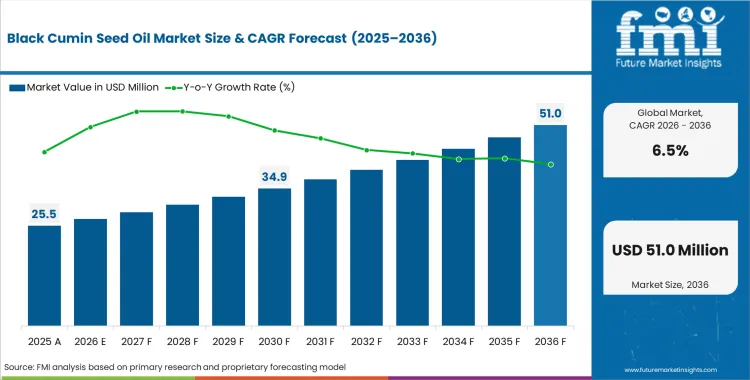
The black cumin seed oil market crossed a valuation of USD 23.9 million in 2025. Industry valuation is estimated to reach USD 25.5 million in 2026 and is projected to expand at a CAGR of 6.5% from 2026 to 2036. The market is expected to attain USD 47.8 million by 2036 as improvements in extraction and active-compound preservation support wider use in nutraceutical, personal care, and clinically positioned botanical formulations.
Summary of Black Cumin Seed Oil Market
- The market is forecast to reach USD 47.8 million by 2036.
- The market is expected to grow at a CAGR of 6.5% from 2026 to 2036.
- The market was estimated at USD 23.9 million in 2025.
- The forecast period represents an incremental opportunity of USD 22.4 million.
- The market is a specialty botanical oil category where quality, traceability, extraction method, and thymoquinone consistency are key purchase drivers.
- Growth is driven by increasing demand for functional wellness and preventive health applications supported by clinical interest in antioxidant and anti-inflammatory benefits.
- Cold-pressed and standardized oils are gaining preference due to higher quality retention and stricter purity expectations.
- India, Germany, and the Netherlands are among the fastest-growing markets, with India leading at a 7.4% CAGR through 2036.
- Liquid oil dominates the form segment, while dietary supplements remain the primary end-use category.
- E-commerce leads distribution, supported by expanding wellness brands and cross-border accessibility.
- Key players in the market include Amazing Herbs, TriNutra, HealthAid, Nature In Bottle, and Heess Oils.
Nutraceutical and wellness brands are placing greater emphasis on supply contracts that can ensure standardized black seed oil quality over longer production cycles. Dependence on spot-market material with inconsistent active-compound retention creates formulation risk, especially in premium channels where regulatory scrutiny, product claims, and shelf performance carry more weight. Extraction yield alone is no longer an adequate purchasing benchmark because higher-output processing can reduce the volatile compounds that underpin functional positioning. Black cumin seed oil demand is therefore becoming more specification-led, with buyers placing greater value on compositional consistency than on bulk availability alone.
Market expectations are likely to tighten further once pharmacy and high-specification retail channels make batch-level active-compound verification a routine requirement. Supply chains that cannot demonstrate traceability from origin through final processing are likely to face greater difficulty in premium supplement and herbal medicinal products categories. That shift favors processors and suppliers that can combine documentation, quality control, and standardized black seed oil output within a commercially reliable sourcing model.
India is expected to remain the leading growth market, with black seed oil demand projected to rise at a CAGR of 7.4% through 2036 as established local processing capacity continues to support reliable supply. Germany follows at 7.1%, where cleaner-label formulation requirements are encouraging stronger adoption in higher-specification applications. The Netherlands is estimated to expand at 6.9% during the forecast period, supported by its role in certified botanical ingredient trade across Europe. The United Kingdom is likely to record 6.7% CAGR, while the United States is projected to grow at 6.5% on the strength of mature wellness retail networks. Türkiye is anticipated to register 6.3%, backed by domestic production depth, and France is set to post 6.1% through 2036, reflecting steadier movement in herbal medicinal products and functional botanical use. Cross-country differences will remain shaped by how far each market shifts from bulk botanical trade toward standardized black seed oil with tighter compositional control.
Segmental Analysis
Black Cumin Seed Oil Market Analysis by Form
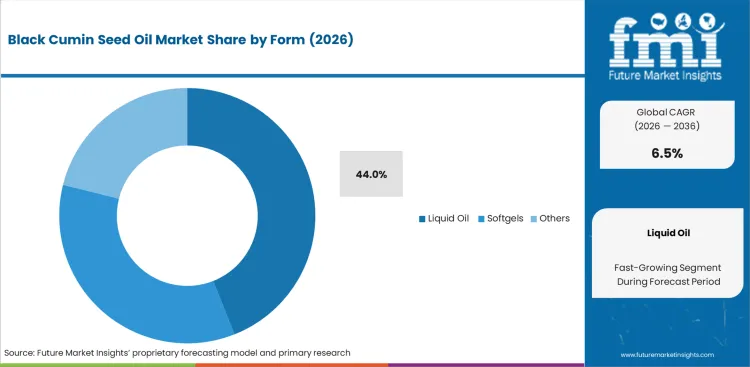
Packaging stability and end-use handling shape format selection more than headline demand alone. Liquid oil remains commercially attractive because it gives brands dosing flexibility and avoids the tooling burden tied to softgel conversion during early-stage product development. FMI estimates liquid oil to account for 44.0% share in 2026. That position reflects bulk-handling efficiency and easier formulation adjustment rather than any clear advantage in oxidative protection. Once opened, liquid formats deteriorate faster and place greater pressure on nitrogen flushing, UV-protective packaging, and air-reduction systems across wellness lines competing within broader herb oil categories. Brands that overlook these packaging controls often face shorter shelf life, weaker product consistency, and higher risk of retailer pushback.
- Initial selection: Liquid presentation supports dosage adjustment and faster product development. It also avoids the early capital commitment linked to custom encapsulation formats.
- Validation phase: Bulk oil still requires strict testing for peroxide values and free fatty acid stability. Early rejection of oxidized lots protects later formulation performance.
- Renewal metrics: Repeat sourcing depends heavily on temperature control during transport and storage. Suppliers that cannot prove consistent cold-chain discipline face weaker reorder continuity.
Black Cumin Seed Oil Market Analysis by Extraction
Clean-label positioning continues to favor mechanically produced oil over chemically extracted alternatives. Premium wellness and personal care channels place high value on residue-free processing and preservation of the native lipid profile. Cold pressed extraction is anticipated to capture 68.0% share in 2026, according to FMI estimates. That lead is supported by its alignment with premium product positioning rather than by superior processing efficiency. Yield remains lower than solvent extraction, and the economics tighten further when processors maintain strict temperature control to avoid friction-led compound degradation. Attempts to raise output by pushing press speeds too far can reduce active quality and weaken the oil’s suitability for higher-grade botanical applications, including formulations benchmarked against hemp seed oil.
- Sourcing savings: Long-term sourcing agreements with pressing facilities can reduce cost volatility. More direct supply relationships also improve visibility on raw material planning.
- Hidden operational expenses: Seed storage conditions matter before extraction begins. High humidity can damage inventories quickly and add avoidable loss before processing.
- Lifecycle value: Premium cold-pressed material often supports stronger retail positioning. That advantage can offset the higher acquisition cost when the brand relies on purity-led differentiation.
Black Cumin Seed Oil Market Analysis by End Use
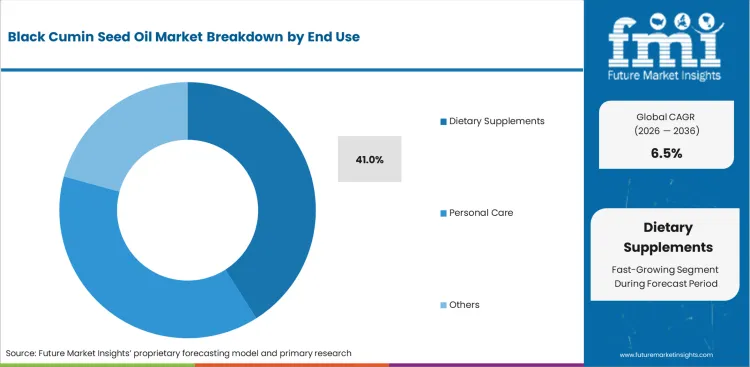
Taste management, dosage precision, and regulatory consistency continue to shape where black cumin seed oil is used most effectively. Supplement formats remain the most scalable route because encapsulation masks bitterness and supports standardized intake across retail markets. This channel also absorbs the highest volume of concentrated extracts in practice. FMI projects dietary supplements to secure 41.0% share in 2026. Cosmetic applications can tolerate more variation in fatty acid profile, but supplements require tighter standardization and clearer batch control. Brands that delay movement toward standardized botanical extract systems often face greater resistance from contract manufacturers and retailers, especially in portfolios positioned alongside adjacent oils such as apple seed oil.
- Early integration: Smaller wellness brands use standardized black cumin oil to differentiate immune-support offerings. Stronger ingredient positioning helps support premium placement.
- Secondary expansion: Broader retail acceptance improves once domestic manufacturing and replenishment become more reliable. Inventory continuity remains a key listing requirement.
- Late-stage conversion: Mass channels typically enter later, once raw material pricing becomes more stable. Margin confidence still matters before category replacement decisions are made.
Black Cumin Seed Oil Market Analysis by Grade
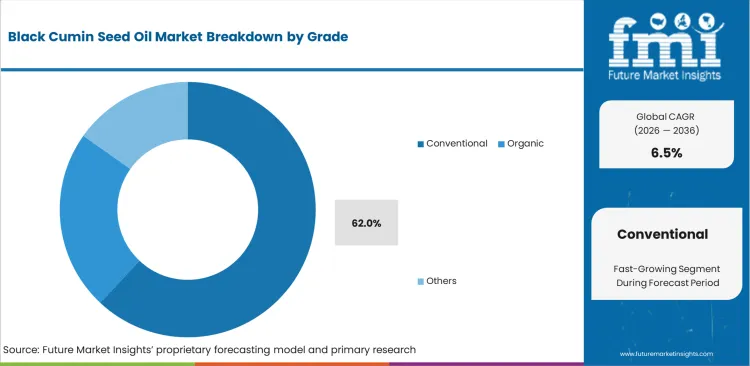
Volume-led applications continue to favor conventional supply over certified alternatives. Manufacturers serving food additive, general wellness, and broad-based formulation demand usually prioritize availability, price control, and blending flexibility across origin points. Conventional grade oil is projected to account for 62.0% share in 2026. That lead reflects the commercial ease of sourcing larger lots rather than a permanent quality gap between conventional and organic streams. Residue and heavy-metal screening standards have tightened enough that conventional supply now faces stricter verification than many market summaries imply.
- Residue accumulation: Cross-batch contamination can create specification failure if cleaning discipline is weak. Processing controls therefore remain important even in conventional supply systems.
- Residual risk: Dependence on a narrow origin base increases exposure to harvest volatility. Single-source strategies weaken supply resilience during poor seasonal output.
- Mitigation strategy: Multi-origin qualification improves continuity and reduces disruption risk. Broader supplier coverage supports steadier factory planning.
Black Cumin Seed Oil Market Analysis by Distribution
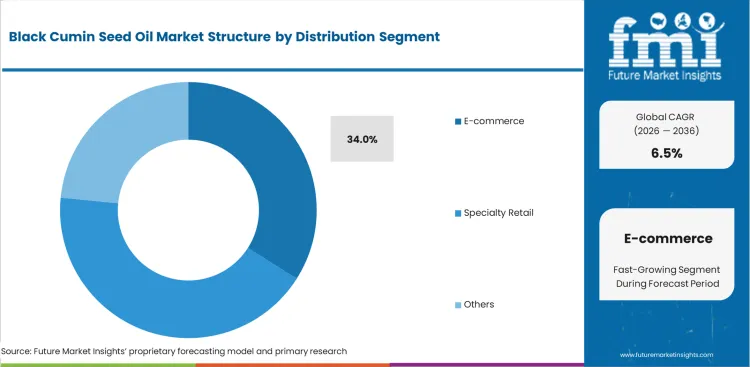
Channel economics are shifting as more botanical brands try to scale through direct digital reach rather than depend only on physical retail placement. E-commerce offers better margin preservation in the early stages because brands can avoid slotting costs and control how niche product benefits are presented online. Inventory discipline and temperature-sensitive fulfillment still remain central to success in this category. FMI expects e-commerce to represent 34.0% share in 2026. That position is meaningful, but it does not remove the burden of customer acquisition cost, return handling, and packaging performance during summer transit. These issues become sharper in competitive digital botanical spaces that also include products such as carica papaya seed oil. Strong subscription retention and reliable product condition on delivery remain more important than topline channel visibility alone.
- Peak efficiency: Digital fulfillment performs well when batch sizes are small and inventory turns are high. Better ordering visibility helps reduce aging stock exposure.
- Edge condition failures: Uninsulated cross-border shipment can degrade oils during hot-weather transit. That raises refund risk and weakens brand trust.
- Qualification standards: Digital platforms increasingly require current third-party testing documents before listing approval. Incomplete certification can block or delay channel access.
Black Cumin Seed Oil Market Drivers, Restraints, and Opportunities
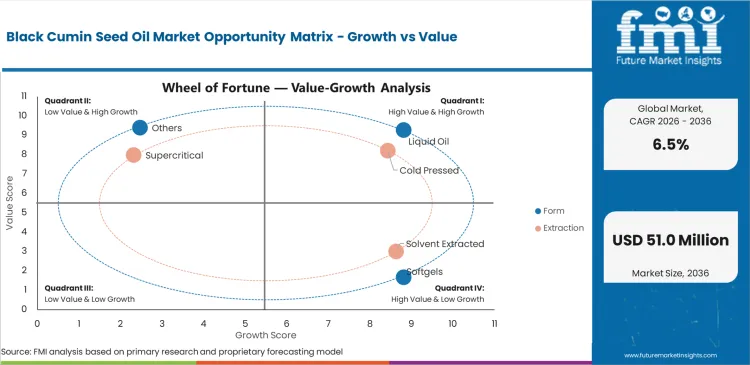
Clinical validation of thymoquinone as an adjunct therapeutic compound compels nutraceutical formulation officers to commercialize Nigella sativa product lines. Delaying entry into the premium botanical lipid space allows competing brands to lock in limited supplies of standardized, high-yield agricultural contracts. Demand is rising as functional wellness protocols shift from generic essential fatty acids toward highly specific, targeted botanical extracts like Asia Pacific tomato seed oil . European market pathways support this expansion, offering clear regulatory guidance for traceable, plant-based specialty ingredients. Brands that conduct thorough black cumin oil demand analysis and secure verified clinical-grade material capture dominant market share among health-conscious demographic segments.
Extraction yield constraints and extreme quality inconsistencies between regional suppliers severely limit large-scale commercial application, creating massive black cumin seed oil sourcing challenges. While brands want to scale supplement lines, they also struggle to find processors capable of delivering identical thymoquinone concentrations across multiple harvest cycles. Agricultural reality dictates that seed compound profiles vary wildly based on soil and climate conditions. Current blending techniques offer partial solutions for achieving baseline consistency, but they fail to satisfy strict requirements of clinical-grade herbal supplements buyers who demand single-origin traceability.
Opportunities in the Black Cumin Seed Oil Market
- Standardization technology: Processors develop proprietary filtration methods that concentrate thymoquinone without applying destructive thermal heat. Premium pricing is achieved by mastering thymoquinone standardization in black seed oil, enabling guaranteed compound percentages for pharmaceutical buyers.
- Microencapsulation formats: R&D directors engineer powder-coated lipid droplets that eliminate the bitter flavor profile completely. Marketing teams gain access to mainstream gummy and chewable supplement formats previously restricted by taste barriers.
- Topical formulation: Skin care brands integrate cold-pressed fractions into high-end serums targeting inflammatory dermatological conditions. Massoia bark essential oil supply is secured alongside to build entirely plant-based anti-aging cosmetic portfolios, accelerating black cumin seed oil cosmetic applications.
Regional Analysis
Based on regional analysis, black cumin seed oil market is segmented into North America, Latin America, Europe, East Asia, South Asia, Oceania, and Middle East and Africa across 40 plus countries.
.webp "Top Country Growth Comparison Black Cumin Seed Oil Market Cagr (2026 2036)")
| Country | CAGR (2026 to 2036) |
|---|---|
| India | 7.4% |
| Germany | 7.1% |
| Netherlands | 6.9% |
| United Kingdom | 6.7% |
| United States | 6.5% |
| Türkiye | 6.3% |
| France | 6.1% |
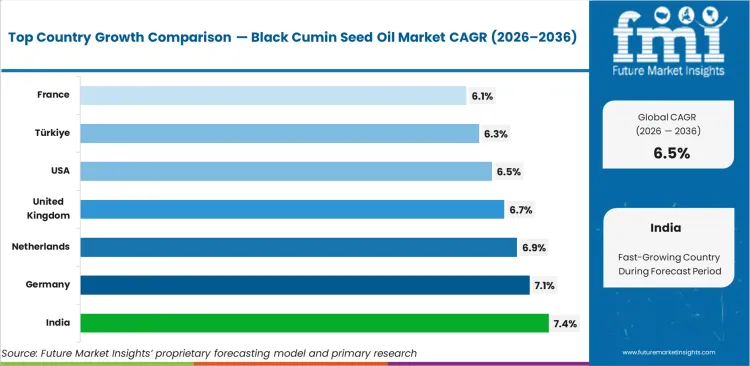
Source: Future Market Insights (FMI) analysis, based on proprietary forecasting model and primary research
Europe Black Cumin Seed Oil Market Analysis
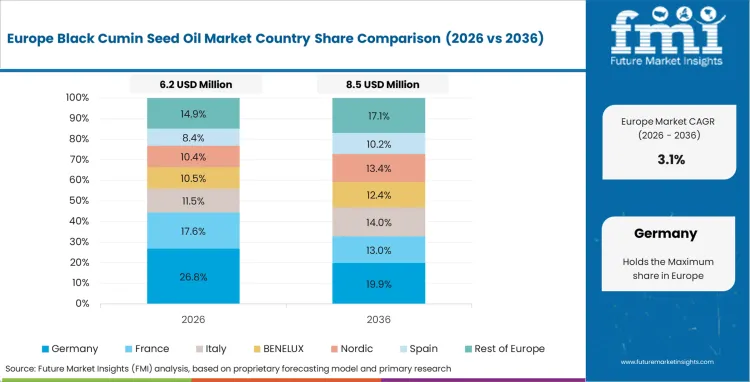
Clean-label mandates across the European Union force botanical processors to upgrade extraction and filtration infrastructure. Formulation officers in premium wellness companies require verifiable supply chains that trace every batch of oil back to specific agricultural cooperatives. FMI analysts note that strict regulatory environments prevent low-grade, adulterated oils from entering the commercial food additive supply. The emphasis on cold-pressed, standardized ingredients allows European manufacturers to command significant retail premiums globally.
- Germany: Strict pharmacopeia standards dictate exact acceptable levels of volatile compounds in functional oils. Quality control directors reject shipments that fail to meet these narrow chemical profiles. The demand in Germany is anticipated to expand at a CAGR of 7.1% through 2036. Qualifying as a trusted supplier to German nutraceutical firms grants processors a critical competitive advantage across the entire continent.
- Netherlands: Deep-water port logistics and specialized chemical testing infrastructure establish this node as the primary clearinghouse for botanical imports. Agricultural shipments are consolidated here before distributing standardized batches to regional processors. The Netherlands is projected to witness 6.9% CAGR in the industry from 2026 to 2036. Mastering the Dutch customs and certification pathway opens immediate commercial opportunities for overseas agricultural cooperatives.
- United Kingdom: Demand for black cumin seed oil in the United Kingdom is set to rise at a CAGR of 6.7% through the forecast period. Rising consumer demand for vegan-certified functional lipids accelerates adoption across high street pharmacy chains. Retail buyers prioritize brands that offer complete transparency regarding seed origin and pressing methodology. Establishing localized encapsulation facilities allows brands to avoid post-Brexit cross-border friction on finished supplements.
- France: Aesthetic dermatology formulators increasingly incorporate Nigella sativa extracts into premium skin care lines targeting urban pollution damage. Firms evaluate suppliers based strictly on lipid stability and low free fatty acid counts. The French sector is expected to register a CAGR of 6.1% through 2036. Securing contracts with prominent French dermocosmetic houses signals peak processing quality to the global market.
FMI's report includes Spain, Italy, and Poland. Market dynamics across the continent continue to prioritize analytical testing capabilities over raw price advantages as marigold essential oil distributors expand their botanical portfolios.
North America Black Cumin Seed Oil Market Analysis
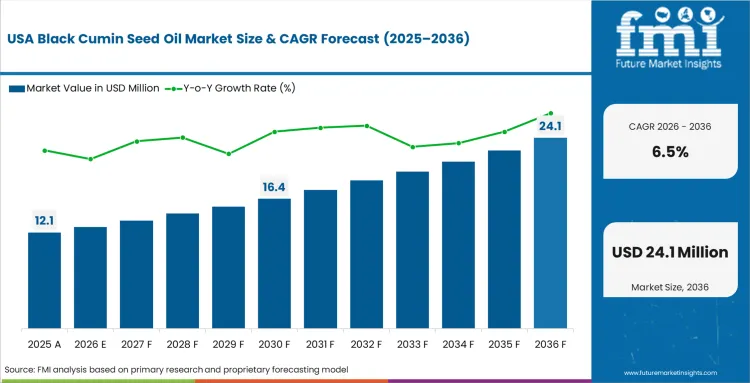
Consumer transition toward preventive health protocols creates continuous expansion across retail pharmacy networks. Encapsulation formats are prioritized to mask strong botanical flavors while delivering verified active compound doses. Based on FMI's assessment, the absence of a unified federal standard for botanical lipids places the burden of quality verification entirely on purchasing departments of major supplement brands.
- United States: High-volume contract manufacturers dominate purchasing landscapes, demanding massive bulk shipments of consistent-grade oil. Companies must continually balance raw material costs against the demand for certified organic inputs. Sales of black cumin seed oil in the United States are expected to increase at a CAGR of 6.5% during the forecast period. Reaching scale in this environment fundamentally changes a supplier's internal operations, requiring a shift from seasonal pressing to continuous year-round industrial extraction.
FMI's report includes Canada. Cross-border integration between Canadian processing facilities and American supplement brands simplifies regulatory compliance for sage essential oil operators entering the black cumin space.
South Asia Black Cumin Seed Oil Market Analysis
Deep historical familiarity with Nigella sativa shapes an entirely different commercial landscape dominated by local processing networks. Domestic supply chain directors source directly from regional agricultural hubs, bypassing complex broker networks required for international trade. FMI's view indicates that local consumption patterns heavily favor basic liquid formats for both culinary and traditional functional applications.
- India: Demand for black cumin seed oil in India is anticipated to rise at a CAGR of 7.4% over the forecast years. Large-scale domestic agricultural output provides processors with immediate, low-cost access to raw seed inventories. Focus is kept on maximizing press uptime rather than achieving hyper-standardized profiles required by European buyers. The strong growth figure masks the reality that much of this volume moves through informal, uncertified channels rather than audited pharmaceutical supply chains.
FMI's report includes Bangladesh and Sri Lanka. Exporting high-yield agricultural output to Western standardized extraction facilities remains the primary expansion avenue for local hops essential oil brokers operating in the region.
Competitive Aligners for Market Players
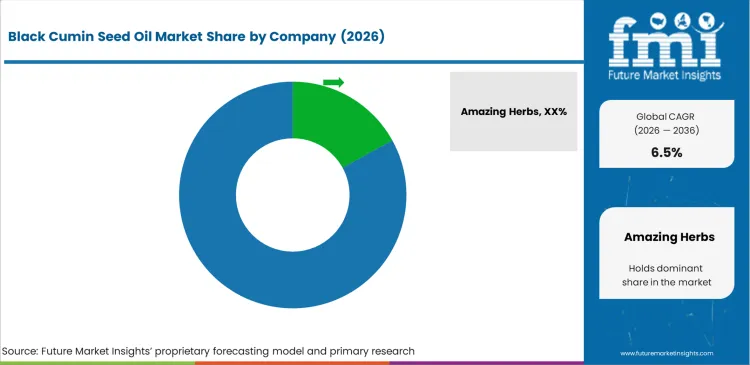
Competition in the botanical lipid sector is increasingly shaped by the ability to retain active compounds such as thymoquinone across changing harvest conditions. Market positioning is likely to depend less on headline output and more on consistency in compound preservation during extraction and storage. Supplier evaluation in black cumin seed oil is therefore centered more on dependable active content than on maximum production scale. Capital investment in controlled cold-press systems and nitrogen-managed storage remains important because product quality is closely tied to handling discipline across the value chain.
Established botanical processors are better positioned where long-term agricultural sourcing and stronger analytical capability support tighter batch control. Newer participants often face a more demanding path because regulatory acceptance depends on reliable compositional data and repeatable product characteristics. Processing infrastructure with in-house chromatography is becoming more relevant in the premium segment, where lipid marker verification influences product acceptance and pricing structure. Competitive advantage, in this part of the market, increasingly reflects the ability to combine sourcing stability with analytical precision.
Large supplement brands are also seeking to reduce dependence on a single ingredient source by defining specifications within acceptable quality ranges. Such an approach supports qualification of secondary suppliers while preserving formulation consistency. Demand for clean and unadulterated botanical inputs is encouraging closer oversight across sourcing and processing networks. Direct alignment with agricultural supply channels can strengthen traceability and improve raw material confidence, especially in segments where ingredient quality carries greater commercial weight.
Key Players in Black Cumin Seed Oil Market
- Amazing Herbs
- TriNutra
- HealthAid
- Nature In Bottle
- Heess Oils
Scope of the Report
| Metric | Value |
|---|---|
| Quantitative Units | USD 25.5 million to USD 47.8 million, at a CAGR of 6.5% |
| Market Definition | Black cumin seed oil is the lipid extract of Nigella sativa seeds, characterized by its concentration of thymoquinone, utilized primarily across clinical nutrition and functional topical applications. |
| Segmentation | By Form, By Extraction, By End Use, By Grade, By Distribution |
| Regions Covered | North America, Latin America, Europe, East Asia, South Asia, Oceania, Middle East and Africa |
| Countries Covered | United States, Canada, Brazil, Mexico, Germany, United Kingdom, France, Spain, Italy, China, Japan, South Korea, India, Australia, New Zealand, Türkiye, South Africa, GCC |
| Key Companies Profiled | Amazing Herbs, TriNutra, HealthAid, Nature In Bottle, Heess Oils |
| Forecast Period | 2026 to 2036 |
| Approach | Baseline anchored on wholesale contract volumes for certified Nigella sativa extracts |
Source: Future Market Insights (FMI) analysis, based on proprietary forecasting model and primary research
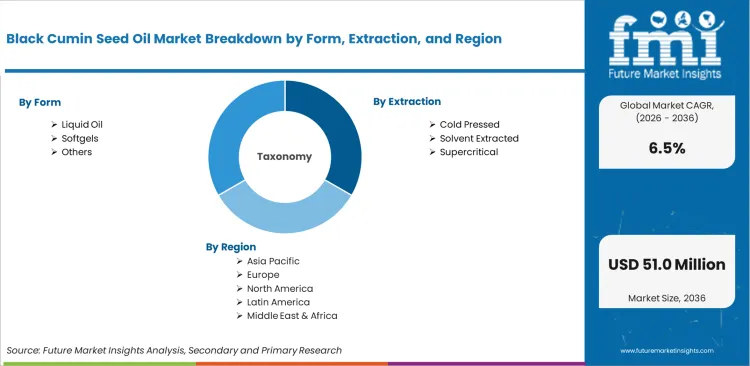
Black Cumin Seed Oil Market Analysis by Segments
By Form
- Liquid Oil
- Softgels
- Capsules
- Bulk Ingredient
By Extraction
- Cold Pressed
- Solvent Extracted
- Supercritical
By End Use
- Dietary Supplements
- Personal Care
- Food Additives
- Herbal Medicine
By Grade
- Conventional
- Organic
- Standardized
By Distribution
- E-commerce
- Specialty Retail
- Pharmacies
- B2B Supply
Region:
- North America
- United States
- Canada
- Europe
- Germany
- United Kingdom
- France
- Italy
- Spain
- Asia Pacific
- China
- Japan
- South Korea
- Taiwan
- Singapore
- Latin America
- Brazil
- Mexico
- Argentina
- Middle East & Africa
- GCC Countries
- South Africa
Bibliography
- Asefa, L., & Gemede, H. F. (2024). Nutritional and antioxidant activities of newly released black cumin (Nigella sativa) seed varities: Suitability for food and industrial uses. Cogent Food & Agriculture, 10(1), 2417832.
- Dąbrowski, G., Czaplicki, S., & Konopka, I. (2024). Variation in the composition and quality of Nigella sativa L. seed oils—The underestimated impact on possible health-promoting properties. Molecules, 29(6), 1360.
- Mohan, M. E., Mohan, M. C., Prabhakaran, P., Syam Das, S., Krishnakumar, I. M., & Baby Chakrapani, P. S. (2024). Exploring the short-term influence of a proprietary oil extract of black cumin (Nigella sativa) on non-restorative sleep: A randomized, double-blinded, placebo-controlled actigraphy study. Frontiers in Nutrition, 10, 1200118.
- Majeed, A., Majeed, S., Parameswarappa, A. K., Murali, A., Gudimallam, S., Siddegowda, C., Chandrashekar, H., & Mundkur, L. (2024). A randomized, double-blind, placebo-controlled study to evaluate the benefits of a standardized Nigella sativa oil containing 5% thymoquinone in reducing the symptoms of seasonal allergy. Medicine, 103(32), e39243.
- Mousavi, S. E., Noori, M., Marandi, H., Fazlollahi, A., Nejadghaderi, S. A., Rahmani, S., Noordoost, M., Karamzad, N., Sullman, M. J. M., Kolahi, A.-A., & Safiri, S. (2024). The efficacy and safety of Nigella sativa in the management of osteoarthritis: A systematic review. Health Science Reports, 7(4), e1989.
This bibliography is provided for reader reference. The full FMI report contains the complete reference list with primary source documentation.
This Report Addresses
- Black cumin seed oil key players and wholesale contract volumes for certified cold-pressed extracts
- Black seed oil market segmentation and nitrogen-flushed bottling adoption rates for liquid botanical formats
- Cross-contamination risks in conventional grade processing facilities
- Organic certification pathways through Dutch agricultural clearinghouses
- Shelf-life testing protocols mandated by European pharmacy chains
- Sourcing shifts away from broker networks toward direct agricultural contracts
- Softgel encapsulation capacities shaping direct-to-consumer expansion
- Proprietary extraction methodologies utilized by leading black seed oil manufacturers
Frequently Asked Questions
What is driving the black cumin seed oil market?
Clinical validation of thymoquinone as an adjunct therapeutic compound pushes nutraceutical formulation officers to commercialize Nigella sativa product lines. Formulators expand their sourcing budgets to secure reliable supplies of high-thymoquinone batches.
How big is the black cumin seed oil market?
The market reached USD 23.9 million in 2025 and is poised to hit USD 25.5 million in 2026. This expansion reflects the transition from unstandardized culinary oils to precision-extracted clinical ingredients.
What is the forecast for black seed oil demand through 2036?
The market is anticipated to reach USD 47.9 million by 2036. Growth traces directly to increased utilization inside premium functional wellness portfolios. Brands unable to secure clean-label materials face immediate limits on their retail expansion.
Which companies are active in black cumin seed oil globally?
Key participants include Amazing Herbs, TriNutra, HealthAid, Nature In Bottle, and Heess Oils. These processors maintain complete traceability documentation from the agricultural cooperative to the final retail shelf.
Why does thymoquinone matter in black seed oil quality?
Thymoquinone dictates the clinical efficacy of the final product. Shipments are rejected, based strictly on thermal damage markers that degrade this volatile compound, rather than basic purity parameters.
What CAGR is expected for black cumin seed oil through 2036?
Demand expands at a CAGR of 6.5% between 2026 and 2036. Financial controllers must balance yield loss against the substantial retail premium commanded by clean-label certification.
Which end-use segment leads the black cumin seed oil market?
The dietary supplement channel holds 41.0% share, functioning as the primary commercial vehicle for standardized thymoquinone extracts. Marketing teams leverage clinical trial data to justify the high retail price points necessary to sustain specialized extraction facilities.
Why is cold-pressed black seed oil commercially preferred?
Cold-pressed material captures 68.0% share by guaranteeing zero chemical solvent residue in the final product. Cosmetic and nutraceutical regulatory bodies strictly limit hexane levels in high-tier formulations. Raw yield volume is sacrificed to achieve these mandatory purity profiles.
Which countries are growing fastest in black cumin seed oil demand?
India expands at a 7.4% CAGR due to its massive domestic agricultural base, followed by Germany at 7.1%. ndian processing operations access raw seed inventories at significantly lower acquisition costs than overseas importers.
How important is thymoquinone standardization in supplier selection?
Ingredient manufacturers possessing proprietary cold-press standardization technology control wholesale pricing dynamics. Minor processors lacking advanced chromatography equipment cannot qualify for lucrative pharmaceutical-grade supply contracts.
What are the main risks in sourcing black cumin seed oil?
Extreme variance in agricultural thymoquinone yields prevents manufacturers from standardizing products without specialized chemical interventions. Purchasing departments struggle to find suppliers capable of delivering identical compound profiles across distinct regional harvest cycles.
Is black cumin seed oil more used in supplements or skincare?
Supplements represent the dominant commercial application due to precise internal dosing metrics. Skincare brands source significant oil volumes utilizing its general emollient properties, tolerating batches that fail the strict standardization tests required for oral supplements.
Preview the report firsthand - request a free sample
Get SampleGet the brochure for pricing and purchase details.
Get PDFTable of Content
- Executive Summary
- Global Market Outlook
- Demand-side Trends
- Supply-side Trends
- Technology Roadmap Analysis
- Analysis and Recommendations
- Market Overview
- Market Coverage / Taxonomy
- Market Definition / Scope / Limitations
- Research Methodology
- Chapter Orientation
- Analytical Lens and Working Hypotheses
- Market Structure, Signals, and Trend Drivers
- Benchmarking and Cross-market Comparability
- Market Sizing, Forecasting, and Opportunity Mapping
- Research Design and Evidence Framework
- Desk Research Programme (Secondary Evidence)
- Company Annual and Sustainability Reports
- Peer-reviewed Journals and Academic Literature
- Corporate Websites, Product Literature, and Technical Notes
- Earnings Decks and Investor Briefings
- Statutory Filings and Regulatory Disclosures
- Technical White Papers and Standards Notes
- Trade Journals, Industry Magazines, and Analyst Briefs
- Conference Proceedings, Webinars, and Seminar Materials
- Government Statistics Portals and Public Data Releases
- Press Releases and Reputable Media Coverage
- Specialist Newsletters and Curated Briefings
- Sector Databases and Reference Repositories
- FMI Internal Proprietary Databases and Historical Market Datasets
- Subscription Datasets and Paid Sources
- Social Channels, Communities, and Digital Listening Inputs
- Additional Desk Sources
- Expert Input and Fieldwork (Primary Evidence)
- Primary Modes
- Qualitative Interviews and Expert Elicitation
- Quantitative Surveys and Structured Data Capture
- Blended Approach
- Why Primary Evidence is Used
- Field Techniques
- Interviews
- Surveys
- Focus Groups
- Observational and In-context Research
- Social and Community Interactions
- Stakeholder Universe Engaged
- C-suite Leaders
- Board Members
- Presidents and Vice Presidents
- R&D and Innovation Heads
- Technical Specialists
- Domain Subject-matter Experts
- Scientists
- Physicians and Other Healthcare Professionals
- Governance, Ethics, and Data Stewardship
- Research Ethics
- Data Integrity and Handling
- Primary Modes
- Tooling, Models, and Reference Databases
- Desk Research Programme (Secondary Evidence)
- Data Engineering and Model Build
- Data Acquisition and Ingestion
- Cleaning, Normalisation, and Verification
- Synthesis, Triangulation, and Analysis
- Quality Assurance and Audit Trail
- Market Background
- Market Dynamics
- Drivers
- Restraints
- Opportunity
- Trends
- Scenario Forecast
- Demand in Optimistic Scenario
- Demand in Likely Scenario
- Demand in Conservative Scenario
- Opportunity Map Analysis
- Product Life Cycle Analysis
- Supply Chain Analysis
- Investment Feasibility Matrix
- Value Chain Analysis
- PESTLE and Porter’s Analysis
- Regulatory Landscape
- Regional Parent Market Outlook
- Production and Consumption Statistics
- Import and Export Statistics
- Market Dynamics
- Global Market Analysis 2021 to 2025 and Forecast, 2026 to 2036
- Historical Market Size Value (USD Million) Analysis, 2021 to 2025
- Current and Future Market Size Value (USD Million) Projections, 2026 to 2036
- Y-o-Y Growth Trend Analysis
- Absolute $ Opportunity Analysis
- Global Market Pricing Analysis 2021 to 2025 and Forecast 2026 to 2036
- Global Market Analysis 2021 to 2025 and Forecast 2026 to 2036, By Form
- Introduction / Key Findings
- Historical Market Size Value (USD Million) Analysis By Form , 2021 to 2025
- Current and Future Market Size Value (USD Million) Analysis and Forecast By Form , 2026 to 2036
- Liquid Oil
- Softgels
- Others
- Liquid Oil
- Y-o-Y Growth Trend Analysis By Form , 2021 to 2025
- Absolute $ Opportunity Analysis By Form , 2026 to 2036
- Global Market Analysis 2021 to 2025 and Forecast 2026 to 2036, By Extraction
- Introduction / Key Findings
- Historical Market Size Value (USD Million) Analysis By Extraction, 2021 to 2025
- Current and Future Market Size Value (USD Million) Analysis and Forecast By Extraction, 2026 to 2036
- Cold Pressed
- Solvent Extracted
- Supercritical
- Cold Pressed
- Y-o-Y Growth Trend Analysis By Extraction, 2021 to 2025
- Absolute $ Opportunity Analysis By Extraction, 2026 to 2036
- Global Market Analysis 2021 to 2025 and Forecast 2026 to 2036, By End Use
- Introduction / Key Findings
- Historical Market Size Value (USD Million) Analysis By End Use, 2021 to 2025
- Current and Future Market Size Value (USD Million) Analysis and Forecast By End Use, 2026 to 2036
- Dietary Supplements
- Personal Care
- Others
- Dietary Supplements
- Y-o-Y Growth Trend Analysis By End Use, 2021 to 2025
- Absolute $ Opportunity Analysis By End Use, 2026 to 2036
- Global Market Analysis 2021 to 2025 and Forecast 2026 to 2036, By Grade
- Introduction / Key Findings
- Historical Market Size Value (USD Million) Analysis By Grade, 2021 to 2025
- Current and Future Market Size Value (USD Million) Analysis and Forecast By Grade, 2026 to 2036
- Conventional
- Organic
- Others
- Conventional
- Y-o-Y Growth Trend Analysis By Grade, 2021 to 2025
- Absolute $ Opportunity Analysis By Grade, 2026 to 2036
- Global Market Analysis 2021 to 2025 and Forecast 2026 to 2036, By Distribution
- Introduction / Key Findings
- Historical Market Size Value (USD Million) Analysis By Distribution, 2021 to 2025
- Current and Future Market Size Value (USD Million) Analysis and Forecast By Distribution, 2026 to 2036
- E-commerce
- Specialty Retail
- Others
- E-commerce
- Y-o-Y Growth Trend Analysis By Distribution, 2021 to 2025
- Absolute $ Opportunity Analysis By Distribution, 2026 to 2036
- Global Market Analysis 2021 to 2025 and Forecast 2026 to 2036, By Region
- Introduction
- Historical Market Size Value (USD Million) Analysis By Region, 2021 to 2025
- Current Market Size Value (USD Million) Analysis and Forecast By Region, 2026 to 2036
- North America
- Latin America
- Western Europe
- Eastern Europe
- East Asia
- South Asia and Pacific
- Middle East & Africa
- Market Attractiveness Analysis By Region
- North America Market Analysis 2021 to 2025 and Forecast 2026 to 2036, By Country
- Historical Market Size Value (USD Million) Trend Analysis By Market Taxonomy, 2021 to 2025
- Market Size Value (USD Million) Forecast By Market Taxonomy, 2026 to 2036
- By Country
- USA
- Canada
- Mexico
- By Form
- By Extraction
- By End Use
- By Grade
- By Distribution
- By Country
- Market Attractiveness Analysis
- By Country
- By Form
- By Extraction
- By End Use
- By Grade
- By Distribution
- Key Takeaways
- Latin America Market Analysis 2021 to 2025 and Forecast 2026 to 2036, By Country
- Historical Market Size Value (USD Million) Trend Analysis By Market Taxonomy, 2021 to 2025
- Market Size Value (USD Million) Forecast By Market Taxonomy, 2026 to 2036
- By Country
- Brazil
- Chile
- Rest of Latin America
- By Form
- By Extraction
- By End Use
- By Grade
- By Distribution
- By Country
- Market Attractiveness Analysis
- By Country
- By Form
- By Extraction
- By End Use
- By Grade
- By Distribution
- Key Takeaways
- Western Europe Market Analysis 2021 to 2025 and Forecast 2026 to 2036, By Country
- Historical Market Size Value (USD Million) Trend Analysis By Market Taxonomy, 2021 to 2025
- Market Size Value (USD Million) Forecast By Market Taxonomy, 2026 to 2036
- By Country
- Germany
- UK
- Italy
- Spain
- France
- Nordic
- BENELUX
- Rest of Western Europe
- By Form
- By Extraction
- By End Use
- By Grade
- By Distribution
- By Country
- Market Attractiveness Analysis
- By Country
- By Form
- By Extraction
- By End Use
- By Grade
- By Distribution
- Key Takeaways
- Eastern Europe Market Analysis 2021 to 2025 and Forecast 2026 to 2036, By Country
- Historical Market Size Value (USD Million) Trend Analysis By Market Taxonomy, 2021 to 2025
- Market Size Value (USD Million) Forecast By Market Taxonomy, 2026 to 2036
- By Country
- Russia
- Poland
- Hungary
- Balkan & Baltic
- Rest of Eastern Europe
- By Form
- By Extraction
- By End Use
- By Grade
- By Distribution
- By Country
- Market Attractiveness Analysis
- By Country
- By Form
- By Extraction
- By End Use
- By Grade
- By Distribution
- Key Takeaways
- East Asia Market Analysis 2021 to 2025 and Forecast 2026 to 2036, By Country
- Historical Market Size Value (USD Million) Trend Analysis By Market Taxonomy, 2021 to 2025
- Market Size Value (USD Million) Forecast By Market Taxonomy, 2026 to 2036
- By Country
- China
- Japan
- South Korea
- By Form
- By Extraction
- By End Use
- By Grade
- By Distribution
- By Country
- Market Attractiveness Analysis
- By Country
- By Form
- By Extraction
- By End Use
- By Grade
- By Distribution
- Key Takeaways
- South Asia and Pacific Market Analysis 2021 to 2025 and Forecast 2026 to 2036, By Country
- Historical Market Size Value (USD Million) Trend Analysis By Market Taxonomy, 2021 to 2025
- Market Size Value (USD Million) Forecast By Market Taxonomy, 2026 to 2036
- By Country
- India
- ASEAN
- Australia & New Zealand
- Rest of South Asia and Pacific
- By Form
- By Extraction
- By End Use
- By Grade
- By Distribution
- By Country
- Market Attractiveness Analysis
- By Country
- By Form
- By Extraction
- By End Use
- By Grade
- By Distribution
- Key Takeaways
- Middle East & Africa Market Analysis 2021 to 2025 and Forecast 2026 to 2036, By Country
- Historical Market Size Value (USD Million) Trend Analysis By Market Taxonomy, 2021 to 2025
- Market Size Value (USD Million) Forecast By Market Taxonomy, 2026 to 2036
- By Country
- Kingdom of Saudi Arabia
- Other GCC Countries
- Turkiye
- South Africa
- Other African Union
- Rest of Middle East & Africa
- By Form
- By Extraction
- By End Use
- By Grade
- By Distribution
- By Country
- Market Attractiveness Analysis
- By Country
- By Form
- By Extraction
- By End Use
- By Grade
- By Distribution
- Key Takeaways
- Key Countries Market Analysis
- USA
- Pricing Analysis
- Market Share Analysis, 2025
- By Form
- By Extraction
- By End Use
- By Grade
- By Distribution
- Canada
- Pricing Analysis
- Market Share Analysis, 2025
- By Form
- By Extraction
- By End Use
- By Grade
- By Distribution
- Mexico
- Pricing Analysis
- Market Share Analysis, 2025
- By Form
- By Extraction
- By End Use
- By Grade
- By Distribution
- Brazil
- Pricing Analysis
- Market Share Analysis, 2025
- By Form
- By Extraction
- By End Use
- By Grade
- By Distribution
- Chile
- Pricing Analysis
- Market Share Analysis, 2025
- By Form
- By Extraction
- By End Use
- By Grade
- By Distribution
- Germany
- Pricing Analysis
- Market Share Analysis, 2025
- By Form
- By Extraction
- By End Use
- By Grade
- By Distribution
- UK
- Pricing Analysis
- Market Share Analysis, 2025
- By Form
- By Extraction
- By End Use
- By Grade
- By Distribution
- Italy
- Pricing Analysis
- Market Share Analysis, 2025
- By Form
- By Extraction
- By End Use
- By Grade
- By Distribution
- Spain
- Pricing Analysis
- Market Share Analysis, 2025
- By Form
- By Extraction
- By End Use
- By Grade
- By Distribution
- France
- Pricing Analysis
- Market Share Analysis, 2025
- By Form
- By Extraction
- By End Use
- By Grade
- By Distribution
- India
- Pricing Analysis
- Market Share Analysis, 2025
- By Form
- By Extraction
- By End Use
- By Grade
- By Distribution
- ASEAN
- Pricing Analysis
- Market Share Analysis, 2025
- By Form
- By Extraction
- By End Use
- By Grade
- By Distribution
- Australia & New Zealand
- Pricing Analysis
- Market Share Analysis, 2025
- By Form
- By Extraction
- By End Use
- By Grade
- By Distribution
- China
- Pricing Analysis
- Market Share Analysis, 2025
- By Form
- By Extraction
- By End Use
- By Grade
- By Distribution
- Japan
- Pricing Analysis
- Market Share Analysis, 2025
- By Form
- By Extraction
- By End Use
- By Grade
- By Distribution
- South Korea
- Pricing Analysis
- Market Share Analysis, 2025
- By Form
- By Extraction
- By End Use
- By Grade
- By Distribution
- Russia
- Pricing Analysis
- Market Share Analysis, 2025
- By Form
- By Extraction
- By End Use
- By Grade
- By Distribution
- Poland
- Pricing Analysis
- Market Share Analysis, 2025
- By Form
- By Extraction
- By End Use
- By Grade
- By Distribution
- Hungary
- Pricing Analysis
- Market Share Analysis, 2025
- By Form
- By Extraction
- By End Use
- By Grade
- By Distribution
- Kingdom of Saudi Arabia
- Pricing Analysis
- Market Share Analysis, 2025
- By Form
- By Extraction
- By End Use
- By Grade
- By Distribution
- Turkiye
- Pricing Analysis
- Market Share Analysis, 2025
- By Form
- By Extraction
- By End Use
- By Grade
- By Distribution
- South Africa
- Pricing Analysis
- Market Share Analysis, 2025
- By Form
- By Extraction
- By End Use
- By Grade
- By Distribution
- USA
- Market Structure Analysis
- Competition Dashboard
- Competition Benchmarking
- Market Share Analysis of Top Players
- By Region
- By Form
- By Extraction
- By End Use
- By Grade
- By Distribution
- Competition Analysis
- Competition Deep Dive
- Amazing Herbs
- Overview
- Product Portfolio
- Profitability by Market Segments (Product/Age /Sales Channel/Region)
- Sales Footprint
- Strategy Overview
- Marketing Strategy
- Product Strategy
- Channel Strategy
- TriNutra
- HealthAid
- Nature In Bottle
- Heess Oils
- Amazing Herbs
- Competition Deep Dive
- Assumptions & Acronyms Used


