

- Market Size (2026)
- USD 47.1 Mn
- Forecast (2036)
- USD 93.2 Mn
- CAGR (2026 to 2036)
- 7.1%
Pomegranate Seed Oil Nutricosmetic Ingredients Market Size, Market Forecast and Outlook by FMI
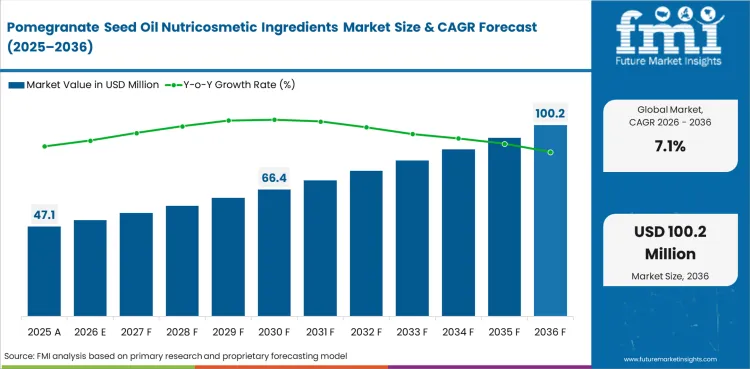
The pomegranate seed oil nutricosmetic ingredients market was valued at USD 44 million in 2025. Industry valuation is estimated at USD 47.1 million in 2026 and USD 93.2 million by 2036, at a CAGR of 7.1% over the forecast period, creating an incremental opportunity of USD 46.1 million.
Summary of Pomegranate Seed Oil Nutricosmetic Ingredients Market
- The market is forecast to reach USD 93.2 million by 2036.
- The market is expected to grow at a 7.1% CAGR from 2026 to 2036.
- The market was estimated at USD 44 million in 2025.
- The forecast period represents an incremental opportunity of USD 46.1 million.
- Liquid oil is expected to account for 56% of the form segment in 2026.
- Conventional material is likely to represent 64% share in 2026.
- Cold-pressed extraction is projected to contribute 62% share in 2026.
- Skin supplements are anticipated to contribute 38% of market share in 2026.
- B2B ingredients are expected to account for 71% share in 2026.
Key Takeaways, Market Size, and Forecast
- Pomegranate Seed Oil Nutricosmetic Ingredients Market is projected to increase from USD 47.1 million in 2026 to USD 93.2 million by 2036, at a CAGR of 7.1%.
- The pomegranate seed oil nutricosmetic ingredients market was valued at USD 44 million in 2025.
- By 2036, the Pomegranate Seed Oil Nutricosmetic Ingredients Market is expected to be worth USD 93.2 million.
- Between 2026 and 2036, the market is anticipated to expand at a CAGR of 7.1%.
- The market is projected to create an incremental opportunity of USD 46.1 million during the study period.
- In 2026, Liquid oil is expected to account for 56.0% of the form segment.
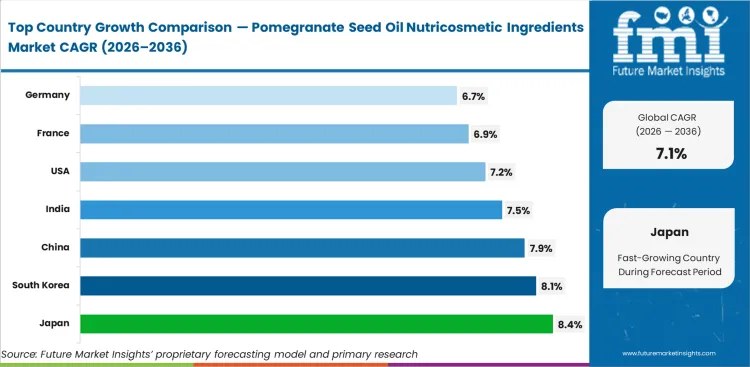
- Japan (8.4%) and South Korea (8.1%) are two of the fastest growing markets.
Pomegranate Seed Oil Nutricosmetic Ingredients Market Key Takeaways
| Parameter | Details |
|---|---|
| Market value (2026) | USD 47.1 million |
| Forecast value (2036) | USD 93.2 million |
| CAGR (2026 to 2036) | 7.1% |
| Estimated market value (2025) | USD 44 million |
| Incremental opportunity | USD 46.1 million |
| Leading form | Liquid oil (56% of form segment) |
| Leading nature | Conventional (64% of nature segment) |
| Leading extraction | Cold pressed (62% of extraction segment) |
| Leading application | Skin supplements (38% of application segment) |
| Leading sales channel | B2B ingredients (71% of sales channel segment) |
| Key players | Gan Shmuel Foods Ltd., SOPHIM, Botanic Innovations, New Directions Aromatics, Jedwards International, Medikonda Nutrients, Aromaaz International |
Source: Future Market Insights analysis, based on proprietary forecasting model and primary research.
Commercial acceptance depend on contract manufacturers being able to validate a stable fatty acid profile in an ingestible format. Punicic acid concentration is becoming a practical benchmark in premium skin-health products rather than a secondary label point. Purity, shelf-life control, and repeatable batch quality matter more in supplier selection. This is making the oil part of the core specification set for premium botanical actives, alongside demand seen in Botanical Extracts and Dietary Supplements.
Japan remains the leading country in the current industry outlook and is projected to expand at a 8.4% CAGR through 2036. South Korea follows at 8.1%. China is expected to advance at 7.9%. India is likely to record 7.5%. The United States is projected at 7.2%. France is expected at 6.9% and Germany at 6.7%. These differences reflect variation in ingestible beauty maturity, botanical ingredient acceptance, and local processing depth.
Pomegranate Seed Oil Nutricosmetic Ingredients Market Definition
The pomegranate seed oil nutricosmetic ingredients market includes seed-oil-based ingredients rich in punicic acid used in ingestible beauty formulations for skin health, hair support. The market covers ingredient-grade supply and excludes finished skincare, finished supplements, or broader pomegranate derivative categories.
Pomegranate Seed Oil Nutricosmetic Ingredients Market Inclusions
Market scope includes liquid oil, softgel-fill formats, and powdered oil. It also covers segmentation by nature, extraction route, application, sales channel, and region. Ingredient sales used in skin supplements, hair supplements, topical actives, and other premium wellness formulations based on pomegranate seed oil. This category connects with the broader Botanical Supplements space, though it remains narrower because it is built around beauty-from-within use rather than general wellness supplementation.
Pomegranate Seed Oil Nutricosmetic Ingredients Market Exclusions
The scope excludes finished skincare products, pomegranate juice concentrates, peel-only extracts, and non-seed pomegranate derivatives. Broader botanical oils are excluded when they are not marketed as pomegranate seed oil nutricosmetic ingredients.
Pomegranate Seed Oil Nutricosmetic Ingredients Market Research Methodology
- Primary Research: FMI analysis uses discussions with ingredient suppliers, formulation stakeholders, and companies active in botanical sourcing and oral beauty development.
- Desk Research: Review includes technical literature, category documents, ingredient composition studies, and public sources relevant to pomegranate seed oil extraction, stability, and market use.
- Market Sizing and Forecasting: Baseline values were developed from ingredient demand patterns and segment-level use of supplement-grade pomegranate seed oil, with forecasts extended through 2036 based on application growth and country-level adoption patterns.
- Data Validation and Update Cycle: Forecasts were validated using sourcing conditions, formulation requirements, and market readiness across regional markets.
Why is the Pomegranate Seed Oil Nutricosmetic Ingredients Market Growing?
- Skin-focused ingestible beauty concepts are increasing demand for oils that can support a stronger functional claim than standard carrier lipids.
- Buyers are placing more value on fatty acid stability, oxidation control, and cleaner extraction narratives when they approve botanical inputs.
- B2B ingredient trade remains the main commercial route because most volumes still enter the market through formulation and manufacturing intermediaries.
Brands want ingredients that support a clearer oral beauty story. Pomegranate seed oil does that well when punicic acid content is stable and the oil performance reliably in production. Manufacturers need an ingredient that can pass qualification, work well in softgels or blends, and support premium pricing with credible technical backing. This matches the wider move toward organic cosmetics where ingredient validation and process discipline carry more importance.
Commercial traction depends on protecting oil quality from raw seed handling through finished ingredient supply. Moisture in fresh seed material, oxidation after extraction, and inconsistency in post-press handling can reduce final ingredient quality quickly. Brands that secure reliable extraction and stronger storage control are better placed to make this oil part of the core specification set in premium skin-health concepts.
Segmental Analysis
Key Facts About Segments
- Liquid oil is expected to command 56% of the form segment in 2026 because bulk ingredient trade still starts with fluid oil before downstream encapsulation or blending.
- Conventional grades are projected to hold 64% of the nature segment in 2026, supported by better availability and lower sourcing cost than organic routes.
- Cold-pressed extraction is likely to represent 62% of the extraction segment in 2026 as buyers continue to favor minimal-processing claims.
- Skin supplements are anticipated to contribute 38% of market share in 2026 because they align more closely with anti-aging and hydration claims.
- B2B ingredients are expected to account for 71% of the sales channel segment in 2026 because most commercial volume moves through formulation and manufacturing intermediaries.
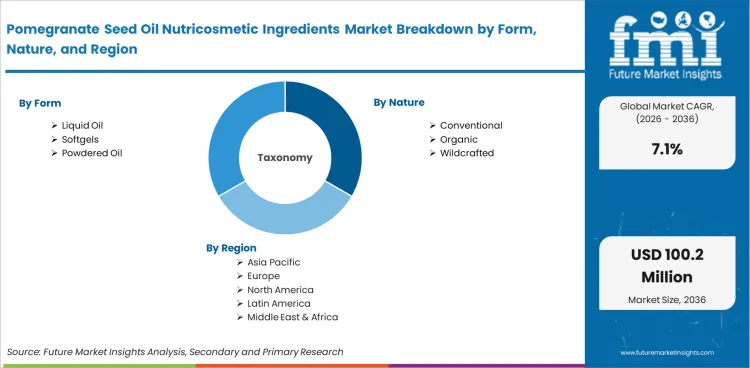
The market is segmented by form, nature, extraction, application, sales channel, and region. By form, it is divided into liquid oil, softgels, and powdered oil. By nature, the market is classified into conventional, organic, and wildcrafted. By extraction, it includes cold pressed, supercritical CO2, and solvent extracted. By application, the market covers skin supplements, hair supplements, and topical actives. By sales channel, it is segmented into B2B ingredients, private label, and direct retail.
Insights into the Liquid Oil Form Segment
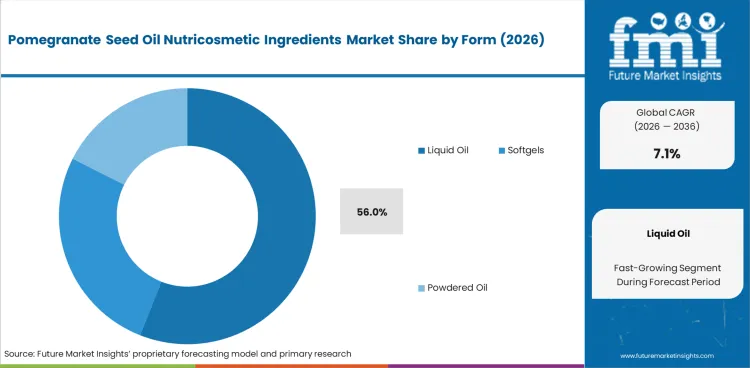
Liquid oil is projected to hold 56% share of the form segment in 2026. Most ingredient supply enters the market first as bulk oil before encapsulation or blended into finished delivery systems. Manufacturers also prefer the format when they want to preserve the original lipid profile and avoid additional drying steps that can raise cost or stability risk. This keeps liquid formats relevant even as more refined beauty concepts expand in the wider USA Nutricosmetics space.
Insights into the Conventional Nature Segment
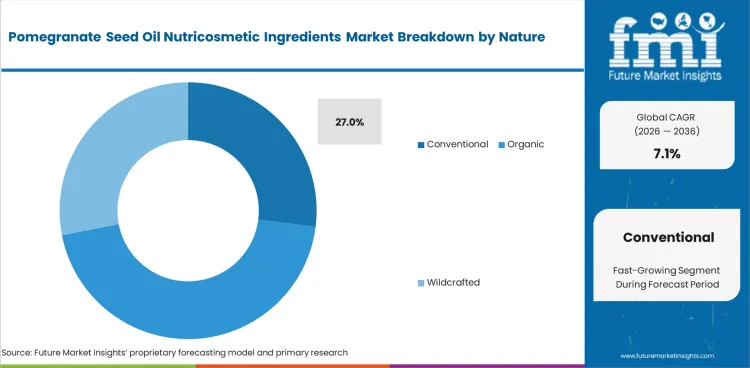
Conventional material is expected to secure 27% share in 2026. Wider orchard access, more dependable volume flow, and better pricing support this lead in a market that still depends on supply continuity. Organic supply supports premium positioning, though conventional routes usually offer stronger volume confidence. Manufacturers running larger programs often choose sourcing models that reduce cost pressure and protect lead times before moving into higher-cost certified routes.
Insights into the Cold-Pressed Extraction Segment
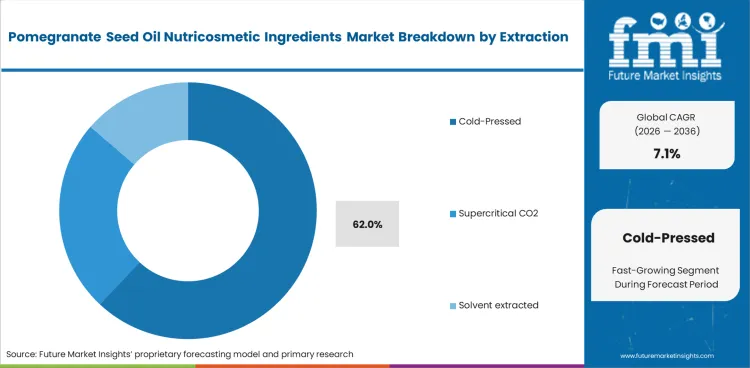
Cold-pressed extraction is likely to represent 62% of the market in 2026. Minimal-processing claims support this lead because they fit premium ingestible beauty positioning and help suppliers avoid solvent-related concerns in documentation and marketing. Yield can be lower than in more intensive extraction routes. Many manufacturers accept that trade-off when purity, positioning, and formulation fit matter more than maximum oil recovery.
Insights into the Skin Supplements Application Segment
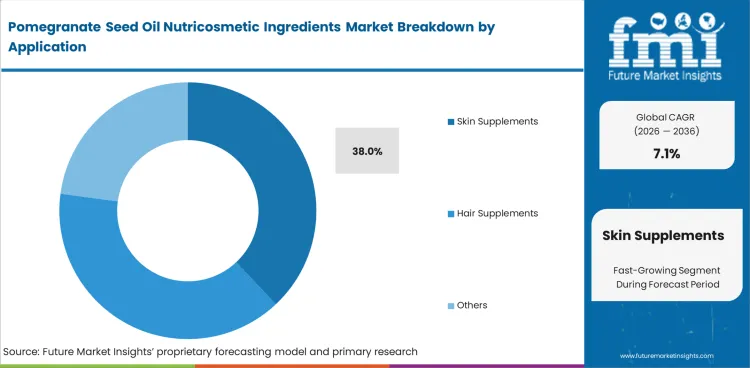
Skin supplements are expected to hold 38% of total market share in 2026. Demand is strongest in this segment because pomegranate seed oil supports hydration, antioxidant, and skin-renewal positioning. This gives formulators a more focused commercial route than in broader wellness applications, where the ingredient story can become less clear. Repeat purchase depends on adherence, delivery format, and communication quality, though skin supplements remain the strongest application for this ingredient.
Insights into the B2B Ingredients Sales Channel Segment
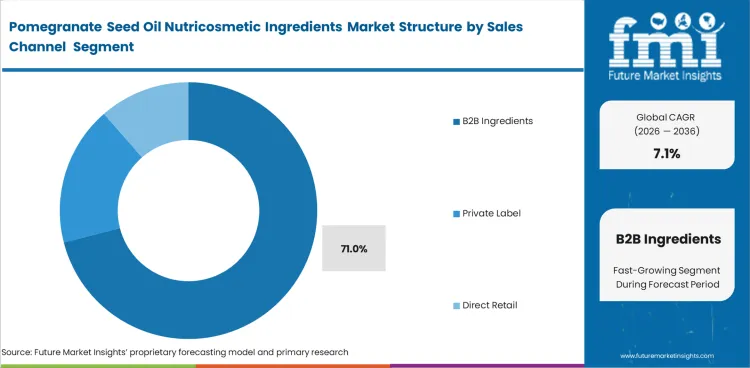
B2B ingredients are projected to account for 71% share in 2026. Most volumes move through ingredient supply chains because formulators, contract manufacturers, and private-label operators still control commercialization. Qualification documents, fatty acid assay consistency, and batch appearance all matter in this channel. Suppliers that meet these requirements are more likely to secure repeat programs and larger contract volumes.
What are the Drivers, Restraints, and Key Trends of the Pomegranate Seed Oil Nutricosmetic Ingredients Market?
- Ingestible beauty demand is creating stronger need for standardized pomegranate seed oil with a stable punicic acid profile.
- Seed drying discipline, oxidation risk, and extraction yield limits continue to restrict supply flexibility.
- Microencapsulation, hybrid ingredient blends, and upcycled sourcing models are opening new product development routes.
The market is expanding as oral beauty products require more technical depth in their ingredient story. Manufacturers want clearer composition control, better formulation fit, and stronger shelf-life performance before a botanical oil is used in premium products. Qualification standards stay high. Processors that combine raw material access with tighter manufacturing control and cleaner product documentation are better placed in this market.
Clinical Positioning and Premium Oral Beauty Demand
Brands are placing more focus on ingestible beauty because premium programs now expect more than topical positioning alone. Pomegranate seed oil fits this shift because it supports antioxidant and skin-health positioning in oral formats. Demand grows fastest where brands tie the ingredient to a clear efficacy concept and support it with reliable delivery performance.
Moisture Control, Oxidation, and Extraction Yield Pressure
Fresh seed handling is a major operating challenge. Post-juice seed material carries high moisture and can spoil quickly if drying is delayed. This makes supply harder to scale in regions without nearby processing. Oxidation creates more pressure after extraction, especially when the oil is intended for longer shelf life in ingestible products. Cold pressing supports premium positioning, though lower yield and tighter process control keep cost pressure in place.
Microencapsulation, Hybrid Blends, and Upcycled Sourcing
New opportunity is growing around better stabilization systems and more flexible formulation design. Microencapsulation can improve digestive survivability and wider application options. Hybrid blends with collagen or tocopherols can strengthen product positioning. Upcycled seed sourcing from juice-processing streams can improve raw material economics when processors control handling quality from the start.
Analysis of Pomegranate Seed Oil Nutricosmetic Ingredients Market by Key Countries
Key Facts About Country
- Japan leads tracked markets with 8.4% CAGR through 2036, supported by stronger acceptance of premium ingestible beauty products.
- South Korea follows at 8.1%, driven by rapid product development and dense innovation in beauty supplement routines.
- China is projected to expand at 7.9%, supported by processing depth and a large domestic demand base.
- India records 7.5%, the United States 7.2%, France 6.9%, and Germany 6.7%, reflecting different conditions around raw material access, certification, and premium botanical adoption.
.webp "Top Country Growth Comparison Pomegranate Seed Oil Nutricosmetic Ingredients Market Cagr (2026 2036)")
| Country | CAGR (2026 to 2036) |
|---|---|
| Japan | 8.4% |
| South Korea | 8.1% |
| China | 7.9% |
| India | 7.5% |
| United States | 7.2% |
| France | 6.9% |
| Germany | 6.7% |
Source: Future Market Insights analysis, based on proprietary forecasting model and primary research.
Demand Outlook for Pomegranate Seed Oil Nutricosmetic Ingredients Market in India
India is projected to grow at a 7.5% CAGR through 2036. The market benefits from local pomegranate availability, which gives processors a stronger raw material base and better control over sourcing cost. Shorter movement between collection and extraction also helps preserve oil quality before handling losses weaken composition. India’s position improves further as ingredient suppliers build stronger traceability and supply discipline for premium nutricosmetic applications.
- Local fruit availability supports more stable feedstock access.
- Shorter sourcing chains improve cost control and handling quality.
- Better traceability strengthens appeal for premium applications.
Future Outlook for Pomegranate Seed Oil Nutricosmetic Ingredients Market in China
China is expected to expand at a 7.9% CAGR through 2036. Local processing depth and broader ingredient-manufacturing capability support its supply in position. Domestic extraction capacity gives manufacturers better control over lead times and procurement planning, which matters in a market where oxidation control and consistency affect ingredient approval. Commercial value in China comes from both demand scale and the ability to support larger-volume supply programs.
- Local processing depth improves supply flexibility.
- Domestic manufacturing supports better lead-time control.
- Scale and production capability strengthen market position.
Opportunity Analysis of Pomegranate Seed Oil Nutricosmetic Ingredients Market in the United States
The United States is projected to record a 7.2% CAGR through 2036. Demand is supported by clean-label preference and stronger interest in differentiated natural actives across supplement and beauty-wellness products. Manufacturers evaluate extraction route, documentation quality, and formulation readiness closely, since premium botanical oils must support both technical fit and commercial story. Suppliers with better technical support and steadier supply are more likely to secure recurring business in this market.
- Clean-label demand is widening interest in specialty botanical oils.
- Technical documentation matters before routine formulation use.
- Stable supply and stronger support improve buyer confidence.
In-depth Analysis of Pomegranate Seed Oil Nutricosmetic Ingredients Market in Germany
Germany is projected to grow at a 6.7% CAGR through 2036. The market is quality-led, with stronger attention on documentation, sourcing discipline, and formulation reliability. Manufacturers place more value on verified quality and cleaner supply routes, which raises the importance of supplier qualification. Commercial demand remains steady where processors and distributors can meet tighter expectations around consistency and technical assurance.
- Verified quality carries more weight in supplier selection.
- Tighter sourcing expectations raise qualification pressure.
- Reliable technical assurance supports steady premium demand.
In-depth Analysis of Pomegranate Seed Oil Nutricosmetic Ingredients Market in South Korea
South Korea is expected to register an 8.1% CAGR through 2036. The market is shaped by fast product development and dense innovation in premium beauty supplement routines. Formulators give close attention to delivery format, ingredient compatibility, and product distinction, which helps specialized oils gain traction when stability is proven. Commercial success depends on formulation fit and technical relevance within advanced beauty-from-within concepts more than on bulk scale.
- Fast innovation cycles support specialty ingredient adoption.
- Delivery format compatibility influences formulation choice.
- Premium beauty routines create room for differentiated oils.
Sales Analysis of Pomegranate Seed Oil Nutricosmetic Ingredients Market in Japan
Japan is projected to grow at an 8.4% CAGR from 2026 to 2036. The market benefits from a more established ingestible beauty culture, where scientifically positioned oral hydration and skin-health products already have stronger acceptance. Manufacturers place strong emphasis on product quality, composition consistency, and premium formulation discipline. This keeps demand focused on suppliers that can deliver stable oil quality and credible technical backing.
- Established oral beauty routines support stronger demand.
- Buyers value stable composition and premium quality.
- Technical credibility improves supplier positioning.
Demand Outlook for Pomegranate Seed Oil Nutricosmetic Ingredients Market in France
France is expected to expand at a 6.9% CAGR through 2036. Demand is supported by strong experience in natural beauty formulation and a premium positioning model that adapts well to selected ingestible concepts. Formulators respond better to ingredients that combine a clean sourcing story with technical support and formulation fit. Organic and well-documented botanical inputs remain relevant here, although the demand stays selective and quality-driven.
- Natural beauty expertise supports ingredient adoption.
- Premium formulation logic favors cleaner botanical inputs.
- Technical support improves positioning in selective programs.
Competitive Landscape of Pomegranate Seed Oil Nutricosmetic Ingredients Market
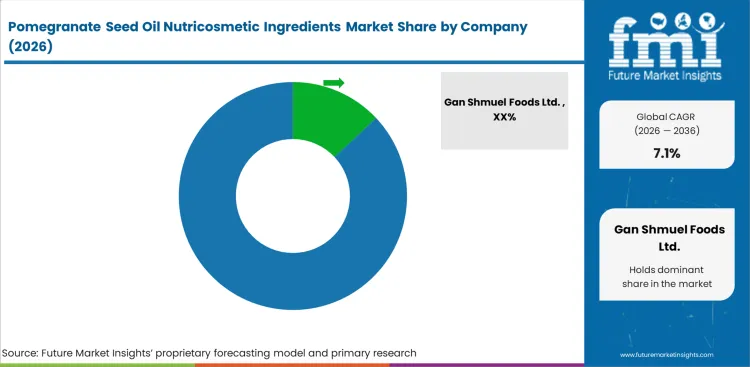
- Competition remains fragmented, which creates room for regional processors and formulation-focused ingredient suppliers.
- The market is shaped by raw material traceability, cold-pressed positioning, documentation quality, and the ability to serve both supplement and cosmetic formulation demand from the same ingredient platform.
- Manufacturesr prefer suppliers that combine batch consistency, technical support, and commercial flexibility, as qualification standards remains high in premium ingestible beauty applications.
The pomegranate seed oil nutricosmetic ingredients market remains fragmented because supplier strength depends on more than access to raw material. Manufacturers assess oxidative stability, documentation standards, and whether the ingredient can move through commercial formulation without avoidable disruption. Large processors and established ingredient suppliers hold an advantage when they combine orchard access, extraction discipline, and repeatable batch quality within one supply model.
Competitive position depends on how well suppliers support qualification. Stability data, chain-of-custody records, and consistent fatty acid profile matter more when brands are defending premium positioning in ingestible beauty products. Mid-tier manufacturers are often reluctant to rely on a single supplier, which creates room for companies that offer responsive lead times, flexible pack formats, and stronger technical coordination during formulation approval.
Major Industry Players
Key global companies leading the pomegranate seed oil nutricosmetic ingredients market include:
- Gan Shmuel Foods Ltd., SOPHIM, Botanic Innovations, and New Directions Aromatics are among the leading participants due to their stronger botanical oil portfolios, better ingredient positioning in premium beauty and wellness channels, and broader ability to serve buyers looking for stable pomegranate seed oil inputs with clearer quality support.
- Jedwards International, Inc. / Bulk Natural Oils, Medikonda Nutrients, and Aromaaz International retain competitive relevance through bulk supply capability, regional distribution reach, and their ability to support selected ingredient programs that require flexible sourcing and practical formulation alignment.
- Smaller and specialized suppliers continue to participate where niche botanical positioning, lower-volume customization, or closer coordination with private-label and contract manufacturing buyers creates room in a still-fragmented market.
Competitive Benchmarking: Pomegranate Seed Oil Nutricosmetic Ingredients Market
| Company | Product Breadth | Traceability & Documentation | Bulk Ingredient Supply | Nutricosmetic Formulation Fit |
|---|---|---|---|---|
| Gan Shmuel Foods Ltd. | High | High | Strong | Medium |
| SOPHIM | Medium | High | Moderate | High |
| Botanic Innovations | Medium | Medium | Moderate | High |
| New Directions Aromatics | High | Medium | Strong | Medium |
| Jedwards International, Inc. / Bulk Natural Oils | Medium | Medium | Strong | Medium |
| Medikonda Nutrients | Medium | Medium | Moderate | Medium |
| Aromaaz International | Medium | Medium | Moderate | Medium |
Source: Future Market Insights competitive analysis, 2026.
Recent Developments in Pomegranate Seed Oil Nutricosmetic Ingredients Market
- In April 2024: SOPHIM acquired Novastell, expanding from cosmetic ingredients into nutritional and functional ingredients and strengthening its position in the nutricosmetic ingredient space.
- In December 2025: Jedwards International expanded its specialty ingredient portfolio by adding more than 20 new products and raw materials, including additional organic and conventional variants.
Key Players in the Pomegranate Seed Oil Nutricosmetic Ingredients Market
Major Global Players
- Gan Shmuel Foods Ltd.
- SOPHIM
- Botanic Innovations
- New Directions Aromatics
- Jedwards International, Inc. / Bulk Natural Oils
Emerging Players / Specialized Suppliers
- Medikonda Nutrients
- Aromaaz International
Scope of the Report
| Metric | Value |
|---|---|
| Quantitative Units | USD 47.1 million to USD 93.2 million, at a CAGR of 7.1% |
| Market Definition | Seed-oil-based ingredients rich in punicic acid supplied for ingestible cosmetic and nutricosmetic applications targeting skin, hair, and related wellness benefits |
| Segmentation | By Form, By Nature, By Extraction, By Application, By Sales Channel, and Region |
| Regions Covered | North America, Latin America, Western Europe, Eastern Europe, and Asia Pacific |
| Countries Covered | Japan, South Korea, China, India, United States, France, Germany, and others |
| Key Companies Profiled | Gan Shmuel Foods Ltd., SOPHIM, Botanic Innovations, New Directions Aromatics, Jedwards International, Medikonda Nutrients, Aromaaz International |
| Forecast Period | 2026 to 2036 |
| Approach | Baseline established through ingredient demand patterns and commercial validation against sourcing, formulation, and processing conditions |
Source: Future Market Insights analysis, based on proprietary forecasting model and primary research.
Pomegranate Seed Oil Nutricosmetic Ingredients Market Segments Analysis
By Form
- Liquid oil
- Softgels
- Powdered oil
By Nature
- Conventional
- Organic
- Wildcrafted
By Extraction
- Cold pressed
- Supercritical CO2
- Solvent extracted
By Application
- Skin supplements
- Hair supplements
- Topical actives
By Sales Channel
- B2B ingredients
- Private label
- Direct retail
By Region
- North America
- Latin America
- Western Europe
- Eastern Europe
- Asia Pacific
Bibliography
- SOPHIM. (2024, April 23). Acquisition of Novastell by SOPHIM: A diversification in nutraceuticals. SOPHIM.
- Agricultural and Processed Food Products Export Development Authority. (2025, April 19). 14 tons of Indian pomegranates exported from Ahilyanagar in Maharashtra to New York, USA. Press Information Bureau, Government of India.
- Press Information Bureau. (2025, September 21). Seeds of the future: Clean Plant Programme gaining momentum. Government of India.
- Almoraie, M. M., Aljaghthmi, O., Khan, M. A., Assaggaf, H. M., Alhamid, S. A., Mnafgui, K., & Aljaghthmi, O. H. (2025, July 8). Foods, 14(14), 2412. Punicic acid: A Potential Nutraceutical Compound in Pomegranate Seed Oil and Its Cardiovascular Benefits.
- Ben Abdennebi, A., Ben Hsouna, A., Trigui, M., & Kchaou, H. (2025, August 25). Unlocking pomegranate’s potential: Ultrasonication-enriched oil in nanobeads for innovative cosmetic hydrogels.
This bibliography is provided for reader reference. The full FMI report contains the complete reference list with primary source documentation.
This Report Addresses
- Processing limits that affect extraction scale and ingredient stability.
- Agricultural and sourcing constraints that shape long-term raw material availability.
- Encapsulation and formulation issues linked to liquid oil stability in ingestible formats.
- Oxidation control requirements during storage and transport.
- Documentation and residue expectations in regulated markets.
- Formulation logic around punicic acid and supporting antioxidant systems.
- Buyer qualification standards in B2B ingredient channels.
- The commercial role of upcycled raw material streams and advanced delivery systems.
Frequently Asked Questions
How large is the demand for pomegranate seed oil nutricosmetic ingredients in 2026?
Demand is estimated to be valued at USD 47.1 million in 2026.
What will be the market size by 2036?
Market size is projected to reach USD 93.2 million by 2036.
What is the expected growth rate between 2026 and 2036?
The market is expected to grow at a 7.1% CAGR during the forecast period.
Which form is expected to lead by 2026?
Liquid oil is projected to lead the form segment with 56% share in 2026 because most ingredient supply still moves first as bulk oil before downstream conversion.
Which nature category is expected to stay ahead?
Conventional material is expected to lead with 64% share in 2026 due to stronger availability and lower sourcing cost than organic supply usually allows.
Which extraction route leads the market?
Cold-pressed material is forecast to represent 62% share in 2026 because buyers continue to favor minimal-processing claims and cleaner documentation.
Preview the report firsthand - request a free sample
Get SampleGet the brochure for pricing and purchase details.
Get PDFTable of Content
- Executive Summary
- Global Market Outlook
- Demand-side Trends
- Supply-side Trends
- Technology Roadmap Analysis
- Analysis and Recommendations
- Market Overview
- Market Coverage / Taxonomy
- Market Definition / Scope / Limitations
- Research Methodology
- Chapter Orientation
- Analytical Lens and Working Hypotheses
- Market Structure, Signals, and Trend Drivers
- Benchmarking and Cross-market Comparability
- Market Sizing, Forecasting, and Opportunity Mapping
- Research Design and Evidence Framework
- Desk Research Programme (Secondary Evidence)
- Company Annual and Sustainability Reports
- Peer-reviewed Journals and Academic Literature
- Corporate Websites, Product Literature, and Technical Notes
- Earnings Decks and Investor Briefings
- Statutory Filings and Regulatory Disclosures
- Technical White Papers and Standards Notes
- Trade Journals, Industry Magazines, and Analyst Briefs
- Conference Proceedings, Webinars, and Seminar Materials
- Government Statistics Portals and Public Data Releases
- Press Releases and Reputable Media Coverage
- Specialist Newsletters and Curated Briefings
- Sector Databases and Reference Repositories
- FMI Internal Proprietary Databases and Historical Market Datasets
- Subscription Datasets and Paid Sources
- Social Channels, Communities, and Digital Listening Inputs
- Additional Desk Sources
- Expert Input and Fieldwork (Primary Evidence)
- Primary Modes
- Qualitative Interviews and Expert Elicitation
- Quantitative Surveys and Structured Data Capture
- Blended Approach
- Why Primary Evidence is Used
- Field Techniques
- Interviews
- Surveys
- Focus Groups
- Observational and In-context Research
- Social and Community Interactions
- Stakeholder Universe Engaged
- C-suite Leaders
- Board Members
- Presidents and Vice Presidents
- R&D and Innovation Heads
- Technical Specialists
- Domain Subject-matter Experts
- Scientists
- Physicians and Other Healthcare Professionals
- Governance, Ethics, and Data Stewardship
- Research Ethics
- Data Integrity and Handling
- Primary Modes
- Tooling, Models, and Reference Databases
- Desk Research Programme (Secondary Evidence)
- Data Engineering and Model Build
- Data Acquisition and Ingestion
- Cleaning, Normalisation, and Verification
- Synthesis, Triangulation, and Analysis
- Quality Assurance and Audit Trail
- Market Background
- Market Dynamics
- Drivers
- Restraints
- Opportunity
- Trends
- Scenario Forecast
- Demand in Optimistic Scenario
- Demand in Likely Scenario
- Demand in Conservative Scenario
- Opportunity Map Analysis
- Product Life Cycle Analysis
- Supply Chain Analysis
- Investment Feasibility Matrix
- Value Chain Analysis
- PESTLE and Porter’s Analysis
- Regulatory Landscape
- Regional Parent Market Outlook
- Production and Consumption Statistics
- Import and Export Statistics
- Market Dynamics
- Global Market Analysis 2021 to 2025 and Forecast, 2026 to 2036
- Historical Market Size Value (USD Million) Analysis, 2021 to 2025
- Current and Future Market Size Value (USD Million) Projections, 2026 to 2036
- Y-o-Y Growth Trend Analysis
- Absolute $ Opportunity Analysis
- Global Market Pricing Analysis 2021 to 2025 and Forecast 2026 to 2036
- Global Market Analysis 2021 to 2025 and Forecast 2026 to 2036, By Form
- Introduction / Key Findings
- Historical Market Size Value (USD Million) Analysis By Form , 2021 to 2025
- Current and Future Market Size Value (USD Million) Analysis and Forecast By Form , 2026 to 2036
- Liquid Oil
- Softgels
- Powdered Oil
- Liquid Oil
- Y-o-Y Growth Trend Analysis By Form , 2021 to 2025
- Absolute $ Opportunity Analysis By Form , 2026 to 2036
- Global Market Analysis 2021 to 2025 and Forecast 2026 to 2036, By Nature
- Introduction / Key Findings
- Historical Market Size Value (USD Million) Analysis By Nature, 2021 to 2025
- Current and Future Market Size Value (USD Million) Analysis and Forecast By Nature, 2026 to 2036
- Conventional
- Organic
- Wildcrafted
- Conventional
- Y-o-Y Growth Trend Analysis By Nature, 2021 to 2025
- Absolute $ Opportunity Analysis By Nature, 2026 to 2036
- Global Market Analysis 2021 to 2025 and Forecast 2026 to 2036, By Extraction
- Introduction / Key Findings
- Historical Market Size Value (USD Million) Analysis By Extraction, 2021 to 2025
- Current and Future Market Size Value (USD Million) Analysis and Forecast By Extraction, 2026 to 2036
- Cold-Pressed
- Supercritical CO2
- Solvent extracted
- Cold-Pressed
- Y-o-Y Growth Trend Analysis By Extraction, 2021 to 2025
- Absolute $ Opportunity Analysis By Extraction, 2026 to 2036
- Global Market Analysis 2021 to 2025 and Forecast 2026 to 2036, By Application
- Introduction / Key Findings
- Historical Market Size Value (USD Million) Analysis By Application, 2021 to 2025
- Current and Future Market Size Value (USD Million) Analysis and Forecast By Application, 2026 to 2036
- Skin Supplements
- Hair Supplements
- Others
- Skin Supplements
- Y-o-Y Growth Trend Analysis By Application, 2021 to 2025
- Absolute $ Opportunity Analysis By Application, 2026 to 2036
- Global Market Analysis 2021 to 2025 and Forecast 2026 to 2036, By Sales Channel
- Introduction / Key Findings
- Historical Market Size Value (USD Million) Analysis By Sales Channel, 2021 to 2025
- Current and Future Market Size Value (USD Million) Analysis and Forecast By Sales Channel, 2026 to 2036
- B2B Ingredients
- Private Label
- Direct Retail
- B2B Ingredients
- Y-o-Y Growth Trend Analysis By Sales Channel, 2021 to 2025
- Absolute $ Opportunity Analysis By Sales Channel, 2026 to 2036
- Global Market Analysis 2021 to 2025 and Forecast 2026 to 2036, By Region
- Introduction
- Historical Market Size Value (USD Million) Analysis By Region, 2021 to 2025
- Current Market Size Value (USD Million) Analysis and Forecast By Region, 2026 to 2036
- North America
- Latin America
- Western Europe
- Eastern Europe
- East Asia
- South Asia and Pacific
- Middle East & Africa
- Market Attractiveness Analysis By Region
- North America Market Analysis 2021 to 2025 and Forecast 2026 to 2036, By Country
- Historical Market Size Value (USD Million) Trend Analysis By Market Taxonomy, 2021 to 2025
- Market Size Value (USD Million) Forecast By Market Taxonomy, 2026 to 2036
- By Country
- USA
- Canada
- Mexico
- By Form
- By Nature
- By Extraction
- By Application
- By Sales Channel
- By Country
- Market Attractiveness Analysis
- By Country
- By Form
- By Nature
- By Extraction
- By Application
- By Sales Channel
- Key Takeaways
- Latin America Market Analysis 2021 to 2025 and Forecast 2026 to 2036, By Country
- Historical Market Size Value (USD Million) Trend Analysis By Market Taxonomy, 2021 to 2025
- Market Size Value (USD Million) Forecast By Market Taxonomy, 2026 to 2036
- By Country
- Brazil
- Chile
- Rest of Latin America
- By Form
- By Nature
- By Extraction
- By Application
- By Sales Channel
- By Country
- Market Attractiveness Analysis
- By Country
- By Form
- By Nature
- By Extraction
- By Application
- By Sales Channel
- Key Takeaways
- Western Europe Market Analysis 2021 to 2025 and Forecast 2026 to 2036, By Country
- Historical Market Size Value (USD Million) Trend Analysis By Market Taxonomy, 2021 to 2025
- Market Size Value (USD Million) Forecast By Market Taxonomy, 2026 to 2036
- By Country
- Germany
- UK
- Italy
- Spain
- France
- Nordic
- BENELUX
- Rest of Western Europe
- By Form
- By Nature
- By Extraction
- By Application
- By Sales Channel
- By Country
- Market Attractiveness Analysis
- By Country
- By Form
- By Nature
- By Extraction
- By Application
- By Sales Channel
- Key Takeaways
- Eastern Europe Market Analysis 2021 to 2025 and Forecast 2026 to 2036, By Country
- Historical Market Size Value (USD Million) Trend Analysis By Market Taxonomy, 2021 to 2025
- Market Size Value (USD Million) Forecast By Market Taxonomy, 2026 to 2036
- By Country
- Russia
- Poland
- Hungary
- Balkan & Baltic
- Rest of Eastern Europe
- By Form
- By Nature
- By Extraction
- By Application
- By Sales Channel
- By Country
- Market Attractiveness Analysis
- By Country
- By Form
- By Nature
- By Extraction
- By Application
- By Sales Channel
- Key Takeaways
- East Asia Market Analysis 2021 to 2025 and Forecast 2026 to 2036, By Country
- Historical Market Size Value (USD Million) Trend Analysis By Market Taxonomy, 2021 to 2025
- Market Size Value (USD Million) Forecast By Market Taxonomy, 2026 to 2036
- By Country
- China
- Japan
- South Korea
- By Form
- By Nature
- By Extraction
- By Application
- By Sales Channel
- By Country
- Market Attractiveness Analysis
- By Country
- By Form
- By Nature
- By Extraction
- By Application
- By Sales Channel
- Key Takeaways
- South Asia and Pacific Market Analysis 2021 to 2025 and Forecast 2026 to 2036, By Country
- Historical Market Size Value (USD Million) Trend Analysis By Market Taxonomy, 2021 to 2025
- Market Size Value (USD Million) Forecast By Market Taxonomy, 2026 to 2036
- By Country
- India
- ASEAN
- Australia & New Zealand
- Rest of South Asia and Pacific
- By Form
- By Nature
- By Extraction
- By Application
- By Sales Channel
- By Country
- Market Attractiveness Analysis
- By Country
- By Form
- By Nature
- By Extraction
- By Application
- By Sales Channel
- Key Takeaways
- Middle East & Africa Market Analysis 2021 to 2025 and Forecast 2026 to 2036, By Country
- Historical Market Size Value (USD Million) Trend Analysis By Market Taxonomy, 2021 to 2025
- Market Size Value (USD Million) Forecast By Market Taxonomy, 2026 to 2036
- By Country
- Kingdom of Saudi Arabia
- Other GCC Countries
- Turkiye
- South Africa
- Other African Union
- Rest of Middle East & Africa
- By Form
- By Nature
- By Extraction
- By Application
- By Sales Channel
- By Country
- Market Attractiveness Analysis
- By Country
- By Form
- By Nature
- By Extraction
- By Application
- By Sales Channel
- Key Takeaways
- Key Countries Market Analysis
- USA
- Pricing Analysis
- Market Share Analysis, 2025
- By Form
- By Nature
- By Extraction
- By Application
- By Sales Channel
- Canada
- Pricing Analysis
- Market Share Analysis, 2025
- By Form
- By Nature
- By Extraction
- By Application
- By Sales Channel
- Mexico
- Pricing Analysis
- Market Share Analysis, 2025
- By Form
- By Nature
- By Extraction
- By Application
- By Sales Channel
- Brazil
- Pricing Analysis
- Market Share Analysis, 2025
- By Form
- By Nature
- By Extraction
- By Application
- By Sales Channel
- Chile
- Pricing Analysis
- Market Share Analysis, 2025
- By Form
- By Nature
- By Extraction
- By Application
- By Sales Channel
- Germany
- Pricing Analysis
- Market Share Analysis, 2025
- By Form
- By Nature
- By Extraction
- By Application
- By Sales Channel
- UK
- Pricing Analysis
- Market Share Analysis, 2025
- By Form
- By Nature
- By Extraction
- By Application
- By Sales Channel
- Italy
- Pricing Analysis
- Market Share Analysis, 2025
- By Form
- By Nature
- By Extraction
- By Application
- By Sales Channel
- Spain
- Pricing Analysis
- Market Share Analysis, 2025
- By Form
- By Nature
- By Extraction
- By Application
- By Sales Channel
- France
- Pricing Analysis
- Market Share Analysis, 2025
- By Form
- By Nature
- By Extraction
- By Application
- By Sales Channel
- India
- Pricing Analysis
- Market Share Analysis, 2025
- By Form
- By Nature
- By Extraction
- By Application
- By Sales Channel
- ASEAN
- Pricing Analysis
- Market Share Analysis, 2025
- By Form
- By Nature
- By Extraction
- By Application
- By Sales Channel
- Australia & New Zealand
- Pricing Analysis
- Market Share Analysis, 2025
- By Form
- By Nature
- By Extraction
- By Application
- By Sales Channel
- China
- Pricing Analysis
- Market Share Analysis, 2025
- By Form
- By Nature
- By Extraction
- By Application
- By Sales Channel
- Japan
- Pricing Analysis
- Market Share Analysis, 2025
- By Form
- By Nature
- By Extraction
- By Application
- By Sales Channel
- South Korea
- Pricing Analysis
- Market Share Analysis, 2025
- By Form
- By Nature
- By Extraction
- By Application
- By Sales Channel
- Russia
- Pricing Analysis
- Market Share Analysis, 2025
- By Form
- By Nature
- By Extraction
- By Application
- By Sales Channel
- Poland
- Pricing Analysis
- Market Share Analysis, 2025
- By Form
- By Nature
- By Extraction
- By Application
- By Sales Channel
- Hungary
- Pricing Analysis
- Market Share Analysis, 2025
- By Form
- By Nature
- By Extraction
- By Application
- By Sales Channel
- Kingdom of Saudi Arabia
- Pricing Analysis
- Market Share Analysis, 2025
- By Form
- By Nature
- By Extraction
- By Application
- By Sales Channel
- Turkiye
- Pricing Analysis
- Market Share Analysis, 2025
- By Form
- By Nature
- By Extraction
- By Application
- By Sales Channel
- South Africa
- Pricing Analysis
- Market Share Analysis, 2025
- By Form
- By Nature
- By Extraction
- By Application
- By Sales Channel
- USA
- Market Structure Analysis
- Competition Dashboard
- Competition Benchmarking
- Market Share Analysis of Top Players
- By Regional
- By Form
- By Nature
- By Extraction
- By Application
- By Sales Channel
- Competition Analysis
- Competition Deep Dive
- Gan Shmuel Foods Ltd.
- Overview
- Product Portfolio
- Profitability by Market Segments (Product/Age /Sales Channel/Region)
- Sales Footprint
- Strategy Overview
- Marketing Strategy
- Product Strategy
- Channel Strategy
- SOPHIM
- Botanic Innovations
- New Directions Aromatics
- Jedwards International, Inc. / Bulk Natural Oils
- Medikonda Nutrients
- Aromaaz International
- Gan Shmuel Foods Ltd.
- Competition Deep Dive
- Assumptions & Acronyms Used


