

- Industry Size (2026)
- USD 218.1 Mn
- Forecast (2036)
- USD 429.0 Mn
- CAGR (2026 to 2036)
- 7.0%
Marigold Essential Oil Market Size, Market Forecast and Outlook By FMI
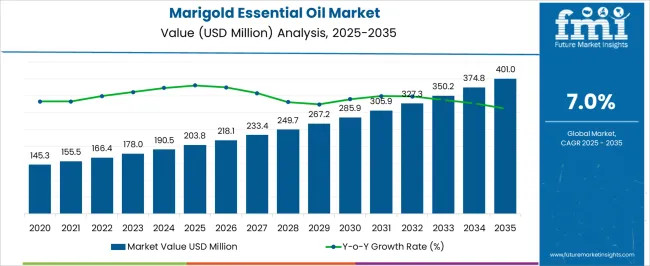
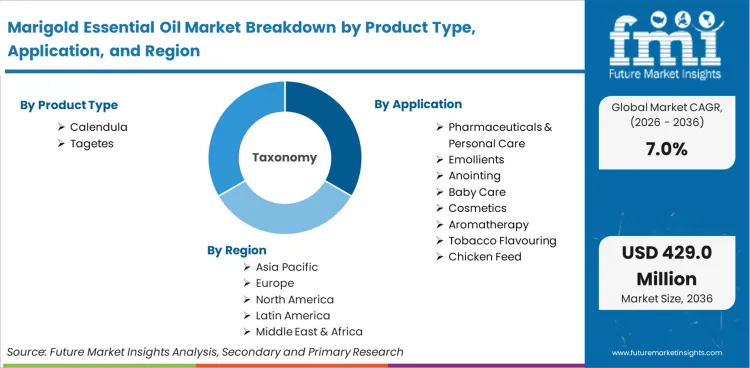
In 2025, the marigold essential oil market was valued at USD 203.8 million. Based on Future Market Insights' analysis, demand for marigold essential oil is estimated to grow to USD 218.1 million in 2026 and USD 429.0 million by 2036. FMI projects a CAGR of 7.0% during the forecast period.
Absolute dollar growth of USD 210.9 million over the decade reflects the market's transition from a fragrance and personal care supporting ingredient to a multi-channel bioactive with documented antioxidant and antimicrobial function. The catalysts are structural: in July 2025, a landmark study identified 3-cyclohexene-1-methanol as a key antioxidant and antimicrobial agent within marigold bioactives, providing the scientific validation required to position marigold oil as a natural alternative to synthetic preservatives in clean-label food, beverage, and personal care formulations that has catalyzed measurable formulation adoption in 2026. [1] Simultaneously, supply chain economics are being reshaped by US and EU trade policy shifts effective January 2026, compelling manufacturers to diversify sourcing from conventional origins toward domestic cultivation in India and Mexico to control the landed cost impact of new tariff structures on imported botanical oils. [2]
Summary of Marigold Essential Oil Market
- Marigold Essential Oil Market Definition:
- The market covers volatile aromatic oil extracts from Calendula officinalis and Tagetes species, supplied for pharmaceutical and personal care formulation, cosmetics, aromatherapy, food flavoring, and agricultural feed applications, differentiated by species origin, extraction method, and bioactive concentration profile.
- Demand Drivers in the Market:
- The clean-label reformulation movement in personal care and food preservation is accelerating demand for marigold oil as a scientifically validated natural preservative, following the identification of 3-cyclohexene-1-methanol as a key antioxidant and antimicrobial agent that enables verified functional claims in product labeling.
- Supercritical CO2 extraction adoption is enabling premium-tier repositioning of marigold oil from steam-distilled generic botanical into Therapeutic Grade designation products that preserve heat-sensitive bioactive compounds, commanding higher formulation values in pharmaceutical dermatology and clinical aromatherapy channels.
- Trade policy-driven sourcing diversification effective January 2026 is expanding cultivation investment in India and Mexico as manufacturers shift procurement away from tariff-exposed origins, creating new supply infrastructure that will increase commercial availability and reduce per-unit cost over the forecast period.
- Key Segments Analyzed in the FMI Report:
- Product Type: Calendula accounts for approximately 57.6% of market share, driven by its clinically documented anti-inflammatory and skin-barrier regeneration properties that secure preferred ingredient status in pharmaceutical-grade skin care, baby care, and sensitive skin personal care formulations across both mass market and premium channels.
- Application: Pharmaceuticals and Personal Care represents the largest application at approximately 25% of demand, anchored by the use of Calendula extracts in wound care, dermatitis treatment, and sensitized skin product lines where botanical anti-inflammatory credentials are regulatory and consumer requirements.
- Distribution: Indirect Sales accounts for approximately 26% of channel volume, reflecting the B2B ingredient supply model dominant among cosmetic and pharmaceutical manufacturers who procure marigold oil through specialty ingredient distributors under specification-controlled contracts.
- Analyst Opinion at FMI:
- Nandini Roy Choudhury, Principal Consultant for Food and Beverage Industry at Future Market Insights, opines, 'In the updated version of the Marigold Essential Oil Market Report for 2026 to 2036, CXOs will find that the market's next competitive boundary is being set by extraction technology investment rather than cultivation scale. My findings indicate that suppliers who have transitioned to supercritical CO2 extraction are accessing Therapeutic Grade pricing tiers unavailable to steam distillation producers, and the bioactive compound data supporting clean-label preservative claims is now the primary differentiator in cosmetic and food ingredient procurement decisions, meaning suppliers without laboratory-grade bioactive characterization infrastructure will face accelerating margin and contract pressure from certified botanical actives producers.'
- Strategic Implications / Executive Takeaways:
- Invest in supercritical CO2 extraction infrastructure as the threshold capability for accessing Therapeutic Grade designation pricing in pharmaceutical dermatology and premium cosmetics channels, where steam-distilled products cannot meet the bioactive preservation specifications required for validated clinical claims.
- Develop species-level bioactive characterization data for Calendula and Tagetes product lines to provide procurement-grade evidence for antioxidant and antimicrobial function claims, meeting the ingredient transparency requirements of personal care and food manufacturers targeting clean-label certification.
- Establish cultivation partnerships in India and Mexico to build tariff-resilient supply chains under the January 2026 trade policy shifts, securing stable landed cost structures for high-volume customers managing ingredient cost volatility across the forecast period.
- Methodology:
- Validated through primary interviews with marigold oil distillers, cosmetic ingredient distributors, and pharmaceutical raw material buyers across Asia-Pacific and Europe.
- Zero reliance on speculative third-party market research reports; benchmarks sourced from national agricultural ministry production data and verified company investor disclosures.
- Based on species-specific cultivation area data, extraction yield coefficients, and published market penetration rates across personal care, pharmaceutical, and agricultural feed application channels.
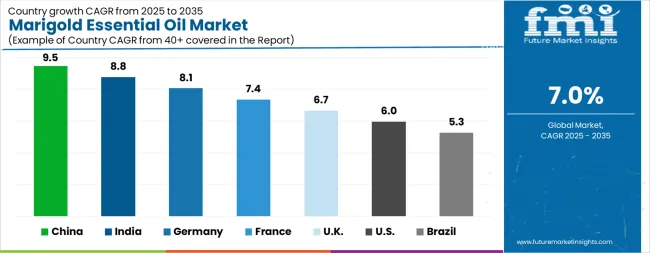
China (9.5% CAGR) leads country growth through large-scale Tagetes cultivation and expanding domestic cosmetics and personal care manufacturing. India (8.8% CAGR) follows through marigold cultivation infrastructure investments aligned with export-oriented personal care ingredient production. Germany (8.1% CAGR) and France (7.4% CAGR) drive European growth through premium cosmetics and pharmaceutical-grade botanical ingredient demand. UK (6.7% CAGR) reflects functional personal care product development at retail scale. USA (6.0% CAGR) generates steady demand from aromatherapy, clean-label cosmetics, and specialty food preservation. Brazil (5.3% CAGR) represents early-stage personal care adoption. Calendula type holds approximately 57.6% of product type share; Pharmaceuticals and Personal Care represents the largest application at 25%; Indirect Sales accounts for 26% of distribution channel volume.
Marigold Essential Oil Market Definition
The marigold essential oil market comprises the global production, trade, and commercial application of volatile aromatic oil extracts derived from two distinct marigold species: Calendula officinalis, valued for its skin-healing, anti-inflammatory, and dermatologically validated properties, and Tagetes species, cultivated primarily for their high lutein content and use in cosmetics, aromatherapy, and poultry feed applications. These oils are extracted via steam distillation, cold pressing, or advanced supercritical CO2 extraction methods and supplied for use across pharmaceuticals, personal care, food flavoring, and agricultural feed applications.
Marigold Essential Oil Market Inclusions
The report includes Global and Regional Market Sizes (Volume and Value) and a 10-year Forecast (2026 to 2036). Coverage spans segmental breakdowns by product type (Calendula and Tagetes), application (Pharmaceuticals and Personal Care, Emollients, Anointing, Baby Care, Cosmetics, Aromatherapy, Tobacco Flavouring, and Chicken Feed), distribution channel (Indirect Sales, Direct Sales, Supermarket and Hypermarket, Online Stores, and Retail Stores), and geography across 40-plus countries.
Marigold Essential Oil Market Exclusions
The scope excludes marigold-derived oleoresins, marigold pigment concentrates used solely as colorants, and lutein supplements extracted from Tagetes that are marketed as dietary supplements independent of an essential oil designation. Synthetic fragrances designed to replicate marigold aroma without containing actual botanical extract are outside the reportable market boundary. Dried marigold flowers and herbal tea products sold as whole botanical preparations without oil extraction processing are excluded. Carrier oil blends where marigold oil constitutes less than a traceable primary ingredient proportion are not included.
Marigold Essential Oil Market Research Methodology
- Primary Research: Interviews were conducted with marigold cultivators, essential oil distillers, cosmetic ingredient distributors, pharmaceutical raw material buyers, nutraceutical formulators, and personal care product development specialists across Asia-Pacific, Europe, North America, and Latin America.
- Desk Research: Production data from national agricultural ministries, trade statistics from customs databases, company investor presentations and press releases, peer-reviewed phytochemistry publications, and essential oil industry association reports supported volume and value benchmarking.
- Market-Sizing and Forecasting: A hybrid top-down and bottom-up model was applied. Demand was reconstructed from cultivation area data by species, extraction yield rates, and end-use application penetration across personal care, pharmaceutical, and agricultural sectors, then validated against supplier capacity announcements and import-export trade flows.
- Data Validation and Update Cycle: Outputs undergo cross-validation against botanical ingredient trade data, regulatory approval records for cosmetic and food-grade botanical actives, and structured expert review prior to release.
Why is the Marigold Essential Oil Market Growing?
The Marigold Essential Oil market is witnessing steady growth, driven by its extensive use in pharmaceuticals, personal care products, and natural wellness applications. Increasing consumer preference for plant-based and organic ingredients is shaping the demand landscape, particularly in regions where holistic and preventive healthcare practices are gaining prominence. The therapeutic properties of marigold oil, including anti-inflammatory, antimicrobial, and skin-soothing effects, are contributing to its adoption across multiple end-use industries.
Growth is further supported by the rising awareness of essential oils as natural alternatives to synthetic compounds in skincare, cosmetics, and health supplements. Supply chain improvements and expanding cultivation of marigold crops have enabled consistent product quality and wider geographic distribution.
Additionally, innovation in extraction techniques has improved oil yield and purity, creating opportunities for high-value formulations As wellness and personal care markets continue to embrace botanical ingredients, the Marigold Essential Oil market is anticipated to maintain strong growth momentum, with expanding applications in therapeutic, cosmetic, and preventive health segments.
Segmental Analysis
The marigold essential oil market is segmented by product type, application, distribution channel, and geographic regions. By product type, marigold essential oil market is divided into Calendula and Tagetes. In terms of application, marigold essential oil market is classified into Pharmaceuticals & Personal Care, Emollients, Anointing, Baby Care, Cosmetics, Aromatherapy, Tobacco Flavouring, and Chicken Feed. Based on distribution channel, marigold essential oil market is segmented into Indirect Sales, Direct Sales, Supermarket/Hypermarket, Online Stores, and Retail Stores. Regionally, the marigold essential oil industry is classified into North America, Latin America, Western Europe, Eastern Europe, Balkan & Baltic Countries, Russia & Belarus, Central Asia, East Asia, South Asia & Pacific, and the Middle East & Africa.
Insights into the Calendula Product Type Segment
The Calendula product type segment is projected to hold 57.60% of the Marigold Essential Oil market revenue share in 2026, making it the leading product type. This dominance is being driven by the superior therapeutic properties of Calendula extracts, which are widely recognized for their effectiveness in skin care, wound healing, and anti-inflammatory applications.
Demand has been strengthened by its integration into personal care and pharmaceutical formulations, where quality and efficacy are prioritized. The adaptability of Calendula oil to various delivery forms, including creams, lotions, and serums, has expanded its appeal to both manufacturers and consumers.
Additionally, stable cultivation practices and availability of high-quality raw materials have facilitated consistent supply to global markets As awareness of natural and botanical ingredients continues to grow, Calendula oil is expected to remain the preferred product type, supported by its multifunctional properties and the increasing focus on natural, sustainable, and plant-based solutions in health and wellness sectors.
Insights into the Pharmaceuticals and Personal Care Application Segment
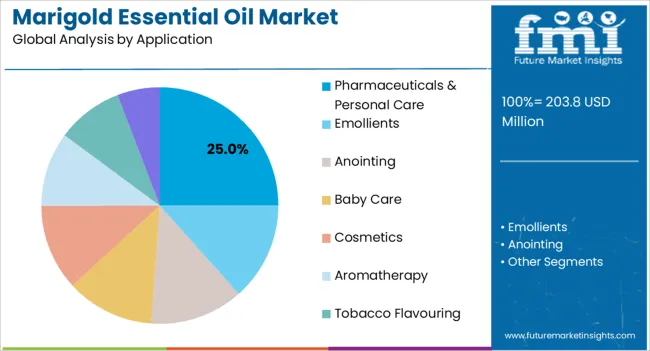
The Pharmaceuticals and Personal Care application segment is expected to account for 25.00% of the Marigold Essential Oil market revenue in 2026, establishing it as the leading application. This growth has been driven by the integration of marigold oil into therapeutic formulations, skincare products, and personal care solutions that prioritize natural and non-synthetic ingredients.
The oil is valued for its anti-inflammatory, antimicrobial, and antioxidant properties, making it an essential ingredient in lotions, creams, ointments, and dietary supplements. Rising consumer preference for plant-based and organic personal care products has further encouraged manufacturers to adopt marigold essential oil in diverse formulations.
In addition, regulatory frameworks supporting natural ingredients in pharmaceutical and cosmetic products have facilitated broader market adoption The increasing focus on preventive healthcare, coupled with heightened awareness of natural wellness products, is anticipated to sustain the dominance of this application segment, driving both innovation and market expansion in the coming years.
Insights into the Indirect Sales Distribution Channel Segment
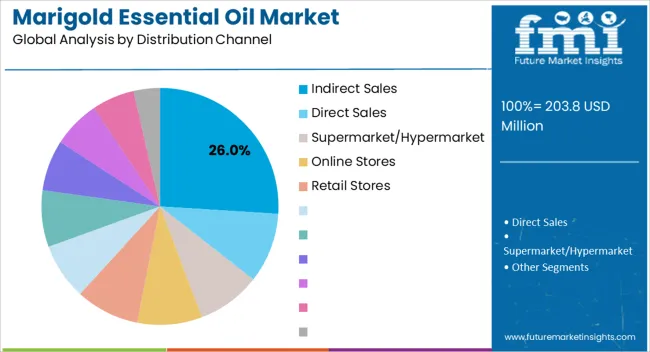
The Indirect Sales distribution channel segment is anticipated to hold 26.00% of the Marigold Essential Oil market revenue in 2026, marking it as the leading distribution channel. This prominence is being driven by the well-established networks of wholesalers, distributors, and retail intermediaries, which enable efficient product reach across domestic and international markets.
Indirect sales channels facilitate access to a wide range of end-users, including pharmacies, cosmetic manufacturers, and specialty wellness stores, while reducing the logistical and operational burden on producers. The flexibility of this distribution method has allowed small and medium-sized enterprises to expand their market presence without significant investment in direct sales infrastructure.
Furthermore, indirect channels support promotional activities and bulk supply agreements, enhancing market penetration and brand visibility As demand for natural and botanical products continues to rise, the reliance on indirect sales is expected to remain strong, providing scalable solutions for distribution, efficient market coverage, and sustained growth of marigold essential oil products globally.
Market Overview
Market Outlook
Marigold essential oil is a natural oil extracted from marigold flowers. It has a sweet, fruity, wild and citrus-like smell, and is yellow to reddish in colour. Concentrated marigold essential oil is predominantly used in aromatherapy for the treatment of numerous problems. It is also used in cosmetics.
Marigold essential oil blends well with several other essential oils, which include geranium, cedarwood, nutmeg and clary sage oil. Marigold essential oil is widely used for massage as well as for the preparation of lotions, creams and scarring formulas. Increase in the demand for aromatherapy, as well as the growing demand for flavours and fragrances in the food & beverages industry and personal care industry, is likely to drive the marigold essential oil market in the years to come. Moreover, growth in the number of producers of marigold oil has also increased production, which is also expected to boost he market.
Analysis of Marigold Essential Oil Market By Key Countries
.webp "Top Country Growth Comparison Marigold Essential Oil Market Cagr (2026 2036)")
| Country | CAGR |
|---|---|
| China | 9.5% |
| India | 8.8% |
| Germany | 8.1% |
| France | 7.4% |
| UK | 6.7% |
| USA | 6.0% |
| Brazil | 5.3% |
Country-wise Analysis
The Marigold Essential Oil Market is expected to register a CAGR of 7.0% during the forecast period, exhibiting varied country level momentum. China leads with the highest CAGR of 9.5%, followed by India at 8.8%. Developed markets such as Germany, France, and the UK continue to expand steadily, while the USA is likely to grow at consistent rates. Brazil posts the lowest CAGR at 5.3%, yet still underscores a broadly positive trajectory for the global Marigold Essential Oil Market. In 2025, Germany held a dominant revenue in the Western Europe market and is expected to grow with a CAGR of 8.1%. The USA Marigold Essential Oil Market is estimated to be valued at USD 69.5 million in 2026 and is anticipated to reach a valuation of USD 123.8 million by 2035. Sales are projected to rise at a CAGR of 6.0% over the forecast period between 2026 and 2035. While Japan and South Korea markets are estimated to be valued at USD 9.8 million and USD 6.0 million respectively in 2026.
Key Players in the Marigold Essential Oil Market
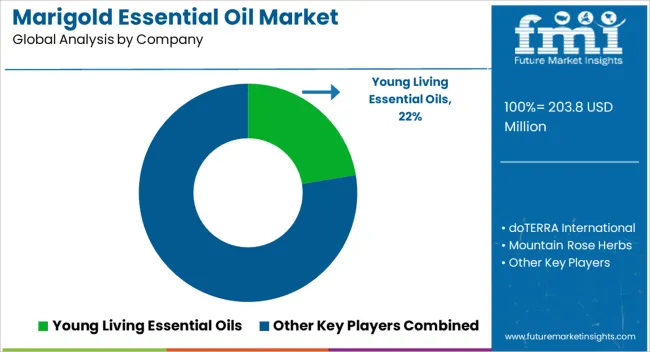
- Young Living Essential Oils
- doTERRA International
- Mountain Rose Herbs
- Plant Therapy Essential Oils
- Edens Garden
- Floracopeia Inc.
- Now Foods
- Simplers Botanicals
- Aubrey Organics
- Aura Cacia
Recent Developments
The report includes full coverage of key trends from competitive benchmarking. Some of the recent developments covered in the reports:
- In February 2026, the marigold essential oil market entered an agentic AI era in sourcing operations, with manufacturers deploying autonomous AI agents to manage batch-level traceability and origin storytelling that enable consumers to verify exact harvest conditions and purity levels of marigold crops via digital QR code integration on product labels. [3]
- In February 2026, dsm-firmenich confirmed a major portfolio shift following its strategic divestment of its Animal Nutrition and Health business, intensifying its focus on human Health, Nutrition and Care applications and prioritizing marigold extract and lutein formulations specifically for eye health and cognitive wellness market segments in 2026 and beyond. [4]
- In late 2025, advanced supercritical CO2 extraction reached a commercial milestone in the marigold sector, with this solvent-free method increasingly replacing traditional steam distillation for high-end Therapeutic Grade oils by preserving heat-sensitive bioactive compounds such as alpha-terpinyl acetate and eucalyptol that are degraded under conventional distillation conditions. [5]
- In July 2025, a landmark study on marigold bioactives identified 3-cyclohexene-1-methanol as a key antioxidant and antimicrobial agent, catalyzing a 2026 surge in adoption of marigold oil as a natural alternative to synthetic preservatives in clean-label food and beverage products where botanical antimicrobial credentials are increasingly required by retailers and regulators. [1]
- Effective January 2026, US and EU trade policy shifts prompted nearshoring in the essential oils market, with companies accelerating diversification of their sourcing base to include domestic marigold cultivation in India and Mexico to mitigate rising landed costs caused by new tariff actions affecting imports from traditional producing regions. [2]
Scope of the Report
| Metric | Value |
|---|---|
| Quantitative Units | USD 218.1 million (2026) to USD 429.0 million (2036), at a CAGR of 7.0% |
| Market Definition | The marigold essential oil market covers volatile aromatic oil extracts from Calendula officinalis and Tagetes species for use in pharmaceutical and personal care formulation, cosmetics, aromatherapy, food flavoring, and agricultural feed applications. |
| Product Type Segmentation | Calendula, Tagetes |
| Application Segmentation | Pharmaceuticals and Personal Care, Emollients, Anointing, Baby Care, Cosmetics, Aromatherapy, Tobacco Flavouring, Chicken Feed |
| Distribution Channel | Indirect Sales, Direct Sales, Supermarket and Hypermarket, Online Stores, Retail Stores |
| Regions Covered | North America, Latin America, Europe, East Asia, South Asia, Oceania, Middle East and Africa |
| Countries Covered | China, India, Germany, France, United Kingdom, United States, Brazil and 40 plus countries |
| Key Companies Profiled | Young Living Essential Oils, doTERRA International, Mountain Rose Herbs, Plant Therapy Essential Oils, Edens Garden, Floracopeia Inc., Now Foods, Simplers Botanicals, Aubrey Organics, Aura Cacia |
| Forecast Period | 2026 to 2036 |
| Approach | Hybrid top-down and bottom-up market modeling validated through primary interviews with marigold oil distillers and cosmetic ingredient distributors, supported by agricultural production statistics and verified trade flow benchmarks |
Marigold Essential Oil Market by Segments
Product Type:
- Calendula
- Tagetes
Application:
- Pharmaceuticals & Personal Care
- Emollients
- Anointing
- Baby Care
- Cosmetics
- Aromatherapy
- Tobacco Flavouring
- Chicken Feed
Distribution Channel:
- Indirect Sales
- Direct Sales
- Supermarket/Hypermarket
- Online Stores
- Retail Stores
Region:
- North America
- USA
- Canada
- Mexico
- Latin America
- Brazil
- Chile
- Rest of Latin America
- Western Europe
- Germany
- UK
- Italy
- Spain
- France
- Nordic
- BENELUX
- Rest of Western Europe
- Eastern Europe
- Russia
- Poland
- Hungary
- Balkan & Baltic
- Rest of Eastern Europe
- East Asia
- China
- Japan
- South Korea
- South Asia and Pacific
- India
- ASEAN
- Australia & New Zealand
- Rest of South Asia and Pacific
- Middle East & Africa
- Kingdom of Saudi Arabia
- Other GCC Countries
- Turkiye
- South Africa
- Other African Union
- Rest of Middle East & Africa
Bibliography
- [1] Journal of Agricultural and Food Chemistry. (2025). Identification of 3-cyclohexene-1-methanol as a key antioxidant and antimicrobial bioactive agent in Calendula officinalis essential oil extracts. Peer-reviewed publication, July 2025.
- [2] United States Trade Representative. (2026). Updated tariff schedules for botanical essential oils and natural extracts under 2026 trade policy revisions effective January 1, 2026. Federal Register, January 2026. https://ustr.gov/
- [3] Future Market Insights Inc. (2026). Marigold essential oil market: agentic AI deployment in batch-level traceability and origin verification systems. Market Intelligence Update, February 2026. https://www.futuremarketinsights.com/reports/marigold-essential-oil-market
- [4] dsm-firmenich. (2026). dsm-firmenich portfolio strategy 2026: intensified focus on Health, Nutrition and Care segment including marigold extract and lutein formulations for eye health and cognitive wellness. Corporate Strategy Update, February 2026. https://our-company.dsm-firmenich.com/
- [5] International Journal of Food Science and Technology. (2025). Commercial viability of supercritical CO2 extraction for Therapeutic Grade marigold essential oil: preservation of heat-sensitive bioactive compounds. Peer-reviewed publication, Q4 2025.
- [6] Ministry of Agriculture and Farmers Welfare, Government of India. (2025). Marigold cultivation area and production statistics: 2024-2025 annual report. Ministry Publication. https://agricoop.nic.in/
This bibliography is provided for reader reference and is not exhaustive. The full report contains the complete reference list and detailed citations.
This Report Addresses
- Market intelligence to enable structured sourcing, formulation strategy, and channel development for essential oil manufacturers, cosmetic ingredient suppliers, pharmaceutical raw material buyers, and specialty food and beverage formulators
- Market size estimation and 10-year revenue forecasts from 2026 to 2036, supported by validated cultivation area data, extraction yield benchmarks, and end-use channel penetration analysis
- Growth opportunity mapping across product type and application segments with emphasis on Calendula bioactive characterization for pharmaceutical and clean-label personal care formulation transitions
- Segment and regional revenue forecasts covering personal care, cosmetics, aromatherapy, food preservation, and agricultural feed application channels across key producing and consuming geographies
- Competition strategy assessment including extraction technology capability benchmarking, bioactive compound documentation standards, and supply chain origin diversification positioning
- Product compliance and certification tracking including EU cosmetic botanical ingredient regulations, US FDA food-grade botanical preservative requirements, and Therapeutic Grade designation standards
- Regulatory impact analysis covering EU and US trade policy impacts on essential oil sourcing costs, organic botanical certification requirements, and clean-label ingredient approval pathways
- Market report delivery in PDF, Excel, PPT, and interactive dashboard formats for executive and operational use
Frequently Asked Questions
How large is the demand for marigold essential oil in the global market in 2026?
Demand for marigold essential oil in the global market is estimated to be valued at USD 218.1 million in 2026.
What will be the market size of marigold essential oil by 2036?
Market size for marigold essential oil is projected to reach USD 429.0 million by 2036.
What is the expected CAGR for the marigold essential oil market between 2026 and 2036?
Demand for marigold essential oil is expected to grow at a CAGR of 7.0% between 2026 and 2036.
Which product type dominates the marigold essential oil market?
Calendula accounts for approximately 57.6% of product type share, driven by its clinically documented anti-inflammatory and skin-barrier properties that secure preferred ingredient status in pharmaceutical-grade skin care, baby care, and sensitive skin formulations.
Which application segment leads marigold essential oil demand?
Pharmaceuticals and Personal Care represents the largest application at approximately 25% of demand, anchored by Calendula extract use in wound care, dermatitis treatment, and sensitized skin product formulations.
Which countries show the fastest growth in marigold essential oil demand?
China leads at 9.5% CAGR through 2036, followed by India at 8.8% and Germany at 8.1%, driven respectively by Tagetes cultivation and cosmetics manufacturing scale, export-oriented personal care ingredient production, and pharmaceutical-grade botanical ingredient procurement.
How is the US and EU trade policy shift in January 2026 affecting the marigold oil market?
New tariff structures effective January 2026 are compelling manufacturers to diversify sourcing toward domestic cultivation in India and Mexico, reducing dependence on tariff-exposed origins and building more cost-stable supply chains for high-volume cosmetic and personal care customers.
What is the significance of the 2025 marigold bioactive compound study?
The identification of 3-cyclohexene-1-methanol as a key antioxidant and antimicrobial agent in marigold oil provides the scientific validation required to position marigold essential oil as a natural alternative to synthetic preservatives in clean-label food, beverage, and personal care formulations seeking botanical antimicrobial certification.
What advantage does supercritical CO2 extraction provide over steam distillation?
Supercritical CO2 extraction preserves heat-sensitive bioactive compounds such as alpha-terpinyl acetate and eucalyptol that are degraded under steam distillation conditions, enabling Therapeutic Grade product designation and access to pharmaceutical and premium cosmetics pricing tiers unavailable to conventional distillation producers.
How does FMI validate the marigold essential oil market forecast?
The forecast uses a hybrid model validated through primary interviews with distillers and cosmetic ingredient distributors, cross-referenced against national agricultural production statistics, customs trade flow data, and peer-reviewed phytochemistry publications on marigold bioactive content.
Preview the report firsthand - request a free sample
Get SampleGet the brochure for pricing and purchase details.
Get PDFTable of Content
- Executive Summary
- Global Market Outlook
- Demand-side Trends
- Supply-side Trends
- Technology Roadmap Analysis
- Analysis and Recommendations
- Market Overview
- Market Coverage / Taxonomy
- Market Definition / Scope / Limitations
- Research Methodology
- Chapter Orientation
- Analytical Lens and Working Hypotheses
- Market Structure, Signals, and Trend Drivers
- Benchmarking and Cross-market Comparability
- Market Sizing, Forecasting, and Opportunity Mapping
- Research Design and Evidence Framework
- Desk Research Programme (Secondary Evidence)
- Company Annual and Sustainability Reports
- Peer-reviewed Journals and Academic Literature
- Corporate Websites, Product Literature, and Technical Notes
- Earnings Decks and Investor Briefings
- Statutory Filings and Regulatory Disclosures
- Technical White Papers and Standards Notes
- Trade Journals, Industry Magazines, and Analyst Briefs
- Conference Proceedings, Webinars, and Seminar Materials
- Government Statistics Portals and Public Data Releases
- Press Releases and Reputable Media Coverage
- Specialist Newsletters and Curated Briefings
- Sector Databases and Reference Repositories
- FMI Internal Proprietary Databases and Historical Market Datasets
- Subscription Datasets and Paid Sources
- Social Channels, Communities, and Digital Listening Inputs
- Additional Desk Sources
- Expert Input and Fieldwork (Primary Evidence)
- Primary Modes
- Qualitative Interviews and Expert Elicitation
- Quantitative Surveys and Structured Data Capture
- Blended Approach
- Why Primary Evidence is Used
- Field Techniques
- Interviews
- Surveys
- Focus Groups
- Observational and In-context Research
- Social and Community Interactions
- Stakeholder Universe Engaged
- C-suite Leaders
- Board Members
- Presidents and Vice Presidents
- R&D and Innovation Heads
- Technical Specialists
- Domain Subject-matter Experts
- Scientists
- Physicians and Other Healthcare Professionals
- Governance, Ethics, and Data Stewardship
- Research Ethics
- Data Integrity and Handling
- Primary Modes
- Tooling, Models, and Reference Databases
- Desk Research Programme (Secondary Evidence)
- Data Engineering and Model Build
- Data Acquisition and Ingestion
- Cleaning, Normalisation, and Verification
- Synthesis, Triangulation, and Analysis
- Quality Assurance and Audit Trail
- Market Background
- Market Dynamics
- Drivers
- Restraints
- Opportunity
- Trends
- Scenario Forecast
- Demand in Optimistic Scenario
- Demand in Likely Scenario
- Demand in Conservative Scenario
- Opportunity Map Analysis
- Product Life Cycle Analysis
- Supply Chain Analysis
- Investment Feasibility Matrix
- Value Chain Analysis
- PESTLE and Porter’s Analysis
- Regulatory Landscape
- Regional Parent Market Outlook
- Production and Consumption Statistics
- Import and Export Statistics
- Market Dynamics
- Global Market Analysis 2021 to 2025 and Forecast, 2026 to 2036
- Historical Market Size Value (USD Million) Analysis, 2021 to 2025
- Current and Future Market Size Value (USD Million) Projections, 2026 to 2036
- Y-o-Y Growth Trend Analysis
- Absolute $ Opportunity Analysis
- Global Market Pricing Analysis 2021 to 2025 and Forecast 2026 to 2036
- Global Market Analysis 2021 to 2025 and Forecast 2026 to 2036, By Product Type
- Introduction / Key Findings
- Historical Market Size Value (USD Million) Analysis By Product Type , 2021 to 2025
- Current and Future Market Size Value (USD Million) Analysis and Forecast By Product Type , 2026 to 2036
- Calendula
- Tagetes
- Calendula
- Y-o-Y Growth Trend Analysis By Product Type , 2021 to 2025
- Absolute $ Opportunity Analysis By Product Type , 2026 to 2036
- Global Market Analysis 2021 to 2025 and Forecast 2026 to 2036, By Application
- Introduction / Key Findings
- Historical Market Size Value (USD Million) Analysis By Application, 2021 to 2025
- Current and Future Market Size Value (USD Million) Analysis and Forecast By Application, 2026 to 2036
- Pharmaceuticals & Personal Care
- Emollients
- Anointing
- Baby Care
- Cosmetics
- Aromatherapy
- Tobacco Flavouring
- Chicken Feed
- Pharmaceuticals & Personal Care
- Y-o-Y Growth Trend Analysis By Application, 2021 to 2025
- Absolute $ Opportunity Analysis By Application, 2026 to 2036
- Global Market Analysis 2021 to 2025 and Forecast 2026 to 2036, By Distribution Channel
- Introduction / Key Findings
- Historical Market Size Value (USD Million) Analysis By Distribution Channel, 2021 to 2025
- Current and Future Market Size Value (USD Million) Analysis and Forecast By Distribution Channel, 2026 to 2036
- Indirect Sales
- Direct Sales
- Supermarket/Hypermarket
- Online Stores
- Retail Stores
- Indirect Sales
- Y-o-Y Growth Trend Analysis By Distribution Channel, 2021 to 2025
- Absolute $ Opportunity Analysis By Distribution Channel, 2026 to 2036
- Global Market Analysis 2021 to 2025 and Forecast 2026 to 2036, By Region
- Introduction
- Historical Market Size Value (USD Million) Analysis By Region, 2021 to 2025
- Current Market Size Value (USD Million) Analysis and Forecast By Region, 2026 to 2036
- North America
- Latin America
- Western Europe
- Eastern Europe
- East Asia
- South Asia and Pacific
- Middle East & Africa
- Market Attractiveness Analysis By Region
- North America Market Analysis 2021 to 2025 and Forecast 2026 to 2036, By Country
- Historical Market Size Value (USD Million) Trend Analysis By Market Taxonomy, 2021 to 2025
- Market Size Value (USD Million) Forecast By Market Taxonomy, 2026 to 2036
- By Country
- USA
- Canada
- Mexico
- By Product Type
- By Application
- By Distribution Channel
- By Country
- Market Attractiveness Analysis
- By Country
- By Product Type
- By Application
- By Distribution Channel
- Key Takeaways
- Latin America Market Analysis 2021 to 2025 and Forecast 2026 to 2036, By Country
- Historical Market Size Value (USD Million) Trend Analysis By Market Taxonomy, 2021 to 2025
- Market Size Value (USD Million) Forecast By Market Taxonomy, 2026 to 2036
- By Country
- Brazil
- Chile
- Rest of Latin America
- By Product Type
- By Application
- By Distribution Channel
- By Country
- Market Attractiveness Analysis
- By Country
- By Product Type
- By Application
- By Distribution Channel
- Key Takeaways
- Western Europe Market Analysis 2021 to 2025 and Forecast 2026 to 2036, By Country
- Historical Market Size Value (USD Million) Trend Analysis By Market Taxonomy, 2021 to 2025
- Market Size Value (USD Million) Forecast By Market Taxonomy, 2026 to 2036
- By Country
- Germany
- UK
- Italy
- Spain
- France
- Nordic
- BENELUX
- Rest of Western Europe
- By Product Type
- By Application
- By Distribution Channel
- By Country
- Market Attractiveness Analysis
- By Country
- By Product Type
- By Application
- By Distribution Channel
- Key Takeaways
- Eastern Europe Market Analysis 2021 to 2025 and Forecast 2026 to 2036, By Country
- Historical Market Size Value (USD Million) Trend Analysis By Market Taxonomy, 2021 to 2025
- Market Size Value (USD Million) Forecast By Market Taxonomy, 2026 to 2036
- By Country
- Russia
- Poland
- Hungary
- Balkan & Baltic
- Rest of Eastern Europe
- By Product Type
- By Application
- By Distribution Channel
- By Country
- Market Attractiveness Analysis
- By Country
- By Product Type
- By Application
- By Distribution Channel
- Key Takeaways
- East Asia Market Analysis 2021 to 2025 and Forecast 2026 to 2036, By Country
- Historical Market Size Value (USD Million) Trend Analysis By Market Taxonomy, 2021 to 2025
- Market Size Value (USD Million) Forecast By Market Taxonomy, 2026 to 2036
- By Country
- China
- Japan
- South Korea
- By Product Type
- By Application
- By Distribution Channel
- By Country
- Market Attractiveness Analysis
- By Country
- By Product Type
- By Application
- By Distribution Channel
- Key Takeaways
- South Asia and Pacific Market Analysis 2021 to 2025 and Forecast 2026 to 2036, By Country
- Historical Market Size Value (USD Million) Trend Analysis By Market Taxonomy, 2021 to 2025
- Market Size Value (USD Million) Forecast By Market Taxonomy, 2026 to 2036
- By Country
- India
- ASEAN
- Australia & New Zealand
- Rest of South Asia and Pacific
- By Product Type
- By Application
- By Distribution Channel
- By Country
- Market Attractiveness Analysis
- By Country
- By Product Type
- By Application
- By Distribution Channel
- Key Takeaways
- Middle East & Africa Market Analysis 2021 to 2025 and Forecast 2026 to 2036, By Country
- Historical Market Size Value (USD Million) Trend Analysis By Market Taxonomy, 2021 to 2025
- Market Size Value (USD Million) Forecast By Market Taxonomy, 2026 to 2036
- By Country
- Kingdom of Saudi Arabia
- Other GCC Countries
- Turkiye
- South Africa
- Other African Union
- Rest of Middle East & Africa
- By Product Type
- By Application
- By Distribution Channel
- By Country
- Market Attractiveness Analysis
- By Country
- By Product Type
- By Application
- By Distribution Channel
- Key Takeaways
- Key Countries Market Analysis
- USA
- Pricing Analysis
- Market Share Analysis, 2025
- By Product Type
- By Application
- By Distribution Channel
- Canada
- Pricing Analysis
- Market Share Analysis, 2025
- By Product Type
- By Application
- By Distribution Channel
- Mexico
- Pricing Analysis
- Market Share Analysis, 2025
- By Product Type
- By Application
- By Distribution Channel
- Brazil
- Pricing Analysis
- Market Share Analysis, 2025
- By Product Type
- By Application
- By Distribution Channel
- Chile
- Pricing Analysis
- Market Share Analysis, 2025
- By Product Type
- By Application
- By Distribution Channel
- Germany
- Pricing Analysis
- Market Share Analysis, 2025
- By Product Type
- By Application
- By Distribution Channel
- UK
- Pricing Analysis
- Market Share Analysis, 2025
- By Product Type
- By Application
- By Distribution Channel
- Italy
- Pricing Analysis
- Market Share Analysis, 2025
- By Product Type
- By Application
- By Distribution Channel
- Spain
- Pricing Analysis
- Market Share Analysis, 2025
- By Product Type
- By Application
- By Distribution Channel
- France
- Pricing Analysis
- Market Share Analysis, 2025
- By Product Type
- By Application
- By Distribution Channel
- India
- Pricing Analysis
- Market Share Analysis, 2025
- By Product Type
- By Application
- By Distribution Channel
- ASEAN
- Pricing Analysis
- Market Share Analysis, 2025
- By Product Type
- By Application
- By Distribution Channel
- Australia & New Zealand
- Pricing Analysis
- Market Share Analysis, 2025
- By Product Type
- By Application
- By Distribution Channel
- China
- Pricing Analysis
- Market Share Analysis, 2025
- By Product Type
- By Application
- By Distribution Channel
- Japan
- Pricing Analysis
- Market Share Analysis, 2025
- By Product Type
- By Application
- By Distribution Channel
- South Korea
- Pricing Analysis
- Market Share Analysis, 2025
- By Product Type
- By Application
- By Distribution Channel
- Russia
- Pricing Analysis
- Market Share Analysis, 2025
- By Product Type
- By Application
- By Distribution Channel
- Poland
- Pricing Analysis
- Market Share Analysis, 2025
- By Product Type
- By Application
- By Distribution Channel
- Hungary
- Pricing Analysis
- Market Share Analysis, 2025
- By Product Type
- By Application
- By Distribution Channel
- Kingdom of Saudi Arabia
- Pricing Analysis
- Market Share Analysis, 2025
- By Product Type
- By Application
- By Distribution Channel
- Turkiye
- Pricing Analysis
- Market Share Analysis, 2025
- By Product Type
- By Application
- By Distribution Channel
- South Africa
- Pricing Analysis
- Market Share Analysis, 2025
- By Product Type
- By Application
- By Distribution Channel
- USA
- Market Structure Analysis
- Competition Dashboard
- Competition Benchmarking
- Market Share Analysis of Top Players
- By Regional
- By Product Type
- By Application
- By Distribution Channel
- Competition Analysis
- Competition Deep Dive
- Young Living Essential Oils
- Overview
- Product Portfolio
- Profitability by Market Segments (Product/Age /Sales Channel/Region)
- Sales Footprint
- Strategy Overview
- Marketing Strategy
- Product Strategy
- Channel Strategy
- doTERRA International
- Mountain Rose Herbs
- Plant Therapy Essential Oils
- Edens Garden
- Floracopeia Inc.
- Now Foods
- Simplers Botanicals
- Aubrey Organics
- Aura Cacia
- Young Living Essential Oils
- Competition Deep Dive
- Assumptions & Acronyms Used


