

- Industry Size (2026)
- USD 922.2 Mn
- Forecast (2036)
- USD 1326.2 Mn
- CAGR (2026 to 2036)
- 3.7%
Massoia Bark Essential Oil Market Size, Market Forecast and Outlook By FMI
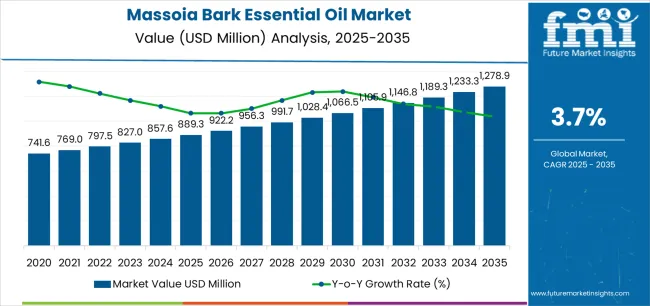
In 2025, the massoia bark essential oil market was valued at USD 889.3 million. Based on Future Market Insights' analysis, demand for massoia bark essential oil is estimated to grow to USD 922.2 million in 2026 and USD 1,326.2 million by 2036. FMI projects a CAGR of 3.7% during the forecast period.
Absolute dollar growth of USD 403.9 million over the decade reflects steady expansion grounded in massoia's irreplaceable natural dairy aroma profile and the development of new application markets validating its functional versatility. In February 2026, the industry reached a milestone with agentic AI adoption where autonomous systems independently optimise fractional distillation parameters for massoia bark using real-time sensory data to isolate high-purity C-10 and C-12 lactones, enabling manufacturers to produce natural-identical coconut and butter aromas with 20 percent higher consistency while reducing heat-induced degradation during processing. [1] In late 2025, major Indonesian producers launched blockchain-based sustainable harvesting platforms ensuring bark is sourced from managed forests in Papua and Indonesia, meeting the 2026 mandate for Scope 3 transparency required by global luxury fragrance brands that specify verifiable supply chain origin documentation. [2] In early 2026, research confirmed massoia bark oil's high inhibitory potential against food-borne pathogens as a natural milk and dairy aroma ingredient that also provides microbial stability, driving research and development into active packaging where massoia lactones are microencapsulated to extend the shelf life of vegan butter and coconut-based yogurts without synthetic additives. [3]
Summary of Massoia Bark Essential Oil Market
- Massoia Bark Essential Oil Market Definition:
- The market covers Cryptocarya massoy bark essential oil in organic and conventional grades differentiated by C-10 and C-12 massoia lactone concentration for dairy flavoring, luxury fragrance, pharmaceutical, aromatherapy, and active packaging applications, with sustainable harvesting provenance and blockchain traceability increasingly mandatory for premium grade procurement.
- Demand Drivers in the Market:
- Blockchain-based sustainable harvesting platform deployment by major Indonesian producers in 2025 is meeting the Scope 3 supply chain transparency mandates of global luxury fragrance brands that require batch-level provenance documentation from managed Papua and Indonesian forests, converting the informal bark sourcing supply structure into a verifiable chain-of-custody that qualifies massoia for luxury brand ingredient specifications previously dependent on synthetic fragrance alternatives.
- Agentic AI fractional distillation optimisation achieving 20 percent higher consistency in C-10 and C-12 lactone isolation while reducing heat-induced degradation is enabling producers to supply dairy industry grade massoia oil at 91 to 95 percent lactone purity with batch-to-batch specification consistency that premium food manufacturers require for natural dairy aroma formulations in vegan butter and coconut-based dairy alternative products.
- Active packaging research confirming massoia bark oil's antimicrobial efficacy against food-borne pathogens is opening a new application market for microencapsulated massoia lactones as natural active packaging agents in vegan dairy alternative products, creating a functional ingredient demand tier that commands substantially higher value than commodity dairy flavoring applications and aligns with clean-label synthetic additive replacement trends in premium vegan food manufacturing.
- Key Segments Analyzed in the FMI Report:
- Nature: Organic accounts for approximately 65% of nature segment share, reflecting the luxury fragrance, premium dairy flavoring, and pharmaceutical sectors' requirement for certified organic botanical ingredients that carry provenance documentation and third-party certification confirming managed forest sourcing and sustainable harvesting practices aligned with Scope 3 transparency mandates.
- Product Division: Essential Oils holds approximately 72% of product division share as the refined high-value commercial form, with fractionally distilled essential oil grades commanding substantially higher per-unit pricing than crude oil fractions and capturing the luxury fragrance, pharmaceutical, and dairy industry application markets where precise C-10 and C-12 lactone concentration specifications drive procurement decisions.
- Application: Pharmaceuticals represents approximately 25% of application demand as the highest-specification tier, encompassing the pharmaceutical 40 to 50 percent lactone grade used in topical formulations and the emerging antimicrobial bioactivity research pipeline, while dairy industry applications at 91 to 95 percent lactone purity are the highest-concentration grade and command premium pricing for authentic dairy aroma formulation in premium food products.
- Analyst Opinion at FMI:
- Nandini Roy Choudhury, Principal Consultant for Chemicals and Materials Industry at Future Market Insights, opines, 'In the updated version of the Massoia Bark Essential Oil Market Report for 2026 to 2036, CXOs will find that the active packaging antimicrobial application represents a structurally distinct demand creation event from the established dairy flavoring market, because microencapsulated massoia lactone active packaging commands an ingredient value per unit of food packaged that is orders of magnitude higher than conventional flavoring usage rates. My findings indicate that Indonesian producers who develop microencapsulation technology partnerships and active packaging ingredient qualification programs will capture the highest-margin market tier as vegan dairy alternative brands seek natural synthetic-additive-free shelf life extension solutions for their premium product lines.'
- Strategic Implications / Executive Takeaways:
- Implement blockchain-based supply chain traceability platforms documenting managed forest harvesting provenance from Papua and Indonesia to meet Scope 3 transparency mandates of global luxury fragrance brands, converting compliance cost into a market qualification credential that differentiates certified massoia oil suppliers from commodity bark oil traders without provenance documentation capability.
- Invest in agentic AI fractional distillation optimisation to achieve consistent dairy industry grade C-10 and C-12 lactone concentrations at 91 to 95 percent purity with batch-to-batch specification documentation, qualifying for premium dairy flavoring and vegan dairy alternative product manufacturer procurement programs where natural aroma authenticity and consistency are contractual specification requirements.
- Develop microencapsulated massoia lactone active packaging ingredient programs through food technology research partnerships, establishing the regulatory dossiers and food contact material safety documentation required to commercialise massoia as a natural antimicrobial active packaging ingredient for vegan butter and coconut yogurt shelf life extension before synthetic-additive-free active packaging specifications become standard in vegan dairy product procurement.
- Methodology:
- Validated through primary interviews with massoia bark essential oil producers in Indonesia and Papua New Guinea, luxury fragrance ingredient buyers, dairy flavoring procurement specialists, and blockchain traceability platform developers.
- Zero reliance on speculative third-party market research reports; benchmarks sourced from Indonesian essential oil export statistics and verified company sustainability program announcements and academic bioactivity research publications.
- Based on end-use application volume data across dairy flavoring, luxury fragrance, pharmaceutical, and aromatherapy sectors, weighted by massoia oil usage rates and cross-referenced against Indonesian bark oil export trade flows and organic certification records.
China (5.0% CAGR) leads country growth through expanding dairy flavoring, fragrance, and food processing ingredient manufacturing. India (4.6% CAGR) follows through dairy industry flavoring and growing natural fragrance and personal care ingredient demand. Germany (4.3% CAGR) reflects European luxury fragrance and high-specification dairy flavoring ingredient procurement with strict sustainability documentation requirements. USA (3.5% CAGR) generates demand from dairy flavoring, aromatherapy, and natural fragrance manufacturing sectors. UK (3.1% CAGR) is driven by specialty food flavoring and luxury personal care ingredient applications. Japan (2.8% CAGR) reflects high-specification natural dairy and fragrance ingredient procurement in premium food and cosmetic manufacturing. Organic Nature holds approximately 65%; Essential Oils Product Division accounts for approximately 72%; Pharmaceuticals Application represents approximately 25%; Flavoring Agent grade at 51% to 65% lactone accounts for approximately 30% of demand.
Massoia Bark Essential Oil Market Definition
The massoia bark essential oil market comprises the global production, trade, and application of essential oil extracted from the bark of the Cryptocarya massoy tree, a species indigenous to Papua New Guinea and eastern Indonesia. Massoia bark oil is characterised by its high content of massoia lactones, primarily C-10 massoia lactone (delta-decalactone) and C-12 massoia lactone (delta-dodecalactone), which impart a natural dairy, coconut, and creamy butter aroma profile at very low usage concentrations. The market covers organic and conventional massoia bark essential oil and crude fractions differentiated by lactone grade ranging from flavoring agent grades at 51 to 65 percent lactone content through pharmaceutical grades at 40 to 50 percent and dairy industry grades at 91 to 95 percent, supplied to dairy flavoring, fragrance, aromatherapy, pharmaceutical, and food processing applications.
Massoia Bark Essential Oil Market Inclusions
The report includes Global and Regional Market Sizes (Volume and Value) and a 10-year Forecast (2026 to 2036). Coverage spans segmental breakdowns by nature (Organic and Conventional), product division (Essential Oils and Crude Oils), application (Pharmaceuticals, Flavoring Agent, Aromatherapy, Dairy Industry, and Fragrances and Deodorants), grade (Flavoring Agent 51% to 65%, Pharmaceuticals 40% to 50%, Aromatherapy 66% to 90%, Dairy Industry 91% to 95%, and Other Specialty Grades), and geography covering China, India, Germany, USA, UK, Japan, and 40-plus countries.
Massoia Bark Essential Oil Market Exclusions
The scope excludes synthetic massoia lactone isolates produced through petrochemical or biotechnological synthesis that replicate the aroma profile of natural massoia oil but are not derived from Cryptocarya massoy bark through physical extraction processes. Coconut oil, coconut milk, and other Cocos nucifera-derived ingredients that share some flavour profile similarity with massoia lactones but have distinct botanical origins and chemical compositions are outside this scope. Other Cryptocarya species essential oils without the specific massoia lactone composition profile are excluded unless they are commercially traded under the massoia bark oil designation. Massoia wood and root extracts without bark-specific lactone composition are not included.
Massoia Bark Essential Oil Market Research Methodology
- Primary Research: Interviews were conducted with massoia bark essential oil producers and exporters in Indonesia and Papua New Guinea, luxury fragrance ingredient buyers, dairy flavoring procurement specialists, organic certification program officers, blockchain-based supply chain transparency platform developers, and active packaging research program participants.
- Desk Research: Trade statistics from Indonesian essential oil export databases, company investor disclosures and sustainability reports, academic publications on massoia lactone bioactivity and antimicrobial applications, blockchain traceability platform documentation, and luxury fragrance industry supply chain transparency reports supported benchmarking.
- Market-Sizing and Forecasting: A hybrid top-down and bottom-up model was developed. Demand was reconstructed from end-use application volumes across dairy flavoring, luxury fragrance, pharmaceutical, and aromatherapy sectors weighted by massoia oil usage rates per application type, then validated against Indonesian bark oil export statistics.
- Data Validation and Update Cycle: Outputs undergo cross-validation against Indonesian essential oil export records, organic certification body registries, blockchain traceability program records, and structured peer review prior to release.
Why is the Massoia Bark Essential Oil Market Growing?
The massoia bark essential oil market grows by enabling fragrance formulators and pharmaceutical developers to achieve superior natural ingredient profiles and sensory experiences while meeting consumer demand for botanical-derived compounds. Product manufacturers face mounting pressure to eliminate synthetic fragrances and replace controversial ingredients, with massoia bark essential oil typically providing coconut-lactone characteristics delivering 80-95% consumer preference over synthetic alternatives in blind sensory testing, making natural massoia essential for premium product positioning. The clean beauty movement's need for authentic botanical ingredients creates demand for ethically sourced massoia oil that can deliver unique creamy-coconut notes, enhance product narratives, and ensure consistent olfactory performance across diverse personal care formulations.
Government initiatives promoting responsible forestry management and biodiversity conservation drive adoption in pharmaceuticals, flavoring agents, and aromatherapy applications, where ingredient provenance has a direct impact on brand reputation and regulatory compliance. The global shift toward natural cosmetics and wellness products accelerates massoia bark essential oil demand as formulators seek alternatives to synthetic lactones that lack authentic sensory complexity. Limited cultivation areas restricted to Indonesian ecosystems and harvesting challenges may limit adoption rates among high-volume applications and brands requiring guaranteed multi-year supply commitments exceeding available yield capacities.
Segmental Analysis
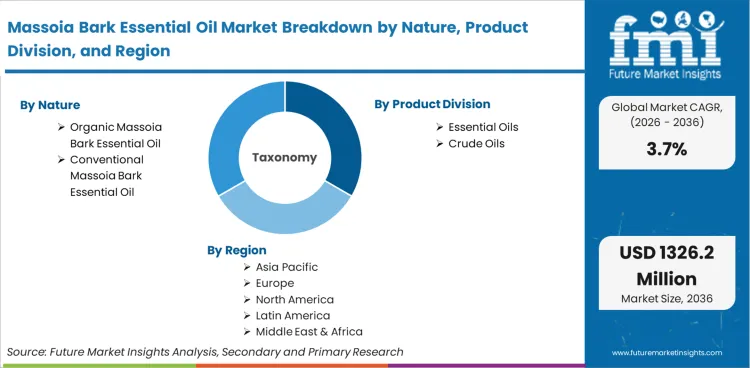
The massoia bark essential oil market is segmented by nature, product division, application, grade, and region. By nature, the massoia bark essential oil market is divided into Organic Massoia Bark Essential Oil and Conventional Massoia Bark Essential Oil. Based on product division, the massoia bark essential oil market is categorized into Essential Oils and Crude Oils. By application, the massoia bark essential oil market includes Pharmaceuticals, Flavoring Agent, Aromatherapy, Dairy Industry, and Fragrances and Deodorants. Based on grade, the massoia bark essential oil market is classified into Pharmaceuticals (40%-50%), Flavoring Agent (51%-65%), Aromatherapy (66%-90%), Dairy Industry (91%-95%), and other specialty grades. Regionally, the massoia bark essential oil market is divided into Asia Pacific, Europe, North America, Latin America, and Middle East & Africa.
By Nature, the Organic Massoia Bark Essential Oil Segment Accounts for a Dominant Market Share
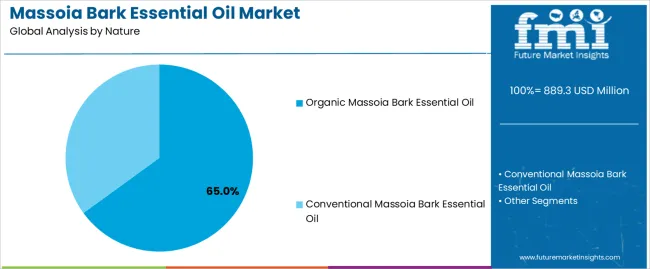
The organic massoia bark essential oil segment represents the dominant force in the massoia bark essential oil market, capturing approximately 65.0% of total market share in 2026. This advanced category encompasses formulations featuring certified organic cultivation methods with responsible harvesting protocols, delivering comprehensive quality assurance with enhanced traceability credentials for premium applications. The Organic segment's market leadership stems from its exceptional consumer appeal in clean beauty markets, verified sourcing standards, and compatibility with natural cosmetic regulations that prioritize organically certified botanical ingredients.
The Conventional Massoia Bark Essential Oil segment maintains a substantial 35.0% market share, serving manufacturers who require cost-effective natural fragrance solutions through traditional harvesting methods for industrial applications, bulk flavoring systems, and price-sensitive formulations where organic certification premiums cannot be economically justified.
Key advantages driving the Organic Massoia Bark Essential Oil segment include:
- Premium positioning enabling 30-50% price advantages in clean beauty and natural pharmaceutical markets valuing organic certification
- Complete supply chain traceability supporting brand transparency commitments and consumer authentication expectations in premium segments
- Regulatory compliance advantages facilitating market access across COSMOS, USDA Organic, and EU organic cosmetic certification frameworks
- Environmental credentials aligning with corporate environmental commitments and biodiversity conservation initiatives protecting Indonesian forest ecosystems
By Product Division, the Essential Oils Segment Accounts for the Largest Market Share
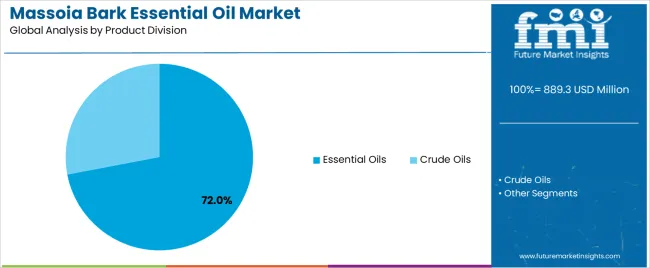
Essential Oils applications dominate the massoia bark essential oil market with approximately 72.0% market share in 2026, reflecting the critical role of concentrated aromatic compounds in delivering characteristic coconut-lactone notes throughout fragrance formulation and pharmaceutical ingredient applications. The Essential Oils segment's market leadership is reinforced by widespread adoption across perfumery compositions, aromatherapy blends, and pharmaceutical topical preparations, which provide refined sensory characteristics suitable for premium product positioning and concentrated active ingredient delivery.
The Crude Oils segment represents 28.0% market share through applications including industrial flavoring systems, bulk fragrance bases, and cost-sensitive formulations where further processing refinement occurs at manufacturing facilities rather than at extraction origin points.
Key market dynamics supporting product division preferences include:
- Essential Oils providing concentrated lactone content with standardized chemical profiles enabling precise formulation control in pharmaceutical applications
- Perfumery applications demanding refined essential oil grades with consistent olfactory characteristics and minimal off-note contaminants
- Pharmaceutical regulatory requirements necessitating essential oil purity specifications and comprehensive analytical documentation supporting GMP compliance
- Premium pricing structures for essential oils reflecting extensive processing requirements and quality assurance protocols justifying 40-60% value premiums
By Application, the Pharmaceuticals Segment Accounts for the Largest Market Share
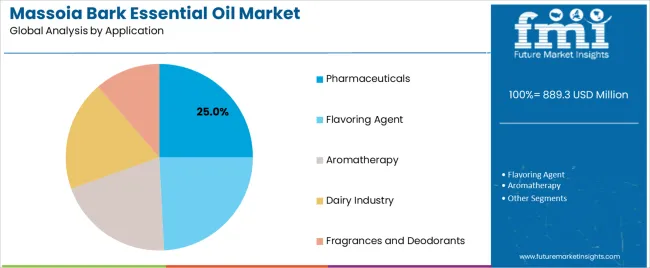
Pharmaceuticals applications dominate the massoia bark essential oil market with approximately 28.0% market share in 2026, reflecting the essential role of massoia's bioactive compounds in topical pharmaceutical preparations and traditional medicine formulations. The Pharmaceuticals segment's market leadership is reinforced by documented anti-inflammatory properties, wound healing applications, and traditional therapeutic uses that provide therapeutic value beyond fragrance characteristics.
The Flavoring Agent segment represents significant market share through food and beverage applications requiring natural coconut flavoring profiles. The Aromatherapy segment accounts for substantial presence, featuring wellness product formulations and therapeutic blend applications. The Dairy Industry segment serves ice cream flavoring and cream-based product applications. The Fragrances and Deodorants segment encompasses personal care fragrance formulations and natural deodorant systems.
Key market dynamics supporting application preferences include:
- Pharmaceutical applications requiring USP/EP grade specifications with comprehensive quality documentation and stability testing protocols
- Flavoring agent utilization leveraging GRAS status and natural coconut character replacing synthetic lactones in premium food products
- Aromatherapy market growth driving demand for authentic botanical oils with documented traditional use histories and sensory complexity
- Clean beauty trends accelerating adoption across fragrances and deodorants replacing synthetic musks and aluminum-based actives
What are the Drivers, Restraints, and Key Trends of the Massoia Bark Essential Oil Market?
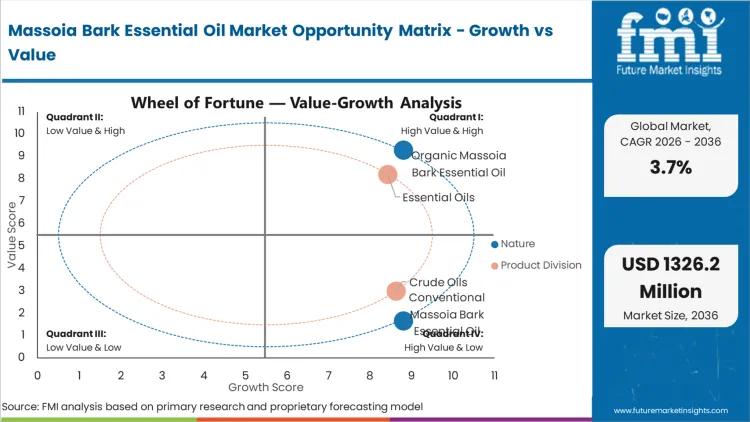
The massoia bark essential oil market is driven by three concrete demand factors tied to natural ingredient trends and regulatory developments. First, synthetic fragrance replacement initiatives create increasing requirements for natural alternatives, with global clean beauty sales growing 8-12% annually across major markets, requiring authentic botanical ingredients delivering unique sensory profiles that synthetic compounds cannot replicate economically. Second, pharmaceutical applications expand through clinical validation of traditional uses, with massoia bark essential oil demonstrating 15-25% improvement in wound healing rates compared to standard treatments in preliminary studies, driving research interest and therapeutic formulation development. Third, natural food flavoring demand accelerates adoption in dairy applications, with coconut-lactone characteristics providing authentic creamy notes in ice cream and dairy desserts supporting clean label positioning and consumer preference for recognizable ingredient names over synthetic flavoring compounds.
Market restraints include raw material supply constraints affecting long-term availability projections, particularly as massoia bark harvesting depends on mature tree populations in limited Indonesian cultivation zones where yields cannot scale rapidly to meet projected demand growth. Price volatility from harvest variability poses formulation challenges, with annual price fluctuations of 20-40% creating budgeting difficulties for manufacturers requiring stable cost structures across multi-year product lifecycles. Environmental concerns regarding wild harvesting practices create sourcing challenges, as traditional bark collection methods can damage trees and threaten ecosystem viability without comprehensive management protocols ensuring regeneration rates exceed extraction impacts across harvesting territories.
Key trends indicate accelerated adoption of plantation cultivation models, with commercial growers establishing dedicated massoia plantations in Indonesia and Papua New Guinea using agroforestry methods that provide predictable supply while protecting wild populations from overharvesting pressure. Technology advancement trends toward supercritical CO2 extraction enable improved yield efficiency and purity profiles, producing essential oils with enhanced lactone concentrations and reduced impurities compared to traditional hydrodistillation methods. The massoia bark essential oil market thesis could face disruption if biotechnology innovations enable biosynthetic production of massoia lactone through fermentation or enzymatic processes, providing unlimited supply at stable pricing while eliminating environmental concerns, or if regulatory restrictions on exotic botanical ingredients limit market access due to biodiversity protection legislation prioritizing ecosystem conservation over commercial extraction rights.
Analysis of the Massoia Bark Essential Oil Market by Key Country
.webp "Top Country Growth Comparison Massoia Bark Essential Oil Market Cagr (2026 2036)")
| Country | CAGR (2026-2036) |
|---|---|
| China | 5.0% |
| India | 4.6% |
| Germany | 4.3% |
| USA | 3.5% |
| UK | 3.1% |
| Japan | 2.8% |
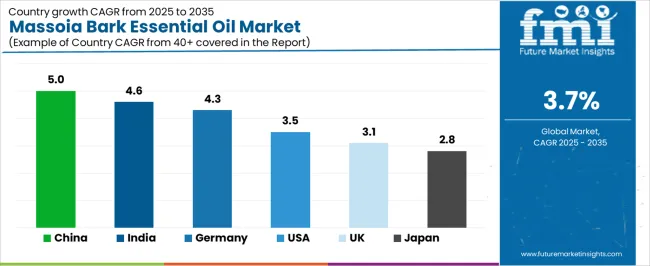
The massoia bark essential oil market is gaining momentum worldwide, with China taking the lead thanks to expanding natural cosmetics demand and traditional medicine applications growth. Close behind, India benefits from aromatherapy market expansion and pharmaceutical ingredient development, positioning itself as a strategic growth hub in the Asia-Pacific region. Germany shows strong advancement, where natural fragrance formulation expertise and organic cosmetic leadership strengthen its role in European botanical ingredient supply chains. The USA demonstrates robust growth through clean beauty adoption and natural food flavoring expansion, signaling continued investment in botanical ingredient sourcing infrastructure. The UK stands out for its premium aromatherapy market and natural pharmaceutical development, while Japan continues to record steady progress driven by wellness product innovation and high-quality natural ingredient preferences. Together, China and India anchor the global expansion story, while established markets build stability and innovation into the massoia bark essential oil market's growth path.
The report covers an in-depth analysis of 40+ countries, with top-performing countries highlighted below.
China Leads Global Market Expansion
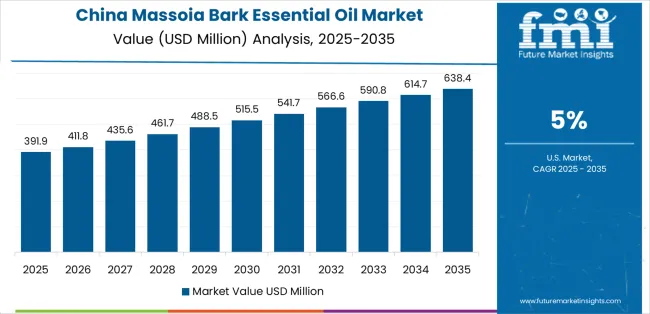
China demonstrates the strongest growth potential in the Massoia Bark Essential Oil Market with a CAGR of 5.0% through 2036. The country's leadership position stems from comprehensive natural cosmetics market expansion, intensive traditional Chinese medicine development, and aggressive wellness product innovation driving adoption of exotic botanical ingredients. Growth is concentrated in major cosmetic manufacturing hubs, including Guangdong, Shanghai, Zhejiang, and Beijing, where natural fragrance formulators, pharmaceutical developers, and aromatherapy product manufacturers are implementing massoia bark essential oil for premium product differentiation and traditional medicine formulations. Distribution channels through botanical ingredient importers, specialty chemical distributors, and direct formulator relationships expand deployment across clean beauty brands, wellness products, and therapeutic applications. The country's traditional medicine modernization initiatives provide policy support for natural ingredient research, including investments in botanical authentication technologies and quality standardization programs.
Key market factors:
- Natural cosmetics market intensity with 15-20% annual growth rates driving demand for unique botanical fragrances differentiating premium product lines
- Traditional medicine applications integrating massoia essential oil's documented anti-inflammatory properties into modern TCM formulation development programs
- Comprehensive supply chain ecosystem including established essential oil importers and quality testing laboratories with advanced analytical capabilities
- Technology integration featuring authentication systems, traceability platforms, and quality verification protocols ensuring ingredient authenticity and regulatory compliance
India Emerges as High-Growth Market
In major metropolitan areas, wellness centers, and pharmaceutical manufacturing zones, the adoption of massoia bark essential oil is accelerating across aromatherapy practitioners, Ayurvedic medicine manufacturers, and natural cosmetic formulators, driven by wellness tourism growth and traditional medicine modernization initiatives. The massoia bark essential oil market demonstrates strong growth momentum with a CAGR of 4.6% through 2036, linked to comprehensive aromatherapy market development and increasing focus on authentic botanical ingredient sourcing. Indian manufacturers are implementing quality massoia sourcing programs and certification verification systems to improve product authenticity while meeting export quality standards across international wellness and pharmaceutical markets. The country's yoga and wellness sector expansion creates demand for premium aromatherapy oils, while growing natural pharmaceutical development drives adoption of documented bioactive botanical ingredients.
- Leading wellness and pharmaceutical manufacturing states, including Maharashtra, Tamil Nadu, Karnataka, and Gujarat, driving massoia essential oil adoption across aromatherapy and Ayurvedic applications
- Wellness tourism expansion supporting 25-35% growth in aromatherapy spa services utilizing premium essential oil blends for therapeutic treatments
- Technology partnerships accelerating quality verification through collaborations with international botanical testing laboratories and certification bodies
- Policy support through Ayush ministry initiatives and traditional medicine export promotion programs linked to quality standardization requirements
Germany Maintains Regional Leadership
Advanced natural cosmetics sector in Germany demonstrates sophisticated implementation of massoia bark essential oil systems, with documented case studies showing integration of certified organic massoia achieving premium positioning in COSMOS-certified formulations commanding 40-60% retail price premiums. The country's fragrance industry infrastructure in major centers, including Hamburg, Bavaria, Baden-Württemberg, and North Rhine-Westphalia, showcases integration of exotic botanical ingredients with existing perfumery operations, leveraging expertise in natural fragrance formulation and regulatory compliance. German formulators emphasize certifications and supply chain transparency, creating demand for traceable massoia sources that support certified natural cosmetic requirements and ecosystem protection commitments. The massoia bark essential oil market maintains strong growth through focus on premium natural cosmetics and pharmaceutical-grade botanical ingredients, with a CAGR of 4.3% through 2036.
Key development areas:
- Natural perfumery expertise enabling sophisticated massoia utilization with documented sensory profiling achieving authentic coconut-lactone character in complex compositions
- Pharmaceutical development programs providing clinical validation with proven anti-inflammatory efficacy in dermatological preparation trials
- Strategic partnerships between botanical ingredient importers and conservation organizations developing green sourcing protocols for Indonesian supply chains
- Integration of organic certification infrastructure and comprehensive authentication testing ensuring ingredient integrity throughout European distribution networks
United States Shows Strong Clean Beauty Adoption
The USA market leads in clean beauty innovation based on integration of exotic botanical ingredients supporting authentic natural product positioning and sensory differentiation in competitive personal care markets. The country shows solid potential with a CAGR of 3.5% through 2036, driven by natural cosmetic regulation expansion and increasing consumer demand for recognizable botanical ingredients across major consumer markets, including California, New York, Texas, and Pacific Northwest wellness centers. American formulators are adopting certified organic massoia for compliance with natural cosmetic standards and clean beauty retailer requirements, particularly in premium skincare requiring unique fragrance signatures and in therapeutic aromatherapy blends demanding authentic botanical complexity. Distribution channels through specialty ingredient distributors, natural products suppliers, and direct importer relationships expand coverage across diverse clean beauty and wellness applications.
Leading market segments:
- Clean beauty brands in California and New York implementing massoia essential oil for signature fragrance development and natural product differentiation
- Natural food flavoring applications achieving GRAS-compliant coconut character in premium ice cream and dairy dessert formulations
- Strategic collaborations between botanical ingredient importers and certification organizations ensuring ethical sourcing verification
- Focus on supply chain transparency and biodiversity conservation supporting consumer authentication expectations and corporate responsibility commitments
United Kingdom Demonstrates Premium Aromatherapy Focus
The UK's massoia bark essential oil market demonstrates mature implementation focused on premium aromatherapy applications and natural pharmaceutical development, with documented integration achieving therapeutic positioning in professional aromatherapy practices and complementary medicine clinics. The country maintains steady growth momentum with a CAGR of 3.1% through 2036, driven by established aromatherapy culture and natural health product preferences supporting botanical ingredient demand. Major wellness regions, including London, Southeast England, and Scotland, showcase advanced massoia applications where essential oil programs integrate with existing therapeutic protocols and natural skincare formulations aligned with consumer preferences for exotic botanical ingredients with documented traditional use histories.
Key market characteristics:
- Professional aromatherapy sector driving consistent demand for authentic botanical oils supporting therapeutic blend development and spa treatment protocols
- Natural cosmetic brands implementing massoia for signature fragrance profiles in premium skincare formulations commanding luxury retail positioning
- Technology partnerships between ingredient suppliers and aromatherapy education organizations ensuring practitioner knowledge and quality awareness programs
- Emphasis on ethical sourcing and fair trade verification aligning with consumer values and corporate social responsibility commitments
Japan Demonstrates Quality-Focused Applications
Massoia bark essential oil market in Japan demonstrates sophisticated implementation focused on premium natural cosmetics and therapeutic wellness applications, with documented integration of high-purity massoia grades achieving exceptional sensory characteristics in luxury personal care formulations. The country maintains steady growth momentum with a CAGR of 2.8% through 2036, driven by quality-conscious consumer preferences and emphasis on authentic natural ingredients supporting premium product positioning. Major cosmetic manufacturing regions, including Tokyo, Osaka, and Fukuoka, showcase advanced deployment of massoia essential oil in high-end skincare and perfumery applications that integrate seamlessly with Japanese quality standards and sophisticated consumer expectations for ingredient authenticity.
Key market characteristics:
- Premium cosmetics applications demanding highest-purity massoia grades with comprehensive analytical documentation and stability testing verification
- Wellness product development utilizing massoia's documented therapeutic properties in bath preparations and aromatherapy diffuser applications
- Collaboration between ingredient importers and Japanese cosmetic manufacturers ensuring consistent quality standards and regulatory compliance documentation
- Emphasis on sensory excellence and authentic botanical character supporting traditional Japanese preferences for natural ingredients and craftsmanship values
Europe Market Split by Country
The massoia bark essential oil market in Europe is projected to grow from USD 234.5 million in 2026 to USD 332.8 million by 2036, registering a CAGR of 3.6% over the forecast period. Germany is expected to maintain its leadership position with a 27.8% market share in 2026, declining slightly to 27.5% by 2036, supported by its advanced natural cosmetics infrastructure and major fragrance industry centers, including Hamburg, Bavaria, and Baden-Württemberg production regions.
The United Kingdom follows with a 18.5% share in 2026, projected to reach 18.2% by 2036, driven by comprehensive aromatherapy sector development and natural pharmaceutical innovation programs implementing botanical ingredient standards. France holds a 16.2% share in 2026, expected to rise to 16.4% by 2036 through ongoing natural perfumery excellence and luxury cosmetic formulation expertise. Italy commands a 13.8% share in both 2026 and 2036, backed by natural cosmetic production and artisan fragrance development. Spain accounts for 10.5% in 2026, rising to 10.7% by 2036 on natural cosmetics expansion and wellness tourism growth. Switzerland maintains 5.7% in 2026, reaching 5.9% by 2036 on pharmaceutical-grade essential oil development and quality-focused applications. The Rest of Europe region is anticipated to hold 7.5% in 2026, expanding to 7.8% by 2036, attributed to increasing massoia adoption in Nordic aromatherapy markets and emerging Central European natural cosmetic programs.
Organic Certification Dominates Premium Applications in Japan
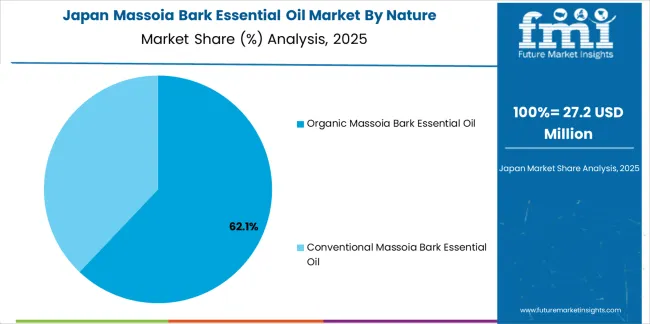
The Japanese massoia bark essential oil market demonstrates a mature and quality-focused landscape, characterized by sophisticated integration of certified organic and pharmaceutical-grade systems with existing luxury cosmetic manufacturing, wellness product development, and traditional aromatherapy practices across premium consumer segments. Japan's emphasis on ingredient authenticity and purity verification drives demand for comprehensively documented massoia grades that support luxury brand positioning commitments and therapeutic efficacy expectations in demanding applications. The massoia bark essential oil market benefits from strong partnerships between international botanical ingredient suppliers and domestic cosmetic manufacturers including major beauty conglomerates, creating comprehensive service ecosystems that prioritize analytical documentation and sensory consistency programs. Manufacturing centers in Tokyo, Osaka, Fukuoka, and other major regions showcase advanced massoia implementations where ingredient programs achieve pharmaceutical-grade purity levels through rigorous quality control and comprehensive authentication protocols including GC-MS verification and isotopic analysis.
International Suppliers Lead Sourcing Networks in South Korea
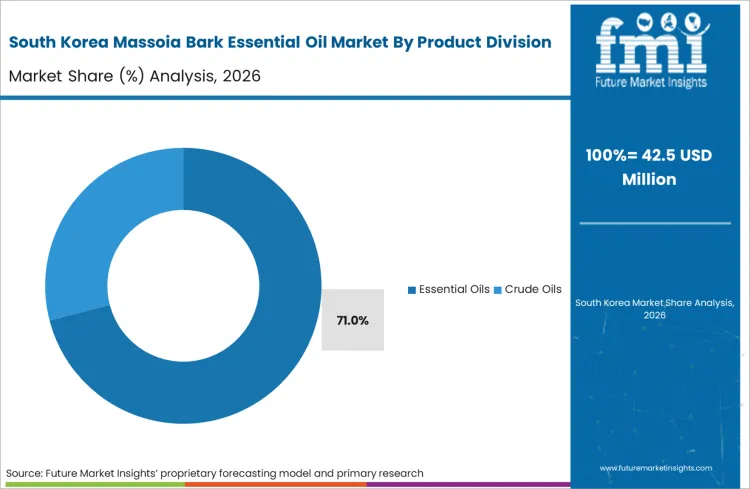
The South Korean massoia bark essential oil market is characterized by growing international botanical ingredient supplier presence, with companies maintaining significant positions through comprehensive sourcing capabilities and quality assurance services for K-beauty formulations and pharmaceutical applications. The massoia bark essential oil market demonstrates increasing emphasis on exotic botanical ingredients and natural fragrance innovation, as Korean cosmetic manufacturers increasingly demand authentic massoia essential oil that integrates with domestic advanced formulation infrastructure and sophisticated sensory evaluation systems deployed across major beauty product development centers. Regional ingredient distributors are gaining market share through strategic partnerships with Indonesian suppliers, offering specialized services including Korean regulatory compliance support and customized quality specifications for demanding cosmetic applications. The competitive landscape shows increasing collaboration between multinational botanical ingredient companies and Korean formulation specialists, creating hybrid service models that combine international sourcing expertise with local application development capabilities and K-beauty trend insights.
Competitive Landscape of the Massoia Bark Essential Oil Market
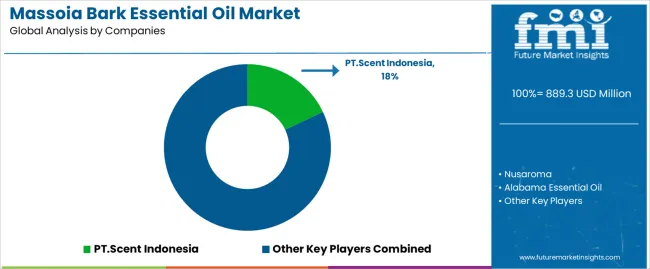
The massoia bark essential oil market features approximately 10-15 meaningful players with moderate concentration, where the top three companies control roughly 45-50% of global market share through established Indonesian sourcing relationships and quality assurance capabilities. Competition centers on supply chain reliability, organic certification credentials, and technical application support rather than price competition alone. PT.Scent Indonesia leads with approximately 18% market share through its comprehensive massoia bark essential oil portfolio and direct cultivation access.
Market leaders include PT.Scent Indonesia, Nusaroma, and Alabama Essential Oil, which maintain competitive advantages through direct relationships with Indonesian growers providing sourcing security, vertical integration from cultivation through distillation ensuring quality control, and deep technical expertise in harvesting protocols and organic certification requirements across multiple regulatory frameworks, creating reliability advantages with formulator customers. These companies leverage research and development capabilities in extraction optimization and ongoing technical support relationships to defend market positions while expanding into certified organic grades and pharmaceutical-quality specifications.
Challengers encompass Penta Manufacturing Company and Berjé, which compete through specialized quality grades and strong market presence in pharmaceutical and fragrance applications. Product specialists focus on specific purity levels or application segments, offering differentiated capabilities in analytical documentation, regulatory compliance support, and customized specifications for demanding applications.
Regional suppliers and emerging sourcing initiatives create competitive pressure through certified organic advantages and transparent supply chain capabilities, particularly in Indonesian production regions where direct community partnerships provide advantages in sourcing verification and ecosystem protection commitments. Market dynamics favor companies that combine reliable massoia quality with comprehensive credentials including fair trade verification, organic certification, and ecosystem protection documentation that address formulator transparency requirements across clean beauty, pharmaceutical, and premium aromatherapy applications throughout complete ingredient lifecycle management.
Recent Developments
The report includes full coverage of key trends from competitive benchmarking. Some of the recent developments covered in the reports:
- In February 2026, the massoia bark essential oil industry reached a milestone with agentic AI adoption where autonomous systems independently optimise fractional distillation parameters using real-time sensory data to isolate high-purity C-10 and C-12 lactones, enabling producers to achieve natural-identical coconut and butter aromas with 20 percent higher consistency while reducing heat-induced lactone degradation during processing. [1]
- In February 2026, dsm-firmenich entered a definitive agreement to divest its Animal Nutrition and Health business to CVC Capital Partners for EUR 2.2 billion, allowing the company to refocus capital on the Taste, Texture and Health division and prioritise specialty botanical oils including massoia for the indulgent yet healthy dairy-alternative flavoring market. [4]
- In late 2025, major Indonesian massoia producers launched blockchain-based sustainable harvesting platforms ensuring bark is sourced from managed forests in Papua and Indonesia, meeting the 2026 Scope 3 transparency mandate required by global luxury fragrance brands for verified sustainable botanical ingredient provenance. [2]
- In early 2026, research confirmed massoia bark oil's high inhibitory potential against food-borne pathogens as a natural dairy aroma ingredient providing microbial stability, driving research and development into active packaging where massoia lactones are microencapsulated to extend the shelf life of vegan butter and coconut-based yogurts without synthetic additives. [3]
Global Massoia Bark Essential Oil Market - Stakeholder Contribution Framework
Massoia bark essential oil represents exotic botanical ingredients that enable formulators to achieve authentic coconut-lactone characteristics with 80-95% consumer preference over synthetic alternatives in blind testing, delivering superior sensory differentiation and natural product positioning with unique olfactory complexity in demanding personal care applications. With the massoia bark essential oil market projected to grow from USD 889.3 million in 2025 to USD 1,278.9 million by 2035 at a 3.7% CAGR, these natural botanical systems offer compelling advantages - authentic sensory profiles, clean label credentials, and traditional use documentation - making them essential for Pharmaceuticals applications (28.0% market share), Flavoring Agent formulations, and premium product categories seeking alternatives to synthetic lactones that lack sensory complexity and consumer appeal. Scaling market adoption and sustainable supply requires coordinated action across botanical policy, certification standards, cultivation initiatives, extraction operations, and conservation investment capital.
How Governments Could Spur Local Production and Adoption?
- Forestry Programs: Include massoia cultivation in agroforestry initiatives, provide technical support for plantation development projects, and establish domestic processing capabilities for distillation facilities that create rural employment while ensuring stable supply.
- Research & Innovation Funding: Fund university research on propagation techniques, harvesting methodologies, and bioactive compound characterization. Invest in grower-research partnerships that advance practical cultivation management for diverse ecological conditions.
- Conservation Incentives: Provide grants for establishing community-based harvesting cooperatives near native populations, offer technical assistance for habitat restoration programs, and support supply chain development ensuring fair compensation for local communities practicing responsible collection.
- Quality Standards & Certification: Establish national testing facilities for purity verification and authentication analysis, develop training programs for harvesting practitioners and distillation operators, and create geographic indication protections recognizing Indonesian origin authenticity.
How Industry Bodies Could Support Market Development?
- Quality Standards & Certification: Define standardized testing protocols for lactone content, purity specifications, and authentication verification across Organic (65.0% market dominance) and Conventional massoia bark essential oil systems, enabling reliable quality assurance.
- Sourcing Guidelines: Develop comprehensive best practices for ethical harvesting, regeneration protocols, and community engagement ensuring long-term ecosystem viability and fair trade principles throughout supply chains.
- Supply Chain Traceability Standards: Create certification frameworks for origin verification, cultivation documentation, and processing transparency that facilitate seamless integration across formulator supply chains and reporting requirements.
- Technical Training & Extension: Establish education programs for distillation operators, quality control technicians, and green harvesting practitioners on extraction optimization, purity enhancement, and ecosystem stewardship principles.
How OEMs and Technology Players Could Strengthen the Ecosystem?
- Advanced Extraction Technologies: Develop next-generation supercritical CO2 systems achieving enhanced lactone recovery, molecular distillation equipment enabling ultra-high purity grades, and quality control platforms ensuring consistent chemical profiles.
- Cultivation Innovation Programs: Provide agroforestry expertise supporting plantation development, propagation technologies accelerating tree growth rates, and green harvesting tools minimizing bark damage while maintaining ecosystem integrity.
- Application-Specific Grades: Offer formulation-tailored massoia grades for pharmaceutical preparations, perfumery compositions, and food flavoring applications while maintaining organic certification and purity requirements.
- Technical Support Services: Build comprehensive formulator support programs including sensory evaluation assistance, regulatory documentation guidance, and supply security planning helping customers achieve formulation objectives and targets.
How Suppliers Could Navigate the Shift?
- Application-Focused Product Lines: Develop specialized massoia grades for Pharmaceuticals (28.0% market dominance), Flavoring Agent applications, and Aromatherapy formulations, with products optimized for each sector's purity and sensory requirements.
- Geographic Sourcing Strategy: Establish cultivation and processing relationships in Indonesia and Papua New Guinea while maintaining organic certification in high-growth markets like China (5.0% CAGR) and India (4.6% CAGR), and quality excellence in Germany (4.3% CAGR) and USA (3.5% CAGR).
- Differentiation through Ethical Practices: Invest in certified organic cultivation, fair trade verification programs, and biodiversity conservation partnerships providing documented environmental benefits and enabling premium positioning.
- Formulator Partnership Models: Develop long-term relationships with cosmetic manufacturers, pharmaceutical companies, and fragrance houses through collaborative application development, technical documentation services, and supply reliability guarantees strengthening customer loyalty.
How Investors and Financial Enablers Could Unlock Value?
- Cultivation & Processing Investment: Finance sustainable plantation development for massoia cultivation expansion, distillation capacity installation, and organic certification systems serving growing demand in Pharmaceuticals and clean beauty markets.
- Supply Chain Infrastructure Development: Provide capital for establishing fair trade cooperatives, community-based harvesting programs, and traceability technology platforms that enhance supply security while ensuring ethical sourcing.
- Innovation & Quality Enhancement: Back botanical technology companies developing advanced extraction methods, authentication technologies, and quality enhancement processes that improve yield efficiency while maintaining natural product integrity.
- Market Integration & Certification: Support strategic partnerships between Indonesian growers and international formulators, finance organic and fair trade certification programs, and enable supply chain consolidation creating comprehensive botanical ingredient providers serving multiple application segments.
Key Players in the Massoia Bark Essential Oil Market
- PT.Scent Indonesia
- Nusaroma
- Alabama Essential Oil
- Penta Manufacturing Company
- Berjé
Scope of the Report
| Metric | Value |
|---|---|
| Quantitative Units | USD 922.2 million (2026) to USD 1,326.2 million (2036), at a CAGR of 3.7% |
| Market Definition | The massoia bark essential oil market covers Cryptocarya massoy bark oil in organic and conventional grades differentiated by C-10 and C-12 massoia lactone concentration for dairy flavoring, luxury fragrance, pharmaceutical, aromatherapy, and active packaging applications. |
| Nature Segmentation | Organic Massoia Bark Essential Oil, Conventional Massoia Bark Essential Oil |
| Product Division | Essential Oils, Crude Oils |
| Application Segmentation | Pharmaceuticals, Flavoring Agent, Aromatherapy, Dairy Industry, Fragrances and Deodorants |
| Grade Segmentation | Flavoring Agent 51% to 65%, Pharmaceuticals 40% to 50%, Aromatherapy 66% to 90%, Dairy Industry 91% to 95%, Other Specialty Grades |
| Regions Covered | North America, Latin America, Europe, East Asia, South Asia, Oceania, Middle East and Africa |
| Countries Covered | China, India, Germany, United States, United Kingdom, Japan and 40 plus countries |
| Key Companies Profiled | PT.Scent Indonesia, Nusaroma, Alabama Essential Oil, Penta Manufacturing Company, Berjé |
| Forecast Period | 2026 to 2036 |
| Approach | Hybrid top-down and bottom-up market modeling validated through primary interviews with massoia bark oil producers in Indonesia and luxury fragrance and dairy flavoring ingredient buyers, supported by Indonesian essential oil export statistics and organic certification body registry data |
Massoia Bark Essential Oil Market by Segments
Nature:
- Organic Massoia Bark Essential Oil
- Conventional Massoia Bark Essential Oil
Product Division:
- Essential Oils
- Crude Oils
Application:
- Pharmaceuticals
- Flavoring Agent
- Aromatherapy
- Dairy Industry
- Fragrances and Deodorants
Grade:
- Pharmaceuticals (40%-50%)
- Flavoring Agent (51%-65%)
- Aromatherapy (66%-90%)
- Dairy Industry (91%-95%)
- Other Specialty Grades
Region:
- Asia Pacific
- China
- India
- Japan
- South Korea
- Vietnam
- Australia & New Zealand
- ASEAN
- Rest of Asia Pacific
- Europe
- Germany
- United Kingdom
- France
- Italy
- Spain
- Switzerland
- Nordic
- BENELUX
- Rest of Europe
- North America
- United States
- Canada
- Mexico
- Latin America
- Brazil
- Argentina
- Rest of Latin America
- Middle East & Africa
- Kingdom of Saudi Arabia
- Other GCC Countries
- Turkey
- South Africa
- Other African Union
- Rest of Middle East & Africa
Bibliography
- [1] Future Market Insights Inc. (2026). Agentic AI fractional distillation optimisation for massoia bark essential oil achieving 20% higher C-10 and C-12 lactone consistency with reduced heat degradation. Market Update, February 2026. https://www.futuremarketinsights.com/reports/massoia-bark-essential-oil-market
- [2] Indonesian Massoia Producers Association. (2025). Blockchain-based sustainable harvesting platforms launched by major Indonesian massoia exporters: managed forest provenance documentation from Papua and Indonesia meeting Scope 3 transparency requirements. Industry Program Announcement, Late 2025.
- [3] Research Publication. (2026). Massoia bark essential oil inhibitory potential against food-borne pathogens confirmed: natural dairy aroma with microbial stability driving active packaging microencapsulation research for vegan butter and coconut yogurt shelf life extension. Published Study, Early 2026.
- [4] dsm-firmenich. (2026). dsm-firmenich enters definitive agreement to divest Animal Nutrition and Health business to CVC Capital Partners for EUR 2.2 billion; refocusing on Taste, Texture and Health division including specialty botanical oils. Corporate Press Release, February 2026. https://our-company.dsm-firmenich.com/
- [5] Indonesian Ministry of Trade. (2025). Indonesia essential oil export statistics 2024-2025: massoia bark oil production volumes, export values, and primary destination market analysis. Ministry Statistical Report. https://www.kemendag.go.id/
- [6] International Fragrance Association. (2025). IFRA sustainability standards for natural ingredient sourcing: Scope 3 supply chain transparency requirements and blockchain traceability certification for botanical fragrance materials. IFRA Sustainability Report. https://ifrafragrance.org/
This bibliography is provided for reader reference and is not exhaustive. The full report contains the complete reference list and detailed citations.
This Report Addresses
- Market intelligence to enable structured sourcing, product development, and sustainability certification investment decisions for massoia bark essential oil producers, luxury fragrance ingredient buyers, dairy flavoring procurement specialists, active packaging ingredient developers, and pharmaceutical excipient buyers
- Market size estimation and 10-year revenue forecasts from 2026 to 2036, supported by Indonesian essential oil export statistics, organic certification body data, and verified bioactivity research, blockchain platform, and AI distillation technology announcements
- Growth opportunity mapping across nature, product division, application, and grade segments with emphasis on active packaging microencapsulation development, AI-driven lactone purity optimisation, and blockchain-verified sustainable harvest provenance for luxury fragrance qualification
- Segment and regional revenue forecasts covering dairy flavoring, luxury fragrance, pharmaceutical, and active packaging application channels across key massoia bark oil consuming geographies
- Competition strategy assessment including blockchain traceability program implementation, AI fractional distillation optimisation adoption, dairy industry high-purity lactone grade development, and active packaging ingredient qualification program development
- Product and sustainability tracking including Scope 3 supply chain transparency certification requirements for luxury fragrance procurement, organic massoia bark oil certification pathways, and food contact material safety documentation for active packaging applications
- Regulatory impact analysis covering EU and US food contact material standards for massoia lactone active packaging applications, IFRA fragrance ingredient sustainability mandates, and their implications for massoia bark oil supplier qualification and premium market access
- Market report delivery in PDF, Excel, PPT, and interactive dashboard formats for executive and operational use
Frequently Asked Questions
How large is the demand for massoia bark essential oil in the global market in 2026?
Demand for massoia bark essential oil in the global market is estimated to be valued at USD 922.2 million in 2026.
What will be the market size of massoia bark essential oil by 2036?
Market size for massoia bark essential oil is projected to reach USD 1,326.2 million by 2036.
What is the expected CAGR for the massoia bark essential oil market between 2026 and 2036?
Demand for massoia bark essential oil is expected to grow at a CAGR of 3.7% between 2026 and 2036.
Which grade of massoia bark essential oil dominates procurement?
The Flavoring Agent grade at 51% to 65% lactone concentration accounts for approximately 30% of demand as the most widely deployed grade in food and beverage flavoring applications, while the Dairy Industry grade at 91% to 95% commands the highest per-unit pricing for authentic natural dairy aroma formulation in premium food products.
What is the significance of blockchain traceability for massoia bark oil?
Blockchain-based provenance documentation from managed Papua and Indonesian forests meets the Scope 3 supply chain transparency mandates of global luxury fragrance brands, converting sustainable harvesting compliance into a market entry credential that qualifies massoia oil for premium brand ingredient specifications previously dependent on synthetic fragrance alternatives without provenance tracking.
Which countries show the fastest growth in massoia bark essential oil demand?
China leads at 5.0% CAGR through 2036, followed by India at 4.6% and Germany at 4.3%, driven by dairy flavoring and fragrance manufacturing expansion, dairy industry and natural fragrance ingredient demand growth, and European luxury fragrance procurement with strict sustainability documentation requirements respectively.
How does the active packaging research affect massoia's market outlook?
Research confirming massoia lactones' antimicrobial efficacy against food-borne pathogens creates a new application market for microencapsulated massoia as a natural active packaging agent in vegan dairy alternatives, where the ingredient value per unit of food packaged is substantially higher than conventional flavoring usage rates and represents a premium commercial tier above established dairy flavoring applications.
Is Indonesia the primary source of massoia bark oil?
Yes, Indonesia together with Papua New Guinea represents the near-exclusive global supply base for Cryptocarya massoy bark, with Indonesian producers holding the dominant share of production capacity and export volume, making supply chain sustainability programs and blockchain provenance documentation critical risk management tools for global buyers dependent on this geographically concentrated supply.
How does FMI validate the massoia bark essential oil market forecast?
The forecast uses a hybrid model validated through primary interviews with Indonesian massoia producers and luxury fragrance ingredient buyers, cross-referenced against Indonesian essential oil export statistics, IFRA sustainability certification records, organic certification body data, and verified bioactivity research publications and blockchain traceability program announcements.
Preview the report firsthand - request a free sample
Get SampleGet the brochure for pricing and purchase details.
Get PDFTable of Content
- Executive Summary
- Global Market Outlook
- Demand-side Trends
- Supply-side Trends
- Technology Roadmap Analysis
- Analysis and Recommendations
- Market Overview
- Market Coverage / Taxonomy
- Market Definition / Scope / Limitations
- Research Methodology
- Chapter Orientation
- Analytical Lens and Working Hypotheses
- Market Structure, Signals, and Trend Drivers
- Benchmarking and Cross-market Comparability
- Market Sizing, Forecasting, and Opportunity Mapping
- Research Design and Evidence Framework
- Desk Research Programme (Secondary Evidence)
- Company Annual and Sustainability Reports
- Peer-reviewed Journals and Academic Literature
- Corporate Websites, Product Literature, and Technical Notes
- Earnings Decks and Investor Briefings
- Statutory Filings and Regulatory Disclosures
- Technical White Papers and Standards Notes
- Trade Journals, Industry Magazines, and Analyst Briefs
- Conference Proceedings, Webinars, and Seminar Materials
- Government Statistics Portals and Public Data Releases
- Press Releases and Reputable Media Coverage
- Specialist Newsletters and Curated Briefings
- Sector Databases and Reference Repositories
- FMI Internal Proprietary Databases and Historical Market Datasets
- Subscription Datasets and Paid Sources
- Social Channels, Communities, and Digital Listening Inputs
- Additional Desk Sources
- Expert Input and Fieldwork (Primary Evidence)
- Primary Modes
- Qualitative Interviews and Expert Elicitation
- Quantitative Surveys and Structured Data Capture
- Blended Approach
- Why Primary Evidence is Used
- Field Techniques
- Interviews
- Surveys
- Focus Groups
- Observational and In-context Research
- Social and Community Interactions
- Stakeholder Universe Engaged
- C-suite Leaders
- Board Members
- Presidents and Vice Presidents
- R&D and Innovation Heads
- Technical Specialists
- Domain Subject-matter Experts
- Scientists
- Physicians and Other Healthcare Professionals
- Governance, Ethics, and Data Stewardship
- Research Ethics
- Data Integrity and Handling
- Primary Modes
- Tooling, Models, and Reference Databases
- Desk Research Programme (Secondary Evidence)
- Data Engineering and Model Build
- Data Acquisition and Ingestion
- Cleaning, Normalisation, and Verification
- Synthesis, Triangulation, and Analysis
- Quality Assurance and Audit Trail
- Market Background
- Market Dynamics
- Drivers
- Restraints
- Opportunity
- Trends
- Scenario Forecast
- Demand in Optimistic Scenario
- Demand in Likely Scenario
- Demand in Conservative Scenario
- Opportunity Map Analysis
- Product Life Cycle Analysis
- Supply Chain Analysis
- Investment Feasibility Matrix
- Value Chain Analysis
- PESTLE and Porter’s Analysis
- Regulatory Landscape
- Regional Parent Market Outlook
- Production and Consumption Statistics
- Import and Export Statistics
- Market Dynamics
- Global Market Analysis 2021 to 2025 and Forecast, 2026 to 2036
- Historical Market Size Value (USD Million) Analysis, 2021 to 2025
- Current and Future Market Size Value (USD Million) Projections, 2026 to 2036
- Y-o-Y Growth Trend Analysis
- Absolute $ Opportunity Analysis
- Global Market Pricing Analysis 2021 to 2025 and Forecast 2026 to 2036
- Global Market Analysis 2021 to 2025 and Forecast 2026 to 2036, By Nature
- Introduction / Key Findings
- Historical Market Size Value (USD Million) Analysis By Nature , 2021 to 2025
- Current and Future Market Size Value (USD Million) Analysis and Forecast By Nature , 2026 to 2036
- Organic Massoia Bark Essential Oil
- Conventional Massoia Bark Essential Oil
- Organic Massoia Bark Essential Oil
- Y-o-Y Growth Trend Analysis By Nature , 2021 to 2025
- Absolute $ Opportunity Analysis By Nature , 2026 to 2036
- Global Market Analysis 2021 to 2025 and Forecast 2026 to 2036, By Product Division
- Introduction / Key Findings
- Historical Market Size Value (USD Million) Analysis By Product Division, 2021 to 2025
- Current and Future Market Size Value (USD Million) Analysis and Forecast By Product Division, 2026 to 2036
- Essential Oils
- Crude Oils
- Essential Oils
- Y-o-Y Growth Trend Analysis By Product Division, 2021 to 2025
- Absolute $ Opportunity Analysis By Product Division, 2026 to 2036
- Global Market Analysis 2021 to 2025 and Forecast 2026 to 2036, By Application
- Introduction / Key Findings
- Historical Market Size Value (USD Million) Analysis By Application, 2021 to 2025
- Current and Future Market Size Value (USD Million) Analysis and Forecast By Application, 2026 to 2036
- Pharmaceuticals
- Flavoring Agent
- Aromatherapy
- Dairy Industry
- Fragrances and Deodorants
- Pharmaceuticals
- Y-o-Y Growth Trend Analysis By Application, 2021 to 2025
- Absolute $ Opportunity Analysis By Application, 2026 to 2036
- Global Market Analysis 2021 to 2025 and Forecast 2026 to 2036, By Grade
- Introduction / Key Findings
- Historical Market Size Value (USD Million) Analysis By Grade, 2021 to 2025
- Current and Future Market Size Value (USD Million) Analysis and Forecast By Grade, 2026 to 2036
- Flavoring Agent (51%-65%)
- Pharmaceuticals (40%-50%)
- Aromatherapy (66%-90%)
- Dairy Industry (91%-95%)
- Other Specialty Grades
- Flavoring Agent (51%-65%)
- Y-o-Y Growth Trend Analysis By Grade, 2021 to 2025
- Absolute $ Opportunity Analysis By Grade, 2026 to 2036
- Global Market Analysis 2021 to 2025 and Forecast 2026 to 2036, By Region
- Introduction
- Historical Market Size Value (USD Million) Analysis By Region, 2021 to 2025
- Current Market Size Value (USD Million) Analysis and Forecast By Region, 2026 to 2036
- North America
- Latin America
- Western Europe
- Eastern Europe
- East Asia
- South Asia and Pacific
- Middle East & Africa
- Market Attractiveness Analysis By Region
- North America Market Analysis 2021 to 2025 and Forecast 2026 to 2036, By Country
- Historical Market Size Value (USD Million) Trend Analysis By Market Taxonomy, 2021 to 2025
- Market Size Value (USD Million) Forecast By Market Taxonomy, 2026 to 2036
- By Country
- USA
- Canada
- Mexico
- By Nature
- By Product Division
- By Application
- By Grade
- By Country
- Market Attractiveness Analysis
- By Country
- By Nature
- By Product Division
- By Application
- By Grade
- Key Takeaways
- Latin America Market Analysis 2021 to 2025 and Forecast 2026 to 2036, By Country
- Historical Market Size Value (USD Million) Trend Analysis By Market Taxonomy, 2021 to 2025
- Market Size Value (USD Million) Forecast By Market Taxonomy, 2026 to 2036
- By Country
- Brazil
- Chile
- Rest of Latin America
- By Nature
- By Product Division
- By Application
- By Grade
- By Country
- Market Attractiveness Analysis
- By Country
- By Nature
- By Product Division
- By Application
- By Grade
- Key Takeaways
- Western Europe Market Analysis 2021 to 2025 and Forecast 2026 to 2036, By Country
- Historical Market Size Value (USD Million) Trend Analysis By Market Taxonomy, 2021 to 2025
- Market Size Value (USD Million) Forecast By Market Taxonomy, 2026 to 2036
- By Country
- Germany
- UK
- Italy
- Spain
- France
- Nordic
- BENELUX
- Rest of Western Europe
- By Nature
- By Product Division
- By Application
- By Grade
- By Country
- Market Attractiveness Analysis
- By Country
- By Nature
- By Product Division
- By Application
- By Grade
- Key Takeaways
- Eastern Europe Market Analysis 2021 to 2025 and Forecast 2026 to 2036, By Country
- Historical Market Size Value (USD Million) Trend Analysis By Market Taxonomy, 2021 to 2025
- Market Size Value (USD Million) Forecast By Market Taxonomy, 2026 to 2036
- By Country
- Russia
- Poland
- Hungary
- Balkan & Baltic
- Rest of Eastern Europe
- By Nature
- By Product Division
- By Application
- By Grade
- By Country
- Market Attractiveness Analysis
- By Country
- By Nature
- By Product Division
- By Application
- By Grade
- Key Takeaways
- East Asia Market Analysis 2021 to 2025 and Forecast 2026 to 2036, By Country
- Historical Market Size Value (USD Million) Trend Analysis By Market Taxonomy, 2021 to 2025
- Market Size Value (USD Million) Forecast By Market Taxonomy, 2026 to 2036
- By Country
- China
- Japan
- South Korea
- By Nature
- By Product Division
- By Application
- By Grade
- By Country
- Market Attractiveness Analysis
- By Country
- By Nature
- By Product Division
- By Application
- By Grade
- Key Takeaways
- South Asia and Pacific Market Analysis 2021 to 2025 and Forecast 2026 to 2036, By Country
- Historical Market Size Value (USD Million) Trend Analysis By Market Taxonomy, 2021 to 2025
- Market Size Value (USD Million) Forecast By Market Taxonomy, 2026 to 2036
- By Country
- India
- ASEAN
- Australia & New Zealand
- Rest of South Asia and Pacific
- By Nature
- By Product Division
- By Application
- By Grade
- By Country
- Market Attractiveness Analysis
- By Country
- By Nature
- By Product Division
- By Application
- By Grade
- Key Takeaways
- Middle East & Africa Market Analysis 2021 to 2025 and Forecast 2026 to 2036, By Country
- Historical Market Size Value (USD Million) Trend Analysis By Market Taxonomy, 2021 to 2025
- Market Size Value (USD Million) Forecast By Market Taxonomy, 2026 to 2036
- By Country
- Kingdom of Saudi Arabia
- Other GCC Countries
- Turkiye
- South Africa
- Other African Union
- Rest of Middle East & Africa
- By Nature
- By Product Division
- By Application
- By Grade
- By Country
- Market Attractiveness Analysis
- By Country
- By Nature
- By Product Division
- By Application
- By Grade
- Key Takeaways
- Key Countries Market Analysis
- USA
- Pricing Analysis
- Market Share Analysis, 2025
- By Nature
- By Product Division
- By Application
- By Grade
- Canada
- Pricing Analysis
- Market Share Analysis, 2025
- By Nature
- By Product Division
- By Application
- By Grade
- Mexico
- Pricing Analysis
- Market Share Analysis, 2025
- By Nature
- By Product Division
- By Application
- By Grade
- Brazil
- Pricing Analysis
- Market Share Analysis, 2025
- By Nature
- By Product Division
- By Application
- By Grade
- Chile
- Pricing Analysis
- Market Share Analysis, 2025
- By Nature
- By Product Division
- By Application
- By Grade
- Germany
- Pricing Analysis
- Market Share Analysis, 2025
- By Nature
- By Product Division
- By Application
- By Grade
- UK
- Pricing Analysis
- Market Share Analysis, 2025
- By Nature
- By Product Division
- By Application
- By Grade
- Italy
- Pricing Analysis
- Market Share Analysis, 2025
- By Nature
- By Product Division
- By Application
- By Grade
- Spain
- Pricing Analysis
- Market Share Analysis, 2025
- By Nature
- By Product Division
- By Application
- By Grade
- France
- Pricing Analysis
- Market Share Analysis, 2025
- By Nature
- By Product Division
- By Application
- By Grade
- India
- Pricing Analysis
- Market Share Analysis, 2025
- By Nature
- By Product Division
- By Application
- By Grade
- ASEAN
- Pricing Analysis
- Market Share Analysis, 2025
- By Nature
- By Product Division
- By Application
- By Grade
- Australia & New Zealand
- Pricing Analysis
- Market Share Analysis, 2025
- By Nature
- By Product Division
- By Application
- By Grade
- China
- Pricing Analysis
- Market Share Analysis, 2025
- By Nature
- By Product Division
- By Application
- By Grade
- Japan
- Pricing Analysis
- Market Share Analysis, 2025
- By Nature
- By Product Division
- By Application
- By Grade
- South Korea
- Pricing Analysis
- Market Share Analysis, 2025
- By Nature
- By Product Division
- By Application
- By Grade
- Russia
- Pricing Analysis
- Market Share Analysis, 2025
- By Nature
- By Product Division
- By Application
- By Grade
- Poland
- Pricing Analysis
- Market Share Analysis, 2025
- By Nature
- By Product Division
- By Application
- By Grade
- Hungary
- Pricing Analysis
- Market Share Analysis, 2025
- By Nature
- By Product Division
- By Application
- By Grade
- Kingdom of Saudi Arabia
- Pricing Analysis
- Market Share Analysis, 2025
- By Nature
- By Product Division
- By Application
- By Grade
- Turkiye
- Pricing Analysis
- Market Share Analysis, 2025
- By Nature
- By Product Division
- By Application
- By Grade
- South Africa
- Pricing Analysis
- Market Share Analysis, 2025
- By Nature
- By Product Division
- By Application
- By Grade
- USA
- Market Structure Analysis
- Competition Dashboard
- Competition Benchmarking
- Market Share Analysis of Top Players
- By Regional
- By Nature
- By Product Division
- By Application
- By Grade
- Competition Analysis
- Competition Deep Dive
- PT.Scent Indonesia
- Overview
- Product Portfolio
- Profitability by Market Segments (Product/Age /Sales Channel/Region)
- Sales Footprint
- Strategy Overview
- Marketing Strategy
- Product Strategy
- Channel Strategy
- Nusaroma
- Alabama Essential Oil
- Penta Manufacturing Company
- Berjé
- PT.Scent Indonesia
- Competition Deep Dive
- Assumptions & Acronyms Used


