

- Industry Size (2026)
- USD 1.05 Bn
- Forecast (2036)
- USD 15.60 Bn
- CAGR (2026 to 2036)
- 31.0%
CBD Oil Market Size, Market Forecast and Outlook By FMI
CBD oil market is expected to expand from USD 1.05 billion in 2026 to USD 15.60 billion by 2036. The market is anticipated to register a 31.0% CAGR during the forecast period. Hemp oil is likely to lead with 71.0% share, while pharmaceuticals are projected to account for 36.0% of application share in 2026.
Summary of the CBD Oil Market
- Demand and Growth Drivers
- Regulatory clarity is improving access through licensed retail and pharmacy channels.
- Pharmaceutical use is rising as CBD formulations gain clinical and regulatory attention.
- Wellness brands are using verified potency labels to improve consumer trust.
- Product and Segment View
- Hemp oil leads because cultivation rules are clearer in more countries.
- Pharmaceutical applications hold strong value due to controlled formulations.
- B2C channels remain important as consumers buy through pharmacies and online stores.
- Geography and Competitive Outlook
- China gains from industrial hemp pathways and cosmetics sector use.
- India benefits from wellness traditions and emerging licensed distribution models.
- CV Sciences, Medical Marijuana Inc., Aurora Cannabis, and Tilray remain active players.
- Analyst Opinion
- Nandini Roy Choudhury, Principal Consultant for Food & Beverage at FMI, opines, “CBD oil demand is moving toward a regulated supply structure where product verification, potency control, and extraction quality decide market access. Companies with certified facilities and clear compliance records are better placed as pharmacy and wellness channels tighten supplier qualification standards.”
- CBD Oil Market Value Analysis
- CBD oil is shifting from informal wellness sales into regulated health channels.
- Hemp-derived products gain wider acceptance due to clearer cultivation rules.
- Pharmaceutical demand is raising the need for verified extraction and testing.
- B2C sales benefit from online access and stronger consumer product awareness.
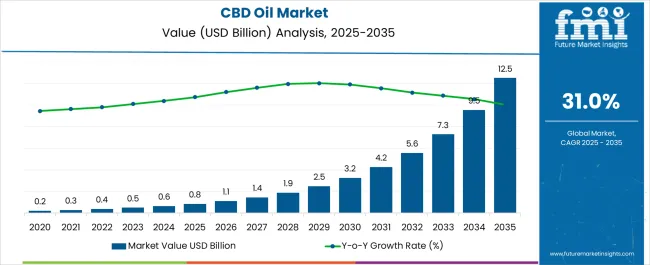
Key Takeaways, Market Size, and Forecast
- CBD oil market value was USD 0.80 billion in 2025.
- Sales are likely to be valued at USD 1.05 billion in 2026.
- By 2036, the market is projected to reach USD 15.60 billion.
- Demand is anticipated to expand at 31.0% CAGR from 2026 to 2036.
- Hemp oil is likely to lead the product type segment with 71.0% share in 2026.
- Pharmaceuticals are forecast to account for 36.0% share by application in 2026.
- Indirect/B2C channels are expected to hold 73.0% share in 2026.
- China is likely to record the fastest growth at 41.9% CAGR through 2036.
CBD Oil Market Key Takeaways
| Metric | Details |
|---|---|
| Industry Size (2026) | USD 1.05 Billion |
| Industry Value (2036) | USD 15.60 Billion |
| CAGR (2026-2036) | 31.0% |
Source: Future Market Insights, 2026
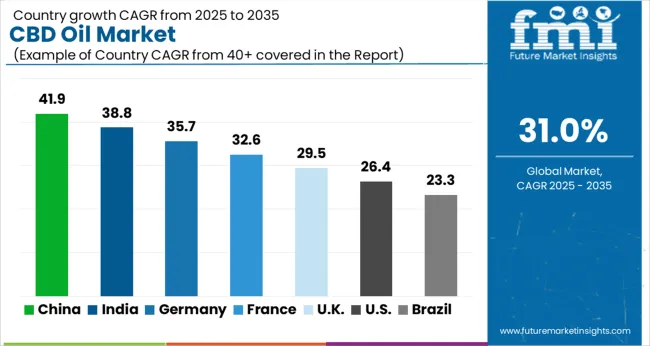
China leads with a 41.9% CAGR as regulatory frameworks for industrial hemp cultivation in Yunnan and Heilongjiang provinces establish legal extraction pathways. India follows at 38.8%, where the Ayush Ministry guidelines and state-level regulatory experiments are opening licensed CBD distribution. Germany registers a 35.7% pace driven by the cannabis regulatory reform that expanded legal CBD access through pharmacy distribution channels. France tracks at 32.6% following the Conseil d'Etat ruling clarifying CBD legality under EU novel food regulations. UK operations advance at 29.5%, supported by the Food Standards Agency CBD product authorization process. USA markets grow at 26.4% anchored by the 2018 Farm Bill hemp legalization and state-level regulatory frameworks. Brazil expands at 23.3% as ANVISA regulatory authorizations for CBD-based health products increase.
CBD Oil Market Definition
CBD oil is an extract derived from Cannabis sativa plant material containing cannabidiol as the primary active compound. The product is formulated into tinctures, capsules, topicals, and edible formats for pharmaceutical, food and beverage, cosmetic, and wellness applications. The market scope covers both hemp-derived and marijuana-derived CBD oil products distributed through licensed commercial channels.
CBD Oil Market Inclusions
Market scope includes hemp-derived CBD oil, marijuana-derived CBD oil, full-spectrum extracts, broad-spectrum extracts, and CBD isolate oil formulations. The report covers global and regional market sizes from 2026 to 2036, segmented by product type, application, distribution channel, and geography.
CBD Oil Market Exclusions
Raw cannabis flower and unprocessed plant material are excluded. THC-dominant cannabis extracts where CBD is not the primary active compound fall outside the analytical scope. Synthetic cannabinoid products manufactured without plant-derived extraction are excluded from the valuation.
CBD Oil Market Research Methodology
- Primary Research: Analysts engaged with procurement specialists, production managers, and supply chain directors to map the decision gates triggering purchasing cycles and supplier qualification requirements.
- Desk Research: Data collection phases aggregated regulatory filings, industry standards documentation, trade association publications, and public company disclosures.
- Market-Sizing and Forecasting: Baseline values derive from a hybrid top-down and bottom-up methodology, applying region-specific adoption curves to project growth velocity through 2036.
- Data Validation and Update Cycle: Projections are tested against publicly reported production volumes, trade data, and industry benchmarks with annual model recalibration.
CBD Oil Market Outlooks 2021 to 2025 in Comparison to 2026 to 2036 Forecasts
Increasing demand for CBD oil in the production of medicines owing to its pain-reducing properties has been facilitating growth in the CBD oil market over the past few years. From 2021 to 2025, the market recorded a CAGR of 11.3%.
CBD oil regulates the endocannabinoid system (ECS) activity and interacts with neurotransmitters. This property makes it an ideal ingredient for anxiety and anti-depression drugs.
In 2020, The World Anti-Doping Agency (WADA) removed cannabidiol (CBD) oil from its list of a prohibited substances. However, all synthetic cannabinoids that mimic the effects of THC are prohibited.
Backed by favorable policies, the global CBD oils market recorded a CAGR of 31.5% and surpassed sales revenue of USD 0.6 million in 2025, says FMI.
Entrepreneurs in the CBD oil industry are concentrating on creating lotions, skin care, pet care, and textile items using cannabidiol, which on the other hand, is driving the CBD oil for pets market.
Increasing market prospects are likely to be offered, particularly in emerging economies, by increasing sales of a variety of CBD-fortified products, new product launches, and the expansion of the product pipeline.
The market is expected to expand as a result of increased research and development (R&D) efforts to lower THC concentration and growing pressure to obtain regulatory approval from agencies more quickly. However, regulations imposed on the application and sales of certain items are likely to hinder sales during the predicted period.
Due to a strong network of online sales channels, widespread knowledge of the many advantages of cannabidiol, and the introduction of retail products like CBD oil, CBD gummies, and CBD beverages in these regions, Europe and North America collectively are expected to hold more than 70% of the global market share for CBD oil.
Is CBD Oil Becoming a New Painkiller?
Research has demonstrated that hemp and marijuana-derived CBD oil plants have the ability to reduce anxiety and tension. When taken as a supplement, CBD oil has therapeutic advantages for neurological illnesses and conditions like depression, discomfort from the nerves, insomnia, and inflammatory pain. This has accelerated the use of CBD oil in the production of drugs used to treat anxiety and pain.
Many pharmaceutical companies are looking to integrate CBD oil into pain-relief medication and introduce new products in the market. For instance, in 2024, dosist™ introduced its progressive new range of CBD+ topical products with all-natural solutions designed to help with pain relief.
The legalization of CBD oil's medical claims has been made possible by relaxing cannabis laws and rising public knowledge of its advantages. Numerous celebrities address their sleep difficulties using CBD oil and related products. In the future years, the sales of CBD oil products are likely to be boosted by celebrity evangelists' endorsement.
CBD Oil Market Country-wise Analysis
.webp "Top Country Growth Comparison Cbd Oil Market Cagr (2026 2036)")
| Country | CAGR |
|---|---|
| China | 41.9% |
| India | 38.8% |
| Germany | 35.7% |
| France | 32.6% |
| UK | 29.5% |
| USA | 26.4% |
| Brazil | 23.3% |
Source: FMI analysis based on primary research and proprietary forecasting model
What Are the Reasons Pushing CBD Oil Demand in the United States?
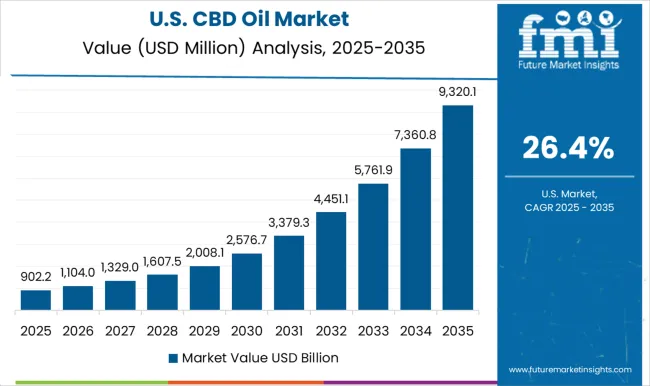
Due to favorable rules governing the use of CBD products and an increasing population who are concerned about their health, the United States is predicted to dominate the CBD oil market over the projected period. The United States agricultural bill's approval in 2024 increased the sales of CBD oil.
Around 50 million persons in the United States suffer from sleep disorders, according to the American Sleep Association. CBD oil modulates and interacts with neurotransmitters, thus helping in achieving deep sleep and alleviating insomnia.
The prevalence of sleep disorders is on the rise, and more studies are showing how well CBD works to treat these conditions, which is expected to help the industry expand in the United States.
Why is the United Kingdom Leading the Europe CBD Oil Market?
- The United Kingdom is forecast to follow the United States and become the second-significant CBD oil market through 2036. The country has one of the most evolved regulatory frameworks for CBD products and has emerged as a significant CBD market across Europe.
- Increasing foreign investment and a rise in research and development activities are projected to allow the CBD oil market to become a significant contributor to the United Kingdom’s economy.
- The United Kingdom’s Food and Standards Agency (FSA) categorized CBD oil as a novel food ingredient. This allowed top CBD companies to apply for and acquire novel food authorization certification for their product range. This led to an increase in demand for high-street products and thus fueled the market growth in the country.
- The majority of CBD oil is imported from parts of Europe and the United States owing to restrictions on the cultivation and extraction of hemp flowers which is a significant CBD source.
- According to the law, hemp farmers are required to lawfully destroy hemp flowers and leaves after harvesting. This makes United Kingdom’s CBD oil industry financially non-viable in long term and thus negatively influences the market growth.
- Medicine and Healthcare products Regulatory Agency (MHRA) stated that any product containing CBD oil and THC cannot be sold as medicine, while the retailers can label and market CBD products as food supplements. These policies are likely to boost the adoption of CBD in the food industry like the production of CBD gummies and other products in the United Kingdom.
What is Driving CBD Oil Market Growth in China?
- Cultivation and production of hemp and CBD are legal only in Yunnan and Heilongjiang provinces of China. The majority of produced hemp is exported as it is legal to export CBD to European and American markets.
- With government approval for the use of CBD oil in cosmetics production in 2020, its application in the production of topical creams, ointments, and balms is expected to skyrocket.
- Significant cosmetic brands are advocating towards use of CBD products. For instance, “One Leaf”, one of the leading face mask companies in China, has started running promotional campaigns for its CBD products through social media and online marketplaces.
- Gradually rising CBD application in China’s cosmetic sector is likely to emerge as a primary growth driver.
CBD Oil Market Category-wise Insights
Why is there a Rise in the Demand for Hemp CBD Oil?
Demand for this market is being driven by the high efficacy of CBD extracted from hemp for various medicinal uses, such as creating a treatment for Parkinson's illness.
Growth is anticipated to be fueled by rising consumer awareness of the health advantages of CBD extracted from hemp oil throughout the assessment period.
The rise in healthcare spending by consumers and the legalization of medical marijuana in North America and Europe are both factors contributing to the demand for hemp oil in the pharmaceutical sector.
Which Distribution Channel is Most Preferred for CBD Oil?
According to FMI, more than 50% of CBD oil sales are likely to be accomplished through online channels.ommerce retail allowed top established and new entrants in CBD oil manufacturing, marketing, and sales to reach customers all around the world.
Some CBD oil manufacturers are selling their products exclusively through e-commerce websites to reach more consumers and create a loyal customer base. However, FMI predicts that the CBD oil market might reflect a paradoxical trend. The demand might shift towards brick-and-mortar stores through 2036.
What Are the Key CBD Oil Applications?
By application type, the food and beverage industry is expected to record high growth due to increasing demand for CBD gummies and snacks across the globe. Market players are working to produce new flavors and are trying to make CBD snacks more accessible to gain a competitive advantage.
FMI expects this segment to grow exponentially owing to an increasing focus on getting certification by international organizations and growing awareness regarding the health benefits of consuming CBD gummies.
Competitive Landscape of the CBD Oil Market
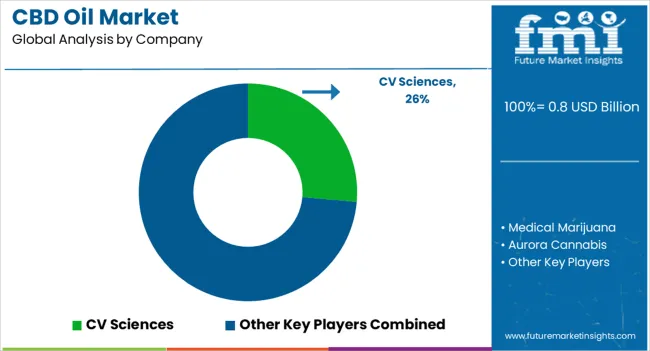
The CBD Oil Market is expanding rapidly, driven by growing awareness of cannabidiol’s therapeutic benefits, rising legalization of hemp-derived products, and increasing integration of CBD into wellness, pharmaceutical, and personal care formulations. CBD oil, extracted from hemp, has gained widespread acceptance for its potential in managing pain, anxiety, inflammation, and sleep disorders without psychoactive effects. Market growth is being fueled by evolving consumer preferences toward natural health remedies, expanding product availability, and supportive regulatory developments across North America, Europe, and parts of Asia-Pacific.
Leading players such as CV Sciences Inc., Medical Marijuana Inc., and Aurora Cannabis Inc. dominate the global market with diversified CBD oil portfolios spanning dietary supplements, tinctures, skincare, and therapeutic applications. CV Sciences Inc. is recognized for its PlusCBD™ line, emphasizing science-backed formulations and strict quality assurance. Medical Marijuana Inc., one of the earliest industry entrants, continues to expand its global footprint through subsidiaries focused on nutraceutical and pharmaceutical-grade CBD products. Aurora Cannabis Inc. leverages its pharmaceutical expertise to deliver high-purity, GMP-certified CBD oils tailored for both medical and wellness segments.
Canopy Growth Corporation and Tilray Brands Inc. are investing heavily in clinical research and global distribution networks to support the mainstream adoption of CBD products. CannTrust Holdings Inc. focuses on pharmaceutical-grade oils with controlled cannabinoid ratios for prescribed use in pain and sleep management, while Kazmira LLC is leading innovation in THC-free broad-spectrum CBD oils through advanced CO₂ extraction and purification technologies.
Leading Players in the CBD Oil Market
- CV Sciences Inc.
- Medical Marijuana Inc.
- Aurora Cannabis Inc.
- Canopy Growth Corporation
- CannTrust Holdings Inc.
- Tilray Brands Inc.
- Kazmira LLC
CBD oil Market Report Scope
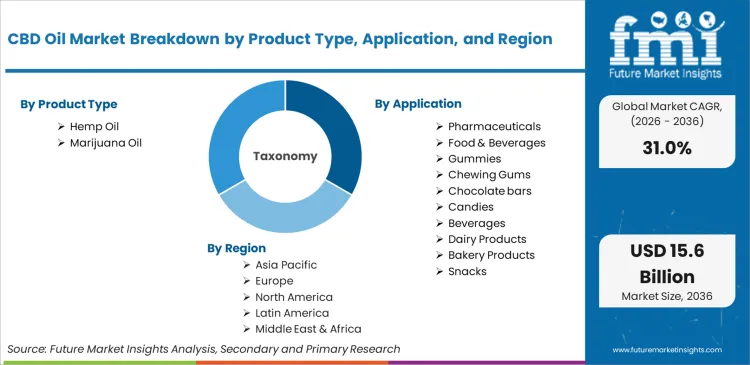
| Metric | Value |
|---|---|
| Quantitative Units | USD Billion 1.05 to USD Billion 15.60, at a CAGR of 31.0% |
| Market Definition | CBD oil is an extract derived from Cannabis sativa plant material containing cannabidiol as the primary active compound. The product is formulated into tinctures, capsules, topicals, and edible formats for pharmaceutical, food and beverage, cosmetic, and wellness applications. The market scope covers both hemp-derived and marijuana-derived CBD oil products distributed through licensed commercial channels. |
| Product Type Segmentation | Hemp Oil, Marijuana Oil |
| Application Segmentation | Pharmaceuticals, Food & Beverages, Cosmetics, Others |
| Distribution Channel Segmentation | Indirect/B2C, Direct/B2B |
| Regions Covered | North America, Latin America, Europe, East Asia, South Asia, Oceania, Middle East & Africa |
| Countries Covered | China, India, Germany, France, UK, USA, Brazil, and 40 plus countries |
| Key Companies Profiled | CV Sciences Inc., Medical Marijuana Inc., Aurora Cannabis Inc., Canopy Growth Corporation, CannTrust Holdings Inc., Tilray Brands Inc., Kazmira LLC |
| Forecast Period | 2026 to 2036 |
| Approach | Hybrid top-down and bottom-up modelling anchored by primary interviews and public data benchmarking |
Key Segments Covered in CBD oil Market Study
By Product Type:
- Hemp Oil
- Marijuana Oil
By Application:
- Pharmaceuticals
- Food & Beverages
- Gummies
- Chewing Gums
- Chocolate bars
- Candies
- Beverages
- Dairy Products
- Bakery Products
- Snacks
- Cosmetics
- Others
By Distribution Channel:
- Direct/B2B
- Indirect/B2C
- Hospital Pharmacy
- Retail Pharmacy
- Hypermarkets/Supermarkets
- Convenience Store
- Online Retail
- Others
By Region:
- North America
- Latin America
- Europe
- South Asia
- East Asia
- Oceania
- Middle East and Africa
Bibliography
- World Health Organization. (2024). Expert Committee on Drug Dependence: Cannabidiol (CBD) Critical Review Report. WHO.
- European Commission. (2024). Novel Food Regulation (EU) 2015/2283: CBD extracts guidance. EUR-Lex.
- United States Congress. (2018). Agriculture Improvement Act of 2018 (2018 Farm Bill), Section 10113. USA Government Publishing Office.
- Food Standards Agency, United Kingdom. (2024). CBD products regulatory guidance for businesses. FSA.
- ANVISA, Brazil. (2024). Resolution RDC No. 327/2019: Cannabis-based health products regulatory framework. Agencia Nacional de Vigilancia Sanitaria.
This bibliography is provided for reader reference. The full FMI report contains the complete reference list with primary research documentation.
Frequently Asked Questions
How large is the demand for CBD Oil in the global market in 2026?
Demand for CBD Oil in the global market is estimated to be valued at USD Billion 1.05 in 2026.
What will be the market size of CBD Oil in the global market by 2036?
Market size for CBD Oil is projected to reach USD Billion 15.60 by 2036.
What is the expected demand growth for CBD Oil in the global market between 2026 and 2036?
Demand for CBD Oil is expected to grow at a CAGR of 31.0% between 2026 and 2036.
Which Product Type is poised to lead global sales by 2026?
Hemp Oil accounts for 71.0% share in 2026.
How significant is the role of Pharmaceuticals in Application?
Pharmaceuticals commands 36.0% of the application segment in 2026.
What is the growth outlook for China?
China is projected to grow at a CAGR of 41.9% during 2026 to 2036.
What is the growth rate for India in this market?
India is projected to expand at a CAGR of 38.8% during 2026 to 2036.
What is CBD Oil and what is it mainly used for?
CBD oil is an extract derived from Cannabis sativa plant material containing cannabidiol as the primary active compound. The product is formulated into tinctures, capsules, topicals, and edible formats for pharmaceutical, food and beverage, cosmetic, and wellness applications.
What is included in the scope of this CBD Oil report?
Market scope includes hemp-derived CBD oil, marijuana-derived CBD oil, full-spectrum extracts, broad-spectrum extracts, and CBD isolate oil formulations. The report covers global and regional market sizes from 2026 to 2036, segmented by product type, application, distribution channel, and geography.
What is excluded from the scope of this report?
Raw cannabis flower and unprocessed plant material are excluded. THC-dominant cannabis extracts where CBD is not the primary active compound fall outside the analytical scope.
What does market forecast mean on this page?
The market forecast represents a model-based projection built on defined industry and supply chain assumptions for strategic planning purposes.
How does FMI build and validate the CBD Oil forecast?
Forecasting models apply a hybrid top-down and bottom-up methodology and cross-validate projections against publicly available industry data and primary research inputs.
What does zero reliance on speculative third-party market research mean here?
Primary interviews, verified public regulatory documentation, and official industry standards registries are used instead of unverified syndicated estimates.
Preview the report firsthand - request a free sample
Get SampleGet the brochure for pricing and purchase details.
Get PDFTable of Content
- Executive Summary
- Global Market Outlook
- Demand-side Trends
- Supply-side Trends
- Technology Roadmap Analysis
- Analysis and Recommendations
- Market Overview
- Market Coverage / Taxonomy
- Market Definition / Scope / Limitations
- Research Methodology
- Chapter Orientation
- Analytical Lens and Working Hypotheses
- Market Structure, Signals, and Trend Drivers
- Benchmarking and Cross-market Comparability
- Market Sizing, Forecasting, and Opportunity Mapping
- Research Design and Evidence Framework
- Desk Research Programme (Secondary Evidence)
- Company Annual and Sustainability Reports
- Peer-reviewed Journals and Academic Literature
- Corporate Websites, Product Literature, and Technical Notes
- Earnings Decks and Investor Briefings
- Statutory Filings and Regulatory Disclosures
- Technical White Papers and Standards Notes
- Trade Journals, Industry Magazines, and Analyst Briefs
- Conference Proceedings, Webinars, and Seminar Materials
- Government Statistics Portals and Public Data Releases
- Press Releases and Reputable Media Coverage
- Specialist Newsletters and Curated Briefings
- Qualitative Interviews and Expert Elicitation
- Quantitative Surveys and Structured Data Capture
- Blended Approach
- Why Primary Evidence is Used
- Field Techniques
- Interviews
- Surveys
- Focus Groups
- Observational and In-context Research
- Social and Community Interactions
- Stakeholder Universe Engaged
- C-suite Leaders
- Board Members
- Presidents and Vice Presidents
- R&D and Innovation Heads
- Technical Specialists
- Domain Subject-matter Experts
- Scientists
- Physicians and Other Healthcare Professionals
- Governance, Ethics, and Data Stewardship
- Research Ethics
- Data Integrity and Handling
- Desk Research Programme (Secondary Evidence)
- Tooling, Models, and Reference Databases
- Data Engineering and Model Build
- Data Acquisition and Ingestion
- Cleaning, Normalisation, and Verification
- Synthesis, Triangulation, and Analysis
- Quality Assurance and Audit Trail
- Market Background
- Market Dynamics
- Drivers
- Restraints
- Opportunity
- Trends
- Scenario Forecast
- Demand in Optimistic Scenario
- Demand in Likely Scenario
- Demand in Conservative Scenario
- Opportunity Map Analysis
- Product Life Cycle Analysis
- Supply Chain Analysis
- Investment Feasibility Matrix
- Value Chain Analysis
- PESTLE and Porter’s Analysis
- Regulatory Landscape
- Regional Parent Market Outlook
- Production and Consumption Statistics
- Import and Export Statistics
- Market Dynamics
- Global Market Analysis 2021 to 2025 and Forecast, 2026 to 2036
- Historical Market Size Value (USD Billion) Analysis, 2021 to 2025
- Current and Future Market Size Value (USD Billion) Projections, 2026 to 2036
- Y-o-Y Growth Trend Analysis
- Absolute $ Opportunity Analysis
- Global Market Pricing Analysis 2021 to 2025 and Forecast 2026 to 2036
- Global Market Analysis 2021 to 2025 and Forecast 2026 to 2036, By Product Type
- Introduction / Key Findings
- Historical Market Size Value (USD Billion) Analysis By Product Type , 2021 to 2025
- Current and Future Market Size Value (USD Billion) Analysis and Forecast By Product Type , 2026 to 2036
- Hemp Oil
- Marijuana Oil
- Hemp Oil
- Y-o-Y Growth Trend Analysis By Product Type , 2021 to 2025
- Absolute $ Opportunity Analysis By Product Type , 2026 to 2036
- Global Market Analysis 2021 to 2025 and Forecast 2026 to 2036, By Application
- Introduction / Key Findings
- Historical Market Size Value (USD Billion) Analysis By Application, 2021 to 2025
- Current and Future Market Size Value (USD Billion) Analysis and Forecast By Application, 2026 to 2036
- Pharmaceuticals
- Food & Beverages
- Gummies
- Chewing Gums
- Chocolate bars
- Candies
- Beverages
- Dairy Products
- Bakery Products
- Snacks
- Cosmetics
- Pharmaceuticals
- Y-o-Y Growth Trend Analysis By Application, 2021 to 2025
- Absolute $ Opportunity Analysis By Application, 2026 to 2036
- Global Market Analysis 2021 to 2025 and Forecast 2026 to 2036, By Distribution Channel
- Introduction / Key Findings
- Historical Market Size Value (USD Billion) Analysis By Distribution Channel, 2021 to 2025
- Current and Future Market Size Value (USD Billion) Analysis and Forecast By Distribution Channel, 2026 to 2036
- Indirect/B2C
- Direct/B2B
- Hospital Pharmacy
- Retail Pharmacy
- Hypermarkets/Supermarkets
- Convenience Store
- Online Retail
- Others
- Indirect/B2C
- Y-o-Y Growth Trend Analysis By Distribution Channel, 2021 to 2025
- Absolute $ Opportunity Analysis By Distribution Channel, 2026 to 2036
- Global Market Analysis 2021 to 2025 and Forecast 2026 to 2036, By Region
- Introduction
- Historical Market Size Value (USD Billion) Analysis By Region, 2021 to 2025
- Current Market Size Value (USD Billion) Analysis and Forecast By Region, 2026 to 2036
- North America
- Latin America
- Western Europe
- Eastern Europe
- East Asia
- South Asia and Pacific
- Middle East & Africa
- Market Attractiveness Analysis By Region
- North America Market Analysis 2021 to 2025 and Forecast 2026 to 2036, By Country
- Historical Market Size Value (USD Billion) Trend Analysis By Market Taxonomy, 2021 to 2025
- Market Size Value (USD Billion) Forecast By Market Taxonomy, 2026 to 2036
- By Country
- USA
- Canada
- Mexico
- By Product Type
- By Application
- By Distribution Channel
- By Country
- Market Attractiveness Analysis
- By Country
- By Product Type
- By Application
- By Distribution Channel
- Key Takeaways
- Latin America Market Analysis 2021 to 2025 and Forecast 2026 to 2036, By Country
- Historical Market Size Value (USD Billion) Trend Analysis By Market Taxonomy, 2021 to 2025
- Market Size Value (USD Billion) Forecast By Market Taxonomy, 2026 to 2036
- By Country
- Brazil
- Chile
- Rest of Latin America
- By Product Type
- By Application
- By Distribution Channel
- By Country
- Market Attractiveness Analysis
- By Country
- By Product Type
- By Application
- By Distribution Channel
- Key Takeaways
- Western Europe Market Analysis 2021 to 2025 and Forecast 2026 to 2036, By Country
- Historical Market Size Value (USD Billion) Trend Analysis By Market Taxonomy, 2021 to 2025
- Market Size Value (USD Billion) Forecast By Market Taxonomy, 2026 to 2036
- By Country
- Germany
- UK
- Italy
- Spain
- France
- Nordic
- BENELUX
- Rest of Western Europe
- By Product Type
- By Application
- By Distribution Channel
- By Country
- Market Attractiveness Analysis
- By Country
- By Product Type
- By Application
- By Distribution Channel
- Key Takeaways
- Eastern Europe Market Analysis 2021 to 2025 and Forecast 2026 to 2036, By Country
- Historical Market Size Value (USD Billion) Trend Analysis By Market Taxonomy, 2021 to 2025
- Market Size Value (USD Billion) Forecast By Market Taxonomy, 2026 to 2036
- By Country
- Russia
- Poland
- Hungary
- Balkan & Baltic
- Rest of Eastern Europe
- By Product Type
- By Application
- By Distribution Channel
- By Country
- Market Attractiveness Analysis
- By Country
- By Product Type
- By Application
- By Distribution Channel
- Key Takeaways
- East Asia Market Analysis 2021 to 2025 and Forecast 2026 to 2036, By Country
- Historical Market Size Value (USD Billion) Trend Analysis By Market Taxonomy, 2021 to 2025
- Market Size Value (USD Billion) Forecast By Market Taxonomy, 2026 to 2036
- By Country
- China
- Japan
- South Korea
- By Product Type
- By Application
- By Distribution Channel
- By Country
- Market Attractiveness Analysis
- By Country
- By Product Type
- By Application
- By Distribution Channel
- Key Takeaways
- South Asia and Pacific Market Analysis 2021 to 2025 and Forecast 2026 to 2036, By Country
- Historical Market Size Value (USD Billion) Trend Analysis By Market Taxonomy, 2021 to 2025
- Market Size Value (USD Billion) Forecast By Market Taxonomy, 2026 to 2036
- By Country
- India
- ASEAN
- Australia & New Zealand
- Rest of South Asia and Pacific
- By Product Type
- By Application
- By Distribution Channel
- By Country
- Market Attractiveness Analysis
- By Country
- By Product Type
- By Application
- By Distribution Channel
- Key Takeaways
- Middle East & Africa Market Analysis 2021 to 2025 and Forecast 2026 to 2036, By Country
- Historical Market Size Value (USD Billion) Trend Analysis By Market Taxonomy, 2021 to 2025
- Market Size Value (USD Billion) Forecast By Market Taxonomy, 2026 to 2036
- By Country
- Kingdom of Saudi Arabia
- Other GCC Countries
- Turkiye
- South Africa
- Other African Union
- Rest of Middle East & Africa
- By Product Type
- By Application
- By Distribution Channel
- By Country
- Market Attractiveness Analysis
- By Country
- By Product Type
- By Application
- By Distribution Channel
- Key Takeaways
- Key Countries Market Analysis
- USA
- Pricing Analysis
- Market Share Analysis, 2025
- By Product Type
- By Application
- By Distribution Channel
- Canada
- Pricing Analysis
- Market Share Analysis, 2025
- By Product Type
- By Application
- By Distribution Channel
- Mexico
- Pricing Analysis
- Market Share Analysis, 2025
- By Product Type
- By Application
- By Distribution Channel
- Brazil
- Pricing Analysis
- Market Share Analysis, 2025
- By Product Type
- By Application
- By Distribution Channel
- Chile
- Pricing Analysis
- Market Share Analysis, 2025
- By Product Type
- By Application
- By Distribution Channel
- Germany
- Pricing Analysis
- Market Share Analysis, 2025
- By Product Type
- By Application
- By Distribution Channel
- UK
- Pricing Analysis
- Market Share Analysis, 2025
- By Product Type
- By Application
- By Distribution Channel
- Italy
- Pricing Analysis
- Market Share Analysis, 2025
- By Product Type
- By Application
- By Distribution Channel
- Spain
- Pricing Analysis
- Market Share Analysis, 2025
- By Product Type
- By Application
- By Distribution Channel
- France
- Pricing Analysis
- Market Share Analysis, 2025
- By Product Type
- By Application
- By Distribution Channel
- India
- Pricing Analysis
- Market Share Analysis, 2025
- By Product Type
- By Application
- By Distribution Channel
- ASEAN
- Pricing Analysis
- Market Share Analysis, 2025
- By Product Type
- By Application
- By Distribution Channel
- Australia & New Zealand
- Pricing Analysis
- Market Share Analysis, 2025
- By Product Type
- By Application
- By Distribution Channel
- China
- Pricing Analysis
- Market Share Analysis, 2025
- By Product Type
- By Application
- By Distribution Channel
- Japan
- Pricing Analysis
- Market Share Analysis, 2025
- By Product Type
- By Application
- By Distribution Channel
- South Korea
- Pricing Analysis
- Market Share Analysis, 2025
- By Product Type
- By Application
- By Distribution Channel
- Russia
- Pricing Analysis
- Market Share Analysis, 2025
- By Product Type
- By Application
- By Distribution Channel
- Poland
- Pricing Analysis
- Market Share Analysis, 2025
- By Product Type
- By Application
- By Distribution Channel
- Hungary
- Pricing Analysis
- Market Share Analysis, 2025
- By Product Type
- By Application
- By Distribution Channel
- Kingdom of Saudi Arabia
- Pricing Analysis
- Market Share Analysis, 2025
- By Product Type
- By Application
- By Distribution Channel
- Turkiye
- Pricing Analysis
- Market Share Analysis, 2025
- By Product Type
- By Application
- By Distribution Channel
- South Africa
- Pricing Analysis
- Market Share Analysis, 2025
- By Product Type
- By Application
- By Distribution Channel
- USA
- Market Structure Analysis
- Competition Dashboard
- Competition Benchmarking
- Market Share Analysis of Top Players
- By Regional
- By Product Type
- By Application
- By Distribution Channel
- Competition Analysis
- Competition Deep Dive
- CV Sciences Inc.
- Overview
- Product Portfolio
- Profitability by Market Segments (Product/Age /Sales Channel/Region)
- Sales Footprint
- Strategy Overview
- Marketing Strategy
- Product Strategy
- Channel Strategy
- Medical Marijuana Inc.
- Aurora Cannabis Inc.
- Canopy Growth Corporation
- CannTrust Holdings Inc.
- Tilray Brands Inc.
- Kazmira LLC
- CV Sciences Inc.
- Competition Deep Dive
- Assumptions & Acronyms Used


