

- Market Size (2026)
- USD 0.6 Bn
- Forecast (2036)
- USD 10.1 Bn
- CAGR (2026 to 2036)
- 33.0%
Pet CBD Market Size, Market Forecast and Outlook By FMI
The pet CBD market is projected to advance from USD 0.5 billion in 2025 to USD 10.1 billion by 2036 at a 33.0% CAGR, fueled by owner preference for traceable animal wellness formats as hemp-derived CBD accounts for 82.0% share and e-commerce websites contribute 46.0% share through certificate-backed education and repeat-purchase convenience.
Summary of the Pet CBD Market
- Demand and Growth Drivers
- Condition-specific pet wellness purchases back demand for CBD oils and chews as owners seek focused animal care products.
- Digital education lifts demand for pet CBD as owners compare serving guidance and batch records online.
- Compliance-led product positioning improves channel trust as regulators monitor animal disease claims.
- Batch documentation and potency control are becoming purchase filters for online platforms and pet specialty outlets.
- Product and Segment View
- Hemp-derived inputs are expected to lead the source segment with 82.0% share in 2026, due to traceable supply and lower THC concerns.
- E-commerce websites are poised to dominate the end user segment with 46.0% share in 2026, reflecting education-heavy purchase behavior.
- Epilepsy is projected to hold high-value indication demand as owners seek wellness products for recurring animal concerns.
- Geography and Competitive Outlook
- Australia is expected to record a CAGR of 36.1% through 2036, due to high pet ownership and tighter claim classification.
- Canada is projected to expand at 35.0% CAGR by 2036, as formal CBD veterinary pathway discussions improve planning clarity.
- Companies combining conservative claim control with batch-level documentation are strengthening their market position during the forecast period.
- Analyst Opinion
- Ronak Shah, Principal Consultant for Consumer Products at FMI, says, “Pet CBD brands are moving toward compliance-led wellness. Retailers expect batch records and careful serving guidance before repeat listings. Veterinary channels support verified hemp sourcing and stable cannabinoid profiles. Claim review controls and e-commerce content discipline shape channel access and scale potential.”
- Pet CBD Market Value Analysis
- The pet CBD market is moving from early wellness adoption into a regulated animal health-adjacent product base.
- Adoption is being shaped by owner interest in oils and chews for named animal wellness concerns.
- The market benefits from deeper use of CBD pet products across adjacent animal wellness portfolios.
- Demand is backed by product records meeting platform review needs and retailer documentation standards.
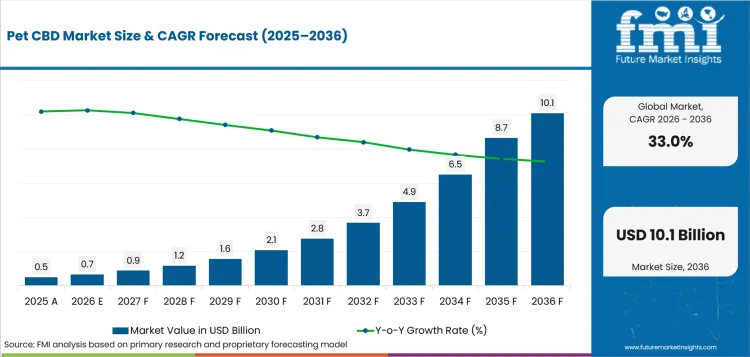
Key Takeaways, Market Size, and Forecast
| Metric | Value |
|---|---|
| Market Size (2026) | USD 0.6 Billion |
| Market Size (2036) | USD 10.1 Billion |
| Forecast CAGR | 33.0% from 2026 to 2036 |
| Leading Source | Hemp |
| Hemp Share In 2026 | 82.0% |
| Leading End User | E-Commerce Websites |
| E-Commerce Websites Share In 2026 | 46.0% |
| Fastest-Growing Country | Australia |
| Australia CAGR | 36.1% through 2036 |
Pet CBD brands now need careful product wording before selling online. FDA’s April 2025 warning letter to HolistaPet reveals how website pages and social media claims can create regulatory risk for animal CBD products. Medterra’s Pet CBD Calming Chews list 10 mg CBD and 25 mg L-Tryptophan per soft chew, which gives pet owners a clear dosage point for comparison. This type of product detail helps buyers understand what they are purchasing without relying on broad wellness claims. A 2024 Frontiers in Veterinary Science study found that 32 healthy beagles tolerated hemp-derived cannabinoids at 5 mg/kg/day over 90 days. This does not make every pet CBD product risk-free, but it gives suppliers a useful safety reference. Brands with careful claims and better product records will be easier for retailers and pet owners to trust.
Pet CBD Market Definition
The pet CBD market includes commercially sold cannabidiol products formulated for companion animal wellness. These products include hemp-derived and marijuana-derived oils, chews, capsules, and topical formats sold through digital channels and specialty outlets. Scope covers products positioned for epilepsy, sleep disorders, cancer, and bowel disorders. Human CBD products, livestock feed cannabinoids, and prescription veterinary drugs without pet CBD positioning are outside the scope.
Pet CBD Market Inclusions
Market scope covers all commercially traded pet CBD products categorized by source, including hemp and marijuana; indications, including epilepsy, sleep disorders, cancer, and bowel disorders; end users, including e-commerce websites, pet shops, and veterinary hospital pharmacies; product forms, including oils, chews, capsules, and topicals; and pet types, including dogs, cats, horses, and other companion animals. Revenue scope covers 2026 to 2036. The key stakeholders include pet CBD brands, hemp extract suppliers, cannabinoid formulators, pet supplement manufacturers, online retailers, pet specialty stores, veterinary hospital pharmacies, packaging suppliers, testing laboratories, distributors, pet owners, regulatory bodies, and animal health advisors.
Pet CBD Market Exclusions
Scope does not include human CBD products, cannabis cultivation revenue, livestock feed cannabinoids, veterinary prescription drugs without CBD positioning, or recreational cannabis products.
Pet CBD Market Research Methodology
- Primary Research: FMI analysts spoke to pet wellness brands, online retailers, pet specialty sellers, formulation experts, and veterinary channel participants in important markets.
- Desk Research: Review work combined regulatory notices, product portfolios, association statistics, official pet ownership data, and online channel structures.
- Market sizing and forecasting: The model added source use, product format mix, channel behavior, and country-level readiness from the bottom up.
- Data validation: Forecasts were cross-checked against claim enforcement, pet ownership bases, product portfolios, and relevant adjacent wellness categories every quarter.
Why is the Pet CBD Market Growing?
- Pet owners are using CBD formats for named animal wellness concerns instead of routine supplement purchases.
- Online stores reduce buyer hesitation through dosage content, customer education, and certificate access.
- Hemp sourcing improves traceability as platforms and retailers ask for stable cannabinoid records.
- Regulatory pressure improves the position of suppliers with conservative claims and batch documentation.
Pet CBD demand is expanding as animal owners connect wellness purchases with specific care concerns. APPA reported in April 2026 that dog ownership increased from 51.0% to 53.0% of USA households in 2025. A larger canine base improves the repeat-use pool for oils and chews with simple serving instructions. This favors brands with clear labels and controlled online content. Adjacent pet care market outlook reinforces premium owner spending across animal wellness products.
Regulatory screening has become a core market force for pet CBD sellers. FDA reviewed HolistaPet websites and social pages in April 2025 and identified several CBD animal products as unapproved new animal drugs. This public action makes product pages and social content operational risk points for CBD brands. Suppliers able to manage wording and evidence files can reduce forced content changes. Channel partners will support brands with careful claim review and usable batch records.
Market Segmentation Analysis
- Hemp is projected to hold 82.0% of the source segment in 2026, as traceable inputs and lower THC positioning help brands pass retailer review.
- Epilepsy is expected to account for 34.0% of indication-based sales in 2026, due to owner focus on recurring animal wellness concerns.
- E-commerce websites are forecast to capture 46.0% of end user activity in 2026, helped by certificate access, product education, and subscription-based repeat purchases.
- Oils are forecast to represent 48.0% of product form revenue in 2026, since flexible serving control helps owners adjust use across different pet sizes.
- Dogs are expected to account for 64.0% of pet type sales in 2026, reflecting broader product availability and higher spending across canine wellness routines.
The market for pet CBD is divided into groups based on source, indication, end user, product form, pet type, and region. Source covers hemp and marijuana. By indication, the market includes epilepsy, sleep disorders, cancer, and bowel disorders. By end user, the market covers e-commerce websites, pet shops, and veterinary hospital pharmacies. Based on product form, it includes oils, chews, capsules, and topicals. By pet type, the market includes dogs, cats, horses, and other companion animals.
Insights into Pet CBD Market by Source
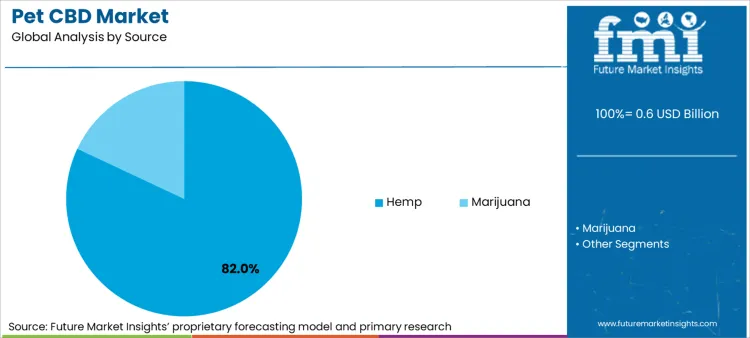
- In 2026, hemp is expected to account for 82.0% of the source segment. Hemp-derived CBD offers better traceability and lower THC positioning across pet wellness products.
- Marijuana-derived CBD serves a narrower product base. Its use is limited by stricter review requirements and higher channel caution in animal CBD selling.
Insights into Pet CBD Market by Indication
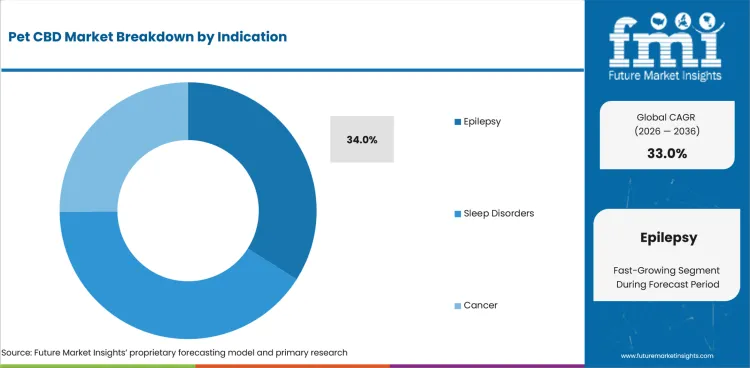
- Epilepsy is projected to account for 34.0% of the indication segment in 2026. Recurring animal wellness concerns enhance higher owner interest in CBD formats.
- Sleep disorders and bowel disorders address more selective use cases. Their uptake relies on careful wellness wording and product records which avoid treatment-style claims.
Insights into Pet CBD Market by End User
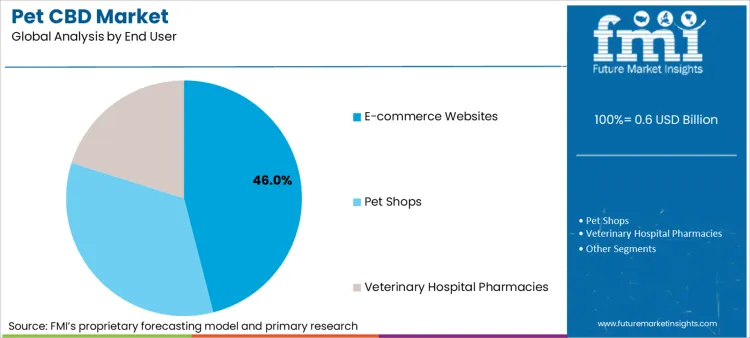
- E-commerce websites are expected to hold 46.0% share of the end user segment in 2026. Online channels allow owners to review certificates and compare CBD oils or chews before purchase.
- Pet shops and veterinary hospital pharmacies serve more controlled purchase settings. Their role improves when products carry clear serving guidance and compliant label language.
Insights into Pet CBD Market by Product Form
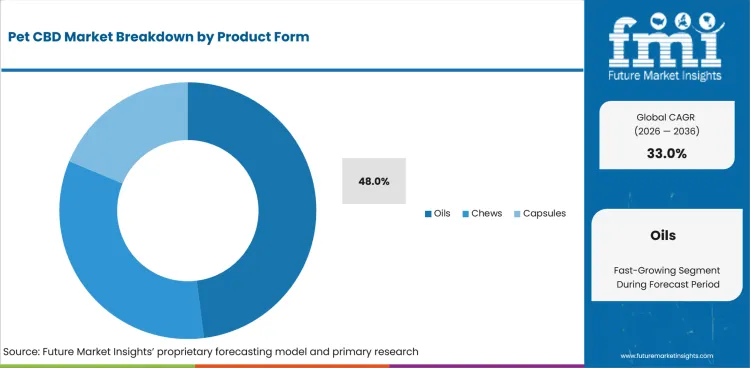
- Oils are projected to account for 48.0% of the product form segment in 2026. Flexible serving control makes oils suitable for dogs and cats across different weight ranges.
- Chews and capsules address convenience-focused pet owners. Their value improves when brands offer stable potency and simple feeding instructions for repeat use.
Insights into Pet CBD Market by Pet Type
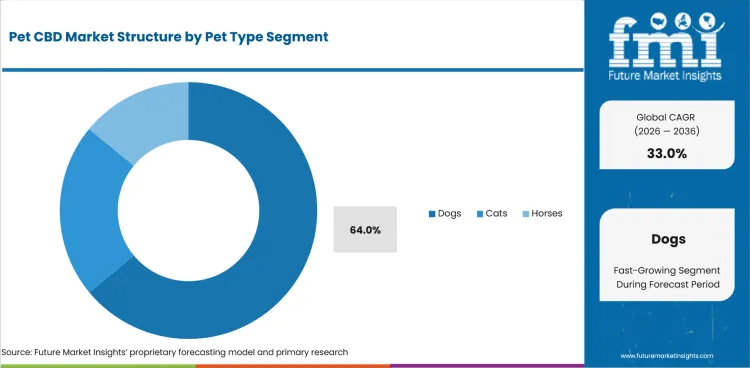
- Dogs are expected to hold 64.0% of the pet type segment in 2026. Canine CBD products have stronger visibility across online stores and specialty pet channels.
- Cats and horses increase smaller but distinct product needs. Their adoption relies on careful serving guidance and formats suited to animal size and handling behavior.
Pet CBD Market Drivers, Restraints and Opportunities
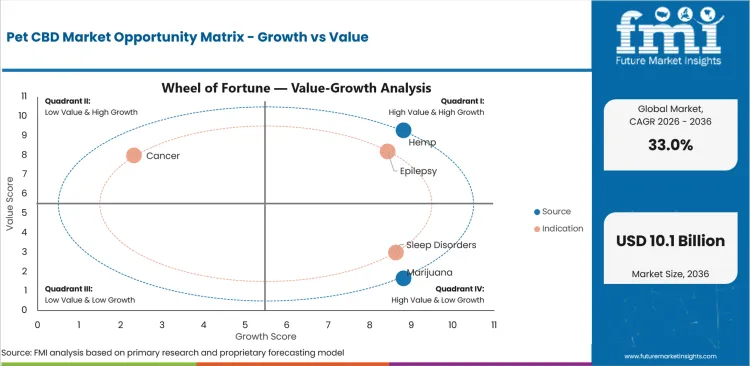
- Driver: Extraction-grade floral hemp repricing keeps pet CBD oil and chew cost floors higher as CBD-rich input supply tightens.
- Restraint: FDA warning activity limits disease-claim selling and enhances delisting risk for weakly documented pet CBD brands.
- Opportunity: Verified hemp sourcing and claim-safe product records increase supplier differentiation for retailers and veterinary-adjacent channels.
Pet CBD pricing is increasingly shaped by extraction feedstock discipline and batch documentation needs. USDA NASS reported in April 2026, USA open-grown extracted floral hemp price increased from USD 22.80 per pound in 2024 to USD 35.80 per pound in 2025. Utilized extracted production fell from 10.849 million pounds to 7.243 million pounds. Lower usable supply and higher input prices reduce room for discount-led CBD oils and chews. Brands with tiered potency packs and tighter batch planning can protect margins during input repricing.
Application-Side Demand and Channel Access Analysis
Application demand is leading where pet CBD products carry clear dosage and careful wellness positioning. FDA’s cannabis-derived product warning letter page listed seven warning letters in 2025 including Bailey’s Wellness and Holista. It included House of Alchemy and CBD Dog Health among animal facing firms. This does not remove consumer interest, but it changes how retailers evaluate shelf access. E-commerce sellers and veterinary-adjacent channels now support CBD products with certificates of analysis and conservative product language. Suppliers must treat claim review as part of channel strategy.
Supply Chain and Compliance Cost Analysis
Supply exposure gives pet CBD a pricing profile different from standard pet supplements. Higher extracted floral hemp prices raise formulation cost for oils and chews. Tinctures face the same pressure as CBD-rich inputs become less discount-priced. Compliance spending adds another cost layer through legal review and batch testing. Dosage checks and label discipline raise operating costs for regulated sellers. Discount sellers can lose channel access if product pages rely on disease claims. Retailers may reject products with unclear serving instructions for pet owners. Premium suppliers can defend price by proving hemp source and cannabinoid content. High claim control across selling channels can protect repeat listings.
Analysis of Pet CBD Market By Key Countries
.webp "Top Country Growth Comparison Pet Cbd Market Cagr (2026 2036)")
| Country | CAGR |
|---|---|
| Australia | 36.1% |
| Canada | 35.0% |
| UK | 34.2% |
| Germany | 33.6% |
| South Korea | 32.8% est. |
| Japan | 32.4% est. |
| USA | 31.5% |
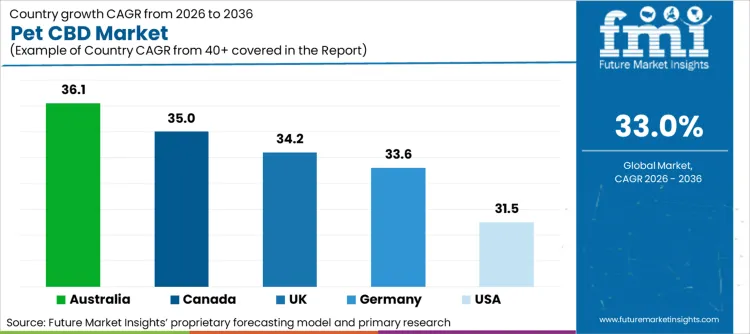
Source: Future Market Insights, 2026. South Korea and Japan are FMI analyst estimates based on pet ownership, digital pet care, and adjacent cannabidiol pet demand patterns. Demand Outlook for Pet CBD Industry in Australia
Australia Pet CBD Industry Outlook
Fastest-expanding country market · 2026 to 2036
Country Market Snapshot Table
| Parameter | Value |
|---|---|
| Market Size in 2025 (Value) | USD 0.5 billion |
| Market Forecast in 2036 (Value) | USD 10.1 billion |
| CAGR (2026-2036) | 36.1% |
| Years Considered | 2016-2036 |
| Base Year | 2025 |
| Forecast Period | 2026-2036 |
| Units Considered | Value (USD Bn) |
| Leading Sub-Region | New South Wales |
Demand Outlook for Pet CBD Industry in Australia
Australia Industry Outlook
Pet CBD demand in Australia is shaped by APVMA veterinary chemical review and a large companion animal base. New South Wales and Victoria carry high online pet wellness activity. APVMA classification exposure makes label wording important for hemp oils and chews sold to urban pet owners.
Australian pet owners spend heavily on companion animal care across veterinary services and premium products. Sydney and Melbourne households enhance early interest in documented oils.
Key Growth Drivers
- New South Wales online pet sellers gain from high household pet ownership, as Animal Medicines Australia reported 73.0% pet-owning households in September 2025, lifting trial demand.
- Victoria pet specialty outlets benefit from national companion animal depth, as Animal Medicines Australia reported 31.6 million pets in September 2025, aiding repeat wellness purchases.
- APVMA classification review increases trust for hemp oils carrying conservative label claims across Sydney digital pet wellness stores.
- Queensland pet owners favor documented chews and oils as premium animal care spending increases across Brisbane households.
Key Restraints
- APVMA registration exposure slows CBD animal product listing, as APVMA guidance in May 2025 covered cannabis pet products under veterinary chemical rules.
- Sydney sellers face higher review costs if pet CBD labels imply treatment claims for epilepsy or cancer.
- Queensland online stores must check hemp oil descriptions carefully before selling into veterinary-adjacent pet wellness channels.
What makes Australia unique
Australia combines high pet ownership with APVMA classification pressure, creating a market built on compliance discipline and product documentation.
Key Companies
- Pet Releaf serves Australia through pet-focused CBD visibility across cross-border online search channels for animal wellness buyers.
- HolistaPet reaches Australian buyers through digital pet CBD pages and pet-specific product education content.
- Endoca has CBD brand awareness among Australian consumers comparing hemp oil product records and certificate access.
Sales & Marketing Channels
- Sydney e-commerce pet wellness stores use certificate-led product pages for hemp oils and chews.
- Melbourne specialty pet retailers handle premium wellness products under APVMA-sensitive label controls.
- Brisbane online pet care sellers use dosage education for oils sold to dog owners.
Country Segment Breakdown Table
| Segment | Sub-Segments |
|---|---|
| By Source | Hemp · Marijuana |
| By Indication | Epilepsy · Sleep Disorders · Cancer · Bowel Disorders |
| By End User | E-commerce Websites · Pet Shops · Veterinary Hospital Pharmacies |
| By Product Form | Oils · Chews · Capsules · Topicals |
| By Pet Type | Dogs · Cats · Horses · Others |
| Key Sub-Regions Covered, States / Territories | New South Wales, Victoria, Queensland, Western Australia, South Australia, Tasmania, Australian Capital Territory, Northern Territory |
Market Taxonomy and Sub-Regions Covered
Frequently Asked Questions
How fast is Australia’s Pet CBD Industry growing?
Australia’s Pet CBD Industry is projected to record a 36.1% CAGR from 2026 to 2036. APVMA classification discipline and high pet ownership drive this pace.
Who leads the Australia Pet CBD Industry?
Pet Releaf, HolistaPet, and Endoca have visible pet CBD positioning for Australian digital buyers. Local leadership relies on claim control and batch records.
What is driving demand in Australia?
New South Wales online selling and Victoria specialty retail activity drive adoption. APVMA-sensitive product wording improves buyer confidence in hemp oils.
Sales Analysis of Pet CBD Industry in Canada
Regulated pathway signal market · 2026 to 2036
Country Market Snapshot Table
| Parameter | Value |
|---|---|
| Market Size in 2025 (Value) | USD 0.5 billion |
| Market Forecast in 2036 (Value) | USD 10.1 billion |
| CAGR (2026-2036) | 35.0% |
| Years Considered | 2016-2036 |
| Base Year | 2025 |
| Forecast Period | 2026-2036 |
| Units Considered | Value (USD Bn) |
| Leading Sub-Region | Ontario |
Sales Analysis of Pet CBD Industry in Canada
Canada Industry Outlook
Pet CBD outlook in Canada is centres on Health Canada pathway work for veterinary drugs containing CBD. Ontario and British Columbia offer strong pet specialty retail coverage. This regulatory direction helps suppliers prepare evidence files before broader veterinary-adjacent access improves.
Canadian owners use veterinary care as a trusted filter for animal wellness purchases. Ontario households increase demand for CBD oils with careful serving guidance. British Columbia e-commerce buyers compare hemp certificates and product wording before repeat purchases through cannabidiol CBD pet industry analysis.
Key Growth Drivers
- Ontario pet wellness retailers gain planning clarity, as Health Canada discussed veterinary CBD access in March 2025, aiding evidence-led suppliers.
- Canadian pet ownership depth helps repeat use, as CAHI reported 7.2 million dogs and 8.2 million cats in March 2025, lifting addressable demand.
- British Columbia digital buyers support hemp oils with origin disclosure and simple serving instructions for dogs.
- Quebec pet specialty stores benefit from bilingual product education and careful claim review for CBD chews.
Key Restraints
- Health Canada pathway timing limits rapid channel expansion, as federal consultation continues for veterinary CBD access.
- Ontario retailers face listing delays if CBD product pages lack batch records and conservative claim language.
- Quebec sellers need bilingual label control across hemp oils and chews before broader consumer rollout.
What makes Canada unique
Canada offers a public regulatory pathway signal for veterinary CBD products, which helps serious suppliers plan evidence-backed entry.
Key Companies
- Canopy Growth brings Canadian cannabinoid sector experience into animal wellness planning discussions.
- Aurora Cannabis has Canadian cannabis infrastructure relevant to cannabinoid compliance knowledge.
- Charlotte’s Web reaches Canadian buyers through North American hemp CBD brand recognition and digital product awareness.
Sales & Marketing Channels
- Ontario specialty pet stores use education-led selling for premium hemp oils and chews.
- British Columbia online channels rely on certificate access and direct product comparison.
- Quebec bilingual retail pages need careful CBD wording for animal wellness claims.
Country Segment Breakdown Table
| Segment | Sub-Segments |
|---|---|
| By Source | Hemp · Marijuana |
| By Indication | Epilepsy · Sleep Disorders · Cancer · Bowel Disorders |
| By End User | E-commerce Websites · Pet Shops · Veterinary Hospital Pharmacies |
| By Product Form | Oils · Chews · Capsules · Topicals |
| By Pet Type | Dogs · Cats · Horses · Others |
| Key Sub-Regions Covered, Provinces / Municipalities | Ontario, British Columbia, Alberta, Quebec, Manitoba, Saskatchewan, Nova Scotia, New Brunswick |
Market Taxonomy and Sub-Regions Covered
Frequently Asked Questions
How fast is Canada’s Pet CBD Industry growing?
Canada’s Pet CBD Industry is expected to expand at 35.0% CAGR from 2026 to 2036. Health Canada pathway work and a large dog-cat base shape this pace.
Who leads the Canada Pet CBD Industry?
Canopy Growth, Aurora Cannabis, and Charlotte’s Web have relevant cannabinoid visibility in Canada. Pet CBD leadership relies on veterinary CBD pathway readiness.
What is driving demand in Canada?
Ontario specialty retail and British Columbia e-commerce activity drive demand. Health Canada pathway discussion improves supplier planning for compliant CBD animal products.
Demand Analysis of Pet CBD Industry in the UK
Authorization-constrained demand industry · 2026 to 2036
Country Market Snapshot Table
| Parameter | Value |
|---|---|
| Market Size in 2025 (Value) | USD 0.5 billion |
| Market Forecast in 2036 (Value) | USD 10.1 billion |
| CAGR (2026-2036) | 34.2% |
| Years Considered | 2016-2036 |
| Base Year | 2025 |
| Forecast Period | 2026-2036 |
| Units Considered | Value (USD Bn) |
| Leading Sub-Region | England |
Demand Analysis of Pet CBD Industry in the UK
UK Industry Outlook
UK pet CBD industry activity is defined by VMD authorization rules for CBD products used in animals. England carries the leading early demand pool through online pet wellness searches. Scottish and Welsh pet retailers need strict wording controls before discussing CBD oils for animals.
British pet owners already spend on premium companion animal care through veterinary and specialty channels. London and South East England increase early visibility for education-led products.
Key Growth Drivers
- England dog ownership raises wellness demand, as PDSA reported 11.1 million UK pet dogs in 2025, aiding canine CBD interest.
- UK cat ownership broadens low-dose oil interest, as PDSA reported 10.5 million pet cats in 2025, lifting careful format exploration.
- London online pet owners compare claim language and certificates before considering hemp oil purchases.
- South East England premium pet shops have higher scope for education-led CBD conversations under VMD rules.
Key Restraints
- VMD authorization rules limit animal CBD selling, as GOV.UK states no CBD-based product has UK veterinary marketing authorization.
- English retailers face enforcement risk if human CBD oils are suggested for pet treatment use.
- Scottish pet wellness outlets must avoid epilepsy or cancer treatment wording across CBD product pages.
What makes the UK unique
The UK has high pet ownership demand under a strict VMD authorization ceiling for animal CBD products.
Key Companies
- Hemp Well has UK-facing pet CBD product visibility through digital channels and animal wellness searches.
- Simply CBD has UK CBD recognition across online wellness buyers comparing hemp-based product options.
- HolistaPet reaches UK consumers through international pet CBD search visibility and education-led product pages.
Sales & Marketing Channels
- England online pet wellness searches rely on conservative CBD education and VMD-aware wording.
- London specialty retailers need authorization awareness before handling animal CBD inquiries.
- Veterinary prescription cascade discussions guide professional consideration under UK animal medicine rules.
Country Segment Breakdown Table
| Segment | Sub-Segments |
|---|---|
| By Source | Hemp · Marijuana |
| By Indication | Epilepsy · Sleep Disorders · Cancer · Bowel Disorders |
| By End User | E-commerce Websites · Pet Shops · Veterinary Hospital Pharmacies |
| By Product Form | Oils · Chews · Capsules · Topicals |
| By Pet Type | Dogs · Cats · Horses · Others |
| Key Sub-Regions Covered, Nations / Regions | England, Scotland, Wales, Northern Ireland, Greater London, South East England, North West England, West Midlands |
Market Taxonomy and Sub-Regions Covered
Frequently Asked Questions
How fast is the UK’s Pet CBD Industry growing?
The UK Pet CBD Industry is forecast to grow at 34.2% CAGR from 2026 to 2036. VMD authorization rules shape the pace and channel structure.
Who leads the UK Pet CBD Industry?
Hemp Well, Simply CBD, and HolistaPet have visible UK-facing CBD positions. Market leadership needs careful animal-use wording and compliant education.
What is driving demand in the UK?
England dog ownership and London premium pet wellness interest drive demand. VMD rules limit direct animal CBD claims across retail channels.
Opportunity Analysis of Pet CBD Industry in Germany
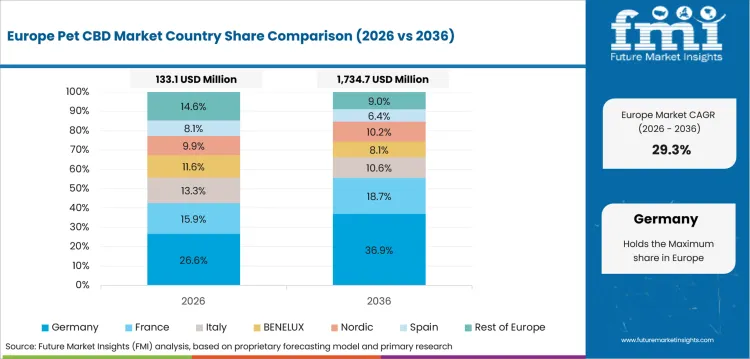
Documentation-driven European industry · 2026 to 2036
Country Market Snapshot Table
| Parameter | Value |
|---|---|
| Market Size in 2025 (Value) | USD 0.5 billion |
| Market Forecast in 2036 (Value) | USD 10.1 billion |
| CAGR (2026-2036) | 33.6% |
| Years Considered | 2016-2036 |
| Base Year | 2025 |
| Forecast Period | 2026-2036 |
| Units Considered | Value (USD Bn) |
| Leading Sub-Region | North Rhine-Westphalia |
Opportunity Analysis of Pet CBD Industry in Germany
Germany Industry Outlook
Germany’s pet CBD opportunity is shaped by EU-style documentation expectations and premium animal care behavior. North Rhine-Westphalia and Bavaria offer dense pet retail access. German buyers often expect German-language serving guidance and verified hemp sourcing before considering CBD oils.
German pet care spending links closely with quality proof and specialty retail credibility. Berlin and Hamburg create high online research activity for wellness products. This environment lifts suppliers aligning pet grooming revenue analysis with documented hemp oil positioning.
Key Growth Drivers
- North Rhine-Westphalia specialty retail density improves access for certificate-backed pet CBD oils.
- European pet ownership depth raises wellness interest, as FEDIAF reported 299 million pets in June 2025, aiding German supplier confidence.
- Bavaria pet owners favor premium wellness products with German-language serving instructions and batch records.
- Berlin e-commerce platforms raise early visibility for hemp CBD products with conservative animal wellness wording.
Key Restraints
- EU veterinary medicine expectations restrict disease-positioned CBD claims across German retail channels.
- North Rhine-Westphalia sellers face higher listing costs if hemp oils need expanded documentation review.
- Bavaria premium buyers may delay purchases if CBD product labels lack German-language dosage clarity.
What makes Germany unique
Germany combines premium pet care behavior with firm documentation expectations across online and specialty retail channels.
Key Companies
- Endoca has European CBD recognition and hemp product credibility among German online buyers.
- CannaPet has pet CBD visibility among German consumers searching for animal wellness products.
- Canopy Growth brings cannabinoid-sector expertise relevant to German compliance-focused suppliers.
Sales & Marketing Channels
- North Rhine-Westphalia pet specialty stores use certificate-backed education for hemp CBD oils.
- Berlin digital sellers need German-language product pages with cautious animal wellness wording.
- Bavaria premium pet retailers lift documented oils and chews with batch-level proof.
Country Segment Breakdown Table
| Segment | Sub-Segments |
|---|---|
| By Source | Hemp · Marijuana |
| By Indication | Epilepsy · Sleep Disorders · Cancer · Bowel Disorders |
| By End User | E-commerce Websites · Pet Shops · Veterinary Hospital Pharmacies |
| By Product Form | Oils · Chews · Capsules · Topicals |
| By Pet Type | Dogs · Cats · Horses · Others |
| Key Sub-Regions Covered, States / Municipalities | North Rhine-Westphalia, Bavaria, Baden-Württemberg, Lower Saxony, Hesse, Berlin, Hamburg, Saxony |
Market Taxonomy and Sub-Regions Covered
Frequently Asked Questions
How fast is Germany’s Pet CBD Industry growing?
Germany’s Pet CBD Industry is expected to advance at 33.6% CAGR from 2026 to 2036. Premium pet care and documentation expectations shape this forecast.
Who leads the Germany Pet CBD Industry?
Endoca, CannaPet, and Canopy Growth have relevant CBD visibility for German buyers. Competitive strength centers on quality files and cautious claims.
What is driving industry outlook in Germany?
North Rhine-Westphalia retail density and Berlin online research drive Germany’s outlook. German-language documentation helps suppliers convert cautious buyers.
Future Outlook for Pet CBD Industry in South Korea
Urban digital pet wellness market · 2026 to 2036
Country Market Snapshot Table
| Parameter | Value |
|---|---|
| Market Size in 2025 (Value) | USD 0.5 billion |
| Market Forecast in 2036 (Value) | USD 10.1 billion |
| CAGR (2026-2036) | 32.8% est. |
| Years Considered | 2016-2036 |
| Base Year | 2025 |
| Forecast Period | 2026-2036 |
| Units Considered | Value (USD Bn) |
| Leading Sub-Region | Seoul Capital Area |
Future Outlook for Pet CBD Industry in South Korea
South Korea Industry Outlook
Pet CBD demand in South Korea is influenced by Seoul’s dense apartment pet ownership and advanced digital retail habits. Seoul Capital Area creates the leading early buyer pool. Cannabinoid product controls make import review and careful label planning essential for CBD animal products.
Korean pet owners pay attention to premium pet food and wellness formats across online channels. Busan and Gyeonggi buyers use digital product comparison before repeat purchases.
Key Growth Drivers
- Seoul digital pet retail improves access for hemp oils with detailed product pages and careful claim wording.
- Premium pet food demand signals buyer readiness, as USDA FAS reported KRW 1.69 trillion dog and cat food value in August 2024.
- Gyeonggi apartment dog owners raise demand for calming and routine wellness formats with simple serving guidance.
- Busan online buyers enhance subscription-style pet wellness products with clear hemp source information.
Key Restraints
- Korean cannabinoid controls limit CBD animal claim flexibility across Seoul imported product pages.
- Import review needs can slow supplier entry if hemp source documents lack clear product traceability.
- Gyeonggi younger households may resist premium CBD pricing without firm serving guidance and proof.
What makes South Korea unique
South Korea combines apartment-based pet ownership with highly developed online retail and strict cannabinoid oversight.
Key Companies
- Medterra has online CBD recognition among South Korean consumers researching hemp wellness products.
- HolistaPet reaches Seoul pet owners through pet-specific CBD search visibility and digital education pages.
- Elixinol has CBD product recognition among Korean digital wellness consumers comparing hemp-based options.
Sales & Marketing Channels
- Seoul e-commerce platforms use detailed education pages for premium CBD pet oils.
- Gangnam pet boutiques focus on imported wellness products for small-breed dog owners.
- Busan online sellers rely on certificate access and conservative claim wording for CBD listings.
Country Segment Breakdown Table
| Segment | Sub-Segments |
|---|---|
| By Source | Hemp · Marijuana |
| By Indication | Epilepsy · Sleep Disorders · Cancer · Bowel Disorders |
| By End User | E-commerce Websites · Pet Shops · Veterinary Hospital Pharmacies |
| By Product Form | Oils · Chews · Capsules · Topicals |
| By Pet Type | Dogs · Cats · Horses · Others |
| Key Sub-Regions Covered, Provinces / Municipalities | Seoul, Gyeonggi, Incheon, Busan, Daegu, Daejeon, Gwangju, Ulsan |
Market Taxonomy and Sub-Regions Covered
Frequently Asked Questions
How fast is South Korea’s Pet CBD Industry growing?
South Korea’s Pet CBD Industry is projected to rise at 32.8% CAGR from 2026 to 2036. This estimate reflects Seoul digital retail and premium pet spending.
Who leads the South Korea Pet CBD Industry?
Medterra, HolistaPet, and Elixinol have online CBD visibility for Korean buyers. Local success needs import readiness and careful label wording.
What is driving adoption in South Korea?
Seoul e-commerce strength and Gyeonggi apartment pet ownership drive adoption. Premium pet food spending signals readiness for documented CBD products.
Demand Outlook for Pet CBD Industry in Japan
High-spend cautious adoption market · 2026 to 2036
Country Market Snapshot Table
| Parameter | Value |
|---|---|
| Market Size in 2025 (Value) | USD 0.5 billion |
| Market Forecast in 2036 (Value) | USD 10.1 billion |
| CAGR (2026-2036) | 32.4% est. |
| Years Considered | 2016-2036 |
| Base Year | 2025 |
| Forecast Period | 2026-2036 |
| Units Considered | Value (USD Bn) |
| Leading Sub-Region | Kanto |
Demand Outlook for Pet CBD Industry in Japan
Japan Industry Outlook
Pet CBD demand in Japan is shaped by careful consumer screening and a strong premium pet retail culture. Kanto and Kansai provide early access through Tokyo and Osaka specialty stores. Cannabinoid import checks require conservative product wording and clear hemp origin files.
Japanese pet owners often spend carefully on cats and senior dogs through premium nutrition channels. Tokyo buyers prefer documented products and Japanese-language instructions before buying wellness oils. This pattern aligns with pet snacks and treats in japan industry outlook across premium companion animal products.
Key Growth Drivers
- Kanto specialty pet retail improves access for documented CBD oils with Japanese-language serving guidance.
- Japan’s cat base lifts low-dose oil interest, as JPFA reported 8.847 million pet cats in its 2025 survey.
- Kansai premium pet stores support small-format CBD products with conservative animal wellness positioning.
- Tokyo digital buyers compare hemp source records before ordering imported CBD pet products.
Key Restraints
- Japanese cannabinoid import controls slow foreign supplier entry into Tokyo online pet channels.
- Kanto retailers need translated product records before listing CBD oils for companion animal buyers.
- Kansai consumers may avoid products lacking conservative serving guidance and origin documentation.
What makes Japan unique
Japan combines high per-pet spending discipline with cautious CBD adoption and reliable product proof expectations.
Key Companies
- Endoca has CBD recognition among Japanese buyers researching imported hemp products.
- Medterra reaches Japanese wellness consumers through international CBD search visibility and online education pages.
- Green Roads has CBD product recognition among Japanese digital wellness shoppers comparing hemp-based products.
Sales & Marketing Channels
- Tokyo online pet wellness stores use translated education pages for CBD oils.
- Osaka specialty pet shops favor small-format products with clear origin records.
- Kanto import sellers need documentation files for cannabinoid product review.
Country Segment Breakdown Table
| Segment | Sub-Segments |
|---|---|
| By Source | Hemp · Marijuana |
| By Indication | Epilepsy · Sleep Disorders · Cancer · Bowel Disorders |
| By End User | E-commerce Websites · Pet Shops · Veterinary Hospital Pharmacies |
| By Product Form | Oils · Chews · Capsules · Topicals |
| By Pet Type | Dogs · Cats · Horses · Others |
| Key Sub-Regions Covered, Prefectures / Regions | Tokyo, Kanagawa, Saitama, Chiba, Osaka, Hyogo, Aichi, Fukuoka |
Market Taxonomy and Sub-Regions Covered
Frequently Asked Questions
How fast is Japan’s Pet CBD Industry growing?
Japan’s Pet CBD Industry is forecast at 32.4% CAGR from 2026 to 2036. This estimate indicates premium pet spending and cautious CBD adoption.
Who leads the Japan Pet CBD Industry?
Endoca, Medterra, and Green Roads have CBD visibility among Japanese digital buyers. Success requires Japanese-language records and conservative product wording.
What is driving demand in Japan?
Kanto premium retail and Tokyo online research drive demand. Cat ownership creates interest in low-dose oils and careful wellness formats.
In-depth Analysis of Pet CBD Industry in USA
Top digital commercialization market · 2026 to 2036
Country Market Snapshot Table
| Parameter | Value |
|---|---|
| Market Size in 2025 (Value) | USD 0.5 billion |
| Market Forecast in 2036 (Value) | USD 10.1 billion |
| CAGR (2026-2036) | 31.5% |
| Years Considered | 2016-2036 |
| Base Year | 2025 |
| Forecast Period | 2026-2036 |
| Units Considered | Value (USD Bn) |
| Leading Sub-Region | California |
In-depth Analysis of Pet CBD Industry in USA
USA Industry Outlook
USA pet CBD activity is based on FDA enforcement and large direct-to-consumer CBD brand infrastructure. California and Colorado provide reliable hemp supply knowledge and online retail depth. Product pages require careful review since animal disease claims can improve unapproved drug exposure.
American pet owners form the top digital commercialization base for CBD pet products. California buyers compare certificates and serving instructions before subscription purchases. This scale connects with pet toys revenue analysis across premium pet spending behavior.
Key Growth Drivers
- California CBD retail maturity boosts a large test base for compliant hemp oils and pet chews.
- USA pet ownership scale is high, as APPA reported 95 million pet-owning households in March 2026, aiding digital conversion.
- Colorado hemp supply experience improves access to tested ingredients for CBD pet formulations.
- Florida online pet owners boost repeat demand for subscriptions with certificate-backed product pages.
Key Restraints
- FDA enforcement limits disease claims, as FDA reviewed HolistaPet digital claims in April 2025, constraining aggressive animal CBD marketing.
- California and Texas CBD rule differences raise content review burdens for national direct-to-consumer brands.
- Platform listing policies can disrupt paid acquisition for USA brands lacking conservative pet CBD wording.
What makes USA unique
USA combines the deepest direct-to-consumer pet CBD base with active FDA scrutiny of animal disease claims.
Key Companies
- Charlotte’s Web leads through national hemp CBD recognition and USA online reach.
- CV Sciences competes through hemp-derived CBD portfolio experience and domestic retail awareness.
- Pet Releaf holds pet-specific CBD strength across USA oils and chews.
- HolistaPet has reliable pet CBD visibility across USA direct-to-consumer channels.
Sales & Marketing Channels
- California direct-to-consumer websites use subscriptions and certificates for CBD pet oils.
- Colorado hemp suppliers provide ingredient depth for CBD pet product manufacturers.
- Florida online pet sellers use education-heavy product pages for dog owner conversion.
Country Segment Breakdown Table
| Segment | Sub-Segments |
|---|---|
| By Source | Hemp · Marijuana |
| By Indication | Epilepsy · Sleep Disorders · Cancer · Bowel Disorders |
| By End User | E-commerce Websites · Pet Shops · Veterinary Hospital Pharmacies |
| By Product Form | Oils · Chews · Capsules · Topicals |
| By Pet Type | Dogs · Cats · Horses · Others |
| Key Sub-Regions Covered, States / Municipalities | California, Colorado, Florida, Texas, New York, Oregon, Washington, Illinois |
Market Taxonomy and Sub-Regions Covered
Frequently Asked Questions
How fast is the USA Pet CBD Industry growing?
The USA Pet CBD Industry is expected to post 31.5% CAGR from 2026 to 2036. FDA scrutiny moderates a large digital CBD pet base.
Who leads the USA Pet CBD Industry?
Charlotte’s Web, CV Sciences, Pet Releaf, and HolistaPet are visible USA players. Better brands manage batch records and claim language carefully.
What is driving adoption in USA?
California CBD retail maturity and Colorado hemp supply depth drive USA adoption. FDA enforcement keeps disease-related pet CBD claims under pressure.
Competitive Landscape and Strategic Positioning
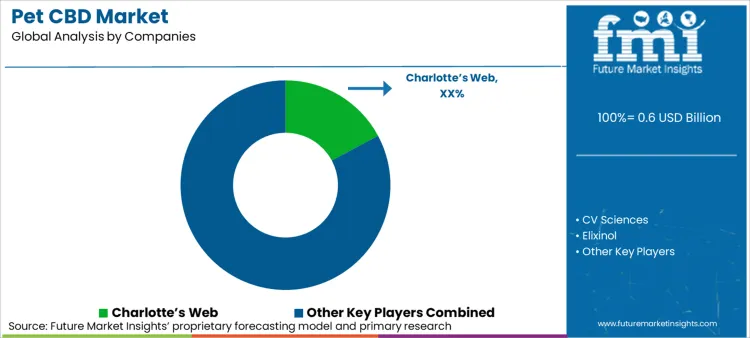
- Charlotte’s Web is positioned as a leading provider through hemp-derived CBD visibility and broad online brand recall.
- CV Sciences and Medterra compete on CBD product portfolios and direct-to-consumer systems aimed at wellness-focused pet owners.
- Specialist providers focus on pet-specific oils and chews as product education stays central to repeat purchases.
Charlotte’s Web has a high position through national CBD recognition and hemp supply experience. Pet Releaf offers deeper pet-specific product coverage across oils and chews. HolistaPet carries high online visibility, and FDA scrutiny points to the need for better claim review. Medterra and Endoca compete on CBD expertise and digital wellness channels. Canopy Growth adds cannabis-sector knowledge for suppliers preparing for future regulatory pathways.
Competitive barriers include authorization limits and platform restrictions in regulated pet CBD selling environments. They involve high documentation needs to increase operational complexity for market participants. Strategic priorities include verified hemp sourcing and conservative claim language practices. They emphasize development of repeat purchase systems for sustained customer retention. Buyers favor brands offering batch records and simple serving instructions. Suppliers with broader pet wellness portfolios can connect CBD formats with flavor acceptance and repeat use across oils and chews.
Key Companies in the Pet CBD Market
Key global companies leading the pet CBD market include:
- Charlotte’s Web, CV Sciences, and Medterra have strong CBD product infrastructure and online selling reach.
- Pet Releaf, HolistaPet, and Endoca serve owners through pet-specific oils, chews, capsules, and education-led retailing.
- Canopy Growth, Aurora Cannabis, and Green Roads hold adjacent cannabinoid capabilities and broader CBD market recognition.
Competitive Benchmarking: Pet CBD Market
| Company | Hemp Traceability | Pet Product Breadth | Claim Governance |
|---|---|---|---|
| Charlotte’s Web | High | Medium | High |
| CV Sciences | High | Medium | High |
| Medterra | High | Medium | Medium |
| Pet Releaf | High | High | Medium |
| HolistaPet | Medium | High | Medium |
| Endoca | High | Medium | High |
| Canopy Growth | High | Medium | High |
| Aurora Cannabis | Medium | Medium | Medium |
| Green Roads | Medium | Medium | Medium |
Source: Future Market Insights, 2026.
Key Developments in Pet CBD Market
- In April 2026, Earth Buddy Pet released a free CBD Dosage Journal for dog and cat owners, positioning the resource around personalized CBD use and dosage education. The company connects the journal to hemp-based pet options, full-spectrum CBD and hemp products, independent lab testing, and practical pet CBD dosage guidance.
- In March 2024, CV Sciences expanded its +PlusCBD Pet portfolio with Pet Hip and Joint Health Chews and Pet Calming Care Chews for dogs. The company stated the THC-free CBD chews use ingredients such as glucosamine, turmeric, chamomile, L-tryptophan, ginger root, and L-theanine, with independent testing and NASC quality-standard compliance.
Key Players in the Pet CBD Market
Major Global Players:
- Charlotte’s Web
- CV Sciences
- Medterra
- Canopy Growth
- Aurora Cannabis
Specialist Players:
- Pet Releaf
- HolistaPet
- Endoca
- Green Roads
- Elixinol
Report Scope and Coverage
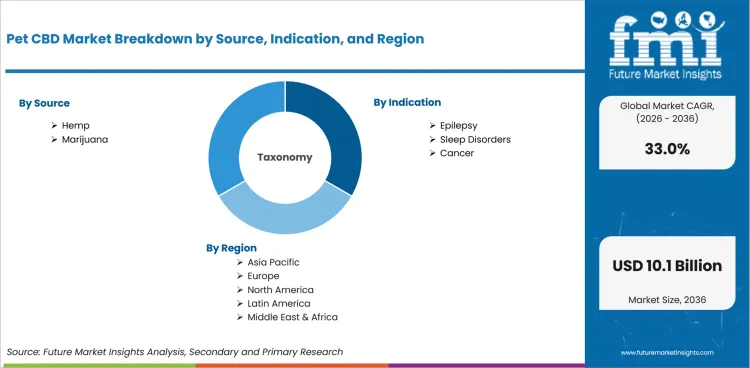
| Parameter | Details |
|---|---|
| Market size by 2036 | USD 10.1 billion |
| Growth rate | 33.0% CAGR (2026-2036) |
| Forecast period | 2026 to 2036 |
| Base year value (2026) | USD 0.6 billion |
| By source | Hemp, Marijuana |
| By indication | Epilepsy, Sleep Disorders, Cancer, Bowel Disorders |
| By end user | E-commerce Websites, Pet Shops, Veterinary Hospital Pharmacies |
| By product form | Oils, Chews, Capsules, Topicals |
| By pet type | Dogs, Cats, Horses, Others |
| Regions covered | North America, Latin America, Europe, East Asia, South Asia and Pacific, Middle East & Africa |
| Countries covered | USA, UK, Germany, Canada, Australia, Japan, South Korea, and 30 plus countries |
| Key companies profiled | Charlotte’s Web, CV Sciences, Medterra, Pet Releaf, HolistaPet, Endoca, Canopy Growth, Aurora Cannabis, Green Roads, Elixinol |
| Approach | Hybrid bottom-up and top-down methodology starting with verified product portfolios, regulatory signals, channel behavior, and adoption patterns across segments and regions. |
Pet CBD Market by Key Segments
Pet CBD Market Segmented by Source:
- Hemp
- Marijuana
Pet CBD Market Segmented by Indication:
- Epilepsy
- Sleep Disorders
- Cancer
- Bowel Disorders
Pet CBD Market Segmented by End User:
- E-commerce Websites
- Pet Shops
- Veterinary Hospital Pharmacies
Pet CBD Market Segmented by Product Form:
- Oils
- Chews
- Capsules
- Topicals
Pet CBD Market Segmented by Pet Type:
- Dogs
- Cats
- Horses
- Others
Pet CBD Market by Region:
- North America
- USA
- Canada
- Mexico
- Latin America
- Brazil
- Chile
- Rest of Latin America
- Western Europe
- Germany
- UK
- France
- Italy
- Spain
- Rest of Western Europe
- Eastern Europe
- Poland
- Russia
- Rest of Eastern Europe
- East Asia
- China
- Japan
- South Korea
- South Asia and Pacific
- India
- ASEAN
- Australia and New Zealand
- Rest of South Asia and Pacific
- Middle East & Africa
- GCC Countries
- South Africa
- Rest of Middle East & Africa
Research Sources and Bibliography
- USA Food and Drug Administration. (2025, April 7). Holista LLC dba HolistaPet warning letter 699082.
- American Pet Products Association. (2026, March 26). USA pet industry reaches USD 158 billion in 2025, poised for continued growth in 2026.
- Health Canada. (2025, March 7). Veterinary drugs containing cannabidiol for animal use.
- Australian Pesticides and Veterinary Medicines Authority. (2025, May 1). Cannabis in veterinary chemical products
- Canadian Animal Health Institute. (2025, March 11). Canadian Pet Population Survey highlights the importance of access to veterinary care.
- PDSA. (2025). UK pet populations of dogs, cats and rabbits.
- Animal Medicines Australia. (2025). Pets in Australia: A national survey of pets and people 2025.
- FEDIAF. (2025, June). Facts and figures 2025.
- Japan Pet Food Association. (2025). National dog and cat ownership survey. https://petfood.or.jp/data-chart/
- USDA Foreign Agricultural Service. (2024, August). South Korea Pet Food Report.
- RCVS Knowledge. (2026, January 20). The use of cannabidiol (CBD) in animals.
- USA Food and Drug Administration. (2025, April 7). Holista LLC dba HolistaPet - 699082 - 04/07/2025.
- Medterra. (2026, June 5 access). Pet CBD calming chews.
- Bookout, W., Dziwenka, M., Valm, K., & Kovacs-Nolan, J. (2024). Safety study of cannabidiol products in healthy dogs. Frontiers in Veterinary Science.
- CV Sciences, Inc. (2024, March 26). CV Sciences, Inc. expands +PlusCBD Pet product offerings with the launch of pet chews.
- USA Food and Drug Administration. (2025, September 3). Warning Letters for Cannabis-Derived Products.
- United States Department of Agriculture, National Agricultural Statistics Service. (2026, April 16). National Hemp Report.
This Report Answers
- What is the current and future size of the pet CBD market?
- How fast is the pet CBD market expected to expand between 2026 and 2036?
- Which source segment is expected to lead the market by 2026?
- Which end user channel is expected to account for the leading demand by 2026?
- What factors are driving demand for pet CBD globally?
- How are CBD animal product claims influencing channel acceptance?
- Why are e-commerce websites the main demand base for pet CBD?
- How are hemp inputs shaping supplier strategy?
- Which countries are projected to record faster expansion through 2036?
- What is driving market expansion in Australia and Canada?
- Who are the key companies active in the pet CBD market?
- How does FMI estimate and validate the market forecast?
Frequently Asked Questions
What is the global market demand for Pet CBD in 2026?
In 2026, the global market for pet CBD is expected to be worth USD 0.6 billion.
How big will the market for Pet CBD be in 2036?
By 2036, the market for pet CBD is expected to be worth USD 10.1 billion.
How much is demand for Pet CBD expected to expand between 2026 and 2036?
Between 2026 and 2036, demand for pet CBD is expected to expand at a CAGR of 33.0%.
Which source segment is likely to be the leading seller globally by 2026?
Hemp-derived inputs will contribute 82.0% of the source segment in 2026.
What is causing demand to rise in Australia?
The Australia pet CBD market is projected to record 36.1% CAGR through 2036, backed by high pet ownership and APVMA classification discipline.
What is causing demand to rise in Canada?
The Canada pet CBD market is projected to expand at 35.0% CAGR through 2036, backed by veterinary CBD pathway discussion and a large dog-cat base.
What does this report mean by Pet CBD Market definition?
The pet CBD market includes cannabidiol products formulated for companion animal wellness and sold through digital, specialty, and veterinary-adjacent outlets.
How does FMI make the Pet CBD forecast and check it?
Forecasting models use a hybrid bottom-up and top-down approach, starting with source demand and checking it against channel behavior and regulatory signals.
Preview the report firsthand - request a free sample
Get SampleGet the brochure for pricing and purchase details.
Get PDFTable of Content
- Executive Summary
- Global Market Outlook
- Demand to side Trends
- Supply to side Trends
- Technology Roadmap Analysis
- Analysis and Recommendations
- Market Overview
- Market Coverage / Taxonomy
- Market Definition / Scope / Limitations
- Research Methodology
- Chapter Orientation
- Analytical Lens and Working Hypotheses
- Market Structure, Signals, and Trend Drivers
- Benchmarking and Cross-market Comparability
- Market Sizing, Forecasting, and Opportunity Mapping
- Research Design and Evidence Framework
- Desk Research Programme (Secondary Evidence)
- Company Annual and Sustainability Reports
- Peer-reviewed Journals and Academic Literature
- Corporate Websites, Product Literature, and Technical Notes
- Earnings Decks and Investor Briefings
- Statutory Filings and Regulatory Disclosures
- Technical White Papers and Standards Notes
- Trade Journals, Industry Magazines, and Analyst Briefs
- Conference Proceedings, Webinars, and Seminar Materials
- Government Statistics Portals and Public Data Releases
- Press Releases and Reputable Media Coverage
- Specialist Newsletters and Curated Briefings
- Sector Databases and Reference Repositories
- FMI Internal Proprietary Databases and Historical Market Datasets
- Subscription Datasets and Paid Sources
- Social Channels, Communities, and Digital Listening Inputs
- Additional Desk Sources
- Expert Input and Fieldwork (Primary Evidence)
- Primary Modes
- Qualitative Interviews and Expert Elicitation
- Quantitative Surveys and Structured Data Capture
- Blended Approach
- Why Primary Evidence is Used
- Field Techniques
- Interviews
- Surveys
- Focus Groups
- Observational and In-context Research
- Social and Community Interactions
- Stakeholder Universe Engaged
- C-suite Leaders
- Board Members
- Presidents and Vice Presidents
- R&D and Innovation Heads
- Technical Specialists
- Domain Subject-matter Experts
- Scientists
- Physicians and Other Healthcare Professionals
- Governance, Ethics, and Data Stewardship
- Research Ethics
- Data Integrity and Handling
- Primary Modes
- Tooling, Models, and Reference Databases
- Desk Research Programme (Secondary Evidence)
- Data Engineering and Model Build
- Data Acquisition and Ingestion
- Cleaning, Normalisation, and Verification
- Synthesis, Triangulation, and Analysis
- Quality Assurance and Audit Trail
- Market Background
- Market Dynamics
- Drivers
- Restraints
- Opportunity
- Trends
- Scenario Forecast
- Demand in Optimistic Scenario
- Demand in Likely Scenario
- Demand in Conservative Scenario
- Opportunity Map Analysis
- Product Life Cycle Analysis
- Supply Chain Analysis
- Investment Feasibility Matrix
- Value Chain Analysis
- PESTLE and Porter’s Analysis
- Regulatory Landscape
- Regional Parent Market Outlook
- Production and Consumption Statistics
- Import and Export Statistics
- Market Dynamics
- Global Market Analysis 2016 to 2025 and Forecast, 2026 to 2036
- Historical Market Size Value (USD Million) Analysis, 2016 to 2025
- Current and Future Market Size Value (USD Million) Projections, 2026 to 2036
- Y to o to Y Growth Trend Analysis
- Absolute $ Opportunity Analysis
- Global Market Pricing Analysis 2016 to 2025 and Forecast 2026 to 2036
- Global Market Analysis 2016 to 2025 and Forecast 2026 to 2036, By Source
- Introduction / Key Findings
- Historical Market Size Value (USD Million) Analysis By Source, 2016 to 2025
- Current and Future Market Size Value (USD Million) Analysis and Forecast By Source, 2026 to 2036
- Hemp
- Marijuana
- Hemp
- Y to o to Y Growth Trend Analysis By Source, 2016 to 2025
- Absolute $ Opportunity Analysis By Source, 2026 to 2036
- Global Market Analysis 2016 to 2025 and Forecast 2026 to 2036, By Indication
- Introduction / Key Findings
- Historical Market Size Value (USD Million) Analysis By Indication, 2016 to 2025
- Current and Future Market Size Value (USD Million) Analysis and Forecast By Indication, 2026 to 2036
- Epilepsy
- Sleep Disorders
- Cancer
- Epilepsy
- Y to o to Y Growth Trend Analysis By Indication, 2016 to 2025
- Absolute $ Opportunity Analysis By Indication, 2026 to 2036
- Global Market Analysis 2016 to 2025 and Forecast 2026 to 2036, By End User
- Introduction / Key Findings
- Historical Market Size Value (USD Million) Analysis By End User, 2016 to 2025
- Current and Future Market Size Value (USD Million) Analysis and Forecast By End User, 2026 to 2036
- E-commerce Websites
- Pet Shops
- Veterinary Hospital Pharmacies
- E-commerce Websites
- Y to o to Y Growth Trend Analysis By End User, 2016 to 2025
- Absolute $ Opportunity Analysis By End User, 2026 to 2036
- Global Market Analysis 2016 to 2025 and Forecast 2026 to 2036, By Product Form
- Introduction / Key Findings
- Historical Market Size Value (USD Million) Analysis By Product Form, 2016 to 2025
- Current and Future Market Size Value (USD Million) Analysis and Forecast By Product Form, 2026 to 2036
- Oils
- Chews
- Capsules
- Oils
- Y to o to Y Growth Trend Analysis By Product Form, 2016 to 2025
- Absolute $ Opportunity Analysis By Product Form, 2026 to 2036
- Global Market Analysis 2016 to 2025 and Forecast 2026 to 2036, By Pet Type
- Introduction / Key Findings
- Historical Market Size Value (USD Million) Analysis By Pet Type, 2016 to 2025
- Current and Future Market Size Value (USD Million) Analysis and Forecast By Pet Type, 2026 to 2036
- Dogs
- Cats
- Horses
- Dogs
- Y to o to Y Growth Trend Analysis By Pet Type, 2016 to 2025
- Absolute $ Opportunity Analysis By Pet Type, 2026 to 2036
- Global Market Analysis 2016 to 2025 and Forecast 2026 to 2036, By Region
- Introduction
- Historical Market Size Value (USD Million) Analysis By Region, 2016 to 2025
- Current Market Size Value (USD Million) Analysis and Forecast By Region, 2026 to 2036
- North America
- Latin America
- Western Europe
- Eastern Europe
- East Asia
- South Asia and Pacific
- Middle East & Africa
- Market Attractiveness Analysis By Region
- North America Market Analysis 2016 to 2025 and Forecast 2026 to 2036, By Country
- Historical Market Size Value (USD Million) Trend Analysis By Market Taxonomy, 2016 to 2025
- Market Size Value (USD Million) Forecast By Market Taxonomy, 2026 to 2036
- By Country
- USA
- Canada
- Mexico
- By Source
- By Indication
- By End User
- By Product Form
- By Pet Type
- By Country
- Market Attractiveness Analysis
- By Country
- By Source
- By Indication
- By End User
- By Product Form
- By Pet Type
- Key Takeaways
- Latin America Market Analysis 2016 to 2025 and Forecast 2026 to 2036, By Country
- Historical Market Size Value (USD Million) Trend Analysis By Market Taxonomy, 2016 to 2025
- Market Size Value (USD Million) Forecast By Market Taxonomy, 2026 to 2036
- By Country
- Brazil
- Chile
- Rest of Latin America
- By Source
- By Indication
- By End User
- By Product Form
- By Pet Type
- By Country
- Market Attractiveness Analysis
- By Country
- By Source
- By Indication
- By End User
- By Product Form
- By Pet Type
- Key Takeaways
- Western Europe Market Analysis 2016 to 2025 and Forecast 2026 to 2036, By Country
- Historical Market Size Value (USD Million) Trend Analysis By Market Taxonomy, 2016 to 2025
- Market Size Value (USD Million) Forecast By Market Taxonomy, 2026 to 2036
- By Country
- Germany
- UK
- Italy
- Spain
- France
- Nordic
- BENELUX
- Rest of Western Europe
- By Source
- By Indication
- By End User
- By Product Form
- By Pet Type
- By Country
- Market Attractiveness Analysis
- By Country
- By Source
- By Indication
- By End User
- By Product Form
- By Pet Type
- Key Takeaways
- Eastern Europe Market Analysis 2016 to 2025 and Forecast 2026 to 2036, By Country
- Historical Market Size Value (USD Million) Trend Analysis By Market Taxonomy, 2016 to 2025
- Market Size Value (USD Million) Forecast By Market Taxonomy, 2026 to 2036
- By Country
- Russia
- Poland
- Hungary
- Balkan & Baltic
- Rest of Eastern Europe
- By Source
- By Indication
- By End User
- By Product Form
- By Pet Type
- By Country
- Market Attractiveness Analysis
- By Country
- By Source
- By Indication
- By End User
- By Product Form
- By Pet Type
- Key Takeaways
- East Asia Market Analysis 2016 to 2025 and Forecast 2026 to 2036, By Country
- Historical Market Size Value (USD Million) Trend Analysis By Market Taxonomy, 2016 to 2025
- Market Size Value (USD Million) Forecast By Market Taxonomy, 2026 to 2036
- By Country
- China
- Japan
- South Korea
- By Source
- By Indication
- By End User
- By Product Form
- By Pet Type
- By Country
- Market Attractiveness Analysis
- By Country
- By Source
- By Indication
- By End User
- By Product Form
- By Pet Type
- Key Takeaways
- South Asia and Pacific Market Analysis 2016 to 2025 and Forecast 2026 to 2036, By Country
- Historical Market Size Value (USD Million) Trend Analysis By Market Taxonomy, 2016 to 2025
- Market Size Value (USD Million) Forecast By Market Taxonomy, 2026 to 2036
- By Country
- India
- ASEAN
- Australia & New Zealand
- Rest of South Asia and Pacific
- By Source
- By Indication
- By End User
- By Product Form
- By Pet Type
- By Country
- Market Attractiveness Analysis
- By Country
- By Source
- By Indication
- By End User
- By Product Form
- By Pet Type
- Key Takeaways
- Middle East & Africa Market Analysis 2016 to 2025 and Forecast 2026 to 2036, By Country
- Historical Market Size Value (USD Million) Trend Analysis By Market Taxonomy, 2016 to 2025
- Market Size Value (USD Million) Forecast By Market Taxonomy, 2026 to 2036
- By Country
- Kingdom of Saudi Arabia
- Other GCC Countries
- Turkiye
- South Africa
- Other African Union
- Rest of Middle East & Africa
- By Source
- By Indication
- By End User
- By Product Form
- By Pet Type
- By Country
- Market Attractiveness Analysis
- By Country
- By Source
- By Indication
- By End User
- By Product Form
- By Pet Type
- Key Takeaways
- Key Countries Market Analysis
- USA
- Pricing Analysis
- Market Share Analysis, 2025
- By Source
- By Indication
- By End User
- By Product Form
- By Pet Type
- Canada
- Pricing Analysis
- Market Share Analysis, 2025
- By Source
- By Indication
- By End User
- By Product Form
- By Pet Type
- Mexico
- Pricing Analysis
- Market Share Analysis, 2025
- By Source
- By Indication
- By End User
- By Product Form
- By Pet Type
- Brazil
- Pricing Analysis
- Market Share Analysis, 2025
- By Source
- By Indication
- By End User
- By Product Form
- By Pet Type
- Chile
- Pricing Analysis
- Market Share Analysis, 2025
- By Source
- By Indication
- By End User
- By Product Form
- By Pet Type
- Germany
- Pricing Analysis
- Market Share Analysis, 2025
- By Source
- By Indication
- By End User
- By Product Form
- By Pet Type
- UK
- Pricing Analysis
- Market Share Analysis, 2025
- By Source
- By Indication
- By End User
- By Product Form
- By Pet Type
- Italy
- Pricing Analysis
- Market Share Analysis, 2025
- By Source
- By Indication
- By End User
- By Product Form
- By Pet Type
- Spain
- Pricing Analysis
- Market Share Analysis, 2025
- By Source
- By Indication
- By End User
- By Product Form
- By Pet Type
- France
- Pricing Analysis
- Market Share Analysis, 2025
- By Source
- By Indication
- By End User
- By Product Form
- By Pet Type
- India
- Pricing Analysis
- Market Share Analysis, 2025
- By Source
- By Indication
- By End User
- By Product Form
- By Pet Type
- ASEAN
- Pricing Analysis
- Market Share Analysis, 2025
- By Source
- By Indication
- By End User
- By Product Form
- By Pet Type
- Australia & New Zealand
- Pricing Analysis
- Market Share Analysis, 2025
- By Source
- By Indication
- By End User
- By Product Form
- By Pet Type
- China
- Pricing Analysis
- Market Share Analysis, 2025
- By Source
- By Indication
- By End User
- By Product Form
- By Pet Type
- Japan
- Pricing Analysis
- Market Share Analysis, 2025
- By Source
- By Indication
- By End User
- By Product Form
- By Pet Type
- South Korea
- Pricing Analysis
- Market Share Analysis, 2025
- By Source
- By Indication
- By End User
- By Product Form
- By Pet Type
- Russia
- Pricing Analysis
- Market Share Analysis, 2025
- By Source
- By Indication
- By End User
- By Product Form
- By Pet Type
- Poland
- Pricing Analysis
- Market Share Analysis, 2025
- By Source
- By Indication
- By End User
- By Product Form
- By Pet Type
- Hungary
- Pricing Analysis
- Market Share Analysis, 2025
- By Source
- By Indication
- By End User
- By Product Form
- By Pet Type
- Kingdom of Saudi Arabia
- Pricing Analysis
- Market Share Analysis, 2025
- By Source
- By Indication
- By End User
- By Product Form
- By Pet Type
- Turkiye
- Pricing Analysis
- Market Share Analysis, 2025
- By Source
- By Indication
- By End User
- By Product Form
- By Pet Type
- South Africa
- Pricing Analysis
- Market Share Analysis, 2025
- By Source
- By Indication
- By End User
- By Product Form
- By Pet Type
- USA
- Market Structure Analysis
- Competition Dashboard
- Competition Benchmarking
- Market Share Analysis of Top Players
- By Region
- By Source
- By Indication
- By End User
- By Product Form
- By Pet Type
- Competition Analysis
- Competition Deep Dive
- Charlotte’s Web
- Overview
- Product Portfolio
- Profitability by Market Segments (Product/Age /Sales Channel/Region)
- Sales Footprint
- Strategy Overview
- Marketing Strategy
- Product Strategy
- Channel Strategy
- CV Sciences
- Medterra
- Canopy Growth
- Aurora Cannabis
- Charlotte’s Web
- Competition Deep Dive
- Assumptions & Acronyms Used


