

- Market Size (2026)
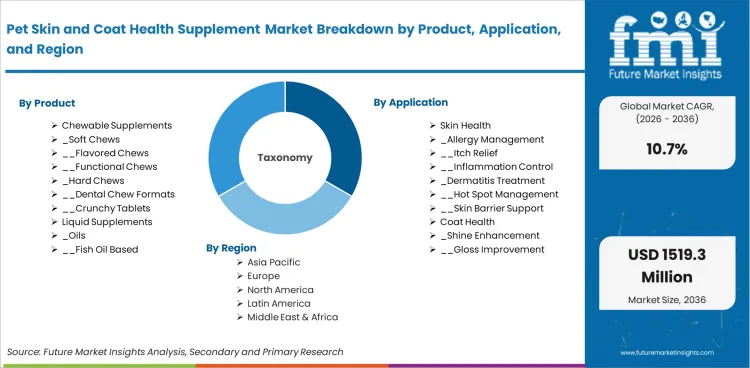
- USD 549.7 Mn
- Forecast (2036)
- USD 1519.3 Mn
- CAGR (2026 to 2036)
- 10.7%
Pet Skin and Coat Health Supplement Market Size, Market Forecast and Outlook By FMI
Summary of the Pet Skin and Coat Health Supplement Market
- Demand and Growth Drivers
- Pet humanization is a primary driver, as owners increasingly transfer wellness spending patterns from human health products to companion animals.
- Veterinary channel recommendations have become the dominant acquisition path for therapeutic supplements, now accounting for over 40% of purchases in developed markets.
- Direct-to-consumer (DTC) subscription models, such as Chewy Autoship and Amazon Subscribe and Save, are accelerating recurring-revenue economics and compressing traditional retail margins.
- Product and Segment View
- Due to their superior palatability and convenience of administration over liquid or powder forms, chewable supplements account for 45.0% of the product segment.
- Applications for skin health account for 50% of the market, followed by those for managing dryness, reducing dermatitis symptoms, and supporting allergies.
- Geography and Competitive Outlook
- North America and Western Europe spend the most in absolute terms, while emerging urban markets in Asia Pacific, especially India and China, have the fastest percentage growth.
- Veterinary-focused nutraceutical brands like Nutramax Laboratories and Zesty Paws are at the top of the competitive landscape. They use money from clinical trials to stay at the top of the market.
- Analyst Opinion
- "The convergence of pet humanization and advanced DTC subscription models is fundamentally restructuring market access, requiring brands to balance premium veterinary channel positioning with high-volume, recurring-revenue digital platforms to secure long-term market share," according to Nandini Roy Choudhury, at FMI.
- Subscription penetration in the USA supplement category increased from less than 10% in 2020 to more than 30% by 2025, demonstrating how the shift toward recurring-revenue economics is increasingly defining market dynamics.
- A big reason for adoption is that clinical validation of substances allows veterinarians to endorse them, which supports higher prices and makes people less sensitive to price.
- Combination formulations, like those that combine omega-3s with probiotics, are becoming more popular in product innovation. These products can cost up to 30% more than single-concern SKUs.
- A major strategic growth factor is the aggressive expansion of clinical trial investment, which serves as a barrier to entry and a prerequisite for successful positioning in the high-value veterinary channel.
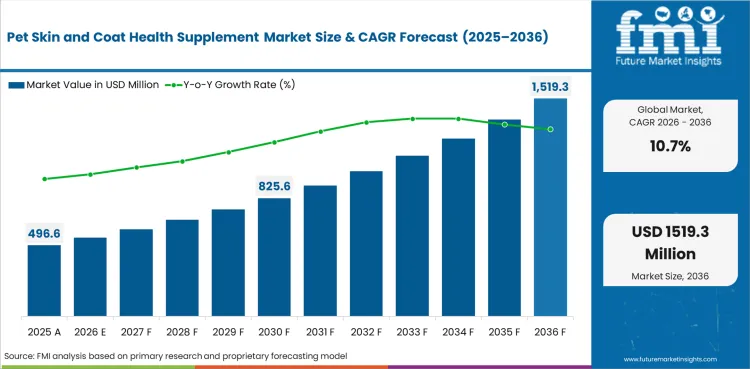
Key Takeaways, Market Size, and Forecast
- The pet skin and coat health supplement market was valued at USD 496.6 million in 2025.
- The market is set to reach USD 549.7 million by the end of 2026.
- The market is projected to grow at a CAGR of 10.7% between 2026 and 2036, reaching USD 1,519.3 million by 2036.
- The global pet skin and coat health supplement market was valued at USD 496.60 million in 2025.
- The market is projected to reach USD 1,519.25 million by 2036, expanding at a CAGR of 10.7%.
- An incremental opportunity of USD 969.52 million is expected to be generated over the forecast period.
- Chewable supplements are the leading product segment, accounting for 45.0% of the market share in 2026.
- Skin health is the dominant application, holding a 50.0% market share in 2026.
- Dogs are the primary end-use segment, capturing 60.0% of category spending.
- Offline retail commands 65.0% of the distribution channel share.
- India is the fastest-growing market, projected to expand at a CAGR of 14.50% through 2036.
Pet Skin and Coat Health Supplement Market Definition
Oral chewables, powders, liquid formulations, and topical supplement treatments intended to promote skin, coat, and dermatological health in dogs, cats, and small companion animals are all included in the pet skin and coat health supplement market. Omega-3, probiotic, biotin, vitamin, and combination formulations distributed through veterinarian, retail, and internet channels are all included in the product scope.
Pet Skin and Coat Health Supplement Market Inclusions
Market scope includes all commercially traded pet skin and coat health supplement covering the product, application, end-use, and distribution-channel segments detailed in Section 4, spanning the 2026 to 2036 forecast period across North America, Latin America, Europe, East Asia, South Asia and Pacific, and Middle East and Africa regions.
Pet Skin and Coat Health Supplement Market Exclusions
The scope excludes prescription veterinary dermatological medications, topical shampoos and conditioners without supplement claims, livestock and equine supplement products, and general-purpose multivitamin supplements without specific skin or coat health positioning.
Pet Skin and Coat Health Supplement Market Research Methodology
- Primary Research: FMI analysts talked to procurement leaders, technical experts, and commercial managers all along the pet skin and coat health supplement value chain in North America, Europe, and Asia-Pacific.
- Desk Research: To set verifiable baseline parameters, data was collected from trade publications, industry association statistics, regulatory filings, and corporate annual reports.
- Market Sizing and Forecasting: We use growth rates and substitution curves for each region to predict demand through 2036. The baseline values come from adding up transaction volumes from the bottom up.
- Data validation and update cycle: Every three months, projections are checked against manufacturer shipment numbers, industry sales data, and regulatory disclosures.c
Why is the Pet Skin and Coat Health Supplement Market Growing?
Skin and coat supplements make up more than 15% of the total value of the pet supplement category, which has grown from USD 7.5 billion in 2020 to more than USD 14 billion in 2025.
More than 40% of people in North America and Western Europe who buy skin and coat supplements now do so because of recommendations from veterinarians. This is up from less than 25% in 2018.
Chewy Autoship, Amazon Subscribe and Save, and niche DTC brands like Finn and The Honest Kitchen have all made it harder for traditional retailers to set prices. Because of this, subscription models have gained a larger share of the market.
Pet owners in North America, Western Europe, and urban Asia Pacific are changing how they spend money on health products for people to health products for pets. This affects demand. Skin and coat supplements are one of the fastest-growing areas of pet health. They have visible results that make people want to buy them again. Dogs get about 60% of the money spent in this category, while cats and small animals get the rest.
Veterinary channel recommendations are the most common way to buy skin and coat supplements in North America and Western Europe. More than 40% of these purchases are made based on veterinarian recommendations. Clinical trial evidence backs up veterinarians' recommendations for things like fish oil, probiotics, EPA and DHA concentrates, and biotin. Companies like Zesty Paws, Nutramax Laboratories, and VetriScience have made a name for themselves in the veterinary channel by putting money into clinical studies and programs to teach veterinarians.
Direct-to-consumer subscription models are changing the way businesses compete with each other. Chewy Autoship, Amazon Subscribe and Save, and specialist DTC companies like The Honest Kitchen, Finn, and Zesty Paws have all moved category share toward recurring-revenue models by lowering the typical retail margin capture. In the USA pet supplement market, the number of people who signed up for subscriptions went up from less than 10% in 2020 to more than 30% in 2025.
Segmental Analysis
- Chewable supplements hold 45% of product share in 2026, driven by palatability and administration ease versus pills, liquids, and powders.
- Skin health applications lead at 50% of application share, with coat shine and shedding management as the next two largest use cases.
- Offline retail holds 65% of distribution, though Chewy, Amazon Pet, and specialty DTC platforms are growing double-digits.
The pet skin and coat health supplement market is segmented by product, application, pet type, distribution channel, formulation, and source. Product segmentation spans chewables, powders, liquids, and topical formats. Applications cover skin health, coat health, allergy support, and combination use.
Insights into the Chewable Supplements Segment
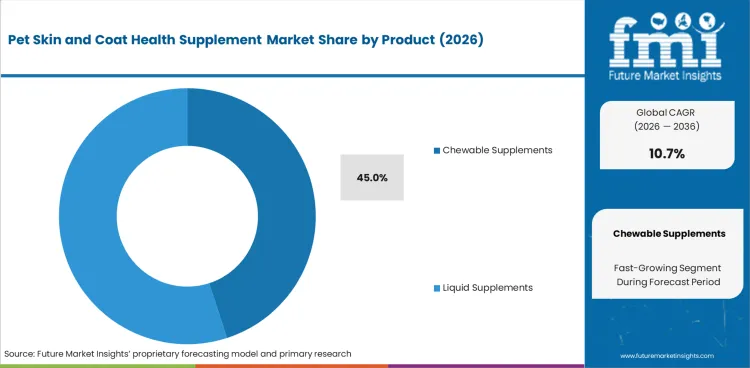
In 2026, chewable supplements are expected to hold a 45% market share. This leadership reflects the convenience of administration for owners of particular dogs and cats, along with palatability advantages over tablets, liquids, and powders.
Soft chews and functional treats made with fish oil, EPA and DHA, biotin, and probiotic blends are the chewables sub-segments that are expanding the fastest. Zesty Paws, VetriScience Laboratories, and Nutramax Laboratories are just a few of the companies that have set category standards for soft-chew palatability and veterinarian-approved formulations.
As tablet and powder forms struggle with administration compliance, chewables are predicted to hold the majority of the market share through 2036. While topical supplement sprays constitute a smaller but expanding subsegment, liquid formulations continue to keep their share in therapeutic applications where dose flexibility is important.
Insights into the Skin Health Applications Segment
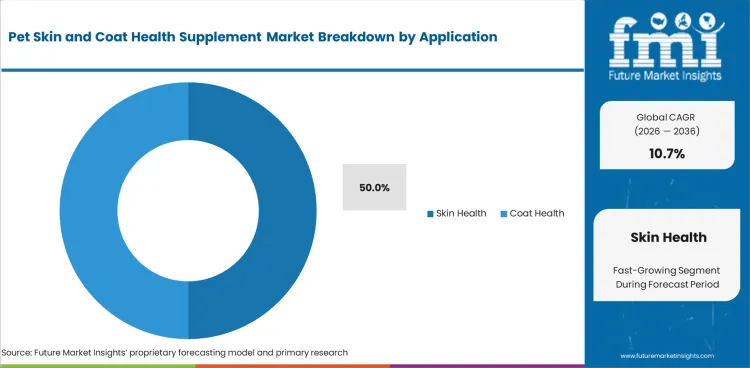
In 2026, skin health applications are predicted to account for half of the application market. Supporting allergies, managing dryness and flaking, and reducing dermatitis symptoms are the main use cases.
The second-largest sub-segment is coat health as a separate application that focuses on shine, reducing shedding, and improving texture. In comparison to single-concern SKUs, combination formulations that address both skin and coat concerns are driving premium pricing, commanding about 30% price hikes.
Pet Skin and Coat Health Supplement Market Drivers, Restraints, and Opportunities
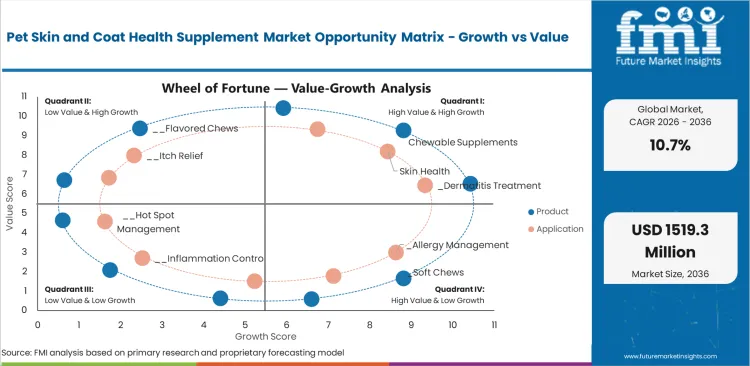
- Spending in premium categories and the transfer of wellness from human health to companion animals are driven by pet humanization.
- In established areas, veterinary channel recommendations represent for more than 40% of category purchases, making them the primary acquisition driver.
- DTC subscription models compress retail margins while accelerating recurring-revenue economics.
The pet skin and coat health supplement segment is shaped by pet humanization, veterinary channel recommendation, and direct-to-consumer subscription expansion. Constraints include limited regulatory oversight creating claim substantiation challenges, ingredient cost volatility on fish oil inputs, and private-label pressure at big-box pet retailers.
Pet Humanization and Premium Category Spending
Demand is shaped by pet humanization as owners in North America, Western Europe, and urban Asia Pacific transfer wellness spending patterns from human health to companion animals. In the US market, annual spending per pet on supplements increased from USD 35 in 2018 to over USD 80 in 2025. Given the obvious results that encourage recurring purchases, skin and coat supplements receive a disproportionate amount of premium pricing.
Veterinary Channel Recommendation and Clinical Substantiation
Growth means that the veterinary channel recommendation went from less than 25% of category purchases in 2018 to more than 40% in 2025 in North America and Western Europe. Nutramax Laboratories, Zesty Paws, VetriScience, and Standard Process have all invested in clinical trials of fish oil EPA and DHA, biotin, and probiotic formulations to get veterinarians to use their products. Veterinarian approval justifies high prices and makes price competition less fierce.
Direct-to-Consumer Subscription Expansion
The rise in use is due to Chewy Autoship, Amazon Subscribe and Save, and the growth of specialized DTC brand subscriptions. In the US, the number of people who subscribe to pet supplements went up from less than 10% in 2020 to more than 30% in 2025. DTC companies like The Honest Kitchen, Finn, and Zesty Paws make money on a regular basis that traditional retail competitors can't match. This makes it harder for PetSmart and Petco to make money on their retail margins.
Regulatory Claim Substantiation and Ingredient Cost Volatility
The FDA's loose control over pet supplements makes it hard to back up claims and raises the risk of lawsuits, which slows growth. Fish oil ingredient costs have gone up by 20% to 50% a year because of the low anchovy harvest rates in South America. This makes it harder for companies that don't have vertical integration to make money. The NASC quality seal makes regulations less unclear, but it doesn't prove any claims.
Analysis of Pet Skin and Coat Health Supplement Market By Key Countries
.webp "Top Country Growth Comparison Pet Skin And Coat Health Supplement Market Cagr (2026 2036)")
| Country | CAGR |
|---|---|
| India | 14.50% |
| China | 12.10% |
| Japan | 10.50% |
| Germany | 9.20% |
| United States | 8.00% |
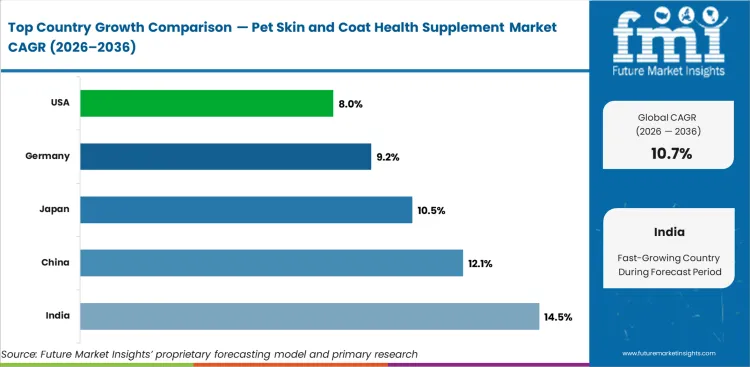
- The largest absolute category spending is found in North America and Western Europe, whereas the fastest percentage increase is seen in Asia Pacific metropolitan areas.
- With a 14.5% CAGR, urbanization, an increase in pet ownership, and the expansion of veterinary infrastructure are the main drivers of growth in India.
- China follows at 12.1% CAGR, propelled by premium pet category development and e-commerce platform growth at Alibaba and JD.com.
- Mature markets including the USA and Germany grow at single-digit rates shaped by channel shift and humanization-driven premium pricing.
The pet skin and coat health supplement market is projected to grow globally at a CAGR of 10.7% from 2026 to 2036. Among the top markets, India leads at 14.50%, China records 12.10%, Japan records 10.50%, Germany records 9.20%, United States records 8.00%. The analysis spans over 30 countries, with the leading markets detailed below.
Demand Outlook for Pet Skin and Coat Health Supplement Market in the United States
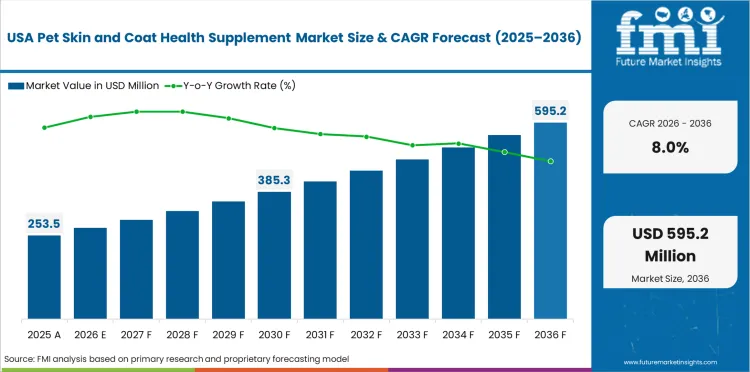
The United States is projected to grow at 8.0% CAGR through 2036, shaped by pet humanization, Chewy Autoship subscription growth, and veterinary channel recommendation at PetSmart VetIQ, Banfield Pet Hospital, and independent veterinary practices. Nutramax Laboratories, Zesty Paws, and VetriScience lead competitive dynamics. DTC brands including Finn and The Honest Kitchen are expanding share through digital-first distribution.
- Chewy Autoship subscription model drives recurring revenue and retail margin compression.
- Veterinary channel recommendation at Banfield and independent clinics supports premium positioning.
- DTC brands Finn, The Honest Kitchen, and Zesty Paws expand share through digital-first distribution.
Future Outlook for Pet Skin and Coat Health Supplement Market in the United Kingdom
The United Kingdom demonstrates steady growth through 2036, with demand shaped by pet ownership increases post-pandemic, Pets at Home private-label expansion, and veterinary channel recommendation through CVS Group, IVC Evidensia, and Vet Partners clinical networks. Domestic brands including Lintbells YuMOVE and Dorwest compete with imported Zesty Paws and Nutramax product ranges. Kennel Club endorsement programs shape retailer range decisions.
- Pets at Home private-label expansion compresses branded margins at scale retail.
- CVS Group and IVC Evidensia veterinary clinical networks drive recommendation-led purchases.
- Lintbells YuMOVE and Dorwest lead domestic branded competition against imports.
Opportunity Analysis of Pet Skin and Coat Health Supplement Market in Germany
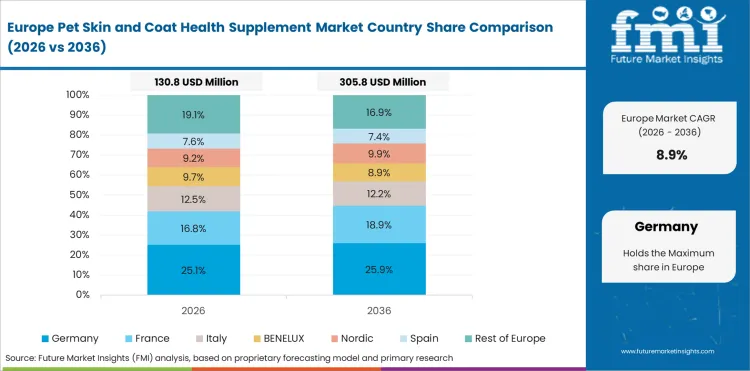
Germany is projected to grow at 9.2% CAGR through 2036, propelled by premium pet category adoption, Fressnapf private-label expansion, and veterinary channel recommendation through established clinical networks. German brands including cdVet and Anifit compete alongside imports from Zesty Paws, Nutramax, and VetriScience. EU pet supplement labeling regulations under Regulation EC 767/2009 shape ingredient claim substantiation.
- Fressnapf private-label expansion drives value-tier share alongside premium imports.
- EU Regulation EC 767/2009 shapes pet supplement labeling and ingredient claim substantiation.
- cdVet and Anifit lead domestic branded competition with premium positioning.
In-depth Analysis of Pet Skin and Coat Health Supplement Market in Japan
Japan is projected to grow at 10.5% CAGR through 2036, reflecting high-spending pet owner segments, small-dog ownership dominance, and premium imported and domestic brand competition. Unicharm PetCare, Japan Pet Communications, and Marukan compete in the domestic branded market alongside imports from Zesty Paws, VetriScience, and Nutramax. Pet Goods and Aeon Pet retail networks drive offline distribution volumes.
- Small-dog ownership dominance creates premium-per-unit spending advantages.
- Unicharm PetCare and Japan Pet Communications lead domestic branded competition.
- Pet Goods and Aeon Pet retail networks drive offline distribution at scale.
Sales Analysis of Pet Skin and Coat Health Supplement Market in China
China is projected to grow at 12.1% CAGR through 2036, propelled by premium pet category development in Tier-1 and Tier-2 cities, e-commerce platform growth at Tmall, JD.com, and Pinduoduo, and veterinary infrastructure expansion. Domestic brands including ATHUB, MAG, and Myfoodie compete with imports from Zesty Paws, Nutramax, and VetriScience. Tmall Global and JD cross-border channels accelerate imported brand reach.
- Tmall, JD.com, and Pinduoduo platform growth drives e-commerce channel dominance.
- Tier-1 and Tier-2 city premium pet ownership supports category pricing power.
- Domestic brands ATHUB, MAG, and Myfoodie compete with imported premium brands.
In-depth Analysis of Pet Skin and Coat Health Supplement Market in India
India leads growth at 14.5% CAGR through 2036, supported by rising urban pet ownership, expanding veterinary clinic infrastructure, and growing middle-class discretionary spending on companion animals. Domestic brands including Drools, Himalaya Pet, and Heads Up For Tails compete with imported Nutramax and Zesty Paws products. Heads Up For Tails DTC distribution and Amazon India marketplace accelerate category trial.
- Urban pet ownership growth in metro cities drives category trial and adoption.
- Drools, Himalaya Pet, and Heads Up For Tails lead domestic branded competition.
- Heads Up For Tails DTC and Amazon India accelerate premium brand distribution.
Competitive Landscape and Strategic Positioning
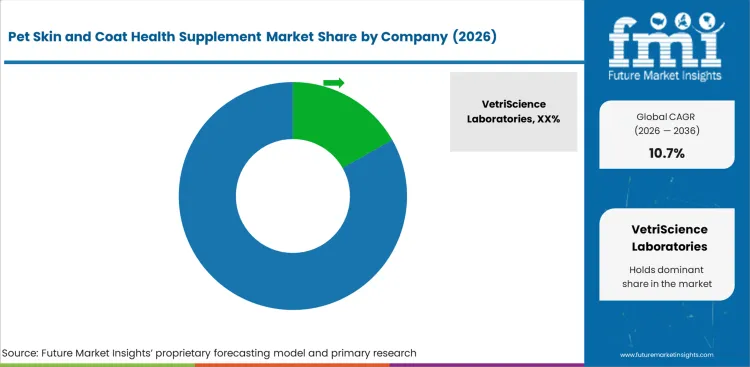
- Nutramax Laboratories and Zesty Paws together own more than 30% of the North American branded revenue share. This is based on investments in the veterinary channel and proof from clinical trials.
- Lintbells YuMOVE (UK, Europe), Unicharm PetCare (Japan), and Drools (India) are regional experts with strong brand positions in their own areas.
- Chewy, Amazon Basics Pet, PetSmart Top Paw, and Pets at Home all sell private-label brands that make up about 20% of the retail category.
Companies that make specialty pet supplements and nutraceuticals for veterinarians have an impact on the market for supplements that help keep pets' skin and coats healthy. Nutramax Laboratories is the leader in premium veterinary channel positioning with skin health products like Welactin and Dasuquin. This is thanks to investments in clinical trials and programs that get practitioners to endorse the products.
Zesty Paws is the leader in the DTC and Amazon channels for soft-chew formulas for skin health, coat care, and combo SKUs. VetriScience Laboratories sells BioActive Protein Soft Chews and other related items in both pet stores and stores for people.
Standard Process and PetNC Natural Care both have a share of the natural positioning market. They both appeal to high-end customers who value ingredient transparency. Vet's Best has more retail exposure thanks to its placement on the shelves of Petco and PetSmart.
Some of the things that make it hard to get in are the NASC quality seal certification standards, the three- to five-year time frames for building relationships with veterinarians, and the growing demand for private-label products at Chewy, Amazon, and big-box pet stores. Investing in therapeutic trials, starting a direct-to-consumer subscription business, and growing internationally are all important strategic goals.
Major Industry Players
Key global companies leading the pet skin and coat health supplement market include:
- Nutramax Laboratories (USA), Zesty Paws (USA), VetriScience Laboratories (USA), and PetNC Natural Care (USA) are some of the best companies in the pet skin and coat health supplement market. They have invested in the veterinary channel, run clinical trials, and offer a wide range of products, including chewables, powders, and liquids.
- Vet's Best (USA), Standard Process (USA), and Lintbells YuMOVE (UK) have become leaders in specialty retail and veterinary channels in North America and Europe by focusing on ingredient transparency, natural formulations, and proprietary quality programs.
- Finn (USA), The Honest Kitchen (USA), and Heads Up For Tails (India), among others, have established themselves as up-and-coming DTC and specialty players by establishing strong positions in direct-to-consumer subscription models, sustainability-focused packaging, and premium brand positioning. This shows that they are making progress in the transition to digitally-led channels.
Competitive Benchmarking: Pet Skin and Coat Health Supplement Market
| Company | Veterinary Access | DTC Channel Strength | Clinical Substantiation | Geographic Footprint |
|---|---|---|---|---|
| Nutramax Laboratories | Strong | Medium | High | North America, Europe |
| Zesty Paws | Medium | Strong | Medium | North America, Global |
| VetriScience Laboratories | Strong | Medium | High | North America |
| PetNC Natural Care | Medium | Medium | Medium | North America |
| Vet's Best | Medium | Medium | Medium | North America, Europe |
| Standard Process | Strong | Low | Medium | North America |
| Lintbells YuMOVE | Strong | Medium | Medium | UK, Europe |
| Finn | Low | Strong | Low | North America |
| The Honest Kitchen | Low | Strong | Low | North America |
| Heads Up For Tails | Low | Medium | Low | India |
Source: Future Market Insights competitive analysis, 2026.
Key Developments in Pet Skin and Coat Health Supplement Market
- In 2025, Nutramax Laboratories prioritized maintaining its premium clinical standing by renewing NASC Quality Seal certifications for its core joint health portfolio, focusing on strengthening veterinarian endorsement in North American markets.
- In 2025, Zesty Paws shifted its e-commerce strategy toward promoting "wellness bundles” pairing existing skin, coat, and probiotic formulas-to drive customer retention via Chewy Autoship and Amazon Subscribe and Save.
Key Players in the Pet Skin and Coat Health Supplement Market
Major Global Players
- Nutramax Laboratories
- Zesty Paws
- VetriScience Laboratories
- PetNC Natural Care
- Vet's Best
- Standard Process
- Lintbells YuMOVE
Emerging Players/Startups
- Finn
- The Honest Kitchen
- Heads Up For Tails
Scope of the report
| Metric | Value |
|---|---|
| Quantitative Units | USD 549.74 billion to USD 1519.25 billion, at a CAGR of 10.7% |
| Market Definition | The pet skin and coat health supplement market encompasses oral chewables, powders, liquid formulations, and topical supplement products designed to support skin, coat, and dermatological health in dogs, cats, and small companion animals. Product scope covers omega-3, probiotic, biotin, vitamin, and combination formulations sold through veterinary, retail, and online channels. |
| Regions Covered | North America, Latin America, Europe, East Asia, South Asia and Pacific, Middle East and Africa |
| Countries Covered | India, China, USA, UK, Germany, Japan, South Korea, Brazil, 30 plus countries |
| Key Companies Profiled | Nutramax Laboratories, Zesty Paws, VetriScience Laboratories, PetNC Natural Care, Vet's Best, Standard Process, Lintbells YuMOVE, Finn, The Honest Kitchen, Heads Up For Tails |
| Forecast Period | 2026 to 2036 |
| Approach | Hybrid bottom-up and top-down methodology starting with verified pet skin and coat health supplement transaction data, projecting adoption velocity across segments and regions. |
Market Segmentation Analysis
Pet Skin and Coat Health Supplement Market Market Segmented by Product:
- Chewable Supplements
- Soft Chews
- Flavored Chews
- Functional Chews
- Hard Chews
- Dental Chew Formats
- Crunchy Tablets
- Soft Chews
- Liquid Supplements
- Oils
- Fish Oil Based
- Plant Oil Based
- Liquid Drops
- Oral Droppers
- Food Mix Liquids
- Oils
- Powders
- Single Ingredient Powder
- Omega Fatty Acid Powders
- Protein Powders
- Blended Powder
- Vitamin Blends
- Mineral Blends
- Single Ingredient Powder
Pet Skin and Coat Health Supplement Market Market Segmented by Application:
- Skin Health
- Allergy Management
- Itch Relief
- Inflammation Control
- Dermatitis Treatment
- Hot Spot Management
- Skin Barrier Support
- Allergy Management
- Coat Health
- Shine Enhancement
- Gloss Improvement
- Color Enhancement
- Hair Strength
- Shedding Control
- Hair Growth Support
- Shine Enhancement
- Overall Wellness
- Immune Support
- Antioxidant Support
- Nutritional Balance
- Immune Support
Pet Skin and Coat Health Supplement Market Market Segmented by Pet Type:
- Dogs
- Small Breeds
- Companion Dogs
- Indoor Dogs
- Large Breeds
- Working Dogs
- Outdoor Dogs
- Small Breeds
- Cats
- Indoor Cats
- Short Hair Cats
- Long Hair Cats
- Outdoor Cats
- Active Cats
- Mixed Environment Cats
- Indoor Cats
- Other Pets
- Small Animals
- Rabbits
- Guinea Pigs
- Small Animals
Pet Skin and Coat Health Supplement Market Market Segmented by Distribution Channel:
- Offline Retail
- Pet Specialty Stores
- Independent Pet Stores
- Retail Chains
- Veterinary Clinics
- Prescription Sales
- Recommended Products
- Supermarkets And Hypermarkets
- Large Format Stores
- Convenience Stores
- Pet Specialty Stores
- Online Retail
- E Commerce Platforms
- Third Party Marketplaces
- Brand Owned Websites
- Subscription Services
- Auto Replenishment
- Customized Plans
- E Commerce Platforms
Pet Skin and Coat Health Supplement Market Market Segmented by Formulation:
- Combination Formulations
- Omega Fatty Acid Blends
- Omega 3 And Omega 6
- Fish Oil Combinations
- Vitamin And Mineral Blends
- Vitamin E Combinations
- Zinc Based Blends
- Protein And Collagen Blends
- Marine Collagen
- Animal Protein Blends
- Omega Fatty Acid Blends
- Single Ingredient
- Fish Oil
- Salmon Oil
- Sardine Oil
- Plant Based Oils
- Flaxseed Oil
- Algae Oil
- Fish Oil
Pet Skin and Coat Health Supplement Market Market Segmented by Source:
- Animal Based
- Marine Sources
- Fish Oil
- Krill Oil
- Land Animal Sources
- Collagen
- Animal Fat Extracts
- Marine Sources
- Plant Based
- Seed Oils
- Flaxseed
- Chia Seed
- Algae Based
- Omega Rich Algae
- Sustainable Sources
- Seed Oils
Pet Skin and Coat Health Supplement Market Market by Region:
- North America
- USA
- Canada
- Mexico
- Latin America
- Brazil
- Chile
- Rest of Latin America
- Western Europe
- Germany
- UK
- Italy
- Spain
- France
- Nordic
- BENELUX
- Rest of Western Europe
- Eastern Europe
- Russia
- Poland
- Hungary
- Balkan & Baltic
- Rest of Eastern Europe
- East Asia
- China
- Japan
- South Korea
- South Asia and Pacific
- India
- ASEAN
- Australia & New Zealand
- Rest of South Asia and Pacific
- Middle East & Africa
- Kingdom of Saudi Arabia
- Other GCC Countries
- Turkiye
- South Africa
- Other African Union
- Rest of Middle East & Africa
Bibliography
- 1. American Pet Products Association. (2025). APPA National Pet Owners Survey. APPA.
- 2. National Animal Supplement Council. (2025). NASC Quality Seal Program Compliance Data. NASC.
- 3. European Pet Food Industry Federation. (2024). FEDIAF Pet Food and Supplement Guidelines. FEDIAF.
- 4. USA Food and Drug Administration. (2024). FDA Center for Veterinary Medicine Regulatory Guidance. FDA CVM.
- 5. American Veterinary Medical Association. (2025). AVMA Pet Health and Supplement Recommendations. AVMA.
This bibliography is provided for reader reference.
This Report Addresses
- Market size and revenue predictions for pet skin and coat health supplements from 2026 to 2036.
- Section 4 covers segmentation analysis for all product, application, end-use, and distribution-channel axes.
- Insights at the regional and country level for more than 30 markets, along with a comparison of their growth rates.
- Regulatory analysis of the main frameworks that affect product specifications and buying priorities in big markets.
- An assessment of the competitive landscape that includes the market structure, vendor positioning, and recent changes.
- Finding investment opportunities across suppliers, brand owners, and channels.
- Tracking the supply chain from getting raw materials to sending out finished products.
- You can get data in PDF and Excel formats, and you can access it every three months.
Frequently Asked Questions
How large is the demand for Pet Skin and Coat Health Supplement Market in the global market in 2026?
Demand for pet skin and coat health supplement market in the global market is estimated to be valued at USD 549.74 billion in 2026.
What will be the market size of Pet Skin and Coat Health Supplement Market by 2036?
Market size for pet skin and coat health supplement market is projected to reach USD 1519.25 billion by 2036.
What is the expected demand growth for Pet Skin and Coat Health Supplement Market between 2026 and 2036?
Demand for pet skin and coat health supplement market is expected to grow at a CAGR of 10.7% between 2026 and 2036.
Which Product is poised to lead global sales by 2026?
Chewable Supplements accounts for 45.0% in 2026, reflecting established manufacturing infrastructure and proven performance advantages.
How is Offline Retail driving Pet Skin and Coat Health Supplement Market adoption?
Offline Retail represents 65.0% of distribution channel demand as dominant operators and procurement organizations drive volume.
What is driving demand in the top-growth country?
India registers a 14.50% CAGR through 2036, propelled by policy mandates, category adoption, and procurement-scale investment.
What does Pet Skin and Coat Health Supplement Market definition mean in this report?
The pet skin and coat health supplement market pet skin and coat health supplement market encompasses oral chewables, powders, liquid formulations, and topical supplement products designed to support skin, coat, and dermatological health in dogs, cats, and small companion animals. Product scope covers omega-3, probiotic, biotin, vitamin, and combination formulations sold through veterinary, retail, and online channels.
How does FMI build and validate the Pet Skin and Coat Health Supplement Market forecast?
Forecasting models apply a hybrid bottom-up methodology starting with verified transaction data, cross-validated against industry sales statistics and manufacturer financial disclosures.
Preview the report firsthand - request a free sample
Get SampleGet the brochure for pricing and purchase details.
Get PDFTable of Content
- Executive Summary
- Global Market Outlook
- Demand-side Trends
- Supply-side Trends
- Technology Roadmap Analysis
- Analysis and Recommendations
- Market Overview
- Market Coverage / Taxonomy
- Market Definition / Scope / Limitations
- Research Methodology
- Chapter Orientation
- Analytical Lens and Working Hypotheses
- Market Structure, Signals, and Trend Drivers
- Benchmarking and Cross-market Comparability
- Market Sizing, Forecasting, and Opportunity Mapping
- Research Design and Evidence Framework
- Desk Research Programme (Secondary Evidence)
- Company Annual and Sustainability Reports
- Peer-reviewed Journals and Academic Literature
- Corporate Websites, Product Literature, and Technical Notes
- Earnings Decks and Investor Briefings
- Statutory Filings and Regulatory Disclosures
- Technical White Papers and Standards Notes
- Trade Journals, Industry Magazines, and Analyst Briefs
- Conference Proceedings, Webinars, and Seminar Materials
- Government Statistics Portals and Public Data Releases
- Press Releases and Reputable Media Coverage
- Specialist Newsletters and Curated Briefings
- Sector Databases and Reference Repositories
- FMI Internal Proprietary Databases and Historical Market Datasets
- Subscription Datasets and Paid Sources
- Social Channels, Communities, and Digital Listening Inputs
- Additional Desk Sources
- Expert Input and Fieldwork (Primary Evidence)
- Primary Modes
- Qualitative Interviews and Expert Elicitation
- Quantitative Surveys and Structured Data Capture
- Blended Approach
- Why Primary Evidence is Used
- Field Techniques
- Interviews
- Surveys
- Focus Groups
- Observational and In-context Research
- Social and Community Interactions
- Stakeholder Universe Engaged
- C-suite Leaders
- Board Members
- Presidents and Vice Presidents
- R&D and Innovation Heads
- Technical Specialists
- Domain Subject-matter Experts
- Scientists
- Physicians and Other Healthcare Professionals
- Governance, Ethics, and Data Stewardship
- Research Ethics
- Data Integrity and Handling
- Primary Modes
- Tooling, Models, and Reference Databases
- Desk Research Programme (Secondary Evidence)
- Data Engineering and Model Build
- Data Acquisition and Ingestion
- Cleaning, Normalisation, and Verification
- Synthesis, Triangulation, and Analysis
- Quality Assurance and Audit Trail
- Market Background
- Market Dynamics
- Drivers
- Restraints
- Opportunity
- Trends
- Scenario Forecast
- Demand in Optimistic Scenario
- Demand in Likely Scenario
- Demand in Conservative Scenario
- Opportunity Map Analysis
- Product Life Cycle Analysis
- Supply Chain Analysis
- Investment Feasibility Matrix
- Value Chain Analysis
- PESTLE and Porter’s Analysis
- Regulatory Landscape
- Regional Parent Market Outlook
- Production and Consumption Statistics
- Import and Export Statistics
- Market Dynamics
- Global Market Analysis 2021 to 2025 and Forecast, 2026 to 2036
- Historical Market Size Value (USD Million) Analysis, 2021 to 2025
- Current and Future Market Size Value (USD Million) Projections, 2026 to 2036
- Y-o-Y Growth Trend Analysis
- Absolute $ Opportunity Analysis
- Global Market Pricing Analysis 2021 to 2025 and Forecast 2026 to 2036
- Global Market Analysis 2021 to 2025 and Forecast 2026 to 2036, By Product
- Introduction / Key Findings
- Historical Market Size Value (USD Million) Analysis By Product , 2021 to 2025
- Current and Future Market Size Value (USD Million) Analysis and Forecast By Product , 2026 to 2036
- Chewable Supplements
- Soft Chews
- Flavored Chews
- Functional Chews
- Hard Chews
- Dental Chew Formats
- Crunchy Tablets
- Liquid Supplements
- Oils
- Fish Oil Based
- Plant Oil Based
- Liquid Drops
- Oral Droppers
- Powders
- Single Ingredient Powder
- Omega Fatty Acid Powders
- Protein Powders
- Blended Powder
- Vitamin Blends
- Chewable Supplements
- Y-o-Y Growth Trend Analysis By Product , 2021 to 2025
- Absolute $ Opportunity Analysis By Product , 2026 to 2036
- Global Market Analysis 2021 to 2025 and Forecast 2026 to 2036, By Application
- Introduction / Key Findings
- Historical Market Size Value (USD Million) Analysis By Application, 2021 to 2025
- Current and Future Market Size Value (USD Million) Analysis and Forecast By Application, 2026 to 2036
- Skin Health
- Allergy Management
- Itch Relief
- Inflammation Control
- Dermatitis Treatment
- Hot Spot Management
- Skin Barrier Support
- Coat Health
- Shine Enhancement
- Gloss Improvement
- Color Enhancement
- Hair Strength
- Shedding Control
- Overall Wellness
- Immune Support
- Antioxidant Support
- Nutritional Balance
- Skin Health
- Y-o-Y Growth Trend Analysis By Application, 2021 to 2025
- Absolute $ Opportunity Analysis By Application, 2026 to 2036
- Global Market Analysis 2021 to 2025 and Forecast 2026 to 2036, By Pet Type
- Introduction / Key Findings
- Historical Market Size Value (USD Million) Analysis By Pet Type, 2021 to 2025
- Current and Future Market Size Value (USD Million) Analysis and Forecast By Pet Type, 2026 to 2036
- Dogs
- Small Breeds
- Companion Dogs
- Indoor Dogs
- Large Breeds
- Working Dogs
- Outdoor Dogs
- Cats
- Indoor Cats
- Short Hair Cats
- Long Hair Cats
- Outdoor Cats
- Active Cats
- Other Pets
- Small Animals
- Rabbits
- Guinea Pigs
- Dogs
- Y-o-Y Growth Trend Analysis By Pet Type, 2021 to 2025
- Absolute $ Opportunity Analysis By Pet Type, 2026 to 2036
- Global Market Analysis 2021 to 2025 and Forecast 2026 to 2036, By Distribution Channel
- Introduction / Key Findings
- Historical Market Size Value (USD Million) Analysis By Distribution Channel, 2021 to 2025
- Current and Future Market Size Value (USD Million) Analysis and Forecast By Distribution Channel, 2026 to 2036
- Offline Retail
- Pet Specialty Stores
- Independent Pet Stores
- Retail Chains
- Veterinary Clinics
- Prescription Sales
- Recommended Products
- Supermarkets And Hypermarkets
- Large Format Stores
- Convenience Stores
- Online Retail
- E Commerce Platforms
- Third Party Marketplaces
- Brand Owned Websites
- Subscription Services
- Auto Replenishment
- Offline Retail
- Y-o-Y Growth Trend Analysis By Distribution Channel, 2021 to 2025
- Absolute $ Opportunity Analysis By Distribution Channel, 2026 to 2036
- Global Market Analysis 2021 to 2025 and Forecast 2026 to 2036, By Formulation
- Introduction / Key Findings
- Historical Market Size Value (USD Million) Analysis By Formulation, 2021 to 2025
- Current and Future Market Size Value (USD Million) Analysis and Forecast By Formulation, 2026 to 2036
- Combination Formulations
- Omega Fatty Acid Blends
- Omega 3 And Omega 6
- Fish Oil Combinations
- Vitamin And Mineral Blends
- Vitamin E Combinations
- Zinc Based Blends
- Protein And Collagen Blends
- Marine Collagen
- Animal Protein Blends
- Single Ingredient
- Fish Oil
- Salmon Oil
- Sardine Oil
- Plant Based Oils
- Flaxseed Oil
- Combination Formulations
- Y-o-Y Growth Trend Analysis By Formulation, 2021 to 2025
- Absolute $ Opportunity Analysis By Formulation, 2026 to 2036
- Global Market Analysis 2021 to 2025 and Forecast 2026 to 2036, By Source
- Introduction / Key Findings
- Historical Market Size Value (USD Million) Analysis By Source, 2021 to 2025
- Current and Future Market Size Value (USD Million) Analysis and Forecast By Source, 2026 to 2036
- Animal Based
- Marine Sources
- Fish Oil
- Krill Oil
- Land Animal Sources
- Collagen
- Animal Fat Extracts
- Plant Based
- Seed Oils
- Flaxseed
- Chia Seed
- Algae Based
- Omega Rich Algae
- Animal Based
- Y-o-Y Growth Trend Analysis By Source, 2021 to 2025
- Absolute $ Opportunity Analysis By Source, 2026 to 2036
- Global Market Analysis 2021 to 2025 and Forecast 2026 to 2036, By Region
- Introduction
- Historical Market Size Value (USD Million) Analysis By Region, 2021 to 2025
- Current Market Size Value (USD Million) Analysis and Forecast By Region, 2026 to 2036
- North America
- Latin America
- Western Europe
- Eastern Europe
- East Asia
- South Asia and Pacific
- Middle East & Africa
- Market Attractiveness Analysis By Region
- North America Market Analysis 2021 to 2025 and Forecast 2026 to 2036, By Country
- Historical Market Size Value (USD Million) Trend Analysis By Market Taxonomy, 2021 to 2025
- Market Size Value (USD Million) Forecast By Market Taxonomy, 2026 to 2036
- By Country
- USA
- Canada
- Mexico
- By Product
- By Application
- By Pet Type
- By Distribution Channel
- By Formulation
- By Source
- By Country
- Market Attractiveness Analysis
- By Country
- By Product
- By Application
- By Pet Type
- By Distribution Channel
- By Formulation
- By Source
- Key Takeaways
- Latin America Market Analysis 2021 to 2025 and Forecast 2026 to 2036, By Country
- Historical Market Size Value (USD Million) Trend Analysis By Market Taxonomy, 2021 to 2025
- Market Size Value (USD Million) Forecast By Market Taxonomy, 2026 to 2036
- By Country
- Brazil
- Chile
- Rest of Latin America
- By Product
- By Application
- By Pet Type
- By Distribution Channel
- By Formulation
- By Source
- By Country
- Market Attractiveness Analysis
- By Country
- By Product
- By Application
- By Pet Type
- By Distribution Channel
- By Formulation
- By Source
- Key Takeaways
- Western Europe Market Analysis 2021 to 2025 and Forecast 2026 to 2036, By Country
- Historical Market Size Value (USD Million) Trend Analysis By Market Taxonomy, 2021 to 2025
- Market Size Value (USD Million) Forecast By Market Taxonomy, 2026 to 2036
- By Country
- Germany
- UK
- Italy
- Spain
- France
- Nordic
- BENELUX
- Rest of Western Europe
- By Product
- By Application
- By Pet Type
- By Distribution Channel
- By Formulation
- By Source
- By Country
- Market Attractiveness Analysis
- By Country
- By Product
- By Application
- By Pet Type
- By Distribution Channel
- By Formulation
- By Source
- Key Takeaways
- Eastern Europe Market Analysis 2021 to 2025 and Forecast 2026 to 2036, By Country
- Historical Market Size Value (USD Million) Trend Analysis By Market Taxonomy, 2021 to 2025
- Market Size Value (USD Million) Forecast By Market Taxonomy, 2026 to 2036
- By Country
- Russia
- Poland
- Hungary
- Balkan & Baltic
- Rest of Eastern Europe
- By Product
- By Application
- By Pet Type
- By Distribution Channel
- By Formulation
- By Source
- By Country
- Market Attractiveness Analysis
- By Country
- By Product
- By Application
- By Pet Type
- By Distribution Channel
- By Formulation
- By Source
- Key Takeaways
- East Asia Market Analysis 2021 to 2025 and Forecast 2026 to 2036, By Country
- Historical Market Size Value (USD Million) Trend Analysis By Market Taxonomy, 2021 to 2025
- Market Size Value (USD Million) Forecast By Market Taxonomy, 2026 to 2036
- By Country
- China
- Japan
- South Korea
- By Product
- By Application
- By Pet Type
- By Distribution Channel
- By Formulation
- By Source
- By Country
- Market Attractiveness Analysis
- By Country
- By Product
- By Application
- By Pet Type
- By Distribution Channel
- By Formulation
- By Source
- Key Takeaways
- South Asia and Pacific Market Analysis 2021 to 2025 and Forecast 2026 to 2036, By Country
- Historical Market Size Value (USD Million) Trend Analysis By Market Taxonomy, 2021 to 2025
- Market Size Value (USD Million) Forecast By Market Taxonomy, 2026 to 2036
- By Country
- India
- ASEAN
- Australia & New Zealand
- Rest of South Asia and Pacific
- By Product
- By Application
- By Pet Type
- By Distribution Channel
- By Formulation
- By Source
- By Country
- Market Attractiveness Analysis
- By Country
- By Product
- By Application
- By Pet Type
- By Distribution Channel
- By Formulation
- By Source
- Key Takeaways
- Middle East & Africa Market Analysis 2021 to 2025 and Forecast 2026 to 2036, By Country
- Historical Market Size Value (USD Million) Trend Analysis By Market Taxonomy, 2021 to 2025
- Market Size Value (USD Million) Forecast By Market Taxonomy, 2026 to 2036
- By Country
- Kingdom of Saudi Arabia
- Other GCC Countries
- Turkiye
- South Africa
- Other African Union
- Rest of Middle East & Africa
- By Product
- By Application
- By Pet Type
- By Distribution Channel
- By Formulation
- By Source
- By Country
- Market Attractiveness Analysis
- By Country
- By Product
- By Application
- By Pet Type
- By Distribution Channel
- By Formulation
- By Source
- Key Takeaways
- Key Countries Market Analysis
- USA
- Pricing Analysis
- Market Share Analysis, 2025
- By Product
- By Application
- By Pet Type
- By Distribution Channel
- By Formulation
- By Source
- Canada
- Pricing Analysis
- Market Share Analysis, 2025
- By Product
- By Application
- By Pet Type
- By Distribution Channel
- By Formulation
- By Source
- Mexico
- Pricing Analysis
- Market Share Analysis, 2025
- By Product
- By Application
- By Pet Type
- By Distribution Channel
- By Formulation
- By Source
- Brazil
- Pricing Analysis
- Market Share Analysis, 2025
- By Product
- By Application
- By Pet Type
- By Distribution Channel
- By Formulation
- By Source
- Chile
- Pricing Analysis
- Market Share Analysis, 2025
- By Product
- By Application
- By Pet Type
- By Distribution Channel
- By Formulation
- By Source
- Germany
- Pricing Analysis
- Market Share Analysis, 2025
- By Product
- By Application
- By Pet Type
- By Distribution Channel
- By Formulation
- By Source
- UK
- Pricing Analysis
- Market Share Analysis, 2025
- By Product
- By Application
- By Pet Type
- By Distribution Channel
- By Formulation
- By Source
- Italy
- Pricing Analysis
- Market Share Analysis, 2025
- By Product
- By Application
- By Pet Type
- By Distribution Channel
- By Formulation
- By Source
- Spain
- Pricing Analysis
- Market Share Analysis, 2025
- By Product
- By Application
- By Pet Type
- By Distribution Channel
- By Formulation
- By Source
- France
- Pricing Analysis
- Market Share Analysis, 2025
- By Product
- By Application
- By Pet Type
- By Distribution Channel
- By Formulation
- By Source
- India
- Pricing Analysis
- Market Share Analysis, 2025
- By Product
- By Application
- By Pet Type
- By Distribution Channel
- By Formulation
- By Source
- ASEAN
- Pricing Analysis
- Market Share Analysis, 2025
- By Product
- By Application
- By Pet Type
- By Distribution Channel
- By Formulation
- By Source
- Australia & New Zealand
- Pricing Analysis
- Market Share Analysis, 2025
- By Product
- By Application
- By Pet Type
- By Distribution Channel
- By Formulation
- By Source
- China
- Pricing Analysis
- Market Share Analysis, 2025
- By Product
- By Application
- By Pet Type
- By Distribution Channel
- By Formulation
- By Source
- Japan
- Pricing Analysis
- Market Share Analysis, 2025
- By Product
- By Application
- By Pet Type
- By Distribution Channel
- By Formulation
- By Source
- South Korea
- Pricing Analysis
- Market Share Analysis, 2025
- By Product
- By Application
- By Pet Type
- By Distribution Channel
- By Formulation
- By Source
- Russia
- Pricing Analysis
- Market Share Analysis, 2025
- By Product
- By Application
- By Pet Type
- By Distribution Channel
- By Formulation
- By Source
- Poland
- Pricing Analysis
- Market Share Analysis, 2025
- By Product
- By Application
- By Pet Type
- By Distribution Channel
- By Formulation
- By Source
- Hungary
- Pricing Analysis
- Market Share Analysis, 2025
- By Product
- By Application
- By Pet Type
- By Distribution Channel
- By Formulation
- By Source
- Kingdom of Saudi Arabia
- Pricing Analysis
- Market Share Analysis, 2025
- By Product
- By Application
- By Pet Type
- By Distribution Channel
- By Formulation
- By Source
- Turkiye
- Pricing Analysis
- Market Share Analysis, 2025
- By Product
- By Application
- By Pet Type
- By Distribution Channel
- By Formulation
- By Source
- South Africa
- Pricing Analysis
- Market Share Analysis, 2025
- By Product
- By Application
- By Pet Type
- By Distribution Channel
- By Formulation
- By Source
- USA
- Market Structure Analysis
- Competition Dashboard
- Competition Benchmarking
- Market Share Analysis of Top Players
- By Regional
- By Product
- By Application
- By Pet Type
- By Distribution Channel
- By Formulation
- By Source
- Competition Analysis
- Competition Deep Dive
- VetriScience Laboratories
- Overview
- Product Portfolio
- Profitability by Market Segments (Product/Age /Sales Channel/Region)
- Sales Footprint
- Strategy Overview
- Marketing Strategy
- Product Strategy
- Channel Strategy
- PetNC Natural Care
- Vet’s Best
- iHeartDogs
- Pet Parents USA
- Lloyd and Lucy’s
- Viter Energy
- WagWell Allergy and Itch Chews
- Makondo Pets
- StrellaLabs
- VetriScience Laboratories
- Competition Deep Dive
- Assumptions & Acronyms Used


