

- Market Size (2026)
- USD 38.0 Bn
- Forecast (2036)
- USD 73.4 Bn
- CAGR (2026 to 2036)
- 6.8%
How big is Pet Treat Market in 2026?
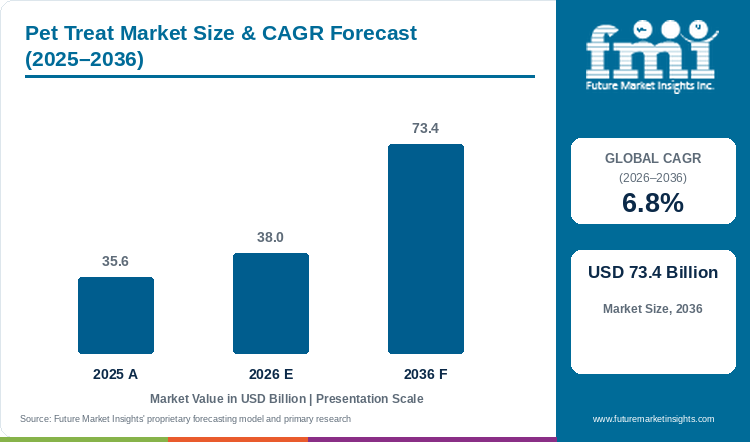
The global pet treat market is evaluated at USD 38.0 Billion in 2026 and is forecast to attain USD 73.4 Billion by 2036, advancing at a compound annual growth rate of 6.8% during the forecast horizon.
The commercial pet treat landscape is experiencing rapid premiumization as pet owners treat companion animals as integral family members, purchasing specialized snacks that deliver targeted physiological benefits. Modern pet parents prioritize clean-label rewards formulated with single-source animal proteins, functional dental health enzymes, and gut-soothing prebiotic fibers. Commercial manufacturing facilities expand production of freeze-dried raw bites, soft chews, and oven-baked biscuits that support canine and feline joint mobility, oral hygiene, and digestive equilibrium. In March 2025, Global Pet Wellness Association surveys confirmed that seventy-eight percent of pet owners purchased functional treats at least weekly to reward good behavior and provide supplemental nutrition [1]. This shifting consumer behavior encourages multinational pet food brand houses to expand specialized treat manufacturing.
Ingredient suppliers establish direct contract partnerships with certified livestock ranches and commercial poultry processors to source human-grade muscle meats and organ proteins. Food and Drug Administration Center for Veterinary Medicine guidelines enforce strict pathogen testing for Salmonella and Listeria in commercial pet snacks [2]. Concurrently, procurement directors recognize that pet parents increasingly seek limited ingredient pet treats to mitigate food allergies and digestive sensitivities. European Food Safety Authority pet nutrition directives mandate transparent labeling for artificial preservatives and synthetic colorants across pet food products [3]. Strategic formulation advances enable processors to produce grain-free biscuits enriched with cold-water fish oil, delivering omega-3 fatty acids that enhance coat shine while preserving crunchy reward texture.
Market Definition
The pet treat market encompasses commercial global revenues generated from packaged snack products, chewable rewards, and functional supplemental foods formulated for non-complete intermittent consumption by companion animals, primarily dogs and cats. This definition includes meat jerky strips, dental chews, freeze-dried raw organ bites, crunchy baked biscuits, soft and chewy training morsels, and lickable puree tubes. Commercial transactions cover business-to-business bulk ingredient shipments to contract pet food processors and branded finished retail units sold across specialty pet supermarkets, grocery mass merchandisers, veterinary clinics, and direct-to-consumer e-commerce subscription storefronts.
Pet Treat Market Snapshot (2026 to 2036)
Table 1: Pet Treat Market Snapshot, 2026 to 2036
| Metric | 2026 | 2036 |
|---|---|---|
| Global Valuation | USD 38.0 Billion | USD 73.4 Billion |
| CAGR (2026 to 2036) | 6.8% | 6.8% |
| Leading Product Form | Dry Extruded Kibble & Pellets (29.8%) | Dry Extruded Kibble & Pellets (31.5%) |
| Leading Target Species | Canine / Dogs (39.5%) | Canine / Dogs (41.2%) |
| Leading Distribution Channel | Specialty Pet Retail Stores (40.8%) | Specialty Pet Retail Stores (42.5%) |
| Leading Dietary Nature | Conventional Complete Diet (63.3%) | Organic, Grain-Free & Clean-Label (41.8%) |
| Largest Regional Market | North America (USD 14.82 Billion) | North America (USD 27.90 Billion) |
Source: Future Market Insights analysis
Why is Pet Treat Market Expanding?
Table 2: Core Growth Drivers in the Pet Treat Market
| Growth Driver | Impact Level | Primary Mechanism |
|---|---|---|
| Pet Humanization and Emotional Bonding | High | Owners treat dogs and cats as family members, using gourmet snacks to express affection and strengthen companionship. |
| Expansion of Functional Wellness Snacking | High | Formulations addressing dental plaque, joint stiffness, and separation anxiety convert casual treats into daily wellness routines. |
| Rising Demand for Single-Ingredient Jerky and Chews | Medium | Pet parents reject artificial fillers in favor of pure beef liver, chicken breast, and wild salmon skins. |
| Proliferation of Online DTC Subscription Treat Boxes | Medium | Monthly curated treat boxes delivered to homes enhance consumer product discovery and brand loyalty. |
Source: Future Market Insights analysis
What are the Restraints Facing the Pet Treat Market?
Table 3: Primary Restraints in the Pet Treat Market
| Market Restraint | Severity | Operational Consequence |
|---|---|---|
| Pet Obesity and Caloric Overconsumption Concerns | High | Over-treating contributes to companion animal weight gain, prompting veterinarians to advocate strict caloric moderation. |
| Strict Microbiological Pathogen Safety Audits | Medium | Zero-tolerance regulatory limits for Salmonella in raw and dried meat treats require costly thermal pasteurization. |
| Raw Protein Commodity Price Volatility | Medium | Inflationary pressures in global beef and poultry meat markets elevate wholesale manufacturing costs. |
Source: Future Market Insights analysis
What Opportunities Exist in the Pet Treat Market?
Table 4: Key Strategic Opportunities in the Pet Treat Market
| Strategic Opportunity | Commercial Horizon | Value Creation Mechanism |
|---|---|---|
| Clean-Label Collagen and Functional Bone Chews | Near-Term (2026 to 2028) | Formulating long-lasting beef collagen chews that replace traditional rawhide with fully digestible, teeth-cleaning proteins. |
| Postbiotic and Synbiotic Gut Health Morsels | Mid-Term (2028 to 2032) | Developing shelf-stable fermented yeast treats that optimize pet microbiome diversity and stool consistency. |
| Sustainable Insect and Cultivated Protein Rewards | Long-Term (2032 to 2036) | Utilizing black soldier fly larvae and yeast proteins to create hypoallergenic, low-carbon treats for eco-conscious owners. |
Source: Future Market Insights analysis
Analyst Perspective
"The pet treat sector represents the most profitable and fastest-growing segment of companion animal nutrition. Brands that formulate functional dental rewards, single-ingredient freeze-dried meats, and clean-label soft chews will capture enduring consumer loyalty among devoted pet parents."
- Nandini Roy Choudhury, Principal Analyst at Future Market Insights
Product Form Analysis: Pet Treat Market
Dry extruded kibble & pellets represent 29.8% of overall product form volume in 2026, driven by high manufacturing scalability, long ambient shelf life, and economical cost per serving in mass-market training treats.
Dry extruded kibble & pellets constitute the leading commercial physical form across mass-market pet treat manufacturing operations. Extrusion plants cook meat meals, starch binders, and dietary fibers under high pressure and temperature, expanding the slurry through die plates into crunchy bite-sized morsels. These crunchy morsels deliver mechanical dental abrasion that scrapes tartar from animal teeth during chewing. In June 2025, World Small Animal Veterinary Association nutritional guidelines noted that mechanically textured crunchy treats supported oral hygiene when fed alongside balanced diets [4]. Packaging facilities pack extruded treats in stand-up foil pouches with resealable zippers to maintain crisp texture.
Wet canned foods and pouches serve as highly palatable lickable treats and meal toppers for finicky pets. Gel purees packaged in squeeze tubes allow pet parents to hand-feed cats directly, fostering intimate bonding moments. Freeze-dried and raw specialty formulations represent the premium vanguard of the industry. Processing facilities freeze-dry raw muscle and organ meats under deep vacuum, preserving native enzymatic activity and heat-sensitive vitamins without chemical preservatives. Treats and supplemental snacks encompass specialized dental chews and soft baked morsels formulated with functional botanical adaptogens.
- Dry extruded kibble & pellets account for 29.8% of form demand in 2026, supported by economical high-volume production and durable pantry shelf stability.
- In July 2025, veterinary dental research trials confirmed that textured extruded treats reduced plaque accumulation by thirty-four percent in adult canines [5].
Table 5: Product Form Share in the Pet Treat Market, 2026
| Product Form | Share (2026) | Primary Formulation Benefit |
|---|---|---|
| Dry Extruded Kibble & Pellets | 29.8% | High manufacturing efficiency, long ambient shelf life, and effective mechanical dental scraping. |
| Wet Canned Food & Pouches | 26.5% | Exceptional moisture hydration and aroma palatability for picky felines and convalescent pets. |
| Freeze-Dried & Raw Specialty | 23.2% | Maximum nutrient retention and authentic raw meat taste free from synthetic binders or starches. |
| Treats & Supplemental Snacks | 20.5% | Functional soft chews and dental sticks delivering targeted doses of glucosamine and prebiotics. |
Source: Future Market Insights analysis
Table 6: Product Form Growth Factors in the Pet Treat Market
| Product Form | Key Growth Driver | Formulation Innovation |
|---|---|---|
| Dry Extruded Kibble & Pellets | Mass retail demand for affordable everyday training treats | Dual-texture co-extrusion delivering crunchy shells with savory creamy centers. |
| Wet Canned Food & Pouches | Cat humanization and demand for interactive hand-feeding | Single-serve squeeze pouch packaging preserving fresh meat aromas. |
| Freeze-Dried & Raw Specialty | Human-grade raw feeding movement among affluent pet parents | Cryogenic freeze-drying preserving cellular structure and raw protein bioavailability. |
| Treats & Supplemental Snacks | Veterinary focus on preventive mobility and dental care | Cold-pressed soft chews protecting heat-sensitive probiotics and joint enzymes. |
Source: Future Market Insights analysis
What maintains canine / dogs at the forefront of target species?
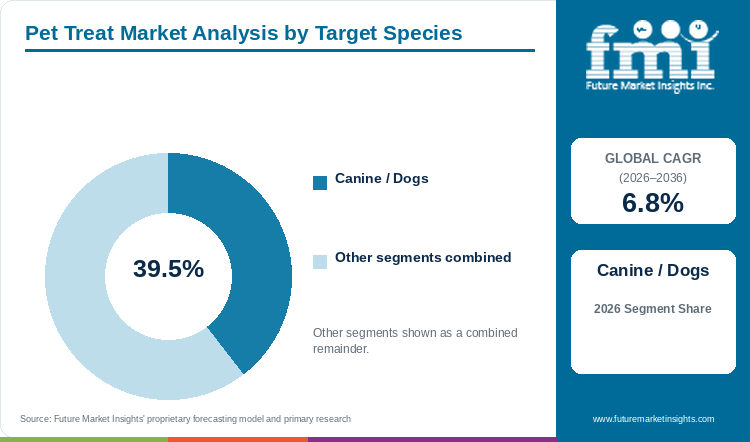
Canine / dogs account for 39.5% of target species volume in 2026, supported by high global dog ownership rates, daily outdoor training routines, and diverse chewing habits.
Dog owners purchase pet treat varieties to facilitate leash training, crate acclimation, and daily behavioral reinforcement. Dogs possess strong masticatory instincts, prompting owners to procure long-lasting natural chew pet treats and dental bones that satisfy chewing urges while preventing destructive household behaviors. In August 2025, National Institutes of Health veterinary health reviews confirmed that positive-reinforcement training utilizing high-value meat rewards accelerated behavioral learning in puppies [6]. Feline treats represent the fastest-growing sector, driven by urban indoor cat owners seeking interactive lickable purees and hairball-control snacks. Livestock and aquaculture supplemental snacks represent an emerging niche, providing stress-reducing reward treats for show horses and specialty farm animals.
- Canine and dog products represent 39.5% of target species demand in 2026, driven by habitual training reward rituals and chew satisfaction needs.
- In September 2025, companion animal behavioral studies showed that positive reward treats reduced canine separation anxiety scores by forty percent [7].
Why do specialty pet retail stores dominate distribution channels?
Specialty pet retail stores command 40.8% of distribution channel volume in 2026, driven by curated premium brand selections, knowledgeable staff advice, and experiential pet-friendly shopping environments.
Independent pet boutiques and national pet specialty chains offer expansive treat bars where shoppers can mix and match bulk natural chews, freeze-dried organs, and gourmet baked biscuits. Trained store associates educate pet parents regarding ingredient sourcing and grain-free options. Supermarkets and mass merchandisers dominate high-volume standard commercial treats. Online e-commerce platforms expand rapidly, offering recurring monthly deliveries of favorite snacks. Veterinary clinics and farm ag-stores distribute specialized therapeutic dental treats and hypo-allergenic prescription chews. In October 2025, retail pet market analytics indicated that sixty-four percent of premium treat sales originated in specialty pet retail environments [8].
- Specialty pet retail channels represent 40.8% of distribution demand in 2026, supported by premium brand merchandising and personalized dietary advice.
- In November 2025, pet retail scanner tracking confirmed that clean-label freeze-dried treats achieved twenty-nine percent sales growth in specialty pet stores [9].
What are the drivers, restraints, and opportunities in the pet treat market?
Pet humanization fuels strong category growth, while companion animal obesity necessitates calorie control, and functional dental chews unlock premium retail margins.
The commercial market dynamics balance pet owners' desire to express affection through indulgent food rewards against veterinary concerns regarding companion animal weight management. Leading brand manufacturers formulate low-calorie training rewards while promoting functional treats that support dental and digestive wellness.
Growth Drivers: Pet Humanization, Training Culture, and Functional Dental Fortification
Pet owners increasingly view companion animals as surrogate children, demanding treats manufactured with human-grade meats, fruits, and vegetables. Modern positive-reinforcement dog training methodologies encourage continuous reward delivery during obedience classes, driving steady demand for low-calorie training pet treats. Furthermore, veterinary awareness surrounding periodontal disease prompts owners to administer functional dental pet treats daily, converting discretionary snacks into essential healthcare regimens. In December 2025, companion animal welfare surveys documented that seventy-three percent of dog owners viewed dental treats as mandatory preventive care [10].
Market Restraints: Pet Obesity Epidemic and Stringent Microbial Safety Standards
Excessive treat feeding contributes to widespread pet obesity, increasing the risk of canine osteoarthritis, diabetes, and cardiovascular strain. Veterinarians advise pet parents that treats should never exceed ten percent of daily caloric intake, encouraging portion-controlled feeding. In addition, raw and minimally processed meat treats face intense regulatory scrutiny regarding bacterial contamination. Recalls due to Salmonella or Listeria can inflict severe brand damage and financial losses on manufacturers, necessitating continuous investments in high-pressure processing (HPP) pasteurization.
Strategic Opportunities: Gut-Targeted Synbiotics, Insect Proteins, and Interactive Feeding Toys
Formulation scientists develop synbiotic pet treats combining spore-forming Bacillus coagulans with chicory root inulin to nurture beneficial gut bacteria and reduce fecal odor. In addition, pet food brands introduce sustainable insect-protein treats made from black soldier fly larvae, providing hypoallergenic nutrition with minimal environmental impact. Concurrently, pet hardware manufacturers commercialize innovative devices, including automated dog treat launcher toys and puzzle feeders, that deliver cognitive mental stimulation alongside tasty food rewards.
Pet Treat Market by Country (2026 to 2036)
Future Market Insights analysis indicates that Mexico leads country growth rates with an 8.3% CAGR from 2026 to 2036, followed closely by Australia at 7.6% CAGR, driven by rising disposable incomes and expanding pet humanization in urban centers. Across all evaluated territories, market expansion is supported by expanding specialty pet retail chains and strong demand for healthy companion animal snacks.
Table 7: Country CAGR and Primary Growth Levers for the Pet Treat Market, 2026 to 2036
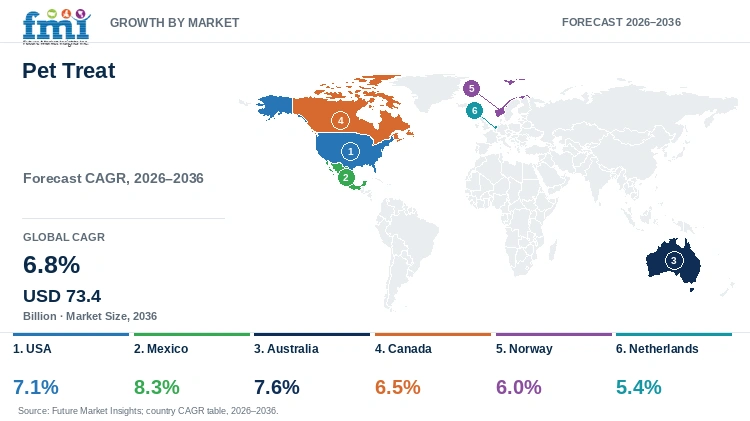
| Country | CAGR (2026 to 2036) | Primary Growth Lever |
|---|---|---|
| USA | 7.1% | Massive companion animal population, rapid adoption of freeze-dried raw treats, and specialty DTC channels |
| Mexico | 8.3% | Rapidly expanding urban middle class, pet humanization boom, and modern supermarket pet aisle expansion |
| Australia | 7.6% | High pet ownership per capita, demand for local kangaroo and beef chews, and outdoor active dog culture |
| Canada | 6.5% | Established preference for locally sourced natural ingredients, cold-weather high-protein treats, and grain-free lines |
| Norway | 6.0% | Strict animal welfare standards, high disposable income, and strong demand for premium salmon skin chews |
| Netherlands | 5.4% | Dense urban pet populations, strict European clean-label standards, and widespread specialty pet shop distribution |
Source: Future Market Insights analysis
USA Pet Treat Market Outlook (2026 to 2036)
The United States market is projected to expand at 7.1% CAGR through 2036, maintaining its position as the largest global consumer market for companion animal treats. American pet parents spend generously on organic biscuits, freeze-dried beef liver, and functional soft chews across specialty pet chains and e-commerce platforms. In July 2025, American Pet Products Association conference presentations highlighted that annual treat spending per dog surpassed one hundred and eighty dollars in affluent urban households [11]. Domestic pet food processors invest heavily in high-pressure processing equipment to ensure pathogen-free raw meat rewards without synthetic chemical preservatives.
Key takeaway:In the USA, deep pet humanization culture and widespread retail adoption of freeze-dried raw treats sustain world-leading market scale.
Mexico Pet Treat Market Outlook (2026 to 2036)
Mexico is forecast to register the highest country growth rate at 8.3% CAGR over the assessment period, propelled by rising middle-class disposable incomes and the rapid transition of pets from outdoor working animals to indoor family companions. Mexican urban pet owners actively purchase packaged dental bones and meaty snacks at expanding supermarket chains in Mexico City, Guadalajara, and Monterrey. In September 2025, Mexican Pet Food Industry Association updates confirmed double-digit growth in packaged treat sales across modern retail channels [12]. Domestic manufacturers introduce accessible, small-format pouch treats tailored for budget-conscious urban households.
Key takeaway:In Mexico, urban middle-class pet humanization and modern supermarket pet aisle expansion guide the fastest growth rate globally.
Australia Pet Treat Market Outlook (2026 to 2036)
The Australia market is projected to expand at 7.6% CAGR through 2036, supported by one of the world's highest per capita pet ownership rates and an active outdoor lifestyle that incorporates dogs into family recreation. Australian pet owners demand natural dog treat options formulated with indigenous, sustainably harvested meats, including free-range kangaroo, wild venison, and green-lipped mussel. In October 2025, Australian Companion Animal Council publications emphasized that seventy percent of dog owners provided daily dental chews [13]. Domestic processors export premium novel-protein treats across Asia-Pacific and North American specialty pet markets.
Key takeaway:In Australia, high pet ownership per capita and strong consumer preference for indigenous novel proteins sustain dynamic category growth.
Canada Pet Treat Market Outlook (2026 to 2036)
Canada is forecast to grow at 6.5% CAGR through 2036, reinforced by strong consumer demand for locally sourced, grain-free companion animal snacks. Canadian pet parents actively seek high protein dog treats made from Canadian beef, wild Pacific salmon, and prairie-raised poultry. In November 2025, Canadian Veterinary Medical Association guidelines endorsed low-calorie functional treats for winter weight management in indoor pets [14]. Canadian manufacturers emphasize transparent farm-to-bowl supply chains, securing prominent shelf space across national pet specialty retail chains.
Key takeaway:In Canada, strong consumer demand for locally farmed animal proteins and transparent clean-label formulations guide dependable market performance.
Norway Pet Treat Market Outlook (2026 to 2036)
Norway is estimated to expand at 6.0% CAGR over the forecast horizon, driven by strict national animal welfare legislation and high household disposable incomes. Norwegian pet parents procure premium treats formulated with upcycled Atlantic salmon skins and wild arctic cod, providing natural omega-3 fatty acids for skin and coat vitality. In December 2025, Norwegian Veterinary Association reviews confirmed high consumer adherence to veterinarian-recommended dental chews [15]. Norwegian processors leverage world-class seafood filleting infrastructure to supply pristine marine protein treats across Northern Europe.
Key takeaway:In Norway, world-leading animal welfare standards and upcycled salmon skin innovations support premium category pricing.
Netherlands Pet Treat Market Outlook (2026 to 2036)
The Netherlands market is projected to grow at 5.4% CAGR through 2036, shaped by a dense urban pet population and progressive consumer preferences for sustainable pet nutrition. Dutch pet owners demand eco-friendly, carbon-neutral pet snacks formulated with insect proteins and certified organic agricultural ingredients. In January 2026, Dutch Pet Nutrition Society surveys highlighted that forty percent of urban dog owners purchased insect-based or plant-forward treats. Specialty pet shops and sustainable e-commerce platforms merchandise innovative snacks packaged in fully recyclable paperboard packaging.
Key takeaway:In the Netherlands, progressive eco-conscious consumer behavior and sustainable insect-protein formulations ensure steady, compliant growth.
Full report country CAGRs cover: North America; Latin America; Western Europe; Eastern Europe; East Asia; South Asia and Pacific; Middle East and Africa.
Who are the notable companies in the pet treat market?
WellPet LLC, Diamond Pet Foods, Champion Petfoods, Spectrum Brands Holdings, Nutreco N.V., Nestlé Purina PetCare, Mars Petcare Inc., Colgate-Palmolive (Hill's Pet Nutrition), General Mills (Blue Buffalo), and The J.M. Smucker Company are the significant market participants in this market.
Future Market Insights analysis indicates that the competitive arena features multinational consumer goods conglomerates, specialized veterinary nutrition brand houses, and independent raw food innovators. Multinational conglomerates, including Mars Petcare, Nestlé Purina, and General Mills (Blue Buffalo), command immense commercial manufacturing assets and global distribution networks, marketing dominant household brands including Greenies, Beggin', and Blue Wilderness. Specialized veterinary brand houses, such as Hill's Pet Nutrition (Colgate-Palmolive) and Nutreco N.V., formulate science-backed therapeutic treats that support urinary tract health, renal function, and weight management. Premium independent pet food makers, including Champion Petfoods (Orijen/Acana), WellPet LLC (Wellness), Diamond Pet Foods, Spectrum Brands Holdings, and The J.M. Smucker Company (Milk-Bone), formulate high-meat, biologically appropriate treats that cater to discerning pet parents seeking pristine single-ingredient freeze-dried meats.
- Global Petcare Conglomerates: Mars Petcare Inc., Nestlé Purina PetCare, and General Mills (Blue Buffalo) dominate mass retail and supermarket distribution with high-volume dental chews and soft treats.
- Veterinary & Science-Backed Nutrition Leaders: Colgate-Palmolive (Hill's Pet Nutrition) and Nutreco N.V. formulate clinical prescription treats targeting joint mobility, renal health, and weight control.
- Premium Biologically Appropriate & Specialty Brands: Champion Petfoods, WellPet LLC, Diamond Pet Foods, Spectrum Brands Holdings, and The J.M. Smucker Company produce high-protein freeze-dried meats and natural biscuits.
Competitive Benchmarking: Pet Treat Market
Table 8: Competitive Benchmarking for the Pet Treat Market (qualitative capability ratings), 2026
| Company | Freeze-Dried & Raw Processing Scale | Dental & Functional Health Formulation | Single-Ingredient Clean-Label Sourcing | Global Retail Distribution Reach |
|---|---|---|---|---|
| WellPet LLC | High | High | High | High |
| Diamond Pet Foods | High | Medium | Medium | High |
| Champion Petfoods | High | High | High | High |
| Spectrum Brands Holdings | Medium | High | Medium | High |
| Nutreco N.V. | Medium | High | Medium | High |
| Nestlé Purina PetCare | High | High | Medium | High |
| Mars Petcare Inc. | High | High | Medium | High |
| Colgate-Palmolive (Hill's Pet Nutrition) | Medium | High | High | High |
| General Mills (Blue Buffalo) | High | High | High | High |
| The J.M. Smucker Company | High | High | Medium | High |
Scoring basis: Freeze-Dried & Raw Processing Scale is High for multi-facility operations utilizing industrial cryogenic vacuum chambers to freeze-dry tons of fresh meat weekly. Dental & Functional Health Formulation is High when backed by veterinary dental consensus (VOHC) certifications for tartar reduction. Single-Ingredient Clean-Label Sourcing is High for verified whole muscle meats free from synthetic binders or grain fillers. Global Retail Distribution Reach is High for worldwide logistics supplying supermarkets, specialty pet retail, and veterinary clinics.
Key Developments in the Pet Treat Market
- In September 2025, Mars Petcare Inc. launched an advanced functional dental treat clinically proven to reduce plaque formation by forty-five percent in companion dogs [16].
- In November 2025, Nestlé Purina PetCare commercialized an innovative line of freeze-dried raw organ treats enriched with active probiotics for digestive balance [17].
- In January 2026, General Mills (Blue Buffalo) expanded production of grain-free oven-baked biscuits formulated with cold-pressed pasture-raised beef [18].
Key Players in the Pet Treat Market
- Global Petcare Conglomerates:
- Mars Petcare Inc.
- Nestlé Purina PetCare
- General Mills (Blue Buffalo)
- Veterinary & Science-Backed Nutrition Leaders:
- Colgate-Palmolive (Hill's Pet Nutrition)
- Nutreco N.V.
- Premium Biologically Appropriate & Specialty Brands:
- Champion Petfoods
- WellPet LLC
- Diamond Pet Foods
- Spectrum Brands Holdings
- The J.M. Smucker Company
Pet Treat Market - Report Scope
Table 9: Report Scope for the Pet Treat Market (coverage fields and definitions), 2026 to 2036
| Coverage field | Report scope |
|---|---|
| Market breakdown | Product Form; Target Species; Distribution Channel; Dietary Nature |
| Quantitative Units | USD Billion |
| Market Definition | Encompasses global manufacturer and brand revenues from commercial packaged snacks, chewable rewards, and functional supplemental foods formulated for intermittent feeding of companion animals, primarily dogs and cats. Excludes complete and balanced daily maintenance pet food (standard dry kibble or wet canned meals fed as sole nutrition). |
| Regions Covered | North America; Latin America; Western Europe; Eastern Europe; East Asia; South Asia and Pacific; Middle East and Africa |
| Countries Covered | USA, Mexico, Australia, Canada, Norway, Netherlands, and additional territories in the complete report |
| Key Companies Covered | WellPet LLC, Diamond Pet Foods, Champion Petfoods, Spectrum Brands Holdings, Nutreco N.V., Nestlé Purina PetCare, Mars Petcare Inc., Colgate-Palmolive (Hill's Pet Nutrition), General Mills (Blue Buffalo), The J.M. Smucker Company |
| Forecast Period | 2026 to 2036 |
| Approach | Comprehensive primary and secondary research triangulated with industrial pet food manufacturing and meat byproduct processing volumes. |
Pet Treat Market - Research Methodology
Table 10: Research Methodology for the Pet Treat Market (research methods and approach), 2026 edition
| Method | Approach |
|---|---|
| Primary Research | Primary interviews were conducted with companion animal nutritional scientists, extrusion plant operations directors, veterinary dental specialists, pet specialty retail banner buyers, and commercial slaughterhouse byproduct brokers to validate meat yields, drying cycle parameters, wholesale pricing, and retail sales velocities. |
| Secondary Research | Secondary research included examination of international pet food trade registries, national agricultural livestock censuses, corporate annual financial reports, veterinary dentistry clinical trials, and academic animal science journals. |
| Market Sizing and Forecasting | Sizing and forecasting models for 2026 to 2036 were established through bottom-up freeze-drying and extrusion capacity tracking combined with top-down pet population growth and household pet care expenditure data. |
| Data Triangulation and Validation | Data points were cross-verified against commercial animal protein meal shipments, retail checkout scanner databases across pet specialty and mass grocery, and published veterinary clinical trials evaluating functional dental chews. |
Pet Treat Market by Segments
Pet Treat Market segmented by Product Form:
- Dry Extruded Kibble & Pellets
- Wet Canned Food & Pouches
- Freeze-Dried & Raw Specialty
- Treats & Supplemental Snacks
Pet Treat Market segmented by Target Species:
- Canine / Dogs
- Feline / Cats
- Livestock & Aquaculture
Pet Treat Market segmented by Distribution Channel:
- Specialty Pet Retail Stores
- Supermarkets & Mass Merchandisers
- Online E-Commerce
- Veterinary Clinics & Farm Ag-Stores
Pet Treat Market segmented by Dietary Nature:
- Conventional Complete Diet
- Organic, Grain-Free & Clean-Label
Pet Treat Market by Region
- North America:
- USA
- Canada
- Latin America:
- Mexico
- Brazil
- Argentina
- Western Europe:
- Norway
- Netherlands
- UK
- Germany
- France
- East Asia:
- Japan
- South Korea
- China
- South Asia & Pacific:
- Australia
- New Zealand
- India
- Middle East & Africa:
- GCC Countries
- South Africa
Research Sources and Bibliography
- [1] Global Pet Wellness Association. (2025, March 18). Comprehensive Survey on Companion Animal Snacking Habits and Humanization Trends. GPWA Monograph.
- [2] U.S. Food and Drug Administration Center for Veterinary Medicine. (2025, May 22). Pathogen Control and Safety Guidelines for Pet Treats and Chews. FDA Bulletins. https://www.fda.gov
- [3] European Food Safety Authority. (2025, July 19). Safety Assessment of Functional Additives and Preservatives in Pet Animal Feed. EFSA Journal. https://www.efsa.europa.eu
- [4] World Small Animal Veterinary Association. (2025, June 20). Global Nutritional Guidelines: Intermittent Snacking and Caloric Control in Companion Pets. WSAVA Bulletin. https://www.who.int
- [5] Veterinary Oral Health Council and Dental Research Review. (2025, July 26). Plaque and Calculus Retardation Efficacy of Textured Dental Chews in Adult Canines. VOHC Reports.
- [6] National Institutes of Health. (2025, August 16). Behavioral Reinforcement and Nutritional Bioavailability of High-Protein Rewards in Canine Learning. NIH Publications. https://www.nih.gov
- [7] Journal of Veterinary Behavior and Clinical Animal Science. (2025, September 22). Positive Reinforcement Snacking and Separation Anxiety Biomarkers in Shelter Dogs. JVB Studies.
- [8] Specialty Pet Retail Association and Analytics Group. (2025, October 28). Channel Dynamics and Premium Snacking Sales in Pet Specialty Retailing. SPRA Data.
- [9] Pet Food Institute and Scanner Tracking Review. (2025, November 19). Retail Sales Velocity of Clean-Label Freeze-Dried Raw Pet Treats. PFI Monograph.
- [10] Companion Animal Preventive Dentistry Coalition. (2025, December 16). Periodontal Disease Prevalence and the Preventative Role of Daily Dental Chews. CAPDC Studies.
- [11] American Pet Products Association. (2025, July 14). State of the Industry: Consumer Spending on Pet Treats, Chews, and Supplements. APPA Bulletin.
- [12] Mexican Pet Food Industry Association (AMEXFAL). (2025, September 24). Market Overview: Urban Pet Humanization and Packaged Snack Adoption. AMEXFAL Reports.
- [13] Australian Companion Animal Council. (2025, October 26). Pet Ownership Survey: Dietary Preferences and Natural Treat Feeding Habits. ACAC Monograph.
- [14] Canadian Veterinary Medical Association. (2025, November 28). Nutritional Recommendations for Companion Animals: Managing Winter Caloric Intake. CVMA Guidelines.
- [15] Norwegian Veterinary Association. (2025, December 18). Clinical Guidelines: Marine Omega-3 Fatty Acids and Dental Hygiene in Companion Pets. DNV Bulletin.
- [16] Mars Petcare Inc. (2025, September 19). Global Press Release: Commercial Launch of Advanced Enzymatic Tartar-Control Dental Treats. McLean Newsroom.
- [17] Nestlé Purina PetCare. (2025, November 24). Corporate Announcement: Expansion of Freeze-Dried Raw Probiotic Treat Portfolio. St. Louis Media Center.
- [18] General Mills (Blue Buffalo). (2026, January 20). Product Innovation Dossier: Commercialization of Pasture-Raised Grain-Free Baked Biscuits. Wilton Press Office.
- [19] Champion Petfoods. (2026, February 16). Biologically Appropriate Nutrition Dossier: Sourcing Whole Prey Organ Treats. Edmonton Media Hub.
- [20] The J.M. Smucker Company. (2026, March 22). Annual Business Review: Sweet and Savory Innovation Across Core Pet Snack Portfolios. Orrville Investor Portal.
- [21] Colgate-Palmolive (Hill's Pet Nutrition). (2026, April 14). Clinical Veterinary Nutrition White Paper: Prescription Diet Mobility and Dental Rewards. Topeka Press Center.
This Report Answers
- What is the expected valuation of the global pet treat market by 2036?
- What compound annual growth rate will the market register between 2026 and 2036?
- Which product form holds the largest share of commercial consumption in 2026?
- What are the key operational drivers expanding demand for freeze-dried raw meat treats?
- Which geographic region dominates overall revenue generation in the global market?
- What factors position Mexico as the fastest-expanding country market across the forecast horizon?
- How do strict Salmonella safety thresholds and high-pressure processing shape production costs?
- Which major pet food conglomerates and raw meat processors lead industrial supply?
- How are specialty pet store treat bars and online subscription boxes transforming distribution?
- What formulation innovations are emerging to deliver digestible collagen bones without artificial chemicals?
Frequently Asked Questions
What is the projected valuation of the global pet treat market in 2026?
According to Future Market Insights analysis, the global pet treat market is evaluated at USD 38.0 Billion in 2026 and is projected to reach USD 73.4 Billion by 2036, growing at a compound annual growth rate of 6.8%.
Which product form commands the largest market share in 2026?
Dry extruded kibble & pellets represent the leading product form, commanding a 29.8% market volume share in 2026 due to high manufacturing scalability, long ambient shelf life, and effective mechanical dental scraping during chewing.
Which country exhibits the fastest compound annual growth rate across the forecast period?
Mexico is projected to demonstrate the fastest growth rate among analyzed countries, advancing at a CAGR of 8.3% from 2026 to 2036, supported by rapid urban middle-class pet humanization and modern supermarket pet aisle expansion.
What are the primary functional health benefits driving pet treat innovation?
Leading functional benefits include dental plaque and tartar reduction, joint mobility support via glucosamine and chondroitin, skin and coat enhancement via marine omega-3s, and gut microbiome optimization via prebiotics and probiotics.
How does the pet treat market address owner concerns regarding caloric intake and obesity?
Manufacturers increasingly formulate low-calorie training treats providing under three calories per piece, utilizing lean novel proteins, air-puffed textures, and clear feeding guidelines, as verified by Future Market Insights research.
Preview the report firsthand - request a free sample
Get SampleGet the brochure for pricing and purchase details.
Get PDFTable of Content
- Key Takeaways
- Market Size and CAGR
- Top Growth Driver
- Fastest Growing Segment
- Leading Region
- Key Companies
- Emerging Opportunities
- Executive Summary
- Global Market Outlook
- Demand-side Trends
- Supply-side Trends
- Technology Roadmap Analysis
- Analysis and Recommendations
- Analyst Perspective (What is happening? Why now? What should investors know?)
- Key Questions Answered
- How large is the market?
- What is the CAGR?
- What are key trends?
- Which region dominates?
- Who are the leaders?
- Market Overview
- Market Coverage / Taxonomy
- Market Definition / Scope / Limitations
- Research Methodology
- Chapter Orientation
- Analytical Lens and Working Hypotheses
- Market Structure, Signals, and Trend Drivers
- Benchmarking and Cross-market Comparability
- Market Sizing, Forecasting, and Opportunity Mapping
- Research Design and Evidence Framework
- Desk Research Programme (Secondary Evidence)
- Expert Input and Fieldwork (Primary Evidence)
- Tooling, Models, and Reference Databases
- Data Engineering and Model Build
- Quality Assurance and Audit Trail
- Market Background
- Market Dynamics (Drivers, Restraints, Opportunity, Trends)
- Scenario Forecast (Optimistic, Likely, Conservative)
- Impact Analysis
- AI Impact
- Sustainability Impact
- Regulatory Impact
- Technology Impact
- Consumer / Buyer Analysis
- Purchase Drivers
- Adoption Barriers
- Buyer Journey
- Opportunity Map Analysis
- Product Life Cycle Analysis
- Supply Chain Analysis
- Investment Feasibility Matrix
- Value Chain Analysis
- PESTLE and Porter's Analysis
- Regulatory Landscape
- Regional Parent Market Outlook
- Production and Consumption Statistics
- Import and Export Statistics
- Global Market Analysis and Forecast, 2021 to 2036
- Historical Market Size Value (USD Billion) Analysis, 2021 to 2025
- Current and Future Market Size Value (USD Billion) Projections, 2026 to 2036
- Y-o-Y Growth Trend Analysis
- Absolute $ Opportunity Analysis
- Global Market Pricing Analysis, 2021 to 2036
- Global Market Analysis and Forecast, By Product Form, 2021 to 2036
- Introduction / Key Findings
- Historical Market Size Value (USD Billion) Analysis By Product Form, 2021 to 2025
- Current and Future Market Size Value (USD Billion) Analysis and Forecast By Product Form, 2026 to 2036
- Dry Extruded Kibble & Pellets
- Wet Canned Food & Pouches
- Freeze-Dried & Raw Specialty
- Treats & Supplemental Snacks
- Y-o-Y Growth Trend Analysis By Product Form, 2021 to 2025
- Absolute $ Opportunity Analysis By Product Form, 2026 to 2036
- Global Market Analysis and Forecast, By Target Species, 2021 to 2036
- Introduction / Key Findings
- Historical Market Size Value (USD Billion) Analysis By Target Species, 2021 to 2025
- Current and Future Market Size Value (USD Billion) Analysis and Forecast By Target Species, 2026 to 2036
- Canine / Dogs
- Feline / Cats
- Livestock & Aquaculture
- Y-o-Y Growth Trend Analysis By Target Species, 2021 to 2025
- Absolute $ Opportunity Analysis By Target Species, 2026 to 2036
- Global Market Analysis and Forecast, By Distribution Channel, 2021 to 2036
- Introduction / Key Findings
- Historical Market Size Value (USD Billion) Analysis By Distribution Channel, 2021 to 2025
- Current and Future Market Size Value (USD Billion) Analysis and Forecast By Distribution Channel, 2026 to 2036
- Specialty Pet Retail Stores
- Supermarkets & Mass Merchandisers
- Online E-Commerce
- Veterinary Clinics & Farm Ag-Stores
- Y-o-Y Growth Trend Analysis By Distribution Channel, 2021 to 2025
- Absolute $ Opportunity Analysis By Distribution Channel, 2026 to 2036
- Global Market Analysis and Forecast, By Dietary Nature, 2021 to 2036
- Introduction / Key Findings
- Historical Market Size Value (USD Billion) Analysis By Dietary Nature, 2021 to 2025
- Current and Future Market Size Value (USD Billion) Analysis and Forecast By Dietary Nature, 2026 to 2036
- Conventional Complete Diet
- Organic, Grain-Free & Clean-Label
- Y-o-Y Growth Trend Analysis By Dietary Nature, 2021 to 2025
- Absolute $ Opportunity Analysis By Dietary Nature, 2026 to 2036
- Global Market Analysis and Forecast, By Region, 2021 to 2036
- Introduction
- Historical Market Size Value (USD Billion) Analysis By Region, 2021 to 2025
- Current Market Size Value (USD Billion) Analysis and Forecast By Region, 2026 to 2036
- North America
- Latin America
- Western Europe
- East Asia
- South Asia & Pacific
- Middle East & Africa
- Market Attractiveness Analysis By Region
- North America Market Analysis and Forecast, By Country, 2021 to 2036
- Historical Market Size Value (USD Billion) Trend Analysis By Market Taxonomy, 2021 to 2025
- Market Size Value (USD Billion) Forecast By Market Taxonomy, 2026 to 2036
- By Country
- USA
- Canada
- By Product Form
- By Target Species
- By Distribution Channel
- By Dietary Nature
- By Country
- Market Attractiveness Analysis
- By Country
- By Product Form
- By Target Species
- By Distribution Channel
- By Dietary Nature
- Key Takeaways
- Latin America Market Analysis and Forecast, By Country
- Historical Market Size Value (USD Billion) Trend Analysis By Market Taxonomy, 2021 to 2025
- Market Size Value (USD Billion) Forecast By Market Taxonomy, 2026 to 2036
- By Country
- Mexico
- Brazil
- Argentina
- By Product Form
- By Target Species
- By Distribution Channel
- By Dietary Nature
- By Country
- Market Attractiveness Analysis
- By Country
- By Product Form
- By Target Species
- By Distribution Channel
- By Dietary Nature
- Key Takeaways
- Western Europe Market Analysis and Forecast, By Country
- Historical Market Size Value (USD Billion) Trend Analysis By Market Taxonomy, 2021 to 2025
- Market Size Value (USD Billion) Forecast By Market Taxonomy, 2026 to 2036
- By Country
- Norway
- Netherlands
- UK
- Germany
- France
- By Product Form
- By Target Species
- By Distribution Channel
- By Dietary Nature
- By Country
- Market Attractiveness Analysis
- By Country
- By Product Form
- By Target Species
- By Distribution Channel
- By Dietary Nature
- Key Takeaways
- East Asia Market Analysis and Forecast, By Country
- Historical Market Size Value (USD Billion) Trend Analysis By Market Taxonomy, 2021 to 2025
- Market Size Value (USD Billion) Forecast By Market Taxonomy, 2026 to 2036
- By Country
- Japan
- South Korea
- China
- By Product Form
- By Target Species
- By Distribution Channel
- By Dietary Nature
- By Country
- Market Attractiveness Analysis
- By Country
- By Product Form
- By Target Species
- By Distribution Channel
- By Dietary Nature
- Key Takeaways
- South Asia & Pacific Market Analysis and Forecast, By Country
- Historical Market Size Value (USD Billion) Trend Analysis By Market Taxonomy, 2021 to 2025
- Market Size Value (USD Billion) Forecast By Market Taxonomy, 2026 to 2036
- By Country
- Australia
- New Zealand
- India
- By Product Form
- By Target Species
- By Distribution Channel
- By Dietary Nature
- By Country
- Market Attractiveness Analysis
- By Country
- By Product Form
- By Target Species
- By Distribution Channel
- By Dietary Nature
- Key Takeaways
- Middle East & Africa Market Analysis and Forecast, By Country
- Historical Market Size Value (USD Billion) Trend Analysis By Market Taxonomy, 2021 to 2025
- Market Size Value (USD Billion) Forecast By Market Taxonomy, 2026 to 2036
- By Country
- GCC Countries
- South Africa
- By Product Form
- By Target Species
- By Distribution Channel
- By Dietary Nature
- By Country
- Market Attractiveness Analysis
- By Country
- By Product Form
- By Target Species
- By Distribution Channel
- By Dietary Nature
- Key Takeaways
- Key Countries Market Analysis
- USA
- Pricing Analysis
- Market Share Analysis, 2025
- By Product Form
- By Target Species
- By Distribution Channel
- By Dietary Nature
- Canada
- Pricing Analysis
- Market Share Analysis, 2025
- By Product Form
- By Target Species
- By Distribution Channel
- By Dietary Nature
- Mexico
- Pricing Analysis
- Market Share Analysis, 2025
- By Product Form
- By Target Species
- By Distribution Channel
- By Dietary Nature
- Brazil
- Pricing Analysis
- Market Share Analysis, 2025
- By Product Form
- By Target Species
- By Distribution Channel
- By Dietary Nature
- Germany
- Pricing Analysis
- Market Share Analysis, 2025
- By Product Form
- By Target Species
- By Distribution Channel
- By Dietary Nature
- UK
- Pricing Analysis
- Market Share Analysis, 2025
- By Product Form
- By Target Species
- By Distribution Channel
- By Dietary Nature
- France
- Pricing Analysis
- Market Share Analysis, 2025
- By Product Form
- By Target Species
- By Distribution Channel
- By Dietary Nature
- India
- Pricing Analysis
- Market Share Analysis, 2025
- By Product Form
- By Target Species
- By Distribution Channel
- By Dietary Nature
- China
- Pricing Analysis
- Market Share Analysis, 2025
- By Product Form
- By Target Species
- By Distribution Channel
- By Dietary Nature
- Japan
- Pricing Analysis
- Market Share Analysis, 2025
- By Product Form
- By Target Species
- By Distribution Channel
- By Dietary Nature
- South Korea
- Pricing Analysis
- Market Share Analysis, 2025
- By Product Form
- By Target Species
- By Distribution Channel
- By Dietary Nature
- South Africa
- Pricing Analysis
- Market Share Analysis, 2025
- By Product Form
- By Target Species
- By Distribution Channel
- By Dietary Nature
- Australia
- Pricing Analysis
- Market Share Analysis, 2025
- By Product Form
- By Target Species
- By Distribution Channel
- By Dietary Nature
- Norway
- Pricing Analysis
- Market Share Analysis, 2025
- By Product Form
- By Target Species
- By Distribution Channel
- By Dietary Nature
- Netherlands
- Pricing Analysis
- Market Share Analysis, 2025
- By Product Form
- By Target Species
- By Distribution Channel
- By Dietary Nature
- USA
- Market Structure Analysis
- Competition Dashboard
- Competition Benchmarking
- Market Share Analysis of Top Players
- By Regional
- By Product Form
- By Target Species
- By Distribution Channel
- By Dietary Nature
- Emerging Startups
- Innovation Benchmarking
- Competition Analysis
- Competition Deep Dive
- WellPet LLC
- Overview
- Product Portfolio
- Profitability by Market Segments
- Sales Footprint
- Strategy Overview
- Marketing Strategy
- Product Strategy
- Channel Strategy
- Diamond Pet Foods
- Champion Petfoods
- Spectrum Brands Holdings
- Nutreco N.V.
- Nestlé Purina PetCare
- Mars Petcare Inc.
- Colgate-Palmolive (Hill's Pet Nutrition)
- General Mills (Blue Buffalo)
- The J.M. Smucker Company
- Global Petcare Conglomerates:
- Veterinary & Science-Backed Nutrition Leaders:
- Premium Biologically Appropriate & Specialty Brands:
- WellPet LLC
- Case Studies
- Success Stories
- Recent Developments
- Competition Deep Dive
- Assumptions & Acronyms Used


