

- Market Size (2026)
- USD 201.5 Mn
- Forecast (2036)
- USD 429.6 Mn
- CAGR (2026 to 2036)
- 7.9%
Pet Light Therapy Devices Market Size, Market Forecast and Outlook By FMI
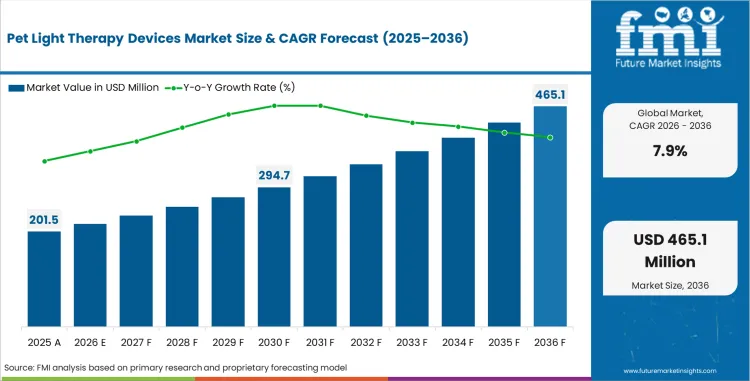
The pet light therapy devices market is projected to grow from USD 187.4 million in 2025 to USD 429.6 million by 2036. The market is expected to reach USD 201.5 million in 2026 and expand at a CAGR of 7.9% from 2026 to 2036. Laser-based devices are expected to lead product demand with 58.0% share in 2026. Pain management is projected to account for 39.0% of application demand in 2026.
Summary of the Pet Light Therapy Devices Market
- Demand and Growth Drivers
- Pain management is projected to account for 39.0% share in 2026 as clinics use light therapy for arthritis and mobility care.
- Veterinary clinics are expected to hold 61.0% share in 2026 as most treatments need clinician setup and dose control.
- Dogs are projected to account for 68.0% share of animal type demand in 2026 due to higher use in mobility care.
- Home-use devices are expected to grow faster than clinic-only systems as pet owners seek maintenance care after diagnosis.
- Product and Segment View
- Laser-based systems are expected to lead product demand with 58.0% share in 2026 as clinics favor stronger dose control.
- LED pads and wraps are projected to gain demand where owners need lower-cost adjunct care.
- Near-infrared devices are anticipated to hold 52.0% of light source demand in 2026 due to deeper tissue targeting.
- Portable devices are expected to grow faster than console systems as smaller clinics need flexible treatment rooms.
- Geography and Competitive Outlook
- The United States is projected to hold the largest value position due to clinic adoption and pet rehabilitation spending.
- Germany and the United Kingdom are expected to remain important European markets due to higher veterinary care standards.
- China is expected to grow faster as domestic device production widens access to lower-cost systems.
- Competition is strongest among suppliers that can prove wavelength control and dose consistency.
- Analyst Opinion
- Nandini Roy Choudhury, Principal Consultant at FMI says, “Pet light therapy is becoming a practical clinic tool when pain control and recovery support need a low-burden option. A weak device with vague wavelength claims gives poor outcomes and hurts trust in the category.”
Key Takeaways, Market Size, and Forecast
- The pet light therapy devices market is expected to be valued at USD 201.5 million in 2026.
- By 2036, the market is forecast to reach USD 429.6 million.
- From 2026 to 2036, the market is projected to expand at a CAGR of 7.9%.
- The market is expected to create an incremental opportunity of USD 228.1 million over the forecast period.
- Laser-based devices are expected to lead product type demand with 58.0% share in 2026.
- Pain management is projected to lead application demand with 39.0% share in 2026.
- Veterinary clinics are expected to hold 61.0% of end-user demand in 2026.
- The United States is expected to remain the largest value market due to higher clinic adoption and pet care spending.
Pet light therapy devices are moving from specialist rehabilitation rooms into wider companion animal care. Photobiomodulation uses non-ionizing light sources such as lasers and LEDs in visible and near-infrared wavelengths. FDA guidance for human PBM devices describes non-clinical testing, clinical evidence, and labeling as core review areas. That gives the veterinary device market a useful signal on what buyers increasingly expect from device makers.
Pet Light Therapy Devices Market Definition
The pet light therapy devices market covers laser and LED systems used for photobiomodulation in companion animals. These devices are used for pain management, inflammation control, wound support, oral care, and rehabilitation. The scope includes clinic systems and owner-use devices sold for dogs and cats. It excludes surgical lasers and decorative pet lighting products.
Pet Light Therapy Devices Market Inclusions
Market scope covers laser therapy devices, LED therapy pads, handheld PBM units, wearable light wraps, clinic console systems, portable devices, veterinary rehabilitation use, post-surgical recovery use, pain care, wound support, and companion animal applications across major regions.
Pet Light Therapy Devices Market Exclusions
The scope excludes surgical cutting lasers, livestock-only phototherapy systems, aquarium lighting, pet grooming lights, decorative LED collars, and wellness lamps without a pet therapy positioning.
Market Research Methodology
- Primary Research: FMI analysts reviewed inputs from veterinary clinics, rehabilitation centers, device distributors, and pet care product suppliers. Discussions focused on clinic adoption, treatment pricing, owner acceptance, and product selection.
- Desk Research: Desk research assessed veterinary PBM literature, device guidance, manufacturer product information, and animal care references. The addressable pool was defined around devices used for therapeutic light exposure in companion animals.
- Market sizing and forecasting: Revenue modeling used device volume, average selling price, replacement cycle, and end-user mix. Country forecasts were adjusted for pet ownership, veterinary spending, and clinic equipment penetration.
- Data validation: Forecasts were checked against veterinary therapy use cases, supplier portfolios, and clinic workflow economics. The model was tested against wider companion animal equipment spending patterns.
Why is the Pet Light Therapy Devices Market Growing?
- Veterinary clinics are using light therapy where pain care needs a non-invasive adjunct.
- Pet rehabilitation centers are adding PBM to mobility care for older dogs.
- Home-use devices are gaining interest where owners want repeat support between clinic visits.
- Oral care and wound support create add-on use cases after surgery.
The market is growing because clinics need options that fit repeat care without heavy sedation or complex setup. The American Animal Hospital Association describes veterinary laser therapy as a tool used for inflammation, pain reduction, and wound healing in pets. These use cases fit common clinic visits because they connect to arthritis care and post-operative recovery. That gives PBM a practical route into daily veterinary workflows. The adoption barrier is not awareness alone. Clinics need devices that staff can use safely and explain clearly to owners.
Clinical evidence is improving, but quality varies by condition and protocol. A veterinary review in PMC assessed laser and LED therapy evidence in horses, dogs, and cats. The review framed PBM as a field where parameters and indications need careful evaluation. This shapes the market in a useful way. Device makers cannot rely on broad red-light claims for long. Buyers will ask for dose data, species guidance, and training support before they approve a system.
Market Segmentation Analysis
- Laser-based devices are expected to account for 58.0% of product type demand in 2026 as clinics need controlled output.
- Near-infrared light sources are projected to represent 52.0% of light source demand in 2026 due to tissue penetration needs.
- Pain management is expected to hold 39.0% of application demand in 2026 as arthritis care supports repeat use.
- Dogs are projected to represent 68.0% of animal type demand in 2026 due to larger mobility-care volume.
- Veterinary clinics are anticipated to account for 61.0% of end-user demand in 2026 with trained staff guiding use.
The market is segmented around device control and treatment setting. Clinic systems command higher value because they offer stronger output control and documented protocols. Home-use devices widen access, though they face more trust and safety questions. Application demand is shaped by repeat treatment need. That is why pain care leads. One-time wound support creates revenue, but recurring mobility care drives stronger device utilization.
Insights into the Laser-based Product Type Segment
Pet Light Therapy Devices Market Analysis By Product Type
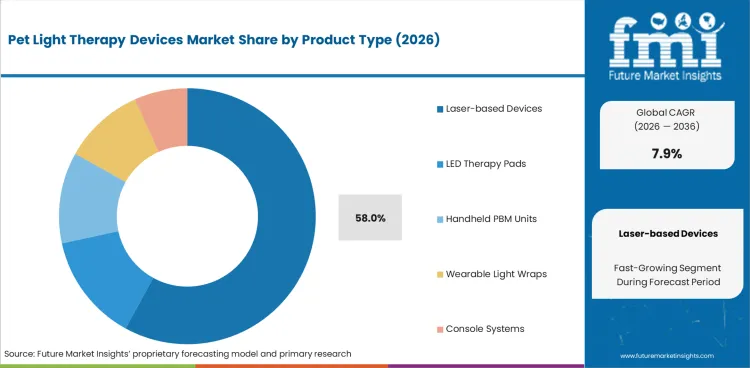
- Laser-based devices are expected to account for 58.0% of product type demand in 2026 as veterinary clinics prefer dose control and shorter treatment times.
- Higher-power systems need tighter training because incorrect use can raise safety concerns. That keeps clinic-grade lasers stronger in professional channels than in owner-led use.
Pet Light Therapy Devices Market Analysis By Light Source
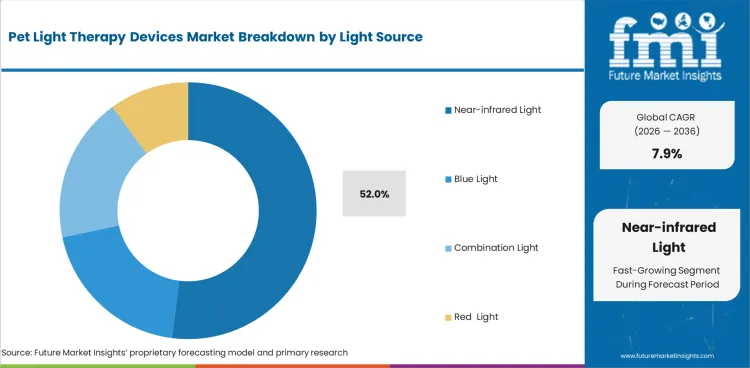
- Near-infrared devices are projected to represent 52.0% of light source demand in 2026 as deeper tissue targeting supports joint and muscle care.
- PBM guidance commonly defines near-infrared light within the 700 nm to 1100 nm range. This wavelength band is central to device positioning for tissue-focused therapy.
Pet Light Therapy Devices Market Analysis By Application
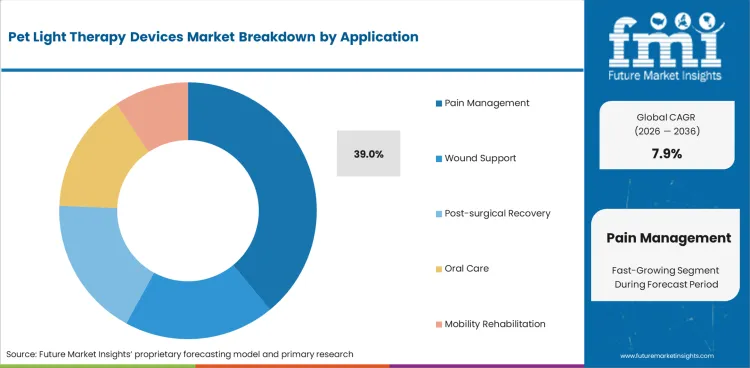
- Pain management is expected to hold 39.0% of application demand in 2026 as arthritis and mobility care create repeat treatment needs.
- The strongest commercial fit is chronic use. Clinics can schedule repeat sessions for older dogs without changing the core medical plan.
Pet Light Therapy Devices Market Analysis By Animal Type
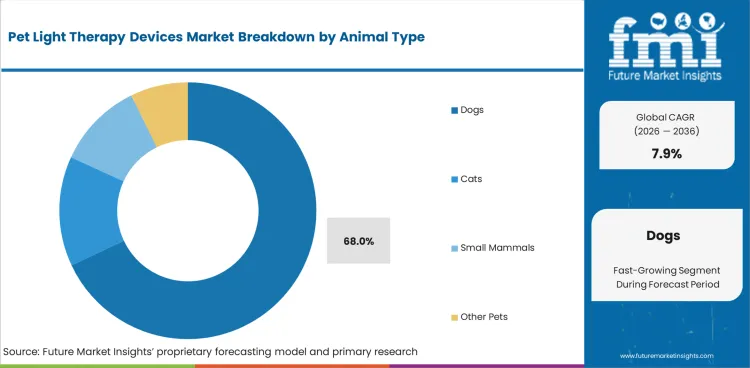
- Dogs are projected to represent 68.0% of animal type demand in 2026 as canine arthritis and soft-tissue injuries drive therapy visits.
- Large-breed dogs create stronger mobility-care demand because joint stress is easier for owners to notice. That makes dogs the clearer first market for clinics.
Pet Light Therapy Devices Market Analysis By End User
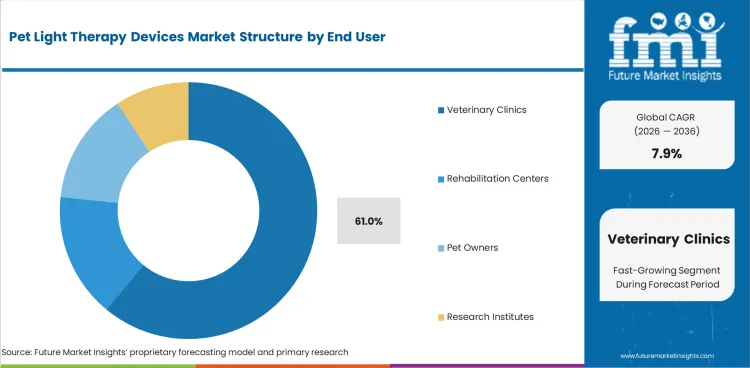
- Veterinary clinics are anticipated to account for 61.0% of end-user demand in 2026 as treatment setup often needs trained staff.
- Clinic buyers compare protocol support before price because staff confidence affects utilization. A device that sits unused produces no payback.
Pet Light Therapy Devices Market Analysis By Distribution Channel
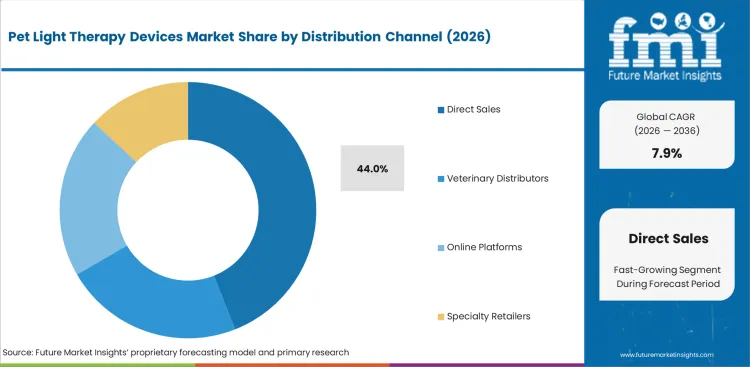
- Direct sales are expected to account for 44.0% of distribution demand in 2026 as clinic systems need demonstration and training support.
- Distributors matter most for smaller practices. They reduce the buying risk by offering local service and financing support.
Pet Light Therapy Devices Market Drivers and Restraints, along with Opportunities
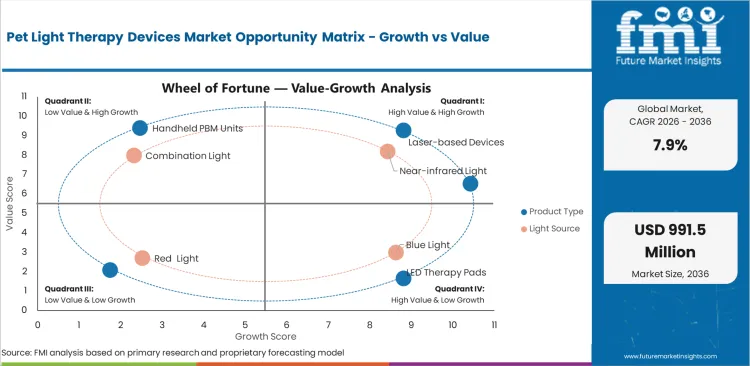
- Chronic mobility care drives repeat sessions where older pets need pain support.
- Device training limits adoption where clinics lack staff time for new procedures.
- Home-use PBM creates upside when products are positioned under veterinary guidance.
- Oral recovery and wound care create add-on use cases after routine procedures.
Chronic mobility care
Mobility care is the main commercial anchor for pet light therapy devices. Older dogs often need repeat support for pain and stiffness, which makes the device useful beyond a single visit. Veterinary PBM references describe treatment use in osteoarthritis and inflammatory conditions. That gives clinics a service line that owners can understand. The buyer decision then shifts from device novelty to payback. Suppliers with clear treatment protocols and staff training are better placed because clinic revenue depends on repeat appointment flow.
Dose and protocol risk
The main restraint is weak protocol discipline. Light therapy outcomes depend on wavelength, energy delivery, and treatment timing. The MSD Veterinary Manual notes that treatment effectiveness depends on if and how light enters the body. This is a critical market warning. A device can look impressive and still fail if it does not deliver a usable dose to the target tissue. That risk favors suppliers with measured output data and training material. It also weakens low-cost gadgets that rely on broad red-light claims.
Home-care expansion
Home-care devices create a growth route, though credibility will decide scale. Owners want easier support for arthritis and recovery, but they may not understand dose or treatment limits. Veterinary Prescriber noted in October 2024 that the animal market includes lasers, LED devices, red light units, and products for owner use. This wider supply creates choice and confusion. The opportunity sits with brands that frame home devices as vet-guided support. Products sold as simple cure-all gadgets will face trust erosion.
Regional Market Analysis
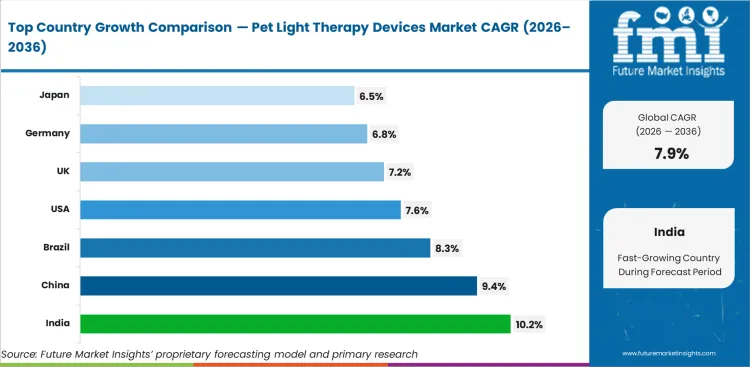
- The United States is projected to grow at 7.6% CAGR from 2026 to 2036 as companion animal care spending supports clinic equipment buying.
- China is forecast to expand at 9.4% CAGR as local device production lowers entry cost for clinics.
- Germany is expected to grow at 6.8% CAGR due to strong veterinary standards and rehabilitation adoption.
- India is projected to record 10.2% CAGR as premium pet care expands from major cities.
.webp "Top Country Growth Comparison Pet Light Therapy Devices Market Cagr (2026 2036)")
| Country | CAGR |
|---|---|
| India | 10.2% |
| China | 9.4% |
| Brazil | 8.3% |
| United States | 7.6% |
| United Kingdom | 7.2% |
| Germany | 6.8% |
| Japan | 6.5% |
Source: FMI analysis based on primary research and proprietary forecasting model.
How is India Shaping the Pet Light Therapy Devices Market?
India is a fast-growing market from a small current base. Premium veterinary care is concentrated in large cities, where pet owners are more willing to pay for rehabilitation and non-invasive care. India is projected to record 10.2% CAGR from 2026 to 2036 as clinics in metro areas add therapy services. The growth case depends on affordability and training. Devices that need heavy capital spending will move slowly outside large clinics.
- Delhi NCR and Mumbai are early demand centers for premium pet clinics.
- Bengaluru supports adoption through higher pet health spending and specialty veterinary services.
- Indian clinics are likely to prefer portable systems that reduce upfront cost and room constraints.
How is China Contributing to the Pet Light Therapy Devices Market?
China is becoming important through domestic production and expanding pet care demand. Local device makers can offer lower-cost systems, which supports adoption across mid-sized clinics. China is forecast to expand at 9.4% CAGR from 2026 to 2036 as domestic supply meets rising companion animal treatment demand. The risk is uneven quality. Buyers will need to separate medical-grade PBM systems from generic red-light products.
- Shanghai and Beijing support higher-value veterinary services for companion animals.
- Shenzhen device manufacturing strengthens access to portable and LED-based systems.
- Chinese suppliers gain buyers when they provide power output data and safety documentation.
What is the Role of Brazil in the Pet Light Therapy Devices Market?
Brazil has a large pet care culture and a growing base of private clinics. Demand is likely to build around pain care and post-surgical recovery rather than high-cost specialty rehabilitation alone. Brazil is expected to grow at 8.3% CAGR from 2026 to 2036 as clinics expand service menus. Currency pressure can slow premium device imports. Local distribution support will therefore influence adoption more than global brand awareness.
- São Paulo remains the main commercial center for premium veterinary services.
- Rio de Janeiro clinics support demand for pet wellness and rehabilitation care.
- Brazilian distributors can improve adoption by offering service plans and clinician training.
How is the United States Impacting the Pet Light Therapy Devices Market?
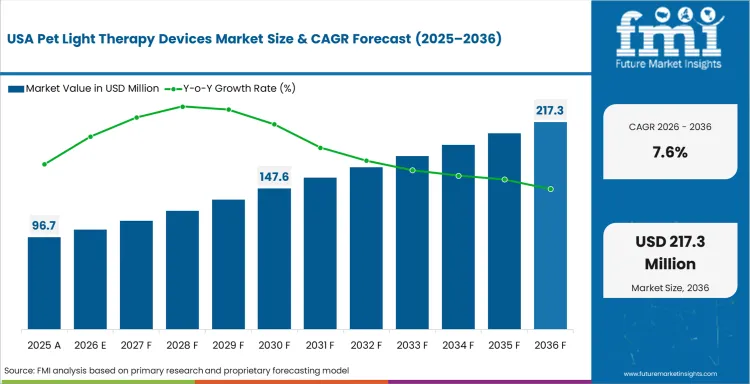
The United States remains the largest value market because pet owners pay for advanced care and clinics already use therapy services. AAHA describes veterinary laser therapy as a modality used for pain and wound healing in pets. That makes the treatment easier to explain during clinic visits. The United States is projected to grow at 7.6% CAGR from 2026 to 2036 as clinics add recurring therapy packages. Market expansion will depend on utilization per device.
- California and Florida support adoption through large pet populations and premium clinics.
- Rehabilitation centers create demand for higher-output systems and better protocol software.
- General practices may prefer portable devices that fit short appointment slots.
How is the United Kingdom Advancing in the Pet Light Therapy Devices Market?
The United Kingdom is a mature pet care market with rising interest in supportive therapies. Clinics are likely to use PBM for pain care and recovery support where owners want lower-drug options. The United Kingdom is expected to advance at 7.2% CAGR from 2026 to 2036 as rehabilitation services expand across companion animal practices. Regulation and professional caution will limit exaggerated claims. This favors trained-use systems.
- London and the South East support premium veterinary service demand.
- Canine rehabilitation centers create use cases for arthritis and injury recovery.
- UK buyers are likely to favor devices with clear treatment protocols and safety guidance.
Why Does Germany Remain Important in the Pet Light Therapy Devices Market?
Germany is important because buyers place high weight on technical quality and clinical discipline. Clinics are likely to assess wavelength control and safety features before adding a device. Germany is forecast at 6.8% CAGR from 2026 to 2036 as rehabilitation and pain care support steady adoption. Growth will be more controlled than in India or China. Higher-quality device documentation will matter more than low price.
- Bavaria and North Rhine Westphalia support demand through dense veterinary service networks.
- German clinics are likely to prefer devices with strong technical files and training support.
- Rehabilitation-focused practices create demand for higher-spec laser systems.
Why Does Japan Remain Relevant in the Pet Light Therapy Devices Market?
Japan is a quality-led market with aging pet demographics and high owner attention to comfort. Demand is likely to concentrate in pain care for older dogs and cats. Japan is expected to post 6.5% CAGR from 2026 to 2036 as clinics use non-invasive support for mobility care. Compact device design matters in this market because clinic space can be limited. Suppliers with smaller systems and reliable safety controls are better placed.
- Tokyo and Osaka support premium veterinary care demand.
- Senior pet care creates demand for low-stress pain management options.
- Japanese clinics are likely to value compact devices with quiet operation and clear safety controls.
Competitive Landscape and Strategic Positioning
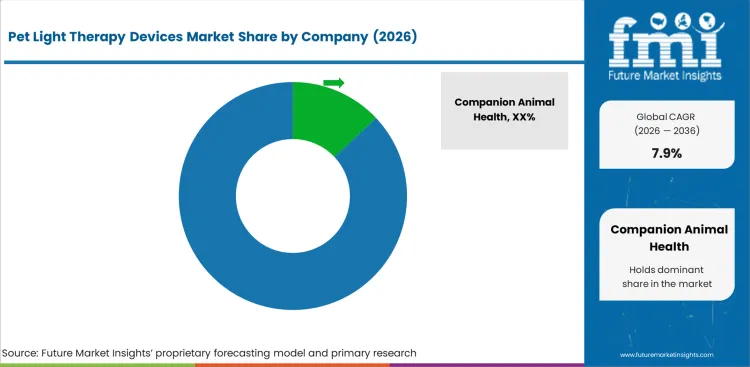
- The market is moderately fragmented across clinic laser brands and lower-cost LED device suppliers.
- Established suppliers win through training support and measured output claims.
- Specialist brands compete with portable systems and pet-specific accessories.
- Entry barriers include clinical credibility, safety guidance, and trust among veterinarians.
Competition is shaped by confidence in the device. Veterinary clinics do not buy light therapy systems only for the hardware. They buy a treatment workflow that staff can explain to pet owners. Companion Animal Health positions PBM as a doctor-prescribed and technician-driven modality. That wording shows why training and workflow support matter in clinic sales. Devices with stronger protocols are better placed to produce repeat use after purchase.
Lower-cost LED devices are widening the field. This helps access but also creates confusion for buyers. Veterinary Prescriber noted that the animal market includes different laser classes, low-level laser systems, LED devices, red light products, and chromophore-based light systems. That broad device mix can blur the difference between clinic therapy and consumer gadgets. Suppliers that clearly state wavelength, output, dose guidance, and safety limits will have an advantage.
Evidence remains a competitive filter. A 2024 Veterinary World study assessed 830-nanometer low-level laser therapy in cats with chronic gingivostomatitis and noted that extraoral application may improve comfort. This type of condition-specific evidence helps clinics judge use cases. The market will reward suppliers that support specific protocols rather than broad claims.
Key Companies in the Pet Light Therapy Devices Market
Key companies active in the market include Companion Animal Health, LiteCure, Multi Radiance Medical, Respond Systems, THOR Photomedicine, K-Laser, Erchonia, MedcoVet, My Pet Laser, and Fotonmedix.
Veterinary Clinic System Leaders
Companion Animal Health, LiteCure, K-Laser, and Respond Systems compete through clinic-grade systems and veterinary workflow support. Their strength lies in training, therapy protocols, and professional channel access.
PBM and Rehabilitation Specialists
Multi Radiance Medical, THOR Photomedicine, and Erchonia serve buyers seeking photobiomodulation depth and specialized device platforms. Their advantage is stronger technical positioning across wavelength selection and treatment logic.
Home-use and Emerging Suppliers
MedcoVet, My Pet Laser, and Fotonmedix compete through portable pet-facing products and lower entry price points. Their adoption depends on credibility, vet endorsement, and clearer safety guidance.
Competitive Benchmarking: Pet Light Therapy Devices Market
| Company | Veterinary Protocol Support | Output Control Depth | Portable Device Coverage | Geographic Footprint |
|---|---|---|---|---|
| Companion Animal Health | Strong | High | Strong | North America |
| LiteCure | Strong | High | Medium | Global |
| K-Laser | Strong | High | Medium | Global |
| Respond Systems | Strong | Medium | Strong | North America |
| Multi Radiance Medical | Medium | High | Strong | Global |
| THOR Photomedicine | Medium | High | Medium | Global |
| Erchonia | Medium | High | Low | United States and exports |
| Fotonmedix | Medium | Medium | Strong | China and exports |
| My Pet Laser | Low | Medium | Strong | North America |
Source: Future Market Insights competitive analysis, 2026. Ratings reflect relative positioning based on veterinary protocol support, output control depth, and portable device coverage.
Key Developments in Pet Light Therapy Devices Market
- In October 2024, Veterinary Prescriber reviewed light therapy for animals and described the widening range of device types in veterinary use. This reflects a broader supplier field.
- In May 2024, Veterinary World published research on 830-nanometer low-level laser therapy in cats with chronic gingivostomatitis. This supports interest in condition-specific protocols.
- In 2025, a veterinary photobiomodulation review in PMC discussed clinical recommendations and expected outcomes for fluorescent light energy. This points to wider clinical interest beyond conventional laser formats.
- In 2026, a review on veterinary PBM applications described use in clinical surgery and recovery support. This reinforces the shift toward procedure-linked applications.
Key Players in the Pet Light Therapy Devices Market
Veterinary Clinic System Leaders
- Companion Animal Health
- LiteCure
- K-Laser
- Respond Systems
PBM and Rehabilitation Specialists
- Multi Radiance Medical
- THOR Photomedicine
- Erchonia
Home-use and Emerging Suppliers
- MedcoVet
- My Pet Laser
- Fotonmedix
Report Scope and Coverage
| Attribute | Details |
|---|---|
| Estimated market size in 2026 | USD 201.5 million |
| Projected market size in 2036 | USD 429.6 million |
| CAGR from 2026 to 2036 | 7.9% |
| Historical period | 2021 to 2025 |
| Forecast period | 2026 to 2036 |
| Quantitative units | USD million |
| Key segment coverage | Product Type, Light Source, Application, Animal Type, End User, Distribution Channel, and Region |
| Regions covered | North America, Latin America, Western Europe, Eastern Europe, East Asia, South Asia and Pacific, Middle East and Africa |
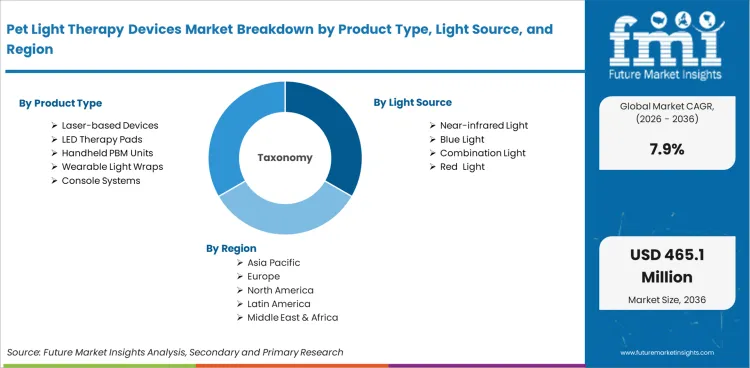
Segment Analysis by Product Type, Light Source, Application, Animal Type, End User, Distribution Channel, and Region
By Product Type:
- Laser-based Devices
- LED Therapy Pads
- Handheld PBM Units
- Wearable Light Wraps
- Console Systems
By Light Source:
- Red Light
- Near-infrared Light
- Blue Light
- Combination Light
By Application:
- Pain Management
- Wound Support
- Post-surgical Recovery
- Oral Care
- Mobility Rehabilitation
By Animal Type:
- Dogs
- Cats
- Small Mammals
- Other Pets
By End User:
- Veterinary Clinics
- Rehabilitation Centers
- Pet Owners
- Research Institutes
By Distribution Channel:
- Direct Sales
- Veterinary Distributors
- Online Platforms
- Specialty Retailers
By Region:
- North America
- Latin America
- Western Europe
- Eastern Europe
- East Asia
- South Asia and Pacific
- Middle East and Africa
Research Sources and Bibliography
- American Animal Hospital Association. What is veterinary laser therapy? AAHA.
- USA Food and Drug Administration. Photobiomodulation devices premarket notification 510(k) submissions. FDA.
- Millis, D. L. Laser therapy. PMC.
- Cornegliani, L. Clinical practice recommendations and expected outcomes of fluorescent light energy in veterinary patients. PMC.
- Veterinary Prescriber. Light therapy for animals.
- Veterinary World. Assessing the potential efficacy of 830-nanometer low-level laser therapy in cats.
- MSD Veterinary Manual. Photomedicine in veterinary patients.
- Companion Animal Health. Veterinary laser therapy products.
- García-González, M. Photobiomodulation applications in clinical veterinary surgery. MDPI.
- THOR Photomedicine. Photobiomodulation PetTHOR.
This Report Answers
- What is the current and future size of the pet light therapy devices market?
- How fast is the pet light therapy devices market expected to grow between 2026 and 2036?
- Which product type is expected to lead pet light therapy device demand?
- Which application area creates the strongest repeat use for pet light therapy devices?
- Why do veterinary clinics remain the main end users for pet light therapy devices?
- How do laser-based systems differ from LED pet therapy products?
- Which countries are expected to grow fastest in pet light therapy devices?
- Which companies are active in pet light therapy device supply?
- How does FMI define the pet light therapy devices market scope?
Frequently Asked Questions
How big is the pet light therapy devices market in 2026?
The pet light therapy devices market is expected to be worth USD 201.5 million in 2026.
What will be the size of the pet light therapy devices market in 2036?
The market is projected to reach USD 429.6 million by 2036 as clinic and home-use adoption expands.
How much will the pet light therapy devices market grow between 2026 and 2036?
The market is expected to expand at a CAGR of 7.9% from 2026 to 2036.
Which product type is expected to lead the market in 2026?
Laser-based devices are expected to lead product demand with 58.0% share in 2026.
Which application is expected to lead demand in 2026?
Pain management is projected to lead application demand with 39.0% share in 2026.
Which animal type accounts for the largest demand?
Dogs are projected to account for 68.0% of demand in 2026 due to arthritis and mobility care needs.
Which country is expected to grow fastest?
India is projected to grow fastest at 10.2% CAGR from 2026 to 2036.
What are pet light therapy devices used for?
Pet light therapy devices are used for pain care, wound support, post-surgical recovery, oral care, and mobility rehabilitation.
Are pet light therapy devices the same as surgical lasers?
No. Therapy devices use light for photobiomodulation and do not cut tissue like surgical lasers.
Can pet owners use light therapy devices at home?
Yes, some devices are sold for home use. Vet guidance is important because dose, treatment time, and target area affect outcomes.
What is the main risk in this market?
The main risk is weak dose control. Devices with vague wavelength claims can reduce trust if owners or clinics see poor results.
Are LED devices weaker than laser devices?
LED devices usually cost less and suit broad-area use. Laser systems often give stronger output control for clinic treatment.
Preview the report firsthand - request a free sample
Get SampleGet the brochure for pricing and purchase details.
Get PDFTable of Content
- Executive Summary
- Global Market Outlook
- Demand-side Trends
- Supply-side Trends
- Technology Roadmap Analysis
- Analysis and Recommendations
- Market Overview
- Market Coverage / Taxonomy
- Market Definition / Scope / Limitations
- Research Methodology
- Chapter Orientation
- Analytical Lens and Working Hypotheses
- Market Structure, Signals, and Trend Drivers
- Benchmarking and Cross-market Comparability
- Market Sizing, Forecasting, and Opportunity Mapping
- Research Design and Evidence Framework
- Desk Research Programme (Secondary Evidence)
- Company Annual and Sustainability Reports
- Peer-reviewed Journals and Academic Literature
- Corporate Websites, Product Literature, and Technical Notes
- Earnings Decks and Investor Briefings
- Statutory Filings and Regulatory Disclosures
- Technical White Papers and Standards Notes
- Trade Journals, Industry Magazines, and Analyst Briefs
- Conference Proceedings, Webinars, and Seminar Materials
- Government Statistics Portals and Public Data Releases
- Press Releases and Reputable Media Coverage
- Specialist Newsletters and Curated Briefings
- Sector Databases and Reference Repositories
- FMI Internal Proprietary Databases and Historical Market Datasets
- Subscription Datasets and Paid Sources
- Social Channels, Communities, and Digital Listening Inputs
- Additional Desk Sources
- Expert Input and Fieldwork (Primary Evidence)
- Primary Modes
- Qualitative Interviews and Expert Elicitation
- Quantitative Surveys and Structured Data Capture
- Blended Approach
- Why Primary Evidence is Used
- Field Techniques
- Interviews
- Surveys
- Focus Groups
- Observational and In-context Research
- Social and Community Interactions
- Stakeholder Universe Engaged
- C-suite Leaders
- Board Members
- Presidents and Vice Presidents
- R&D and Innovation Heads
- Technical Specialists
- Domain Subject-matter Experts
- Scientists
- Physicians and Other Healthcare Professionals
- Governance, Ethics, and Data Stewardship
- Research Ethics
- Data Integrity and Handling
- Primary Modes
- Tooling, Models, and Reference Databases
- Desk Research Programme (Secondary Evidence)
- Data Engineering and Model Build
- Data Acquisition and Ingestion
- Cleaning, Normalisation, and Verification
- Synthesis, Triangulation, and Analysis
- Quality Assurance and Audit Trail
- Market Background
- Market Dynamics
- Drivers
- Restraints
- Opportunity
- Trends
- Scenario Forecast
- Demand in Optimistic Scenario
- Demand in Likely Scenario
- Demand in Conservative Scenario
- Opportunity Map Analysis
- Product Life Cycle Analysis
- Supply Chain Analysis
- Investment Feasibility Matrix
- Value Chain Analysis
- PESTLE and Porter’s Analysis
- Regulatory Landscape
- Regional Parent Market Outlook
- Production and Consumption Statistics
- Import and Export Statistics
- Market Dynamics
- Global Market Analysis 2021 to 2025 and Forecast, 2026 to 2036
- Historical Market Size Value (USD Million) Analysis, 2021 to 2025
- Current and Future Market Size Value (USD Million) Projections, 2026 to 2036
- Y-o-Y Growth Trend Analysis
- Absolute $ Opportunity Analysis
- Global Market Pricing Analysis 2021 to 2025 and Forecast 2026 to 2036
- Global Market Analysis 2021 to 2025 and Forecast 2026 to 2036, By Product Type
- Introduction / Key Findings
- Historical Market Size Value (USD Million) Analysis By Product Type , 2021 to 2025
- Current and Future Market Size Value (USD Million) Analysis and Forecast By Product Type , 2026 to 2036
- Laser-based Devices
- LED Therapy Pads
- Handheld PBM Value (USD Million)s
- Wearable Light Wraps
- Console Systems
- Laser-based Devices
- Y-o-Y Growth Trend Analysis By Product Type , 2021 to 2025
- Absolute $ Opportunity Analysis By Product Type , 2026 to 2036
- Global Market Analysis 2021 to 2025 and Forecast 2026 to 2036, By Light Source
- Introduction / Key Findings
- Historical Market Size Value (USD Million) Analysis By Light Source, 2021 to 2025
- Current and Future Market Size Value (USD Million) Analysis and Forecast By Light Source, 2026 to 2036
- Near-infrared Light
- Blue Light
- Combination Light
- Red Light
- Near-infrared Light
- Y-o-Y Growth Trend Analysis By Light Source, 2021 to 2025
- Absolute $ Opportunity Analysis By Light Source, 2026 to 2036
- Global Market Analysis 2021 to 2025 and Forecast 2026 to 2036, By Application
- Introduction / Key Findings
- Historical Market Size Value (USD Million) Analysis By Application, 2021 to 2025
- Current and Future Market Size Value (USD Million) Analysis and Forecast By Application, 2026 to 2036
- Pain Management
- Wound Support
- Post-surgical Recovery
- Oral Care
- Mobility Rehabilitation
- Pain Management
- Y-o-Y Growth Trend Analysis By Application, 2021 to 2025
- Absolute $ Opportunity Analysis By Application, 2026 to 2036
- Global Market Analysis 2021 to 2025 and Forecast 2026 to 2036, By Animal Type
- Introduction / Key Findings
- Historical Market Size Value (USD Million) Analysis By Animal Type, 2021 to 2025
- Current and Future Market Size Value (USD Million) Analysis and Forecast By Animal Type, 2026 to 2036
- Dogs
- Cats
- Small Mammals
- Other Pets
- Dogs
- Y-o-Y Growth Trend Analysis By Animal Type, 2021 to 2025
- Absolute $ Opportunity Analysis By Animal Type, 2026 to 2036
- Global Market Analysis 2021 to 2025 and Forecast 2026 to 2036, By End User
- Introduction / Key Findings
- Historical Market Size Value (USD Million) Analysis By End User, 2021 to 2025
- Current and Future Market Size Value (USD Million) Analysis and Forecast By End User, 2026 to 2036
- Veterinary Clinics
- Rehabilitation Centers
- Pet Owners
- Research Institutes
- Veterinary Clinics
- Y-o-Y Growth Trend Analysis By End User, 2021 to 2025
- Absolute $ Opportunity Analysis By End User, 2026 to 2036
- Global Market Analysis 2021 to 2025 and Forecast 2026 to 2036, By Distribution Channel
- Introduction / Key Findings
- Historical Market Size Value (USD Million) Analysis By Distribution Channel, 2021 to 2025
- Current and Future Market Size Value (USD Million) Analysis and Forecast By Distribution Channel, 2026 to 2036
- Direct Sales
- Veterinary Distributors
- Online Platforms
- Specialty Retailers
- Direct Sales
- Y-o-Y Growth Trend Analysis By Distribution Channel, 2021 to 2025
- Absolute $ Opportunity Analysis By Distribution Channel, 2026 to 2036
- Global Market Analysis 2021 to 2025 and Forecast 2026 to 2036, By Region
- Introduction
- Historical Market Size Value (USD Million) Analysis By Region, 2021 to 2025
- Current Market Size Value (USD Million) Analysis and Forecast By Region, 2026 to 2036
- North America
- Latin America
- Western Europe
- Eastern Europe
- East Asia
- South Asia and Pacific
- Middle East & Africa
- Market Attractiveness Analysis By Region
- North America Market Analysis 2021 to 2025 and Forecast 2026 to 2036, By Country
- Historical Market Size Value (USD Million) Trend Analysis By Market Taxonomy, 2021 to 2025
- Market Size Value (USD Million) Forecast By Market Taxonomy, 2026 to 2036
- By Country
- USA
- Canada
- Mexico
- By Product Type
- By Light Source
- By Application
- By Animal Type
- By End User
- By Distribution Channel
- By Country
- Market Attractiveness Analysis
- By Country
- By Product Type
- By Light Source
- By Application
- By Animal Type
- By End User
- By Distribution Channel
- Key Takeaways
- Latin America Market Analysis 2021 to 2025 and Forecast 2026 to 2036, By Country
- Historical Market Size Value (USD Million) Trend Analysis By Market Taxonomy, 2021 to 2025
- Market Size Value (USD Million) Forecast By Market Taxonomy, 2026 to 2036
- By Country
- Brazil
- Chile
- Rest of Latin America
- By Product Type
- By Light Source
- By Application
- By Animal Type
- By End User
- By Distribution Channel
- By Country
- Market Attractiveness Analysis
- By Country
- By Product Type
- By Light Source
- By Application
- By Animal Type
- By End User
- By Distribution Channel
- Key Takeaways
- Western Europe Market Analysis 2021 to 2025 and Forecast 2026 to 2036, By Country
- Historical Market Size Value (USD Million) Trend Analysis By Market Taxonomy, 2021 to 2025
- Market Size Value (USD Million) Forecast By Market Taxonomy, 2026 to 2036
- By Country
- Germany
- UK
- Italy
- Spain
- France
- Nordic
- BENELUX
- Rest of Western Europe
- By Product Type
- By Light Source
- By Application
- By Animal Type
- By End User
- By Distribution Channel
- By Country
- Market Attractiveness Analysis
- By Country
- By Product Type
- By Light Source
- By Application
- By Animal Type
- By End User
- By Distribution Channel
- Key Takeaways
- Eastern Europe Market Analysis 2021 to 2025 and Forecast 2026 to 2036, By Country
- Historical Market Size Value (USD Million) Trend Analysis By Market Taxonomy, 2021 to 2025
- Market Size Value (USD Million) Forecast By Market Taxonomy, 2026 to 2036
- By Country
- Russia
- Poland
- Hungary
- Balkan & Baltic
- Rest of Eastern Europe
- By Product Type
- By Light Source
- By Application
- By Animal Type
- By End User
- By Distribution Channel
- By Country
- Market Attractiveness Analysis
- By Country
- By Product Type
- By Light Source
- By Application
- By Animal Type
- By End User
- By Distribution Channel
- Key Takeaways
- East Asia Market Analysis 2021 to 2025 and Forecast 2026 to 2036, By Country
- Historical Market Size Value (USD Million) Trend Analysis By Market Taxonomy, 2021 to 2025
- Market Size Value (USD Million) Forecast By Market Taxonomy, 2026 to 2036
- By Country
- China
- Japan
- South Korea
- By Product Type
- By Light Source
- By Application
- By Animal Type
- By End User
- By Distribution Channel
- By Country
- Market Attractiveness Analysis
- By Country
- By Product Type
- By Light Source
- By Application
- By Animal Type
- By End User
- By Distribution Channel
- Key Takeaways
- South Asia and Pacific Market Analysis 2021 to 2025 and Forecast 2026 to 2036, By Country
- Historical Market Size Value (USD Million) Trend Analysis By Market Taxonomy, 2021 to 2025
- Market Size Value (USD Million) Forecast By Market Taxonomy, 2026 to 2036
- By Country
- India
- ASEAN
- Australia & New Zealand
- Rest of South Asia and Pacific
- By Product Type
- By Light Source
- By Application
- By Animal Type
- By End User
- By Distribution Channel
- By Country
- Market Attractiveness Analysis
- By Country
- By Product Type
- By Light Source
- By Application
- By Animal Type
- By End User
- By Distribution Channel
- Key Takeaways
- Middle East & Africa Market Analysis 2021 to 2025 and Forecast 2026 to 2036, By Country
- Historical Market Size Value (USD Million) Trend Analysis By Market Taxonomy, 2021 to 2025
- Market Size Value (USD Million) Forecast By Market Taxonomy, 2026 to 2036
- By Country
- Kingdom of Saudi Arabia
- Other GCC Countries
- Turkiye
- South Africa
- Other African Union
- Rest of Middle East & Africa
- By Product Type
- By Light Source
- By Application
- By Animal Type
- By End User
- By Distribution Channel
- By Country
- Market Attractiveness Analysis
- By Country
- By Product Type
- By Light Source
- By Application
- By Animal Type
- By End User
- By Distribution Channel
- Key Takeaways
- Key Countries Market Analysis
- USA
- Pricing Analysis
- Market Share Analysis, 2025
- By Product Type
- By Light Source
- By Application
- By Animal Type
- By End User
- By Distribution Channel
- Canada
- Pricing Analysis
- Market Share Analysis, 2025
- By Product Type
- By Light Source
- By Application
- By Animal Type
- By End User
- By Distribution Channel
- Mexico
- Pricing Analysis
- Market Share Analysis, 2025
- By Product Type
- By Light Source
- By Application
- By Animal Type
- By End User
- By Distribution Channel
- Brazil
- Pricing Analysis
- Market Share Analysis, 2025
- By Product Type
- By Light Source
- By Application
- By Animal Type
- By End User
- By Distribution Channel
- Chile
- Pricing Analysis
- Market Share Analysis, 2025
- By Product Type
- By Light Source
- By Application
- By Animal Type
- By End User
- By Distribution Channel
- Germany
- Pricing Analysis
- Market Share Analysis, 2025
- By Product Type
- By Light Source
- By Application
- By Animal Type
- By End User
- By Distribution Channel
- UK
- Pricing Analysis
- Market Share Analysis, 2025
- By Product Type
- By Light Source
- By Application
- By Animal Type
- By End User
- By Distribution Channel
- Italy
- Pricing Analysis
- Market Share Analysis, 2025
- By Product Type
- By Light Source
- By Application
- By Animal Type
- By End User
- By Distribution Channel
- Spain
- Pricing Analysis
- Market Share Analysis, 2025
- By Product Type
- By Light Source
- By Application
- By Animal Type
- By End User
- By Distribution Channel
- France
- Pricing Analysis
- Market Share Analysis, 2025
- By Product Type
- By Light Source
- By Application
- By Animal Type
- By End User
- By Distribution Channel
- India
- Pricing Analysis
- Market Share Analysis, 2025
- By Product Type
- By Light Source
- By Application
- By Animal Type
- By End User
- By Distribution Channel
- ASEAN
- Pricing Analysis
- Market Share Analysis, 2025
- By Product Type
- By Light Source
- By Application
- By Animal Type
- By End User
- By Distribution Channel
- Australia & New Zealand
- Pricing Analysis
- Market Share Analysis, 2025
- By Product Type
- By Light Source
- By Application
- By Animal Type
- By End User
- By Distribution Channel
- China
- Pricing Analysis
- Market Share Analysis, 2025
- By Product Type
- By Light Source
- By Application
- By Animal Type
- By End User
- By Distribution Channel
- Japan
- Pricing Analysis
- Market Share Analysis, 2025
- By Product Type
- By Light Source
- By Application
- By Animal Type
- By End User
- By Distribution Channel
- South Korea
- Pricing Analysis
- Market Share Analysis, 2025
- By Product Type
- By Light Source
- By Application
- By Animal Type
- By End User
- By Distribution Channel
- Russia
- Pricing Analysis
- Market Share Analysis, 2025
- By Product Type
- By Light Source
- By Application
- By Animal Type
- By End User
- By Distribution Channel
- Poland
- Pricing Analysis
- Market Share Analysis, 2025
- By Product Type
- By Light Source
- By Application
- By Animal Type
- By End User
- By Distribution Channel
- Hungary
- Pricing Analysis
- Market Share Analysis, 2025
- By Product Type
- By Light Source
- By Application
- By Animal Type
- By End User
- By Distribution Channel
- Kingdom of Saudi Arabia
- Pricing Analysis
- Market Share Analysis, 2025
- By Product Type
- By Light Source
- By Application
- By Animal Type
- By End User
- By Distribution Channel
- Turkiye
- Pricing Analysis
- Market Share Analysis, 2025
- By Product Type
- By Light Source
- By Application
- By Animal Type
- By End User
- By Distribution Channel
- South Africa
- Pricing Analysis
- Market Share Analysis, 2025
- By Product Type
- By Light Source
- By Application
- By Animal Type
- By End User
- By Distribution Channel
- USA
- Market Structure Analysis
- Competition Dashboard
- Competition Benchmarking
- Market Share Analysis of Top Players
- By Regional
- By Product Type
- By Light Source
- By Application
- By Animal Type
- By End User
- By Distribution Channel
- Competition Analysis
- Competition Deep Dive
- Companion Animal Health
- Overview
- Product Portfolio
- Profitability by Market Segments (Product/Age /Sales Channel/Region)
- Sales Footprint
- Strategy Overview
- Marketing Strategy
- Product Strategy
- Channel Strategy
- LiteCure
- K-Laser
- Respond Systems
- Multi Radiance Medical
- THOR Photomedicine
- Erchonia
- Fotonmedix
- My Pet Laser
- Companion Animal Health
- Competition Deep Dive
- Assumptions & Acronyms Used


