

- Industry Size (2026)
- USD 1092.7 Mn
- Forecast (2036)
- USD 1938.4 Mn
- CAGR (2026 to 2036)
- 5.9%
Radiotherapy Positioning Devices Market Size, Market Forecast and Outlook By FMI
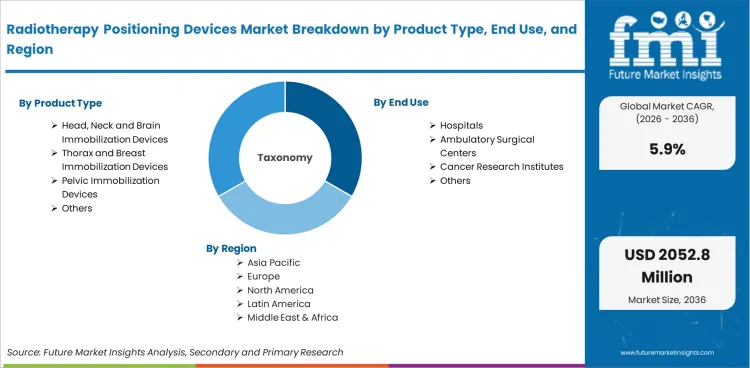
The radiotherapy positioning devices market is expected to expand from USD 1,092.7 million in 2026 to USD 1,938.4 million by 2036. The market is anticipated to register a 5.9% CAGR during the forecast period. Head, neck and brain immobilization devices are likely to lead product type demand with a 38.7% share, while hospitals are projected to account for 45.2% share of the end user segment in 2026.
Summary of the Radiotherapy Positioning Devices Market
- Demand and Growth Drivers
- Rising radiotherapy procedure volumes are expected to support demand for positioning devices across oncology centers.
- Precision-led treatment workflows are likely to increase use of immobilization systems that improve setup repeatability.
- Radiotherapy capacity expansion is anticipated to support procurement of workflow-compatible positioning systems.
- Product and Segment View
- Head, neck and brain immobilization devices are expected to lead product type due to high setup accuracy needs.
- Hospitals are likely to remain the leading end user because radiotherapy delivery depends on integrated oncology infrastructure.
- Thorax, breast and pelvic positioning devices are anticipated to support demand across broader cancer treatment pathways.
- Geography and Competitive Outlook
- China is expected to lead country-level growth due to oncology infrastructure expansion and radiotherapy system deployment.
- India is likely to record strong expansion as cancer treatment access and radiotherapy capacity continue to improve.
- Companies with stronger anatomical coverage, workflow integration and product reliability are anticipated to improve supplier positioning.
- Analyst Opinion
- Anurag Sharma, Principal Consultant for Healthcare at FMI, suggests, “The radiotherapy positioning devices market is likely to move toward systems that improve setup reproducibility and treatment-room workflow. Suppliers with broader anatomical portfolios and dependable immobilization performance are expected to gain advantage as oncology providers prioritize precision and patient stability.”
- Radiotherapy Positioning Devices Market Value Analysis
- The radiotherapy positioning devices market is moving from basic patient support into precision-led oncology workflow infrastructure.
- Demand is likely to rise as cancer centers need reproducible positioning across repeated radiotherapy sessions.
- Adoption is expected to improve through head, neck and brain immobilization devices used in high-accuracy treatments.
- Spending is anticipated to be supported by radiotherapy capacity additions, equipment upgrades and protocol-led positioning needs.
"With the estimated number of new cancer cases in the USA anticipated to increase by about 35% between the year 2022 and 20401, it's important that medical teams have the resources they need to offer the best possible care today and into the future. The Radixact System is designed to offer certainty in every step of the treatment process, from simulation through radiation delivery, to facilitate high quality cancer care today while also providing a platform able to evolve with continued innovation," said Suzanne Winter, president and CEO of Accuray. [1]
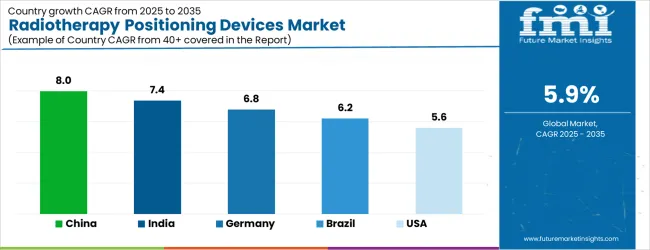
Based on FMI’s report, China (8.0% CAGR) and India (7.4% CAGR) are expected to lead growth due to expanding oncology infrastructure and rising radiotherapy capacity additions. Germany (6.8% CAGR) and Brazil (6.2% CAGR) are expected to maintain healthy expansion through institutional upgrades and broader access to structured cancer care. Mature markets such as the USA (5.6%), the UK (5.0%), and Japan (4.4%) are expected to contribute mainly through replacement demand, technology refresh cycles, and protocol-led positioning upgrades.
Radiotherapy Positioning Devices Market Definition
The market includes patient immobilization and positioning devices used during radiotherapy planning and treatment delivery to maintain reproducible body alignment and reduce unwanted movement across treatment sessions. These products are sold to hospitals, ambulatory surgical centers, cancer research institutes, and related oncology care settings to support radiation therapy workflows where positioning precision and patient stability are clinically required.
The market includes head, neck and brain immobilization devices, thorax and breast immobilization devices, pelvic immobilization devices, and related positioning products used for routine radiotherapy applications. The market is driven by radiotherapy treatment volumes, precision requirements, workflow standardization, and provider preference for reproducible setup solutions. The revenue stream is derived from sales of immobilization and positioning systems to radiotherapy care providers.
Radiotherapy Positioning Devices Market Inclusions
The report provides global and regional market sizing, as well as a 10-year forecast from 2026 to 2036. The report also provides market sizing by product type and end user, with country-level CAGR comparisons across key markets. The report also provides analysis on competitive positioning of key suppliers, institutional purchasing dynamics, and the influence of treatment precision, product reliability, and workflow integration on supplier choice, as per FMI.
Radiotherapy Positioning Devices Market Exclusions
The scope does not include linear accelerators, treatment planning software, imaging guidance systems, radiation dose delivery hardware, and broader radiotherapy room infrastructure. Diagnostic imaging equipment, shielding products, and unrelated patient support furniture are also excluded. The scope also does not include non-radiotherapy positioning aids not used in structured radiation treatment workflows, but only radiotherapy positioning devices used for patient setup and immobilization during planning and delivery.
Radiotherapy Positioning Devices Market Research Methodology
- Primary Research: Interviews were carried out with radiation oncologists, radiotherapy technicians, procurement managers, and oncology equipment distributors to confirm adoption patterns and purchase decision criteria.
- Desk Research: Public data from regulatory bodies, hospital and cancer center sources, company materials, and oncology treatment publications were analyzed to compare positioning needs and technology use trends.
- Market Sizing and Forecasting: A hybrid approach was created based on treatment-site demand mapping, end-user procurement patterns, and radiotherapy throughput, and then harmonized through volume and price triangulation.
- Data Validation and Update Cycle: Results were filtered for variance, tested for internal consistency, and assessed through structured peer review before distribution.
Segmental Analysis
Radiotherapy Positioning Devices Market Analysis by Product Type
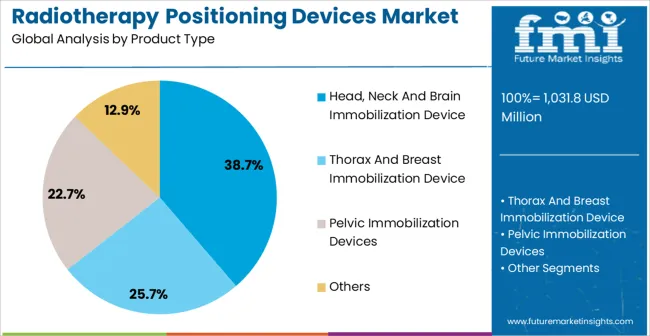
Based on FMI’s report, head, neck and brain immobilization devices are estimated to hold 38.7% share in 2026. This lead position is supported by the high precision requirement of cranial and upper-body radiotherapy workflows, where reproducible setup and motion control remain critical to treatment accuracy across repeated sessions. Their larger share is being reinforced by the frequency of head and neck treatment pathways, tighter treatment margins in cranial radiotherapy, and the operational need to reduce positional deviation across fractionated care delivery.
- Daily Reproducibility Drives Usage: These devices lead demand because head, neck, and brain treatments are commonly delivered over multiple fractions, making reproducible daily positioning essential. A 2024 head-and-neck study evaluating 1,204 CBCT images across 189 patients focused specifically on immobilization accuracy and repeatability in this setting. [2]
- Narrow Margins Demand Control: Cranial and head-and-neck radiotherapy requires very tight setup precision because small positional errors can affect target coverage and nearby critical organs. Recent stereotactic radiotherapy reviews continue to describe dedicated mask-based immobilization as a standard requirement for these high-accuracy treatments.[3]
- High-precision treatment dependency: Head, neck, and brain immobilization devices hold the highest share because radiotherapy in these anatomical regions depends heavily on highly stable, reproducible positioning, where even small patient movements can affect treatment accuracy across repeated therapy sessions.
Radiotherapy Positioning Devices Market Analysis by End User
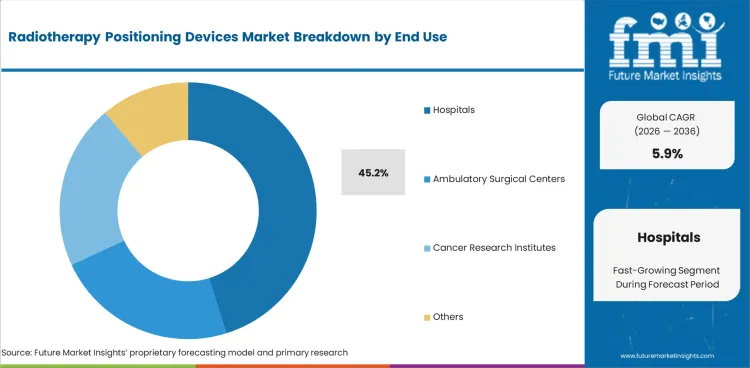
Hospitals account for 45.2% share in 2026, based on FMI’s report, reflecting their role as the primary setting for integrated radiotherapy delivery, oncology case management, and capital-intensive treatment infrastructure. Their leading position is supported by higher patient throughput, broader access to radiotherapy planning and delivery equipment, and stronger institutional ability to standardize positioning protocols across multiple treatment sites and cancer care teams. Demand is therefore being concentrated in hospitals where complex oncology workflows and repeat treatment volumes remain highest.
- Integrated Cancer Care Setting: Hospitals lead demand because radiotherapy is commonly delivered within broader multidisciplinary cancer care pathways that integrate imaging, treatment planning, radiation delivery, and supportive oncology services, making hospital-based settings the main operational hub for positioning and immobilization device use.[4]
- High-Throughput Protocol Reliance: Hospitals sustain the highest share because large radiotherapy departments depend on standardized positioning workflows to manage repeat daily treatments efficiently. Recent radiotherapy workflow and positioning literature emphasizes precise, reproducible patient setup as a core requirement for institutional treatment efficiency and safe delivery. [5]
- Centralized Treatment Volume Concentration: Hospitals hold the highest share because a large portion of radiotherapy care is concentrated in hospital-based settings, where higher patient volumes and repeated treatment sessions create stronger and more consistent demand for positioning and immobilization devices.
Radiotherapy Positioning Devices Market Drivers, Restraints, and Opportunities
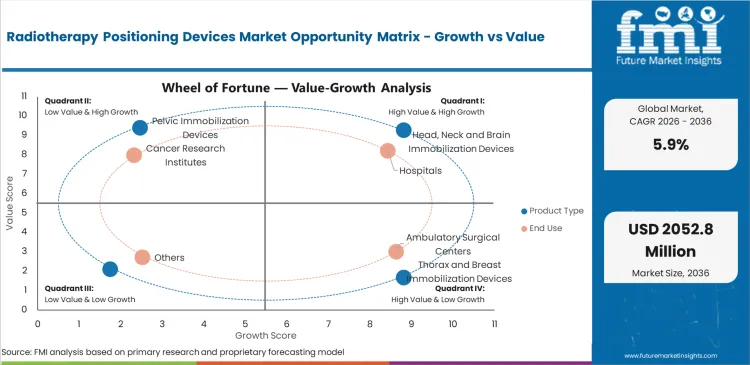
Future Market Insights analysis indicates that historical patterns point to a precision-dependent radiotherapy support devices category where demand is anchored in patient setup reproducibility, treatment accuracy, and workflow consistency across repeated radiation sessions. Estimated valuation in 2026 is being supported by rising cancer treatment volumes, broader use of image-guided radiotherapy, and growing institutional focus on patient positioning quality within modern oncology care environments, as per FMI.
While category demand is being restrained by capital approval cycles, procurement formalities, and slower replacement timing in mature hospital systems, value is being supported by radiotherapy capacity expansion, treatment complexity, and stronger emphasis on reducing setup error across different anatomical sites. Based on FMI’s report, the forecast trajectory reflects a market where hospitals remain the largest end user, while suppliers are differentiated by anatomical coverage, product durability, and workflow integration capability.
- Accuracy-backed demand: Demand is being supported as providers continue to invest in devices that improve reproducible alignment across repeated radiotherapy sessions.
- Tender-led: As oncology equipment budgets remain structured, purchasing pace is filtered through institutional approvals and replacement cycles.
- Capacity expansion: Demand is being supported as more cancer centers and treatment rooms are being added in emerging healthcare markets.
Regional Analysis
Based on the regional analysis, radiotherapy positioning devices market is segmented into North America, Latin America, East Asia, South Asia & Pacific, Western Europe, Eastern Europe, and Middle East & Africa across 40+ countries. Regional performance is assessed using country-level demand signals tied to oncology infrastructure, radiotherapy access, institutional procurement discipline, and treatment modernization, as per FMI. The full report also offers market attractiveness analysis based on regional trends.
.webp "Top Country Growth Comparison Radiotherapy Positioning Devices Market Cagr (2026 2036)")
| Country | CAGR |
|---|---|
| China | 8.0% |
| India | 7.4% |
| Germany | 6.8% |
| Brazil | 6.2% |
| United States | 5.6% |
| United Kingdom | 5.0% |
| Japan | 4.4% |
Source: Future Market Insights (FMI) analysis, based on proprietary forecasting model and primary research
North America Radiotherapy Positioning Devices Market Analysis
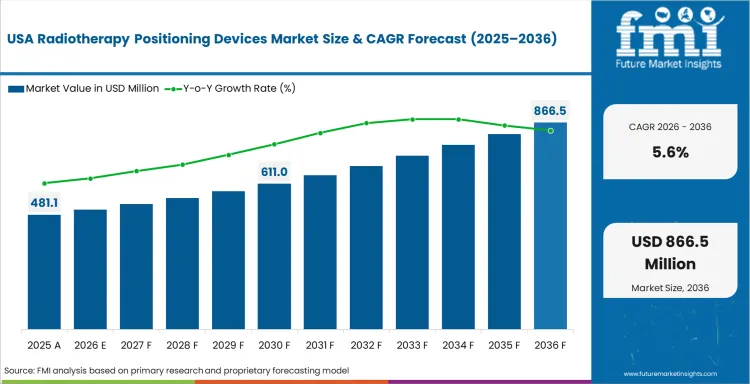
North America is shaped by precision-led oncology workflows and structured equipment procurement, where product choice is influenced by treatment-room compatibility, setup reproducibility, and provider preference for reliable immobilization performance. Varian Medical Systems holds strong placement through broad radiotherapy ecosystem access and institutional relationships across cancer care networks. CIVCO Radiotherapy and Orfit Industries compete through focused immobilization portfolios and established integration into treatment workflows. Based on FMI’s report, demand remains anchored in hospital radiotherapy volumes and technology refresh cycles.
- United States: The demand for radiotherapy positioning devices in the United States is expected to grow at a CAGR of 5.6% during the forecast period of 2036. This is driven by strong oncology infrastructure, continued radiotherapy modernization, and repeat replacement demand, although this is tempered by structured capital planning and mature institutional purchasing behavior.
FMI’s report includes a detailed analysis of the growth in the North American region, along with a country-wise assessment that includes the United States. Readers can also find regional trends, regulations, and market growth based on different segments and countries in the North America region.
East Asia Radiotherapy Positioning Devices Market Analysis
East Asia continues to be a high-growth demand market, driven by expanding cancer treatment infrastructure, wider installation of radiotherapy systems, and stronger institutional investment in structured oncology workflows. Varian Medical Systems maintains broad institutional relevance through multinational scale and treatment-room ecosystem presence. Regional and specialized suppliers compete on the basis of anatomical product fit, channel access, and pricing support into public and private cancer care settings. Based on FMI’s report, demand remains supported by oncology capacity expansion and radiotherapy adoption formalization.
- China: The radiotherapy positioning devices market in China is estimated to expand at a CAGR of 8.0% during the forecast period of 2036. This is being driven by rapid oncology infrastructure development, broader radiotherapy system deployment, and rising institutional spending on treatment precision, with market dynamics influenced by hospital expansion and technology standardization.
- Japan: The demand for radiotherapy positioning devices in Japan is expected to grow at a CAGR of 4.4% during the forecast period of 2036. This is driven by replacement demand and continued use of precision-oriented radiotherapy workflows, although this remains moderated by mature infrastructure and slower volume expansion.
The full report analyzes the radiotherapy positioning devices market across East Asia from 2021 to 2036, covering pricing, trends, and growth drivers in China, Japan, South Korea, and related regional markets. The assessment highlights trends that dictate regional demand and procurement behaviour.
South Asia & Pacific Radiotherapy Positioning Devices Market Analysis
South Asia & Pacific is being shaped by expanding oncology access, rising cancer care investment, and gradual strengthening of radiotherapy delivery infrastructure across developing health systems. Supplier positioning in the region is influenced by product affordability, institutional reach, and ability to support workflow-compatible positioning across growing treatment networks. Based on FMI’s report, demand remains supported by capacity build-out and broader integration of structured radiotherapy pathways into cancer care delivery.
- India: Demand for radiotherapy positioning devices in India is projected to rise at 7.4% CAGR through 2036. Growth is supported by increasing cancer care investment, expansion of treatment access, and higher procurement of workflow-compatible positioning systems across developing oncology networks.
The full report analyzes the radiotherapy positioning devices market across South Asia & Pacific from 2021 to 2036, covering pricing, trends, and growth drivers in India, ASEAN Countries, Australia & New Zealand, and Rest of South Asia. The assessment highlights trends that dictate regional demand and procurement behaviour.
Western Europe Radiotherapy Positioning Devices Market Analysis
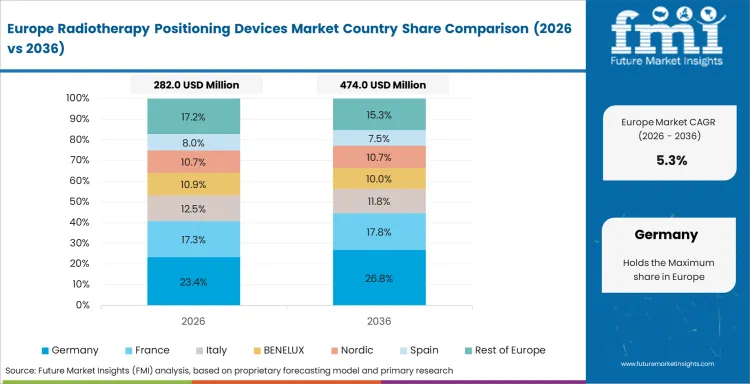
Western Europe is compliance-led and treatment-standardized, where purchasing is shaped by oncology protocol discipline, hospital tender scoring, and provider expectations around reproducible patient setup. CIVCO Radiotherapy, Orfit Industries, and IBA Dosimetry GmbH maintain relevance through focused radiotherapy support portfolios and institutional access across treatment centers. Product use continues to be governed by quality standards, anatomical treatment needs, and compatibility with established radiotherapy room workflows. As per FMI, replacement demand and precision-led care continue to influence product mix across the region.
- Germany: Demand for radiotherapy positioning devices in Germany is projected to rise at 6.8% CAGR through 2036. Growth is supported by advanced oncology infrastructure, structured radiotherapy practice, and continuing institutional investment in treatment precision and patient setup consistency.
- United Kingdom: The demand for radiotherapy positioning devices in the United Kingdom is expected to grow at a CAGR of 5.0% during the forecast period of 2036. This is driven by stable radiotherapy demand and modernization of cancer treatment pathways, although this is filtered through public procurement discipline and replacement-led purchasing cycles.
FMI’s analysis of radiotherapy positioning devices market in Western Europe consists of country-wise assessment that includes Germany, the UK, France, Italy, Spain, BENELUX, Nordic Countries, and Rest of Western Europe. Readers can know various regulations and latest trends in the regional market.
Latin America Radiotherapy Positioning Devices Market Analysis
Latin America is shaped by expanding oncology access and uneven but improving radiotherapy infrastructure, where demand is influenced by institutional funding cycles, treatment capacity additions, and provider need for standardized patient setup tools. Global suppliers retain visibility through distributor-led access and hospital procurement channels, while adoption continues to be concentrated in larger cancer treatment centers. According to FMI’s report, demand conversion is being supported by rising cancer care investment and gradual improvement in treatment-room availability.
- Brazil: The demand for radiotherapy positioning devices in Brazil is expected to grow at a CAGR of 6.2% during the forecast period of 2036. This is driven by expanding cancer treatment infrastructure, improving radiotherapy access, and growing focus on reproducible positioning in structured oncology workflows, although this remains influenced by procurement timing and institutional budget cycles.
The report includes an analysis of the market in Brazil, Argentina, and Rest of Latin America. The reader can gain information about various factors, such as the pricing analysis and trends, that are currently influencing the market in the Latin America region.
Competitive Aligners for Market Players
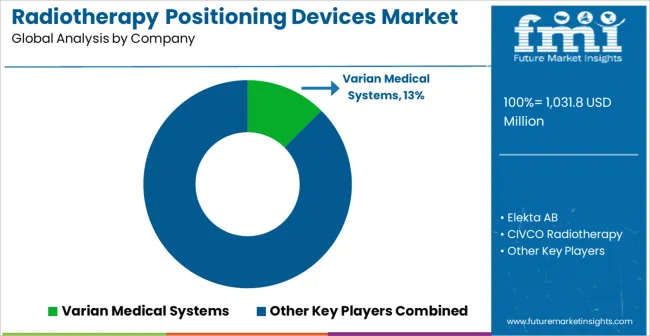
The market structure remains moderately concentrated, with effective competition centered on suppliers capable of supporting reproducible immobilization performance, workflow integration, and dependable product quality across radiotherapy treatment environments. The data provided shows the presence of a leading participant in the market, with the rest of demand distributed across a focused set of specialized radiotherapy support companies. The key competitive factor is setup reliability across anatomical indications, as provider qualification is filtered through treatment precision, ease of use, and consistency in repeated patient positioning. The product portfolio also reflects this emphasis, as head, neck and brain immobilization devices account for the leading share in the supplied segmentation, as indicated by FMI.
Companies with established radiotherapy channel access, treatment-room familiarity, and anatomically differentiated product portfolios carry structural advantages because buyer qualification is governed by clinical workflow fit, product durability, and confidence in setup reproducibility. Scale leaders benefit from institutional reach, broader oncology relationships, and the ability to support multiple treatment sites under the same product umbrella. Portfolio breadth across cranial, thoracic, breast, and pelvic positioning helps protect account positions when providers simplify vendor lists and standardize around proven immobilization systems. Suppliers with narrower manufacturing or distribution footprints tend to compete through selective geographies, pricing flexibility, or niche anatomical applications, which can weaken their position during structured rebids.
Customer concentration reinforces buyer leverage. Hospitals account for the largest end-user pool in the supplied segmentation, with ambulatory surgical centers and cancer research institutes forming the next tier of demand. Large oncology providers commonly qualify a limited number of vendors for core positioning systems, keep approved alternates active, and prioritize products that align with existing treatment-room protocols. Pricing power is therefore moderated for standard immobilization categories, with measured advantage retained only where anatomical fit, product reliability, or workflow familiarity creates stronger institutional preference, Future Market Insights analysis.
Recent Developments
- In September 2025, Leo Cancer Care announced an expansion of its collaboration with IHH Healthcare to bring upright radiotherapy solutions to its hospital network. Building on IHH’s 2024 entry into the Upright Photon Alliance, the group is looking to introduce Leo Cancer Care’s newly launched upright linear accelerators (linacs), Grace, across its hospitals to provide the potential benefits of upright photon therapy to its patients. [6]
- In July 2025, Leo Cancer Care, a leader in upright radiotherapy solutions, announced that its flagship product, Marie, has received 510(k) clearance from the USA Food and Drug Administration (FDA). [7]
Key Players in Radiotherapy Positioning Devices Market
- Varian Medical Systems
- Elekta AB
- CIVCO Radiotherapy
- Brainlab AG
- Accuray Incorporated
- IBA Dosimetry GmbH
- Qfix
- Orfit Industries
- Medtronic plc
- Stryker Corporation
- Smith & Nephew plc
- Bionix Radiation Therapy
- C-RAD AB
- Klarity Medical Products
- Mizuho OSI
Scope of the Report
| Metric | Value |
|---|---|
| Quantitative Units | USD 1,092.7 million (2026) to USD 1,938.4 million (2036), at a CAGR of 5.9% |
| Market Definition | The radiotherapy positioning devices market comprises patient immobilization and positioning systems used to maintain reproducible alignment during radiotherapy planning and treatment delivery, where demand is shaped by treatment precision requirements, workflow standardization, and provider preference for reliable setup performance across oncology care settings. |
| Product Segmentation | Head, Neck and Brain Immobilization Devices, Thorax and Breast Immobilization Devices, Pelvic Immobilization Devices, Others |
| End User Segmentation | Hospitals, Ambulatory Surgical Centers, Cancer Research Institutes, Others |
| Regions Covered | North America, Latin America, East Asia, South Asia & Pacific, Western Europe, Eastern Europe, and Middle East & Africa |
| Countries Covered | United States, Canada, United Kingdom, Germany, France, China, Japan, South Korea, Brazil, Australia, India, and 40+ countries |
| Key Companies Profiled | Varian Medical Systems, Elekta AB, CIVCO Radiotherapy, Brainlab AG, Accuray Incorporated, IBA Dosimetry GmbH, Qfix, Orfit Industries, Medtronic plc, Stryker Corporation, Smith & Nephew plc, Bionix Radiation Therapy, C-RAD AB, Klarity Medical Products, Mizuho OSI |
| Forecast Period | 2026 to 2036 |
| Approach | Hybrid top down and bottom up market modeling validated through primary interviews with oncology and procurement stakeholders, supported by demand triangulation across radiotherapy throughput, anatomical treatment needs, and product adoption patterns, as per FMI. |
Radiotherapy Positioning Devices Market Analysis by Segments
Product Type
- Head, Neck and Brain Immobilization Devices
- Thorax and Breast Immobilization Devices
- Pelvic Immobilization Devices
- Others
End User
- Hospitals
- Ambulatory Surgical Centers
- Cancer Research Institutes
- Others
Region
- North America
- USA
- Canada
- Mexico
- Latin America
- Brazil
- Argentina
- Rest of Latin America
- East Asia
- China
- Japan
- South Korea
- South Asia & Pacific
- India
- ASEAN Countries
- Australia & New Zealand
- Rest of South Asia
- Western Europe
- Germany
- UK
- France
- Italy
- Spain
- BENELUX
- Nordic Countries
- Rest of Western Europe
- Eastern Europe
- Russia
- Hungary
- Poland
- Rest of Eastern Europe
- Middle East & Africa
- Saudi Arabia
- Türkiye
- South Africa
- Other African Union
- Rest of Middle East & Africa
Bibliography
- [1] Accuray Incorporated (2024), Halifax Health in Florida is First in the USA to Treat Patients with Cancer Using the Accuray Radixact Radiation Delivery System and VitalHold Technology
- [2] PubMed Central (2024), Evaluation of positioning accuracy in head-and-neck cancer treatment: A cone beam computed tomography assessment of three immobilization devices with volumetric modulated arc therapy
- [3] PubMed Central (2024), Stereotactic radiotherapy: An educational narrative review
- [4] International Atomic Energy Agency & (WHO) (2024), Guidance on setting up a comprehensive cancer centre
- [5] PubMed Central (2025), Time Matters: A Review of Current Radiotherapy Practices and Efficiency Strategies
- [6] Leo Cancer Care (2025), IHH Healthcare Expands Collaboration with Leo Cancer Care to Advance Upright Cancer Therapies in Asia
- [7] Leo Cancer Care (2025), Leo Cancer Care Receives FDA 510(k) Clearance for MARIE - A Revolutionary Upright Radiotherapy Platform
This bibliography is provided for reader reference and is not exhaustive. The full report contains the complete reference list and detailed citations.
This Report Addresses
- Market intelligence to enable structured strategic decision making across radiotherapy workflow expansion and positioning system planning
- Market size estimation and 10-year revenue forecasts from 2026 to 2036 for radiotherapy positioning device demand
- Growth opportunity mapping across product type classes and end-user treatment pools
- Segment and regional revenue forecasts aligned to the stated taxonomy and covered geographies
- Competition strategy assessment including supplier positioning, portfolio fit, and oncology channel coverage benchmarking
- Product and compliance tracking focused on setup reproducibility, treatment workflow standards, and institutional equipment expectations
- Regulatory impact analysis covering product-led positioning selection and provider-level protocol adoption in regulated care settings
- Market report delivery in PDF, Excel, PPT, and interactive dashboard formats for executive and operational use
Frequently Asked Questions
How large is the demand for Radiotherapy Positioning Devices in the global market in 2026?
Demand for radiotherapy positioning devices in the global market is estimated to be valued at USD 1,092.7 million in 2026, as per FMI.
What will be the market size of Radiotherapy Positioning Devices in the global market by 2036?
Market size for radiotherapy positioning devices is projected to reach USD 1,938.4 million by 2036.
What is the expected demand growth for Radiotherapy Positioning Devices in the global market between 2026 and 2036?
Demand for radiotherapy positioning devices in the global market is expected to grow at a CAGR of 5.9% between 2026 and 2036.
Which product type is poised to lead global sales by 2026?
Head, neck and brain immobilization devices are expected to be the dominant product type, capturing 38.7% share in 2026.
How significant is the role of hospitals in driving adoption in 2026?
Hospitals are projected to hold 45.2% share of end-user demand in 2026.
Which country is expected to record the fastest growth during the forecast period?
China is projected to grow at a CAGR of 8.0% during 2026 to 2036 among the listed countries.
Preview the report firsthand - request a free sample
Get SampleGet the brochure for pricing and purchase details.
Get PDFTable of Content
- Executive Summary
- Global Market Outlook
- Demand-side Trends
- Supply-side Trends
- Technology Roadmap Analysis
- Analysis and Recommendations
- Market Overview
- Market Coverage / Taxonomy
- Market Definition / Scope / Limitations
- Research Methodology
- Chapter Orientation
- Analytical Lens and Working Hypotheses
- Market Structure, Signals, and Trend Drivers
- Benchmarking and Cross-market Comparability
- Market Sizing, Forecasting, and Opportunity Mapping
- Research Design and Evidence Framework
- Desk Research Programme (Secondary Evidence)
- Company Annual and Sustainability Reports
- Peer-reviewed Journals and Academic Literature
- Corporate Websites, Product Literature, and Technical Notes
- Earnings Decks and Investor Briefings
- Statutory Filings and Regulatory Disclosures
- Technical White Papers and Standards Notes
- Trade Journals, Industry Magazines, and Analyst Briefs
- Conference Proceedings, Webinars, and Seminar Materials
- Government Statistics Portals and Public Data Releases
- Press Releases and Reputable Media Coverage
- Specialist Newsletters and Curated Briefings
- Sector Databases and Reference Repositories
- FMI Internal Proprietary Databases and Historical Market Datasets
- Subscription Datasets and Paid Sources
- Social Channels, Communities, and Digital Listening Inputs
- Additional Desk Sources
- Expert Input and Fieldwork (Primary Evidence)
- Primary Modes
- Qualitative Interviews and Expert Elicitation
- Quantitative Surveys and Structured Data Capture
- Blended Approach
- Why Primary Evidence is Used
- Field Techniques
- Interviews
- Surveys
- Focus Groups
- Observational and In-context Research
- Social and Community Interactions
- Stakeholder Universe Engaged
- C-suite Leaders
- Board Members
- Presidents and Vice Presidents
- R&D and Innovation Heads
- Technical Specialists
- Domain Subject-matter Experts
- Scientists
- Physicians and Other Healthcare Professionals
- Governance, Ethics, and Data Stewardship
- Research Ethics
- Data Integrity and Handling
- Primary Modes
- Tooling, Models, and Reference Databases
- Desk Research Programme (Secondary Evidence)
- Data Engineering and Model Build
- Data Acquisition and Ingestion
- Cleaning, Normalisation, and Verification
- Synthesis, Triangulation, and Analysis
- Quality Assurance and Audit Trail
- Market Background
- Market Dynamics
- Drivers
- Restraints
- Opportunity
- Trends
- Scenario Forecast
- Demand in Optimistic Scenario
- Demand in Likely Scenario
- Demand in Conservative Scenario
- Opportunity Map Analysis
- Product Life Cycle Analysis
- Supply Chain Analysis
- Investment Feasibility Matrix
- Value Chain Analysis
- PESTLE and Porter’s Analysis
- Regulatory Landscape
- Regional Parent Market Outlook
- Production and Consumption Statistics
- Import and Export Statistics
- Market Dynamics
- Global Market Analysis 2021 to 2025 and Forecast, 2026 to 2036
- Historical Market Size Value (USD Million) Analysis, 2021 to 2025
- Current and Future Market Size Value (USD Million) Projections, 2026 to 2036
- Y-o-Y Growth Trend Analysis
- Absolute $ Opportunity Analysis
- Global Market Pricing Analysis 2021 to 2025 and Forecast 2026 to 2036
- Global Market Analysis 2021 to 2025 and Forecast 2026 to 2036, By Product Type
- Introduction / Key Findings
- Historical Market Size Value (USD Million) Analysis By Product Type , 2021 to 2025
- Current and Future Market Size Value (USD Million) Analysis and Forecast By Product Type , 2026 to 2036
- Head, Neck and Brain Immobilization Devices
- Thorax and Breast Immobilization Devices
- Pelvic Immobilization Devices
- Others
- Head, Neck and Brain Immobilization Devices
- Y-o-Y Growth Trend Analysis By Product Type , 2021 to 2025
- Absolute $ Opportunity Analysis By Product Type , 2026 to 2036
- Global Market Analysis 2021 to 2025 and Forecast 2026 to 2036, By End Use
- Introduction / Key Findings
- Historical Market Size Value (USD Million) Analysis By End Use, 2021 to 2025
- Current and Future Market Size Value (USD Million) Analysis and Forecast By End Use, 2026 to 2036
- Hospitals
- Ambulatory Surgical Centers
- Cancer Research Institutes
- Others
- Hospitals
- Y-o-Y Growth Trend Analysis By End Use, 2021 to 2025
- Absolute $ Opportunity Analysis By End Use, 2026 to 2036
- Global Market Analysis 2021 to 2025 and Forecast 2026 to 2036, By Region
- Introduction
- Historical Market Size Value (USD Million) Analysis By Region, 2021 to 2025
- Current Market Size Value (USD Million) Analysis and Forecast By Region, 2026 to 2036
- North America
- Latin America
- Western Europe
- Eastern Europe
- East Asia
- South Asia and Pacific
- Middle East & Africa
- Market Attractiveness Analysis By Region
- North America Market Analysis 2021 to 2025 and Forecast 2026 to 2036, By Country
- Historical Market Size Value (USD Million) Trend Analysis By Market Taxonomy, 2021 to 2025
- Market Size Value (USD Million) Forecast By Market Taxonomy, 2026 to 2036
- By Country
- USA
- Canada
- Mexico
- By Product Type
- By End Use
- By Country
- Market Attractiveness Analysis
- By Country
- By Product Type
- By End Use
- Key Takeaways
- Latin America Market Analysis 2021 to 2025 and Forecast 2026 to 2036, By Country
- Historical Market Size Value (USD Million) Trend Analysis By Market Taxonomy, 2021 to 2025
- Market Size Value (USD Million) Forecast By Market Taxonomy, 2026 to 2036
- By Country
- Brazil
- Chile
- Rest of Latin America
- By Product Type
- By End Use
- By Country
- Market Attractiveness Analysis
- By Country
- By Product Type
- By End Use
- Key Takeaways
- Western Europe Market Analysis 2021 to 2025 and Forecast 2026 to 2036, By Country
- Historical Market Size Value (USD Million) Trend Analysis By Market Taxonomy, 2021 to 2025
- Market Size Value (USD Million) Forecast By Market Taxonomy, 2026 to 2036
- By Country
- Germany
- UK
- Italy
- Spain
- France
- Nordic
- BENELUX
- Rest of Western Europe
- By Product Type
- By End Use
- By Country
- Market Attractiveness Analysis
- By Country
- By Product Type
- By End Use
- Key Takeaways
- Eastern Europe Market Analysis 2021 to 2025 and Forecast 2026 to 2036, By Country
- Historical Market Size Value (USD Million) Trend Analysis By Market Taxonomy, 2021 to 2025
- Market Size Value (USD Million) Forecast By Market Taxonomy, 2026 to 2036
- By Country
- Russia
- Poland
- Hungary
- Balkan & Baltic
- Rest of Eastern Europe
- By Product Type
- By End Use
- By Country
- Market Attractiveness Analysis
- By Country
- By Product Type
- By End Use
- Key Takeaways
- East Asia Market Analysis 2021 to 2025 and Forecast 2026 to 2036, By Country
- Historical Market Size Value (USD Million) Trend Analysis By Market Taxonomy, 2021 to 2025
- Market Size Value (USD Million) Forecast By Market Taxonomy, 2026 to 2036
- By Country
- China
- Japan
- South Korea
- By Product Type
- By End Use
- By Country
- Market Attractiveness Analysis
- By Country
- By Product Type
- By End Use
- Key Takeaways
- South Asia and Pacific Market Analysis 2021 to 2025 and Forecast 2026 to 2036, By Country
- Historical Market Size Value (USD Million) Trend Analysis By Market Taxonomy, 2021 to 2025
- Market Size Value (USD Million) Forecast By Market Taxonomy, 2026 to 2036
- By Country
- India
- ASEAN
- Australia & New Zealand
- Rest of South Asia and Pacific
- By Product Type
- By End Use
- By Country
- Market Attractiveness Analysis
- By Country
- By Product Type
- By End Use
- Key Takeaways
- Middle East & Africa Market Analysis 2021 to 2025 and Forecast 2026 to 2036, By Country
- Historical Market Size Value (USD Million) Trend Analysis By Market Taxonomy, 2021 to 2025
- Market Size Value (USD Million) Forecast By Market Taxonomy, 2026 to 2036
- By Country
- Kingdom of Saudi Arabia
- Other GCC Countries
- Turkiye
- South Africa
- Other African Union
- Rest of Middle East & Africa
- By Product Type
- By End Use
- By Country
- Market Attractiveness Analysis
- By Country
- By Product Type
- By End Use
- Key Takeaways
- Key Countries Market Analysis
- USA
- Pricing Analysis
- Market Share Analysis, 2025
- By Product Type
- By End Use
- Canada
- Pricing Analysis
- Market Share Analysis, 2025
- By Product Type
- By End Use
- Mexico
- Pricing Analysis
- Market Share Analysis, 2025
- By Product Type
- By End Use
- Brazil
- Pricing Analysis
- Market Share Analysis, 2025
- By Product Type
- By End Use
- Chile
- Pricing Analysis
- Market Share Analysis, 2025
- By Product Type
- By End Use
- Germany
- Pricing Analysis
- Market Share Analysis, 2025
- By Product Type
- By End Use
- UK
- Pricing Analysis
- Market Share Analysis, 2025
- By Product Type
- By End Use
- Italy
- Pricing Analysis
- Market Share Analysis, 2025
- By Product Type
- By End Use
- Spain
- Pricing Analysis
- Market Share Analysis, 2025
- By Product Type
- By End Use
- France
- Pricing Analysis
- Market Share Analysis, 2025
- By Product Type
- By End Use
- India
- Pricing Analysis
- Market Share Analysis, 2025
- By Product Type
- By End Use
- ASEAN
- Pricing Analysis
- Market Share Analysis, 2025
- By Product Type
- By End Use
- Australia & New Zealand
- Pricing Analysis
- Market Share Analysis, 2025
- By Product Type
- By End Use
- China
- Pricing Analysis
- Market Share Analysis, 2025
- By Product Type
- By End Use
- Japan
- Pricing Analysis
- Market Share Analysis, 2025
- By Product Type
- By End Use
- South Korea
- Pricing Analysis
- Market Share Analysis, 2025
- By Product Type
- By End Use
- Russia
- Pricing Analysis
- Market Share Analysis, 2025
- By Product Type
- By End Use
- Poland
- Pricing Analysis
- Market Share Analysis, 2025
- By Product Type
- By End Use
- Hungary
- Pricing Analysis
- Market Share Analysis, 2025
- By Product Type
- By End Use
- Kingdom of Saudi Arabia
- Pricing Analysis
- Market Share Analysis, 2025
- By Product Type
- By End Use
- Turkiye
- Pricing Analysis
- Market Share Analysis, 2025
- By Product Type
- By End Use
- South Africa
- Pricing Analysis
- Market Share Analysis, 2025
- By Product Type
- By End Use
- USA
- Market Structure Analysis
- Competition Dashboard
- Competition Benchmarking
- Market Share Analysis of Top Players
- By Regional
- By Product Type
- By End Use
- Competition Analysis
- Competition Deep Dive
- Varian Medical Systems
- Overview
- Product Portfolio
- Profitability by Market Segments (Product/Age /Sales Channel/Region)
- Sales Footprint
- Strategy Overview
- Marketing Strategy
- Product Strategy
- Channel Strategy
- Elekta AB
- CIVCO Radiotherapy
- Brainlab AG
- Accuray Incorporated
- IBA Dosimetry GmbH
- Qfix
- Orfit Industries
- Medtronic plc
- Stryker Corporation
- Smith & Nephew plc
- Bionix Radiation Therapy
- C-RAD AB
- Klarity Medical Products
- Mizuho OSI
- Varian Medical Systems
- Competition Deep Dive
- Assumptions & Acronyms Used


