

- Industry Size (2026)
- USD 6.7 Bn
- Forecast (2036)
- USD 15.1 Bn
- CAGR (2026 to 2036)
- 8.5%
Oncology Resection Devices Market Forecast and Outlook 2026 to 2036
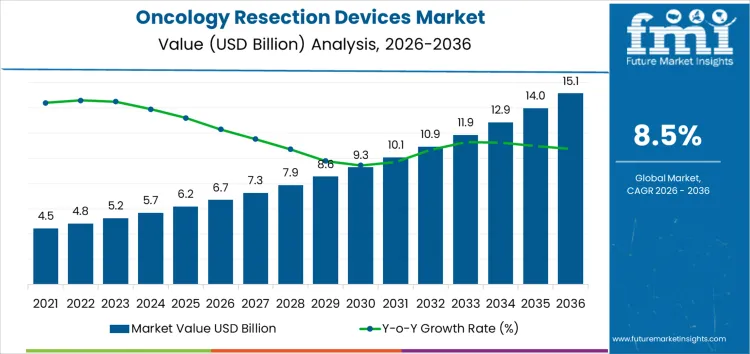
The Oncology Resection Devices market is projected at USD 6.7 billion in 2026 and is expected to reach USD 15.1 billion by 2036, growing at a CAGR of 8.5%. Electrosurgical devices dominate the sector, while ultrasonic and laser resection tools support specialized surgical procedures. Hospitals are the primary end users, followed by cancer centers and ambulatory surgery centers. Leading companies include Medtronic, Johnson & Johnson, Stryker, Olympus, and BD. Growth is driven by rising cancer prevalence and the adoption of minimally invasive surgical technologies.
Expansion is supported by technological enhancements in precision cutting, hemostasis, and tissue-sparing capabilities, improving procedural outcomes. Increasing investments in oncology infrastructure, along with training programs for surgeons, enhance device utilization. The rising need for outpatient procedures and improved patient recovery further propels demand. Continuous product innovation and integration of imaging guidance systems sustain growth, ensuring the market trajectory remains robust through 2036.
Quick Stats for Oncology Resection Devices Market
- Oncology Resection Devices Market Value (2026): USD 6.7 billion
- Oncology Resection Devices Market Forecast Value (2036): USD 15.1 billion
- Oncology Resection Devices Market Forecast CAGR: 8.5%
- Leading Type in Oncology Resection Devices Market: Electrosurgical Devices
- Key Growth Regions in Oncology Resection Devices Market: North America, Europe, and Asia Pacific
- Top Players in Oncology Resection Devices Market: Medtronic, Johnson & Johnson, Stryker, Olympus, BD
What is the Growth Forecast for the Oncology Resection Devices Market through 2036?
From 2026 to 2031, the oncology resection devices market grows from USD 6.7 billion to approximately USD 9.3 billion, representing the early adoption phase. Annual increments rise from USD 0.5 billion in 2026 to USD 0.7 billion in 2031. Growth is driven by adoption in hospitals, cancer centers, and surgical oncology clinics where advanced resection devices improve precision, minimize tissue damage, and enhance patient outcomes. North America and Europe account for roughly 65% of early adoption, supported by regulatory approvals, high procedural volumes, and integration with minimally invasive and robotic-assisted surgical platforms.
Between 2031 and 2036, the market expands from roughly USD 9.3 billion to USD 15.1 billion, illustrating the late adoption phase characterized by broader commercialization and multi-site deployment. Annual increments increase from USD 0.7 billion to USD 1.3 billion, supported by repeat procurement, portfolio-wide adoption, and expansion into emerging markets in Asia Pacific and Latin America. Growth is reinforced by technological innovation, rising cancer prevalence, and integration into robotic-assisted and image-guided surgical systems. Early growth relied on selective high-value hospitals, whereas later expansion reflects structural adoption and normalization across global oncology surgical facilities.
Oncology Resection Devices Market Key Takeaways
| Metric | Value |
|---|---|
| Market Value (2026) | USD 6.7 billion |
| Forecast Value (2036) | USD 15.1 billion |
| Forecast CAGR (2026–2036) | 8.5% |
What Is Driving Growth in the Oncology Resection Devices Market?
Growth in the oncology resection devices market has been shaped by rising incidence of cancer and evolving clinical practice toward surgical intervention. Surgical resection remains a cornerstone treatment for many solid tumours in organs such as the breast, liver, lung, and gastrointestinal tract, where complete removal of malignant tissue offers the best chance for long term survival. Advances in imaging, intraoperative guidance, and pathological assessment have increased surgeon confidence in resection precision. Demand has also been influenced by earlier diagnosis through screening programmes, which expands the pool of patients eligible for resection rather than palliative measures.
Future growth reflects procedural innovation and shifts in treatment standards rather than simple increases in cancer diagnoses. Oncology resection devices are being refined to support minimally invasive approaches, reduce collateral tissue damage, and improve functional outcomes. Technologies such as energy based cutting instruments, integrated vascular control systems, and real time margin assessment tools are being specified to improve efficiency and reduce operative time. Healthcare systems are standardising resection techniques and incorporating evidence based device performance into surgical protocols. Regulatory and reimbursement frameworks are increasingly tying adoption to documented improvements in clinical outcomes, postoperative recovery, and cost effectiveness. Demand for these devices will align with guideline recommendations and institutional quality metrics rather than growth in surgical volume alone.
What Factors Are Affecting the Demand for Oncology Resection Devices Market in Terms of Product Type and Application?
The oncology resection devices market is driven by rising cancer surgery volumes, preference for minimally invasive techniques, and the need for precise tumor removal with controlled margins. Demand concentrates on technologies that balance cutting efficiency, hemostasis, and compatibility with modern surgical workflows. Market leadership reflects clinical reliability, surgeon familiarity, and adaptability across tumor types rather than novelty alone. Application patterns are shaped by the predominance of solid tumor surgeries, where resection remains a primary treatment modality.
What Is Driving Leadership by Product Type in the Oncology Resection Devices Market?
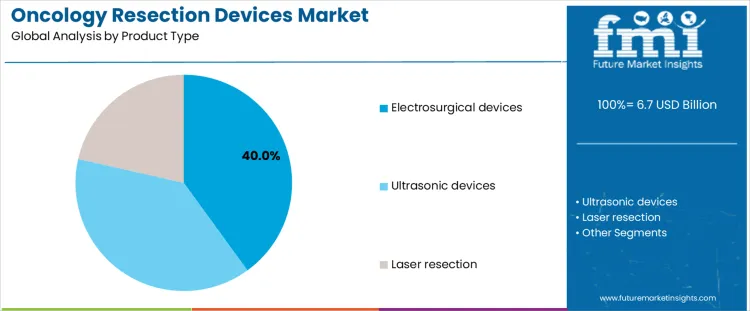
Electrosurgical devices account for about 40% of demand because they provide a versatile combination of cutting, coagulation, and tissue control across a wide range of oncologic procedures. Surgeons favor these devices for their reliability, ease of integration into existing operating rooms, and suitability for both open and minimally invasive surgeries. Electrosurgical tools allow precise tissue dissection while maintaining hemostasis, which is critical in tumor resections where blood loss must be minimized. Their compatibility with laparoscopic and robotic platforms further strengthens adoption.
Ultrasonic devices play an important role in procedures requiring reduced thermal spread and enhanced precision, particularly near critical structures. Laser resection devices are used selectively in specialized cases, such as superficial or highly localized tumors, but require higher capital investment and specialized training. Product type leadership is therefore driven by versatility, cost effectiveness, and broad clinical acceptance rather than superior performance in niche indications. Electrosurgical systems also benefit from standardized training and long standing clinical protocols. Ultrasonic and laser technologies complement rather than replace them, reinforcing electrosurgery as the foundational resection modality in oncology practice.
What Is Driving Leadership by Application in the Oncology Resection Devices Market?
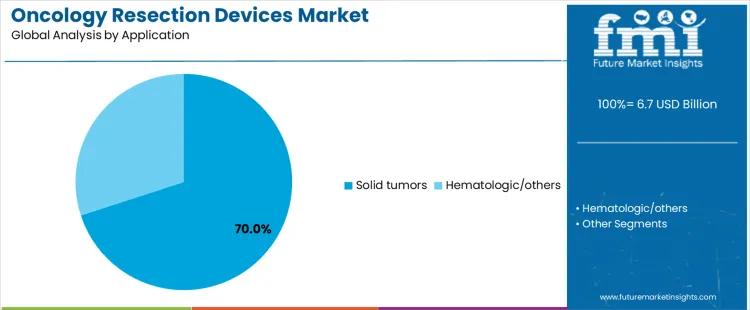
Solid tumors represent about 70% of demand because surgical resection remains a cornerstone treatment for cancers of the breast, lung, liver, colorectal region, and other organs. These procedures require reliable resection tools capable of precise margin control and effective hemostasis. Advances in early detection and surgical techniques have increased the number of patients eligible for tumor removal, sustaining high procedural volumes. Electrosurgical and ultrasonic devices are widely used in solid tumor surgeries due to their adaptability across anatomical sites and surgical approaches.
Hematologic and other cancer applications account for a smaller share, as many blood related malignancies are treated primarily with systemic therapies rather than surgery. Solid tumor dominance reflects the central role of surgery in curative and debulking strategies. Hematologic applications remain limited to biopsy or supportive procedures. Application leadership therefore reflects treatment paradigms and procedural dependence rather than overall cancer incidence.
How Is the Oncology Resection Devices Market Being Applied Across Surgical Oncology Procedures?
Use appears in hospitals, cancer centers, and specialized surgical suites where precision removal of malignant tissue is critical. Surgeons use resection devices for tumor excision in organs such as the liver, lung, gastrointestinal tract, and brain, aiming to maximize healthy tissue preservation while achieving clear margins. Devices may include electrosurgical tools, ultrasonic scalpels, or robotic-assisted instruments integrated with imaging guidance. These applications reflect operational and clinical priorities rather than decorative purposes, with adoption driven by surgical precision, patient outcomes, and workflow efficiency.
What Operational and Material Conditions Support Adoption of Oncology Resection Devices?
Selection aligns with surgical environments requiring high accuracy, hemostasis, and minimal thermal or mechanical tissue damage. Device materials are biocompatible, durable, and compatible with sterilization procedures. Integration with imaging systems, robotic platforms, and surgical navigation enhances intraoperative guidance. Surgeons rely on ergonomic design, precision control, and reliability during long or complex procedures. These conditions emerge from operational efficiency, procedural safety, and clinical performance priorities in structured oncology surgical workflows.
Which Practical Considerations Limit Wider Use of Oncology Resection Devices?
High capital cost and maintenance requirements limit adoption to tertiary hospitals and specialized cancer centers. Training and expertise are essential for effective use, particularly for robotic or advanced electrosurgical devices. Regulatory approval and clinical validation vary by device type and region. Device compatibility with existing surgical suites and patient-specific anatomy may restrict utilization. These factors lead to selective deployment where surgical accuracy, patient safety, and treatment efficacy justify incremental cost and operational adaptation.
What is the Demand for Oncology Resection Devices by Country?
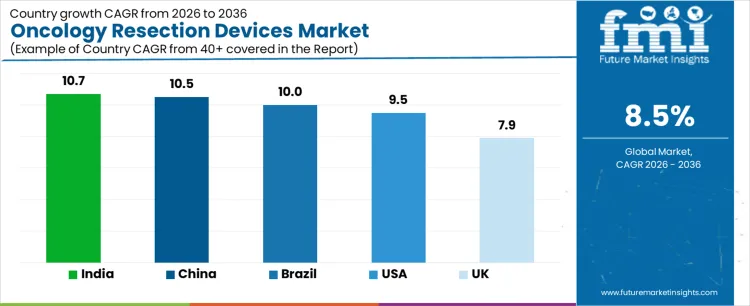
| Country | CAGR (%) |
|---|---|
| USA | 9.5% |
| Brazil | 10.0% |
| China | 10.5% |
| India | 10.7% |
| UK | 7.9% |
The demand for oncology resection devices varies across countries, driven by rising cancer prevalence, advanced surgical adoption, and healthcare infrastructure expansion. India leads with a 10.7% CAGR, supported by increasing oncology cases, expanding hospital networks, and growing access to advanced surgical technologies. China follows at 10.5%, driven by large patient population, hospital modernization, and adoption of minimally invasive cancer surgeries. Brazil records 10.0%, shaped by healthcare expansion and increasing cancer treatment accessibility. The USA grows at 9.5%, reflecting established oncology services and adoption of advanced resection devices. The UK posts 7.9%, supported by mature healthcare systems and steady demand for surgical oncology solutions.
How Is Oncology Resection Device Adoption Growing in the United States?
In the United States, revenue from the Oncology Resection Devices Market is expanding at a CAGR of 9.5% through 2036, driven by increasing demand for precision surgical tools in cancer resection procedures. Hospitals, cancer centers, and specialty surgical clinics are integrating advanced resection devices to improve tumor removal accuracy, reduce operative time, and enhance patient outcomes. Demand is concentrated in oncology units, academic medical centers, and high-volume surgical hospitals. Domestic suppliers provide high-performance, clinically validated devices compatible with standard surgical protocols. Rising cancer prevalence, regulatory approvals, and recurring surgical procedures are sustaining predictable adoption nationwide.
- Oncology units, surgical clinics, and academic medical centers drive adoption
- Devices improve tumor removal accuracy and reduce operative time
- Domestic suppliers provide clinically validated, high-performance surgical tools
- Recurring procedures sustain predictable adoption
How Are Cancer Care Services Supporting Growth in Brazil?
In Brazil, the market is growing at a CAGR of 10% through 2036, supported by expanding oncology treatment centers and increasing surgical volumes. Manufacturers are supplying advanced resection devices to enhance surgical precision, patient safety, and recovery outcomes. Demand is concentrated in urban hospitals, specialized cancer centers, and private surgical facilities. Local suppliers provide devices that meet clinical standards and regulatory requirements. Growth in cancer awareness programs, infrastructure expansion, and recurring surgical procedures are sustaining adoption nationwide.
- Urban hospitals, specialized cancer centers, and private facilities drive adoption
- Devices enhance surgical precision and patient safety
- Local suppliers provide clinically compliant, high-performance devices
- Recurring surgical procedures sustain adoption
How Is Surgical Oncology Expansion Accelerating Adoption in China?
China is witnessing growth at a CAGR of 10.5% through 2036, driven by rapid expansion of hospitals, cancer centers, and specialty surgical units adopting oncology resection devices. Manufacturers are integrating high-precision tools to improve operative outcomes, reduce complications, and support advanced tumor removal procedures. Demand is concentrated in tertiary hospitals, urban oncology centers, and specialized surgical facilities. Domestic suppliers are scaling production of high-performance, clinically validated devices compatible with standard surgical workflows. Increasing cancer prevalence, healthcare infrastructure expansion, and recurring procedures are sustaining rapid adoption nationwide.
- Tertiary hospitals, oncology centers, and surgical facilities drive adoption
- Devices improve operative outcomes and reduce complications
- Domestic suppliers scale clinically validated, high-performance tools
- Recurring procedures sustain rapid adoption
How Is Oncology Surgery Infrastructure Supporting Growth in India?
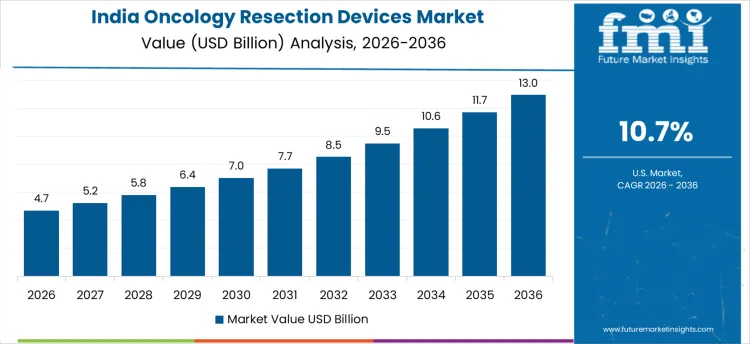
In India, revenue from the Oncology Resection Devices Market is expanding at a CAGR of 10.7% through 2036, supported by increasing cancer incidence, hospital expansion, and adoption of precision surgical technologies. Hospitals and specialty surgical centers are deploying advanced resection devices to enhance tumor removal accuracy and reduce recovery times. Demand is concentrated in urban hospitals, oncology units, and teaching hospitals. Domestic suppliers provide high-performance, clinically compatible devices suitable for complex surgical procedures. Rising healthcare infrastructure, procedural volumes, and recurring surgical use are sustaining robust adoption nationwide.
- Urban hospitals, oncology units, and teaching hospitals drive adoption
- Devices enhance tumor removal accuracy and reduce recovery time
- Domestic suppliers provide clinically compatible, high-performance tools
- Recurring surgical procedures sustain robust adoption
How Are Clinical Standards Supporting Adoption in the United Kingdom?
In the United Kingdom, the market is growing at a CAGR of 7.9% through 2036, driven by adoption of oncology resection devices in hospitals and specialized surgical units. Manufacturers are providing precision tools to improve surgical accuracy, reduce operative complications, and enhance patient outcomes in cancer treatment. Demand is concentrated in oncology departments, academic hospitals, and specialized clinics. Domestic suppliers provide high-performance, clinically validated devices compatible with standard surgical protocols. Regulatory compliance, procedural volumes, and recurring surgical use are sustaining consistent procurement nationwide.
- Oncology departments, academic hospitals, and specialized clinics drive adoption
- Devices improve surgical accuracy and reduce complications
- Domestic suppliers provide clinically validated, high-performance tools
- Recurring surgical procedures sustain consistent procurement
Which Strategic Approaches Are Companies Using to Compete in The Oncology Resection Devices Market Across Surgical Pathways?
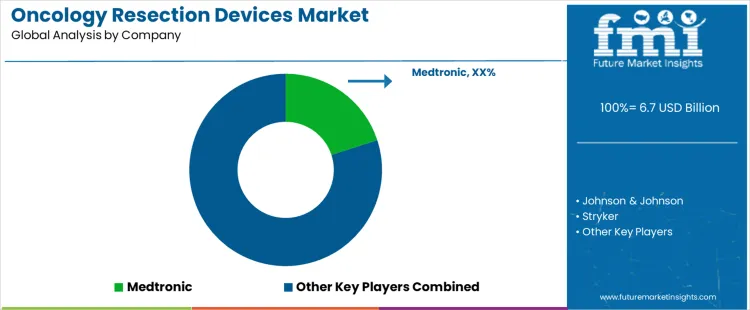
Competition in the Oncology Resection Devices Market is driven by how effectively devices integrate into established surgical workflows and tumor specific procedures. Medtronic and Johnson and Johnson pursue platform strategies that link resection tools with energy devices, visualization, and stapling systems, reinforcing surgeon familiarity and procedural continuity. Stryker focuses on precision and ergonomics in powered instruments used in orthopedic and neuro oncologic resections, where control and stability influence outcomes. Olympus approaches competition through endoscopic and minimally invasive pathways, aligning resection devices with imaging and access systems used in gastrointestinal and thoracic oncology. Purchasing decisions prioritize reliability, tactile control, and compatibility with imaging guidance rather than frequent hardware changes.
Longer term strategy emphasizes evidence, training, and institutional alignment. Leading suppliers invest in surgeon education, procedure specific kits, and incremental design refinements that preserve regulatory continuity while improving ease of use. BD participates through resection adjacent devices and consumables that support tissue handling and access rather than primary cutting platforms. Smaller and emerging players typically target niche indications or adjunct technologies rather than direct competition with integrated systems. Across the market, success depends on embedding devices within care standards, maintaining consistent performance across procedures, and supporting hospital value analysis requirements. Competitive advantage is sustained through clinical trust, workflow fit, and long qualification cycles rather than rapid product turnover or aggressive pricing.
Key Players in the Oncology Resection Devices Market
- Medtronic
- Johnson & Johnson
- Stryker
- Olympus
- BD
- Others
Scope of the Report
| Items | Values |
|---|---|
| Quantitative Units (2026) | USD billion |
| Product Type | Electrosurgical devices, Ultrasonic devices, Laser resection |
| Application | Solid tumors, Hematologic/others |
| End-Use Industry | Hospitals, Cancer centers, ASCs |
| Region | Asia Pacific (China, Japan, South Korea, India, Australia & New Zealand, ASEAN, Rest of Asia Pacific), Europe (Germany, UK, France, Italy, Spain, Nordic, BENELUX, Rest of Europe), North America (United States, Canada, Mexico), Latin America (Brazil, Chile, Rest of Latin America), Middle East & Africa (KSA, Other GCC, Turkey, South Africa, Other African Union, Rest of MEA) |
| Key Companies Profiled | Medtronic, Johnson & Johnson, Stryker, Olympus, BD, Others |
| Additional Attributes | Dollar by sales by product type, Dollar by sales by application, Dollar by sales by end-user, Dollar by sales by region, Annual procurement cycles, Procedural volume coverage, Device precision and cutting efficiency, Hemostasis control rating, Material biocompatibility and durability, Integration with imaging or robotic systems, Training and handling programs, Repeat procurement frequency, Compliance with surgical standards, Domestic vs. imported device distribution, Supply chain reliability, Regulatory adherence (FDA, CE, ISO), Adoption by oncology surgical units, Hospital inventory stocking levels, Operational efficiency and procedure time metrics |
Oncology Resection Devices Market Segmentation
Product Type:
- Electrosurgical devices
- Ultrasonic devices
- Laser resection
Application:
- Solid tumors
- Hematologic/others
End User:
- Hospitals
- Cancer centers
- ASCs
Region
Asia Pacific
- China
- Japan
- South Korea
- India
- Australia & New Zealand
- ASEAN
- Rest of Asia Pacific
Europe
- Germany
- United Kingdom
- France
- Italy
- Spain
- Nordic
- BENELUX
- Rest of Europe
North America
- United States
- Canada
- Mexico
Latin America
- Brazil
- Chile
- Rest of Latin America
Middle East & Africa
- Kingdom of Saudi Arabia
- Other GCC Countries
- Turkey
- South Africa
- Other African Union
- Rest of Middle East & Africa
Frequently Asked Questions
How big is the oncology resection devices market in 2026?
The global oncology resection devices market is estimated to be valued at USD 6.7 billion in 2026.
What will be the size of oncology resection devices market in 2036?
The market size for the oncology resection devices market is projected to reach USD 15.1 billion by 2036.
How much will be the oncology resection devices market growth between 2026 and 2036?
The oncology resection devices market is expected to grow at a 8.5% CAGR between 2026 and 2036.
What are the key product types in the oncology resection devices market?
The key product types in oncology resection devices market are electrosurgical devices, ultrasonic devices and laser resection.
Which application segment to contribute significant share in the oncology resection devices market in 2026?
In terms of application, solid tumors segment to command 70.0% share in the oncology resection devices market in 2026.
Preview the report firsthand - request a free sample
Get SampleGet the brochure for pricing and purchase details.
Get PDFTable of Content
- Executive Summary
- Global Market Outlook
- Demand-side Trends
- Supply-side Trends
- Technology Roadmap Analysis
- Analysis and Recommendations
- Market Overview
- Market Coverage / Taxonomy
- Market Definition / Scope / Limitations
- Market Background
- Market Dynamics
- Drivers
- Restraints
- Opportunity
- Trends
- Scenario Forecast
- Demand in Optimistic Scenario
- Demand in Likely Scenario
- Demand in Conservative Scenario
- Opportunity Map Analysis
- Product Life Cycle Analysis
- Supply Chain Analysis
- Investment Feasibility Matrix
- Value Chain Analysis
- PESTLE and Porter’s Analysis
- Regulatory Landscape
- Regional Parent Market Outlook
- Production and Consumption Statistics
- Import and Export Statistics
- Market Dynamics
- Global Market Analysis 2021 to 2025 and Forecast, 2026 to 2036
- Historical Market Size Value (USD Million) Analysis, 2021 to 2025
- Current and Future Market Size Value (USD Million) Projections, 2026 to 2036
- Y-o-Y Growth Trend Analysis
- Absolute $ Opportunity Analysis
- Global Market Pricing Analysis 2021 to 2025 and Forecast 2026 to 2036
- Global Market Analysis 2021 to 2025 and Forecast 2026 to 2036, By Product Type
- Introduction / Key Findings
- Historical Market Size Value (USD Million) Analysis By Product Type , 2021 to 2025
- Current and Future Market Size Value (USD Million) Analysis and Forecast By Product Type , 2026 to 2036
- Electrosurgical devices
- Ultrasonic devices
- Laser resection
- Electrosurgical devices
- Y-o-Y Growth Trend Analysis By Product Type , 2021 to 2025
- Absolute $ Opportunity Analysis By Product Type , 2026 to 2036
- Global Market Analysis 2021 to 2025 and Forecast 2026 to 2036, By Application
- Introduction / Key Findings
- Historical Market Size Value (USD Million) Analysis By Application, 2021 to 2025
- Current and Future Market Size Value (USD Million) Analysis and Forecast By Application, 2026 to 2036
- Solid tumors
- Hematologic/others
- Solid tumors
- Y-o-Y Growth Trend Analysis By Application, 2021 to 2025
- Absolute $ Opportunity Analysis By Application, 2026 to 2036
- Global Market Analysis 2021 to 2025 and Forecast 2026 to 2036, By End User
- Introduction / Key Findings
- Historical Market Size Value (USD Million) Analysis By End User, 2021 to 2025
- Current and Future Market Size Value (USD Million) Analysis and Forecast By End User, 2026 to 2036
- Hospitals
- Cancer centers
- ASCs
- Hospitals
- Y-o-Y Growth Trend Analysis By End User, 2021 to 2025
- Absolute $ Opportunity Analysis By End User, 2026 to 2036
- Global Market Analysis 2021 to 2025 and Forecast 2026 to 2036, By Region
- Introduction
- Historical Market Size Value (USD Million) Analysis By Region, 2021 to 2025
- Current Market Size Value (USD Million) Analysis and Forecast By Region, 2026 to 2036
- North America
- Latin America
- Western Europe
- Eastern Europe
- East Asia
- South Asia and Pacific
- Middle East & Africa
- Market Attractiveness Analysis By Region
- North America Market Analysis 2021 to 2025 and Forecast 2026 to 2036, By Country
- Historical Market Size Value (USD Million) Trend Analysis By Market Taxonomy, 2021 to 2025
- Market Size Value (USD Million) Forecast By Market Taxonomy, 2026 to 2036
- By Country
- USA
- Canada
- Mexico
- By Product Type
- By Application
- By End User
- By Country
- Market Attractiveness Analysis
- By Country
- By Product Type
- By Application
- By End User
- Key Takeaways
- Latin America Market Analysis 2021 to 2025 and Forecast 2026 to 2036, By Country
- Historical Market Size Value (USD Million) Trend Analysis By Market Taxonomy, 2021 to 2025
- Market Size Value (USD Million) Forecast By Market Taxonomy, 2026 to 2036
- By Country
- Brazil
- Chile
- Rest of Latin America
- By Product Type
- By Application
- By End User
- By Country
- Market Attractiveness Analysis
- By Country
- By Product Type
- By Application
- By End User
- Key Takeaways
- Western Europe Market Analysis 2021 to 2025 and Forecast 2026 to 2036, By Country
- Historical Market Size Value (USD Million) Trend Analysis By Market Taxonomy, 2021 to 2025
- Market Size Value (USD Million) Forecast By Market Taxonomy, 2026 to 2036
- By Country
- Germany
- UK
- Italy
- Spain
- France
- Nordic
- BENELUX
- Rest of Western Europe
- By Product Type
- By Application
- By End User
- By Country
- Market Attractiveness Analysis
- By Country
- By Product Type
- By Application
- By End User
- Key Takeaways
- Eastern Europe Market Analysis 2021 to 2025 and Forecast 2026 to 2036, By Country
- Historical Market Size Value (USD Million) Trend Analysis By Market Taxonomy, 2021 to 2025
- Market Size Value (USD Million) Forecast By Market Taxonomy, 2026 to 2036
- By Country
- Russia
- Poland
- Hungary
- Balkan & Baltic
- Rest of Eastern Europe
- By Product Type
- By Application
- By End User
- By Country
- Market Attractiveness Analysis
- By Country
- By Product Type
- By Application
- By End User
- Key Takeaways
- East Asia Market Analysis 2021 to 2025 and Forecast 2026 to 2036, By Country
- Historical Market Size Value (USD Million) Trend Analysis By Market Taxonomy, 2021 to 2025
- Market Size Value (USD Million) Forecast By Market Taxonomy, 2026 to 2036
- By Country
- China
- Japan
- South Korea
- By Product Type
- By Application
- By End User
- By Country
- Market Attractiveness Analysis
- By Country
- By Product Type
- By Application
- By End User
- Key Takeaways
- South Asia and Pacific Market Analysis 2021 to 2025 and Forecast 2026 to 2036, By Country
- Historical Market Size Value (USD Million) Trend Analysis By Market Taxonomy, 2021 to 2025
- Market Size Value (USD Million) Forecast By Market Taxonomy, 2026 to 2036
- By Country
- India
- ASEAN
- Australia & New Zealand
- Rest of South Asia and Pacific
- By Product Type
- By Application
- By End User
- By Country
- Market Attractiveness Analysis
- By Country
- By Product Type
- By Application
- By End User
- Key Takeaways
- Middle East & Africa Market Analysis 2021 to 2025 and Forecast 2026 to 2036, By Country
- Historical Market Size Value (USD Million) Trend Analysis By Market Taxonomy, 2021 to 2025
- Market Size Value (USD Million) Forecast By Market Taxonomy, 2026 to 2036
- By Country
- Kingdom of Saudi Arabia
- Other GCC Countries
- Turkiye
- South Africa
- Other African Union
- Rest of Middle East & Africa
- By Product Type
- By Application
- By End User
- By Country
- Market Attractiveness Analysis
- By Country
- By Product Type
- By Application
- By End User
- Key Takeaways
- Key Countries Market Analysis
- USA
- Pricing Analysis
- Market Share Analysis, 2025
- By Product Type
- By Application
- By End User
- Canada
- Pricing Analysis
- Market Share Analysis, 2025
- By Product Type
- By Application
- By End User
- Mexico
- Pricing Analysis
- Market Share Analysis, 2025
- By Product Type
- By Application
- By End User
- Brazil
- Pricing Analysis
- Market Share Analysis, 2025
- By Product Type
- By Application
- By End User
- Chile
- Pricing Analysis
- Market Share Analysis, 2025
- By Product Type
- By Application
- By End User
- Germany
- Pricing Analysis
- Market Share Analysis, 2025
- By Product Type
- By Application
- By End User
- UK
- Pricing Analysis
- Market Share Analysis, 2025
- By Product Type
- By Application
- By End User
- Italy
- Pricing Analysis
- Market Share Analysis, 2025
- By Product Type
- By Application
- By End User
- Spain
- Pricing Analysis
- Market Share Analysis, 2025
- By Product Type
- By Application
- By End User
- France
- Pricing Analysis
- Market Share Analysis, 2025
- By Product Type
- By Application
- By End User
- India
- Pricing Analysis
- Market Share Analysis, 2025
- By Product Type
- By Application
- By End User
- ASEAN
- Pricing Analysis
- Market Share Analysis, 2025
- By Product Type
- By Application
- By End User
- Australia & New Zealand
- Pricing Analysis
- Market Share Analysis, 2025
- By Product Type
- By Application
- By End User
- China
- Pricing Analysis
- Market Share Analysis, 2025
- By Product Type
- By Application
- By End User
- Japan
- Pricing Analysis
- Market Share Analysis, 2025
- By Product Type
- By Application
- By End User
- South Korea
- Pricing Analysis
- Market Share Analysis, 2025
- By Product Type
- By Application
- By End User
- Russia
- Pricing Analysis
- Market Share Analysis, 2025
- By Product Type
- By Application
- By End User
- Poland
- Pricing Analysis
- Market Share Analysis, 2025
- By Product Type
- By Application
- By End User
- Hungary
- Pricing Analysis
- Market Share Analysis, 2025
- By Product Type
- By Application
- By End User
- Kingdom of Saudi Arabia
- Pricing Analysis
- Market Share Analysis, 2025
- By Product Type
- By Application
- By End User
- Turkiye
- Pricing Analysis
- Market Share Analysis, 2025
- By Product Type
- By Application
- By End User
- South Africa
- Pricing Analysis
- Market Share Analysis, 2025
- By Product Type
- By Application
- By End User
- USA
- Market Structure Analysis
- Competition Dashboard
- Competition Benchmarking
- Market Share Analysis of Top Players
- By Regional
- By Product Type
- By Application
- By End User
- Competition Analysis
- Competition Deep Dive
- Medtronic
- Overview
- Product Portfolio
- Profitability by Market Segments (Product/Age /Sales Channel/Region)
- Sales Footprint
- Strategy Overview
- Marketing Strategy
- Product Strategy
- Channel Strategy
- Johnson & Johnson
- Stryker
- Olympus
- BD
- Others
- Medtronic
- Competition Deep Dive
- Assumptions & Acronyms Used
- Research Methodology


