

- Industry Size (2026):
- USD 1.0 Bn
- Forecast (2036):
- USD 3.1 Bn
- CAGR (2026 to 2036)
- 10.8%
AI Oncology Vibe CT Scanners Market Forecast and Outlook 2026 to 2036
The AI oncology Vibe CT scanners market is projected to reach USD 3.1 billion by 2036, growing at a CAGR of 10.8% from its 2026 valuation of USD 1.0 billion. Between 2026 and 2036, cost structures will be a key determinant in value capture, with manufacturers focusing on reducing production costs while maintaining advanced AI capabilities. Companies that can optimize efficiency in research, development, and manufacturing will have a competitive edge. Pricing control will play a crucial role, as the ability to set premium prices for highly advanced scanning technology can directly impact margins. Margin concentration will be influenced by the degree of technological differentiation, with companies that offer superior AI integration commanding higher margins. Over time, larger players with established distribution networks and strategic partnerships are likely to capture a greater share of the value, while smaller entrants may struggle to achieve the economies of scale needed for significant profitability.
Quick Stats for the AI Oncology Vibe CT Scanners Market
- AI Oncology Vibe CT Scanners Market Value (2026): USD 1.0 billion
- AI Oncology Vibe CT Scanners Market Forecast Value (2036): USD 3.1 billion
- AI Oncology Vibe CT Scanners Market Global Forecast CAGR (2026-2036): 10.8%
- AI Oncology Vibe CT Scanners Market Leading Segment: Oncology Diagnosis & Staging (51%)
- Key Growth Regions in AI Oncology Vibe CT Scanners Market: India
- Top Players in AI Oncology Vibe CT Scanners Market: GE HealthCare, Siemens Healthineers, Philips Healthcare, Canon Medical Systems, United Imaging Healthcare
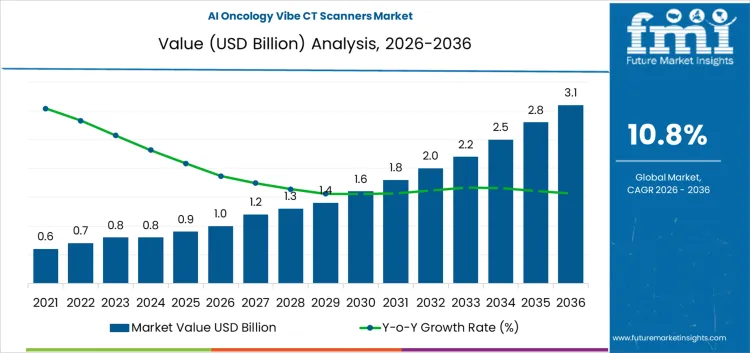
What is the Compound Annual Growth Rate (CAGR) for the AI Oncology Vibe CT Scanners Market through 2036?
The compound annual growth rate (CAGR) of 10.8% reflects the accelerating adoption of AI oncology Vibe CT scanners over the next decade. From USD 1.0 billion in 2026, the market will grow steadily, reaching USD 1.4 billion in 2028. This reflects the increasing integration of AI technology in cancer diagnosis, enhancing the efficiency and precision of CT scans in detecting tumors. The growth trajectory continues with gradual expansion, reaching USD 1.8 billion in 2030 and USD 2 billion in 2031.
By 2036, the market will reach USD 3.1 billion, driven by continuous technological advancements in AI and increasing demand for advanced medical imaging tools. The CAGR of 10.8% demonstrates the significant market potential of AI-powered CT scanners in oncology, as they become essential tools for healthcare providers striving to improve diagnostic accuracy and patient care in the fight against cancer.
AI Oncology Vibe CT Scanners Market Key Takeaways
| Metric | Value |
|---|---|
| Industry Sales Value (2026) | USD 1.0 billion |
| Industry Forecast Value (2036) | USD 3.1 billion |
| Industry Forecast CAGR (2026-2036) | 10.8% |
What Is Driving the AI Oncology Vibe CT Scanners Market?
Historically, the AI oncology Vibe CT scanners market developed as part of the broader evolution of CT imaging toward more advanced diagnostic capabilities in clinical practice. Conventional CT scanners delivered high resolution cross sectional images that were essential for diagnosing a wide range of conditions, including cancer, but interpretation heavily relied on human radiologists and manual workflow processes. The oncology segment of the CT market grew steadily with rising cancer incidence and the corresponding need for accurate tumor detection, staging, and treatment monitoring. CT systems improved over time with enhancements in slice count, image reconstruction, and dose reduction, enabling more detailed visualization of anatomical structures critical for oncology care. Traditional scanners lacked integrated artificial intelligence tools capable of automating lesion detection, segmentation, or workflow optimization, which limited throughput and introduced variability in interpretation. Early research and pilot deployments of AI enabled CT imaging focused on algorithms for tumor segmentation, characterization, and radiomics analysis, demonstrating improved accuracy and consistency compared with manual methods and laying the foundation for wider clinical integration. AI innovations helped radiologists detect intricate patterns and trends that could be missed by conventional imaging interpretation, establishing initial demand signals for AI enhanced CT solutions in oncology.
Future demand for AI oncology Vibe CT scanners is expected to be shaped by multiple concurrent growth drivers tied to clinical needs and healthcare trends. The increasing global prevalence of cancer continues to heighten demand for early, accurate, and efficient diagnostic imaging in hospitals and cancer centers, motivating adoption of advanced CT scanners that integrate AI powered tools to streamline workflows and improve diagnostic confidence. AI enabled capabilities such as automated protocol selection, intelligent reconstruction, and enhanced lesion detection reduce exam times and support consistent, high quality imaging outcomes, addressing provider and patient expectations for timeliness and precision. The broader AI in oncology diagnostics market is projected to grow rapidly as healthcare systems invest in technologies that improve early detection and personalized care, accelerating demand for AI integrated imaging modalities. Growth will also hinge on improvements in software algorithms, regulatory approvals of AI driven features, and the expansion of healthcare infrastructure, particularly in regions with rising cancer incidence and imaging demand. Barriers include the need for clinical validation, integration with existing hospital workflows, and ensuring consistent performance across diverse patient populations. Long term market expansion will depend on demonstrable evidence of improved outcomes, operational efficiency gains, and alignment between AI driven CT solutions and oncology care pathways.
What are the Key Segments in the AI Oncology Vibe CT Scanners Market?
The AI Oncology Vibe CT Scanners market is segmented into applications and end users. Application segments include oncology diagnosis & staging, tumor monitoring & treatment response, radiation therapy planning support, and research & clinical trials, with oncology diagnosis & staging accounting for 51% of the market share. End-user segments include cancer treatment centers, hospitals (diagnostic imaging units), specialty oncology clinics, and research & academic institutes, with cancer treatment centers holding the largest share at 43%. The market is driven by the growing demand for advanced imaging technologies to support the early detection, monitoring, and treatment of cancer. The integration of AI into CT scanning technologies enhances diagnostic accuracy, reduces interpretation time, and improves treatment planning. Key regions driving growth include North America, Europe, and Asia Pacific, where advancements in healthcare infrastructure and cancer care are increasing the adoption of AI-enhanced medical imaging.
What is Driving Growth in the Oncology Diagnosis & Staging Application?
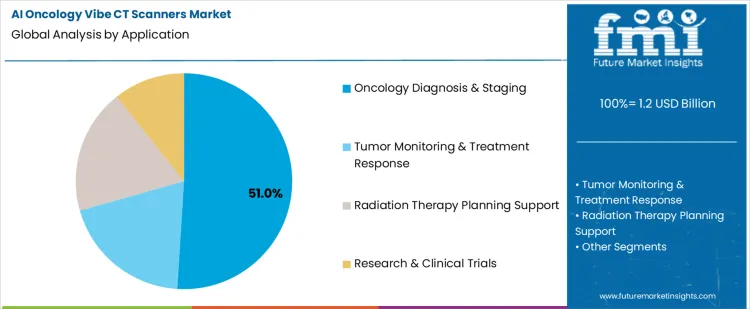
Oncology diagnosis & staging leads the application segment in the AI Oncology Vibe CT Scanners market, representing 51% of the market share. This growth is driven by the increasing need for early cancer detection and accurate staging, which are essential for effective treatment planning and improved patient outcomes. AI-enabled CT scanners significantly enhance the diagnostic capabilities by providing high-resolution imaging with better contrast and clarity, allowing clinicians to detect small tumors and identify cancerous tissues at earlier stages. Additionally, AI algorithms assist in automating the analysis and interpretation of CT scan images, reducing human error and improving diagnostic efficiency. As the global cancer burden continues to rise, the demand for advanced imaging technologies to support accurate diagnosis and staging is growing. AI-enabled CT scanners, with their ability to process large volumes of data quickly and identify subtle patterns in imaging, are becoming integral to oncology departments. The adoption of these advanced systems is particularly strong in regions like North America and Europe, where healthcare facilities are increasingly prioritizing the integration of AI into medical imaging to enhance precision and improve clinical decision-making.
What is Driving the Demand for Cancer Treatment Centers in the Market?
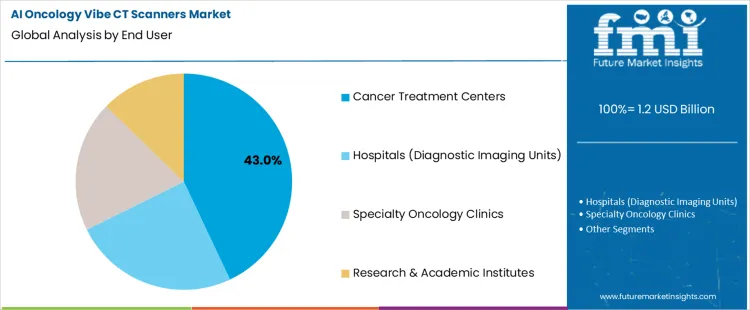
Cancer treatment centers represent the largest end-user segment in the AI Oncology Vibe CT Scanners market, holding 43% of the market share. This growth is primarily driven by the increasing focus on specialized cancer care and the need for advanced diagnostic and treatment planning tools. Cancer treatment centers require high-quality imaging technologies, such as AI-enabled CT scanners, to provide precise imaging for diagnosis, tumor monitoring, and radiation therapy planning. The ability of AI-driven CT scanners to deliver faster, more accurate results is critical in oncology, where timely and accurate imaging is essential for determining treatment strategies and assessing tumor response. The integration of AI also allows for better monitoring of treatment progress, enabling oncologists to adjust therapies based on real-time data. As cancer treatment centers expand globally and continue to adopt the latest technologies to enhance patient care, the demand for advanced imaging solutions like AI Oncology Vibe CT Scanners is expected to grow. Additionally, the increasing focus on personalized cancer treatment and precision medicine further fuels the demand for sophisticated imaging systems that can provide comprehensive insights into tumor behavior and treatment efficacy. This trend is particularly notable in regions such as North America and Asia Pacific, where significant investments are being made in cancer care infrastructure.
What are the Key Dynamics in the AI Oncology Vibe CT Scanners Market?
The AI oncology Vibe CT scanners market is experiencing growth due to the increasing demand for advanced diagnostic tools in cancer detection and treatment planning. Vibe CT scanners, integrated with artificial intelligence (AI) algorithms, provide enhanced imaging capabilities that improve the accuracy of cancer diagnosis, staging, and treatment planning. These scanners use AI to process imaging data faster, highlight areas of concern, and provide more precise insights, ultimately aiding oncologists in making informed decisions. The market is driven by advancements in both AI and medical imaging technology, as well as the growing prevalence of cancer worldwide. As healthcare systems push for improved diagnostic efficiency, better clinical outcomes, and reduced costs, the integration of AI into CT scanners is gaining traction. AI-powered oncology CT scanners can detect subtle tissue changes that may be missed by traditional methods, allowing for earlier and more accurate diagnoses.
What are the Key Drivers of Growth in the AI Oncology Vibe CT Scanners Market?
Several factors are driving the growth of the AI oncology Vibe CT scanners market. The primary driver is the rising prevalence of cancer globally, which is increasing the demand for faster, more accurate diagnostic tools. AI-powered CT scanners enable earlier detection of cancer, particularly in complex cases such as those involving small tumors or ambiguous lesions. These advanced scanners also enhance the precision of treatment planning, as they can identify the exact location and size of tumors, helping oncologists develop personalized treatment strategies. The increasing adoption of AI in healthcare, along with improvements in machine learning and deep learning technologies, is also fueling market growth. As AI algorithms continue to improve in accuracy and efficiency, they are becoming an essential part of medical imaging systems. Moreover, the push toward precision medicine and the need for more effective, personalized healthcare solutions are driving the demand for AI-enhanced diagnostic tools. Furthermore, healthcare systems are increasingly focused on reducing costs, and AI oncology Vibe CT scanners contribute by improving diagnostic workflow efficiency and reducing the need for repeat imaging.
What are the Key Restraints in the AI Oncology Vibe CT Scanners Market?
Despite the promising growth prospects, the AI oncology Vibe CT scanners market faces several challenges. One of the main restraints is the high cost of AI-powered medical imaging systems, which can be a significant barrier, particularly for smaller healthcare providers or institutions in developing regions. The initial investment required for these advanced technologies, including the cost of both the scanner and AI software, can be prohibitive. Additionally, the integration of AI into existing healthcare infrastructure can be complex and requires substantial training and technical support. Another challenge is the need for rigorous validation and regulatory approval for AI algorithms, which can delay the introduction of new AI-powered CT scanners to the market. While AI technologies are showing great promise, there is still a degree of uncertainty about their accuracy, especially in rare or complex cases. Concerns over the interpretability of AI-generated results and the potential for errors or biases in algorithms could also slow down adoption. Finally, data privacy and cybersecurity issues surrounding patient data are critical considerations, as AI systems rely on large amounts of patient information to function effectively.
What are the Key Trends in the AI Oncology Vibe CT Scanners Market?
Several key trends are shaping the AI oncology Vibe CT scanners market. One of the most prominent trends is the integration of AI with multi-modal imaging systems. AI algorithms are increasingly being used in conjunction with other imaging technologies, such as MRI, PET, and X-ray, to provide a more comprehensive view of a patient's condition, enhancing diagnostic accuracy and treatment planning. Another significant trend is the growing role of deep learning algorithms, which are improving the ability of AI systems to detect complex patterns in medical images, enabling more precise tumor detection and classification. The development of AI-driven solutions for real-time image analysis is also gaining traction, allowing radiologists to receive immediate feedback and accelerate diagnosis. Additionally, advancements in cloud-based platforms for healthcare are making it easier for healthcare providers to access AI-powered CT scanners, share patient data securely, and collaborate with specialists across various locations. As the healthcare industry continues to focus on precision medicine, AI oncology Vibe CT scanners are being integrated into personalized treatment workflows, supporting tailored therapies based on individual patient profiles. These trends are all contributing to the increasing adoption of AI oncology Vibe CT scanners, which are poised to revolutionize cancer diagnosis and treatment.
What is the Country-Wise Analysis of the AI Oncology Vibe CT Scanners Market?
The AI oncology vibe CT scanners market is experiencing growth due to the increasing use of artificial intelligence (AI) in medical imaging, particularly for the diagnosis and monitoring of cancer. AI-enabled CT scanners offer significant advantages, such as enhanced image quality, faster processing times, and improved accuracy in detecting tumors and other anomalies. This is crucial for oncologists, as early and precise diagnosis plays a key role in successful cancer treatment. Key countries such as the USA, China, Germany, Japan, and India are investing heavily in healthcare technologies, and AI-driven diagnostic tools are becoming a critical part of their medical infrastructure, driving the growth of the AI oncology vibe CT scanners market.
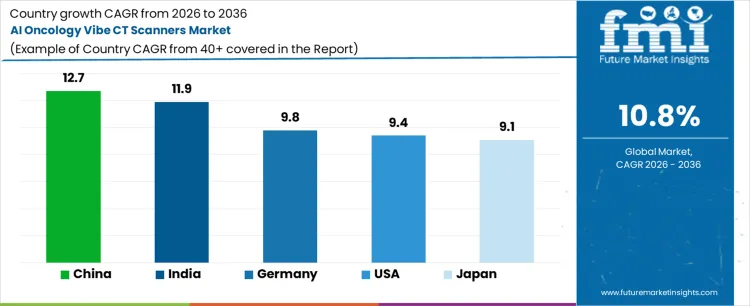
| Country | CAGR (%) |
|---|---|
| USA | 9.4 |
| China | 12.7 |
| Germany | 9.8 |
| Japan | 9.1 |
| India | 11.9 |
What is Driving the Growth of the AI Oncology Vibe CT Scanners Market in the USA?
The AI oncology vibe CT scanners market in the USA is growing at a CAGR of 9.4%. The USA has been a leader in adopting advanced healthcare technologies, with AI in medical imaging becoming an essential tool in the early diagnosis and monitoring of cancer. AI oncology vibe CT scanners are highly valued for their ability to analyze complex imaging data more accurately and quickly than traditional methods, which is crucial for improving cancer detection rates. With the growing incidence of cancer and the increasing demand for early and precise diagnosis, the USA’s healthcare sector is heavily investing in AI-based diagnostic solutions. Additionally, regulatory support and government incentives for healthcare innovation are contributing to the growth of this market.
How is the AI Oncology Vibe CT Scanners Market Performing in China?
China’s AI oncology vibe CT scanners market is growing at a CAGR of 12.7%, the highest among the countries analyzed. China’s growing healthcare infrastructure and its emphasis on modernizing medical technologies are driving the adoption of AI in oncology imaging. The demand for more accurate, timely, and cost-effective cancer diagnosis is pushing healthcare providers to adopt AI-enabled CT scanners. China’s increasing cancer burden and rising healthcare expenditures are also contributing to the demand for these advanced diagnostic tools. Furthermore, China’s government is prioritizing healthcare innovation and AI technologies, providing a favorable environment for the growth of AI oncology vibe CT scanners.
What Factors are Shaping the AI Oncology Vibe CT Scanners Market in Germany?
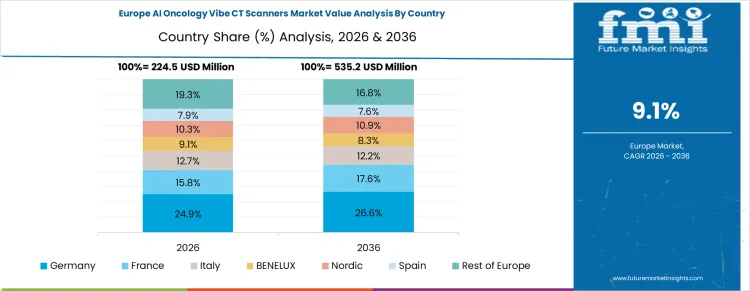
Germany’s AI oncology vibe CT scanners market is growing at a CAGR of 9.8%. Germany’s healthcare system is one of the most advanced in Europe, and there is a strong focus on integrating AI and other technologies to improve patient care, particularly in oncology. The increasing demand for faster and more accurate cancer diagnoses is driving the adoption of AI-powered CT scanners in German hospitals and clinics. As the prevalence of cancer rises, AI technologies that enhance diagnostic accuracy and speed are becoming essential tools in cancer care. Additionally, Germany’s strong research and development in medical technologies, along with a focus on improving healthcare delivery, are contributing to the market's growth.
How is the AI Oncology Vibe CT Scanners Market Evolving in Japan?
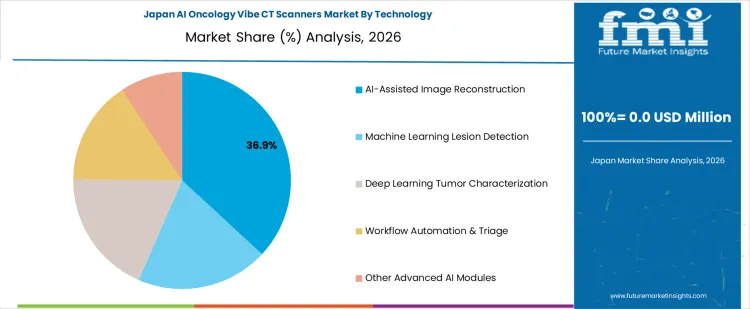
Japan’s AI oncology vibe CT scanners market is growing at a CAGR of 9.1%. Japan is one of the leading countries in healthcare innovation, with a growing emphasis on AI in medical diagnostics. The adoption of AI oncology vibe CT scanners is being driven by the country’s aging population and the increasing need for efficient cancer diagnosis and treatment. AI technology allows for quicker, more accurate imaging analysis, which is particularly important in early-stage cancer detection. As Japan continues to prioritize healthcare innovation and improve its cancer care infrastructure, the demand for AI-driven diagnostic tools such as vibe CT scanners is expected to rise steadily.
What is Contributing to the Growth of the AI Oncology Vibe CT Scanners Market in India?
India’s AI oncology vibe CT scanners market is growing at a CAGR of 11.9%, reflecting the country’s increasing focus on improving healthcare accessibility and quality. As the incidence of cancer continues to rise in India, there is a growing need for advanced diagnostic tools that provide quicker and more accurate results. AI-powered CT scanners are becoming integral to the healthcare sector, offering improved image processing and better detection of tumors. The demand for AI oncology vibe CT scanners is also being fueled by India’s ongoing efforts to modernize its healthcare infrastructure, improve early detection capabilities, and offer more affordable cancer care. The government’s focus on healthcare innovation and expanding access to advanced medical technologies is contributing to the market’s growth in India.
What is the Competitive Landscape for the AI Oncology Vibe CT Scanners Market?
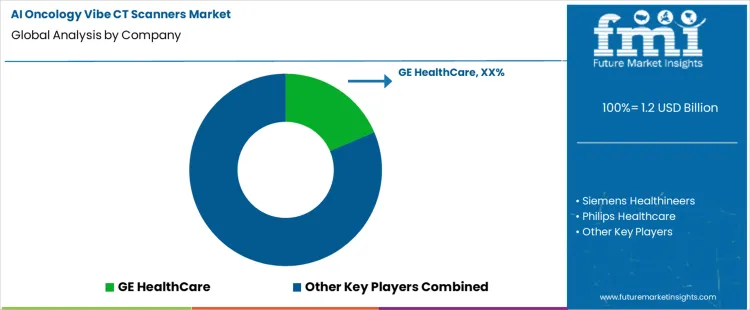
The AI oncology Vibe CT scanners market is experiencing rapid growth, driven by the increasing demand for advanced imaging technologies in cancer diagnostics. GE HealthCare is the market leader, offering AI-powered CT scanners specifically designed for oncology applications. The company’s Vibe CT scanners leverage artificial intelligence to enhance image resolution, reduce radiation exposure, and improve diagnostic accuracy, making them highly effective in detecting and monitoring various types of cancer. Siemens Healthineers is another major player, developing advanced AI-driven CT scanners that integrate deep learning algorithms to improve image quality and automate the detection of oncological conditions. Siemens focuses on enhancing workflow efficiency and supporting clinicians with AI-powered tools that facilitate faster, more accurate cancer detection. Philips Healthcare is also a key competitor, offering CT scanners with AI capabilities that enhance precision in oncology imaging, with features aimed at improving patient outcomes and minimizing imaging time. Canon Medical Systems brings advanced imaging solutions with AI-enhanced CT scanners designed for oncology, focusing on optimizing diagnostic processes and providing clear, accurate images. United Imaging Healthcare is positioning itself as a strong player in the market with innovative AI-integrated CT scanners that provide high-performance imaging and real-time diagnostics for oncology patients. These companies are driving the market forward with advanced technologies that improve the quality and speed of cancer diagnosis.
To stay competitive in the AI oncology Vibe CT scanners market, companies are prioritizing innovation, integration of AI algorithms, and improving user experience. GE HealthCare continues to enhance its AI oncology solutions, focusing on further improving image quality, diagnostic capabilities, and reducing scanning time. Siemens Healthineers is expanding its AI-powered CT scanners to offer more comprehensive imaging tools, integrating AI with advanced analytics to aid in clinical decision-making. Philips Healthcare is investing in AI technologies that optimize scan protocols, allowing for customized imaging solutions based on individual patient needs. Canon Medical Systems is advancing its AI capabilities to improve workflow, support precise diagnosis, and ensure high-quality results with less patient discomfort. United Imaging Healthcare is focusing on incorporating AI-driven features into its CT scanners to automate processes and improve the efficiency of oncology imaging. These strategies are positioning these companies to lead in the competitive AI oncology Vibe CT scanners market, where accuracy, speed, and AI integration are critical to advancing cancer diagnostics.
Key Players of the AI Oncology Vibe CT Scanners Market
- GE HealthCare
- Siemens Healthineers
- Philips Healthcare
- Canon Medical Systems
- United Imaging Healthcare
- Others
Scope of the Report
| Items | Values |
|---|---|
| Quantitative Units (2026) | USD Billion |
| Technology | AI-Assisted Image Reconstruction, Machine Learning Lesion Detection, Deep Learning Tumor Characterization, Workflow Automation & Triage, Other Advanced AI Modules |
| Application | Oncology Diagnosis & Staging, Tumor Monitoring & Treatment Response, Radiation Therapy Planning Support, Research & Clinical Trials |
| End User | Cancer Treatment Centers, Hospitals (Diagnostic Imaging Units), Specialty Oncology Clinics, Research & Academic Institutes |
| Companies | GE HealthCare, Siemens Healthineers, Philips Healthcare, Canon Medical Systems, United Imaging Healthcare, Others |
| Regions Covered | North America, Latin America, Western Europe, Eastern Europe, South Asia and Pacific, East Asia, Middle East & Africa |
| Countries Covered | United States, Canada, Mexico, Brazil, Argentina, Germany, France, United Kingdom, Italy, Spain, Netherlands, China, India, Japan, South Korea, ANZ, GCC Countries, South Africa |
| Additional Attributes | Dollar by sales by technology, application, end user, and region. Includes market trends towards AI advancements in oncology imaging, cost-effectiveness, regulatory compliance, and the role of AI-driven CT scanners in improving diagnostic accuracy and treatment planning in oncology. |
AI Oncology Vibe CT Scanners Market Segmentation
Technology:
- AI-Assisted Image Reconstruction
- Machine Learning Lesion Detection
- Deep Learning Tumor Characterization
- Workflow Automation & Triage
- Other Advanced AI Modules
Application:
- Oncology Diagnosis & Staging
- Tumor Monitoring & Treatment Response
- Radiation Therapy Planning Support
- Research & Clinical Trials
- Others
End User:
- Cancer Treatment Centers
- Hospitals (Diagnostic Imaging Units)
- Specialty Oncology Clinics
- Research & Academic Institutes
- Others
Region:
- Asia Pacific
- China
- Japan
- India
- Australia & New Zealand
- ASEAN
- Rest of Asia Pacific
- Europe
- Germany
- United Kingdom
- France
- Italy
- Spain
- Nordic
- BENELUX
- Rest of Europe
- North America
- United States
- Canada
- Mexico
- Latin America
- Brazil
- Argentina
- Rest of Latin America
- Middle East & Africa
- Kingdom of Saudi Arabia
- Other GCC Countries
- South Africa
- Rest of Middle East & Africa
Bibliography
- World Health Organization. (2024, February 1). Global cancer burden growing, amidst mounting need for services. World Health Organization.
- U.S. Food and Drug Administration. (2025, December 5). Artificial intelligence-enabled medical devices. Food and Drug Administration.
- U.S. Food and Drug Administration. (2025, August). Marketing submission recommendations for a predetermined change control plan for artificial intelligence-enabled device software functions: Guidance for industry and Food and Drug Administration staff. Food and Drug Administration.
- National Institute of Standards and Technology. (2023). Artificial intelligence risk management framework (AI RMF 1.0) (NIST AI 100-1). National Institute of Standards and Technology.
Frequently Asked Questions
How big is the AI oncology vibe CT scanners market in 2026?
The global AI oncology vibe CT scanners market is estimated to be valued at USD 1.0 billion in 2026.
What will be the size of AI oncology vibe CT scanners market in 2036?
The market size for the AI oncology vibe CT scanners market is projected to reach USD 3.1 billion by 2036.
How much will be the AI oncology vibe CT scanners market growth between 2026 and 2036?
The AI oncology vibe CT scanners market is expected to grow at a 10.8% CAGR between 2026 and 2036.
What are the key product types in the AI oncology vibe CT scanners market?
The key product types in AI oncology vibe CT scanners market are ai-assisted image reconstruction, machine learning lesion detection, deep learning tumor characterization, workflow automation & triage and other advanced ai modules.
Which application segment to contribute significant share in the AI oncology vibe CT scanners market in 2026?
In terms of application, oncology diagnosis & staging segment to command 51.0% share in the AI oncology vibe CT scanners market in 2026.
Preview the report firsthand - request a free sample
Get SampleGet the brochure for pricing and purchase details.
Get PDFTable of Content
- Executive Summary
- Global Market Outlook
- Demand-side Trends
- Supply-side Trends
- Technology Roadmap Analysis
- Analysis and Recommendations
- Market Overview
- Market Coverage / Taxonomy
- Market Definition / Scope / Limitations
- Market Background
- Market Dynamics
- Drivers
- Restraints
- Opportunity
- Trends
- Scenario Forecast
- Demand in Optimistic Scenario
- Demand in Likely Scenario
- Demand in Conservative Scenario
- Opportunity Map Analysis
- Product Life Cycle Analysis
- Supply Chain Analysis
- Investment Feasibility Matrix
- Value Chain Analysis
- PESTLE and Porter’s Analysis
- Regulatory Landscape
- Regional Parent Market Outlook
- Production and Consumption Statistics
- Import and Export Statistics
- Market Dynamics
- Global Market Analysis 2021 to 2025 and Forecast, 2026 to 2036
- Historical Market Size Value (USD Million) Analysis, 2021 to 2025
- Current and Future Market Size Value (USD Million) Projections, 2026 to 2036
- Y-o-Y Growth Trend Analysis
- Absolute $ Opportunity Analysis
- Global Market Pricing Analysis 2021 to 2025 and Forecast 2026 to 2036
- Global Market Analysis 2021 to 2025 and Forecast 2026 to 2036, By Technology
- Introduction / Key Findings
- Historical Market Size Value (USD Million) Analysis By Technology , 2021 to 2025
- Current and Future Market Size Value (USD Million) Analysis and Forecast By Technology , 2026 to 2036
- AI-Assisted Image Reconstruction
- Machine Learning Lesion Detection
- Deep Learning Tumor Characterization
- Workflow Automation & Triage
- Other Advanced AI Modules
- AI-Assisted Image Reconstruction
- Y-o-Y Growth Trend Analysis By Technology , 2021 to 2025
- Absolute $ Opportunity Analysis By Technology , 2026 to 2036
- Global Market Analysis 2021 to 2025 and Forecast 2026 to 2036, By Application
- Introduction / Key Findings
- Historical Market Size Value (USD Million) Analysis By Application, 2021 to 2025
- Current and Future Market Size Value (USD Million) Analysis and Forecast By Application, 2026 to 2036
- Oncology Diagnosis & Staging
- Tumor Monitoring & Treatment Response
- Radiation Therapy Planning Support
- Research & Clinical Trials
- Oncology Diagnosis & Staging
- Y-o-Y Growth Trend Analysis By Application, 2021 to 2025
- Absolute $ Opportunity Analysis By Application, 2026 to 2036
- Global Market Analysis 2021 to 2025 and Forecast 2026 to 2036, By End User
- Introduction / Key Findings
- Historical Market Size Value (USD Million) Analysis By End User, 2021 to 2025
- Current and Future Market Size Value (USD Million) Analysis and Forecast By End User, 2026 to 2036
- Cancer Treatment Centers
- Hospitals (Diagnostic Imaging Value (USD Million)s)
- Specialty Oncology Clinics
- Research & Academic Institutes
- Cancer Treatment Centers
- Y-o-Y Growth Trend Analysis By End User, 2021 to 2025
- Absolute $ Opportunity Analysis By End User, 2026 to 2036
- Global Market Analysis 2021 to 2025 and Forecast 2026 to 2036, By Region
- Introduction
- Historical Market Size Value (USD Million) Analysis By Region, 2021 to 2025
- Current Market Size Value (USD Million) Analysis and Forecast By Region, 2026 to 2036
- North America
- Latin America
- Western Europe
- Eastern Europe
- East Asia
- South Asia and Pacific
- Middle East & Africa
- Market Attractiveness Analysis By Region
- North America Market Analysis 2021 to 2025 and Forecast 2026 to 2036, By Country
- Historical Market Size Value (USD Million) Trend Analysis By Market Taxonomy, 2021 to 2025
- Market Size Value (USD Million) Forecast By Market Taxonomy, 2026 to 2036
- By Country
- USA
- Canada
- Mexico
- By Technology
- By Application
- By End User
- By Country
- Market Attractiveness Analysis
- By Country
- By Technology
- By Application
- By End User
- Key Takeaways
- Latin America Market Analysis 2021 to 2025 and Forecast 2026 to 2036, By Country
- Historical Market Size Value (USD Million) Trend Analysis By Market Taxonomy, 2021 to 2025
- Market Size Value (USD Million) Forecast By Market Taxonomy, 2026 to 2036
- By Country
- Brazil
- Chile
- Rest of Latin America
- By Technology
- By Application
- By End User
- By Country
- Market Attractiveness Analysis
- By Country
- By Technology
- By Application
- By End User
- Key Takeaways
- Western Europe Market Analysis 2021 to 2025 and Forecast 2026 to 2036, By Country
- Historical Market Size Value (USD Million) Trend Analysis By Market Taxonomy, 2021 to 2025
- Market Size Value (USD Million) Forecast By Market Taxonomy, 2026 to 2036
- By Country
- Germany
- UK
- Italy
- Spain
- France
- Nordic
- BENELUX
- Rest of Western Europe
- By Technology
- By Application
- By End User
- By Country
- Market Attractiveness Analysis
- By Country
- By Technology
- By Application
- By End User
- Key Takeaways
- Eastern Europe Market Analysis 2021 to 2025 and Forecast 2026 to 2036, By Country
- Historical Market Size Value (USD Million) Trend Analysis By Market Taxonomy, 2021 to 2025
- Market Size Value (USD Million) Forecast By Market Taxonomy, 2026 to 2036
- By Country
- Russia
- Poland
- Hungary
- Balkan & Baltic
- Rest of Eastern Europe
- By Technology
- By Application
- By End User
- By Country
- Market Attractiveness Analysis
- By Country
- By Technology
- By Application
- By End User
- Key Takeaways
- East Asia Market Analysis 2021 to 2025 and Forecast 2026 to 2036, By Country
- Historical Market Size Value (USD Million) Trend Analysis By Market Taxonomy, 2021 to 2025
- Market Size Value (USD Million) Forecast By Market Taxonomy, 2026 to 2036
- By Country
- China
- Japan
- South Korea
- By Technology
- By Application
- By End User
- By Country
- Market Attractiveness Analysis
- By Country
- By Technology
- By Application
- By End User
- Key Takeaways
- South Asia and Pacific Market Analysis 2021 to 2025 and Forecast 2026 to 2036, By Country
- Historical Market Size Value (USD Million) Trend Analysis By Market Taxonomy, 2021 to 2025
- Market Size Value (USD Million) Forecast By Market Taxonomy, 2026 to 2036
- By Country
- India
- ASEAN
- Australia & New Zealand
- Rest of South Asia and Pacific
- By Technology
- By Application
- By End User
- By Country
- Market Attractiveness Analysis
- By Country
- By Technology
- By Application
- By End User
- Key Takeaways
- Middle East & Africa Market Analysis 2021 to 2025 and Forecast 2026 to 2036, By Country
- Historical Market Size Value (USD Million) Trend Analysis By Market Taxonomy, 2021 to 2025
- Market Size Value (USD Million) Forecast By Market Taxonomy, 2026 to 2036
- By Country
- Kingdom of Saudi Arabia
- Other GCC Countries
- Turkiye
- South Africa
- Other African Union
- Rest of Middle East & Africa
- By Technology
- By Application
- By End User
- By Country
- Market Attractiveness Analysis
- By Country
- By Technology
- By Application
- By End User
- Key Takeaways
- Key Countries Market Analysis
- USA
- Pricing Analysis
- Market Share Analysis, 2025
- By Technology
- By Application
- By End User
- Canada
- Pricing Analysis
- Market Share Analysis, 2025
- By Technology
- By Application
- By End User
- Mexico
- Pricing Analysis
- Market Share Analysis, 2025
- By Technology
- By Application
- By End User
- Brazil
- Pricing Analysis
- Market Share Analysis, 2025
- By Technology
- By Application
- By End User
- Chile
- Pricing Analysis
- Market Share Analysis, 2025
- By Technology
- By Application
- By End User
- Germany
- Pricing Analysis
- Market Share Analysis, 2025
- By Technology
- By Application
- By End User
- UK
- Pricing Analysis
- Market Share Analysis, 2025
- By Technology
- By Application
- By End User
- Italy
- Pricing Analysis
- Market Share Analysis, 2025
- By Technology
- By Application
- By End User
- Spain
- Pricing Analysis
- Market Share Analysis, 2025
- By Technology
- By Application
- By End User
- France
- Pricing Analysis
- Market Share Analysis, 2025
- By Technology
- By Application
- By End User
- India
- Pricing Analysis
- Market Share Analysis, 2025
- By Technology
- By Application
- By End User
- ASEAN
- Pricing Analysis
- Market Share Analysis, 2025
- By Technology
- By Application
- By End User
- Australia & New Zealand
- Pricing Analysis
- Market Share Analysis, 2025
- By Technology
- By Application
- By End User
- China
- Pricing Analysis
- Market Share Analysis, 2025
- By Technology
- By Application
- By End User
- Japan
- Pricing Analysis
- Market Share Analysis, 2025
- By Technology
- By Application
- By End User
- South Korea
- Pricing Analysis
- Market Share Analysis, 2025
- By Technology
- By Application
- By End User
- Russia
- Pricing Analysis
- Market Share Analysis, 2025
- By Technology
- By Application
- By End User
- Poland
- Pricing Analysis
- Market Share Analysis, 2025
- By Technology
- By Application
- By End User
- Hungary
- Pricing Analysis
- Market Share Analysis, 2025
- By Technology
- By Application
- By End User
- Kingdom of Saudi Arabia
- Pricing Analysis
- Market Share Analysis, 2025
- By Technology
- By Application
- By End User
- Turkiye
- Pricing Analysis
- Market Share Analysis, 2025
- By Technology
- By Application
- By End User
- South Africa
- Pricing Analysis
- Market Share Analysis, 2025
- By Technology
- By Application
- By End User
- USA
- Market Structure Analysis
- Competition Dashboard
- Competition Benchmarking
- Market Share Analysis of Top Players
- By Regional
- By Technology
- By Application
- By End User
- Competition Analysis
- Competition Deep Dive
- GE HealthCare
- Overview
- Product Portfolio
- Profitability by Market Segments (Product/Age /Sales Channel/Region)
- Sales Footprint
- Strategy Overview
- Marketing Strategy
- Product Strategy
- Channel Strategy
- Siemens Healthineers
- Philips Healthcare
- Canon Medical Systems
- Value (USD Million)ed Imaging Healthcare
- Others
- GE HealthCare
- Competition Deep Dive
- Assumptions & Acronyms Used
- Research Methodology


