

- Market Size (2026)
- USD 903.2 Mn
- Forecast (2036)
- USD 2805.1 Mn
- CAGR (2026 to 2036)
- 12.0%
How big is AI-Driven Cardiac Diagnostics Market in 2026?
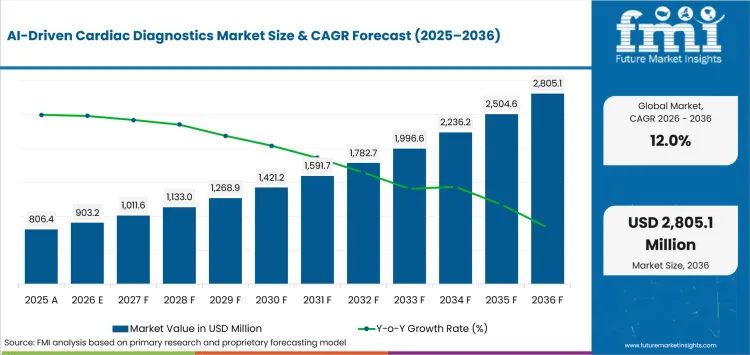
USD 903.2 million in 2026 and USD 2,805.1 million by 2036 at a 12.0% CAGR
Sales in AI-driven cardiac diagnostics market are projected to push valuation from USD 903.2 million in 2026 to USD 2,805.1 million by 2036, expanding at a 12.0% CAGR, supported by clinical demand for earlier risk identification and shorter interpretation cycles. The World Health Organization reported in July 2025 that cardiovascular diseases caused 19.8 million deaths in 2022. The burden gives health systems a clear reason to evaluate tools that can sort urgent ECG and imaging findings without creating a separate review queue. Related investment in cardiac monitoring and cardiac rhythm management devices provides the equipment base that these algorithms need.
The United States combines broad reimbursement pathways with high diagnostic spending, whereas Japan places more weight on older patients and limited specialist capacity. The American Heart Association reported in January 2025 that direct and indirect cardiovascular disease costs reached USD 417.9 billion during 2020 and 2021. A hospital deployment still depends on clean signal capture, structured image transfer, and a defined escalation route for uncertain findings. Operational discipline gives AI output commercial value after a clinician can review it inside the normal diagnostic record. Demand for artificial intelligence in healthcare gives vendors a broader integration route beyond a single cardiac application.
Key Takeaways of AI-Driven Cardiac Diagnostics Market
- Demand for AI-driven cardiac diagnostics is driven by clinical workload and cardiovascular disease burden, with the market projected to rise from USD 903.2 million in 2026 to USD 2,805.1 million by 2036 at a 12.0% CAGR.
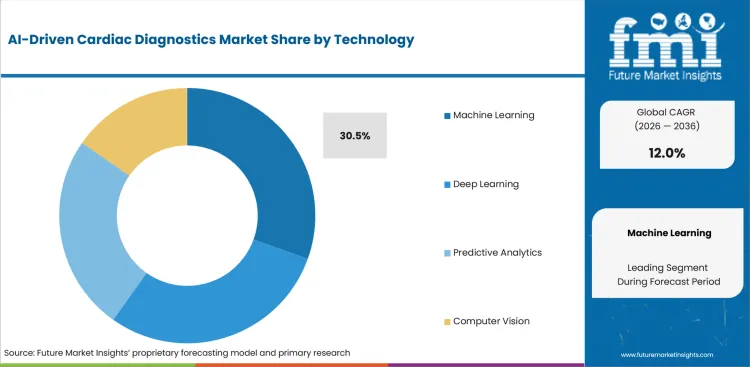
- By technology, machine learning is expected to lead with 30.5% share in 2026, supported by its use across classification and risk models.
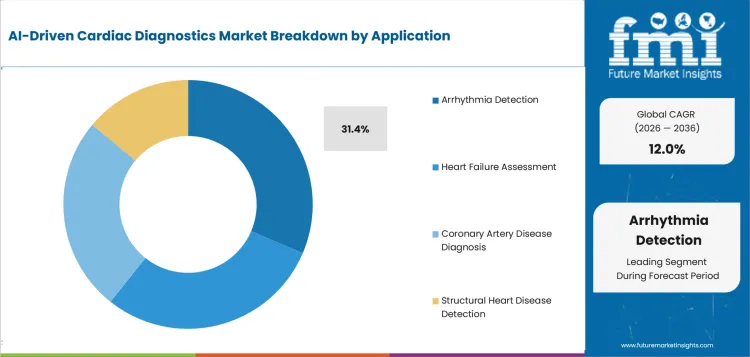
- Arrhythmia detection is the dominant application segment, projected to hold 31.4% share in 2026, attributable to repeatable ECG data and high review volume.
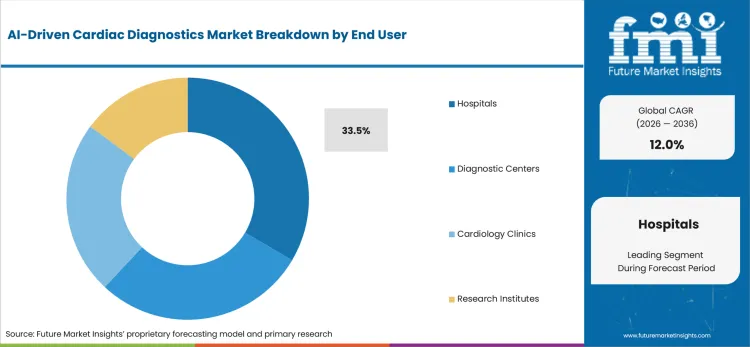
- Hospitals are estimated to retain the leading end-user position with 33.5% share in 2026, owing to specialist teams and connected diagnostic systems.
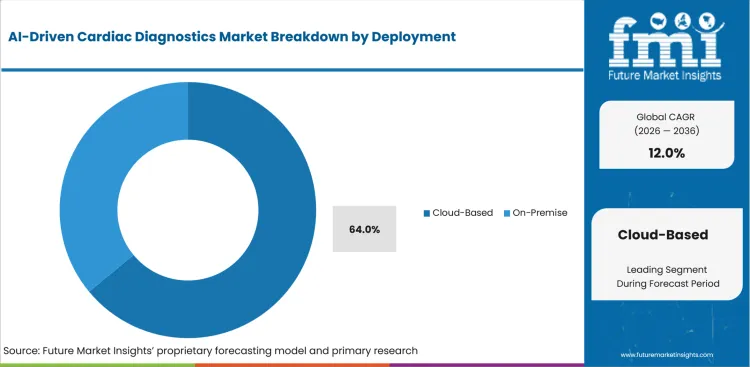
- Cloud-based deployment is anticipated to retain 64.0% share in 2026, reinforced by multi-site access and controlled software updates.
- South Korea and the United States are expected to lead growth at 13.4% and 12.8% CAGR respectively through 2036, supported by connected hospital networks and active reimbursement pathways.
- Competition centers on GE HealthCare, Philips, Siemens Healthineers, Eko Health, AliveCor, Tempus AI, Cardiologs, Heartflow, Cleerly, and Viz.ai, with vendors differentiating through imaging integration, ECG/acoustic signal analysis, coronary CT analysis, and care-coordination platforms.
Analyst Perspective
"The AI-driven cardiac diagnostics market is moving beyond algorithm performance toward clinical integration and measurable care outcomes. Healthcare providers are assessing whether AI improves diagnostic confidence while fitting into established clinical workflows without increasing reporting complexity or review burden. Adoption will continue to depend on clinical validation, physician acceptance, data governance, and evidence that AI delivers consistent value across routine patient populations rather than selected pilot cases."
-Anurag Sharma, Principal Analyst at Future Market Insights
How is the AI-Driven Cardiac Diagnostics Market segmented?
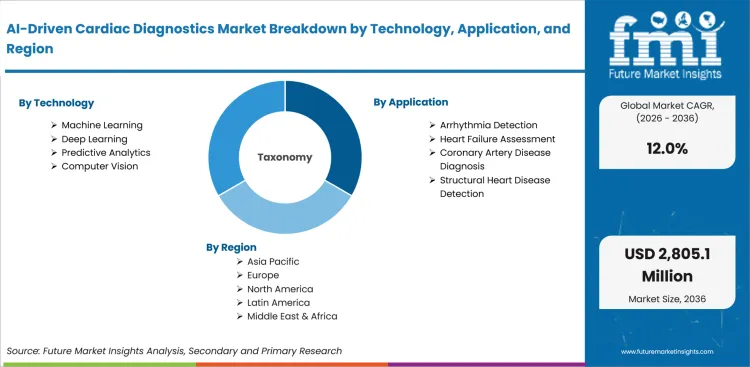
The AI-driven cardiac diagnostics industry is segmented by technology, application, end user, deployment, and region.
The segmentation separates the algorithm method from the clinical task, purchasing setting, and delivery model. Technology analysis covers machine learning, deep learning, predictive analytics, and computer vision methods used in cardiac diagnostics. Application analysis follows arrhythmia detection, heart failure assessment, coronary artery disease diagnosis, and structural heart disease detection. End-user categories distinguish hospitals from diagnostic centers, cardiology clinics, and research institutes. Deployment analysis compares cloud-based access with on-premise control across hospital and diagnostic network environments worldwide. The framework helps readers separate software capability from the care setting that pays for it. The final distinction matters because remote electrocardiogram monitoring can use similar algorithms through a different operating model.
What supports demand for Machine Learning within the Technology category?
AliveCor reported in January 2025 that its Kardia 12L system produced results comparable with a standard 12-lead ECG for several morphology classes. The device uses proprietary machine-learning software to assess 35 cardiac determinations from a reduced lead set. The development shows why buyers look beyond an algorithm label and examine the quality of the input signal, the intended diagnostic claim, and the evidence collected against routine clinical equipment.
- Machine Learning is projected to account for 30.5% share in the 2026, supported by broad use in ECG classification, image measurement, and risk scoring. The position reflects a practical software layer that can operate across several cardiac tests without requiring the same network design for every application.
- Cardiology departments are purchasing machine-learning functions for repeatable tasks, driven by the need to shorten review time and identify records that deserve specialist attention. The same tools still require local validation against the hospital population, since performance can change with recording devices, referral patterns, and disease prevalence.
How does Arrhythmia Detection shape demand within the Application category?
Tempus AI reported in June 2026 that a multi-center validation of its ECG-AF model was published in Heart Rhythm. The software estimates one-year atrial fibrillation risk from a standard clinical ECG. The development connects arrhythmia analysis with preventive follow-up rather than limiting software use to one-time rhythm classification. Health systems can use that evidence to identify patients for additional monitoring, but the workflow must explain who receives the alert and how the result changes care.
- Arrhythmia Detection is estimated to represent 31.4% share in the 2026 base year, attributable to the volume and repeatability of ECG data. Automated screening can reduce normal recordings that require full manual review while preserving a clear path for uncertain or urgent events.
- Electrophysiology teams and ambulatory monitoring services are increasing purchase activity, owing to longer recording periods and the need to review more rhythm events without matching growth in specialist time. Demand remains tied to low false-alert rates because excessive notifications can erase the labor benefit that supports the investment.
What makes Hospitals central to the End User category?
Hospital are dominant end user segment as inpatient and outpatient teams control large volumes of ECG, ultrasound, CT, and MR data through connected clinical systems. The same data layer can extend into cardiovascular ultrasound workflows that require consistent measurements across sites Viz.ai reported in January 2026 that its platform had expanded to nearly 2,000 United States hospitals and supported care for more than 230 million lives. The scale illustrates how hospital networks can spread a validated diagnostic workflow across several sites once governance and integration are established..
- By 2036, Hospitals are forecast to retain their 33.5% share position from 2026, owing to their concentration of cardiac specialists and diagnostic equipment. Access to laboratory, imaging, and patient-history data gives clinical teams a practical basis for controlled deployment. Staff can compare algorithm output with those records before acting on a result in routine care.
- Hospital cardiology and radiology departments favor platforms that integrate with existing records, reinforced by the need to preserve accountability across screening, interpretation, and referral. A common installation can support several care sites under one validation standard. The purchasing case improves through a documented escalation process that keeps clinical accountability clear.
How do health systems evaluate Cloud-Based deployment?
Philips announced in November 2025 that its FDA-cleared Cardiovascular Workspace included cloud-hosted availability and Software-as-a-Service deployment. The release connected cardiac imaging information with automated analysis, documentation, and reporting. Cloud delivery can reduce local server work and make updates easier across a health network. The model still requires clear rules for data location, access controls, downtime, and the clinical review of software changes.
- Between 2026 and 2036, Cloud-Based deployment is projected to retain its 64.0% share position from 2026, reinforced by multi-site access and centralized software maintenance. The share reflects a market in which hospitals and diagnostic networks need to deploy the same approved workflow without rebuilding infrastructure at every location.
- Multi-hospital systems and diagnostic service providers are drawing attention to cloud delivery, supported by the need for shared cardiac records and consistent software versions. Contract value depends on uptime, data portability, and integration support because a low subscription price cannot offset an interruption in a time-sensitive diagnostic pathway.
What are the drivers, restraints, and opportunities in the AI-Driven Cardiac Diagnostics Market?
A 12.0% CAGR from 2026 to 2036 is supported by wider clinical deployment; evidence and integration demands can slow procurement; reimbursement and cloud delivery create practical commercial openings.
- Driver: Cardiac departments need faster interpretation across growing ECG and imaging volumes without weakening clinical accountability.
- Restraint: Algorithm performance can vary across patient groups, devices, and clinical settings that differ from the development data.
- Opportunity: Reimbursement and multi-site delivery can turn validated diagnostic tools into recurring clinical service pathways.
A factor supporting growth is the movement of AI functions into normal cardiac equipment and reporting workflows. GE HealthCare announced in August 2025 that its ESC portfolio included AI-supported echo measurements, cardiac CT analysis, and coronary imaging functions. The company stated that one CT platform could reduce scan time by up to 50%. Faster acquisition and structured reporting can raise equipment use, but hospitals still need evidence that the complete workflow improves diagnostic decisions. portable cardiology ultrasound systems provide another route for wider access.
A factor limiting growth is the evidence burden attached to changing software. The United States Food and Drug Administration issued draft guidance in January 2025 covering lifecycle management and marketing submissions for AI-enabled device software functions. The guidance places specific attention on data management, validation, transparency, and planned software changes throughout the product lifecycle. Cardiac developers must show that performance remains acceptable across the intended population and equipment mix. Poor generalization can create false reassurance or unnecessary alerts, which makes procurement teams cautious about scaling a pilot. clinical AI model governance is becoming a defined part of hospital purchasing and software oversight decisions.
An emerging opportunity is payment for diagnostic support that fits routine outpatient care. Eko Health reported in December 2025 that the final outpatient payment rule established national reimbursement for AI-assisted cardiac analysis through its SENSORA platform. Reimbursement gives hospital-associated clinics a clearer way to connect clinical use with sustainable service revenue. Commercial expansion still depends on staff training and appropriate referral pathways. Vendors that combine evidence with implementation support can move beyond isolated device sales and build recurring service relationships across continuous cardiac monitoring devices and related workflows.
Which country CAGRs are profiled in the AI-driven Cardiac Diagnostics Market?
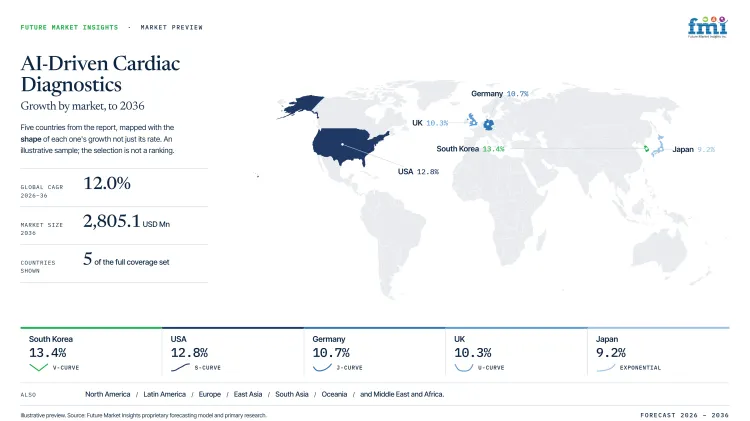
| Country | CAGR |
|---|---|
| USA | 12.8% |
| UK | 10.3% |
| Germany | 10.7% |
| Japan | 9.2% |
| South Korea | 13.4% |
How do country-level CAGRs compare in the AI-driven Cardiac Diagnostics Market?
The country range reaches 4.2 percentage points and divides into two clear clusters. South Korea and the USA remain closely aligned through connected hospitals and established commercial deployment routes. Germany and the UK form a compressed middle group shaped by public-system evidence requirements. Japan occupies a measured lower position owing to careful local validation and equipment integration.
- South Korea scales validated software across digitally connected hospitals using structured diagnostic and rhythm data.
- The USA combines reimbursement pathways with broad ECG and imaging infrastructure across large health systems.
- Germany requires interoperability and German-language implementation before algorithms enter routine diagnostic records across hospital networks.
- UK purchasing depends on documented service improvement and a clear route from alerts to specialist review.
- Japan prioritizes transparent output and local clinical evidence for hospitals managing substantial cardiac assessment volumes.
Similar growth rates still create different sales cycles because payment rules and workflow ownership vary materially. Suppliers must align validation plans with referral processes and established diagnostic equipment across each country. The full report provides country-level CAGR analysis across North America, Latin America, Europe, East Asia, South Asia, Oceania and the Middle East and Africa.
Country-wise Analysis
- Large health systems can connect ECG and imaging algorithms with established cardiology service lines and payment processes. The USA is projected to grow at 12.8% CAGR by 2036, supported by active reimbursement pathways and a broad installed base of diagnostic equipment. The American Heart Association reported in January 2026 that cardiovascular disease caused 915,973 deaths in the country during 2023. The burden keeps earlier detection on executive agendas. Cardiology directors can justify investment after a platform shortens review time and documents completed follow-up at scale. Supplier selection should focus on evidence for the intended population and integration with the health system record.
- Public healthcare purchasing places a clear value on evidence that a tool improves access without creating another isolated workflow. Clinical teams must first connect the algorithm to local referral and diagnostic pathways. AI-driven cardiac diagnostics demand in the UK is forecast to rise at 10.3% CAGR over the forecast period, attributable to pressure on cardiac services and structured national data. The Office for Health Improvement and Disparities reported in December 2025 that premature coronary heart disease mortality in England fell to 39.1 per 100,000 during 2024. The remaining burden supports targeted screening. NHS organizations should require a clear service impact and a workable route from alert to specialist review.
- Germany is building the data infrastructure needed to connect diagnostic results across care settings. The electronic patient record can improve access to prior findings and reduce repeated information gathering. Adoption of AI-driven cardiac diagnostics is estimated to expand at 10.7% CAGR through 2036, reinforced by hospital digitalization and formal interoperability requirements. The Federal Ministry of Health reported in January 2025 that about 300 practices, pharmacies, and hospitals joined the first electronic patient record pilot regions. Cardiology departments can use that foundation to place structured AI findings in a broader record. Vendors need strong interoperability and German-language implementation support to convert technical approval into routine use.
- An older population raises the volume of cardiac assessment while specialist time remains a constrained clinical resource. Japan is estimated to post 9.2% CAGR during the forecast period, shaped by demand for consistent review and careful integration with established equipment. The Cabinet Office of Japan reported in June 2025 that 29.3% of the population was aged 65 or older during 2024. The demographic structure supports tools that help clinicians prioritize risk across high testing volumes. Japanese hospitals are likely to favor systems with transparent output and reliable service. Suppliers must demonstrate performance on local data and provide a deployment model that fits existing clinical operations.
- Connected hospital networks and strong digital infrastructure create a practical route for scaling validated cardiac software. Between 2026 and 2036, the South Korea market sector is projected to record 13.4% CAGR, driven by structured clinical data and interest in earlier disease detection. The Korea Disease Control and Prevention Agency reported in October 2025 that the 2024 heart-disease mortality rate reached 65.7 per 100,000 people. The figure supports investment in risk finding and faster referral. University hospitals and national medical centers can test algorithms across large datasets. Connected wearable medical devices can supply longitudinal rhythm data for selected pathways. Commercial success depends on local evidence and integration with established hospital information systems.
Who are the notable companies in the AI-Driven Cardiac Diagnostics Market?
GE HealthCare, Philips, Siemens Healthineers, Eko Health, Heartflow, AliveCor, Tempus AI, Viz.ai, Cleerly, and Cardiologs (Philips) are the notable companies profiled in this market.
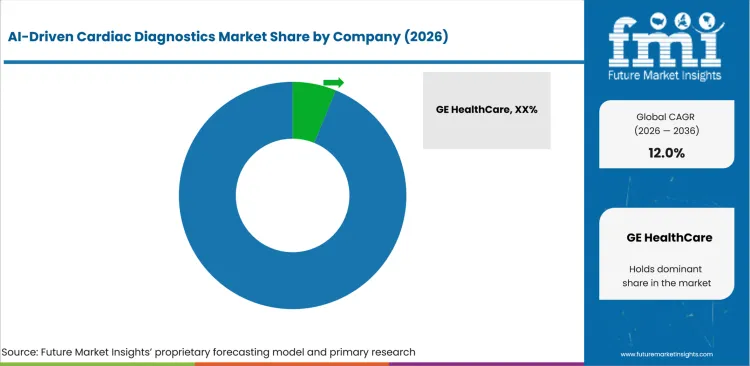
Competition spans integrated equipment companies and focused software developers. GE HealthCare, Philips, and Siemens Healthineers can place cardiac analysis inside imaging and enterprise systems. Eko Health, AliveCor, Tempus AI, and Cardiologs (Philips) focus on cardiac sounds or ECG data. Heartflow and Cleerly analyze coronary CT images, whereas Viz.ai connects detection with care coordination. Buyers should compare clinical evidence and integration effort by use case rather than treating every product as a substitute. Demand for a cardiovascular enterprise viewer can strengthen the value of tools that deliver results across departments.
- Integrated imaging platforms such as GE HealthCare, Philips, and Siemens Healthineers combine cardiac imaging analysis with equipment and reporting systems. Their commercial advantage comes from established service teams and installed systems, but hospitals still need to test whether each AI function improves a defined diagnostic decision.
- Signal-analysis specialists like Eko Health, AliveCor, Tempus AI, and Cardiologs (Philips) apply software to heart sounds or ECG records. Focused signal-analysis companies compete through narrow diagnostic claims, workflow speed, and implementation support inside cardiology services. Their products require clear escalation rules because an alert has limited value without a named clinical response.
- Heartflow and Cleerly quantify coronary physiology or plaque from CT data. The products can extend the value of a CCTA examination through structured measurements. Adoption depends on scan quality, reimbursement, and the ability to return findings in time for the next clinical decision.
- Viz.ai links disease detection with notifications and follow-up workflows across multi-site health systems in real time. The model can shorten the gap between an abnormal result and specialist action. Hospitals should measure alert acceptance and completed follow-up because software use alone does not prove an improvement in diagnosis.
Competitive Benchmarking: AI-Driven Cardiac Diagnostics Market
| Company | ECG and Acoustic Analysis | Cardiac Imaging Analysis | Clinical Workflow Integration | Cloud Delivery | Geographic Reach |
|---|---|---|---|---|---|
| GE HealthCare | High | High | High | Medium | Global |
| Philips | High | High | High | High | Global |
| Siemens Healthineers | Low | High | High | Medium | Global |
| Eko Health | High | Low | Medium | High | United States and selected international markets |
| Heartflow | Low | High | Medium | High | North America, Europe, and Asia-Pacific |
| AliveCor | High | Low | Medium | High | North America, Europe, and India |
| Tempus AI | High | Low | Medium | High | United States |
| Viz.ai | Medium | Medium | High | High | North America |
| Cleerly | Low | High | Medium | High | United States and selected international markets |
| Cardiologs (Philips) | High | Low | Medium | High | Global through Philips |
Key Developments in the AI-Driven Cardiac Diagnostics Market
- In July 2025, Heartflow released DECIDE Registry findings showing that its AI-enabled plaque analysis changed medical management for more than half of evaluated patients beyond coronary CT angiography alone. The result gives cardiology teams a concrete measure of clinical impact. It supports purchasing discussions that connect quantitative plaque findings with medication decisions and follow-up rather than treating the software as a separate image-processing step.
- In September 2025, Cleerly announced that UnitedHealthcare and Cigna coverage policies for its AI-based coronary plaque analysis would take effect on October 1, 2025. The coverage expands the number of patients who can access quantitative CCTA assessment. Commercial value depends on whether providers can integrate ordering, analysis, and results into established chest-pain and preventive cardiology pathways.
- In July 2025, Tempus AI received FDA 510(k) clearance for ECG-Low EF software that analyzes clinical 12-lead ECG recordings for signs associated with low left ventricular ejection fraction. The clearance added a second ECG-AI device to the company portfolio. Hospitals can use the result to identify patients who may need confirmatory cardiac imaging or specialist assessment.
- In October 2025, Viz.ai launched Viz ACS to support the identification and coordination of patients with suspected acute coronary syndrome. The product extends AI use from disease detection into communication and coordinated care-team response workflows. Health systems should evaluate the time from software flag to clinical action because that interval determines whether faster recognition changes treatment decisions.
Key Players in the AI-Driven Cardiac Diagnostics Market
Integrated Imaging and Diagnostic Platforms
- GE HealthCare
- Philips
- Siemens Healthineers
Cardiac Signal and Point-of-Care Analysis
- Eko Health
- AliveCor
- Tempus AI
- Cardiologs (Philips)
Coronary Imaging and Care Coordination Software
- Heartflow
- Viz.ai
- Cleerly
AI-Driven Cardiac Diagnostics Market - Report Scope
| Coverage field | Report scope |
|---|---|
| Market breakdown | Technology, application, end user, deployment, and region. |
| Quantitative Units | Revenue in USD Million, CAGR in %. |
| Market Definition | Software and software-enabled medical devices that use artificial intelligence to interpret cardiac signals or images and support a diagnostic decision. |
| Regions Covered | North America, Latin America, Europe, East Asia, South Asia, Oceania, and Middle East and Africa. |
| Countries Covered | USA, UK, Germany, Japan, South Korea and 5+ countries within the regional model. |
| Key Companies Profiled | GE HealthCare, Philips, Siemens Healthineers, Eko Health, Heartflow, AliveCor, Tempus AI, Viz.ai, Cleerly, and Cardiologs (Philips) |
| Forecast Period | 2026 to 2036. |
| Approach | Hybrid bottom-up and top-down market sizing supported by primary interviews and official desk research. |
AI-Driven Cardiac Diagnostics Market - Research Methodology
| Method | Approach |
|---|---|
| Primary Research | FMI analysts gathered input from manufacturers, service providers, technology developers, distributors, end users, procurement teams, and subject-matter experts. Interviews examined purchasing decisions, product or service evaluation, adoption barriers, approval requirements, pricing considerations, and expectations for technical or commercial support. Respondents were also asked what evidence is required before a trial, pilot, or initial order develops into regular purchasing. |
| Desk Research | Desk research covered government statistics, regulatory publications, trade data, industry associations, technical literature, standards, company filings, product information, and official corporate announcements. Sources were reviewed for relevance, publication date, geographic coverage, and consistency with the defined market scope. Claims relating to performance, applications, approvals, capacity, investment, and commercial activity were retained only when supported by credible public evidence. |
| Market Sizing and Forecasting | The market model combined the baseline value with historical performance, segment structure, pricing and volume indicators, adoption levels, company participation, and country-level demand conditions. Forecast assumptions considered economic activity, investment trends, regulatory developments, technology adoption, purchasing cycles, supply availability, and barriers to wider market use. Segment and regional estimates were reconciled before the final market total was calculated. |
| Data Validation | Estimates were checked against multiple independent indicators, including public data, company activity, trade patterns, industry developments, and findings from primary interviews. Validation also tested whether products, services, applications, and company revenues fell within the defined market boundaries. Adjacent categories, unsupported claims, overlapping revenues, and activities without direct market relevance were excluded to reduce double counting and maintain consistency across segments and countries. |
AI-Driven Cardiac Diagnostics Market by Segments
AI-Driven Cardiac Diagnostics Market segmented by Technology:
- Machine Learning
- Deep Learning
- Predictive Analytics
- Computer Vision
AI-Driven Cardiac Diagnostics Market segmented by Application:
- Arrhythmia Detection
- Heart Failure Assessment
- Coronary Artery Disease Diagnosis
- Structural Heart Disease Detection
AI-Driven Cardiac Diagnostics Market segmented by End User:
- Hospitals
- Diagnostic Centers
- Cardiology Clinics
- Research Institutes
AI-Driven Cardiac Diagnostics Market segmented by Deployment:
- Cloud-Based
- On-Premise
AI-Driven Cardiac Diagnostics Market by Region:
- North America
- USA
- Canada
- Latin America
- Brazil
- Mexico
- Argentina
- Rest of Latin America
- Europe
- UK
- Germany
- France
- Italy
- Spain
- Nordic Countries
- Rest of Europe
- East Asia
- Japan
- South Korea
- China
- South Asia
- India
- ASEAN Countries
- Rest of South Asia
- Oceania
- Australia
- New Zealand
- Middle East and Africa
- GCC Countries
- South Africa
- Israel
- Rest of Middle East and Africa
Research Sources and Bibliography
- World Health Organization. (2025, July 31). Cardiovascular diseases (CVDs).
- American Heart Association. (2025, January 27). 2025 Heart Disease and Stroke Statistics Update Fact Sheet: At-a-Glance.
- AliveCor. (2025, January 14). New Study Shows AliveCor's Kardia 12L ECG System Performs Equivalently to a Standard 12-Lead ECG.
- Tempus AI. (2026, June 11). Tempus Announces Multi-Center Validation of AI-Enabled ECG Model for Predicting Atrial Fibrillation Risk Published in Heart Rhythm.
- Viz.ai. (2026, January 12). Viz.ai Closes 2025 with Record Scale and Patient Impact, Achieving Profitability in Its Healthcare Business while Accelerating Life Sciences Growth.
- Philips. (2025, November 13). Philips receives FDA 510(k) clearance for Cardiovascular Workspace.
- GE HealthCare. (2025, August 28). GE HealthCare showcases integrated cardiology care pathway solutions and new AI-driven innovations at ESC 2025.
- United States Food and Drug Administration. (2025, January 7). Artificial Intelligence-Enabled Device Software Functions: Lifecycle Management and Marketing Submission Recommendations.
- Eko Health. (2025, December 2). CMS Finalizes OPPS Payment for Eko Health’s SENSORA Platform, Expanding Reimbursement for AI-Enabled Cardiac Disease Detection in Hospital-Associated Outpatient Care.
- American Heart Association. (2026, January 21). What the latest heart disease and stroke numbers mean for your health.
- Office for Health Improvement and Disparities. (2025, December 2). Cardiovascular disease profiles: short statistical commentary.
- Federal Ministry of Health of Germany. (2025, January 15). ePA für alle in Modellregionen gestartet.
- Cabinet Office of Japan. (2025, June 5). Annual Report on the Ageing Society: Summary FY2025.
- Korea Disease Control and Prevention Agency. (2025, October). Cardio-cerebrovascular Disease Mortality Trends, 2014-2024.
- Heartflow. (2025, July 17). Heartflow Unveils Landmark DECIDE Registry Data Demonstrating AI-Enabled Plaque Analysis Drives Medical Management Changes.
- Cleerly. (2025, September 30). UnitedHealthcare and Cigna Coverage for Cleerly LABS Advanced Plaque Analysis Begins October 1st.
- Tempus AI. (2025, July 16). Tempus Receives USA FDA 510(k) Clearance for Tempus ECG-Low EF Software.
- Viz.ai. (2025, October 8). Viz.ai Launches Viz ACS to Accelerate Treatment for Heart Attack Patients.
- Siemens Healthineers. (2025, December 2). Siemens Healthineers Advances Coronary Artery Disease Management with Syngo.CT Coronary Cockpit Software.
- Philips. (n.d.). Cardiologs AI-assisted ECG analysis.
- Eko Health. (2025, September 25). Eko Health Receives First FDA Clearance for Cardiac Foundation Model.
- Heartflow. (2025, February 25). Heartflow Unveils New Vision for Management of Coronary Artery Disease.
- Cleerly. (2025, September 3). Cleerly Demonstrates Significant Cardiovascular Risk Prediction in Late-Breaking Clinical Science at European Society of Cardiology Congress 2025.
- AliveCor. (2025, January 15). Kardia 12L ECG System Receives CMS Reimbursement Approval.
This bibliography is provided for reader reference and is not exhaustive, because the full report contains the complete reference list and detailed citations.
This Report Answers
- How large is the AI-driven cardiac diagnostics market in 2025, 2026, and 2036?
- Which clinical and operational factors support a 12.0% CAGR from 2026 to 2036?
- Why does Machine Learning account for 30.5% share in 2026?
- How does Arrhythmia Detection shape application demand and workflow design?
- Why do Hospitals account for 33.5% share in 2026?
- What supports a 64.0% Cloud-Based deployment share in 2026?
- How do country CAGRs differ across the USA, UK, Germany, Japan, and South Korea?
- Which companies compete through imaging, ECG, coronary CT, or care-coordination capabilities?
- What evidence, integration, and reimbursement issues affect commercial adoption?
Frequently Asked Questions
What is driving growth in the AI-Driven Cardiac Diagnostics Market?
Clinical teams need earlier risk finding and faster interpretation across increasing cardiac data volumes. AI tools can prioritize abnormal findings inside established diagnostic workflows
Who are the key players in the AI-Driven Cardiac Diagnostics Market?
The profiled companies include integrated imaging groups and focused cardiac software developers. Their products cover ECG, heart sounds, cardiac imaging, and care coordination.
What is a notable restraint in the AI-Driven Cardiac Diagnostics Market?
Performance can change across patient groups and recording equipment. Hospitals therefore require local validation and a clear process for uncertain or incorrect findings.
Why should executives track the AI-Driven Cardiac Diagnostics Market?
Cardiac diagnostics affects specialist capacity and referral speed across health systems. Validated software can improve resource use when it fits the existing clinical record.
What business problem does the AI-Driven Cardiac Diagnostics Market address?
The market addresses slow review and inconsistent prioritization across cardiac tests. It helps clinical teams identify records that require faster specialist attention.
What should cardiology leaders evaluate in the AI-Driven Cardiac Diagnostics Market?
Cardiology leaders should compare accuracy, false-alert rates, integration effort, and service support. A pilot should measure clinical response as well as software use.
What limits return on investment in the AI-Driven Cardiac Diagnostics Market?
Weak integration and low clinician use reduce the value of a licensed platform. Unclear reimbursement or excessive alerts can delay expansion beyond a pilot.
What supports long-term commercial confidence in the AI-Driven Cardiac Diagnostics Market?
Documented performance across real clinical settings supports continued purchasing. Clear reimbursement, data governance, and implementation support give health systems a practical basis for expansion.
Preview the report firsthand - request a free sample
Get SampleGet the brochure for pricing and purchase details.
Get PDFTable of Content
- Key Takeaways
- Market Size and CAGR
- Top Growth Driver
- Fastest Growing Segment
- Leading Region
- Key Companies
- Emerging Opportunities
- Executive Summary
- Global Market Outlook
- Demand-side Trends
- Supply-side Trends
- Technology Roadmap Analysis
- Analysis and Recommendations
- Analyst Perspective (What is happening? Why now? What should investors know?)
- Key Questions Answered
- How large is the market?
- What is the CAGR?
- What are key trends?
- Which region dominates?
- Who are the leaders?
- Market Overview
- Market Coverage / Taxonomy
- Market Definition / Scope / Limitations
- Research Methodology
- Chapter Orientation
- Analytical Lens and Working Hypotheses
- Market Structure, Signals, and Trend Drivers
- Benchmarking and Cross-market Comparability
- Market Sizing, Forecasting, and Opportunity Mapping
- Research Design and Evidence Framework
- Desk Research Programme (Secondary Evidence)
- Expert Input and Fieldwork (Primary Evidence)
- Tooling, Models, and Reference Databases
- Data Engineering and Model Build
- Quality Assurance and Audit Trail
- Market Background
- Market Dynamics (Drivers, Restraints, Opportunity, Trends)
- Scenario Forecast (Optimistic, Likely, Conservative)
- Impact Analysis
- AI Impact
- Sustainability Impact
- Regulatory Impact
- Technology Impact
- Consumer / Buyer Analysis
- Purchase Drivers
- Adoption Barriers
- Buyer Journey
- Opportunity Map Analysis
- Product Life Cycle Analysis
- Supply Chain Analysis
- Investment Feasibility Matrix
- Value Chain Analysis
- PESTLE and Porter's Analysis
- Regulatory Landscape
- Regional Parent Market Outlook
- Production and Consumption Statistics
- Import and Export Statistics
- Global Market Analysis and Forecast, 2021 to 2036
- Historical Market Size Value (USD Million) Analysis, 2021 to 2025
- Current and Future Market Size Value (USD Million) Projections, 2026 to 2036
- Y-o-Y Growth Trend Analysis
- Absolute $ Opportunity Analysis
- Global Market Pricing Analysis, 2021 to 2036
- Global Market Analysis and Forecast, By Technology, 2021 to 2036
- Introduction / Key Findings
- Historical Market Size Value (USD Million) Analysis By Technology, 2021 to 2025
- Current and Future Market Size Value (USD Million) Analysis and Forecast By Technology, 2026 to 2036
- Machine Learning
- Deep Learning
- Predictive Analytics
- Computer Vision
- Machine Learning
- Y-o-Y Growth Trend Analysis By Technology, 2021 to 2025
- Absolute $ Opportunity Analysis By Technology, 2026 to 2036
- Global Market Analysis and Forecast, By Application, 2021 to 2036
- Introduction / Key Findings
- Historical Market Size Value (USD Million) Analysis By Application, 2021 to 2025
- Current and Future Market Size Value (USD Million) Analysis and Forecast By Application, 2026 to 2036
- Arrhythmia Detection
- Heart Failure Assessment
- Coronary Artery Disease Diagnosis
- Structural Heart Disease Detection
- Arrhythmia Detection
- Y-o-Y Growth Trend Analysis By Application, 2021 to 2025
- Absolute $ Opportunity Analysis By Application, 2026 to 2036
- Global Market Analysis and Forecast, By End User, 2021 to 2036
- Introduction / Key Findings
- Historical Market Size Value (USD Million) Analysis By End User, 2021 to 2025
- Current and Future Market Size Value (USD Million) Analysis and Forecast By End User, 2026 to 2036
- Hospitals
- Diagnostic Centers
- Cardiology Clinics
- Research Institutes
- Hospitals
- Y-o-Y Growth Trend Analysis By End User, 2021 to 2025
- Absolute $ Opportunity Analysis By End User, 2026 to 2036
- Global Market Analysis and Forecast, By Deployment, 2021 to 2036
- Introduction / Key Findings
- Historical Market Size Value (USD Million) Analysis By Deployment, 2021 to 2025
- Current and Future Market Size Value (USD Million) Analysis and Forecast By Deployment, 2026 to 2036
- Cloud-Based
- On-Premise
- Cloud-Based
- Y-o-Y Growth Trend Analysis By Deployment, 2021 to 2025
- Absolute $ Opportunity Analysis By Deployment, 2026 to 2036
- Global Market Analysis and Forecast, By Region, 2021 to 2036
- Introduction
- Historical Market Size Value (USD Million) Analysis By Region, 2021 to 2025
- Current Market Size Value (USD Million) Analysis and Forecast By Region, 2026 to 2036
- North America
- Latin America
- Western Europe
- Eastern Europe
- East Asia
- South Asia and Pacific
- Middle East & Africa
- Market Attractiveness Analysis By Region
- North America Market Analysis and Forecast, By Country, 2021 to 2036
- Historical Market Size Value (USD Million) Trend Analysis By Market Taxonomy, 2021 to 2025
- Market Size Value (USD Million) Forecast By Market Taxonomy, 2026 to 2036
- By Country
- USA
- Canada
- By Technology
- By Application
- By End User
- By Deployment
- By Country
- Market Attractiveness Analysis
- By Country
- By Technology
- By Application
- By End User
- By Deployment
- Key Takeaways
- Latin America Market Analysis and Forecast, By Country
- Historical Market Size Value (USD Million) Trend Analysis By Market Taxonomy, 2021 to 2025
- Market Size Value (USD Million) Forecast By Market Taxonomy, 2026 to 2036
- By Country
- Brazil
- Mexico
- Chile
- Rest of Latin America
- By Technology
- By Application
- By End User
- By Deployment
- By Country
- Market Attractiveness Analysis
- By Country
- By Technology
- By Application
- By End User
- By Deployment
- Key Takeaways
- Western Europe Market Analysis and Forecast, By Country
- Historical Market Size Value (USD Million) Trend Analysis By Market Taxonomy, 2021 to 2025
- Market Size Value (USD Million) Forecast By Market Taxonomy, 2026 to 2036
- By Country
- Germany
- UK
- Italy
- Spain
- France
- Nordic
- BENELUX
- Rest of Western Europe
- By Technology
- By Application
- By End User
- By Deployment
- By Country
- Market Attractiveness Analysis
- By Country
- By Technology
- By Application
- By End User
- By Deployment
- Key Takeaways
- Eastern Europe Market Analysis and Forecast, By Country
- Historical Market Size Value (USD Million) Trend Analysis By Market Taxonomy, 2021 to 2025
- Market Size Value (USD Million) Forecast By Market Taxonomy, 2026 to 2036
- By Country
- Russia
- Poland
- Hungary
- Balkan & Baltic
- Rest of Eastern Europe
- By Technology
- By Application
- By End User
- By Deployment
- By Country
- Market Attractiveness Analysis
- By Country
- By Technology
- By Application
- By End User
- By Deployment
- Key Takeaways
- East Asia Market Analysis and Forecast, By Country
- Historical Market Size Value (USD Million) Trend Analysis By Market Taxonomy, 2021 to 2025
- Market Size Value (USD Million) Forecast By Market Taxonomy, 2026 to 2036
- By Country
- China
- Japan
- South Korea
- By Technology
- By Application
- By End User
- By Deployment
- By Country
- Market Attractiveness Analysis
- By Country
- By Technology
- By Application
- By End User
- By Deployment
- Key Takeaways
- South Asia and Pacific Market Analysis and Forecast, By Country
- Historical Market Size Value (USD Million) Trend Analysis By Market Taxonomy, 2021 to 2025
- Market Size Value (USD Million) Forecast By Market Taxonomy, 2026 to 2036
- By Country
- India
- ASEAN
- Australia & New Zealand
- Rest of South Asia and Pacific
- By Technology
- By Application
- By End User
- By Deployment
- By Country
- Market Attractiveness Analysis
- By Country
- By Technology
- By Application
- By End User
- By Deployment
- Key Takeaways
- Middle East & Africa Market Analysis and Forecast, By Country
- Historical Market Size Value (USD Million) Trend Analysis By Market Taxonomy, 2021 to 2025
- Market Size Value (USD Million) Forecast By Market Taxonomy, 2026 to 2036
- By Country
- Kingdom of Saudi Arabia
- Other GCC Countries
- Türkiye
- South Africa
- Other African Union
- Rest of Middle East & Africa
- By Technology
- By Application
- By End User
- By Deployment
- By Country
- Market Attractiveness Analysis
- By Country
- By Technology
- By Application
- By End User
- By Deployment
- Key Takeaways
- Key Countries Market Analysis
- USA
- Pricing Analysis
- Market Share Analysis, 2025
- By Technology
- By Application
- By End User
- By Deployment
- Canada
- Pricing Analysis
- Market Share Analysis, 2025
- By Technology
- By Application
- By End User
- By Deployment
- Mexico
- Pricing Analysis
- Market Share Analysis, 2025
- By Technology
- By Application
- By End User
- By Deployment
- Brazil
- Pricing Analysis
- Market Share Analysis, 2025
- By Technology
- By Application
- By End User
- By Deployment
- Chile
- Pricing Analysis
- Market Share Analysis, 2025
- By Technology
- By Application
- By End User
- By Deployment
- Germany
- Pricing Analysis
- Market Share Analysis, 2025
- By Technology
- By Application
- By End User
- By Deployment
- UK
- Pricing Analysis
- Market Share Analysis, 2025
- By Technology
- By Application
- By End User
- By Deployment
- Italy
- Pricing Analysis
- Market Share Analysis, 2025
- By Technology
- By Application
- By End User
- By Deployment
- Spain
- Pricing Analysis
- Market Share Analysis, 2025
- By Technology
- By Application
- By End User
- By Deployment
- France
- Pricing Analysis
- Market Share Analysis, 2025
- By Technology
- By Application
- By End User
- By Deployment
- India
- Pricing Analysis
- Market Share Analysis, 2025
- By Technology
- By Application
- By End User
- By Deployment
- ASEAN
- Pricing Analysis
- Market Share Analysis, 2025
- By Technology
- By Application
- By End User
- By Deployment
- Australia & New Zealand
- Pricing Analysis
- Market Share Analysis, 2025
- By Technology
- By Application
- By End User
- By Deployment
- China
- Pricing Analysis
- Market Share Analysis, 2025
- By Technology
- By Application
- By End User
- By Deployment
- Japan
- Pricing Analysis
- Market Share Analysis, 2025
- By Technology
- By Application
- By End User
- By Deployment
- South Korea
- Pricing Analysis
- Market Share Analysis, 2025
- By Technology
- By Application
- By End User
- By Deployment
- Russia
- Pricing Analysis
- Market Share Analysis, 2025
- By Technology
- By Application
- By End User
- By Deployment
- Poland
- Pricing Analysis
- Market Share Analysis, 2025
- By Technology
- By Application
- By End User
- By Deployment
- Hungary
- Pricing Analysis
- Market Share Analysis, 2025
- By Technology
- By Application
- By End User
- By Deployment
- Kingdom of Saudi Arabia
- Pricing Analysis
- Market Share Analysis, 2025
- By Technology
- By Application
- By End User
- By Deployment
- Türkiye
- Pricing Analysis
- Market Share Analysis, 2025
- By Technology
- By Application
- By End User
- By Deployment
- South Africa
- Pricing Analysis
- Market Share Analysis, 2025
- By Technology
- By Application
- By End User
- By Deployment
- USA
- Market Structure Analysis
- Competition Dashboard
- Competition Benchmarking
- Market Share Analysis of Top Players
- By Regional
- By Technology
- By Application
- By End User
- By Deployment
- Emerging Startups
- Innovation Benchmarking
- Competition Analysis
- Competition Deep Dive
- GE HealthCare
- Overview
- Product Portfolio
- Profitability by Market Segments
- Sales Footprint
- Strategy Overview
- Marketing Strategy
- Product Strategy
- Channel Strategy
- Philips
- Siemens Healthineers
- Eko Health
- HeartFlow
- AliveCor
- Tempus AI
- Viz.ai
- Cleerly
- Cardiologs
- GE HealthCare
- Case Studies
- Success Stories
- Recent Developments
- Competition Deep Dive
- Assumptions & Acronyms Used


