

- Market Size (2026)
- USD 60.0 Mn
- Forecast (2036)
- USD 130.0 Mn
- CAGR (2026 to 2036)
- 8.0%
How big is Cardiac Ambulatory Monitoring Patch Data Services Market size?
USD 60.0 million in 2026 and USD 130.0 million by 2036 at an 8.0% CAGR.
Sales of cardiac ambulatory monitoring patch data services are estimated to rise at 8.0% CAGR through 2036, increasing valuation from USD 60.0 million in 2026 to USD 130.0 million by 2036. In November 2025, Battisti and colleagues reported stating 60.5% of actionable arrhythmias across 1,100,337 long-term patch recordings appeared after the first 48 hours. This critical finding reflects many serious heart rhythm issues to have occurred after two days, reinforcing the strong clinical demand for extended monitoring and expert technician analysis. Patients generate significant amounts of heart data requiring automated algorithmic screening and professional human confirmation, led by continuously wearing cardiac monitoring devices for longer periods. Resulting with healthcare systems selecting a monitoring service to carefully evaluate prompt delivery of reports and reliable escalation of urgent heart events to doctors.
International healthcare organizations focus on distinct regional priorities based on adopting such cardiac data services. Providers in the United States and Germany emphasize seamless report integration and documented escalation protocols. Health systems in China and India favor reliable access to recorder hardware along with localized clinical assistance. Widespread clinical adoption demonstrates the growing reliance on such online platforms. In May 2024, Philips reported deploying its wearable ePatch across 14 Spanish healthcare providers. Such broad multi-site rollout highlights the considerable clinical demand for remotely analyzed ambulatory heart recordings and standardized easy-to-read clinician reports.
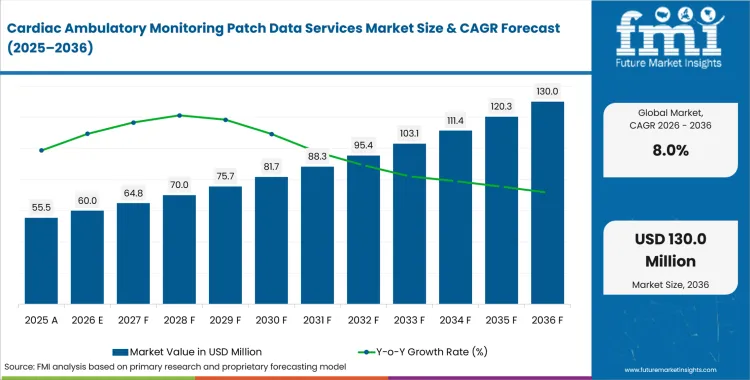
Key Takeaways for the Cardiac Ambulatory Monitoring Patch Data Services Market
- Demand for cardiac ambulatory monitoring patch data services reflects longer outpatient observation and clinician need for prioritized rhythm findings.
- Monitoring is anticipated to secure 45.0% share of application in 2026, enabled by continuous rhythm capture and event-focused clinical review.
- Software is forecast to represent product type with 24.0% share in 2026, led by analysis workflows and report-delivery operations.
- Fragmented software connections and unreliable alert transmission limit confidence during enterprise service assessment.
- Competition focuses on iRhythm Technologies, Philips, Boston Scientific, Baxter, AliveCor, VitalConnect, and SmartCardia, with providers competing based on recording duration and report operations.
Analyst Perspective
“Cardiac ambulatory monitoring patch data services create commercial value by converting extended recordings into prioritized clinical findings. Healthcare organizations examine escalation procedures and report connections during provider review. Sustainable adoption follows dependable monitoring operations reinforced depending on documented clinical oversight.”
- Anurag Sharma, Principal Consultant for Healthcare at Future Market Insights
How is Cardiac Ambulatory Monitoring Patch Data Services Market segmented?
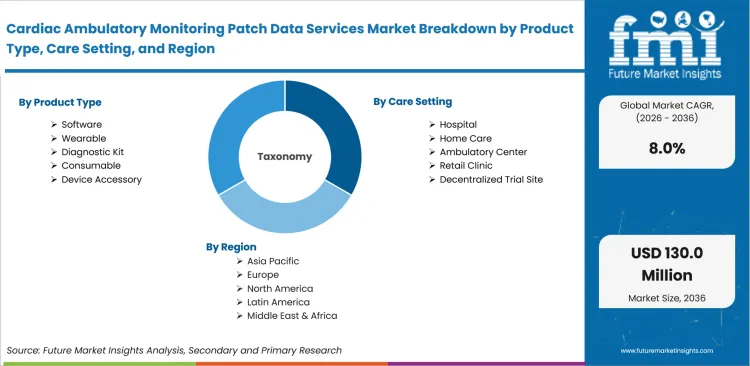
The cardiac ambulatory monitoring patch data services industry is segmented by product type, care setting, application, and end user.
The cardiac ambulatory monitoring patch data services market is segmented by product type, care setting, application, and end user. Product type coverage includes software and cardiac rhythm remote monitoring devices together with diagnostic kits. Consumables and device accessories complete product coverage supporting patch operations. Care setting coverage includes hospitals and home care with ambulatory centers. Retail clinics and decentralized trial sites complete service-location assessment. Application coverage includes monitoring and diagnosis together with workflow automation. Therapy support and infection control complete application assessment. End-user coverage spans hospitals and payers with diagnostic laboratories. Medtech firms and patients complete buyer assessment.
Why does software dominate product type?
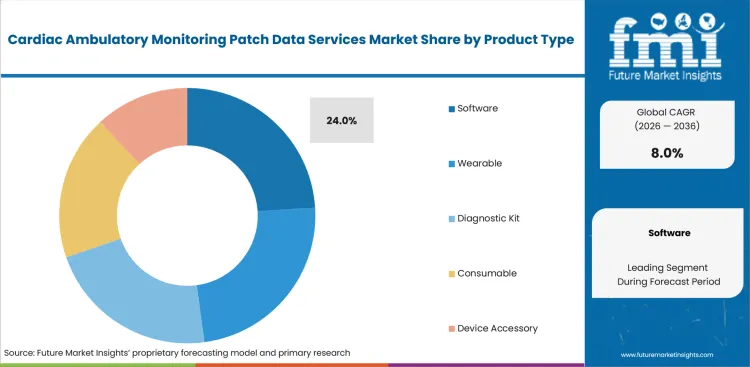
Software converts long recordings into review queues and final reports suited to clinician workflows. Service providers combine healthcare analytics with technician review to reduce manual interpretation workload. United States Food and Drug Administration cleared Philips Holter Analysis System in March 2025 for software analysis of up to 168 hours (7 days) of contiguous ECG data, confirming analysis capacity for extended ambulatory recordings. Event classification and report routing shape clinical usability across extended recordings. Report consistency influences renewals across cardiology groups using repeated monitoring orders.
- By product type, software is expected to hold 24.0% share in 2026 due to its position inside analysis and report-delivery operations. Clinical buyers examine event classification and report turnaround during service comparisons.
- Wearable systems and diagnostic kits enable signal capture across extended outpatient periods. Consumables and device accessories affect attachment quality and uninterrupted recording across each prescribed study.
Why does hospital remain central to care setting?
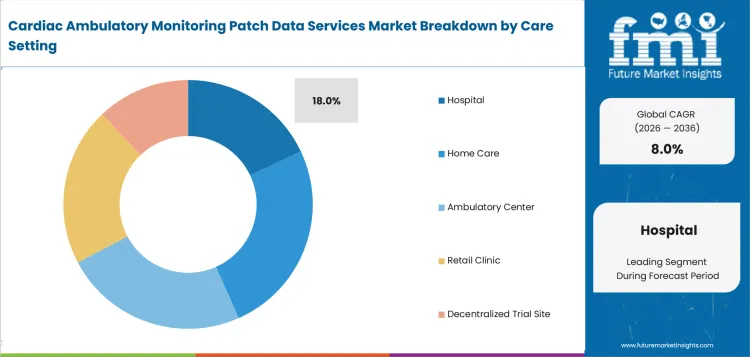
SmartCardia reported a hospital telemetry study involving 53 patients in September 2024, providing direct evidence of wearable monitoring under supervised clinical workflows. Hospital-led evidence supports service expansion into home care and ambulatory centers. Hospitals coordinate ordering and interpretation across cardiology clinics using patient monitoring devices. Clinical teams require dependable transfer from patch enrollment into reviewed findings and medical records.
- Hospital is projected to account for 18.0% share of care setting in 2026, driven by specialist oversight and established escalation responsibilities. Service reviews examine enrollment assistance and abnormal-event communication.
- Home care and ambulatory centers extend monitoring beyond inpatient departments based on prescribed recording periods. Retail clinics and decentralized trial sites require simple setup procedures and reliable return logistics.
Why does monitoring lead application demand?
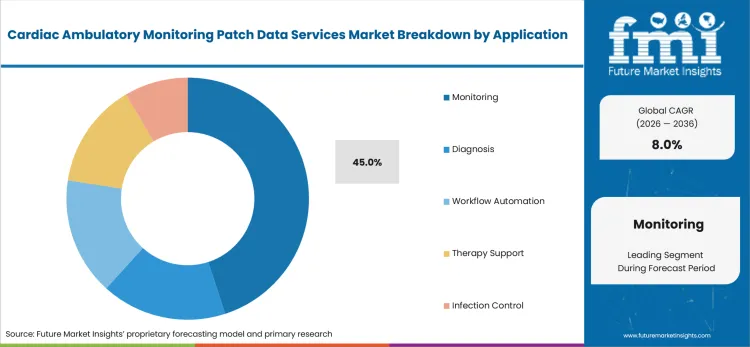
Remote electrocardiogram monitoring produces continuous rhythm records for detecting of intermittent abnormalities outside short clinical visits. Data services identify reportable episodes and prepare findings for physician interpretation. United States Food and Drug Administration cleared SmartCardia’s 7-lead mobile cardiac telemetry platform in October 2024, expanding regulated capability for outpatient rhythm surveillance. Continuous analysis across multi-channel remote ECG monitors raises demand for structured review operations and timely clinical escalation.
- Based on application, monitoring is anticipated to account for 45.0% share in 2026 as it is reflected direct use in extended rhythm observation and event review. Buyers evaluate signal quality and notification controls during service assessment.
- Diagnosis and therapy assistance rely on interpreted recordings across follow-up pathways. Workflow automation reduces administrative effort led by order handling and report routing without replacing clinician judgement.
Why do payers influence end user demand?
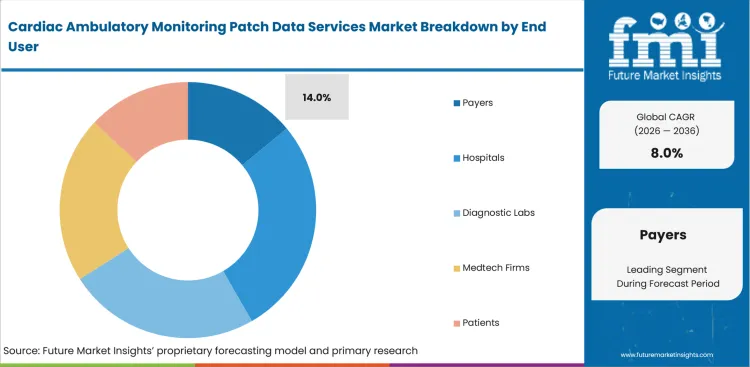
Philips reported preferred-provider access to 3.4 million Optum members in September 2025, illustrating how network inclusion expands availability for ambulatory cardiac monitoring services. Coverage relationships affect service volume and provider consideration. Payers influence provider access depending on network participation and coverage administration. Contracted service arrangements affect patient reach and ordering convenience across participating clinics.
- In 2026, payers are likely to hold 14.0% share owing to network decisions affecting covered monitoring access. Service providers document coding guidance and clinical reporting procedures during contracting.
- Hospitals and diagnostic laboratories manage ordering and interpretation responsibilities across monitored patients. Medtech firms and patients influence device experience and adherence across extended recording periods.
What are drivers, restraints, and opportunities in cardiac ambulatory monitoring patch data services market?
Longer outpatient monitoring advances service adoption and notification failures restrict clinical confidence. Accurate report operations create expansion potential across cardiology networks.
- Driver: Extended recording increases detection opportunities for intermittent rhythm abnormalities outside brief clinical assessments. Clinicians gain a longer observation window for episodic arrhythmias, promoting clearer diagnostic decisions across outpatient cardiology pathways.
- Restraint: Incomplete alert delivery and fragmented software connections expose providers to delayed clinical review. Missed notifications interrupt escalation routines and increase manual verification work for cardiology teams reviewing time-sensitive rhythm events.
- Opportunity: Faster verified reports and direct record transfer improve service utility across distributed cardiology practices. Interoperable report delivery reduces administrative handoffs and shortens physician access to clinically reviewed rhythm findings.
Mobile cardiac telemetry systems gain demand as clinicians seek longer observation without inpatient admission. Philips reported an approximate 10.0% diagnostic yield from an initial ePatch patient series in March 2026, indicating clinical value from extended recording and prioritized rhythm review. Documented findings encourage recurring service use across outpatient cardiology pathways.
Delayed information weakens clinical response and restricts adoption. United States Food and Drug Administration reported 109 injuries associated with a Philips outpatient telemetry correction in January 2025, highlighting operational risk from missed information or notifications. Buyers examine alert redundancy and incident management during service qualification.
Accurate reporting creates room for wireless patient monitoring providers combining algorithmic review with clinical oversight. Boston Scientific reported 99.0% final-report accuracy for BodyGuardian services as of August 2025, supporting confidence in structured analysis across ambulatory recordings. Verified outputs reduce repeat review effort and strengthen service utility for cardiology practices.
How are country CAGRs aligned in cardiac ambulatory monitoring patch data services market?
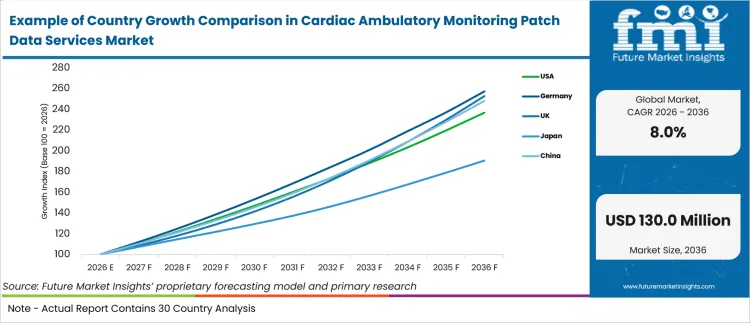
| Country or Market | CAGR |
|---|---|
| China | 10.8% |
| India | 10.0% |
| United States | 9.2% |
| Japan | 8.4% |
| United Kingdom | 7.6% |
| Germany | 6.8% |
Source: Future Market Insights analysis, 2026.
How do country-level CAGRs compare in cardiac ambulatory monitoring patch data services market?
Country comparison shows a gradual step-down across profiled healthcare systems. China occupies first forecast position followed by India. United States forms the middle rate band through established ambulatory monitoring services. Japan and United Kingdom follow under distinct clinical and reimbursement structures. Germany completes disclosed comparison with formal electronic-report requirements. A 4.0 percentage-point spread separates China from Germany.
- China places East Asia first across disclosed country forecasts.
- India follows China as hospital equipment additions expand ambulatory monitoring capacity.
- United States occupies the middle band through established provider networks and integrated reporting services.
- Japan and United Kingdom form the next rate group under specialist-led ordering pathways.
- Germany completes comparison through formal documentation standards and national health-information targets.
Similar CAGRs may reflect different entry conditions across recorder supply and clinical reporting operations. Full report coverage includes North America and Latin America with Western Europe. Eastern Europe and East Asia extend assessment across established cardiac-care systems. South Asia and Pacific with Middle East and Africa complete regional analysis.
Country-wise Analysis
- Cardiac ambulatory monitoring patch data services market in China is forecast to expand at 10.8% CAGR from 2026 to 2036, driven by domestic wearable electrocardiogram development and growing outpatient rhythm surveillance. Xinyan Medical launched a wearable 12-lead electrocardiogram device in January 2026, expanding locally developed recording capability suited to extended diagnostic pathways. Local device availability supports service providers seeking regional technical assistance and compatible analysis operations.
- All India Institute of Medical Sciences published a tender for 20 recorders in November 2025, confirming institutional investment in ambulatory electrocardiogram capacity and generating recurring requirements for data review. Industry in India is estimated to grow at 10.0% CAGR by 2036, reflecting hospital-led acquisition and expanding cardiology diagnostics. Recorder additions create continuing needs for patient enrollment and interpreted reports across scheduled studies.
- Established ambulatory monitoring services encourage repeat ordering across United States cardiology practices. Sector in the United States is projected to record 9.2% CAGR between 2026 and 2036, reflecting provider familiarity and connected report-delivery operations. Philips reported service coverage across 23 Austin Regional Clinic primary-care sites in March 2025, showing distributed access to patch-based cardiac monitoring and centralized results. Multi-site use rewards providers offering standardized enrollment and report connections across practice groups.
- Sales in Japan are anticipated to post 8.4% CAGR during the study period, guided by regulated ambulatory recording services and technician-assisted report preparation. iRhythm Japan’s February 2025 English instructions specify recording for up to 14 days, extending observation beyond brief electrocardiogram testing and increasing review volume per patient. Local instructions and support procedures influence service adoption across Japanese cardiology providers.
- Frimley Health reported clinician-overseen ePatch results usually returned within 72 hours in July 2025, documenting direct use of analyzed patch recordings inside United Kingdom cardiology services. The market in United Kingdom is expected to progress at 7.6% CAGR during the assessment period, enabled by established diagnostic services and standardized report delivery. Service providers gain value from dependable analysis across outpatient monitoring pathways.
- Federal Ministry of Health reported in February 2026 a target for 100.0% of medical reports to move electronically between German healthcare providers starting end-2027, strengthening demand for report-ready monitoring operations. Structured transfer requirements favor cardiac ambulatory monitoring providers supplying interoperable results and traceable review records. Demand in Germany is predicted to rise at 6.8% CAGR during the forecast period, shaped by formal healthcare information standards.
Who are notable companies in cardiac ambulatory monitoring patch data services market?
iRhythm Technologies, Philips, Boston Scientific, Baxter, AliveCor, VitalConnect, and SmartCardia are notable companies influencing market competition.
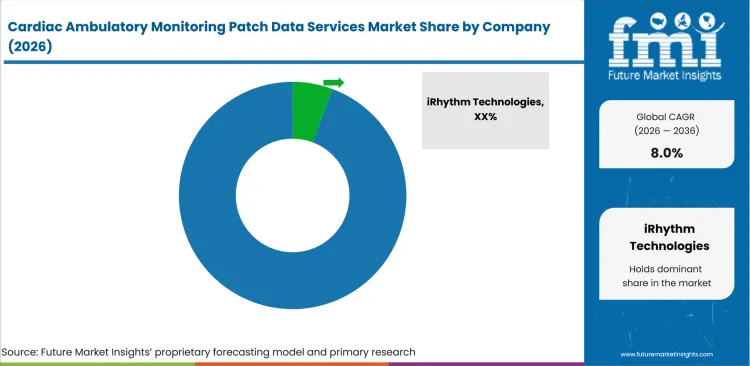
Competition centers on recording duration and analysis quality across ambulatory care programs. Integrated suppliers combine wearable devices with enrollment assistance and interpreted reports. Software-focused providers emphasize event classification and clinician access. Service networks influence patient onboarding and report turnaround across distributed practices. Buyer review covers alert handling and clinical escalation responsibilities.
- iRhythm Technologies and Philips compete based on integrated patch services and centralized report operations. Health systems assess recording duration and medical-record connectivity during provider review.
- Boston Scientific and Baxter combine wearable monitoring portfolios with established healthcare relationships. Cardiology groups compare onboarding assistance and reporting consistency across repeated orders.
- AliveCor and VitalConnect focus on connected electrocardiogram capture and remote review workflows. Clinical teams examine data access and escalation procedures during service assessment.
- Bardy Diagnostics and SmartCardia contribute specialized patch formats and analytical capabilities. Bardy Diagnostics operates within Baxter’s cardiac monitoring portfolio and SmartCardia supplies multi-lead monitoring services.
Competitive Benchmarking: Cardiac Ambulatory Monitoring Patch Data Services Market
| Company | Recording and Analysis Capability | Report and Integration Support | Clinical Service Reach | Geographic Reach |
|---|---|---|---|---|
| iRhythm Technologies | High | High | High | Global |
| Philips | High | High | High | Global |
| Boston Scientific | High | Medium | High | North America |
| Baxter | High | Medium | High | Global |
| AliveCor | Medium | High | Medium | International |
| VitalConnect | High | Medium | Medium | International |
| SmartCardia | High | Medium | Medium | International |
Source: Future Market Insights competitive analysis, 2026.
Key Developments in Cardiac Ambulatory Monitoring Patch Data Services Market
- In July 2025, Philips announced collaboration with Epic to connect ambulatory cardiac monitoring orders and reports through Aura. Integration reduces manual transfer steps and accelerates clinician access across participating health systems.
- In August 2025, United States Food and Drug Administration granted a substantially equivalent decision for Zio Monitor. Clearance maintained commercial availability for long-term patch recording and centralized report preparation.
Key Players in Cardiac Ambulatory Monitoring Patch Data Services Market
Integrated Patch and Report Services
- iRhythm Technologies
- Philips
- Boston Scientific
- Baxter
Connected Electrocardiogram Platforms
- AliveCor
- VitalConnect
Specialist Patch Providers
- SmartCardia
Cardiac Ambulatory Monitoring Patch Data Services Market Report Scope
| Coverage field | Report scope |
|---|---|
| Market breakdown | Cardiac ambulatory monitoring patch data services market breakdown includes product type, care setting, application, and end user. |
| Quantitative Units | USD million in 2026 to USD million by 2036 at CAGR |
| Market Definition | Cardiac ambulatory monitoring patch data services cover wearable rhythm recording with software analysis and technician-reviewed report preparation. Enrollment assistance and event escalation complete defined service coverage. Conventional bedside telemetry without ambulatory patch operations is excluded. |
| Regions Covered | North America, Latin America, Western Europe, Eastern Europe, East Asia, South Asia and Pacific, Middle East and Africa. |
| Countries Covered | China, India, United States, Japan, United Kingdom, Germany, and more than 25 additional countries complete full report coverage. |
| Key Companies Profiled | iRhythm Technologies, Philips, Boston Scientific, Baxter, AliveCor, VitalConnect, and SmartCardia. |
| Forecast Period | 2026 to 2036 |
| Approach | Hybrid bottom-up and top-down methodology uses segment shares and country CAGRs. Provider activity and buyer adoption inform final market reconciliation. |
Source: Future Market Insights analysis, 2026.
Cardiac Ambulatory Monitoring Patch Data Services Market - Research Methodology
| Method | Approach |
|---|---|
| Primary Research | FMI analysts gathered input from manufacturers, service providers, technology developers, distributors, end users, procurement teams, and subject-matter experts. Interviews examined purchasing decisions, product or service evaluation, adoption barriers, approval requirements, pricing considerations, and expectations for technical or commercial support. Respondents were also asked what evidence is required before a trial, pilot, or initial order develops into regular purchasing. |
| Desk Research | Desk research covered government statistics, regulatory publications, trade data, industry associations, technical literature, standards, company filings, product information, and official corporate announcements. Sources were reviewed for relevance, publication date, geographic coverage, and consistency with the defined market scope. Claims relating to performance, applications, approvals, capacity, investment, and commercial activity were retained only when supported by credible public evidence. |
| Market Sizing and Forecasting | The market model combined the baseline value with historical performance, segment structure, pricing and volume indicators, adoption levels, company participation, and country-level demand conditions. Forecast assumptions considered economic activity, investment trends, regulatory developments, technology adoption, purchasing cycles, supply availability, and barriers to wider market use. Segment and regional estimates were reconciled before the final market total was calculated. |
| Data Validation | Estimates were checked against multiple independent indicators, including public data, company activity, trade patterns, industry developments, and findings from primary interviews. Validation also tested whether products, services, applications, and company revenues fell within the defined market boundaries. Adjacent categories, unsupported claims, overlapping revenues, and activities without direct market relevance were excluded to reduce double counting and maintain consistency across segments and countries. |
Source: Future Market Insights analysis, 2026.
Cardiac Ambulatory Monitoring Patch Data Services Market by Segments
Cardiac Ambulatory Monitoring Patch Data Services Market segmented by Product Type:
- Software
- Wearable
- Diagnostic Kit
- Consumable
- Device Accessory
Cardiac Ambulatory Monitoring Patch Data Services Market segmented by Care Setting:
- Hospital
- Home Care
- Ambulatory Center
- Retail Clinic
- Decentralized Trial Site
Cardiac Ambulatory Monitoring Patch Data Services Market segmented by Application:
- Monitoring
- Diagnosis
- Workflow Automation
- Therapy Support
- Infection Control
Cardiac Ambulatory Monitoring Patch Data Services Market segmented by End User:
- Hospitals
- Payers
- Diagnostic Labs
- Medtech Firms
- Patients
Cardiac Ambulatory Monitoring Patch Data Services Market by Region:
- North America
- United States
- Canada
- Latin America
- Brazil
- Mexico
- Chile
- Rest of Latin America
- Western Europe
- Germany
- UK
- Italy
- Spain
- France
- Nordic
- BENELUX
- Rest of Western Europe
- Eastern Europe
- Russia
- Poland
- Hungary
- Balkan and Baltic
- Rest of Eastern Europe
- East Asia
- China
- Japan
- South Korea
- South Asia and Pacific
- India
- ASEAN
- Australia and New Zealand
- Rest of South Asia and Pacific
- Middle East and Africa
- Kingdom of Saudi Arabia
- Other GCC Countries
- Turkiye
- South Africa
- Other African Union
- Rest of Middle East and Africa
Research Sources and Bibliography
- All India Institute of Medical Sciences. (2025, November 21). Corrigendum for date extension for purchase of Ambulatory ECG monitoring (Holter) System-1 unit with 20 recorders for Department of Cardiology, CNC, AIIMS, New Delhi-29 vide Tender No. 80/CNC/CARD/25-26/ST. (GEM Portal Tender ID: GEM/2025/B/6604883).
- Battisti, A. J., Pinkerton, R., Fokin, V., Wright, B., Alexander, J., Berger, R. G., & Turakhia, M. P. (2025, November 6). Relationship of symptom frequency and symptom-rhythm correlation to arrhythmia type and time to detection: Insights from ambulatory electrocardiogram monitoring in over 1 million patients. Heart Rhythm.
- Boston Scientific Corporation. (2025, August). BodyGuardian cardiac monitor devices (physicians).
- Federal Ministry of Health. (2026, February 10). The Strategy’s key content.
- Frimley Health NHS Foundation Trust. (2025, July 15). Heart patients to benefit from wearable tech in NHS first.
- iRhythm Technologies Japan, Inc. (2025, February). Instructions for use (LB10247.01).
- Philips. (2024, May 22). Philips ePatch and AI analytics platform rolled out to 14 hospitals across Spain to monitor heart patients.
- Philips. (2025, March 3). Austin Regional Clinic: Better connectivity for better, faster patient care.
- Philips. (2026, March 11). Improved clinical outcomes, better patient experience.
- Philips. (2025, July 24). Philips announces collaboration with Epic to enhance ambulatory cardiac monitoring.
- Philips. (2025, September 25). Philips joins Optum Healthcare’s network as a preferred provider in the USA.
- SmartCardia. (2024, September 30). SmartCardia 7L patch for cardiac telemetry.
- United States Food and Drug Administration. (2024, October 31). 510(k) premarket notification [SmartCardia 7L Platform (MCT), K240653].
- United States Food and Drug Administration. (2025, January 14). Outpatient telemetry correction: Philips issues correction for Monitoring Service Application used with Mobile Cardiac Outpatient Telemetry due to potential for missed information or notifications that may impact patient care.
- United States Food and Drug Administration. (2025, March 21). 510(k) premarket notification [Philips Holter Analysis System, K241890].
- United States Food and Drug Administration. (2025, August 15). 510(k) premarket notification [Zio Monitor, K243650].
- United States Food and Drug Administration. (2026, April 23). 510(k) premarket notification [Rhythm Master ECG Patch, K252389].
- Xinyan Medical. (2026, January 25). Innovating for the Future | Xinyan Medical Successfully Hosts the Launch Event of Its Wearable 12-Lead ECG Monitoring Device (YMHeart XY-12).
This bibliography provides reader reference and is not exhaustive. The full report coverage includes complete source records and detailed verification notes.
This Report Answers
- How do product type and care setting influence cardiac ambulatory monitoring patch data services demand?
- What criteria guide cardiology teams evaluating ambulatory monitoring providers for recurring use?
- Why do country CAGRs differ across profiled healthcare systems?
- What companies compete through recording capability and report operations?
- How are forecasts validated through bottom-up and top-down analysis using independent indicators?
- What evidence informs health system review prior to multi-site service adoption?
- Why do alert reliability and report integration influence provider selection?
- How does fragmented connectivity limit return across enrollment and clinical review?
- How do technician review records influence physician confidence across monitoring studies?
- What company capabilities improve recurring service use across cardiology accounts?
Frequently Asked Questions
What advances demand in Cardiac Ambulatory Monitoring Patch Data Services Market?
Demand is likely to gain from clinicians seeking longer rhythm observation outside hospitals. Buyers are expected to favor services offering verified reports and documented escalation procedures.
Who are key players in Cardiac Ambulatory Monitoring Patch Data Services Market?
Key companies are anticipated to include iRhythm Technologies and Philips among others. Competition is likely to reflect recording capability and service assistance across outpatient monitoring programs.
What restraint affects Cardiac Ambulatory Monitoring Patch Data Services Market?
Alert-delivery failures and fragmented report connections restrict provider confidence during adoption. Clinical risk increases if abnormal findings lack dependable escalation into care teams.
Why do executives track Cardiac Ambulatory Monitoring Patch Data Services Market?
Executives are expected to track service adoption as outpatient monitoring affects cardiology capacity and diagnostic throughput. Provider selection creates clinical governance and integration duties across hospital functions.
What business problem does Cardiac Ambulatory Monitoring Patch Data Services Market address?
Patch data services convert long electrocardiogram recordings into prioritized findings and clinician-ready reports. Operational assistance helps teams manage extended monitoring without assigning full recordings to manual review.
What do cardiology teams evaluate prior to selecting companies?
Cardiology teams are likely to evaluate recording duration and report accuracy during provider review. Alert procedures and medical-record connections are expected to influence final approval.
What limits return on investment for purchasing teams?
Return weakens through repeated manual transfer or unresolved alert-delivery failures. Extended recording creates limited operational value without timely analysis and clinician access.
How do companies build long-term customer confidence?
Companies build confidence based on repeatable analysis and dependable report delivery across monitoring programs. Maintained integrations and documented clinical escalation encourage recurring service use.
Preview the report firsthand - request a free sample
Get SampleGet the brochure for pricing and purchase details.
Get PDFTable of Content
- Key Takeaways
- Market Size and CAGR
- Top Growth Driver
- Fastest Growing Segment
- Leading Region
- Key Companies
- Emerging Opportunities
- Executive Summary
- Global Market Outlook
- Demand-side Trends
- Supply-side Trends
- Technology Roadmap Analysis
- Analysis and Recommendations
- Analyst Perspective (What is happening? Why now? What should investors know?)
- Key Questions Answered
- How large is the market?
- What is the CAGR?
- What are key trends?
- Which region dominates?
- Who are the leaders?
- Market Overview
- Market Coverage / Taxonomy
- Market Definition / Scope / Limitations
- Research Methodology
- Chapter Orientation
- Analytical Lens and Working Hypotheses
- Market Structure, Signals, and Trend Drivers
- Benchmarking and Cross-market Comparability
- Market Sizing, Forecasting, and Opportunity Mapping
- Research Design and Evidence Framework
- Desk Research Programme (Secondary Evidence)
- Expert Input and Fieldwork (Primary Evidence)
- Tooling, Models, and Reference Databases
- Data Engineering and Model Build
- Quality Assurance and Audit Trail
- Market Background
- Market Dynamics (Drivers, Restraints, Opportunity, Trends)
- Scenario Forecast (Optimistic, Likely, Conservative)
- Impact Analysis
- AI Impact
- Sustainability Impact
- Regulatory Impact
- Technology Impact
- Consumer / Buyer Analysis
- Purchase Drivers
- Adoption Barriers
- Buyer Journey
- Opportunity Map Analysis
- Product Life Cycle Analysis
- Supply Chain Analysis
- Investment Feasibility Matrix
- Value Chain Analysis
- PESTLE and Porter's Analysis
- Regulatory Landscape
- Regional Parent Market Outlook
- Production and Consumption Statistics
- Import and Export Statistics
- Global Market Analysis and Forecast, 2021 to 2036
- Historical Market Size Value (USD Million) Analysis, 2021 to 2025
- Current and Future Market Size Value (USD Million) Projections, 2026 to 2036
- Y-o-Y Growth Trend Analysis
- Absolute $ Opportunity Analysis
- Global Market Pricing Analysis, 2021 to 2036
- Global Market Analysis and Forecast, By Product Type, 2021 to 2036
- Introduction / Key Findings
- Historical Market Size Value (USD Million) Analysis By Product Type, 2021 to 2025
- Current and Future Market Size Value (USD Million) Analysis and Forecast By Product Type, 2026 to 2036
- Software
- Wearable
- Diagnostic Kit
- Consumable
- Device Accessory
- Software
- Y-o-Y Growth Trend Analysis By Product Type, 2021 to 2025
- Absolute $ Opportunity Analysis By Product Type, 2026 to 2036
- Global Market Analysis and Forecast, By Care Setting, 2021 to 2036
- Introduction / Key Findings
- Historical Market Size Value (USD Million) Analysis By Care Setting, 2021 to 2025
- Current and Future Market Size Value (USD Million) Analysis and Forecast By Care Setting, 2026 to 2036
- Hospital
- Home Care
- Ambulatory Center
- Retail Clinic
- Decentralized Trial Site
- Hospital
- Y-o-Y Growth Trend Analysis By Care Setting, 2021 to 2025
- Absolute $ Opportunity Analysis By Care Setting, 2026 to 2036
- Global Market Analysis and Forecast, By Application, 2021 to 2036
- Introduction / Key Findings
- Historical Market Size Value (USD Million) Analysis By Application, 2021 to 2025
- Current and Future Market Size Value (USD Million) Analysis and Forecast By Application, 2026 to 2036
- Monitoring
- Diagnosis
- Workflow Automation
- Therapy Support
- Infection Control
- Monitoring
- Y-o-Y Growth Trend Analysis By Application, 2021 to 2025
- Absolute $ Opportunity Analysis By Application, 2026 to 2036
- Global Market Analysis and Forecast, By End User, 2021 to 2036
- Introduction / Key Findings
- Historical Market Size Value (USD Million) Analysis By End User, 2021 to 2025
- Current and Future Market Size Value (USD Million) Analysis and Forecast By End User, 2026 to 2036
- Payers
- Hospitals
- Diagnostic Labs
- Medtech Firms
- Patients
- Payers
- Y-o-Y Growth Trend Analysis By End User, 2021 to 2025
- Absolute $ Opportunity Analysis By End User, 2026 to 2036
- Global Market Analysis and Forecast, By Region, 2021 to 2036
- Introduction
- Historical Market Size Value (USD Million) Analysis By Region, 2021 to 2025
- Current Market Size Value (USD Million) Analysis and Forecast By Region, 2026 to 2036
- North America
- Latin America
- Western Europe
- Eastern Europe
- East Asia
- South Asia and Pacific
- Middle East & Africa
- Market Attractiveness Analysis By Region
- North America Market Analysis and Forecast, By Country, 2021 to 2036
- Historical Market Size Value (USD Million) Trend Analysis By Market Taxonomy, 2021 to 2025
- Market Size Value (USD Million) Forecast By Market Taxonomy, 2026 to 2036
- By Country
- USA
- Canada
- By Product Type
- By Care Setting
- By Application
- By End User
- By Country
- Market Attractiveness Analysis
- By Country
- By Product Type
- By Care Setting
- By Application
- By End User
- Key Takeaways
- Latin America Market Analysis and Forecast, By Country
- Historical Market Size Value (USD Million) Trend Analysis By Market Taxonomy, 2021 to 2025
- Market Size Value (USD Million) Forecast By Market Taxonomy, 2026 to 2036
- By Country
- Brazil
- Mexico
- Chile
- Rest of Latin America
- By Product Type
- By Care Setting
- By Application
- By End User
- By Country
- Market Attractiveness Analysis
- By Country
- By Product Type
- By Care Setting
- By Application
- By End User
- Key Takeaways
- Western Europe Market Analysis and Forecast, By Country
- Historical Market Size Value (USD Million) Trend Analysis By Market Taxonomy, 2021 to 2025
- Market Size Value (USD Million) Forecast By Market Taxonomy, 2026 to 2036
- By Country
- Germany
- UK
- Italy
- Spain
- France
- Nordic
- BENELUX
- Rest of Western Europe
- By Product Type
- By Care Setting
- By Application
- By End User
- By Country
- Market Attractiveness Analysis
- By Country
- By Product Type
- By Care Setting
- By Application
- By End User
- Key Takeaways
- Eastern Europe Market Analysis and Forecast, By Country
- Historical Market Size Value (USD Million) Trend Analysis By Market Taxonomy, 2021 to 2025
- Market Size Value (USD Million) Forecast By Market Taxonomy, 2026 to 2036
- By Country
- Russia
- Poland
- Hungary
- Balkan & Baltic
- Rest of Eastern Europe
- By Product Type
- By Care Setting
- By Application
- By End User
- By Country
- Market Attractiveness Analysis
- By Country
- By Product Type
- By Care Setting
- By Application
- By End User
- Key Takeaways
- East Asia Market Analysis and Forecast, By Country
- Historical Market Size Value (USD Million) Trend Analysis By Market Taxonomy, 2021 to 2025
- Market Size Value (USD Million) Forecast By Market Taxonomy, 2026 to 2036
- By Country
- China
- Japan
- South Korea
- By Product Type
- By Care Setting
- By Application
- By End User
- By Country
- Market Attractiveness Analysis
- By Country
- By Product Type
- By Care Setting
- By Application
- By End User
- Key Takeaways
- South Asia and Pacific Market Analysis and Forecast, By Country
- Historical Market Size Value (USD Million) Trend Analysis By Market Taxonomy, 2021 to 2025
- Market Size Value (USD Million) Forecast By Market Taxonomy, 2026 to 2036
- By Country
- India
- ASEAN
- Australia & New Zealand
- Rest of South Asia and Pacific
- By Product Type
- By Care Setting
- By Application
- By End User
- By Country
- Market Attractiveness Analysis
- By Country
- By Product Type
- By Care Setting
- By Application
- By End User
- Key Takeaways
- Middle East & Africa Market Analysis and Forecast, By Country
- Historical Market Size Value (USD Million) Trend Analysis By Market Taxonomy, 2021 to 2025
- Market Size Value (USD Million) Forecast By Market Taxonomy, 2026 to 2036
- By Country
- Kingdom of Saudi Arabia
- Other GCC Countries
- Türkiye
- South Africa
- Other African Union
- Rest of Middle East & Africa
- By Product Type
- By Care Setting
- By Application
- By End User
- By Country
- Market Attractiveness Analysis
- By Country
- By Product Type
- By Care Setting
- By Application
- By End User
- Key Takeaways
- Key Countries Market Analysis
- USA
- Pricing Analysis
- Market Share Analysis, 2025
- By Product Type
- By Care Setting
- By Application
- By End User
- Canada
- Pricing Analysis
- Market Share Analysis, 2025
- By Product Type
- By Care Setting
- By Application
- By End User
- Mexico
- Pricing Analysis
- Market Share Analysis, 2025
- By Product Type
- By Care Setting
- By Application
- By End User
- Brazil
- Pricing Analysis
- Market Share Analysis, 2025
- By Product Type
- By Care Setting
- By Application
- By End User
- Chile
- Pricing Analysis
- Market Share Analysis, 2025
- By Product Type
- By Care Setting
- By Application
- By End User
- Germany
- Pricing Analysis
- Market Share Analysis, 2025
- By Product Type
- By Care Setting
- By Application
- By End User
- UK
- Pricing Analysis
- Market Share Analysis, 2025
- By Product Type
- By Care Setting
- By Application
- By End User
- Italy
- Pricing Analysis
- Market Share Analysis, 2025
- By Product Type
- By Care Setting
- By Application
- By End User
- Spain
- Pricing Analysis
- Market Share Analysis, 2025
- By Product Type
- By Care Setting
- By Application
- By End User
- France
- Pricing Analysis
- Market Share Analysis, 2025
- By Product Type
- By Care Setting
- By Application
- By End User
- India
- Pricing Analysis
- Market Share Analysis, 2025
- By Product Type
- By Care Setting
- By Application
- By End User
- ASEAN
- Pricing Analysis
- Market Share Analysis, 2025
- By Product Type
- By Care Setting
- By Application
- By End User
- Australia & New Zealand
- Pricing Analysis
- Market Share Analysis, 2025
- By Product Type
- By Care Setting
- By Application
- By End User
- China
- Pricing Analysis
- Market Share Analysis, 2025
- By Product Type
- By Care Setting
- By Application
- By End User
- Japan
- Pricing Analysis
- Market Share Analysis, 2025
- By Product Type
- By Care Setting
- By Application
- By End User
- South Korea
- Pricing Analysis
- Market Share Analysis, 2025
- By Product Type
- By Care Setting
- By Application
- By End User
- Russia
- Pricing Analysis
- Market Share Analysis, 2025
- By Product Type
- By Care Setting
- By Application
- By End User
- Poland
- Pricing Analysis
- Market Share Analysis, 2025
- By Product Type
- By Care Setting
- By Application
- By End User
- Hungary
- Pricing Analysis
- Market Share Analysis, 2025
- By Product Type
- By Care Setting
- By Application
- By End User
- Kingdom of Saudi Arabia
- Pricing Analysis
- Market Share Analysis, 2025
- By Product Type
- By Care Setting
- By Application
- By End User
- Türkiye
- Pricing Analysis
- Market Share Analysis, 2025
- By Product Type
- By Care Setting
- By Application
- By End User
- South Africa
- Pricing Analysis
- Market Share Analysis, 2025
- By Product Type
- By Care Setting
- By Application
- By End User
- USA
- Market Structure Analysis
- Competition Dashboard
- Competition Benchmarking
- Market Share Analysis of Top Players
- By Regional
- By Product Type
- By Care Setting
- By Application
- By End User
- Emerging Startups
- Innovation Benchmarking
- Competition Analysis
- Competition Deep Dive
- iRhythm Technologies
- Overview
- Product Portfolio
- Profitability by Market Segments
- Sales Footprint
- Strategy Overview
- Marketing Strategy
- Product Strategy
- Channel Strategy
- Philips
- Boston Scientific
- Baxter
- AliveCor
- VitalConnect
- SmartCardia
- iRhythm Technologies
- Case Studies
- Success Stories
- Recent Developments
- Competition Deep Dive
- Assumptions & Acronyms Used


