

- Industry Size (2026)
- USD 8.3 Bn
- Forecast (2036)
- USD 23.5 Bn
- CAGR (2026 to 2036)
- 11.0%
Pet Care Industry Forecast and Outlook 2026 to 2036
South Asia pet care is estimated at USD 8.3 billion in 2026 and is projected to reach USD 23.5 billion by 2036, registering an 11.0% CAGR. The growth engine is repeat purchase conversion, supported by industrial supply expansion in Southeast Asia and portfolio investment in companion animal health. Thailand’s role as a manufacturing base matters because it reduces availability friction for mass food formats and private label volumes. i-Tail states its Thailand manufacturing facilities have annual capacity of 195,440 tons and it plans to increase that capacity, which is an industrial signal that food throughput is being built for sustained replenishment demand rather than episodic spikes.
The category also deepens through companion animal health intensity, where preventive and chronic care products pull recurring spend. Zoetis CEO Kristin Peck stated, Zoetis delivered excellent full year results in 2024, driven by the demand for our innovative products and the strength of our key franchises. Mars framed a structural ownership mix shift through its pet parent study, stating, Almost half (47%) of those surveyed are first-time owners, signalling a new era of pet parents. On the supply side, i-Tail CEO Pichitchai Wongpiya linked performance to production discipline and product development, and the company’s public communication also referenced pet supplement development targeted for introduction by 2025. This combination of throughput, trust, and adjacencies is what sustains the 2026 to 2036 value build.
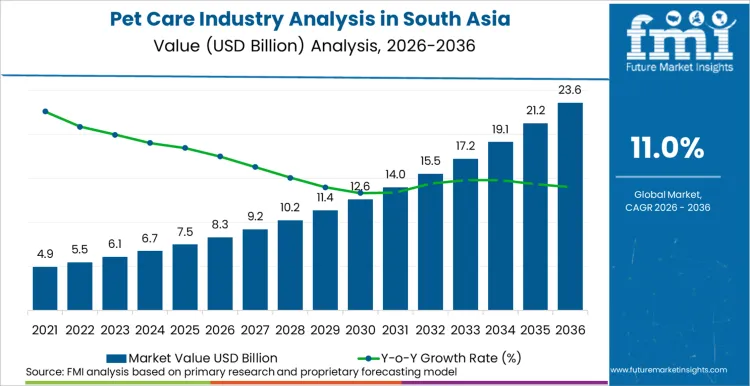
Summary of Pet Care Industry in South Asia
- The South Asia pet care market covers pet food, healthcare, hygiene and grooming, accessories, and related services for companion animals, structured around repeat purchase and regulated distribution.
- The defined scope follows FMI taxonomy across product and service category, pet type, food type, distribution channel, price tier, and country, excluding livestock feed and non-pet human OTC categories.
- The market is projected to grow at an 11.0% CAGR from 2026 to 2036, expanding from USD 8.3 billion in 2026 to USD 23.5 billion by 2036, driven by food-led replenishment, compliance-led supply formalisation, and rising veterinary healthcare attach.
- Pet food drives 62.0% of spend, dogs account for 52.0% of demand pull-through, dry food leads with 55.0% within food, modern trade holds 28.0% of distribution, and economy tier captures 45.0%, reflecting penetration-led scaling.
- Competitive power sits with Mars Petcare, Nestlé Purina, Hill’s, Zoetis, MSD Animal Health, Boehringer Ingelheim, Virbac, and regional manufacturers such as i-Tail, where capacity expansion and regulatory execution determine growth capture.
- Indonesia leads growth at 12.5% CAGR, followed by Vietnam at 11.8% and the Philippines at 11.0%, while Thailand, Malaysia, and Singapore expand steadily under governance-led distribution systems.
Pet Care Industry Analysis in South Asia Key Takeaways
| Metric | Value (USD Billion) |
|---|---|
| Market Size 2026 | USD 8.3 Billion |
| Forecast Value 2036 | USD 23.5 Billion |
| CAGR (2026 to 2036) | 11.0% |
Source: Future Market Insights’ proprietary forecasting model and primary research
What Forces the Category From Occasional Spending Into Regimen Discipline Through 2036?
The driver is governance-led formalisation that reduces low-quality supply leakage and makes repeatable distribution possible. Singapore’s AVS sets explicit conditions for importing pet food, including documentation requirements that raise compliance discipline for importers and favour scaled suppliers that can execute repeat consignments without disruption. Vietnam’s feed management framework requires imported animal feed to be registered for circulation, pushing the market toward documented SKUs and professional distribution. Indonesia’s animal-based feed ingredient import controls are positioned around disease prevention and feed security, which increases the advantage of compliant supply chains and stabilises long-cycle category growth.
How is the Pet Care Industry Segmented in South Asia?
The market is segmented by product and service category, pet type, food type within pet food, distribution channel, price tier, and country. Segment leadership reflects where repeat purchase is structurally easiest to execute. Food and hygiene scale through shelf availability and predictable replenishment. Veterinary and supplement adjacencies scale through regulated access and clinician trust. Price tiers reflect penetration economics, with economy driving scale and premium expanding where compliance, income density, and channel readiness are highest.
Why Does Pet Food Command the Largest Share in 2026?
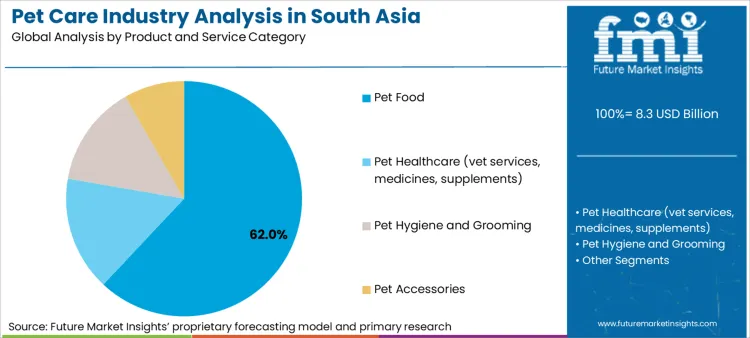
Pet food leads at 62.0% because it is the only segment that converts into a measurable replenishment system across mass households, and that system is being industrialised by regional manufacturers. I-Tail discloses 195,440 tons of annual capacity in Thailand and states that it plans to increase capacity, which signals that the industry is building throughput to protect continuity of supply for recurring purchase categories. That matters because modern trade and marketplaces punish stockouts, and the fastest-growing markets in Southeast Asia are still in the phase where first-time owners become repeat buyers only if availability stays stable across pay cycles. Food also becomes the drive basket that enables repeat cross-sell into treats, supplements, and hygiene once households establish a default ration. Mars’ pet parent study highlights a high proportion of first-time owners, which implies that onboarding volume is still large and food is the first habit that stabilises this cohort. The segment holds the centre of gravity because every other segment’s monetisation depends on the same base household staying active, and the strongest corporate actions remain capacity expansion and distribution scale aimed at protecting food continuity.
What Keeps Dogs as the Dominant Pet Type?
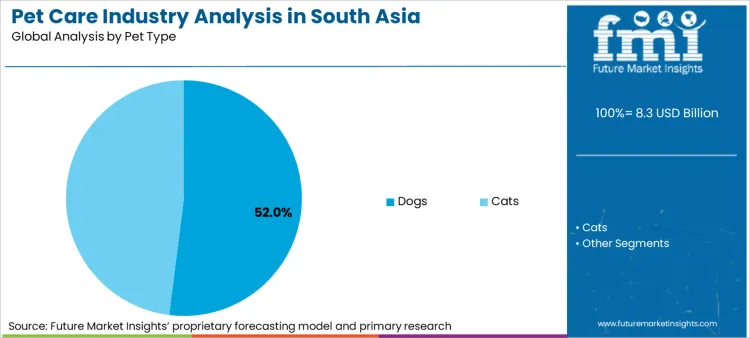
Dogs hold 52.0% because their care routines force higher recurring consumption and higher clinical attach than other pet types, particularly in preventive categories such as parasite control, vaccination cadence, and functional nutrition. The commercial signal is how animal health leaders describe demand in franchise terms rather than one-off product cycles. Zoetis’ CEO linked full-year performance to demand strength and key franchises, which aligns with a market where dog-heavy households create the most repeatable clinic and pharmacy throughput. Dogs also drive larger pack sizes and higher feeding volumes, which compounds the advantage of dry food formats in environments where storage and logistics favour shelf-stable rations. In emerging urban clusters, dogs also pull spending into services such as grooming and boarding faster than smaller pets because working households value convenience solutions. The segment remains dominant because it concentrates both the volume base and the highest probability pathways for healthcare adjacencies to attach.
Why Does Dry Food Hold Leadership Within Pet Food?
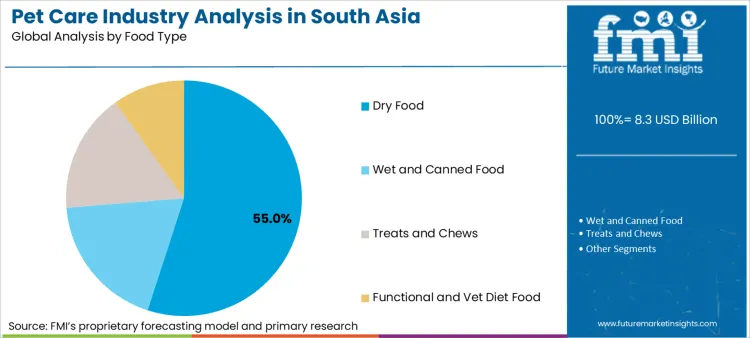
Dry food parasite control holds 55.0% because it fits the region’s distribution physics and compliance economics. It is easier to ship, store, and keep in planograms without cold chain or short shelf-life constraints, which matters in markets where import documentation and clearance steps raise the cost of fragmented supply. Singapore’s AVS import process formalises entry conditions and documentation discipline, which indirectly favours stable, predictable SKU flows and formats that tolerate longer transport and warehousing cycles. Dry food also supports economy-tier penetration by allowing larger packs and lower per-meal cost, which aligns with the 45.0% economy share in the region. The outcome is that dry formats remain the base ration that scales through modern trade and general trade, while other formats and functional diets grow as add-ons inside a household that is already drived on dry replenishment routines.
What Trends and Restraints Are Shaping South Asia Pet Care?
A defining trend is that compliance frameworks are turning pet food and animal health distribution into a repeatable system. Vietnam’s circulation registration requirements for imported feed similarly push the market toward documented SKUs, formal distributors, and fewer quality failures, improving consumer trust and lifting repeat purchase velocity. This trend shifts the market from informal availability to governed availability, which accelerates penetration for brands that invest in regulatory readiness and retailer execution.
A key restraint is that the same governance raises barriers for smaller players and slows SKU proliferation, especially in healthcare-adjacent products. The Philippines requires pet food and feeds to be registered prior to importation, which creates a procedural gating step that increases time-to-market and compliance cost. In Indonesia, tighter import requirements for animal-based feed ingredients are linked to animal health controls and facility procedures, which can increase friction for fragmented importers and complicate rapid assortment expansion. This restraint concentrates growth among players with compliance depth and distributor control.
What is the Pet Care Industry Regional Outlook in South Asia?
Growth across South Asia is outpacing many mature pet markets because the category is still converting first-time ownership into disciplined repeat purchase under tightening governance frameworks. While the regional market expands at 11.0%, higher-growth economies are accelerating faster as regulated import systems and distributor control stabilise replenishment cycles. Indonesia leads at 12.5%, driven by enforceable feed-import governance that rewards compliant scale and improves stock reliability. Vietnam follows at 11.8%, supported by circulation registration rules that formalise SKU entry and strengthen modern trade conversion. The Philippines tracks the regional baseline at 11.0%, reflecting steady but gated expansion under registration-led import discipline. Thailand grows at 10.5%, reinforced by its manufacturing base that underwrites supply continuity across the region. Malaysia expands at 10.0% through channel conversion and distributor efficiency, while Singapore grows at 8.5% from a mature, highly regulated baseline.
FMI analysis indicates that future acceleration will concentrate in markets where compliance systems, manufacturing throughput, and modern trade execution align to convert onboarding pet households into stable replenishment demand rather than episodic spending.
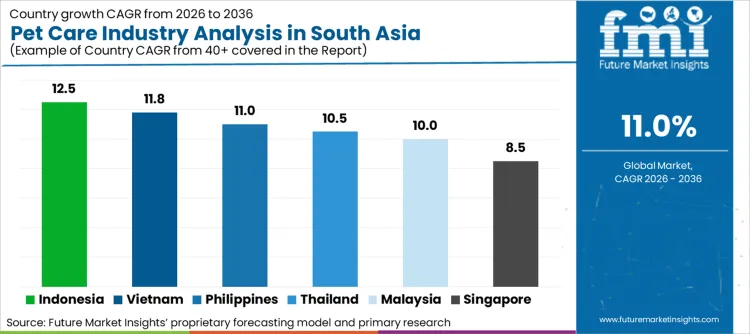
| Country | CAGR (2026 to 2036) |
|---|---|
| Indonesia | 12.5% |
| Vietnam | 11.8% |
| Philippines | 11.0% |
| Thailand | 10.5% |
| Malaysia | 10.0% |
| Singapore | 8.5% |
Source: Future Market Insights (FMI) analysis, based on proprietary forecasting model and primary research.
Why Is Indonesia Emerging as the Region’s Fastest-Growing Pet Care Market?
Indonesia’s 12.5% CAGR is driven by tightening governance around animal-based feed ingredient imports that rewards compliant scale and stabilises supply for repeat purchase categories. As authorities formalise documentation, facility standards, and import controls, larger suppliers with structured compliance systems gain advantage, reducing disruption risk across modern trade and general trade channels. Once compliant imports become predictable, retailer confidence improves, distributor service levels stabilise, and the economy tier can scale without recurring stockout penalties. This matters in a penetration-stage market where first-time ownership is still converting into habitual purchasing. Reliable shelf availability ensures that onboarding demand transitions into repeat replenishment rather than lapsing due to supply gaps. Over time, stable food continuity enables adjacencies such as treats, supplements, and hygiene to attach to the same household basket. Indonesia grows faster than peers because enforceable processes, distributor discipline, and improving retail execution align simultaneously, converting structural governance tightening into sustained replenishment-driven volume expansion across the decade.
What Is Powering Vietnam’s Expansion Beyond Just Premium Adoption?
Vietnam’s 11.8% CAGR is supported by circulation registration requirements for imported animal feed, which push the market toward documented SKUs and professionally managed distribution networks. Governance creates a structural filter that advantages portfolio-scale suppliers capable of handling regulatory dossiers, labelling compliance, and consistent channel servicing. As compliant supply becomes more predictable, modern trade and online platforms can widen assortment without compromising reliability. This improves repeat purchase frequency because households encounter fewer availability disruptions across pay cycles. Unlike markets that rely purely on premium diffusion, Vietnam expands through penetration-led scaling in core food categories, supported by improving trust in regulated products. Veterinary healthcare attach strengthens as clinics and licensed distributors reinforce consumer confidence in documented brands. The compounding effect emerges from governance and availability rather than price inflation alone. Vietnam therefore sustains strong growth through disciplined distribution, predictable replenishment, and gradual adjacencies into healthcare and functional nutrition, maintaining momentum without requiring premium-only acceleration.
Why Is the Philippines Growing Steadily Rather Than Rapidly?
The Philippines grows at 11.0% CAGR because formal registration and import gating steps support structured expansion while moderating rapid SKU proliferation. Regulatory processes create a controlled environment where compliant suppliers can scale, but approvals and documentation cycles slow the speed of new assortment entry. Food categories expand steadily through supermarkets, pet specialty outlets, and online marketplaces, anchoring the replenishment system that drives volume stability. However, rapid premium diffusion is tempered because each additional product must navigate administrative clearance pathways before circulation. The market remains resilient because high-cadence segments such as staple food and hygiene continue expanding even when innovation cycles are measured. As circulation strengthens, veterinary healthcare attachment gradually improves, reinforcing consumer trust in regulated products. Growth in the Philippines is therefore balanced rather than explosive, shaped by disciplined import governance and reliable distribution rather than aggressive SKU multiplication, enabling steady compounding aligned with formalised channel execution.
How Is Thailand Balancing Domestic Growth with Its Role as a Manufacturing Hub?
Thailand’s 10.5% CAGR is reinforced by its manufacturing role, which underwrites availability for domestic consumption and the wider Southeast Asian region. Disclosed production capacity and expansion intent signal deliberate throughput planning designed to prevent stockouts in high-frequency food categories. Because Thailand controls the execution layer of manufacturing, it benefits from shorter supply loops, stronger retailer confidence, and more predictable service levels. Reliable base ration availability encourages households to deepen spending into treats, hygiene products, and supplements within the same purchase cycle. Although Thailand grows slightly slower than the fastest markets, this reflects its relatively stronger starting baseline rather than structural weakness. Compounding remains durable because manufacturing continuity shields the market from external supply disruptions and import friction. Over time, adjacency categories expand once core food penetration stabilises. Thailand therefore represents a supply-driven growth model, where execution discipline and industrial capacity sustain expansion even without the sharp acceleration seen in earlier-stage penetration markets.
Why Is Malaysia Expanding at a Measured but Consistent Pace?
Malaysia’s 10.0% CAGR is driven by channel conversion and disciplined distribution rather than domestic export manufacturing leadership. The market depends heavily on imported portfolios, making distributor efficiency and retail execution the primary control points for scaling. Growth accelerates when organised retail chains and online marketplaces improve replenishment reliability, allowing households to maintain consistent feeding routines without disruption. As service levels stabilise, repeat purchase frequency strengthens in core ration and hygiene categories. However, reliance on imports introduces exposure to clearance timing and logistics cycles, which can moderate rapid assortment expansion. Premium and healthcare adjacencies expand gradually as consumer trust builds around documented brands and regulated supply. Malaysia’s trajectory is therefore steady rather than explosive, shaped by disciplined channel management and retail professionalism. The market compounds through improved conversion efficiency and shelf execution rather than manufacturing scale, delivering predictable mid-tier expansion supported by organised trade development.
Why Does Singapore Grow More Incrementally Despite Strong Spending Power?
Singapore grows at 8.5% CAGR because it begins from a mature penetration baseline and operates within a highly governed import environment that emphasises documentation, safety, and quality assurance. Compliance-led access strengthens trust in premium and clinically adjacent categories, particularly within veterinary and regulated product segments. However, high existing penetration means incremental household onboarding is limited compared with earlier-stage markets. Operating discipline within distribution channels ensures stable availability but reduces the likelihood of uncontrolled volume spikes. Retailers and importers prioritise structured SKU management over rapid assortment proliferation, maintaining a tightly managed ecosystem. While premium mix and healthcare intensity remain strong, overall volume growth is naturally incremental due to market maturity and high baseline spending levels. Singapore therefore represents a governance-stabilised, high-trust market where expansion occurs through value density and adjacencies rather than rapid unit acceleration, sustaining moderate but consistent compounding across the forecast horizon.
Who really holds power in South Asia’s pet care market, and why don’t global leaders always dominate locally?
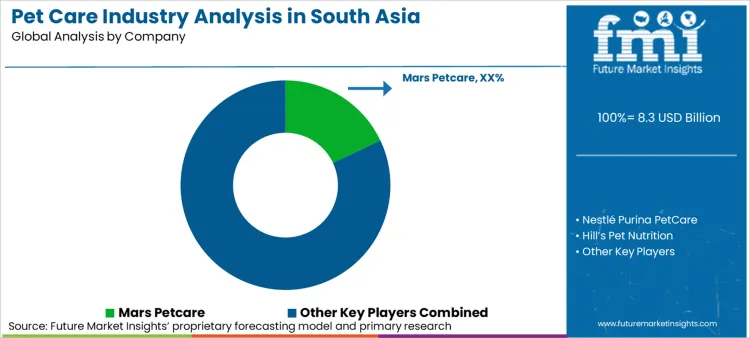
Scope includes pet food, treats, supplements, veterinary medicines, veterinary services, hygiene and grooming products and services, accessories, and other services such as boarding, training, daycare, and pet insurance. Scope excludes livestock feed, farm animal inputs, and non-pet human OTC categories. Globally, Mars Petcare holds the broadest scale platform across pet nutrition and services, with Nestlé Purina as a portfolio-scale nutrition competitor, while Zoetis, MSD Animal Health, Boehringer Ingelheim Animal Health, and Virbac lead regulated animal health portfolios. Asia leadership does not always mirror global brand leadership because manufacturing hubs and distributor control influence who wins on availability and price laddering. Japan must be treated separately because premium and functional nutrition intensity is high, but channel structure and local incumbents can limit direct translation of global brand dominance into regional leadership. In Southeast Asia, Thailand-based manufacturing scale and exporter discipline can give regional suppliers leverage in private label and export-driven scaling even when global leaders dominate brand equity.
Recent Developments
- In February 2025, MSD Animal Health won the 2024 S&P Global Award for Best New Companion Animal Product for its injectable BRAVECTO, offering dogs year-long flea and tick protection with a single dose.
- In June 2024, Boehringer Ingelheim and Trupanion announced an exclusive collaboration to expand access to pet healthcare, combining insurance expertise and animal health innovation to support early disease detection, treatment, and lifelong care.
Key Players in Pet Care Industry Analysis in South Asia
- Mars Petcare
- Nestlé Purina PetCare
- Hill’s Pet Nutrition
- Zoetis
- MSD Animal Health
- Boehringer Ingelheim Animal Health
- Virbac
- Perfect Companion Group (PCG)
- i-Tail Corporation
- Betagro Pet Business
Market Definition
The market covers consumer and institutional spend on products and services used to feed, maintain, protect, and manage companion animals. It includes pet food and treats, supplements, veterinary medicines, veterinary services, hygiene and grooming products and services, accessories, and other services such as boarding, training, daycare, and pet insurance. The market is measured as end-user spending across retail and service channels. It is structured around repeat purchase and regulated trust, where food creates the base and healthcare attach increases value density over time.
Market Inclusion
Included revenues capture packaged food and treat sales through modern trade, pet specialty retail, e-commerce, veterinary channels, and general trade. Included are veterinary services delivered through clinics and hospitals, and regulated medicines and supplements sold through licensed channels. Included are grooming services and hygiene products, accessories such as leashes and toys, and paid services such as daycare, training, boarding, and pet insurance where explicitly sold for companion animals. When company segment revenues are not disclosed, competitive inference relies on disclosed capacity, footprint, portfolio scale, and repeated executive emphasis.
Market Exclusion
Excluded are livestock feed, aquaculture feed, farm animal inputs, and production systems for food-producing animals. Excluded are general human OTC categories not regulated or marketed for pets, and non-pet retail services. Capital equipment for clinics is excluded unless bundled as an explicit service line. Informal or untraceable trade outside regulated frameworks is excluded to maintain channel comparability. Regional leadership divergence is explained through manufacturing hubs, distributor control, and regulatory access rather than brand awareness.
Scope of Report
| Items | Values |
|---|---|
| Quantitative Units (2026) | USD 8.3 Billion |
| Product and Service Category | Pet Food; Pet Healthcare (Veterinary Services, Medicines, Supplements); Pet Hygiene and Grooming; Pet Accessories; Other Services (Boarding, Training, Daycare, Pet Insurance) |
| Pet Type | Dogs; Cats; Others (Birds, Fish, Small Mammals, Reptiles) |
| Food Type (Within Pet Food) | Dry Food; Wet and Canned Food; Treats and Chews; Functional and Veterinary Diet Food; Other Food (Fresh, Freeze-dried, Toppers) |
| Distribution Channel | Modern Trade (Supermarkets and Hypermarkets); Pet Specialty Stores; E-commerce and Online Marketplaces; Veterinary Clinics and Hospitals; Convenience and Traditional Retail (General Trade) |
| Price Tier | Economy and Mass; Mid-range; Premium and Super-premium |
| Region Covered | South Asia (with Southeast Asia focus) |
| Key Countries | Indonesia; Vietnam; Philippines; Thailand; Malaysia; Singapore |
| Key Companies Profiled | Mars Petcare; Nestlé Purina PetCare; Hill’s Pet Nutrition; Zoetis; MSD Animal Health; Boehringer Ingelheim Animal Health; Virbac; Perfect Companion Group (PCG); i-Tail Corporation; Betagro Pet Business |
| Additional Attributes | End-user spending measured across food-led replenishment, veterinary healthcare attach, hygiene and accessory expansion, and regulated service delivery, analysed by product mix, pet type intensity, price ladder penetration, modern trade and marketplace conversion, veterinary channel trust, import and circulation compliance frameworks, regional manufacturing throughput signals, private label and exporter ecosystem influence, and divergence between global brand leadership and regional distributor-controlled scale. |
Source: Future Market Insights analysis, supported by a proprietary forecasting model and primary research
Pet Care Industry Analysis in South Asia by Key Segments
By Product and Service Category:
- Pet Food
- Pet Healthcare (vet services, medicines, supplements)
- Pet Hygiene and Grooming
- Pet Accessories
- Other Services (boarding, training, daycare, pet insurance, others)
By Pet Type:
- Dogs
- Cats
- Others (birds, fish, small mammals, reptiles)
By Food Type (within Pet Food):
- Dry Food
- Wet and Canned Food
- Treats and Chews
- Functional and Vet Diet Food
- Other Food (fresh, freeze-dried, toppers)
By Distribution Channel:
- Modern Trade (supermarkets and hypermarkets)
- Pet Specialty Stores
- E-commerce and Online Marketplaces
- Veterinary Clinics and Hospitals
- Convenience and Traditional Retail (general trade)
By Price Tier:
- Economy and Mass
- Mid-range
- Premium and Super-premium
By Country:
- Indonesia
- Vietnam
- Philippines
- Thailand
- Malaysia
- Singapore
Bibliography
- Department of Agriculture. (2024). Administrative Circular No. 04: Guidelines on the registration of animal feed and veterinary drugs. Republic of the Philippines.
- Ministry of Agriculture and Rural Development (MARD). (2024). Circular 09/2024/TT-BNNPTNT: Amending regulations on the inspection and certification of food safety for imported animal products. Government of Vietnam.
- Ministry of Agriculture. (2024). Regulation No. 18/2024 concerning the supervision of quality and safety of animal feed ingredients. Republic of Indonesia.
Frequently Asked Questions
How big is the pet care industry analysis in south asia in 2026?
The global pet care industry analysis in south asia is estimated to be valued at USD 8.3 billion in 2026.
What will be the size of pet care industry analysis in south asia in 2036?
The market size for the pet care industry analysis in south asia is projected to reach USD 23.6 billion by 2036.
How much will be the pet care industry analysis in south asia growth between 2026 and 2036?
The pet care industry analysis in south asia is expected to grow at a 11.0% CAGR between 2026 and 2036.
What are the key product types in the pet care industry analysis in south asia?
The key product types in pet care industry analysis in south asia are pet food , pet healthcare (vet services, medicines, supplements), pet hygiene and grooming and pet accessories.
Which pet type segment to contribute significant share in the pet care industry analysis in south asia in 2026?
In terms of pet type, dogs segment to command 52.0% share in the pet care industry analysis in south asia in 2026.
Preview the report firsthand - request a free sample
Get SampleGet the brochure for pricing and purchase details.
Get PDFTable of Content
- Executive Summary
- Global Market Outlook
- Demand-side Trends
- Supply-side Trends
- Technology Roadmap Analysis
- Analysis and Recommendations
- Market Overview
- Market Coverage / Taxonomy
- Market Definition / Scope / Limitations
- Research Methodology
- Chapter Orientation
- Analytical Lens and Working Hypotheses
- Market Structure, Signals, and Trend Drivers
- Benchmarking and Cross-market Comparability
- Market Sizing, Forecasting, and Opportunity Mapping
- Research Design and Evidence Framework
- Desk Research Programme (Secondary Evidence)
- Company Annual and Sustainability Reports
- Peer-reviewed Journals and Academic Literature
- Corporate Websites, Product Literature, and Technical Notes
- Earnings Decks and Investor Briefings
- Statutory Filings and Regulatory Disclosures
- Technical White Papers and Standards Notes
- Trade Journals, Industry Magazines, and Analyst Briefs
- Conference Proceedings, Webinars, and Seminar Materials
- Government Statistics Portals and Public Data Releases
- Press Releases and Reputable Media Coverage
- Specialist Newsletters and Curated Briefings
- Sector Databases and Reference Repositories
- FMI Internal Proprietary Databases and Historical Market Datasets
- Subscription Datasets and Paid Sources
- Social Channels, Communities, and Digital Listening Inputs
- Additional Desk Sources
- Expert Input and Fieldwork (Primary Evidence)
- Primary Modes
- Qualitative Interviews and Expert Elicitation
- Quantitative Surveys and Structured Data Capture
- Blended Approach
- Why Primary Evidence is Used
- Field Techniques
- Interviews
- Surveys
- Focus Groups
- Observational and In-context Research
- Social and Community Interactions
- Stakeholder Universe Engaged
- C-suite Leaders
- Board Members
- Presidents and Vice Presidents
- R&D and Innovation Heads
- Technical Specialists
- Domain Subject-matter Experts
- Scientists
- Physicians and Other Healthcare Professionals
- Governance, Ethics, and Data Stewardship
- Research Ethics
- Data Integrity and Handling
- Primary Modes
- Tooling, Models, and Reference Databases
- Desk Research Programme (Secondary Evidence)
- Data Engineering and Model Build
- Data Acquisition and Ingestion
- Cleaning, Normalisation, and Verification
- Synthesis, Triangulation, and Analysis
- Quality Assurance and Audit Trail
- Market Background
- Market Dynamics
- Drivers
- Restraints
- Opportunity
- Trends
- Scenario Forecast
- Demand in Optimistic Scenario
- Demand in Likely Scenario
- Demand in Conservative Scenario
- Opportunity Map Analysis
- Product Life Cycle Analysis
- Supply Chain Analysis
- Investment Feasibility Matrix
- Value Chain Analysis
- PESTLE and Porter’s Analysis
- Regulatory Landscape
- Regional Parent Market Outlook
- Production and Consumption Statistics
- Import and Export Statistics
- Market Dynamics
- Global Market Analysis 2021 to 2025 and Forecast, 2026 to 2036
- Historical Market Size Value (USD Million) Analysis, 2021 to 2025
- Current and Future Market Size Value (USD Million) Projections, 2026 to 2036
- Y-o-Y Growth Trend Analysis
- Absolute $ Opportunity Analysis
- Global Market Pricing Analysis 2021 to 2025 and Forecast 2026 to 2036
- Global Market Analysis 2021 to 2025 and Forecast 2026 to 2036, By Product and Service Category
- Introduction / Key Findings
- Historical Market Size Value (USD Million) Analysis By Product and Service Category , 2021 to 2025
- Current and Future Market Size Value (USD Million) Analysis and Forecast By Product and Service Category , 2026 to 2036
- Pet Food
- Pet Healthcare (vet services, medicines, supplements)
- Pet Hygiene and Grooming
- Pet Accessories
- Pet Food
- Y-o-Y Growth Trend Analysis By Product and Service Category , 2021 to 2025
- Absolute $ Opportunity Analysis By Product and Service Category , 2026 to 2036
- Global Market Analysis 2021 to 2025 and Forecast 2026 to 2036, By Pet Type
- Introduction / Key Findings
- Historical Market Size Value (USD Million) Analysis By Pet Type, 2021 to 2025
- Current and Future Market Size Value (USD Million) Analysis and Forecast By Pet Type, 2026 to 2036
- Dogs
- Cats
- Dogs
- Y-o-Y Growth Trend Analysis By Pet Type, 2021 to 2025
- Absolute $ Opportunity Analysis By Pet Type, 2026 to 2036
- Global Market Analysis 2021 to 2025 and Forecast 2026 to 2036, By Food Type
- Introduction / Key Findings
- Historical Market Size Value (USD Million) Analysis By Food Type, 2021 to 2025
- Current and Future Market Size Value (USD Million) Analysis and Forecast By Food Type, 2026 to 2036
- Dry Food
- Wet and Canned Food
- Treats and Chews
- Functional and Vet Diet Food
- Dry Food
- Y-o-Y Growth Trend Analysis By Food Type, 2021 to 2025
- Absolute $ Opportunity Analysis By Food Type, 2026 to 2036
- Global Market Analysis 2021 to 2025 and Forecast 2026 to 2036, By Region
- Introduction
- Historical Market Size Value (USD Million) Analysis By Region, 2021 to 2025
- Current Market Size Value (USD Million) Analysis and Forecast By Region, 2026 to 2036
- North America
- Latin America
- Western Europe
- Eastern Europe
- East Asia
- South Asia and Pacific
- Middle East & Africa
- Market Attractiveness Analysis By Region
- North America Market Analysis 2021 to 2025 and Forecast 2026 to 2036, By Country
- Historical Market Size Value (USD Million) Trend Analysis By Market Taxonomy, 2021 to 2025
- Market Size Value (USD Million) Forecast By Market Taxonomy, 2026 to 2036
- By Country
- USA
- Canada
- Mexico
- By Product and Service Category
- By Pet Type
- By Food Type
- By Country
- Market Attractiveness Analysis
- By Country
- By Product and Service Category
- By Pet Type
- By Food Type
- Key Takeaways
- Latin America Market Analysis 2021 to 2025 and Forecast 2026 to 2036, By Country
- Historical Market Size Value (USD Million) Trend Analysis By Market Taxonomy, 2021 to 2025
- Market Size Value (USD Million) Forecast By Market Taxonomy, 2026 to 2036
- By Country
- Brazil
- Chile
- Rest of Latin America
- By Product and Service Category
- By Pet Type
- By Food Type
- By Country
- Market Attractiveness Analysis
- By Country
- By Product and Service Category
- By Pet Type
- By Food Type
- Key Takeaways
- Western Europe Market Analysis 2021 to 2025 and Forecast 2026 to 2036, By Country
- Historical Market Size Value (USD Million) Trend Analysis By Market Taxonomy, 2021 to 2025
- Market Size Value (USD Million) Forecast By Market Taxonomy, 2026 to 2036
- By Country
- Germany
- UK
- Italy
- Spain
- France
- Nordic
- BENELUX
- Rest of Western Europe
- By Product and Service Category
- By Pet Type
- By Food Type
- By Country
- Market Attractiveness Analysis
- By Country
- By Product and Service Category
- By Pet Type
- By Food Type
- Key Takeaways
- Eastern Europe Market Analysis 2021 to 2025 and Forecast 2026 to 2036, By Country
- Historical Market Size Value (USD Million) Trend Analysis By Market Taxonomy, 2021 to 2025
- Market Size Value (USD Million) Forecast By Market Taxonomy, 2026 to 2036
- By Country
- Russia
- Poland
- Hungary
- Balkan & Baltic
- Rest of Eastern Europe
- By Product and Service Category
- By Pet Type
- By Food Type
- By Country
- Market Attractiveness Analysis
- By Country
- By Product and Service Category
- By Pet Type
- By Food Type
- Key Takeaways
- East Asia Market Analysis 2021 to 2025 and Forecast 2026 to 2036, By Country
- Historical Market Size Value (USD Million) Trend Analysis By Market Taxonomy, 2021 to 2025
- Market Size Value (USD Million) Forecast By Market Taxonomy, 2026 to 2036
- By Country
- China
- Japan
- South Korea
- By Product and Service Category
- By Pet Type
- By Food Type
- By Country
- Market Attractiveness Analysis
- By Country
- By Product and Service Category
- By Pet Type
- By Food Type
- Key Takeaways
- South Asia and Pacific Market Analysis 2021 to 2025 and Forecast 2026 to 2036, By Country
- Historical Market Size Value (USD Million) Trend Analysis By Market Taxonomy, 2021 to 2025
- Market Size Value (USD Million) Forecast By Market Taxonomy, 2026 to 2036
- By Country
- India
- ASEAN
- Australia & New Zealand
- Rest of South Asia and Pacific
- By Product and Service Category
- By Pet Type
- By Food Type
- By Country
- Market Attractiveness Analysis
- By Country
- By Product and Service Category
- By Pet Type
- By Food Type
- Key Takeaways
- Middle East & Africa Market Analysis 2021 to 2025 and Forecast 2026 to 2036, By Country
- Historical Market Size Value (USD Million) Trend Analysis By Market Taxonomy, 2021 to 2025
- Market Size Value (USD Million) Forecast By Market Taxonomy, 2026 to 2036
- By Country
- Kingdom of Saudi Arabia
- Other GCC Countries
- Turkiye
- South Africa
- Other African Union
- Rest of Middle East & Africa
- By Product and Service Category
- By Pet Type
- By Food Type
- By Country
- Market Attractiveness Analysis
- By Country
- By Product and Service Category
- By Pet Type
- By Food Type
- Key Takeaways
- Key Countries Market Analysis
- USA
- Pricing Analysis
- Market Share Analysis, 2025
- By Product and Service Category
- By Pet Type
- By Food Type
- Canada
- Pricing Analysis
- Market Share Analysis, 2025
- By Product and Service Category
- By Pet Type
- By Food Type
- Mexico
- Pricing Analysis
- Market Share Analysis, 2025
- By Product and Service Category
- By Pet Type
- By Food Type
- Brazil
- Pricing Analysis
- Market Share Analysis, 2025
- By Product and Service Category
- By Pet Type
- By Food Type
- Chile
- Pricing Analysis
- Market Share Analysis, 2025
- By Product and Service Category
- By Pet Type
- By Food Type
- Germany
- Pricing Analysis
- Market Share Analysis, 2025
- By Product and Service Category
- By Pet Type
- By Food Type
- UK
- Pricing Analysis
- Market Share Analysis, 2025
- By Product and Service Category
- By Pet Type
- By Food Type
- Italy
- Pricing Analysis
- Market Share Analysis, 2025
- By Product and Service Category
- By Pet Type
- By Food Type
- Spain
- Pricing Analysis
- Market Share Analysis, 2025
- By Product and Service Category
- By Pet Type
- By Food Type
- France
- Pricing Analysis
- Market Share Analysis, 2025
- By Product and Service Category
- By Pet Type
- By Food Type
- India
- Pricing Analysis
- Market Share Analysis, 2025
- By Product and Service Category
- By Pet Type
- By Food Type
- ASEAN
- Pricing Analysis
- Market Share Analysis, 2025
- By Product and Service Category
- By Pet Type
- By Food Type
- Australia & New Zealand
- Pricing Analysis
- Market Share Analysis, 2025
- By Product and Service Category
- By Pet Type
- By Food Type
- China
- Pricing Analysis
- Market Share Analysis, 2025
- By Product and Service Category
- By Pet Type
- By Food Type
- Japan
- Pricing Analysis
- Market Share Analysis, 2025
- By Product and Service Category
- By Pet Type
- By Food Type
- South Korea
- Pricing Analysis
- Market Share Analysis, 2025
- By Product and Service Category
- By Pet Type
- By Food Type
- Russia
- Pricing Analysis
- Market Share Analysis, 2025
- By Product and Service Category
- By Pet Type
- By Food Type
- Poland
- Pricing Analysis
- Market Share Analysis, 2025
- By Product and Service Category
- By Pet Type
- By Food Type
- Hungary
- Pricing Analysis
- Market Share Analysis, 2025
- By Product and Service Category
- By Pet Type
- By Food Type
- Kingdom of Saudi Arabia
- Pricing Analysis
- Market Share Analysis, 2025
- By Product and Service Category
- By Pet Type
- By Food Type
- Turkiye
- Pricing Analysis
- Market Share Analysis, 2025
- By Product and Service Category
- By Pet Type
- By Food Type
- South Africa
- Pricing Analysis
- Market Share Analysis, 2025
- By Product and Service Category
- By Pet Type
- By Food Type
- USA
- Market Structure Analysis
- Competition Dashboard
- Competition Benchmarking
- Market Share Analysis of Top Players
- By Regional
- By Product and Service Category
- By Pet Type
- By Food Type
- Competition Analysis
- Competition Deep Dive
- Mars Petcare
- Overview
- Product Portfolio
- Profitability by Market Segments (Product/Age /Sales Channel/Region)
- Sales Footprint
- Strategy Overview
- Marketing Strategy
- Product Strategy
- Channel Strategy
- Nestlé Purina PetCare
- Hill’s Pet Nutrition
- Zoetis
- MSD Animal Health
- Mars Petcare
- Competition Deep Dive
- Assumptions & Acronyms Used


