

- Market Size (2026)
- USD 3.07 Bn
- Forecast (2036)
- USD 7.6 Bn
- CAGR (2026 to 2036)
- 9.5%
Indonesia Pet Care Market Size, Market Forecast and Outlook By FMI
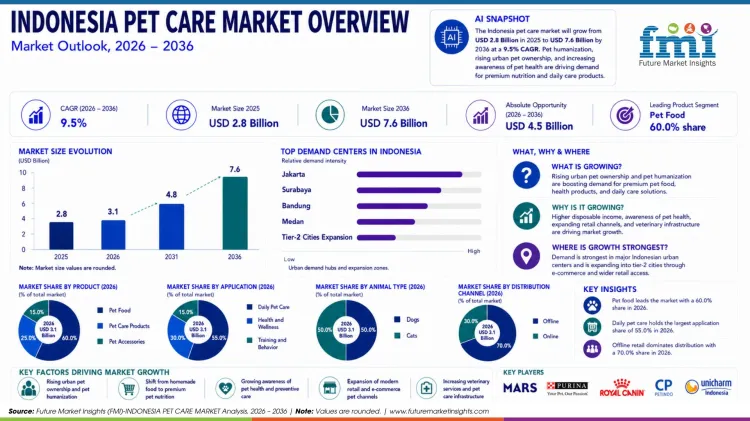
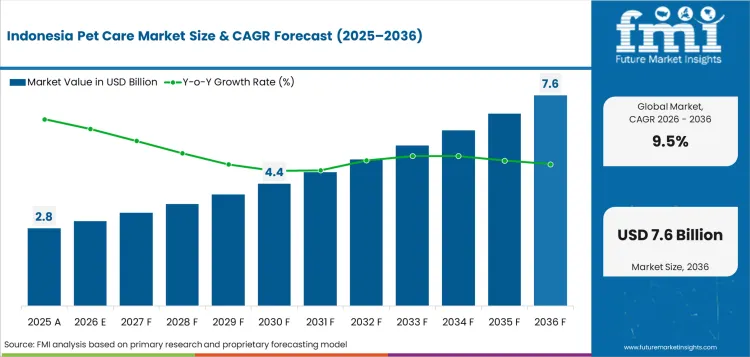
The indonesia pet care market was valued at USD 2.8 billion in 2025. The market is set to reach USD 3.1 billion by 2026-end and grow at a CAGR of 9.5% between 2026-2036 to reach USD 7.6 billion by 2036. Pet Food will dominate with a 60.0% share, while Daily Pet Care will lead with a 55.0% share.
Key Takeaways, Market Size, and Forecast
| Metric | Value |
|---|---|
| Market Size (2025) | USD 2.8 Billion |
| Market Size (2036) | USD 7.6 Billion |
| CAGR (2026–2036) | 9.5% |
| Incremental Opportunity (2026–2036) | USD 4.53 Billion |
| Leading Product (2026) | Pet Food |
| Pet Food Share (2026) | 60.0% |
| Fastest-Growing Country | China |
| China CAGR | 12.8% |
| 2nd Fastest-Growing Country | India |
| India CAGR | 11.9% |
Summary of the Indonesia Pet Care Market
- Demand and Growth Drivers
- Urban middle-class household growth in Indonesia is driving pet humanization, with pet ownership rates in Jakarta, Surabaya, and Bandung increasing as smaller family sizes and apartment living create demand for companion animals.
- Commercial pet food penetration is accelerating as Indonesian urban consumers shift from table-scrap feeding to manufactured pet food, with branded products replacing unbranded local alternatives.
- Young Indonesians are becoming more aware of pet health and with expanding veterinary services, there is increasing demand for preventive care, vaccinations and specialty veterinary treatments.
- Product and Segment View
- The product segment of pet food is sustained at 60.0% in 2026 with the highest volume categories of dry dog food and cat food as commercial feeding replaces traditional home-prepared pet meals.
- The most popular animal type was dogs (50.0% share), due to cultural preference for dog ownership in non-Muslim majority areas of Indonesia, and the growing popularity of cats across all demographics.
- Offline retail (70.0%) dominates the distribution channel. Traditional pet shops, veterinary clinics and modern retail chains are the main places of purchase.
- Geography and Competitive Outlook
- China leads global pet care growth at 12.8% CAGR, driven by rapid pet population expansion among urban millennials and Gen Z consumers treating pets as family members.
- India at 11.9% reflects pet ownership formalization and commercial pet food adoption accelerating in metropolitan areas.
- Mars Incorporated holds the leading position in Indonesia through Pedigree, Whiskas, and Royal Canin brand portfolios with established distribution across modern and traditional retail channels.
- Analyst Opinion
- The Indonesia pet care market is one of the highest growth opportunities in Southeast Asia with the increasing disposable income, urbanization and pet humanization trends transforming informal pet keeping to commercial pet care consumption.
- As Indonesian social media pet content drives awareness of nutrition, grooming and healthcare standards previously limited to Western markets, the adoption of commercial pet products is increasing.
- Mars Incorporated is the leader in depth of brand portfolio and distribution reach across modern retail, veterinary clinics and traditional pet shops.
- Companies developing veterinary clinic partnerships and opening pet specialty retail in tier-2 Indonesian cities are well-placed to capitalise on growth as commercial pet care expands beyond Jakarta and Surabaya.
- We expect capital allocation to cold chain distribution for premium pet food, veterinary service network development, and e-commerce fulfillment to shape competitive positioning through 2036.
Indonesia Pet Care Market Definition
The Indonesia pet care market encompasses pet food, pet care products (grooming, health, hygiene), and pet accessories sold for dogs, cats, and other companion animals through offline and online retail channels. Market scope includes manufactured pet food, veterinary health products, grooming supplies, toys, and pet housing accessories.
Indonesia Pet Care Market Inclusions
Market scope includes pet food (dry, wet, treats), pet care products (shampoos, dental care, supplements, flea and tick treatments), and pet accessories (collars, leashes, beds, toys). Revenue is tracked by product, application, end use, distribution channel, and animal type from 2026 to 2036.
Indonesia Pet Care Market Exclusions
The scope does not include livestock feed, aquarium fish food sold for commercial aquaculture, or veterinary pharmaceutical products requiring prescription. Agricultural working animals are excluded.
Indonesia Pet Care Market Research Methodology
- Primary Research: FMI analysts interviewed pet food manufacturers, pet shop owners, veterinary clinic operators and e-commerce pet category managers in Indonesian cities.
- Desk research: Data from Indonesian pet industry associations, retail audit data, veterinary registration data and manufacturer disclosures.
- Market Sizing & Forecasting: Bottom-up aggregation based on estimated pet population, spending per pet by category, and commercial product penetration rates across urban and peri-urban Indonesian markets.
- Data Validation: Cross-check quarterly against retail sales audit data, import records of pet products, and manufacturer financial disclosures.
Why is the Indonesia Pet Care Market Growing?
- Pet ownership in Indonesia is moving from utilitarian (guard dogs, pest-control cats) to companion-centric. Urban pet owners are spending on nutrition, grooming and healthcare that resemble human household spending patterns.
- China’s 12.8% CAGR is the global benchmark and a future indicator for Indonesian pet humanization trajectories as consumer income and urbanization patterns converge.
- E-commerce platforms Tokopedia and Shopee are increasing access to pet products in tier-2 and tier-3 cities of Indonesia where dedicated pet retail stores are rare.
The pet care market in Indonesia is growing as the demographics of urban households are shifting toward smaller families, apartment living and adoption of companion animals. Jakarta, Surabaya, Bandung and Medan are the main demand centers with the highest commercial pet care penetration. Trend 4: “Pet humanization” is expanding among young Indonesian professionals, who are spending on branded pet foods, grooming products and veterinary services outside the traditional pattern of expenditure for pet keeping. Social media pet content is driving demand for premium products previously only available to expat consumers by accelerating awareness of pet nutrition and health standards.
The commercial pet food penetration is still below 30% of the total pet population, which provides significant growth headroom with continued urbanization and rising income levels. The biggest volume growth opportunity is the move from feeding table scraps to commercial pet food. The premium and super-premium segments are growing faster than the economy segment because early adopters have developed spending habits that new pet owners follow. The market is expected to grow at a CAGR of 9.5% from 2026 to 2036.
Market Segmentation Analysis
- Pet food holds 60.0% of the product segment, with dry food as the largest format category and wet food gaining share in urban premium segments.
- 65.0% of end-use demand is represented by household pet owners, with spending focused on food, basic care products, and increasing veterinary health services.
- Offline retail holds 70.0% of the distribution channel, though online channels through Tokopedia, Shopee, and specialized pet e-commerce are growing at twice the offline rate.
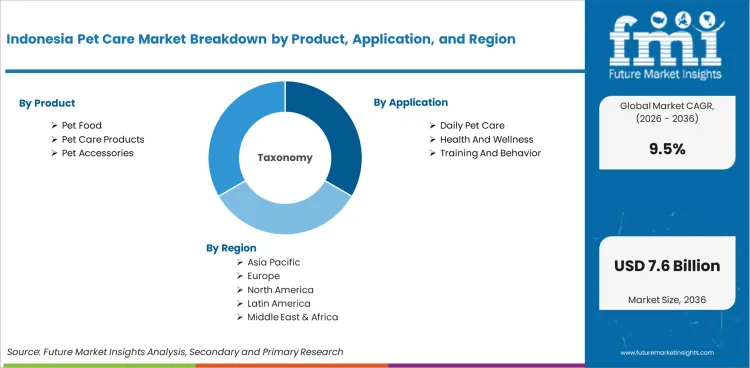
The Indonesia pet care market is segmented by product, application, end use, distribution channel, and animal type. Each dimension captures distinct consumer behavior patterns reflecting the early-stage commercialization of Indonesian pet care.
Insights into the Pet Food Product Segment
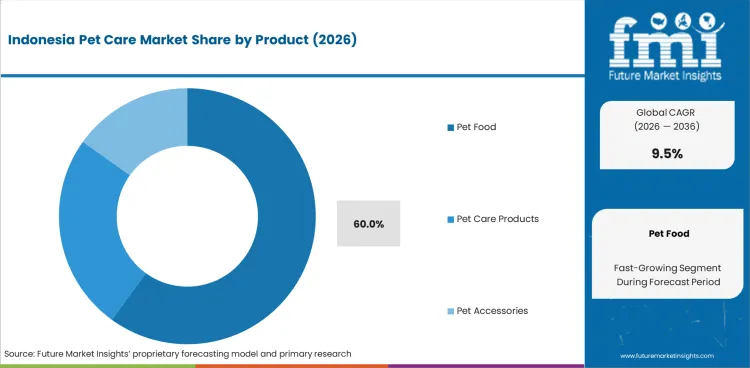
The product segment is projected to be 60.0% pet food in 2026. The cheapest and easiest to distribute is dry food. The most known brands are Pedigree and Whiskas. Premium pet food brands such as Royal Canin and Hill’s Science Diet are focusing on city dwellers who are willing to pay two to three times the price of standard products for the nutrition and health positioning.
The rest is pet care products (grooming, health, hygiene) and accessories. Grooming products are growing due to the booming of pet salons in malls and commercial districts in Indonesia. Emerging categories like pet health supplements and dental care products are being promoted by vets.
Insights into the Dogs Animal Type Segment
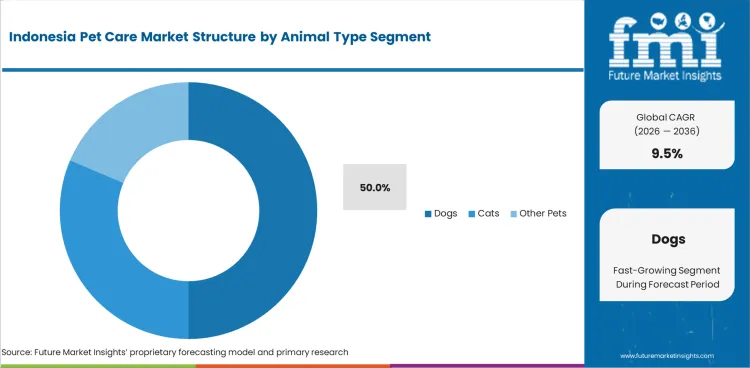
Dogs constitute 50.0% of the animal type segment in 2026. Dog ownership in Indonesia is concentrated in areas where the majority of the population is non-Muslim such as Bali, North Sulawesi and East Nusa Tenggara and in large metropolitan areas between people of different religions. Apartment living is seeing a rise in small dog breeds, which increases per pet spending on premium food and grooming.
Cats are the fastest growing animal category and are culturally accepted across all Indonesian demographics. Cat ownership in Jakarta and Java is growing rapidly, with cat food and cat care products the fastest growing sub-segments.
Indonesia Pet Care Market Drivers, Restraints, and Opportunities
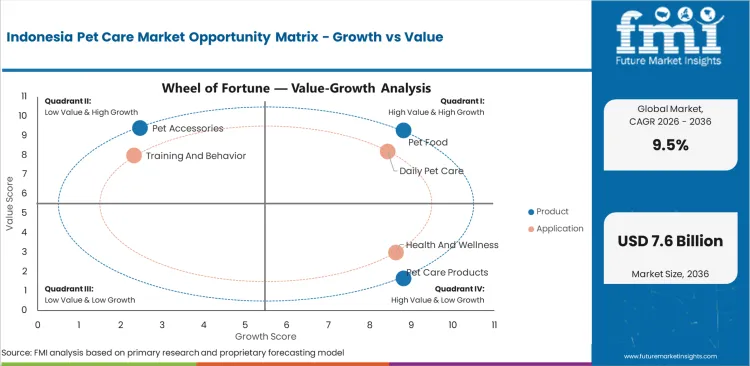
- The trend towards pet humanization and the growth of urban middle-class income are fueling the adoption of commercial pet care in Indonesian cities, with consumers moving from basic to branded products and increasing their spending per pet.
- Lack of cold chain infrastructure and fragmented traditional retail limits distribution of premium pet food outside tier-1 cities, resulting in concentration of high-value sales in Jakarta and Surabaya metropolitan areas.
- The increase in veterinary service networks and pet health awareness, coupled with the growth of product sales, creating new service revenue streams.
Urbanization, rising incomes and changing cultural attitudes toward pet companionship are impacting the Indonesian pet care market. The 9.5% CAGR growth from 2026-2036 suggests the increasing commercialization of pet care in Indonesian urban centers.
Pet Humanization and Income Growth
As disposable income rises, Indonesian urban households can allocate funds to pet nutrition, health, and grooming. Younger generations treat pets as part of the family, spending more on branded products and veterinary care than previous generations.
Distribution Infrastructure Constraints
Adoption of premium pet products is limited by cold chain constraints and retail fragmentation outside of tier-1 cities. Wet pet food and refrigerated treats require distribution infrastructure that is under-developed in tier-2 and tier-3 markets, centralizing premium sales in metropolitan areas.
E-commerce Channel Expansion
The pet categories of Tokopedia, Shopee and Lazada are expanding the reach of products beyond the constraints of physical retail. Through e-commerce, consumers in tier-2 and tier-3 cities have access to branded pet products that were only available in specialty stores in Jakarta and Surabaya.
Veterinary Services Growth
The growth of veterinary clinics in Indonesian cities is raising awareness about preventive care, vaccination and dietary management, prompting upgrades of pet food and health products. Veterinary recommendations affect the brand selection and adoption of premium products by health conscious pet owners.
Competitive Landscape and Strategic Positioning
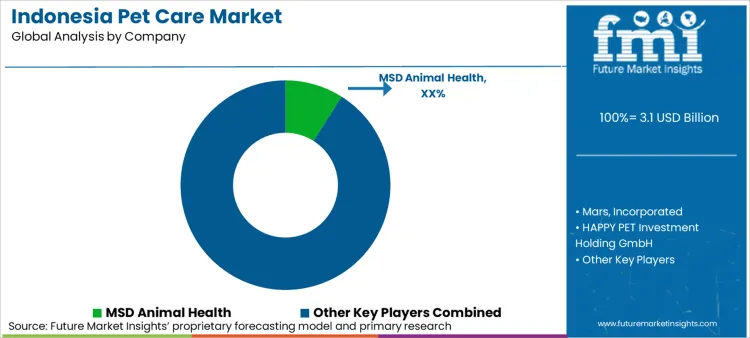
- Indonesia’s market leader is Mars Incorporated, with its Pedigree, Whiskas and Royal Canin brand portfolios sold through modern retail, veterinary clinics and traditional pet shops.
- The battle for brand equity and premium veterinary diet positioning in the Indonesian urban markets is between Nestle (Purina) and Colgate-Palmolive (Hill's).
- Indonesian domestic players like PT Nutricell Pacific and PT Central Proteina Prima focus on the economy segments through local production and traditional retail distribution.
Mars Incorporated has a deep multi-brand portfolio that includes economy (Pedigree, Whiskas), premium (Royal Canin, Nutro) and veterinary diet segments and is the leader. In Indonesia, distribution is through modern retail chains (Alfamart, Indomaret), pet specialty shops and veterinary clinic channels.
MSD Animal Health has veterinary pharmaceutical and health product portfolios to compete. Nestle’s Purina brand and JM Smucker’s pet food brands are entering the Indonesian market via collaborations with modern retailers.
Barriers include building distribution networks across the archipelago geography of Indonesia, cold chain infrastructure for premium products and brand awareness in a market that is transitioning from informal pet keeping. Strategic priorities include expanding distribution in tier-2 cities, developing e-commerce channels, and implementing veterinary partnership programs.
Key Companies in the Indonesia Pet Care Market
Key global companies leading the indonesia pet care market include:
- Mars Incorporated (USA), Colgate-Palmolive (USA), and Nestle S.A. (Switzerland) hold leading multinational positions through established brand portfolios and modern retail distribution in Indonesian urban markets.
- MSD Animal Health (USA) and JM Smucker (USA) maintain positions through veterinary health products and pet food brands entering the Indonesian market through distributor partnerships.
- PT Nutricell Pacific, PT Central Proteina Prima, and Bali Pet Shop represent domestic Indonesian players serving economy and regional segments through localized production and traditional retail networks.
Competitive Benchmarking: Indonesia Pet Care Market
| Company | Brand Portfolio | Distribution Reach | Product Range | Indonesia Presence |
|---|---|---|---|---|
| Mars, Incorporated | High | Strong | High | Established |
| MSD Animal Health | Medium | Moderate | Medium (Health) | Growing |
| HAPPY PET Investment | Medium | Moderate | Medium | Regional |
| PT Nutricell Pacific | Low | Moderate | Medium | Domestic |
| Colgate-Palmolive | Medium | Moderate | Medium | Growing |
| JM Smucker Co. | Medium | Moderate | Medium | Entering |
| Nestle S.A. | High | Strong | High | Growing |
| PT Central Proteina Prima | Low | Moderate | Low | Domestic |
| Groovy Vetcare Clinic | Low | Low | Low (Services) | Jakarta |
| Bali Pet Shop PT | Low | Low | Medium | Bali regional |
Source: Future Market Insights competitive analysis, 2026.
Key Developments in Indonesia Pet Care Market
- In 2025, Mars, Incorporated expanded premium pet food and veterinary care distribution across Southeast Asia, including Indonesia, through retail partnerships and omnichannel pet care networks supporting rising demand for companion animal nutrition and wellness products.
- In 2025, Nestlé S.A. strengthened its Indonesia pet care presence through wider availability of Purina pet nutrition products in modern retail and e-commerce channels, reflecting growing urban pet ownership and premiumization trends in the domestic market.
Key Players in the Indonesia Pet Care Market
Major Global Players
- Mars, Incorporated
- MSD Animal Health
- HAPPY PET Investment Holding GmbH
- PT Nutricell Pacific
- Colgate-Palmolive Company
- JM Smucker Co.
- Nestlé S.A.
Emerging Players/Startups
- PT Central Proteina Prima Tbk
- Groovy Vetcare Clinic
- Bali Pet Shop PT
- KW Aquatic Supplies Sdn Bhd
- PT Citra Mandiri Kencana
- Menara Petskita Indonesia
- Other Players
Report Scope and Coverage
| Parameter | Details |
|---|---|
| Quantitative Units | USD 3.07 billion to USD 7.6 billion, at a CAGR of 9.5% |
| Market Definition | The Indonesia pet care market includes pet food, care products, and accessories for dogs, cats, and companion animals sold through offline and online retail channels. |
| Regions Covered | North America, Latin America, Europe, East Asia, South Asia and Pacific, Middle East and Africa |
| Key Companies Profiled | Mars, Incorporated, MSD Animal Health, HAPPY PET Investment Holding GmbH, PT Nutricell Pacific, Colgate-Palmolive Company, JM Smucker Co., Nestlé S.A., PT Central Proteina Prima Tbk, Groovy Vetcare Clinic, Bali Pet Shop PT, KW Aquatic Supplies Sdn Bhd, PT Citra Mandiri Kencana |
| Forecast Period | 2026 to 2036 |
| Approach | Hybrid bottom-up methodology using estimated pet population, per-pet spending by category, and commercial product penetration rates across urban Indonesian markets. |
Segmentation
Indonesia Pet Care Market Segmented by Product:
- Pet Food
- Dry Food
- Kibble
- Baked Dry Food
- Wet Food
- Canned Food
- Pouches
- Treats And Snacks
- Functional Treats
- Training Treats
- Dry Food
- Pet Care Products
- Grooming Products
- Shampoos And Conditioners
- Brushes And Combs
- Health Products
- Supplements
- Dental Care Products
- Grooming Products
- Pet Accessories
- Bedding And Furniture
- Pet Beds
- Crates And Kennels
- Toys And Training Products
- Interactive Toys
- Training Aids
- Bedding And Furniture
Indonesia Pet Care Market Segmented by Application:
- Daily Pet Care
- Feeding
- Routine Feeding
- Special Diet Feeding
- Hygiene And Grooming
- Bathing
- Coat Care
- Feeding
- Health And Wellness
- Preventive Care
- Supplements Use
- Dental Care
- Medical Care
- Therapeutic Diets
- Veterinary Products
- Preventive Care
- Training And Behavior
- Obedience Training
- Basic Training
- Advanced Training
- Behavior Management
- Anxiety Relief
- Activity Engagement
- Obedience Training
Indonesia Pet Care Market Segmented by End Use:
- Household Pet Owners
- Dog Owners
- Small Breed Owners
- Large Breed Owners
- Cat Owners
- Indoor Cats
- Outdoor Cats
- Dog Owners
- Professional Services
- Pet Grooming Services
- Salons
- Mobile Grooming
- Veterinary Clinics
- Private Clinics
- Animal Hospitals
- Pet Grooming Services
- Pet Care Facilities
- Boarding And Daycare
- Short Term Boarding
- Long Term Care
- Training Centers
- Behavior Training
- Skill Training
- Boarding And Daycare
Indonesia Pet Care Market Segmented by Distribution Channel:
- Offline Retail
- Pet Specialty Stores
- Independent Stores
- Retail Chains
- Supermarkets And Hypermarkets
- Large Format Stores
- Convenience Stores
- Veterinary Clinics
- In Clinic Sales
- Prescription Products
- Pet Specialty Stores
- Online Retail
- E Commerce Platforms
- Marketplace Platforms
- Brand Owned Websites
- Quick Commerce
- App Based Delivery
- Subscription Services
- E Commerce Platforms
Indonesia Pet Care Market Segmented by Animal Type:
- Dogs
- Companion Dogs
- Indoor Pets
- Outdoor Pets
- Working Dogs
- Guard Dogs
- Service Dogs
- Companion Dogs
- Cats
- Domestic Cats
- Indoor Cats
- Outdoor Cats
- Pedigree Cats
- Show Cats
- Breeding Cats
- Domestic Cats
- Other Pets
- Small Mammals
- Rabbits
- Hamsters
- Birds And Fish
- Pet Birds
- Aquarium Fish
- Small Mammals
Research Sources and Bibliography
- 1. Food and Agriculture Organization. (2025). FAO Animal Feed and Pet Food Production Data. FAO.
- 2. World Organisation for Animal Health. (2025). WOAH Companion Animal Health Data. WOAH.
- 3. European Pet Food Industry Federation. (2025). FEDIAF Annual Report on Pet Population and Nutrition. FEDIAF.
- 4. American Pet Products Association. (2025). APPA National Pet Owners Survey. APPA.
- 5. Indonesian Ministry of Agriculture. (2025). Companion Animal Registration Statistics. MOA.
- 6. World Bank. (2025). World Bank Indonesia Urban Development Indicators. World Bank.
This bibliography is provided for reader reference. The full Future Market Insights report contains the complete reference list with publication dates, URLs, and supporting data for all cited works.
This Report Answers
- Estimating the size of the Indonesia pet care market and revenue projections from 2026 to 2036.
- Segmentation by product, application, end use, distribution channel, and animal type.
- Insights across more than 30 regional markets including global benchmarks.
- Analysis of commercial pet food penetration and premiumization trends.
- Assessment of the competitive landscape across multinational and domestic players.
- Identification of investment opportunities in pet food, veterinary services, and e-commerce distribution.
- Distribution channel analysis covering offline retail, online platforms, and veterinary clinics.
- Delivery of data in PDF and Excel formats.
Frequently Asked Questions
What is the global market demand for Indonesia Pet Care in 2026?
In 2026, the Indonesia pet care market is estimated at USD 3.07 billion.
How big will the Indonesia Pet Care Market be in 2036?
By 2036, the market is projected to reach USD 7.6 billion.
How much is demand for the Indonesia Pet Care Market expected to grow between 2026 and 2036?
Between 2026 and 2036, the market is projected to expand at a CAGR of 9.5%.
Which product segment is expected to lead in the Indonesia Pet Care Market in 2026?
Pet food is expected to hold 60.0% of the product segment in 2026, driven by commercial feeding adoption replacing traditional home-prepared pet meals.
What is causing demand to rise in China?
China is expected to grow at 12.8% CAGR through 2036, driven by urban millennial pet ownership expansion and per-pet spending increases.
What is causing demand to rise in India?
India is expected to grow at 11.9% CAGR through 2036, supported by pet ownership formalization and commercial pet food adoption in metropolitan areas.
What does this report mean by Indonesia Pet Care Market definition?
The market includes pet food, care products, and accessories for dogs, cats, and companion animals sold through offline and online retail channels in Indonesia.
How does FMI make the Indonesia Pet Care Market forecast and validate it?
Forecasting uses hybrid methodology with estimated pet population and per-pet spending, validated against retail audit data and manufacturer disclosures.
Preview the report firsthand - request a free sample
Get SampleGet the brochure for pricing and purchase details.
Get PDFTable of Content
- Key Takeaways
- Market Size and CAGR
- Top Growth Driver
- Fastest Growing Segment
- Leading Region
- Key Companies
- Emerging Opportunities
- Executive Summary
- Indonesia Market Outlook
- Demand-side Trends
- Supply-side Trends
- Technology Roadmap Analysis
- Analysis and Recommendations
- Analyst Perspective (What is happening? Why now? What should investors know?)
- Key Questions Answered
- How large is the market?
- What is the CAGR?
- What are key trends?
- Which region dominates?
- Who are the leaders?
- Market Overview
- Market Coverage / Taxonomy
- Market Definition / Scope / Limitations
- Research Methodology
- Chapter Orientation
- Analytical Lens and Working Hypotheses
- Market Structure, Signals, and Trend Drivers
- Benchmarking and Cross-market Comparability
- Market Sizing, Forecasting, and Opportunity Mapping
- Research Design and Evidence Framework
- Desk Research Programme (Secondary Evidence)
- Expert Input and Fieldwork (Primary Evidence)
- Tooling, Models, and Reference Databases
- Data Engineering and Model Build
- Quality Assurance and Audit Trail
- Market Background
- Market Dynamics (Drivers, Restraints, Opportunity, Trends)
- Scenario Forecast (Optimistic, Likely, Conservative)
- Impact Analysis
- AI Impact
- Sustainability Impact
- Regulatory Impact
- Technology Impact
- Consumer / Buyer Analysis
- Purchase Drivers
- Adoption Barriers
- Buyer Journey
- Opportunity Map Analysis
- Product Life Cycle Analysis
- Supply Chain Analysis
- Investment Feasibility Matrix
- Value Chain Analysis
- PESTLE and Porter's Analysis
- Regulatory Landscape
- Regional Parent Market Outlook
- Production and Consumption Statistics
- Import and Export Statistics
- Indonesia Market Analysis and Forecast, 2021 to 2036
- Historical Market Size Value (USD Billion) Analysis, 2021 to 2025
- Current and Future Market Size Value (USD Billion) Projections, 2026 to 2036
- Y-o-Y Growth Trend Analysis
- Absolute $ Opportunity Analysis
- Indonesia Market Pricing Analysis, 2021 to 2036
- Indonesia Market Analysis and Forecast, By Product Type, 2021 to 2036
- Introduction / Key Findings
- Historical Market Size Value (USD Billion) Analysis By Product Type, 2021 to 2025
- Current and Future Market Size Value (USD Billion) Analysis and Forecast By Product Type, 2026 to 2036
- Pet Food
- Dry Food
- Kibble
- Baked Dry Food
- Wet Food
- Canned Food
- Pouches
- Treats And Snacks
- Functional Treats
- Training Treats
- Dry Food
- Pet Care Products
- Grooming Products
- Shampoos And Conditioners
- Brushes And Combs
- Health Products
- Supplements
- Dental Care Products
- Grooming Products
- Pet Accessories
- Bedding And Furniture
- Pet Beds
- Crates And Kennels
- Toys And Training Products
- Interactive Toys
- Training Aids
- Bedding And Furniture
- Pet Food
- Y-o-Y Growth Trend Analysis By Product Type, 2021 to 2025
- Absolute $ Opportunity Analysis By Product Type, 2026 to 2036
- Indonesia Market Analysis and Forecast, By Application, 2021 to 2036
- Introduction / Key Findings
- Historical Market Size Value (USD Billion) Analysis By Application, 2021 to 2025
- Current and Future Market Size Value (USD Billion) Analysis and Forecast By Application, 2026 to 2036
- Daily Pet Care
- Feeding
- Routine Feeding
- Special Diet Feeding
- Hygiene And Grooming
- Bathing
- Coat Care
- Feeding
- Health And Wellness
- Preventive Care
- Supplements Use
- Dental Care
- Medical Care
- Therapeutic Diets
- Veterinary Products
- Preventive Care
- Training And Behavior
- Obedience Training
- Basic Training
- Advanced Training
- Behavior Management
- Anxiety Relief
- Activity Engagement
- Obedience Training
- Daily Pet Care
- Y-o-Y Growth Trend Analysis By Application, 2021 to 2025
- Absolute $ Opportunity Analysis By Application, 2026 to 2036
- Indonesia Market Analysis and Forecast, By Animal Type, 2021 to 2036
- Introduction / Key Findings
- Historical Market Size Value (USD Billion) Analysis By Animal Type, 2021 to 2025
- Current and Future Market Size Value (USD Billion) Analysis and Forecast By Aninal Type, 2026 to 2036
- Dogs
- Companion Dogs
- Indoor Pets
- Outdoor Pets
- Working Dogs
- Guard Dogs
- Service Dogs
- Companion Dogs
- Cats
- Domestic Cats
- Indoor Cats
- Outdoor Cats
- Pedigree Cats
- Show Cats
- Breeding Cats
- Domestic Cats
- Other Pets
- Small Mammals
- Rabbits
- Hamsters
- Birds And Fish
- Pet Birds
- Aquarium Fish
- Small Mammals
- Dogs
- Y-o-Y Growth Trend Analysis By Animal Type , 2021 to 2025
- Absolute $ Opportunity Analysis By Animal Type, 2026 to 2036
- Indonesia Market Analysis and Forecast, By Country, 2021 to 2036
- Introduction
- Historical Market Size Value (USD Billion) Analysis By Country, 2021 to 2025
- Current Market Size Value (USD Billion) Analysis and Forecast By Country, 2026 to 2036
- Indonesia
- Market Attractiveness Analysis By Country
- Indonesia Market Analysis and Forecast, By Country, 2021 to 2036
- Historical Market Size Value (USD Billion) Trend Analysis By Market Taxonomy, 2021 to 2025
- Market Size Value (USD Billion) Forecast By Market Taxonomy, 2026 to 2036
- By Product Type
- By Application
- By Animal Type
- Market Attractiveness Analysis
- By Product Type
- By Application
- By Animal Type
- Key Takeaways
- Market Structure Analysis
- Competition Dashboard
- Competition Benchmarking
- Market Share Analysis of Top Players
- By Regional
- By Product Type
- By Application
- By Animal Type
- Case Studies
- Success Stories
- Recent Developments
- Competition Analysis
- Competition Deep Dive
- MSD Animal Health
- Overview
- Product Portfolio
- Profitability by Market Segments
- Sales Footprint
- Strategy Overview
- Marketing Strategy
- Product Strategy
- Channel Strategy
- Mars, Incorporated
- Nestlé SA
- Colgate-Palmolive Company
- PT Central Proteina Prima Tbk
- PT. Nutricell Pacific
- HAPPY PET Investment Holding GmbH
- JM Smucker Co.
- MSD Animal Health
- Competition Deep Dive
- Assumptions & Acronyms Used


