

- Industry Size (2025)
- USD 14.2 Mn
- Forecast (2035)
- USD 52.1 Mn
- CAGR (2025 to 2035)
- 13.9%
Eldercare-Assistive Robots Market Size and Share Forecast Outlook in East Asia From 2024 to 2035
The Eldercare-Assistive Robots Industry Analysis in East Asia is estimated to be valued at USD 14.2 million in 2025 and is projected to reach USD 52.1 million by 2035, registering a compound annual growth rate (CAGR) of 13.9% over the forecast period.
The eldercare-assistive robots industry in East Asia is expanding rapidly, supported by an aging population, labor shortages in caregiving professions, and rising healthcare technology investments. Robotics is increasingly being integrated into elderly care systems to provide physical assistance, emotional support, and health monitoring.
The market is characterized by strong government backing, particularly in Japan, South Korea, and China, where social welfare programs are encouraging the adoption of robotic solutions to reduce caregiver burden. Technological advancements in AI, voice recognition, and sensory perception have enhanced human-robot interaction, improving acceptance among elderly users.
With rising emphasis on independent living and quality of life, assistive robots are gaining prominence across residential and institutional care settings. The regional market is projected to experience sustained growth, supported by innovation and favorable policy frameworks promoting robotic healthcare deployment.
Quick Stats for Eldercare-Assistive Robots Industry Analysis in East Asia
- Eldercare-Assistive Robots Industry Analysis in East Asia Industry Value (2025): USD 14.2 million
- Eldercare-Assistive Robots Industry Analysis in East Asia Forecast Value (2035): USD 52.1 million
- Eldercare-Assistive Robots Industry Analysis in East Asia Forecast CAGR: 13.9%
- Leading Segment in Eldercare-Assistive Robots Industry Analysis in East Asia in 2025: Robot Companion Pets (69.6%)
- Key Growth Region in Eldercare-Assistive Robots Industry Analysis in East Asia: North America, Asia-Pacific, Europe
- Top Key Players in Eldercare-Assistive Robots Industry Analysis in East Asia: Intuition Robotics (ElliQ), Luvozo (SAM), Nanjing AvatarMind Robot Technology Co., Ltd. (iPal), Blue Frog Robotics (Buddy), Ageless Innovation, LLC (JOY FOR ALL Companion Pets), Akara Robotics Ltd. (Stevie), SoftBank Robotics, Sony Corporation, Consequential Robotics (MiRo)
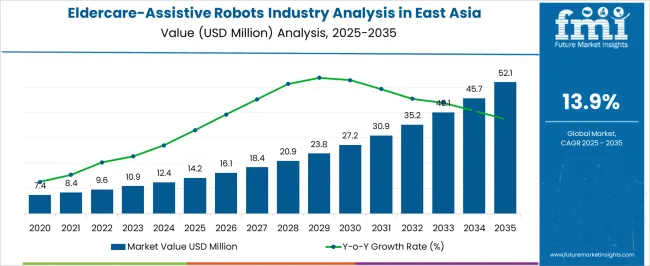
| Metric | Value |
|---|---|
| Eldercare-Assistive Robots Industry Analysis in East Asia Estimated Value in (2025 E) | USD 14.2 million |
| Eldercare-Assistive Robots Industry Analysis in East Asia Forecast Value in (2035 F) | USD 52.1 million |
| Forecast CAGR (2025 to 2035) | 13.9% |
Segmental Analysis
The market is segmented by Robot Type and End-Use Verticals and region. By Robot Type, the market is divided into Robot Companion Pets and Eldercare Service Robot. In terms of End-Use Verticals, the market is classified into Personal Or Residential, Senior Living Community, Nursing Care Centres, and Other End-Use Verticals. Regionally, the market is classified into North America, Latin America, Western Europe, Eastern Europe, Balkan & Baltic Countries, Russia & Belarus, Central Asia, East Asia, South Asia & Pacific, and the Middle East & Africa.
Insights into the Robot Companion Pets Segment
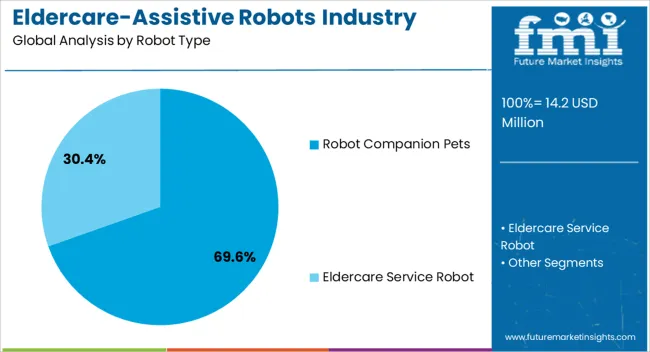
The robot companion pets segment holds approximately 69.60% share in the robot type category, reflecting its dominant role in providing emotional support and social engagement to elderly individuals. These robots are designed to simulate pet behavior, offering companionship, reducing loneliness, and improving mental well-being.
Adoption has been driven by their therapeutic benefits and user-friendly interaction interfaces. The segment benefits from increasing awareness of psychological health in eldercare and technological innovations enabling responsive, lifelike behavior.
With affordability improving and product variety expanding, robot companion pets are expected to remain the most preferred category in assistive robotics for emotional wellness.
Insights into the Personal Or Residential Segment
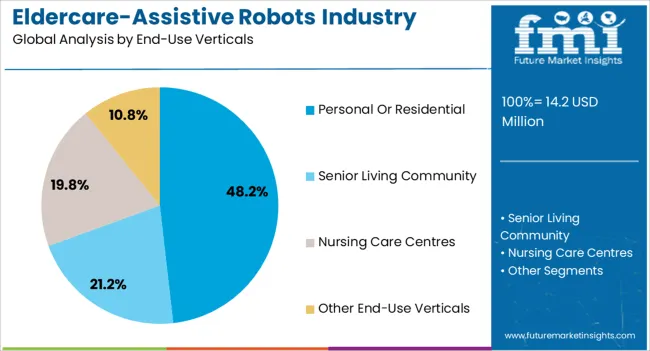
The personal or residential segment dominates the end-use verticals category with approximately 48.20% share, driven by growing adoption of assistive robots in home-based elderly care. Families are increasingly investing in robotic companions and mobility-assist systems to support independent living for aging relatives.
Convenience, lower long-term care costs, and enhanced safety monitoring are key factors contributing to this trend. Governments and healthcare providers are also promoting home-based robotic assistance to reduce institutional care dependency.
With improving affordability and cultural acceptance of in-home automation, the personal or residential segment is projected to maintain its leadership position across East Asia’s eldercare-assistive robots market.
Sales Trend Analysis from Historical Performance Compared to Market Outlook for 2024 to 2035
The socially assistive healthcare industry in East Asia experienced slow growth during the historical period. Most of the vendors were focused on the research and development phase to form robotic companionship industry leaders. The elderly people in East Asia were hesitant to accept the change brought upon by the introduction of senior care robots.
As eldercare assistive robotics were deployed more into existing nursing-care facilities and hospitals, the manufacturers received feedback to improve the product. Gradually, the medical robots industry gained sufficient ground in other Asian countries, leading to a rapid expansion of the sector in Japan and South Korea as well. With further advancement of robotics for senior independence in East Asia, elderly people are expected to get used to the robots and become more accepting.
Key Drivers Accelerating Demand for Eldercare-Assistive Robots in East Asia
- Better funding and more investments are made towards the improvement of nursing and care facilities
- The median age of the population is rising in many East Asian countries due to a higher life expectancy
- A shortage of nurses could mean eldercare facilities are likely to make more use of assistive robots
- The surge in awareness about the benefits of robotic healthcare for the elderly
- Growing popularity of telehealth and medical data analysis solutions
Factors Restraining the Demand for Eldercare-Assistive Robots in East Asia
- High cost of development and testing of robots
- Challenges with regard to elders accepting technology
- Service robots need to handle more uncertain tasks when compared to industrial robots
- Potential privacy concerns with regard to data collected
- Lack of training given to nursing staff on the effective usage of these robots
Emerging Opportunities in the East Asia Healthcare Companion Robots Market
- Involving the end users in the design process of eldercare assistive robots
- Incorporating the latest AI developments and large language models
- Development of custom eldercare-assistive robots based on the needs of facilities
- Incorporating personal information about elders into the robot to provide better assistance
- Research into fully autonomous robots for eldercare assistance
Top Market Dynamics and Industry Trends in East Asia's Eldercare-Assistive Robot Industry
- Increasing focus of manufacturers on affordability
- Manufacturing robots catered towards specific illnesses
- Manufacturers looking to integrate with existing robot management software
- Assistive robots are being used as a way of providing telehealth to seniors
Analysis of Top Countries Manufacturing, Certifying, and Operating Eldercare-Assistive Robots in East Asia
| Countries | CAGR (2025 to 2035) |
|---|---|
| Japan | 14.8% |
| South Korea | 12.0% |
Early Adoption of Robotics Technology in Japan
The eldercare-assistive robot industry in Japan holds a dominant share of 64.1% in 2025. Over the next ten years, eldercare-assistive robot sales in Japan are likely to rise at a CAGR of 14.8%.
- Japan has been early in adopting and incorporating senior care robots into their existing eldercare services.
- Currently, Japan is facing the biggest issue with regard to the aging population, and the median age is also rapidly growing when compared to the rest of the world.
Acceptance of Assistive Robots in South Korea
The eldercare-assistive robots industry in South Korea is expected to grow at a CAGR of 12.0% over the forecast period. Some of the key reasons that are expected to drive the regional industry of South Korea through the projected years include:
- South Korean citizens, especially elders, are becoming more accepting of newer technologies such as robotic healthcare for the elderly.
- Manufacturers are encouraged to participate in the research and manufacturing of eldercare-assistive robots by the government in South Korea through supportive policies and financing.
Eldercare-Assistive Robots Industry Analysis by Top Investment Segments in East Asia
Higher Sales of Robot Companion Pets Due to Lower Cost of Manufacturing
The robot companion pets segment is estimated to have the dominant industry share of 69.6% in 2025, with a total valuation of USD 52.1 million by 2035. This segment is likely to expand at a rate of 12.8% through the forecast years.
| Top Robot Type | Robot Companion Pets |
|---|---|
| Value CAGR (2025 to 2035) | 12.8% |
- The cost associated with the manufacturing of industrial robots leads to elderly care robotics becoming more expensive to purchase.
- Robot companion pets are much cheaper to manufacture compared to service robots.
- The introduction of emergency response systems in robot companion pets is likely to increase their adoption to guarantee the security of senior citizens and their caretakers.
Emergence and Growth Potential of Eldercare-Assistive Robots for Personal or Residential Use
The personal or residential end-use vertical is expected to grow at a CAGR of 15.6% over the forecast period.
| Top End-Use Vertical | Personal or Residential |
|---|---|
| Value CAGR (2025 to 2035) | 15.6% |
- The pandemic increased the need for contactless care solutions, driving the relevance and necessity of eldercare-assistive robots in residents.
- The growing acceptance and adoption of eldercare-assistive robots as instruments to improve senior care are influenced by societal values.
Notable Players in the Business Landscape in East Asia
Key players are focusing on product innovation. This means that they are focused on integrating new technologies, such as advancements in artificial technology (AI), into their product line. Smart eldercare robotic and AI-based solutions allow robots to perform much more tasks such as better understanding the person’s emotions and queries.
Strategic Developments by Leading Firms in Japan and South Korea
Focus on Research and Testing
Many companies are focused on testing their robots for eldercare. It is primarily done through the use of test runs where the robot is deployed into a nursing center and data about user feedback and quality of service provided is collected.
Expanding Product Line
As the healthcare assistive robot industry size is expanding, companies are looking to expand their line of products. The development and manufacture of smart eldercare robotics for various use cases are expected to enable the companies to grow by targeting a broader demographic.
Expansion into Emerging Regions
As the Asia Pacific eldercare-assistive robots industry expands, vendors in Japan and South Korea are expected to expand into other emerging countries in the neighborhood. This diversification is also anticipated to allow them to tap into new customer bases and support businesses in emerging economies with their assistive robots.
Looking to Expand Abroad
Some of the leading industry players are looking to expand into Europe and North American countries. It is expected to increase their share and also help develop robotics for the aging population by gaining access to feedback from a broader demographic and more variety in terms of culture.
Leading Suppliers in the East Asia Eldercare-Assistive Robots Sector
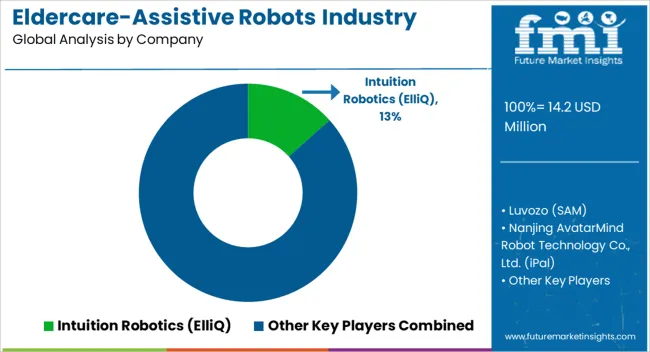
- Intuition Robotics (ElliQ)
- Luvozo (SAM)
- Nanjing AvatarMind Robot Technology Co., Ltd. (iPal)
- Blue Frog Robotics (Buddy)
- Ageless Innovation, LLC (JOY FOR ALL Companion Pets)
- Akara Robotics Ltd. (Stevie)
- SoftBank Robotics
- Sony Corporation
- Consequential Robotics (MiRo)
Key Developments in the Eldercare-Assistive Robots in East Asia
- In December 2025, SoftBank Robotics America, the United States division of SoftBank Robotics Group Corp. announced a strategic partnership with Formant to integrate SoftBank’s robots with Formant’s Robot Management System (RMS).
- In December 2025, Intuition Robotics, Ltd. announced an updated version of ELIQ. After taking feedback from users, ELIQ 2.0 will feature an upgraded screen and microphone as well as a new virtual café experience, which allows seniors to visit 18 cities across the world virtually.
- In September 2025, Ageless Innovation LLC announced the launch of a new companion bird designed to sit on top of walking devices. This product was invented by a customer of the company who had pitched the idea to the company.
Related Industry Growth Outlook Scenario
| Particulars | CAGR (2025 to 2035) |
|---|---|
| Service Robotics | 21.0% |
| Edge AI | 20.8% |
| Medical Electronic | 6.8% |
Scope and Coverage of the East Asia Eldercare-Assistive Robots Market Report
| Attribute | Details |
|---|---|
| Estimated Industry Size in 2025 | USD 10.92 million |
| Projected Industry Size in 2035 | USD 40.37 million |
| Anticipated CAGR from 2025 to 2035 | 13.9% CAGR |
| Historical Analysis of Demand for Eldercare-Assistive Robots in East Asia | 2020 to 2025 |
| Demand Forecast for Eldercare-Assistive Robots in East Asia | 2025 to 2035 |
| Report Coverage | Industry Size, Industry Trends, Analysis of key factors influencing Eldercare-Assistive Robot Sales in East Asia, Insights on Global Players and their Industry Strategy in East Asia, Ecosystem Analysis of Local and East Asia Providers |
| Key Countries Analyzed while Studying Opportunities in Eldercare-Assistive Robots in East Asia | Japan, South Korea |
| Key Companies Profiled | Intuition Robotics (ElliQ); Luvozo (SAM); Nanjing AvatarMind Robot Technology Co., Ltd. (iPal); Blue Frog Robotics (Buddy); Ageless Innovation, LLC (JOY FOR ALL Companion Pets); Akara Robotics Ltd. (Stevie); SoftBank Robotics; Sony Corporation; Consequential Robotics (MiRo) |
Top Segments Studied in the East Asia Eldercare-Assistive Robots Market
By Robot Type:
- Robot Companion Pets
- Eldercare Service Robot
By End-Use Verticals:
- Personal or Residential
- Senior Living Community
- Nursing Care Centres
- Other End-Use Verticals
By Country:
- Japan
- South Korea
Frequently Asked Questions
How big is the eldercare-assistive robots industry analysis in east asia in 2025?
The global eldercare-assistive robots industry analysis in east asia is estimated to be valued at USD 14.2 million in 2025.
What will be the size of eldercare-assistive robots industry analysis in east asia in 2035?
The market size for the eldercare-assistive robots industry analysis in east asia is projected to reach USD 52.1 million by 2035.
How much will be the eldercare-assistive robots industry analysis in east asia growth between 2025 and 2035?
The eldercare-assistive robots industry analysis in east asia is expected to grow at a 13.9% CAGR between 2025 and 2035.
What are the key product types in the eldercare-assistive robots industry analysis in east asia?
The key product types in eldercare-assistive robots industry analysis in east asia are robot companion pets and eldercare service robot.
Which end-use verticals segment to contribute significant share in the eldercare-assistive robots industry analysis in east asia in 2025?
In terms of end-use verticals, personal or residential segment to command 48.2% share in the eldercare-assistive robots industry analysis in east asia in 2025.
Preview the report firsthand - request a free sample
Get SampleGet the brochure for pricing and purchase details.
Get PDFTable of Content
- Executive Summary
- Global Market Outlook
- Demand-side Trends
- Supply-side Trends
- Technology Roadmap Analysis
- Analysis and Recommendations
- Market Overview
- Market Coverage / Taxonomy
- Market Definition / Scope / Limitations
- Market Background
- Market Dynamics
- Drivers
- Restraints
- Opportunity
- Trends
- Scenario Forecast
- Demand in Optimistic Scenario
- Demand in Likely Scenario
- Demand in Conservative Scenario
- Opportunity Map Analysis
- Product Life Cycle Analysis
- Supply Chain Analysis
- Investment Feasibility Matrix
- Value Chain Analysis
- PESTLE and Porter’s Analysis
- Regulatory Landscape
- Regional Parent Market Outlook
- Production and Consumption Statistics
- Import and Export Statistics
- Market Dynamics
- Global Analysis 2020 to 2024 and Forecast, 2025 to 2035
- Historical Market Size Value (USD Million) Analysis, 2020 to 2024
- Current and Future Market Size Value (USD Million) Projections, 2025 to 2035
- Y-o-Y Growth Trend Analysis
- Absolute $ Opportunity Analysis
- Global Pricing Analysis 2020 to 2024 and Forecast 2025 to 2035
- Global Analysis 2020 to 2024 and Forecast 2025 to 2035, By Robot Type
- Introduction / Key Findings
- Historical Market Size Value (USD Million) Analysis By Robot Type , 2020 to 2024
- Current and Future Market Size Value (USD Million) Analysis and Forecast By Robot Type , 2025 to 2035
- Robot Companion Pets
- Eldercare Service Robot
- Y-o-Y Growth Trend Analysis By Robot Type , 2020 to 2024
- Absolute $ Opportunity Analysis By Robot Type , 2025 to 2035
- Global Analysis 2020 to 2024 and Forecast 2025 to 2035, By End-Use Verticals
- Introduction / Key Findings
- Historical Market Size Value (USD Million) Analysis By End-Use Verticals, 2020 to 2024
- Current and Future Market Size Value (USD Million) Analysis and Forecast By End-Use Verticals, 2025 to 2035
- Personal Or Residential
- Senior Living Community
- Nursing Care Centres
- Other End-Use Verticals
- Y-o-Y Growth Trend Analysis By End-Use Verticals, 2020 to 2024
- Absolute $ Opportunity Analysis By End-Use Verticals, 2025 to 2035
- Global Analysis 2020 to 2024 and Forecast 2025 to 2035, By Region
- Introduction
- Historical Market Size Value (USD Million) Analysis By Region, 2020 to 2024
- Current Market Size Value (USD Million) Analysis and Forecast By Region, 2025 to 2035
- North America
- Latin America
- Western Europe
- Eastern Europe
- East Asia
- South Asia and Pacific
- Middle East & Africa
- Market Attractiveness Analysis By Region
- North America Analysis 2020 to 2024 and Forecast 2025 to 2035, By Country
- Historical Market Size Value (USD Million) Trend Analysis By Market Taxonomy, 2020 to 2024
- Market Size Value (USD Million) Forecast By Market Taxonomy, 2025 to 2035
- By Country
- USA
- Canada
- Mexico
- By Robot Type
- By End-Use Verticals
- By Country
- Market Attractiveness Analysis
- By Country
- By Robot Type
- By End-Use Verticals
- Key Takeaways
- Latin America Analysis 2020 to 2024 and Forecast 2025 to 2035, By Country
- Historical Market Size Value (USD Million) Trend Analysis By Market Taxonomy, 2020 to 2024
- Market Size Value (USD Million) Forecast By Market Taxonomy, 2025 to 2035
- By Country
- Brazil
- Chile
- Rest of Latin America
- By Robot Type
- By End-Use Verticals
- By Country
- Market Attractiveness Analysis
- By Country
- By Robot Type
- By End-Use Verticals
- Key Takeaways
- Western Europe Analysis 2020 to 2024 and Forecast 2025 to 2035, By Country
- Historical Market Size Value (USD Million) Trend Analysis By Market Taxonomy, 2020 to 2024
- Market Size Value (USD Million) Forecast By Market Taxonomy, 2025 to 2035
- By Country
- Germany
- UK
- Italy
- Spain
- France
- Nordic
- BENELUX
- Rest of Western Europe
- By Robot Type
- By End-Use Verticals
- By Country
- Market Attractiveness Analysis
- By Country
- By Robot Type
- By End-Use Verticals
- Key Takeaways
- Eastern Europe Analysis 2020 to 2024 and Forecast 2025 to 2035, By Country
- Historical Market Size Value (USD Million) Trend Analysis By Market Taxonomy, 2020 to 2024
- Market Size Value (USD Million) Forecast By Market Taxonomy, 2025 to 2035
- By Country
- Russia
- Poland
- Hungary
- Balkan & Baltic
- Rest of Eastern Europe
- By Robot Type
- By End-Use Verticals
- By Country
- Market Attractiveness Analysis
- By Country
- By Robot Type
- By End-Use Verticals
- Key Takeaways
- East Asia Analysis 2020 to 2024 and Forecast 2025 to 2035, By Country
- Historical Market Size Value (USD Million) Trend Analysis By Market Taxonomy, 2020 to 2024
- Market Size Value (USD Million) Forecast By Market Taxonomy, 2025 to 2035
- By Country
- China
- Japan
- South Korea
- By Robot Type
- By End-Use Verticals
- By Country
- Market Attractiveness Analysis
- By Country
- By Robot Type
- By End-Use Verticals
- Key Takeaways
- South Asia and Pacific Analysis 2020 to 2024 and Forecast 2025 to 2035, By Country
- Historical Market Size Value (USD Million) Trend Analysis By Market Taxonomy, 2020 to 2024
- Market Size Value (USD Million) Forecast By Market Taxonomy, 2025 to 2035
- By Country
- India
- ASEAN
- Australia & New Zealand
- Rest of South Asia and Pacific
- By Robot Type
- By End-Use Verticals
- By Country
- Market Attractiveness Analysis
- By Country
- By Robot Type
- By End-Use Verticals
- Key Takeaways
- Middle East & Africa Analysis 2020 to 2024 and Forecast 2025 to 2035, By Country
- Historical Market Size Value (USD Million) Trend Analysis By Market Taxonomy, 2020 to 2024
- Market Size Value (USD Million) Forecast By Market Taxonomy, 2025 to 2035
- By Country
- Kingdom of Saudi Arabia
- Other GCC Countries
- Turkiye
- South Africa
- Other African Union
- Rest of Middle East & Africa
- By Robot Type
- By End-Use Verticals
- By Country
- Market Attractiveness Analysis
- By Country
- By Robot Type
- By End-Use Verticals
- Key Takeaways
- Key Countries Analysis
- USA
- Pricing Analysis
- Market Share Analysis, 2024
- By Robot Type
- By End-Use Verticals
- Canada
- Pricing Analysis
- Market Share Analysis, 2024
- By Robot Type
- By End-Use Verticals
- Mexico
- Pricing Analysis
- Market Share Analysis, 2024
- By Robot Type
- By End-Use Verticals
- Brazil
- Pricing Analysis
- Market Share Analysis, 2024
- By Robot Type
- By End-Use Verticals
- Chile
- Pricing Analysis
- Market Share Analysis, 2024
- By Robot Type
- By End-Use Verticals
- Germany
- Pricing Analysis
- Market Share Analysis, 2024
- By Robot Type
- By End-Use Verticals
- UK
- Pricing Analysis
- Market Share Analysis, 2024
- By Robot Type
- By End-Use Verticals
- Italy
- Pricing Analysis
- Market Share Analysis, 2024
- By Robot Type
- By End-Use Verticals
- Spain
- Pricing Analysis
- Market Share Analysis, 2024
- By Robot Type
- By End-Use Verticals
- France
- Pricing Analysis
- Market Share Analysis, 2024
- By Robot Type
- By End-Use Verticals
- India
- Pricing Analysis
- Market Share Analysis, 2024
- By Robot Type
- By End-Use Verticals
- ASEAN
- Pricing Analysis
- Market Share Analysis, 2024
- By Robot Type
- By End-Use Verticals
- Australia & New Zealand
- Pricing Analysis
- Market Share Analysis, 2024
- By Robot Type
- By End-Use Verticals
- China
- Pricing Analysis
- Market Share Analysis, 2024
- By Robot Type
- By End-Use Verticals
- Japan
- Pricing Analysis
- Market Share Analysis, 2024
- By Robot Type
- By End-Use Verticals
- South Korea
- Pricing Analysis
- Market Share Analysis, 2024
- By Robot Type
- By End-Use Verticals
- Russia
- Pricing Analysis
- Market Share Analysis, 2024
- By Robot Type
- By End-Use Verticals
- Poland
- Pricing Analysis
- Market Share Analysis, 2024
- By Robot Type
- By End-Use Verticals
- Hungary
- Pricing Analysis
- Market Share Analysis, 2024
- By Robot Type
- By End-Use Verticals
- Kingdom of Saudi Arabia
- Pricing Analysis
- Market Share Analysis, 2024
- By Robot Type
- By End-Use Verticals
- Turkiye
- Pricing Analysis
- Market Share Analysis, 2024
- By Robot Type
- By End-Use Verticals
- South Africa
- Pricing Analysis
- Market Share Analysis, 2024
- By Robot Type
- By End-Use Verticals
- USA
- Market Structure Analysis
- Competition Dashboard
- Competition Benchmarking
- Market Share Analysis of Top Players
- By Regional
- By Robot Type
- By End-Use Verticals
- Competition Analysis
- Competition Deep Dive
- Intuition Robotics (ElliQ)
- Overview
- Product Portfolio
- Profitability by Market Segments (Product/Age /Sales Channel/Region)
- Sales Footprint
- Strategy Overview
- Marketing Strategy
- Product Strategy
- Channel Strategy
- Luvozo (SAM)
- Nanjing AvatarMind Robot Technology Co., Ltd. (iPal)
- Blue Frog Robotics (Buddy)
- Ageless Innovation, LLC (JOY FOR ALL Companion Pets)
- Akara Robotics Ltd. (Stevie)
- SoftBank Robotics
- Sony Corporation
- Consequential Robotics (MiRo)
- Intuition Robotics (ElliQ)
- Competition Deep Dive
- Assumptions & Acronyms Used
- Research Methodology


