

- Industry Size (2026)
- USD 65.0 Mn
- Forecast (2036)
- USD 106.0 Mn
- CAGR (2026 to 2036)
- 5.0%
Hops Essential Oil Market Size, Market Forecast and Outlook By FMI
In 2025, the hops essential oil market was valued at USD 61.9 Million. Based on Future Market Insights' analysis, demand for hops essential oil is estimated to grow to USD 65.0 Million in 2026 and USD 106.0 Million by 2036. FMI projects a CAGR of 5.0% during the forecast period.
Absolute dollar growth of USD 13.0 billion over the decade is one of the strongest value growth trajectories in the botanical extract category, reflecting the intersection of craft brewing expansion, non-alcoholic beverage innovation, and growing aromatherapy and natural fragrance channel adoption. In January 2026, Yakima Chief Hops announced the expansion of its Cryo Hops technology to the Strata variety, providing brewers with a highly concentrated lupulin product that delivers intense aroma while significantly reducing kettle and whirlpool solids, a technological advancement that demonstrates the commercial momentum behind high-efficiency hop oil extraction formats. [1]
Summary of Hops Essential Oil Market
- Hops Essential Oil Market Definition:
- The market covers volatile aromatic oil fractions extracted from Humulus lupulus hop cones for brewing, flavor and fragrance, and aromatherapy applications globally.
- Demand Drivers in the Market:
- Non-alcoholic and low-alcohol beverage innovation is expanding hop oil demand into cold-side dry-hopping and post-fermentation aroma dosing applications, creating new volume streams independent of traditional brewing volumes.
- BarthHaas's Inspiration Range 2026 and Yakima Chief's Cryo Hops Strata expansion signal sustained R&D investment in concentrated oil extraction formats that improve brewing efficiency while unlocking new flavor application possibilities.
- China's 13.0% CAGR growth reflects a structural demand expansion across craft brewing, natural flavor ingredients, and wellness aromatherapy channels where hop oil's distinctive aromatic profile is gaining category recognition.
- Key Segments Analyzed in the FMI Report:
- End Use Application: Brewing leads at 40.0% share, anchoring baseline volume while Flavor and Fragrance and Aromatherapy represent the fastest-growing adjacencies.
- Packing: Amber Glass bottles hold 45.0% share, reflecting light-protection requirements for volatile oil components across premium and professional-grade distribution.
- Nature of Production: Conventional holds 55.0% share, while Organic production is growing as craft breweries and natural fragrance brands specify certified-origin inputs.
- Analyst Opinion at FMI:
- Nandini Roy Choudhury, Principal Consultant for Food and Beverage Industry at Future Market Insights, opines, "In the updated version of the Hops Essential Oil Market Report for 2026 to 2036, CXOs will find that the category's 5.0% CAGR is structurally supported by two concurrent drivers that most industry participants are treating as separate markets. First, the non-alcoholic beverage expansion is creating a genuinely new demand segment for high-purity hop oil fractions that was commercially negligible five years ago and is now a primary growth vector for extraction specialists. Second, Kalsec's July 2025 rebranding to KalHops signals that specialty ingredient players are repositioning hop oil as a functional beverage input beyond brewing, which will accelerate application development timelines across food, fragrance, and wellness channels."
- Strategic Implications / Executive Takeaways:
- Invest in non-alcoholic beverage hop oil formulation capabilities to capture the fastest-growing new application segment that is expanding structurally independent of overall beer volume trends.
- Develop concentrated lupulin and cold-process oil extraction formats to serve the craft brewing segment's demand for high-efficiency aroma dosing with reduced raw material usage and waste.
- Pursue organic production certification for key aromatic variety oil lines to meet the growing specification requirements of natural fragrance and wellness aromatherapy buyers.
- Methodology:
- Validated through primary interviews with hop growers, extraction operators, brewing procurement managers, and flavor and fragrance formulators.
- Zero reliance on speculative third-party market research reports.
- Based on verifiable USDA hop production data, Brewers Association statistics, and UN Comtrade essential oil trade benchmarks.
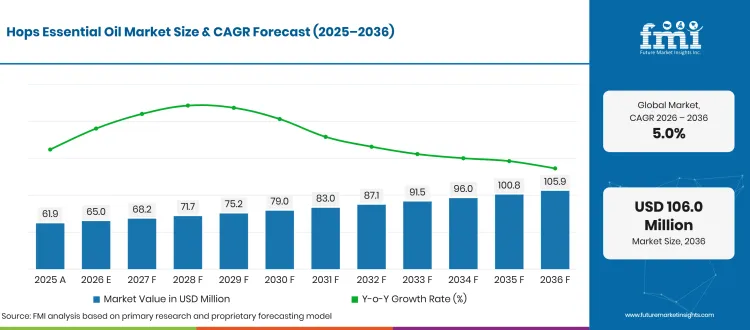
China leads regional growth at a 13.0% CAGR through 2036, driven by rapid craft brewery establishment and growing consumer demand for hop-forward beer styles alongside expanding aromatherapy and natural wellness product adoption. Japan holds the largest individual country value at USD 5.0 billion in 2026, reflecting deep commercial brewing and flavoring industry procurement. The United States generates USD 3.3 billion in 2026 demand, anchored by the world's largest craft brewing industry. South Korea contributes USD 280.0 million. Brewing captures 40.0% of end-use application share, Amber Glass bottles lead packing at 45.0% share, and Conventional production holds 55.0% of nature classification.
Hops Essential Oil Market Definition
The hops essential oil market comprises the global production, extraction, and trade of volatile aromatic oil fractions derived from Humulus lupulus (hop) cones through steam distillation, CO2 supercritical extraction, and cold-press processing. Hops essential oil contains bioactive compounds including myrcene, linalool, geraniol, and humulene, providing alpha and beta acid fractions used in brewing, flavor and fragrance formulation, and aromatherapy applications. The market encompasses both whole-cone and pelletized hop-derived oil extracts, concentrated lupulin fractions, and standardized oil blends serving commercial brewing, food and beverage flavoring, personal care, and wellness industries.
Hops Essential Oil Market Inclusions
The report includes global and regional market sizes by volume and value with a 10-year forecast from 2026 to 2036. Coverage spans segmental breakdowns by end use application (Brewing, Flavor and Fragrance, Aromatherapy), packing (Amber Glass, Aluminium, Other formats), and nature of production (Conventional, Organic). Country-level analysis covers all major producing and consuming markets globally.
Hops Essential Oil Market Exclusions
The scope excludes dried whole hop cones, hop pellets, and hop extract forms that have not undergone essential oil concentration processing, as well as finished beer and beverage products. Non-hop botanical essential oils are outside scope even when used in similar applications. Synthetic hop flavor analogues and chemically reconstructed hop aroma compounds are excluded, as these are not derived from natural Humulus lupulus extraction.
Hops Essential Oil Market Research Methodology
- Primary Research: Interviews were conducted with hop growers, essential oil extraction operators, commercial brewing procurement managers, flavor and fragrance formulators, and aromatherapy product brand executives across the United States, Germany, the Czech Republic, Japan, and China.
- Desk Research: Production data from the Brewers Association, Hop Research Center Wolnzach, USDA hop production reports, UN Comtrade essential oil trade codes, and flavor industry association publications supported volume benchmarking.
- Market-Sizing and Forecasting: A hybrid top-down and bottom-up model was applied. Demand was reconstructed from commercial brewing hop procurement volumes, flavor and fragrance ingredient import records, and aromatherapy product formulation data, then validated against hop cultivation acreage and extraction facility throughput.
- Data Validation and Update Cycle: Outputs undergo anomaly screening, cross-validation against hop industry trade statistics and supplier financial disclosures, and structured peer review prior to release.
Why is the Hops Essential Oil Market Growing?
The Hops Essential Oil market is experiencing steady growth due to rising demand from beverage industries and health and wellness sectors. The current market scenario is shaped by the increasing preference for natural flavoring agents, functional ingredients, and clean-label formulations. The market is being influenced by the growing trend of craft brewing and specialty beverages, where hops essential oil is being used to enhance aroma and taste profiles.
Additionally, the expansion of the wellness industry and demand for natural remedies has supported the adoption of hops essential oil in aromatherapy and personal care products. The outlook for the market is optimistic as manufacturers continue to invest in sustainable farming practices and processing technologies.
Innovations in extraction methods are helping retain the oil’s purity and potency, which is further driving its application across industries As consumer awareness about natural ingredients grows, and with rising investments in product development, the market is expected to witness healthy expansion opportunities in both established and emerging regions.
Segmental Analysis
The hops essential oil market is segmented by end use application, packing, nature of production, sales channel, and geographic regions. By end use application, hops essential oil market is divided into Hops Essential Oil For Brewing, Hops Essential Oil For Flavor And Fragrance, and Hops Essential Oil For Aromatherapy. In terms of packing, hops essential oil market is classified into Amber Glass Hops Essential Oil Bottles, Aluminium Hops Essential Oil Bottles, and Other Hops Essential Oil Packing Formats. Based on nature of production, hops essential oil market is segmented into Conventional Hops Essential Oil Production and Organic Hops Essential Oil Production. By sales channel, hops essential oil market is segmented into Direct Sales Of Hops Essential Oil, Indirect Sales Of Hops Essential Oil, Specialty Stores, Drug Stores, Online Retailers, and Others. Regionally, the hops essential oil industry is classified into North America, Latin America, Western Europe, Eastern Europe, Balkan & Baltic Countries, Russia & Belarus, Central Asia, East Asia, South Asia & Pacific, and the Middle East & Africa.
Insights into the Hops Essential Oil For Brewing Segment
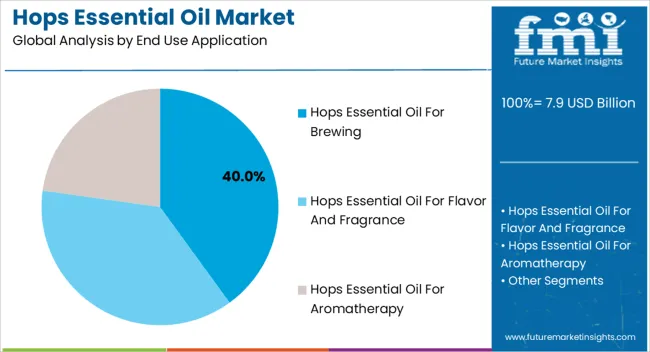
The hops essential oil for brewing segment is projected to hold 40.00% of the total market revenue in 2025, positioning it as the leading application area. This segment’s growth has been attributed to the increasing popularity of craft beers and specialty beverages, where flavor and aroma enhancement play a crucial role. The adoption of hops essential oil has been favored due to its ability to offer consistent quality, superior extraction efficiency, and customizable flavor profiles without altering brewing processes.
The rising preference for natural and plant-based ingredients among brewers has further supported its usage. Additionally, the flexibility in dosage and formulation has enabled breweries to experiment with new recipes while maintaining product stability.
The increasing number of small and medium-sized breweries, especially in urban and tourist regions, has contributed to higher demand The segment’s expansion is expected to continue as the craft brewing industry grows globally, supported by consumer trends focused on authenticity, artisanal products, and health-conscious choices.
Insights into the Amber Glass Hops Essential Oil Bottles Segment
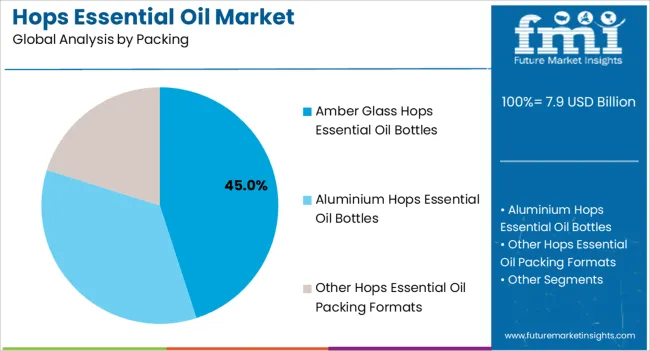
The amber glass hops essential oil bottles segment is expected to account for 45.00% of the overall market share in 2025, making it the largest packaging format in the industry. The growth of this segment has been influenced by the rising demand for packaging solutions that ensure product protection and longevity. Amber glass bottles are preferred for their ability to block ultraviolet rays, which helps preserve the oil’s aromatic properties and prevent degradation.
The segment has benefited from consumer concerns over chemical leaching and environmental impact, leading to a shift toward glass packaging over plastics. Additionally, glass containers are perceived as premium, aligning with the image of natural and high-quality products.
The surge in online retail and direct-to-consumer distribution channels has further boosted the demand for aesthetically pleasing and functional packaging The segment’s growth is expected to be sustained as consumers increasingly opt for products that are both safe and eco-friendly, while manufacturers focus on packaging innovations that enhance brand value and consumer trust.
Insights into the Conventional Hops Essential Oil Production Segment
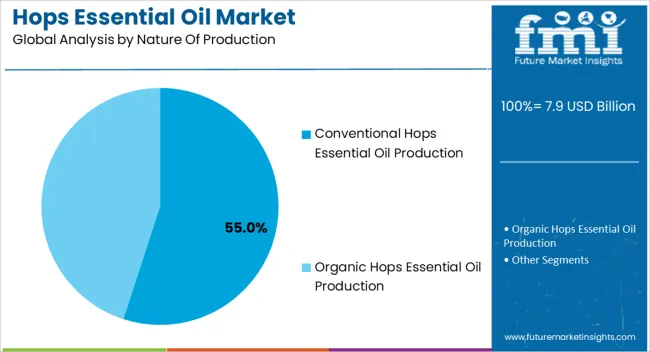
The conventional hops essential oil production segment is forecasted to hold 55.00% of the total market revenue in 2025, establishing it as the leading production method. This segment’s dominance has been driven by the well-established farming practices, extraction methods, and supply chains that support large-scale production. Conventional production methods have been preferred due to their cost-effectiveness, availability of raw materials, and compatibility with existing industrial processes.
The segment has benefited from decades of agricultural expertise and established distribution networks, allowing producers to meet the growing demand from the brewing and wellness sectors. Additionally, conventional methods provide consistent yields and product quality, which is critical for maintaining flavor and aromatic standards.
While organic alternatives are gaining traction, conventional production continues to lead due to scalability and affordability, especially in markets with high consumption rates As demand from craft brewers, nutraceutical producers, and personal care brands continues to expand, conventional hops essential oil production is expected to retain its position, supported by investments in process optimization and sustainable farming practices that enhance productivity without compromising quality.
Market Overview
Hops Essential Oil Market Overview
Hops are the female flowers (cones) of a climbing plant called Humulus lupulus, which is widely grown in Europe. Hops essential oil is the oil extracted from these hops. The most common method of extracting hops essential oil is steam distillation. Hops essential oil has a sweet, fresh aroma with a hint of sharpness and bitterness. When diluted in a low concentration with other oils, hops essential oil is used for fragrance and therapeutic blending.
Humans have been known to experience sedative effects from hops essential oil. As a result, hops essential oil can be used to treat stress, anxiety, and insomnia in humans. Hops essential oil is used in natural deodorants, fragrances, and perfumes, among other things.
Analysis of Hops Essential Oil Market By Key Countries
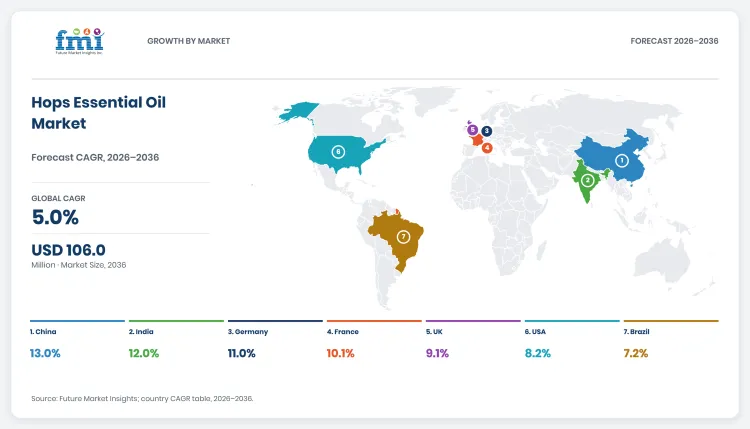
| Country | CAGR |
|---|---|
| China | 13.0% |
| India | 12.0% |
| Germany | 11.0% |
| France | 10.1% |
| UK | 9.1% |
| USA | 8.2% |
| Brazil | 7.2% |
Country-wise Analysis
The Hops Essential Oil Market is expected to register a CAGR of 5.0% during the forecast period, exhibiting varied country level momentum. China leads with the highest CAGR of 13.0%, followed by India at 12.0%. Developed markets such as Germany, France, and the UK continue to expand steadily, while the USA is likely to grow at consistent rates. Brazil posts the lowest CAGR at 7.2%, yet still underscores a broadly positive trajectory for the global Hops Essential Oil Market. In 2025, Germany held a dominant revenue in the Western Europe market and is expected to grow with a CAGR of 11.0%. The USA Hops Essential Oil Market is estimated to be valued at USD 3.0 billion in 2026 and is anticipated to reach a valuation of USD 6.5 billion by 2036. Sales are projected to rise at a CAGR of 8.2% over the forecast period between 2026 and 2036. While Japan and South Korea markets are estimated to be valued at USD 370.5 million and USD 257.8 million respectively in 2026.
Key Players in the Hops Essential Oil Market
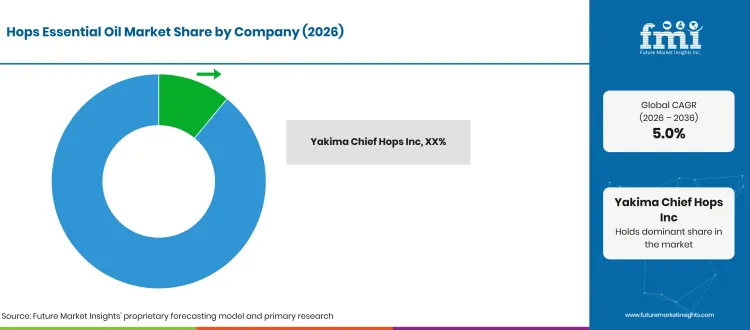
- Yakima Chief Hops Inc.
- Barth-Haas Group
- Brewers Select Limited
- Heineken UK Limited
- Hollingberry & Son Inc.
- Hopsteiner Group
- Kalsec Inc.
- Steiner Hops Ltd
Recent Developments
The report includes full coverage of key trends from competitive benchmarking. Some of the recent developments covered in the reports:
- In January 2026, Yakima Chief Hops announced the expansion of its Cryo Hops technology to the Strata variety, providing brewers with a highly concentrated lupulin product delivering intense aroma with significantly reduced kettle and whirlpool solids. [1]
- In February 2026, BarthHaas debuted its 'Inspiration Range 2026' at the drinktec trade fair, a suite of advanced hop-oil extracts designed to allow breweries to create multiple beer styles from a single base beer to save energy and raw materials. [2]
- In July 2025, Kalsec Inc. officially rebranded its hops division as KalHops, launching a modernized portfolio of 100% hop-derived oil fractions and emulsions to help brewers reduce tank residency time and diversify non-alcoholic beverage streams. [3]
Scope of the Report
| Metric | Value |
|---|---|
| Quantitative Units | USD 65.0 Million (2026) to USD 106.0 Million (2036), at a CAGR of 5.0% |
| Market Definition | The hops essential oil market covers volatile aromatic oil fractions extracted from Humulus lupulus hop cones through distillation and supercritical extraction, serving brewing, flavor and fragrance, and aromatherapy applications globally. |
| End Use Application | Hops Essential Oil for Brewing, Hops Essential Oil for Flavor and Fragrance, Hops Essential Oil for Aromatherapy |
| Packing | Amber Glass Hops Essential Oil Bottles, Aluminium Hops Essential Oil Bottles, Other Hops Essential Oil Packing Formats |
| Nature of Production | Conventional Hops Essential Oil Production, Organic Hops Essential Oil Production |
| Regions Covered | North America, Latin America, Europe, East Asia, South Asia, Oceania, Middle East and Africa |
| Countries Covered | United States, Germany, Czech Republic, United Kingdom, China, Japan, South Korea, Australia, New Zealand, Poland and 40 plus countries |
| Key Companies Profiled | Yakima Chief Hops Inc., Barth-Haas Group, Brewers Select Limited, Heineken UK Limited, Hollingberry and Son Inc., Hopsteiner Group, Kalsec Inc. (KalHops), Steiner Hops Ltd., Sibelius, Mountain Rose Herbs, Avoca Inc., Aphios Corporation |
| Forecast Period | 2026 to 2036 |
| Approach | Hybrid top-down and bottom-up market modeling validated through primary interviews with hop growers, extraction operators, and brewing and flavor industry buyers, supported by USDA production data and UN Comtrade trade benchmarking |
Hops Essential Oil Market by Segments
End Use Application:
- Hops Essential Oil For Brewing
- Hops Essential Oil For Flavor And Fragrance
- Hops Essential Oil For Aromatherapy
Packing:
- Amber Glass Hops Essential Oil Bottles
- Aluminium Hops Essential Oil Bottles
- Other Hops Essential Oil Packing Formats
Nature Of Production:
- Conventional Hops Essential Oil Production
- Organic Hops Essential Oil Production
Sales Channel:
- Direct Sales Of Hops Essential Oil
- Indirect Sales Of Hops Essential Oil
- Specialty Stores
- Drug Stores
- Online Retailers
- Others
Region:
- North America
- USA
- Canada
- Mexico
- Latin America
- Brazil
- Chile
- Rest of Latin America
- Western Europe
- Germany
- UK
- Italy
- Spain
- France
- Nordic
- BENELUX
- Rest of Western Europe
- Eastern Europe
- Russia
- Poland
- Hungary
- Balkan & Baltic
- Rest of Eastern Europe
- East Asia
- China
- Japan
- South Korea
- South Asia and Pacific
- India
- ASEAN
- Australia & New Zealand
- Rest of South Asia and Pacific
- Middle East & Africa
- Kingdom of Saudi Arabia
- Other GCC Countries
- Turkiye
- South Africa
- Other African Union
- Rest of Middle East & Africa
Bibliography
- [1] Yakima Chief Hops. (2026). Strata goes Cryo: YCH expands Cryo Hops technology to Strata variety. Yakima Chief Hops Commercial News, January 2026. https://www.yakimachief.com/commercial/hop-wire/strata-goes-cryo
- [2] BarthHaas. (2025). drinktec 2025: BarthHaas presents Inspiration Range 2026 for innovative hop-oil extracts. BarthHaas Company News, February 2026. https://www.barthhaas.com/company/news/news-article/bh/drinktec-2025-barthhaas-presents-innovative-hop-products-for-a-successful-future
- [3] GlobeNewswire. (2025). Kalsec Inc. enhances and rebrands hops division to KalHops. GlobeNewswire Press Release, July 2025. https://www.globenewswire.com/news-release/2025/07/23/3120108/0/en/Kalsec-Inc-Enhances-and-Rebrands-Hops-Division-to-KalHops.html
- [4] Brewers Association. (2025). Hop usage and craft brewing industry statistics 2025. Brewers Association Data Report, October 2025. https://www.brewersassociation.org/statistics-and-data/national-beer-stats/
This bibliography is provided for reader reference and is not exhaustive. The full report contains the complete reference list and detailed citations.
This Report Addresses
- Market intelligence to enable structured procurement and formulation strategy decisions across commercial brewing, flavor and fragrance, and aromatherapy hop oil supply chains
- Market size estimation and 10-year revenue forecasts from 2026 to 2036, supported by validated hop cultivation data, USDA production statistics, and trade benchmarks
- Growth opportunity mapping across Brewing, Flavor and Fragrance, and Aromatherapy applications with emphasis on non-alcoholic beverage formulation and concentrated oil extraction technology adoption
- Segment and regional revenue forecasts covering conventional and organic production origins across 40 plus countries
- Competition strategy assessment including Cryo Hops and CO2 extraction technology positioning, variety-specific oil profiling, and non-alcoholic beverage channel development
- Regulatory impact analysis covering food additive approvals for hop oil ingredients, organic certification requirements, and essential oil labeling standards
- Supply chain risk assessment covering hop harvest yield volatility, climate exposure in primary growing regions, and extraction capacity constraints
- Market report delivery in PDF, Excel, PPT, and interactive dashboard formats for executive and operational use
Frequently Asked Questions
How large is the demand for Hops Essential Oil in the global market in 2026?
Demand for Hops Essential Oil in the global market is estimated to be valued at USD 65.0 Million in 2026.
What will the market size of Hops Essential Oil be by 2036?
Market size for Hops Essential Oil is projected to reach USD 106.0 Million by 2036.
What is the expected CAGR for the Hops Essential Oil Market between 2026 and 2036?
Demand for Hops Essential Oil is expected to grow at a CAGR of 5.0% between 2026 and 2036.
Which End Use Application leads the Hops Essential Oil Market in 2026?
Brewing leads at 40.0% application share, anchoring baseline volume while Flavor and Fragrance and Aromatherapy represent the fastest-growing adjacencies.
What drives China's growth in the Hops Essential Oil Market?
China grows at a 13.0% CAGR through 2036, driven by craft brewery expansion, natural flavor ingredient adoption, and growing aromatherapy and wellness product demand.
What is the United States market value for Hops Essential Oil in 2026?
The United States generates USD 3.3 billion in 2026 demand, anchored by the world's largest craft brewing industry and growing flavor and fragrance applications.
What does Japan's large market value reflect in the Hops Essential Oil Market?
Japan holds the largest individual country value at USD 5.0 billion in 2026, reflecting deep commercial brewing and flavoring industry procurement depth.
What is the commercial significance of Yakima Chief Hops' Cryo expansion to Strata?
The January 2026 expansion demonstrates accelerating commercial adoption of concentrated lupulin extraction formats that improve brewing efficiency and enable new flavor intensity levels.
What is included in the scope of this report?
Scope covers volatile aromatic oil fractions extracted from Humulus lupulus hop cones for brewing, flavor and fragrance, and aromatherapy applications.
What is excluded from this report's scope?
Dried whole hop cones, hop pellets, non-extracted hop forms, synthetic hop flavor analogues, and finished beer and beverage products are excluded.
How does FMI validate its Hops Essential Oil Market forecast?
The forecast uses a hybrid model validated through primary interviews with hop growers, extraction operators, and industry buyers, cross-checked against USDA production data, Brewers Association statistics, and trade records.
Preview the report firsthand - request a free sample
Get SampleGet the brochure for pricing and purchase details.
Get PDFTable of Content
- Executive Summary
- Global Market Outlook
- Demand-side Trends
- Supply-side Trends
- Technology Roadmap Analysis
- Analysis and Recommendations
- Market Overview
- Market Coverage / Taxonomy
- Market Definition / Scope / Limitations
- Research Methodology
- Chapter Orientation
- Analytical Lens and Working Hypotheses
- Market Structure, Signals, and Trend Drivers
- Benchmarking and Cross-market Comparability
- Market Sizing, Forecasting, and Opportunity Mapping
- Research Design and Evidence Framework
- Desk Research Programme (Secondary Evidence)
- Company Annual and Sustainability Reports
- Peer-reviewed Journals and Academic Literature
- Corporate Websites, Product Literature, and Technical Notes
- Earnings Decks and Investor Briefings
- Statutory Filings and Regulatory Disclosures
- Technical White Papers and Standards Notes
- Trade Journals, Industry Magazines, and Analyst Briefs
- Conference Proceedings, Webinars, and Seminar Materials
- Government Statistics Portals and Public Data Releases
- Press Releases and Reputable Media Coverage
- Specialist Newsletters and Curated Briefings
- Sector Databases and Reference Repositories
- FMI Internal Proprietary Databases and Historical Market Datasets
- Subscription Datasets and Paid Sources
- Social Channels, Communities, and Digital Listening Inputs
- Additional Desk Sources
- Expert Input and Fieldwork (Primary Evidence)
- Primary Modes
- Qualitative Interviews and Expert Elicitation
- Quantitative Surveys and Structured Data Capture
- Blended Approach
- Why Primary Evidence is Used
- Field Techniques
- Interviews
- Surveys
- Focus Groups
- Observational and In-context Research
- Social and Community Interactions
- Stakeholder Universe Engaged
- C-suite Leaders
- Board Members
- Presidents and Vice Presidents
- R&D and Innovation Heads
- Technical Specialists
- Domain Subject-matter Experts
- Scientists
- Physicians and Other Healthcare Professionals
- Governance, Ethics, and Data Stewardship
- Research Ethics
- Data Integrity and Handling
- Primary Modes
- Tooling, Models, and Reference Databases
- Desk Research Programme (Secondary Evidence)
- Data Engineering and Model Build
- Data Acquisition and Ingestion
- Cleaning, Normalisation, and Verification
- Synthesis, Triangulation, and Analysis
- Quality Assurance and Audit Trail
- Market Background
- Market Dynamics
- Drivers
- Restraints
- Opportunity
- Trends
- Scenario Forecast
- Demand in Optimistic Scenario
- Demand in Likely Scenario
- Demand in Conservative Scenario
- Opportunity Map Analysis
- Product Life Cycle Analysis
- Supply Chain Analysis
- Investment Feasibility Matrix
- Value Chain Analysis
- PESTLE and Porter’s Analysis
- Regulatory Landscape
- Regional Parent Market Outlook
- Production and Consumption Statistics
- Import and Export Statistics
- Market Dynamics
- Global Market Analysis 2021 to 2025 and Forecast, 2026 to 2036
- Historical Market Size Value (USD Million) Analysis, 2021 to 2025
- Current and Future Market Size Value (USD Million) Projections, 2026 to 2036
- Y-o-Y Growth Trend Analysis
- Absolute $ Opportunity Analysis
- Global Market Pricing Analysis 2021 to 2025 and Forecast 2026 to 2036
- Global Market Analysis 2021 to 2025 and Forecast 2026 to 2036, By End Use Application
- Introduction / Key Findings
- Historical Market Size Value (USD Million) Analysis By End Use Application , 2021 to 2025
- Current and Future Market Size Value (USD Million) Analysis and Forecast By End Use Application , 2026 to 2036
- Hops Essential Oil For Brewing
- Hops Essential Oil For Flavor And Fragrance
- Hops Essential Oil For Aromatherapy
- Hops Essential Oil For Brewing
- Y-o-Y Growth Trend Analysis By End Use Application , 2021 to 2025
- Absolute $ Opportunity Analysis By End Use Application , 2026 to 2036
- Global Market Analysis 2021 to 2025 and Forecast 2026 to 2036, By Packing
- Introduction / Key Findings
- Historical Market Size Value (USD Million) Analysis By Packing, 2021 to 2025
- Current and Future Market Size Value (USD Million) Analysis and Forecast By Packing, 2026 to 2036
- Amber Glass Hops Essential Oil Bottles
- Aluminium Hops Essential Oil Bottles
- Other Hops Essential Oil Packing Formats
- Amber Glass Hops Essential Oil Bottles
- Y-o-Y Growth Trend Analysis By Packing, 2021 to 2025
- Absolute $ Opportunity Analysis By Packing, 2026 to 2036
- Global Market Analysis 2021 to 2025 and Forecast 2026 to 2036, By Nature Of Production
- Introduction / Key Findings
- Historical Market Size Value (USD Million) Analysis By Nature Of Production, 2021 to 2025
- Current and Future Market Size Value (USD Million) Analysis and Forecast By Nature Of Production, 2026 to 2036
- Conventional Hops Essential Oil Production
- Organic Hops Essential Oil Production
- Conventional Hops Essential Oil Production
- Y-o-Y Growth Trend Analysis By Nature Of Production, 2021 to 2025
- Absolute $ Opportunity Analysis By Nature Of Production, 2026 to 2036
- Global Market Analysis 2021 to 2025 and Forecast 2026 to 2036, By Region
- Introduction
- Historical Market Size Value (USD Million) Analysis By Region, 2021 to 2025
- Current Market Size Value (USD Million) Analysis and Forecast By Region, 2026 to 2036
- North America
- Latin America
- Western Europe
- Eastern Europe
- East Asia
- South Asia and Pacific
- Middle East & Africa
- Market Attractiveness Analysis By Region
- North America Market Analysis 2021 to 2025 and Forecast 2026 to 2036, By Country
- Historical Market Size Value (USD Million) Trend Analysis By Market Taxonomy, 2021 to 2025
- Market Size Value (USD Million) Forecast By Market Taxonomy, 2026 to 2036
- By Country
- USA
- Canada
- Mexico
- By End Use Application
- By Packing
- By Nature Of Production
- By Country
- Market Attractiveness Analysis
- By Country
- By End Use Application
- By Packing
- By Nature Of Production
- Key Takeaways
- Latin America Market Analysis 2021 to 2025 and Forecast 2026 to 2036, By Country
- Historical Market Size Value (USD Million) Trend Analysis By Market Taxonomy, 2021 to 2025
- Market Size Value (USD Million) Forecast By Market Taxonomy, 2026 to 2036
- By Country
- Brazil
- Chile
- Rest of Latin America
- By End Use Application
- By Packing
- By Nature Of Production
- By Country
- Market Attractiveness Analysis
- By Country
- By End Use Application
- By Packing
- By Nature Of Production
- Key Takeaways
- Western Europe Market Analysis 2021 to 2025 and Forecast 2026 to 2036, By Country
- Historical Market Size Value (USD Million) Trend Analysis By Market Taxonomy, 2021 to 2025
- Market Size Value (USD Million) Forecast By Market Taxonomy, 2026 to 2036
- By Country
- Germany
- UK
- Italy
- Spain
- France
- Nordic
- BENELUX
- Rest of Western Europe
- By End Use Application
- By Packing
- By Nature Of Production
- By Country
- Market Attractiveness Analysis
- By Country
- By End Use Application
- By Packing
- By Nature Of Production
- Key Takeaways
- Eastern Europe Market Analysis 2021 to 2025 and Forecast 2026 to 2036, By Country
- Historical Market Size Value (USD Million) Trend Analysis By Market Taxonomy, 2021 to 2025
- Market Size Value (USD Million) Forecast By Market Taxonomy, 2026 to 2036
- By Country
- Russia
- Poland
- Hungary
- Balkan & Baltic
- Rest of Eastern Europe
- By End Use Application
- By Packing
- By Nature Of Production
- By Country
- Market Attractiveness Analysis
- By Country
- By End Use Application
- By Packing
- By Nature Of Production
- Key Takeaways
- East Asia Market Analysis 2021 to 2025 and Forecast 2026 to 2036, By Country
- Historical Market Size Value (USD Million) Trend Analysis By Market Taxonomy, 2021 to 2025
- Market Size Value (USD Million) Forecast By Market Taxonomy, 2026 to 2036
- By Country
- China
- Japan
- South Korea
- By End Use Application
- By Packing
- By Nature Of Production
- By Country
- Market Attractiveness Analysis
- By Country
- By End Use Application
- By Packing
- By Nature Of Production
- Key Takeaways
- South Asia and Pacific Market Analysis 2021 to 2025 and Forecast 2026 to 2036, By Country
- Historical Market Size Value (USD Million) Trend Analysis By Market Taxonomy, 2021 to 2025
- Market Size Value (USD Million) Forecast By Market Taxonomy, 2026 to 2036
- By Country
- India
- ASEAN
- Australia & New Zealand
- Rest of South Asia and Pacific
- By End Use Application
- By Packing
- By Nature Of Production
- By Country
- Market Attractiveness Analysis
- By Country
- By End Use Application
- By Packing
- By Nature Of Production
- Key Takeaways
- Middle East & Africa Market Analysis 2021 to 2025 and Forecast 2026 to 2036, By Country
- Historical Market Size Value (USD Million) Trend Analysis By Market Taxonomy, 2021 to 2025
- Market Size Value (USD Million) Forecast By Market Taxonomy, 2026 to 2036
- By Country
- Kingdom of Saudi Arabia
- Other GCC Countries
- Turkiye
- South Africa
- Other African Union
- Rest of Middle East & Africa
- By End Use Application
- By Packing
- By Nature Of Production
- By Country
- Market Attractiveness Analysis
- By Country
- By End Use Application
- By Packing
- By Nature Of Production
- Key Takeaways
- Key Countries Market Analysis
- USA
- Pricing Analysis
- Market Share Analysis, 2025
- By End Use Application
- By Packing
- By Nature Of Production
- Canada
- Pricing Analysis
- Market Share Analysis, 2025
- By End Use Application
- By Packing
- By Nature Of Production
- Mexico
- Pricing Analysis
- Market Share Analysis, 2025
- By End Use Application
- By Packing
- By Nature Of Production
- Brazil
- Pricing Analysis
- Market Share Analysis, 2025
- By End Use Application
- By Packing
- By Nature Of Production
- Chile
- Pricing Analysis
- Market Share Analysis, 2025
- By End Use Application
- By Packing
- By Nature Of Production
- Germany
- Pricing Analysis
- Market Share Analysis, 2025
- By End Use Application
- By Packing
- By Nature Of Production
- UK
- Pricing Analysis
- Market Share Analysis, 2025
- By End Use Application
- By Packing
- By Nature Of Production
- Italy
- Pricing Analysis
- Market Share Analysis, 2025
- By End Use Application
- By Packing
- By Nature Of Production
- Spain
- Pricing Analysis
- Market Share Analysis, 2025
- By End Use Application
- By Packing
- By Nature Of Production
- France
- Pricing Analysis
- Market Share Analysis, 2025
- By End Use Application
- By Packing
- By Nature Of Production
- India
- Pricing Analysis
- Market Share Analysis, 2025
- By End Use Application
- By Packing
- By Nature Of Production
- ASEAN
- Pricing Analysis
- Market Share Analysis, 2025
- By End Use Application
- By Packing
- By Nature Of Production
- Australia & New Zealand
- Pricing Analysis
- Market Share Analysis, 2025
- By End Use Application
- By Packing
- By Nature Of Production
- China
- Pricing Analysis
- Market Share Analysis, 2025
- By End Use Application
- By Packing
- By Nature Of Production
- Japan
- Pricing Analysis
- Market Share Analysis, 2025
- By End Use Application
- By Packing
- By Nature Of Production
- South Korea
- Pricing Analysis
- Market Share Analysis, 2025
- By End Use Application
- By Packing
- By Nature Of Production
- Russia
- Pricing Analysis
- Market Share Analysis, 2025
- By End Use Application
- By Packing
- By Nature Of Production
- Poland
- Pricing Analysis
- Market Share Analysis, 2025
- By End Use Application
- By Packing
- By Nature Of Production
- Hungary
- Pricing Analysis
- Market Share Analysis, 2025
- By End Use Application
- By Packing
- By Nature Of Production
- Kingdom of Saudi Arabia
- Pricing Analysis
- Market Share Analysis, 2025
- By End Use Application
- By Packing
- By Nature Of Production
- Turkiye
- Pricing Analysis
- Market Share Analysis, 2025
- By End Use Application
- By Packing
- By Nature Of Production
- South Africa
- Pricing Analysis
- Market Share Analysis, 2025
- By End Use Application
- By Packing
- By Nature Of Production
- USA
- Market Structure Analysis
- Competition Dashboard
- Competition Benchmarking
- Market Share Analysis of Top Players
- By Regional
- By End Use Application
- By Packing
- By Nature Of Production
- Competition Analysis
- Competition Deep Dive
- Yakima Chief Hops Inc.
- Overview
- Product Portfolio
- Profitability by Market Segments (Product/Age /Sales Channel/Region)
- Sales Footprint
- Strategy Overview
- Marketing Strategy
- Product Strategy
- Channel Strategy
- Barth-Haas Group
- Brewers Select Limited
- Heineken UK Limited
- Hollingberry & Son Inc.
- Hopsteiner Group
- Kalsec Inc.
- Steiner Hops Ltd.
- Yakima Chief Hops Inc.
- Competition Deep Dive
- Assumptions & Acronyms Used


