

- Industry Size (2026)
- USD 334.0 Mn
- Forecast (2036)
- USD 714.4 Mn
- CAGR (2026 to 2036)
- 7.9%
Perilla Seed Oil Market Size, Market Forecast and Outlook By FMI
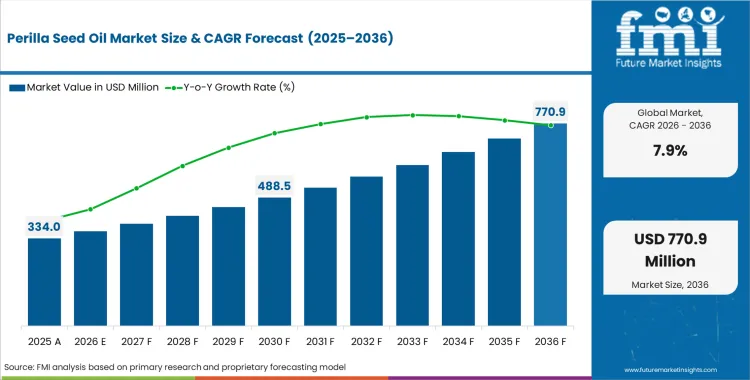
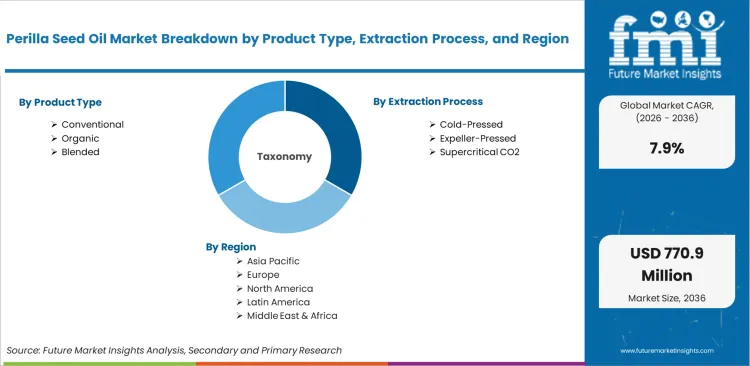
The perilla seed oil market stood at USD 309.5 million in 2025. Industry is poised to cross USD 334.0 million in 2026, and reach USD 714.4 million by 2036, at a 7.9% CAGR over the forecast period. Rise in sales is driven by continuous functional-food adoption as brand formulators transition from marine sources to high-alpha-linolenic acid botanical alternatives.
Summary of Perilla Seed Oil Market
- The market is estimated at USD 334.0 million in 2026.
- The market is projected to reach USD 714.4 million by 2036.
- The market is expected to grow at a CAGR of 7.9% from 2026 to 2036.
- The forecast period represents an incremental opportunity of USD 380.4 million.
- Conventional segment leads the product type segment with a 68.0% share.
- Cold-pressed segment dominates the extraction process segment with a 61.0% share.
- Food segment leads the application segment with a 49.0% share.
- B2B bulk segment dominates the distribution channel segment with a 57.0% share.
- Household segment leads the end use segment with a 44.0% share.
- South Korea (8.6%), India (8.4%), and Japan (8.2%) are among the fastest-growing markets.
Perilla Seed Oil Market Key Takeaways
| Metric | Details |
| Industry Size (2026) | USD 334.0 Million |
| Industry Value (2036) | USD 714.4 Million |
| CAGR (2026 to 2036) | 7.9% |
Source: Future Market Insights (FMI) analysis, based on proprietary forecasting model and primary research
Formulators specifying omega-3 ingredients face escalating pressure from clean-label retail buyers refusing animal-derived lipids. Delaying transitions toward plant-based complexes risks immediate delisting in premium grocery channels, prompting urgent evaluation of the perilla seed oil industry dynamics. Sourcing personnel at mid-tier supplement brands often misjudge this shift, assuming legacy botanicals remain an acceptable default, while sophisticated competitors quietly lock up Asia-based organic edible oil contracts to secure superior stability profiles. Securing reliable baseline volume mimics strategies seen in black seed oil procurement, where early-mover agricultural partnerships prevent later raw material shortages and stabilize pricing trends across the perilla seed oil market.
Once extraction facilities establish verifiable cold-pressed supply chains outside Korea and Japan, global qualification bottlenecks clear rapidly. Early indicators show European cosmetic labs actively validating these new routes to secure a reliable cosmetic grade supply pipeline, treating them with identical urgency as specialty lime seed oils required for specialized skincare lines.
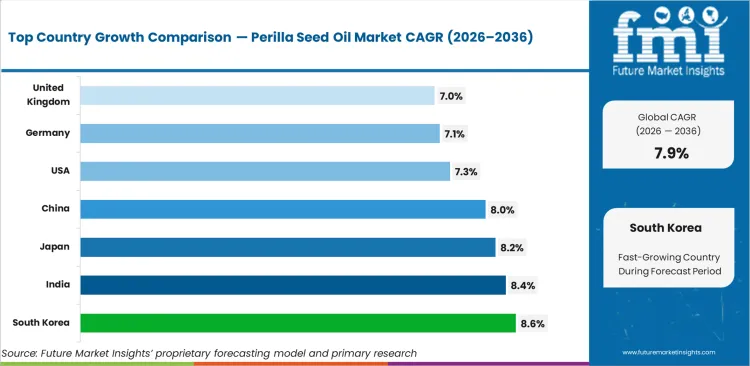
South Korea is expected to register an 8.6% CAGR during the forecast period due to embedded culinary familiarity providing a secure baseline for functional-food upselling. India is estimated to expand at an 8.4% CAGR during the forecast period, as expanding Himalayan cultivation targets export-grade supply and impacts global volume trends. Over the forecast period, Japan is poised to expand at an 8.2% CAGR, China at 8.0% CAGR, the United States at 7.3% CAGR, Germany and the United Kingdom at a 7.1% and 7.0% CAGR respectively. Divergence across this range stems directly from whether a country treats this botanical primarily as a household cooking staple or strictly as a premium cold pressed oil for supplementation.
Segmental Analysis
Perilla Seed Oil Market Analysis by Product Type
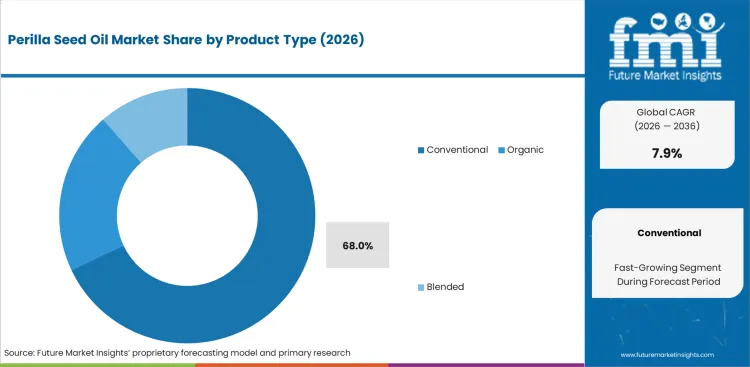
High product demand in entrenched East Asian household culinary traditions sustains the primary advantage of conventional supplies across large-scale manufacturing. The conventional segment is expected to hold 68.0% share in 2026, owing to the necessity to maintain aggressive retail price points across highly competitive supermarket channels. The establishment of extensive long-term procurement contracts with large-scale food processors, significantly lowering raw ingredient acquisition costs, and stabilizing entire pricing structures for premium product tiers.
Formulating with standard inputs allows companies to achieve required operational margins while satisfying essential nutritional requirements to maintain competitive final retail pricing. Delaying supply agreements in hopes of better spot pricing frequently causes unexpected inventory shortages during weak harvest cycles, mirroring core volume requirements seen in generic tomato seed oil processing.
- Initial cost evaluation dynamics: Baseline sourcing necessitates procurement officers rigorously balancing alpha-linolenic acid concentration yields against exceptionally strict per-kilogram budget constraints. Formulation officers secure massive conventional volumes precisely to maintain margin targets across high-velocity, mass-market product lines where premium pricing proves impossible to pass onto the end consumer.
- Rigorous qualification testing protocols: Validating massive conventional batches demands rigorous, multi-stage pesticide residue screening before blending approvals occur at the factory level. Quality control managers face catastrophic product rejection scenarios and massive financial write-downs if imported raw material fails strictly enforced regional regulatory safety limits.
- Strategic contract renewal friction: Long-term supply stability hinges entirely on securing consistent sensory profiles over consecutive harvest seasons. Sourcing personnel immediately shift vendors, breaking years-long relationships, if subtle flavor degradation in conventional batches begins to impact final consumer acceptance and triggers retail returns.
Perilla Seed Oil Market Analysis by Extraction Process
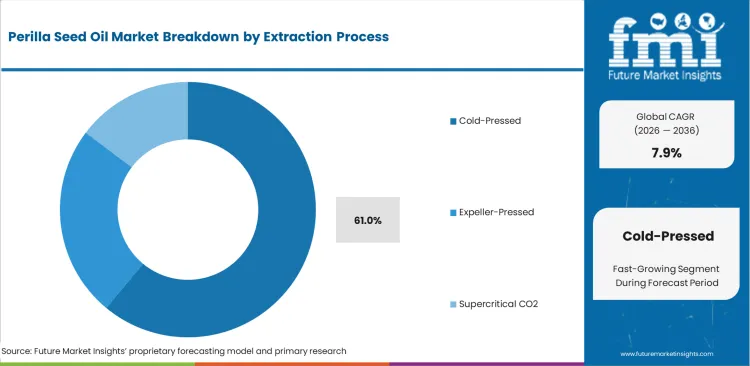
Mechanical extraction avoids thermal degradation entirely, ensuring maximum active compound delivery to the final product formulation. Brands attempting to cut operational costs by substituting expeller-pressed material routinely experience catastrophic shelf-life failures, lipid separation, and rancidity in finished goods. The cold-pressed segment is estimated to secure 61.0% revenue share in 2026. This leading market position is driven by factors including technical necessity of preventing the thermal degradation of delicate omega fatty acids during extraction.
Other factors are strict clean-label mandates from premium cosmetic formulators requiring entirely intact antioxidant profiles, rising consumer willingness to pay significant retail premiums for mechanically extracted wellness lipids, and requirement to prevent rapid perillaldehyde oxidation during early manufacturing stages. High-heat processing techniques are steadily losing ground globally as nutritional integrity becomes a non-negotiable metric for sophisticated buyer approval.
- Navigating severe yield constraints: Low-temperature mechanical operation inherently and unavoidably leaves significant residual lipids trapped inside the discarded seed cakes. Plant managers face intense daily operational pressure to optimize mechanical pressure settings to extract maximum oil volume without ever crossing the strict thermal degradation thresholds that would ruin the batch.
- Secondary processing commercialization: Handling residual press cake creates vital secondary revenue streams if the material is marketed properly to agricultural or protein buyers. Operations personnel must proactively secure reliable buyers for these protein-rich manufacturing byproducts to offset the inherently high primary extraction costs associated with slow, cold-press machinery.
- Full lifecycle realization metrics: Total factory profitability depends entirely on maximizing commercial value from both the premium lipid output and the functional powder outputs derived from the waste cake. Finance chiefs evaluate advanced extraction equipment ROI based strictly on this dual-stream commercialization strategy, rather than viewing oil yield in isolation.
Perilla Seed Oil Market Analysis by Application
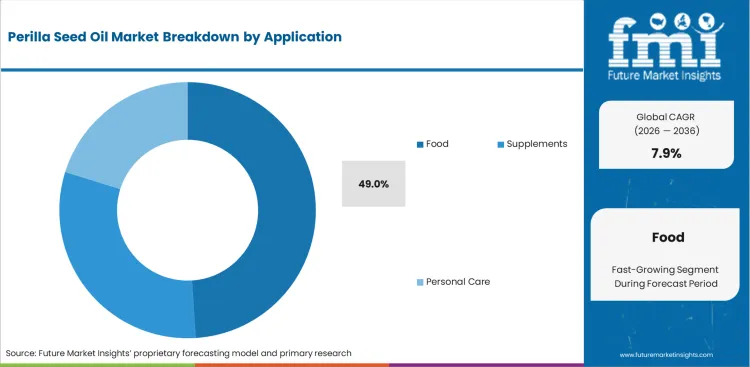
Product developers at leading snack-food companies utilize these functional foods specifically to hit coveted omega-3 nutritional targets without introducing complex allergen labeling requirements. Integrating botanical lipids allows R&D personnel to confidently claim cardiovascular health benefits directly on plant-based product labels, opening up new retail channels. The food segment is likely to account for 49.0% revenue share in 2026, driven by key factors such as deeply embedded, multi-generational dietary and cooking habits in East Asian households, and rapid global expansion of plant-based functional nutrition seeking marine-lipid replacements.
Strategic integration of botanical lipids into vegan snacks to actively avoid fish-allergy triggers, and continuous, high-volume household purchasing patterns that secure steady inventory turnover for agricultural cooperatives are also key factors driving growth of this segment. Formulators treating this delicate ingredient like standard fish oil alternatives frequently ruin entire production runs through unexpected and rapid flavor reversion. Securing a reliable food grade supplier with deep technical expertise prevents these catastrophic sensory failures during mass production scale-up.
- Sensory failure prevention strategies: Preventing rancidity in commercial baked goods requires the immediate, precise incorporation of highly protective botanical tocopherols during the mixing phase. Flavor scientists face severe, immediate consumer backlash and brand damage if oxidative off-notes develop prematurely during standard grocery store shelf-life windows.
- Managing residual stability risks: Even perfectly formulated recipes remain highly vulnerable to extreme ambient temperature fluctuations during global distribution and warehousing. Quality assurance heads must implement strict, temperature-controlled ambient storage protocols throughout the entire logistics chain to prevent premature lipid breakdown before the product reaches the consumer.
- Optimal extraction integration audits: Capturing full consumer loyalty demands absolute sensory consistency across every single production batch, year over year. Brand managers mandate rigorous, unannounced supplier audits to ensure that upstream raw material handling, seed storage, and extraction temperature controls meet exact, non-negotiable specifications.
Perilla Seed Oil Market Analysis by Distribution Channel
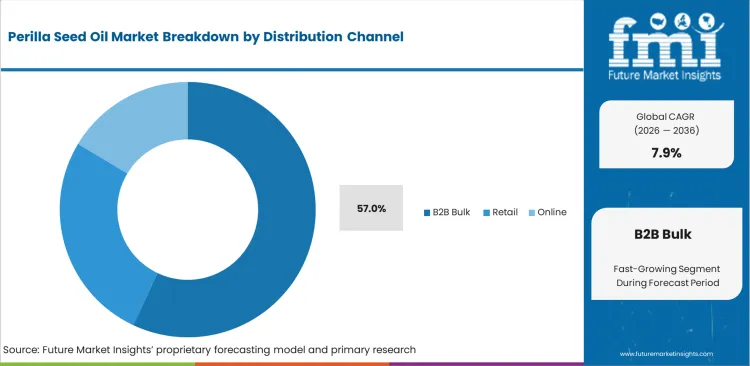
The B2B bulk segment is estimated to account for 57.0% revenue share in 2026. This channel dominates due to factors such as huge raw volume requirements of private-label contract manufacturers that process botanical ingredients before consumer branding, and superior logistical efficiency and cost-reduction of drum-and-tote shipments over fragmented retail packaging.
The critical operational need to standardize internal quality-control sampling at a massive scale before downstream formulation, and financial imperative for large buyers to bypass unpredictable middleman spot-market markups by contracting directly with processors. Securing large-format packaging vastly simplifies receiving dock logistics and standardizes internal quality-control sampling procedures, allowing labs to test one large batch rather than hundreds of small containers. Securing reliable omega 3 ingredients requires deep, structural integration with regional exporters rather than passive reliance on spot brokers.
- Consolidated procurement efficiencies: Purchasing raw materials in massive industrial formats drastically reduces the per-unit packaging overhead that destroys product margins. Logistics managers avoid compounding freight, handling, and palletizing costs associated with managing, scanning, and storing thousands of small, retail-ready glass or plastic bottles.
- Overcoming warehouse handling hurdles: Storing massive 55-gallon drums requires specialized, highly regulated climate-controlled facility space with strict fire and safety compliance. Inventory personnel face severe financial losses and total product write-offs if heating system failures or poor ventilation cause bulk inventory to oxidize and go rancid prematurely.
- Designing future supply architectures: Establishing direct, transparent pipelines to international agricultural processors eliminates unpredictable middleman markups and raw material adulteration risks. Chief operating officers prioritize these vertical integration strategies to protect long-term corporate margins and ensure uninterrupted factory operations during global shipping crises.
Perilla Seed Oil Market Analysis by End Use
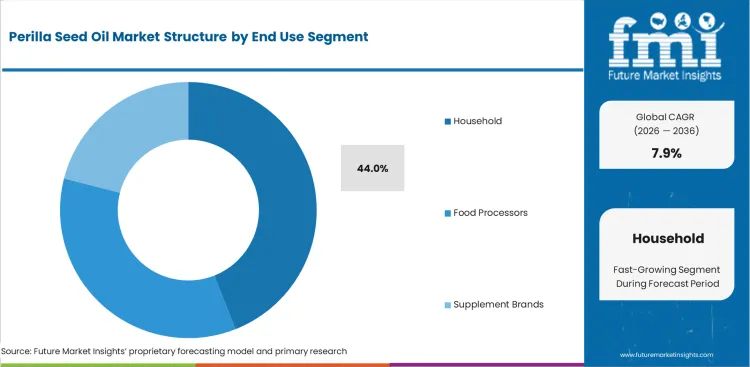
High-frequency meal preparation routines establish the primary foundation sustaining persistent end-user demand across established residential households. The household segment is estimated to account for 44.0% share in 2026, owing to ongoing daily culinary habits deeply embedded within core localized consumer markets. Other factors include targeted supermarket merchandising positioning premium branded bottles alongside standard cooking oils, strong cultural loyalty toward geographically specific seed varieties boasting distinct flavor profiles, and expanding community supply chains subsidized to feed conventional retail channels.
Misinterpreting this regional purchasing dominance frequently leads overseas companies to mistakenly introduce raw packaged products into distant grocery outlets rather than utilizing specialized omega 3 concentrates for advanced cosmetic formulations. Securing consistent domestic procurement ensures steady volume turnover for agricultural cooperatives while isolating producers from unpredictable wellness supplement cycles.
- Capturing early culinary adopters: Traditional consumers instantly recognize specific, authentic flavor profiles and demand exact regional seed varieties for heritage recipes, therefore retail grocery buyers must precisely stock geographically specific brands to satisfy these strict heritage-cooking preferences, avoiding the risk of losing the entire household basket to a competing supermarket.
- Executing follow-on functional integration: Health-conscious shoppers slowly adopt botanical ingredients into their diets following repeated features in trusted wellness media and medical journals, consequently marketing personnel capture this secondary, highly profitable wave by repositioning traditional culinary labels with modern, highlighted nutritional callouts regarding omega-3 density.
- Driving late-stage clinical conversion: Medical professionals and cardiologists eventually recommend specific botanical lipids for highly targeted dietary interventions, consequently clinical dietitians drive this final, sticky adoption phase by writing explicit, long-term dietary prescriptions for patients managing hyperlipidemia, completely removing the product from the realm of discretionary spending.
Perilla Seed Oil Market Drivers, Restraints, and Opportunities
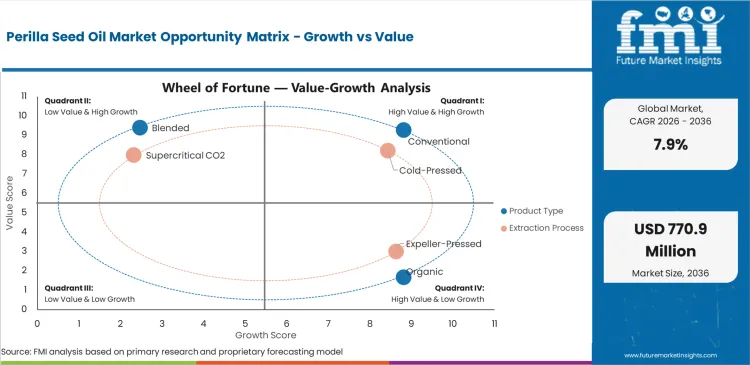
Consumer demand for clean-label, plant-based nutrition compels dietary supplement formulators to abandon marine-derived lipids entirely, driving structural expansion across the perilla seed oil market. Sourcing personnel face intense pressure from retail category executives rejecting all new merchandise containing animal byproducts amidst tightening plant-based compliance standards. Delaying vital transitions toward botanical alpha-linolenic acid sources risks immediate delisting across high-growth vegan grocery channels prioritizing ethical ingredient sourcing.
Procurement teams must rapidly identify highly stable, high-yield plant options to maintain necessary functional omega-3 claims on retail packaging without compromising sensory profiles. Securing dedicated international agricultural pipelines provides an immediate competitive advantage over rival brands constantly struggling alongside unresolved flaxseed flavor degradation issues during prolonged storage. Incorporating exact tocopherol antioxidant blend stabilization further allows proactive formulators to extend product shelf life far beyond legacy marine equivalents to ensure consumer satisfaction.
Extreme oxidative instability creates severe operational friction slowing widespread ingredient adoption despite product formulation teams actively desiring rapid market entry for plant-based wellness lines. Abundant concentrations of delicate polyunsaturated fatty acids render this specific botanical lipid exceptionally prone to rapid rancidity upon continuous oxygen exposure. Quality assurance managers continuously struggle validating mandatory two-year shelf-life requirements without utilizing synthetic preservatives violating strict clean-label regulatory mandates.
This inescapable chemical reality forces commercial manufacturers to invest heavily alongside expensive nitrogen-flushing equipment and specialized dark-glass packaging lines preventing light degradation. Advanced microencapsulation technologies offer partial stabilization solutions for dry powder applications alongside liquid formats remaining structurally challenging for mass-market distribution networks lacking strict climate control. Attempting to formulate stable hemp seed oil moisturizers presents identical oxidative hurdles for advanced skincare chemists requiring prolonged ambient shelf stability across global supply chains.
Opportunities in the Perilla Seed Oil Market
- Cosmetic formulation expansion: Skincare chemists replace synthetic emollients with botanical lipid profiles to capture natural-beauty consumers. Marketing personnel gain premium pricing power by highlighting specific East Asian heritage ingredients in new product launches.
- Nutraceutical microencapsulation: Packaging delicate oils into stable powder formats opens entirely new beverage application categories. R&D heads capture significant hemp seed oil crossover consumers by delivering tasteless omega-3 fortifications.
- Agronomic yield optimization: Investing in advanced seed genetics drastically improves total lipid recovery per hectare. Farm operations managers secure higher processor payouts by delivering raw material optimized specifically for mechanical cold-pressing.
Regional Analysis
Based on regional analysis, the perilla seed oil market is segmented into North America, Latin America, Europe, Asia Pacific, and Middle East & Africa across 40 plus countries.
.webp "Top Country Growth Comparison Perilla Seed Oil Market Cagr (2026 2036)")
| Country | CAGR (2026 to 2036) |
|---|---|
| South Korea | 8.6% |
| India | 8.4% |
| Japan | 8.2% |
| China | 8.0% |
| United States | 7.3% |
| Germany | 7.1% |
| United Kingdom | 7.0% |
Source: Future Market Insights (FMI) analysis, based on proprietary forecasting model and primary research
Asia Pacific Perilla Seed Oil Market Analysis
The perilla seed oil market in Asia Pacific benefits from embedded domestic agricultural tracking and comprehensive culinary integration, establishing a profoundly secure foundation for regional commercialization. Consumers in South Korea and Japan consider this botanical lipid a regular supermarket staple instead of viewing it as an innovative wellness component. Retail category managers appropriately allot premium shelf space to both the roasted and cold-pressed varieties, thereby ensuring rapid inventory movement. Cultural familiarity enables local processing facilities to confidently pursue experimentation with elevated-margin nutricosmetic and pharmaceutical derivatives. Robust regional consumption consistently utilizes local agricultural production, restricting the amount available for bulk exporting and consequently raising the cost of raw materials for ingredient houses seeking to secure supply contracts from the continent.
- South Korea: South Korea historically sustained robust internal consumption volumes, securing localized baseline revenues; however, sophisticated botanical lipid formulations now unlock lucrative commercial opportunities across the wider personal care and premium nutrition spaces. This structural capability expansion directly positions regional beauty and food brands to dominate high-margin ingredient supply across the broader wellness sector. South Korea is predicted to expand at an 8.6% CAGR during the forecast period, owing to the existence of deeply embedded agricultural tracking protocols continuously guaranteeing raw material availability for industrial processors. Other factors are extremely high baseline consumer product familiarity supporting rapid health-food upselling without requiring costly educational outreach, sustained health-focused promotional initiatives successfully engaging younger snacking demographics seeking targeted physiological benefits, and simultaneous high-margin formulation breakthroughs by local cosmetic chemists utilizing active botanical fractions similar to raspberry seed oil applications in advanced skin barrier creams.
- Japan: Japan is estimated to expand at a CAGR of 8.2% during the forecast period. Expansion is driven by seamless integration of wellness lipids into daily supermarket purchasing routines for an increasingly aging demographic, and soaring national demand for specialized cardiovascular dietary support embedded in traditional meals. Highly successful retail strategies that utilize specialized organic lines to differentiate from standard mass-market commodity cooking oils, and advanced local formulation labs blending these botanicals closely with broader grapeseed oil trends are also factors driving market growth.
- China: China industry is estimated to incline at an 8.0% CAGR during the forecast period. Significant local agricultural scale and easily accommodating extensive internal cooking requirements alongside lucrative international bulk-ingredient contracts are also pushing the demand. Sustained industrial processing advancements dramatically streamlining factory-level operational outcomes alongside maturing secondary networks specializing exclusively across high-purity pharmaceutical extracts is also expected to support market growth.
- India: Expanding localized manufacturing capabilities tailored for high-margin personal care exports is proving to be highly beneficial for overall market expansion within this geography. India is likely to register an 8.4% CAGR during the forecast period across the broader domestic landscape. Adoption is driven by coordinated crop development programs targeting export-grade cosmetic requirements and emerging infrastructure positioning local producers competitively against established apple seed oil suppliers across global beauty value chains while significantly reducing historical transit oxidation risks.
North America Perilla Seed Oil Market Analysis
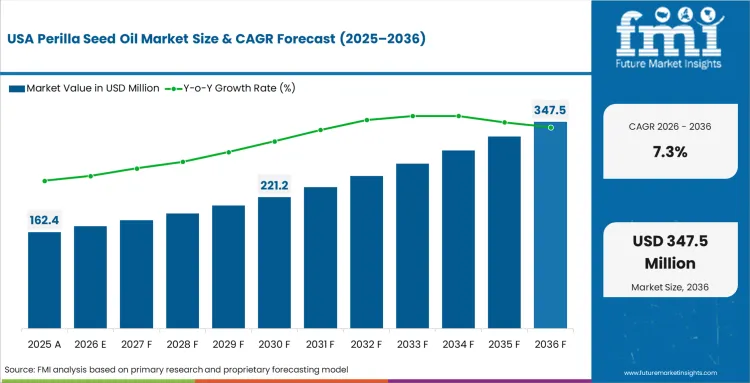
Dietary supplement innovation drives virtually all regional volume movement across the North America perilla seed oil market, as household culinary awareness remains negligible. Nutraceutical formulators utilize specialized botanical lipids to build completely vegan omega-3 complexes for premium retail channels. Sourcing personnel import finished bulk oil or encapsulated powders rather than establishing domestic pressing operations due to a complete lack of localized, commercial-scale seed cultivation. Clean-label cosmetic brands also integrate imported lipids into anti-aging serums to satisfy consumer demand for exotic plant-based emollients. Heavy reliance on trans-Pacific shipping leaves regional manufacturers highly vulnerable to maritime logistics disruptions and subsequent oxidation risks.
- United States: United States is expected to register 7.3% CAGR during the forecast period, supported by pace of dietary supplement innovation seeking to capture premium retail margins, and massive vegan demographic expansion forcing major legacy brands to completely replace fish-derived ingredients with stable plant alternatives. Formulation chemists demanding strict peroxide-value documentation upon arrival to guarantee shelf-life stability alongside the rapid integration of these botanical lipids into clean-label anti-aging serums by domestic cosmetic brands is also expected to support adoption of perilla seed oil. Successfully navigating delayed regulatory approvals for novel food applications quietly caps broader structural adoption across mass-market grocery aisles, forcing processors to concentrate entirely on the highly lucrative but lower volume specialty supplement and premium cosmetic sectors.
Europe Perilla Seed Oil Market Analysis
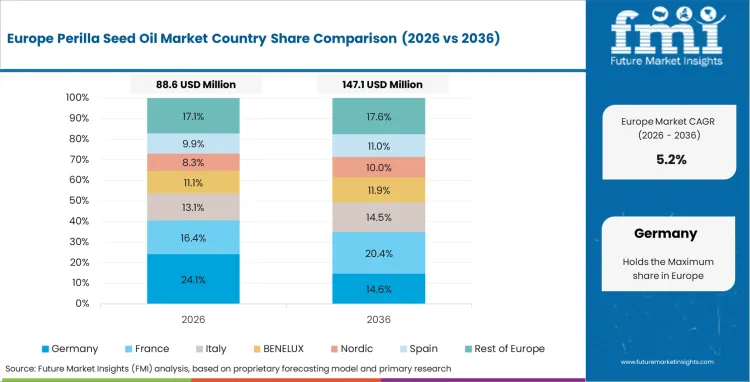
Europe reliance on imported botanical ingredients forces localized cosmetic laboratories to implement exceptionally rigorous incoming-material oxidation testing protocols, shaping the regional perilla seed oil market. Ingredient houses act as the primary gatekeepers, absorbing trans-continental shipping risks and standardizing raw agricultural outputs to meet stringent European Union cosmetic directives before releasing material to high-end formulation labs.
- Germany: Germany previously relied upon decentralized raw ingredient procurement systems, securing localized volume; however, highly standardized botanical lipid profiles now unlock major commercial opportunities. This internal capability expansion directly positions trusted ingredient houses to dominate premium ingredient supply across the continental plant-based sector. Germany is predicted to expand at 7.1% CAGR during the forecast period, owing to the existence of exceptionally rigorous oxidation testing protocols restricting market entry entirely toward superior quality botanical extracts. Other growth driving factors are procurement personnel relying exclusively upon decades-long international processor relationships ensuring absolute batch-to-batch consistency, and rapid formulation integration into high-margin cosmetic applications demanding completely predictable chemical profiles across all shipped batches.
- United Kingdom: The United Kingdom is likely to register 7.0% CAGR during the forecast period, owing to the existence of highly sophisticated retail grocery channels constantly championing uncompromising vegan product mandates. Premium clean-label botanical ingredients are bringing major commercial opportunities in the United Kingdom. This internal capability expansion directly positions boutique cosmetic brands to dominate premium specialty supply across the domestic plant-based beauty sector. Other market growth driving factors are health-conscious consumers completely abandoning marine lipids favoring plant-based dietary supplements, and rigorous import regulations requiring immaculate supply-chain traceability alongside extensive sustainability documentation before approving any new commercial supplier contracts.
Competitive Aligners for Market Players
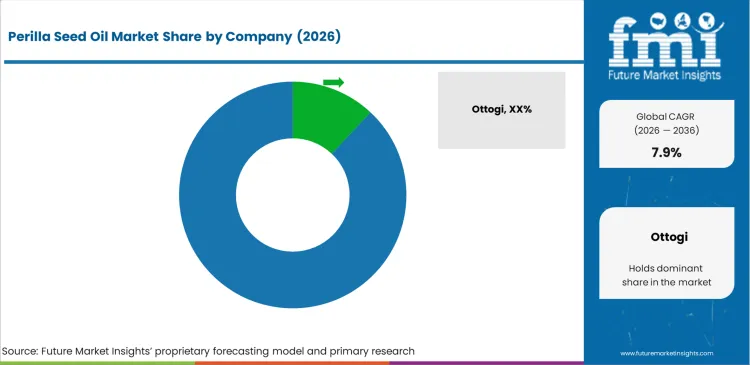
Regional agricultural proximity dictates competitive advantage far more than advanced processing technology in the perilla seed oil market space. Ottogi and Sempio leverage massive domestic Korea-based retail footprints and deep agricultural cooperative relationships to secure raw material volumes competitors cannot match. Sourcing personnel seeking to evaluate perilla seed oil market suppliers realize local pricing structures force smaller players to compete entirely on niche premiumization or specialized extraction claims. European ingredient houses like Henry Lamotte Oils and Gustav Heess navigate this environment by acting as high-trust quality filters, purchasing bulk Asian material and standardizing it for strict Western specifications.
Incumbents possess deep analytical testing libraries proving long-term oxidative stability across various formulation matrices. Blackcurrant seed oil manufacturers entering this category quickly realize pressing seeds is simple, but guaranteeing two-year shelf life requires proprietary handling protocols developed over decades. Cosmetic chemists conducting a rigorous supplier comparison rely entirely on established stability profiles when selecting vendor partners, creating a massive barrier to entry for unproven agricultural startups. Challengers must build specialized cold-chain logistics networks to even qualify for initial sample testing at major nutraceutical brands.
Some large multinational supplement brands resist vendor lock-in by aggressively qualifying secondary manufacturers in emerging cultivation zones like India. Quality assurance managers mandate identical peroxide value limits across all geographies, forcing new suppliers to match incumbent processing standards immediately. Expanding contract farming networks outside traditional East Asian strongholds remains a viable strategy for diluting established supplier power and stabilizing long-term global ingredient pricing, echoing supply shifts observed in niche strawberry seed oil supply chains.
Key Players in Perilla Seed Oil Market
- Ottogi
- Sempio
- Henry Lamotte Oils
- Gustav Heess
- O&3
- JAFEX
- Aadhunik Ayurveda
Scope of the Report
| Metric | Value |
|---|---|
| Quantitative Units | USD 334.0 Million to USD 714.4 Million, at a CAGR of 7.9% |
| Market Definition | Extraction of fixed lipids from Perilla frutescens seeds driven by high alpha-linolenic acid concentrations. |
| Segmentation | By Product Type, By Extraction Process, By Application, By Distribution Channel, By End Use, By Region |
| Regions Covered | North America, Latin America, Europe, Asia Pacific, Middle East & Africa |
| Countries Covered | South Korea, India, Japan, China, United States, Germany, United Kingdom |
| Key Companies Profiled | Ottogi, Sempio, Henry Lamotte Oils, Gustav Heess, O&3, JAFEX, Aadhunik Ayurveda |
| Forecast Period | 2026 to 2036 |
| Approach | Top-down and bottom-up methodology anchoring regional consumption against documented agricultural yield data. |
Source: Future Market Insights (FMI) analysis, based on proprietary forecasting model and primary research
Perilla Seed Oil Market Analysis by Segments
By Product Type:
- Conventional
- Organic
- Blended
By Extraction Process:
- Cold-Pressed
- Expeller-Pressed
- Supercritical CO2
- Solvent-Extracted
By Application:
- Food
- Supplements
- Personal Care
- Pharma
- Industrial
By Distribution Channel:
- B2B Bulk
- Retail
- Online
- Specialty Stores
By End Use:
- Household
- Food Processors
- Supplement Brands
- Cosmetic Brands
- Pharma Makers
Region
- North America
- United States
- Canada
- Europe
- Germany
- United Kingdom
- France
- Italy
- Spain
- Asia Pacific
- China
- Japan
- South Korea
- Taiwan
- Singapore
- Latin America
- Brazil
- Mexico
- Argentina
- Middle East & Africa
- GCC Countries
- South Africa
- Israel
- Rest of Middle East & Africa
Bibliography
- Guan, L., Zhang, L., Zhang, X., Huang, Y., Wang, K., Liu, B., Yang, X., Zhao, Y., Sun, D., Li, S., Chen, Q., & Fan, J. (2024, November). Perilla seed oil and protein: Composition, health benefits, and potential applications in functional foods. Molecules, 29(22), 5258.
- Pan, J., Tang, Y., Liu, Z., Cao, Y., Chen, Y., & Chen, Y. (2025, August). Improvement in the stability of perilla seed oil microemulsion and its role in fat accumulation reduction in Caenorhabditis elegans. Beverages, 9(5), 56.
- Ansari, M. A., Kumar, A., Shabeer, T. P. A., Kumar, A., Roy, S. S., Ansari, M. H., Singh, R., Sangeeta, M., Layek, J., Prakash, N., & Mishra, V. K. (2025, February). Exploring the genotypic potential of perilla (Perilla frutescens L.) for climate-resilient agriculture in the North Eastern Himalayas. Frontiers in Sustainable Food Systems, 9, 1549061.
- Kaur, S., Sharma, P., Sharma, V., & colleagues. (2024, June). A comprehensive review on nutritional, nutraceutical, and industrial perspectives of perilla (Perilla frutescens L.) seeds: An orphan oilseed crop. Heliyon, 10.
- Gao, X., Liu, Y., Zhang, H., & colleagues. (2026, March). Morphological, biochemical and fatty acid variations of three perilla (Perilla frutescens L.) cultivars under open-field conditions in Northern China. Journal of Food Composition and Analysis (Elsevier)
This bibliography is provided for reader reference. The full FMI report contains the complete reference list with primary source documentation.
This Report Addresses
- South Korea agricultural reporting methods anchoring global botanical lipid supply availability.
- Oxidation control pressures forcing cosmetic chemists to specify cold-pressed variants.
- Plant-based omega-3 transitions compelling supplement brands to abandon marine lipid sources.
- Retail culinary demand dynamics sustaining East Asian conventional raw material processing.
- B2B bulk logistics dictating inventory stability for European natural-ingredient houses.
- Himalayan cultivation initiatives diluting legacy East Asian supplier concentration.
- Flavor reversion risks in high-temperature food processing applications using polyunsaturated fats.
- Specialized nitrogen-flushing protocols required to validate two-year ambient shelf life.
Frequently Asked Questions
What is the size of the perilla seed oil market in 2025 and 2036?
Industry size reached USD 309.5 million in 2025 and is projected to reach USD 714.4 million by 2036. This establishes a clear baseline for niche functional botanicals transitioning from regional culinary staples into globally recognized nutraceutical ingredients.
What CAGR is expected for the perilla seed oil market from 2026 to 2036?
A 7.9% compound growth rate is anticipated through the forecast period. Expanding clean-label mandates inside dietary supplement manufacturing force brands to rapidly swap animal-derived omega-3 sources with highly stable botanical alternatives to retain shelf placement.
Why is perilla seed oil demand growing?
Consumers demanding plant-based omega-3 complexes drive immediate adoption across functional food and nutraceutical sectors. Skincare formulators also mandate low-temperature mechanical extraction to prevent thermal degradation of delicate antioxidants.
Which countries lead perilla seed oil consumption and growth?
South Korea leads global expansion at an 8.6% CAGR, supported by deeply embedded cooking traditions. India follows closely at 8.4% by targeting high-altitude cosmetic supply chains, while Japan advances at 8.2% through supermarket wellness integration.
Is perilla seed oil mainly a food ingredient or a cosmetic ingredient?
Food applications dominate current volume due to culinary traditions in Asia, but cosmetic and nutraceutical utilization expands rapidly as beauty brands source stable plant-based emollients to replace synthetic chemicals.
How does perilla oil compare with flaxseed oil and hemp seed oil?
Formulators prefer this specific lipid over flaxseed due to superior sensory stability and lack of fishy off-notes over time. It offers a higher alpha-linolenic acid concentration than hemp, making it highly attractive for concentrated vegan omega-3 supplements.
Who are the major companies in the perilla seed oil market?
Key participants guiding global volume include Ottogi, Sempio, Henry Lamotte Oils, Gustav Heess, O&3, JAFEX, and Aadhunik Ayurveda. Regional agricultural proximity dictates competitive advantage far more than advanced processing technology.
Why does cold-pressed perilla oil lead the segment?
Skincare formulators mandate low-temperature mechanical extraction to prevent thermal degradation of delicate antioxidants. Preserving these active compounds remains essential for substantiating anti-aging claims on consumer packaging.
What are the main supply-chain risks in perilla seed oil?
Extreme oxidative instability requires manufacturers to invest heavily in specialized cold-chain logistics and protective bottling. Brands lacking sophisticated nitrogen-flushing capabilities routinely face catastrophic flavor reversion during transit.
Is perilla seed oil a meaningful plant-based omega-3 alternative?
Yes, it serves as a critical replacement for marine lipids in vegan product lines. Converting delicate liquid oils into stable dry powders eliminates ambient oxidation risks, allowing beverage formulators to integrate high-value botanical fortifications seamlessly.
Preview the report firsthand - request a free sample
Get SampleGet the brochure for pricing and purchase details.
Get PDFTable of Content
- Executive Summary
- Global Market Outlook
- Demand-side Trends
- Supply-side Trends
- Technology Roadmap Analysis
- Analysis and Recommendations
- Market Overview
- Market Coverage / Taxonomy
- Market Definition / Scope / Limitations
- Research Methodology
- Chapter Orientation
- Analytical Lens and Working Hypotheses
- Market Structure, Signals, and Trend Drivers
- Benchmarking and Cross-market Comparability
- Market Sizing, Forecasting, and Opportunity Mapping
- Research Design and Evidence Framework
- Desk Research Programme (Secondary Evidence)
- Company Annual and Sustainability Reports
- Peer-reviewed Journals and Academic Literature
- Corporate Websites, Product Literature, and Technical Notes
- Earnings Decks and Investor Briefings
- Statutory Filings and Regulatory Disclosures
- Technical White Papers and Standards Notes
- Trade Journals, Industry Magazines, and Analyst Briefs
- Conference Proceedings, Webinars, and Seminar Materials
- Government Statistics Portals and Public Data Releases
- Press Releases and Reputable Media Coverage
- Specialist Newsletters and Curated Briefings
- Sector Databases and Reference Repositories
- FMI Internal Proprietary Databases and Historical Market Datasets
- Subscription Datasets and Paid Sources
- Social Channels, Communities, and Digital Listening Inputs
- Additional Desk Sources
- Expert Input and Fieldwork (Primary Evidence)
- Primary Modes
- Qualitative Interviews and Expert Elicitation
- Quantitative Surveys and Structured Data Capture
- Blended Approach
- Why Primary Evidence is Used
- Field Techniques
- Interviews
- Surveys
- Focus Groups
- Observational and In-context Research
- Social and Community Interactions
- Stakeholder Universe Engaged
- C-suite Leaders
- Board Members
- Presidents and Vice Presidents
- R&D and Innovation Heads
- Technical Specialists
- Domain Subject-matter Experts
- Scientists
- Physicians and Other Healthcare Professionals
- Governance, Ethics, and Data Stewardship
- Research Ethics
- Data Integrity and Handling
- Primary Modes
- Tooling, Models, and Reference Databases
- Desk Research Programme (Secondary Evidence)
- Data Engineering and Model Build
- Data Acquisition and Ingestion
- Cleaning, Normalisation, and Verification
- Synthesis, Triangulation, and Analysis
- Quality Assurance and Audit Trail
- Market Background
- Market Dynamics
- Drivers
- Restraints
- Opportunity
- Trends
- Scenario Forecast
- Demand in Optimistic Scenario
- Demand in Likely Scenario
- Demand in Conservative Scenario
- Opportunity Map Analysis
- Product Life Cycle Analysis
- Supply Chain Analysis
- Investment Feasibility Matrix
- Value Chain Analysis
- PESTLE and Porter’s Analysis
- Regulatory Landscape
- Regional Parent Market Outlook
- Production and Consumption Statistics
- Import and Export Statistics
- Market Dynamics
- Global Market Analysis 2021 to 2025 and Forecast, 2026 to 2036
- Historical Market Size Value (USD Million) Analysis, 2021 to 2025
- Current and Future Market Size Value (USD Million) Projections, 2026 to 2036
- Y-o-Y Growth Trend Analysis
- Absolute $ Opportunity Analysis
- Global Market Pricing Analysis 2021 to 2025 and Forecast 2026 to 2036
- Global Market Analysis 2021 to 2025 and Forecast 2026 to 2036, By Product Type
- Introduction / Key Findings
- Historical Market Size Value (USD Million) Analysis By Product Type , 2021 to 2025
- Current and Future Market Size Value (USD Million) Analysis and Forecast By Product Type , 2026 to 2036
- Conventional
- Organic
- Blended
- Conventional
- Y-o-Y Growth Trend Analysis By Product Type , 2021 to 2025
- Absolute $ Opportunity Analysis By Product Type , 2026 to 2036
- Global Market Analysis 2021 to 2025 and Forecast 2026 to 2036, By Extraction Process
- Introduction / Key Findings
- Historical Market Size Value (USD Million) Analysis By Extraction Process, 2021 to 2025
- Current and Future Market Size Value (USD Million) Analysis and Forecast By Extraction Process, 2026 to 2036
- Cold-Pressed
- Expeller-Pressed
- Supercritical CO2
- Cold-Pressed
- Y-o-Y Growth Trend Analysis By Extraction Process, 2021 to 2025
- Absolute $ Opportunity Analysis By Extraction Process, 2026 to 2036
- Global Market Analysis 2021 to 2025 and Forecast 2026 to 2036, By Application
- Introduction / Key Findings
- Historical Market Size Value (USD Million) Analysis By Application, 2021 to 2025
- Current and Future Market Size Value (USD Million) Analysis and Forecast By Application, 2026 to 2036
- Food
- Supplements
- Personal Care
- Food
- Y-o-Y Growth Trend Analysis By Application, 2021 to 2025
- Absolute $ Opportunity Analysis By Application, 2026 to 2036
- Global Market Analysis 2021 to 2025 and Forecast 2026 to 2036, By Distribution Channel
- Introduction / Key Findings
- Historical Market Size Value (USD Million) Analysis By Distribution Channel, 2021 to 2025
- Current and Future Market Size Value (USD Million) Analysis and Forecast By Distribution Channel, 2026 to 2036
- B2B Bulk
- Retail
- Online
- B2B Bulk
- Y-o-Y Growth Trend Analysis By Distribution Channel, 2021 to 2025
- Absolute $ Opportunity Analysis By Distribution Channel, 2026 to 2036
- Global Market Analysis 2021 to 2025 and Forecast 2026 to 2036, By End Use
- Introduction / Key Findings
- Historical Market Size Value (USD Million) Analysis By End Use, 2021 to 2025
- Current and Future Market Size Value (USD Million) Analysis and Forecast By End Use, 2026 to 2036
- Household
- Food Processors
- Supplement Brands
- Household
- Y-o-Y Growth Trend Analysis By End Use, 2021 to 2025
- Absolute $ Opportunity Analysis By End Use, 2026 to 2036
- Global Market Analysis 2021 to 2025 and Forecast 2026 to 2036, By Region
- Introduction
- Historical Market Size Value (USD Million) Analysis By Region, 2021 to 2025
- Current Market Size Value (USD Million) Analysis and Forecast By Region, 2026 to 2036
- North America
- Latin America
- Western Europe
- Eastern Europe
- East Asia
- South Asia and Pacific
- Middle East & Africa
- Market Attractiveness Analysis By Region
- North America Market Analysis 2021 to 2025 and Forecast 2026 to 2036, By Country
- Historical Market Size Value (USD Million) Trend Analysis By Market Taxonomy, 2021 to 2025
- Market Size Value (USD Million) Forecast By Market Taxonomy, 2026 to 2036
- By Country
- USA
- Canada
- Mexico
- By Product Type
- By Extraction Process
- By Application
- By Distribution Channel
- By End Use
- By Country
- Market Attractiveness Analysis
- By Country
- By Product Type
- By Extraction Process
- By Application
- By Distribution Channel
- By End Use
- Key Takeaways
- Latin America Market Analysis 2021 to 2025 and Forecast 2026 to 2036, By Country
- Historical Market Size Value (USD Million) Trend Analysis By Market Taxonomy, 2021 to 2025
- Market Size Value (USD Million) Forecast By Market Taxonomy, 2026 to 2036
- By Country
- Brazil
- Chile
- Rest of Latin America
- By Product Type
- By Extraction Process
- By Application
- By Distribution Channel
- By End Use
- By Country
- Market Attractiveness Analysis
- By Country
- By Product Type
- By Extraction Process
- By Application
- By Distribution Channel
- By End Use
- Key Takeaways
- Western Europe Market Analysis 2021 to 2025 and Forecast 2026 to 2036, By Country
- Historical Market Size Value (USD Million) Trend Analysis By Market Taxonomy, 2021 to 2025
- Market Size Value (USD Million) Forecast By Market Taxonomy, 2026 to 2036
- By Country
- Germany
- UK
- Italy
- Spain
- France
- Nordic
- BENELUX
- Rest of Western Europe
- By Product Type
- By Extraction Process
- By Application
- By Distribution Channel
- By End Use
- By Country
- Market Attractiveness Analysis
- By Country
- By Product Type
- By Extraction Process
- By Application
- By Distribution Channel
- By End Use
- Key Takeaways
- Eastern Europe Market Analysis 2021 to 2025 and Forecast 2026 to 2036, By Country
- Historical Market Size Value (USD Million) Trend Analysis By Market Taxonomy, 2021 to 2025
- Market Size Value (USD Million) Forecast By Market Taxonomy, 2026 to 2036
- By Country
- Russia
- Poland
- Hungary
- Balkan & Baltic
- Rest of Eastern Europe
- By Product Type
- By Extraction Process
- By Application
- By Distribution Channel
- By End Use
- By Country
- Market Attractiveness Analysis
- By Country
- By Product Type
- By Extraction Process
- By Application
- By Distribution Channel
- By End Use
- Key Takeaways
- East Asia Market Analysis 2021 to 2025 and Forecast 2026 to 2036, By Country
- Historical Market Size Value (USD Million) Trend Analysis By Market Taxonomy, 2021 to 2025
- Market Size Value (USD Million) Forecast By Market Taxonomy, 2026 to 2036
- By Country
- China
- Japan
- South Korea
- By Product Type
- By Extraction Process
- By Application
- By Distribution Channel
- By End Use
- By Country
- Market Attractiveness Analysis
- By Country
- By Product Type
- By Extraction Process
- By Application
- By Distribution Channel
- By End Use
- Key Takeaways
- South Asia and Pacific Market Analysis 2021 to 2025 and Forecast 2026 to 2036, By Country
- Historical Market Size Value (USD Million) Trend Analysis By Market Taxonomy, 2021 to 2025
- Market Size Value (USD Million) Forecast By Market Taxonomy, 2026 to 2036
- By Country
- India
- ASEAN
- Australia & New Zealand
- Rest of South Asia and Pacific
- By Product Type
- By Extraction Process
- By Application
- By Distribution Channel
- By End Use
- By Country
- Market Attractiveness Analysis
- By Country
- By Product Type
- By Extraction Process
- By Application
- By Distribution Channel
- By End Use
- Key Takeaways
- Middle East & Africa Market Analysis 2021 to 2025 and Forecast 2026 to 2036, By Country
- Historical Market Size Value (USD Million) Trend Analysis By Market Taxonomy, 2021 to 2025
- Market Size Value (USD Million) Forecast By Market Taxonomy, 2026 to 2036
- By Country
- Kingdom of Saudi Arabia
- Other GCC Countries
- Turkiye
- South Africa
- Other African Union
- Rest of Middle East & Africa
- By Product Type
- By Extraction Process
- By Application
- By Distribution Channel
- By End Use
- By Country
- Market Attractiveness Analysis
- By Country
- By Product Type
- By Extraction Process
- By Application
- By Distribution Channel
- By End Use
- Key Takeaways
- Key Countries Market Analysis
- USA
- Pricing Analysis
- Market Share Analysis, 2025
- By Product Type
- By Extraction Process
- By Application
- By Distribution Channel
- By End Use
- Canada
- Pricing Analysis
- Market Share Analysis, 2025
- By Product Type
- By Extraction Process
- By Application
- By Distribution Channel
- By End Use
- Mexico
- Pricing Analysis
- Market Share Analysis, 2025
- By Product Type
- By Extraction Process
- By Application
- By Distribution Channel
- By End Use
- Brazil
- Pricing Analysis
- Market Share Analysis, 2025
- By Product Type
- By Extraction Process
- By Application
- By Distribution Channel
- By End Use
- Chile
- Pricing Analysis
- Market Share Analysis, 2025
- By Product Type
- By Extraction Process
- By Application
- By Distribution Channel
- By End Use
- Germany
- Pricing Analysis
- Market Share Analysis, 2025
- By Product Type
- By Extraction Process
- By Application
- By Distribution Channel
- By End Use
- UK
- Pricing Analysis
- Market Share Analysis, 2025
- By Product Type
- By Extraction Process
- By Application
- By Distribution Channel
- By End Use
- Italy
- Pricing Analysis
- Market Share Analysis, 2025
- By Product Type
- By Extraction Process
- By Application
- By Distribution Channel
- By End Use
- Spain
- Pricing Analysis
- Market Share Analysis, 2025
- By Product Type
- By Extraction Process
- By Application
- By Distribution Channel
- By End Use
- France
- Pricing Analysis
- Market Share Analysis, 2025
- By Product Type
- By Extraction Process
- By Application
- By Distribution Channel
- By End Use
- India
- Pricing Analysis
- Market Share Analysis, 2025
- By Product Type
- By Extraction Process
- By Application
- By Distribution Channel
- By End Use
- ASEAN
- Pricing Analysis
- Market Share Analysis, 2025
- By Product Type
- By Extraction Process
- By Application
- By Distribution Channel
- By End Use
- Australia & New Zealand
- Pricing Analysis
- Market Share Analysis, 2025
- By Product Type
- By Extraction Process
- By Application
- By Distribution Channel
- By End Use
- China
- Pricing Analysis
- Market Share Analysis, 2025
- By Product Type
- By Extraction Process
- By Application
- By Distribution Channel
- By End Use
- Japan
- Pricing Analysis
- Market Share Analysis, 2025
- By Product Type
- By Extraction Process
- By Application
- By Distribution Channel
- By End Use
- South Korea
- Pricing Analysis
- Market Share Analysis, 2025
- By Product Type
- By Extraction Process
- By Application
- By Distribution Channel
- By End Use
- Russia
- Pricing Analysis
- Market Share Analysis, 2025
- By Product Type
- By Extraction Process
- By Application
- By Distribution Channel
- By End Use
- Poland
- Pricing Analysis
- Market Share Analysis, 2025
- By Product Type
- By Extraction Process
- By Application
- By Distribution Channel
- By End Use
- Hungary
- Pricing Analysis
- Market Share Analysis, 2025
- By Product Type
- By Extraction Process
- By Application
- By Distribution Channel
- By End Use
- Kingdom of Saudi Arabia
- Pricing Analysis
- Market Share Analysis, 2025
- By Product Type
- By Extraction Process
- By Application
- By Distribution Channel
- By End Use
- Turkiye
- Pricing Analysis
- Market Share Analysis, 2025
- By Product Type
- By Extraction Process
- By Application
- By Distribution Channel
- By End Use
- South Africa
- Pricing Analysis
- Market Share Analysis, 2025
- By Product Type
- By Extraction Process
- By Application
- By Distribution Channel
- By End Use
- USA
- Market Structure Analysis
- Competition Dashboard
- Competition Benchmarking
- Market Share Analysis of Top Players
- By Regional
- By Product Type
- By Extraction Process
- By Application
- By Distribution Channel
- By End Use
- Competition Analysis
- Competition Deep Dive
- Ottogi
- Overview
- Product Portfolio
- Profitability by Market Segments (Product/Age /Sales Channel/Region)
- Sales Footprint
- Strategy Overview
- Marketing Strategy
- Product Strategy
- Channel Strategy
- Sempio
- Henry Lamotte Oils
- Gustav Heess
- O&3
- JAFEX
- Ottogi
- Competition Deep Dive
- Assumptions & Acronyms Used


