

- Market Size (2026)
- USD 58.0 Mn
- Forecast (2036)
- USD 158.8 Mn
- CAGR (2026 to 2036)
- 10.6%
Prickly Pear Fruit Metabolic Health Ingredients Market Size, Market Forecast and Outlook By FMI
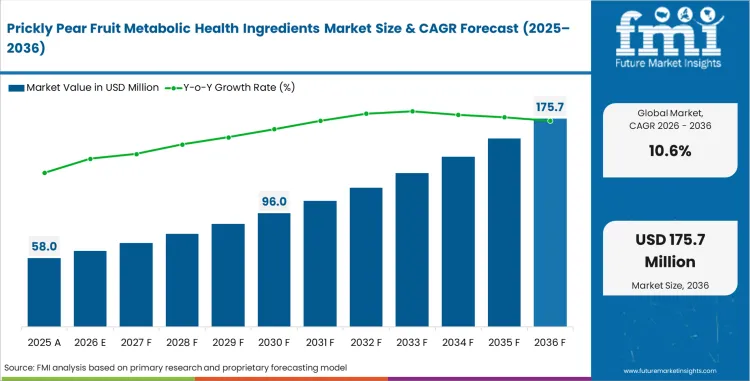
The prickly pear fruit metabolic health ingredients market crossed a valuation of USD 52.4 million in 2025. Sales are expected to reach USD 58.0 million in 2026 at a CAGR of 10.6% during the forecast period. Sustained revenue buildup takes the valuation to USD 158.8 million by 2036 as formulators keep adding fruit-based metabolic support ingredients into capsule, powder, and sachet formats that are easier to dose and easier to position.
Summary of Prickly Pear Fruit Metabolic Health Ingredients Market
- The market is forecast to reach USD 158.8 million by 2036.
- The market is expected to grow at a CAGR of 10.6% from 2026 to 2036.
- The market was estimated at USD 52.4 million in 2025.
- The forecast period represents an incremental opportunity of USD 100.8 million.
- Prickly pear metabolic health ingredients are mainly used in capsules, powders, sachets, and selected functional beverage formats.
- Fruit extract powders are expected to remain the leading ingredient format, while glycemic support is projected to stay the leading health function.
- Dietary supplements are anticipated to remain the main application area due to easier dose control and clearer product positioning.
- Nexira, Anderson Advanced Ingredients, Wellgreen Technology, Chemcopia Ingredients, and ESSERRE Pharma are among the companies referenced in the market landscape.
Key Takeaways, Market Size, and Forecast
- Prickly Pear Fruit Metabolic Health Ingredients Market is forecast to climb from USD 58.0 million in 2026 to USD 158.8 million by 2036, at a CAGR of 10.6%.
- The prickly pear fruit metabolic health ingredients market was valued at USD 52.4 million in 2025.
- By 2036, the Prickly Pear Fruit Metabolic Health Ingredients Market is expected to total USD 158.8 million.
- The market is expected to move ahead at a CAGR of 10.6% from 2026 to 2036.
- The market is projected to add USD 100.8 million in incremental opportunity across the forecast horizon.
- In 2026, Fruit extract powders are expected to account for 32.0% of the ingredient format segment.
- India (12.4%) and the United States (11.8%) are two of the fastest growing markets.
Prickly Pear Fruit Metabolic Health Ingredients Market key takeaways
| Parameter | Details |
|---|---|
| Market value (2026) | USD 58.0 million |
| Forecast value (2036) | USD 158.8 million |
| CAGR (2026 to 2036) | 10.6% |
| Estimated market value (2025) | USD 52.4 million |
| Incremental opportunity | USD 100.8 million |
| Leading ingredient format | Fruit extract powders |
| Leading health function | Glycemic support |
| Leading application | Dietary supplements |
| Leading delivery form | Capsules |
| Leading label positioning | Conventional |
| Leading end buyer | B2B formulators |
| Brands referenced in market landscape | Nexira, Anderson Advanced Ingredients, Wellgreen Technology, Chemcopia Ingredients, and ESSERRE Pharma |
Source: Future Market Insights (FMI) analysis, based on proprietary forecasting model and primary research.
Commercial uptake in this category depends less on novelty appeal and more on whether prickly pear can enter established supplement programs without adding formulation instability, sensory burden, or dose inconsistency. Prickly pear becomes more commercially attractive when suppliers position it around one lead metabolic use case, usually glycemic or satiety support, rather than stretching it across too many benefit claims at launch. Wider adoption still depends on clean standardization, because brands selling metabolic support products usually want dosing consistency before they widen distribution.
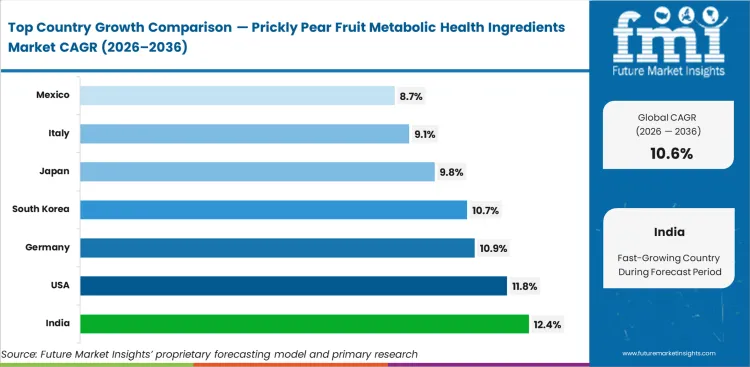
India is expected to post the fastest growth, with demand rising at a CAGR of 12.4% through 2036, while the United States follows at 11.8%. Germany is projected at 10.9%, South Korea at 10.7%, Japan at 9.8%, Italy at 9.1%, and Mexico at 8.7%. Spread across this range reflects differences in supplement maturity, ingredient familiarity, and how easily metabolic-health claims can be translated into commercial consumer products.
Formulation Versatility May Beat Hero Branding
Prickly pear is unlikely to become a stand-alone blockbuster ingredient on branding alone. Its stronger route may be as a formulation-friendly metabolic health support component that complements fiber, gut-health, blood-sugar, or healthy-aging concepts. Recent work continues to examine anti-obesity, microbiome, anti-inflammatory, and steatosis-related effects from different Opuntia fruit fractions and extracts, suggesting the commercial whitespace lies in systems thinking rather than single-claim storytelling. That matters because brands are increasingly building multi-benefit metabolic platforms instead of launching isolated hero botanicals. For suppliers, the practical answer is to emphasize compatibility with powders, beverages, gummies, or blend systems and to support that with compositional clarity. In this market, formulation versatility may convert faster than trying to sell prickly pear as the next standalone metabolic miracle.
Segmental Analysis
Key Facts About Segments
- Fruit extract powders are projected to account for 32.0% of market share by 2026.
- Demand for fruit extract powders is supported by easier dosing, better shelf stability, smoother blending, and broader use across capsules, sachets, and powder mixes.
- Glycemic support is expected to capture 31.0% of total market share in 2026.
- Preference for glycemic support remains strong due to clear consumer relevance, easier product positioning, daily wellness use, and simpler benefit communication on finished packs.
- Dietary supplements are projected to contribute 38.0% of market share by 2026.
- This application area continues to attract product developers through easier active loading, clearer serving guidance, better format flexibility, and stronger fit across capsule, powder, and sachet systems.
Prickly Pear Fruit Metabolic Health Ingredients Market Analysis by Ingredient Format
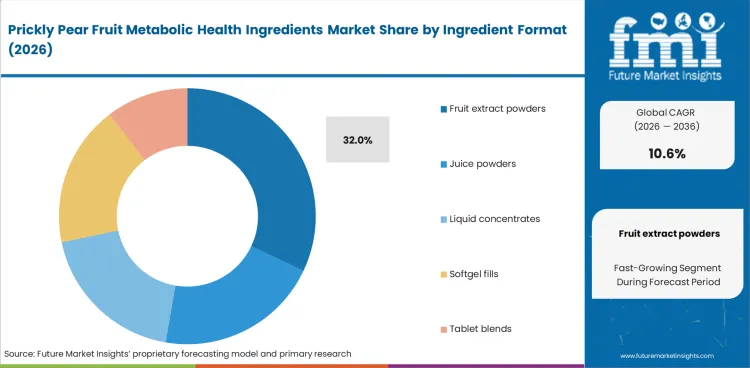
Ingredient format shapes day-to-day use because each form brings a different level of ease in dosing, storage, blending, and line handling. Fruit extract powders remain the best entry format because they reduce handling complexity across capsules, sachets, and blends, making them easier to standardize, qualify, and scale than liquid systems. Liquid formats can improve fruit identity, but they remain harder to scale because transport cost, stickiness, and tighter stability management increase execution risk after pilot stage. Softgels and tablets remain useful once dose targets and raw material consistency become clearer. In 2026, fruit extract powders are expected to contribute 32.0% of total market share, due to easier shelf management and owing to smoother use across multiple finished formats.
- Fruit Extract Powders: Dry handling suits routine production because scooping, blending, and filling stay easier than liquid work. Moisture control remains important, yet stable packing and cleaner dose setting give brands a practical route for daily metabolic-health products across capsules, sachets, and bulk powder packs.
- Juice Powders: Broader fruit character gives this format a softer consumer feel and a more familiar taste direction. Extra care around sweetness balance and moisture pickup still matters, owing to clumping risk during storage and supported by sensitivity in flavored wellness blends.
- Liquid Concentrates: Richer fruit identity can help premium concepts and ready-mix products feel closer to fresh ingredient use. Added work in transport, drum handling, and taste balancing keeps wider rollout more selective, due to heavier shipping needs and owing to shorter comfort in plant operations.
Prickly Pear Fruit Metabolic Health Ingredients Market Analysis by Fruit Fraction
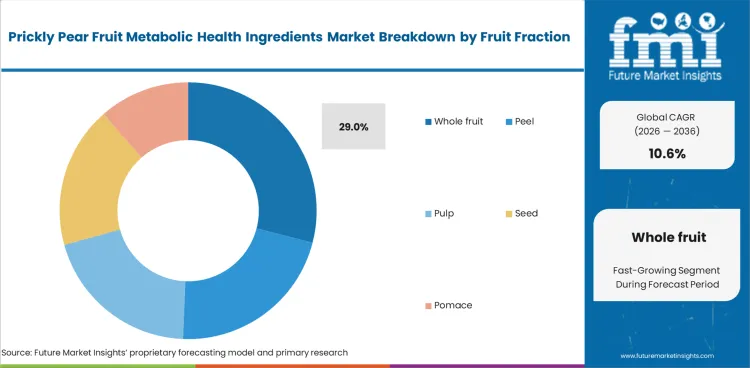
Fruit fraction changes product meaning because each part of prickly pear carries a different mix of fiber, color, texture, and story value. Whole-fruit ingredients tend to work best in early commercialization because they offer simpler label language and broader consumer acceptance, even if they provide less precise functional targeting than more concentrated fractions. Peel and pomace become more relevant when suppliers want stronger fiber, color, or value-added sourcing stories, but these routes usually need clearer application guidance before they can move beyond niche positioning. Value in this segment comes from selecting a fraction that matches both formula behavior and label clarity. The whole fruit segment is estimated to account for 29.0% share in 2026, due to broad phytocomplex appeal and owing to easier brand communication in finished products. Simple ingredient language still matters a lot in this category because everyday shoppers usually respond better to clear benefit cues than technical fraction talk.
- Whole Fruit: Wider product fit comes from a balanced mix of fiber, color compounds, and familiar fruit identity. Cleaner label language and easier shelf communication support regular use in supplements and beverage mixes, due to simpler ingredient storytelling and owing to fewer explanation needs during selling.
- Peel: Polyphenol and color strength make peel useful in formulas built around antioxidant support and vivid botanical identity. Stronger active focus can add appeal, yet taste balance and clearer positioning stay important, supported by concentrated plant notes and due to narrower mainstream familiarity.
- Pomace: Better raw material use gives pomace a practical role in value-led ingredient programs and fiber-centered formulas. Interest grows in lines built around fuller fruit use, owing to cost awareness and supported by demand for ingredients with less visible waste from processing.
Prickly Pear Fruit Metabolic Health Ingredients Market Analysis by Bioactive Focus
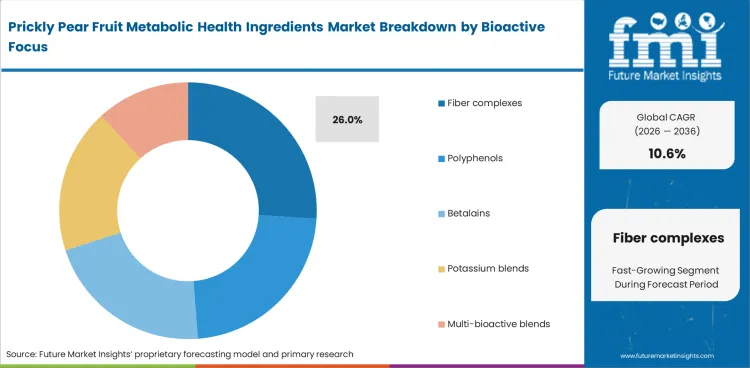
Bioactive focus decides the main health message carried into the final pack, so a clear lead group usually matters more than a long list of active compounds. Fiber complexes remain central because blood sugar support and fullness cues are easier to explain in plain words during routine selling. Polyphenols and betalains still add value, especially in products built around cell stress support and natural color identity. Potassium blends and mixed systems have room, yet broader formulas often need more education at shelf level. Fiber complexes are anticipated to capture 26.0% of the market in 2026, due to easy benefit language and owing to stronger fit with daily metabolic support positioning. Practical sales logic in this category still favors active systems that feel familiar and simple at first glance.
- Fiber Complexes: Fullness support and simple blood sugar language give this group a clear place in everyday wellness products. Mixing ease can vary by formula, yet plain consumer understanding supports wider use, due to familiar fiber language and owing to stronger repeat-buy comfort.
- Polyphenols: Sharper plant-active focus suits premium formulas built around antioxidant value and deeper botanical positioning. Extra explanation is often needed in front-end selling, supported by lower public familiarity and due to benefit language that can feel less direct than fiber.
- Betalains: Natural color and plant identity help betalains stand out in products built for visual appeal and cleaner fruit cues. Use rises in differentiated formulas, owing to vivid appearance and supported by interest in ingredients that look as natural as the label reads.
Prickly Pear Fruit Metabolic Health Ingredients Market Analysis by Health Function
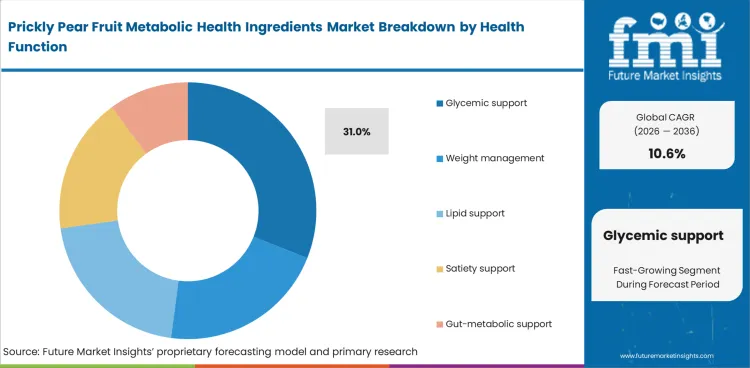
Health function sets the first reason for purchase, so a clear use case often decides if a formula moves ahead or stays in trial mode. Glycemic support remains the most commercially usable health function because it gives brands a clearer route into metabolic-health positioning than broader lipid or gut-metabolic narratives, provided the ingredient specification and evidence base are handled carefully. Weight-management positioning remains relevant, but it works better as a secondary benefit tied to satiety and routine-use formats than as the sole basis for market entry. Lipid support and gut-metabolic support add range, though both need a little more context in front-facing communication. Glycemic support is set to represent 31.0% of market share in 2026, due to direct consumer relevance and owing to easier placement in daily wellness routines. Product ideas tied to a familiar need usually move ahead faster because shelf language stays simple and repeat use feels easy to picture.
- Glycemic Support: Daily blood sugar balance gives brands a clear place to start and a simple reason to buy. Familiar need states keep this route active across capsules, powders, and blends, due to steady routine use and supported by easier message delivery on pack.
- Weight Management: Satiety and portion control keep this route relevant in products aimed at routine wellness and food-intake balance. Product fit stays stronger in practical daily formats, owing to overlap with habit-based use and supported by simple benefit language in selling.
- Lipid Support: Broader heart-and-metabolic positioning gives this route value in more complete wellness formulas and premium blends. Use stays narrower than glycemic support, due to longer explanation needs and owing to a less immediate day-to-day purchase trigger.
Prickly Pear Fruit Metabolic Health Ingredients Market Analysis by Delivery Form
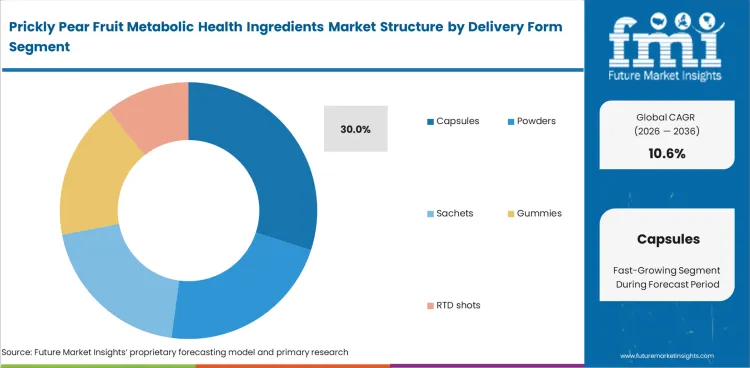
Delivery form affects repeat use because a good ingredient story can still lose appeal if the finished product feels awkward to take every day. Capsules remain a steady choice across metabolic-health launches since dose setting stays clear and taste issues stay mostly out of the way. Powders and sachets keep good relevance in routines built around mixing at home, while gummies need careful work on sweetness and active load. Ready-to-drink shots look convenient, yet formula flexibility can narrow once dose, taste, and shelf comfort all need to fit together. Capsules are projected to secure 30.0% share in 2026, due to easy dose control and owing to smoother product development across wellness lines. Simple use often wins in this space because daily compliance depends on very little effort at the point of consumption.
- Capsules: Clear serving size and easier swallowing keep capsules relevant in adult wellness routines built around consistency. Taste masking becomes far less demanding in this form, due to closed-shell delivery and supported by easier pack communication for regular intake.
- Powders: Mix-at-home use gives powders room in routines built around smoothies, shakes, and water-based wellness drinks. Flexibility adds value for many brands, owing to format variety and supported by easier pairing with multi-ingredient blends in everyday use.
- Gummies: Softer texture and approachable taste can widen interest across casual wellness users and entry-level buyers. Active loading still needs care in development, due to sweetness balance and owing to limited room for larger functional doses per piece.
Prickly Pear Fruit Metabolic Health Ingredients Market Analysis by Application
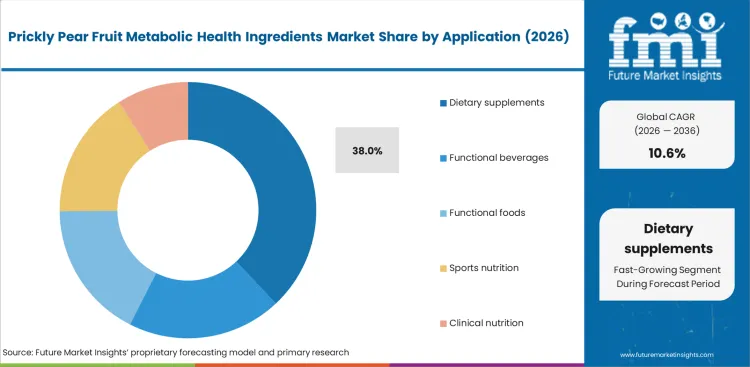
Application shows the first place a supplier or brand can earn practical use because ingredient fit changes a lot from one finished format to another. Dietary supplements remain the priority application because they allow clearer dose delivery, simpler benefit communication, and less formulation compromise than functional foods or beverage systems. Functional beverages remain selective rather than mainstream in this category, because taste masking, solubility, and dose realism become harder to manage once prickly pear moves into liquid delivery. Sports nutrition and clinical nutrition stay relevant in narrower pockets tied to recovery or structured wellness needs. Dietary supplements are anticipated to emerge with 38.0% market share in 2026, due to easier dose management and owing to clearer product messaging in finished packs. Commercial fit stays strongest in formats that let the ingredient work without heavy taste compromise or label crowding.
- Dietary Supplements: Capsule, sachet, and powder systems give this route flexibility across simple daily products and premium formulas. Clear serving habits support faster scale-up, due to familiar supplement behavior and owing to easier active loading than food-led formats.
- Functional Beverages: Fruit identity and drinkable wellness appeal give beverages a visible role in lifestyle-led concepts and hydration-linked products. Taste, texture, and stability still need careful balancing, supported by liquid-format demands and due to daily repeat use expectations.
- Functional Foods: Wider reach looks appealing in food formats, yet active inclusion has to work with portion size and eating comfort. Slow movement in this route comes from texture limits and recipe constraints, owing to product complexity and supported by tighter sensory expectations.
Prickly Pear Fruit Metabolic Health Ingredients Market Analysis by Label Positioning
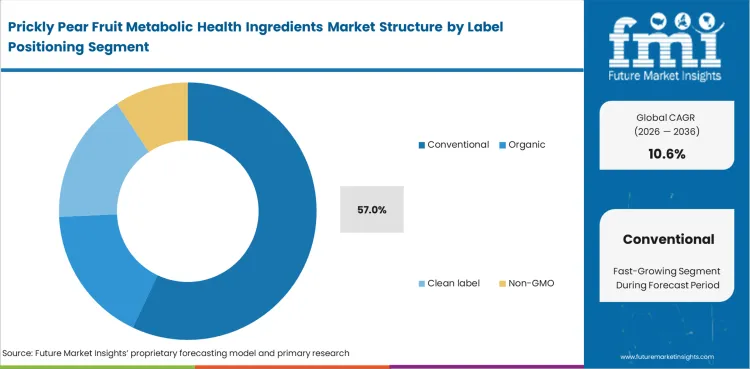
Label positioning shapes both price comfort and supply flexibility, so a strong health story alone rarely settles the final route. Conventional products stay ahead because stable sourcing and workable finished-product cost still matter in broad commercial rollout. Organic, clean-label, and non-GMO options add appeal in selected channels, yet stricter standards can narrow ingredient options or raise cost pressure. Balance in this segment comes from matching claim ambition with practical supply comfort. The conventional category is likely to account for 57.0% share in 2026, due to broader sourcing freedom and owing to better cost control in finished lines. Many brands start with the most workable path first, then layer tighter claim language once a stable ingredient system is in place.
- Conventional: Broader supply access keeps this route active across entry, mid-tier, and premium product programs. Cost discipline remains easier here, due to wider ingredient availability and owing to fewer restrictions during qualification and regular supply planning.
- Organic: Farming story and cleaner origin cues support interest in premium wellness channels and fruit-led product lines. Tight supply and higher cost can narrow wider use, owing to certification burden and supported by lower flexibility in raw material sourcing.
- Clean Label: Simple ingredient language helps botanical products feel easier to trust and easier to place in daily routines. Appeal stays meaningful across wellness shelves, due to label clarity and owing to stronger comfort with recognizable fruit-based ingredient descriptions.
Prickly Pear Fruit Metabolic Health Ingredients Market Analysis by End Buyer
End-buyer structure shows the point commercial movement starts because many finished concepts begin long before a consumer sees a product on shelf. B2B formulators sit close to the front of this process since ingredient choice, dose fit, and basic product architecture often take shape at early design stages. Brand owners guide positioning and channel focus, while contract manufacturers keep a useful role in faster launch paths for smaller labels. Practitioner-led routes and direct-selling brands add niche depth, though volume build often starts earlier in development pipelines. In 2026, the B2B formulators segment is poised to account for 41.0% of market share, due to early-stage product design influence and owing to strong control over ingredient selection in commercial development. Upstream decisions carry lasting weight here because later packaging or channel work rarely fixes a weak formulation start.
- B2B Formulators: Early formula design keeps this group central in ingredient choice, dose balance, and finished product structure. Strong influence begins before brand storytelling takes shape, due to front-end product planning and owing to direct work on technical fit.
- Brand Owners: Positioning, pack language, and channel focus keep brand owners closely tied to commercial direction and portfolio fit. Final product shape still depends on workable formulation, owing to launch risk and supported by the need for a clear shelf message.
- Contract Manufacturers: Faster route-to-shelf appeal gives contract manufacturing steady value across smaller wellness labels and lean operating setups. Use stays strong in outsourced development paths, due to lower setup burden and owing to easier movement from pilot batches to launch.
Prickly Pear Fruit Metabolic Health Ingredients Market Drivers, Restraints, and Opportunities
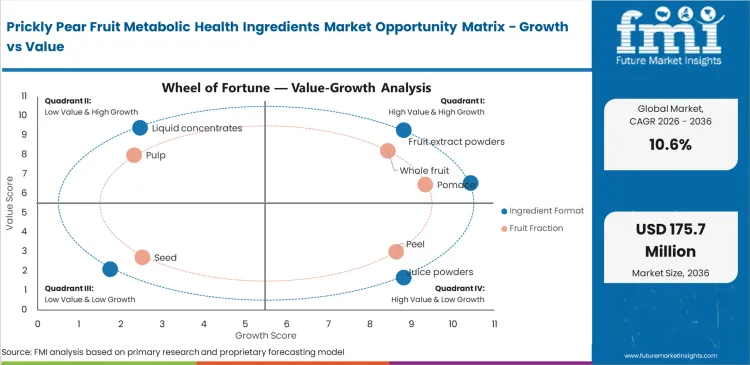
Consumer demand for blood sugar support and broader daily metabolic care is giving prickly pear ingredients a clearer place in finished wellness products. Interest stays stronger when suppliers can present the fruit as a practical ingredient rather than a niche superfruit concept. Buyers usually move faster when one ingredient can support several simple product narratives without making the formula harder to build.
Supply variation still acts as a restraint. Raw fruit quality can shift by origin, season, and fraction choice, which makes standardization harder when brands want repeatable active profiles. Taste handling and dose practicality can also slow wider beverage use, even though processed superfruits and organic fruit powder categories show that fruit-led wellness ingredients can scale when formulation burdens stay manageable. Adoption in prickly pear improves when suppliers solve those practical issues early rather than relying on the fruit story alone.
Opportunities in the Prickly Pear Fruit Metabolic Health Ingredients Market
- Format Expansion: Capsules, sachets, and dry blends offer the cleanest near-term room for growth because active delivery stays simple and daily use feels easier for consumers. Commercial value rises further due to easier storage and owing to smoother handling during blending, filling, and final packing.
- Channel Broadening: Channel expansion is most realistic after suppliers simplify the metabolic-health proposition into one lead benefit and support it with clean documentation, because mainstream supplement shelves reward clarity more than novelty. Wider movement into mainstream channels gains support because simple blood sugar and satiety language travels better than crowded scientific wording.
- Value-Added Sourcing: Peel, pomace, and fuller fruit fractions can help suppliers build deeper ingredient portfolios instead of relying only on standard extract routes. Extra value comes through better raw material use because more of the fruit can move into marketable formats with a clearer role in metabolic support. Commercial appeal grows due to cost awareness and owing to stronger interest in ingredient systems that carry both function and fuller fruit identity.
Regional Analysis
Key Facts About Country
- India is identified as the fastest-growing market among the countries highlighted, with a CAGR of 12.4% through 2036.
- The United States follows at 11.8%, placing it among the stronger-growth markets covered in the analysis.
- Germany records 10.9%, indicating a steady growth outlook among mature supplement markets.
- South Korea stands at 10.7%, while Japan reaches 9.8%, reflecting measured but healthy expansion across established wellness categories.
- Italy posts 9.1%, remaining below the growth rates projected for India, the United States, Germany, South Korea, and Japan.
- Mexico records 8.7%, making it the slowest-growing market among the countries cited here.
Based on regional analysis, the prickly pear fruit metabolic health ingredients market is segmented into North America, Europe, Asia Pacific, Latin America, and Middle East & Africa across 40 plus countries.
.webp "Top Country Growth Comparison Prickly Pear Fruit Metabolic Health Ingredients Market Cagr (2026 2036)")
| Country | CAGR (2026-2036) |
|---|---|
| India | 12.4% |
| United States | 11.8% |
| Germany | 10.9% |
| South Korea | 10.7% |
| Japan | 9.8% |
| Italy | 9.1% |
| Mexico | 8.7% |
Asia Pacific Prickly Pear Fruit Metabolic Health Ingredients Market Analysis
Asia Pacific remains the most active growth area in this space because supplement demand continues to widen and daily metabolic support is becoming a more regular purchase across urban wellness channels. Product movement gains pace due to broader comfort with botanical wellness and owing to easier entry for capsules, powders, and drink-mix formats. India adds the biggest pull across the region, and South Korea and Japan add premium demand backed by stronger health-product discipline.
- India: India offers the strongest near-term growth because routine supplement buying is widening across major urban centers, and metabolic-health products can be commercialized in relatively straightforward capsule and powder formats. Demand for Prickly Pear Fruit Metabolic Health Ingredients Market in India is anticipated to rise at a CAGR of 12.4% from 2026 to 2036, due to broad metabolic wellness demand and owing to stronger acceptance of plant-based support products in daily routines. Mumbai, Bengaluru, Hyderabad, and Delhi continue to add sales depth as wellness buying becomes more organized and more routine. Capsule and powder formats suit this setting because dose clarity stays simple and finished products remain easier to price for repeated purchase.
- South Korea: South Korea brings a polished premium setting into this category because health-food retail, beauty-linked wellness, and compact dosage forms already sit close to everyday purchase habits. Sales of Prickly Pear Fruit Metabolic Health Ingredients Market in South Korea are expected to increase at a CAGR of 10.7% during the forecast period, driven by premium botanical demand and supported by clean-label preference across urban wellness shelves. Seoul and nearby high-income clusters keep adding room for refined capsule and sachet products built around balance and daily use. Prickly pear gains more acceptance in this setting due to measured positioning and owing to smooth product presentation across pack, taste, and serving guidance. Product polish matters a lot in this area because repeat purchase depends on trust as much as ingredient appeal.
- Japan: Japan offers a calmer but steady demand path because health maintenance products already sit inside established daily routines across mature consumer segments. The Prickly Pear Fruit Metabolic Health Ingredients Market in Japan is poised to expand at a CAGR of 9.8% through 2036, because supplement use stays disciplined and supported by preference for measured wellness formats with clear serving structure. Tokyo, Osaka, and Nagoya remain central to demand due to strong health-food channels and orderly supplement buying habits. Prickly pear works better in products built around calm routine use, easy serving steps, and simple label language.
Asia Pacific keeps its lead due to broad supplement access and supported by a consumer base that already understands regular wellness intake. Better results usually come from practical formats and simple metabolic-support language rather than crowded positioning built around too many benefit claims.
North America Prickly Pear Fruit Metabolic Health Ingredients Market Analysis
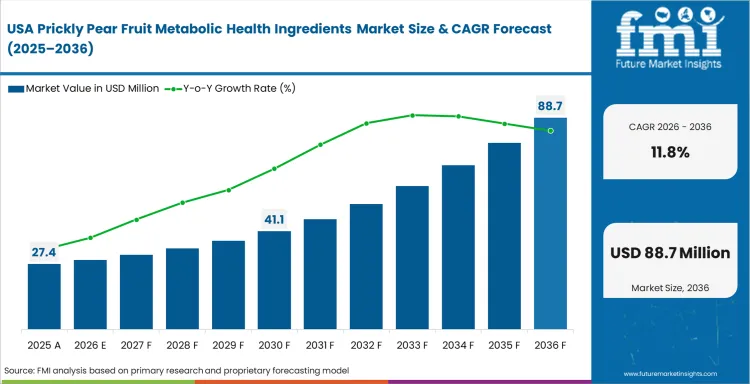
North America combines strong commercial pull with tighter scrutiny around formulation quality, active consistency, and finished product fit. Demand grows faster in settings backed by mature supplement shelves and supported by consumers already familiar with blood sugar, satiety, and weight-balance products. Capsules, powders, and sachets keep a stronger hold than more complex beverage systems due to easier dose control and smoother scale-up into repeat retail movement.
- United States: The United States remains commercially attractive because targeted metabolic-health supplements already have established shelf presence, making it easier for prickly pear to enter as a differentiated ingredient rather than an unfamiliar category. United States is set to record a CAGR of 11.8% in prickly pear fruit metabolic health ingredients market during the assessment period, due to mature supplement buying habits and owing to strong retail and e-commerce support for focused metabolic-health products. California, Texas, Florida, and New York keep adding commercial depth as product variety expands across mainstream wellness and premium botanical shelves. Prickly pear fits best in capsule, powder, and sachet formats because ingredient delivery stays simple and consumer understanding remains stronger in those systems.
- Mexico: Mexico remains important from a different angle because fruit supply and processing depth give it a strong place in the wider value chain. Prickly pear fruit metabolic health ingredients market adoption in Mexico is likely to advance at a CAGR of 8.7% by 2036, supported by raw-material availability and driven by gradual movement toward higher-value processed fractions rather than fresh produce alone. Jalisco, Zacatecas, and central growing areas matter due to deeper links between cultivation and ingredient conversion. Commercial upside improves once more fruit moves into standardized extracts, powders, and value-added fractions built for wellness formats.
North America remains commercially important due to shelf maturity and supported by consumers already used to targeted supplement use. Better supplier outcomes usually come from clear formulation support, stable active profiles, and easier movement from ingredient intake to finished product launch.
Europe Prickly Pear Fruit Metabolic Health Ingredients Market Analysis
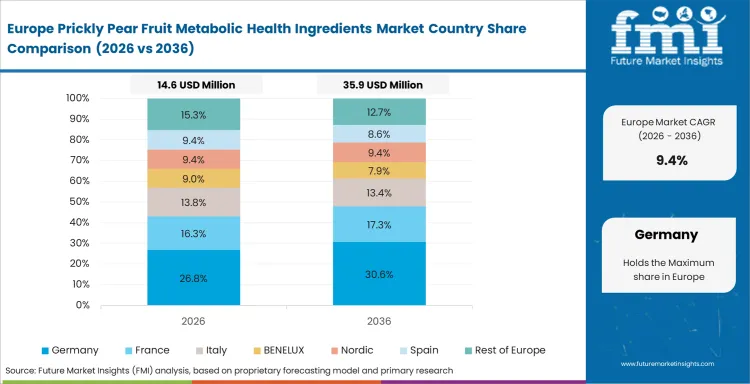
Europe offers a steady and quality-led demand profile because buyers in this area usually place more weight on ingredient discipline, clean formulation, and premium wellness fit. Growth stays supported by fruit-led botanical familiarity and owing to stronger interest in products built around daily balance rather than impulse-led claims. Capsules and powders remain more workable than broad beverage use due to easier control over serving size and finished-product behavior. Commercial progress in Europe often comes from steady trust-building, not fast novelty-driven rollout.
- Germany: Germany stands out as a disciplined demand base where buyers respond better to measured product positioning, clearer documentation, and simpler dosage systems than to broad lifestyle-led botanical messaging. Germany is projected to witness 10.9% CAGR in the prickly pear fruit metabolic health ingredients market through 2036, due to disciplined supplement demand and supported by preference for precise product formats with clear benefit language. Berlin, Munich, Hamburg, and Frankfurt continue to hold commercial weight across retail and online wellness channels. Prickly pear fits more naturally in simple dosage systems due to better control over intake and owing to stronger comfort with measured product positioning.
- Italy: Italy adds value through fruit familiarity and a food-wellness culture that already accepts plant-based support products across premium and everyday use paths. The market for Prickly pear fruit metabolic health ingredients market in Italy is expected to grow at a CAGR of 9.1% during the study period, because Mediterranean fruit identity remains familiar and supported by stronger links between origin story and processed ingredient appeal. Sicily and nearby production areas matter due to closer ties between cultivation, processing, and ingredient identity.
Europe remains attractive due to quality-focused buying habits and supported by consumers willing to stay with products that feel reliable in everyday use.
Competitive Aligners for Market Players
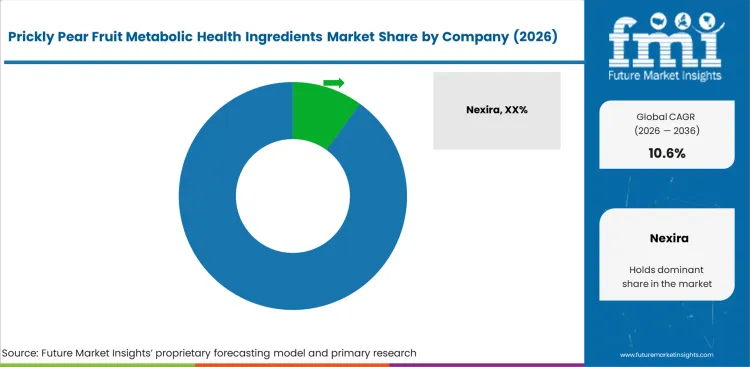
Competition in this market depends less on supplier scale alone and more on the ability to provide standardized extracts, application support, documentation quality, and smoother integration into capsule, powder, and sachet systems. Buyers looking across this space usually compare more than ingredient origin. Buyers usually compare suppliers on extract consistency, dose practicality, formulation support, and the ease with which the ingredient can be adapted to targeted metabolic-health supplement programs.
Wellgreen Technology, and Chemcopia Ingredients remain relevant because they help keep the supply side broad rather than concentrated. A fragmented structure suits this category at the current stage because many buyers are still testing where prickly pear fits in relation to fruit powders, freeze dried powders, and other fruit-led wellness inputs. Commercial preference in that setting often goes to suppliers that make sampling, format adaptation, and documentation easier for finished-product developers.
ESSERRE Pharma add another layer of competition because both sit closer to the clinically framed side of botanical wellness. Their presence matters in Europe where links with EU fruit powders, Japan slimming supplements, and selected botanical bioactives demand pools show that buyers often want proof of formulation fit before they broaden volume. Competition in this market is therefore decided less by size alone and more by how well each supplier turns prickly pear into a usable finished-product ingredient.
Key Players in Prickly Pear Fruit Metabolic Health Ingredients Market
- Nexira
- Anderson Advanced Ingredients
- Wellgreen Technology Co., Ltd.
- Chemcopia Ingredients Pvt. Ltd.
- ESSERRE Pharma SRL
Scope of the Report
| Metric | Value |
|---|---|
| Quantitative Units | USD 52.4 million in 2025 to USD 158.8 million by 2036, at a CAGR of 10.6% |
| Market Definition | Fruit-derived metabolic health ingredient systems based on prickly pear, used in supplements, functional beverages, and selected functional food products, including powders, concentrates, and fruit-fraction ingredients positioned for glycemic support, satiety support, lipid balance, and broader daily metabolic wellness. |
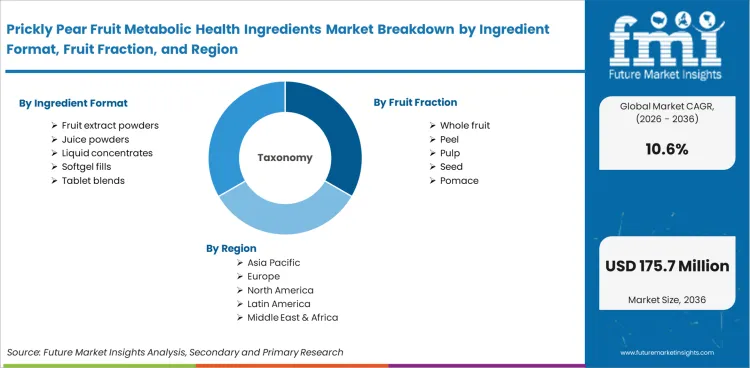
| Segmentation | Ingredient Format, Fruit Fraction, Bioactive Focus, Health Function, Delivery Form, Application, Label Positioning, End Buyer, Region |
| Regions Covered | Asia Pacific, North America, Europe |
| Countries Covered | India, United States, Germany, South Korea, Japan, Italy, Mexico |
| Key Companies Profiled | Nexira, Anderson Advanced Ingredients, Wellgreen Technology Co., Ltd., Chemcopia Ingredients Pvt. Ltd., ESSERRE Pharma SRL, Natural Hub, Bionap S.r.l. |
| Forecast Period | 2026 to 2036 |
| Approach | Demand was assessed through prickly pear ingredient use across metabolic-health product formats, then aligned with formulation practicality, bioactive positioning, delivery-form suitability, and application fit across supplements, beverage mixes, and selected food-based wellness products. |
Prickly Pear Fruit Metabolic Health Ingredients Market Analysis by Segments
Ingredient Format
- Fruit extract powders
- Juice powders
- Liquid concentrates
- Softgel fills
- Tablet blends
Fruit Fraction
- Whole fruit
- Peel
- Pulp
- Seed
- Pomace
Bioactive Focus
- Fiber complexes
- Polyphenols
- Betalains
- Potassium blends
- Multi-bioactive blends
Health Function
- Glycemic support
- Weight management
- Lipid support
- Satiety support
- Gut-metabolic support
Delivery Form
- Capsules
- Powders
- Sachets
- Gummies
- RTD shots
Application
- Dietary supplements
- Functional beverages
- Functional foods
- Sports nutrition
- Clinical nutrition
Label Positioning
- Conventional
- Organic
- Clean label
- Non-GMO
End Buyer
- B2B formulators
- Brand owners
- Contract manufacturers
- Practitioners
- DTC brands
Region
- Asia Pacific
- North America
- Europe
- Countries
- India
- United States
- Germany
- South Korea
- Japan
- Italy
- Mexico
Bibliography
- Laura Eline Slot, and Fatiha Fort. (2024). Drivers of Adoption of Sustainable Prickly Pear (Opuntia ficus-indica) Innovations and Conservation Agriculture by Smallholder Farmers in Morocco.
- Clemson Cooperative Extension Home & Garden Information Center. (2025, January 13). Prickly pear and diabetes.
- López-Martínez, Laura A.; Rössel-Kipping Erich D.; Loera-Alvarado, Gerardo; León-Morales Janet M.; Ojeda-Rivas, Martín (2025). Valorization of prickly pear pericarp (Opuntia albicarpa Scheinvar) through aerobic fermentation.
- Simona Terzo, Pasquale Calvi, Ignazio Restivo, Alessandro Massaro, Luisa Tesoriere, José‐Manuel Fernández‐Real, Marta Giardina, Antonella Amato, Flavia Mulè, and Mario Allegra (2025). Opuntia ficus-indica fruit consumption improves insulin resistance in mice with diet-induced obesity.
- Sondos M. Alqudah1, Mohammad Hailat2, Zainab Zakaraya, Alaa Azeez Abu Dayah, Mohammad Abu Assab (2024). Impact of Opuntia ficus-indica Juice and Empagliflozin on Glycemic Control in Rats.
This Report Addresses
- Market intelligence to support strategic decision making across fruit extract powders, fiber complexes, glycemic support formats, and dietary supplement applications.
- Market size estimation and 10-year revenue forecasts from 2026 to 2036, supported by bottom-up ingredient logic and cross-checking against active commercialization.
- Growth opportunity mapping across ingredient format, fruit fraction, bioactive focus, health function, delivery form, application, label positioning, and end-buyer structure.
- Segment and regional demand outlook covering fruit extract powders, whole fruit, fiber complexes, glycemic support, capsules, and dietary supplements across Asia Pacific, North America, and Europe.
- Competition assessment including standardization quality, format adaptability, application support, and ease of finished-product integration.
- Ingredient development tracking linked to powders, concentrates, fruit fractions, and metabolic-health positioning across branded and formulation-led channels.
- Commercial access analysis covering supplement routes, functional beverage entry points, and value-added sourcing paths tied to peel, pomace, and broader fruit fractions.
- Report delivery logic designed for strategy planning, product development review, channel prioritization, and operating benchmark work.
Frequently Asked Questions
What is the projected value of the prickly pear fruit metabolic health ingredients market in 2036?
Demand advances toward USD 158.8 million by 2036. Formulators continue adopting these fruit-based inputs into capsule and powder systems across major regions. This revenue expansion reflects a 10.6% compound annual growth rate starting from a baseline of USD 58.0 million in 2026.
Which ingredient format captures the largest commercial share?
Fruit extract powders lead product planning, accounting for 32.0% of the baseline 2026 valuation. Dry handling simplifies routine production runs significantly. Moisture control remains practical, allowing brands a steady route for daily wellness capsules without complex liquid blending challenges.
What health function drives primary adoption for these botanical inputs?
Glycemic support commands 31.0% of the commercial base in 2026. Daily blood sugar balance provides brands a highly visible entry point for consumers. Simple consumer communication around this specific need state drives faster retail turnover than broader wellness claims.
Why do formulators prefer whole fruit fractions over isolated components?
Whole fruit complexes secure 29.0% share because they offer a balanced phytocomplex identity. Clean label communication becomes much simpler on the final package. Shoppers respond better to plain fruit language than to technical descriptions of isolated plant compounds during front-end selling.
How do dietary supplements maintain application dominance?
Capsule and sachet formats give buyers precise control over daily serving sizes. Active loading remains straightforward compared to complex functional food matrices. This delivery path avoids the sensory compromises and shelf-stability hurdles that often complicate liquid beverage development cycles.
What role do B2B formulators play in expanding market reach?
These upstream decision-makers establish the technical architecture long before brand storytelling begins. Their early choices around dose balance and format fit determine whether a finished product can scale commercially. Securing their approval guarantees steadier long-term volume across distribution channels.
Where do supply chain variations create friction for buyers?
Raw material consistency shifts based on seasonal harvest and regional origin. Product developers struggle to maintain steady active profiles across multiple production batches. Suppliers who solve these standardization issues capture preference faster than those selling unrefined fruit matter into the supply chain.
Why does India present the fastest regional expansion rate?
Urban centers across India integrate metabolic support into daily routines rapidly, pushing demand at a 12.4% trajectory. Local supplement buyers prioritize plant-based wellness products consistently. Capsule formats align perfectly with this established preference for straightforward, habit-driven consumption among adult demographics.
How does the United States buyer landscape differ from Europe?
North American procurement teams focus heavily on targeted weight balance and satiety alignment. United States buyers demand immediate application support and clean documentation. European developers, particularly in Germany, place greater emphasis on precise clinical framing and measured dosage discipline.
What limits functional food adoption for prickly pear ingredients?
Recipe constraints restrict active inclusion rates severely. Food matrices demand strict texture and taste balance, which limits how much botanical material formulators can use per serving. Capsule systems bypass these sensory hurdles entirely, keeping them the primary delivery vehicle.
How does conventional label positioning impact procurement strategy?
Mainstream sourcing provides broader raw material access without the certification bottlenecks of organic programs. Cost discipline stays manageable across large production runs. Brands secure stable supply lines first, establishing market presence before layering premium non-GMO or organic claims later.
What makes fruit extract powders superior for contract manufacturing?
Dry formats eliminate the heavy shipping weights and storage complications of liquid concentrates. Blending equipment handles powders predictably without excessive recalibration. This operational predictability reduces setup burden, allowing contract facilities to move from pilot batches to full commercial rollout swiftly.
When do product developers choose liquid concentrates over powders?
Premium beverage lines require richer fruit identity to justify higher retail pricing structures. Liquids deliver closer fresh-fruit characteristics. Procurement directors accept the higher transport costs and handling complexity when the final ready-to-drink format demands a distinctly natural sensory profile.
How do betalains change formulation priorities?
Natural color cues help botanical products stand out visually on crowded retail shelves. Formulas utilizing betalains prioritize appearance alongside core health function. Brands accept higher ingredient costs to ensure the finished product looks exactly as natural as the label suggests.
What advantage do established incumbent suppliers maintain?
Companies like Nexira and Anderson Advanced Ingredients provide immediate application fit for commercial supplements. Their documentation minimizes qualification delays substantially. Buyers choose reliability and format compatibility over raw botanical novelty when launching critical metabolic-health product lines into mainstream channels.
How will supply networks adapt toward 2036?
Value extraction moves beyond standard preparations toward advanced peel and pomace utilization. Maximizing the total harvest improves margin stability for processors. Operations in Mexico will increasingly focus on converting raw fruit into standardized extracts rather than shipping unprocessed commodities internationally.
What structural shift determines mainstream retail success?
Transitioning from specialist wellness outlets to everyday pharmacy channels requires simplified messaging. Products must communicate basic blood sugar and fullness benefits instantly. Overly clinical positioning fails at mainstream retail where purchase decisions happen in seconds without practitioner guidance or advice.
Where does formulation risk sit for new market entrants?
Gummy formats present significant hurdles around active loading and sweetness balance. Cramming sufficient functional doses into a softgel or gummy without ruining texture ruins repeat purchase intent. Smart developers start with capsules to secure baseline functional credibility before expanding.
How do formulators use this market intelligence?
Developers map specific bioactives against workable delivery formats systematically. Identifying the precise intersection between glycemic support and dry powder systems prevents wasted research spend. Teams align their ingredient selection with the most stable segments before initiating expensive pilot runs.
What procurement strategy minimizes supply chain disruption?
Qualifying multiple suppliers based on format expertise rather than geographical origin prevents bottlenecks. Securing a reliable powder source matters more than seasonal whole-fruit pricing. Active documentation and strict moisture control specifications remain the primary metrics for vendor approval protocols.
Preview the report firsthand - request a free sample
Get SampleGet the brochure for pricing and purchase details.
Get PDFTable of Content
- Executive Summary
- Global Market Outlook
- Demand-side Trends
- Supply-side Trends
- Technology Roadmap Analysis
- Analysis and Recommendations
- Market Overview
- Market Coverage / Taxonomy
- Market Definition / Scope / Limitations
- Research Methodology
- Chapter Orientation
- Analytical Lens and Working Hypotheses
- Market Structure, Signals, and Trend Drivers
- Benchmarking and Cross-market Comparability
- Market Sizing, Forecasting, and Opportunity Mapping
- Research Design and Evidence Framework
- Desk Research Programme (Secondary Evidence)
- Company Annual and Sustainability Reports
- Peer-reviewed Journals and Academic Literature
- Corporate Websites, Product Literature, and Technical Notes
- Earnings Decks and Investor Briefings
- Statutory Filings and Regulatory Disclosures
- Technical White Papers and Standards Notes
- Trade Journals, Industry Magazines, and Analyst Briefs
- Conference Proceedings, Webinars, and Seminar Materials
- Government Statistics Portals and Public Data Releases
- Press Releases and Reputable Media Coverage
- Specialist Newsletters and Curated Briefings
- Sector Databases and Reference Repositories
- FMI Internal Proprietary Databases and Historical Market Datasets
- Subscription Datasets and Paid Sources
- Social Channels, Communities, and Digital Listening Inputs
- Additional Desk Sources
- Expert Input and Fieldwork (Primary Evidence)
- Primary Modes
- Qualitative Interviews and Expert Elicitation
- Quantitative Surveys and Structured Data Capture
- Blended Approach
- Why Primary Evidence is Used
- Field Techniques
- Interviews
- Surveys
- Focus Groups
- Observational and In-context Research
- Social and Community Interactions
- Stakeholder Universe Engaged
- C-suite Leaders
- Board Members
- Presidents and Vice Presidents
- R&D and Innovation Heads
- Technical Specialists
- Domain Subject-matter Experts
- Scientists
- Physicians and Other Healthcare Professionals
- Governance, Ethics, and Data Stewardship
- Research Ethics
- Data Integrity and Handling
- Primary Modes
- Tooling, Models, and Reference Databases
- Desk Research Programme (Secondary Evidence)
- Data Engineering and Model Build
- Data Acquisition and Ingestion
- Cleaning, Normalisation, and Verification
- Synthesis, Triangulation, and Analysis
- Quality Assurance and Audit Trail
- Market Background
- Market Dynamics
- Drivers
- Restraints
- Opportunity
- Trends
- Scenario Forecast
- Demand in Optimistic Scenario
- Demand in Likely Scenario
- Demand in Conservative Scenario
- Opportunity Map Analysis
- Product Life Cycle Analysis
- Supply Chain Analysis
- Investment Feasibility Matrix
- Value Chain Analysis
- PESTLE and Porter’s Analysis
- Regulatory Landscape
- Regional Parent Market Outlook
- Production and Consumption Statistics
- Import and Export Statistics
- Market Dynamics
- Global Market Analysis 2021 to 2025 and Forecast, 2026 to 2036
- Historical Market Size Value (USD Million) Analysis, 2021 to 2025
- Current and Future Market Size Value (USD Million) Projections, 2026 to 2036
- Y-o-Y Growth Trend Analysis
- Absolute $ Opportunity Analysis
- Global Market Pricing Analysis 2021 to 2025 and Forecast 2026 to 2036
- Global Market Analysis 2021 to 2025 and Forecast 2026 to 2036, By Ingredient Format
- Introduction / Key Findings
- Historical Market Size Value (USD Million) Analysis By Ingredient Format , 2021 to 2025
- Current and Future Market Size Value (USD Million) Analysis and Forecast By Ingredient Format , 2026 to 2036
- Fruit extract powders
- Juice powders
- Liquid concentrates
- Softgel fills
- Tablet blends
- Fruit extract powders
- Y-o-Y Growth Trend Analysis By Ingredient Format , 2021 to 2025
- Absolute $ Opportunity Analysis By Ingredient Format , 2026 to 2036
- Global Market Analysis 2021 to 2025 and Forecast 2026 to 2036, By Fruit Fraction
- Introduction / Key Findings
- Historical Market Size Value (USD Million) Analysis By Fruit Fraction, 2021 to 2025
- Current and Future Market Size Value (USD Million) Analysis and Forecast By Fruit Fraction, 2026 to 2036
- Whole fruit
- Peel
- Pulp
- Seed
- Pomace
- Whole fruit
- Y-o-Y Growth Trend Analysis By Fruit Fraction, 2021 to 2025
- Absolute $ Opportunity Analysis By Fruit Fraction, 2026 to 2036
- Global Market Analysis 2021 to 2025 and Forecast 2026 to 2036, By Bioactive Focus
- Introduction / Key Findings
- Historical Market Size Value (USD Million) Analysis By Bioactive Focus, 2021 to 2025
- Current and Future Market Size Value (USD Million) Analysis and Forecast By Bioactive Focus, 2026 to 2036
- Fiber complexes
- Polyphenols
- Betalains
- Potassium blends
- Multi-bioactive blends
- Fiber complexes
- Y-o-Y Growth Trend Analysis By Bioactive Focus, 2021 to 2025
- Absolute $ Opportunity Analysis By Bioactive Focus, 2026 to 2036
- Global Market Analysis 2021 to 2025 and Forecast 2026 to 2036, By Health Function
- Introduction / Key Findings
- Historical Market Size Value (USD Million) Analysis By Health Function, 2021 to 2025
- Current and Future Market Size Value (USD Million) Analysis and Forecast By Health Function, 2026 to 2036
- Glycemic support
- Weight management
- Lipid support
- Satiety support
- Gut-metabolic support
- Glycemic support
- Y-o-Y Growth Trend Analysis By Health Function, 2021 to 2025
- Absolute $ Opportunity Analysis By Health Function, 2026 to 2036
- Global Market Analysis 2021 to 2025 and Forecast 2026 to 2036, By Delivery Form
- Introduction / Key Findings
- Historical Market Size Value (USD Million) Analysis By Delivery Form, 2021 to 2025
- Current and Future Market Size Value (USD Million) Analysis and Forecast By Delivery Form, 2026 to 2036
- Capsules
- Powders
- Sachets
- Gummies
- RTD shots
- Capsules
- Y-o-Y Growth Trend Analysis By Delivery Form, 2021 to 2025
- Absolute $ Opportunity Analysis By Delivery Form, 2026 to 2036
- Global Market Analysis 2021 to 2025 and Forecast 2026 to 2036, By Application
- Introduction / Key Findings
- Historical Market Size Value (USD Million) Analysis By Application, 2021 to 2025
- Current and Future Market Size Value (USD Million) Analysis and Forecast By Application, 2026 to 2036
- Dietary supplements
- Functional beverages
- Functional foods
- Sports nutrition
- Clinical nutrition
- Dietary supplements
- Y-o-Y Growth Trend Analysis By Application, 2021 to 2025
- Absolute $ Opportunity Analysis By Application, 2026 to 2036
- Global Market Analysis 2021 to 2025 and Forecast 2026 to 2036, By Label Positioning
- Introduction / Key Findings
- Historical Market Size Value (USD Million) Analysis By Label Positioning, 2021 to 2025
- Current and Future Market Size Value (USD Million) Analysis and Forecast By Label Positioning, 2026 to 2036
- Conventional
- Organic
- Clean label
- Non-GMO
- Conventional
- Y-o-Y Growth Trend Analysis By Label Positioning, 2021 to 2025
- Absolute $ Opportunity Analysis By Label Positioning, 2026 to 2036
- Global Market Analysis 2021 to 2025 and Forecast 2026 to 2036, By Region
- Introduction
- Historical Market Size Value (USD Million) Analysis By Region, 2021 to 2025
- Current Market Size Value (USD Million) Analysis and Forecast By Region, 2026 to 2036
- North America
- Latin America
- Western Europe
- Eastern Europe
- East Asia
- South Asia and Pacific
- Middle East & Africa
- Market Attractiveness Analysis By Region
- North America Market Analysis 2021 to 2025 and Forecast 2026 to 2036, By Country
- Historical Market Size Value (USD Million) Trend Analysis By Market Taxonomy, 2021 to 2025
- Market Size Value (USD Million) Forecast By Market Taxonomy, 2026 to 2036
- By Country
- USA
- Canada
- Mexico
- By Ingredient Format
- By Fruit Fraction
- By Bioactive Focus
- By Health Function
- By Delivery Form
- By Application
- By Label Positioning
- By Country
- Market Attractiveness Analysis
- By Country
- By Ingredient Format
- By Fruit Fraction
- By Bioactive Focus
- By Health Function
- By Delivery Form
- By Application
- By Label Positioning
- Key Takeaways
- Latin America Market Analysis 2021 to 2025 and Forecast 2026 to 2036, By Country
- Historical Market Size Value (USD Million) Trend Analysis By Market Taxonomy, 2021 to 2025
- Market Size Value (USD Million) Forecast By Market Taxonomy, 2026 to 2036
- By Country
- Brazil
- Chile
- Rest of Latin America
- By Ingredient Format
- By Fruit Fraction
- By Bioactive Focus
- By Health Function
- By Delivery Form
- By Application
- By Label Positioning
- By Country
- Market Attractiveness Analysis
- By Country
- By Ingredient Format
- By Fruit Fraction
- By Bioactive Focus
- By Health Function
- By Delivery Form
- By Application
- By Label Positioning
- Key Takeaways
- Western Europe Market Analysis 2021 to 2025 and Forecast 2026 to 2036, By Country
- Historical Market Size Value (USD Million) Trend Analysis By Market Taxonomy, 2021 to 2025
- Market Size Value (USD Million) Forecast By Market Taxonomy, 2026 to 2036
- By Country
- Germany
- UK
- Italy
- Spain
- France
- Nordic
- BENELUX
- Rest of Western Europe
- By Ingredient Format
- By Fruit Fraction
- By Bioactive Focus
- By Health Function
- By Delivery Form
- By Application
- By Label Positioning
- By Country
- Market Attractiveness Analysis
- By Country
- By Ingredient Format
- By Fruit Fraction
- By Bioactive Focus
- By Health Function
- By Delivery Form
- By Application
- By Label Positioning
- Key Takeaways
- Eastern Europe Market Analysis 2021 to 2025 and Forecast 2026 to 2036, By Country
- Historical Market Size Value (USD Million) Trend Analysis By Market Taxonomy, 2021 to 2025
- Market Size Value (USD Million) Forecast By Market Taxonomy, 2026 to 2036
- By Country
- Russia
- Poland
- Hungary
- Balkan & Baltic
- Rest of Eastern Europe
- By Ingredient Format
- By Fruit Fraction
- By Bioactive Focus
- By Health Function
- By Delivery Form
- By Application
- By Label Positioning
- By Country
- Market Attractiveness Analysis
- By Country
- By Ingredient Format
- By Fruit Fraction
- By Bioactive Focus
- By Health Function
- By Delivery Form
- By Application
- By Label Positioning
- Key Takeaways
- East Asia Market Analysis 2021 to 2025 and Forecast 2026 to 2036, By Country
- Historical Market Size Value (USD Million) Trend Analysis By Market Taxonomy, 2021 to 2025
- Market Size Value (USD Million) Forecast By Market Taxonomy, 2026 to 2036
- By Country
- China
- Japan
- South Korea
- By Ingredient Format
- By Fruit Fraction
- By Bioactive Focus
- By Health Function
- By Delivery Form
- By Application
- By Label Positioning
- By Country
- Market Attractiveness Analysis
- By Country
- By Ingredient Format
- By Fruit Fraction
- By Bioactive Focus
- By Health Function
- By Delivery Form
- By Application
- By Label Positioning
- Key Takeaways
- South Asia and Pacific Market Analysis 2021 to 2025 and Forecast 2026 to 2036, By Country
- Historical Market Size Value (USD Million) Trend Analysis By Market Taxonomy, 2021 to 2025
- Market Size Value (USD Million) Forecast By Market Taxonomy, 2026 to 2036
- By Country
- India
- ASEAN
- Australia & New Zealand
- Rest of South Asia and Pacific
- By Ingredient Format
- By Fruit Fraction
- By Bioactive Focus
- By Health Function
- By Delivery Form
- By Application
- By Label Positioning
- By Country
- Market Attractiveness Analysis
- By Country
- By Ingredient Format
- By Fruit Fraction
- By Bioactive Focus
- By Health Function
- By Delivery Form
- By Application
- By Label Positioning
- Key Takeaways
- Middle East & Africa Market Analysis 2021 to 2025 and Forecast 2026 to 2036, By Country
- Historical Market Size Value (USD Million) Trend Analysis By Market Taxonomy, 2021 to 2025
- Market Size Value (USD Million) Forecast By Market Taxonomy, 2026 to 2036
- By Country
- Kingdom of Saudi Arabia
- Other GCC Countries
- Turkiye
- South Africa
- Other African Union
- Rest of Middle East & Africa
- By Ingredient Format
- By Fruit Fraction
- By Bioactive Focus
- By Health Function
- By Delivery Form
- By Application
- By Label Positioning
- By Country
- Market Attractiveness Analysis
- By Country
- By Ingredient Format
- By Fruit Fraction
- By Bioactive Focus
- By Health Function
- By Delivery Form
- By Application
- By Label Positioning
- Key Takeaways
- Key Countries Market Analysis
- USA
- Pricing Analysis
- Market Share Analysis, 2025
- By Ingredient Format
- By Fruit Fraction
- By Bioactive Focus
- By Health Function
- By Delivery Form
- By Application
- By Label Positioning
- Canada
- Pricing Analysis
- Market Share Analysis, 2025
- By Ingredient Format
- By Fruit Fraction
- By Bioactive Focus
- By Health Function
- By Delivery Form
- By Application
- By Label Positioning
- Mexico
- Pricing Analysis
- Market Share Analysis, 2025
- By Ingredient Format
- By Fruit Fraction
- By Bioactive Focus
- By Health Function
- By Delivery Form
- By Application
- By Label Positioning
- Brazil
- Pricing Analysis
- Market Share Analysis, 2025
- By Ingredient Format
- By Fruit Fraction
- By Bioactive Focus
- By Health Function
- By Delivery Form
- By Application
- By Label Positioning
- Chile
- Pricing Analysis
- Market Share Analysis, 2025
- By Ingredient Format
- By Fruit Fraction
- By Bioactive Focus
- By Health Function
- By Delivery Form
- By Application
- By Label Positioning
- Germany
- Pricing Analysis
- Market Share Analysis, 2025
- By Ingredient Format
- By Fruit Fraction
- By Bioactive Focus
- By Health Function
- By Delivery Form
- By Application
- By Label Positioning
- UK
- Pricing Analysis
- Market Share Analysis, 2025
- By Ingredient Format
- By Fruit Fraction
- By Bioactive Focus
- By Health Function
- By Delivery Form
- By Application
- By Label Positioning
- Italy
- Pricing Analysis
- Market Share Analysis, 2025
- By Ingredient Format
- By Fruit Fraction
- By Bioactive Focus
- By Health Function
- By Delivery Form
- By Application
- By Label Positioning
- Spain
- Pricing Analysis
- Market Share Analysis, 2025
- By Ingredient Format
- By Fruit Fraction
- By Bioactive Focus
- By Health Function
- By Delivery Form
- By Application
- By Label Positioning
- France
- Pricing Analysis
- Market Share Analysis, 2025
- By Ingredient Format
- By Fruit Fraction
- By Bioactive Focus
- By Health Function
- By Delivery Form
- By Application
- By Label Positioning
- India
- Pricing Analysis
- Market Share Analysis, 2025
- By Ingredient Format
- By Fruit Fraction
- By Bioactive Focus
- By Health Function
- By Delivery Form
- By Application
- By Label Positioning
- ASEAN
- Pricing Analysis
- Market Share Analysis, 2025
- By Ingredient Format
- By Fruit Fraction
- By Bioactive Focus
- By Health Function
- By Delivery Form
- By Application
- By Label Positioning
- Australia & New Zealand
- Pricing Analysis
- Market Share Analysis, 2025
- By Ingredient Format
- By Fruit Fraction
- By Bioactive Focus
- By Health Function
- By Delivery Form
- By Application
- By Label Positioning
- China
- Pricing Analysis
- Market Share Analysis, 2025
- By Ingredient Format
- By Fruit Fraction
- By Bioactive Focus
- By Health Function
- By Delivery Form
- By Application
- By Label Positioning
- Japan
- Pricing Analysis
- Market Share Analysis, 2025
- By Ingredient Format
- By Fruit Fraction
- By Bioactive Focus
- By Health Function
- By Delivery Form
- By Application
- By Label Positioning
- South Korea
- Pricing Analysis
- Market Share Analysis, 2025
- By Ingredient Format
- By Fruit Fraction
- By Bioactive Focus
- By Health Function
- By Delivery Form
- By Application
- By Label Positioning
- Russia
- Pricing Analysis
- Market Share Analysis, 2025
- By Ingredient Format
- By Fruit Fraction
- By Bioactive Focus
- By Health Function
- By Delivery Form
- By Application
- By Label Positioning
- Poland
- Pricing Analysis
- Market Share Analysis, 2025
- By Ingredient Format
- By Fruit Fraction
- By Bioactive Focus
- By Health Function
- By Delivery Form
- By Application
- By Label Positioning
- Hungary
- Pricing Analysis
- Market Share Analysis, 2025
- By Ingredient Format
- By Fruit Fraction
- By Bioactive Focus
- By Health Function
- By Delivery Form
- By Application
- By Label Positioning
- Kingdom of Saudi Arabia
- Pricing Analysis
- Market Share Analysis, 2025
- By Ingredient Format
- By Fruit Fraction
- By Bioactive Focus
- By Health Function
- By Delivery Form
- By Application
- By Label Positioning
- Turkiye
- Pricing Analysis
- Market Share Analysis, 2025
- By Ingredient Format
- By Fruit Fraction
- By Bioactive Focus
- By Health Function
- By Delivery Form
- By Application
- By Label Positioning
- South Africa
- Pricing Analysis
- Market Share Analysis, 2025
- By Ingredient Format
- By Fruit Fraction
- By Bioactive Focus
- By Health Function
- By Delivery Form
- By Application
- By Label Positioning
- USA
- Market Structure Analysis
- Competition Dashboard
- Competition Benchmarking
- Market Share Analysis of Top Players
- By Regional
- By Ingredient Format
- By Fruit Fraction
- By Bioactive Focus
- By Health Function
- By Delivery Form
- By Application
- By Label Positioning
- Competition Analysis
- Competition Deep Dive
- Nexira
- Overview
- Product Portfolio
- Profitability by Market Segments (Product/Age /Sales Channel/Region)
- Sales Footprint
- Strategy Overview
- Marketing Strategy
- Product Strategy
- Channel Strategy
- Anderson Advanced Ingredients
- Wellgreen Technology Co., Ltd.
- Chemcopia Ingredients Pvt. Ltd.
- ESSERRE Pharma SRL
- Nexira
- Competition Deep Dive
- Assumptions & Acronyms Used


