

- Industry Size (2026)
- USD 640.0 Mn
- Forecast (2036)
- USD 740.0 Mn
- CAGR
- (2026 to 2036)
Cold Chain Micro-Fulfillment Hub Networks Market Size, Market Forecast and Outlook By FMI
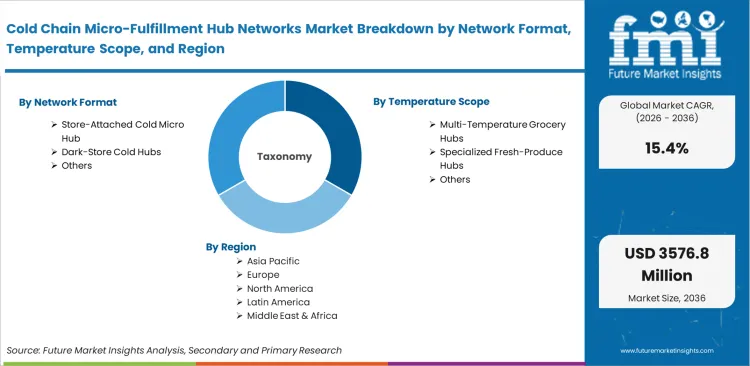
The cold chain micro-fulfillment hub networks market crossed a valuation of USD 640.0 million in 2025. Sales are expected to reach USD 740.0 million in 2026 and grow at a 15.4% CAGR through 2036. Grocers are moving chilled inventory out of regional distribution centers and into smaller automated nodes closer to urban consumers. This shift in how perishable inventory is positioned is expected to push total market valuation to USD 3,100.0 million by 2036.
Summary of Cold Chain Micro-Fulfillment Hub Networks Market
- Cold Chain Micro-Fulfillment Hub Networks Market Definition
- Decentralized urban storage facilities equipped with automated picking hardware and specialized thermal control zones form the core of this category. These sites are designed specifically to handle perishable inventory with greater speed, accuracy, and temperature integrity. Value is created through localized fulfillment infrastructure that supports faster order turnaround, reduces spoilage risk, and improves last-mile responsiveness for grocery and other temperature-sensitive product flows across dense urban demand centers.
- Demand Drivers in the Market
- Unpredictable retail volume spikes force merchants to secure automated overflow picking without committing to heavy hardware capital expenditure.
- Urban commercial real estate constraints require specialized dense robotic configurations to maximize vertical cube utilization.
- Rising final-mile delivery expectations compel brands to stage inventory in localized automated nodes near dense populations.
- Key Segments Analyzed in the FMI Report
- Network Format: Store-attached cold micro-hubs is expected to hold 35.0% share in 2026, dominating as grocers seek completely outsourced hardware and labor within existing footprints.
- Temperature Scope: Chilled + ambient integrated hubs is projected to capture 38.0% share in 2026, reflecting the absolute necessity for mixed-temperature order consolidation.
- End Use: Grocery and e-grocery is anticipated to lead with 46.0% share, demanding high-velocity picking for highly perishable inventory.
- Service Scope: Fulfillment + cold storage + orchestration is set to command 41.0% share, driving extreme demand for complete operational abstraction.
- Deployment Mode: Cloud-connected networked hubs is estimated to account for 56.0% share, providing essential multi-site thermal visibility across fragmented networks.
- India: 17.6% compound growth, driven by rapid formalization of ultra-fast grocery delivery services requiring continuous cold chain integrity.
- Analyst Opinion at FMI
- Rahul Pandita, Principal Analyst, Technology, at FMI, observes, "Procurement committees frequently ask analysts to give me the cold chain micro-fulfillment hub market size before approving automation budgets. Supply chain executives assume renting automated refrigerated space solves local capacity crunches instantly. In reality, executing high velocity fulfillment across fragmented chilled zones destroys inventory accuracy unless the underlying software architecture integrates perfectly. Companies purchase flexible freezing capacity in hours but spend weeks trying to force diverse hardware providers to use standardized temperature telemetry logic."
- Strategic Implications / Executive Takeaways
- Logistics design directors must prioritize software interoperability before authorizing physical inventory transfers to external automated facilities.
- Procurement heads evaluating shared robotic capacity should mandate strict liability insurance tracking across all provider contracts.
- Operations managers running perishable businesses face unavoidable spoilage unless utilizing strict temperature-controlled automated orchestration.
- Methodology
- Primary Research: Consultations with automation IT directors determine genuine software implementation bottlenecks.
- Desk Research: Developer API documentation and interoperability standard whitepapers provide technical baseline data.
- Market-Sizing and Forecasting: Managed service revenue disclosures establish accurate valuation models.
- Data Validation and Update Cycle: Commercial real estate occupancy data corroborates underlying automated service license activations.
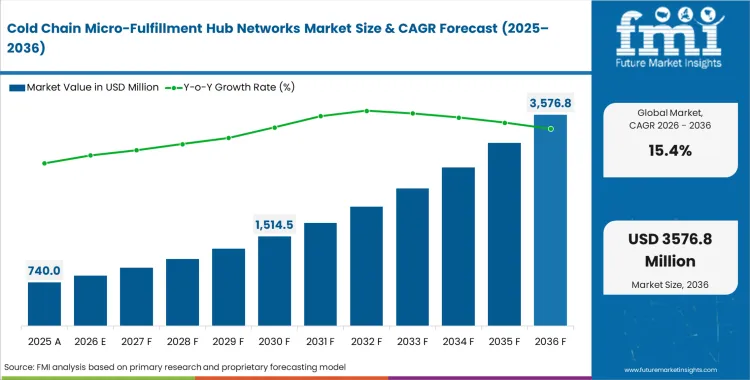
Cold Chain Micro-Fulfillment Hub Networks Market Key Takeaways
| Metric | Details |
|---|---|
| Industry Size (2026) | USD 740.0 million |
| Industry Value (2036) | USD 3,100.0 million |
| CAGR (2026 to 2036) | 15.4% |
Source: Future Market Insights (FMI) analysis, based on proprietary forecasting model and primary research
Grocery supply chain directors are under pressure to shorten final-mile transit windows for perishable goods without increasing spoilage. Relying on traditional suburban cold storage forces operators into massive insulated transportation costs when fulfilling frequent low-value basket orders within congested city limits. Logistics teams resolving this thermal friction direct significant capital toward the cold chain micro fulfillment market, integrating advanced smart warehouse technologies. When supply chain planners ask how do refrigerated micro-fulfillment hubs work, they discover these facilities ignore static shelving, instead requiring automated buffering sequences that pull frozen goods exactly three minutes before ambient items to ensure precise order consolidation.
Transitioning from centralized cold storage to distributed urban nodes requires tight inventory synchronization across all sites. Micro-fulfillment can maintain cold chain integrity, but only if the facility has been validated for thermal load capacity before automated picking begins. Once that is confirmed, the orchestration software depends on continuous temperature monitoring across all zones to catch equipment problems before spoilage occurs. A single undetected failure in a densely packed automated grid can result in significant perishable losses. Operators that complete this validation process are better positioned to open additional urban hub locations because they have a repeatable commissioning standard to work from.
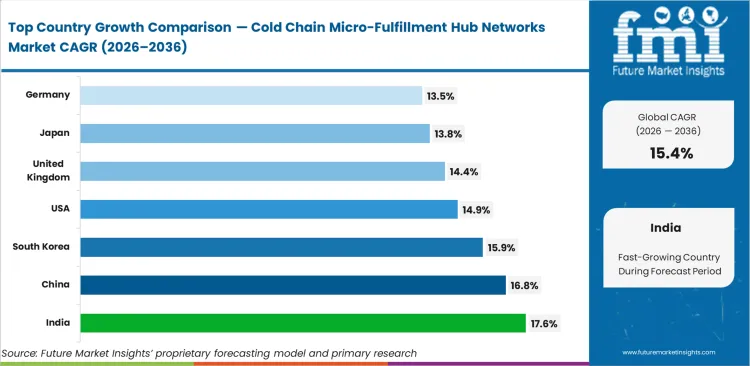
India leads at 17.6% compound annual growth from 2026 to 2036, driven by rapid expansion of cold storage capacity across urban centers. The cold chain micro-fulfillment market in China tracks at 16.8% optimizing massive fresh food delivery density. South Korea advances at 15.9% coordinating high-velocity chilled piece picking. The cold chain micro-fulfillment market in the United States registers 14.9% overcoming chronic localized labor shortages inside freezer zones. UK sites hit 14.4% replacing legacy static refrigerated fulfillment models. Japan follows at 13.8% deploying highly efficient shared cold storage architectures. Germany expands at 13.5% integrating complex pharmaceutical buffering networks.
Cold Chain Micro-Fulfillment Hub Networks Market Definition
Clarifying what is a cold chain micro-fulfillment hub centers on decentralized urban storage facilities equipped with automated picking hardware and specialized thermal control zones designed specifically for perishable inventory. Scope mandates active transactional throughput capabilities executing multi-temperature order consolidation. Purely ambient retail storage falls strictly outside this boundary. Integrating high-density robotics within strict freezing parameters distinguishes modern localized cold nodes from historical static refrigerated warehouses.
Cold Chain Micro-Fulfillment Hub Networks Market Inclusions
The category spans multi-temperature automated storage grids, chilled robotic shuttles, localized order consolidation software, and integrated thermal monitoring sensors. Micro-fulfillment deployments tailored for strict grocery compliance are fully covered within the market boundary. Structural engineering studies validating localized freezer insulation requirements also remain inside scope. Much of the value is generated through professional managed services that direct localized chilled automated picking and support compliant cold-chain execution.
Cold Chain Micro-Fulfillment Hub Networks Market Exclusions
Standalone industrial ammonia refrigeration plants sold entirely as capital equipment sit completely outside this analysis. Traditional refrigerated facility leases lacking robotic execution services remain entirely excluded. Base-level execution software sold exclusively for single-tenant ambient manual operations belongs in broader enterprise categories. General refrigerated truck fleets disconnected from precise localized automated storage hubs are strictly excluded.
Cold Chain Micro-Fulfillment Hub Networks Market Research Methodology
- Primary Research: Fulfillment network directors, urban real estate managers, and chief supply chain officers detail chilled capacity procurement timelines.
- Desk Research: Thermodynamics patent filings, provider transaction volume disclosures, and municipal food safety zoning standards provide essential structural context.
- Market-Sizing and Forecasting: Declared service provider gross merchandise value and enterprise SaaS license agreements baseline current spending.
- Data Validation and Update Cycle: Industrial refrigerated real estate vacancy metrics cross-validate flexible automated cold storage demand curves quarterly.
Segmental Analysis
Cold Chain Micro-Fulfillment Hub Networks Market Analysis by Network Format
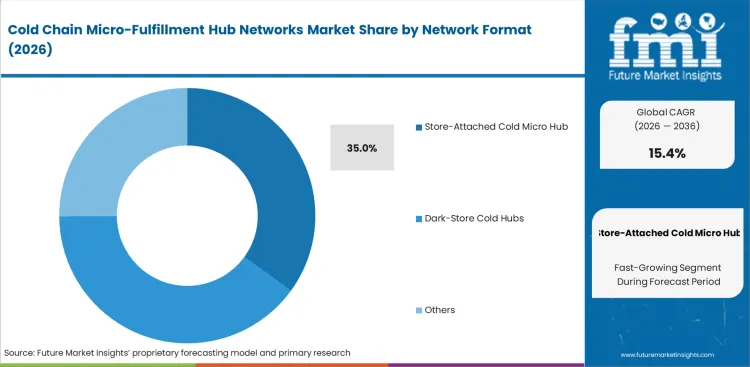
Deploying a store-attached cold micro hub commands 35.0% share in 2026 because grocers cannot justify building new standalone refrigerated warehouses inside expensive city limits. According to FMI's estimates, facility managers drastically increase sales per square foot by converting unprofitable backrooms into highly automated cold picking engines. Integrating these dense robotic grids directly behind consumer-facing aisles allows retailers to process digital orders without deploying manual pickers who frequently block retail shoppers while pulling items from open refrigerator cases. Service providers installing automation inside these environments earn significant revenue by charging per transaction. Brands delaying these backroom upgrades struggle permanently with inefficient space utilization compared to specialized dark store operators.
- Space constraint: Limited backroom square footage restricts inventory depth severely. Retailers restrict automated picking exclusively to the fastest-moving perishable stock keeping units.
- Dock congestion: High-velocity digital orders require constant inbound refrigerated replenishment trucks. Transport managers schedule deliveries during overnight hours strictly avoiding daytime clashes.
- Grid density: Vertical clearance inside older retail boxes limits robotic scalability. Engineering teams deploy specialized ultra-compact cooling hardware bypassing traditional clearance requirements.
Cold Chain Micro-Fulfillment Hub Networks Market Analysis by Temperature Scope
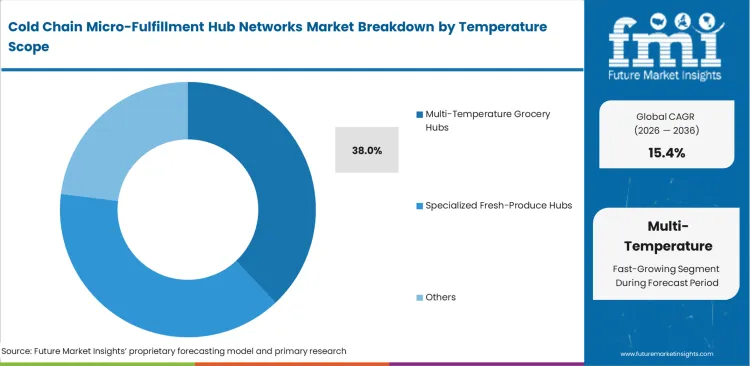
Handling extreme perishable velocity alongside dry goods defines automation success. Operating multi-temperature micro-fulfillment hubs accounts for 38.0% share in 2026 because online supermarkets aggressively deploy solutions maximizing individual worker picking efficiency across varied thermal inventories. FMI analysts note that fulfillment directors completely redesign workflows around frozen and chilled order fulfillment hubs to maintain acceptable grocery e-commerce delivery windows. This specific environment requires continuous dynamic hardware routing as expiration dates force strict first-in-first-out sequencing. Traditional manual operations lacking these specialized routing demands face massive operational disadvantages when attempting profitable individual item fulfillment. Many third-party providers mistakenly assume standard automation easily handles varied grocery profiles, yet condensation forms rapidly on ambient robots transitioning into chilled zones, frequently jamming rigid tote handling algorithms.
- Condensation management: Robots transitioning between thermal zones generate disruptive moisture. Facility managers install dedicated dehumidification barriers preventing electronic sensor failures.
- Fragility handling: Soft chilled produce crushes easily under dense storage pressure. Software algorithms dictate heavy ambient items drop into delivery totes before delicate goods.
- Velocity matching: Grocery orders typically contain dozens of individual items spanning multiple temperatures simultaneously. System architects program robots to consolidate complex multi-zone picks seamlessly.
Cold Chain Micro-Fulfillment Hub Networks Market Analysis by End Use
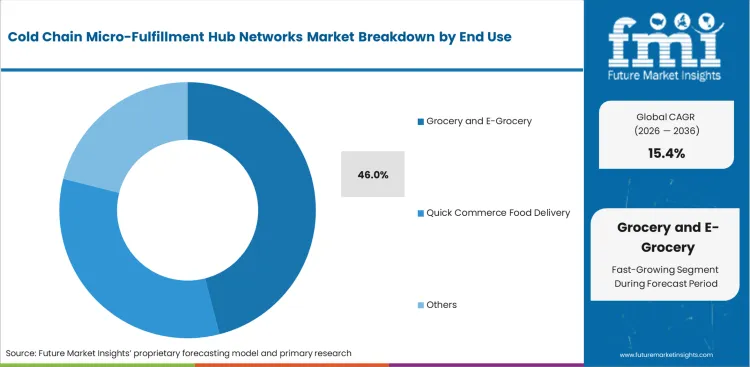
Processing highly perishable goods requires absolute thermal precision. The grocery cold micro-fulfillment market captures 46.0% share in 2026 as legacy supermarkets upgrade aging fulfillment infrastructure to compete with agile digital entrants. FMI observes that supply chain directors depend entirely on localized cold hubs to achieve profitability on tight-margin food orders. Expanding beyond simple frozen goods, fresh produce logistics demand continuous atmospheric monitoring validating absolute quality from receipt to final dispatch. Facilities maintaining perfect thermal integrity throughout the entire robotic sorting sequence secure dominant competitive advantages. Operations running manual grocery fulfillment tend to see higher spoilage rates and lose customers to faster competitors. Grocery executives prioritizing cold chain quick commerce infrastructure force rapid capital deployment into specialized thermal automation.
- Atmospheric validation: Continuous monitoring ensures fresh produce remains viable. Quality assurance directors prevent degraded goods from reaching consumers.
- Rapid consolidation: Multi-temperature items require immediate packing. Floor managers minimize dwell time ensuring frozen goods remain solid.
- Margin protection: Automated picking slashes expensive manual labor costs. Financial controllers achieve profitability on notoriously challenging fresh food deliveries.
Cold Chain Micro-Fulfillment Hub Networks Market Analysis by Service Scope
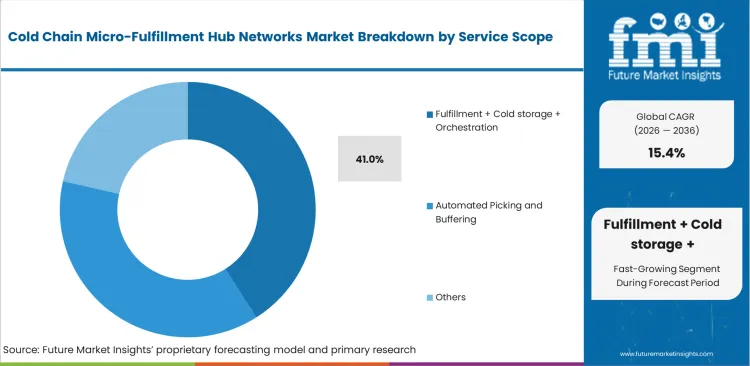
Complete operational abstraction remains the ultimate corporate goal. A completely integrated grocery same-day cold fulfillment network holds 41.0% share in 2026 because industrial buyers actively avoid fragmented automation deployments. In FMI's view, contracting bundled services natively guarantees immediate interoperability across picking execution and host enterprise systems. Incumbent service providers absorb timeline risks while commanding premium transactional fees for comprehensive coverage. Shippers conducting rigorous vendor evaluations frequently discover that piecemeal automation software promises cheaper baseline rates but quietly forces operators to manage complex middleware bridging themselves. Operators building a refrigerated last-mile fulfillment hub must implement overarching abstraction layers connecting external hardware to their internal order fulfillment software before scaling facilities. Sourcing managers regain critical flexibility only by prioritizing open architecture standards within bundled service contracts.
- Interoperability metric: API response times dictate total system latency precisely. IT directors demand sub-second data synchronization preventing digital bottlenecking during peak hours.
- Uptime guarantee: Hardware availability percentages govern vendor penalty clauses. Operations managers secure massive financial credits if external chilled robots fail during promotional periods.
- Throughput capability: Maximum hourly picks define physical facility limits. Supply chain planners halt digital order ingestion automatically when local demand exceeds robotic output capabilities.
Cold Chain Micro-Fulfillment Hub Networks Market Analysis by Deployment Mode
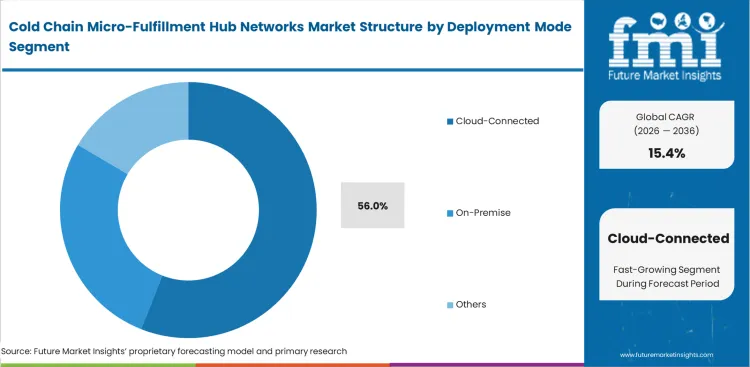
Cloud-connected networked hubs leads with 56.0% share in 2026 as risk-averse chief supply chain officers demand continuous updates without maintaining massive localized servers. Based on FMI's assessment, subscribing to remote orchestration ensures operators maintain immediate access to the latest routing algorithms across dozens of cold micro-sites simultaneously. Software providers absorb cybersecurity risks while commanding steady monthly integration revenue streams. Rigid on-premise execution requiring expensive manual patching consistently fails modern IT security audits when applied to disparate urban hubs. Enterprise buyers rarely calculate how compounding remote hosting fees over a ten-year facility lifecycle eventually dwarf the cost of localized servers. Logistics architects require advanced supply chain visibility software to ensure continuous thermal compliance.
- Server dependency: Remote hosting exposes localized picking to external internet outages. Facility engineers install redundant fiber connections to keep sites running if the primary internet connection fails.
- Update frequency: Cloud environments push algorithmic improvements globally overnight. Software directors bypass disruptive manual patching routines entirely.
- Data security: Encrypted transactional streams protect sensitive consumer purchasing habits. Compliance officers verify strict third-party data handling protocols preventing disastrous external breaches.
Cold Chain Micro-Fulfillment Hub Networks Market Drivers, Restraints, and Opportunities
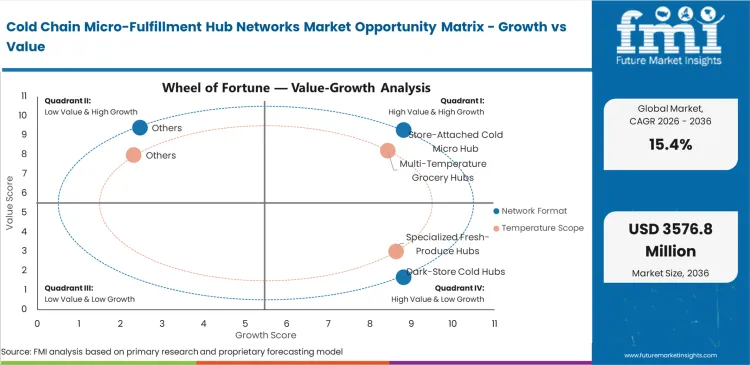
Consumer demand for sub-two-hour delivery continues to place heavy pressure on operations leaders to implement localized automated staging strategies rapidly. Failing to optimize urban inventory positioning can undermine cut-offs and send customers to competing channels. Logistics architects now depend on specialized service platforms that align high-density chilled robotics with immediate retail demand without requiring major capital spending. This trend is accelerating shared automation models across urban distribution networks, where manual procurement often damages workflow stability during promotional peaks.
Legacy retail execution software architecture creates massive friction slowing decentralized cold automation adoption. Systems designed decades ago for pallet-based ambient replenishment simply cannot process continuous single-unit transactional data generated by modern robotic grids operating in sub-zero environments. IT directors patching older execution systems often run into serious latency problems when high-frequency inventory data from robotic grids overwhelms the database. This structural software barrier severely throttles physical facility efficiency across outsourced networks.
Opportunities in the Cold Chain Micro-Fulfillment Hub Networks Market
- Automated fresh consolidation: Processing high-velocity organic produce requires intense sorting capabilities avoiding bruising. Engineering teams deploying specialized gentle handling logistics modules within MFCs secure premium revenue.
- Format optimization: Evaluating what is the difference between dark store and cold micro hub architectures reveals that cold hubs utilize dense robotics rather than manual picker aisles, allowing platform providers to transform tiny urban footprints into high-margin automated assets.
- Predictive staging logic: Integrating external cold fulfillment grids directly with brand forecasting engines allows service providers to position perishable inventory predictively, minimizing expensive food spoilage.
Regional Analysis
.webp "Top Country Growth Comparison Cold Chain Micro Fulfillment Hub Networks Market Cagr (2026 2036)")
Based on regional analysis, Cold Chain Micro-Fulfillment Hub Networks Market is segmented into North America, Europe, East Asia, South Asia & Pacific, Latin America, and Middle East & Africa across 40 plus countries.
| Country | CAGR (2026 to 2036) |
|---|---|
| India | 17.6% |
| China | 16.8% |
| South Korea | 15.9% |
| United States | 14.9% |
| United Kingdom | 14.4% |
| Japan | 13.8% |
| Germany | 13.5% |
Source: Future Market Insights (FMI) analysis, based on proprietary forecasting model and primary research
South Asia & Pacific Cold Chain Micro-Fulfillment Hub Networks Market Analysis
Rapid formalization across domestic retail networks forces immediate digital capacity adoption. According to FMI's estimates, regional logistics conglomerates rapidly abandon disorganized manual cold storage tracking favoring high-throughput algorithmic service models. Developers bridging this severe technological leap secure massive foundational contracts by providing outsourced thermal automation. Local operations managers often need external technical support to work through robotic integration requirements.
- India: Rapid growth in intralogistics is increasing the need for faster urban delivery systems. Supply chain teams handling rising e-commerce volumes are investing in automated refrigerated staging facilities. The cold chain micro-fulfillment market in India is projected to grow at a CAGR of 17.6%. Software vendors that build dependable local cold networks are securing early contracts by placing chilled inventory closer to consumers, which helps reduce spoilage during the monsoon season.
East Asia Cold Chain Micro-Fulfillment Hub Networks Market Analysis
Unprecedented urban density pushes existing cold logistics networks past physical breaking points. FMI's analysis indicates massive regional export giants and domestic fresh food retailers deploy dynamic storage grids simply to buffer shipments inside constrained metropolitan borders. Integrating these massive temporary automated fleets requires unprecedented spatial orchestration bandwidth. Facility architects constantly push physical boundaries seeking marginal storage density gains within congested cities. Service providers installing ultra-dense vertical racking formats capture immense market share by eliminating the need for vast horizontal warehouse footprints entirely.
- China: China’s large grocery and food delivery base is creating steady demand for more efficient cold staging capacity in cities. Operators are upgrading shared refrigerated fulfillment setups so they can handle higher order volumes without slowing turnaround times. The market in China is expected to grow at a CAGR of 16.8%. Local platform companies are also refining dense operating models that make better use of limited urban space, and some of those methods are starting to influence nearby regional markets.
- South Korea: In South Korea, strong digital infrastructure is making it easier for retailers and logistics providers to adopt outsourced cold automation. Demand is rising for software layers that can connect robotics, storage, and order flow across tightly packed urban networks. The market is projected to expand at a CAGR of 15.9%. During busy retail periods, sites with well-integrated systems are able to raise throughput without taking on additional fixed warehouse space.
- Japan: Japan’s cold fulfillment model is being shaped by long-running labor shortages and the need to keep delivery performance consistent. That is pushing retailers toward more automated shared facilities, especially where manual freezer picking is becoming harder to sustain. The market in Japan is forecast to grow at a CAGR of 13.8%. Software and integration providers are improving how available capacity is matched with live demand, which is helping shared micro-sites become a more practical option for daily operations.
North America Cold Chain Micro-Fulfillment Hub Networks Market Analysis
Aging commercial real estate infrastructure requires complete technological overhauls to support modern digital fulfillment sharing. Based on FMI's assessment, massive retail networks urgently replace obsolete static leases with flexible dynamic spatial logic powered by advanced robotics. Coordinating this transition without stopping daily retail operations requires extreme software precision and careful vendor selection. Planners rely heavily on detailed algorithmic modeling ensuring zero inventory misplacement when trusting external service providers with sensitive perishable goods.
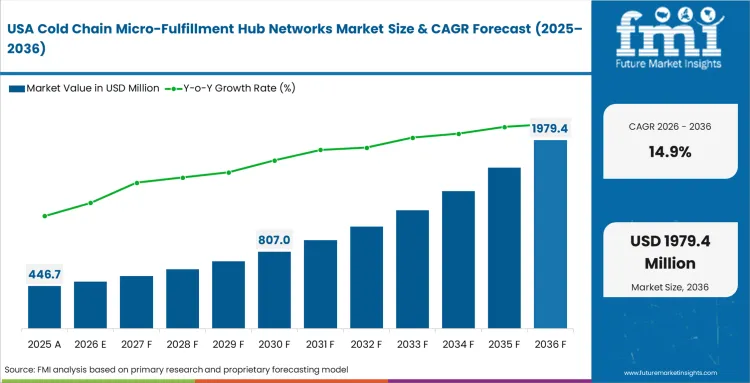
- United States: The USA market is seeing rising investment in the systems needed to run large third-party cold fulfillment networks. Retailers want better control over temperature, order flow, and site coordination across multiple automated facilities. That is increasing demand for software that can tie these moving parts together without disrupting daily shipping activity. The cold chain micro-fulfillment market in the United States is expected to grow at a CAGR of 14.9%. Providers that can manage these networks well, while also taking care of maintenance and system performance, are more likely to secure long-term enterprise contracts.
Europe Cold Chain Micro-Fulfillment Hub Networks Market Analysis
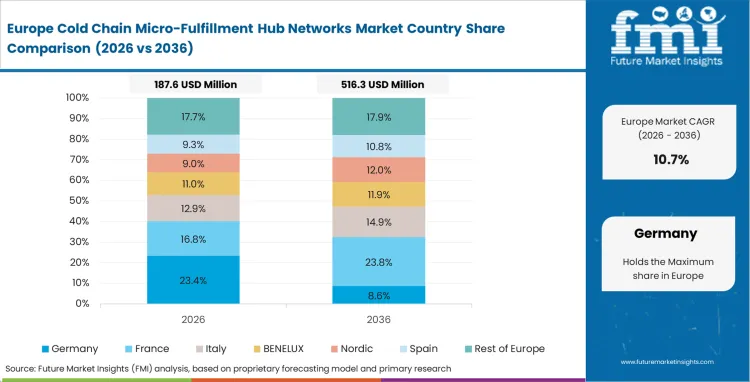
Strict municipal zoning regulations shape urban logistics deployment architecture heavily. FMI observes that European operations directors must balance maximum storage density against stringent environmental compliance requirements affecting refrigerated truck routing inside city limits. Vendors modifying their capacity platforms addressing these emissions hurdles by positioning inventory closer to bicycle or electric vehicle couriers capture significant enterprise contracts. Establishing zero-emission final mile delivery requires dense automated staging nodes placed directly inside restricted zones.
- United Kingdom: Retailers in the United Kingdom are investing more in cold fulfillment services as grocery networks come under greater delivery pressure. Managing fast-moving perishable inventory has become more important, especially in dense urban areas where temporary refrigerated capacity can support short-cycle demand. The market in the United Kingdom is forecast to grow at a CAGR of 14.4%. Operators that improve local automation and keep freshness standards consistent are better placed to attract premium service agreements.
- Germany: In Germany, cold micro-fulfillment demand is rising as brands look for more reliable ways to manage perishable inventory close to end markets. Service requirements are becoming more specific, especially where urban delivery, product quality, and operational precision all matter at the same time. The market in Germany is projected to expand at a CAGR of 13.5%. Facilities that can route goods efficiently through shared logistics spaces are helping customers reduce delivery disruptions and improve day-to-day performance.
Competitive Aligners for Market Players
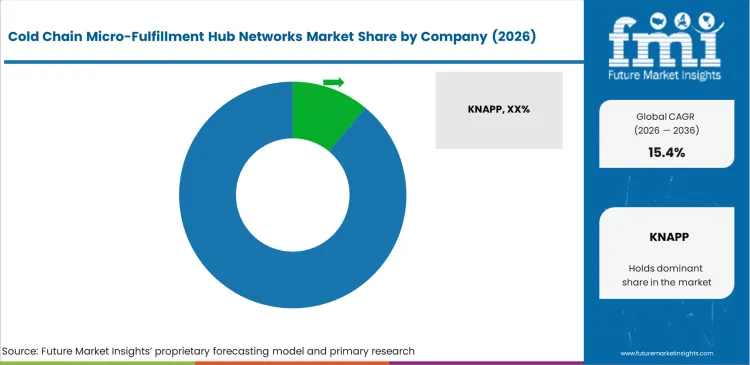
Digital connectivity now plays a bigger role in the cold chain micro-fulfillment market. Buyers are not looking at storage capacity or equipment alone. They also want to see how well a company’s software fits into retail systems and day-to-day operations. KNAPP and Dematic often stand out for this reason. Their platforms work well with client systems and help support smooth execution. Ocado has also built a strong position with its store-based fulfillment model. Its experience with API integration helps retailers set up operations faster, even in older stores.
Companies that only provide cold storage without strong digital support are finding it harder to compete. Many customers now want a partner that can offer both physical infrastructure and reliable software. This is also shaping how newer players enter the market. Instead of putting all their focus on real estate, many are spending more on software connectivity and network management. Operations teams usually place more trust in providers with proven integration experience than in those making broad claims about capacity. Providers that can manage several micro-sites through one connected system are gaining more attention because they make coordination easier for clients.
At the same time, large retail buyers do not want to rely too much on one software vendor. Many are now working with several partners at once. They want systems that can connect easily across different platforms and equipment. This is helping flexible providers gain more interest. Companies that support open standards and clear API connections are seeing better adoption. That approach gives retailers more flexibility as their networks grow, while still helping them keep control over their own data.
Key Players in Cold Chain Micro-Fulfillment Hub Networks Market
- KNAPP
- Dematic
- Ocado
- Swisslog
- AutoStore
- Fabric
Scope of the Report
| Metric | Value |
|---|---|
| Quantitative Units | USD 740.0 million to USD 3,100.0 million, at a CAGR of 15.4% |
| Market Definition | Cold Chain Micro-Fulfillment Hub Networks encompasses decentralized urban storage facilities equipped with automated picking hardware and specialized thermal control zones designed specifically for perishable inventory. |
| Segmentation | Network Format, Temperature Scope, End Use, Service Scope, Deployment Mode, Region |
| Regions Covered | North America, Europe, East Asia, South Asia & Pacific, Latin America, Middle East & Africa |
| Countries Covered | United States, China, India, South Korea, Japan, United Kingdom, Germany |
| Key Companies Profiled | KNAPP, Dematic, Ocado, Swisslog, AutoStore, Fabric |
| Forecast Period | 2026 to 2036 |
| Approach | Declared service provider gross merchandise value and enterprise SaaS license agreements baseline current spending. |
Source: Future Market Insights (FMI) analysis, based on proprietary forecasting model and primary research
Cold Chain Micro-Fulfillment Hub Networks Market Analysis by Segments
Network Format
- Store-attached cold micro-hubs
- Dark-store cold hubs
- Stand-alone urban cold micro-fulfillment nodes
- Hybrid city network models
Temperature Scope
- Chilled + ambient integrated hubs
- Frozen + chilled hubs
- Multi-temperature grocery hubs
- Specialized fresh-produce hubs
End Use
- Grocery and e-grocery
- Quick commerce food delivery
- Meal kits and prepared foods
- Pharmacy and health retail
- Specialty perishables
Service Scope
- Fulfillment + cold storage + orchestration
- Automated picking and buffering
- Order consolidation and dispatch staging
- Replenishment and slotting optimization
- Network monitoring and uptime services
Deployment Mode
- Cloud-connected networked hubs
- On-premise managed systems
- Hybrid control models
Region
- North America
- Latin America
- Europe
- East Asia
- South Asia & Pacific
- Middle East & Africa
Bibliography
- Iyer, P., Malesios, C., Emrouznejad, A., Govindan, K., & Jha, P. C. (2025). Cold chain optimisation models: A systematic literature review. Computers & Industrial Engineering, 207, 110987.
- Karaoulanis, A., & Kotzab, H. (2024). The role of micro fulfilment centers in alleviating, in a sustainable way, the urban last mile logistics problem: A systematic literature review. Sustainability, 16(20), 8774.
- Yang, X., Boysen, N., de Koster, R., & Fedtke, S. (2024). Winning the race to customers with micro-fulfillment centers: An approach for network planning in quick commerce. Central European Journal of Operations Research.
- Schorung, M., Hübner, A., Kuhn, H., & Wollenburg, J. (2024). Quick commerce and the evolving business models of the food retail industry: Investigating the quick commerce supply chain and the urban impacts of dark stores. Journal of Transport Geography, 119, 103947.
- USACensus Bureau. (2026, March 10). Quarterly retail e-commerce sales: Fourth quarter 2025. USA Department of Commerce.
This bibliography is provided for reader reference. The full FMI report contains the complete reference list with primary source documentation
This Report Addresses
- Digital capacity exchange platforms accelerating unified automated facility utilization metrics inside dense urban environments.
- As-a-service deployment eliminating severe refrigerated inventory storage bottlenecks immediately without heavy corporate capital expenditure.
- Transactional billing models transforming traditional robotic equipment depreciation schedules into highly flexible operating expenses.
- Legacy warehouse software latency causing physical hardware integration friction across multi-tenant cold spaces.
- Distributed automated staging nodes reducing massive outbound freight costs and shortening delivery windows substantially.
- India leading regional compound growth through rapid robotic modernization across localized dark store networks.
- Proprietary automation algorithms generating significant operational lock-in friction post-deployment across major metropolitan retail hubs.
- Grocers implementing specialized thermal capacity automation securing critical cold-chain execution advantages dynamically.
Frequently Asked Questions
What is a cold chain micro-fulfillment hub network?
These solutions encompass decentralized urban storage facilities equipped with automated picking hardware and specialized thermal control zones designed specifically for perishable inventory, avoiding heavy upfront retailer capital expenditure.
How do refrigerated micro-fulfillment hubs work?
They bypass simple static shelving by deploying dynamic automated sorting grids that synchronize ambient, chilled, and frozen item retrievals simultaneously to ensure continuous thermal integrity right up until delivery dispatch.
What is the market size in 2026 and 2036?
Capital requirements hit USD 740.0 million globally in 2026, scaling rapidly to USD 3,100.0 million by 2036. Retailers face immense pressure securing localized automated staging nodes without expanding permanent commercial real estate footprints.
What is the difference between a dark store and a cold micro hub?
A dark store often relies on manual pickers walking aisles in a closed retail format, whereas an MFC heavily utilizes dense robotic grids and automation to execute picks in a fraction of the space.
Which companies lead cold chain micro-fulfillment?
Major global players include KNAPP, Dematic, Ocado, Swisslog, AutoStore, and Fabric networks. Operations directors evaluate these firms based on proprietary robotic logic and geographic facility density.
Why is demand rising for outsourced cold fulfillment?
Unpredictable retail volume spikes force merchants to secure automated overflow picking dynamically. Rising final-mile delivery expectations compel brands to stage inventory in localized temporary automated nodes near urban populations reducing outbound transit times.
Which end users adopt these platforms most?
Grocery and e-grocery sectors command 46.0% share. Processing perishable orders requires extremely fluid physical staging and highly sophisticated temperature-controlled robotic routing logic managing sudden promotional bursts.
How are as-a-service cold contracts typically priced?
Shippers pay based on consumption. Chief financial officers refuse authorizing massive fixed robotic purchases, preferring transactional agility adjusting automation costs matching actual inventory volume scaling exactly with throughput.
Which regions grow fastest?
India tracks at 17.6% compound growth. Rapid formalization across domestic logistics networks forces massive immediate automation upgrades moving regional hubs from disorganized manual capacity tracking toward fully automated outsourced networks.
What role does e-commerce play in category growth?
E-commerce environments prioritize maximum delivery velocity. Traditional manual operations lacking localized staging nodes face massive operational disadvantages attempting rapid individual piece-picking fulfillment required for demanding online orders.
How do these services help during seasonal surges?
Connecting existing single-tenant networks to outsourced automated spaces allows shippers to absorb massive seasonal imports instantly. Planners clear crowded sorting facilities without overloading their primary permanent manual warehouses.
Can retailers use backrooms for automated cold fulfillment?
Yes. Store-attached MFCs command 35.0% share. Providers install and operate dense automated grids directly inside existing retail backrooms, charging the host retailer based on system utilization rather than selling the equipment outright.
What drives demand for fully managed MFC solutions?
Managed integrated hubs capture significant share. Risk-averse logistics directors historically demanded active robotic pick-and-pack capabilities avoiding massive transportation costs moving stagnant inventory back to primary manual distribution hubs.
What structural constraint slows automation deployment computationally?
Legacy retail software architecture causes immense friction. Older codebases cannot process multi-tenant high-speed robotic inventory flows accurately, rendering shared automated facility utilization extremely difficult.
How does software latency impact fulfillment performance?
API translation delays introduce micro-latency into robotic picking execution occasionally causing missed delivery cut-offs. Identifying system constraints early reduces the risk of missed deliveries during peak periods.
What risk accompanies single-provider integration?
Proprietary robotic network architecture heavily favors incumbent hardware providers. Specific software frameworks severely limit future competitive bidding when shippers require specialized geographic nodes absent from their primary provider's network.
How do frozen facilities represent specific automated opportunities?
Temperature-controlled urban spaces face extreme capacity constraints. Engineering teams capable of deploying algorithmic thermal robotic matchmaking secure premium specialized execution revenue streams computationally.
What advantage do established developers hold over new entrants?
Incumbent providers control massive networks containing pre-vetted automated physical facilities. Accessing established physical nodes allows operations directors accelerating deployment schedules significantly compared to sourcing individual automation vendors from scratch.
How does SaaS software generate recurring revenue here?
Providers demand continuous transaction processing fees well past initial equipment installation dates. Transitioning simple hardware sales toward ongoing orchestration subscriptions builds extremely stable recurring revenue models.
What friction do open API standards address directly?
Sourcing directors deliberately fragment automated capacity purchases demanding open architecture. Forcing developers to utilize hardware-agnostic software frameworks ensures operators maintain maximum flexibility during future automated expansions.
How does delivery velocity impact automation logic?
Unrelenting consumer expectations demanding sub-two-hour delivery eliminate basic centralized distribution viability completely. Supply chain architects designing distributed robotic networks maximize localized staging accelerating final-mile transit speeds.
How do predictable operating expenses impact real estate procurement?
Transactional software models lower financial barriers significantly. Financial controllers approve variable operating expense budgets quickly bypassing rigorous internal capital expenditure review boards required for purchasing heavy robotics directly.
Preview the report firsthand - request a free sample
Get SampleGet the brochure for pricing and purchase details.
Get PDFTable of Content
- Executive Summary
- Global Market Outlook
- Demand-side Trends
- Supply-side Trends
- Technology Roadmap Analysis
- Analysis and Recommendations
- Market Overview
- Market Coverage / Taxonomy
- Market Definition / Scope / Limitations
- Research Methodology
- Chapter Orientation
- Analytical Lens and Working Hypotheses
- Market Structure, Signals, and Trend Drivers
- Benchmarking and Cross-market Comparability
- Market Sizing, Forecasting, and Opportunity Mapping
- Research Design and Evidence Framework
- Desk Research Programme (Secondary Evidence)
- Company Annual and Sustainability Reports
- Peer-reviewed Journals and Academic Literature
- Corporate Websites, Product Literature, and Technical Notes
- Earnings Decks and Investor Briefings
- Statutory Filings and Regulatory Disclosures
- Technical White Papers and Standards Notes
- Trade Journals, Industry Magazines, and Analyst Briefs
- Conference Proceedings, Webinars, and Seminar Materials
- Government Statistics Portals and Public Data Releases
- Press Releases and Reputable Media Coverage
- Specialist Newsletters and Curated Briefings
- Sector Databases and Reference Repositories
- FMI Internal Proprietary Databases and Historical Market Datasets
- Subscription Datasets and Paid Sources
- Social Channels, Communities, and Digital Listening Inputs
- Additional Desk Sources
- Expert Input and Fieldwork (Primary Evidence)
- Primary Modes
- Qualitative Interviews and Expert Elicitation
- Quantitative Surveys and Structured Data Capture
- Blended Approach
- Why Primary Evidence is Used
- Field Techniques
- Interviews
- Surveys
- Focus Groups
- Observational and In-context Research
- Social and Community Interactions
- Stakeholder Universe Engaged
- C-suite Leaders
- Board Members
- Presidents and Vice Presidents
- R&D and Innovation Heads
- Technical Specialists
- Domain Subject-matter Experts
- Scientists
- Physicians and Other Healthcare Professionals
- Governance, Ethics, and Data Stewardship
- Research Ethics
- Data Integrity and Handling
- Primary Modes
- Tooling, Models, and Reference Databases
- Desk Research Programme (Secondary Evidence)
- Data Engineering and Model Build
- Data Acquisition and Ingestion
- Cleaning, Normalisation, and Verification
- Synthesis, Triangulation, and Analysis
- Quality Assurance and Audit Trail
- Market Background
- Market Dynamics
- Drivers
- Restraints
- Opportunity
- Trends
- Scenario Forecast
- Demand in Optimistic Scenario
- Demand in Likely Scenario
- Demand in Conservative Scenario
- Opportunity Map Analysis
- Product Life Cycle Analysis
- Supply Chain Analysis
- Investment Feasibility Matrix
- Value Chain Analysis
- PESTLE and Porter’s Analysis
- Regulatory Landscape
- Regional Parent Market Outlook
- Production and Consumption Statistics
- Import and Export Statistics
- Market Dynamics
- Global Market Analysis 2021 to 2025 and Forecast, 2026 to 2036
- Historical Market Size Value (USD Million) Analysis, 2021 to 2025
- Current and Future Market Size Value (USD Million) Projections, 2026 to 2036
- Y-o-Y Growth Trend Analysis
- Absolute $ Opportunity Analysis
- Global Market Pricing Analysis 2021 to 2025 and Forecast 2026 to 2036
- Global Market Analysis 2021 to 2025 and Forecast 2026 to 2036, By Network Format
- Introduction / Key Findings
- Historical Market Size Value (USD Million) Analysis By Network Format , 2021 to 2025
- Current and Future Market Size Value (USD Million) Analysis and Forecast By Network Format , 2026 to 2036
- Store-Attached Cold Micro Hub
- Dark-Store Cold Hubs
- Others
- Store-Attached Cold Micro Hub
- Y-o-Y Growth Trend Analysis By Network Format , 2021 to 2025
- Absolute $ Opportunity Analysis By Network Format , 2026 to 2036
- Global Market Analysis 2021 to 2025 and Forecast 2026 to 2036, By Temperature Scope
- Introduction / Key Findings
- Historical Market Size Value (USD Million) Analysis By Temperature Scope, 2021 to 2025
- Current and Future Market Size Value (USD Million) Analysis and Forecast By Temperature Scope, 2026 to 2036
- Multi-Temperature Grocery Hubs
- Specialized Fresh-Produce Hubs
- Others
- Multi-Temperature Grocery Hubs
- Y-o-Y Growth Trend Analysis By Temperature Scope, 2021 to 2025
- Absolute $ Opportunity Analysis By Temperature Scope, 2026 to 2036
- Global Market Analysis 2021 to 2025 and Forecast 2026 to 2036, By End Use
- Introduction / Key Findings
- Historical Market Size Value (USD Million) Analysis By End Use, 2021 to 2025
- Current and Future Market Size Value (USD Million) Analysis and Forecast By End Use, 2026 to 2036
- Grocery and E-Grocery
- Quick Commerce Food Delivery
- Others
- Grocery and E-Grocery
- Y-o-Y Growth Trend Analysis By End Use, 2021 to 2025
- Absolute $ Opportunity Analysis By End Use, 2026 to 2036
- Global Market Analysis 2021 to 2025 and Forecast 2026 to 2036, By Service Scope
- Introduction / Key Findings
- Historical Market Size Value (USD Million) Analysis By Service Scope, 2021 to 2025
- Current and Future Market Size Value (USD Million) Analysis and Forecast By Service Scope, 2026 to 2036
- Fulfillment + Cold storage + Orchestration
- Automated Picking and Buffering
- Others
- Fulfillment + Cold storage + Orchestration
- Y-o-Y Growth Trend Analysis By Service Scope, 2021 to 2025
- Absolute $ Opportunity Analysis By Service Scope, 2026 to 2036
- Global Market Analysis 2021 to 2025 and Forecast 2026 to 2036, By Deployment Mode
- Introduction / Key Findings
- Historical Market Size Value (USD Million) Analysis By Deployment Mode, 2021 to 2025
- Current and Future Market Size Value (USD Million) Analysis and Forecast By Deployment Mode, 2026 to 2036
- Cloud-Connected
- On-Premise
- Others
- Cloud-Connected
- Y-o-Y Growth Trend Analysis By Deployment Mode, 2021 to 2025
- Absolute $ Opportunity Analysis By Deployment Mode, 2026 to 2036
- Global Market Analysis 2021 to 2025 and Forecast 2026 to 2036, By Region
- Introduction
- Historical Market Size Value (USD Million) Analysis By Region, 2021 to 2025
- Current Market Size Value (USD Million) Analysis and Forecast By Region, 2026 to 2036
- North America
- Latin America
- Western Europe
- Eastern Europe
- East Asia
- South Asia and Pacific
- Middle East & Africa
- Market Attractiveness Analysis By Region
- North America Market Analysis 2021 to 2025 and Forecast 2026 to 2036, By Country
- Historical Market Size Value (USD Million) Trend Analysis By Market Taxonomy, 2021 to 2025
- Market Size Value (USD Million) Forecast By Market Taxonomy, 2026 to 2036
- By Country
- USA
- Canada
- Mexico
- By Network Format
- By Temperature Scope
- By End Use
- By Service Scope
- By Deployment Mode
- By Country
- Market Attractiveness Analysis
- By Country
- By Network Format
- By Temperature Scope
- By End Use
- By Service Scope
- By Deployment Mode
- Key Takeaways
- Latin America Market Analysis 2021 to 2025 and Forecast 2026 to 2036, By Country
- Historical Market Size Value (USD Million) Trend Analysis By Market Taxonomy, 2021 to 2025
- Market Size Value (USD Million) Forecast By Market Taxonomy, 2026 to 2036
- By Country
- Brazil
- Chile
- Rest of Latin America
- By Network Format
- By Temperature Scope
- By End Use
- By Service Scope
- By Deployment Mode
- By Country
- Market Attractiveness Analysis
- By Country
- By Network Format
- By Temperature Scope
- By End Use
- By Service Scope
- By Deployment Mode
- Key Takeaways
- Western Europe Market Analysis 2021 to 2025 and Forecast 2026 to 2036, By Country
- Historical Market Size Value (USD Million) Trend Analysis By Market Taxonomy, 2021 to 2025
- Market Size Value (USD Million) Forecast By Market Taxonomy, 2026 to 2036
- By Country
- Germany
- UK
- Italy
- Spain
- France
- Nordic
- BENELUX
- Rest of Western Europe
- By Network Format
- By Temperature Scope
- By End Use
- By Service Scope
- By Deployment Mode
- By Country
- Market Attractiveness Analysis
- By Country
- By Network Format
- By Temperature Scope
- By End Use
- By Service Scope
- By Deployment Mode
- Key Takeaways
- Eastern Europe Market Analysis 2021 to 2025 and Forecast 2026 to 2036, By Country
- Historical Market Size Value (USD Million) Trend Analysis By Market Taxonomy, 2021 to 2025
- Market Size Value (USD Million) Forecast By Market Taxonomy, 2026 to 2036
- By Country
- Russia
- Poland
- Hungary
- Balkan & Baltic
- Rest of Eastern Europe
- By Network Format
- By Temperature Scope
- By End Use
- By Service Scope
- By Deployment Mode
- By Country
- Market Attractiveness Analysis
- By Country
- By Network Format
- By Temperature Scope
- By End Use
- By Service Scope
- By Deployment Mode
- Key Takeaways
- East Asia Market Analysis 2021 to 2025 and Forecast 2026 to 2036, By Country
- Historical Market Size Value (USD Million) Trend Analysis By Market Taxonomy, 2021 to 2025
- Market Size Value (USD Million) Forecast By Market Taxonomy, 2026 to 2036
- By Country
- China
- Japan
- South Korea
- By Network Format
- By Temperature Scope
- By End Use
- By Service Scope
- By Deployment Mode
- By Country
- Market Attractiveness Analysis
- By Country
- By Network Format
- By Temperature Scope
- By End Use
- By Service Scope
- By Deployment Mode
- Key Takeaways
- South Asia and Pacific Market Analysis 2021 to 2025 and Forecast 2026 to 2036, By Country
- Historical Market Size Value (USD Million) Trend Analysis By Market Taxonomy, 2021 to 2025
- Market Size Value (USD Million) Forecast By Market Taxonomy, 2026 to 2036
- By Country
- India
- ASEAN
- Australia & New Zealand
- Rest of South Asia and Pacific
- By Network Format
- By Temperature Scope
- By End Use
- By Service Scope
- By Deployment Mode
- By Country
- Market Attractiveness Analysis
- By Country
- By Network Format
- By Temperature Scope
- By End Use
- By Service Scope
- By Deployment Mode
- Key Takeaways
- Middle East & Africa Market Analysis 2021 to 2025 and Forecast 2026 to 2036, By Country
- Historical Market Size Value (USD Million) Trend Analysis By Market Taxonomy, 2021 to 2025
- Market Size Value (USD Million) Forecast By Market Taxonomy, 2026 to 2036
- By Country
- Kingdom of Saudi Arabia
- Other GCC Countries
- Turkiye
- South Africa
- Other African Union
- Rest of Middle East & Africa
- By Network Format
- By Temperature Scope
- By End Use
- By Service Scope
- By Deployment Mode
- By Country
- Market Attractiveness Analysis
- By Country
- By Network Format
- By Temperature Scope
- By End Use
- By Service Scope
- By Deployment Mode
- Key Takeaways
- Key Countries Market Analysis
- USA
- Pricing Analysis
- Market Share Analysis, 2025
- By Network Format
- By Temperature Scope
- By End Use
- By Service Scope
- By Deployment Mode
- Canada
- Pricing Analysis
- Market Share Analysis, 2025
- By Network Format
- By Temperature Scope
- By End Use
- By Service Scope
- By Deployment Mode
- Mexico
- Pricing Analysis
- Market Share Analysis, 2025
- By Network Format
- By Temperature Scope
- By End Use
- By Service Scope
- By Deployment Mode
- Brazil
- Pricing Analysis
- Market Share Analysis, 2025
- By Network Format
- By Temperature Scope
- By End Use
- By Service Scope
- By Deployment Mode
- Chile
- Pricing Analysis
- Market Share Analysis, 2025
- By Network Format
- By Temperature Scope
- By End Use
- By Service Scope
- By Deployment Mode
- Germany
- Pricing Analysis
- Market Share Analysis, 2025
- By Network Format
- By Temperature Scope
- By End Use
- By Service Scope
- By Deployment Mode
- UK
- Pricing Analysis
- Market Share Analysis, 2025
- By Network Format
- By Temperature Scope
- By End Use
- By Service Scope
- By Deployment Mode
- Italy
- Pricing Analysis
- Market Share Analysis, 2025
- By Network Format
- By Temperature Scope
- By End Use
- By Service Scope
- By Deployment Mode
- Spain
- Pricing Analysis
- Market Share Analysis, 2025
- By Network Format
- By Temperature Scope
- By End Use
- By Service Scope
- By Deployment Mode
- France
- Pricing Analysis
- Market Share Analysis, 2025
- By Network Format
- By Temperature Scope
- By End Use
- By Service Scope
- By Deployment Mode
- India
- Pricing Analysis
- Market Share Analysis, 2025
- By Network Format
- By Temperature Scope
- By End Use
- By Service Scope
- By Deployment Mode
- ASEAN
- Pricing Analysis
- Market Share Analysis, 2025
- By Network Format
- By Temperature Scope
- By End Use
- By Service Scope
- By Deployment Mode
- Australia & New Zealand
- Pricing Analysis
- Market Share Analysis, 2025
- By Network Format
- By Temperature Scope
- By End Use
- By Service Scope
- By Deployment Mode
- China
- Pricing Analysis
- Market Share Analysis, 2025
- By Network Format
- By Temperature Scope
- By End Use
- By Service Scope
- By Deployment Mode
- Japan
- Pricing Analysis
- Market Share Analysis, 2025
- By Network Format
- By Temperature Scope
- By End Use
- By Service Scope
- By Deployment Mode
- South Korea
- Pricing Analysis
- Market Share Analysis, 2025
- By Network Format
- By Temperature Scope
- By End Use
- By Service Scope
- By Deployment Mode
- Russia
- Pricing Analysis
- Market Share Analysis, 2025
- By Network Format
- By Temperature Scope
- By End Use
- By Service Scope
- By Deployment Mode
- Poland
- Pricing Analysis
- Market Share Analysis, 2025
- By Network Format
- By Temperature Scope
- By End Use
- By Service Scope
- By Deployment Mode
- Hungary
- Pricing Analysis
- Market Share Analysis, 2025
- By Network Format
- By Temperature Scope
- By End Use
- By Service Scope
- By Deployment Mode
- Kingdom of Saudi Arabia
- Pricing Analysis
- Market Share Analysis, 2025
- By Network Format
- By Temperature Scope
- By End Use
- By Service Scope
- By Deployment Mode
- Turkiye
- Pricing Analysis
- Market Share Analysis, 2025
- By Network Format
- By Temperature Scope
- By End Use
- By Service Scope
- By Deployment Mode
- South Africa
- Pricing Analysis
- Market Share Analysis, 2025
- By Network Format
- By Temperature Scope
- By End Use
- By Service Scope
- By Deployment Mode
- USA
- Market Structure Analysis
- Competition Dashboard
- Competition Benchmarking
- Market Share Analysis of Top Players
- By Regional
- By Network Format
- By Temperature Scope
- By End Use
- By Service Scope
- By Deployment Mode
- Competition Analysis
- Competition Deep Dive
- KNAPP
- Overview
- Product Portfolio
- Profitability by Market Segments (Product/Age /Sales Channel/Region)
- Sales Footprint
- Strategy Overview
- Marketing Strategy
- Product Strategy
- Channel Strategy
- Dematic
- Ocado
- Swisslog
- AutoStore
- Fabric
- KNAPP
- Competition Deep Dive
- Assumptions & Acronyms Used


