

- Industry Size (2026)
- USD 2.0 Bn
- Forecast (2036)
- USD 4.5 Bn
- CAGR (2026 to 2036)
- 8.4%
Cold-Chain Antifreeze Glycols Market Forecast and Outlook 2026 to 2036
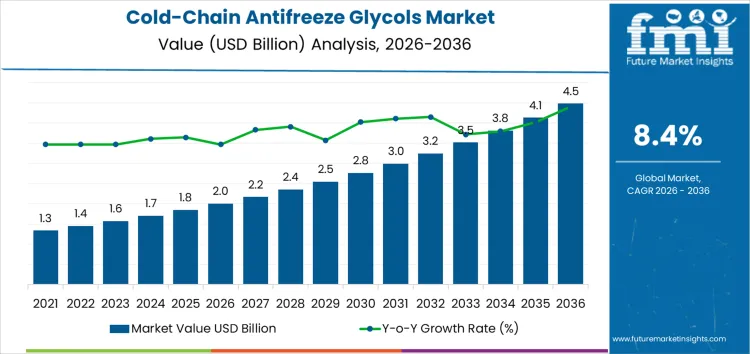
The cold-chain antifreeze glycols market is valued at USD 2.0 billion in 2026 and is projected to reach USD 4.5 billion by 2036, reflecting a CAGR of 8.4%. Production is concentrated among suppliers with access to high-quality feedstocks and specialized processing capabilities for low-freezing, high-purity glycols. Regional control over distribution and cold-chain infrastructure affects supply reliability and lead times. Performance depends on formulation consistency, regulatory compliance, and compatibility with refrigeration systems. Smaller operators face limitations in sourcing certified raw materials and maintaining consistent production. Margin concentration favors companies supplying validated, application-ready antifreeze glycols with technical support rather than bulk commodity products.
Adoption is shaped by alignment with temperature-sensitive logistics programs in food, pharmaceuticals, and chemicals. Regional uptake varies based on infrastructure, regulatory standards, and operational scale. High-value margins are captured by suppliers integrating product validation, multi-application compatibility, and long-term technical support. Fragmentation persists among regional distributors and small-scale producers, while leading operators secure concentrated value through production control, supply reliability, and alignment with critical cold-chain operations rather than output volume alone.
Quick Stats of the Cold-Chain Antifreeze Glycols Market
- Cold-Chain Antifreeze Glycols Market Value (2026): USD 2.0 billion
- Cold-Chain Antifreeze Glycols Forecast Value (2036): USD 4.5 billion
- Cold-Chain Antifreeze Glycols Forecast CAGR 2026 to 2036: 8.4%
- Leading Product Type in Cold-Chain Antifreeze Glycols Market: Monoethylene Glycol (MEG) (39.4% share)
- Leading Application in Cold-Chain Antifreeze Glycols Market: Cold-Chain Transport Refrigeration (42.3% share)
- Key Growth Regions in Cold-Chain Antifreeze Glycols Market: USA, China, India, Germany, Japan
- Top Players in Cold-Chain Antifreeze Glycols Market: BASF SE, Dow Chemical Company, Shell Chemicals, INEOS, Clariant AG
What is the Growth Forecast for Cold-Chain Antifreeze Glycols Market through 2036?
Between 2026 and 2031, the cold-chain antifreeze glycols market is projected to grow from USD 2 billion to USD 2.7 billion, generating an absolute increase of USD 0.7 billion. Volume contributes approximately 67% of growth, driven by adoption of monoethylene glycol (MEG), propylene glycol (PG), diethylene glycol (DEG), and triethylene glycol (TEG) across cold-chain transport, storage warehouses, and pharmaceutical logistics. Price growth accounts for 33%, supported by premium grades, high-performance formulations, and regulatory compliance. Value capture favors suppliers delivering consistent quality, validated performance, and technical support for logistics, pharmaceutical, and food & beverage end-users.
From 2031 to 2036, the market is expected to expand from USD 2.7 billion to USD 4.5 billion, adding USD 1.7 billion. Volume remains the dominant driver, contributing roughly 65% of growth due to expanded cold-chain adoption, increasing refrigerated transport, and warehouse integration. Price growth represents 35%, supported by differentiated glycol formulations, high-purity standards, and specialty cold-chain applications. Competitive advantage favors suppliers with proven product performance, strong distribution networks, and integration with logistics and pharmaceutical supply chains. Leading companies include BASF SE, Dow Chemical Company, Shell Chemicals, INEOS, and Clariant AG.
Cold Chain Antifreeze Glycols Market Key Takeaways
| Metric | Value |
|---|---|
| Market Value (2026) | USD 2.0 billion |
| Forecast Value (2036) | USD 4.5 billion |
| Forecast CAGR 2026 to 2036 | 8.40% |
What Is Driving Demand for Cold-Chain Antifreeze Glycols?
Cold-chain antifreeze glycols are increasingly used to maintain temperature-controlled logistics in food, pharmaceutical, and chemical industries. Historically, conventional coolants offered limited freeze protection, resulting in compromised product integrity and storage challenges in low-temperature environments. Modern glycols provide precise freezing point depression, thermal stability, and low viscosity at subzero temperatures, ensuring safe storage and transport of sensitive goods. Cold-chain operators, logistics providers, and warehouse managers prioritize fluid compatibility, thermal performance, and regulatory compliance. Early adoption focused on pharmaceutical cold storage and high-value perishable foods, while current demand extends to large-scale food distribution, biologics transport, and chemical storage driven by global trade expansion and stricter temperature control requirements. Glycol concentration, chemical purity, and freeze-point consistency guide product selection.
Rising demand for perishable goods, biologics, and temperature-sensitive chemicals is shaping the cold-chain antifreeze glycols market. Compared with traditional solutions, contemporary glycols emphasize extended thermal stability, low toxicity, and compatibility with pumping and refrigeration systems. Cost structures depend on feedstock quality, production processes, and quality control, concentrating margins among suppliers capable of delivering reliable, high-purity antifreeze solutions. Logistics providers adopt these glycols to maintain product integrity, prevent freeze-related damage, and comply with regulatory standards. By 2036, cold-chain antifreeze glycols are expected to be standard in refrigerated transport and storage operations, supporting product safety, operational efficiency, and global cold-chain reliability.
What Factors Are Shaping the Demand for Cold-Chain Antifreeze Glycols in Terms of Product Type and Application?
The demand for cold-chain antifreeze glycols is segmented by product type and application. Product types include monoethylene glycol (MEG), propylene glycol (PG), diethylene glycol (DEG), triethylene glycol (TEG), and other variants. Applications cover cold-chain transport refrigeration, cold storage warehouses, pharmaceutical and biologics logistics, food and beverage cold-chain, and additional sectors. Adoption is influenced by freeze protection, thermal stability, and regulatory compliance. Uptake is driven by operational reliability, energy efficiency, and product safety. Product type and application selection depend on temperature control requirements, chemical compatibility, and system design, ensuring effective cooling, durability, and safety in global cold-chain operations.
Why Is Monoethylene Glycol (MEG) Leading the Product Type Segment in Cold-Chain Antifreeze Glycols?
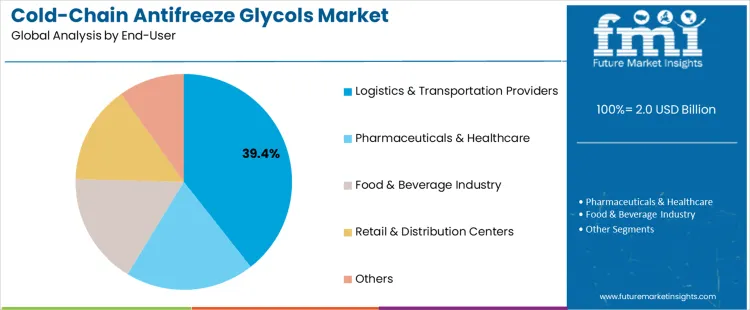
Monoethylene glycol (MEG) accounts for 39.4% of total product type demand, making it the leading category. MEG provides high thermal stability, effective freeze protection, and compatibility with refrigeration systems. Adoption is reinforced by its widespread use in cold-chain transport refrigeration, industrial cooling loops, and glycol-water mixtures. Manufacturers select MEG for its low viscosity, consistent performance across temperature ranges, and proven chemical stability. Maintenance practices involve monitoring concentration, system corrosion, and thermal efficiency to ensure operational reliability. The segment leads because MEG combines performance, safety, and adaptability, supporting efficient and reliable cold-chain operations.
Operational factors further shape adoption. MEG must maintain heat transfer efficiency, chemical integrity, and low toxicity under continuous operation. Integration with pumps, heat exchangers, and refrigeration loops ensures consistent cooling. The segment leads because MEG delivers predictable thermal performance, durability, and operational reliability, making it the preferred choice for cold-chain antifreeze systems.
Why Is Cold-Chain Transport Refrigeration Representing the Largest Application Segment in Antifreeze Glycols?
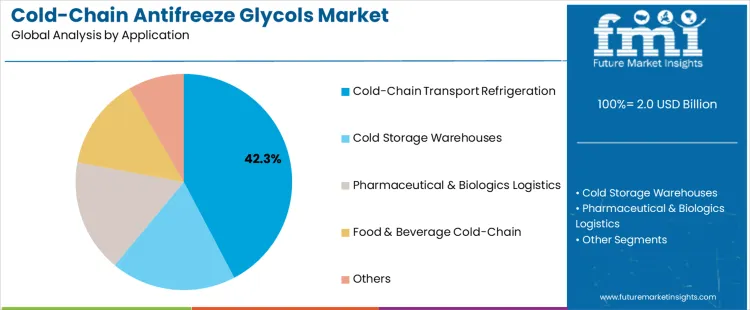
Cold-chain transport refrigeration accounts for 42.3% of total application segment demand, making it the largest category. Adoption is driven by the need to maintain temperature-sensitive products during transit, including pharmaceuticals, food, and biologics. Glycol-based coolants prevent freezing, ensure consistent heat transfer, and protect perishable cargo. Fleet operators and logistics providers rely on MEG, PG, and other glycols to sustain engine and refrigeration performance. Maintenance routines monitor coolant levels, concentration, and system integrity to prevent operational failure.
Operational and functional factors influence adoption. Coolants must withstand pressure fluctuations, mechanical vibration, and wide temperature ranges while maintaining thermal efficiency. Proper system calibration ensures even cooling and minimal energy loss. Cold-chain transport refrigeration leads because it represents the primary operational application requiring reliable antifreeze glycols, providing measurable protection, efficiency, and regulatory compliance across global logistics networks.
How Are Cold-Chain Antifreeze Glycols Ensuring Temperature-Sensitive Logistics?
Cold-chain antifreeze glycols are increasingly adopted in refrigerated transport, storage facilities, and industrial cooling systems to maintain precise temperature control for perishable goods. Adoption is strongest in regions with high pharmaceutical, food, and biotech distribution activities. Glycols are selected for thermal stability, low viscosity, and compatibility with cooling system materials. Growth is driven by regulatory mandates for temperature-controlled logistics, product safety requirements, and operational reliability. Investment focuses on chemical purity, freeze protection, and system efficiency. Operators prioritize glycols that prevent freezing, maintain continuous cooling, and comply with regional safety and environmental regulations.
Why Are Regional Cold-Chain Regulations and Industry Requirements Driving Demand?
Demand is influenced by local standards for pharmaceutical, food, and perishable product storage and transport. Companies adopt antifreeze glycols to comply with temperature regulations, reduce spoilage, and maintain product quality. Products that offer consistent thermal performance, low toxicity, and material compatibility gain preference. Adoption is concentrated in regions with strict cold-chain compliance and high-value temperature-sensitive shipments. Regulatory adherence and operational reliability drive procurement rather than cost. Suppliers delivering certified, high-performance glycols secure competitive advantage among logistics providers, pharmaceutical manufacturers, and food distributors.
What Challenges Limit Broader Adoption of Cold-Chain Antifreeze Glycols?
High raw material and formulation costs, potential environmental restrictions, and compatibility issues with system components restrict adoption. Glycol performance can be affected by prolonged exposure to extreme temperatures, contamination, or improper maintenance. Certification, testing, and regional regulatory approval timelines can delay deployment. Smaller logistics operators or regions with limited cold-chain infrastructure may face adoption constraints. These factors concentrate early deployment among well-resourced pharmaceutical, food, and biotech companies with technical expertise and infrastructure to ensure reliable operation.
How Are Technological Innovations and Collaboration Shaping Market Growth?
Recent developments include low-toxicity glycols, extended freeze protection formulations, and enhanced thermal conductivity for system efficiency. Collaboration between glycol manufacturers, cold-chain operators, and regulatory bodies ensures performance validation, compliance, and integration with transport and storage systems. Pilot programs test freeze protection, viscosity, and compatibility before full-scale use. Quality monitoring, traceability, and standardized production processes maintain reliability and regulatory alignment. Focus is on thermal performance, operational reliability, and regulatory compliance rather than cost or volume. Collaborative efforts enable broader adoption of cold-chain antifreeze glycols, safeguarding temperature-sensitive products across regional logistics networks.
What is the Demand for Cold-Chain Antifreeze Glycols by Country?
| Country | CAGR (%) |
|---|---|
| USA | 8.9 |
| China | 9.6 |
| India | 10.0 |
| Germany | 8.2 |
| Japan | 7.7 |
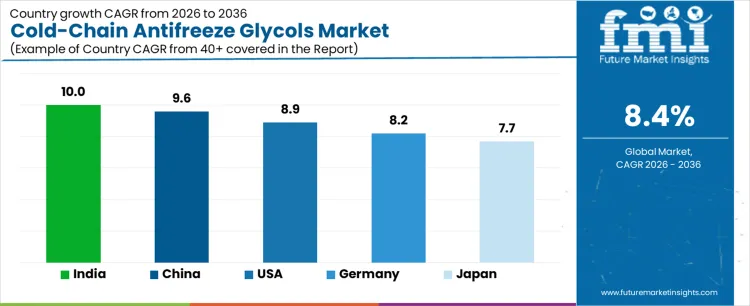
Demand for cold-chain antifreeze glycols is rising as the food, pharmaceutical, and logistics sectors expand temperature-controlled storage and transportation. India leads with a 10.0% CAGR, driven by growing cold-chain infrastructure, increasing pharmaceutical and frozen food production, and adoption of efficient glycol-based antifreeze solutions. China follows at 9.6%, supported by rapid expansion of cold storage facilities, logistics networks, and industrial refrigeration. The USA grows at 8.9%, shaped by adoption in food processing, transport, and pharmaceutical cold-chain systems. Germany records 8.2% growth, reflecting steady investment in temperature-controlled logistics and industrial refrigeration. Japan shows 7.7% CAGR, driven by incremental expansion of cold-chain networks and use of glycol-based antifreeze in storage and transport applications.
How Is the United States Experiencing Growth in the Cold-Chain Antifreeze Glycols Market?
United States is experiencing growth at a CAGR of 8.9%, supported by adoption of antifreeze glycols in cold-chain logistics, refrigerated transport, and industrial cooling applications to maintain temperature-sensitive goods. Manufacturers and suppliers are producing glycols optimized for low freezing points, thermal stability, and long-term performance under variable conditions. Demand is concentrated in transportation hubs, cold storage facilities, and food processing regions. Investments focus on material quality, thermal efficiency, and regulatory compliance rather than fleet or facility expansion. Growth reflects rising cold-chain infrastructure, adoption of advanced cooling solutions, and regulatory requirements for safe handling of perishable goods.
- Cold-chain operations drive adoption.
- Glycols maintain temperature stability in transport and storage.
- Transportation hubs and cold storage centers concentrate demand.
- Material quality and thermal efficiency guide investment.
How Is China Witnessing Rapid Adoption With Refrigerated Logistics Expansion?
China is witnessing growth at a CAGR of 9.6%, fueled by adoption of cold-chain antifreeze glycols to support food, pharmaceutical, and industrial cold storage operations. Manufacturers and suppliers are providing glycols designed for low-temperature stability, corrosion resistance, and long-term thermal performance. Demand is concentrated in major industrial and logistics hubs. Investments prioritize material durability, thermal efficiency, and compliance with food safety and environmental regulations rather than expansion of facilities. Growth reflects rapid expansion of refrigerated logistics, increasing demand for temperature-sensitive transport, and industrial adoption of high-performance antifreeze glycols.
- Refrigerated logistics drive adoption.
- Glycols ensure thermal stability and product protection.
- Industrial and logistics hubs concentrate demand.
- Material durability and regulatory compliance guide investment.
How Is India Experiencing Rapid Growth With Cold-Chain Infrastructure Development?
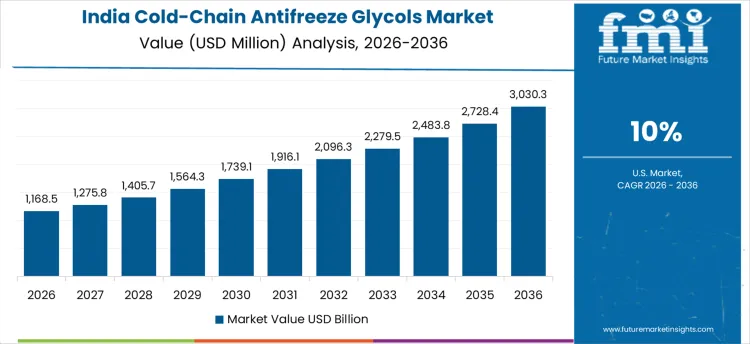
India is experiencing growth at a CAGR of 10%, supported by adoption of antifreeze glycols in cold-chain transport, food storage, and pharmaceutical logistics to maintain temperature-sensitive goods. Suppliers are deploying glycols optimized for low freezing points, thermal efficiency, and chemical stability. Demand is concentrated in metropolitan areas, food processing hubs, and refrigerated transport corridors. Investments focus on material performance, compliance with safety standards, and operational reliability rather than facility expansion. Growth reflects government initiatives for cold-chain development, rising e-commerce and perishable food transport, and adoption of advanced antifreeze solutions in logistics operations.
- Cold-chain infrastructure drives adoption.
- Glycols maintain temperature control for perishable goods.
- Metropolitan and industrial hubs concentrate demand.
- Material performance and regulatory compliance guide investment.
How Is Germany Witnessing Steady Growth With Industrial Cooling Applications?
Germany is witnessing growth at a CAGR of 8.2%, supported by adoption of cold-chain antifreeze glycols in food storage, pharmaceutical transport, and industrial refrigeration systems. Manufacturers and suppliers are providing glycols optimized for thermal stability, corrosion resistance, and long-term performance under low temperatures. Demand is concentrated in industrial hubs, cold storage centers, and transport networks. Investments prioritize material quality, operational reliability, and regulatory adherence rather than expansion of industrial capacity. Growth reflects adoption of advanced cold-chain technologies, compliance with food safety standards, and industrial focus on temperature-controlled logistics.
- Industrial cooling drives adoption.
- Glycols optimize temperature control in storage and transport.
- Industrial hubs and cold storage centers concentrate demand.
- Material quality and regulatory adherence guide investment.
How Is Japan Experiencing Moderate Growth With Temperature-Sensitive Logistics?
Japan is experiencing growth at a CAGR of 7.7%, fueled by adoption of antifreeze glycols in cold-chain logistics, refrigerated transport, and industrial cooling to maintain perishable goods and pharmaceuticals. Manufacturers and suppliers are deploying glycols designed for thermal stability, corrosion resistance, and long-term reliability under low temperatures. Demand is concentrated in urban centers, cold storage hubs, and transport corridors. Investments focus on material performance, thermal efficiency, and compliance with safety regulations rather than large-scale facility expansion. Growth reflects increasing adoption of advanced cold-chain systems, rising demand for perishable goods transport, and industrial focus on safe, temperature-controlled logistics.
- Cold-chain logistics drive adoption.
- Glycols ensure thermal stability and product protection.
- Urban centers and cold storage hubs concentrate demand.
- Material performance and regulatory compliance guide investment.
Who Competes in the Cold-Chain Antifreeze Glycols Market and What Defines Their Capabilities?
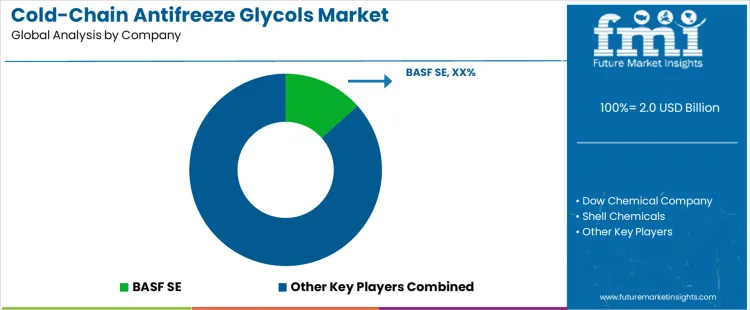
Competition in the cold-chain antifreeze glycols market centers on formulation performance at low temperatures, compatibility with refrigeration systems, and supply reliability for industrial and food logistics applications. BASF SE offers glycols engineered for freeze protection and heat transfer efficiency tailored to controlled temperature supply chain needs. Dow Chemical Company supplies antifreeze glycol products calibrated for performance stability and long service intervals in transport refrigeration units and cold storage. Shell Chemicals delivers glycols formulated to meet OEM specifications for mobile and stationary cooling equipment. INEOS focuses on glycol grades designed for consistent heat transfer and system compatibility. Clariant AG competes through additive packages that enhance low-temperature performance and decomposition resistance. Other participants include regional producers and specialty firms that supply antifreeze glycols adjusted for local regulatory standards and application requirements. Product adoption reflects supplier ability to provide quality documentation, technical support for system integration, and consistent delivery across seasonal demand cycles in logistics and industrial refrigeration segments.
Market differentiation in the cold-chain antifreeze glycols segment arises from materials innovation, impurity control, and alignment with sustainability targets in temperature-sensitive supply chains. BASF SE emphasizes research in polymer purity and controlled thermal properties to support reliable operation under extended low-temperature exposure. Dow Chemical Company advances glycol formulations that maintain viscosity and thermal stability for refrigerated transport and warehouse cooling systems. Shell Chemicals integrates fluid quality monitoring support for fleet operators and equipment manufacturers. INEOS focuses on high-performance glycol products that resist system degradation caused by repeated freeze cycles. Clariant AG contributes additive technologies that improve corrosion protection and fluid longevity. Other competitors tailor antifreeze glycols for niche requirements such as ultra-low-temperature applications or green supply chain initiatives. Competitive positioning in this market reflects product consistency, technical validation for thermal management, and ability to align with regulatory and sustainability reporting expectations among cold-chain stakeholders.
Key Players in the Cold-Chain Antifreeze Glycols Market
- BASF SE
- Dow Chemical Company
- Shell Chemicals
- INEOS
- Clariant AG
- Others
Scope of the Report
| Items | Values |
|---|---|
| Quantitative Units (2026) | USD billion |
| Product Type | Monoethylene Glycol (MEG), Propylene Glycol (PG), Diethylene Glycol (DEG), Triethylene Glycol (TEG), Others |
| Application | Cold Chain Transport Refrigeration, Cold Storage Warehouses, Pharmaceutical & Biologics Logistics, Food & Beverage Cold Chain, Others |
| End User | Logistics & Transportation Providers, Pharmaceuticals & Healthcare, Food & Beverage Industry, Retail & Distribution Centers, Others |
| Region | Asia Pacific, Europe, North America, Latin America, Middle East & Africa |
| Key Countries Covered | China, Japan, South Korea, India, Australia & New Zealand, Germany, United Kingdom, France, Italy, Spain, Nordic, BENELUX, United States, Canada, Mexico, Brazil, Chile, Kingdom of Saudi Arabia, Other GCC Countries, Turkey, South Africa, Other African Union |
| Key Companies Profiled | BASF SE, Dow Chemical Company, Shell Chemicals, INEOS, Clariant AG, Others |
| Additional Attributes | Dollar sales by product type, application, and end user; regional CAGR, volume and value growth projections; adoption in pharmaceutical, food, and cold storage logistics; feedstock sourcing, purity consistency, and process traceability; technical support and regulatory compliance |
Cold-Chain Antifreeze Glycols Market Segmentation
Product Type:
- Monoethylene Glycol (MEG)
- Propylene Glycol (PG)
- Diethylene Glycol (DEG)
- Triethylene Glycol (TEG)
- Others
Application:
- Cold-Chain Transport Refrigeration
- Cold Storage Warehouses
- Pharmaceutical & Biologics Logistics
- Food & Beverage Cold-Chain
- Others
End-User:
- Logistics & Transportation Providers
- Pharmaceuticals & Healthcare
- Food & Beverage Industry
- Retail & Distribution Centers
- Others
Region:
- Asia Pacific
- China
- Japan
- South Korea
- India
- Australia & New Zealand
- ASEAN
- Rest of Asia Pacific
- Europe
- Germany
- United Kingdom
- France
- Italy
- Spain
- Nordic
- BENELUX
- Rest of Europe
- North America
- United States
- Canada
- Mexico
- Latin America
- Brazil
- Chile
- Rest of Latin America
- Middle East & Africa
- Kingdom of Saudi Arabia
- Other GCC Countries
- Turkey
- South Africa
- Other African Union
- Rest of Middle East & Africa
Bibliography
- Food and Agriculture Organization of the United Nations (FAO). (2024). Cold‑chain infrastructure and temperature‑controlled logistics for food safety. FAO Plant Production and Protection Division.
- World Health Organization (WHO). (2024). Temperature‑controlled supply chains for pharmaceuticals and vaccines. World Health Organization.
- International Energy Agency (IEA). (2024). Refrigeration and cooling technologies in global supply chains. International Energy Agency.
- Organisation for Economic Co‑operation and Development (OECD). (2024). Chemical fluids, thermal management, and cold‑chain resilience. OECD Environment, Health and Safety Programme.
- European Commission – Joint Research Centre (JRC). (2025). Industrial heat‑transfer fluids and low‑temperature logistics systems. Publications Office of the European Union.
- U.S. Department of Energy (DOE). (2024). Thermal fluids and refrigeration efficiency in industrial and transport systems. U.S. Department of Energy.
Frequently Asked Questions
How big is the cold-chain antifreeze glycols market in 2026?
The global cold-chain antifreeze glycols market is estimated to be valued at USD 2.0 billion in 2026.
What will be the size of cold-chain antifreeze glycols market in 2036?
The market size for the cold-chain antifreeze glycols market is projected to reach USD 4.5 billion by 2036.
How much will be the cold-chain antifreeze glycols market growth between 2026 and 2036?
The cold-chain antifreeze glycols market is expected to grow at a 8.4% CAGR between 2026 and 2036.
What are the key product types in the cold-chain antifreeze glycols market?
The key product types in cold-chain antifreeze glycols market are monoethylene glycol (meg), propylene glycol (pg), diethylene glycol (deg), triethylene glycol (teg) and others.
Which application segment to contribute significant share in the cold-chain antifreeze glycols market in 2026?
In terms of application, cold‑chain transport refrigeration segment to command 42.3% share in the cold-chain antifreeze glycols market in 2026.
Preview the report firsthand - request a free sample
Get SampleGet the brochure for pricing and purchase details.
Get PDFTable of Content
- Executive Summary
- Global Market Outlook
- Demand-side Trends
- Supply-side Trends
- Technology Roadmap Analysis
- Analysis and Recommendations
- Market Overview
- Market Coverage / Taxonomy
- Market Definition / Scope / Limitations
- Market Background
- Market Dynamics
- Drivers
- Restraints
- Opportunity
- Trends
- Scenario Forecast
- Demand in Optimistic Scenario
- Demand in Likely Scenario
- Demand in Conservative Scenario
- Opportunity Map Analysis
- Product Life Cycle Analysis
- Supply Chain Analysis
- Investment Feasibility Matrix
- Value Chain Analysis
- PESTLE and Porter’s Analysis
- Regulatory Landscape
- Regional Parent Market Outlook
- Production and Consumption Statistics
- Import and Export Statistics
- Market Dynamics
- Global Market Analysis 2021 to 2025 and Forecast, 2026 to 2036
- Historical Market Size Value (USD Million) Analysis, 2021 to 2025
- Current and Future Market Size Value (USD Million) Projections, 2026 to 2036
- Y-o-Y Growth Trend Analysis
- Absolute $ Opportunity Analysis
- Global Market Pricing Analysis 2021 to 2025 and Forecast 2026 to 2036
- Global Market Analysis 2021 to 2025 and Forecast 2026 to 2036, By Product Type
- Introduction / Key Findings
- Historical Market Size Value (USD Million) Analysis By Product Type , 2021 to 2025
- Current and Future Market Size Value (USD Million) Analysis and Forecast By Product Type , 2026 to 2036
- Monoethylene Glycol (MEG)
- Propylene Glycol (PG)
- Diethylene Glycol (DEG)
- Triethylene Glycol (TEG)
- Others
- Monoethylene Glycol (MEG)
- Y-o-Y Growth Trend Analysis By Product Type , 2021 to 2025
- Absolute $ Opportunity Analysis By Product Type , 2026 to 2036
- Global Market Analysis 2021 to 2025 and Forecast 2026 to 2036, By Application
- Introduction / Key Findings
- Historical Market Size Value (USD Million) Analysis By Application, 2021 to 2025
- Current and Future Market Size Value (USD Million) Analysis and Forecast By Application, 2026 to 2036
- Cold‑Chain Transport Refrigeration
- Cold Storage Warehouses
- Pharmaceutical & Biologics Logistics
- Food & Beverage Cold‑Chain
- Others
- Cold‑Chain Transport Refrigeration
- Y-o-Y Growth Trend Analysis By Application, 2021 to 2025
- Absolute $ Opportunity Analysis By Application, 2026 to 2036
- Global Market Analysis 2021 to 2025 and Forecast 2026 to 2036, By End‑User
- Introduction / Key Findings
- Historical Market Size Value (USD Million) Analysis By End‑User, 2021 to 2025
- Current and Future Market Size Value (USD Million) Analysis and Forecast By End‑User, 2026 to 2036
- Logistics & Transportation Providers
- Pharmaceuticals & Healthcare
- Food & Beverage Industry
- Retail & Distribution Centers
- Others
- Logistics & Transportation Providers
- Y-o-Y Growth Trend Analysis By End‑User, 2021 to 2025
- Absolute $ Opportunity Analysis By End‑User, 2026 to 2036
- Global Market Analysis 2021 to 2025 and Forecast 2026 to 2036, By Region
- Introduction
- Historical Market Size Value (USD Million) Analysis By Region, 2021 to 2025
- Current Market Size Value (USD Million) Analysis and Forecast By Region, 2026 to 2036
- North America
- Latin America
- Western Europe
- Eastern Europe
- East Asia
- South Asia and Pacific
- Middle East & Africa
- Market Attractiveness Analysis By Region
- North America Market Analysis 2021 to 2025 and Forecast 2026 to 2036, By Country
- Historical Market Size Value (USD Million) Trend Analysis By Market Taxonomy, 2021 to 2025
- Market Size Value (USD Million) Forecast By Market Taxonomy, 2026 to 2036
- By Country
- USA
- Canada
- Mexico
- By Product Type
- By Application
- By End‑User
- By Country
- Market Attractiveness Analysis
- By Country
- By Product Type
- By Application
- By End‑User
- Key Takeaways
- Latin America Market Analysis 2021 to 2025 and Forecast 2026 to 2036, By Country
- Historical Market Size Value (USD Million) Trend Analysis By Market Taxonomy, 2021 to 2025
- Market Size Value (USD Million) Forecast By Market Taxonomy, 2026 to 2036
- By Country
- Brazil
- Chile
- Rest of Latin America
- By Product Type
- By Application
- By End‑User
- By Country
- Market Attractiveness Analysis
- By Country
- By Product Type
- By Application
- By End‑User
- Key Takeaways
- Western Europe Market Analysis 2021 to 2025 and Forecast 2026 to 2036, By Country
- Historical Market Size Value (USD Million) Trend Analysis By Market Taxonomy, 2021 to 2025
- Market Size Value (USD Million) Forecast By Market Taxonomy, 2026 to 2036
- By Country
- Germany
- UK
- Italy
- Spain
- France
- Nordic
- BENELUX
- Rest of Western Europe
- By Product Type
- By Application
- By End‑User
- By Country
- Market Attractiveness Analysis
- By Country
- By Product Type
- By Application
- By End‑User
- Key Takeaways
- Eastern Europe Market Analysis 2021 to 2025 and Forecast 2026 to 2036, By Country
- Historical Market Size Value (USD Million) Trend Analysis By Market Taxonomy, 2021 to 2025
- Market Size Value (USD Million) Forecast By Market Taxonomy, 2026 to 2036
- By Country
- Russia
- Poland
- Hungary
- Balkan & Baltic
- Rest of Eastern Europe
- By Product Type
- By Application
- By End‑User
- By Country
- Market Attractiveness Analysis
- By Country
- By Product Type
- By Application
- By End‑User
- Key Takeaways
- East Asia Market Analysis 2021 to 2025 and Forecast 2026 to 2036, By Country
- Historical Market Size Value (USD Million) Trend Analysis By Market Taxonomy, 2021 to 2025
- Market Size Value (USD Million) Forecast By Market Taxonomy, 2026 to 2036
- By Country
- China
- Japan
- South Korea
- By Product Type
- By Application
- By End‑User
- By Country
- Market Attractiveness Analysis
- By Country
- By Product Type
- By Application
- By End‑User
- Key Takeaways
- South Asia and Pacific Market Analysis 2021 to 2025 and Forecast 2026 to 2036, By Country
- Historical Market Size Value (USD Million) Trend Analysis By Market Taxonomy, 2021 to 2025
- Market Size Value (USD Million) Forecast By Market Taxonomy, 2026 to 2036
- By Country
- India
- ASEAN
- Australia & New Zealand
- Rest of South Asia and Pacific
- By Product Type
- By Application
- By End‑User
- By Country
- Market Attractiveness Analysis
- By Country
- By Product Type
- By Application
- By End‑User
- Key Takeaways
- Middle East & Africa Market Analysis 2021 to 2025 and Forecast 2026 to 2036, By Country
- Historical Market Size Value (USD Million) Trend Analysis By Market Taxonomy, 2021 to 2025
- Market Size Value (USD Million) Forecast By Market Taxonomy, 2026 to 2036
- By Country
- Kingdom of Saudi Arabia
- Other GCC Countries
- Turkiye
- South Africa
- Other African Union
- Rest of Middle East & Africa
- By Product Type
- By Application
- By End‑User
- By Country
- Market Attractiveness Analysis
- By Country
- By Product Type
- By Application
- By End‑User
- Key Takeaways
- Key Countries Market Analysis
- USA
- Pricing Analysis
- Market Share Analysis, 2025
- By Product Type
- By Application
- By End‑User
- Canada
- Pricing Analysis
- Market Share Analysis, 2025
- By Product Type
- By Application
- By End‑User
- Mexico
- Pricing Analysis
- Market Share Analysis, 2025
- By Product Type
- By Application
- By End‑User
- Brazil
- Pricing Analysis
- Market Share Analysis, 2025
- By Product Type
- By Application
- By End‑User
- Chile
- Pricing Analysis
- Market Share Analysis, 2025
- By Product Type
- By Application
- By End‑User
- Germany
- Pricing Analysis
- Market Share Analysis, 2025
- By Product Type
- By Application
- By End‑User
- UK
- Pricing Analysis
- Market Share Analysis, 2025
- By Product Type
- By Application
- By End‑User
- Italy
- Pricing Analysis
- Market Share Analysis, 2025
- By Product Type
- By Application
- By End‑User
- Spain
- Pricing Analysis
- Market Share Analysis, 2025
- By Product Type
- By Application
- By End‑User
- France
- Pricing Analysis
- Market Share Analysis, 2025
- By Product Type
- By Application
- By End‑User
- India
- Pricing Analysis
- Market Share Analysis, 2025
- By Product Type
- By Application
- By End‑User
- ASEAN
- Pricing Analysis
- Market Share Analysis, 2025
- By Product Type
- By Application
- By End‑User
- Australia & New Zealand
- Pricing Analysis
- Market Share Analysis, 2025
- By Product Type
- By Application
- By End‑User
- China
- Pricing Analysis
- Market Share Analysis, 2025
- By Product Type
- By Application
- By End‑User
- Japan
- Pricing Analysis
- Market Share Analysis, 2025
- By Product Type
- By Application
- By End‑User
- South Korea
- Pricing Analysis
- Market Share Analysis, 2025
- By Product Type
- By Application
- By End‑User
- Russia
- Pricing Analysis
- Market Share Analysis, 2025
- By Product Type
- By Application
- By End‑User
- Poland
- Pricing Analysis
- Market Share Analysis, 2025
- By Product Type
- By Application
- By End‑User
- Hungary
- Pricing Analysis
- Market Share Analysis, 2025
- By Product Type
- By Application
- By End‑User
- Kingdom of Saudi Arabia
- Pricing Analysis
- Market Share Analysis, 2025
- By Product Type
- By Application
- By End‑User
- Turkiye
- Pricing Analysis
- Market Share Analysis, 2025
- By Product Type
- By Application
- By End‑User
- South Africa
- Pricing Analysis
- Market Share Analysis, 2025
- By Product Type
- By Application
- By End‑User
- USA
- Market Structure Analysis
- Competition Dashboard
- Competition Benchmarking
- Market Share Analysis of Top Players
- By Regional
- By Product Type
- By Application
- By End‑User
- Competition Analysis
- Competition Deep Dive
- BASF SE
- Overview
- Product Portfolio
- Profitability by Market Segments (Product/Age /Sales Channel/Region)
- Sales Footprint
- Strategy Overview
- Marketing Strategy
- Product Strategy
- Channel Strategy
- Dow Chemical Company
- Shell Chemicals
- INEOS
- Clariant AG
- Others
- BASF SE
- Competition Deep Dive
- Assumptions & Acronyms Used
- Research Methodology


