

- Industry Size (2026)
- USD 2.4 Bn
- Forecast (2036)
- USD 5.5 Bn
- CAGR (2026 to 2036)
- 8.6%
Recycled PET Bottle Glycols Market Forecast and Outlook 2026 to 2036
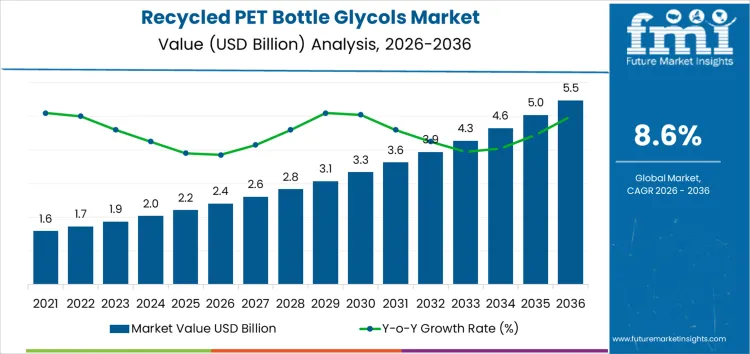
The recycled PET bottle glycols market is valued at USD 2.4 billion in 2026 and is projected to reach USD 5.5 billion by 2036, reflecting a CAGR of 8.6%. Production is concentrated among suppliers with access to large-scale PET recycling streams and integrated glycol synthesis facilities. Regional control over recycling collection, feedstock availability, and logistics affects consistent supply. Reliability is influenced by seasonal collection fluctuations, polymer quality, and regulatory compliance for recycled content. Smaller operators face constraints in scaling production and securing high-quality feedstock. Margin concentration favors companies providing validated, application-ready glycols for packaging, fiber, and industrial polymer applications rather than bulk, undifferentiated material.
Performance is shaped by alignment with high-volume industrial and packaging programs and integration with certified recycling streams. Adoption varies regionally depending on collection infrastructure, polymer availability, and regulatory mandates for recycled content. Operators offering certified glycols with consistent purity, performance validation, and technical support capture concentrated value. Fragmentation persists among regional recyclers and small-scale converters, while leading suppliers secure margins through production control, validated quality, and multi-application compatibility. Revenue concentration depends on feedstock access, product reliability, and integration with end-use supply chains rather than output volume alone.
Quick Stats of the Recycled PET Bottle Glycols Market
- Recycled PET Bottle Glycols Market Value (2026): USD 2.4 billion
- Recycled PET Bottle Glycols Forecast Value (2036): USD 5.5 billion
- Recycled PET Bottle Glycols Forecast CAGR 2026 to 2036: 8.6%
- Leading Product Type in Recycled PET Bottle Glycols Market: rPET Glycol (52.4% share)
- Leading End-Use Industry in Recycled PET Bottle Glycols Market: Polyester Fiber Production (41.8% share)
- Key Growth Regions in Recycled PET Bottle Glycols Market: USA, China, India, Germany, Japan
- Top Players in Recycled PET Bottle Glycols Market: Indorama Ventures, M&G Chemicals, Far Eastern New Century (FENC), Unifi, Inc., SABIC (recycled PET business)
What is the Growth Forecast for Recycled PET Bottle Glycols Market through 2036?
Between 2026 and 2031, the recycled PET bottle glycols market is projected to grow from USD 2.4 billion to USD 3.3 billion, generating an absolute increase of USD 0.9 billion. Volume contributes approximately 68% of growth, driven by adoption of recycled PET glycol (rPET glycol), rPET-derived MEG, and rPET-derived DEG across polyester fiber production, PET bottle recycling, and packaging films. Price growth accounts for 32%, supported by premium recycled feedstocks, high-purity processing, and application-specific formulations. Value capture favors suppliers providing consistent quality, technical support, and integration with fiber, packaging, and automotive end-use industries.
From 2031 to 2036, the market is expected to expand from USD 3.3 billion to USD 5.5 billion, adding USD 1.6 billion. Volume remains the dominant driver, contributing roughly 66% of growth due to expanded adoption in textiles, packaging, and automotive applications, along with rising recycling penetration. Price growth represents 34%, supported by differentiated rPET products, high-purity glycol grades, and regulatory compliance. Competitive advantage favors suppliers with validated rPET glycol production, strong end-use partnerships, and scalable operations. Leading companies include Indorama Ventures, M&G Chemicals, Far Eastern New Century (FENC), Unifi, Inc., and SABIC (recycled PET business).
Recycled PET Bottle Glycols Market Key Takeaways
| Metric | Value |
|---|---|
| Market Value (2026) | USD 2.4 billion |
| Forecast Value (2036) | USD 5.5 billion |
| Forecast CAGR 2026 to 2036 | 8.60% |
What Is Driving Demand for Recycled PET Bottle Glycols?
Recycled PET (rPET) bottle glycols are increasingly used to produce polyesters, fibers, and resins while promoting circularity in plastic packaging. Historically, virgin PET glycol feedstocks dominated production, creating dependency on fossil resources and contributing to environmental impact. Modern rPET glycols are recovered through depolymerization of post-consumer PET bottles, providing high-purity intermediates for PET resin, polyester fibers, and polyurethane applications. Resin manufacturers, fiber producers, and chemical companies prioritize material consistency, purity, and regulatory compliance. Early adoption focused on eco-conscious brands and specialty fibers, while current demand spans mass-market packaging, textiles, and industrial polyester applications driven by sustainability mandates, recycled content regulations, and corporate circular economy commitments. Feedstock availability, depolymerization efficiency, and product purity influence supplier selection.
Increasing regulatory pressure, consumer demand for sustainable packaging, and corporate ESG targets are shaping growth in the rPET bottle glycols market. Compared with virgin feedstocks, recycled glycols emphasize process efficiency, consistent chemical composition, and compatibility with existing polymerization processes. Cost structures depend on collection logistics, depolymerization technology, and purification steps, concentrating margins among suppliers capable of delivering high-quality, traceable glycols. Manufacturers adopt rPET glycols to reduce carbon footprint, comply with recycled content requirements, and support circular production models. By 2036, recycled PET bottle glycols are expected to become a standard feedstock for polyester and PET resin production, enabling sustainable manufacturing and enhanced resource efficiency across multiple industries.
What Factors Are Shaping the Demand for Recycled PET Bottle Glycols in Terms of Product Type and End-Use Industry?
The demand for recycled PET (rPET) bottle glycols is segmented by product type and end-use industry. Product types include rPET glycol, rPET-derived monoethylene glycol (MEG), rPET-derived diethylene glycol (DEG), and other derivatives. End-use industries cover polyester fiber production, PET bottle recycling, packaging films and sheets, automotive and industrial applications, and other sectors. Adoption is influenced by sustainability targets, regulatory compliance, and feedstock availability. Uptake is driven by circular economy initiatives, cost efficiency, and operational reliability. Product type and industry selection depend on manufacturing requirements, material compatibility, and performance needs, ensuring efficient utilization of recycled PET glycols across diverse applications.
Why Is rPET Glycol Leading the Product Type Segment in Recycled PET Bottle Glycols?
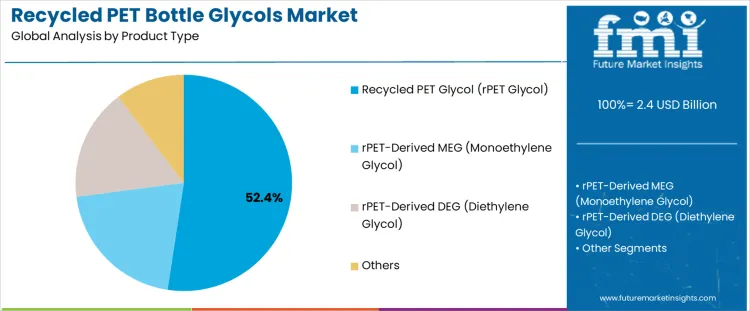
rPET glycol accounts for approximately 52% of total product type demand, making it the leading category. This compound is produced by glycolysis of post-consumer PET bottles and serves as a feedstock for polyester resins, fiber, and packaging materials. Adoption is reinforced by its compatibility with existing polymerization processes, consistent quality, and environmental benefits. Manufacturers incorporate rPET glycol into polyester fiber production, films, and sheets to reduce reliance on virgin raw materials and lower carbon footprint. Maintenance includes monitoring glycol purity, viscosity, and reaction conditions to ensure performance. The segment leads because rPET glycol combines operational reliability, sustainability, and versatility for diverse industrial applications.
Operational factors further support adoption. rPET glycol must maintain chemical stability, consistent composition, and processability under variable temperature and reaction conditions. Integration into downstream polymerization or resin production ensures high-quality end products. The segment leads because rPET glycol provides predictable performance, enhances circular economy goals, and supports reliable industrial operations across multiple sectors.
Why Is Polyester Fiber Production Representing the Largest End-Use Industry Segment in Recycled PET Glycols?
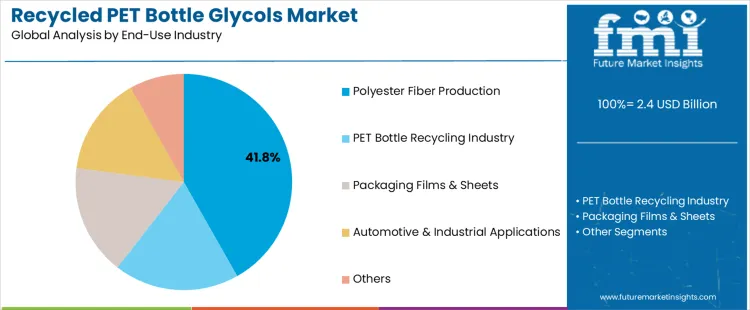
Polyester fiber production accounts for approximately 41.8% of total end-use demand, making it the largest segment. Recycled PET glycols serve as key monomers for producing polyester fibers used in textiles, industrial fabrics, and nonwovens. Adoption is driven by demand for sustainable fibers, regulatory encouragement, and operational efficiency. Manufacturers utilize rPET glycols to produce high-strength, durable polyester with reduced environmental impact. Maintenance and quality assurance involve monitoring polymerization, fiber consistency, and chemical composition.
Operational and functional factors influence adoption. Glycols must react efficiently during polymerization, maintain thermal stability, and produce fibers with consistent mechanical properties. Integration with spinning and finishing processes ensures quality and performance. Polyester fiber production leads because it represents the largest and most consistent industrial demand for recycled PET glycols, providing measurable sustainability, operational reliability, and economic benefits across the textile and industrial sectors.
How Are Recycled PET Bottle Glycols Supporting Circular Economy Initiatives?
Recycled PET (rPET) bottle glycols are increasingly used in polyester fiber production, packaging resins, and engineering plastics to reduce reliance on virgin PET and minimize environmental impact. Adoption is strongest in regions with established PET recycling infrastructure, strict sustainability regulations, and growing demand for recycled content products. Glycols are selected for purity, reaction consistency, and compatibility with polymerization processes. Growth is driven by regulatory mandates on recycled content, corporate sustainability targets, and consumer demand for circular products. Investment focuses on collection, purification, and quality control processes. Manufacturers prioritize rPET glycols that maintain polymer performance while meeting regional environmental and regulatory standards.
Why Are Regional Recycling Infrastructure and Sustainability Policies Driving Demand?
Demand is shaped by local recycling programs, extended producer responsibility regulations, and mandates for recycled content in packaging and textiles. Manufacturers adopt rPET glycols to comply with environmental regulations, reduce carbon footprint, and achieve sustainability certifications. Glycols with consistent purity, chemical stability, and compatibility with existing polyester production gain preference. Adoption is concentrated in regions with well-developed recycling networks and active sustainability policies. Compliance with environmental standards and operational reliability drive procurement rather than cost. Suppliers providing validated, high-quality rPET glycols gain competitive advantage among polymer producers and brand owners.
What Factors Restrict Broader Adoption of Recycled PET Glycols?
High collection and purification costs, variability in feedstock quality, and processing challenges restrict adoption. Contaminants in post-consumer PET and fluctuations in bottle supply can impact glycol consistency. Integration into existing polymerization processes requires technical expertise. Certification and regulatory approval timelines may delay deployment. Smaller manufacturers or regions with limited recycling infrastructure face adoption challenges. These factors concentrate early use among large-scale polyester producers, brands with sustainability targets, and regions with efficient PET collection and recycling systems.
How Are Technological Advances and Industry Collaboration Shaping Market Growth?
Innovations include advanced depolymerization methods, purification technologies, and process optimization to produce high-purity rPET glycols. Collaboration between recycling companies, polymer manufacturers, and research institutions ensures quality validation, regulatory compliance, and process efficiency. Pilot programs evaluate chemical consistency, polymer performance, and environmental impact before large-scale deployment. Quality monitoring, traceability, and standardization support reliability and compliance. Focus is on material performance, sustainability, and regulatory alignment rather than cost or volume. Collaborative initiatives enable broader adoption of rPET glycols, promoting circular economy practices in regional polyester production and packaging industries.
What is the Demand for Recycled PET Bottle Glycols by Country?
| Country | CAGR (%) |
|---|---|
| USA | 9.1 |
| China | 9.8 |
| India | 10.2 |
| Germany | 8.4 |
| Japan | 7.9 |
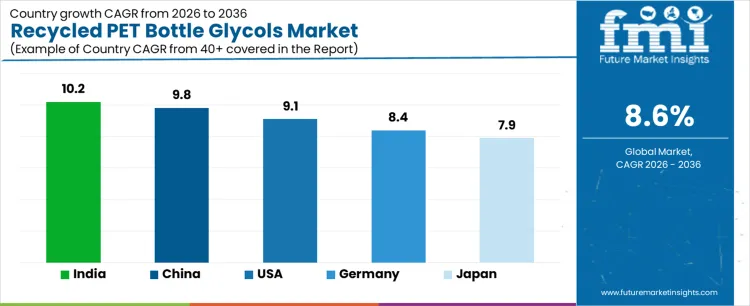
Demand for recycled PET bottle glycols is rising as manufacturers prioritize sustainable feedstocks for polyester production, packaging, and textile applications. India leads with a 10.2% CAGR, driven by growing recycling infrastructure, rising domestic PET consumption, and adoption of circular economy practices. China follows at 9.8%, supported by large-scale PET recycling programs, high industrial consumption, and regulatory initiatives for sustainable materials. The USA grows at 9.1%, shaped by demand in packaging, fibers, and engineering polymers. Germany records 8.4% growth, reflecting steady adoption in textile and packaging sectors. Japan shows 7.9% CAGR, driven by moderate domestic PET recycling and use in polyester production and industrial applications.
How Is the United States Experiencing Growth in the Recycled PET Bottle Glycols Market?
United States is experiencing growth at a CAGR of 9.1%, supported by adoption of recycled PET (rPET) glycols in packaging, textile, and polymer applications to reduce environmental impact and promote circular economy initiatives. Manufacturers and chemical suppliers are producing glycols derived from post-consumer PET bottles, optimized for polymerization, thermal stability, and consistent quality. Demand is concentrated in industrial hubs, packaging manufacturers, and textile production centers. Investments focus on material purity, process efficiency, and regulatory compliance rather than production scale expansion. Growth reflects increasing industrial adoption of recycled materials, regulatory support for sustainable production, and rising demand for eco-friendly polymer intermediates.
- rPET glycols drive adoption.
- Applications include packaging, textiles, and polymer production.
- Industrial hubs and production centers concentrate demand.
- Material purity and process efficiency guide investment.
How Is China Witnessing Rapid Growth With Circular Economy Initiatives?
China is witnessing growth at a CAGR of 9.8%, fueled by adoption of recycled PET glycols to support circular economy strategies and reduce plastic waste. Chemical manufacturers and polymer producers are deploying glycols derived from post-consumer PET, optimized for polymerization, thermal stability, and consistent performance. Demand is concentrated in major industrial hubs and packaging and textile production centers. Investments prioritize material quality, process reliability, and compliance with environmental regulations rather than broad-scale expansion. Growth reflects government policies supporting recycling, increasing industrial adoption of sustainable materials, and rising demand for eco-friendly polymer intermediates.
- Circular economy initiatives drive adoption.
- Glycols are applied in polymer, textile, and packaging production.
- Industrial hubs and production centers concentrate demand.
- Material quality and process reliability guide investment.
How Is India Experiencing Rapid Growth With Sustainable Polymer Solutions?
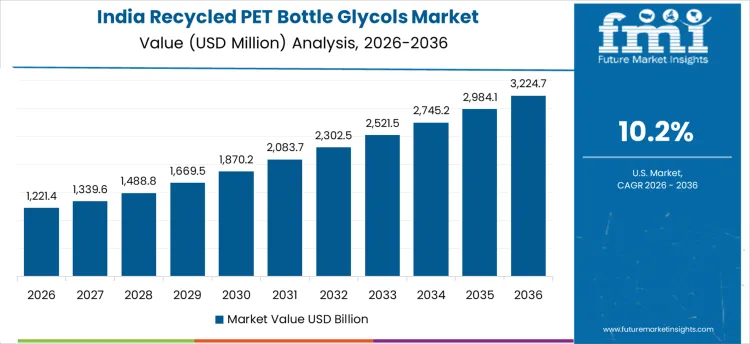
India is experiencing growth at a CAGR of 10.2%, supported by adoption of recycled PET glycols in packaging, textile, and polymer industries to reduce reliance on virgin materials and minimize environmental impact. Manufacturers and suppliers are producing glycols derived from post-consumer PET bottles, optimized for thermal stability, polymerization, and consistent quality. Demand is concentrated in industrial clusters, textile production regions, and packaging hubs. Investments focus on material purity, process efficiency, and regulatory compliance rather than production area expansion. Growth reflects rising awareness of sustainable materials, government incentives for recycling, and increasing industrial adoption of eco-friendly polymer intermediates.
- Sustainable polymer solutions drive adoption.
- Glycols are used in packaging, textile, and polymer applications.
- Industrial clusters and production hubs concentrate demand.
- Material purity and process efficiency guide investment.
How Is Germany Witnessing Steady Growth With Recycling Programs?
Germany is witnessing growth at a CAGR of 8.4%, supported by adoption of recycled PET glycols in industrial and packaging applications to enhance sustainability and reduce carbon footprint. Chemical producers and polymer manufacturers are deploying glycols optimized for thermal stability, polymerization efficiency, and product consistency. Demand is concentrated in industrial hubs, packaging manufacturers, and textile production centers. Investments prioritize material quality, regulatory compliance, and process reliability rather than area expansion. Growth reflects government recycling programs, industrial adoption of sustainable polymers, and increasing use of recycled materials in commercial production.
- Recycling initiatives drive adoption.
- Glycols are applied in polymer, packaging, and textile industries.
- Industrial hubs and manufacturing centers concentrate demand.
- Material quality and regulatory compliance guide investment.
How Is Japan Experiencing Moderate Growth With Eco-Friendly Polymer Adoption?
Japan is experiencing growth at a CAGR of 7.9%, fueled by adoption of recycled PET glycols in packaging, textile, and polymer production to reduce environmental impact and support sustainability goals. Manufacturers and chemical suppliers are deploying glycols derived from post-consumer PET, optimized for polymerization, thermal stability, and consistent performance. Demand is concentrated in industrial clusters, packaging manufacturers, and textile production regions. Investments focus on material purity, process efficiency, and regulatory compliance rather than large-scale expansion. Growth reflects gradual industrial adoption of eco-friendly polymers, government initiatives for recycling, and rising demand for sustainable materials.
- Eco-friendly polymers drive adoption.
- Glycols are used in packaging, textile, and polymer production.
- Industrial clusters and production regions concentrate demand.
- Material purity and process efficiency guide investment.
Who Competes in the Recycled PET Bottle Glycols Market and What Defines Their Roles?
Competition in the recycled PET bottle glycols market centers on feedstock sourcing, glycol quality consistency, and alignment with polyester downstream specifications. Indorama Ventures supplies recycled ethylene glycol from post consumer PET streams tailored for textile and packaging resin producers seeking reduced environmental footprint inputs. M&G Chemicals offers glycol products derived from mechanical and advanced recycling that serve polyester filament and resin manufacturers focused on circularity performance. Far Eastern New Century (FENC) develops recycled glycols integrated with its feedstock infrastructure to support large scale polyester production demands.
Unifi, Inc. positions its recycled glycols within branded recycled polyester fibers emphasizing supply chain traceability. SABIC (recycled PET business) competes with engineered recycled glycols that align with circular feedstock platforms. Other market participants include regional recyclers and specialty chemical firms that supply glycol streams matched to processing and quality thresholds required by polyester end users. Adoption reflects supplier ability to deliver consistent quality, integrate traceability documentation, and support formulation for high performance polyester applications.
Product differentiation in the recycled PET bottle glycols market emerges from polymer quality, decontamination technology, and alignment with customer performance needs. Indorama Ventures emphasizes investment in purification processes that stabilize glycol properties for critical applications in textile filaments and packaging resin blends. M&G Chemicals focuses on broad application glycol grades that meet varied polyester polymerization requirements and support fiber and film production. Far Eastern New Century (FENC) integrates recycled glycol supply with established polymer production, enabling consistent throughput.
Unifi, Inc. links recycled PET feedstock to its branded textile offerings, providing downstream users with traceability assurances. SABIC (recycled PET business) delivers engineered glycols compatible with circular economy frameworks and documented quality standards. Other competitors include regional and specialty firms with glycol grades designed for defined viscosity and impurity thresholds. Market distinction is shaped by ability to meet stringent quality metrics, provide supply security, and align documentation with regulatory and sustainability reporting expectations.
Key Players in the Recycled PET Bottle Glycols Market
- Indorama Ventures
- M&G Chemicals
- Far Eastern New Century (FENC)
- Unifi, Inc.
- SABIC (recycled PET business)
- Others
Scope of the Report
| Items | Values |
|---|---|
| Quantitative Units (2026) | USD billion |
| Product Type | Recycled PET Glycol (rPET Glycol), rPET Derived MEG (Monoethylene Glycol), rPET Derived DEG (Diethylene Glycol), Others |
| End Use Industry | Polyester Fiber Production, PET Bottle Recycling Industry, Packaging Films & Sheets, Automotive & Industrial Applications, Others |
| Application | Textile & Apparel, Packaging, Automotive, Consumer Goods, Others |
| Region | Asia Pacific, Europe, North America, Latin America, Middle East & Africa |
| Key Countries Covered | China, Japan, South Korea, India, Australia & New Zealand, Germany, United Kingdom, France, Italy, Spain, Nordic, BENELUX, United States, Canada, Mexico, Brazil, Chile, Kingdom of Saudi Arabia, Other GCC Countries, Turkey, South Africa, Other African Union |
| Key Companies Profiled | Indorama Ventures, M&G Chemicals, Far Eastern New Century (FENC), Unifi, Inc., SABIC (recycled PET business), Others |
| Additional Attributes | Dollar sales by product type, end-use industry, and application; regional CAGR, volume and value growth projections; adoption in polyester fiber, packaging, and industrial polymer production; feedstock sourcing, purity consistency, and process traceability; technical support and regulatory compliance |
Recycled PET Bottle Glycols Market Segmentation
Product Type:
- Recycled PET Glycol (rPET Glycol)
- rPET Derived MEG (Monoethylene Glycol)
- rPET Derived DEG (Diethylene Glycol)
- Others
End Use Industry:
- Polyester Fiber Production
- PET Bottle Recycling Industry
- Packaging Films & Sheets
- Automotive & Industrial Applications
- Others
Application:
- Textile & Apparel
- Packaging
- Automotive
- Consumer Goods
- Others
Region:
- Asia Pacific
- China
- Japan
- South Korea
- India
- Australia & New Zealand
- ASEAN
- Rest of Asia Pacific
- Europe
- Germany
- United Kingdom
- France
- Italy
- Spain
- Nordic
- BENELUX
- Rest of Europe
- North America
- United States
- Canada
- Mexico
- Latin America
- Brazil
- Chile
- Rest of Latin America
- Middle East & Africa
- Kingdom of Saudi Arabia
- Other GCC Countries
- Turkey
- South Africa
- Other African Union
- Rest of Middle East & Africa
Bibliography
- European Commission – Joint Research Centre (JRC). (2024). Chemical recycling of PET and production of secondary glycols for circular plastics. Publications Office of the European Union.
- Organisation for Economic Co‑operation and Development (OECD). (2024). Chemical recycling pathways and recycled feedstocks in the circular plastics economy. OECD Environment, Health and Safety Programme.
- United Nations Environment Programme (UNEP). (2025). Advanced recycling of plastics and circular production of polymer intermediates. UNEP Chemicals and Health Branch.
- U.S. Department of Energy (DOE). (2024). Chemical recycling technologies for PET waste and production of recycled glycols. Office of Energy Efficiency & Renewable Energy, U.S. Department of Energy.
- International Energy Agency (IEA). (2025). Energy and material efficiency in chemical recycling of plastics. IEA Technology Collaboration Programme.
Frequently Asked Questions
How big is the recycled pet bottle glycols market in 2026?
The global recycled pet bottle glycols market is estimated to be valued at USD 2.4 billion in 2026.
What will be the size of recycled pet bottle glycols market in 2036?
The market size for the recycled pet bottle glycols market is projected to reach USD 5.5 billion by 2036.
How much will be the recycled pet bottle glycols market growth between 2026 and 2036?
The recycled pet bottle glycols market is expected to grow at a 8.6% CAGR between 2026 and 2036.
What are the key product types in the recycled pet bottle glycols market?
The key product types in recycled pet bottle glycols market are recycled pet glycol (rpet glycol), rpet‑derived meg (monoethylene glycol), rpet‑derived deg (diethylene glycol) and others.
Which end‑use industry segment to contribute significant share in the recycled pet bottle glycols market in 2026?
In terms of end‑use industry, polyester fiber production segment to command 41.8% share in the recycled pet bottle glycols market in 2026.
Preview the report firsthand - request a free sample
Get SampleGet the brochure for pricing and purchase details.
Get PDFTable of Content
- Executive Summary
- Global Market Outlook
- Demand-side Trends
- Supply-side Trends
- Technology Roadmap Analysis
- Analysis and Recommendations
- Market Overview
- Market Coverage / Taxonomy
- Market Definition / Scope / Limitations
- Market Background
- Market Dynamics
- Drivers
- Restraints
- Opportunity
- Trends
- Scenario Forecast
- Demand in Optimistic Scenario
- Demand in Likely Scenario
- Demand in Conservative Scenario
- Opportunity Map Analysis
- Product Life Cycle Analysis
- Supply Chain Analysis
- Investment Feasibility Matrix
- Value Chain Analysis
- PESTLE and Porter’s Analysis
- Regulatory Landscape
- Regional Parent Market Outlook
- Production and Consumption Statistics
- Import and Export Statistics
- Market Dynamics
- Global Market Analysis 2021 to 2025 and Forecast, 2026 to 2036
- Historical Market Size Value (USD Million) Analysis, 2021 to 2025
- Current and Future Market Size Value (USD Million) Projections, 2026 to 2036
- Y-o-Y Growth Trend Analysis
- Absolute $ Opportunity Analysis
- Global Market Pricing Analysis 2021 to 2025 and Forecast 2026 to 2036
- Global Market Analysis 2021 to 2025 and Forecast 2026 to 2036, By Product Type
- Introduction / Key Findings
- Historical Market Size Value (USD Million) Analysis By Product Type , 2021 to 2025
- Current and Future Market Size Value (USD Million) Analysis and Forecast By Product Type , 2026 to 2036
- Recycled PET Glycol (rPET Glycol)
- rPET‑Derived MEG (Monoethylene Glycol)
- rPET‑Derived DEG (Diethylene Glycol)
- Others
- Recycled PET Glycol (rPET Glycol)
- Y-o-Y Growth Trend Analysis By Product Type , 2021 to 2025
- Absolute $ Opportunity Analysis By Product Type , 2026 to 2036
- Global Market Analysis 2021 to 2025 and Forecast 2026 to 2036, By End‑Use Industry
- Introduction / Key Findings
- Historical Market Size Value (USD Million) Analysis By End‑Use Industry, 2021 to 2025
- Current and Future Market Size Value (USD Million) Analysis and Forecast By End‑Use Industry, 2026 to 2036
- Polyester Fiber Production
- PET Bottle Recycling Industry
- Packaging Films & Sheets
- Automotive & Industrial Applications
- Others
- Polyester Fiber Production
- Y-o-Y Growth Trend Analysis By End‑Use Industry, 2021 to 2025
- Absolute $ Opportunity Analysis By End‑Use Industry, 2026 to 2036
- Global Market Analysis 2021 to 2025 and Forecast 2026 to 2036, By Application
- Introduction / Key Findings
- Historical Market Size Value (USD Million) Analysis By Application, 2021 to 2025
- Current and Future Market Size Value (USD Million) Analysis and Forecast By Application, 2026 to 2036
- Textile & Apparel
- Packaging
- Automotive
- Consumer Goods
- Others
- Textile & Apparel
- Y-o-Y Growth Trend Analysis By Application, 2021 to 2025
- Absolute $ Opportunity Analysis By Application, 2026 to 2036
- Global Market Analysis 2021 to 2025 and Forecast 2026 to 2036, By Region
- Introduction
- Historical Market Size Value (USD Million) Analysis By Region, 2021 to 2025
- Current Market Size Value (USD Million) Analysis and Forecast By Region, 2026 to 2036
- North America
- Latin America
- Western Europe
- Eastern Europe
- East Asia
- South Asia and Pacific
- Middle East & Africa
- Market Attractiveness Analysis By Region
- North America Market Analysis 2021 to 2025 and Forecast 2026 to 2036, By Country
- Historical Market Size Value (USD Million) Trend Analysis By Market Taxonomy, 2021 to 2025
- Market Size Value (USD Million) Forecast By Market Taxonomy, 2026 to 2036
- By Country
- USA
- Canada
- Mexico
- By Product Type
- By End‑Use Industry
- By Application
- By Country
- Market Attractiveness Analysis
- By Country
- By Product Type
- By End‑Use Industry
- By Application
- Key Takeaways
- Latin America Market Analysis 2021 to 2025 and Forecast 2026 to 2036, By Country
- Historical Market Size Value (USD Million) Trend Analysis By Market Taxonomy, 2021 to 2025
- Market Size Value (USD Million) Forecast By Market Taxonomy, 2026 to 2036
- By Country
- Brazil
- Chile
- Rest of Latin America
- By Product Type
- By End‑Use Industry
- By Application
- By Country
- Market Attractiveness Analysis
- By Country
- By Product Type
- By End‑Use Industry
- By Application
- Key Takeaways
- Western Europe Market Analysis 2021 to 2025 and Forecast 2026 to 2036, By Country
- Historical Market Size Value (USD Million) Trend Analysis By Market Taxonomy, 2021 to 2025
- Market Size Value (USD Million) Forecast By Market Taxonomy, 2026 to 2036
- By Country
- Germany
- UK
- Italy
- Spain
- France
- Nordic
- BENELUX
- Rest of Western Europe
- By Product Type
- By End‑Use Industry
- By Application
- By Country
- Market Attractiveness Analysis
- By Country
- By Product Type
- By End‑Use Industry
- By Application
- Key Takeaways
- Eastern Europe Market Analysis 2021 to 2025 and Forecast 2026 to 2036, By Country
- Historical Market Size Value (USD Million) Trend Analysis By Market Taxonomy, 2021 to 2025
- Market Size Value (USD Million) Forecast By Market Taxonomy, 2026 to 2036
- By Country
- Russia
- Poland
- Hungary
- Balkan & Baltic
- Rest of Eastern Europe
- By Product Type
- By End‑Use Industry
- By Application
- By Country
- Market Attractiveness Analysis
- By Country
- By Product Type
- By End‑Use Industry
- By Application
- Key Takeaways
- East Asia Market Analysis 2021 to 2025 and Forecast 2026 to 2036, By Country
- Historical Market Size Value (USD Million) Trend Analysis By Market Taxonomy, 2021 to 2025
- Market Size Value (USD Million) Forecast By Market Taxonomy, 2026 to 2036
- By Country
- China
- Japan
- South Korea
- By Product Type
- By End‑Use Industry
- By Application
- By Country
- Market Attractiveness Analysis
- By Country
- By Product Type
- By End‑Use Industry
- By Application
- Key Takeaways
- South Asia and Pacific Market Analysis 2021 to 2025 and Forecast 2026 to 2036, By Country
- Historical Market Size Value (USD Million) Trend Analysis By Market Taxonomy, 2021 to 2025
- Market Size Value (USD Million) Forecast By Market Taxonomy, 2026 to 2036
- By Country
- India
- ASEAN
- Australia & New Zealand
- Rest of South Asia and Pacific
- By Product Type
- By End‑Use Industry
- By Application
- By Country
- Market Attractiveness Analysis
- By Country
- By Product Type
- By End‑Use Industry
- By Application
- Key Takeaways
- Middle East & Africa Market Analysis 2021 to 2025 and Forecast 2026 to 2036, By Country
- Historical Market Size Value (USD Million) Trend Analysis By Market Taxonomy, 2021 to 2025
- Market Size Value (USD Million) Forecast By Market Taxonomy, 2026 to 2036
- By Country
- Kingdom of Saudi Arabia
- Other GCC Countries
- Turkiye
- South Africa
- Other African Union
- Rest of Middle East & Africa
- By Product Type
- By End‑Use Industry
- By Application
- By Country
- Market Attractiveness Analysis
- By Country
- By Product Type
- By End‑Use Industry
- By Application
- Key Takeaways
- Key Countries Market Analysis
- USA
- Pricing Analysis
- Market Share Analysis, 2025
- By Product Type
- By End‑Use Industry
- By Application
- Canada
- Pricing Analysis
- Market Share Analysis, 2025
- By Product Type
- By End‑Use Industry
- By Application
- Mexico
- Pricing Analysis
- Market Share Analysis, 2025
- By Product Type
- By End‑Use Industry
- By Application
- Brazil
- Pricing Analysis
- Market Share Analysis, 2025
- By Product Type
- By End‑Use Industry
- By Application
- Chile
- Pricing Analysis
- Market Share Analysis, 2025
- By Product Type
- By End‑Use Industry
- By Application
- Germany
- Pricing Analysis
- Market Share Analysis, 2025
- By Product Type
- By End‑Use Industry
- By Application
- UK
- Pricing Analysis
- Market Share Analysis, 2025
- By Product Type
- By End‑Use Industry
- By Application
- Italy
- Pricing Analysis
- Market Share Analysis, 2025
- By Product Type
- By End‑Use Industry
- By Application
- Spain
- Pricing Analysis
- Market Share Analysis, 2025
- By Product Type
- By End‑Use Industry
- By Application
- France
- Pricing Analysis
- Market Share Analysis, 2025
- By Product Type
- By End‑Use Industry
- By Application
- India
- Pricing Analysis
- Market Share Analysis, 2025
- By Product Type
- By End‑Use Industry
- By Application
- ASEAN
- Pricing Analysis
- Market Share Analysis, 2025
- By Product Type
- By End‑Use Industry
- By Application
- Australia & New Zealand
- Pricing Analysis
- Market Share Analysis, 2025
- By Product Type
- By End‑Use Industry
- By Application
- China
- Pricing Analysis
- Market Share Analysis, 2025
- By Product Type
- By End‑Use Industry
- By Application
- Japan
- Pricing Analysis
- Market Share Analysis, 2025
- By Product Type
- By End‑Use Industry
- By Application
- South Korea
- Pricing Analysis
- Market Share Analysis, 2025
- By Product Type
- By End‑Use Industry
- By Application
- Russia
- Pricing Analysis
- Market Share Analysis, 2025
- By Product Type
- By End‑Use Industry
- By Application
- Poland
- Pricing Analysis
- Market Share Analysis, 2025
- By Product Type
- By End‑Use Industry
- By Application
- Hungary
- Pricing Analysis
- Market Share Analysis, 2025
- By Product Type
- By End‑Use Industry
- By Application
- Kingdom of Saudi Arabia
- Pricing Analysis
- Market Share Analysis, 2025
- By Product Type
- By End‑Use Industry
- By Application
- Turkiye
- Pricing Analysis
- Market Share Analysis, 2025
- By Product Type
- By End‑Use Industry
- By Application
- South Africa
- Pricing Analysis
- Market Share Analysis, 2025
- By Product Type
- By End‑Use Industry
- By Application
- USA
- Market Structure Analysis
- Competition Dashboard
- Competition Benchmarking
- Market Share Analysis of Top Players
- By Regional
- By Product Type
- By End‑Use Industry
- By Application
- Competition Analysis
- Competition Deep Dive
- Indorama Ventures
- Overview
- Product Portfolio
- Profitability by Market Segments (Product/Age /Sales Channel/Region)
- Sales Footprint
- Strategy Overview
- Marketing Strategy
- Product Strategy
- Channel Strategy
- M&G Chemicals
- Far Eastern New Century (FENC)
- Unifi, Inc.
- SABIC (recycled PET business)
- Others
- Indorama Ventures
- Competition Deep Dive
- Assumptions & Acronyms Used
- Research Methodology


