

- Industry Size (2026)
- USD 136.3 Mn
- Forecast (2036)
- USD 211.4 Mn
- CAGR (2026 to 2036)
- 5.0%
Organ Static Cold Storage Solution Market Forecast and Outlook By FMI
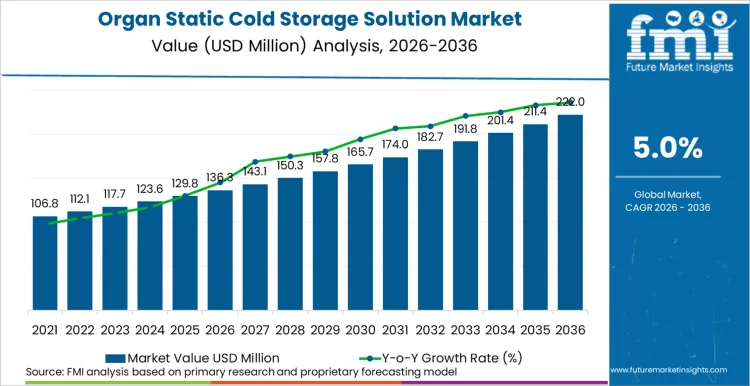
In 2025, the global organ static cold storage solution market was valued at approximately USD 129.8 million. Based on Future Market Insights' analysis, demand for organ static cold storage solutions is estimated to grow to USD 136.3 million in 2026 and is projected to reach approximately USD 211.4 million by 2036. FMI projects a CAGR of approximately 5.0% during the forecast period.
Absolute dollar growth of over USD 81.6 million over the decade signals steady expansion driven by increasing transplant procedure volumes, wider organ procurement coordination networks, and the need for standardized preservation protocols that maintain organ viability during transport and pre-transplant holding periods. Despite emerging perfusion-based technologies gaining attention, static cold storage solutions remain the global baseline due to regulatory familiarity, operational simplicity, and established clinical evidence.
Summary of Organ Static Cold Storage Solution Market
- Organ Static Cold Storage Solution Market Definition:
- The industry covers specialized preservation fluids used to maintain donated organs during cold storage and transport, ensuring viability for transplantation.
- Demand Drivers in the Market:
- Global transplant procedure volumes continue to expand.
- Organ procurement networks require standardized preservation protocols.
- Emphasis on organ quality and cold ischemia time management.
- Key Segments Analyzed in the FMI Report:
- Packaging Volume: 1000ml/bag leads with 48.2% share.
- Application: Hospitals dominate at 66.0% share.
- Geography: Asia Pacific leads growth; North America maintains largest market.
- Analyst Opinion at FMI:
- Sabyasachi Ghosh, Principal Consultant for Healthcare at Future Market Insights, opines, "In the updated version of the Organ Static Cold Storage Solution Market Report for 2026 to 2036, transplant center administrators and procurement specialists will find insights into how formulation advancements are extending acceptable cold ischemia times and how packaging innovations are improving cold chain logistics. Besides this, my findings point at cost sensitivity in developing healthcare systems and the emergence of enhanced preservation formulations with superior cellular protection properties."
- Strategic Implications/Executive Takeaways:
- Shift focus from commodity preservation media to application-specific solutions with documented clinical efficacy.
- Treat regulatory approvals and quality certifications as market access requirements.
- Prioritize partnerships with transplant centers and organ procurement organizations.
- Methodology:
- Validated through transplant procedure statistics and manufacturer shipment data.
- Zero reliance on speculative third-party market research reports.
- Based on verifiable organ procurement records and clinical adoption patterns.
As Craig Marshall, CEO of OrganOx, noted regarding the urgency of global transplant demand and the company’s strategic expansion, “The global need for donor organs remains urgent, with thousands of patients each year dying while waiting for a transplant or facing the risk of a failed transplant. Our mission has always been to create a world where every organ counts. Joining Terumo will accelerate our ability to scale our operations more rapidly, enter new markets and ensure that more patients around the globe can benefit from our technologies.” [1]
China (9.3% projected) and India (8.6% projected) drive new opportunities through expanding transplant program infrastructure and comprehensive organ procurement system development. Germany (7.9% projected) and Brazil (7.2% projected) contribute via leadership in transplant medicine and healthcare modernization.
Organ Static Cold Storage Solution Market Definition
Organ static cold storage (SCS) solutions are specialized preservation fluids used to maintain donated organs (kidneys, livers, hearts, pancreata) during transportation and storage between procurement and transplantation. These solutions are designed to reduce cellular metabolism, minimize ischemic injury, and preserve organ viability by maintaining a controlled cold environment (typically 2-8°C). The solutions contain electrolytes, buffers, and impermeants to prevent cellular swelling, along with antioxidants and metabolic substrates to support cellular integrity during cold ischemia. Available in various packaging volumes (1000ml/bag, 2000ml/bag), SCS solutions are the foundational preservation technology in transplant medicine, used by hospitals, organ procurement organizations, and research institutions .
Organ Static Cold Storage Solution Market Inclusions
The report includes a comprehensive analysis of market dynamics, featuring Global and Regional Market Sizes (Volume and Value) and a 10-year Forecast (2026-2036). It covers segmental breakdowns by packaging volume (1000ml/bag, 2000ml/bag, Others), application (Hospitals, Laboratories/Research Institutes, Others), and geographic regions.
Organ Static Cold Storage Solution Market Exclusions
The scope excludes machine perfusion systems and devices, organ transport containers and cold storage equipment, and non-preservation solutions used in transplant procedures (immunosuppressants, surgical supplies).
Organ Static Cold Storage Solution Market Research Methodology
- Primary Research: Interviews were conducted with transplant surgeons, organ procurement organization directors, hospital procurement specialists, and preservation solution manufacturers across major regions. Biochemists clarified solution formulation and preservation mechanisms.
- Desk Research: Transplant procedure statistics, organ procurement data, and corporate financial filings supported volume benchmarking.
- Market-Sizing and Forecasting: A hybrid top-down and bottom-up model was developed. Demand was reconstructed from global transplant volumes, solution consumption per procedure, and regional adoption patterns, then validated against manufacturer shipment data.
- Data Validation and Update Cycle: Outputs undergo anomaly screening, variance checks across production and trade datasets, and structured peer review prior to release.
Segmental Analysis
Organ Static Cold Storage Solution Market Analysis by Packaging Volume
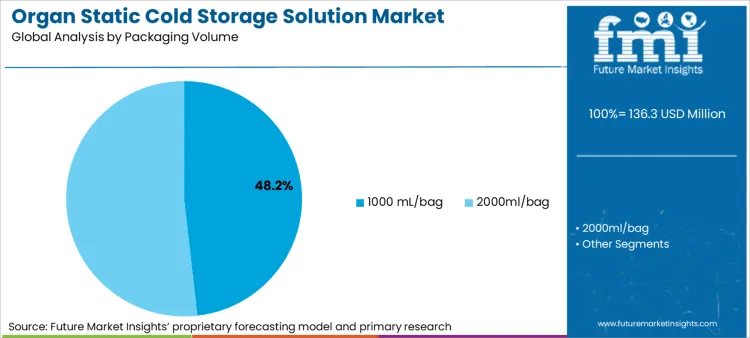
Based on FMI’s organ static cold storage solution market report, the 1000 mL/bag format is estimated to hold 48.2% share in 2026. Growth in demand for the 1000 mL format stems from its role as the standardized unit for single-organ flushing and hypothermic storage, aligning precisely with surgical protocols while minimizing excess medical waste and handling complexity during time-sensitive transplant procedures.
- Clinical Standardization: Bridge to Life Ltd. provides Belzer UW® Cold Storage Solution in "1,000 mL in one-liter bags" as the standard unit, ensuring compatibility with established surgical flush-out and preservation workflows [2].
- Dual-Organ Efficiency: Preservation Solutions Inc. notes that "Preservation Solutions, Inc. recommends a volume of 1000 mL of MaPerSol® perfusate (one bag) for two (2) human kidneys," supporting efficient allocation in machine-assisted or paired-organ protocols [3].
- Waste Minimization: Standardized volume packaging reduces partial-use disposal and simplifies cold-chain inventory control within hospital transplant units.
Organ Static Cold Storage Solution Market Analysis by Application
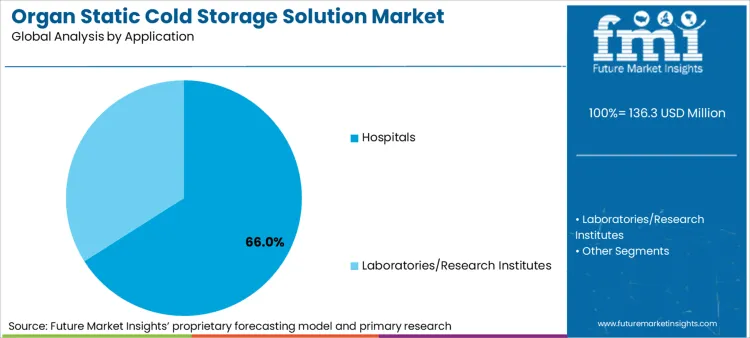
Hospitals are estimated to hold 66.0% share in 2026. This concentration reflects their position as the central node of the transplant lifecycle, managing donor stabilization, organ retrieval, preservation, and recipient implantation within tightly controlled clinical environments.
- Transplant Protocol Control: National Organ and Tissue Transplant Organization guidelines specify that the "OT (Operating Theatre) should be kept warm and warming blanket and fluid warmers should be used," while cold preservation processes are initiated immediately upon organ retrieval [4].
- Immediate Flush Requirement: According to Bridge to Life Ltd. instructions, the "cold solution is used to flush the isolated organ immediately before removal from the donor and/or immediately after removal from the donor," reinforcing hospital-centered procurement integration [5].
- Logistics Integration: Hospitals rely on preservation solutions that align seamlessly with established retrieval timelines, sterile handling protocols, and on-site surgical team coordination.
Organ Static Cold Storage Solution Market Drivers, Restraints, and Opportunities
Future Market Insights analysis that historical patterns point at a mature but essential medical technology category where static cold storage remains the global standard for organ preservation, now seeing incremental innovation in formulation chemistry and packaging while facing potential disruption from perfusion technologies. Estimated valuation in 2026 represents the "quality optimization phase" as transplant centers emphasize cold ischemia time management and organ quality metrics.
While emerging perfusion technologies pose long-term competitive pressure, the proven reliability, cost-effectiveness, and regulatory familiarity of SCS solutions ensure continued dominance for the majority of transplant procedures, resulting in steady mid-single-digit growth aligned with transplant volume expansion.
- Transplant Volume Growth: Continuous expansion of organ transplantation programs across established and emerging healthcare markets drives demand for standardized preservation solutions.
- Organ Procurement Network Development: Growing emphasis on organized procurement systems and coordinated transport logistics creates demand for reliable preservation technologies.
- Clinical Quality Focus: Increasing emphasis on transplant outcome optimization and organ quality maintenance throughout preservation periods supports adoption of advanced preservation solutions.
Regional Analysis
Based on the regional analysis, the Organ Static Cold Storage Solution Market is segmented into North America, Latin America, Europe, East Asia, South Asia, Oceania and Middle East & Africa across 40+ countries. The full report also offers market attractiveness analysis based on regional trends.
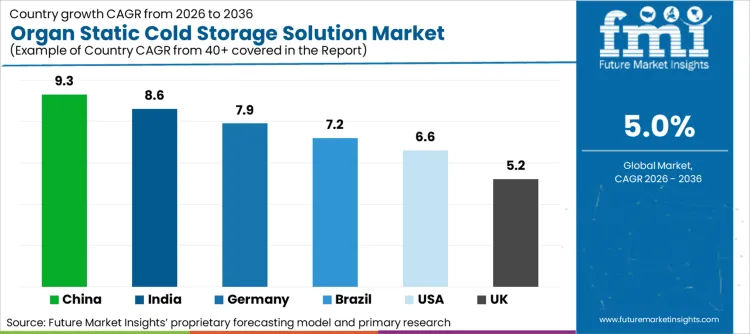
| Country | CAGR (2026 to 2036) |
|---|---|
| India | 8.6% |
| China | 9.3% |
| Brazil | 7.2% |
| United States | 6.6% |
| Germany | 7.9% |
| United Kingdom | 5.2% |
Source: Future Market Insights (FMI) analysis, based on proprietary forecasting model and primary research
North America Organ Static Cold Storage Solution Market Analysis
North America remains the global leader in clinical transplant innovation, where growth is supported by the integration of advanced perfusion platforms alongside traditional static cold storage protocols. Market expansion is reinforced by structured PMA studies and scaling of organ transport systems that complement cold preservation workflows.
- United States: Demand for organ static cold storage solutions in the United States is projected to rise at 6.6% CAGR through 2036. Leading providers reported that "during 2026 we will continue to build an organization ready to deliver a full-scale product launch of XVIVO Heart Assist Transport and Kidney Assist," following a year in which "the Abdominal business area delivered sales growth in local currencies of 30 percent." [6]
FMI’s report includes detailed analysis of growth in North America, along with a country-wise assessment that includes the United States and Canada. Readers can review transplant volumes, clinical innovation trends, and hospital procurement frameworks shaping the regional market.
Asia Pacific Organ Static Cold Storage Solution Market Analysis
Asia Pacific is the fastest-growing region, driven by rapid transplant system expansion and government-backed infrastructure programs designed to stabilize organ donation and retrieval networks.
- China: Leading with a 9.3% CAGR, transplant infrastructure continues to scale. Official reporting states that "since China launched pilot programs in 2010, organ donation has developed from nonexistence into a well-established system over the past 15 years," with "11,249 organ donation cases in 2024," including "6,744 posthumous donations and 4,505 living donations from relatives." [7]
- India: Domestic demand is advancing at 8.6% CAGR, supported by infrastructure expansion. The National Organ Transplant Program networks with "857 hospitals/institutions, including 654 organ transplant centers and 132 organ retrieval centers," strengthening procurement logistics nationwide. [8]
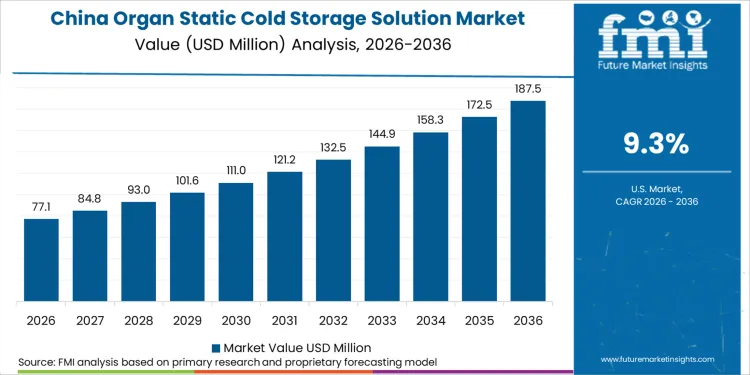
The full report analyzes the Organ Static Cold Storage Solution Market across East and South Asia from 2021-2036, covering transplant system growth, hospital integration, and preservation protocol standardization.
Latin America Organ Static Cold Storage Solution Market Analysis
Latin America is emerging as a high-volume transplant region, supported by rising surgical activity and targeted national acceleration programs.
- Brazil: A projected 7.2% CAGR through 2036 aligns with transplant growth milestones. The country "reached a historic record for transplants performed by the Unified Health System (SUS) in 2024, with more than 30,000 procedures," though the "donation effectiveness rate (27%) was below the expected rate (30%), mainly due to high family refusal (46%)." [9]
The report provides detailed analysis for Brazil, Mexico, Argentina, Chile, Peru and the Rest of Latin America. Readers can assess transplant volumes, policy initiatives, and donor participation metrics influencing regional demand.
Europe Organ Static Cold Storage Solution Market Analysis
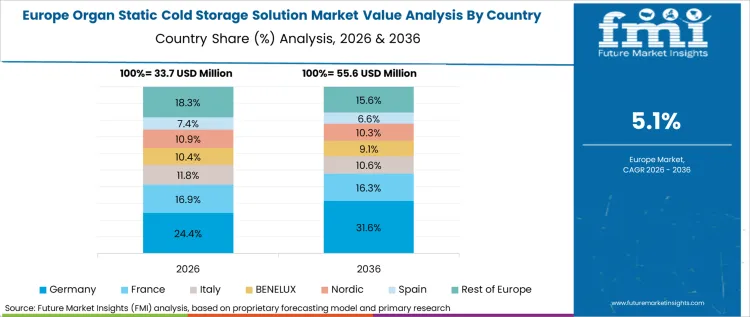
Europe operates within a highly regulated transplant framework, where preservation standards and cross-border coordination drive solution demand. Growth is linked to standardized procurement models and institutional reimbursement mechanisms.
- Germany: Demand in Germany is projected to rise at 7.9% CAGR through 2036. The regulatory structure mandates that "organ removal from ‘non-heart-beating donors’ is prohibited," and the DSO "reimburses the personnel and material costs which arise in the course of an organ donation," reinforcing centralized oversight. [10]
- United Kingdom: The UK market is projected to grow at 5.2% CAGR through 2036. NHS Blood and Transplant positions itself as "vital infrastructure to the NHS," calling for "systemic changes that shift the dial on reducing the organ and tissue transplant waiting list." [11]
FMI’s analysis of the European market includes country-wise assessment covering Germany, France, Italy, the United Kingdom, Spain, Nordic countries, Benelux and the Rest of Europe. Readers can evaluate regulatory structures, transplant network integration, and clinical protocol standardization shaping regional growth.
Competitive Aligners for Market Players
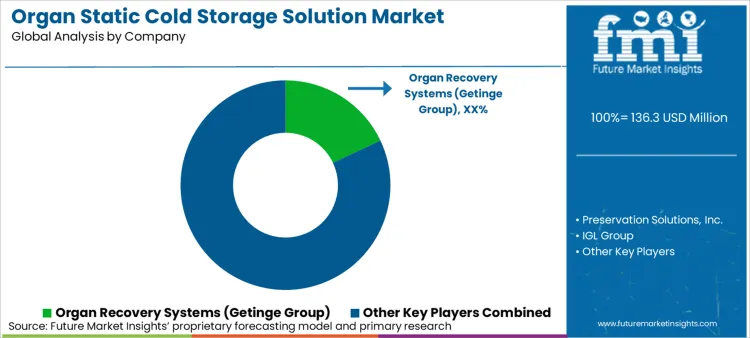
The Organ Static Cold Storage Solution market remains structurally fragmented at a global level, yet effective competition is concentrated among a limited group of clinically validated manufacturers capable of meeting regulatory, sterility, and distribution requirements of major transplant centers. A meaningful share of global supply is controlled by companies with vertically integrated formulation, aseptic filling, and cold-chain logistics infrastructure, while smaller regional producers operate with limited pricing leverage and high compliance dependency. Primary competitive variable is regulatory survivability and uninterrupted hospital supply, not peak margin expansion during procurement cycles.
Manufacturers with in-house sterile compounding facilities, validated GMP-compliant production lines, and established distribution agreements absorb raw material volatility and quality control costs more effectively. Suppliers dependent on third-party contract manufacturers face greater exposure to batch delays, audit risks, and margin compression. Regulatory compliance further narrows the field. The ability to consistently meet FDA, EMA, and national transplant authority standards for solution stability, endotoxin limits, and packaging integrity requires advanced quality systems and documented clinical validation, creating natural attrition among undercapitalized entrants.
Customer concentration reinforces buyer leverage. Large hospital transplant networks and national procurement bodies multi-source preservation solutions to prevent dependency, limiting price pass-through and raising qualification barriers for new suppliers.
Recent Developments
The report includes full coverage of key trends from competitive benchmarking. Some of the recent developments covered in the reports:
- In January 2026, Bridge to Life secured FDA De Novo clearance for its VitaSmart HOPE system, the first USA-approved cold machine perfusion technology for liver transplant preservation, with commercial launch planned for early 2026 [12].
- In January 2025, Paragonix announced the first-in-human use of its FDA-cleared KidneyVault portable renal perfusion system, successfully transporting four donor kidneys nationwide while maintaining continuous hypothermic perfusion and real-time monitoring [13].
Key Players in Organ Static Cold Storage Solution Market
- Organ Recovery Systems (Getinge Group)
- Preservation Solutions, Inc.
- IGL Group
- Koehler Chemie GmbH & Co. KG
- Bridge to Life Ltd.
- OrganOx Limited
- XVIVO Perfusion AB
- Vivaly (Dr. Franz Köhler Chemie GmbH)
- Paragonix Technologies, Inc.
- SALF S.p.A.
- TX Innovations B.V.
- tranSnovo GmbH
- TransMedics, Inc.
- Waters Medical Systems
- Essential Pharmaceuticals, LLC
- BioLife Solutions, Inc.
- CryoPort, Inc.
- Cell & Tissue Systems, Inc.
- Tecomed Group
- Medtronic plc
Scope of the Report
| Metric | Value |
|---|---|
| Quantitative Units | USD 136.3 million (2026) to USD 211.4 million (2036), at a CAGR of 5.0% |
| Market Definition | The organ static cold storage solution market comprises the global production and clinical distribution of specialized preservation fluids formulated to maintain donor organ viability during hypothermic storage and transport (2-8°C), containing electrolytes, buffers, impermeants, antioxidants, and metabolic substrates to minimize ischemic injury prior to transplantation. |
| Packaging Volume Segmentation | 1000ml/bag, 2000ml/bag, Others |
| Application Segmentation | Hospitals, Laboratories/Research Institutes, Others |
| Application Coverage | Single-Organ Preservation, Multi-Organ Procedures, Cold Ischemia Management, Organ Transport Stabilization, Preservation Research and Protocol Development |
| Regions Covered | North America, Latin America, Europe, East Asia, South Asia, Oceania, Middle East & Africa |
| Countries Covered | United States, Canada, Mexico, Brazil, Argentina, Germany, France, United Kingdom, Italy, Spain, China, India, Japan, South Korea, Australia & New Zealand, GCC Countries, Turkey, South Africa and 40+ countries |
| Key Companies Profiled | Organ Recovery Systems (Getinge Group), Preservation Solutions, Inc., IGL Group, Koehler Chemie GmbH & Co. KG, Bridge to Life Ltd., OrganOx Limited, XVIVO Perfusion AB, Paragonix Technologies, Inc., SALF S.p.A., TransMedics, Inc., BioLife Solutions, Inc., Medtronic plc |
| Forecast Period | 2026 to 2036 |
| Approach | Hybrid top-down and bottom-up market modeling validated through primary interviews with transplant surgeons, organ procurement organizations, hospital procurement teams, and preservation solution manufacturers, supported by transplant procedure statistics, organ procurement records, and manufacturer shipment benchmarking. |
Organ Static Cold Storage Solution Market Analysis by Segments
Packaging Volume:
- 1000ml/bag
- Single-organ preservation
- Standard transplant protocols
- 2000ml/bag
- Extended transport
- Multi-organ procedures
- Research applications
- Others
- Specialized formats
- Experimental protocols
Application:
- Hospitals
- Transplant Centers
- Surgical Departments
- Organ Procurement Units
- Laboratories/Research Institutes
- Preservation Research
- Protocol Development
- Ex Vivo Organ Assessment
- Others
- Organ Procurement Organizations
- Transport Services
- Specialized Preservation Facilities
Region:
- North America
- United States
- Canada
- Europe
- Germany
- France
- United Kingdom
- Italy
- Spain
- Rest of Europe
- Asia Pacific
- China
- India
- Japan
- South Korea
- Australia & New Zealand
- Rest of Asia Pacific
- Latin America
- Brazil
- Mexico
- Argentina
- Rest of Latin America
- Middle East & Africa
- GCC Countries
- Turkey
- South Africa
- Rest of Middle East & Africa
Bibliography
- OrganOx Ltd. (2025). OrganOx completes acquisition by Terumo Corporation to advance the future of organ transplantation. OrganOx.
- Bridge to Life Ltd. (2025). Belzer UW® cold storage transplant solution. Bridge to Life™.
- Preservation Solutions, Inc. (2025). MAPERSOL® preservation solutions.
- National Organ and Tissue Transplant Organization (NOTTO), Ministry of Health & Family Welfare, Government of India. (2024). Standard operating procedures for organ transplantation.
- Bridge to Life Ltd. (2025). Instructions for use: Belzer UW® cold storage solution. Bridge to Life™.
- XVIVO Perfusion AB. (2026). Year-end report 2025.
- Global Times. (2025). Over 7.3 million people recorded as registered organ donation volunteers in China.
- National Organ and Tissue Transplant Organization (NOTTO), Ministry of Health & Family Welfare, Government of India. (2024). NOTTO annual report 2023-2024.
- Brazilian Transplant Registry. (2024). Analysis of the Brazilian transplant registry 2024.
- German Reference Centre for Ethics in the Life Sciences (DRZE). (2025). Organ transplantation.
- NHS Blood and Transplant. (2025). Annual report and accounts: 2024 to 2025.
- Bridge to Life Ltd. (2025). Bridge to Life™ secures FDA De Novo clearance for VitaSmart™ hypothermic oxygenated perfusion (HOPE) system.
- Paragonix Technologies, Inc. (2025). Paragonix announces world’s first-in-human use of KidneyVault renal perfusion system.
This bibliography is provided for reader reference and is not exhaustive. The full report contains the complete reference list and detailed citations.
This Report Addresses
- Market intelligence to enable structured strategic decision-making across mature and emerging organ static cold storage solution markets
- Market size estimation and 10-year revenue forecasts from 2026 to 2036, supported by validated transplant procedure statistics and organ procurement data
- Growth opportunity mapping across packaging volumes and applications with emphasis on 1000ml/bag format and hospital applications
- Segment and regional revenue forecasts covering all major product categories and geographic regions
- Competition strategy assessment including clinical validation, regulatory approvals, and institutional relationships benchmarking
- Technology roadmap tracking including formulation advancements, packaging innovations, and preservation chemistry developments
- Regulatory impact analysis covering medical device standards, pharmaceutical regulations, and transplant quality requirements
- Market report delivery in PDF, Excel, PPT, and interactive dashboard formats for executive and operational use
Frequently Asked Questions
How large is the demand for Organ Static Cold Storage Solutions in the global market in 2026?
Demand for organ static cold storage solutions is estimated to be valued at USD 136.3 million in 2026.
What will be the market size of Organ Static Cold Storage Solutions by 2036?
The market is projected to reach approximately USD 211.4 million by 2036.
What is the expected demand growth for Organ Static Cold Storage Solutions between 2026 and 2036?
Demand is expected to grow at a CAGR of 5.0% during the forecast period.
Which Packaging Volume is poised to lead global sales by 2026?
The 1000ml/bag format is expected to be the dominant segment, capturing approximately 48.2% of global market share in 2026 due to alignment with standardized single-organ transplant protocols.
How significant is the role of Hospitals in driving market demand in 2026?
Hospitals represent the dominant application segment, projected to hold approximately 66.0% of total market share in 2026, reflecting their central role in organ retrieval, preservation, and transplantation procedures.
What is driving demand growth globally?
Growth is driven by rising transplant procedure volumes, expansion of organized organ procurement networks, and emphasis on cold ischemia time management and organ quality preservation.
What is the United States growth outlook in this report?
The United States is projected to grow at a CAGR of 6.6% between 2026 and 2036.
Why is North America described as a mature innovation hub in this report?
North America combines established static cold storage protocols with integration of advanced perfusion technologies, supported by structured regulatory frameworks and high transplant volumes.
What is China’s growth outlook in this report?
China is projected to expand at a CAGR of 9.3% during the forecast period, driven by rapid transplant system expansion and organ donation infrastructure development.
What is India’s growth outlook in this report?
India is expected to grow at a CAGR of 8.6% between 2026 and 2036, supported by expansion of transplant centers and national organ procurement programs.
What is Germany’s growth outlook in this report?
Germany is projected to expand at a CAGR of 7.9% during the forecast period.
What is Brazil’s growth outlook in this report?
Brazil is expected to grow at a CAGR of 7.2% between 2026 and 2036, aligned with increasing transplant volumes under the national health system.
What is the United Kingdom’s growth outlook in this report?
The United Kingdom is projected to grow at a CAGR of 5.2% during the forecast period.
Which Application Segment dominates the market?
Hospitals dominate the market due to their direct control over organ retrieval, cold flushing, storage, and transplant implantation processes.
What is included in the scope of this Organ Static Cold Storage Solution market report?
The scope covers packaging volume segmentation, application-based analysis, regional forecasts, competitive benchmarking, regulatory assessment, and 10-year revenue projections from 2026 to 2036.
What is excluded from the scope of this report?
Machine perfusion systems, organ transport hardware, cold storage equipment, immunosuppressants, and other non-preservation transplant products are excluded.
What does market forecast mean in this report?
Market forecast represents a structured projection based on transplant procedure statistics, preservation solution consumption per procedure, and defined growth assumptions.
How does FMI build and validate the Organ Static Cold Storage Solution market forecast?
The forecast is developed using hybrid top-down and bottom-up modeling validated through transplant volume data, organ procurement records, primary interviews with transplant stakeholders, and manufacturer shipment benchmarking.
What does zero reliance on speculative third-party market research mean here?
It indicates that projections rely on primary research, verified transplant statistics, and institutional data rather than unverified syndicated market estimates.
Preview the report firsthand - request a free sample
Get SampleGet the brochure for pricing and purchase details.
Get PDFTable of Content
- Executive Summary
- Global Market Outlook
- Demand-side Trends
- Supply-side Trends
- Technology Roadmap Analysis
- Analysis and Recommendations
- Market Overview
- Market Coverage / Taxonomy
- Market Definition / Scope / Limitations
- Research Methodology
- Chapter Orientation
- Analytical Lens and Working Hypotheses
- Market Structure, Signals, and Trend Drivers
- Benchmarking and Cross-market Comparability
- Market Sizing, Forecasting, and Opportunity Mapping
- Research Design and Evidence Framework
- Desk Research Programme (Secondary Evidence)
- Company Annual and Sustainability Reports
- Peer-reviewed Journals and Academic Literature
- Corporate Websites, Product Literature, and Technical Notes
- Earnings Decks and Investor Briefings
- Statutory Filings and Regulatory Disclosures
- Technical White Papers and Standards Notes
- Trade Journals, Industry Magazines, and Analyst Briefs
- Conference Proceedings, Webinars, and Seminar Materials
- Government Statistics Portals and Public Data Releases
- Press Releases and Reputable Media Coverage
- Specialist Newsletters and Curated Briefings
- Sector Databases and Reference Repositories
- FMI Internal Proprietary Databases and Historical Market Datasets
- Subscription Datasets and Paid Sources
- Social Channels, Communities, and Digital Listening Inputs
- Additional Desk Sources
- Expert Input and Fieldwork (Primary Evidence)
- Primary Modes
- Qualitative Interviews and Expert Elicitation
- Quantitative Surveys and Structured Data Capture
- Blended Approach
- Why Primary Evidence is Used
- Field Techniques
- Interviews
- Surveys
- Focus Groups
- Observational and In-context Research
- Social and Community Interactions
- Stakeholder Universe Engaged
- C-suite Leaders
- Board Members
- Presidents and Vice Presidents
- R&D and Innovation Heads
- Technical Specialists
- Domain Subject-matter Experts
- Scientists
- Physicians and Other Healthcare Professionals
- Governance, Ethics, and Data Stewardship
- Research Ethics
- Data Integrity and Handling
- Primary Modes
- Tooling, Models, and Reference Databases
- Desk Research Programme (Secondary Evidence)
- Data Engineering and Model Build
- Data Acquisition and Ingestion
- Cleaning, Normalisation, and Verification
- Synthesis, Triangulation, and Analysis
- Quality Assurance and Audit Trail
- Market Background
- Market Dynamics
- Drivers
- Restraints
- Opportunity
- Trends
- Scenario Forecast
- Demand in Optimistic Scenario
- Demand in Likely Scenario
- Demand in Conservative Scenario
- Opportunity Map Analysis
- Product Life Cycle Analysis
- Supply Chain Analysis
- Investment Feasibility Matrix
- Value Chain Analysis
- PESTLE and Porter’s Analysis
- Regulatory Landscape
- Regional Parent Market Outlook
- Production and Consumption Statistics
- Import and Export Statistics
- Market Dynamics
- Global Market Analysis 2021 to 2025 and Forecast, 2026 to 2036
- Historical Market Size Value (USD Million) Analysis, 2021 to 2025
- Current and Future Market Size Value (USD Million) Projections, 2026 to 2036
- Y-o-Y Growth Trend Analysis
- Absolute $ Opportunity Analysis
- Global Market Pricing Analysis 2021 to 2025 and Forecast 2026 to 2036
- Global Market Analysis 2021 to 2025 and Forecast 2026 to 2036, By Packaging Volume
- Introduction / Key Findings
- Historical Market Size Value (USD Million) Analysis By Packaging Volume , 2021 to 2025
- Current and Future Market Size Value (USD Million) Analysis and Forecast By Packaging Volume , 2026 to 2036
- 1000 mL/bag
- 2000ml/bag
- 1000 mL/bag
- Y-o-Y Growth Trend Analysis By Packaging Volume , 2021 to 2025
- Absolute $ Opportunity Analysis By Packaging Volume , 2026 to 2036
- Global Market Analysis 2021 to 2025 and Forecast 2026 to 2036, By Application
- Introduction / Key Findings
- Historical Market Size Value (USD Million) Analysis By Application, 2021 to 2025
- Current and Future Market Size Value (USD Million) Analysis and Forecast By Application, 2026 to 2036
- Hospitals
- Laboratories/Research Institutes
- Hospitals
- Y-o-Y Growth Trend Analysis By Application, 2021 to 2025
- Absolute $ Opportunity Analysis By Application, 2026 to 2036
- Global Market Analysis 2021 to 2025 and Forecast 2026 to 2036, By Region
- Introduction
- Historical Market Size Value (USD Million) Analysis By Region, 2021 to 2025
- Current Market Size Value (USD Million) Analysis and Forecast By Region, 2026 to 2036
- North America
- Latin America
- Western Europe
- Eastern Europe
- East Asia
- South Asia and Pacific
- Middle East & Africa
- Market Attractiveness Analysis By Region
- North America Market Analysis 2021 to 2025 and Forecast 2026 to 2036, By Country
- Historical Market Size Value (USD Million) Trend Analysis By Market Taxonomy, 2021 to 2025
- Market Size Value (USD Million) Forecast By Market Taxonomy, 2026 to 2036
- By Country
- USA
- Canada
- Mexico
- By Packaging Volume
- By Application
- By Country
- Market Attractiveness Analysis
- By Country
- By Packaging Volume
- By Application
- Key Takeaways
- Latin America Market Analysis 2021 to 2025 and Forecast 2026 to 2036, By Country
- Historical Market Size Value (USD Million) Trend Analysis By Market Taxonomy, 2021 to 2025
- Market Size Value (USD Million) Forecast By Market Taxonomy, 2026 to 2036
- By Country
- Brazil
- Chile
- Rest of Latin America
- By Packaging Volume
- By Application
- By Country
- Market Attractiveness Analysis
- By Country
- By Packaging Volume
- By Application
- Key Takeaways
- Western Europe Market Analysis 2021 to 2025 and Forecast 2026 to 2036, By Country
- Historical Market Size Value (USD Million) Trend Analysis By Market Taxonomy, 2021 to 2025
- Market Size Value (USD Million) Forecast By Market Taxonomy, 2026 to 2036
- By Country
- Germany
- UK
- Italy
- Spain
- France
- Nordic
- BENELUX
- Rest of Western Europe
- By Packaging Volume
- By Application
- By Country
- Market Attractiveness Analysis
- By Country
- By Packaging Volume
- By Application
- Key Takeaways
- Eastern Europe Market Analysis 2021 to 2025 and Forecast 2026 to 2036, By Country
- Historical Market Size Value (USD Million) Trend Analysis By Market Taxonomy, 2021 to 2025
- Market Size Value (USD Million) Forecast By Market Taxonomy, 2026 to 2036
- By Country
- Russia
- Poland
- Hungary
- Balkan & Baltic
- Rest of Eastern Europe
- By Packaging Volume
- By Application
- By Country
- Market Attractiveness Analysis
- By Country
- By Packaging Volume
- By Application
- Key Takeaways
- East Asia Market Analysis 2021 to 2025 and Forecast 2026 to 2036, By Country
- Historical Market Size Value (USD Million) Trend Analysis By Market Taxonomy, 2021 to 2025
- Market Size Value (USD Million) Forecast By Market Taxonomy, 2026 to 2036
- By Country
- China
- Japan
- South Korea
- By Packaging Volume
- By Application
- By Country
- Market Attractiveness Analysis
- By Country
- By Packaging Volume
- By Application
- Key Takeaways
- South Asia and Pacific Market Analysis 2021 to 2025 and Forecast 2026 to 2036, By Country
- Historical Market Size Value (USD Million) Trend Analysis By Market Taxonomy, 2021 to 2025
- Market Size Value (USD Million) Forecast By Market Taxonomy, 2026 to 2036
- By Country
- India
- ASEAN
- Australia & New Zealand
- Rest of South Asia and Pacific
- By Packaging Volume
- By Application
- By Country
- Market Attractiveness Analysis
- By Country
- By Packaging Volume
- By Application
- Key Takeaways
- Middle East & Africa Market Analysis 2021 to 2025 and Forecast 2026 to 2036, By Country
- Historical Market Size Value (USD Million) Trend Analysis By Market Taxonomy, 2021 to 2025
- Market Size Value (USD Million) Forecast By Market Taxonomy, 2026 to 2036
- By Country
- Kingdom of Saudi Arabia
- Other GCC Countries
- Turkiye
- South Africa
- Other African Union
- Rest of Middle East & Africa
- By Packaging Volume
- By Application
- By Country
- Market Attractiveness Analysis
- By Country
- By Packaging Volume
- By Application
- Key Takeaways
- Key Countries Market Analysis
- USA
- Pricing Analysis
- Market Share Analysis, 2025
- By Packaging Volume
- By Application
- Canada
- Pricing Analysis
- Market Share Analysis, 2025
- By Packaging Volume
- By Application
- Mexico
- Pricing Analysis
- Market Share Analysis, 2025
- By Packaging Volume
- By Application
- Brazil
- Pricing Analysis
- Market Share Analysis, 2025
- By Packaging Volume
- By Application
- Chile
- Pricing Analysis
- Market Share Analysis, 2025
- By Packaging Volume
- By Application
- Germany
- Pricing Analysis
- Market Share Analysis, 2025
- By Packaging Volume
- By Application
- UK
- Pricing Analysis
- Market Share Analysis, 2025
- By Packaging Volume
- By Application
- Italy
- Pricing Analysis
- Market Share Analysis, 2025
- By Packaging Volume
- By Application
- Spain
- Pricing Analysis
- Market Share Analysis, 2025
- By Packaging Volume
- By Application
- France
- Pricing Analysis
- Market Share Analysis, 2025
- By Packaging Volume
- By Application
- India
- Pricing Analysis
- Market Share Analysis, 2025
- By Packaging Volume
- By Application
- ASEAN
- Pricing Analysis
- Market Share Analysis, 2025
- By Packaging Volume
- By Application
- Australia & New Zealand
- Pricing Analysis
- Market Share Analysis, 2025
- By Packaging Volume
- By Application
- China
- Pricing Analysis
- Market Share Analysis, 2025
- By Packaging Volume
- By Application
- Japan
- Pricing Analysis
- Market Share Analysis, 2025
- By Packaging Volume
- By Application
- South Korea
- Pricing Analysis
- Market Share Analysis, 2025
- By Packaging Volume
- By Application
- Russia
- Pricing Analysis
- Market Share Analysis, 2025
- By Packaging Volume
- By Application
- Poland
- Pricing Analysis
- Market Share Analysis, 2025
- By Packaging Volume
- By Application
- Hungary
- Pricing Analysis
- Market Share Analysis, 2025
- By Packaging Volume
- By Application
- Kingdom of Saudi Arabia
- Pricing Analysis
- Market Share Analysis, 2025
- By Packaging Volume
- By Application
- Turkiye
- Pricing Analysis
- Market Share Analysis, 2025
- By Packaging Volume
- By Application
- South Africa
- Pricing Analysis
- Market Share Analysis, 2025
- By Packaging Volume
- By Application
- USA
- Market Structure Analysis
- Competition Dashboard
- Competition Benchmarking
- Market Share Analysis of Top Players
- By Regional
- By Packaging Volume
- By Application
- Competition Analysis
- Competition Deep Dive
- Organ Recovery Systems (Getinge Group)
- Overview
- Product Portfolio
- Profitability by Market Segments (Product/Age /Sales Channel/Region)
- Sales Footprint
- Strategy Overview
- Marketing Strategy
- Product Strategy
- Channel Strategy
- Preservation Solutions, Inc.
- IGL Group
- Koehler Chemie GmbH & Co. KG
- Bridge to Life Ltd.
- OrganOx Limited
- XVIVO Perfusion AB
- Vivaly (Dr. Franz Köhler Chemie GmbH)
- Paragonix Technologies, Inc.
- Organ Recovery Systems (Getinge Group)
- Competition Deep Dive
- Assumptions & Acronyms Used


