

- Industry Size (2026)
- USD 154.6 Mn
- Forecast (2036)
- USD 925.8 Mn
- CAGR (2026 to 2036)
- 19.6%
Lyophilized Viral Vector Storage Solutions Market Size, Market Forecast and Outlook By FMI
The lyophilized viral vector storage solutions market was valued at USD 129.3 million in 2025. The industry is poised to surpass USD 154.6 million in 2026 at a CAGR of 19.6% during the forecast period. Ongoing investment is expected to expand the market opportunity to USD 925.8 million by 2036, driven by gene therapy developers moving away from ultra‑cold supply chains toward more scalable thermal storage profiles that support global commercialization.
Biopharma sponsors are being forced to make a decisive supply chain transition before late-stage clinical trials. Historically, early-stage gene therapies relied on frozen storage utilizing cryogenic systems, an approach that fractures commercially once a therapy targets larger patient populations across decentralized hospital networks. The stakes of delaying the transition to a lyophilized format involve severe constraints on market access and prohibitive specialized logistics costs. An inherent constraint often missed by generalists is that viral vector development timelines are rarely gated by the drying cycle itself, but by the analytical bridging required to prove the reconstituted drug performs identically to the frozen clinical batch.
Summary of Lyophilized Viral Vector Storage Solutions Market
- Lyophilized Viral Vector Storage Solutions Market Definition
- The market consists of the targeted formulation services, specialized drying protocols, and engineered packaging required to transition viral vectors from ultra-cold liquid formats into thermally stable solid states, enabling decentralized global distribution.
- Demand Drivers in the Market
- Decentralized clinical trial designs compel translational medicine directors to mandate formulation formats that can survive conventional hospital pharmacy storage without specialized cryogenic infrastructure.
- Commercial margin pressures require supply chain executives to eliminate the complex active-cooling logistics networks required for continuous deep-freeze transit.
- Regulatory expectations for extended commercial shelf-life push CMC teams to adopt solid-state formulations that demonstrate superior long-term stability against viral titer degradation.
- Key Segments Analyzed in the FMI Report
- Adeno-associated virus (AAV): Adeno-associated virus (AAV) is estimated to account for 49.0% share in 2026, driven by its dominant status as the primary delivery vehicle for systemically administered in vivo gene therapies reaching commercial maturity.
- Formulation & excipient systems: Formulation & excipient systems is estimated to hold 31.5% share in 2026, as the intellectual property and technical complexity of preventing capsid aggregation during freezing reside primarily in the chemical matrix.
- 2°C to 8°C storage solutions: 2°C to 8°C storage solutions are expected to record 42.0% share in 2026, representing the most pragmatic balance between formulation feasibility and alignment with standard hospital pharmacy infrastructure.
- Glass vials: Glass vials is anticipated to grab 57.0% share in 2026, supported by their established regulatory precedent in sterile sterile freeze-dried biologics.
- Biopharma & gene therapy developers: Biopharma & gene therapy developers are set to dominate with 55.0% share in 2026, as primary sponsors must internalise the strategic decision to bridge formulations prior to Phase III.
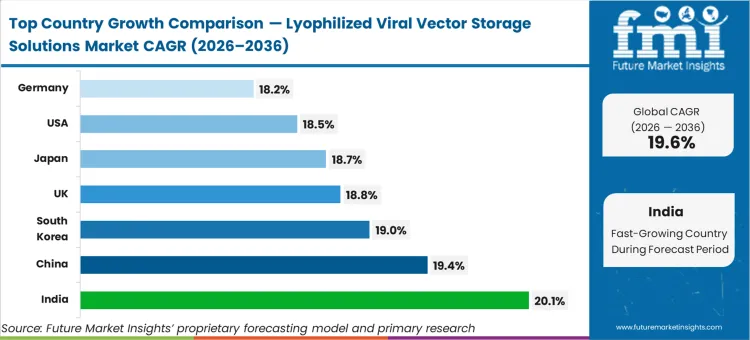
- India: 20.1% compound growth, reflecting rapid domestic CDMO investment in complex analytical capabilities aimed at capturing outsourced formulation contracts from Western sponsors.
- Analyst Opinion at FMI
- Sabyasachi Ghosh, Principal Analyst, Healthcare, at FMI, says, "Sponsors often expect the transition to a lyophilized format to occur seamlessly between Phase II and Phase III. However, the clock runs differently; the analytical bridging required to prove capsid integrity must begin in pre-clinical development, meaning the commercial storage strategy is locked far earlier than procurement teams anticipate."
- Strategic Implications / Executive Takeaways
- CMC directors must initiate excipient screening during early-stage clinical development to prevent costly comparability failures when transitioning to commercial-scale drying cycles.
- Specialized CDMOs should aggressively market their analytical bridging capabilities to capture sponsors attempting to pivot away from unsustainable ultra-cold supply chains.
- Primary packaging manufacturers face a technical imperative to develop zero-moisture transmission closure systems that prevent vector degradation over multi-year ambient timelines.
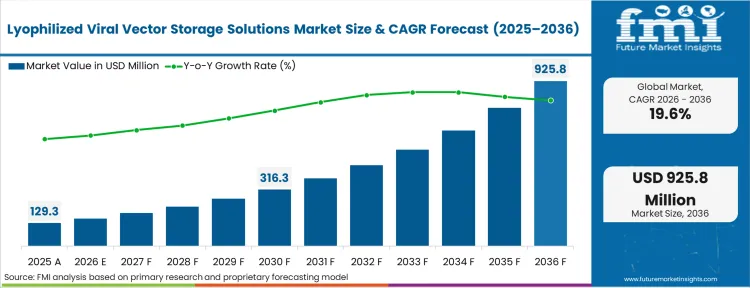
For the market to scale beyond specialized contract manufacturing and achieve broad commercial adoption, the formulation excipient challenge must be addressed. Partners with the capability to accurately characterize the glass transition behavior of complex viral capsids are critical to enabling this shift. Once robust, scalable protective matrices are validated, refrigerated or ambient storage can be implemented as a deliberate lifecycle strategy, supporting predictable commercialization rather than serving as a late-stage corrective measure.
India is estimated to track at 20.1%, followed by China advancing at 19.4%, South Korea registering 19.0%, and the United Kingdom expanding at 18.8%. Japan is likely to grow at 18.7%, the United States expanding at 18.5%, and Germany posting 18.2%. The divergence across the range reflects how quickly regional manufacturing ecosystems are upgrading their analytical formulation capabilities to support global export mandates, separating advanced formulation hubs from basic fill-finish geographies.
Lyophilized Viral Vector Storage Solutions Market Key Takeaways
| Metric | Details |
|---|---|
| Industry Size (2026) | USD 154.6 million |
| Industry Value (2036) | USD 925.8 million |
| CAGR (2026–2036) | 19.6% |
Source: Future Market Insights (FMI) analysis, based on proprietary forecasting model and primary research
Lyophilized Viral Vector Storage Solutions Market Definition
The Lyophilized Viral Vector Storage Solutions Market covers the formulation chemistries, drying cycles, and container-closure systems engineered specifically to preserve viral vector stability outside of deep-frozen states. It is functionally distinct from general biologics lyophilization due to the unique biophysical fragility of viral capsids and the complex excipient matrices required to prevent viral aggregation during the moisture removal process.
Lyophilized Viral Vector Storage Solutions Market Inclusions
This market includes specialized excipient formulations, tailored freeze-drying cycle development services, analytical stability testing specifically for dried vectors, and primary packaging optimized for high-vacuum sealing. Revenue generated by contract development and manufacturing organizations (CDMOs) providing end-to-end cell and gene therapy manufacturing for lyophilized formats is captured within this scope, alongside specialized container-closure components designed to maintain moisture barriers over extended shelf lives.
Lyophilized Viral Vector Storage Solutions Market Exclusions
Standard frozen storage media, general-purpose cryogenic freezers, and liquid formulation services that do not target a freeze-dried end state are excluded. These categories belong to broader logistics and traditional bioprocessing markets. Their inclusion would obscure the highly specialised value generated by moisture-removal technologies and the specific analytical techniques required to validate solid-state viral titer integrity.
Lyophilized Viral Vector Storage Solutions Market Research Methodology
- Primary Research: Chief Scientific Officers, VP of CMC (Chemistry, Manufacturing, and Controls), and formulation directors at leading gene therapy CDMOs.
- Desk Research: Aggregation of stability guidance from the EMA and FDA, commercial launch formulation dossiers, and peer-reviewed biophysics publications detailing capsid degradation.
- Market-Sizing and Forecasting: Baseline anchored to the volume of late-stage viral vector clinical trials actively bridging away from ultra-cold frozen formulations.
- Data Validation and Update Cycle: Forecasts triangulated against CDMO capacity expansion announcements specifically targeting clinical lyophilization suites and sterile fill-finish lines.
Segmental Analysis
Lyophilized Viral Vector Storage Solutions Market Analysis by Vector Type
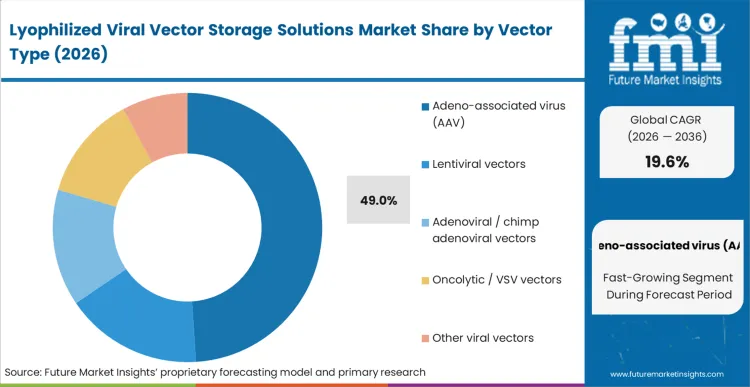
The logic behind Adeno-associated virus (AAV) holding a 49.0% share stems from its overwhelming dominance in the current pipeline of late-stage in vivo therapies. According to FMI's estimates, as developers push these therapies toward commercialization, they rely heavily on specialized aav packaging services and targeted formulation to prevent the unique aggregation tendencies of AAV capsids under stress. The biophysical characteristics of AAV require highly specific excipient matrices to maintain the integrity of the viral genome during the water-removal phase. Sponsors face intense pressure to perfect this stabilisation early; failing to do so results in unacceptable titer drops that render the final drug product sub-therapeutic. By integrating bioprocess containers and fluid transfer solutions tailored for these sensitive vectors, manufacturing teams can streamline the transition to solid-state stability. Developers who underinvest in vector-specific formulation logic face severe regulatory delays during pivotal trial reviews.
- Purchase trigger: Widespread adoption of AAV as the preferred vehicle for systemic gene delivery forces sponsors to solve its inherent thermal fragility before commercial launch.
- Qualification validation: Successful preservation of the genomic titer post-reconstitution serves as the primary metric for formulation viability.
- Renewal expansion: The ability to apply a validated AAV formulation platform across a broader portfolio of pipeline assets drives long-term vendor lock-in.
Lyophilized Viral Vector Storage Solutions Market Analysis by Solution Type
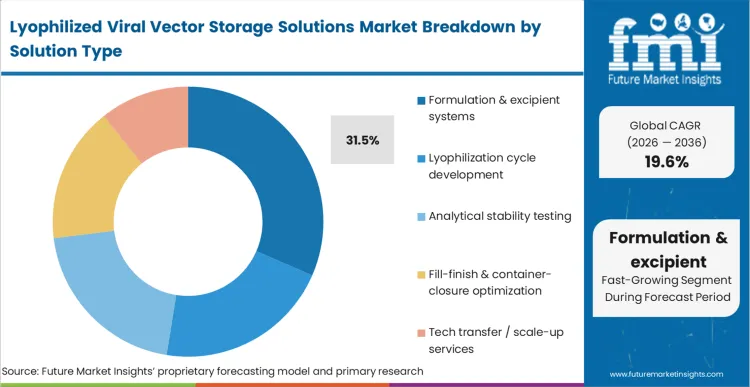
The operational consequence of a failed drying cycle almost always traces back to inadequate chemical protection, positioning Formulation & excipient systems to capture 31.5% of the market. Rather than competing purely on equipment capacity, leading CDMOs differentiate by offering proprietary stabilisation matrices that protect the vector from freeze-concentration stresses.
FMI analysts opine that this upstream chemical architecture dictates the success of the entire downstream manufacturing process, directly impacting healthcare cold chain logistics. Buyers must prioritize partners with deep biophysical analytical capabilities to custom-design these matrices. A misaligned excipient strategy ultimately forces sponsors to restart time-consuming stability studies from scratch.
- Cost origin: Investment goes upstream into early formulation screening to prevent catastrophic batch failures during scale-up.
- Hidden operational burden: Managing the precise sourcing and regulatory documentation for complex, novel excipients adds significant overhead to quality assurance teams.
- Lifecycle comparison: Therapies launched with optimized formulations drastically reduce long-term commercial logistics expenditures compared to frozen alternatives.
Lyophilized Viral Vector Storage Solutions Market Analysis by Storage Target
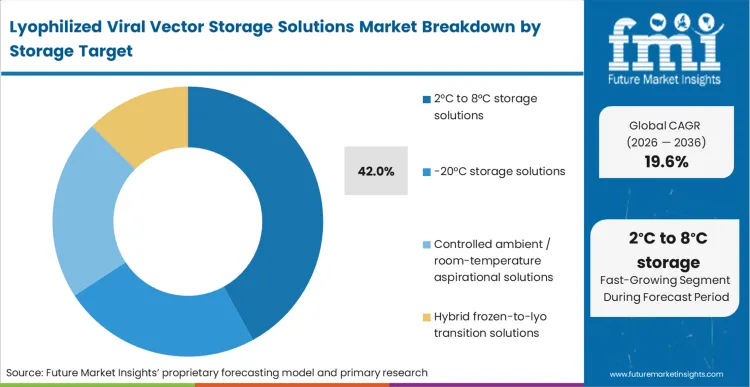
The specific choice facing a CMC director right now is whether to push for aggressive ambient stability or settle for 2°C to 8°C targets, which command a 42.0% share. Refrigerated storage represents the pragmatic middle ground, aligning perfectly with existing hospital pharmacy infrastructure while still bypassing the severe limitations of -80°C networks.
As per FMI's projection, this target thermal profile allows developers to utilize established pharmaceuticalutilisehain packaging formats without requiring bespoke ambient stabilization chemistries that often complicate regulatory reviews. Integration with standard automated compound storage and retrieval systems further solidifies refrigerated targets as the commercial standard. Organisations that aim exclusively for ambient stability without a 2°C to 8°C fallback often find their clinical timelines extended by years due to formulation instability.
- Primary failure prevention: Maintaining the product within standard refrigeration prevents the catastrophic titer loss associated with accidental freeze-thaw excursions.
- Residual risk management: Hospitals must still maintain validated 2°C to 8°C monitoring to prevent temperature deviations during the final mile of delivery.
- Full benefit capture: Sponsors unlock global commercialization potential by aligning their product format with the most universally accessible thermal distribution network.
Lyophilized Viral Vector Storage Solutions Market Analysis by Primary Container / Format
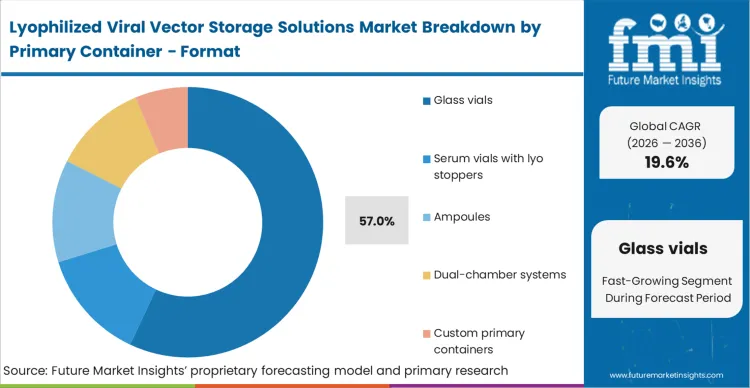
The 57.0% share held by Glass vials is rooted in the necessity of maintaining an absolute moisture barrier over a multi-year shelf life. While polymers advance, Type 1 borosilicate glass remains the undisputed standard for deep-vacuum sealing required in sterile solid-state biologics.
Based on FMI's assessment, the interaction between the freeze-dried cake, the glass surface, and specialised cryogenic vials utilized in earlier stages dictates the long-term viability of the drug product. Switching to alternative materials introduces an immense regulatory comparability burden that most sponsors refuse to shoulder. Consequently, biopharmaceuticals packaging decisions heavily favor established glass formats to streamline the path to market. Procurement teams that deviate from validated glass systems face severe delays as container-closure integrity failures emerge during long-term stability trials.
- Supply sustainability: A robust, multi-decade manufacturing infrastructure ensures consistent global supply of pharmaceutical-grade glass for sterile fill-finish operations.
- Constraint planning: Sponsors must actively forecast their specialized vial stopper and aluminum seal requirements to mitigate periodic supply chain bottlenecks.
- Future landscape: Advances in internal vial coatings will increasingly minimize vector adsorption issues, solidifying glass's dominance through 2036.
Lyophilized Viral Vector Storage Solutions Market Analysis by End User
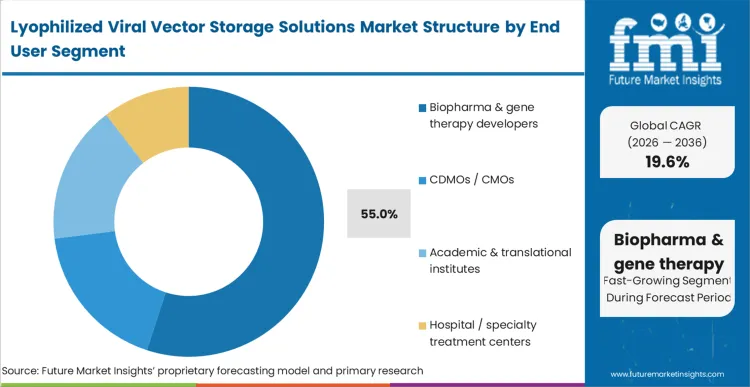
A contradiction defines the Biopharma & gene therapy developers segment, which holds 55.0% share: while manufacturing is heavily outsourced, the core intellectual property of the formulation must be tightly controlled by the sponsor. These developers are the primary risk-bearers, forced to fund the extensive analytical bridging studies required to move a therapy from a liquid clinical format to a commercial lyophilized state.
In FMI's view, integrating upstream gene synthesis with downstream stabilization planning is crucial for these entities to maintain product viability. Their decisions dictate the protocols used in cell and gene therapy clinical trial phases. Biopharma teams that fail to lock in their lyophilization strategy early in the clinical pathway suffer severe commercialization delays, effectively forfeiting market exclusivity windows to faster competitors.
- Performance baseline: Developers demand formulation platforms that can routinely achieve higher than 90% vector recovery post-reconstitution.
- Edge condition gaps: Complex multi-capsid therapies frequently expose the limitations of standardized platform drying cycles, requiring highly customized interventions.
- Acceptability standards: Regulatory agencies rigorously dictate the acceptable moisture content and physical cake appearance criteria that sponsors must meet for approval.
Lyophilized Viral Vector Storage Solutions Market Drivers, Restraints, and Opportunities
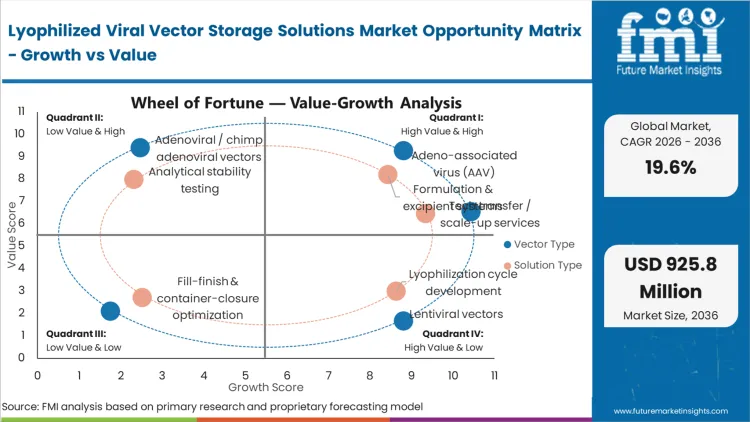
The pressure of scaling from localized clinical trials to global commercial distribution compels CMC directors to eliminate active deep-freeze logistics networks. A therapy that requires -80°C storage, limits its patient reach to a handful of elite treatment centers equipped with specialized handling infrastructure. By transitioning to a lyophilized format, sponsors remove the burden from complex clinical transit and onto the upfront formulation architecture, drastically widening the addressable patient population. The commercial stakes are absolute: therapies that successfully bridge to 2°C to 8°C profiles capture the mass market, while those tethered to cryogenic requirements remain niche, low-volume assets.
The single biggest buyer friction is the biophysical degradation of the viral capsid during the freeze-drying process itself. Unlike simple monoclonal antibodies, complex viral vectors are highly susceptible to aggregation, physical shearing, and irreversible titer loss when subjected to the extreme physical stresses of freezing and sublimation. While predictive thermal modeling offers a partial solution for identifying optimal excipient matrices, it cannot replace the lengthy, empirical stability trials required to validate the process. The complexity is compounded by strict clinical trial packaging regulations, which mandate precise documentation of stability profiles under various thermal excursions.
Opportunities in the Lyophilized Viral Vector Storage Solutions Market
- Analytical Bridging Partnerships: The regulatory mandate to prove bioequivalence between frozen and dried formats creates high-margin service opportunities. Specialized CDMOs who invest in proprietary high-throughput analytical assays can capture premium contracts from sponsors desperate to accelerate commercialization.
- Standardized Platform Excipients: The fragmentation of custom stabilization matrices opens the door for universal protective chemistries. Formulation developers capable of validating off-the-shelf excipient platforms for widely used AAV serotypes can secure long-term licensing agreements with tier-1 biopharma pipelines.
- Dual-Chamber Reconstitution Systems: The operational complexity of point-of-care preparation creates a demand for foolproof administration formats. Packaging manufacturers who successfully engineer zero-loss, pre-filled dual-chamber syringes for viral vectors position themselves as indispensable partners to commercial-stage gene therapy sponsors.
Regional Analysis
The regional assessment segments the Lyophilized Viral Vector Storage Solutions Market across more than 40 countries, spanning North America, Europe, Asia Pacific, and the rest of the world.
.webp "Top Country Growth Comparison Lyophilized Viral Vector Storage Solutions Market Cagr (2026 2036)")
| Country | CAGR (2026 to 2036) |
|---|---|
| India | 20.1% |
| China | 19.4% |
| South Korea | 19.0% |
| United Kingdom | 18.8% |
| Japan | 18.7% |
| United States | 18.5% |
| Germany | 18.2% |
Source: Future Market Insights (FMI) analysis, based on proprietary forecasting model and primary research
North America Lyophilized Viral Vector Storage Solutions Market Analysis
How the regulatory environment shapes buyer behaviour fundamentally dictates the North American market trajectory. The FDA’s increasingly stringent demands for long-term commercial stability data force regional biopharma sponsors to aggressively pursue lyophilization earlier in the clinical pathway. FMI analysts opine that North American CDMOs are pivoting from capacity-building to capability-building, prioritizing advanced biophysical characterization labs over sheer bioreactor volume. This concentration of analytical expertise ensures that the initial proof-of-concept drying cycles for most global gene therapies are established here, heavily influencing the specification of downstream united states and canada cold chain packaging requirements.
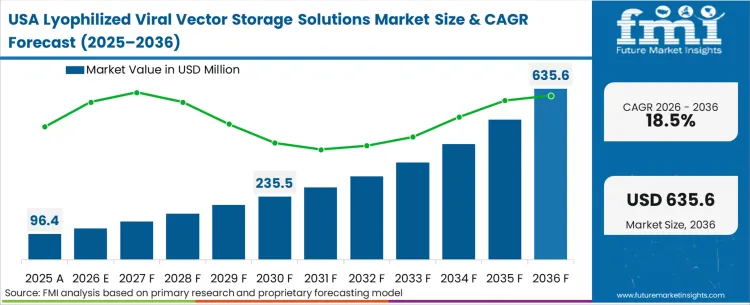
- United States: The United States is estimated to expand at 18.5% compound between 2026 and 2036. The sheer density of late-stage gene therapy assets navigating FDA pivotal reviews forces domestic sponsors to finalize their commercial formulations. Formulation directors in the US must simultaneously satisfy stringent stability criteria and prepare for decentralized patient administration networks. By locking in a validated 2°C to 8°C profile early, domestic sponsors open direct access to broad commercial reimbursement networks that reject ultra-cold logistical overhead.
Europe Lyophilized Viral Vector Storage Solutions Market Analysis
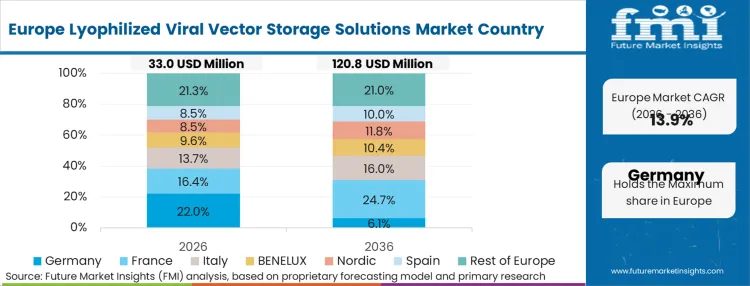
How cost structures and margin dynamics drive decisions heavily influences the European landscape. Public health technology assessment (HTA) bodies aggressively scrutinize the total lifecycle cost of advanced therapies, heavily penalizing assets that require specialized cryogenic handling at the hospital level. To maintain pricing viability, European developers utilize advanced cell therapy manufacturing frameworks to build thermal stability directly into their product profiles. According to FMI's estimates, this economic pressure forces local CDMOs to perfect low-cost, highly scalable drying cycles that meet stringent EMA quality directives without inflating unit costs.
- United Kingdom: The UK's robust translational research infrastructure actively supports the spin-out of early-stage gene therapies that immediately require scalable stabilization. Biopharma start-ups here must bridge their academic formulations into robust, investor-ready commercial formats to secure late-stage funding. The UK is anticipated to increase by a CAGR of 18.8%. This environment creates a highly lucrative pipeline for specialized local CDMOs capable of taking a fragile viral asset from bench-scale liquid to a clinically viable solid state.
- Germany: Industry is likely to post a CAGR of 18.2% in Germany. The high concentration of specialised sterile fill-finish manufacturing establishes it as a critical hub for complex biologics packaging. Operations heads in German facilities focus intensively on engineering pristine container-closure integrity to support deep-vacuum lyophilization cycles. Market dynamics indicate a move toward strong consolidation, as domestic fill‑finish providers increasingly acquire specialized analytical firms to build end‑to‑end stability capabilities.
Asia Pacific Lyophilized Viral Vector Storage Solutions Market Analysis
How physical and technical infrastructure conditions shape adoption defines the Asia Pacific dynamic. The lack of reliable -80°C deep-freeze logistical networks outside of major metropolitan hubs mandates that any broadly distributed therapy must achieve ambient or refrigerated stability. Based on FMI's assessment, local CDMOs are responding by rapidly scaling their formulation suites to serve both domestic pipelines and Western sponsors seeking cost-effective secondary manufacturing sites. This necessitates massive investments in controlled environments, including specialized cryo box systems to handle intermediate clinical batches before drying.
- India: India's massive contract manufacturing sector is actively moving up the value chain, transitioning from basic small-molecule fill-finish to complex viral vector stabilization. Over the forecast period, India is set for a CAGR of 20.1%. Domestic CDMOs operate under a mandate to prove their analytical comparability to Western sponsors. Achieving this technical parity changes India's competitive positioning, elevating it from a secondary supply hub into a primary formulation partner for global gene therapy launches.
- China: China is projected to witness growth at a CAGR of 19.4%. Massive government backing for domestic gene therapy development requires equally aggressive scaling of specialized formulation infrastructure. Procurement directors at Chinese biopharma firms heavily favour integrated domestic partners who can navigate complex local regulatory stability requirements. The on-the-ground reality is a race for capacity, where the speed of scaling lyophilization suites often outpaces the availability of specialized biophysical analytical talent.
- South Korea: South Korea's highly concentrated biomanufacturing conglomerates leverage their established biologics capacity to rapidly capture market share in viral vector services. Sponsors here operate under aggressive export-driven commercial timelines that demand immediate formulation finalization. Demand for solutions in South Korea is set to grow at 19.0%. Successful integration of high-throughput drying cycles allows these entities to streamline their operations, completely clearing the bottleneck between clinical batch production and final packaging.
- Japan: The market for solutions in Japan is forecast to register a CAGR of 18.7%. Japan's stringent PMDA stability requirements force domestic sponsors to adopt highly conservative, heavily validated lyophilization matrices. The focus remains heavily on zero-defect container-closure integrity and pristine cake formation. Buyers who delay their investment in these advanced stabilization frameworks face severe regulatory pushback that can stall commercialization indefinitely.
FMI's report includes secondary Asian markets and Latin American pharmaceutical hubs actively attempting to build domestic gene therapy capabilities. The recurring pattern across these emerging markets is an intense reliance on imported formulation technology and analytical equipment, creating a lucrative export market for established Western and tier-1 Asian solution providers. Integration of automated sample storage systems across these regions further facilitates the transition to modern commercial formats.
Competitive Aligners for Market Players
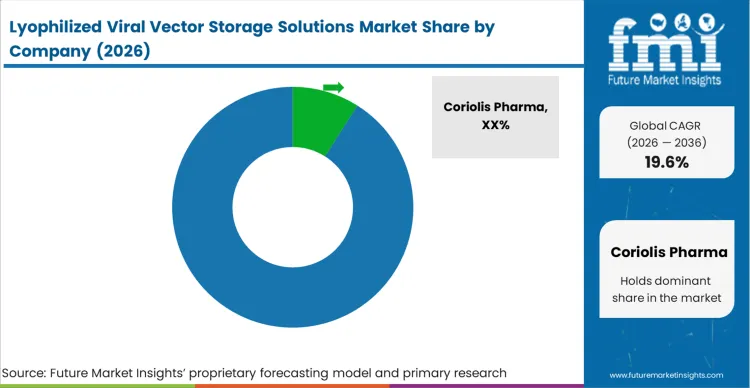
The high technical barrier to successfully stabilising viral capsids creates a highly concentrated market at the premium end. Buyers do not select vendors based on available freeze-dryer shelf space; they qualify partners based exclusively on their biophysical analytical capabilities and proprietary excipient libraries. Companies like Coriolis Pharma and Leukocare dominate because they possess the specialised assays required to prove that the vector has not aggregated during the sublimation phase. Standard fill-finish operators attempting to enter this space routinely fail qualification because they treat viral vectors like resilient monoclonal antibodies, leading to catastrophic batch losses.
To compete, challengers must build comprehensive analytical bridging frameworks rather than simply purchasing newer drying equipment. Incumbents maintain their advantage because they possess historical datasets mapping the glass transition behaviors of multiple AAV and Lentiviral serotypes. Replicating this requires challengers to invest heavily in predictive thermal modeling and high-throughput biophysical characterization. The integration of robust reusable biologics cold chain shippers for handling pre-lyophilized clinical material demonstrates the end-to-end competency that sponsors demand during the vendor selection process.
Large biopharma sponsors actively resist vendor lock-in by attempting to internalize the core formulation intellectual property, treating CDMOs purely as execution partners for the drying cycle. However, the sheer complexity of custom excipient matrices often forces a reliance on the specialized formulation provider. Through 2036, the market will likely see increased vertical integration, with massive generalist CDMOs acquiring specialized boutique formulation labs to close their analytical capability gaps and offer fully integrated viral vector commercialization pathways.
Key Players in Lyophilized Viral Vector Storage Solutions Market
- Coriolis Pharma
- Leukocare
- Thermo Fisher Scientific (Patheon Viral Vector Services)
- Recipharm
- Curia (formerly AMRI)
- Sharp Sterile Manufacturing (formerly Berkshire Sterile Manufacturing)
- Azenta Life Sciences
Scope of the Report
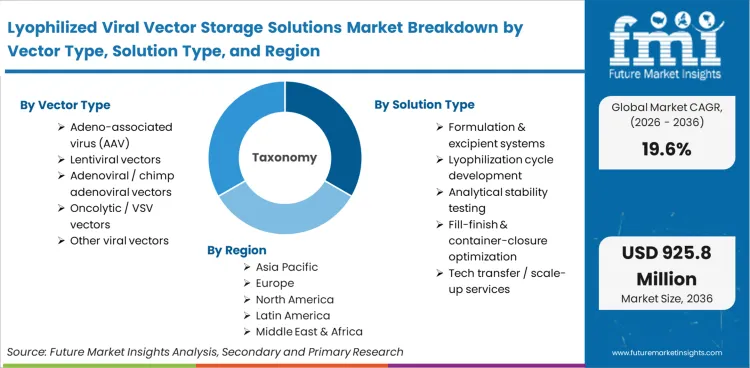
| Metric | Value |
|---|---|
| Quantitative Units | USD 154.6 million to USD 925.8 million, at a CAGR of 19.6% |
| Market Definition | The market covers the specialized formulation, drying cycles, and container systems engineered to preserve viral vector stability outside of deep-frozen states. |
| Vector Type Segmentation | Adeno-associated virus (AAV), Lentiviral vectors, Adenoviral / chimp adenoviral vectors, Oncolytic / VSV vectors, Other viral vectors |
| Solution Type Segmentation | Formulation & excipient systems, Lyophilization cycle development, Analytical stability testing, Fill-finish & container-closure optimization, Tech transfer / scale-up services |
| Storage Target Segmentation | 2°C to 8°C storage solutions, -20°C storage solutions, Controlled ambient / room-temperature aspirational solutions, Hybrid frozen-to-lyo transition solutions |
| Primary Container / Format Segmentation | Glass vials, Serum vials with lyo stoppers, Ampoules, Dual-chamber systems, Custom primary containers |
| Regions Covered | North America, Europe, Asia Pacific, Rest of the World |
| Countries Covered | United States, United Kingdom, Germany, Japan, South Korea, China, India, and 40 plus countries |
| Key Companies Profiled | Coriolis Pharma, Leukocare, Thermo Fisher Scientific (Patheon Viral Vector Services), Recipharm, Curia (formerly AMRI), Sharp Sterile Manufacturing (formerly Berkshire Sterile Manufacturing), Azenta Life Sciences |
| Forecast Period | 2026 to 2036 |
| Approach | Primary interviews were conducted with CMC and formulation directors at gene therapy developers. The baseline was anchored to active late-stage vector clinical trials. Forecasts were cross-validated using specialized CDMO capacity utilization rates. |
Source: Future Market Insights (FMI) analysis, based on proprietary forecasting model and primary research
Lyophilized Viral Vector Storage Solutions Market Analysis by Segments
-
Vector Type:
- Adeno-associated virus (AAV)
- Lentiviral vectors
- Adenoviral / chimp adenoviral vectors
- Oncolytic / VSV vectors
- Other viral vectors
-
Solution Type:
- Formulation & excipient systems
- Lyophilization cycle development
- Analytical stability testing
- Fill-finish & container-closure optimization
- Tech transfer / scale-up services
-
Storage Target:
- 2°C to 8°C storage solutions
- -20°C storage solutions
- Controlled ambient / room-temperature aspirational solutions
- Hybrid frozen-to-lyo transition solutions
-
Primary Container / Format:
- Glass vials
- Serum vials with lyo stoppers
- Ampoules
- Dual-chamber systems
- Custom primary containers
-
End User:
- Biopharma & gene therapy developers
- CDMOs / CMOs
- Academic & translational institutes
- Hospital / specialty treatment centers
-
Region:
- North America
- Europe
- Asia-Pacific
- Rest of the World
- Latin America
- Middle East, and Africa
Bibliography
- McGlinch, B. P., Jaspers, C. J., Haya, M. C., Feiner, K. M., White, A. D., de Hart, G. W., & Randolph, T. W. (2025). Lyophilization of adeno-associated virus serotypes for storage and global distribution. Biomedicines, 14(1), 25.
- Vargas, S. K., Sharifi, F., Nambayan, R., Moshashaee, S., & Siahaan, T. J. (2025). Formulation development and feasibility of AAV5 as a lyophilized drug product. Journal of Pharmaceutical Sciences, 114(2), 1214-1223.
- Mathot, F., Lefebvre, E., Francq, B. G., Guillaume, D., Meeus, A., De Smedt, S. C., Sanders, N. N., & Bourlès, E. (2025). A lyophilised formulation of chimpanzee adenovirus vector for long-term stability outside the deep-freeze cold chain. Communications Medicine, 5, Article 23.
- Kontogiannis, T., Fiore, M., Wyrwch, J., Salas, D., Vallan, C., Li, M., Arjomand, A., Schmelzer, A. E., & Riske, F. J. (2024). Characterization of AAV vectors: A review of analytical techniques and critical quality attributes. Molecular Therapy: Methods & Clinical Development, 34, 101309.
- Som, M., Gikanga, B., Kanapuram, V., & Yadav, S. (2024). Drug product formulation and fill/finish manufacturing process considerations for AAV-based genomic medicines. Journal of Pharmaceutical Sciences, 113, 1711-1725.
- United States Pharmacopeia. (2024, February 22). USP Biologics Stakeholder Forum 2024: Innovative analytical approaches to cell and gene therapy. United States Pharmacopeia.
- National Institute of Standards and Technology. (2025, January 6). Study highlights need for standardized measurement methods in gene therapy. National Institute of Standards and Technology.
- American Society of Gene & Cell Therapy. (2025, January 1). Gene, Cell, & RNA Therapy Landscape Report: Q4 2024 quarterly data report. American Society of Gene & Cell Therapy.
This bibliography is provided for reader reference. The full FMI report contains the complete reference list with primary source documentation.
This Report Addresses
- Market intelligence to support strategic decision making across formulation excipients and specific vector drying services
- Market size estimation and 10-year revenue forecasts from 2026 to 2036, supported by clinical pipeline volume aggregation
- Growth opportunity mapping across adeno-associated virus and lentiviral segments with emphasis on mapping glass transition boundaries
- Segment and regional revenue forecasts covering glass vial formats across stringently evaluated regulatory environments
- Competition strategy assessment including proprietary biophysical assay development and thermal modeling capabilities
- Formulation capability development tracking including advanced primary container glass innovations and deep-vacuum sealing standards
- Market access analysis covering EMA and FDA CMC stability validation pathways
- Market report delivery in PDF, Excel, PPT, and interactive dashboard formats for executive strategy, commercial supply chain operations, and operational benchmarking use
Frequently Asked Questions
How large is the Lyophilized Viral Vector Storage Solutions Market in 2026?
The industry valuation reaches USD 154.6 million in 2026. This metric signals that the transition from clinical-scale liquid frozen formats to commercial-scale solid states is actively underway across tier-1 biopharma pipelines.
What will it be valued at by 2036?
The market is expected to expand to USD 925.8 million by 2036. This long-term baseline reflects that the global distribution networks will systematically refuse to absorb the logistics overhead of active cryogenic cooling for mass-market therapies.
What CAGR is projected?
The sector records a 19.6% CAGR over the forecast period. This rate is heavily tied to the volume of late-stage in vivo assets progressing toward regulatory review, where definitive commercial stability profiles must be established.
Which Vector Type segment leads?
Adeno-associated virus (AAV) commands 49.0% of the market. Its dominance is purely a function of its current status as the primary delivery mechanism for systemic gene therapies, forcing sponsors to solve its specific thermal fragility before commercial launch.
Which Solution Type segment leads?
Formulation & excipient systems account for 31.5% of the total share. The intellectual property and technical complexity reside almost entirely in the chemical matrix that protects the vector during water removal, rather than in the drying equipment itself.
Which Storage Target segment leads?
The 2°C to 8°C target represents 42.0% of the market. This profile provides the most pragmatic alignment with standard hospital pharmacy infrastructure without incurring the massive regulatory delays often associated with proving absolute ambient stability.
What drives rapid growth?
The commercial imperative to eliminate -80°C supply chains compels the growth. Therapies locked into ultra-cold infrastructure face severely restricted patient reach, forcing sponsors to transition to scalable, thermally stable formats.
What is the primary restraint?
The extreme biophysical degradation of capsids during sublimation acts as the primary friction point. Formulating a protective matrix requires lengthy, empirical analytical bridging studies that routinely stall clinical timelines if initiated too late.
Which country grows fastest?
India advances at 20.1%, outpacing China's 19.4%. The difference reflects India's aggressive mandate to upgrade domestic CDMO analytical formulation capabilities specifically to capture outsourced stability contracts from Western sponsors.
Why is AAV formulation so critical to commercialization?
AAV capsids are exceptionally prone to aggregation under freezing stress. Establishing a robust excipient matrix early in clinical development is the only mechanism that prevents catastrophic titer loss during subsequent commercial scale-up.
What role do specialized CDMOs play in this market?
Specialized providers bridge the gap between biological production and solid-state stability. Sponsors rely on these entities not just for capacity, but for their proprietary biophysical assays required to validate the integrity of the dried vector.
How does the choice of primary container impact the therapy?
Maintaining an absolute moisture barrier is paramount for solid-state biologics. Deep-vacuum sealing in glass vials prevents atmospheric moisture from triggering premature vector degradation over a multi-year shelf life.
Why do developers struggle with the liquid-to-solid transition?
The tension lies in the timing. Developers often delay the transition until Phase III to save early-stage costs, only to find that the required analytical comparability studies cannot be completed without delaying the commercial launch window.
What makes European procurement dynamics different?
European HTA bodies aggressively penalize the total lifecycle costs associated with cryogenic handling. This forces regional developers to proactively build 2°C to 8°C thermal stability directly into their product profiles to ensure favorable reimbursement.
How is the US market structured?
The sheer volume of FDA pivotal reviews forces domestic sponsors to finalize their formulations. The focus remains heavily on securing integrated CDMO partnerships capable of executing both complex formulation and flawless sterile fill-finish.
What differentiates premium CDMOs from standard fill-finish operators?
Premium vendors possess proprietary historical datasets mapping the glass transition behaviors of specific serotypes. Standard operators lack this predictive thermal modeling capability, often leading to costly batch failures during qualification.
Why is India's trajectory significant?
India's CDMO sector is elevating its technical baseline from simple small-molecule filling to highly complex biological stabilization, shifting the global outsourcing dynamic for late-stage gene therapies.
What hidden costs emerge if stabilization fails?
Sponsors face the immediate write-off of high-value biological batches, coupled with the systemic cost of restarting multi-year stability trials required to satisfy regulatory comparability demands.
How do dual-chamber systems factor into the market?
These systems simplify the point-of-care reconstitution process, eliminating the risk of handling errors by hospital staff. While technically complex to manufacture, they represent the aspirational standard for decentralized commercial administration.
What limits the push for fully ambient (room-temperature) stability?
While ambient storage is the ultimate goal, the chemical interventions required to achieve it often introduce novel excipient toxicity risks that complicate regulatory reviews, making refrigerated targets a safer commercial strategy.
How does the methodology validate these specialized services?
FMI cross-references public clinical pipeline progressions against the specific capacity expansions of tier-1 biomanufacturing suites, ensuring the forecast tracks actual clinical demand rather than theoretical equipment sales.
What is the 2036 end state for this market?
By 2036, lyophilization will represent the default commercial formulation standard for all systemically administered gene therapies, permanently reserving ultra-cold logistical infrastructure exclusively for patient-specific, autologous treatments.
Preview the report firsthand - request a free sample
Get SampleGet the brochure for pricing and purchase details.
Get PDFTable of Content
- Executive Summary
- Global Market Outlook
- Demand-side Trends
- Supply-side Trends
- Technology Roadmap Analysis
- Analysis and Recommendations
- Market Overview
- Market Coverage / Taxonomy
- Market Definition / Scope / Limitations
- Research Methodology
- Chapter Orientation
- Analytical Lens and Working Hypotheses
- Market Structure, Signals, and Trend Drivers
- Benchmarking and Cross-market Comparability
- Market Sizing, Forecasting, and Opportunity Mapping
- Research Design and Evidence Framework
- Desk Research Programme (Secondary Evidence)
- Company Annual and Sustainability Reports
- Peer-reviewed Journals and Academic Literature
- Corporate Websites, Product Literature, and Technical Notes
- Earnings Decks and Investor Briefings
- Statutory Filings and Regulatory Disclosures
- Technical White Papers and Standards Notes
- Trade Journals, Industry Magazines, and Analyst Briefs
- Conference Proceedings, Webinars, and Seminar Materials
- Government Statistics Portals and Public Data Releases
- Press Releases and Reputable Media Coverage
- Specialist Newsletters and Curated Briefings
- Sector Databases and Reference Repositories
- FMI Internal Proprietary Databases and Historical Market Datasets
- Subscription Datasets and Paid Sources
- Social Channels, Communities, and Digital Listening Inputs
- Additional Desk Sources
- Expert Input and Fieldwork (Primary Evidence)
- Primary Modes
- Qualitative Interviews and Expert Elicitation
- Quantitative Surveys and Structured Data Capture
- Blended Approach
- Why Primary Evidence is Used
- Field Techniques
- Interviews
- Surveys
- Focus Groups
- Observational and In-context Research
- Social and Community Interactions
- Stakeholder Universe Engaged
- C-suite Leaders
- Board Members
- Presidents and Vice Presidents
- R&D and Innovation Heads
- Technical Specialists
- Domain Subject-matter Experts
- Scientists
- Physicians and Other Healthcare Professionals
- Governance, Ethics, and Data Stewardship
- Research Ethics
- Data Integrity and Handling
- Primary Modes
- Tooling, Models, and Reference Databases
- Desk Research Programme (Secondary Evidence)
- Data Engineering and Model Build
- Data Acquisition and Ingestion
- Cleaning, Normalisation, and Verification
- Synthesis, Triangulation, and Analysis
- Quality Assurance and Audit Trail
- Market Background
- Market Dynamics
- Drivers
- Restraints
- Opportunity
- Trends
- Scenario Forecast
- Demand in Optimistic Scenario
- Demand in Likely Scenario
- Demand in Conservative Scenario
- Opportunity Map Analysis
- Product Life Cycle Analysis
- Supply Chain Analysis
- Investment Feasibility Matrix
- Value Chain Analysis
- PESTLE and Porter’s Analysis
- Regulatory Landscape
- Regional Parent Market Outlook
- Production and Consumption Statistics
- Import and Export Statistics
- Market Dynamics
- Global Market Analysis 2021 to 2025 and Forecast, 2026 to 2036
- Historical Market Size Value (USD Million) Analysis, 2021 to 2025
- Current and Future Market Size Value (USD Million) Projections, 2026 to 2036
- Y-o-Y Growth Trend Analysis
- Absolute $ Opportunity Analysis
- Global Market Pricing Analysis 2021 to 2025 and Forecast 2026 to 2036
- Global Market Analysis 2021 to 2025 and Forecast 2026 to 2036, By Vector Type
- Introduction / Key Findings
- Historical Market Size Value (USD Million) Analysis By Vector Type , 2021 to 2025
- Current and Future Market Size Value (USD Million) Analysis and Forecast By Vector Type , 2026 to 2036
- Adeno-associated virus (AAV)
- Lentiviral vectors
- Adenoviral / chimp adenoviral vectors
- Oncolytic / VSV vectors
- Other viral vectors
- Adeno-associated virus (AAV)
- Y-o-Y Growth Trend Analysis By Vector Type , 2021 to 2025
- Absolute $ Opportunity Analysis By Vector Type , 2026 to 2036
- Global Market Analysis 2021 to 2025 and Forecast 2026 to 2036, By Solution Type
- Introduction / Key Findings
- Historical Market Size Value (USD Million) Analysis By Solution Type, 2021 to 2025
- Current and Future Market Size Value (USD Million) Analysis and Forecast By Solution Type, 2026 to 2036
- Formulation & excipient systems
- Lyophilization cycle development
- Analytical stability testing
- Fill-finish & container-closure optimization
- Tech transfer / scale-up services
- Formulation & excipient systems
- Y-o-Y Growth Trend Analysis By Solution Type, 2021 to 2025
- Absolute $ Opportunity Analysis By Solution Type, 2026 to 2036
- Global Market Analysis 2021 to 2025 and Forecast 2026 to 2036, By Storage Target
- Introduction / Key Findings
- Historical Market Size Value (USD Million) Analysis By Storage Target, 2021 to 2025
- Current and Future Market Size Value (USD Million) Analysis and Forecast By Storage Target, 2026 to 2036
- 2°C to 8°C storage solutions
- -20°C storage solutions
- Controlled ambient / room-temperature aspirational solutions
- Hybrid frozen-to-lyo transition solutions
- 2°C to 8°C storage solutions
- Y-o-Y Growth Trend Analysis By Storage Target, 2021 to 2025
- Absolute $ Opportunity Analysis By Storage Target, 2026 to 2036
- Global Market Analysis 2021 to 2025 and Forecast 2026 to 2036, By Primary Container / Format
- Introduction / Key Findings
- Historical Market Size Value (USD Million) Analysis By Primary Container / Format, 2021 to 2025
- Current and Future Market Size Value (USD Million) Analysis and Forecast By Primary Container / Format, 2026 to 2036
- Glass vials
- Serum vials with lyo stoppers
- Ampoules
- Dual-chamber systems
- Custom primary containers
- Glass vials
- Y-o-Y Growth Trend Analysis By Primary Container / Format, 2021 to 2025
- Absolute $ Opportunity Analysis By Primary Container / Format, 2026 to 2036
- Global Market Analysis 2021 to 2025 and Forecast 2026 to 2036, By End User
- Introduction / Key Findings
- Historical Market Size Value (USD Million) Analysis By End User, 2021 to 2025
- Current and Future Market Size Value (USD Million) Analysis and Forecast By End User, 2026 to 2036
- Biopharma & gene therapy developers
- CDMOs / CMOs
- Academic & translational institutes
- Hospital / specialty treatment centers
- Biopharma & gene therapy developers
- Y-o-Y Growth Trend Analysis By End User, 2021 to 2025
- Absolute $ Opportunity Analysis By End User, 2026 to 2036
- Global Market Analysis 2021 to 2025 and Forecast 2026 to 2036, By Region
- Introduction
- Historical Market Size Value (USD Million) Analysis By Region, 2021 to 2025
- Current Market Size Value (USD Million) Analysis and Forecast By Region, 2026 to 2036
- North America
- Latin America
- Western Europe
- Eastern Europe
- East Asia
- South Asia and Pacific
- Middle East & Africa
- Market Attractiveness Analysis By Region
- North America Market Analysis 2021 to 2025 and Forecast 2026 to 2036, By Country
- Historical Market Size Value (USD Million) Trend Analysis By Market Taxonomy, 2021 to 2025
- Market Size Value (USD Million) Forecast By Market Taxonomy, 2026 to 2036
- By Country
- USA
- Canada
- Mexico
- By Vector Type
- By Solution Type
- By Storage Target
- By Primary Container / Format
- By End User
- By Country
- Market Attractiveness Analysis
- By Country
- By Vector Type
- By Solution Type
- By Storage Target
- By Primary Container / Format
- By End User
- Key Takeaways
- Latin America Market Analysis 2021 to 2025 and Forecast 2026 to 2036, By Country
- Historical Market Size Value (USD Million) Trend Analysis By Market Taxonomy, 2021 to 2025
- Market Size Value (USD Million) Forecast By Market Taxonomy, 2026 to 2036
- By Country
- Brazil
- Chile
- Rest of Latin America
- By Vector Type
- By Solution Type
- By Storage Target
- By Primary Container / Format
- By End User
- By Country
- Market Attractiveness Analysis
- By Country
- By Vector Type
- By Solution Type
- By Storage Target
- By Primary Container / Format
- By End User
- Key Takeaways
- Western Europe Market Analysis 2021 to 2025 and Forecast 2026 to 2036, By Country
- Historical Market Size Value (USD Million) Trend Analysis By Market Taxonomy, 2021 to 2025
- Market Size Value (USD Million) Forecast By Market Taxonomy, 2026 to 2036
- By Country
- Germany
- UK
- Italy
- Spain
- France
- Nordic
- BENELUX
- Rest of Western Europe
- By Vector Type
- By Solution Type
- By Storage Target
- By Primary Container / Format
- By End User
- By Country
- Market Attractiveness Analysis
- By Country
- By Vector Type
- By Solution Type
- By Storage Target
- By Primary Container / Format
- By End User
- Key Takeaways
- Eastern Europe Market Analysis 2021 to 2025 and Forecast 2026 to 2036, By Country
- Historical Market Size Value (USD Million) Trend Analysis By Market Taxonomy, 2021 to 2025
- Market Size Value (USD Million) Forecast By Market Taxonomy, 2026 to 2036
- By Country
- Russia
- Poland
- Hungary
- Balkan & Baltic
- Rest of Eastern Europe
- By Vector Type
- By Solution Type
- By Storage Target
- By Primary Container / Format
- By End User
- By Country
- Market Attractiveness Analysis
- By Country
- By Vector Type
- By Solution Type
- By Storage Target
- By Primary Container / Format
- By End User
- Key Takeaways
- East Asia Market Analysis 2021 to 2025 and Forecast 2026 to 2036, By Country
- Historical Market Size Value (USD Million) Trend Analysis By Market Taxonomy, 2021 to 2025
- Market Size Value (USD Million) Forecast By Market Taxonomy, 2026 to 2036
- By Country
- China
- Japan
- South Korea
- By Vector Type
- By Solution Type
- By Storage Target
- By Primary Container / Format
- By End User
- By Country
- Market Attractiveness Analysis
- By Country
- By Vector Type
- By Solution Type
- By Storage Target
- By Primary Container / Format
- By End User
- Key Takeaways
- South Asia and Pacific Market Analysis 2021 to 2025 and Forecast 2026 to 2036, By Country
- Historical Market Size Value (USD Million) Trend Analysis By Market Taxonomy, 2021 to 2025
- Market Size Value (USD Million) Forecast By Market Taxonomy, 2026 to 2036
- By Country
- India
- ASEAN
- Australia & New Zealand
- Rest of South Asia and Pacific
- By Vector Type
- By Solution Type
- By Storage Target
- By Primary Container / Format
- By End User
- By Country
- Market Attractiveness Analysis
- By Country
- By Vector Type
- By Solution Type
- By Storage Target
- By Primary Container / Format
- By End User
- Key Takeaways
- Middle East & Africa Market Analysis 2021 to 2025 and Forecast 2026 to 2036, By Country
- Historical Market Size Value (USD Million) Trend Analysis By Market Taxonomy, 2021 to 2025
- Market Size Value (USD Million) Forecast By Market Taxonomy, 2026 to 2036
- By Country
- Kingdom of Saudi Arabia
- Other GCC Countries
- Turkiye
- South Africa
- Other African Union
- Rest of Middle East & Africa
- By Vector Type
- By Solution Type
- By Storage Target
- By Primary Container / Format
- By End User
- By Country
- Market Attractiveness Analysis
- By Country
- By Vector Type
- By Solution Type
- By Storage Target
- By Primary Container / Format
- By End User
- Key Takeaways
- Key Countries Market Analysis
- USA
- Pricing Analysis
- Market Share Analysis, 2025
- By Vector Type
- By Solution Type
- By Storage Target
- By Primary Container / Format
- By End User
- Canada
- Pricing Analysis
- Market Share Analysis, 2025
- By Vector Type
- By Solution Type
- By Storage Target
- By Primary Container / Format
- By End User
- Mexico
- Pricing Analysis
- Market Share Analysis, 2025
- By Vector Type
- By Solution Type
- By Storage Target
- By Primary Container / Format
- By End User
- Brazil
- Pricing Analysis
- Market Share Analysis, 2025
- By Vector Type
- By Solution Type
- By Storage Target
- By Primary Container / Format
- By End User
- Chile
- Pricing Analysis
- Market Share Analysis, 2025
- By Vector Type
- By Solution Type
- By Storage Target
- By Primary Container / Format
- By End User
- Germany
- Pricing Analysis
- Market Share Analysis, 2025
- By Vector Type
- By Solution Type
- By Storage Target
- By Primary Container / Format
- By End User
- UK
- Pricing Analysis
- Market Share Analysis, 2025
- By Vector Type
- By Solution Type
- By Storage Target
- By Primary Container / Format
- By End User
- Italy
- Pricing Analysis
- Market Share Analysis, 2025
- By Vector Type
- By Solution Type
- By Storage Target
- By Primary Container / Format
- By End User
- Spain
- Pricing Analysis
- Market Share Analysis, 2025
- By Vector Type
- By Solution Type
- By Storage Target
- By Primary Container / Format
- By End User
- France
- Pricing Analysis
- Market Share Analysis, 2025
- By Vector Type
- By Solution Type
- By Storage Target
- By Primary Container / Format
- By End User
- India
- Pricing Analysis
- Market Share Analysis, 2025
- By Vector Type
- By Solution Type
- By Storage Target
- By Primary Container / Format
- By End User
- ASEAN
- Pricing Analysis
- Market Share Analysis, 2025
- By Vector Type
- By Solution Type
- By Storage Target
- By Primary Container / Format
- By End User
- Australia & New Zealand
- Pricing Analysis
- Market Share Analysis, 2025
- By Vector Type
- By Solution Type
- By Storage Target
- By Primary Container / Format
- By End User
- China
- Pricing Analysis
- Market Share Analysis, 2025
- By Vector Type
- By Solution Type
- By Storage Target
- By Primary Container / Format
- By End User
- Japan
- Pricing Analysis
- Market Share Analysis, 2025
- By Vector Type
- By Solution Type
- By Storage Target
- By Primary Container / Format
- By End User
- South Korea
- Pricing Analysis
- Market Share Analysis, 2025
- By Vector Type
- By Solution Type
- By Storage Target
- By Primary Container / Format
- By End User
- Russia
- Pricing Analysis
- Market Share Analysis, 2025
- By Vector Type
- By Solution Type
- By Storage Target
- By Primary Container / Format
- By End User
- Poland
- Pricing Analysis
- Market Share Analysis, 2025
- By Vector Type
- By Solution Type
- By Storage Target
- By Primary Container / Format
- By End User
- Hungary
- Pricing Analysis
- Market Share Analysis, 2025
- By Vector Type
- By Solution Type
- By Storage Target
- By Primary Container / Format
- By End User
- Kingdom of Saudi Arabia
- Pricing Analysis
- Market Share Analysis, 2025
- By Vector Type
- By Solution Type
- By Storage Target
- By Primary Container / Format
- By End User
- Turkiye
- Pricing Analysis
- Market Share Analysis, 2025
- By Vector Type
- By Solution Type
- By Storage Target
- By Primary Container / Format
- By End User
- South Africa
- Pricing Analysis
- Market Share Analysis, 2025
- By Vector Type
- By Solution Type
- By Storage Target
- By Primary Container / Format
- By End User
- USA
- Market Structure Analysis
- Competition Dashboard
- Competition Benchmarking
- Market Share Analysis of Top Players
- By Regional
- By Vector Type
- By Solution Type
- By Storage Target
- By Primary Container / Format
- By End User
- Competition Analysis
- Competition Deep Dive
- Coriolis Pharma
- Overview
- Product Portfolio
- Profitability by Market Segments (Product/Age /Sales Channel/Region)
- Sales Footprint
- Strategy Overview
- Marketing Strategy
- Product Strategy
- Channel Strategy
- Leukocare
- Thermo Fisher Scientific (Patheon Viral Vector Services)
- Recipharm
- Curia (formerly AMRI)
- Sharp Sterile Manufacturing (formerly Berkshire Sterile Manufacturing)
- Azenta Life Sciences
- Coriolis Pharma
- Competition Deep Dive
- Assumptions & Acronyms Used


